WO2024201983A1 - 情報処理装置、情報処理方法、および情報処理プログラム - Google Patents
情報処理装置、情報処理方法、および情報処理プログラム Download PDFInfo
- Publication number
- WO2024201983A1 WO2024201983A1 PCT/JP2023/013494 JP2023013494W WO2024201983A1 WO 2024201983 A1 WO2024201983 A1 WO 2024201983A1 JP 2023013494 W JP2023013494 W JP 2023013494W WO 2024201983 A1 WO2024201983 A1 WO 2024201983A1
- Authority
- WO
- WIPO (PCT)
- Prior art keywords
- attribute
- learning
- model
- product
- unit
- Prior art date
- Legal status (The legal status is an assumption and is not a legal conclusion. Google has not performed a legal analysis and makes no representation as to the accuracy of the status listed.)
- Ceased
Links
Images




Classifications
-
- G—PHYSICS
- G06—COMPUTING OR CALCULATING; COUNTING
- G06N—COMPUTING ARRANGEMENTS BASED ON SPECIFIC COMPUTATIONAL MODELS
- G06N20/00—Machine learning
Definitions
- the present invention relates to an information processing device, an information processing method, and an information processing program, and in particular to a technique for predicting attributes of a product from an image that includes the product.
- EC electronic commerce
- PC Personal Computer
- EC sites may display recommended products that have similar attributes to products that the user has previously purchased (information specific to the product) on the screen the user is viewing. Furthermore, when a user wishes to purchase a desired product, they may search based on the attributes of the product they wish to purchase. For this reason, identifying product attributes is a common challenge for site operators and product providers in e-commerce.
- Patent Document 1 discloses a technology that predicts multiple attributes of a product by applying an image that includes the product to a learning model constructed using a neural network.
- Patent Document 1 makes it possible to automatically predict multiple attributes of a product by applying an image containing the product to a learning model. Meanwhile, the variety and number of products handled in electronic commerce is increasing, and the number of types of attributes is also increasing accordingly. Therefore, it is desirable to build a learning model that can predict new attributes as well as existing attributes of a product from an image containing the product.
- incremental learning In order to train a learning model for a new task, a method called incremental learning is known in which the learning model is trained using additional learning data continuously. With incremental learning, by training the learning model using additional learning data for new attributes, it is possible to build a learning model that can predict not only attributes that have already been learned, but also newly learned attributes.
- the present invention was made in consideration of the above problems, and aims to provide a technology for learning new attributes of a product from an image that contains the product, while suppressing catastrophic forgetting.
- An information processing device has a learning unit that trains an attribute prediction model for predicting N attributes (N is an integer equal to or greater than 2) of a product from an image including the product, and the learning unit has a first learning unit that trains an i-th learning model for predicting an i-th attribute (i is an integer from 1 to N-1) of the product using i-th learning data for the i-th attribute, and a second learning unit that trains the attribute prediction model using the i-th learning model trained by the first learning unit, a portion of the i-th learning data, and N-th learning data for the N-th attribute of the product.
- An information processing method is an information processing method for training an attribute prediction model for predicting N attributes (N is an integer equal to or greater than 2) of a product from an image including the product, and includes training an i-th learning model for predicting an i-th attribute (i is an integer from 1 to N-1) of the product using i-th learning data for the i-th attribute, and training the attribute prediction model using the i-th learning model trained by the first learning unit, a portion of the i-th learning data, and N-th learning data for the N-th attribute of the product.
- An information processing program is an information processing program for training an attribute prediction model for predicting N attributes (N is an integer equal to or greater than 2) of a product from an image including the product, and causes a computer to train an i-th learning model for predicting an i-th attribute (i is an integer from 1 to N-1) of the product using i-th learning data for the i-th attribute, and train the attribute prediction model using the i-th learning model trained by the first learning unit, a portion of the i-th learning data, and N-th learning data for the N-th attribute of the product.
- FIG. 1 shows an example of the configuration of a natural language processing system according to an embodiment.
- FIG. 2 shows an example of a hardware configuration of an information processing device according to an embodiment.
- FIG. 3A is a diagram for explaining product attributes.
- FIG. 3B shows the relationship between product images and attributes.
- FIG. 4 shows a conceptual diagram of attribute learning data.
- FIG. 5A shows the learning procedure of the learning model for the first attribute at the first time step.
- FIG. 5B shows a learning procedure of the learning model from the first attribute to the second attribute in the second time step.
- FIG. 5C shows the learning procedure of the learning model for the first attribute to the third attribute in the third time step.
- FIG. 5D is a diagram for explaining the learning procedure of the learning model for the first attribute to the Nth attribute in the Nth time step.
- FIG. 6A shows a flowchart of a learning process of an attribute prediction model executed by an information processing device according to an embodiment.
- FIG. 6B shows a flowchart of a modified example of the learning process of an attribute prediction model executed by the information processing device according to the embodiment.
- FIG. 7 shows a flowchart of an attribute prediction process executed by the information processing device according to the embodiment.
- the information processing device 100 acquires an image (hereinafter also referred to as a product image) that includes a product (i.e., displays the product) and predicts multiple attributes of the product.
- Product attributes are information specific to the product, such as the visual characteristics of the product.
- Product attributes can be indicators for a user when purchasing the product. Note that, although an example of predicting product attributes is described in this embodiment, this embodiment can also be applied to the case where attributes of any item, including a product, are predicted from an image that includes the item (i.e., displays the item).
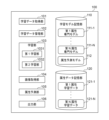
- FIG. 1 shows an example of the functional configuration of an information processing device 100 according to the present embodiment.
- the information processing device 100 includes a learning data acquisition unit 101, a learning data management unit 102, a learning unit 103, an image acquisition unit 104, an attribute prediction unit 105, an output unit 106, a learning model storage unit 110, and an attribute data storage unit 120.
- the learning unit 103 includes a first learning unit 1031 and a second learning unit 1032.
- the learning model storage unit 110 is configured to store a first attribute specialized model 111-1 to an N-th attribute specialized model 111-N and an attribute prediction model 112.
- the attribute data storage unit 120 is configured to store a first attribute learning data 121-1 to an N-th attribute learning data 121-N.
- "N" is an integer of 2 or more.
- the learning data acquisition unit 101 acquires learning data (teacher data) for training the learning model.
- the learning data includes product images and correct answer data for product attributes.
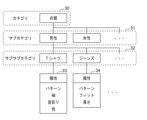
- FIG. 3A is a diagram for explaining product attributes.
- the products are assumed to be products that can be handled on an EC (Electronic Commerce) site. Since the variety and number of products that can be handled on an EC site is enormous, product attributes are set for classified products (product groups). Products can be classified hierarchically. In this embodiment, attributes are assumed for a product category that indicates a higher classification among product classifications, where "clothing" is the product category.
- subcategories 31 which indicate subcategories of category 30, and sub-subcategories 32, which indicate further subcategories of subcategories 31.
- Subcategory 31 indicates the subjects on which "clothing” is worn, and in the example of FIG. 3A includes “men” and “women.”
- Subcategory 31 may also include “children,” “seniors,” and “unisex,” which is not gender-specific.
- Sub-subcategory 32 indicates the type and shape of "clothing.” When subcategory 31 is “men,” sub-subcategory 32 includes “T-shirts” and “jeans.” When subcategory 31 is “men,” sub-subcategory 32 may also include “jackets,” “coats,” etc.
- attributes are set for products in sub-subcategory 32. If sub-subcategory 32 is "T-shirts", the attributes include “pattern”, “sleeve”, “neckline”, and “color”. If sub-subcategory 32 is “jeans”, the attributes include “pattern”, "fit”, and "length”. Note that the types of attributes for each product shown in FIG. 3A are merely examples and are not limited to those shown. Furthermore, the types of attributes may be increased in the future. Also, although attributes are set for products in sub-subcategory 32 in FIG. 3A, attributes may also be set for subcategories 31 and category 30.
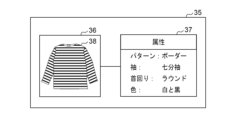
- Figure 3B shows the relationship between product images and attributes.
- Figure 3B shows data 35 including attributes 37 of product 38 included in product image 36.
- attributes 37 include "pattern”, “sleeves”, “neckline”, and "color”.
- each attribute has a correct feature (feature value) (hereinafter also referred to as a correct feature).
- the correct features for each attribute of product 38 in product image 36 are as shown in Figure 3B, where "pattern” is “border”, “sleeves” is “three-quarter sleeves”, “neckline” is “round”, and "color” is "white and black”.
- the learning data includes product images and correct answer data for product attributes.
- the learning data acquisition unit 101 generates and acquires learning data from data 35 shown in FIG. 3B, for example. If the attribute of product 38 shown in FIG. 3B is "pattern,” the possible features of the "pattern” are, for example, "border,” “solid,” “check,” “dot,” and “print.” In the case of a classification problem, all correct answer data for learning are 1 or 0. In other words, there are two options: 100% (correct answer feature) or 0% (incorrect answer feature). Since the "pattern" of product 38 included in product image 36 is "border,” in the order of "border,” “solid,” “check,” “dot,” and “print,” the first feature is the correct answer feature. Therefore, the correct answer data is given in the form of a probability distribution, for example, ⁇ 1, 0, 0, 0, 0 ⁇ .
- the learning data management unit 102 stores the learning data acquired by the learning data acquisition unit 101 in the attribute data storage unit 120 as attribute learning data for each attribute.
- the learning data management unit 102 stores combinations of product images 36 and correct answer data for attributes 37 (i.e., "pattern,” “sleeve,” “neckline,” and “color") in the attribute data storage unit 120 as attribute learning data for each attribute.
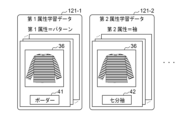
- FIG. 4 shows a conceptual diagram of the attribute learning data stored in the attribute data storage unit 120.
- the attribute data storage unit 120 is configured to store the first attribute learning data 121-1 to the Nth attribute learning data 121-N.
- the first attribute is "pattern” and the second attribute is "sleeve".
- the learning data management unit 102 classifies the combination data of the product image 36 and the correct answer data in which "border” 41 is “1" into the first attribute learning data 121-1.
- the learning data management unit 102 classifies the combination of the product image 36 and the correct answer data in which "three-quarter sleeve" 42 is "1" into the second attribute learning data 121-1.
- the learning data management unit 102 extracts the product image and one or more attributes from the learning data acquired by the learning data acquisition unit 101, and classifies the combination of the product image and the correct answer data into any one of the first attribute learning data 121-1 to the Nth attribute learning data 121-N for each attribute.
- each of the first attribute learning data 121-1 to the Nth attribute learning data 121-N stores a set of combination data of a product image and correct answer data for the first attribute to the Nth attribute of the product contained in the image.
- the learning data management unit 102 is configured to store the learning data acquired by the learning data acquisition unit 101 in the attribute data storage unit 120 for each attribute, but the procedure for storing data in the attribute data storage unit 120 is not limited to this.
- the learning data management unit 102 may store combination data of the product image and correct answer data corresponding to the correct answer feature in accordance with the attribute in any one of the first attribute learning data 121-1 to the Nth attribute learning data 121-N.
- the learning data acquisition unit 101 may directly store the combination data in any one of the first attribute learning data 121-1 to the Nth attribute learning data 121-N.
- the learning data management unit 102 manages data to be supplied to the learning unit 103 from the first attribute learning data 121-1 to the N-th attribute learning data 121-N stored in the attribute data storage unit 120. Taking the first attribute learning data 121-1 as an example, the learning data management unit 102 may supply the full set of the first attribute learning data 121-1 to the learning unit 103. Alternatively, the learning data management unit 102 may select (sample) a portion of the first attribute learning data 121-1 and supply it to the learning unit 103. The portion of data may be selected randomly or according to a predetermined rule.
- full set of data means a larger amount of data (e.g., including a larger set of learning data) than "a portion of data.”
- the learning data management unit 102 may supply the attribute learning data to the learning unit 103 in response to a request from the learning unit 103.
- the learning unit 103 learns the first attribute learning data 121-1 to the Nth attribute learning data 121-N and the attribute prediction model 112.
- These learning models can be configured using a CNN (Convolutional Neural Network).
- the learning unit 103 includes a first learning unit 1301 and a second learning unit 1302, and is responsible for controlling the overall learning process, including controlling the first learning unit 1301 and the second learning unit 1302.
- the first learning unit 1301 is configured to learn the first attribute dedicated model 111-1 to the Nth attribute dedicated model 111-N.
- the second learning unit 1302 is configured to learn the attribute prediction model 112 using at least one of the learned first attribute dedicated model 111-1 to the Nth attribute dedicated model 111-N.
- the learning procedure of the learning unit 103 for the first attribute-specific model 111-1 to the Nth attribute-specific model 111-N and the attribute prediction model 112 will be described later.
- the image acquisition unit 104 acquires product images including the target product (i.e., the product whose attributes are to be predicted).
- the image acquisition unit 104 may acquire the product images by an input operation by a user (operator) via the input unit 25 (Fig. 2), or may acquire the product images from a storage unit (ROM 22 or RAM 23 in Fig. 2) by a user operation.
- the image acquisition unit 104 may also acquire product images received from an external device via the communication I/F 27 (Fig. 2).
- the attribute prediction unit 105 applies the product image acquired by the image acquisition unit 104 to the trained attribute prediction model 112, and predicts multiple attributes of the target product contained in the product image.
- the output unit 106 outputs information on the attributes predicted by the attribute prediction unit 105 (attribute prediction result).
- the output unit 106 may output the attribute prediction result, for example, in association with the product image acquired by the image acquisition unit 104.
- the output unit 106 may display the attribute prediction result on the display unit 26 ( Figure 2).
- the output unit 106 may transmit the attribute prediction result to the external device via the communication I/F 27 ( Figure 2) so as to be displayed on the display unit of the external device.
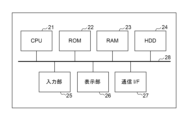
- FIG. 1 is a block diagram showing an example of a hardware configuration of the information processing device 100 according to the present embodiment.
- the information processing device 100 can be implemented on a single or multiple computers, mobile devices, or any other processing platform. 2, the information processing device 100 is illustrated as being implemented in a single computer, but the information processing device 100 according to the present embodiment may be implemented in a computer system including multiple computers. The multiple computers may be connected to each other via a wired or wireless network so as to be able to communicate with each other.
- the information processing device 100 may include a CPU (Central Processing Unit) 21, a ROM (Read Only Memory) 22, a RAM (Random Access Memory) 23, a HDD (Hard Disk Drive) 24, an input unit 25, a display unit 26, a communication I/F 27, and a system bus 28.
- the information processing device 100 may also include an external memory.
- the CPU 21 comprehensively controls the operation of the information processing device 100, and controls each component (22 to 27) via a system bus 28, which is a data transmission path.
- the CPU 21 is composed of one or more processors.
- At least one of the one or more processors may be replaced by one or more processors such as an ASIC (Application Specific Integrated Circuit), an FPGA (Field Programmable Gate Array), a DSP (Digital Signal Processor), or a GPU (Graphics Processing Unit).
- ASIC Application Specific Integrated Circuit
- FPGA Field Programmable Gate Array
- DSP Digital Signal Processor
- GPU Graphics Processing Unit
- the ROM 22 is a non-volatile memory that stores control programs and the like necessary for the CPU 21 to execute processes. Note that the programs may be stored in a non-volatile memory such as the HDD 24 or an SSD (Solid State Drive) or an external memory such as a removable storage medium (not shown).
- the RAM 23 is a volatile memory and functions as a main memory, a work area, etc. of the CPU 21. That is, when executing a process, the CPU 21 loads necessary programs, etc. from the ROM 22 into the RAM 23 and executes the programs, etc. to realize various functional operations.
- the learning model storage unit 110 and the attribute data storage unit 120 shown in FIG. 1 can be configured by the RAM 23.
- the HDD 24 stores, for example, various data and various information required when the CPU 21 performs processing using a program.
- the HDD 24 also stores, for example, various data and various information obtained when the CPU 21 performs processing using a program.
- the input unit 25 is composed of a keyboard and a pointing device such as a mouse.
- the display unit 26 is configured with a monitor such as a liquid crystal display (LCD) etc.
- the display unit 26 may be configured in combination with the input unit 25 to function as a GUI (Graphical User Interface).
- the communication I/F 27 is an interface that controls communication between the information processing device 100 and external devices.
- the communication I/F 27 provides an interface with a network and executes communication with an external device via the network.
- Various data, various parameters, etc. are transmitted and received between the external device and the communication I/F 27.
- the communication I/F 27 may execute communication via a wired LAN (Local Area Network) or a dedicated line that complies with a communication standard such as Ethernet (registered trademark).
- the network that can be used in this embodiment is not limited to this, and may be configured as a wireless network.
- This wireless network includes wireless PANs (Personal Area Networks) such as Bluetooth (registered trademark), ZigBee (registered trademark), and UWB (Ultra Wide Band). It also includes wireless LANs (Local Area Networks) such as Wi-Fi (Wireless Fidelity) (registered trademark) and wireless MANs (Metropolitan Area Networks) such as WiMAX (registered trademark). It also includes wireless WANs (Wide Area Networks) such as 4G and 5G defined by 3GPP (Third Generation Partnership Project) (registered trademark). Note that the network only needs to be able to connect the devices to each other so that they can communicate with each other, and the communication standard, scale, and configuration are not limited to those described above.
- At least some of the functions of the information processing device 100 shown in FIG. 1 can be realized by the CPU 21 executing a program. However, at least some of the functions of the information processing device 100 shown in FIG. 1 may be operated as dedicated hardware. In this case, the dedicated hardware may operate under the control of the CPU 21.
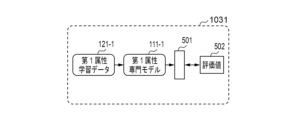
- Fig. 5A shows the learning procedure of the learning model for the first attribute in the first time step.
- Fig. 5B shows the learning procedure of the learning model for the first attribute to the second attribute in the second time step.
- Fig. 5C shows the learning procedure of the learning model for the first attribute to the third attribute in the third time step.
- Fig. 5D is a diagram for explaining the learning procedure of the learning model for the first attribute to the Nth attribute in the Nth time step.
- time step is understood to be a term representing a relative time, and not a term representing a specific time (or time span).
- the first learning unit 1031 applies the first attribute learning data 121-1 stored in the attribute data storage unit 120 to the first attribute dedicated model 111-1 to train the first attribute dedicated model 111-1.
- a full set of first attribute learning data 121-1 is used. Therefore, for example, the first learning unit 1031 may request the full set of first attribute learning data 121-1 from the learning data management unit 102. In response, the learning data management unit 102 may supply the full set of first attribute learning data 121-1 to the first learning unit 1031.
- the first learning unit 1031 inputs product images included in the first attribute learning data 121-1 to the first attribute dedicated model 111-1, and obtains a probability distribution of possible characteristics of the first attribute (hereinafter also referred to as an estimated probability distribution) as output 501 (estimation result).
- the first attribute is "pattern”, as described above, the possible characteristics of "pattern” are, for example, "border”, “plain”, “check”, “dot", and "print”.
- the output 501 is an estimated probability distribution in this order, for example, ⁇ 0.6, 0.1, 0.1, 0.1, 0.1 ⁇ .
- the correct probability distribution which is the correct answer data, is ⁇ 1, 0, 0, 0, 0 ⁇ .
- the first learning unit 1031 acquires the output 501 (estimated probability distribution) and the correct probability distribution for all of the first attribute learning data 121-1, and calculates an evaluation value (evaluation function) 502 based on the output 501 and the correct probability distribution.
- cross-entropy CE
- CE cross-entropy loss
- the first learning unit 1031 trains the first attribute-specific model 111-1 based on the evaluation value 502 (for example, so as to minimize the evaluation value 502).
- the first learning unit 1031 stores the trained first attribute-specific model 111-1 in the learning model storage unit 110.
- the trained first attribute-specific model 111-1 is used for the learning process in the second time step.
- the first learning unit 1031 applies the second attribute learning data 121-2 stored in the attribute data storage unit 120 to the second attribute dedicated model 111-2 to train the second attribute dedicated model 111-2.
- a full set of second attribute learning data 121-2 is used to train the second attribute dedicated model 111-2. Therefore, for example, the first learning unit 1031 may request the full set of second attribute learning data 121-2 from the learning data management unit 102. In response, the learning data management unit 102 may supply the full set of second attribute learning data 121-2 to the first learning unit 1031.
- the first learning unit 1031 inputs product images included in the second attribute learning data 121-2 to the second attribute dedicated model 111-2 and obtains an estimated probability distribution for the second attribute as the output 503. As in the process in the first time step, the first learning unit 1031 obtains the output 503 (estimated probability distribution) and the correct answer probability distribution for all of the second attribute learning data 121-2, and calculates an evaluation value 504 (e.g., cross entropy) based on the output 503 and the correct answer probability distribution. The first learning unit 1031 trains the second attribute dedicated model 111-2 based on the evaluation value 504 (e.g., so as to minimize the evaluation value 504). The first learning unit 1031 stores the trained second attribute dedicated model 111-2 in the learning model storage unit 110. The trained second attribute dedicated model 111-2 is used for the learning process in the third time step.
- an evaluation value 504 e.g., cross entropy
- the second learning unit 1032 trains the attribute prediction model 112.
- the attribute prediction model 112 in the second time step is a learning model for predicting the first attribute and the second attribute.
- the second learning unit 1032 applies the first attribute learning data 121-1 and the second attribute learning data 121-2 stored in the attribute data storage unit 120 to the attribute prediction model 112 to train the attribute prediction model 112.
- a portion of the first attribute learning data 121-1 and the full set of the second attribute learning data 121-2 are used. Therefore, for example, the second learning unit 1032 may request a portion of the first attribute learning data 121-1 and the full set of the second attribute learning data 121-2 from the learning data management unit 102.
- the learning data management unit 102 may supply a portion of the first attribute learning data 121-1 and the full set of the second attribute learning data 121-2 to the second learning unit 1032. Note that in the figures of the present disclosure, a portion of an area of attribute learning data is shaded to indicate that it is a portion of the attribute learning data.
- the second learning unit 1032 inputs product images included in a portion of the first attribute learning data 121-1 to the attribute prediction model 112, and obtains an estimated probability distribution for the first attribute as output 505.
- the second learning unit 1302 also inputs product images included in a portion of the first attribute learning data 121-1 to the first attribute dedicated model 111-1, and obtains an estimated probability distribution for the first attribute as output 506.
- the second learning unit 1032 obtains output 505 (estimated probability distribution) and output 506 (estimated probability distribution) for all of the portion of the first attribute learning data 121-1, and calculates an evaluation value 507 representing the similarity based on output 505 and output 506.
- KL divergence Kullback-Leibler divergence
- KL divergence loss KL divergence loss
- the second learning unit 1302 trains the attribute prediction model 112 so that the output 505 from the first attribute-dedicated model 111-1 matches the output 506 from the attribute prediction model 112.
- the second learning unit 1302 trains the learning model so that the output from the dedicated model trained for a specific attribute (in the example of FIG. 5B, the first attribute-dedicated model 111-1) matches the output from the learning model to be trained (in the example of FIG. 5B, the attribute prediction model 112), thereby performing so-called knowledge distillation.
- the second learning unit 1032 inputs the product images included in the full set of second attribute learning data 121-2 into the attribute prediction model 112 and obtains an estimated probability distribution for the second attribute as output 508.
- the second learning unit 1032 obtains output 508 (estimated probability distribution) and correct answer probability distribution for all of the second attribute learning data 121-2, and calculates an evaluation value 509 (e.g., cross entropy) based on the output 508 and the correct answer probability distribution.
- the second learning unit 1032 trains the attribute prediction model 112 based on the evaluation value 509 (e.g., so as to minimize the evaluation value 509).
- the second learning unit 1032 can suppress forgetting of tasks for the first attribute that have already been learned by using knowledge distillation to train the attribute prediction model 112.
- the second learning unit 1032 stores the learned attribute prediction model 112 in the learning model storage unit 110.
- the first learning unit 1031 applies the third attribute learning data 121-3 stored in the attribute data storage unit 120 to the third attribute dedicated model 111-3 to train the third attribute dedicated model 111-3.
- a full set of third attribute learning data 121-3 is used to train the third attribute dedicated model 111-3. Therefore, for example, the first learning unit 1031 may request the full set of third attribute learning data 121-3 from the learning data management unit 102. In response to this, the learning data management unit 102 may supply the full set of third attribute learning data 121-3 to the first learning unit 1031.
- the first learning unit 1031 inputs product images included in the third attribute learning data 121-3 to the third attribute dedicated model 111-3 and obtains an estimated probability distribution for the third attribute as the output 510. As in the process in the first time step, the first learning unit 1031 obtains the output 510 (estimated probability distribution) and the correct answer probability distribution for all of the third attribute learning data 121-3, and calculates an evaluation value 511 (e.g., cross entropy) based on the output 510 and the correct answer probability distribution. The first learning unit 1031 trains the third attribute dedicated model 111-3 based on the evaluation value 511 (e.g., so as to minimize the evaluation value 511). The first learning unit 1031 stores the trained third attribute dedicated model 111-3 in the learning model storage unit 110. The trained third attribute dedicated model 111-3 is used for the learning process in the fourth time step.
- an evaluation value 511 e.g., cross entropy
- the second learning unit 1032 trains the attribute prediction model 112.
- the attribute prediction model 112 in the third time step is a learning model for predicting the third attribute from the first attribute.
- the second learning unit 1032 applies the first attribute learning data 121-1, the second attribute learning data 121-2, and the third attribute learning data 121-3 stored in the attribute data storage unit 120 to the attribute prediction model 112 to train the attribute prediction model 112.
- a portion of the first attribute learning data 121-1, a portion of the second attribute learning data 121-2, and the full set of the third attribute learning data 121-3 are used.
- the second learning unit 1032 may request a portion of the first attribute learning data 121-1, a portion of the second attribute learning data 121-2, and the full set of the third attribute learning data 121-3 from the learning data management unit 102.
- the learning data management unit 102 may supply a portion of the first attribute learning data 121-1, a portion of the second attribute learning data 121-2, and the full set of the third attribute learning data 121-3 to the second learning unit 1032.
- the second learning unit 1032 inputs product images included in a portion of the first attribute learning data 121-1 to the attribute prediction model 112 and obtains an estimated probability distribution for the first attribute as output 512.
- the second learning unit 1302 also inputs product images included in a portion of the first attribute learning data 121-1 to the first attribute dedicated model 111-1 and obtains an estimated probability distribution for the first attribute as output 513.
- the second learning unit 1032 obtains output 512 (estimated probability distribution) and output 513 (estimated probability distribution) for all of the portion of the first attribute learning data 121-1, and calculates an evaluation value 514 (e.g., KL divergence) based on output 512 and output 513.
- an evaluation value 514 e.g., KL divergence
- the second learning unit 1032 trains the attribute prediction model 112 based on evaluation value 514 (e.g., so as to minimize evaluation value 514).
- the second learning unit 1032 also inputs product images included in a portion of the second attribute learning data 121-2 to the attribute prediction model 112 and obtains an estimated probability distribution for the second attribute as the output 515.
- the second learning unit 1302 also inputs product images included in a portion of the second attribute learning data 121-2 to the second attribute dedicated model 111-2 and obtains an estimated probability distribution for the second attribute as the output 516.
- the second learning unit 1032 obtains the output 515 (estimated probability distribution) and the output 516 (estimated probability distribution) for all of the portion of the second attribute learning data 121-2, and calculates an evaluation value 517 (for example, KL divergence) based on the output 515 and the output 516.
- the second learning unit 1032 trains the attribute prediction model 112 based on the evaluation value 517 (for example, to minimize the evaluation value 517).
- the second learning unit 1032 inputs product images included in the full set of third attribute learning data 121-3 to the attribute prediction model 112, and obtains an estimated probability distribution for the third attribute as output 518.
- the second learning unit 1032 obtains the output 518 (estimated probability distribution) and a correct answer probability distribution for all of the third attribute learning data 121-2, and calculates an evaluation value 519 (e.g., cross entropy) based on the output 518 and the correct answer probability distribution.
- the second learning unit 1032 trains the attribute prediction model 112 based on the evaluation value 519 (e.g., so as to minimize the evaluation value 519).
- the second learning unit 10312 stores the learned attribute prediction model 112 in the learning model storage unit 110.
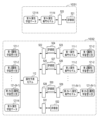
- FIG. 5D shows a diagram for explaining the learning procedure at the N-th time step by the first learning unit 1031 and the second learning unit 1302.
- the learning procedure shown in FIG. 5D corresponds to a generalized version of the learning procedures at the second time step to the N-th time step.
- the first learning unit 1301 inputs the full set of N-th attribute learning data 121-N to the N-th attribute-specific model 111-N, and trains the N-th attribute-specific model 111-N based on the output 520 and the evaluation value 521.
- the second learning unit 1032 trains the attribute prediction model 112.
- the attribute prediction model 112 in the N-th time step is a learning model for predicting the N-th attribute from the first attribute.
- the second learning unit 1032 trains the attribute prediction model 112 based on an evaluation value 524 based on an output 522 and an output 523 for a portion of the first attribute learning data 121-1, an evaluation value 527 based on an output 525 and an output 526 for a portion of the second attribute learning data 121-1, and an evaluation value 530 based on an output 528 and an output 529 for a portion of the (N-1)-th attribute learning data 121-1.
- the second learning unit 1302 inputs the full set of the Nth attribute learning data 121-N to the attribute prediction model 112, and trains the attribute prediction model 112 based on the output 531 and the evaluation value 532.
- the loss function L used by the second learning unit 1032 to train the attribute prediction model 112 in the Nth time step can be expressed as in equation (1).
- CE represents cross entropy
- KL represents KL divergence
- ⁇ represents temperature
- ⁇ represents softmax function
- ⁇ represents log-softmax function
- ⁇ represents weight (balancing weight).
- Y o i represents output from the i-th attribute specialized model (i is an integer equal to or greater than 1).
- Y ⁇ o i represents output for the i-th attribute from the attribute prediction model 112.
- Y ⁇ N represents output for the N-th attribute from the attribute prediction model 112.
- Y N represents correct answer data for the N-th attribute.
- the loss function is based on the value obtained by multiplying the evaluation value (KL divergence) for the first attribute to the (N-1)-th attribute by the weight ⁇ and adding them together, and the value obtained by multiplying the evaluation value (cross entropy) for the N-th attribute by the weight (1- ⁇ ).
- the second learning unit 1032 trains the attribute prediction model 112 so as to optimize the value derived by the loss function (e.g., minimize the value).
- the learning unit 103 trains the attribute prediction model 112 for predicting the first attribute to the Nth attribute for the first attribute to the (N-1)th attribute according to knowledge distillation. Specifically, for the first attribute to the (N-1)th attribute, the learning unit 103 trains the attribute prediction model 112 using the trained first attribute dedicated model 111-1 to (N-1)th attribute dedicated model 111-(N-1), which have been trained using a full set of training data for the attribute. This makes it possible to train the attribute prediction model 112 so as to suppress catastrophic forgetting for the first attribute to the (N-1)th attribute.
- the attribute prediction model 112 trained in each of the second time step to the (N-1)th time step may be stored in the learning model storage unit 110 separately from the attribute prediction model 112 trained in the Nth time step.
- the attribute prediction model 112 trained in the Nth time step is a learning model for predicting the Nth attribute from the first attribute
- the attribute prediction model 112 trained in the nth time step (n is an integer greater than or equal to 2 and less than or equal to N-1) is a learning model for predicting the nth attribute from the first attribute.
- the first learning unit 1301 trains the first attribute dedicated model 111-1 to the (N-1)th attribute dedicated model 111-(N-1), respectively, using the first attribute learning data 121-1 to the (N-1)th attribute learning data 121-(N-1), respectively.
- This learning procedure corresponds to the learning procedure of the first learning unit 1301 described with reference to Figs. 5A to 5D, for example.
- the second learning unit 1302 trains the attribute dedicated model 112 according to the procedure described with reference to Fig. 5D.
- the learning procedure according to this modified example also makes it possible to train the attribute prediction model 112 so as to suppress catastrophic forgetting for the first attribute to the (N-1)th attribute.
- FIG. 6A shows a flowchart of a learning process of the attribute prediction model 112 for predicting an N-th attribute from a first attribute, which is executed by the information processing device 100.
- the learning unit 103 sets a parameter i to 1. i corresponds to the time step in the learning procedure described with reference to Figures 5A to 5D.
- the learning unit 103 determines whether i is 1. If i is 1 (Yes in S602), the process proceeds to S603, and if not (No in S602), the process proceeds to S605.
- S603 is a learning process in the first time step.
- the first learning unit 1031 uses the first attribute learning data 121-1 to train the first attribute specialized model 111-1.
- the learning procedure in S603 is as described with reference to FIG. 5A.
- the first learning unit 1031 stores the trained first attribute specialized model 111-1 in the training model storage unit 110.
- the learning unit 103 increments the parameter i. After that, the process proceeds to S602.
- S605 to S606 are learning processes in the i-th time step (i is 2 or more).
- the first learning unit 1031 uses the i-th attribute learning data 121-i to train the i-th attribute specialized model 111-i.
- the first learning unit 1031 stores the trained i-th attribute specialized model 111-i in the training model storage unit 110.
- the second learning unit 1032 trains the attribute prediction model 112 using the trained first attribute dedicated model 111-1 to the (i-1)th attribute dedicated model 111-(i-1), a portion of each of the first attribute learning data 121-1 to the (i-1)th attribute learning data 121-(i-1), and the i-th attribute learning data 121-i.
- the learning procedure in S606 is as described with reference to FIG. 5B to FIG. 5D.
- the second learning unit 1032 may store the attribute prediction model 112 in the learning model storage unit 110.
- the second learning unit 1302 may store the attribute prediction model 112 trained in the i-th time step in the learning model storage unit 110 so that it can be identified as a learning model for predicting the i-th attribute from the first attribute. Then, in S607, the learning unit 103 determines whether the parameter i is N or not. If i is N (Yes in S607), the process proceeds to S608. If not (No in S607), the process proceeds to S604.
- the second learning unit 1032 stores the learned attribute prediction model 112 in the learning model storage unit 110 as a learning model for predicting the Nth attribute from the first attribute.
- FIG. 6B shows a flowchart of a modified example of the learning process of the attribute prediction model 112 executed by the information processing device 100.
- this modified example is a process in which only the attribute prediction model 112 for predicting the Nth attribute from the first attribute is trained.
- the first learning unit 1031 uses the first attribute learning data 121-1 to the (N-1)th attribute learning data 121-(N-1) to train the first attribute dedicated model 111-1 to the (N-1)th attribute dedicated model 111-(N-1), respectively.
- the training procedure in S611 is as described with reference to FIG. 5A.
- the first learning unit 1031 After training the first attribute dedicated model 111-1 to the (N-1)th attribute dedicated model 111-(N-1), the first learning unit 1031 stores the trained first attribute dedicated model 111-1 to the (N-1)th attribute dedicated model 111-(N-1) in the training model storage unit 110.
- the second learning unit 1032 trains the attribute prediction model 112 using the trained first attribute dedicated model 111-1 to the (N-1)th attribute dedicated model 111-(N-1), a portion of each of the first attribute learning data 121-1 to the (N-1)th attribute learning data 121-(N-1), and the Nth attribute learning data 121-N.
- the learning procedure in S612 is as described with reference to FIG. 5D.
- the second learning unit 1032 stores the learned attribute prediction model 112 in the learning model storage unit 110 as a learning model for predicting the Nth attribute from the first attribute.
- Fig. 7 shows a flowchart of the attribute prediction processing executed by the information processing device 100.
- a trained attribute prediction model 112 for predicting an Nth attribute (N is an integer equal to or greater than 2) from a first attribute is used.
- the image acquisition unit 104 acquires a product image including a target product (a product for which attributes are to be predicted). For example, the image acquisition unit 104 acquires the product image by an operator of the information processing device 100 operating the information processing device 100 to access any electronic commerce site and then selecting a product image including the target product.
- the image acquisition unit 104 can also acquire a product image by acquiring a product image sent from an external device such as a user device or a URL (Uniform Resource Locator) indicating a product image.
- an external device such as a user device or a URL (Uniform Resource Locator) indicating a product image.
- the attribute prediction unit 105 inputs the product image acquired by the image acquisition unit 104 into the trained attribute prediction model 112, and predicts N attributes of the first attribute from the first attribute of the target product included in the product image. Specifically, the attribute prediction unit 105 extracts the types of N attributes of the target product, and predicts the characteristics of each of the N types of attributes.
- the output unit 106 outputs information on the attributes predicted by the attribute prediction unit 105 (attribute prediction results). Specifically, the output unit 106 outputs the N attribute types predicted by the attribute prediction unit 105 and the features (feature values) of each of the N attribute types. The output unit 106 may display the attribute prediction results on the display unit 26 ( Figure 2). Furthermore, when a product image is acquired from an external device such as a user device, the output unit 106 may transmit the product image to the external device via the communication I/F 27 ( Figure 2) so as to be displayed on the display unit of the external device.
- the information processing device 100 trains the attribute prediction model 112 for predicting multiple attributes of a product from a product image that includes the product, it trains one or more attributes that have already been trained using a dedicated learning model trained specifically for the one or more attributes. This makes it possible to train the attribute prediction model 112 to learn new attributes while suppressing catastrophic forgetting.
- the learning procedure of the learning model and the attribute prediction procedure for predicting multiple attributes of a product when the product image contains one product have been described.
- the information processing device 100 may be configured to divide the product image into partial images containing each of the multiple products using a known image recognition process, and to predict multiple attributes for each partial image using the procedure described in this embodiment.
- An information processing device having a learning unit that trains an attribute prediction model for predicting N attributes (N is an integer equal to or greater than 2) of a product from an image including the product, the learning unit having a first learning unit that trains an i-th learning model for predicting an i-th attribute (i is an integer from 1 to N-1) of the product using i-th learning data for the i-th attribute, and a second learning unit that trains the attribute prediction model using the i-th learning model trained by the first learning unit, a portion of the i-th learning data, and N-th learning data for the N-th attribute of the product.
- [5] The information processing device according to any one of [1] to [4], wherein the second learning unit trains the attribute prediction model using a first estimation result for each of the first attribute to the (N-1)th attribute obtained by applying a portion of the i-th learning data to the i-th learning model, and a second prediction result for each of the first attribute to the N-th attribute obtained by applying a portion of the i-th learning data and the N-th learning data to the attribute prediction model.
- each of the (N-1) first evaluation values is a KL divergence
- the second evaluation value is a cross entropy
- An information processing device according to any one of [1] to [8], further comprising: an acquisition unit that acquires an image including a target product; and a prediction unit that inputs the image acquired by the acquisition unit into the attribute prediction model trained by the second learning unit, and predicts the first attribute to the Nth attribute of the target product.
- An information processing method for training an attribute prediction model for predicting N attributes (N is an integer equal to or greater than 2) of a product from an image including the product including: training an i-th learning model for predicting an i-th attribute (i is an integer from 1 to N-1) of the product using i-th learning data for the i-th attribute; and training the attribute prediction model using the i-th learning model trained by the first learning unit, a portion of the i-th learning data, and N-th learning data for the N-th attribute of the product.
- An information processing program for training an attribute prediction model for predicting N attributes (N is an integer equal to or greater than 2) of a product from an image including the product the information processing program causing a computer to execute the following: training an i-th learning model for predicting an i-th attribute (i is an integer from 1 to N-1) of the product using i-th learning data for the i-th attribute; and training the attribute prediction model using the i-th learning model trained by the first learning unit, a portion of the i-th learning data, and N-th learning data for the N-th attribute of the product.
- 100 Information processing device
- 101 Learning data acquisition unit
- 102 Learning data management unit
- 103 Learning unit
- 1301 First learning unit
- 1302 Second learning unit
- 104 Image acquisition unit
- 105 Attribute prediction unit
- 106 Output unit
- 110 Learning model storage unit
- 111-1 First attribute specialized model
- 111-N Nth attribute dedicated model
- 112 Attribute prediction model
- 120 Attribute data storage unit
- 121-1 First attribute learning data
- 121-N Nth attribute learning data
Landscapes
- Engineering & Computer Science (AREA)
- Theoretical Computer Science (AREA)
- Software Systems (AREA)
- Data Mining & Analysis (AREA)
- Evolutionary Computation (AREA)
- Medical Informatics (AREA)
- Computer Vision & Pattern Recognition (AREA)
- Physics & Mathematics (AREA)
- Computing Systems (AREA)
- General Engineering & Computer Science (AREA)
- General Physics & Mathematics (AREA)
- Mathematical Physics (AREA)
- Artificial Intelligence (AREA)
- Image Analysis (AREA)
Abstract
情報処理装置は、商品を含む画像から、該商品のN個の属性(Nは、2以上の整数)を予測するための属性予測モデルを学習させる学習部を有する。該学習部は、該商品の第i属性(iは、1からN-1の整数)を予測するための第i学習モデルを、該第i属性に対する第i学習データを用いて学習させる第1学習部と、該第1学習部により学習済みの該第i学習モデルと、該第i学習データの一部と、該商品の第N属性に対する第N学習データとを用いて、該属性予測モデルを学習させる第2学習部と、を有する。
Description
本発明は、情報処理装置、情報処理方法、および情報処理プログラムに関し、特に、商品を含む画像から、当該商品の属性を予測するための技術に関する。
近年、インターネットを使って商品の販売を行う電子商取引(Electronic Commerce(EC))が盛んに実施されており、そのような電子商取引の実施のためのECサイトがウェブ上に多く構築されている。ECサイトは、世界中の各国の言語を用いて構築されることも多く、多くの国に在住するユーザ(消費者)が商品を購入することを可能にしている。ユーザは、PC(Personal Computer)や、スマートフォンといった携帯端末からECサイトにアクセスすることで、実際の店舗に赴くことなく、また時間に関係なく、所望の商品の選択や購入を行うことが可能となっている。
ECサイトでは、ユーザによる購買意欲を増進させることを目的に、過去にユーザが購入した商品の属性(商品に特有な情報)と同様の属性を有する商品を、レコメンデーションする商品として、ユーザが閲覧している画面において合わせて表示することがある。また、ユーザも、所望の商品を購入する場合に、購入しようとする商品の属性から検索する場合がある。このようなことから、電子商取引では、商品の属性を識別することが、サイト運営側や商品提供側にとって共通の課題となっている。
近年では、機械学習のための学習モデルを用いて、商品を含む画像から、当該商品の属性を予測する技術が開発されている。例えば、特許文献1には、商品を含む画像を、ニューラルネットワークを用いて構成された学習モデルに適用することで、当該商品の複数の属性を予測する技術が開示されている。
特許文献1に開示される技術によれば、商品を含む画像を学習モデルに適用することにより、自動的に、当該商品の複数の属性を予測することが可能となる。一方、電子商取引で扱う商品の種類や数は増加しており、それに伴い、属性の種類も増加する。よって、商品を含む画像から、当該商品の既存の属性だけでなく新たな属性を予測する学習モデルの構築が望まれる。
新たなタスクを学習モデルに学習させるために、追加的な学習データを連続的に用いて学習モデルを学習させる、インクリメンタル学習という方法が知られている。インクリメンタル学習によれば、追加的に新たな属性の学習データを用いて学習モデル学習させることにより、既に学習させた属性だけでなく新たに学習させた属性も予測可能な学習モデルを構築することが可能となる。
しかしながら、追加的な学習データを連続的に用いて学習モデルを学習させる場合、過去に学習させたデータを「忘れて」しまうという、破滅的忘却(Catastrophic forgetting)という課題が生じる。例えば、過去に学習させたデータについて、正解データとの誤差が大きくなることや、誤差が大きくなることや、完全に忘れてしまうことが生じうる。
本発明は上記課題に鑑みてなされたものであり、破滅的忘却を抑制しつつ、商品を含む画像から当該商品の新たな属性を学習させるための技術を提供することを目的とする。
本発明の一態様による情報処理装置は、商品を含む画像から、前記商品のN個の属性(Nは、2以上の整数)を予測するための属性予測モデルを学習させる学習部を有し、前記学習部は、前記商品の第i属性(iは、1からN-1の整数)を予測するための第i学習モデルを、前記第i属性に対する第i学習データを用いて学習させる第1学習部と、前記第1学習部により学習済みの前記第i学習モデルと、前記第i学習データの一部と、前記商品の第N属性に対する第N学習データとを用いて、前記属性予測モデルを学習させる第2学習部と、を有する。
本発明の一態様による情報処理方法は、商品を含む画像から、前記商品のN個の属性(Nは、2以上の整数)を予測するための属性予測モデルを学習させるための情報処理方法であって、前記商品の第i属性(iは、1からN-1の整数)を予測するための第i学習モデルを、前記第i属性に対する第i学習データを用いて学習させることと、前記第1学習部により学習済みの前記第i学習モデルと、前記第i学習データの一部と、前記商品の第N属性に対する第N学習データとを用いて、前記属性予測モデルを学習させること、を含む。
本発明の一態様による情報処理プログラムは、商品を含む画像から、前記商品のN個の属性(Nは、2以上の整数)を予測するための属性予測モデルを学習させる情報処理プログラムであって、前記商品の第i属性(iは、1からN-1の整数)を予測するための第i学習モデルを、前記第i属性に対する第i学習データを用いて学習させることと、前記第1学習部により学習済みの前記第i学習モデルと、前記第i学習データの一部と、前記商品の第N属性に対する第N学習データとを用いて、前記属性予測モデルを学習させること、をコンピュータに実行させるものである。
本発明によれば、破滅的忘却を抑制しつつ、商品を含む画像から当該商品の新たな属性を学習させることが可能となる。
上記した本発明の目的、態様及び効果並びに上記されなかった本発明の目的、態様及び効果は、当業者であれば添付図面及び請求の範囲の記載を参照することにより下記の発明を実施するための形態から理解できるであろう。
上記した本発明の目的、態様及び効果並びに上記されなかった本発明の目的、態様及び効果は、当業者であれば添付図面及び請求の範囲の記載を参照することにより下記の発明を実施するための形態から理解できるであろう。
以下、添付図面を参照して、本発明を実施するための実施形態について詳細に説明する。以下に開示される構成要素のうち、同一機能を有するものには同一の符号を付し、その説明を省略する。なお、以下に開示される実施形態は、本発明の実現手段としての一例であり、本発明が適用される装置の構成や各種条件によって適宜修正または変更されるべきものであり、本発明は以下の実施形態に限定されるものではない。また、本実施形態で説明されている特徴の組み合わせの全てが本発明の解決手段に必須のものとは限らない。
[情報処理装置の機能構成]
本実施形態による情報処理装置100は、商品を含む(すなわち、商品を表示する)画像(以下、商品画像とも称する)を取得し、当該商品の複数の属性を予測する。商品の属性とは、商品に特有な情報であり、例えば、商品の視覚的な特徴である。商品の属性は、ユーザが当該商品を購入する際の指標になりうる。なお、本実施形態では、商品の属性を予測する例を説明するが、商品を含む、任意のアイテムを含む(すなわち、アイテムを表示する)画像から当該アイテムの属性を予測する場合も、本実施形態を適用可能である。
本実施形態による情報処理装置100は、商品を含む(すなわち、商品を表示する)画像(以下、商品画像とも称する)を取得し、当該商品の複数の属性を予測する。商品の属性とは、商品に特有な情報であり、例えば、商品の視覚的な特徴である。商品の属性は、ユーザが当該商品を購入する際の指標になりうる。なお、本実施形態では、商品の属性を予測する例を説明するが、商品を含む、任意のアイテムを含む(すなわち、アイテムを表示する)画像から当該アイテムの属性を予測する場合も、本実施形態を適用可能である。
図1は、本実施形態による情報処理装置100の機能構成の一例を示す。
情報処理装置100は、学習データ取得部101、学習データ管理部102、学習部103、画像取得部104、属性予測部105、出力部106、学習モデル記憶部110、属性データ記憶部120を備える。学習部103は、第1学習部1031と第2学習部1032を備える。学習モデル記憶部110は、第1属性専門モデル111-1から第N属性専門モデル111-Nと、属性予測モデル112を記憶するように構成される。属性データ記憶部120は、第1属性学習データ121-1から第N属性学習データ121-Nを記憶するように構成される。本開示において、「N」は、2以上の整数である。
情報処理装置100は、学習データ取得部101、学習データ管理部102、学習部103、画像取得部104、属性予測部105、出力部106、学習モデル記憶部110、属性データ記憶部120を備える。学習部103は、第1学習部1031と第2学習部1032を備える。学習モデル記憶部110は、第1属性専門モデル111-1から第N属性専門モデル111-Nと、属性予測モデル112を記憶するように構成される。属性データ記憶部120は、第1属性学習データ121-1から第N属性学習データ121-Nを記憶するように構成される。本開示において、「N」は、2以上の整数である。
学習データ取得部101は、学習モデルを学習させるための学習データ(教師データ)を取得する。本実施形態では、学習データは、商品画像と、商品の属性の正解データとを含んで構成される。ここで、図3Aを参照して、本実施形態における商品の属性の例について説明する。図3Aは、商品の属性を説明するための図である。
本実施形態では、商品は、EC(Electronic Commerce)サイトで扱いうる商品を想定する。ECサイトで扱いうる商品の数の種類や数は膨大であるため、商品の属性は、分類した商品(商品群)に対して設定される。商品に対する分類は、階層的に行われうる。本実施形態では、商品に対する分類のうち、上位分類を示す商品カテゴリが「衣類」である場合の属性を想定する。
図3Aにおいて、商品カテゴリ30が「衣類」の商品は、カテゴリ30の下位分類を示すサブカテゴリ31、サブカテゴリ31のさらに下位分類を示すサブサブカテゴリ32に分類される。サブカテゴリ31は、「衣類」を装着する対象を示し、図3Aの例では、「男性」と「女性」を含む。このほか、サブカテゴリ31は、「子ども」や、「シニア」や、性別を意識しない「ユニセックス」等を含んでもよい。サブサブカテゴリ32は、「衣類」の種類や形状を示す。サブカテゴリ31が「男性」である場合、サブサブカテゴリ32は、「Tシャツ」と「ジーンズ」を含む。このほか、サブカテゴリ31が「男性」である場合、サブサブカテゴリ32は、「ジャケット」や、「コート」等を含んでもよい。
図3Aの例では、属性は、サブサブカテゴリ32の商品に対して設定される。サブサブカテゴリ32が「Tシャツ」の場合、属性は、「パターン」、「袖」、「首回り」、および「色」を含む。また、サブサブカテゴリ32が「ジーンズ」の場合、属性は、「パターン」、「フィット」、および「長さ」を含む。なお、図3Aに示す各商品に対する属性の種類は、一例であり、図示されるものに限定されない。また、属性の種類は将来的にさらに増加しうる。また、図3Aでは、サブサブカテゴリ32の商品に対して属性が設定されているが、サブカテゴリ31やカテゴリ30に対して属性が設定されてもよい。
図3Bに、商品画像と属性との関係を示す。図3Bでは、商品画像36に含まれる商品38の属性37を含むデータ35が示されている。商品38は、図3Aにおける、カテゴリ30=「衣類」、サブカテゴリ31=「男性」、サブサブカテゴリ32=「Tシャツ」に分類される商品であり、図3Aを参照して、属性37は、「パターン」、「袖」、「首回り」、および「色」を含む。さらに、属性37において、各属性は正解となる特徴(特徴値)(以下、正解特徴とも称する)を有する。商品画像36の商品38の各属性に対する正解特徴は図3Bに示す通りであり、「パターン」は「ボーダー」、「袖」は「七分袖」、「首回り」は「ラウンド」、「色」は「白と黒」である。
前述したように、学習データは、商品画像と、商品の属性の正解データを含んで構成される。学習データ取得部101は、例えば、図3Bに示すデータ35から、学習データを生成して取得する。図3Bに示す商品38の属性が「パターン」である場合、「パターン」が取りうる特徴を、例えば、「ボーダー」、「無地」、「チェック」、「ドット」、「プリント」とする。分類問題の場合、学習のための正解データは、全て1または0となる。つまり、100%(正解特徴)か0%(非正解特徴)かという二択になる。商品画像36に含まれる商品38の「パターン」は「ボーダー」であるから、「ボーダー」、「無地」、「チェック」、「ドット」、「プリント」の順では、1番目の特徴が正解特徴である。よって、正解データは、例えば、{1,0,0,0,0}のような確率分布の形式で与えられる。
学習データ管理部102は、学習データ取得部101により取得された学習データを、属性ごとに、属性学習データとして属性データ記憶部120に保存する。図3Bを参照すると、学習データ管理部102は、商品画像36と、属性37(すなわち、「パターン」、「袖」、「首回り」、および「色」)の正解データとの組み合わせを、属性ごとに、属性学習データとして属性データ記憶部120に保存する。図4に、属性データ記憶部120に保存される、属性学習データの概念図を示す。
図1に示したように、属性データ記憶部120には、第1属性学習データ121-1から第N属性学習データ121-Nを記憶するように構成される。説明のために、第1属性=「パターン」、第2属性=「袖」であるとする。学習データ管理部102は、例えば、図3Bに示すデータ35に基づいて、商品画像36と、「ボーダー」41が「1」となる正解データとの組み合わせデータを、第1属性学習データ121-1に分類する。また、学習データ管理部102は、商品画像36と、「七分袖」42が「1」となる正解データの組み合わせを、第2属性学習データ121-1に分類する。このように、学習データ管理部102は、学習データ取得部101により取得された学習データから、商品画像と1つ以上の属性を抽出し、当該商品画像と、正解データとの組み合わせを、属性ごとに、第1属性学習データ121-1から第N属性学習データ121-Nのいずれかに分類する。これにより、第1属性学習データ121-1から第N属性学習データ121-Nのそれぞれには、商品画像と、当該画像に含まれる商品の第1属性から第N属性に対する正解データとの組み合わせデータのセットが保存される。
なお、本実施形態では、学習データ管理部102は、学習データ取得部101により取得された学習データを、属性ごとに、属性データ記憶部120に保存するように構成されるが、属性データ記憶部120へのデータ保存手順はこれに限定されない。例えば、学習データ取得部101が、商品画像と、1つの属性の正解特徴とを取得した場合、学習データ管理部102は、当該属性に従って、当該商品画像と、当該正解特徴に応じた正解データとの組み合わせデータを、第1属性学習データ121-1から第N属性学習データ121-Nのいずれかに保存してもよい。あるいは、この場合は、学習データ取得部101が、直接的に、当該組み合わせデータを、第1属性学習データ121-1から第N属性学習データ121-Nのいずれかに保存してもよい。
さらに、学習データ管理部102は、属性データ記憶部120に保存された第1属性学習データ121-1から第N属性学習データ121-Nのうち、学習部103へ供給するデータを管理する。第1属性学習データ121-1を例にすると、学習データ管理部102は、フルセットの第1属性学習データ121-1を、学習部103へ供給しうる。あるいは、学習データ管理部102は、第1属性学習データ121-1の一部を選択(サンプリング)して、学習部103へ供給しうる。当該一部のデータは、ランダムに選択されてもよいし、所定のルールに従って選択されてもよい。本開示において、「フルセットのデータ」という語は、「一部のデータ」よりデータ量が多い(例えば、より多くの学習データのセットを含む)ことを意味する。学習データ管理部102は、属性学習データを、学習部103からの要求に応じて、学習部103へ供給しうる。
図1の説明に戻り、学習部103は、第1属性学習データ121-1から第N属性学習データ121-Nと、属性予測モデル112を学習させる。これらの学習モデルは、CNN(Convolutional Neural Network)を利用して構成されうる。学習部103は、第1学習部1301と第2学習部1302を含んで構成され、第1学習部1301と第2学習部1302に対する制御を含む、学習処理全般の制御を担う。第1学習部1301は、第1属性専用モデル111-1から第N属性専用モデル111-Nを学習させるように構成される。第2学習部1302は、学習済みの第1属性専用モデル111-1から第N属性専用モデル111-Nの少なくともいずれかを用いて、属性予測モデル112を学習させるように構成される。学習部103による、第1属性専用モデル111-1から第N属性専用モデル111-Nと、属性予測モデル112の学習手順については後述する。
画像取得部104は、対象商品(すなわち、属性予測対象の商品)を含む商品画像を取得する。画像取得部104は、当該商品画像を、ユーザ(オペレータ)による入力部25(図2)を介した入力操作によって取得してもよいし、ユーザの操作により記憶部(図2のROM22やRAM23)から取得してもよい。また、画像取得部104は、通信I/F27(図2)を介して外部装置から受信した商品画像を取得してもよい。
属性予測部105は、画像取得部104により取得された商品画像を、学習済みの属性予測モデル112に適用し、当該商品画像に含まれる対象商品の複数の属性を予測する。
出力部106は、属性予測部105により予測された属性の情報(属性予測結果)を出力する。出力部106は、例えば、画像取得部104により取得された商品画像と対応付けて、属性予測結果を出力してもよい。出力部106は、属性予測結果を、表示部26(図2)に表示してもよい。また、商品画像がユーザ装置といった外部装置から取得された場合は、出力部106は、通信I/F27(図2)を介して当該外部装置の表示部に表示されるように、当該外部装置へ送信してもよい。
[情報処理装置のハードウェア構成]
図2は、本実施形態による情報処理装置100のハードウェア構成の一例を示すブロック図である。情報処理装置100は、単一または複数の、あらゆるコンピュータ、モバイルデバイス、または他のいかなる処理プラットフォーム上にも実装することができる。
図2を参照して、情報処理装置100は、単一のコンピュータに実装される例が示されているが、本実施形態による情報処理装置100は、複数のコンピュータを含むコンピュータシステムに実装されてよい。複数のコンピュータは、有線または無線のネットワークにより相互通信可能に接続されてよい。
図2は、本実施形態による情報処理装置100のハードウェア構成の一例を示すブロック図である。情報処理装置100は、単一または複数の、あらゆるコンピュータ、モバイルデバイス、または他のいかなる処理プラットフォーム上にも実装することができる。
図2を参照して、情報処理装置100は、単一のコンピュータに実装される例が示されているが、本実施形態による情報処理装置100は、複数のコンピュータを含むコンピュータシステムに実装されてよい。複数のコンピュータは、有線または無線のネットワークにより相互通信可能に接続されてよい。
図2に示すように、情報処理装置100は、CPU(Central Processing Unit)21と、ROM(Read Only Memory)22と、RAM(Random Access Memory)23と、HDD(Hard Disk Drive)24と、入力部25と、表示部26と、通信I/F27と、システムバス28とを備えてよい。情報処理装置100はまた、外部メモリを備えてよい。
CPU21は、情報処理装置100における動作を統括的に制御するものであり、データ伝送路であるシステムバス28を介して、各構成部(22~27)を制御する。CPU21は、1つ以上のプロセッサにより構成される。当該1つ以上のプロセッサの少なくともいずれかは、ASIC(Application specific integrated circuit)、FPGA(Field Programmable Gate Array)、DSP(Digital Signal Processor)、GPU(Graphics Processing Unit)等の1つ以上のプロセッサによって置き換えられてもよい。
CPU21は、情報処理装置100における動作を統括的に制御するものであり、データ伝送路であるシステムバス28を介して、各構成部(22~27)を制御する。CPU21は、1つ以上のプロセッサにより構成される。当該1つ以上のプロセッサの少なくともいずれかは、ASIC(Application specific integrated circuit)、FPGA(Field Programmable Gate Array)、DSP(Digital Signal Processor)、GPU(Graphics Processing Unit)等の1つ以上のプロセッサによって置き換えられてもよい。
ROM22は、CPU21が処理を実行するために必要な制御プログラム等を記憶する不揮発性メモリである。なお、当該プログラムは、HDD24、SSD(Solid State Drive)等の不揮発性メモリや着脱可能な記憶媒体(不図示)等の外部メモリに記憶されていてもよい。
RAM23は、揮発性メモリであり、CPU21の主メモリ、ワークエリア等として機能する。すなわち、CPU21は、処理の実行に際してROM22から必要なプログラム等をRAM23にロードし、当該プログラム等を実行することで各種の機能動作を実現する。図1に示す学習モデル記憶部110および属性データ記憶部120は、RAM23で構成されうる。
RAM23は、揮発性メモリであり、CPU21の主メモリ、ワークエリア等として機能する。すなわち、CPU21は、処理の実行に際してROM22から必要なプログラム等をRAM23にロードし、当該プログラム等を実行することで各種の機能動作を実現する。図1に示す学習モデル記憶部110および属性データ記憶部120は、RAM23で構成されうる。
HDD24は、例えば、CPU21がプログラムを用いた処理を行う際に必要な各種データや各種情報等を記憶している。また、HDD24には、例えば、CPU21がプログラム等を用いた処理を行うことにより得られた各種データや各種情報等が記憶される。
入力部25は、キーボードやマウス等のポインティングデバイスにより構成される。
表示部26は、液晶ディスプレイ(LCD)等のモニターにより構成される。表示部26は、入力部25と組み合わせて構成されることにより、GUI(Graphical User Interface)として機能してもよい。
入力部25は、キーボードやマウス等のポインティングデバイスにより構成される。
表示部26は、液晶ディスプレイ(LCD)等のモニターにより構成される。表示部26は、入力部25と組み合わせて構成されることにより、GUI(Graphical User Interface)として機能してもよい。
通信I/F27は、情報処理装置100と外部装置との通信を制御するインタフェースである。
通信I/F27は、ネットワークとのインタフェースを提供し、ネットワークを介して、外部装置との通信を実行する。通信I/F27を介して、外部装置との間で各種データや各種パラメータ等が送受信される。本実施形態では、通信I/F27は、イーサネット(登録商標)等の通信規格に準拠する有線LAN(Local Area Network)や専用線を介した通信を実行してよい。ただし、本実施形態で利用可能なネットワークはこれに限定されず、無線ネットワークで構成されてもよい。この無線ネットワークは、Bluetooth(登録商標)、ZigBee(登録商標)、UWB(Ultra Wide Band)等の無線PAN(Personal Area Network)を含む。また、Wi-Fi(Wireless Fidelity)(登録商標)等の無線LAN(Local Area Network)や、WiMAX(登録商標)等の無線MAN(Metropolitan Area Network)を含む。さらに、3GPP(Third Generation Partnership Project)(登録商標)で規定される4G、5G等の無線WAN(Wide Area Network)を含む。なお、ネットワークは、各機器を相互に通信可能に接続し、通信が可能であればよく、通信の規格、規模、構成は上記に限定されない。
通信I/F27は、ネットワークとのインタフェースを提供し、ネットワークを介して、外部装置との通信を実行する。通信I/F27を介して、外部装置との間で各種データや各種パラメータ等が送受信される。本実施形態では、通信I/F27は、イーサネット(登録商標)等の通信規格に準拠する有線LAN(Local Area Network)や専用線を介した通信を実行してよい。ただし、本実施形態で利用可能なネットワークはこれに限定されず、無線ネットワークで構成されてもよい。この無線ネットワークは、Bluetooth(登録商標)、ZigBee(登録商標)、UWB(Ultra Wide Band)等の無線PAN(Personal Area Network)を含む。また、Wi-Fi(Wireless Fidelity)(登録商標)等の無線LAN(Local Area Network)や、WiMAX(登録商標)等の無線MAN(Metropolitan Area Network)を含む。さらに、3GPP(Third Generation Partnership Project)(登録商標)で規定される4G、5G等の無線WAN(Wide Area Network)を含む。なお、ネットワークは、各機器を相互に通信可能に接続し、通信が可能であればよく、通信の規格、規模、構成は上記に限定されない。
図1に示す情報処理装置100の少なくとも一部の機能は、CPU21がプログラムを実行することで実現することができる。ただし、図1に示す情報処理装置100の少なくとも一部の機能が専用のハードウェアとして動作するようにしてもよい。この場合、専用のハードウェアは、CPU21の制御に基づいて動作しうる。
[学習モデルの学習手順]
次に、学習部103による学習モデルの学習手順について、図5Aから図5Dを参照して説明する。本実施形態では、学習部103は、追加的な学習データを連続的に用いて学習モデルを学習させる、インクリメンタル学習を実施する。図5Aは、第1タイムステップにおける、第1属性に対する学習モデルの学習手順を示す。図5Bは、第2タイムステップにおける、第1属性から第2属性に対する学習モデルの学習手順を示す。図5Cは、第3タイムステップにおける、第1属性から第3属性に対する学習モデルの学習手順を示す。図5Dは、第Nタイムステップにおける、第1属性から第N属性に対する学習モデルの学習手順を説明するための図である。ここで、タイムステップという語は、相対的な時間を表す語であり、特定の時間(または時間幅)を表す語ではないものとして理解される。
次に、学習部103による学習モデルの学習手順について、図5Aから図5Dを参照して説明する。本実施形態では、学習部103は、追加的な学習データを連続的に用いて学習モデルを学習させる、インクリメンタル学習を実施する。図5Aは、第1タイムステップにおける、第1属性に対する学習モデルの学習手順を示す。図5Bは、第2タイムステップにおける、第1属性から第2属性に対する学習モデルの学習手順を示す。図5Cは、第3タイムステップにおける、第1属性から第3属性に対する学習モデルの学習手順を示す。図5Dは、第Nタイムステップにおける、第1属性から第N属性に対する学習モデルの学習手順を説明するための図である。ここで、タイムステップという語は、相対的な時間を表す語であり、特定の時間(または時間幅)を表す語ではないものとして理解される。
まず、第1タイムステップにおける学習手順について、図5Aを参照して説明する。第1タイムステップにおいて、第1学習部1031は、属性データ記憶部120に格納されている第1属性学習データ121-1を第1属性専用モデル111-1に適用して、第1属性専用モデル111-1を学習させる。第1属性専用モデル111-1を学習させるために、フルセットの第1属性学習データ121-1が用いられる。そのため、例えば、第1学習部1031は、フルセットの第1属性学習データ121-1を、学習データ管理部102に要求しうる。これに応じて、学習データ管理部102は、フルセットの第1属性学習データ121-1を第1学習部1031へ供給しうる。
第1学習部1031は、第1属性学習データ121-1に含まれる商品画像を第1属性専用モデル111-1に入力し、出力501(推定結果)として、第1属性が取りうる特徴の確率分布(以下、推定確率分布とも称する)を取得する。例えば、第1属性が「パターン」である場合、前述したように、「パターン」が取りうる特徴を、例えば、「ボーダー」、「無地」、「チェック」、「ドット」、「プリント」とする。出力501は、この順での推定確率分布であり、例えば、{0.6,0.1,0.1,0.1,0.1}となる。また、前述したように、図3Bに示すデータ35の場合、正解データである正解確率分布は{1,0,0,0,0}である。
第1学習部1031は、第1属性学習データ121-1の全てについて、出力501(推定確率分布)と正解確率分布を取得し、出力501と当該正解確率分布に基づいて、評価値(評価関数)502を算出する。本実施形態では、第1属性専用モデル111-1といった属性専用モデルを学習させるための評価値として、交差エントロピー(Closs-entropy(CE))(交差エントロピー損失とも称する)を用いる。第1学習部1031は、評価値502に基づいて(例えば、評価値502を最小にするように)、第1属性専用モデル111-1を学習させる。第1学習部1031は、学習済みの第1属性専用モデル111-1を、学習モデル記憶部110に格納する。学習済みの第1属性専用モデル111-1は、第2タイムステップにおける学習処理に使用される。
次に、第2タイムステップにおける学習手順について、図5Bを参照して説明する。第2タイムステップにおいて、第1学習部1031は、属性データ記憶部120に格納されている第2属性学習データ121-2を第2属性専用モデル111-2に適用して、第2属性専用モデル111-2を学習させる。図5Aを参照して説明した手順と同様に、第2属性専用モデル111-2を学習させるために、フルセットの第2属性学習データ121-2が用いられる。そのため、例えば、第1学習部1031は、フルセットの第2属性学習データ121-2を、学習データ管理部102に要求しうる。これに応じて、学習データ管理部102は、フルセットの第2属性学習データ121-2を第1学習部1031へ供給しうる。
第1学習部1031は、第2属性学習データ121-2に含まれる商品画像を第2属性専用モデル111-2に入力し、出力503として、第2属性に対する推定確率分布を取得する。第1タイムステップにおける処理と同様に、第1学習部1031は、第2属性学習データ121-2の全てについて、出力503(推定確率分布)と正解確率分布を取得し、出力503と当該正解確率分布に基づいて、評価値504(例えば、交差エントロピー)を算出する。第1学習部1031は、評価値504に基づいて(例えば、評価値504を最小にするように)、第2属性専用モデル111-2を学習させる。第1学習部1031は、学習済みの第2属性専用モデル111-2を、学習モデル記憶部110に格納する。学習済みの第2属性専用モデル111-2は、第3タイムステップにおける学習処理に使用される。
さらに、第2タイムステップにおいて、第2学習部1032は、属性予測モデル112を学習させる。第2タイムステップにおける属性予測モデル112は、第1属性と第2属性を予測するための学習モデルである。第2学習部1032は、属性データ記憶部120に格納されている、第1属性学習データ121-1と、第2属性学習データ121-2とを属性予測モデル112に適用して、属性予測モデル112を学習させる。属性予測モデル112を学習させるために、第1属性学習データ121-1の一部と、フルセットの第2属性学習データ121-2が用いられる。そのため、例えば、第2学習部1032は、第1属性学習データ121-1の一部と、フルセットの第2属性学習データ121-2とを、学習データ管理部102に要求しうる。これに応じて、学習データ管理部102は、第1属性学習データ121-1の一部と、フルセットの第2属性学習データ121-2とを、第2学習部1032へ供給しうる。なお、本開示の図において、属性学習データの領域の一部が網掛けされていることは、当該属性学習データの一部であることを意味する。
第2学習部1032は、第1属性学習データ121-1の一部に含まれる商品画像を、属性予測モデル112に入力し、出力505として、第1属性に対する推定確率分布を取得する。また、第2学習部1302は、第1属性学習データ121-1の一部に含まれる商品画像を、第1属性専用モデル111-1に入力し、出力506として、第1属性に対する推定確率分布を取得する。第2学習部1032は、第1属性学習データ121-1の一部の全てについて、出力505(推定確率分布)と出力506(推定確率分布)を取得し、出力505と出力506に基づいて、類似度を表す評価値507を算出する。本実施形態では、類似度を表す評価値として、KLダイバージェンス(Kullback-Leibler divergence)(KLダイバージェンス損失とも称する)を用いる。第2学習部1032は、出力505と出力506が一致するように(すなわち、類似度が高くなるように)、属性予測モデル112を学習させる。評価値507としてKLダイバージェンスを用いる場合、第2学習部1032は、評価値507を最小にするように、属性予測モデル112を学習させる。
このように、第2学習部1302は、第1属性専用モデル111-1からの出力505と、属性予測モデル112からの出力506とが一致するように、属性予測モデル112を学習させる。言い換えると、第2学習部1302は、特定の属性専用に学習された専用モデル(図5Bの例では、第1属性専用モデル111-1)からの出力と、学習させる対象の学習モデル(図5Bの例では、属性予測モデル112)からの出力とが一致させるように、当該学習モデルを学習させる、いわゆる、知識の蒸留(Knowledge-Distillation)を行う。
さらに、第2学習部1032は、フルセットの第2属性学習データ121-2に含まれる商品画像を、属性予測モデル112に入力し、出力508として、第2属性に対する推定確率分布を取得する。第2学習部1032は、第2属性学習データ121-2の全てについて、出力508(推定確率分布)と正解確率分布を取得し、出力508と当該正解確率分布に基づいて、評価値509(例えば、交差エントロピー)を算出する。第2学習部1032は、評価値509に基づいて(例えば、評価値509を最小にするように)、属性予測モデル112を学習させる。
このように、第2学習部1032は、知識の蒸留を用いて、属性予測モデル112を学習させることにより、既に学習した第1属性に対するタスクを忘却することを抑制することができる。第2学習部1032は、学習済みの属性予測モデル112を、学習モデル記憶部110に格納する。
次に、第3タイムステップにおける学習手順について、図5Cを参照して説明する。第3タイムステップにおいて、第1学習部1031は、属性データ記憶部120に格納されている第3属性学習データ121-3を第3属性専用モデル111-3に適用して、第3属性専用モデル111-3を学習させる。図5Aを参照して説明した手順と同様に、第3属性専用モデル111-3を学習させるために、フルセットの第3属性学習データ121-3が用いられる。そのため、例えば、第1学習部1031は、フルセットの第3属性学習データ121-3を、学習データ管理部102に要求しうる。これに応じて、学習データ管理部102は、フルセットの第3属性学習データ121-3を第1学習部1031へ供給しうる。
第1学習部1031は、第3属性学習データ121-3に含まれる商品画像を第3属性専用モデル111-3に入力し、出力510として、第3属性に対する推定確率分布を取得する。第1タイムステップにおける処理と同様に、第1学習部1031は、第3属性学習データ121-3の全てについて、出力510(推定確率分布)と正解確率分布を取得し、出力510と当該正解確率分布に基づいて、評価値511(例えば、交差エントロピー)を算出する。第1学習部1031は、評価値511に基づいて(例えば、評価値511を最小にするように)、第3属性専用モデル111-3を学習させる。第1学習部1031は、学習済みの第3属性専用モデル111-3を、学習モデル記憶部110に格納する。学習済みの第3属性専用モデル111-3は、第4タイムステップにおける学習処理に使用される。
さらに、第3タイムステップにおいて、第2学習部1032は、属性予測モデル112を学習させる。第3タイムステップにおける属性予測モデル112は、第1属性から第3属性を予測するための学習モデルである。第2学習部1032は、属性データ記憶部120に格納されている、第1属性学習データ121-1、第2属性学習データ121-2、および第3属性学習データ121-3を属性予測モデル112に適用して、属性予測モデル112を学習させる。属性予測モデル112を学習させるために、第1属性学習データ121-1の一部と、第2属性学習データ121-2の一部と、フルセットの第3属性学習データ121-3が用いられる。そのため、例えば、第2学習部1032は、第1属性学習データ121-1の一部と、第2属性学習データ121-2の一部と、フルセットの第3属性学習データ121-3とを、学習データ管理部102に要求しうる。これに応じて、学習データ管理部102は、第1属性学習データ121-1の一部と、第2属性学習データ121-2の一部と、フルセットの第3属性学習データ121-3とを、第2学習部1032へ供給しうる。
第2学習部1032は、第1属性学習データ121-1の一部に含まれる商品画像を、属性予測モデル112に入力し、出力512として、第1属性に対する推定確率分布を取得する。また、第2学習部1302は、第1属性学習データ121-1の一部に含まれる商品画像を、第1属性専用モデル111-1に入力し、出力513として、第1属性に対する推定確率分布を取得する。第2学習部1032は、第1属性学習データ121-1の一部の全てについて、出力512(推定確率分布)と出力513(推定確率分布)を取得し、出力512と出力513に基づいて、評価値514(例えば、KLダイバージェンス)を算出する。第2学習部1032は、評価値514に基づいて(例えば、評価値514を最小にするように)、属性予測モデル112を学習させる。また、第2学習部1032は、第2属性学習データ121-2の一部に含まれる商品画像を、属性予測モデル112に入力し、出力515として、第2属性に対する推定確率分布を取得する。また、第2学習部1302は、第2属性学習データ121-2の一部に含まれる商品画像を、第2属性専用モデル111-2に入力し、出力516として、第2属性に対する推定確率分布を取得する。第2学習部1032は、第2属性学習データ121-2の一部の全てについて、出力515(推定確率分布)と出力516(推定確率分布)を取得し、出力515と出力516に基づいて、評価値517(例えば、KLダイバージェンス)を算出する。第2学習部1032は、評価値517に基づいて(例えば、評価値517を最小にするように)、属性予測モデル112を学習させる。
さらに、第2学習部1032は、フルセットの第3属性学習データ121-3に含まれる商品画像を、属性予測モデル112に入力し、出力518として、第3属性に対する推定確率分布を取得する。第2学習部1032は、第3属性学習データ121-2の全てについて、出力518(推定確率分布)と正解確率分布を取得し、出力518と当該正解確率分布に基づいて、評価値519(例えば、交差エントロピー)を算出する。第2学習部1032は、評価値519に基づいて(例えば、評価値519を最小にするように)、属性予測モデル112を学習させる。
第2学習部10312、学習済みの属性予測モデル112を、学習モデル記憶部110に格納する。
第2学習部10312、学習済みの属性予測モデル112を、学習モデル記憶部110に格納する。
図5Dに、第Nタイムステップにおける第1学習部1031と第2学習部1302による学習手順を説明するための図を示す。図5Dに示す学習手順は、第2タイムステップから第Nタイムステップそれぞれにおける学習手順を一般化したものに対応する。
図5Bと図5Cを参照して説明した手順と同様に、第1学習部1301は、フルセットの第N属性学習データ121-Nを第N属性専用モデル111-Nに入力し、出力520と評価値521に基づいて、第N属性専用モデル111-Nを学習させる。
また、図5Bと図5Cを参照して説明した手順と同様に、第2学習部1032は、属性予測モデル112を学習させる。第Nタイムステップにおける属性予測モデル112は、第1属性から第N属性を予測するための学習モデルである。第1属性、第2属性、第(N-1)属性を例にすると、第2学習部1032は、第1属性学習データ121-1の一部に対する出力522と出力523に基づく評価値524、第2属性学習データ121-1の一部に対する出力525と出力526に基づく評価値527、第(N-1)属性学習データ121-1の一部に対する出力528と出力529に基づく評価値530に基づいて、属性予測モデル112を学習させる。さらに、第2学習部1302は、フルセットの第N属性学習データ121-Nを属性予測モデル112に入力し、出力531と評価値532に基づいて、属性予測モデル112を学習させる。
図5Bと図5Cを参照して説明した手順と同様に、第1学習部1301は、フルセットの第N属性学習データ121-Nを第N属性専用モデル111-Nに入力し、出力520と評価値521に基づいて、第N属性専用モデル111-Nを学習させる。
また、図5Bと図5Cを参照して説明した手順と同様に、第2学習部1032は、属性予測モデル112を学習させる。第Nタイムステップにおける属性予測モデル112は、第1属性から第N属性を予測するための学習モデルである。第1属性、第2属性、第(N-1)属性を例にすると、第2学習部1032は、第1属性学習データ121-1の一部に対する出力522と出力523に基づく評価値524、第2属性学習データ121-1の一部に対する出力525と出力526に基づく評価値527、第(N-1)属性学習データ121-1の一部に対する出力528と出力529に基づく評価値530に基づいて、属性予測モデル112を学習させる。さらに、第2学習部1302は、フルセットの第N属性学習データ121-Nを属性予測モデル112に入力し、出力531と評価値532に基づいて、属性予測モデル112を学習させる。
評価値として、交差エントロピーとKLダイバージェンスを用いる場合、第Nタイムステップにおいて、第2学習部1032が属性予測モデル112を学習させるための損失関数Lは、(1)式のように表すことができる。
 ここで、CEは交差エントロピー、KLはKLダイバージェンス、τは温度、σはsoftmax関数、λはlog-softmax関数、αは重み(balancing weight)を表す。また、Yo
iは、第i属性専門モデルからの出力を表す(iは1以上の整数)。Y^
o
iは、属性予測モデル112からの第i属性に対する出力を表す。Y^
Nは、属性予測モデル112からの第N属性に対する出力を表す。YNは、第N属性に対する正解データを表す。(1)式からわかるように、損失関数は、第1属性から第(N-1)に対する評価値(KLダイバージェンス)に、重みαを乗算して足し合わせた値と、第N属性に対する評価値(交差エントロピー)に重み(1-α)を乗算した値に基づく。第2学習部1032は、当該損失関数により導出される値を最適化する(例えば、当該値を最小にする)ように、属性予測モデル112を学習させる。
ここで、CEは交差エントロピー、KLはKLダイバージェンス、τは温度、σはsoftmax関数、λはlog-softmax関数、αは重み(balancing weight)を表す。また、Yo
iは、第i属性専門モデルからの出力を表す(iは1以上の整数)。Y^
o
iは、属性予測モデル112からの第i属性に対する出力を表す。Y^
Nは、属性予測モデル112からの第N属性に対する出力を表す。YNは、第N属性に対する正解データを表す。(1)式からわかるように、損失関数は、第1属性から第(N-1)に対する評価値(KLダイバージェンス)に、重みαを乗算して足し合わせた値と、第N属性に対する評価値(交差エントロピー)に重み(1-α)を乗算した値に基づく。第2学習部1032は、当該損失関数により導出される値を最適化する(例えば、当該値を最小にする)ように、属性予測モデル112を学習させる。
このように、学習部103は、第1属性から第N属性を予測するための属性予測モデル112を、第1属性から第(N-1)属性については、知識の蒸留に従って学習させる。具体的には、学習部103は、第1属性から第(N-1)属性については、当該属性についてフルセットの学習データを用いて学習された、学習済みの第1属性専用モデル111-1から第(N-1)属性専用モデル111-(N-1)を用いて、属性予測モデル112を学習させる。これにより、第1属性から第(N-1)属性について破滅的忘却を抑制するように、属性予測モデル112を学習させることが可能となる。
なお、第2タイムステップから第(N-1)タイムステップそれぞれにおいて学習された属性予測モデル112は、第Nタイムステップにおいて学習された属性予測モデル112と区別して、学習モデル記憶部110に保存されてもよい。第Nタイムステップにおいて学習された属性予測モデル112は、第1属性から第N属性を予測するための学習モデルであり、第n(nは2以上、N-1以下の整数)タイムステップにおいて学習された属性予測モデル112は、第1属性から第n属性を予測するための学習モデルである。
[学習モデルの学習手順の変形例]
図5Aから図5Dを参照して、タイムステップごとの手順について説明したが、第2学習部1032は、上記とは別の手順で、第1属性から第N属性を予測するための属性予測モデル112を学習させてもよい。本変形例は、第1属性から第N属性を予測するための属性予測モデル112のみを学習させる処理に対応する。
図5Aから図5Dを参照して、タイムステップごとの手順について説明したが、第2学習部1032は、上記とは別の手順で、第1属性から第N属性を予測するための属性予測モデル112を学習させてもよい。本変形例は、第1属性から第N属性を予測するための属性予測モデル112のみを学習させる処理に対応する。
本変形例では、まず、第1学習部1301は、第1属性学習データ121-1から第(N-1)属性学習データ121-(N-1)それぞれを用いて、第1属性専用モデル111-1から第(N-1)属性専用モデル111-(N-1)それぞれを学習させる。当該学習手順は、例えば、図5Aから図5Dを参照して説明した第1学習部1301の学習手順に対応する。続いて、第2学習部1302は、図5Dを参照して説明した手順に従って、属性専用モデル112を学習させる。当該変形例による学習手順によっても、第1属性から第(N-1)属性について破滅的忘却を抑制するように、属性予測モデル112を学習させることが可能となる。
[処理の流れ]
次に、図6A、図6B、および図7を参照して、本実施形態による情報処理装置100により実行される処理の流れについて説明する。図6A、図6B、および図7に示す処理は、情報処理装置100のCPU21がROM22等に格納されたプログラムをRAM23にロードして実行することによって実現されうる。
次に、図6A、図6B、および図7を参照して、本実施形態による情報処理装置100により実行される処理の流れについて説明する。図6A、図6B、および図7に示す処理は、情報処理装置100のCPU21がROM22等に格納されたプログラムをRAM23にロードして実行することによって実現されうる。
(1-1)属性予測モデル112の学習処理
図6Aは、情報処理装置100により実行される、第1属性から第N属性を予測するための属性予測モデル112の学習処理のフローチャートを示す。
S601において、学習部103は、パラメータiを1にセットする。iは、図5Aから図5Dを参照して説明した学習手順におけるタイムステップに相当する。S602において、学習部103は、iが1であるか否かを判定する。iが1の場合(S602でYes)、処理はS603へ進み、そうでない場合(S602でNo)、処理はS605へ進む。
図6Aは、情報処理装置100により実行される、第1属性から第N属性を予測するための属性予測モデル112の学習処理のフローチャートを示す。
S601において、学習部103は、パラメータiを1にセットする。iは、図5Aから図5Dを参照して説明した学習手順におけるタイムステップに相当する。S602において、学習部103は、iが1であるか否かを判定する。iが1の場合(S602でYes)、処理はS603へ進み、そうでない場合(S602でNo)、処理はS605へ進む。
S603は、第1タイムステップにおける学習処理である。S603において、第1学習部1031は、第1属性学習データ121-1を用いて、第1属性専門モデル111-1を学習させる。S603における学習手順は、図5Aを参照して説明した通りである。第1学習部1031は、第1属性専門モデル111-1を学習後、学習済みの第1属性専門モデル111-1を学習モデル記憶部110に保存する。そして、S604において、学習部103は、パラメータiをインクリメントする。その後、処理はS602へ進む。
S605からS606は、第iタイムステップ(iは2以上)における学習処理である。S605において、第1学習部1031は、第i属性学習データ121-iを用いて、第i属性専門モデル111-iを学習させる。第1学習部1031は、第i属性専門モデル111-iを学習後、学習済みの第i属性専門モデル111-iを学習モデル記憶部110に保存する。次に、S606において、第2学習部1032は、学習済みの第1属性専用モデル111-1から第(i-1)属性専用モデル111-(i-1)と、第1属性学習データ121-1から第(i-1)属性学習データ121-(i-1)それぞれの一部と、第i属性学習データ121-iとを用いて、属性予測モデル112を学習させる。S606における学習手順は、図5Bから図5Dを参照して説明した通りである。第2学習部1032は、属性予測モデル112を学習後、当該属性予測モデル112を、学習モデル記憶部110に保存しうる。第2学習部1302は、第iタイムステップにおいて学習させた属性予測モデル112を、第1属性から第i属性を予測するための学習モデルであることを識別可能なように、学習モデル記憶部110に保存してもよい。そして、S607において、学習部103は、パラメータiがNか否かを判定し、iがNの場合(S607でYes)、処理はS608へ進み、そうでない場合(S607でNo)、処理はS604へ進む。
S608において、第2学習部1032は、第1属性から第N属性を予測するための学習モデルとして、学習済みの属性予測モデル112を、学習モデル記憶部110に保存する。
(1-2)属性予測モデル112の学習処理(変形例)
次に、前述の(1-1)の処理の変形例を説明する。図6Bは、情報処理装置100により実行される属性予測モデル112の学習処理の変形例のフローチャートを示す。当該変形例は、前述のように、本変形例は、第1属性から第N属性を予測するための属性予測モデル112のみを学習させる処理である。
次に、前述の(1-1)の処理の変形例を説明する。図6Bは、情報処理装置100により実行される属性予測モデル112の学習処理の変形例のフローチャートを示す。当該変形例は、前述のように、本変形例は、第1属性から第N属性を予測するための属性予測モデル112のみを学習させる処理である。
S611において、第1学習部1031は、第1属性学習データ121-1から第(N-1)属性学習データ121-(N-1)それぞれを用いて、第1属性専用モデル111-1から第(N-1)属性専用モデル111-(N-1)それぞれを学習させる。S611における学習手順は、図5Aを参照して説明した通りである。第1学習部1031は、第1属性専用モデル111-1から第(N-1)属性専用モデル111-(N-1)を学習後、学習済みの第1属性専用モデル111-1から第(N-1)属性専用モデル111-(N-1)を学習モデル記憶部110に保存する。
S612において、第2学習部1032は、学習済みの第1属性専用モデル111-1から第(N-1)属性専用モデル111-(N-1)と、第1属性学習データ121-1から第(N-1)属性学習データ121-(N-1)それぞれの一部と、第N属性学習データ121-Nとを用いて、属性予測モデル112を学習させる。S612における学習手順は、図5Dを参照して説明した通りである
S613において、第2学習部1032は、第1属性から第N属性を予測するための学習モデルとして、学習済みの属性予測モデル112を、学習モデル記憶部110に保存する。
(2)商品画像に含まれる商品の属性予測処理
前述の(1-1)または(1-2)の処理後、情報処理装置100は、商品画像に含まれる商品の属性を予測する。図7は、情報処理装置100により実行される属性予測処理のフローチャートを示す。本処理では、学習済みの、第1属性から第N属性(Nは2以上の整数)を予測するための属性予測モデル112が使用される。
前述の(1-1)または(1-2)の処理後、情報処理装置100は、商品画像に含まれる商品の属性を予測する。図7は、情報処理装置100により実行される属性予測処理のフローチャートを示す。本処理では、学習済みの、第1属性から第N属性(Nは2以上の整数)を予測するための属性予測モデル112が使用される。
S71において、画像取得部104は、対象商品(属性予測対象の商品)を含む商品画像を取得する。例えば、画像取得部104は、情報処理装置100の操作者が、情報処理装置100を操作して、任意の電子商取引のサイトにアクセスした上で対象商品を含む商品画像を選択することにより、当該商品画像を取得する。また、画像取得部104は、ユーザ装置といった外部装置から送信された商品画像または商品画像を示すURL(Uniform Resource Locator)を取得することで、商品画像を取得することができる。
S72では、属性予測部105は、画像取得部104により取得された商品画像を、学習済みの属性予測モデル112に入力し、当該商品画像に含まれる対象商品の第1属性から第1属性のN個の属性を予測する。具体的には、属性予測部105は、当該対象商品のN個の属性の種類を抽出するとともに、当該N個の属性の種類それぞれの特徴を予測する。
S73において、出力部106は、属性予測部105により予測された属性の情報(属性予測結果)を出力する。具体的には、出力部106は、属性予測部105により予測された、N個の属性の種類と、当該N個の属性の種類それぞれの特徴(特徴値)を出力する。出力部106は、属性予測結果を、表示部26(図2)に表示してもよい。また、商品画像がユーザ装置といった外部装置から取得された場合は、出力部106は、通信I/F27(図2)を介して当該外部装置の表示部に表示されるように、当該外部装置へ送信してもよい。
このように、本実施形態による情報処理装置100は、商品を含む商品画像から、当該商品の複数の属性を予測するための属性予測モデル112を学習させる際に、既に学習させた1つ以上の属性については、当該1つ以上の属性専用に学習させた専用学習モデルを用いて、学習させる。これにより、破滅的忘却を抑制しながら、属性予測モデル112に対して新たな属性を学習させることが可能となる。
なお、本実施形態では、商品画像が1つの商品を含む場合に、当該商品の複数の属性を予測するための、学習モデルの学習手順と、属性の予測手順について説明した。商品画像が複数の商品を含む場合は、情報処理装置100は、既知の画像認識処理により、当該複数の商品それぞれを含む部分画像に分割し、当該部分画像に対し、本実施形態で述べた手順により、複数の属性を予測するように構成されてもよい。
なお、上記において特定の実施形態が説明されているが、当該実施形態は単なる例示であり、本発明の範囲を限定する意図はない。本明細書に記載された装置及び方法は上記した以外の形態において具現化することができる。また、本発明の範囲から離れることなく、上記した実施形態に対して適宜、省略、置換及び変更をなすこともできる。かかる省略、置換及び変更をなした形態は、請求の範囲に記載されたもの及びこれらの均等物の範疇に含まれ、本発明の技術的範囲に属する。
本実施形態の開示は以下の構成を含む。
[1]商品を含む画像から、前記商品のN個の属性(Nは、2以上の整数)を予測するための属性予測モデルを学習させる学習部を有し、前記学習部は、前記商品の第i属性(iは、1からN-1の整数)を予測するための第i学習モデルを、前記第i属性に対する第i学習データを用いて学習させる第1学習部と、前記第1学習部により学習済みの前記第i学習モデルと、前記第i学習データの一部と、前記商品の第N属性に対する第N学習データとを用いて、前記属性予測モデルを学習させる第2学習部と、を有する、情報処理装置。
[1]商品を含む画像から、前記商品のN個の属性(Nは、2以上の整数)を予測するための属性予測モデルを学習させる学習部を有し、前記学習部は、前記商品の第i属性(iは、1からN-1の整数)を予測するための第i学習モデルを、前記第i属性に対する第i学習データを用いて学習させる第1学習部と、前記第1学習部により学習済みの前記第i学習モデルと、前記第i学習データの一部と、前記商品の第N属性に対する第N学習データとを用いて、前記属性予測モデルを学習させる第2学習部と、を有する、情報処理装置。
[2]前記第1学習部は、前記第i学習データを、前記第i学習モデルに適用することにより得られた、第i属性の推定結果を用いて、前記第i学習モデルを学習させる、[1]に記載の情報処理装置。
[3]前記第1学習部は、前記第i属性の推定結果により得られる評価値を用いて、前記第i学習モデルを学習させる、[2]に記載の情報処理装置。
[4]前記評価値は、交差エントロピーである、[3]に記載の情報処理装置。
[5]前記第2学習部は、前記第i学習データの一部を前記第i学習モデルに適用することにより得られた、第1属性から第(N-1)属性それぞれの第1の推定結果と、前記第i学習データの一部と前記第N学習データを前記属性予測モデルに適用することにより得られた、第1属性から第N属性それぞれの第2予測結果と、を用いて、前記属性予測モデルを学習させる、[1]から[4]のいずれかに記載の情報処理装置。
[6]前記第2学習部は、前記第1属性から前記第(N-1)属性それぞれの第1推定結果と、前記第1属性から前記第(N-1)属性それぞれの第2予測結果により得られる、(N-1)個の第1評価値と、前記第N属性の第2予測結果により得られる第2評価値と、を用いて、前記属性予測モデルを学習させる、[5]に記載の情報処理装置。
[7]前記(N-1)個の第1評価値のそれぞれは、KLダイバージェンスであり、前記第2評価値は、交差エントロピーである、[6]に記載の情報処理装置。
[8]前記第2学習部は、前記(N-1)個の第1評価値それぞれに、重みαを乗算して足し合わせた値と、前記第2評価値に重み(1-α)を乗算した値とに基づく損失関数を用いて、前記属性予測モデルを学習させる、[7]に記載の情報処理装置。
[9]対象商品を含む画像を取得する取得部と、前記取得部により取得された画像を、前記第2学習部により学習済みの前記属性予測モデルに入力して、当該対象商品の第1属性から第N属性を予測する予測部と、を更に有する、[1]から[8]のいずれかに記載の情報処理装置。
[10]商品を含む画像から、前記商品のN個の属性(Nは、2以上の整数)を予測するための属性予測モデルを学習させるための情報処理方法であって、前記商品の第i属性(iは、1からN-1の整数)を予測するための第i学習モデルを、前記第i属性に対する第i学習データを用いて学習させることと、前記第1学習部により学習済みの前記第i学習モデルと、前記第i学習データの一部と、前記商品の第N属性に対する第N学習データとを用いて、前記属性予測モデルを学習させること、を含む、情報処理方法。
[11]商品を含む画像から、前記商品のN個の属性(Nは、2以上の整数)を予測するための属性予測モデルを学習させる情報処理プログラムであって、前記商品の第i属性(iは、1からN-1の整数)を予測するための第i学習モデルを、前記第i属性に対する第i学習データを用いて学習させることと、前記第1学習部により学習済みの前記第i学習モデルと、前記第i学習データの一部と、前記商品の第N属性に対する第N学習データとを用いて、前記属性予測モデルを学習させること、をコンピュータに実行させる、情報処理プログラム。
100:情報処理装置、101:学習データ取得部、102:学習データ管理部、103:学習部、1301:第1学習部、1302:第2学習部、104:画像取得部、105:属性予測部、106:出力部、110:学習モデル記憶部、111-1:第1属性専門モデル、111-N:第N属性専用モデル、112:属性予測モデル、120:属性データ記憶部、121-1:第1属性学習データ、121-N:第N属性学習データ
Claims (11)
- 商品を含む画像から、前記商品のN個の属性(Nは、2以上の整数)を予測するための属性予測モデルを学習させる学習部を有し、
前記学習部は、
前記商品の第i属性(iは、1からN-1の整数)を予測するための第i学習モデルを、前記第i属性に対する第i学習データを用いて学習させる第1学習部と、
前記第1学習部により学習済みの前記第i学習モデルと、前記第i学習データの一部と、前記商品の第N属性に対する第N学習データとを用いて、前記属性予測モデルを学習させる第2学習部と、
を有する、情報処理装置。 - 前記第1学習部は、前記第i学習データを、前記第i学習モデルに適用することにより得られた、第i属性の推定結果を用いて、前記第i学習モデルを学習させる、
請求項1に記載の情報処理装置。 - 前記第1学習部は、前記第i属性の推定結果により得られる評価値を用いて、前記第i学習モデルを学習させる、
請求項2に記載の情報処理装置。 - 前記評価値は、交差エントロピーである、請求項3に記載の情報処理装置。
- 前記第2学習部は、
前記第i学習データの一部を前記第i学習モデルに適用することにより得られた、第1属性から第(N-1)属性それぞれの第1の推定結果と、
前記第i学習データの一部と前記第N学習データを前記属性予測モデルに適用することにより得られた、第1属性から第N属性それぞれの第2予測結果と、
を用いて、前記属性予測モデルを学習させる、
請求項1に記載の情報処理装置。 - 前記第2学習部は、前記第1属性から前記第(N-1)属性それぞれの第1推定結果と、前記第1属性から前記第(N-1)属性それぞれの第2予測結果により得られる、(N-1)個の第1評価値と、前記第N属性の第2予測結果により得られる第2評価値と、を用いて、前記属性予測モデルを学習させる、
請求項5に記載の情報処理装置。 - 前記(N-1)個の第1評価値のそれぞれは、KLダイバージェンスであり、前記第2評価値は、交差エントロピーである、
請求項6に記載の情報処理装置。 - 前記第2学習部は、前記(N-1)個の第1評価値それぞれに、重みαを乗算して足し合わせた値と、前記第2評価値に重み(1-α)を乗算した値とに基づく損失関数を用いて、前記属性予測モデルを学習させる、請求項7に記載の情報処理装置。
- 対象商品を含む画像を取得する取得部と、
前記取得部により取得された画像を、前記第2学習部により学習済みの前記属性予測モデルに入力して、当該対象商品の第1属性から第N属性を予測する予測部と、
を更に有する、
請求項1から8のいずれか1項に記載の情報処理装置。 - 商品を含む画像から、前記商品のN個の属性(Nは、2以上の整数)を予測するための属性予測モデルを学習させるための情報処理方法であって、
前記商品の第i属性(iは、1からN-1の整数)を予測するための第i学習モデルを、前記第i属性に対する第i学習データを用いて学習させることと、
前記第1学習部により学習済みの前記第i学習モデルと、前記第i学習データの一部と、前記商品の第N属性に対する第N学習データとを用いて、前記属性予測モデルを学習させること、
を含む、情報処理方法。 - 商品を含む画像から、前記商品のN個の属性(Nは、2以上の整数)を予測するための属性予測モデルを学習させる情報処理プログラムであって、
前記商品の第i属性(iは、1からN-1の整数)を予測するための第i学習モデルを、前記第i属性に対する第i学習データを用いて学習させることと、
前記第1学習部により学習済みの前記第i学習モデルと、前記第i学習データの一部と、前記商品の第N属性に対する第N学習データとを用いて、前記属性予測モデルを学習させること、
をコンピュータに実行させる、情報処理プログラム。
Priority Applications (2)
| Application Number | Priority Date | Filing Date | Title |
|---|---|---|---|
| PCT/JP2023/013494 WO2024201983A1 (ja) | 2023-03-31 | 2023-03-31 | 情報処理装置、情報処理方法、および情報処理プログラム |
| JP2024519664A JP7676662B2 (ja) | 2023-03-31 | 2023-03-31 | 情報処理装置、情報処理方法、および情報処理プログラム |
Applications Claiming Priority (1)
| Application Number | Priority Date | Filing Date | Title |
|---|---|---|---|
| PCT/JP2023/013494 WO2024201983A1 (ja) | 2023-03-31 | 2023-03-31 | 情報処理装置、情報処理方法、および情報処理プログラム |
Publications (1)
| Publication Number | Publication Date |
|---|---|
| WO2024201983A1 true WO2024201983A1 (ja) | 2024-10-03 |
Family
ID=92904487
Family Applications (1)
| Application Number | Title | Priority Date | Filing Date |
|---|---|---|---|
| PCT/JP2023/013494 Ceased WO2024201983A1 (ja) | 2023-03-31 | 2023-03-31 | 情報処理装置、情報処理方法、および情報処理プログラム |
Country Status (2)
| Country | Link |
|---|---|
| JP (1) | JP7676662B2 (ja) |
| WO (1) | WO2024201983A1 (ja) |
Citations (1)
| Publication number | Priority date | Publication date | Assignee | Title |
|---|---|---|---|---|
| JP2018106284A (ja) * | 2016-12-22 | 2018-07-05 | 楽天株式会社 | 情報処理装置、情報処理方法及び情報処理プログラム |
Family Cites Families (4)
| Publication number | Priority date | Publication date | Assignee | Title |
|---|---|---|---|---|
| US8837820B2 (en) * | 2012-05-25 | 2014-09-16 | Xerox Corporation | Image selection based on photographic style |
| EP4036931B1 (en) * | 2019-09-26 | 2025-07-23 | Lunit Inc. | Training method for specializing artificial intelligence model in institution for deployment, and apparatus for training artificial intelligence model |
| US11989871B2 (en) * | 2021-06-02 | 2024-05-21 | Canon Medical Systems Corporation | Model training apparatus and method |
| CN115082963B (zh) * | 2022-06-27 | 2025-02-07 | 重庆紫光华山智安科技有限公司 | 人体属性识别模型训练及人体属性识别方法、相关装置 |
-
2023
- 2023-03-31 WO PCT/JP2023/013494 patent/WO2024201983A1/ja not_active Ceased
- 2023-03-31 JP JP2024519664A patent/JP7676662B2/ja active Active
Patent Citations (1)
| Publication number | Priority date | Publication date | Assignee | Title |
|---|---|---|---|---|
| JP2018106284A (ja) * | 2016-12-22 | 2018-07-05 | 楽天株式会社 | 情報処理装置、情報処理方法及び情報処理プログラム |
Non-Patent Citations (1)
| Title |
|---|
| LI ZHIZHONG; HOIEM DEREK: "Learning without Forgetting", IEEE TRANSACTIONS ON PATTERN ANALYSIS AND MACHINE INTELLIGENCE, IEEE COMPUTER SOCIETY., USA, vol. 40, no. 12, 1 December 2018 (2018-12-01), USA , pages 2935 - 2947, XP011698759, ISSN: 0162-8828, DOI: 10.1109/TPAMI.2017.2773081 * |
Also Published As
| Publication number | Publication date |
|---|---|
| JP7676662B2 (ja) | 2025-05-14 |
| JPWO2024201983A1 (ja) | 2024-10-03 |
Similar Documents
| Publication | Publication Date | Title |
|---|---|---|
| US11803872B2 (en) | Creating meta-descriptors of marketing messages to facilitate in delivery performance analysis, delivery performance prediction and offer selection | |
| WO2019191810A1 (en) | Methods and systems for resolving user interface features, and related applications | |
| US12061650B2 (en) | Systems, methods, computing platforms, and storage media for comparing non-adjacent data subsets | |
| US12217459B2 (en) | Multimodal color variations using learned color distributions | |
| US12417244B2 (en) | Determining user affinities for content generation applications | |
| Samreen et al. | Transferable knowledge for low-cost decision making in cloud environments | |
| US20240119275A1 (en) | Contrastive learning by dynamically selecting dropout ratios and locations based on reinforcement learning | |
| JP7676662B2 (ja) | 情報処理装置、情報処理方法、および情報処理プログラム | |
| WO2023062668A1 (ja) | 情報処理装置、情報処理方法、情報処理システム、およびプログラム | |
| Bi et al. | Effects of symmetry and number of compositional elements on chinese users' aesthetic ratings of interfaces: Experimental and modeling investigations | |
| JP7445782B2 (ja) | 情報処理装置、情報処理方法、およびプログラム | |
| US12462546B2 (en) | Information processing apparatus, information processing method, non-transitory computer readable medium, and learning model | |
| CN115774814B (zh) | 信息推荐方法、装置、存储介质及计算机设备 | |
| Singh | Using CloudWatch with SageMaker | |
| KR20240025158A (ko) | 고객 맞춤형 의류를 추천하는 전자 장치의 제어 방법 | |
| KR102568001B1 (ko) | O2o 기반 사용자 맞춤형 온라인 수선 플랫폼 서비스 제공 방법, 장치 및 시스템 | |
| WO2024201980A1 (ja) | 検索システム、検索方法、および情報処理装置 | |
| JP7557496B2 (ja) | 情報処理装置、情報処理方法、およびプログラム | |
| Majid et al. | Innovation in Marketing: The Emergence of New Technologies Shaping Future Marketing Concepts and Perspectives | |
| US12395558B2 (en) | Virtualizing internet-of-things devices in virtual environments | |
| US11461629B1 (en) | Neural network model visualization | |
| Scheidthauer et al. | Visualizing Customer Journeys: How to Illustrate the Entire Customer Interaction Universe of a Commercial Website in Real Time | |
| US20230334830A1 (en) | Emotional resonance scoring of a visual stimulus | |
| Filho et al. | Hybrid Multilevel Explanation: A New Approach for Explaining Regression Models | |
| Xu et al. | PCSR: Privacy Computing Strategy Recommendation Model Based on Deep Learning |
Legal Events
| Date | Code | Title | Description |
|---|---|---|---|
| WWE | Wipo information: entry into national phase |
Ref document number: 2024519664 Country of ref document: JP |
|
| 121 | Ep: the epo has been informed by wipo that ep was designated in this application |
Ref document number: 23930618 Country of ref document: EP Kind code of ref document: A1 |
|
| NENP | Non-entry into the national phase |
Ref country code: DE |
|
| 122 | Ep: pct application non-entry in european phase |
Ref document number: 23930618 Country of ref document: EP Kind code of ref document: A1 |