WO2024201715A1 - 棚割りデータ更新装置、棚割りデータ更新方法、及びコンピュータ可読媒体 - Google Patents
棚割りデータ更新装置、棚割りデータ更新方法、及びコンピュータ可読媒体 Download PDFInfo
- Publication number
- WO2024201715A1 WO2024201715A1 PCT/JP2023/012522 JP2023012522W WO2024201715A1 WO 2024201715 A1 WO2024201715 A1 WO 2024201715A1 JP 2023012522 W JP2023012522 W JP 2023012522W WO 2024201715 A1 WO2024201715 A1 WO 2024201715A1
- Authority
- WO
- WIPO (PCT)
- Prior art keywords
- area
- shelf
- image
- allocation data
- determination result
- Prior art date
- Legal status (The legal status is an assumption and is not a legal conclusion. Google has not performed a legal analysis and makes no representation as to the accuracy of the status listed.)
- Ceased
Links
Images




Classifications
-
- G—PHYSICS
- G06—COMPUTING OR CALCULATING; COUNTING
- G06Q—INFORMATION AND COMMUNICATION TECHNOLOGY [ICT] SPECIALLY ADAPTED FOR ADMINISTRATIVE, COMMERCIAL, FINANCIAL, MANAGERIAL OR SUPERVISORY PURPOSES; SYSTEMS OR METHODS SPECIALLY ADAPTED FOR ADMINISTRATIVE, COMMERCIAL, FINANCIAL, MANAGERIAL OR SUPERVISORY PURPOSES, NOT OTHERWISE PROVIDED FOR
- G06Q30/00—Commerce
- G06Q30/06—Buying, selling or leasing transactions
Definitions
- This disclosure relates to a shelf allocation data updating device, a shelf allocation data updating method, and a computer-readable medium.
- Patent Document 1 discloses a product identification system.
- a management terminal performs keystone correction processing on a captured image obtained by photographing a product display shelf, and converts the captured image into an upright image, which is an image of the product shelf photographed from the front.
- the management terminal compares image information of a face in the second upright image with image information of a predetermined range of the face in the first upright image that corresponds to that face, to identify product identification information of the product located on the face in the second upright image.
- the management terminal identifies the area in which the product is placed, i.e., the face, for each shelf level in the upright image information.
- the management terminal matches the image information of the face with the product specimen image information for each face to identify the product identification information of the product displayed on that face.
- the management terminal determines the similarity between the image information of the face in the Nth upright image and the image information of the face in the (N-1)th upright image information corresponding to that face. For faces with low similarity, the management terminal identifies product identification information by performing image matching processing between the image information of the area of that face and the specimen image information.
- shelf allocation data which digitizes the location where each product is displayed, is essential data for detecting stockouts and replenishing products. Shelf allocation is changed as needed for various reasons within the store. When the shelf allocation is changed, the shelf allocation data must be updated each time. If the shelf allocation data were to be updated manually, it would be time-consuming and there would be concerns that changes would be overlooked.
- Patent Document 1 the identification information of the products displayed is specified for each face. However, although Patent Document 1 describes identifying products for each face, it does not describe converting the display location of each product into data. Therefore, in Patent Document 1, when the shelf layout is changed, the shelf layout data is not changed, although the changed products can be identified.
- the present disclosure aims to provide a shelf layout data updating device, a shelf layout data updating method, and a computer-readable medium that can update shelf layout data based on images acquired in a time series.
- the shelf allocation data updating device includes an area determination unit that performs object detection on an image acquired by photographing a shelf on which objects are lined up, and performs area determination that determines, for each object, an area in which the object is located based on the object detection result, an inconsistent area identification unit that compares a first area determination result that is a result of the area determination on a first image acquired by photographing the shelf at a first time with a second area determination result that is a result of the area determination on a second image acquired by photographing the shelf at a second time that is later than the first time, and identifies an inconsistent area that is an area where the objects detected in the first image and the second image do not match, and a shelf allocation data updating unit that updates the shelf allocation data of the shelf based on the second area determination result and the inconsistent area.
- the present disclosure provides, as a second aspect, a method for updating shelf allocation data.
- the shelf allocation data updating method includes performing object detection on a first image acquired by photographing a shelf on which objects are lined up at a first time, determining an area in which each object is located based on the object detection result to obtain a first area determination result, performing object detection on a second image acquired by photographing the shelf at a second time that is later than the first time, determining an area in which each object is located based on the object detection result to obtain a second area determination result, comparing the first area determination result with the second area determination result, identifying a mismatch area in which objects detected in the first image and the second image do not match, and updating shelf allocation data for the shelf based on the second area determination result and the mismatch area.
- the present disclosure provides a computer-readable medium as a third aspect.
- the computer-readable medium stores a program for causing a computer to execute a process including: performing object detection on a first image acquired by photographing a shelf on which objects are lined up at a first time, determining an area in which each object is located based on the object detection result to obtain a first area determination result; performing object detection on a second image acquired by photographing the shelf at a second time that is later than the first time, determining an area in which each object is located based on the object detection result to obtain a second area determination result; comparing the first area determination result with the second area determination result, identifying a mismatch area in which objects detected in the first image and the second image do not match, and updating the shelf allocation data of the shelf based on the second area determination result and the mismatch area.
- shelf layout data updating device can update shelf layout data based on images acquired in time series.
- FIG. 1 is a block diagram showing a schematic configuration example of a shelf planogram data updating device according to the present disclosure.
- FIG. 1 is a block diagram showing a shelf planogram data updating device according to an embodiment of the present disclosure.
- FIG. 6 is a schematic diagram showing an example of a result of region determination performed on a first image.
- FIG. 11 is a schematic diagram showing an example of a result of region determination performed on a second image.
- FIG. 11 is a schematic diagram showing a specific example of the degree of matching of regions.
- FIG. 2 is a schematic diagram showing a specific example of the results of identifying mismatched regions.
- FIG. 13 is a schematic diagram showing a specific example of shelf planogram data before updating.
- FIG. 13 is a schematic diagram showing a specific example of updated shelf layout data.
- 4 is a flowchart showing an operation procedure of the shelf allocation data updating device.
- FIG. 1 is a block diagram showing an example of the configuration of a computer device.
- FIG. 1 shows a schematic configuration example of a shelf allocation data update device according to the present disclosure.
- the shelf allocation data update device 10 has an area determination unit 11, an inconsistent area identification unit 12, and a shelf allocation data update unit 13.
- the area determination unit 11 performs object detection on an image obtained by photographing a shelf on which objects are lined up. Based on the result of object detection, the area determination unit 11 determines the area in which the object is located for each object. The area determination unit 11 performs area determination on a first image obtained by photographing the shelf at a first time, and outputs a first area determination result. The area determination unit 11 also performs area determination on a second image obtained by photographing the shelf at a second time, and outputs a second area determination result. The second time is a time later than the first time.
- the mismatched area identifying unit 12 compares the first area determination result with the second area determination result and identifies a mismatched area, which is an area where the objects detected in the first image and the second image do not match.
- the shelf allocation data updating unit 13 updates the shelf allocation data based on the second area determination result and the mismatched area identified by the mismatched area identifying unit 12.
- the mismatched area identifying unit 12 compares the results of the area determination at two times and identifies mismatched areas where the objects detected in the first image and the second image do not match. Areas where the objects detected in the first image and the second image acquired in chronological order do not match are areas where the shelf allocation may have been changed.
- the shelf allocation data updating unit 13 updates the shelf allocation data for such areas. In this way, the shelf allocation data updating device 10 according to the present disclosure can update the shelf allocation data based on the images acquired in chronological order.
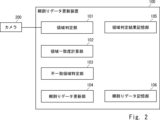
- FIG. 2 shows a shelf allocation data updating device according to one embodiment of the present disclosure.
- the shelf allocation data updating device 100 has an area determination unit 101, an area coincidence calculation unit 102, an inconsistent area identification unit 103, a shelf allocation data updating unit 104, an area determination result storage unit 105, and a shelf allocation data storage unit 106.
- the shelf allocation data updating device 100 may be configured as a device having one or more processors and one or more memories. For example, at least a portion of each functional block in the shelf allocation data updating device 100 may be realized by the processor executing processing in accordance with instructions read from the memory.
- the shelf allocation data updating device 100 acquires images taken by the camera 200 from the camera 200.
- the camera 200 is a camera that captures images of shelves on which objects such as products are displayed.
- the camera 200 is installed in a location such as the ceiling of a sales floor of a store, and captures images of shelves on which products are displayed in the sales floor, i.e., product shelves.
- the shelf allocation data updating device 100 acquires images of product shelves captured by the camera 200, for example, periodically.
- the images acquired by the shelf allocation data updating device 100 include a first image captured at a first time and a second image captured at a second time that is later than the first time.
- the area determination unit 101 performs object detection on the image acquired from the camera 200. For example, the area determination unit 101 performs object detection on an image of a shelf on which products are displayed, and detects the products displayed on the shelf. Based on the result of the object detection, the area determination unit 101 determines the area in which each detected object is located. For example, the area determination unit 101 determines the area in which the product is located on the shelf by merging areas or frames in which the same product is consecutive on the shelf. The area determination unit 101 performs area determination on each of the first image and the second image. The area determination unit 101 stores the results of the area determination in the area determination result storage unit 105.
- FIG. 3 shows an example of the result of area determination performed on the first image.
- the products displayed on the shelf are bottled drinks.
- Six types of products, products A-F are displayed on the shelf.
- the area determination unit 101 performs object detection on the first image, for example, and individually detects the areas in which products A-F are arranged.
- the area determination unit 101 merges individual product areas in which the same products are lined up consecutively, and determines areas 210A-210F in which each product is arranged.
- the area determination unit 101 stores, for example, the coordinates of areas 210A-210F in which products A-F are arranged, such as a pair of the top left coordinate and bottom right coordinate of an area represented by a rectangle, in the area determination result storage unit 105 as the first area determination result.
- the area determination unit 101 stores, for example, the coordinates of the areas 220A-220G in which products A-G are arranged, such as a pair of the top left coordinate and the bottom right coordinate of an area represented by a rectangle, in the area determination result storage unit 105 as the second area determination result.
- the area coincidence calculation unit 102 compares the first area determination result with the second area determination result, and calculates the degree of coincidence of the areas for each object, i.e., product. For example, the area coincidence calculation unit 102 calculates the degree of coincidence as the ratio of the area of the overlapping portion of the areas, i.e., the common portion, to the area of the union of the area of the product in the first area determination result and the area of the product in the second area determination result. For example, the area coincidence calculation unit 102 calculates IoU (Intersection over Union), which is an index indicating the degree to which two areas overlap, for each product area in the first area determination result and each product area in the second area determination result.
- IoU Intersection over Union
- the area matching calculation unit 102 calculates the area matching for each of products detected from both the first image and the second image, products detected only from the first image, and products detected only from the second image.
- a predetermined threshold it can be determined that there may have been a change in the shelf layout, i.e., an increase or decrease in the number of faces.
- the matching is equal to or greater than the threshold, it is considered that the shelf layout has not been changed. For this reason, there is no need to update the shelf layout data for products with a high degree of matching.
- FIG. 5 shows a specific example of the degree of agreement between the areas of each product in the first area determination result and the areas of each product in the second area determination result.
- the area agreement calculation unit 102 calculates the degree of agreement between areas 210A-F in the first area determination result and areas 220A-G in the second area determination result for each of products A-G.
- the area agreement calculation unit 102 calculates the ratio of the area of the common part to the area of the union of area 210A in the first area determination result and area 220A in the second area determination result as the degree of agreement.
- the area agreement calculation unit 102 calculates the ratio of the area of the common part to the area of the union of the two areas as the degree of agreement.
- the area agreement calculation unit 102 calculates that for product A, the agreement between area 210A and area 220A is 64%.
- the area agreement calculation unit 102 calculates that the agreement between area 210B-F and area 220B-F is 48%, 61%, 64%, 26%, and 97%, respectively.
- the area agreement calculation unit 102 calculates the agreement as 0%.
- the agreement between the area of product F is 97%, which is equal to or greater than a predetermined threshold value. In this case, it can be determined that the shelf allocation of product F has not been changed in the period between the time the first image was acquired and the time the second image was acquired.
- the mismatch area identifying unit 103 compares the first area determination result with the second area determination result, and identifies mismatch areas, which are areas where the objects detected in the first image and the second image do not match.
- the mismatch area identifying unit 103 identifies mismatch areas, for example, for products where the degree of match between the first area determination result and the second area determination result is less than a predetermined threshold. For products where the degree of match between the first area determination result and the second area determination result is high, it is considered that no increase or decrease in the face has occurred. For this reason, the mismatch area identifying unit 103 does not need to identify mismatch areas for products where the degree of match is high.
- FIG. 6 shows a specific example of the results of identifying mismatched areas.
- the mismatched area identifying unit 103 compares areas 210A-210F of products A-F in the first area determination result (see FIG. 3) with areas 220A-G of products A-G in the second area determination result (see FIG. 4) to identify mismatched areas.
- the mismatched area identifying unit 103 identifies areas of each product that are common to both area determination results as matching areas 251-256.
- the mismatched area identifying unit 103 identifies areas of each product that are not common to both area determination results as mismatched areas 261-264.
- the identification of mismatched areas by the mismatched area identifying unit 103 and the calculation of the area matching degree by the area matching degree calculation unit 102 may be performed simultaneously.
- the shelf allocation data storage unit 106 stores the shelf allocation data of the shelf photographed by the camera 200.
- the shelf allocation data includes, for example, a list of products to be placed on the shelf and information indicating the area of the shelf in which each product is placed.
- the shelf allocation data storage unit 106 stores the shelf allocation data that was updated at the time when the first image is acquired.
- the initial value of the shelf allocation data may be generated automatically from the area determination result of the area determination unit 101 at the start of operation, for example.
- the camera 200 acquires an image of a shelf that is filled with products without any gaps at the start of operation.
- the area determination unit 101 performs object detection on the image acquired from the camera 200, and for each detected object, determines the area in which the object is located.
- the result of the area determination at the start of operation may be used as the initial value of the shelf allocation data.
- the initial value of the shelf allocation data may be given manually.
- the allocation data update unit 104 updates the allocation data stored in the allocation data storage unit 106 based on the second area determination result determined from the second image and the mismatched area identified by the mismatched area identification unit 103.
- the allocation data update unit 104 updates the allocation data, for example, depending on whether a product is detected in the mismatched area in the second image. For example, the allocation data update unit 104 determines whether a product is detected in the second image for each mismatched area identified by the mismatched area identification unit 103. Specifically, the allocation data update unit 104 determines whether an object is detected in the second image for each of the mismatched areas 261-264 shown in FIG. 6.
- the allocation data update unit 104 determines which product the mismatched area is, depending on whether a product is detected in the mismatched area.
- the allocation data update unit 104 determines that a change in the allocation or an increase or decrease in the number of faces has occurred, and updates the allocation data. If a product is detected in a mismatched area in the second image, the allocation data update unit 104 assigns the product detected in the mismatched area in the second image to the mismatched area in the updated allocation data. If no object is detected in the mismatched area in the second image, the allocation data update unit 104 determines that the mismatched area has occurred due to a shortage of a product. In that case, the allocation data update unit 104 does not change the product assigned to the mismatched area from the product assigned to the mismatched area in the allocation data at the time the first image was acquired. The allocation data update unit 104 stores the updated allocation data in the allocation data storage unit 106.
- FIG. 7 shows a specific example of the planogram data before updating.
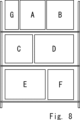
- FIG. 8 shows a specific example of the planogram data after updating.
- A" to “G” indicate which product, A to G, the rectangular area is assigned to.
- A" to “G” indicate which product, A to G, each area corresponds to.
- the planogram data before updating shown in FIG. 7 is planogram data updated or generated at the time the first image was acquired.
- the planogram data update unit 104 updates the product assigned to the inconsistent area identified by the inconsistent area identification unit 103 depending on whether or not a product is detected in the inconsistent area in the second image.
- the mismatched area 261 shown in FIG. 6 is assigned to product A.
- the planogram data update unit 104 determines whether a product has been detected in the second image for the mismatched area 261. As shown in FIG. 4, product G has been detected in the mismatched area 261 in the second image. In other words, the mismatched area 261 overlaps with the area 220G of product G in the second area determination result. In this case, the planogram data update unit 104 changes the product assigned to the mismatched area 261 in the planogram data from product A before the update to product G. Because the product assigned to the mismatched area 261 has changed, the planogram data update unit 104 reduces the area of product A by one product in the updated planogram data, as shown in FIG. 8.
- the mismatched area 263 shown in FIG. 6 is assigned to product C.
- the planogram data update unit 104 determines whether or not a product has been detected in the second image for the mismatched area 263. As shown in FIG. 4, product D has been detected in the mismatched area 263 in the second image. In other words, the mismatched area 263 overlaps with the area 220D of product D in the second area determination result.
- the planogram data update unit 104 changes the product assigned to the mismatched area 261 in the planogram data from product C before the update to product D.
- the area of product D is expanded by one product, and the area of product C is reduced by one product.
- the mismatched areas 262 and 264 shown in FIG. 6 are assigned to product B and product E, respectively.
- the planogram data update unit 104 determines whether or not a product is detected in the second image for each of the mismatched areas 262 and 264. As shown in FIG. 4, no product is detected in the mismatched areas 262 and 264 in the second image. In this case, the planogram data update unit 104 does not change the products assigned to the mismatched areas 262 and 264, respectively, in the planogram data from product B and product D before the update.
- the degree of area coincidence calculated by the area coincidence calculation unit 102 is equal to or greater than the threshold value, so there is no change in the area of product F in the planogram data.
- the planogram data update unit 104 stores the updated planogram data shown in FIG. 8 in the planogram data storage unit 106.
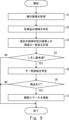
- FIG. 9 shows the operation procedure of the shelf allocation data updating device 100.
- the operation procedure of the shelf allocation data updating device 100 corresponds to the shelf allocation data updating method.
- the area determination unit 101 acquires an image of a shelf on which products are displayed from the camera 200 (step S1).
- the area determination unit 101 determines the area of each product displayed on the shelf from the acquired image (step S2).
- the area determination unit 101 for example, performs object detection on the image of the shelf acquired from the camera 200 to detect products, and determines the area of each product by merging the areas of the detected products.
- the area determination unit 101 stores the results of the area determination in the area determination result storage unit 105.
- the area agreement calculation unit 102 compares the result of the area determination in step S2 with the result of the area determination performed in the past planogram data update stored in the area determination result storage unit 105, and calculates the agreement of the area for each product present on the shelf (step S3).
- the result of the area determination performed in the past planogram data update is referred to as the first area determination result.
- the result of the area determination in step S1 is referred to as the second area determination result.
- the area agreement calculation unit 102 obtains, for example, the result of the area determination performed in the previous planogram data update as the first area determination result.
- the area agreement calculation unit 102 calculates the IoU between the area in the first area determination result and the area in the second area determination result for each product.
- the mismatched area identifying unit 103 determines whether the degree of matching of the area is less than a predetermined threshold for each product (step S4).
- the mismatched area identifying unit 103 identifies mismatched areas for products whose degree of matching of the area is less than the predetermined threshold (step S5).
- the planogram data updating unit 104 determines whether the product exists in the image acquired in step S1 for each identified mismatched area (step S6).
- the planogram data updating unit 104 updates the planogram data for the mismatched areas determined in step S6 to contain a product (step S7).
- step S7 the planogram data updating unit 104 assigns the mismatched areas determined in step S6 to contain a product, in the planogram data, to the product detected from the image acquired in step S1.
- the shelf allocation data update unit 104 does not update the shelf allocation data for products for which it is determined in step S4 that the degree of matching of the areas is equal to or greater than the threshold value. Furthermore, the shelf allocation data update unit 104 does not update the shelf allocation data for mismatched areas for which it is determined in step S6 that no products exist. The shelf allocation data update unit 104 stores the updated shelf allocation data in the shelf allocation data storage unit 106.
- the user may operate the shelf allocation data updating device 100 or another device to display the shelf allocation data stored in the shelf allocation data storage unit 106 on the display screen of the display device. By looking at the displayed shelf allocation data, the user can check whether the actual shelf allocation matches the shelf allocation indicated by the shelf allocation data. The user may operate the shelf allocation data updating device 100 or another device to manually correct the shelf allocation data stored in the shelf allocation data storage unit 106.
- the planogram data storage unit 106 may record a change history.
- the planogram data updating device 100 or another device may display frames indicating areas of changed products in a color different from the color of frames indicating areas of unchanged products. In this case, the user can know which parts have been changed in the update.
- the planogram data updating device 100 or another device may display the planogram data before the update and the updated planogram data in a manner that allows comparison.
- the planogram data updating device 100 may display the planogram data before the update shown in FIG. 7 and the updated planogram data shown in FIG. 8 side by side on the display screen.
- the planogram data updating device 100 or another device may display, in addition to the planogram data, an image of the camera 200 used to update the planogram data on the display screen.
- the user may be able to select any area or product in the displayed planogram data.
- the planogram data updating device 100 or another device uses the update history to identify the timing when the planogram data for that product or area was updated.
- the planogram data updating device 100 or another device may display the planogram data before the update at the identified timing and the updated planogram data in a manner that allows comparison.
- the area determination unit 101 performs area determination on a first image acquired at a first time and obtains a first area determination result.
- the area determination unit 101 also performs area determination on a second image acquired at a second time and obtains a second area determination result.
- the mismatched area identification unit 103 compares the first area determination result with the second area determination result and identifies a mismatched area.
- the shelf allocation data update unit 104 updates the shelf allocation data based on the second area determination result and the identified mismatched area.
- the mismatched area identified by the mismatched area identification unit 103 is considered to be related to an area where a change in shelf allocation or an increase or decrease in the number of faces has occurred.
- the shelf allocation data update device 100 can detect a change in shelf allocation or an increase or decrease in the number of faces based on the first image and the second image acquired in chronological order, and update the shelf allocation data according to the detected change in shelf allocation or increase or decrease in the number of faces.
- the allocation data update unit 104 determines whether or not a product has been detected in the second image for each identified mismatch area. Depending on whether or not a product is present in the mismatch area in the second image, it can be determined whether the product is absent in the second image, i.e., is out of stock, or whether the product has been replaced. In this embodiment, the allocation data update unit 104 updates the allocation data depending on whether or not a product has been detected in the mismatch area in the second image. In this case, the allocation data update unit 104 can appropriately update the allocation data for the out-of-stock areas and the areas where products have been replaced.
- the camera 200 acquires images of product display shelves arranged in a sales area in a store.
- the camera 200 does not necessarily have to be installed in a store such as a retail store, and for example, the camera 200 may acquire images of shelves on which some object is placed in a location other than a store, such as a warehouse.
- the shelf allocation data updating device 100 can be used to update shelf allocation data for objects placed on shelves in a warehouse.
- the shelf allocation data updating device 100 may be configured using a computer device or a server device.
- FIG. 10 shows an example configuration of a computer device that may be used in the shelf allocation data updating device 100.
- the computer device 500 has a control unit (CPU: Central Processing Unit) 510, a storage unit 520, a ROM (Read Only Memory) 530, a RAM (Random Access Memory) 540, a communication interface (IF: Interface) 550, and a user interface 560.
- the communication interface 550 is an interface for connecting the computer device 500 to a communication network via a wired communication means or a wireless communication means.
- the user interface 560 includes a display unit such as a display.
- the user interface 560 also includes an input unit such as a keyboard, a mouse, and a touch panel.
- the storage unit 520 is an auxiliary storage device that can hold various types of data.
- the storage unit 520 does not necessarily have to be a part of the computer device 500, and may be an external storage device or cloud storage connected to the computer device 500 via a network.
- the storage unit 520 can be used as at least one of the area determination result storage unit 105 and the shelf allocation data storage unit 106 (see FIG. 2).
- the ROM 530 is a non-volatile storage device.
- a semiconductor storage device with a relatively small capacity such as a flash memory, is used for the ROM 530.
- the programs executed by the CPU 510 can be stored in the storage unit 520 or the ROM 530.
- the storage unit 520 or the ROM 530 stores various programs for implementing the functions of each part of the shelf planogram data update device 100, for example.
- the program includes instructions (or software code) that, when loaded into a computer, cause the computer to perform one or more functions described in the embodiments.
- the program may be stored on a non-transitory computer-readable medium or a tangible storage medium.
- computer-readable media or tangible storage media include RAM, ROM, flash memory, solid-state drive (SSD) or other memory technology, Compact Disc (CD), digital versatile disc (DVD), Blu-ray (registered trademark) disc or other optical disk storage, magnetic cassette, magnetic tape, magnetic disk storage or other magnetic storage devices.
- the program may be transmitted on a transitory computer-readable medium or a communication medium.
- transitory computer-readable media or communication media include electrical, optical, acoustic, or other forms of propagated signals.
- RAM 540 is a volatile storage device. Various semiconductor memory devices such as DRAM (Dynamic Random Access Memory) or SRAM (Static Random Access Memory) are used for RAM 540. RAM 540 can be used as an internal buffer for temporarily storing data, etc.
- CPU 510 loads a program stored in storage unit 520 or ROM 530 into RAM 540 and executes it. By CPU 510 executing a program, the functions of each unit in shelf allocation data update device 100 can be realized.
- CPU 510 may have an internal buffer for temporarily storing data, etc.
- the shelf allocation data update device 100 does not necessarily have to be configured as a single device.
- the shelf allocation data update device 100 may be configured using multiple physically separated devices.
- shelf allocation data updating device 11 Area determination unit 12: Mismatched area identification unit 13: Shelf allocation data updating unit 100: Shelf allocation data updating device 101: Area determination unit 102: Area agreement degree calculation unit 103: Mismatched area identification unit 104: Shelf allocation data updating unit 105: Area determination result storage unit 106: Shelf allocation data storage unit 500: Computer device 510: Control unit 520: Storage unit 530: ROM 540: RAM 550: Communication interface 560: User interface
Landscapes
- Business, Economics & Management (AREA)
- Accounting & Taxation (AREA)
- Finance (AREA)
- Development Economics (AREA)
- Economics (AREA)
- Marketing (AREA)
- Strategic Management (AREA)
- Physics & Mathematics (AREA)
- General Business, Economics & Management (AREA)
- General Physics & Mathematics (AREA)
- Engineering & Computer Science (AREA)
- Theoretical Computer Science (AREA)
- Management, Administration, Business Operations System, And Electronic Commerce (AREA)
Abstract
Description
11:領域判定部
12:不一致領域特定部
13:棚割りデータ更新部
100:棚割りデータ更新装置
101:領域判定部
102:領域一致度計算部
103:不一致領域特定部
104:棚割りデータ更新部
105:領域判定結果記憶部
106:棚割りデータ記憶部
500:コンピュータ装置
510:制御部
520:記憶部
530:ROM
540:RAM
550:通信インタフェース
560:ユーザインタフェース
Claims (9)
- 物体が並ぶ棚を撮影することで取得される画像に対して物体検出を実施し、該物体検出の結果に基づいて、物体ごとに該物体が配置される領域を判定する領域判定を実施する領域判定部と、
前記棚を第1の時刻に撮影することで取得される第1の画像に対する前記領域判定の結果である第1の領域判定結果と、前記棚を前記第1の時刻よりも後の時刻である第2の時刻に撮影することで取得される第2の画像に対する前記領域判定の結果である第2の領域判定結果とを比較し、前記第1の画像と前記第2の画像とで検出される物体が一致しない領域である不一致領域を特定する不一致領域特定部と、
前記第2の領域判定結果と、前記不一致領域とに基づいて、前記棚の棚割りデータを更新する棚割りデータ更新部とを備える棚割りデータ更新装置。 - 前記棚割りデータ更新部は、前記第2の画像において前記不一致領域で物体が検出されているか否かに応じて、前記棚割りデータを更新するか否かを決定する、請求項1に記載の棚割りデータ更新装置。
- 前記棚割りデータ更新部は、前記第2の画像において前記不一致領域で物体が検出されている場合、前記棚割りデータにおいて、前記第2の画像において前記不一致領域で検出された物体を前記不一致領域に割り当て、前記第2の画像において前記不一致領域で物体が検出されていない場合、前記棚割りデータにおいて、前記不一致領域に割り当てられる物体を、前記第1の時刻の前記棚割りデータにおいて前記不一致領域に割り当てられている物体から変更しない、請求項2に記載の棚割りデータ更新装置。
- 前記第1の領域判定結果と前記第2の領域判定結果とを比較し、物体ごとに、前記物体が配置される領域の一致度を計算する領域一致度計算部を更に有し、
前記不一致領域特定部は、前記領域の一致度が所定値未満の物体について、前記不一致領域を特定する、請求項1から3何れか1項に記載の棚割りデータ更新装置。 - 前記領域一致度計算部は、物体ごとに、第1の領域判定結果における領域と第2の領域判定結果における領域の和集合の面積に対する、第1の領域判定結果における領域と第2の領域判定結果における領域との共通部分の面積の割合を、一致度として計算する、請求項4に記載の棚割りデータ更新装置。
- 物体が並ぶ棚を第1の時刻に撮影することで取得される第1の画像に対して物体検出を実施し、該物体検出の結果に基づいて、物体ごとに該物体が配置される領域を判定することで、第1の領域判定結果を取得し、
前記棚を第1の時刻よりも後の時刻である第2の時刻に撮影することで取得される第2の画像に対して物体検出を実施し、該物体検出の結果に基づいて、物体ごとに該物体が配置される領域を判定することで、第2の領域判定結果を取得し、
前記第1の領域判定結果と、前記第2の領域判定結果とを比較し、前記第1の画像と前記第2の画像とで検出される物体が一致しない領域である不一致領域を特定し、
前記第2の領域判定結果と、前記不一致領域とに基づいて、前記棚の棚割りデータを更新することを有する棚割りデータ更新方法。 - 前記棚割りデータを更新することは、前記第2の画像において前記不一致領域で物体が検出されているか否かに応じて、前記棚割りデータを更新するか否かを決定することを有する、請求項6に記載の棚割りデータ更新方法。
- 物体が並ぶ棚を第1の時刻に撮影することで取得される第1の画像に対して物体検出を実施し、該物体検出の結果に基づいて、物体ごとに該物体が配置される領域を判定することで、第1の領域判定結果を取得し、
前記棚を第1の時刻よりも後の時刻である第2の時刻に撮影することで取得される第2の画像に対して物体検出を実施し、該物体検出の結果に基づいて、物体ごとに該物体が配置される領域を判定することで、第2の領域判定結果を取得し、
前記第1の領域判定結果と、前記第2の領域判定結果とを比較し、前記第1の画像と前記第2の画像とで検出される物体が一致しない領域である不一致領域を特定し、
前記第2の領域判定結果と、前記不一致領域とに基づいて、前記棚の棚割りデータを更新することを含む処理をコンピュータに実行させるためのプログラムを格納する非一時的なコンピュータ可読媒体。 - 前記棚割りデータを更新することは、前記第2の画像において前記不一致領域で物体が検出されているか否かに応じて、前記棚割りデータを更新するか否かを決定することを有する、請求項8に記載の非一時的なコンピュータ可読媒体。
Priority Applications (2)
| Application Number | Priority Date | Filing Date | Title |
|---|---|---|---|
| PCT/JP2023/012522 WO2024201715A1 (ja) | 2023-03-28 | 2023-03-28 | 棚割りデータ更新装置、棚割りデータ更新方法、及びコンピュータ可読媒体 |
| JP2025509337A JPWO2024201715A5 (ja) | 2023-03-28 | 棚割りデータ更新装置、棚割りデータ更新方法、及びプログラム |
Applications Claiming Priority (1)
| Application Number | Priority Date | Filing Date | Title |
|---|---|---|---|
| PCT/JP2023/012522 WO2024201715A1 (ja) | 2023-03-28 | 2023-03-28 | 棚割りデータ更新装置、棚割りデータ更新方法、及びコンピュータ可読媒体 |
Publications (1)
| Publication Number | Publication Date |
|---|---|
| WO2024201715A1 true WO2024201715A1 (ja) | 2024-10-03 |
Family
ID=92904314
Family Applications (1)
| Application Number | Title | Priority Date | Filing Date |
|---|---|---|---|
| PCT/JP2023/012522 Ceased WO2024201715A1 (ja) | 2023-03-28 | 2023-03-28 | 棚割りデータ更新装置、棚割りデータ更新方法、及びコンピュータ可読媒体 |
Country Status (1)
| Country | Link |
|---|---|
| WO (1) | WO2024201715A1 (ja) |
Citations (2)
| Publication number | Priority date | Publication date | Assignee | Title |
|---|---|---|---|---|
| JP2019040227A (ja) * | 2017-08-22 | 2019-03-14 | 株式会社日立製作所 | 在庫管理システム |
| JP2021080087A (ja) * | 2019-11-21 | 2021-05-27 | 株式会社Retail AI Lab | 情報処理システムと情報処理装置と情報処理プログラムと情報処理方法 |
-
2023
- 2023-03-28 WO PCT/JP2023/012522 patent/WO2024201715A1/ja not_active Ceased
Patent Citations (2)
| Publication number | Priority date | Publication date | Assignee | Title |
|---|---|---|---|---|
| JP2019040227A (ja) * | 2017-08-22 | 2019-03-14 | 株式会社日立製作所 | 在庫管理システム |
| JP2021080087A (ja) * | 2019-11-21 | 2021-05-27 | 株式会社Retail AI Lab | 情報処理システムと情報処理装置と情報処理プログラムと情報処理方法 |
Also Published As
| Publication number | Publication date |
|---|---|
| JPWO2024201715A1 (ja) | 2024-10-03 |
Similar Documents
| Publication | Publication Date | Title |
|---|---|---|
| US20220277563A1 (en) | Shelf label detection device, shelf label detection method, and shelf label detection program | |
| US11403843B2 (en) | Image processing apparatus, display control apparatus, image processing method and recording medium | |
| US20200334620A1 (en) | Shelf monitoring device, shelf monitoring method, and shelf monitoring program | |
| WO2014049729A1 (ja) | 動画像認識装置及び動画像認識方法 | |
| US10387395B2 (en) | Parallelized execution of window operator | |
| US20230386209A1 (en) | Processing device, processing method, and non-transitory storage medium | |
| US20230306741A1 (en) | Product detection device, product detection method, and recording medium | |
| CN105447839A (zh) | 矩形框的合并方法及合并系统 | |
| JP7108553B2 (ja) | 棚割情報生成装置及び棚割情報生成プログラム | |
| WO2024201715A1 (ja) | 棚割りデータ更新装置、棚割りデータ更新方法、及びコンピュータ可読媒体 | |
| CN113269053A (zh) | 商品的货架层列获取方法、终端、存储装置 | |
| US20160125032A1 (en) | Partition-aware distributed execution of window operator | |
| WO2022024341A1 (ja) | 商品検知装置、商品検知システム、商品検知方法および記録媒体 | |
| WO2021024459A1 (ja) | 処理装置、会計装置、処理方法及びプログラム | |
| JP5876129B2 (ja) | 動画像認識装置及び動画像認識方法 | |
| US20230290080A1 (en) | Systems and methods for tracking objects stored in a real-world 3d space | |
| US20250232432A1 (en) | Vehicle management device, system, method, and computer-readable medium | |
| JP7544269B2 (ja) | 欠品検出装置、欠品検出方法、及びプログラム | |
| EP4095688A1 (en) | Method and apparatus for processing transaction | |
| JP7563625B2 (ja) | 画像解析システム、画像解析方法およびプログラム | |
| US11551289B2 (en) | Intelligent store system and intelligent store method | |
| JP6519330B2 (ja) | プログラム、情報処理装置及び情報処理方法 | |
| US20160232510A1 (en) | Checkout apparatus and method for presenting candidate merchandise | |
| WO2025204989A1 (ja) | 在庫管理方法、プログラム、及び、在庫管理システム | |
| WO2025017855A1 (ja) | 監視装置、監視方法、及び記録媒体 |
Legal Events
| Date | Code | Title | Description |
|---|---|---|---|
| 121 | Ep: the epo has been informed by wipo that ep was designated in this application |
Ref document number: 23930355 Country of ref document: EP Kind code of ref document: A1 |
|
| ENP | Entry into the national phase |
Ref document number: 2025509337 Country of ref document: JP Kind code of ref document: A |
|
| WWE | Wipo information: entry into national phase |
Ref document number: 2025509337 Country of ref document: JP |
|
| NENP | Non-entry into the national phase |
Ref country code: DE |
|
| 122 | Ep: pct application non-entry in european phase |
Ref document number: 23930355 Country of ref document: EP Kind code of ref document: A1 |