WO2024181410A1 - カテーテル装置、および、カテーテル - Google Patents
カテーテル装置、および、カテーテル Download PDFInfo
- Publication number
- WO2024181410A1 WO2024181410A1 PCT/JP2024/006974 JP2024006974W WO2024181410A1 WO 2024181410 A1 WO2024181410 A1 WO 2024181410A1 JP 2024006974 W JP2024006974 W JP 2024006974W WO 2024181410 A1 WO2024181410 A1 WO 2024181410A1
- Authority
- WO
- WIPO (PCT)
- Prior art keywords
- catheter
- subject
- electrical stimulation
- control unit
- catheter device
- Prior art date
- Legal status (The legal status is an assumption and is not a legal conclusion. Google has not performed a legal analysis and makes no representation as to the accuracy of the status listed.)
- Ceased
Links
Images





Classifications
-
- A—HUMAN NECESSITIES
- A61—MEDICAL OR VETERINARY SCIENCE; HYGIENE
- A61N—ELECTROTHERAPY; MAGNETOTHERAPY; RADIATION THERAPY; ULTRASOUND THERAPY
- A61N1/00—Electrotherapy; Circuits therefor
- A61N1/18—Applying electric currents by contact electrodes
- A61N1/32—Applying electric currents by contact electrodes alternating or intermittent currents
- A61N1/36—Applying electric currents by contact electrodes alternating or intermittent currents for stimulation
- A61N1/3601—Applying electric currents by contact electrodes alternating or intermittent currents for stimulation of respiratory organs
-
- A—HUMAN NECESSITIES
- A61—MEDICAL OR VETERINARY SCIENCE; HYGIENE
- A61N—ELECTROTHERAPY; MAGNETOTHERAPY; RADIATION THERAPY; ULTRASOUND THERAPY
- A61N1/00—Electrotherapy; Circuits therefor
- A61N1/02—Details
- A61N1/04—Electrodes
- A61N1/05—Electrodes for implantation or insertion into the body, e.g. heart electrode
- A61N1/0551—Spinal or peripheral nerve electrodes
-
- A—HUMAN NECESSITIES
- A61—MEDICAL OR VETERINARY SCIENCE; HYGIENE
- A61N—ELECTROTHERAPY; MAGNETOTHERAPY; RADIATION THERAPY; ULTRASOUND THERAPY
- A61N1/00—Electrotherapy; Circuits therefor
- A61N1/18—Applying electric currents by contact electrodes
- A61N1/32—Applying electric currents by contact electrodes alternating or intermittent currents
- A61N1/36—Applying electric currents by contact electrodes alternating or intermittent currents for stimulation
- A61N1/3605—Implantable neurostimulators for stimulating central or peripheral nerve system
- A61N1/3606—Implantable neurostimulators for stimulating central or peripheral nerve system adapted for a particular treatment
- A61N1/3611—Respiration control
Definitions
- the present invention relates to a catheter device and a catheter.
- Patent No. 7153373 U.S. Pat. No. 1,105,2250
- Patent Document 1 may not be able to restore negative pressure ventilation via the diaphragm, and in that case may not contribute to improving lung function.
- the present invention has been made to solve the above problems, and aims to provide a catheter device and the like that helps improve lung function.
- a catheter device is a catheter device that includes a catheter for draining pleural fluid from a subject, an electrode provided on the catheter for electrically stimulating the respiratory muscles or phrenic nerve of the subject, and a control unit for controlling the electrical stimulation by the electrode.
- a catheter device is a catheter device that includes a catheter for draining ascites from a subject, an electrode provided on the catheter for electrically stimulating the respiratory muscles or phrenic nerve of the subject, and a control unit for controlling the electrical stimulation by the electrode.
- the present invention can be realized not only as an apparatus, but also as a method in which the processing means constituting the apparatus are steps, as a program that causes a computer to execute those steps, as a computer-readable recording medium such as a CD-ROM on which the program is recorded, or as information, data, or signals that indicate the program. Furthermore, those programs, information, data, and signals may be distributed via a communications network such as the Internet.
- the catheter device of the present invention helps improve lung function.
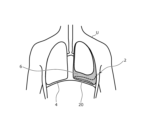
- FIG. 1A and 1B are first explanatory diagrams showing an example of the configuration of a thoracic catheter device according to an embodiment and a state during use.
- FIG. 2 is a second explanatory diagram showing an example of the configuration of a thoracic catheter device according to an embodiment and how it appears when in use.
- FIG. 1 is an explanatory diagram illustrating a schematic configuration of a catheter according to an embodiment.
- 3A to 3C are explanatory diagrams illustrating examples of the configuration of electrodes according to the embodiment.
- FIG. 2 is an explanatory diagram illustrating a functional configuration of a control device according to an embodiment.
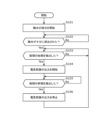
- FIG. 4 is a flow chart showing processing of a control device according to the embodiment.
- FIG. 1A and 1B are first explanatory diagrams showing an example of the configuration of a thoracic catheter device according to an embodiment and a state during use.
- FIG. 2 is a second explanatory diagram showing an example of the configuration of a thoracic catheter device according to
- FIG. 11 is a timing chart showing an example of the timing of drainage of pleural fluid and electrical stimulation by the thoracic catheter device according to the embodiment.
- FIG. 11 is a first explanatory diagram illustrating a schematic configuration of a catheter according to a first modified example of an embodiment.
- FIG. 13 is a second explanatory diagram illustrating the configuration of the catheter according to the first modified example of the embodiment.
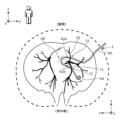
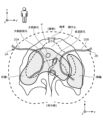
- 10 is an explanatory diagram illustrating a schematic diagram of a position where a catheter according to a first modified example of an embodiment is placed inside a human body.
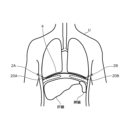
- FIG. FIG. 11 is a first explanatory diagram showing an example of a state in which a abdominal catheter device according to a second modified example of an embodiment is in use.
- FIG. 11 is a second explanatory diagram showing an example of a state when the abdominal catheter device according to the second modified example of the embodiment is used.
- ICU intensive care unit
- a patient's own respiratory muscles may weaken while receiving respiratory assistance from a ventilator for a long period of time, which may induce diaphragmatic dysfunction (VIDD (ventilator-induced diaphragmatic dysfunction)).
- VIP ventilation-induced diaphragmatic dysfunction
- a patient may accumulate pleural fluid in the thoracic cavity or ascites in the abdominal cavity due to being bedridden for a long period of time.
- positive pressure ventilation by a ventilator is a non-physiological ventilation method, the lungs may not be able to expand sufficiently.
- the two phrenic nerves that control the activation of the diaphragm run from the brain through the neck, along the left and right sides of the heart, through the chest and to the diaphragm.
- One prior art is a technique that stimulates the phrenic nerves in the neck to pace the diaphragm (see Patent Document 2).
- the other prior art is a technique that approaches the central vein percutaneously from the left subclavian vein, stimulates the phrenic nerves from within the blood vessel and paces the diaphragm (see Patent Document 1).
- the present invention provides a catheter device that helps improve lung function. Specifically, the present invention provides a catheter device that improves symptoms of decreased respiratory function or atelectasis caused by respiratory muscle weakness, accumulation of pleural or ascites fluid, or pulmonary expansion failure.
- the catheter device is a novel device that is capable of electrically stimulating respiratory muscles or the phrenic nerve while draining accumulated pleural or ascites fluid.
- a catheter device comprising: a catheter for draining pleural fluid from a subject; an electrode attached to the catheter for electrically stimulating the respiratory muscles or phrenic nerve of the subject; and a control unit for controlling the electrical stimulation by the electrode.
- the catheter device both drains pleural fluid using a catheter that can be placed around the lungs of the subject, and electrically stimulates the respiratory muscles or phrenic nerve of the subject.
- the catheter device secures space around the lungs of the subject by draining pleural fluid, and contracts the diaphragm by electrical stimulation.
- the catheter device secures space in which the lungs can expand, and allows the lungs to expand into the secured space, thereby promoting the physiological breathing pattern of the subject (i.e., negative pressure ventilation).
- the catheter device has the effect of suppressing muscular atrophy of the diaphragm by moving the diaphragm, which is the largest respiratory muscle, by electrical stimulation.
- the catheter device achieves the above effect only with the catheter placed in the thoracic cavity of the subject (in other words, without placing another device in the body), thereby reducing the physical and mental burden on the subject and contributing to the continuous achievement of the above effect.
- the catheter device can also reduce the treatment period of patients receiving artificial respiration treatment, and reduce complications or deaths by eliminating the decline in respiratory function due to muscle weakness of the respiratory muscles, which is an unmet medical need, or atelectasis. In this way, the catheter device helps improve lung function.
- electrical stimulation is started after drainage of pleural fluid from the thoracic cavity has begun, so electrical stimulation can be performed appropriately after the fluid has been removed from the thoracic cavity and space has been secured for the lungs to expand. This further promotes the subject's physiological breathing pattern.
- the catheter device more appropriately supports the improvement of lung function.
- control unit acquires timing information indicating the timing of breathing output from a sensor that detects the timing of breathing of the subject, and the control unit controls the repeated output of the electrical stimulation by the electrodes in synchronization with the timing of breathing indicated in the timing information while continuously draining the pleural fluid through the catheter.
- the catheter device continuously drains pleural fluid from the subject while providing electrical stimulation in synchronization with the subject's breathing. This allows the drainage of pleural fluid to ensure space around the subject's lungs, while the electrical stimulation synchronized with breathing can further promote a physiological breathing pattern caused by diaphragm contraction. Thus, the catheter device further supports the improvement of lung function.
- control unit detects the inhalation and exhalation periods of the subject's breathing based on the timing information, and performs the control by starting the output of the electrical stimulation at the start of the inhalation period, stopping the output of the electrical stimulation at the end of the inhalation period, and prohibiting the output of the electrical stimulation during the exhalation period.
- the catheter device controls the output of electrical stimulation during the subject's inhalation phase and not during exhalation phase. This makes it possible to enhance the effect of strengthening diaphragm muscle strength or inhibiting muscle atrophy by causing muscle contraction due to electrical stimulation when the subject's diaphragm contracts during inhalation.
- the catheter device further supports the improvement of lung function.
- the catheter device more easily drains pleural fluid from the thoracic cavity by using the drainage device to aspirate the pleural fluid.
- the catheter device more easily supports the improvement of lung function.
- the catheter device further comprising a reception unit that receives operations by an operator, and the control unit controls the drainage of the pleural fluid by the catheter in response to the reception unit receiving an operation related to the drainage of the pleural fluid, and controls the electrical stimulation by the electrodes in response to the reception unit receiving an operation related to the electrical stimulation.
- the catheter device controls the drainage of pleural fluid and the electrical stimulation in response to operation by the operator, so that the drainage of pleural fluid and the control of the electrical stimulation can be performed at the discretion of the operator. This can further promote a physiological breathing pattern using diaphragm contraction.
- the catheter device further supports the improvement of lung function in a more appropriate state.
- a catheter device according to any one of (1) to (6), in which the catheter has a hole at the distal end of the catheter and a side hole located closer to the distal end of the catheter than the electrode.
- the catheter aspirates pleural fluid through both the hole located at the distal end and the side hole located near the distal end. If the catheter only had a hole located at the distal end, there was a risk that aspirating pleural fluid would be hindered if this hole was blocked by the subject's blood or the like. Because the catheter also has a side hole, even if the hole located at the distal end is blocked, it is possible to properly maintain aspirating pleural fluid through the side hole. Thus, the catheter device supports the improvement of lung function under more appropriate conditions.
- a catheter device in which the catheter is inserted into the subject's body, the distal end of the catheter is located within the subject's thoracic cavity, and the electrodes are adjacent to the subject's respiratory muscles or phrenic nerve.
- the catheter is inserted into the subject's body, the distal end of the catheter is positioned within the subject's thoracic cavity, and the electrodes are in close proximity to the subject's respiratory muscles or phrenic nerve, so that pleural fluid can be more appropriately drained and the respiratory muscles or phrenic nerve can be more appropriately stimulated.
- the catheter device supports the improvement of lung function in a more appropriate state.
- the above embodiment has the effect of making it easier for the catheter to be inserted between the diaphragm and the lungs.
- the electrodes can be brought closer to the respiratory muscles or phrenic nerve, making it possible to more appropriately electrically stimulate the respiratory muscles or phrenic nerve.
- the catheter device more appropriately supports the improvement of lung function.
- the shape of the catheter corresponds to the shape of the gap between the diaphragm and the lungs, which has the effect of making it easier to insert the catheter between the diaphragm and the lungs.
- the electrodes can be brought closer to the respiratory muscles or phrenic nerve, allowing for more appropriate electrical stimulation of the respiratory muscles or phrenic nerve.
- the catheter device more appropriately supports the improvement of lung function.
- the electrodes placed in the curved portion can more appropriately provide electrical stimulation to the respiratory muscles or phrenic nerve.
- the catheter device more appropriately supports the improvement of lung function.
- the catheter device assists in improving the subject's atelectasis symptoms by controlling the drainage of pleural fluid and electrical stimulation of the respiratory muscles or phrenic nerve.
- a catheter for draining pleural effusion from a subject having an electrode attached to the catheter for electrically stimulating the respiratory muscles or phrenic nerve of the subject.
- the catheter is placed around the lungs of the subject, and both drains pleural fluid and electrically stimulates the respiratory muscles or phrenic nerve of the subject.
- the catheter secures space around the lungs of the subject by draining pleural fluid, and allows the lungs to expand into the secured space by contracting the diaphragm through electrical stimulation, thereby promoting the physiological breathing pattern of the subject (i.e., negative pressure ventilation).
- the catheter also has the effect of suppressing muscular atrophy of the diaphragm by moving the diaphragm, the largest respiratory muscle, through electrical stimulation.
- the catheter also achieves the above effect without placing any other device in the body, thereby reducing the physical and mental burden on the subject and contributing to the continuous achievement of the above effect.
- the catheter can also reduce the treatment period and reduce complications or deaths of patients receiving artificial respiration treatment by eliminating the decline in respiratory function due to muscle weakness of the respiratory muscles or atelectasis, which are unmet medical needs. In this way, the catheter supports the improvement of lung function.
- a catheter device comprising: a catheter for draining ascites from a subject; an electrode provided on the catheter for electrically stimulating the respiratory muscles or phrenic nerve of the subject; and a control unit for controlling the electrical stimulation by the electrode.
- the catheter device both drains ascites through a catheter that can be placed in the abdominal cavity of the subject, and electrically stimulates the respiratory muscles or phrenic nerve of the subject.
- the catheter device suppresses a decrease in the lung space of the subject caused by the accumulation of ascites pushing up the diaphragm, and also contracts the diaphragm through electrical stimulation.
- the catheter device secures space in which the lungs can expand, and allows the lungs to expand into the secured space, thereby promoting the physiological breathing pattern of the subject (i.e., negative pressure ventilation).
- the catheter device has the effect of suppressing muscular atrophy of the diaphragm by moving the diaphragm, the largest respiratory muscle, through electrical stimulation.
- the catheter device exerts the above effect only through the catheter that is placed in the abdominal cavity of the subject (in other words, without placing any other device in the body), thereby reducing the physical and mental burden on the subject and contributing to the continuous exertion of the above effect.
- the catheter device can address unmet medical needs, such as reduced respiratory function and atelectasis caused by weakened respiratory muscles, thereby shortening the treatment period for patients receiving artificial respiration and reducing complications or deaths. In this way, the catheter device helps improve lung function.
- a catheter for draining ascites from a subject having an electrode for electrically stimulating the respiratory muscles or phrenic nerve of the subject.
- the catheter has the same effect as the catheter device.
- a control method executed by a catheter device comprising: a catheter for draining pleural fluid from a subject; an electrode provided on the catheter for electrically stimulating the respiratory muscles or phrenic nerve of the subject; and a control unit, the control unit controlling the catheter to start draining the pleural fluid, and controlling the electrode to start the electrical stimulation after controlling the catheter to start draining the pleural fluid.
- the above aspect provides the same effects as the catheter device described above.
- a control method executed by a catheter device comprising: a catheter for draining ascites from a subject; an electrode provided on the catheter for electrically stimulating the respiratory muscles or phrenic nerve of the subject; and a control unit, the control unit controlling the catheter to start draining the ascites, and controlling the electrode to start the electrical stimulation after controlling the catheter to start draining the ascites.
- the above aspect provides the same effects as the catheter device described above.
- the catheter device in this embodiment is a thoracic catheter device that is placed around the lungs of a subject.
- the thoracic catheter device can support improvement of pulmonary function by at least using drainage of pleural fluid through a catheter.
- FIGS. 1 and 2 are schematic diagrams showing an example of the configuration of a thoracic catheter device 10 according to this embodiment and how it appears when in use.
- the thoracic catheter device 10 is a device that controls electrical stimulation to the phrenic nerve of a user U (also referred to as a subject) while draining pleural fluid from the user U.
- the user U is, for example, a patient with symptoms of atelectasis. It is assumed that the user U is receiving positive pressure ventilation using an artificial ventilator, but this is not limited to this.
- Pleural fluid has accumulated in the thoracic cavity 6 of the user U (see Figure 2).
- the thoracic catheter device 10 includes a catheter 20 and a control device 30.
- the thoracic catheter device 10 is also connected to a drainage device 40 and a sensor 50.
- the thoracic catheter device 10 may further be connected to an artificial ventilator 42.
- the thoracic catheter device 10, the drainage device 40, and the sensor 50 may be configured as a single system.
- the thoracic catheter device 10, the drainage device 40, the ventilator 42, and the sensor 50 may be configured as a single system.
- the catheter 20 is a catheter tube connected to the control device 30.
- the inner diameter of the catheter 20 is, for example, about 2 to 6.5 mm, and the outer diameter is, for example, about 3 to 7 mm.
- the length of the catheter 20 is, for example, about 50 to 80 cm.
- the material of the catheter 20 is a biocompatible material, such as silicone or polyurethane.
- the catheter 20 is percutaneously inserted into the body of the user U (more specifically, into the thoracic cavity 6).
- One end (also called the proximal end) of the catheter 20 is connected to the control device 30.
- the other end (also called the distal end) of the catheter 20 is inserted into the thoracic cavity 6 and is retained therein.
- the catheter 20 has an electrode (electrode 22, described below).
- the catheter 20 is inserted into the thoracic cavity 6 of the user U, for example, from the left or right intercostal space of the user U. Specifically, the catheter 20 is inserted into the thoracic cavity 6 of the user U through a hole 2 formed on the surface of the user U's body. The distal end of the catheter 20 is located within the thoracic cavity 6 of the user U, and the electrodes are positioned in close proximity to the respiratory muscles or phrenic nerve of the user U. The position close to the respiratory muscles or phrenic nerve of the user U is, for example, a position on the diaphragm 4 of the user U. It can also be said that the catheter 20 is placed on the diaphragm 4 of the user U.
- the catheter 20 can also be surgically inserted or placed in the thoracic cavity 6 of the user U. In that case, for example, the catheter 20 is placed so that the catheter 20 exits from inside the user U's body in the epigastric region.
- the position where the catheter 20 exits from inside the user U's body is not limited to the above.
- the electrodes can electrically stimulate the respiratory muscles or phrenic nerve of the user U.
- the catheter 20 can also drain pleural fluid that has accumulated in the thoracic cavity 6 of the user U by suction using the drainage device 40.
- the control device 30 is a control device that controls the drainage of pleural fluid through the catheter 20 and the electrical stimulation through the electrodes of the catheter 20.
- the control device 30 may be realized by a general-purpose computer or microcontroller executing a predetermined program, or may be realized by dedicated hardware.
- the drainage device 40 is connected to the proximal end of the catheter 20, and is a device that drains pleural fluid through the catheter 20. Specifically, when the distal end of the catheter 20 is located within the thoracic cavity 6 of the user U, the drainage device 40 applies a predetermined suction pressure to the proximal end of the catheter 20, thereby aspirating and discharging the pleural fluid accumulated in the thoracic cavity 6 through the catheter 20.
- the drainage device 40 is connected to the control device 30, and can perform a suction operation according to a signal received from the control device 30. Note that the drainage device 40 can also perform a suction operation according to a signal received from an independent control device without being connected to the control device 30.
- the drainage device 40 does not need to be a dedicated device for the thoracic catheter device 10, but may be a general drainage device 40.
- the ventilator 42 is a device that performs respiratory management by controlling the inhalation and exhalation of the user U.
- the ventilator 42 may be a positive pressure mechanical ventilator.
- the ventilator 42 does not need to be a dedicated device for the thoracic catheter device 10, and may be a general ventilator 42.
- the sensor 50 is a sensor that detects the breathing of the user U. More specifically, the sensor 50 detects the inhalation of the user U by detecting changes in physical quantities such as the airflow of exhaled and inhaled breath, temperature, carbon dioxide concentration, air pressure, or humidity. The sensor 50 then detects the timing of the breathing of the user U and obtains timing information indicating the timing of the breathing of the user U. The sensor 50 provides the timing information to the control device 30. Note that, in the case where the artificial ventilator 42 used by the user U has a function of providing timing information indicating the timing of breathing, the sensor 50 may be the above-mentioned function of the artificial ventilator 42.
- FIG. 2 illustrates an example in which pleural fluid has accumulated in the thoracic cavity 6 on the left side of the user U's chest
- pleural fluid may also accumulate in the thoracic cavity on the right side of the user U's chest.
- the catheter 20 is placed in the thoracic cavity in which the pleural fluid has accumulated (i.e., the thoracic cavity on the right side of the user U's chest).
- FIG. 3A is an explanatory diagram that shows a schematic configuration of the catheter 20 according to this embodiment.
- FIG. 3B is an explanatory diagram that shows a schematic configuration of the electrode 22 according to this embodiment.
- the configuration of the catheter 20 will be explained with reference to FIGS. 3A and 3B.
- the catheter 20 includes an electric wire 21, an electrode 22, and a side hole 23. Of the two ends of the catheter 20, end 25 corresponds to the distal end, and end 26 corresponds to the proximal end.
- the electric wire 21 electrically connects the control device 30 and the electrode 22, and transmits the electrical signal generated by the control device 30 to the electrode 22.
- the electrode 22 electrically stimulates the respiratory muscles or phrenic nerve of the user U.
- the electrode 22 electrically stimulates the respiratory muscles or phrenic nerve of the user U when the catheter 20 is placed in the thoracic cavity 6 of the user U (specifically, placed on the diaphragm 4).
- the electrode 22 is disposed on the outer surface of the catheter 20 (more specifically, the side wall of the catheter 20).
- the electrode 22 is disposed at a position a predetermined length away from the end 25. This is because the electrode 22 is appropriately disposed near the respiratory muscles or phrenic nerve that are the target of electrical stimulation, and the end 25 is appropriately disposed at the location where pleural fluid accumulates in the thoracic cavity 6.
- the predetermined length can be set to approximately the same length as the distance between the location of the respiratory muscles or phrenic nerve and the location where pleural fluid accumulates, which is generally known in the human body, and can be, for example, approximately 5 cm to 10 cm, but is not limited to this.
- the material of the electrode 22 is a biocompatible material, such as stainless steel, platinum, or iridium.
- the electrodes 22 have one or more electrodes 22a, 22b, 22c, 22d, and 22e (also referred to as electrodes 22a, etc.).
- Each of the electrodes 22a, etc. provides the above-mentioned electrical stimulation by changing the potential due to an electrical signal transmitted from the control device 30 through the electric wire 21. Note that depending on the position at which each of the electrodes 22a, etc. is placed, it may not be possible to effectively provide electrical stimulation to the position that is the target of electrical stimulation. In such a case, by changing the selection of the electrode that changes the potential among the electrodes 22a, etc., it is possible to effectively provide electrical stimulation to the position that is the target of electrical stimulation.
- the number of electrodes 22a, etc. is five, the number of electrodes 22a, etc. is not limited to the above.
- the above-mentioned electrical stimulation can be performed by changing the potential of the electrode 22 using the body of the user U as an earth.
- the above-mentioned electrical stimulation can be appropriately performed by changing the potential between at least two of the multiple electrodes 22.
- the electrode 22 may be, for example, a plate-shaped electrode provided along the outer periphery of the catheter 20, or an electrode formed of a conductor wound in a coil or spiral shape around the outer periphery of the catheter (see, for example, FIG. 3B).
- the side hole 23 is an opening provided in the catheter 20 (more specifically, in the side wall of the catheter 20).
- suction pressure is applied to the end 26 by the drainage device 40, the user U's pleural fluid flows into the side hole 23.
- the pleural fluid that flows in flows inside the catheter 20 and is sucked into the drainage device 40.
- Side holes 23 are located closer to end 25 than electrode 22. Side holes 23 are located in the vicinity of end 25 (for example, within about 5 cm). More specifically, side holes 23 have one or more side holes 23a, 23b, 23c, 23d, 23e, and 23f. Note that while an example is shown in which there are six side holes 23a, etc., the number of side holes 23a, etc. is not limited to the above. Side holes 23a, etc. may be arranged at various positions in the circumferential direction.
- the end 25 has an opening.
- the opening is, for example, circular or elliptical, and its diameter is, for example, about 1 mm.
- End 25 is positioned at a position in thoracic cavity 6 where pleural fluid is accumulated.
- User U's pleural fluid flows into end 25 when suction pressure is applied to end 26 by drainage device 40.
- the pleural fluid that flows in from end 25 flows inside catheter 20 and is sucked into drainage device 40. Note that user U's pleural fluid may also flow into end 25 when suction pressure is applied to end 26 due to a drop.
- the opening at the end 25 also functions as a hole through which a wire that functions as a guide for the catheter 20 is inserted when the catheter 20 is inserted into the thoracic cavity 6 of the user U.
- the end 26 has an opening.
- a drainage device 40 is connected to the end 26. When suction pressure is applied to the end 26 by the drainage device 40, pleural fluid that has flowed into the inside of the catheter 20 from the opening of the end 25 or the side hole 23 flows inside the catheter 20 and is sucked into the drainage device 40.
- the catheter 20 has an opening at the end 25 and a side hole 23 as openings, and the pleural fluid of the user U flows in through these openings. If the opening at the end 25 was the only opening, there is a risk that the suction of the pleural fluid will be hindered when the end 25 becomes blocked by the user U's blood or the like. Because the catheter 20 also has the side hole 23 as an opening, the suction of the pleural fluid through the side hole 23 can be maintained even if the opening at the end 25 is blocked.
- control device 30 The configuration of the control device 30 will now be explained in more detail.
- FIG. 4 is an explanatory diagram showing the functional configuration of the control device 30 according to this embodiment.
- the control device 30 includes an acquisition unit 31, a control unit 32, and a reception unit 33.
- the acquisition unit 31 is connected to the sensor 50 and acquires timing information indicating the timing of the user U's breathing from the sensor 50.
- the control unit 32 controls the electrical stimulation by the electrodes 22 of the catheter 20.
- the control unit 32 can also control the drainage of pleural fluid by the catheter 20.
- control unit 32 can control the drainage of pleural fluid using the catheter 20 while providing electrical stimulation using the electrode 22.
- the control unit 32 can also control the initiation of electrical stimulation by the electrode 22 after initiating the discharge of pleural fluid by the catheter 20. In other words, the control unit 32 can control the initiation of electrical stimulation by the electrode 22 after initiating the discharge of pleural fluid by the catheter 20.
- the control unit 32 controls the drainage device 40 to aspirate the pleural fluid through the catheter 20 by sending a control signal to the drainage device 40.
- the control unit 32 In controlling electrical stimulation, the control unit 32 generates an electrical signal for electrical stimulation and transmits the generated electrical signal to the electrode 22 through the electric wire 21.
- the signal pattern of the electrical signal may be determined arbitrarily, and may be, for example, a rectangular wave, a sine wave, an amplitude modulated wave, a frequency modulated wave, a burst modulated wave, or a Gaussian modulated sine wave.
- the amplitude of the electrical signal may be, for example, 5 to 25 mA, and the frequency may be, for example, within the range of 20 to 1000 Hz, or within the range of 30 to 150 Hz.
- an amplitude modulated wave By using an amplitude modulated wave, a frequency modulated wave, or a burst modulated wave as the signal pattern and gradually increasing the amplitude or frequency of the electrical signal, it is possible to soften the stimulation to the user U immediately after the start of electrical stimulation.
- the amplitude of the electrical signal can be set within a range of, for example, 0.1 to 25 mA, and electrical stimulation can begin with an amplitude from the lower limit of the range, and the amplitude can be gradually increased (higher).
- the frequency of the electrical signal can be set within a range of, for example, 1 to 150 Hz, and electrical stimulation can begin with a frequency from the lower limit of the range, and the frequency can be gradually increased (higher).
- the frequency of the electrical signal in the case of a burst modulated wave, can be set within a range of, for example, 20 to 2000 Hz, and electrical stimulation can begin with a frequency from the lower limit of the range, and the frequency can be gradually increased (higher).
- the control unit 32 may control the electrical stimulation in accordance with the timing of the user U's breathing while continuously draining the pleural fluid. In other words, the control unit 32 may control the repeated electrical stimulation by the electrodes in synchronization with the timing of the user U's breathing as indicated by the timing information while continuously draining the pleural fluid using the catheter 20.
- control unit 32 may detect the inhalation and exhalation periods of the user U's breathing based on the timing information, and start electrical stimulation at the start of the inhalation period and stop electrical stimulation at the end of the inhalation period, as a control synchronized with the timing of the user U's breathing.
- the electric wire 21 prohibits electrical stimulation during the exhalation period.
- the control unit 32 may control the drainage of pleural fluid and the electrical stimulation in response to an operation received by the reception unit 33. That is, the control unit 32 may control the drainage of pleural fluid in response to the reception unit 33 receiving an operation related to the drainage of pleural fluid. The control unit 32 may also control the electrical stimulation by the electrodes 22 in response to the reception unit 33 receiving an operation related to the electrical stimulation.
- the reception unit 33 receives operations by an operator (e.g., a doctor). When the reception unit 33 receives an operation, it provides information indicating the received operation to the control unit 32.
- the above operations may include, for example, an operation to instruct the drainage of pleural fluid or an operation to instruct electrical stimulation.
- the above operations may also include an operation to adjust the amount of pleural fluid drained or an operation to adjust the intensity of the electrical stimulation.
- the reception unit 33 may be, for example, a button or switch that receives operations by the operator.
- the reception unit 33 may also be an input device such as a touch panel, a touch pad, a keyboard, or a mouse. In this case, the reception unit 33 may display a guide image on a display screen (not shown) that guides the operation by the operator, and may receive operations performed by the operator who views the guide image via the input device.
- control device 30 The processing of the control device 30 will be explained below.
- FIG. 5 is a flow diagram showing the processing of the control device 30 according to this embodiment.
- the series of processing shown in FIG. 5 is processing performed by the control device 30 after the catheter 20 is inserted into the thoracic cavity 6 of the subject (in other words, a control method executed by the thoracic catheter device 10).
- the series of processing shown in FIG. 5 can also be said to be a method of treating the subject using the thoracic catheter device 10.
- the thoracic catheter device 10 when it outputs electrical stimulation in synchronization with the timing of the subject's breathing after draining the subject's pleural fluid.
- the thoracic catheter device 10 helps improve the lung function of the user U.
- step S101 the control unit 32 performs control to start the drainage of pleural fluid.
- the start of drainage of pleural fluid may be based on an operation by the operator. That is, the control unit 32 may start the drainage of pleural fluid in response to the reception unit 33 receiving an operation to start the drainage of pleural fluid.
- a guide image that guides the operation of draining the pleural fluid may be presented in advance, and the operation to be performed by the operator who has viewed the guide image may be received.
- the pleural fluid continues to be drained even while the processing from step S102 onwards is being carried out.
- step S102 the control unit 32 determines whether or not the pleural fluid in the thoracic cavity 6 of the user U has been sufficiently drained as a result of the control in step S101.
- the determination of whether or not the pleural fluid in the thoracic cavity 6 of the user U has been sufficiently drained can be determined, for example, based on the amount of pleural fluid discharged per unit time by the drainage device 40 suctioning.
- the control unit 32 can determine that the pleural fluid in the thoracic cavity 6 of the user U has been sufficiently drained when the amount of pleural fluid discharged per unit time becomes equal to or less than a reference value.
- the reference value is, for example, 10 ml per minute.
- step S102 If it is determined that the pleural fluid has been sufficiently drained (Yes in step S102), the process proceeds to step S103, and if not (No in step S102), the control unit 32 executes step S102 again. In other words, the control unit 32 waits in step S102 until the pleural fluid in the thoracic cavity 6 of the user U has been sufficiently drained.
- step S103 the control unit 32 determines whether or not the start of the inhalation period of the user U has been detected. If the control unit 32 has detected the start of the inhalation period of the user U (Yes in step S103), it proceeds to step S104, and if not (No in step S103), it executes step S103 again. In other words, the control unit 32 waits in step S103 until it detects the start of the inhalation period of the user U.
- Detecting the start of the inhalation period of the user U specifically includes detecting that an action potential of the phrenic nerve that can be acquired by the electrode 22 has occurred or exceeded a reference value, detecting that the intrathoracic pressure has fallen below the lower limit of the reference range, or detecting that the inhalation flow rate that can be acquired by the sensor 50 has risen beyond a reference value.
- step S104 the control unit 32 starts outputting electrical stimulation from the electrodes 22.
- the start of outputting electrical stimulation may be performed automatically based on the control unit 32 detecting the start of the inhalation period in step S103, or may be performed based on an operation by the operator.
- the control unit 32 may start outputting electrical stimulation in response to the reception unit 33 receiving an operation to start outputting electrical stimulation.
- a guide image may be presented in advance to guide the operation to start outputting electrical stimulation, and the operation to be performed by the operator who has viewed the guide image may be received.
- step S105 the control unit 32 determines whether or not the end of the inhalation period of the user U has been detected. If the control unit 32 has detected the end of the inhalation period of the user U (Yes in step S105), it proceeds to step S106, and if not (No in step S105), it executes step S105 again. In other words, the control unit 32 waits in step S105 until it detects the end of the inhalation period of the user U.
- Detecting the end of the inhalation period specifically includes detecting that the action potential of the phrenic nerve that can be acquired by the electrode 22 has fallen below a reference value, detecting that the intrathoracic pressure has exceeded the upper limit of a reference range, or detecting that the inhalation flow rate that can be acquired by the sensor 50 has fallen below a reference value.
- step S106 the control unit 32 stops the output of the electrical stimulation by the electrodes 22.
- the output of the electrical stimulation may be stopped automatically based on the control unit 32 detecting the end of the inhalation phase in step S105, or based on an operation by the operator.
- the control unit 32 may stop the output of the electrical stimulation in response to the reception unit 33 receiving an operation to stop the output of the electrical stimulation.
- a guide image may be presented in advance to guide the operation to stop the output of the electrical stimulation, and the operation performed by the operator who has viewed the guide image may be received.
- the output of the electrical stimulation may also be automatically terminated when a certain time (e.g., one second) has elapsed since the start of breathing, according to a setting made in advance by the operator.
- step S106 proceed to step S103.
- Throracic catheter device 10 through the series of processes shown in FIG. 5, drains the subject's pleural fluid and then outputs electrical stimulation in synchronization with the subject's breathing, thereby helping to improve lung function.
- the intensity of the electrical stimulation can be set manually or automatically by the control unit 32.
- the control unit 32 may reduce the intensity of the electrical stimulation when the action potential of the phrenic nerve obtained by the electrodes 22 exceeds the upper limit of the reference range, and may increase the intensity of the electrical stimulation when the action potential falls below the lower limit of the reference range.
- the control unit 32 may also increase the intensity of the electrical stimulation when the intrathoracic pressure exceeds the upper limit of the reference range, and may reduce the intensity of the electrical stimulation when the intrathoracic pressure falls below the lower limit of the reference range.
- the control unit 32 may also reduce the intensity of the electrical stimulation when the flow rate of the inhaled air obtained by the sensor 50 exceeds the upper limit of the reference range, and may increase the intensity of the electrical stimulation when the flow rate falls below the lower limit of the reference range.
- FIG. 6 is a timing diagram showing an example of the timing of pleural fluid drainage and electrical stimulation using the thoracic catheter device 10 according to this embodiment.
- FIG. 6 shows the timing of the drainage of pleural fluid by the catheter 20 and the electrical stimulation by the thoracic catheter device 10, along with the inhalation and exhalation periods of the user U.
- the timing of the drainage of pleural fluid by the catheter 20 and the electrical stimulation by the thoracic catheter device 10 shown in FIG. 6 is an example of the timing achieved by the thoracic catheter device 10 executing the series of processes shown in FIG. 5.
- the catheter 20 is percutaneously inserted into the thoracic cavity 6 of the user U.
- the catheter 20 is inserted, for example, by a doctor.
- the thoracic catheter device 10 starts draining the pleural fluid using the catheter 20 and the drainage device 40 (step S101). After time t1, when the pleural fluid has been sufficiently drained, the thoracic catheter device 10 controls the electrical stimulation in synchronization with the breathing timing of the user U.
- the thoracic catheter device 10 starts outputting electrical stimulation in response to detecting the start of the inhalation period of the user U (Yes in step S103, step S104).
- the thoracic catheter device 10 stops outputting electrical stimulation in response to detecting the end of the inhalation phase of the user U (Yes in step S105, step S106). During the exhalation phase after time t3, no electrical stimulation is output (in other words, output of electrical stimulation is prohibited).
- the thoracic catheter device 10 starts outputting electrical stimulation in response to detecting the start of the inhalation period of the user U at time t4 (similar to time t2), and stops outputting electrical stimulation in response to detecting the end of the inhalation period of the user U at time t5 (similar to time t3). During the exhalation period after time t5, no electrical stimulation is output.
- the thoracic catheter device 10 assists the user U's spontaneous breathing (i.e., negative pressure ventilation) by moving the diaphragm by outputting electrical stimulation in synchronization with the timing of the user U's breathing while draining the pleural fluid from the user U. Furthermore, by continuously outputting electrical stimulation, it is possible to prevent the weakening or atrophy of the diaphragm's muscle fibers. Furthermore, by continuing to drain the pleural fluid, it is possible to ensure that space is available for the lungs to expand, and to prevent lung expansion from being impeded.
- the thoracic catheter device of this modified example has a different catheter from that of the above embodiment.
- the differences between the catheter 60 of this modified example and the catheter 20 (see FIG. 3A) of the above embodiment are explained. Items that are not specifically explained are the same as those of the catheter 20.
- FIGS. 7 and 8 are explanatory diagrams that show a schematic configuration of the catheter 60 according to this modified example.
- FIG. 7 is a perspective view of the catheter 60.
- FIG. 8(a) is a schematic diagram of the curved portion 68 as viewed in the direction of arrow A in FIG. 7.
- FIG. 8(b) is a schematic diagram of the curved portion 68 as viewed in the direction of arrow B in FIG. 7. The following explanation will be given using the xyz coordinate axes shown in FIG. 7 and FIG. 8.
- the catheter 60 includes an electric wire 61, an electrode 62, and a side hole 63. Of the two ends of the catheter 60, the end 65 corresponds to the distal end, and the end 66 corresponds to the proximal end. A part of the catheter 60 has a curved portion 68 having a curved shape. In addition, a part of the catheter 60 including the end 65 has an annular portion 69 having a ring shape.
- the electric wire 61 like the electric wire 21 of the catheter 20, electrically connects the control device 30 to the electrode 62 and transmits the electrical signal generated by the control device 30 to the electrode 62.
- the electrodes 62 are disposed on the outer surface of the catheter 60 (more specifically, the side wall of the catheter 60), similar to the electrodes 22 of the catheter 20. Although an example in which there are two electrodes 62 is illustrated, the number of electrodes 62 is not limited to the above.
- Side hole 63 is located near end 65, similar to side hole 23 of catheter 20.
- Side hole 63 has one or more side holes (not shown), such as side hole 23a in the above embodiment. At least a portion of the one or more side holes is provided in annular portion 69.
- Ends 65 and 66 are similar to ends 25 and 26, respectively, of catheter 20.
- the curved portion 68 is a portion having a curved shape.
- the position of the curved portion 68 is, for example, about 10 cm to 15 cm away from the end portion 65 along the catheter 60.
- the curved portion 68 has a length of, for example, about 5 cm to 10 cm along the catheter 60.
- the curved portion 68 has a curved shape when viewed in the positive direction of the z-axis as shown in FIG. 7.
- the curved portion 68 rises above (i.e., in the positive direction of the z-axis) a plane (also called a reference plane) to which the portion of the catheter 60 excluding the curved portion 68 (also called a non-curved portion) belongs (see (a) and (b) of FIG. 8).
- the curved portion 68 has an electrode 62.
- the curved portion 68 is inserted between the diaphragm and lungs of the user U, and the electrode 62 is positioned in close proximity to the respiratory muscles or phrenic nerve of the user U.
- the catheter 60 having the curved portion 68 has the effect of making it easier for the catheter 60 to be inserted between the diaphragm and the lungs, and also makes it easier for the electrode 62 to be close to the respiratory muscles or phrenic nerve of the user U.
- the annular portion 69 is a ring-shaped portion including the end portion 65.
- the annular portion 69 has a shape that appears to be annular when viewed from a certain direction (e.g., the z-axis positive direction).
- the ring shape has, for example, a substantially circular or elliptical shape. Note that the ring shape does not necessarily have to be a closed figure, and may be a partially open figure.
- the width of the ring is, for example, about 0.8 cm to 1.5 cm, but is not limited to this. Because the ring-shaped portion 69 has a ring shape, this has the effect of preventing the end portion 65 from damaging tissue inside the user U's body when the catheter 60 is inserted into the user U's body. In addition, because the ring-shaped portion 69 has a ring shape, the side holes 63 (specifically, one or more side holes) provided in the ring-shaped portion 69 can be arranged facing in various directions. This has the effect of further preventing the inflow of pleural fluid from being impeded when suction pressure is applied to the end portion 66 by the drainage device 40.
- FIG. 9 is an explanatory diagram showing a schematic diagram of the position where the catheter 60 according to this modified example is placed inside the body of the user U. The explanation will be given using the xyz coordinate axes shown in FIG. 9.
- FIG. 9 shows a schematic diagram of a cross section of the body of user U near the lungs and diaphragm as viewed from above (in other words, a cross section parallel to the xy plane as viewed from the positive z-direction).
- the phrenic nerve is shown as a nerve trunk 71 and a nerve 70 arranged to branch off from the nerve trunk 71.
- the curved portion 68 of the catheter 60 is positioned so as to surround the nerve trunk 71. This results in the electrodes 62 being positioned at multiple positions around the nerve trunk 71. The electrodes 62 are also positioned near portions 72 and 73 of the nerve 70 that are relatively close to the nerve trunk 71. The electrodes 62 positioned in this manner can electrically stimulate the nerve trunk 71, as well as portions 72 and 73 of the nerve 70 that are relatively close to the nerve trunk 71. As a result, the effect of the electrical stimulation can be made more pronounced.
- the annular portion 69 of the catheter 60 can be positioned at a relatively low position relative to the curved portion 68 (i.e., a position in the negative z-axis direction). By positioning the annular portion 69 at a relatively low position where pleural fluid is likely to accumulate, the pleural fluid can be more appropriately drained by aspirating it at the above-mentioned position.
- the catheter 60 can further contribute to supporting the improvement of lung function by properly draining pleural fluid and making the effects of electrical stimulation more pronounced.
- a catheter device for supporting improvement of pulmonary function will be described as an example different from the above embodiment.
- the catheter device in this modification is a peritoneal catheter device that is placed in the peritoneal cavity of a subject.
- the peritoneal catheter device can support improvement of pulmonary function by at least using the drainage of ascites through the catheter.
- the diaphragm when ascites accumulates, the diaphragm is pushed up, reducing the space in the user U's lungs and may impede the user U's breathing.
- the peritoneal catheter device of this modified example the peritoneal fluid is drained to ensure space for the lungs to expand, while electrical stimulation is used to contract the diaphragm, allowing the lungs to expand into the ensured space, promoting the subject's physiological breathing pattern (i.e., negative pressure ventilation).
- the peritoneal catheter device of this modified example differs from the thoracic catheter device of the above embodiment in that it is placed in the peritoneal cavity and uses a catheter to drain ascites.
- the peritoneal catheter device of this modified example differs from the thoracic catheter device of the above embodiment in that it is placed in the peritoneal cavity and uses a catheter to drain ascites.
- the peritoneal catheter device of this modified example includes at least a catheter and a control device, similar to the thoracic catheter device 10 in the above embodiment.
- the position within the body of the user U where the catheter included in the peritoneal catheter device is placed is different from the catheter 20 included in the thoracic catheter device 10. Note that matters that are not specifically described are the same as those for the catheter 20.
- Figures 10 and 11 are schematic diagrams showing an example of how the abdominal catheter device of this modified example appears when in use.
- Figure 10 shows a schematic diagram of the body of user U as viewed from the front of user U
- Figure 11 shows a schematic diagram of a cross section of user U's body near the diaphragm 4, liver, and spleen of user U as viewed from below (in other words, a cross section parallel to the xy plane as viewed from the negative z-direction).
- the catheter provided in the abdominal catheter device can be placed in at least one of the right side and the left side of the abdomen of the user U.
- an example of a catheter that can be placed in the right side of the abdomen of the user U is illustrated as catheter 20A
- catheter 20B an example of a catheter that can be placed in the left side of the abdomen of the user U is illustrated as catheter 20B.
- catheter 20A is placed between the diaphragm 4 and the liver on the upper right side of user U's abdomen, and exits from inside to outside the body of user U through hole 2A.
- Catheter 20B is placed between the diaphragm 4 and the liver and spleen on the upper left side of user U's abdomen, and exits from inside to outside the body of user U through hole 2B.
- the peritoneal catheter device of this modified example assists the user U's spontaneous breathing (i.e., negative pressure ventilation) by moving the diaphragm by outputting electrical stimulation in synchronization with the timing of the user U's breathing while draining ascites from the user U. Furthermore, by continuously outputting electrical stimulation, it is possible to prevent the weakening or atrophy of the diaphragm's muscle fibers. Furthermore, by continuing to drain ascites, it is possible to ensure that space is available for the lungs to expand, and to prevent lung expansion from being impeded.
- spontaneous breathing i.e., negative pressure ventilation
- the present invention can be realized not only as an apparatus, but also as a method in which the processing means constituting the apparatus are steps, as a program that causes a computer to execute those steps, as a computer-readable recording medium such as a CD-ROM on which the program is recorded, or as information, data, or signals that indicate the program. Furthermore, those programs, information, data, and signals may be distributed via a communications network such as the Internet.
- the present invention can be used in catheter devices that help improve lung function.
Landscapes
- Health & Medical Sciences (AREA)
- Life Sciences & Earth Sciences (AREA)
- Public Health (AREA)
- Veterinary Medicine (AREA)
- Engineering & Computer Science (AREA)
- Biomedical Technology (AREA)
- Nuclear Medicine, Radiotherapy & Molecular Imaging (AREA)
- Radiology & Medical Imaging (AREA)
- General Health & Medical Sciences (AREA)
- Animal Behavior & Ethology (AREA)
- Neurology (AREA)
- Pulmonology (AREA)
- Neurosurgery (AREA)
- Orthopedic Medicine & Surgery (AREA)
- Cardiology (AREA)
- Heart & Thoracic Surgery (AREA)
- Physiology (AREA)
- External Artificial Organs (AREA)
- Electrotherapy Devices (AREA)
Priority Applications (2)
| Application Number | Priority Date | Filing Date | Title |
|---|---|---|---|
| EP24763889.3A EP4674471A1 (en) | 2023-03-01 | 2024-02-27 | Catheter device and catheter |
| JP2025503912A JPWO2024181410A1 (https=) | 2023-03-01 | 2024-02-27 |
Applications Claiming Priority (2)
| Application Number | Priority Date | Filing Date | Title |
|---|---|---|---|
| JP2023-031346 | 2023-03-01 | ||
| JP2023031346 | 2023-03-01 |
Publications (1)
| Publication Number | Publication Date |
|---|---|
| WO2024181410A1 true WO2024181410A1 (ja) | 2024-09-06 |
Family
ID=92589827
Family Applications (1)
| Application Number | Title | Priority Date | Filing Date |
|---|---|---|---|
| PCT/JP2024/006974 Ceased WO2024181410A1 (ja) | 2023-03-01 | 2024-02-27 | カテーテル装置、および、カテーテル |
Country Status (3)
| Country | Link |
|---|---|
| EP (1) | EP4674471A1 (https=) |
| JP (1) | JPWO2024181410A1 (https=) |
| WO (1) | WO2024181410A1 (https=) |
Citations (3)
| Publication number | Priority date | Publication date | Assignee | Title |
|---|---|---|---|---|
| JP2018538075A (ja) * | 2015-12-14 | 2018-12-27 | スティムディア メディカル, インコーポレイテッド | 横隔膜機能の保持および回復のための電気刺激 |
| US20190374772A1 (en) * | 2017-02-16 | 2019-12-12 | International Private Bank Llc | Thorease neurostimulation chest tube |
| JP7153373B2 (ja) | 2014-01-21 | 2022-10-14 | ラングペーサー メディカル インコーポレイテッド | 横隔膜ペーシングシステム |
-
2024
- 2024-02-27 JP JP2025503912A patent/JPWO2024181410A1/ja active Pending
- 2024-02-27 WO PCT/JP2024/006974 patent/WO2024181410A1/ja not_active Ceased
- 2024-02-27 EP EP24763889.3A patent/EP4674471A1/en active Pending
Patent Citations (4)
| Publication number | Priority date | Publication date | Assignee | Title |
|---|---|---|---|---|
| JP7153373B2 (ja) | 2014-01-21 | 2022-10-14 | ラングペーサー メディカル インコーポレイテッド | 横隔膜ペーシングシステム |
| JP2018538075A (ja) * | 2015-12-14 | 2018-12-27 | スティムディア メディカル, インコーポレイテッド | 横隔膜機能の保持および回復のための電気刺激 |
| US11052250B2 (en) | 2015-12-14 | 2021-07-06 | Stimdia Medical, Inc. | Electrical stimulation for preservation and restoration of diaphragm function |
| US20190374772A1 (en) * | 2017-02-16 | 2019-12-12 | International Private Bank Llc | Thorease neurostimulation chest tube |
Non-Patent Citations (1)
| Title |
|---|
| See also references of EP4674471A1 |
Also Published As
| Publication number | Publication date |
|---|---|
| EP4674471A1 (en) | 2026-01-07 |
| JPWO2024181410A1 (https=) | 2024-09-06 |
Similar Documents
| Publication | Publication Date | Title |
|---|---|---|
| JP7834371B2 (ja) | 認知障害の予防、緩和、及び/または治療のための装置 | |
| JP7677631B2 (ja) | 検知及び刺激のためのシステム及び方法 | |
| JP6537517B2 (ja) | 多電極神経ペーシングの最適化のためのシステムおよび関連する方法 | |
| JP6486976B2 (ja) | 呼吸努力の検知結果に基づいて刺激プロトコルを選択するためのシステム | |
| US12029903B2 (en) | Systems and methods for strengthening a respiratory muscle | |
| US20080234556A1 (en) | Method and apparatus for sensing respiratory activities using sensor in lymphatic system | |
| EP2254069A1 (en) | Method and apparatus for detecting cardiopulmonary comorbidities | |
| JP2007502670A5 (https=) | ||
| US20150283382A1 (en) | Respiration Sensors For Recording Of Triggered Respiratory Signals In Neurostimulators | |
| US20240123226A1 (en) | Stimulation methods for an electromagnetically or electrically controlled spontaneous respiration | |
| AU2016418245B2 (en) | Respiratory triggered parasternal electromyographic recording in neurostimulators | |
| JP2020507361A (ja) | 血液ポンプ、制御ユニットおよび測定値を通知するための機器を備えるアセンブリ | |
| US20260034321A1 (en) | Systems, devices and methods for modulating a respiratory drive of a patient | |
| US20240285941A1 (en) | Stimulation methods for an electromagnetically or electrically controlled spontaneous respiration | |
| WO2024181410A1 (ja) | カテーテル装置、および、カテーテル | |
| US20260124453A1 (en) | Acoustic analysis for phrenic nerve stimulation | |
| WO2024076878A1 (en) | Acoustic analysis for phrenic nerve stimulation |
Legal Events
| Date | Code | Title | Description |
|---|---|---|---|
| 121 | Ep: the epo has been informed by wipo that ep was designated in this application |
Ref document number: 24763889 Country of ref document: EP Kind code of ref document: A1 |
|
| ENP | Entry into the national phase |
Ref document number: 2025503912 Country of ref document: JP Kind code of ref document: A |
|
| WWE | Wipo information: entry into national phase |
Ref document number: 2025503912 Country of ref document: JP |
|
| WWE | Wipo information: entry into national phase |
Ref document number: 2024763889 Country of ref document: EP |
|
| NENP | Non-entry into the national phase |
Ref country code: DE |
|
| ENP | Entry into the national phase |
Ref document number: 2024763889 Country of ref document: EP Effective date: 20251001 |
|
| ENP | Entry into the national phase |
Ref document number: 2024763889 Country of ref document: EP Effective date: 20251001 |
|
| ENP | Entry into the national phase |
Ref document number: 2024763889 Country of ref document: EP Effective date: 20251001 |
|
| WWP | Wipo information: published in national office |
Ref document number: 2024763889 Country of ref document: EP |