WO2024172066A1 - 推定感情処理装置、その生産方法、推定感情処理用プログラム及び記録媒体 - Google Patents
推定感情処理装置、その生産方法、推定感情処理用プログラム及び記録媒体 Download PDFInfo
- Publication number
- WO2024172066A1 WO2024172066A1 PCT/JP2024/004992 JP2024004992W WO2024172066A1 WO 2024172066 A1 WO2024172066 A1 WO 2024172066A1 JP 2024004992 W JP2024004992 W JP 2024004992W WO 2024172066 A1 WO2024172066 A1 WO 2024172066A1
- Authority
- WO
- WIPO (PCT)
- Prior art keywords
- emotion
- information
- estimated
- color
- indirect
- Prior art date
- Legal status (The legal status is an assumption and is not a legal conclusion. Google has not performed a legal analysis and makes no representation as to the accuracy of the status listed.)
- Ceased
Links
Images


Classifications
-
- A—HUMAN NECESSITIES
- A61—MEDICAL OR VETERINARY SCIENCE; HYGIENE
- A61B—DIAGNOSIS; SURGERY; IDENTIFICATION
- A61B5/00—Measuring for diagnostic purposes; Identification of persons
- A61B5/16—Devices for psychotechnics; Testing reaction times ; Devices for evaluating the psychological state
Definitions
- This invention relates to an estimated emotion processing device that outputs estimated emotion information indicating an estimated emotion in association with other information related to the estimated emotion.
- Patent Document 1 discloses an apparatus that performs emotion analysis based on biometric information and records the resulting emotion parameters indicating the degree of emotion in association with information content data.
- Patent Document 2 discloses an apparatus that displays the emotional state of a live viewer watching content live on a device of an online viewer watching the content online as the live viewer's reaction at a specific moment.
- Patent document 3 discloses a device that allows other users to relive the emotions of the user at the time the content was recorded by playing back biometric information and content.
- Patent document 4 discloses a device that controls the operation of amusement park rides based on the emotional state or state of the passengers, such as their attention level.
- Patent Document 5 discloses an apparatus that estimates the emotions and cognitive abilities of a worker based on biometric data and movement measurement data of the worker and learning data, and estimates the productivity of the worker based on the estimation results and a relational equation.
- Patent Document 6 discloses an apparatus that evaluates tire performance using biometric information (brain waves, etc.) signals that can be obtained from the occupants of a vehicle equipped with the tire to be evaluated.
- JP 2005-124909 A U.S. Pat. No. 9,854,410 JP 2017-211862 A U.S. Pat. No. 9,943,769 JP 2018-142258 A JP 2011-158402 A
- the above-mentioned patent documents disclose an estimated emotion processing device that uses the estimated emotion of an emotion estimation subject to perform recording, live viewing, content playback, drive control, management, or evaluation.
- an estimated emotion processing device when managing the estimated emotion processing device, or when evaluating the performance of the estimated emotion processing device, there are situations in which multiple estimated emotions estimated based on data obtained from a single emotion estimation subject are compared, and/or where estimated emotions of different emotion estimation subjects are compared.
- emotion estimation accuracy is required that satisfies not only the subject of emotion estimation but also those involved in the estimated emotion processing device, such as users who use the estimated emotion processing device, decision makers who evaluate the estimated emotion processing device and decide whether to adopt or introduce it, and administrators who manage and operate the estimated emotion processing device.
- the object of the present invention is to realize a configuration for an estimated emotion processing device that processes data using estimated emotions, capable of improving the emotion estimation accuracy while suppressing a decrease in the degree of freedom in the design of hardware resources, or, when the level of emotion estimation accuracy is the same, to realize a configuration that can improve the degree of freedom in the design of hardware resources.
- the inventors have investigated a configuration for an estimated emotion processing device that processes data using estimated emotions, which can improve the emotion estimation accuracy while suppressing a decrease in the degree of freedom in designing hardware resources, or, when the level of emotion estimation accuracy is the same, can improve the degree of freedom in designing hardware resources.
- the inventors first attempted to consider the accuracy of emotion estimation. As a result of their consideration, the inventors found that the accuracy of emotion estimation is determined by the degree of agreement between the estimated emotion estimated using, for example, bio-signals, movements, facial features, and expressions, and the cognitive emotion recognized by the person's brain. The inventors also found that the degree of agreement increases the sense of satisfaction of not only the subject of emotion estimation, but also those involved in the estimated emotion processing device, such as users who use the estimated emotion processing device, decision makers who evaluate the estimated emotion processing device and decide to adopt or introduce it, and administrators who manage and operate the estimated emotion processing device.
- the inventors discovered that it is possible to suppress the discrepancy between the estimated emotion and the cognitive emotion by devising a way to present information that influences the cognitive emotion of the relevant person, rather than increasing the type or amount of data.
- the devising of the presentation of information that influences the cognitive emotion of the relevant person is, for example, a method of presenting information based on the technical idea of combining multiple pieces of information so as to take advantage of human ambiguity, thereby increasing the sense of convincingness when comparing the combined pieces of information, thereby improving the accuracy of emotion estimation.
- the ambiguous color remains ambiguous compared to when expressed numerically, but the accuracy is increased and the differences can be clearly recognized when compared. Therefore, even if the type and amount of data used to estimate emotions is the same, the sense of satisfaction of the parties involved is increased and the accuracy of the estimated emotions can be improved. Therefore, the estimation accuracy of emotions can be improved while suppressing a decrease in the degree of freedom in designing hardware resources in estimated emotion processing. Furthermore, if the level of estimation accuracy of emotions does not change, the degree of freedom in designing hardware resources in estimated emotion processing can be improved.
- the inventors also realized that by using the estimated emotion of the subject in data processing, the data processing using the estimated emotion can be used for various purposes, without being limited to the applications of the configurations described in the above-mentioned patent documents.
- the configuration of Patent Document 1 may be a device that associates not only information content data but also other data with estimated emotions and stores them
- the configuration of Patent Document 2 may display the emotional states of various live viewers on a device, etc.
- the configuration of Patent Document 3 may play various contents so that the user's emotions can be relived.
- the configuration of Patent Document 4 may control the drive of a moving object other than an amusement park ride based on the emotional state of a passenger
- the configuration of Patent Document 5 may manage objects other than workers based on estimated emotions
- the configuration of Patent Document 6 may be used to evaluate objects other than tire performance.
- An estimated emotion processing device has a control unit that acquires estimated emotion information indicating the estimated emotion and other information different from the estimated emotion and related to the estimated emotion, associates the acquired estimated emotion information with the other information, stores the associated information in a memory unit, and outputs output data including the estimated emotion information and the other information stored in the memory unit, such as an information content recording device that records estimated emotions and information content estimated based on various data acquired from an emotion estimation subject whose emotion is to be estimated, a live event providing device that provides a live event so that the estimated emotions of live viewers are conveyed to online viewers, a content playback device that plays back the estimated emotions and content, a vehicle control device that controls attraction vehicles in accordance with the estimated emotions of passengers, an employee management device that manages employees using the estimated emotions, or an evaluation device that uses the estimated emotions to evaluate objects that affect the five senses of the emotion estimation subject.
- a control unit that acquires estimated emotion information indicating the estimated emotion and other information different from the estimated emotion and related to the estimated emotion, associates the acquired estimated emotion information with the other information
- the estimated emotion information acquired by the control unit includes color data expressing the estimated emotion in a color standard in which the difference in the intensity of the emotion is expressed by a gradation of color shades that change in the radial direction of a virtual circle and the difference in the type of the emotion is expressed by a gradation of color tones that change in the circumferential direction of the virtual circle so that the difference in the intensity of the emotion and the difference in the type of the emotion are expressed by different types of gradations, while including estimated emotion color information that does not include numerical information, word information, and phrase information that directly indicate the estimated emotion so that the degree of the estimated emotion is more ambiguous than when the estimated emotion is expressed by a numerical value.
- the other information acquired by the control unit and related to the estimated emotion includes information on factors that are related to the emotion estimation target and affect data used to estimate the emotion of the emotion estimation target, such as the place where the emotion estimation target was, the environment where the emotion estimation target was, the things they saw, the things they touched, the things they ate, the smells they smelled, the sounds they heard, the people they were with or conversed with, and the people around the emotion estimation target, while including influencing factor indirect visual information that does not include numerical information, word information, and phrase information that directly indicate emotion and is visual information that indirectly indicates emotion.
- the output data output from the control unit includes composite visual indirect emotion information configured in a data format in which both the estimated emotion color information and the indirect visual information of the influence factor are displayed simultaneously so that the ambiguity of the color data of the estimated emotion color information in the color standard in which the difference in intensity of the emotion and the difference in the type of the emotion are expressed by gradation are compensated for by the indirect visual information of the influence factor, or so that the indirect visual information of the influence factor is compensated for by the ambiguity of the color data of the estimated emotion color information.
- the estimated emotion color information includes color data that expresses the estimated emotion in a color standard in which the difference in the intensity of the emotion and the difference in the type of emotion are expressed by a gradation of color shades that change in the radial direction of the virtual circle, and the difference in the type of emotion is expressed by a gradation of color tones that change in the circumferential direction of the virtual circle, so that the difference in the intensity of the emotion and the difference in the type of emotion are expressed by different types of gradations, but does not include numerical information, word information, or phrase information that directly indicates the estimated emotion, so that the degree of the estimated emotion is more ambiguous than when the estimated emotion is expressed by a numerical value.
- the cognitive emotion when a person visually obtains and recognizes the estimated emotion color information can be made ambiguous compared to when it is expressed by a numerical value when viewed alone, but the difference in the cognitive emotion can be made clear when viewed in comparison.
- the cognitive emotion color information is more strongly influenced by information that directly indicates it than by ambiguous information. Therefore, it is important that the estimated emotion color information does not include numerical information, word information, or phrase information that directly indicates the estimated emotion.
- Influence factor indirect visual information is visual information that includes information about factors that relate to the emotion estimation subject and that affect the data used to estimate the emotion of the emotion estimation subject, such as the place the emotion estimation subject was in, the environment he/she was in, the things he/she saw, touched, ate, the smells he/she smelled, the sounds he/she heard, the people he/she was with or talking to, and the people around him/her, but does not include numerical information, word information, or phrase information that directly indicates emotion, and instead indicates emotion indirectly. Therefore, the perceived emotion when a person visually obtains and recognizes the influence factor indirect visual information can be made more ambiguous than when it is expressed by numerical values. Moreover, by configuring the influence factor indirect visual information as described above, the above-mentioned action and effect can be obtained without increasing the amount of data.
- the output data includes composite visual indirect emotional information configured in a data format in which both the estimated emotional color information and the indirect visual information of the influence factor are displayed simultaneously so that the ambiguity of the color data of the estimated emotional color information in the color standard in which the difference in intensity of the emotions and the difference in the type of the emotions are expressed by gradations is compensated for by the indirect visual information of the influence factor, or so that the indirect visual information of the influence factor is compensated for by the ambiguity of the color data of the estimated emotional color information.
- the person collects information necessary to judge emotions from the output data.
- the estimated emotion color information nor the influential factor indirect visual information contained in the output data contains information about direct emotions.
- the output data contains a plurality of pieces of information that indirectly indicate emotions, albeit ambiguously. Therefore, people use these pieces of information to recognize emotions. Since emotions are subjective and vary from person to person, there is a tendency for discrepancies to occur between the estimated emotion and the individual's recognition. In response to this, it is presumed that by showing multiple pieces of ambiguous information about emotions as described above, the human brain estimates emotions closer to the individual's subjectivity. Therefore, by estimating emotions using multiple pieces of ambiguous information, the accuracy of emotion estimation can be improved.
- the perceived emotion when a person visually obtains and recognizes the composite visual indirect emotion information can be made more certain, although it remains ambiguous compared to when it is expressed numerically.
- due to the effect of clarifying the comparison in the estimated emotion color information described above it is possible to improve the estimation accuracy of the emotion even when the composite visual indirect emotion information is viewed in comparison.
- an estimated emotion processing device that processes data using estimated emotions, it is possible to realize a configuration that can improve the emotion estimation accuracy while suppressing a decrease in the degree of freedom in designing hardware resources, or, if the level of emotion estimation accuracy is the same, it is possible to realize a configuration that can improve the degree of freedom in designing hardware resources.
- the estimated emotion processing device of the present invention includes the following configuration.
- the estimated emotion color information includes a plurality of the color data.
- the composite visual indirect emotion information is configured in a data format in which the plurality of color data included in the estimated emotion color information and the influencing factor indirect visual information are simultaneously displayed so that the plurality of color data included in the estimated emotion color information can be compared.
- the influencing factor indirect visual information may be single or multiple.
- an estimated emotion processing device that processes data using estimated emotions, it is possible to realize a configuration that can improve the emotion estimation accuracy while suppressing a decrease in the degree of freedom in designing hardware resources, or, if the level of emotion estimation accuracy is the same, it is possible to realize a configuration that can improve the degree of freedom in designing hardware resources.
- the estimated emotion processing device of the present invention includes the following configuration.
- the multiple color data include at least one of color data of different emotion estimation subjects, color data at different positions, or time-series color data.
- the composite visual indirect emotion information is configured in a data format in which the influencing factor indirect visual information and the multiple color data are displayed simultaneously so that at least one of differences in the multiple color data of different emotion estimation subjects, differences in the multiple color data at different positions, or time-series changes in the multiple color data can be recognized.
- an estimated emotion processing device that processes data using estimated emotions, it is possible to realize a configuration that can improve the emotion estimation accuracy while suppressing a decrease in the degree of freedom in designing hardware resources, or, if the level of emotion estimation accuracy is the same, it is possible to realize a configuration that can improve the degree of freedom in designing hardware resources.
- the estimated emotion processing device of the present invention includes the following configuration.
- the estimated emotion information includes gradient color plane information including at least a part of the color reference in which the difference in intensity of the emotion and the type of the emotion are expressed by a gradient.
- the composite visual indirect emotion information is configured in a data format in which the gradient color plane information, the estimated emotion color information, and the influencing factor indirect visual information are displayed simultaneously.
- this can be achieved by simply simultaneously displaying the gradation color surface information, the estimated emotion color information, and the influential factor indirect visual information, so that an increase in the amount of data can be suppressed. Therefore, an increase in the load on hardware resources can be suppressed.
- an estimated emotion processing device that processes data using estimated emotions, it is possible to realize a configuration that can improve the emotion estimation accuracy while suppressing a decrease in the degree of freedom in designing hardware resources, or, if the level of emotion estimation accuracy is the same, it is possible to realize a configuration that can improve the degree of freedom in designing hardware resources.
- the estimated emotion processing device of the present invention preferably includes the following configuration:
- the output data includes the estimated emotion color information that is displayed superimposed on the color reference.
- an estimated emotion processing device that processes data using estimated emotions, it is possible to realize a configuration that can improve the emotion estimation accuracy while suppressing a decrease in the degree of freedom in designing hardware resources, or, if the level of emotion estimation accuracy is the same, it is possible to realize a configuration that can improve the degree of freedom in designing hardware resources.
- the estimated emotion processing device of the present invention includes the following configuration.
- the influential factor indirect visual information includes at least one of video information and still image information displaying a plurality of pieces of information.
- the composite visual indirect emotion information is configured in a data format in which the estimated emotion color plane information and at least one of the video information and the still image information are simultaneously displayed so that the estimated emotion color plane information and at least one of the video information and the still image information are recognized as different information, or so that the estimated emotion color information and at least one of the video information and the still image information are fused together.
- the estimated emotional color plane information contained in the estimated emotional color information to be displayed, and at least one of the video information and still image information contained in the influential factor indirect visual information to be displayed. Therefore, since it is easy for the human brain to recognize, the certainty of the recognized emotion when a person visually acquires and recognizes composite visual indirect emotional information can be increased, although there remains ambiguity compared to when it is expressed by numerical values. As a result, it is possible to improve the estimation accuracy of the emotion when the composite visual indirect emotional information is viewed alone. Moreover, since the video information and the still image information each contain multiple pieces of information, by displaying them simultaneously with the estimated emotional color plane information, the certainty of the estimated emotion can be further increased, and the sense of satisfaction of the relevant parties can be further increased.
- the multiple pieces of information include, for example, information about the subject, and information about the weather, time, location, etc. in the image.
- an estimated emotion processing device that processes data using estimated emotions, it is possible to realize a configuration that can improve the emotion estimation accuracy while suppressing a decrease in the degree of freedom in designing hardware resources, or, if the level of emotion estimation accuracy is the same, it is possible to realize a configuration that can improve the degree of freedom in designing hardware resources.
- the estimated emotion processing device of the present invention includes the following configuration.
- the estimated emotion processing device has a display unit capable of displaying information, and a communication unit capable of communicating information with an external device by wired or wireless communication using an electrical signal.
- the control unit outputs the composite visual indirect emotion information to at least one of the memory unit, the display unit, or the communication unit.
- the control unit of the estimated emotion processing device can output the composite visual indirect emotion information to at least one of the storage unit, display unit, or communication unit so as to simultaneously display the estimated emotion color information and the indirect visual information of the influencing factor.
- the composite visual indirect emotion information can be stored in the storage unit, displayed on the display unit, or transmitted to another device via the communication unit. Furthermore, by making it possible to output the composite visual indirect emotion information as described above, it becomes possible to share information with other users via a network, etc.
- the control unit, the storage unit, the display unit, and the communication unit may be provided in a mobile terminal.
- the control unit of the mobile terminal outputs the composite visual indirect emotion information to the storage unit or the display unit of the mobile terminal.
- the control unit and the communication unit may be provided in a mobile terminal, and the storage unit and the display unit may be provided in a server capable of communicating with the mobile terminal.
- the control unit of the mobile terminal outputs the composite visual indirect emotion information to the storage unit or the display unit of the server.
- One of the storage unit or the display unit may be provided in the mobile terminal.
- the control unit of the mobile terminal outputs the composite visual indirect emotion information to the other of the storage unit or the display unit provided in the server.
- the control unit and the communication unit may be provided in a server capable of communicating with a mobile terminal, and the storage unit and the display unit may be provided in the mobile terminal.
- the control unit of the server outputs the composite visual indirect emotion information to the storage unit or the display unit of the mobile terminal.
- One of the storage unit or the display unit may be provided in the server.
- the control unit of the server outputs the composite visual indirect emotion information to the other of the storage unit or the display unit provided in the mobile terminal.
- a tablet device or the like may be used instead of the mobile device mentioned above.
- an emotion estimation processing device can be realized using hardware resources of diverse configurations without affecting the emotion estimation accuracy. This improves the design freedom of hardware resources.
- an estimated emotion processing device that processes data using estimated emotions, it is possible to realize a configuration that can improve the design freedom of hardware resources without reducing the level of emotion estimation accuracy.
- the estimated emotion processing device of the present invention includes the following configuration.
- the control unit acquires text emotion information that includes numerical information, word information, and phrase information that directly indicate emotion and is information different from the composite visual indirect emotion information, and outputs composite emotion information configured in a data format that simultaneously displays both the text emotion information and the composite visual indirect emotion information as the output data.
- text emotion information including numerical information, word information, and phrase information that directly indicate emotions
- the text emotion information and the composite visual indirect emotion information can therefore complement each other, further increasing the accuracy of the estimated emotion and the sense of satisfaction. This can therefore improve the accuracy of emotion estimation.
- an increase in the load on hardware resources can be suppressed.
- an estimated emotion processing device that processes data using estimated emotions, it is possible to realize a configuration that can improve the emotion estimation accuracy while suppressing a decrease in the degree of freedom in designing hardware resources, or, if the level of emotion estimation accuracy is the same, it is possible to realize a configuration that can improve the degree of freedom in designing hardware resources.
- a method for producing an estimated emotion processing device is a method for producing an estimated emotion processing device by installing an estimated emotion processing program in a computer that acquires estimated emotion information indicating the estimated emotion and other information that is different from the estimated emotion and related to the estimated emotion, associates the acquired estimated emotion information with the other information and stores it in a memory unit, and outputs output data including the estimated emotion information and the other information stored in the memory unit, such as an information content recording device that records estimated emotions and information content estimated based on various data acquired from an emotion estimation subject whose emotion is to be estimated, a live event providing device that provides a live event so that the estimated emotions of live viewers are conveyed to online viewers, a content playback device that plays back the estimated emotions and content, a vehicle control device that controls attraction vehicles in accordance with the estimated emotions of passengers, an employee management device that manages employees using the estimated emotions, and an evaluation device that evaluates objects that affect the five senses of an emotion estimation subject using the estimated emotions.
- the estimated emotion information includes color data expressing the estimated emotion in a color standard in which the difference in the intensity of the emotion and the difference in the type of the emotion are expressed by a gradation of color shades that change in the radial direction of a virtual circle, and the difference in the type of the emotion is expressed by a gradation of color tones that change in the circumferential direction of the virtual circle, so that the difference in the intensity of the emotion and the difference in the type of the emotion are expressed by different types of gradations, while including estimated emotion color information that does not include numerical information, word information, and phrase information that directly indicate the estimated emotion, so that the degree of the estimated emotion is more ambiguous than when the estimated emotion is expressed by a numerical value.
- the other information related to the estimated emotion includes information on factors that are related to the emotion estimation target and affect data used to estimate the emotion of the emotion estimation target, such as the place where the emotion estimation target was, the environment where the emotion estimation target was, the things they saw, the things they touched, the things they ate, the smells they smelled, the sounds they heard, the people they were with or conversed with, and the people around the emotion estimation target, while including influencing factor indirect visual information that does not include numerical information, word information, and phrase information that directly indicate emotion, and is visual information that indirectly indicates emotion.
- the output data includes composite visual indirect emotion information configured in a data format in which both the estimated emotion color information and the indirect visual information of the influential factor are displayed simultaneously so that the ambiguity of the color data of the estimated emotion color information in the color standard in which the difference in intensity of the emotion and the difference in the type of the emotion are expressed by gradation are compensated for by the indirect visual information of the influential factor, or so that the indirect visual information of the influential factor is compensated for by the ambiguity of the color data of the estimated emotion color information.
- the method includes a step of installing the estimated emotion processing program on the computer to obtain an estimated emotion processing device that outputs the output data including the estimated emotion information and the other information.
- an estimated emotion processing device By installing a program for processing estimated emotions on a computer, an estimated emotion processing device is obtained that outputs output data including estimated emotion information and other information.
- the estimated emotion processing program of one embodiment of the present invention is an estimated emotion processing program that causes a computer to acquire estimated emotion information indicating the estimated emotion and other information that is different from the estimated emotion and related to the estimated emotion, associate the acquired estimated emotion information with the other information and store them in a memory unit, and output output data including the estimated emotion information and the other information stored in the memory unit, such as an information content recording device that records estimated emotions and information content estimated based on various data acquired from an emotion estimation subject whose emotion is to be estimated, a live event providing device that provides a live event so that the estimated emotions of live viewers are conveyed to online viewers, a content playback device that plays back the estimated emotions and content, a vehicle control device that controls attraction vehicles in accordance with the estimated emotions of passengers, an employee management device that manages employees using the estimated emotions, and an evaluation device that uses the estimated emotions to evaluate objects that affect the five senses of the emotion estimation subject.
- an information content recording device that records estimated emotions and information content estimated based on various data acquired from an emotion estimation subject whose emotion is to be estimated
- the estimated emotion information includes color data expressing the estimated emotion in a color standard in which the difference in the intensity of the emotion and the difference in the type of the emotion are expressed by a gradation of color shades that change in the radial direction of a virtual circle, and the difference in the type of the emotion is expressed by a gradation of color tones that change in the circumferential direction of the virtual circle, so that the difference in the intensity of the emotion and the difference in the type of the emotion are expressed by different types of gradations, while including estimated emotion color information that does not include numerical information, word information, and phrase information that directly indicate the estimated emotion, so that the degree of the estimated emotion is more ambiguous than when the estimated emotion is expressed by a numerical value.
- the other information related to the estimated emotion includes information on factors that are related to the emotion estimation target and affect data used to estimate the emotion of the emotion estimation target, such as the place where the emotion estimation target was, the environment where the emotion estimation target was, the things they saw, the things they touched, the things they ate, the smells they smelled, the sounds they heard, the people they were with or conversed with, and the people around the emotion estimation target, while including influencing factor indirect visual information that does not include numerical information, word information, and phrase information that directly indicate emotion, and is visual information that indirectly indicates emotion.
- the output data includes composite visual indirect emotion information configured in a data format in which both the estimated emotion color information and the indirect visual information of the influence factor are displayed simultaneously so that the ambiguity of the color data of the estimated emotion color information in the color standard in which the difference in intensity of the emotion and the difference in the type of the emotion are expressed by a gradation are compensated for by the indirect visual information of the influence factor, or so that the indirect visual information of the influence factor is compensated for by the ambiguity of the color data of the estimated emotion color information.
- a recording medium is a computer-readable recording medium that records an estimated emotion processing program that causes a computer to acquire estimated emotion information indicating the estimated emotion and other information that is different from the estimated emotion and related to the estimated emotion, associate the acquired estimated emotion information with the other information and store them in a memory unit, and output data including the estimated emotion information and the other information stored in the memory unit, such as an information content recording device that records estimated emotions and information content estimated based on various data acquired from an emotion estimation subject whose emotion is to be estimated, a live event providing device that provides a live event so that the estimated emotions of live viewers are conveyed to online viewers, a content playback device that plays back the estimated emotions and content, a vehicle control device that controls attraction vehicles in accordance with the estimated emotions of passengers, an employee management device that manages employees using the estimated emotions, and an evaluation device that uses the estimated emotions to evaluate objects that affect the five senses of the emotion estimation subject.
- an information content recording device that records estimated emotions and information content estimated based on various data acquired from an emotion estimation subject whose emotion is to be estimated
- the estimated emotion information includes color data expressing the estimated emotion in a color standard in which the difference in the intensity of the emotion and the difference in the type of the emotion are expressed by a gradation of color shades that change in the radial direction of a virtual circle, and the difference in the type of the emotion is expressed by a gradation of color tones that change in the circumferential direction of the virtual circle, so that the difference in the intensity of the emotion and the difference in the type of the emotion are expressed by different types of gradations, while including estimated emotion color information that does not include numerical information, word information, and phrase information that directly indicate the estimated emotion, so that the degree of the estimated emotion is more ambiguous than when the estimated emotion is expressed by a numerical value.
- the other information related to the estimated emotion includes information on factors that are related to the emotion estimation target and affect data used to estimate the emotion of the emotion estimation target, such as the place where the emotion estimation target was, the environment where the emotion estimation target was, the things they saw, the things they touched, the things they ate, the smells they smelled, the sounds they heard, the people they were with or conversed with, and the people around the emotion estimation target, while including influencing factor indirect visual information that does not include numerical information, word information, and phrase information that directly indicate emotion, and is visual information that indirectly indicates emotion.
- the output data includes composite visual indirect emotion information configured in a data format in which both the estimated emotion color information and the indirect visual information of the influence factor are displayed simultaneously so that the ambiguity of the color data of the estimated emotion color information in the color standard in which the difference in intensity of the emotion and the difference in the type of the emotion are expressed by a gradation are compensated for by the indirect visual information of the influence factor, or so that the indirect visual information of the influence factor is compensated for by the ambiguity of the color data of the estimated emotion color information.
- connection As used herein, the terms “attached,” “connected,” “coupled,” and/or their equivalents are used broadly to encompass both “direct and indirect” attachments, connections, and couplings. Additionally, “connected” and “coupled” are not limited to physical or mechanical connections or couplings, but can include direct or indirect electrical connections or couplings.
- This specification describes embodiments of an estimated emotion processing device, a method for producing the device, a program for processing estimated emotions, and a recording medium according to the present invention.
- the term “storage unit” refers to a storage device or storage medium capable of storing data.
- the storage unit includes not only storage devices or storage media capable of temporarily storing data, but also recording media on which data cannot be overwritten.
- the storage unit includes, for example, a memory inside a processor such as a register or cache memory, a volatile memory, a storage device such as a hard disk or a solid state drive, a recording medium such as a USB, and the like.
- the intensity of emotion is an expression showing the strength of emotion in stages.
- the intensity of emotion may be expressed by a numerical value, or may be expressed by a character, a word, or a phrase.
- the intensity of emotion means, for example, the magnitude of each of the arousal of the emotion and the valence on a two-dimensional plane displayed using two evaluation indexes of the arousal of the emotion and the valence.
- the types of emotions include, for example, joy, anger, sadness, pleasure, emotion, relief, boredom, tension, etc.
- the types of emotions may be, for example, the types of emotions shown in Russell's circumplex model of emotions, which is represented on a two-dimensional plane using two evaluation indexes of emotional arousal and emotional valence, or may be the types of emotions represented by other emotion models.
- output includes not only outputting data to the outside, but also displaying the data on a display unit or the like.
- the radial direction of a virtual circle means the radial direction of a virtual circle when a virtual circle is considered to have a center at the intersection of two evaluation indexes of emotional arousal and emotional valence in Russell's emotional circumplex model.
- the radial direction of the virtual circle may also mean the radial direction of a virtual circle when a virtual circle is considered to have a center at the intersection of the two evaluation indexes on a two-dimensional plane represented by two evaluation indexes related to emotions.
- the circumferential direction of a virtual circle means the circumferential direction of a virtual circle centered on the intersection of two evaluation indexes, emotional arousal and emotional valence, in Russell's emotion circumferential model.
- the circumferential direction of a virtual circle may also mean the circumferential direction of a virtual circle centered on the intersection of the two evaluation indexes on a two-dimensional plane represented by two evaluation indexes related to emotions.
- other information related to the estimated emotion includes, for example, information on the location where the emotion was estimated, environmental information (sound, temperature, humidity, time), things the emotion estimation subject saw, touched, ate, smelled, heard, people the emotion estimation subject was with, conversed with, or was around.
- Other information related to the estimated emotion is, for example, information that has a direct relationship with the emotion estimation subject when data used for estimation is obtained from the emotion estimation subject.
- Other information related to the estimated emotion is, for example, information obtained from the emotion estimation subject and related to factors that affect the data used for estimation.
- Other information related to the estimated emotion is, for example, information other than information on the estimated emotion that was estimated.
- the gradation of color shade means a continuous and gradual change in color shade, and refers to a state in which the color shade changes smoothly without abrupt changes. For example, if the boundary between the color shades can be visually distinguished, it does not correspond to the color shade gradation of the present invention.
- the gradation of color tone means a continuous and gradual change in color tone, and refers to a state in which the color tone changes smoothly without abrupt changes. For example, if the boundary between color tones can be visually distinguished, it does not fall under the gradation of color tone in the present invention.
- the estimated emotion is the emotion of the emotion estimation target estimated using the biometric information, movement, facial features, and facial expressions of the emotion estimation target.
- the estimated emotion information is information about the estimated emotion.
- the estimated emotion information is information about the estimated emotion of the emotion estimation target.
- the emotion means a state in which the target feels joy, anger, sadness, and the like.
- the emotion includes a state in which the emotion estimation target feels happy, a state in which the emotion estimation target feels relaxed, a state in which the emotion estimation target feels angry, and a state in which the emotion estimation target feels sad.
- the estimated emotion information includes information about the probability of the emotion of the estimated emotion estimation target being relevant.
- the estimated emotion information may include information about the degree of the emotion of the estimated emotion estimation target.
- One piece of estimated emotion information may include multiple emotions.
- the estimated emotion information is created, for example, by a control unit provided in a mobile terminal held by the emotion estimation target, a server, or the like.
- the color standard is used as a standard when the relationship between emotions and colors is expressed by gradations of color shades and gradations of color tones, and when the estimated emotions are expressed by colors.
- the color standard is such that the difference in the intensity of emotions is expressed by gradations of color shades that change in the radial direction of a virtual circle, and the difference in the type of emotions is expressed by gradations of color tones that change in the circumferential direction of the virtual circle, so that the difference in the intensity of emotions and the difference in the type of emotions are expressed by different types of gradations.
- the color criteria may include not only gradations of color shades and gradations of color tones, but also boundaries showing emotional boundaries, areas showing each emotion, or textual information related to emotions, etc., superimposed on these gradations.
- estimated emotion color information refers to information that includes color data that represents an estimated emotion in a color standard, but does not include numerical information, word information, or phrase information that directly indicates the estimated emotion, so that the degree of the estimated emotion is more ambiguous than when the estimated emotion is expressed by a numerical value.
- numerical information directly indicating an estimated emotion is information in which an estimated emotion, which is an estimated emotion, is indicated by a numerical value.
- Word information directly indicating an estimated emotion is information in which the estimated emotion is indicated by a word.
- Phrase information directly indicating an estimated emotion is information in which the estimated emotion is indicated by a phrase. In this way, directly indicating the estimated emotion means directly indicating the estimated emotion itself, and does not include indicating the estimated emotion by an indirect or ambiguous expression.
- the legend included in the color criteria which indicates the difference in the direction of the types of emotions, is word and phrase information, but is not information that directly indicates the estimated emotions.
- Numerical information, word information, and phrase information that directly indicate an estimated emotion means, for example, information that expresses an emotion using coordinate data, information that expresses an emotion using numerical values or a mathematical formula, information on words or phrases that express an emotion, information on words or phrases that indicate the degree of an emotion, etc.
- Information on words or phrases that express colors, information on words or phrases that express shades, and information on words or phrases that express gradations are information that indirectly indicate an estimated emotion, and are not included in numerical information, word information, and phrase information that directly indicate an estimated emotion.
- the information directly indicating the estimated emotion may include, in addition to the above-mentioned numerical information, word information, and phrase information, information that expresses the emotion in a graphical form, information that expresses the emotion in a sound, and information that expresses the emotion in an image.
- a factor that influences data used for emotion estimation means a factor that directly or indirectly influences data (e.g., biometric information, etc.) used for emotion estimation of an emotion estimation target.
- the factors include all items that influence emotion estimation of the emotion estimation target, such as the place where the emotion estimation target was, the environment where the emotion estimation target was, the things they saw, the things they touched, the things they ate, the smells they smelled, the sounds they heard, the people they were with or talking to, and the people around the emotion estimation target.
- the data used for emotion estimation of the emotion estimation target is not limited to the biometric information, and may be the movement, facial features, and facial expressions of the emotion estimation target.
- the indirect visual information of influence factors is visual information that includes information on factors related to the emotion estimation target and that affect the data used to estimate the emotion of the emotion estimation target, but does not include numerical information, word information, or phrase information that directly indicates the emotion, and indirectly indicates the emotion.
- the indirect visual information of influence factors includes information related to the actions of the emotion estimation target, such as visited places (travel destinations, shops, etc.), addresses, workplaces (offices, etc.), tourist spots visited (castles, seas, etc.), vehicles used (trains, airplanes, etc.), foods eaten (ramen, eel, etc.), foods drunk (juice, tea, etc.), smells smelled, sounds heard, temperatures felt, atmosphere felt on the skin, vibrations felt, people who were with them, people who talked to them, scenery seen (sea, mountains, etc.), surrounding environment, objects touched, events attended (for example, live performances, etc.), etc.
- the indirect visual information of influence factors may include information on adjectives such as beautiful, bright, light, etc., as long as it does not include information that directly indicates the emotion.
- moving image information or still image information displaying multiple pieces of information means moving image information or still image information that includes and displays multiple pieces of information.
- Moving image information or still image information displaying multiple pieces of information is information that is only recognized when the brain of the person viewing it interprets the multiple pieces of information.
- Moving image information or still image information displaying multiple pieces of information is ambiguous compared to when it is expressed by numerical values. Therefore, individual differences are likely to occur in the degree of recognition.
- Video information or still image information in which multiple pieces of information are displayed includes cases where the multiple pieces of information are displayed side by side, where at least some of the multiple pieces of information are displayed overlapping each other, and where at least some of the multiple pieces of information are displayed surrounded by a frame.
- color data refers to the colors of a portion of a color standard in which differences in the intensity of emotions are represented by a gradation of color shades that change in the radial direction of a virtual circle and differences in the type of emotions are represented by a gradation of color tones that change in the circumferential direction of the virtual circle, and also refers to information regarding colors when inferred emotions are represented by different types of gradations in which differences in the intensity of emotions and differences in the type of emotions are represented.
- fusion of estimated emotional color information with at least one of moving image information and still image information means combining the estimated emotional color information with at least one of moving image information and still image information into a single piece of information.
- estimated emotional color information may be incorporated into a part of at least one of the moving image information or still image information to generate new information.
- information that displays at least one of the moving image information or still image information may be generated based on the estimated emotional color information.
- character emotion information includes numerical information, word information, and phrase information that directly indicate emotions, and is information that is different from complex visual indirect emotion information.
- Character emotion information includes character information such as comments, messages, and text.
- the character emotion information may be character information displayed in, for example, social networking services, web pages, emails, books, etc.
- an estimated emotion processing device that processes data using estimated emotions, it is possible to realize a configuration that can improve the emotion estimation accuracy while suppressing a decrease in the degree of freedom in the design of hardware resources, or a configuration that can improve the degree of freedom in the design of hardware resources when the level of emotion estimation accuracy is the same.
- FIG. 1 is a diagram showing a schematic configuration of an estimated emotion processing device according to a first embodiment of the present invention.
- FIG. 2 is a diagram showing an example of a color reference.
- FIG. 3 is a diagram illustrating the output data.
- FIG. 4 is a diagram showing an example of estimated emotion color information and influencing factor indirect visual information output by the estimated emotion processing device according to the second embodiment, displayed on a display unit.
- FIG. 5 is a diagram showing an example in which influential factor indirect visual information and a plurality of color data are simultaneously displayed on a display unit.
- FIG. 6 is a diagram showing a schematic configuration of an estimated emotion processing device according to the third embodiment.
- FIG. 1 is a diagram showing a schematic configuration of an estimated emotion processing device according to a first embodiment of the present invention.
- FIG. 2 is a diagram showing an example of a color reference.
- FIG. 3 is a diagram illustrating the output data.
- FIG. 4 is a diagram showing an example of estimated emotion color information and influencing factor indirect
- FIG. 7 is a diagram showing an example of gradation color surface information, estimated emotion color information, and influencing factor indirect visual information output by the estimated emotion processing device according to embodiment 3, displayed on a display unit.
- FIG. 8 is a diagram showing a schematic configuration of an estimated emotion processing device according to the fourth embodiment.
- FIG. 9 is a diagram showing a schematic configuration of an estimated emotion processing device according to a fifth embodiment.
- FIG. 10 is a diagram showing an example of the textual emotion information and composite visual indirect emotion information output by the estimated emotion processing device according to embodiment 5, displayed on a display unit.
- FIG. 1 shows a schematic configuration of an estimated emotion processing device 1 according to a first embodiment of the present invention.
- the estimated emotion processing device 1 is a device that processes data using estimated emotion information indicating an estimated emotion (hereinafter also referred to as an estimated emotion) of an emotion estimation subject.
- the estimated emotion processing device 1 may be realized by installing a program having the functions of the estimated emotion processing device in, for example, a mobile terminal, a tablet terminal, a server, a computer, or the like (hereinafter collectively referred to as a computer).
- the estimated emotion processing device 1 may also be a dedicated device. In other words, the estimated emotion processing device 1 may be any device that is capable of executing data processing using estimated emotion information indicating an estimated emotion.
- the computer is a device that has a calculation processing function such as a CPU (Central Processing Unit) and is capable of calculation processing.
- CPU Central Processing Unit
- the estimated emotion processing device 1 is a device that processes data using the estimated emotion, such as an information content recording device that records estimated emotions and information content estimated based on various data obtained from an emotion estimation subject whose emotion is to be estimated, a live event providing device that provides a live event so that the estimated emotions of live viewers are conveyed to online viewers, a content replay device that replays the estimated emotions and content, a vehicle control device that controls attraction vehicles according to the estimated emotions of passengers, an employee management device that manages employees using the estimated emotions, or an evaluation device that uses the estimated emotions to evaluate objects that affect the five senses of the emotion estimation subject.
- an information content recording device that records estimated emotions and information content estimated based on various data obtained from an emotion estimation subject whose emotion is to be estimated
- a live event providing device that provides a live event so that the estimated emotions of live viewers are conveyed to online viewers
- a content replay device that replays the estimated emotions and content
- a vehicle control device that controls attraction vehicles according to the estimated emotions of passengers
- an employee management device that manages employees using
- the estimated emotion processing device 1 acquires estimated emotion information D1 relating to the estimated emotion of the emotion estimation subject, and other information D2 that is different from the estimated emotion and related to the estimated emotion, and outputs the acquired estimated emotion information D1 and other information D2 in association with each other.
- the estimated emotion information D1 is acquired from a device that estimates the emotion of the emotion estimation subject.
- the other information D2 is acquired in association with the estimated emotion information D1 from, for example, an imaging device, a recording device such as a driving recorder, a GPS device, an external storage device, an information management device, etc.
- the estimated emotion is, for example, an emotion estimated based on the biometric information of the emotion estimation subject.
- the estimated emotion includes the type of emotion of the emotion estimation subject (joy, anger, sadness, happiness, etc.) and the intensity (degree) of the emotion.
- the estimated emotion may be an emotion estimated based on information other than biometric information.
- biometric information is various physiological and anatomical information emitted by the subject or test subject.
- the biometric information refers to the overall life activity occurring in the body of the subject or test subject.
- the biometric information includes, for example, information on the subject's heart rate, heart sounds, heart rate waveform, heart rate cycle, heart rate changes, blood pressure, pulse waves, three-axis acceleration, body surface temperature, brain waves, respiratory rate, pupil state, electromyography, blood components, exhalation, exhaled air volume, exhaled air components, etc.
- the biometric information is measured by a heart rate sensor, acceleration sensor, temperature sensor, etc., which are wearable sensors worn by the subject.
- the estimated emotion information D1 is information indicating the estimated emotion, and includes, for example, estimated emotion color information d1 including color data da that indicates the estimated emotion in a color standard described later.
- the color data da is data that indicates the estimated emotion in a color standard in which the difference in the intensity of the emotion is expressed by a gradation of color shades that changes in the radial direction of a virtual circle P described later, and the difference in the type of emotion is expressed by a gradation of color tones that changes in the circumferential direction of the virtual circle P, so that the difference in the intensity of the emotion and the difference in the type of emotion are expressed by different types of gradations.
- the color data da may be color data that is displayed alone, or may be data that indicates the position of the color in the color standard.
- the estimated emotion color information d1 does not include numerical information, word information, or phrase information that directly indicates the estimated emotion, so that the degree of the estimated emotion is more ambiguous than when the estimated emotion is expressed by a numerical value.
- FIG. 2 is a diagram showing an example of the color criterion.
- the color criterion for example, in Russell's circular emotion model, expresses the intensity of emotion with a gradation of color shades and expresses the type of emotion with a gradation of color tones.
- the color criterion may also express the intensity of emotion with a gradation of color shades and express the type of emotion with a gradation of color tones in other emotion models.
- the color standard As one moves radially outward from the intersection of the two evaluation indexes of emotional arousal and emotional valence on the virtual circle P, the intensity of the emotion increases, and so the color becomes darker.
- the type of emotion changes in the circumferential direction of the virtual circle P, and so the color tone changes. For example, in the color standard shown in FIG. 2, emotion is blue, relief is green, boredom is yellow, and tension is red.
- the color standard changes continuously and smoothly through a gradation of color tones.
- the intersection of the two evaluation indexes of emotional arousal and emotional valence is white, and as one moves from the intersection outward in the radial direction of the virtual circle P, one of the colors becomes darker, blue, green, yellow, or red, and the color changes continuously and smoothly in the circumferential direction of the virtual circle P due to a gradation of color tone. Therefore, in the color standard, even if the intensity and type of emotion differ, the boundaries are not clear and are vague.
- the color standard may have boundary lines indicating the boundaries of emotions, areas indicating each emotion, or text information related to emotions superimposed on the gradation of color shades and gradations of color tone.
- the color data da corresponding to the estimated emotion in the color standard shown in FIG. 2 is color data that represents the estimated emotion.
- an example of the position of the color data da in the color standard is indicated by the symbol X.
- the estimated emotion information D1 may have information regarding the position of the color data da that represents the estimated emotion in the color standard shown in FIG. 2, or may have information regarding the shade and hue of the color in the color data da that represents the estimated emotion.
- the position of the color data da in the color standard is displayed by a ring, but it may also be displayed by a marker having another shape, such as a square or circle.
- Other information D2 that is different from the estimated emotion and related to the estimated emotion includes indirect visual information d2 of influencing factors that are related to the emotion estimation subject and that affect the data used to estimate the emotion of the emotion estimation subject, such as the place where the emotion estimation subject was, the environment where the emotion estimation subject was, the things they saw, the things they touched, the things they ate, the smells they smelled, the sounds they heard, the people they were with or talking to, and the people around the emotion estimation subject.
- Indirect visual information d2 of influencing factors is visual information that indirectly indicates the emotion of the emotion estimation subject, without including numerical information, word information, or phrase information that directly indicates the emotion of the emotion estimation subject.
- the visual information is information obtained by sight.
- Influencing factor indirect visual information may include information about adjectives, such as beautiful, bright, light, etc., as long as it does not include information that directly indicates emotion.
- the estimated emotion processing device 1 has a memory unit 11 and a control unit 12.
- the storage unit 11 stores the acquired estimated emotion information D1 in association with other information D2.
- the storage unit 11 may be any storage device or storage medium capable of storing data, including not only storage devices or storage media capable of storing data temporarily, but also recording media on which data cannot be overwritten.
- the control unit 12 outputs the estimated emotion color information d1 contained in the estimated emotion information D1 stored in the memory unit 11 and the influencing factor indirect visual information d2 contained in the other information D2 stored in the memory unit 11 so as to be displayed simultaneously.
- the control unit 12 generates and outputs output data D0 that includes the estimated emotion color information d1 and the influencing factor indirect visual information d2 and in which these pieces of information are displayed simultaneously.
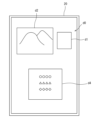
- FIG. 3 is a diagram showing output data D0.
- the output data D0 has a data format that simultaneously displays estimated emotion color information d1 and indirect visual information d2 of influence factors as shown in FIG. 3.
- the output data D0 includes composite visual indirect emotion information d0 configured in a data format in which both the estimated emotion color information d1 and the indirect visual information d2 of the influence factor are displayed simultaneously so that the ambiguity of the color data of the estimated emotion color information d1 in the color standard in which the difference in the intensity of the emotion and the difference in the type of the emotion are expressed by a gradation are compensated for by the indirect visual information d2 of the influence factor, or so that the indirect visual information d2 of the influence factor is compensated for by the ambiguity of the estimated emotion color information d1.
- the control unit 12 By the control unit 12 outputting the output data D0 having the above-mentioned configuration, the ambiguity of the color data da of the estimated emotion color information d1 in the color standard, in which the difference in the intensity of the emotion and the difference in the type of the emotion are expressed by a gradation, and the indirect visual information d2 of the influencing factor are mutually complemented, so that the accuracy of the estimated emotion can be further increased.
- the estimated emotion color information d1 includes color standards in which differences in emotion intensity are expressed by a gradation of color shades that change in the radial direction of the virtual circle P, and differences in emotion type are expressed by a gradation of color tones that change in the circumferential direction of the virtual circle P, and the differences in emotion intensity and differences in emotion type are expressed by different types of gradations that do not include numerical information, word information, or phrase information that directly indicate the estimated emotion, so that the degree is more ambiguous than when expressed by numerical values. Therefore, when a person visually acquires and recognizes the estimated emotion color information d1, the perceived emotion can be made ambiguous when viewed alone compared to when expressed by numerical values, while the difference in the perceived emotion can be made clear when viewed in comparison. Moreover, by configuring the estimated emotion color information d1 as described above, the above-mentioned action and effect can be obtained with a small amount of data.
- the indirect visual information d2 of influencing factors is visual information that is included in information about factors that relate to the subject of emotion estimation and affect the data used for the emotion estimation, such as the places the subject of emotion estimation was in, the environment he or she was in, the things they saw, touched, ate, the smells they smelled, the sounds they heard, the people they were with or talking to, and the people around the subject of emotion estimation, and does not include numerical information, word information, or phrase information that directly indicates emotions, but indirectly indicates emotions. Therefore, the perceived emotions when a person visually obtains and recognizes the indirect visual information d2 of influencing factors can be made more ambiguous than when it is expressed by numerical values. Moreover, by configuring the indirect visual information d2 of influencing factors as described above, the above-mentioned action and effect can be obtained without increasing the amount of data.
- the output data D0 includes composite visual indirect emotion information d0 configured in a data format in which both the estimated emotion color information d1 and the influencing factor indirect visual information d2 are displayed simultaneously so that the ambiguity of the color data da of the estimated emotion color information d1 included in the color standard in which both the difference in the intensity of the emotion and the difference in the type of the emotion are expressed by gradation is compensated for by the influencing factor indirect visual information d2, or so that the influencing factor indirect visual information d2 is compensated for by the ambiguity of the color data da of the estimated emotion color information d1.
- the perceived emotion when a person visually acquires and recognizes the composite visual indirect emotion information d0 remains ambiguous compared to when it is expressed by a numerical value, the certainty can be increased.
- the estimation accuracy of the emotion when the composite visual indirect emotion information d0 is viewed can be improved.
- the reduction in the degree of freedom in designing the hardware resources in the estimated emotion processing device 1 can be suppressed.
- the degree of freedom in designing the hardware resources in the estimated emotion processing device 1 can be improved.
- the estimated emotion processing device 1 that processes data using estimated emotions, it is possible to realize a configuration that can improve the emotion estimation accuracy while suppressing a decrease in the degree of freedom in designing hardware resources, or, if the level of emotion estimation accuracy is about the same, it is possible to realize a configuration that can improve the degree of freedom in designing hardware resources.
- the estimated emotion processing device 1 may be realized, for example, by installing an estimated emotion processing program having the functions of an estimated emotion processing device in a computer.
- the estimated emotion processing program causes the computer to function as the control unit 12 of the estimated emotion processing device 1.
- a method for producing the estimated emotion processing device 1 can be realized by the process of installing the estimated emotion processing program in the computer and obtaining an estimated emotion processing device 1 that outputs output data D0 including estimated emotion information D1 and other information D2.
- the estimated emotion processing program of this embodiment is an estimated emotion processing program that causes a computer to acquire estimated emotion information indicating the estimated emotion and other information that is different from the estimated emotion and related to the estimated emotion, associate the acquired estimated emotion information with the other information and store them in a memory unit, and output output data including the estimated emotion information and the other information stored in the memory unit, such as an information content recording device that records estimated emotions and information content estimated based on various data acquired from an emotion estimation subject whose emotion is to be estimated, a live event providing device that provides a live event so that the estimated emotion of a live viewer is conveyed to online viewers, a content playback device that plays back the estimated emotion and content, a vehicle control device that controls an attraction vehicle in accordance with the estimated emotion of a passenger, an employee management device that manages employees using the estimated emotion, and an evaluation device that uses the estimated emotion to evaluate an object that affects the five senses of the emotion estimation subject.
- an information content recording device that records estimated emotions and information content estimated based on various data acquired from an emotion estimation subject whose emotion is
- the estimated emotion information includes color data expressing the estimated emotion in a color standard in which the difference in the intensity of the emotion and the difference in the type of the emotion are expressed by a gradation of color shades that change in the radial direction of a virtual circle, and the difference in the type of the emotion is expressed by a gradation of color tones that change in the circumferential direction of the virtual circle, so that the difference in the intensity of the emotion and the difference in the type of the emotion are expressed by different types of gradations, while including estimated emotion color information that does not include numerical information, word information, and phrase information that directly indicate the estimated emotion, so that the degree of the estimated emotion is more ambiguous than when the estimated emotion is expressed by a numerical value.
- the other information related to the estimated emotion includes information on factors that are related to the emotion estimation target and affect data used to estimate the emotion of the emotion estimation target, such as the place where the emotion estimation target was, the environment where the emotion estimation target was, the things they saw, the things they touched, the things they ate, the smells they smelled, the sounds they heard, the people they were with or conversed with, and the people around the emotion estimation target, while including influencing factor indirect visual information that does not include numerical information, word information, and phrase information that directly indicate emotion, and is visual information that indirectly indicates emotion.
- the output data includes composite visual indirect emotion information configured in a data format in which both the estimated emotion color information and the indirect visual information of the influence factor are displayed simultaneously so that the ambiguity of the color data of the estimated emotion color information in the color standard in which the difference in intensity of the emotion and the difference in the type of the emotion are expressed by a gradation are compensated for by the indirect visual information of the influence factor, or so that the indirect visual information of the influence factor is compensated for by the ambiguity of the color data of the estimated emotion color information.
- a method for producing an estimated emotion processing device is a method for producing an estimated emotion processing device by installing an estimated emotion processing program in a computer that acquires estimated emotion information indicating the estimated emotion and other information that is different from the estimated emotion and related to the estimated emotion, associates the acquired estimated emotion information with the other information and stores it in a memory unit, and outputs output data including the estimated emotion information and the other information stored in the memory unit, such as an information content recording device that records estimated emotions and information content estimated based on various data acquired from an emotion estimation subject whose emotion is to be estimated, a live event providing device that provides a live event so that the estimated emotions of live viewers are conveyed to online viewers, a content playback device that plays back the estimated emotions and content, a vehicle control device that controls attraction vehicles in accordance with the estimated emotions of passengers, an employee management device that manages employees using the estimated emotions, and an evaluation device that evaluates objects that affect the five senses of an emotion estimation subject using the estimated emotions.
- the estimated emotion information includes color data expressing the estimated emotion in a color standard in which the difference in the intensity of the emotion and the difference in the type of the emotion are expressed by a gradation of color shades that change in the radial direction of a virtual circle, and the difference in the type of the emotion is expressed by a gradation of color tones that change in the circumferential direction of the virtual circle, so that the difference in the intensity of the emotion and the difference in the type of the emotion are expressed by different types of gradations, while including estimated emotion color information that does not include numerical information, word information, and phrase information that directly indicate the estimated emotion, so that the degree of the estimated emotion is more ambiguous than when the estimated emotion is expressed by a numerical value.
- the other information related to the estimated emotion includes information on factors that are related to the emotion estimation target and affect data used to estimate the emotion of the emotion estimation target, such as the place where the emotion estimation target was, the environment where the emotion estimation target was, the things they saw, the things they touched, the things they ate, the smells they smelled, the sounds they heard, the people they were with or conversed with, and the people around the emotion estimation target, while including influencing factor indirect visual information that does not include numerical information, word information, and phrase information that directly indicate emotion, and is visual information that indirectly indicates emotion.
- the output data includes composite visual indirect emotion information configured in a data format in which both the estimated emotion color information and the indirect visual information of the influential factor are displayed simultaneously so that the ambiguity of the color data of the estimated emotion color information in the color standard in which the difference in intensity of the emotion and the difference in the type of the emotion are expressed by gradation are compensated for by the indirect visual information of the influential factor, or so that the indirect visual information of the influential factor is compensated for by the ambiguity of the color data of the estimated emotion color information.
- the method includes a step of installing the estimated emotion processing program on the computer to obtain an estimated emotion processing device that outputs the output data including the estimated emotion information and the other information.
- the estimated emotion processing program may be recorded on a recording medium that can be read by the computer.
- the recording medium includes a recording medium using magnetism, a recording medium using light, a recording medium using magneto-optical technology, or a recording medium using a semiconductor.
- the recording medium may be a writable or rewritable recording medium, or may be a read-only recording medium.
- the recording medium of this embodiment is a computer-readable recording medium that records an estimated emotion processing program that causes a computer to acquire estimated emotion information indicating the estimated emotion and other information that is different from the estimated emotion and related to the estimated emotion, associate the acquired estimated emotion information with the other information and store them in a memory unit, and output output data including the estimated emotion information and the other information stored in the memory unit, such as an information content recording device that records estimated emotions and information content estimated based on various data acquired from an emotion estimation subject whose emotion is to be estimated, a live event providing device that provides a live event so that the estimated emotion of a live viewer is conveyed to online viewers, a content playback device that plays back the estimated emotion and content, a vehicle control device that controls an attraction vehicle in accordance with the estimated emotion of a passenger, an employee management device that manages employees using the estimated emotion, and an evaluation device that evaluates an object that affects the five senses of the emotion estimation subject using the estimated emotion.
- an information content recording device that records estimated emotions and information content estimated based on various data acquired from an
- the estimated emotion information includes color data expressing the estimated emotion in a color standard in which the difference in the intensity of the emotion and the difference in the type of the emotion are expressed by a gradation of color shades that change in the radial direction of a virtual circle, and the difference in the type of the emotion is expressed by a gradation of color tones that change in the circumferential direction of the virtual circle, so that the difference in the intensity of the emotion and the difference in the type of the emotion are expressed by different types of gradations, while including estimated emotion color information that does not include numerical information, word information, and phrase information that directly indicate the estimated emotion, so that the degree of the estimated emotion is more ambiguous than when the estimated emotion is expressed by a numerical value.
- the other information related to the estimated emotion includes information on factors that are related to the emotion estimation target and affect data used to estimate the emotion of the emotion estimation target, such as the place where the emotion estimation target was, the environment where the emotion estimation target was, the things they saw, the things they touched, the things they ate, the smells they smelled, the sounds they heard, the people they were with or conversed with, and the people around the emotion estimation target, while including influencing factor indirect visual information that does not include numerical information, word information, and phrase information that directly indicate emotion, and is visual information that indirectly indicates emotion.
- the output data includes composite visual indirect emotion information configured in a data format in which both the estimated emotion color information and the indirect visual information of the influence factor are displayed simultaneously so that the ambiguity of the color data of the estimated emotion color information in the color standard in which the difference in intensity of the emotion and the difference in the type of the emotion are expressed by a gradation are compensated for by the indirect visual information of the influence factor, or so that the indirect visual information of the influence factor is compensated for by the ambiguity of the color data of the estimated emotion color information.
- Embodiment 2] 4 is a diagram showing an example in which estimated emotional color information d1 and influencing factor indirect visual information d2 output by an estimated emotion processing device according to embodiment 2 are displayed on a display unit 20.
- This embodiment differs from embodiment 1 in that estimated emotional color information d1 and influencing factor indirect visual information d2 are displayed simultaneously.
- the same components as in embodiment 1 are denoted by the same reference numerals, and only the parts that differ from embodiment 1 will be described.
- the estimated emotional color information d1 includes estimated emotional color plane information that displays colors included in the color reference.
- the influential factor indirect visual information d2 includes at least one of video information and still image information that displays multiple pieces of information. This allows the estimated emotion processing device to display, on the display unit 20, the estimated emotional color information d1 that includes the estimated emotional color plane information and the influential factor indirect visual information d2 that includes at least one of the video information and the still image information, as shown in FIG. 4.
- the composite visual indirect emotion information d0 is configured in a data format in which the estimated emotional color information d1 and at least one of the video information or the still image information are displayed simultaneously so that the estimated emotional color information d1 and at least one of the video information or the still image information are recognized as different information, or so that the estimated emotional color information d1 and at least one of the video information or the still image information are fused together.
- This allows the estimated emotion processing device to simultaneously display on the display unit 20 the estimated emotional color information d1 including the estimated emotional color surface information and the influencing factor indirect visual information d2 including at least one of the video information or the still image information.
- the composite visual indirect emotion information d0 has a data format in which the estimated emotion color information d1 and the influencing factor indirect visual information d2 are displayed side by side in one direction on the display unit 20.
- the estimated emotion color information d1 and the influencing factor indirect visual information d2 may be displayed side by side in the vertical or horizontal direction on the display unit 20, side by side in a diagonal direction, or partially overlapping.
- At least one of the estimated emotion color information d1 and the influencing factor indirect visual information d2 may be surrounded by a frame.
- the estimated emotion color information d1 and the influencing factor indirect visual information d2 may be merged, for example, by changing the color of a part of a photo to match the color of the estimated emotion color information d1.
- the composite visual indirect emotion information d0 may have a data format in which the display size of the estimated emotion color information d1 and the display size of the influencing factor indirect visual information d2 on the display unit 20 are the same display size, or may have a data format in which one of the pieces of information is larger.
- the display unit 20 includes, for example, a display device such as a display screen of a mobile terminal, a display, or a projector.
- the display unit 20 is capable of displaying an image on a surface such as a screen.
- the estimated emotion color surface information includes information for displaying color data da, which is included in a color standard and represents an estimated emotion, on a surface.
- the estimated emotion color surface information includes information for displaying color data da on a surface having a predetermined shape, such as a circle or a polygon.
- the video information and the still image information each include a plurality of pieces of information related to the estimated emotion.
- the plurality of pieces of information includes, for example, information about the location where the emotion estimation subject was, the environment (time, season, brightness, etc.), the route traveled, things they saw, things they touched, things they ate, people they were with or talking to, and people around the emotion estimation subject.
- the video information and the still image information each include at least one of image data, graphic data, figure data, animation data, and text data.
- the video information and the still image information are information that can be displayed on a surface.
- the above configuration makes it possible to display the estimated emotion color plane information contained in the estimated emotion color information d1, and to display the video information or still image information contained in the influential factor indirect visual information d2. Therefore, although the perceived emotion when a person visually acquires and recognizes the composite visual indirect emotion information d0 remains ambiguous compared to when it is expressed numerically, the certainty can be increased. As a result, the estimation accuracy of the emotion when the composite visual indirect emotion information d0 is viewed alone can be improved. Moreover, since at least one of the video information or the still image information contains multiple pieces of information, by displaying them simultaneously with the estimated emotion color plane information, the certainty of the estimated emotion can be further increased, and the sense of satisfaction of the relevant parties can be further increased. This makes it possible to further improve the estimation accuracy of the emotion.
- an estimated emotion processing device that processes data using estimated emotions, it is possible to realize a configuration that can improve the emotion estimation accuracy while suppressing a decrease in the degree of freedom in designing hardware resources, or, if the level of emotion estimation accuracy is the same, it is possible to realize a configuration that can improve the degree of freedom in designing hardware resources.
- the estimated emotion color information d1 may include multiple color data da.
- FIG. 5 is a diagram showing an example in which influencing factor indirect visual information d2 and multiple color data da are simultaneously displayed on the display unit 20.
- the estimated emotion processing device causes the display unit 20 to simultaneously display influencing factor indirect visual information d2 and multiple color data da included in the estimated emotion color information d1 so that the multiple color data da included in the estimated emotion color information d1 can be compared.
- the control unit of the estimated emotion processing device generates and outputs composite visual indirect emotion information d0 having a data format in which the influencing factor indirect visual information d2 and the multiple color data da contained in the estimated emotion color information d1 are simultaneously displayed so that the multiple color data da contained in the estimated emotion color information d1 can be compared.
- the multiple color data da may be displayed such that some of the color data da are partially overlapped, or all of the color data da are partially overlapped.
- the indirect visual information d2 of the influencing factor and the multiple color data da may be displayed such that they are partially overlapped.
- the display size of the multiple color data da may be the same display size.
- the display size of some of the color data da may be different display sizes.
- the display size of the influence factor indirect visual information d2 and the display size of the multiple color data da may be the same display size or different display sizes.
- the shape of the influence factor indirect visual information d2 and the shape of the multiple color data da displayed on the display unit 20 may be the same shape or different shapes.
- the shape of each of the influence factor indirect visual information d2 and the multiple color data da displayed on the display unit 20 may be any shape, such as a circle or a polygon.
- the multiple color data da include at least one of color data of different emotion estimation subjects, color data of different positions, or color data in time series. Therefore, the control unit of the estimated emotion processing device generates and outputs composite visual indirect emotion information d0 having a data format in which the influencing factor indirect visual information d2 and the multiple color data da are displayed simultaneously, so that at least one of the differences between the different emotion estimation subjects in the multiple color data da, the differences at different positions in the multiple color data da, or the time series changes in the multiple color data da can be recognized.
- the color data for the different positions may be displayed, for example, on a map, or may be displayed side by side.
- the time-series color data may be displayed as color data for a predetermined period of time side by side in chronological order.
- the multiple color data da may all be displayed side by side, or some of the color data may be selectively displayed side by side, for example, by a selection switch (not shown).
- the multiple color data da may include, for example, color data representing estimated emotions at different times, or may include color data representing estimated emotions in different environments. In other words, the multiple color data da may include color data representing different estimated emotions.
- the composite visual indirect emotion information d0 is in a data format in which the influencing factor indirect visual information d2 and the multiple color data da included in the estimated emotion color information d1 are displayed simultaneously, so that the multiple color data da included in the estimated emotion color information d1 can be compared and viewed, and the differences in cognitive emotions when a person visually acquires and recognizes the multiple color data da can be clarified. Therefore, by comparing the multiple color data da with the influencing factor indirect visual information d2, the human brain can easily recognize, and the estimation accuracy of emotions can be improved. Moreover, since this can be achieved simply by comparing the multiple color data da with the influencing factor indirect visual information d2, it can be achieved with a small amount of data. This makes it possible to suppress an increase in the load on hardware resources.
- an estimated emotion processing device that processes data using estimated emotions, it is possible to realize a configuration that can improve the emotion estimation accuracy while suppressing a decrease in the degree of freedom in designing hardware resources, or, if the level of emotion estimation accuracy is the same, it is possible to realize a configuration that can improve the degree of freedom in designing hardware resources.
- FIG. 6 is a diagram showing an example of gradation color surface information d3, estimated emotion color information d1, and influencing factor indirect visual information d2 output by the estimated emotion processing device 300 according to embodiment 3, displayed on the display unit 20.
- the configuration of the output data D0 output from the estimated emotion processing device 300 differs from that of embodiments 1 and 2.
- the same reference numerals are used to designate the same configuration as in embodiment 2, and only the parts that differ from embodiments 1 and 2 will be described.
- the estimated emotion information acquired by the control unit 312 includes gradient color surface information d3 that includes at least a portion of the color reference by which differences in the intensity of emotions and differences in the types of emotions are expressed by gradients.
- the gradient color surface information d3 may include all of the information related to the color reference.
- the estimated emotion processing device 300 has a memory unit 11 and a control unit 312.
- the control unit 312 generates and outputs composite visual indirect emotion information d0 configured in a data format that simultaneously displays gradation color surface information d3, estimated emotion color information d1, and influencing factor indirect visual information d2. This allows the estimated emotion processing device 300 to simultaneously display the estimated emotion color information d1, influencing factor indirect visual information d2, and gradation color surface information d3 side-by-side on the display unit 20, as shown in FIG. 7.
- the composite visual indirect emotional information d0 may have a data format in which the estimated emotional color information d1, the influencing factor indirect visual information d2, and the gradation color surface information d3 are displayed side by side in one direction on the display unit 20, or may have a data format in which two pieces of information out of the estimated emotional color information d1, the influencing factor indirect visual information d2, and the gradation color surface information d3 are displayed side by side in one direction, and the remaining piece of information is displayed side by side in a direction different from the direction in which the two pieces of information are displayed.
- the estimated emotional color information d1 and the gradation color surface information d3 may be displayed side by side in the left-right direction on the display unit 20, while the influencing factor indirect visual information d2 may be displayed side by side in the up-down direction on the display unit 20 relative to the other two pieces of information.
- the estimated emotional color information d1 and the influencing factor indirect visual information d2 may be displayed side by side in the left-right direction on the display unit 20, while the gradation color surface information d3 may be displayed side by side in the up-down direction on the display unit 20 relative to the other two pieces of information.
- the influencing factor indirect visual information d2 and the gradation color surface information d3 may be displayed side by side in the left-right direction on the display unit 20, while the estimated emotional color information d1 may be displayed side by side in the up-down direction on the other two pieces of information.
- the estimated emotion color information d1 the influential factor indirect visual information d2, and the gradation color surface information d3 may be displayed diagonally side-by-side or overlapping on the display unit 20.
- the display size of the estimated emotional color information d1, the display size of the influencing factor indirect visual information d2, and the display size of the gradation color surface information d3 on the display unit 20 may be the same display size, or the display size of at least one of the three pieces of information may be a different display size.
- the display shapes of the estimated emotional color information d1, the influencing factor indirect visual information d2, and the gradation color surface information d3 displayed on the display unit 20 may be the same shape, or may have partially different shapes.
- the display shapes of the estimated emotional color information d1, the influencing factor indirect visual information d2, and the gradation color surface information d3 displayed on the display unit 20 may be any shape, such as a circle or a polygon.
- the accuracy of the estimated emotion displayed by the estimated emotion color information d1 can be further increased, thereby further increasing the sense of convincingness.
- this can be achieved by simply simultaneously displaying the gradation color surface information d3, the estimated emotion color information d1, and the indirect visual information d2 of the influencing factors, thereby improving the accuracy of emotion estimation while suppressing an increase in the amount of data.
- an estimated emotion processing device that processes data using estimated emotions, it is possible to realize a configuration that can improve the emotion estimation accuracy while suppressing a decrease in the degree of freedom in designing hardware resources, or, if the level of emotion estimation accuracy is the same, it is possible to realize a configuration that can improve the degree of freedom in designing hardware resources.
- Emodiment 4] 8 is a diagram showing a schematic configuration of an estimated emotion processing device 400 according to embodiment 4. This embodiment differs from the configuration of embodiment 1 in that the estimated emotion processing device 400 has a display unit 20 and a communication unit 30.
- the same components as in embodiment 1 are given the same reference numerals, and only the parts that differ from embodiment 1 will be described.
- the estimated emotion processing device 400 has a memory unit 11, a control unit 412, a display unit 20, and a communication unit 30.
- the control unit 412 outputs output data D0 including composite visual indirect emotion information d0 configured in a data format in which both estimated emotion color information d1 and influence factor indirect visual information d2 are displayed simultaneously to at least one of the memory unit 11, the display unit 20, and the communication unit 30.
- the communication unit 30 is a device capable of communicating the output data D0 with an external device via electrical signals in a wired or wireless manner.
- the communication unit 30 includes, for example, a communication module, a communication device, a communication equipment, etc.
- the control unit 412 of the estimated emotion processing device 400 can output the composite visual indirect emotion information d0 included in the output data D0 to at least one of the storage unit 11, the display unit 20, or the communication unit 30 so as to simultaneously display the estimated emotion color information d1 and the influencing factor indirect visual information d2. Therefore, the composite visual indirect emotion information d0 can be stored in the storage unit 11, displayed on the display unit 20, or transmitted to another device via the communication unit 30. Furthermore, by making it possible to output the composite visual indirect emotion information d0 as described above, it also becomes possible to share information with other users via a network, etc.
- the perceived emotion when a person visually acquires and recognizes the composite visual indirect emotion information d0 can be made more certain, although it remains ambiguous compared to when it is expressed numerically.
- the estimation accuracy of the emotion when viewing the composite visual indirect emotion information d0 can be improved.
- a decrease in the degree of freedom in designing the hardware resources in the estimated emotion processing device can be suppressed.
- the degree of freedom in designing the hardware resources in the estimated emotion processing device can be improved.
- the estimated emotion processing device 400 that processes data using estimated emotions, it is possible to realize a configuration that can improve the emotion estimation accuracy while suppressing a decrease in the design freedom of hardware resources, or, if the level of emotion estimation accuracy is about the same, it is possible to realize a configuration that can improve the design freedom of hardware resources.
- FIG. 9 is a diagram showing a schematic configuration of an estimated emotion processing device 500 according to embodiment 5.
- information output from the estimated emotion processing device differs from that in embodiment 1.
- the same components as in embodiment 1 are given the same reference numerals, and only the parts that differ from embodiment 1 will be described.
- the estimated emotion processing device 500 has a memory unit 11 and a control unit 512.
- the control unit 512 acquires character emotion information d4, which includes numerical information, word information, and phrase information that directly indicate emotions and is information different from the composite visual indirect emotion information d0.
- the control unit 512 stores the acquired character emotion information d4 in the memory unit 11.
- the character emotion information d4 is character information that allows emotions to be directly recognized.
- the character emotion information d4 may be acquired by input to the control unit 512, or the control unit 512 may acquire it from another input device or memory device, etc.
- the control unit 512 generates and outputs composite visual indirect emotion information d0 configured in a data format in which both estimated emotion color information d1 and influential factor indirect visual information d2 are displayed simultaneously, as well as composite emotion information configured in a data format in which text emotion information d4 is also displayed simultaneously.
- FIG. 10 is a diagram showing an example of the composite visual indirect emotion information d0 and text emotion information d4 output by the estimated emotion processing device 500 displayed on the display unit 20.
- FIG. 10 by displaying not only the composite visual indirect emotion information d0 but also the text emotion information d4, it is possible to further increase the accuracy of the estimated emotion of the estimated emotion color information d1 included in the composite visual indirect emotion information d0. This makes it possible to further increase the degree of agreement between the estimated emotion and the cognitive emotion recognized by the brain.
- the composite estimated emotion information may be configured in a data format in which the text emotion information d4 is displayed superimposed on at least one of the estimated emotion color information d1 and the influential factor indirect visual information d2 of the composite visual indirect emotion information d0.
- the estimated emotion processing device 1 acquires estimated emotion information D1 and other information D2.
- the estimated emotion processing device may also estimate the emotion of the emotion estimation target person and use the estimation result as estimated emotion information.
- the estimated emotion processing device may acquire other information by itself, rather than acquiring other information from another device.
- the estimated emotion processing device may have an imaging device, a recording device such as a driving recorder, a GPS device, a storage device, an information management device, etc.
- the estimated emotion processing device 1 expresses an estimated emotion using color data included in a color reference created based on Russell's emotion circle model.
- the estimated emotion processing device may express an estimated emotion using color data included in a color reference created based on another emotion model.
- the color standard is blue for emotion, green for relief, yellow for boredom, and red for tension.
- different types of emotions may be represented by colors other than those mentioned above.
- the color criterion is white at the intersection of the two evaluation indexes, emotional arousal and emotional valence, and one of the colors, blue, green, yellow, or red, becomes darker as one moves radially outward from the intersection of the virtual circle P, and the color changes continuously and smoothly in the circumferential direction of the virtual circle P according to a gradation of color tones.
- the color may become lighter as one moves radially outward from the intersection of the virtual circle, or a color other than the above may become darker in the circumferential direction of the virtual circle.
- the estimated emotion processing device generates and outputs composite visual indirect emotion information having a data format that simultaneously displays influencing factor indirect visual information d2 and multiple color data da.
- the estimated emotion processing device may also generate and output composite visual indirect emotion information having a data format that simultaneously displays color data and multiple influencing factor indirect visual information, or may generate and output composite visual indirect emotion information having a data format that simultaneously displays multiple color data and multiple influencing factor indirect visual information.
- the estimated emotion processing device 400 has a memory unit 11, a control unit 412, a display unit 20, and a communication unit 30.
- the estimated emotion processing device may have only either the display unit or the communication unit, or may have neither the display unit nor the communication unit.
- the estimated emotion processing device 500 generates and outputs not only composite visual indirect emotion information d0 configured in a data format in which both estimated emotion color information d1 and influencing factor indirect visual information d2 are displayed simultaneously, but also composite estimated emotion information configured in a data format in which text emotion information d4 is displayed simultaneously.
- the estimated emotion processing device may generate and output composite estimated emotion information configured in a data format that displays the gradation color surface information shown in the third embodiment in addition to the estimated emotion color information, influencing factor indirect visual information, and text emotion information.
- the estimated emotion processing device may also generate and output composite visual indirect emotion information configured in a data format that displays text emotion information and estimated emotion color information or influencing factor indirect visual information simultaneously.
- the present invention can be used in an estimated emotion processing device that processes data using estimated emotions.
Landscapes
- Health & Medical Sciences (AREA)
- Life Sciences & Earth Sciences (AREA)
- Engineering & Computer Science (AREA)
- Hospice & Palliative Care (AREA)
- Pathology (AREA)
- Developmental Disabilities (AREA)
- Psychiatry (AREA)
- Psychology (AREA)
- Social Psychology (AREA)
- Physics & Mathematics (AREA)
- Child & Adolescent Psychology (AREA)
- Biophysics (AREA)
- Educational Technology (AREA)
- Biomedical Technology (AREA)
- Heart & Thoracic Surgery (AREA)
- Medical Informatics (AREA)
- Molecular Biology (AREA)
- Surgery (AREA)
- Animal Behavior & Ethology (AREA)
- General Health & Medical Sciences (AREA)
- Public Health (AREA)
- Veterinary Medicine (AREA)
- Measurement Of The Respiration, Hearing Ability, Form, And Blood Characteristics Of Living Organisms (AREA)
Priority Applications (2)
| Application Number | Priority Date | Filing Date | Title |
|---|---|---|---|
| JP2025501174A JPWO2024172066A1 (https=) | 2023-02-15 | 2024-02-14 | |
| TW113105220A TW202435160A (zh) | 2023-02-15 | 2024-02-15 | 推定感情處理裝置及其生產方法、推定感情處理用程式及記錄媒體 |
Applications Claiming Priority (2)
| Application Number | Priority Date | Filing Date | Title |
|---|---|---|---|
| JP2023022001 | 2023-02-15 | ||
| JP2023-022001 | 2023-02-15 |
Publications (1)
| Publication Number | Publication Date |
|---|---|
| WO2024172066A1 true WO2024172066A1 (ja) | 2024-08-22 |
Family
ID=92421885
Family Applications (1)
| Application Number | Title | Priority Date | Filing Date |
|---|---|---|---|
| PCT/JP2024/004992 Ceased WO2024172066A1 (ja) | 2023-02-15 | 2024-02-14 | 推定感情処理装置、その生産方法、推定感情処理用プログラム及び記録媒体 |
Country Status (3)
| Country | Link |
|---|---|
| JP (1) | JPWO2024172066A1 (https=) |
| TW (1) | TW202435160A (https=) |
| WO (1) | WO2024172066A1 (https=) |
Cited By (1)
| Publication number | Priority date | Publication date | Assignee | Title |
|---|---|---|---|---|
| JP7765059B1 (ja) * | 2025-07-14 | 2025-11-06 | アイピーロジック株式会社 | 情報処理装置、情報処理方法および情報処理プログラム |
Citations (4)
| Publication number | Priority date | Publication date | Assignee | Title |
|---|---|---|---|---|
| JP2005058449A (ja) * | 2003-08-12 | 2005-03-10 | Sony Corp | 感情の可視化装置および感情の可視化方法、感情の可視化出力物 |
| US20140223462A1 (en) * | 2012-12-04 | 2014-08-07 | Christopher Allen Aimone | System and method for enhancing content using brain-state data |
| JP2020185138A (ja) * | 2019-05-14 | 2020-11-19 | 学校法人 芝浦工業大学 | 感情推定システム、および感情推定装置 |
| WO2021181699A1 (ja) * | 2020-03-13 | 2021-09-16 | ヤマハ発動機株式会社 | 位置評価装置及び位置評価システム |
Family Cites Families (2)
| Publication number | Priority date | Publication date | Assignee | Title |
|---|---|---|---|---|
| JP2021052812A (ja) * | 2018-01-26 | 2021-04-08 | 久和 正岡 | 感情分析システム |
| KR102871649B1 (ko) * | 2019-02-19 | 2025-10-16 | 현대자동차주식회사 | 전자 장치 및 그 제어 방법 |
-
2024
- 2024-02-14 JP JP2025501174A patent/JPWO2024172066A1/ja active Pending
- 2024-02-14 WO PCT/JP2024/004992 patent/WO2024172066A1/ja not_active Ceased
- 2024-02-15 TW TW113105220A patent/TW202435160A/zh unknown
Patent Citations (4)
| Publication number | Priority date | Publication date | Assignee | Title |
|---|---|---|---|---|
| JP2005058449A (ja) * | 2003-08-12 | 2005-03-10 | Sony Corp | 感情の可視化装置および感情の可視化方法、感情の可視化出力物 |
| US20140223462A1 (en) * | 2012-12-04 | 2014-08-07 | Christopher Allen Aimone | System and method for enhancing content using brain-state data |
| JP2020185138A (ja) * | 2019-05-14 | 2020-11-19 | 学校法人 芝浦工業大学 | 感情推定システム、および感情推定装置 |
| WO2021181699A1 (ja) * | 2020-03-13 | 2021-09-16 | ヤマハ発動機株式会社 | 位置評価装置及び位置評価システム |
Cited By (1)
| Publication number | Priority date | Publication date | Assignee | Title |
|---|---|---|---|---|
| JP7765059B1 (ja) * | 2025-07-14 | 2025-11-06 | アイピーロジック株式会社 | 情報処理装置、情報処理方法および情報処理プログラム |
Also Published As
| Publication number | Publication date |
|---|---|
| JPWO2024172066A1 (https=) | 2024-08-22 |
| TW202435160A (zh) | 2024-09-01 |
Similar Documents
| Publication | Publication Date | Title |
|---|---|---|
| US12175385B2 (en) | Adapting a virtual reality experience for a user based on a mood improvement score | |
| US20240333997A1 (en) | Configurable content for grouped subsets of users | |
| US12076642B2 (en) | Delivery of spectator feedback content to virtual reality environments provided by head mounted display | |
| KR102690201B1 (ko) | 사용자 감정 상태에 반응하여 영화 컨텐츠의 생성 및 제어 | |
| US20210165490A1 (en) | Wearable computing apparatus and method | |
| US10712998B2 (en) | Information processing device, information processing method, and program | |
| Franinovic et al. | Sonic interaction design | |
| JP7496514B2 (ja) | コンテンツ選択方法、コンテンツ選択装置及びコンテンツ選択プログラム | |
| KR20190074563A (ko) | 모션인식과 가상현실을 이용한 치매고위험군과 경도인지장애를 위한 평가 및 훈련장치와 그 방법 | |
| WO2019031257A1 (ja) | 情報処理装置および方法、並びにプログラム | |
| JP2021146214A (ja) | ドライバー監視システムでメディア誘発感情から運転感情を分離するための技術 | |
| KR20050033450A (ko) | 정보 기록 장치 및 정보 기록 방법 | |
| US20200184843A1 (en) | Information processing apparatus, information processing method, and computer program | |
| JP2020185138A (ja) | 感情推定システム、および感情推定装置 | |
| US20120194648A1 (en) | Video/ audio controller | |
| WO2016181670A1 (ja) | 情報処理装置、情報処理方法及びプログラム | |
| JP2018189720A (ja) | 情報出力制御装置、情報出力制御方法、情報出力システム、およびプログラム | |
| KR102158910B1 (ko) | 부모의 성향과 아이의 성향을 동시에 고려한 육아가이드를 제공하는 육아코칭 및 상담 서비스 제공방법 및 제공시스템 | |
| WO2024172066A1 (ja) | 推定感情処理装置、その生産方法、推定感情処理用プログラム及び記録媒体 | |
| Goulding et al. | Dance clubs, rave, and the consumer experience: an exploratory study of a subcultural phenomenon | |
| JP6375597B2 (ja) | ネットワークシステム、サーバー、プログラム、並びにトレーニング支援方法 | |
| JP2005044150A (ja) | データ収集装置 | |
| KR102383793B1 (ko) | 등록된 확장현실 기기 사용자의 집중도를 관리 및 제어하는 방법, 장치 및 시스템 | |
| Dawson | A discussion of immersion in human computer interaction: the immersion model of user experience | |
| US12444137B2 (en) | Generative tile patterning using aperiodic monotiles |
Legal Events
| Date | Code | Title | Description |
|---|---|---|---|
| 121 | Ep: the epo has been informed by wipo that ep was designated in this application |
Ref document number: 24756907 Country of ref document: EP Kind code of ref document: A1 |
|
| WWE | Wipo information: entry into national phase |
Ref document number: 2025501174 Country of ref document: JP |
|
| NENP | Non-entry into the national phase |
Ref country code: DE |
|
| 122 | Ep: pct application non-entry in european phase |
Ref document number: 24756907 Country of ref document: EP Kind code of ref document: A1 |