WO2024157451A1 - 連結浮体姿勢制御システム、及び浮体の運搬方法 - Google Patents
連結浮体姿勢制御システム、及び浮体の運搬方法 Download PDFInfo
- Publication number
- WO2024157451A1 WO2024157451A1 PCT/JP2023/002635 JP2023002635W WO2024157451A1 WO 2024157451 A1 WO2024157451 A1 WO 2024157451A1 JP 2023002635 W JP2023002635 W JP 2023002635W WO 2024157451 A1 WO2024157451 A1 WO 2024157451A1
- Authority
- WO
- WIPO (PCT)
- Prior art keywords
- floating body
- attitude control
- floating
- separation distance
- bodies
- Prior art date
- Legal status (The legal status is an assumption and is not a legal conclusion. Google has not performed a legal analysis and makes no representation as to the accuracy of the status listed.)
- Ceased
Links
Images


Classifications
-
- B—PERFORMING OPERATIONS; TRANSPORTING
- B63—SHIPS OR OTHER WATERBORNE VESSELS; RELATED EQUIPMENT
- B63B—SHIPS OR OTHER WATERBORNE VESSELS; EQUIPMENT FOR SHIPPING
- B63B77/00—Transporting or installing offshore structures on site using buoyancy forces, e.g. using semi-submersible barges, ballasting the structure or transporting of oil-and-gas platforms
- B63B77/10—Transporting or installing offshore structures on site using buoyancy forces, e.g. using semi-submersible barges, ballasting the structure or transporting of oil-and-gas platforms specially adapted for electric power plants, e.g. wind turbines or tidal turbine generators
-
- B—PERFORMING OPERATIONS; TRANSPORTING
- B63—SHIPS OR OTHER WATERBORNE VESSELS; RELATED EQUIPMENT
- B63B—SHIPS OR OTHER WATERBORNE VESSELS; EQUIPMENT FOR SHIPPING
- B63B21/00—Tying-up; Shifting, towing, or pushing equipment; Anchoring
- B63B21/56—Towing or pushing equipment
- B63B21/62—Towing or pushing equipment characterised by moving of more than one vessel
-
- B—PERFORMING OPERATIONS; TRANSPORTING
- B63—SHIPS OR OTHER WATERBORNE VESSELS; RELATED EQUIPMENT
- B63H—MARINE PROPULSION OR STEERING
- B63H25/00—Steering; Slowing-down otherwise than by use of propulsive elements; Dynamic anchoring, i.e. positioning vessels by means of main or auxiliary propulsive elements
- B63H25/06—Steering by rudders
- B63H2025/066—Arrangements of two or more rudders; Steering gear therefor
-
- B—PERFORMING OPERATIONS; TRANSPORTING
- B63—SHIPS OR OTHER WATERBORNE VESSELS; RELATED EQUIPMENT
- B63H—MARINE PROPULSION OR STEERING
- B63H25/00—Steering; Slowing-down otherwise than by use of propulsive elements; Dynamic anchoring, i.e. positioning vessels by means of main or auxiliary propulsive elements
- B63H25/42—Steering or dynamic anchoring by propulsive elements; Steering or dynamic anchoring by propellers used therefor only; Steering or dynamic anchoring by rudders carrying propellers
Definitions
- This disclosure relates to a joint floating body attitude control system and a method for transporting a floating body.
- the present disclosure has been made to solve the above problems, and aims to provide a linked floating body attitude control system capable of stably maintaining the spacing between floating bodies, and a method of transporting floating bodies using the same.
- the linked floating body attitude control system disclosed herein comprises a number of floating bodies capable of floating on the water surface, a connecting section that connects the floating bodies together in a state in which they can be displaced relative to one another, and an attitude control section that is provided for each floating body and can operate independently of each other.
- the method of transporting a floating body is a method of transporting a floating body using the above-mentioned linked floating body attitude control system, and includes the steps of attaching the attitude control unit to the floating body, and towing the floating bodies by a propulsive force generated by a propulsion device other than the attitude control unit, which is provided on at least one of the floating bodies.
- the present disclosure provides a connected float attitude control system capable of stably maintaining the spacing between floats, and a method for transporting floats using the same.
- FIG. 2 is a top view showing the configuration of the linked floating body attitude control system according to the first embodiment of the present disclosure.
- FIG. 2 is a functional block diagram showing a configuration of a control device according to the first embodiment of the present disclosure.
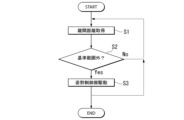
- 4 is a flowchart showing a control flow of a control device according to the first embodiment of the present disclosure.
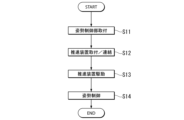
- 10 is a flowchart showing each step of a method for transporting a float according to a second embodiment of the present disclosure.
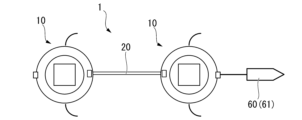
- FIG. 11 is a top view showing the state of a floating body being transported using a transportation method according to a second embodiment of the present disclosure.
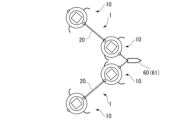
- FIG. 11 is a top view showing a modified example of a method for transporting a float according to the second embodiment of the present disclosure.
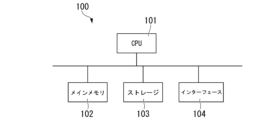
- FIG. 2 is a hardware configuration diagram of a control device according to each embodiment of the present disclosure.
- the linked floating body attitude control system 1 is used to maintain a constant distance between a plurality of linked floating bodies 10 that can float on the water surface of the ocean, lakes, marshes, or rivers.
- the "floating body 10" mentioned here includes not only an object that can float by its own buoyancy, but also a structure that is heavy enough not to obtain sufficient buoyancy and is mounted on an object that assists buoyancy.
- the connected floating body attitude control system 1 includes multiple (for example, two) floating bodies 10, a connecting part 20, a tension sensor 30, an attitude control part 40, and a control device 50.
- the float 10 has a structure 11 and a float body 12.
- the structure 11 may be, for example, a tower-shaped construction such as a lighthouse, a windmill, or an oil field drilling rig.
- the float body 12 supports the structure 11 from below while floating it on the water surface by buoyancy.
- the float body 12 may be a container-shaped member having a cavity using air buoyancy, a floating device formed of foamed resin, or a barge without power. In either case, the configuration and dimensions of the float body 12 are appropriately set according to the weight and dimensions of the structure 11.
- the float body 12 is circular or annular when viewed from the top and bottom.
- the structure 11 itself generates buoyancy, that is, if it can float on the water surface by itself, the structure 11 itself constitutes the float body 12.
- An example of such a structure 11 is a hollow pillar member.
- the connecting parts 20 connect the floating bodies 10 to each other in a state in which the floating bodies 10 can move relative to each other.
- Specific examples of the connecting parts 20 include rigging such as chains, wires, or ropes.
- the connecting parts 20 connect the floating bodies 10 to each other so that they do not separate, while having flexibility to allow slight movement of each floating body 10.
- the tension sensor 30 measures the tension acting on the connecting portion 20, and transmits the measurement result as an electrical signal to a control device 50 (described later).
- One tension sensor 30 is provided for each floating body 10.
- the attitude control unit 40 controls the attitude of each floating body 10 based on a signal generated by the control device 50 based on the measurement results of the tension sensor 30.
- a attitude control unit 40 is provided for each floating body 10, and each floating body 10 can operate independently.
- the attitude control unit 40 has a thruster 41 and a spoiler 42.
- the thruster 41 is provided below the water surface below the float 10 or below the water surface to the side, and generates a thrust for the float 10 by pumping water underwater. It is desirable for the thruster 41 to be able to generate thrust in all directions 360°. Specific examples of the thruster 41 include a device with a propeller and a device using jet propulsion. The thruster 41 is attached to the float 10 so that it can be freely attached and detached.
- the spoilers 42 are provided to control the position of the float 10 by reducing or reducing the moving speed to zero while the float 10 is moving.
- one spoiler 42 is provided on each side of the width of the float 10.
- Each spoiler 42 is attached so that it can transition between a deployed state and a stored state on the float 10 side.
- the spoiler 42 itself is in the shape of a plate having a concave surface that is recessed toward the rear side in the moving direction when deployed.
- the spoiler 42 does not necessarily have to have a concave surface, and may be flat.
- the number of spoilers 42 is not limited to two, and may be increased or decreased as appropriate depending on the design, specifications, or dimensions and size of the float 10.
- the control device 50 includes a separation distance acquisition unit 51 , a comparison and determination unit 52 , a drive control unit 53 , and a storage unit 54 .
- the separation distance acquisition unit 51 acquires the separation distance between the floating bodies 10 based on the measurement results of the tension sensor 30 described above. For example, the separation distance between these floating bodies 10 is acquired by referring to a predetermined table according to the magnitude of the tension of the connecting part 20.
- the comparison and judgment unit 52 compares and judges whether the value of the separation distance acquired by the separation distance acquisition unit 51 is within a predetermined reference range.
- the memory unit 54 is provided to store the value of this reference range, etc. If it is determined that the separation distance is outside the reference range, the comparison and judgment unit 52 sends a command signal to the drive control unit 53, which will be described later.
- the drive control unit 53 controls the operation of the above-mentioned attitude control unit 40 based on the judgment result of the comparison and judgment unit 52. In other words, if the comparison and judgment unit 52 judges that the separation distance is outside the reference range, the drive control unit 53 operates to adjust the relative positions of the floating bodies 10 so that the separation distance falls within the reference range.
- step S1 the separation distance acquisition unit 51 acquires the separation distance between the floating bodies 10.
- step S2 the comparison and determination unit 52 determines whether the value of the separation distance is outside the reference range. If the determination in step S2 is No, the process returns to step S1 again. If the determination in step S2 is Yes, the process proceeds to step S3.
- step S3 the drive control unit 53 drives the attitude control unit 40 to adjust the separation distance between the floating bodies 10.
- steps S1 and S2 are further repeatedly executed to determine whether the separation distance has been corrected to within the reference range.
- the control flow is terminated after step S3.
- the separation distance between the floating bodies 10 falls within the standard range.
- the attitude control unit 40 is provided for each floating body 12, and can operate independently of each other.
- the attitude control unit 40 of at least one of the floating bodies 10 is operated to move the floating bodies 12 relative to each other. This allows one floating body 10 to move away from the other floating body 10, or conversely, to approach to an appropriate distance while maintaining the connection by the connecting unit 20. As a result, it becomes possible to maintain a constant distance between these floating bodies 12.
- multiple offshore wind turbines are arranged at intervals, it becomes possible to ensure and maintain the distance between these wind turbines.
- the comparison and determination unit 52 compares the separation distance with the reference distance. This determines whether the distance between the floating bodies 12 deviates from the reference range. If it deviates from the reference range, the attitude control unit 40 is driven by the drive control unit 53 to adjust the separation distance as described above. Thereafter, the distance between the floating bodies 12 can be autonomously corrected until the separation distance falls within the reference range.
- the separation distance acquisition unit 51 acquires the separation distance based on the measurement results of the tension sensor 30. Therefore, the separation distance between the floating bodies 12 can be acquired more directly and accurately based on the tension acting on the connecting part 20. This makes it possible to more stably and precisely control and maintain the distance between the floating bodies 12.
- the movement speed of the floating body 12 can be adjusted by deploying the spoiler 42.
- the movement speed of the floating body 12 can be adjusted by deploying the spoiler 42.
- the first embodiment of the present disclosure has been described above.
- a radar device can be used instead of the tension sensor 30 described in the first embodiment.
- the distance between the floating bodies 10 can be accurately obtained based on the measurement and search results of the radar device.
- attitude control (ensuring the distance) by making the floating bodies 12 have magnetic forces.
- the floating bodies 12 are separated from each other by the repulsion of magnetic forces, and a certain distance or more can be maintained.
- a buffer material or a fender on the outer surface of the floating body 12.
- the above-mentioned control device 50 and tension sensor 30 do not necessarily need to be provided. In this case, an operator can visually determine the size of the separation distance and operate the attitude control unit 40 appropriately to ensure and maintain the separation distance.
- the distance between the floating body bodies 12 is obtained by a position sensor or GPS (Global Positioning System).
- GPS Global Positioning System
- this transportation method includes step S11 of attaching the attitude control unit 40 to the floating body 12, step S12 of attaching the propulsion device 60 to at least one floating body 12, step S13 of driving the propulsion device 60, and step S14 of controlling the attitude of the floating bodies 10.
- step S11 the attitude control unit 40 including the thrusters 41 and spoilers 42 described in the first embodiment is attached to each floating body 12.
- a propulsion device 60 different from the thrusters 41 is attached or connected to at least one floating body 12.
- a towing vessel 61 may be used as the propulsion device 60, or a thrust generating source different from the thrusters 41 may be directly attached to the floating body 12.
- the floating body 12 may be an object that can float under its own power, such as a tower-like structure.
- step S13 the propulsion device 60 is driven to tow (transport) the multiple floating bodies 10.
- step S14 the distance between the floating bodies 10 is appropriately maintained and controlled by the linked floating body attitude control system 1 described in the first embodiment above (step S14). Through the above steps, the transportation of the floating bodies 10 is completed.
- the floating bodies 12 and the structures 11 can be transported while maintaining a constant distance between the floating bodies 12. This reduces the possibility of interference between the floating bodies 12 and the structures 11, which may cause damage or fouling.
- the floating bodies 10 may collide or come into contact with each other.
- control device 50 in the embodiment of the present disclosure may be changed as long as appropriate processing is performed.
- the memory unit 54 and each of the other storage devices may be provided anywhere within the range in which appropriate information is transmitted and received. Furthermore, each of the memory unit 54 and each of the other storage devices may exist in multiple locations within the range in which appropriate information is transmitted and received, and data may be stored in a distributed manner.
- control device 50 The above-mentioned processing steps performed by the control device 50 are stored in the form of a program on a recording medium that can be read by the computer 100, and the above-mentioned processing is performed by the computer 100 reading and executing this program.
- a specific example of the computer 100 is shown below.
- the computer 100 includes a CPU 101 , a main memory 102 , a storage 103 , and an interface 104 .
- the above-mentioned control device 50 is implemented in a computer 100.
- the operations of the above-mentioned processing units are stored in the storage 103 in the form of a program.
- the CPU 101 reads the program from the storage 103, loads it in the main memory 102, and executes the above-mentioned processing in accordance with the program.
- the CPU 101 also secures a storage area in the main memory 102 corresponding to the above-mentioned storage unit 54 in accordance with the program.
- Storage 103 examples include HDD (Hard Disk Drive), SSD (Solid State Drive), magnetic disk, magneto-optical disk, CD-ROM (Compact Disc Read Only Memory), DVD-ROM (Digital Versatile Disc Read Only Memory), and semiconductor memory.
- Storage 103 may be an internal medium directly connected to the bus of computer 100, or an external medium connected to computer 100 via interface 104 or a communication line.
- computer 100 that receives the program may expand the program in main memory 102 and execute the above process.
- Storage 103 is a non-transitory tangible storage medium.
- the program may also realize some of the functions described above.
- the program may be a file that can realize the functions described above in combination with a program already recorded in computer 100, a so-called differential file (differential program).
- the device may be equipped with a custom LSI (Large Scale Integrated Circuit) such as a PLD (Programmable Logic Device), an ASIC (Application Specific Integrated Circuit), a GPU (Graphics Processing Unit), or a similar processing device.
- PLDs include PAL (Programmable Array Logic), GAL (Generic Array Logic), CPLD (Complex Programmable Logic Device), and FPGA (Field Programmable Gate Array).
- PLDs Programmable Array Logic
- GAL Generic Array Logic
- CPLD Complex Programmable Logic Device
- FPGA Field Programmable Gate Array
- the linked floating body attitude control system 1 includes a plurality of floating bodies 12 capable of floating a structure 11 on the water surface, a connecting unit 20 that connects the plurality of floating bodies 12 in a state in which the floating bodies 12 can be displaced relative to each other, and an attitude control unit 40 that is provided individually for each of the floating bodies 12 and operates independently of each other, thereby being able to adjust the distance between the plurality of floating bodies 12.
- an attitude control unit 40 is provided for each floating body 12, and they can operate independently of each other. Therefore, if a change occurs in the distance between the floating bodies 12, the attitude control unit 40 of at least one of the floating bodies 10 can be operated to move the floating body 12 relative to itself, thereby making it possible to maintain a constant distance between these floating bodies 12.
- the linked floating body attitude control system 1 is the linked floating body attitude control system 1 of (1), further comprising a control device 50 having a separation distance acquisition unit 51 that acquires the separation distance between the floating body bodies 12, a comparison and determination unit 52 that compares the separation distance acquired by the separation distance acquisition unit 51 with a predetermined reference range, and a drive control unit 53 that controls the operation of the attitude control unit 40 based on the determination result of the comparison and determination unit 52.
- the attitude control unit 40 is driven by the drive control unit 53, and the distance between the floating bodies 12 can be autonomously corrected.
- the third aspect of the connected floating body attitude control system 1 is the connected floating body attitude control system 1 of (2), in which the separation distance acquisition unit 51 acquires the separation distance based on the measurement results of a tension sensor 30 that measures the tension acting on the connection unit 20.
- the separation distance between the floating bodies 12 can be obtained more directly and accurately based on the measurement results of the tension sensor 30. This makes it possible to maintain the distance between the floating bodies 12 more stably.
- the fourth aspect of the linked floating body attitude control system 1 is the linked floating body attitude control system 1 of (2), in which the separation distance acquisition unit 51 acquires the separation distance based on the measurement results of a radar device provided for each floating body 12.
- the separation distance between the floating bodies 12 can be obtained accurately even when the distance between the floating bodies 12 is relatively long. This makes it possible to more stably maintain the distance between the floating bodies 12.
- the fifth aspect of the linked floating body attitude control system 1 is a linked floating body attitude control system 1 according to any one of the aspects (1) to (4), in which the attitude control unit 40 has a thruster 41 that generates a propulsive force in water.
- the floating bodies 12 can be moved relative to each other by any distance in any direction by driving the propellers 41. This makes it possible to easily and stably maintain the separation distance between the floating bodies 12.
- the sixth aspect of the linked floating body attitude control system 1 is a linked floating body attitude control system 1 according to any one of the aspects (1) to (5), in which the attitude control unit 40 has a spoiler 42 that can transition between a state deployed in water and a state stored in the floating body main body 12.
- the movement speed of the floating body 12 can be adjusted by deploying the spoiler 42.
- the movement speed of the floating body 12 can be adjusted by deploying the spoiler 42.
- a method for transporting a floating body 10 according to the seventh aspect is a method for transporting a floating body 10 using a linked floating body attitude control system 1 according to any one of the aspects (1) to (6), and includes the steps of attaching the attitude control unit 40 to the floating body main body 12, and towing the floating body main body 12 and the structure 11 by a propulsive force generated by a propulsion device 60 different from the attitude control unit 40 and provided on at least one of the floating body main bodies 12.
- the above method allows the transportation of multiple floating bodies 12 and structures 11 while maintaining a constant distance between the floating bodies 12. This reduces the possibility of the floating bodies 12 or structures 11 interfering with each other, causing damage or fouling.
- the above-mentioned linked floating body attitude control system and floating body transportation method make it possible to stably maintain the spacing between the floating bodies, and to transport multiple floating bodies while maintaining that spacing.
Landscapes
- Engineering & Computer Science (AREA)
- Chemical & Material Sciences (AREA)
- Combustion & Propulsion (AREA)
- Mechanical Engineering (AREA)
- Ocean & Marine Engineering (AREA)
- Life Sciences & Earth Sciences (AREA)
- Sustainable Development (AREA)
- Sustainable Energy (AREA)
- Transportation (AREA)
- Control Of Position, Course, Altitude, Or Attitude Of Moving Bodies (AREA)
Priority Applications (3)
| Application Number | Priority Date | Filing Date | Title |
|---|---|---|---|
| JP2024572783A JPWO2024157451A1 (https=) | 2023-01-27 | 2023-01-27 | |
| EP23918413.8A EP4640548A4 (en) | 2023-01-27 | 2023-01-27 | POSTURE CONTROL SYSTEM FOR CONNECTED FLOATS AND METHOD FOR TRANSPORTING FLOATS |
| PCT/JP2023/002635 WO2024157451A1 (ja) | 2023-01-27 | 2023-01-27 | 連結浮体姿勢制御システム、及び浮体の運搬方法 |
Applications Claiming Priority (1)
| Application Number | Priority Date | Filing Date | Title |
|---|---|---|---|
| PCT/JP2023/002635 WO2024157451A1 (ja) | 2023-01-27 | 2023-01-27 | 連結浮体姿勢制御システム、及び浮体の運搬方法 |
Publications (1)
| Publication Number | Publication Date |
|---|---|
| WO2024157451A1 true WO2024157451A1 (ja) | 2024-08-02 |
Family
ID=91970107
Family Applications (1)
| Application Number | Title | Priority Date | Filing Date |
|---|---|---|---|
| PCT/JP2023/002635 Ceased WO2024157451A1 (ja) | 2023-01-27 | 2023-01-27 | 連結浮体姿勢制御システム、及び浮体の運搬方法 |
Country Status (3)
| Country | Link |
|---|---|
| EP (1) | EP4640548A4 (https=) |
| JP (1) | JPWO2024157451A1 (https=) |
| WO (1) | WO2024157451A1 (https=) |
Cited By (1)
| Publication number | Priority date | Publication date | Assignee | Title |
|---|---|---|---|---|
| CN120621599A (zh) * | 2025-07-21 | 2025-09-12 | 中国电力工程顾问集团有限公司 | 一种泥浮式海上风机的湿拖辅助装置 |
Citations (5)
| Publication number | Priority date | Publication date | Assignee | Title |
|---|---|---|---|---|
| JPS5417292A (en) * | 1977-07-08 | 1979-02-08 | Sumikin Kaiun Kk | Method of navigation for group of barge |
| US6606958B1 (en) * | 1999-06-22 | 2003-08-19 | Hydroacoustics Inc. | Towed acoustic source array system for marine applications |
| JP2012180088A (ja) | 2011-03-01 | 2012-09-20 | Stx France Sa | 風力タービンを洋上サイトに輸送するための船舶およびそれを設置する方法 |
| US20140345299A1 (en) * | 2011-09-16 | 2014-11-27 | Woodside Energy Technologies Pty Ltd. | Method of marine transportation of unsweetened natural gas |
| CN111792005A (zh) * | 2020-07-14 | 2020-10-20 | 陈广生 | 一种多拖体全航态定深与矢量布放技术 |
Family Cites Families (1)
| Publication number | Priority date | Publication date | Assignee | Title |
|---|---|---|---|---|
| FR526425A (fr) * | 1920-10-25 | 1921-10-08 | Arthur William Loth | Procédé et dispositifs de remorquage électrique à traction différentielle |
-
2023
- 2023-01-27 WO PCT/JP2023/002635 patent/WO2024157451A1/ja not_active Ceased
- 2023-01-27 EP EP23918413.8A patent/EP4640548A4/en active Pending
- 2023-01-27 JP JP2024572783A patent/JPWO2024157451A1/ja active Pending
Patent Citations (5)
| Publication number | Priority date | Publication date | Assignee | Title |
|---|---|---|---|---|
| JPS5417292A (en) * | 1977-07-08 | 1979-02-08 | Sumikin Kaiun Kk | Method of navigation for group of barge |
| US6606958B1 (en) * | 1999-06-22 | 2003-08-19 | Hydroacoustics Inc. | Towed acoustic source array system for marine applications |
| JP2012180088A (ja) | 2011-03-01 | 2012-09-20 | Stx France Sa | 風力タービンを洋上サイトに輸送するための船舶およびそれを設置する方法 |
| US20140345299A1 (en) * | 2011-09-16 | 2014-11-27 | Woodside Energy Technologies Pty Ltd. | Method of marine transportation of unsweetened natural gas |
| CN111792005A (zh) * | 2020-07-14 | 2020-10-20 | 陈广生 | 一种多拖体全航态定深与矢量布放技术 |
Non-Patent Citations (1)
| Title |
|---|
| See also references of EP4640548A1 |
Cited By (1)
| Publication number | Priority date | Publication date | Assignee | Title |
|---|---|---|---|---|
| CN120621599A (zh) * | 2025-07-21 | 2025-09-12 | 中国电力工程顾问集团有限公司 | 一种泥浮式海上风机的湿拖辅助装置 |
Also Published As
| Publication number | Publication date |
|---|---|
| JPWO2024157451A1 (https=) | 2024-08-02 |
| EP4640548A1 (en) | 2025-10-29 |
| EP4640548A4 (en) | 2026-02-25 |
Similar Documents
| Publication | Publication Date | Title |
|---|---|---|
| US20100067989A1 (en) | Vessel for transporting wind turbines and methods thereof | |
| EP2819916A2 (en) | A vessel | |
| US20250109734A1 (en) | Floating offshore wind turbine assembly unit | |
| CN102292261B (zh) | 用于运输风力涡轮机的船及其方法 | |
| KR101380722B1 (ko) | 부유식 해양 구조물의 동적 위치 유지 시스템 및 방법 | |
| CN106628018B (zh) | 自航式大型构件运输安装一体船及施工工艺 | |
| US6973893B2 (en) | Submarine guidance system | |
| CN101678878A (zh) | 可配置的多功能浮船 | |
| WO2024157451A1 (ja) | 連結浮体姿勢制御システム、及び浮体の運搬方法 | |
| CN105151239A (zh) | 用于双船浮托整体拆除海上平台上部组块的船侧支撑结构 | |
| SG173942A1 (en) | Marine structure having azimuth propulsion devices | |
| US7918696B2 (en) | System and method for dynamic energy recovery in marine propulsion | |
| WO2022248400A1 (en) | A floating fabrication arrangement and a method of building floating structures | |
| CN116476987A (zh) | 一种海上无人系统自主布放回收系统 | |
| US8858277B2 (en) | System and method for dynamic energy recovery in marine propulsion | |
| KR101670665B1 (ko) | 초고속 수중익선 | |
| JP4065208B2 (ja) | ケーブル等の長尺体を布設する工法 | |
| CN107187554B (zh) | 用于半潜式钻井平台干拖运输的双体半潜驳船及作业方法 | |
| WO2017141177A1 (en) | Barge system | |
| CN116176779A (zh) | 一种海洋装备用无人船 | |
| KR101444152B1 (ko) | 선박용 추진장치 | |
| TWI920485B (zh) | 意欲暫時支撐離岸風力渦輪機平台之離岸浮動干預船、相關總成、及干預方法 | |
| KR101166716B1 (ko) | 스마트 하버 시스템 및 이를 이용하는 화물 하역 방법 | |
| JP7710727B2 (ja) | 船舶 | |
| KR101166714B1 (ko) | 스마트 하버 시스템 및 이를 이용하는 화물 하역 방법 |
Legal Events
| Date | Code | Title | Description |
|---|---|---|---|
| 121 | Ep: the epo has been informed by wipo that ep was designated in this application |
Ref document number: 23918413 Country of ref document: EP Kind code of ref document: A1 |
|
| ENP | Entry into the national phase |
Ref document number: 2024572783 Country of ref document: JP Kind code of ref document: A |
|
| WWE | Wipo information: entry into national phase |
Ref document number: 2024572783 Country of ref document: JP |
|
| WWE | Wipo information: entry into national phase |
Ref document number: 2023918413 Country of ref document: EP |
|
| ENP | Entry into the national phase |
Ref document number: 2023918413 Country of ref document: EP Effective date: 20250724 |
|
| ENP | Entry into the national phase |
Ref document number: 2023918413 Country of ref document: EP Effective date: 20250724 |
|
| NENP | Non-entry into the national phase |
Ref country code: DE |
|
| WWP | Wipo information: published in national office |
Ref document number: 2023918413 Country of ref document: EP |