WO2024154622A1 - 移動通信システム、ドナーノード、及び通信制御方法 - Google Patents
移動通信システム、ドナーノード、及び通信制御方法 Download PDFInfo
- Publication number
- WO2024154622A1 WO2024154622A1 PCT/JP2024/000268 JP2024000268W WO2024154622A1 WO 2024154622 A1 WO2024154622 A1 WO 2024154622A1 JP 2024000268 W JP2024000268 W JP 2024000268W WO 2024154622 A1 WO2024154622 A1 WO 2024154622A1
- Authority
- WO
- WIPO (PCT)
- Prior art keywords
- signal
- interference
- node
- relay
- relay nodes
- Prior art date
- Legal status (The legal status is an assumption and is not a legal conclusion. Google has not performed a legal analysis and makes no representation as to the accuracy of the status listed.)
- Ceased
Links
Images





Classifications
-
- H—ELECTRICITY
- H04—ELECTRIC COMMUNICATION TECHNIQUE
- H04W—WIRELESS COMMUNICATION NETWORKS
- H04W16/00—Network planning, e.g. coverage or traffic planning tools; Network deployment, e.g. resource partitioning or cells structures
- H04W16/24—Cell structures
- H04W16/26—Cell enhancers or enhancement, e.g. for tunnels, building shadow
-
- H—ELECTRICITY
- H04—ELECTRIC COMMUNICATION TECHNIQUE
- H04W—WIRELESS COMMUNICATION NETWORKS
- H04W72/00—Local resource management
- H04W72/04—Wireless resource allocation
- H04W72/044—Wireless resource allocation based on the type of the allocated resource
- H04W72/0453—Resources in frequency domain, e.g. a carrier in FDMA
-
- H—ELECTRICITY
- H04—ELECTRIC COMMUNICATION TECHNIQUE
- H04W—WIRELESS COMMUNICATION NETWORKS
- H04W72/00—Local resource management
- H04W72/50—Allocation or scheduling criteria for wireless resources
- H04W72/54—Allocation or scheduling criteria for wireless resources based on quality criteria
- H04W72/541—Allocation or scheduling criteria for wireless resources based on quality criteria using the level of interference
-
- H—ELECTRICITY
- H04—ELECTRIC COMMUNICATION TECHNIQUE
- H04W—WIRELESS COMMUNICATION NETWORKS
- H04W92/00—Interfaces specially adapted for wireless communication networks
- H04W92/16—Interfaces between hierarchically similar devices
- H04W92/20—Interfaces between hierarchically similar devices between access points
Definitions
- This disclosure relates to a mobile communication system, a donor node, and a communication control method.
- IAB Integrated Access and Backhaul
- a standardization project for mobile communication systems the introduction of a new relay node called an IAB (Integrated Access and Backhaul) node is being considered (see, for example, non-patent document 1).
- IAB Integrated Access and Backhaul
- One or more IAB nodes intervene in wireless communication between a base station and a user device, and relay the wireless communication.
- the terminal node of the NR backhaul is called a donor node.
- a donor node is a base station that has additional functions to support IAB.
- a network or topology is formed with the donor node as the root.
- a mobile communication system is a mobile communication system having a donor node and multiple relay nodes.
- the donor node has a transmitting unit that simultaneously transmits specific signals addressed to each of the multiple relay nodes using the same frequency.
- the donor node has a receiving unit that receives the signal-to-interference-plus-noise ratios for the specific signal from the multiple relay nodes.
- the donor node has a control unit that, when it is determined that interference is occurring at the multiple relay nodes based on the signal-to-interference-plus-noise ratios, sets the transmission frequency for the relay node that transmitted the smallest signal-to-interference-plus-noise ratio to a frequency different from the same frequency.
- a donor node is a donor node that performs wireless communication with multiple relay nodes.
- the donor node has a transmitting unit that simultaneously transmits specific signals addressed to each of the multiple relay nodes using the same frequency.
- the donor node also has a receiving unit that receives signal-to-interference-plus-noise ratios for the specific signal from the multiple relay nodes.
- the donor node has a control unit that, when it is determined that interference is occurring at the multiple relay nodes based on the signal-to-interference-plus-noise ratios, sets the transmission frequency of the relay node that transmitted the smallest signal-to-interference-plus-noise ratio to a frequency different from the frequency.
- a communication control method is a communication control method in a mobile communication system having a donor node and a plurality of relay nodes.
- the communication control method includes a step in which the donor node simultaneously transmits a specific signal addressed to each of the plurality of relay nodes using the same frequency.
- the communication control method also includes a step in which the donor node receives signal-to-interference-plus-noise ratios for the specific signal from the plurality of relay nodes.
- the communication control method also includes a step in which, when the donor node determines that interference is occurring at the plurality of relay nodes based on the signal-to-interference-plus-noise ratios, the donor node sets the transmission frequency of the relay node that transmitted the smallest signal-to-interference-plus-noise ratio to a frequency different from the frequency.
- FIG. 1 is a diagram showing an example of the configuration of a mobile communication system according to the first embodiment.
- FIG. 2 is a diagram illustrating an example of the configuration of a donor node according to the first embodiment.
- FIG. 3 is a diagram illustrating an example of the configuration of a relay node according to the first embodiment.
- FIG. 4 is a diagram illustrating an example of the configuration of a user equipment (UE) according to the first embodiment.
- FIG. 5 is a diagram illustrating an example of an operation according to the first embodiment.
- 6A and 6B are diagrams for explaining an operation example according to the first embodiment.
- 7A and 7B are diagrams for explaining an operation example according to the first embodiment.
- 8A and 8B are diagrams illustrating an example of the measurement process.
- FIG. 9 is a diagram for explaining an operation example according to the first embodiment.
- 10A and 10B are diagrams for explaining an operation example according to the first embodiment.
- the first wireless signal from the donor node to the first relay node may become an interference signal for the second wireless signal from the donor node to the second relay node.
- the second relay node may not be able to properly receive the second wireless signal addressed to itself due to the interference.
- the first relay node may also not be able to properly receive the first wireless signal due to the second wireless signal becoming an interference signal.
- the present disclosure therefore aims to provide a mobile communication system, a donor node, and a communication control method that automatically attempts to avoid interference.
- the first relay node and the second relay node are installed close to each other at a distance equal to or less than a threshold distance.
- the first wireless signal from the donor node to the first relay node may become an interference signal with respect to the second wireless signal from the donor node to the own station.
- the second wireless signal from the donor node to the second relay node may become an interference signal with respect to the first wireless signal to the own station.
- desk calculations may be performed in advance.
- the locations for installing the first relay node and the second relay node are determined based on these calculations so that interference does not occur.
- the first embodiment aims to automatically try to avoid interference.
- FIG. 1 is a diagram showing a configuration of a mobile communication system 10 according to the first embodiment.
- the mobile communication system 10 complies with the 3GPP standard 5th Generation System (5GS).
- 5GS is taken as an example, but the mobile communication system 10 may be at least partially applied to a Long Term Evolution (LTE) system.
- LTE Long Term Evolution
- 6G sixth generation
- the mobile communication system 10 includes a 5G core network (5GC) 20, a donor node 100, relay nodes 200-N1 and 200-N2, and user equipment (UE) 300-1 and 300-2.
- 5GC 5G core network
- UE user equipment
- relay node 200-N1 when there is no particular distinction between relay node 200-N1 and relay node 200-N2, they may be referred to as relay node 200.
- relay node 200 when there is no particular distinction between UE 300-1 and UE 300-2, they may be referred to as UE 300.
- 5GC20 includes core network devices such as AMF (Access and Mobility Management Function) and UPF (User Plane Function), and is connected to the external Internet.
- AMF Access and Mobility Management Function
- UPF User Plane Function
- AMF is a core network device that performs various mobility controls for UE300-1 and 300-2.
- AMF is capable of communicating with UE300-1 and 300-2 using NAS (Non-Access Stratum) signaling.
- UPF is a core network device that performs user data forwarding control, etc.
- the mobile communication system 10 supports IAB.
- IAB will be explained with reference to FIG. 1.
- IAB The wireless link between the donor node 100 and the relay node 200 may be referred to as a backhaul link, whereas the wireless link between the relay node 200 and the UE 300 may be referred to as an access link.
- IAB is also a wireless communication method that enables wireless relay of NR access by using NR, which is a wireless access method of the 5G system, for backhaul.
- a network including one or more relay nodes 200 is configured with a donor node 100 as the root.
- This network may be referred to as a topology (specifically, a directed acyclic graph (DAG) topology).
- Figure 1 shows an example in which two relay nodes 200-N1 and 200-N2 are connected to one donor node 100.
- the donor node 100 is a terminal node of the NR backhaul as described above.
- the donor node 100 is also a base station (i.e., a gNB) that provides network access to the UE 300 via a backhaul link and an access link.
- the donor node 100 is also a base station having additional functions to support IAB.
- An example of the additional functions is, for example, path (or route) management of packet data transmitted between the donor node 100 and the UEs 300-1 and 300-2.
- the donor node 100 centralizes topology resources, route management, etc. within the network.
- FIG. 1 shows an example of a single-hop (or one-hop) backhaul link between the donor node 100 and the UE 300 via one relay node 200
- multi-hop links between the donor node 100 and the UE 300 via multiple relay nodes 200 are also possible.
- the donor node 100 may be a gNB.
- a gNB is a fixed wireless communication node that manages one or more cells.
- the gNB is connected to the 5GC 20 via an interface called an NG interface.
- the gNB may be divided into an aggregation unit (CU: Central Unit) and a distribution unit (DU: Distribution Unit).
- the CU and DU are connected to each other via an interface called an F1 interface.
- the F1 interface includes the F1-C protocol, which is a control plane protocol, and the F1-U protocol, which is a user plane protocol.
- the relay node 200 is, for example, a node that relays between the donor node 100 and the UE 300 (i.e., an IAB node).
- IAB node a node that relays between the donor node 100 and the UE 300
- relay node and IAB node may be used interchangeably.
- the relay node 200 supports the IAB-DU function.
- the IAB-DU function is, for example, a functional block in the relay node 200 that has a function equivalent to that of a base station.
- the IAB-DU function has a function of terminating the NR access interface for the UE 300 and terminating the F1 protocol for the gNB-CU of the donor node 100.
- the relay node 200 also supports an IAB-MT function.
- the IAB-MT function is, for example, a functional block having a function equivalent to that of a UE in the relay node 200.
- the IAB-MT function can be connected to either the IAB-DU function of another relay node 200 or the gNB-DU of the donor node 100 via the physical layer, the MAC (Medium Access Control) layer, the RLC (Radio Link Control) layer, and the BAP (Backhaul Adaptation Protocol) layer.
- the IAB-MT function can also be connected to the gNB-CU of the donor node 100 via the PDCP (Packet Data Convergence Protocol) layer and the RRC (Radio Resource Control) layer.
- the IAB-MT function can be connected to the AMF of the 5GC20 via the NAS layer.
- UE300 is a mobile terminal device that performs wireless communication with a cell.
- UE300 may be any device that performs wireless communication with either the relay node 200 or the donor node 100.
- UE300 is a mobile phone terminal and/or a tablet terminal, a notebook PC, a communication module (including a communication card or chipset), a sensor or a device provided in a sensor, a vehicle or a device provided in a vehicle, an aircraft or a device provided in an aircraft (UAV: Unmanned Aerial Vehicle).
- UE300 wirelessly connects to the relay node 200 or the donor node 100 via an access link.
- the UE 300 may directly communicate wirelessly with the donor node 100, in the first embodiment, the UE 300 is not able to directly communicate wirelessly with the donor node 100. This allows the donor node 100 to use the resources for the UE 300 for the functions of the donor node 100 (such as resource management or route management in the topology).
- UE 300-1 is connected to relay node 200-N1
- UE 300-2 is connected to relay node 200-N2.
- the number of UEs 300 connected to relay node 200 may be one or more.
- two relay nodes 200-N1 and 200-N2 are connected to the donor node 100, but the number of relay nodes 200 connected to the donor node 100 may be three or more.
- Fig. 2 is a diagram showing a configuration example of the donor node 100.
- the donor node 100 has a wireless communication unit 110, a network communication unit 120, and a control unit 130.
- the wireless communication unit 110 performs wireless communication with the relay node 200.
- the wireless communication unit 110 has a receiving unit 111 and a transmitting unit 112.
- the receiving unit 111 performs various receptions under the control of the control unit 130.
- the receiving unit 111 includes an antenna, and converts (down-converts) a wireless signal received by the antenna into a baseband signal (received signal) and outputs the signal to the control unit 130.
- the transmitting unit 112 performs various transmissions under the control of the control unit 130.
- the transmitting unit 112 includes an antenna, and converts (up-converts) a baseband signal (transmitted signal) output by the control unit 130 into a wireless signal and transmits the signal from the antenna.
- the network communication unit 120 performs wired communication (or wireless communication) with the 5GC20.
- the network communication unit 120 has a receiving unit 121 and a transmitting unit 122.
- the receiving unit 121 performs various receptions under the control of the control unit 130.
- the receiving unit 121 receives a signal from the outside and outputs the received signal to the control unit 130.
- the transmitting unit 122 performs various transmissions under the control of the control unit 130.
- the transmitting unit 122 transmits the transmission signal output by the control unit 130 to the outside.
- the control unit 130 performs various controls in the donor node 100.
- the control unit 130 includes at least one memory and at least one processor electrically connected to the memory.
- the memory stores programs executed by the processor and information used in processing by the processor.
- the processor may include a baseband processor and a CPU.
- the baseband processor performs modulation/demodulation and encoding/decoding of baseband signals.
- the CPU executes programs stored in the memory to perform various processes.
- the processor performs processing of each layer. Note that the processing or operations in the donor node 100 described below may be performed by the control unit 130.
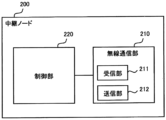
- Fig. 3 is a diagram showing a configuration example of a relay node 200.
- the relay node 200 has a wireless communication unit 210 and a control unit 220.
- the relay node 200 may have a plurality of wireless communication units 210.
- the wireless communication unit 210 performs wireless communication with the donor node 100 (BH link) and wireless communication with the UE 300 (access link).
- a wireless communication unit 210 for BH link communication and a wireless communication unit 210 for access link communication may be provided separately.
- the wireless communication unit 210 has a receiving unit 211 and a transmitting unit 212.
- the receiving unit 211 performs various receptions under the control of the control unit 220.
- the receiving unit 211 includes an antenna, and converts (down-converts) a wireless signal received by the antenna into a baseband signal (received signal) and outputs it to the control unit 220.
- the transmitting unit 212 performs various transmissions under the control of the control unit 220.
- the transmitting unit 212 includes an antenna, and converts (up-converts) a baseband signal (transmitted signal) output by the control unit 220 into a wireless signal and transmits it from the antenna.
- the control unit 220 performs various controls in the relay node 200.
- the control unit 220 includes at least one memory and at least one processor electrically connected to the memory.
- the memory stores programs executed by the processor and information used in processing by the processor.
- the processor may include a baseband processor and a CPU.
- the baseband processor performs modulation/demodulation and encoding/decoding of baseband signals.
- the CPU executes programs stored in the memory to perform various processes.
- the processor performs processing of each layer. Note that the processing or operations in the relay node 200 described below may be performed by the control unit 220.
- Fig. 4 is a diagram illustrating a configuration example of the UE 300 (user equipment). As shown in Fig. 4, the UE 300 has a wireless communication unit 310 and a control unit 320.
- the wireless communication unit 310 performs wireless communication in an access link, i.e., wireless communication with the relay node 200.
- the wireless communication unit 310 may also perform wireless communication in a side link, i.e., wireless communication with other UEs 300.
- the wireless communication unit 310 has a receiving unit 311 and a transmitting unit 312.
- the receiving unit 311 performs various receptions under the control of the control unit 320.
- the receiving unit 311 includes an antenna, and converts (down-converts) a wireless signal received by the antenna into a baseband signal (received signal) and outputs the signal to the control unit 320.
- the transmitting unit 312 performs various transmissions under the control of the control unit 320.
- the transmitting unit 312 includes an antenna, and converts (up-converts) a baseband signal (transmitted signal) output by the control unit 320 into a wireless signal and transmits the signal from the antenna.
- the control unit 320 performs various controls in the UE 300.
- the control unit 320 includes at least one memory and at least one processor electrically connected to the memory.
- the memory stores programs executed by the processor and information used in processing by the processor.
- the processor may include a baseband processor and a CPU.
- the baseband processor performs modulation/demodulation and encoding/decoding of baseband signals.
- the CPU executes programs stored in the memory to perform various processes.
- the processor performs processing of each layer, which will be described later. Note that the processing or operations in the UE 300, which will be described later, may be performed by the control unit 320.
- a transmitter e.g., transmitter 112 of a donor node (e.g., donor node 100) uses the same frequency to simultaneously transmit specific signals addressed to multiple relay nodes (e.g., relay node 200).
- simultaneous transmission means that the transmission start times are not necessarily the same, but that all specific signals are transmitted in the same time period.
- a receiver e.g., receiver 111 of the donor node receives signal-to-interference plus noise ratios (e.g., SINR (Signal to Interference plus Noise Ratio)) for the specific signals from multiple relay nodes.
- SINR Signal-to-interference plus noise ratio
- the controller sets the transmission frequency for the relay node with the smallest signal-to-interference plus noise ratio to a frequency different from the above frequency.
- the donor node 100 transmits a specific signal (hereinafter also referred to as a first specific signal) addressed to the relay node 200-N1 and a specific signal (hereinafter also referred to as a second specific signal) addressed to the relay node 200-N2 to the relay node 200-N1 and the relay node 200-N2, respectively, using the same frequency and at the same timing.
- the relay node 200-N1 measures the SINR (hereinafter also referred to as a first SINR) of the second specific signal relative to the first specific signal.
- the relay node 200-N2 measures the SINR (hereinafter also referred to as a second SINR) of the first specific signal relative to the second specific signal.
- the relay node 200-N1 transmits the first SINR to the donor node 100, and the relay node 200-N2 transmits the second SINR to the donor node 100.
- the donor node 100 determines, based on the first SINR and the second SINR, that interference is occurring between the communication from the donor node 100 to the relay node 200-N1 and the communication from the donor node 100 to the relay node 200-N2.
- the donor node 100 sets the transmission frequency addressed to the relay node 200-N2 to a frequency different from the frequency used to transmit the second specified signal, assuming that the second SINR is the smallest SINR.
- the donor node 100 sets the transmission frequency addressed to the relay node 200-N1 to the same frequency as the frequency used to transmit the first specified signal.
- the donor node 100 when the donor node 100 detects the occurrence of interference based on the SINR, it is possible to set the transmission frequency for the relay node 200-N1 and the transmission frequency for the relay node 200-N2 to different frequencies. This makes it possible to try to avoid interference, for example, between wireless communication from the donor node 100 to the relay node 200-N1 and wireless communication from the donor node 100 to the relay node 200-N2. Moreover, since the donor node 100 determines the occurrence of interference based on the SINR actually measured at the relay nodes 200-N1 and 200-N2, rather than on desk calculations, and automatically sets the transmission frequency for the wireless communication that is the subject of interference to a different frequency, there is a high possibility that interference can be avoided.
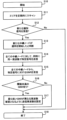
- FIG. 5 is a diagram showing an example of operation according to the first embodiment.
- FIG. 5 mainly shows an example of operation performed in the control unit 130 of the donor node 100.
- FIGS. 6(A) to 10(B) are diagrams for explaining the example of operation. The example of operation shown in FIG. 5 will be explained with reference to each of FIGS. 6(A) to 10(B).
- step S10 the donor node 100 starts processing.
- the donor node 100 periodically scans the area around the donor node 100.
- FIG. 6A is a diagram showing an example in which the donor node 100 scans the area around the donor node 100.
- the relay node 200-N1 transmits an identification signal including its own identification information (hereinafter also referred to as a first identification signal) to the donor node 100
- the relay node 200-N2 transmits an identification signal including its own identification information (hereinafter also referred to as a second identification signal) to the donor node 100.
- the relay nodes 200-N1 and 200-N2 may periodically transmit the identification signal.
- the donor node 100 may transmit the identification signal by including the identification information in any one of an RRC message, a BAP Control PDU (Protocol Data Unit), and a MAC CE (Control Element) and transmitting it.
- step S12 the donor node 100 determines whether or not it has received an identification signal including new identification information.
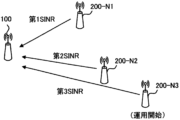
- FIG. 6(B) shows an example in which the relay node 200-N3, which has started operation, transmits an identification signal including new identification information that is not used by the other relay nodes 200-N1 and 200-N2. That is, the donor node 100 periodically receives identification signals from the currently connected relay nodes 200-N1 and 200-N2 (FIG. 6(A)), but receives an identification signal including new identification information that has not been received before from the relay node 200-N3, which has started operation (FIG. 6(B)). The donor node determines whether or not it has received an identification signal including identification information that it has not received before.
- step S12 if the donor node 100 receives the identification signal (Yes in step S12), the process proceeds to step S13. On the other hand, if the donor node 100 does not receive the identification signal (No in step S12), the process proceeds to step S18.
- step S13 the donor node 100 determines that a new relay node has started operation. That is, when the donor node 100 receives an identification signal that includes new identification information that has not been used before, it determines that a new relay node (e.g., relay node 200-N3) has started operation.
- a new relay node e.g., relay node 200-N3
- the donor node 100 simultaneously transmits a specific signal to all relay nodes 200 using the same frequency.
- the donor node 100 may transmit the specific signal in response to receiving an identification signal from the relay node 200-N3 that has started operation as a trigger.
- the transmitter 112 of the donor node 100 may transmit the specific signal in response to receiving, at the receiver 111, an identification signal including identification information that identifies the relay node 200-N3 from the relay node 200-N3 that has newly started operation among the multiple relay nodes 200.
- FIG. 7(A) is a diagram showing an example of transmitting a specific signal.
- the donor node 100 transmits a first specific signal including the identification information of the relay node 200-N1 to the relay node 200-N1.
- the donor node 100 also transmits a second specific signal including the identification information of the relay node 200-N2 to the relay node 200-N2.
- the donor node 100 transmits a third specific signal including the identification information of the relay node 200-N3 to the relay node 200-N3.
- the donor node 100 transmits the first to third specific signals at the same timing using the same frequency.
- the donor node 100 may transmit each specific signal toward each relay node 200 using a phased array antenna.
- FIG. 7B is a diagram showing an example of the configuration of a phased array antenna in the donor node 100.
- FIG. 7B shows an example in which the donor node 100 has four antennas, the first antenna ANT#1 to the fourth antenna ANT#4.
- Each of the antennas ANT#1 to ANT#4 has multiple antenna elements, and a beam having a main lobe in a specific direction can be formed by beamforming control (specifically, phase control, etc.) for each antenna element.
- the antenna ANT#1 transmits a first specific signal to the relay node 200-N1 using a beam having a main lobe in the direction of the relay node 200-N1.
- the antenna ANT#2 transmits a second specific signal to the relay node 200-N2 using a beam having a main lobe in the direction of the relay node 200-N2.
- antenna ANT#3 transmits a third specific signal to relay node 200-N3 using a beam having a main lobe in the direction of relay node 200-N3.
- donor node 100 may transmit a specific signal to each relay node 200 using any one of the four antennas ANT#1 to ANT#4.
- the specific signal may be a synchronization signal (SSB: Synchronization Signal Block).
- SSB Synchronization Signal Block
- the specific signal may be a newly defined signal. In the latter case, the specific signal may be transmitted in any one of an RRC message, a BAP Control PDU, and a MAC CE.
- the donor node 100 receives the SINR for the specific signal from all relay nodes 200. All relay nodes 200 perform a measurement process to measure the SINR using the specific signal, and transmit the measured SINR to the donor node 100.
- FIG. 8(A) and FIG. 8(B) are diagrams showing an example of a measurement process.
- FIG. 8(A) shows examples of a first specific signal, a second specific signal, and a third specific signal.
- the donor node 100 transmits the first specific signal to the third specific signal using the same frequency.
- the relay node 200-N1 judges the first specified signal to be a desired signal (a signal addressed to the own station) because the first specified signal contains the identification information of the own station, and judges the second and third specified signals to be other signals (i.e., noise and interference signals) because the second and third specified signals do not contain the identification information of the own station, and measures an SINR (e.g., a first SINR) that indicates the ratio of the received power of the other signals (the second and third specified signals) to the received power of the desired signal (the first specified signal).
- SINR e.g., a first SINR
- the relay node 200-N2 judges the second specified signal that contains the identification information of the own station to be a desired signal, and judges the first and third specified signals that do not contain the identification information of the own station to be other signals, and measures an SINR (e.g., a second SINR) that indicates the ratio of the received power of the other signals (the first and third specified signals) to the received power of the desired signal (the second specified signal).
- SINR e.g., a second SINR
- the relay node 200-N3 determines the third specified signal, which includes the identification information of the own station, as the desired signal, and determines the first specified signal and the second specified signal, which do not include the identification information of the own station, as other signals, and measures an SINR (e.g., the third SINR) that represents the ratio of the received power of the other signals (the first specified signal and the second specified signal) to the received power of the desired signal (the third specified signal).
- SINR e.g., the third SINR
- Each of the relay nodes 200-N1 to 200-N3 transmits the SINRs measured in the above manner to the donor node 100.
- Figure 9 shows an example in which the relay node 200-N1 transmits a first SINR to the donor node 100, the relay node 200-N2 transmits a second SINR to the donor node 100, and the relay node 200-N3 transmits a third SINR to the donor node 100.
- each relay node 200-N1 to 200-N3 may transmit the measured SINR by including it in a measurement report.
- each relay node 200-N1 to 200-N3 may transmit the measured SINR by including it in a newly defined message.
- each SINR may be transmitted by being included in any of an RRC message, a BAP Control PDU, and a MAC CE.
- the donor node 100 determines whether or not there is an SINR below the threshold.
- the donor node 100 compares the SINR with the threshold to determine whether or not interference is occurring in each relay node 200. Specifically, when the SINR is below the threshold, the donor node 100 determines that interference is occurring in at least two relay nodes 200. On the other hand, when the SINR is equal to or greater than the threshold, the donor node 100 determines that no interference is occurring in the relay node 200.
- the relay node 200-N1 is separated from the relay node 200-N2 and the relay node 200-N3 by a predetermined distance or more. Therefore, in the relay node 200-N1, the difference in received power between the desired signal (first specific signal) and the other signal (second specific signal or third specific signal) is a predetermined value or more. Therefore, the first SINR can be a threshold value or more. Conversely, if the first SINR is a threshold value or more, it is assumed that the second specific signal or the third specific signal does not become an interfering signal with the first specific signal in the relay node 200-N1 and no interference occurs. Therefore, in the donor node 100, when the SINR is a threshold value or more, it is determined that no interference occurs in the relay node 200 that transmitted the SINR.
- the distance between the relay node 200-N2 and the relay node 200-N3 is less than a predetermined distance. Therefore, in the relay node 200-N2, the difference in the received power between the desired signal (second specific signal) and the other signal (third specific signal) is less than a predetermined value. That is, the second SINR may be less than a threshold. In such a case, in the relay node 200-N2, the third specific signal is an interference signal of the second specific signal addressed to the own station, so the second SINR is less than the threshold. In other words, if the second SINR is less than the threshold, it is assumed that the third specific signal is an interference signal of the second specific signal addressed to the own station, and interference is occurring in the relay node 200-N2. Therefore, in the donor node 100, when the SINR is less than the threshold, it is determined that interference is occurring in the relay node 200 that transmitted the SINR.
- the second specific signal is an interfering signal for the third specific signal addressed to the local station, so the third SINR may be less than the threshold.
- the donor node 100 determines that interference is occurring in the relay node 200-N3 because the third SINR is less than the threshold.
- step S16 if there is an SINR below the threshold (Yes in step S16), the process proceeds to step S17. On the other hand, if there is no SINR below the threshold (No in step S16), the process proceeds to step S18.
- step S17 the donor node 100 sets the transmission frequency for the relay node 200 that transmitted the smallest SINR among the SINRs that are less than the threshold to a frequency different from the frequency used to transmit the specific signal.
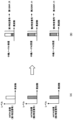
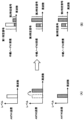
- FIGS. 10(A) and 10(B) are diagrams showing examples of setting the transmission frequency.
- the donor node 100 determines that the second SINR is the smallest SINR, and sets the transmission frequency for the relay node 200-N2 that transmitted the second SINR to a frequency different from the frequency used to transmit the specific signal. In this case, the donor node 100 sets the transmission frequency for the relay node 200-N3 to the frequency used to transmit the specific signal.
- FIG. 10(B) is a diagram showing an example of the SINR in each of the relay nodes 200-N1 to 200-3 when the first specific signal to the third specific signal are transmitted simultaneously after the transmission frequency for the relay node 200-N2 is set.
- the second specific signal and the third specific signal transmitted from the donor node 100 to the two relay nodes 200-N2 and 200-N3, respectively are transmitted using different frequencies. Therefore, there is a high possibility that interference will not occur in the relay nodes 200-N2 and 200-3. In this way, in this embodiment, it is possible to automatically attempt to avoid the occurrence of interference.
- the donor node 100 determines that no interference is occurring.
- step S18 the donor node 100 ends the series of processes.
- each of the relay nodes 200-N1 to 200-N3 transmits the SINR to the donor node 100
- each of the relay nodes 200-N1 to 200-N3 may compare the SINR with a threshold and transmit the comparison result to the donor node 100.
- the comparison result may be information indicating that the SINR is equal to or greater than the threshold (or the SINR is large), or information indicating that the SINR is less than the threshold (or the SINR is small).
- the comparison result may also be transmitted using any of an RRC message, a BAP Control PDU, and a MAC CE.
- the donor node 100 may determine that interference is occurring, and if the donor node 100 receives a comparison result indicating that the SINR is greater than or equal to a threshold, it may determine that interference is not occurring.
- the relay node 200-N3 that has started operation transmits an identification signal including identification information.
- the identification information may be issued by the donor node 100.
- the relay node 200-N3 that has started operation transmits an "IAB-indication" to the donor node 100.
- the "IAB-indication" is, for example, an information element that indicates that the relay node 200-N3 is an IAB node.
- the "IAB-indication" may be transmitted using any of an RRC message, a BAP Control PDU, and a MAC CE.
- the donor node 100 issues identification information to the relay node 200-N3 and transmits the identification information to the relay node 200-N3.
- the identification information may also be transmitted using, for example, any of an RRC message, a BAP Control PDU, and a MAC CE.
- the relay node 200-N3 transmits a control signal including the identification information.
- the relay node 200-N3 may transmit information indicating that a new connection will be made to the donor node 100.
- the information may be an "IAB-indication".
- the information may be included in a newly defined message and transmitted. In the latter case, the information may be included in any one of an RRC message, a BAP Control PDU, and a MAC CE and transmitted.
- the number of antennas in the donor node 100 is "four" has been described, but the number of antennas is not limited to this.
- the number of antennas provided in the donor node 100 may be "one" or more.
- a signal e.g., a specific signal
- the donor node 100 transmits a specific signal when the donor node 100 receives an identification signal from the relay node 200-N3 that has started operation, but the trigger for transmitting the specific signal is not limited to this.
- the donor node 100 may transmit the specific signal as appropriate.
- the donor node 100 uses “f1" as the transmission frequency for the relay node 200-N1 and “f2" as the transmission frequency for the relay node 200-N2. It is also assumed that the use of frequency "f1" has begun in wireless communication other than the mobile communication system 10 shown in FIG. 1. In such a case, the SINR of the transmission frequency "f1" used by the donor node 100 becomes smaller compared to before the use of frequency "f1" has begun in the other wireless communication.
- the donor node 100 may use a specific signal of frequency "f1" and transmit the specific signal simultaneously to the relay node 200-N2 as appropriate. This enables the donor node 100 to detect the presence or absence of interference as described in the first embodiment, and in some cases, may also change the transmission frequency. In this way, the donor node 100 may transmit a specific signal as appropriate to check (or improve) the transmission frequency.
- an index other than the SINR may be used.
- Such an index may be a signal to interference power ratio (SIR).
- Such an index may be a signal to noise power ratio (SNR).
- the index may be information indicating the ratio between a desired signal and other signals (for example, an interference signal or a noise signal).
- a program may be provided that causes a computer to execute each process performed by the donor node 100, the relay node 200, and the UE 300.
- the program may be recorded in a computer-readable medium.
- a computer-readable medium it is possible to install the program in a computer.
- the computer-readable medium on which the program is recorded may be a non-transient recording medium.
- the non-transient recording medium is not particularly limited, and may be, for example, a recording medium such as a CD-ROM or a DVD-ROM.
- circuits that execute each process performed by the donor node 100, the relay node 200, and the UE 300 may be integrated, and at least a part of the donor node 100, the relay node 200, and the UE 300 may be configured as a semiconductor integrated circuit (chip set, SoC: System on a chip).
- the terms “based on” and “depending on” do not mean “based only on” or “depending only on”, unless otherwise specified.
- the term “based on” means both “based only on” and “based at least in part on”.
- the term “depending on” means both “based only on” and “depending at least in part on”.
- the terms “include” and “comprise” do not mean including only the items listed, but may include only the items listed, or may include additional items in addition to the items listed.
- the term “or” as used in this disclosure is not intended to be an exclusive or. Additionally, any reference to elements using designations such as “first”, “second”, etc., as used in this disclosure is not intended to generally limit the quantity or order of those elements.
- a mobile communication system having a donor node and a plurality of relay nodes,
- the donor node is a transmitting unit that simultaneously transmits specific signals addressed to each of the plurality of relay nodes using the same frequency; a receiving unit that receives a signal-to-interference-and-noise ratio for the specific signal from the plurality of relay nodes; and a control unit that, when it is determined that interference is occurring in the plurality of relay nodes based on the signal-to-interference-plus-noise ratio, sets a transmission frequency for the relay node that has transmitted the smallest signal-to-interference-plus-noise ratio to a frequency different from the same frequency.
- the control unit sets the transmission frequency of a relay node that has transmitted a smallest signal-to-interference-plus-noise ratio among the signal-to-interference-plus-noise ratios that are less than the threshold to a frequency different from the smallest signal-to-interference-plus-noise ratio among the signal-to-interference-plus-noise ratios that are less than the threshold.
- a donor node that wirelessly communicates with a plurality of relay nodes, a transmitting unit that simultaneously transmits specific signals addressed to each of the plurality of relay nodes using the same frequency; a receiving unit that receives a signal-to-interference-and-noise ratio for the specific signal from the plurality of relay nodes; and a control unit that, when it is determined that interference is occurring in the plurality of relay nodes based on the signal-to-interference-and-noise ratio, sets a transmission frequency in the relay node that has transmitted the smallest signal-to-interference-and-noise ratio to a frequency different from the same frequency.
- a communication control method in a mobile communication system having a donor node and a plurality of relay nodes comprising: the donor node simultaneously transmitting a specific signal addressed to each of the plurality of relay nodes using the same frequency; the donor node receiving a signal to interference and noise ratio for the particular signal from the plurality of relay nodes; and when the donor node determines that interference is occurring at the plurality of relay nodes based on the signal-to-interference-and-noise ratio, setting a transmission frequency at the relay node that has transmitted the smallest signal-to-interference-and-noise ratio to a frequency different from the same frequency.
Landscapes
- Engineering & Computer Science (AREA)
- Computer Networks & Wireless Communication (AREA)
- Signal Processing (AREA)
- Quality & Reliability (AREA)
- Mobile Radio Communication Systems (AREA)
Priority Applications (1)
| Application Number | Priority Date | Filing Date | Title |
|---|---|---|---|
| JP2024571712A JPWO2024154622A1 (https=) | 2023-01-16 | 2024-01-10 |
Applications Claiming Priority (2)
| Application Number | Priority Date | Filing Date | Title |
|---|---|---|---|
| JP2023004242 | 2023-01-16 | ||
| JP2023-004242 | 2023-01-16 |
Publications (1)
| Publication Number | Publication Date |
|---|---|
| WO2024154622A1 true WO2024154622A1 (ja) | 2024-07-25 |
Family
ID=91955959
Family Applications (1)
| Application Number | Title | Priority Date | Filing Date |
|---|---|---|---|
| PCT/JP2024/000268 Ceased WO2024154622A1 (ja) | 2023-01-16 | 2024-01-10 | 移動通信システム、ドナーノード、及び通信制御方法 |
Country Status (2)
| Country | Link |
|---|---|
| JP (1) | JPWO2024154622A1 (https=) |
| WO (1) | WO2024154622A1 (https=) |
Citations (1)
| Publication number | Priority date | Publication date | Assignee | Title |
|---|---|---|---|---|
| JP2016508324A (ja) * | 2013-01-02 | 2016-03-17 | クゥアルコム・インコーポレイテッドQualcomm Incorporated | スペクトル検知およびチャネル予約を使用した無認可帯域におけるバックホールトラフィックの信頼性 |
-
2024
- 2024-01-10 JP JP2024571712A patent/JPWO2024154622A1/ja active Pending
- 2024-01-10 WO PCT/JP2024/000268 patent/WO2024154622A1/ja not_active Ceased
Patent Citations (1)
| Publication number | Priority date | Publication date | Assignee | Title |
|---|---|---|---|---|
| JP2016508324A (ja) * | 2013-01-02 | 2016-03-17 | クゥアルコム・インコーポレイテッドQualcomm Incorporated | スペクトル検知およびチャネル予約を使用した無認可帯域におけるバックホールトラフィックの信頼性 |
Non-Patent Citations (2)
| Title |
|---|
| ERICSSON: "Timing, interference management and power control in enhanced IAB", 3GPP TSG RAN WG1 #106-E R1-2108108, 6 August 2021 (2021-08-06), XP052033779 * |
| NTT DOCOMO, INC.: "Discussion on enhancements to support NR backhaul links", 3GPP TSG RAN WG1 #94 R1-1809155, 11 August 2018 (2018-08-11), XP051516525 * |
Also Published As
| Publication number | Publication date |
|---|---|
| JPWO2024154622A1 (https=) | 2024-07-25 |
Similar Documents
| Publication | Publication Date | Title |
|---|---|---|
| JP7798924B2 (ja) | セルアクセス方法、通信装置、およびコンピュータ記憶媒体 | |
| EP3637918B1 (en) | Electronic apparatus, wireless communication device, and wireless communication method | |
| EP3352381B1 (en) | Electronic device in wireless communication system, and wireless communication method | |
| JP2023515337A (ja) | 一つのdciに基づくm-trp urllc送信のためのビーム障害回復 | |
| CN110476396A (zh) | 在空间准共址的高频多载波操作中用于波束管理的系统和方法 | |
| CN115868139B (zh) | 发送接收点配对指示 | |
| US11540111B2 (en) | Optimized multiple subscriber identity module mode in high mobility environments | |
| CN115119239A (zh) | 用于无线通信的电子设备和方法、计算机可读存储介质 | |
| CN115039443A (zh) | 一种通信方法及通信装置 | |
| US20170367133A1 (en) | Communication device performing device-to-device communication and operating method thereof | |
| KR20250002543A (ko) | 위성 통신 방법 및 장치 | |
| CN115516993B (zh) | 用于具有多个订阅的用户设备的调谐脱离配置 | |
| US11496951B2 (en) | Mobile communication system and radio terminal | |
| CN118830308A (zh) | 通信方法、终端设备和网络设备 | |
| WO2024154622A1 (ja) | 移動通信システム、ドナーノード、及び通信制御方法 | |
| CN112806066B (zh) | 使用辅助上行进行通信的系统和方法 | |
| CN115211202A (zh) | 用于无线通信的电子设备和方法、计算机可读存储介质 | |
| US12557157B2 (en) | Method and apparatus for dual connectivity in communication system | |
| US20240235802A9 (en) | Utilizing unused frequency division duplex uplink for time division duplex operations in wireless networks | |
| EP4319301A1 (en) | User equipment and communication control method | |
| CN118785285A (zh) | 一种通信方法、通信装置及通信系统 | |
| CN121645378A (zh) | 一种通信方法及装置 | |
| KR20250063189A (ko) | 다중 빔 통신에서 핸드오버를 수행하는 방법 및 장치 | |
| CN121510164A (zh) | 测量上报方法、通信装置、存储介质及芯片系统 | |
| CN121753443A (zh) | 通信方法、终端、网络设备、存储介质及程序产品 |
Legal Events
| Date | Code | Title | Description |
|---|---|---|---|
| 121 | Ep: the epo has been informed by wipo that ep was designated in this application |
Ref document number: 24744545 Country of ref document: EP Kind code of ref document: A1 |
|
| ENP | Entry into the national phase |
Ref document number: 2024571712 Country of ref document: JP Kind code of ref document: A |
|
| WWE | Wipo information: entry into national phase |
Ref document number: 2024571712 Country of ref document: JP |
|
| NENP | Non-entry into the national phase |
Ref country code: DE |
|
| 122 | Ep: pct application non-entry in european phase |
Ref document number: 24744545 Country of ref document: EP Kind code of ref document: A1 |