WO2024150722A1 - 積層体、半導体素子およびmems素子 - Google Patents
積層体、半導体素子およびmems素子 Download PDFInfo
- Publication number
- WO2024150722A1 WO2024150722A1 PCT/JP2024/000108 JP2024000108W WO2024150722A1 WO 2024150722 A1 WO2024150722 A1 WO 2024150722A1 JP 2024000108 W JP2024000108 W JP 2024000108W WO 2024150722 A1 WO2024150722 A1 WO 2024150722A1
- Authority
- WO
- WIPO (PCT)
- Prior art keywords
- group
- resin layer
- substrate
- metal electrode
- laminate
- Prior art date
- Legal status (The legal status is an assumption and is not a legal conclusion. Google has not performed a legal analysis and makes no representation as to the accuracy of the status listed.)
- Ceased
Links
Images


Classifications
-
- H—ELECTRICITY
- H10—SEMICONDUCTOR DEVICES; ELECTRIC SOLID-STATE DEVICES NOT OTHERWISE PROVIDED FOR
- H10W—GENERIC PACKAGES, INTERCONNECTIONS, CONNECTORS OR OTHER CONSTRUCTIONAL DETAILS OF DEVICES COVERED BY CLASS H10
- H10W72/00—Interconnections or connectors in packages
- H10W72/30—Die-attach connectors
-
- H—ELECTRICITY
- H10—SEMICONDUCTOR DEVICES; ELECTRIC SOLID-STATE DEVICES NOT OTHERWISE PROVIDED FOR
- H10W—GENERIC PACKAGES, INTERCONNECTIONS, CONNECTORS OR OTHER CONSTRUCTIONAL DETAILS OF DEVICES COVERED BY CLASS H10
- H10W90/00—Package configurations
-
- B—PERFORMING OPERATIONS; TRANSPORTING
- B32—LAYERED PRODUCTS
- B32B—LAYERED PRODUCTS, i.e. PRODUCTS BUILT-UP OF STRATA OF FLAT OR NON-FLAT, e.g. CELLULAR OR HONEYCOMB, FORM
- B32B15/00—Layered products comprising a layer of metal
-
- B—PERFORMING OPERATIONS; TRANSPORTING
- B32—LAYERED PRODUCTS
- B32B—LAYERED PRODUCTS, i.e. PRODUCTS BUILT-UP OF STRATA OF FLAT OR NON-FLAT, e.g. CELLULAR OR HONEYCOMB, FORM
- B32B15/00—Layered products comprising a layer of metal
- B32B15/04—Layered products comprising a layer of metal comprising metal as the main or only constituent of a layer, which is next to another layer of the same or of a different material
- B32B15/043—Layered products comprising a layer of metal comprising metal as the main or only constituent of a layer, which is next to another layer of the same or of a different material of metal
-
- B—PERFORMING OPERATIONS; TRANSPORTING
- B81—MICROSTRUCTURAL TECHNOLOGY
- B81B—MICROSTRUCTURAL DEVICES OR SYSTEMS, e.g. MICROMECHANICAL DEVICES
- B81B7/00—Microstructural systems ; Auxiliary parts of microstructural devices or systems
- B81B7/0006—Interconnects
-
- B—PERFORMING OPERATIONS; TRANSPORTING
- B81—MICROSTRUCTURAL TECHNOLOGY
- B81C—PROCESSES OR APPARATUS SPECIALLY ADAPTED FOR THE MANUFACTURE OR TREATMENT OF MICROSTRUCTURAL DEVICES OR SYSTEMS
- B81C1/00—Manufacture or treatment of devices or systems in or on a substrate
- B81C1/00015—Manufacture or treatment of devices or systems in or on a substrate for manufacturing microsystems
- B81C1/00222—Integrating an electronic processing unit with a micromechanical structure
- B81C1/00238—Joining a substrate with an electronic processing unit and a substrate with a micromechanical structure
-
- C—CHEMISTRY; METALLURGY
- C08—ORGANIC MACROMOLECULAR COMPOUNDS; THEIR PREPARATION OR CHEMICAL WORKING-UP; COMPOSITIONS BASED THEREON
- C08G—MACROMOLECULAR COMPOUNDS OBTAINED OTHERWISE THAN BY REACTIONS ONLY INVOLVING UNSATURATED CARBON-TO-CARBON BONDS
- C08G73/00—Macromolecular compounds obtained by reactions forming a linkage containing nitrogen with or without oxygen or carbon in the main chain of the macromolecule, not provided for in groups C08G12/00 - C08G71/00
- C08G73/06—Polycondensates having nitrogen-containing heterocyclic rings in the main chain of the macromolecule
-
- C—CHEMISTRY; METALLURGY
- C08—ORGANIC MACROMOLECULAR COMPOUNDS; THEIR PREPARATION OR CHEMICAL WORKING-UP; COMPOSITIONS BASED THEREON
- C08G—MACROMOLECULAR COMPOUNDS OBTAINED OTHERWISE THAN BY REACTIONS ONLY INVOLVING UNSATURATED CARBON-TO-CARBON BONDS
- C08G73/00—Macromolecular compounds obtained by reactions forming a linkage containing nitrogen with or without oxygen or carbon in the main chain of the macromolecule, not provided for in groups C08G12/00 - C08G71/00
- C08G73/06—Polycondensates having nitrogen-containing heterocyclic rings in the main chain of the macromolecule
- C08G73/10—Polyimides; Polyester-imides; Polyamide-imides; Polyamide acids or similar polyimide precursors
- C08G73/1003—Preparatory processes
- C08G73/1007—Preparatory processes from tetracarboxylic acids or derivatives and diamines
- C08G73/101—Preparatory processes from tetracarboxylic acids or derivatives and diamines containing chain terminating or branching agents
- C08G73/1017—Preparatory processes from tetracarboxylic acids or derivatives and diamines containing chain terminating or branching agents in the form of (mono)amine
-
- C—CHEMISTRY; METALLURGY
- C08—ORGANIC MACROMOLECULAR COMPOUNDS; THEIR PREPARATION OR CHEMICAL WORKING-UP; COMPOSITIONS BASED THEREON
- C08G—MACROMOLECULAR COMPOUNDS OBTAINED OTHERWISE THAN BY REACTIONS ONLY INVOLVING UNSATURATED CARBON-TO-CARBON BONDS
- C08G73/00—Macromolecular compounds obtained by reactions forming a linkage containing nitrogen with or without oxygen or carbon in the main chain of the macromolecule, not provided for in groups C08G12/00 - C08G71/00
- C08G73/06—Polycondensates having nitrogen-containing heterocyclic rings in the main chain of the macromolecule
- C08G73/10—Polyimides; Polyester-imides; Polyamide-imides; Polyamide acids or similar polyimide precursors
- C08G73/1039—Polyimides; Polyester-imides; Polyamide-imides; Polyamide acids or similar polyimide precursors comprising halogen-containing substituents
-
- C—CHEMISTRY; METALLURGY
- C08—ORGANIC MACROMOLECULAR COMPOUNDS; THEIR PREPARATION OR CHEMICAL WORKING-UP; COMPOSITIONS BASED THEREON
- C08G—MACROMOLECULAR COMPOUNDS OBTAINED OTHERWISE THAN BY REACTIONS ONLY INVOLVING UNSATURATED CARBON-TO-CARBON BONDS
- C08G73/00—Macromolecular compounds obtained by reactions forming a linkage containing nitrogen with or without oxygen or carbon in the main chain of the macromolecule, not provided for in groups C08G12/00 - C08G71/00
- C08G73/06—Polycondensates having nitrogen-containing heterocyclic rings in the main chain of the macromolecule
- C08G73/10—Polyimides; Polyester-imides; Polyamide-imides; Polyamide acids or similar polyimide precursors
- C08G73/1042—Copolyimides derived from at least two different tetracarboxylic compounds or two different diamino compounds
-
- C—CHEMISTRY; METALLURGY
- C08—ORGANIC MACROMOLECULAR COMPOUNDS; THEIR PREPARATION OR CHEMICAL WORKING-UP; COMPOSITIONS BASED THEREON
- C08G—MACROMOLECULAR COMPOUNDS OBTAINED OTHERWISE THAN BY REACTIONS ONLY INVOLVING UNSATURATED CARBON-TO-CARBON BONDS
- C08G73/00—Macromolecular compounds obtained by reactions forming a linkage containing nitrogen with or without oxygen or carbon in the main chain of the macromolecule, not provided for in groups C08G12/00 - C08G71/00
- C08G73/06—Polycondensates having nitrogen-containing heterocyclic rings in the main chain of the macromolecule
- C08G73/10—Polyimides; Polyester-imides; Polyamide-imides; Polyamide acids or similar polyimide precursors
- C08G73/1057—Polyimides containing other atoms than carbon, hydrogen, nitrogen or oxygen in the main chain
- C08G73/106—Polyimides containing other atoms than carbon, hydrogen, nitrogen or oxygen in the main chain containing silicon
-
- C—CHEMISTRY; METALLURGY
- C08—ORGANIC MACROMOLECULAR COMPOUNDS; THEIR PREPARATION OR CHEMICAL WORKING-UP; COMPOSITIONS BASED THEREON
- C08G—MACROMOLECULAR COMPOUNDS OBTAINED OTHERWISE THAN BY REACTIONS ONLY INVOLVING UNSATURATED CARBON-TO-CARBON BONDS
- C08G73/00—Macromolecular compounds obtained by reactions forming a linkage containing nitrogen with or without oxygen or carbon in the main chain of the macromolecule, not provided for in groups C08G12/00 - C08G71/00
- C08G73/06—Polycondensates having nitrogen-containing heterocyclic rings in the main chain of the macromolecule
- C08G73/10—Polyimides; Polyester-imides; Polyamide-imides; Polyamide acids or similar polyimide precursors
- C08G73/1067—Wholly aromatic polyimides, i.e. having both tetracarboxylic and diamino moieties aromatically bound
- C08G73/1071—Wholly aromatic polyimides containing oxygen in the form of ether bonds in the main chain
-
- C—CHEMISTRY; METALLURGY
- C08—ORGANIC MACROMOLECULAR COMPOUNDS; THEIR PREPARATION OR CHEMICAL WORKING-UP; COMPOSITIONS BASED THEREON
- C08G—MACROMOLECULAR COMPOUNDS OBTAINED OTHERWISE THAN BY REACTIONS ONLY INVOLVING UNSATURATED CARBON-TO-CARBON BONDS
- C08G73/00—Macromolecular compounds obtained by reactions forming a linkage containing nitrogen with or without oxygen or carbon in the main chain of the macromolecule, not provided for in groups C08G12/00 - C08G71/00
- C08G73/06—Polycondensates having nitrogen-containing heterocyclic rings in the main chain of the macromolecule
- C08G73/22—Polybenzoxazoles
-
- C—CHEMISTRY; METALLURGY
- C08—ORGANIC MACROMOLECULAR COMPOUNDS; THEIR PREPARATION OR CHEMICAL WORKING-UP; COMPOSITIONS BASED THEREON
- C08L—COMPOSITIONS OF MACROMOLECULAR COMPOUNDS
- C08L101/00—Compositions of unspecified macromolecular compounds
-
- C—CHEMISTRY; METALLURGY
- C08—ORGANIC MACROMOLECULAR COMPOUNDS; THEIR PREPARATION OR CHEMICAL WORKING-UP; COMPOSITIONS BASED THEREON
- C08L—COMPOSITIONS OF MACROMOLECULAR COMPOUNDS
- C08L79/00—Compositions of macromolecular compounds obtained by reactions forming in the main chain of the macromolecule a linkage containing nitrogen with or without oxygen or carbon only, not provided for in groups C08L61/00 - C08L77/00
- C08L79/04—Polycondensates having nitrogen-containing heterocyclic rings in the main chain; Polyhydrazides; Polyamide acids or similar polyimide precursors
- C08L79/08—Polyimides; Polyester-imides; Polyamide-imides; Polyamide acids or similar polyimide precursors
-
- H—ELECTRICITY
- H10—SEMICONDUCTOR DEVICES; ELECTRIC SOLID-STATE DEVICES NOT OTHERWISE PROVIDED FOR
- H10W—GENERIC PACKAGES, INTERCONNECTIONS, CONNECTORS OR OTHER CONSTRUCTIONAL DETAILS OF DEVICES COVERED BY CLASS H10
- H10W72/00—Interconnections or connectors in packages
- H10W72/071—Connecting or disconnecting
-
- H—ELECTRICITY
- H10—SEMICONDUCTOR DEVICES; ELECTRIC SOLID-STATE DEVICES NOT OTHERWISE PROVIDED FOR
- H10W—GENERIC PACKAGES, INTERCONNECTIONS, CONNECTORS OR OTHER CONSTRUCTIONAL DETAILS OF DEVICES COVERED BY CLASS H10
- H10W74/00—Encapsulations, e.g. protective coatings
- H10W74/01—Manufacture or treatment
- H10W74/012—Manufacture or treatment of encapsulations on active surfaces of flip-chip devices, e.g. forming underfills
-
- H—ELECTRICITY
- H10—SEMICONDUCTOR DEVICES; ELECTRIC SOLID-STATE DEVICES NOT OTHERWISE PROVIDED FOR
- H10W—GENERIC PACKAGES, INTERCONNECTIONS, CONNECTORS OR OTHER CONSTRUCTIONAL DETAILS OF DEVICES COVERED BY CLASS H10
- H10W74/00—Encapsulations, e.g. protective coatings
- H10W74/10—Encapsulations, e.g. protective coatings characterised by their shape or disposition
- H10W74/15—Encapsulations, e.g. protective coatings characterised by their shape or disposition on active surfaces of flip-chip devices, e.g. underfills
-
- H—ELECTRICITY
- H10—SEMICONDUCTOR DEVICES; ELECTRIC SOLID-STATE DEVICES NOT OTHERWISE PROVIDED FOR
- H10W—GENERIC PACKAGES, INTERCONNECTIONS, CONNECTORS OR OTHER CONSTRUCTIONAL DETAILS OF DEVICES COVERED BY CLASS H10
- H10W74/00—Encapsulations, e.g. protective coatings
- H10W74/40—Encapsulations, e.g. protective coatings characterised by their materials
- H10W74/47—Encapsulations, e.g. protective coatings characterised by their materials comprising organic materials, e.g. plastics or resins
-
- B—PERFORMING OPERATIONS; TRANSPORTING
- B32—LAYERED PRODUCTS
- B32B—LAYERED PRODUCTS, i.e. PRODUCTS BUILT-UP OF STRATA OF FLAT OR NON-FLAT, e.g. CELLULAR OR HONEYCOMB, FORM
- B32B2255/00—Coating on the layer surface
- B32B2255/06—Coating on the layer surface on metal layer
-
- B—PERFORMING OPERATIONS; TRANSPORTING
- B32—LAYERED PRODUCTS
- B32B—LAYERED PRODUCTS, i.e. PRODUCTS BUILT-UP OF STRATA OF FLAT OR NON-FLAT, e.g. CELLULAR OR HONEYCOMB, FORM
- B32B2255/00—Coating on the layer surface
- B32B2255/26—Polymeric coating
-
- B—PERFORMING OPERATIONS; TRANSPORTING
- B32—LAYERED PRODUCTS
- B32B—LAYERED PRODUCTS, i.e. PRODUCTS BUILT-UP OF STRATA OF FLAT OR NON-FLAT, e.g. CELLULAR OR HONEYCOMB, FORM
- B32B2307/00—Properties of the layers or laminate
- B32B2307/30—Properties of the layers or laminate having particular thermal properties
-
- B—PERFORMING OPERATIONS; TRANSPORTING
- B32—LAYERED PRODUCTS
- B32B—LAYERED PRODUCTS, i.e. PRODUCTS BUILT-UP OF STRATA OF FLAT OR NON-FLAT, e.g. CELLULAR OR HONEYCOMB, FORM
- B32B2307/00—Properties of the layers or laminate
- B32B2307/50—Properties of the layers or laminate having particular mechanical properties
- B32B2307/51—Elastic
-
- B—PERFORMING OPERATIONS; TRANSPORTING
- B32—LAYERED PRODUCTS
- B32B—LAYERED PRODUCTS, i.e. PRODUCTS BUILT-UP OF STRATA OF FLAT OR NON-FLAT, e.g. CELLULAR OR HONEYCOMB, FORM
- B32B2307/00—Properties of the layers or laminate
- B32B2307/70—Other properties
- B32B2307/748—Releasability
-
- B—PERFORMING OPERATIONS; TRANSPORTING
- B32—LAYERED PRODUCTS
- B32B—LAYERED PRODUCTS, i.e. PRODUCTS BUILT-UP OF STRATA OF FLAT OR NON-FLAT, e.g. CELLULAR OR HONEYCOMB, FORM
- B32B2457/00—Electrical equipment
- B32B2457/14—Semiconductor wafers
-
- B—PERFORMING OPERATIONS; TRANSPORTING
- B81—MICROSTRUCTURAL TECHNOLOGY
- B81C—PROCESSES OR APPARATUS SPECIALLY ADAPTED FOR THE MANUFACTURE OR TREATMENT OF MICROSTRUCTURAL DEVICES OR SYSTEMS
- B81C2203/00—Forming microstructural systems
- B81C2203/07—Integrating an electronic processing unit with a micromechanical structure
- B81C2203/0785—Transfer and j oin technology, i.e. forming the electronic processing unit and the micromechanical structure on separate substrates and joining the substrates
- B81C2203/0792—Forming interconnections between the electronic processing unit and the micromechanical structure
Definitions
- the present invention relates to a laminate, a semiconductor element, and a MEMS element. More specifically, it relates to a technology for mounting elements by direct bonding using metal electrodes and an insulating film.
- a first substrate having an exposed metal electrode (A-1) and an exposed resin layer (B-1) on the same surface of a substrate body;
- a second substrate having an exposed metal electrode (A-2) and an exposed resin layer (B-2), or an exposed metal electrode (A-2) and an exposed inorganic insulating layer (C) on the same surface of the substrate body, At least a part of the (A-1) metal electrode and the (A-2) metal electrode, and at least a part of the (B-1) resin layer and the (B-2) resin layer, or A laminate in which at least a portion of the (A-1) metal electrode and the (A-2) metal electrode, and at least a portion of the (B-1) resin layer and the (C) inorganic insulating layer are bonded together so as to be directly bonded to each other, At least one of the (B-1) resin layer and the (B-2) resin layer contains one or more resins selected from the group consisting of a carbonyl group,
- R 1 to R 4 each independently represent an alkylene group having 1 to 6 carbon atoms.
- R 5 to R 12 each independently represent a hydrogen atom, a fluorine atom, or an alkyl group having 1 to 6 carbon atoms.
- the structures represented in the parentheses are different from one another.
- g, h, and i each independently represent an integer of 0 to 35, provided that g+h+i>0. * represents a bonding site.
- R 13 and R 14 each independently represent an alkylene group having 1 to 30 carbon atoms, an alkenylene group having 2 to 10 carbon atoms, an alkynylene group having 2 to 10 carbon atoms, or a phenylene group having 6 to 20 carbon atoms.
- R 15 to R 18 each independently represent an alkyl group having 1 to 30 carbon atoms, a phenyl group, or a phenoxy group.
- R to R each independently represent a hydrogen atom, a fluorine atom, a hydroxyl group, or a hydrocarbon group having 1 to 6 carbon atoms (which may be partially or completely substituted with one or more of a fluorine atom, a hydroxyl group, or a carboxyl group).)
- [12] The laminate according to any one of [1] to [11], in which the bonding strength between the first substrate and the second substrate in a die shear test is 10 MPa or more.
- a semiconductor device comprising the laminate according to any one of [1] to [13].
- a MEMS element comprising the laminate according to any one of [1] to [14].
- the laminate of the present invention has high bonding strength and few voids on the bonding surface, making it highly reliable.
- the laminate of the present invention comprises a first substrate having an exposed metal electrode (A-1) and an exposed resin layer (B-1) on the same surface of a substrate body; A second substrate having an exposed metal electrode (A-2) and an exposed resin layer (B-2), or an exposed metal electrode (A-2) and an exposed inorganic insulating layer (C), on the same surface of the substrate body; At least a part of the (A-1) metal electrode and the (A-2) metal electrode, and at least a part of the (B-1) resin layer and the (B-2) resin layer, or At least a portion of the (A-1) metal electrode and the (A-2) metal electrode, and at least a portion of the (B-1) resin layer and the (C) inorganic insulating layer are bonded together so as to be directly bonded to each other, thereby obtaining the laminate.
- direct bonding means joining two surfaces without using adhesives or other materials to assist the bonding.
- a conductive bonding aid such as solder
- direct bonding a bonding method that does not use a bonding aid
- the laminate of the present invention has an (A-1) metal electrode and an (A-2) metal electrode (hereinafter, these two may be collectively referred to as "(A) metal electrode”).
- the (A-1) metal electrode and the (A-2) metal electrode are preferably the same type of metal, but may be different types.
- the (A) metal electrode may be made of metals such as copper, gold, silver, aluminum, platinum, titanium, chromium, molybdenum, zinc, nickel, magnesium, etc.
- the (A) metal electrode may also be an alloy or laminate of these metals. It may also be a conductive metal oxide such as ITO or ZnO.
- barrier metals include nickel, chromium, and molybdenum.
- the laminate of the present invention has a (B-1) resin layer and a (B-2) resin layer (hereinafter, these two may be collectively referred to as "(B) resin layer").
- the laminate of the present invention has a (B-1) resin layer and a (C) inorganic insulating layer. It is preferable that the laminate of the present invention has a (B-1) resin layer and a (B-2) resin layer.
- the second substrate has an exposed (A-2) metal electrode and an exposed (B-2) resin layer, or an exposed (A-2) metal electrode and an exposed (C) inorganic insulating layer, and the second substrate has an exposed (A-2) metal electrode and an exposed (B-2) resin layer on the same surface of the substrate body.
- the (B-1) resin layer and the (B-2) resin layer are preferably made of the same type of resin, but may be made of different types of resin.
- At least one of the (B-1) resin layer and the (B-2) resin layer contains a resin having one or more of a carbonyl group, a hydroxyl group, an alkylene oxide group, a group having a siloxane bond, and a nitrogen-containing heterocycle. The presence of these chemical structures strengthens the chemical interaction at the interface, resulting in high adhesive strength.
- the laminate when the second substrate has an exposed metal electrode (A-2) and an exposed resin layer (B-2), the laminate includes a resin layer (B-1) and a resin layer (B-2), and at least one of the resin layer (B-1) and the resin layer (B-2) contains a resin having one or more of a carbonyl group, a hydroxyl group, an alkylene oxide group, a group having a siloxane bond, and a nitrogen-containing heterocycle,
- the laminate does not include the (B-2) resin layer, and the (B-1) resin layer contains one or more resins selected from the group consisting of a carbonyl group, a hydroxyl group, an alkylene oxide group, a group having a siloxane bond, and a nitrogen-containing heterocycle.
- At least one of the (B-1) resin layer and the (B-2) resin layer refers to at least one of the (B-1) resin layer and the (B-2) resin layer when the laminate includes the (B-1) resin layer and the (B-2) resin layer, and refers to the (B-1) resin layer when the laminate does not include the (B-2) resin layer.
- Functional groups containing the carbonyl group include amides, esters, ketones, aldehydes, urethanes, ureas, and imides, and resins having a carbonyl group include acrylic resins, polyimides, polyimide precursors, polybenzoxazole precursors, polyamides, polyureas, polyurethanes, polyesters, maleimides, and maleic acid resins.
- polyamide refers to polyamides other than polyimide precursors and polybenzoxazole precursors.
- the hydroxyl group may be an alcoholic hydroxyl group, a phenolic hydroxyl group, a silanol hydroxyl group, or the like, and may be introduced as a functional group into various resins.
- Representative examples include phenolic resin, polyvinyl alcohol, and polysiloxane.
- Preferred examples of R 1 to R 4 include a propylene group, and a butylene group, and preferred examples of R 5 to R 12 include a hydrogen atom, a methyl group, and an ethyl group.
- the alkylene oxide group may be an ethylene oxide group, a propylene oxide group, a butylene oxide group, an epoxy group, an oxetanyl group, or the like.
- the resin contained in at least one of the (B-1) resin layer and the (B-2) resin layer has a group represented by the following formula (1) in which these groups are contained in combination.
- R 1 to R 4 each independently represent an alkylene group having 1 to 6 carbon atoms.
- R 5 to R 12 each independently represent a hydrogen atom, a fluorine atom, or an alkyl group having 1 to 6 carbon atoms.
- the structures represented in the parentheses are different from one another.
- g, h, and i each independently represent an integer of 0 to 35, and g+h+i>0. * represents a bond.
- Resins containing alkylene oxide groups include polyalkylene oxides, epoxy resins, as well as condensation resins such as polyimides and polyamides that contain alkylene oxide groups.
- Examples of the group having a siloxane bond include groups having the structure (Si(R) 2 -O) (D2 unit), (Si(R)-O) 3/2 (T3 unit) and (Si-O) 2 (Q4 unit) (R is an organic group having a carbon bonded to silicon).
- D2 unit is preferred from the viewpoint of adhesive strength during direct bonding, and the group represented by formula (2) is more preferred.
- j is a natural number from 1 to 50.
- R 13 and R 14 each independently represent an alkylene group having 1 to 30 carbon atoms, an alkenylene group having 2 to 10 carbon atoms, an alkynylene group having 2 to 10 carbon atoms, or a phenylene group having 6 to 20 carbon atoms.
- R 15 to R 18 each independently represent an alkyl group having 1 to 30 carbon atoms, a phenyl group, or a phenoxy group. * represents a bonding site.
- R 13 and R 14 include a propylene group, a butylene group, a vinylene group, and a phenylene group
- preferred examples of R 15 to R 18 include a methyl group and a phenyl group.
- the nitrogen-containing heterocycle can be any group having a heterocyclic structure containing nitrogen, and examples thereof include a cyclic imide group, an oxazole group, an imidazole group, an oxazoline group, an oxazine group, etc. Resins containing these include polyimide, polybenzoxazole, polybenzimidazole, polybenzoxazine, etc.
- resins containing a group having a siloxane bond include polysiloxane, dimethyl silicone, polyimide siloxane, and siloxane-modified benzocyclobutene.
- resins having a group represented by formula (2) are preferred.
- polyimide siloxane and siloxane-modified benzocyclobutene having a group represented by formula (2) are even more preferred from the viewpoint of adhesion and reliability.
- acrylic resins include (meth)acrylic acid and (meth)acrylic acid esters radically polymerized.
- carboxyl group-containing acrylic resins are preferred from the viewpoint of adhesiveness during direct bonding, and it is preferred from the viewpoint of chemical resistance that at least a portion of the resin has an ethylenically unsaturated double bond group introduced therein.
- (meth)acrylic acid refers to methacrylic acid or acrylic acid. The same applies to similar descriptions below.
- Methods for synthesizing acrylic resins include radical polymerization of (meth)acrylic compounds.
- (meth)acrylic compounds include (meth)acrylic compounds containing carboxyl groups and/or acid anhydride groups, or other (meth)acrylic acid esters.
- Azo compounds such as azobisisobutyronitrile or organic peroxides such as benzoyl peroxide are generally used as catalysts for radical polymerization.
- Examples of (meth)acrylic acid esters that can be used include methyl (meth)acrylate, ethyl (meth)acrylate, propyl (meth)acrylate, cyclopropyl (meth)acrylate, cyclopentyl (meth)acrylate, cyclohexyl (meth)acrylate, cyclohexenyl (meth)acrylate, 4-methoxycyclohexyl (meth)acrylate, 2-cyclopropyloxycarbonylethyl (meth)acrylate, 2-cyclopentyloxycarbonylethyl (meth)acrylate, 2-cyclohexyloxycarbonylethyl (meth)acrylate, 2-cyclohexyloxycarbonylethyl (meth)acrylate, and 2-cyclohexenyloxycarbonylethyl (meth)acrylate.
- the acrylic resin may also be a copolymer of a (meth)acrylic compound and another unsaturated double bond-containing monomer.
- unsaturated double bond-containing monomers include styrene, p-methylstyrene, o-methylstyrene, m-methylstyrene, ⁇ -methylstyrene, p-hydroxystyrene, maleic anhydride, norbornene, norbornene dicarboxylic acid, norbornene dicarboxylic anhydride, cyclohexene, butyl vinyl ether, butyl allyl ether, 2-hydroxyethyl vinyl ether, 2-hydroxyethyl allyl ether, cyclohexane vinyl ether, cyclohexane allyl ether, and 4-hydroxybutyl vinyl ether.
- the acrylic resin having an ethylenically unsaturated bond is preferably one obtained by radical polymerization of a (meth)acrylic compound containing a carboxyl group and/or an acid anhydride group, a (meth)acrylic acid ester and/or other unsaturated double bond-containing monomer, followed by an addition reaction of an epoxy compound having an ethylenically unsaturated double bond group.
- catalysts used in the addition reaction include amino catalysts such as dimethylaniline, 2,4,6-tris(dimethylaminomethyl)phenol, and dimethylbenzylamine, phosphorus catalysts such as triphenylphosphine, ammonium catalysts such as tetrabutylammonium acetate, and chromium catalysts such as chromium acetylacetonate and chromium chloride.
- amino catalysts such as dimethylaniline, 2,4,6-tris(dimethylaminomethyl)phenol, and dimethylbenzylamine
- phosphorus catalysts such as triphenylphosphine
- ammonium catalysts such as tetrabutylammonium acetate
- chromium catalysts such as chromium acetylacetonate and chromium chloride.
- epoxy compounds having an ethylenically unsaturated double bond group include glycidyl (meth)acrylate, ⁇ -ethyl glycidyl (meth)acrylate, 3,4-epoxybutyl (meth)acrylate, butyl vinyl ether, butyl allyl ether, 2-hydroxyethyl vinyl ether, 2-hydroxyethyl allyl ether, cyclohexane vinyl ether, cyclohexane allyl ether, o-vinylbenzyl glycidyl ether, m-vinylbenzyl glycidyl ether, etc.
- Polysiloxanes include hydrolysis condensates using at least one organosilane compound.
- organosilane compounds include tetrafunctional silanes such as tetramethoxysilane, tetraethoxysilane, tetraacetoxysilane, and tetraphenoxysilane, methyltrimethoxysilane, methyltriethoxysilane, ethyltrimethoxysilane, ethyltriethoxysilane, n-propyltrimethoxysilane, n-propyltriethoxysilane, n-hexyltrimethoxysilane, n-hexyltriethoxysilane, decyltrimethoxysilane, vinyltrimethoxysilane, vinyltriethoxysilane, and 3-methacryloxypropyl.
- trimethoxysilane 3-acryloxypropyltrimethoxysilane, phenyltrimethoxysilane, phenyltriethoxysilane, p-hydroxyphenyltrimethoxysilane, 1-(p-hydroxyphenyl)ethyltrimethoxysilane, 2-(p-hydroxyphenyl)ethyltrimethoxysilane, trifluoromethyltrimethoxysilane, 3,3,3-trifluoropropyltrimethoxysilane, 3-aminopropyltrimethoxysilane, 3-aminopropyltriethoxysilane, 3-glycidoxypropyltrimethoxysilane, 2-(3,4-epoxycyclohexyl)ethyltrimethoxysilane, [(3-ethyl-3-oxetanyl)methoxy]propyltrimethoxysilane, [(3-ethyl-3-oxetany
- the hydrolysis reaction conditions for the organosilane compound may be set as appropriate, but for example, it is preferable to add an acid catalyst and water to the organosilane compound in a solvent over 1 to 180 minutes, and then react at room temperature to 110°C for 1 to 180 minutes. By carrying out the hydrolysis reaction under such conditions, it is possible to suppress a rapid reaction.
- the reaction temperature is preferably 30 to 105°C.
- the hydrolysis reaction is preferably carried out in the presence of an acid catalyst.
- the acid catalyst is preferably an acidic aqueous solution containing formic acid, acetic acid, or phosphoric acid.
- the content of these acid catalysts is preferably 0.1 to 5 parts by mass per 100 parts by mass of all organosilane compounds used in the hydrolysis reaction.
- Conditions for the condensation reaction are preferably such that after obtaining a silanol compound by hydrolysis of the organosilane compound, the reaction liquid is heated as is at 50°C to the boiling point of the solvent for 1 to 100 hours. To increase the degree of polymerization of the polysiloxane, reheating or addition of a base catalyst may be performed. If necessary, after the hydrolysis reaction, an appropriate amount of the produced alcohol may be distilled and removed by heating and/or reducing pressure, and then an optional solvent may be added.
- Siloxane-modified benzocyclobutene resins are produced, for example, by reacting a brominated arylcyclobutene compound with a compound containing an unsaturated alkyl group in the presence of a palladium catalyst.
- a brominated arylcyclobutene compound with a compound containing an unsaturated alkyl group in the presence of a palladium catalyst.
- Specific examples include benzocyclobutenes having the siloxane structure described in formula (2) above, with divinylsiloxane bisbenzocyclobutene being preferred.
- Commercially available benzocyclobutene compounds include "CYCLOTENE" 3022-63 or 4026-46 (both trade names, manufactured by The Dow Chemical Company).
- the polyimide siloxane may be a polyimide obtained by using at least one of an acid dianhydride having a siloxane structure and a diamine having a siloxane structure as a monomer. Specific examples of the monomer are exemplified in the description of the polyimide precursor described below.
- the epoxy resin may be a resin obtained by curing a known epoxy compound. Examples of the epoxy compound include bisphenol A diglycidyl ether, cresol novolac resin type multifunctional glycidyl ether, ethylene glycol diglycidyl ether, and hydrogenated bisphenol A diglycidyl ether.
- Epolight registered trademark
- Epolight 100E Epolight 200E
- Epolight 400E Epolight 70P
- Epolight 200P Epolight 400P
- Epolight 1500NP Epolight 80MF
- Epolight 4000 Epolight.
- Phenolic resins include novolac resins and resol resins, which are obtained by polycondensing various phenols alone or in combination with aldehydes such as formalin.
- Phenols that make up novolac resins and resol resins include, for example, phenol, p-cresol, m-cresol, o-cresol, 2,3-dimethylphenol, 2,4-dimethylphenol, 2,5-dimethylphenol, 2,6-dimethylphenol, 3,4-dimethylphenol, 3,5-dimethylphenol, 2,3,4-trimethylphenol, 2,3,5-trimethylphenol, 3,4,5-trimethylphenol, 2,4,5-trimethylphenol, methylenebisphenol, methylenebis-p-cresol, resorcinol, and carboxylates.
- Examples include tetrachlorophenol, 2-methylresorcin, 4-methylresorcin, o-chlorophenol, m-chlorophenol, p-chlorophenol, 2,3-dichlorophenol, m-methoxyphenol, p-methoxyphenol, p-butoxyphenol, o-ethylphenol, m-ethylphenol, p-ethylphenol, 2,3-diethylphenol, 2,5-diethylphenol, p-isopropylphenol, p-phenylphenol, ⁇ -naphthol, and ⁇ -naphthol, which can be used alone or in mixtures.
- aldehydes used for polycondensation with novolak resins or resol resins include, in addition to formalin, paraformaldehyde, acetaldehyde, benzaldehyde, hydroxybenzaldehyde, and chloroacetaldehyde, and these can be used alone or in combination.
- the phenolic resin may also have a structure in which some of the hydrogen atoms attached to the aromatic ring are replaced with one or more of the following: an alkyl group having 1 to 20 carbon atoms, a fluoroalkyl group, a hydroxyl group, an alkoxyl group, an alkoxymethyl group, a methylol group, a carboxyl group, an ester group, a nitro group, a cyano group, a fluorine atom, or a chlorine atom.
- novolac resins or resol resins having a rigid naphthalene structure or biphenyl structure are more preferable, and specifically, it is preferable to use p-phenylphenol, ⁇ -naphthol or ⁇ -naphthol as the phenol.
- phenolic resins include PN-80, PN-100, GPH-65, GPH-103 (all trade names, manufactured by Nippon Kayaku Co., Ltd.), XLC-3L (trade name, manufactured by Mitsui Chemicals, Inc.), and MEHC-7851SS (trade name, manufactured by Meiwa Kasei Co., Ltd.), and in particular GPH-65, GPH-103 and MEHC-7851SS, which have a rigid structure, are preferable.
- Maleic acid resins are produced, for example, by copolymerizing maleic anhydride or maleic acid esters with compounds containing unsaturated alkyl groups in the presence of a radical polymerization catalyst. Specific examples include styrene-maleic anhydride copolymers and maleic anhydride-modified polyethylene.
- Commercially available maleic acid resins include "XIRAN” 1000, “XIRAN” 1440, "XIRAN” 2000, “XIRAN” 2500, “XIRAN” 3000, “XIRAN” 3500, "XIRAN” 4000, "XIRAN” 6000, and "XIRAN” 9000 (all trade names, manufactured by Tomoe Engineering Co., Ltd.).
- polyimide precursors include those obtained by reacting tetracarboxylic acids and their derivatives with diamines and their derivatives.
- polyimide precursors include polyamic acids, polyamic acid esters, polyamic acid amides, and polyisoimides.
- tetracarboxylic acids and their derivatives include 1,2,4,5-benzenetetracarboxylic acid (pyromellitic acid), 3,3',4,4'-biphenyltetracarboxylic acid, 2,3,3',4'-biphenyltetracarboxylic acid, 2,2',3,3'-biphenyltetracarboxylic acid, 1,2,5,6-naphthalenetetracarboxylic acid, 1,4,5,8-naphthalenetetracarboxylic acid, 2,3,6,7-naphthalenetetracarboxylic acid, and 3,3',4,4'-benzophenonetetracarboxylic acid.
- 2,2',3,3'-benzophenonetetracarboxylic acid bis(3,4-dicarboxyphenyl)methane, bis(2,3-dicarboxyphenyl)methane, 1,1-bis(3,4-dicarboxyphenyl)ethane, 1,1-bis(2,3-dicarboxyphenyl)ethane, 2,2-bis(3,4-dicarboxyphenyl)propane, 2,2-bis(2,3-dicarboxyphenyl)propane, 2,2'-bis[4-(3,4-dicarboxyphenoxy)phenyl]propane, 2,2-bis( 3,4-dicarboxyphenyl)hexafluoropropane, 2,2-bis(2,3-dicarboxyphenyl)hexafluoropropane, bis(3,4-dicarboxyphenyl)sulfone, bis(3,4-dicarboxyphenyl)ether, 2,3,5,6-pyridinetetracarbox
- tetracarboxylic acid or acid dianhydride having a siloxane structure is preferable because direct bonding is possible at low temperatures of room temperature to about 100°C.
- acid dianhydrides having a siloxane structure include X-22-168AS, X-22-168A, X-22-168B, and X-22-168-P5-B.
- Diamines and their derivatives include, for example, m-phenylenediamine, p-phenylenediamine, 3,5-diaminobenzoic acid, 4,4'-diaminobiphenyl, bis(4-aminophenoxy)biphenyl, 2,2'-dimethyl-4,4'-diaminobiphenyl, 2,2'-diethyl-4,4'-diaminobiphenyl, 3,3'-dimethyl-4,4'-diaminobiphenyl, 3,3'-diethyl-4,4'-diaminobiphenyl, Nobiphenyl, 2,2',3,3'-tetramethyl-4,4'-diaminobiphenyl, 3,3',4,4'-tetramethyl-4,4'-diaminobiphenyl, 2,2'-bis(trifluoromethyl)-4,4'-diaminobiphenyl, dimercaptophenylenediamine,
- bisaminophenol compounds are preferred because they have a phenolic hydroxyl group, which improves the adhesive strength when directly joined and reduces corrosion when the metal electrode is copper or silver.
- Examples of bisaminophenol compounds include bis(3-amino-4-hydroxyphenyl)ether, bis(3-amino-4-hydroxyphenyl)methylene, bis[N-(3-aminobenzoyl)-3-amino-4-hydroxyphenyl]sulfone, bis[N-(4-aminobenzoyl)-3-amino-4-hydroxyphenyl]sulfone, bis(3-amino-4-hydroxyphenyl)sulfone, bis(3-amino-4-hydroxyphenyl)propane, 2,2' -bis[N-(3-aminobenzoyl)-3-amino-4-hydroxyphenyl]propane, 2,2'-bis[N-(4-aminobenzoyl)-3-amino-4-hydroxyphenyl
- diamines having an alkylene oxide group or a siloxane structure are preferable because direct bonding is possible at low temperatures of room temperature to about 100°C.
- a diamine having a structure represented by the above formula (1) is preferable, and examples of commercially available products include ED-600, ED-900, ED-2003, EDR-148, EDR-176, D-200, D-400, D-2000, THF-100, THF-140, THF-170, RE-600, RE-900, RE-2000, RP-405, RP-409, RP-2005, RP-2009, RT-1000, HE-1000, HT-1100, and HT-1700 (all trade names, manufactured by HUNTSMAN Co., Ltd.).
- the siloxane structure is preferably a diamine having the structure represented by the above formula (2), and specific examples include bis(3-aminopropyl)tetramethyldisiloxane, bis(p-aminophenyl)octamethylpentasiloxane, PAM-E, KF-8010, X-22-161A, X-22-161B, KF-8012, KF-8008, X-22-1660B-3, and X-22-9409 (all trade names, manufactured by Shin-Etsu Chemical Co., Ltd.).
- the above polyamine compounds may be used as they are or as compounds in which the amine moiety is isocyanated or trimethylsilylated. Two or more of these polyamine compounds may be used in combination. Furthermore, by capping the resin terminals with a monoamine, an acid anhydride, an acid chloride or a monocarboxylic acid, it is possible to adjust the weight average molecular weight of the resin or to introduce a functional group different from that in the interior of the molecule.
- Preferred examples of monoamines include 5-amino-8-hydroxyquinoline, 1-hydroxy-7-aminonaphthalene, 1-hydroxy-6-aminonaphthalene, 1-hydroxy-5-aminonaphthalene, 1-hydroxy-4-aminonaphthalene, 2-hydroxy-7-aminonaphthalene, 2-hydroxy-6-aminonaphthalene, 2-hydroxy-5-aminonaphthalene, 1-carboxy-7-aminonaphthalene, 1-carboxy-6-aminonaphthalene, and 1-carboxy-5-aminonaphthalene.
- 2-carboxy-7-aminonaphthalene 2-carboxy-6-aminonaphthalene, 2-carboxy-5-aminonaphthalene
- 2-aminobenzoic acid 3-aminobenzoic acid
- 4-aminobenzoic acid 4-aminosalicylic acid, 5-aminosalicylic acid, 6-aminosalicylic acid, 3-amino-4,6-dihydroxypyrimidine, 2-aminophenol, 3-aminophenol, 4-aminophenol, 2-aminothiophenol, 3-aminothiophenol, 4-aminothiophenol, etc. Two or more of these may be used.
- acid anhydrides, acid chlorides, and monocarboxylic acids include acid anhydrides such as phthalic anhydride, maleic anhydride, nadic anhydride, cyclohexanedicarboxylic anhydride, and 3-hydroxyphthalic anhydride, 3-carboxyphenol, 4-carboxyphenol, 3-carboxythiophenol, 4-carboxythiophenol, 1-hydroxy-7-carboxynaphthalene, 1-hydroxy-6-carboxynaphthalene, 1-hydroxy-5-carboxynaphthalene, 1-mercapto-7-carboxynaphthalene, 1-mercapto-6-carboxynaphthalene, and 1-mercapto-5-carboxynaphthalene.
- acid anhydrides such as phthalic anhydride, maleic anhydride, nadic anhydride, cyclohexanedicarboxylic anhydride, and 3-hydroxyphthalic anhydride
- 3-carboxyphenol 4-carboxyphenol, 3-carboxythio
- Examples of such compounds include monocarboxylic acids such as terephthalic acid, phthalic acid, maleic acid, cyclohexanedicarboxylic acid, 1,5-dicarboxynaphthalene, 1,6-dicarboxynaphthalene, 1,7-dicarboxynaphthalene, and 2,6-dicarboxynaphthalene, and monoacid chloride compounds in which only one carboxyl group of dicarboxylic acids such as terephthalic acid, phthalic acid, maleic acid, cyclohexanedicarboxylic acid, 1,5-dicarboxynaphthalene, 1,6-dicarboxynaphthalene, 1,7-dicarboxynaphthalene, and 2,6-dicarboxynaphthalene is acid chlorided, and active ester compounds obtained by reacting a monoacid chloride compound with N-hydroxybenzotriazole or N-hydroxy-5-norbornene-2,3-dicarboximide.
- the polyimide precursor is preferably a polyamic acid or a polyamic acid ester, and examples thereof include a polyimide precursor containing a structural unit represented by formula (3).
- R 19 represents a tetravalent to hexavalent organic group
- R 20 represents a divalent to decavalent organic group
- Each of the multiple R 22 independently represents an organic group having 1 to 10 carbon atoms or a hydroxyl group, and n represents an integer of 0 to 8.
- the multiple R 21 may be the same or different and represent a hydrogen atom or a monovalent organic group having 1 to 30 carbon atoms.
- m represents an integer of 2 to 4.
- R 19 -(COOR 21 ) m represents the above-mentioned tetracarboxylic acid and/or a derivative thereof residue.
- R 20 -(R 22 ) n represents the above-mentioned diamine and/or a derivative thereof residue.
- Examples of the organic group having 1 to 30 carbon atoms for R 21 include hydrocarbon groups such as a methyl group, an ethyl group, an n-propyl group, an i-propyl group, an n-butyl group, a t-butyl group, an n-pentyl group, a neopentyl group, an n-hexyl group, an s-hexyl group, an n-heptyl group, an n-octyl group, and an s-octyl group; alkylene oxide groups such as a 2-methoxyethyl group, a 2-methoxypropyl group, a diethylene glycol methyl group, and a dipropylene glycol methyl group; and unsaturated bond-containing organic groups such as an ethyl 2-(meth)acrylate group, a 2-propyl 2-(meth)acrylate group, a 2-butyl
- polyimides examples include those obtained by dehydrating and ring-closing the above-mentioned polyamic acid, polyamic acid ester, polyamic acid amide, or polyisoimide by heating or a reaction using an acid or a base, etc., and have a tetracarboxylic acid and/or a derivative residue thereof and a diamine and/or a derivative residue thereof.
- the simplest and most preferred method is to apply a polyimide precursor solution onto the substrate, dry it, and heat it to a temperature equal to or higher than the imidization temperature.
- the polyimide may, for example, include a polyimide containing a structural unit represented by the following formula (4).
- R 23 represents a tetravalent to decavalent organic group
- R 24 represents a divalent to octavalent organic group
- R 25 and R 26 represent a hydroxyl group or an organic group having 1 to 20 carbon atoms, and each may be a single one or different ones may be mixed.
- k and l represent integers of 0 to 6.
- R 23 -(R 25 ) k represents the above-mentioned tetracarboxylic acid and/or a derivative residue thereof.
- R 24 -(R 26 ) l represents the above-mentioned diamine and/or a derivative residue thereof.
- * represents a bonding point.
- polybenzoxazole precursor is polyhydroxyamide obtained by reacting a dicarboxylic acid or its derivative with a diamine such as a bisaminophenol compound.
- dicarboxylic acids examples include terephthalic acid, isophthalic acid, dimer acid, diphenyl ether dicarboxylic acid, bis(carboxyphenyl)hexafluoropropane, biphenyl dicarboxylic acid, benzophenone dicarboxylic acid, and triphenyl dicarboxylic acid
- examples of tricarboxylic acids include trimellitic acid, trimesic acid, diphenyl ether tricarboxylic acid, and biphenyl tricarboxylic acid. These compounds may be used alone or in combination of two or more. Dimer acid is particularly preferred from the viewpoint of reducing the dielectric loss tangent.
- the bisaminophenol examples include the bisaminophenol compounds exemplified in the polyimide precursor.
- the polybenzoxazole precursor used in the present invention includes those containing the structural unit shown in the following formula (5).
- R 27 represents a divalent to hexavalent organic group
- R 28 represents a single bond or a divalent to hexavalent organic group
- R 29 and R 30 represent an organic group having 1 to 10 carbon atoms or a hydroxyl group.
- q and r represent integers of 0 to 4.
- R 27 -(R 29 ) q represents a residue of the above-mentioned dicarboxylic acid and/or a derivative thereof. In particular, a dimer acid residue is preferred from the viewpoint of low dielectric tangent.
- R 28 -(R 30 ) r represents a residue of the above-mentioned bisaminophenol compound and/or a derivative thereof. * represents a bonding point.
- polybenzoxazoles examples include those obtained by dehydrating and ring-closing dicarboxylic acids and bisaminophenol compounds as diamines using polyphosphoric acid, and those obtained by dehydrating and ring-closing the above-mentioned polyhydroxyamides using heating or a reaction using phosphoric anhydride, a base, or a carbodiimide compound as a polybenzoxazole precursor.
- Polybenzoxazoles include those containing the structural unit shown in formula (6).
- R 31 represents a divalent to hexavalent organic group
- R 32 represents a tetravalent to hexavalent organic group
- R 33 and R 34 each independently represent an organic group having 1 to 10 carbon atoms or a hydroxyl group.
- o represents an integer of 0 to 4
- p represents an integer of 0 to 2.
- R 31 -(R 33 ) o represents a residue of the above-mentioned dicarboxylic acid and/or a derivative thereof. In particular, a dimer acid residue is preferred from the viewpoint of low dielectric tangent.
- R 32 -(R 34 ) p represents a residue of the above-mentioned bisaminophenol compound and/or a derivative thereof. * represents a bonding point.
- polyamides include those obtained by reacting a dicarboxylic acid and a diamine compound with polyphosphoric acid to cause dehydration condensation.
- the polyamide may include those containing a structural unit represented by the following formula (7).
- R 35 and R 36 represent a divalent to hexavalent organic group.
- R 37 and R 38 each independently represent an organic group having 1 to 10 carbon atoms or a hydroxyl group.
- s represents an integer of 0 to 4
- t represents an integer of 0 to 4.
- R 35 -(R 37 ) s represents the above-mentioned dicarboxylic acid and/or a derivative thereof residue
- R 36 -(R 38 ) t represents the above-mentioned diamine compound and/or a derivative thereof residue except for the bisaminophenol compound.
- * represents a bonding point.
- the (B) resin layer may contain a copolymer of two or more materials selected from the group consisting of polyimide, polyimide precursor, polybenzoxazole, polybenzoxazole precursor, polyamide, polyurethane, and polyurea.
- An example of the polyurea is one obtained by a polyaddition reaction between a diamine and a polyfunctional isocyanate.
- diamine the compounds exemplified in the polyimide, polybenzoxazole, and polyamide can be mentioned. Preferred examples are also the same.
- polyfunctional isocyanate examples include hexamethylene diisocyanate, 1,3-bis(isocyanatemethyl)benzene, 1,3-bis(isocyanatemethyl)cyclohexane, norbornene diisocyanate, naphthalene-1,5-disocyanate, diphenylmethane-4,4'-diisocyanate, and toluene-2,4-diisocyanate.
- polyol examples include ethylene glycol, propylene glycol, pentaerythritol, dipentaerythritol, 1,4-bis(2-hydroxyethoxy)benzene, 1,3-bis(2-hydroxyethoxy)benzene, 4,4'-bis(2-hydroxyethoxy)biphenyl, 2,2-bis(4-(2-hydroxyethoxy)phenyl)propane, and bis(4-(2-hydroxyethoxy)phenyl)methane.
- the polyaddition reaction product of the diamine and the polyfunctional isocyanate can be obtained without a catalyst, but a catalyst may be used, such as a tin compound such as dibutyltin dilaurate or a tertiary amine such as 1,4-diazabicyclo[2.2.2]octane.
- a catalyst such as a tin compound such as dibutyltin dilaurate or a tertiary amine such as 1,4-diazabicyclo[2.2.2]octane.
- polyesters those obtained through a polyaddition reaction between a polyol compound and an acid dianhydride are preferred because they are easy to synthesize and have few side reactions.
- polyol compounds those obtained by reacting a polyfunctional epoxy compound with a monobasic acid compound containing a radical polymerizable group, such as (meth)acrylic acid, are preferred because they are easy to introduce radical polymerizable groups and aromatic rings into.
- polyfunctional epoxy compounds include, but are not limited to, aliphatic epoxy compounds such as ethylene glycol diglycidyl ether, neopentyl glycol diglycidyl ether, or hydrogenated bisphenol A diglycidyl ether, or aromatic epoxy compounds such as 9,9-bis(4-glycidyloxyphenyl)fluorene.
- polyol compound examples include aliphatic alcohol compounds such as ethylene glycol, propylene glycol, butylene glycol, glycerin, trimethylolpropane, and pentaerythritol, and 9,9-bis[4-(2-hydroxyethoxy)phenyl]fluorene.
- acid dianhydride examples include the tetracarboxylic acid dianhydrides exemplified in the description of the polyimide precursor.
- Polyurethanes include, for example, those obtained by a polyaddition reaction between a polyol compound and a polyfunctional isocyanate.
- polyol compounds include the compounds exemplified for polyesters.
- polyfunctional isocyanates include the compounds exemplified for polyureas.
- a catalyst may be used in the polyaddition reaction, and examples of the catalyst include the compounds exemplified for polyureas.
- the laminate of the present invention may have an inorganic insulating layer (C). That is, the second substrate may have an exposed (A-2) metal electrode and an exposed (C) inorganic insulating layer.
- the inorganic insulating layer (C) an inorganic insulating layer such as silicon oxide (SiO 2 ), silicon nitride (SiN), silicon carbide nitride (SiCN), silicon nitride oxide (SiON), titanium oxide (TiO 2 ), zirconium oxide (ZrO 2 ), or aluminum oxide (Al 2 O 3 ) can be used.
- the inorganic insulating layer (C) may also be a laminate of these. Among these, from the viewpoints of insulation and economy (cost), an inorganic insulating layer comprising SiO 2 , SiN, or SiCN is preferred.
- the (B) resin layer preferably contains a resin having a group represented by formula (1) or formula (2) among the above-mentioned examples. That is, it is preferable that at least one of the (B-1) resin layer and the (B-2) resin layer contains a resin having an alkylene oxide group, and the alkylene oxide group is a group represented by formula (1). It is also preferable that at least one of the (B-1) resin layer and the (B-2) resin layer contains a resin having a group having a siloxane bond, and the group having the siloxane bond is a group represented by formula (2).
- the (B) resin layer contains one or more resins selected from the group consisting of polyimide, polyimide precursor, polybenzoxazole, polybenzoxazole precursor, polyamide (excluding polyimide precursor and polybenzoxazole precursor) and copolymers thereof, which have a group represented by formula (1) or formula (2) among the above-mentioned examples.
- At least one of the (B-1) resin layer and the (B-2) resin layer contains one or more resins selected from the group consisting of polyimide, polyimide precursor, polybenzoxazole, polybenzoxazole precursor, polyamide (excluding polyimide precursor and polybenzoxazole precursor) and copolymers thereof, which have a group represented by formula (1) or formula (2).
- the resin contained in at least one of the (B-1) resin layer and the (B-2) resin layer contains two or more types of structures represented by formula (9), since this keeps the thermal expansion coefficient low.
- R to R each independently represent a hydrogen atom, a fluorine atom, a hydroxyl group, or a hydrocarbon group having 1 to 6 carbon atoms (which may be partially or completely substituted with one or more of a fluorine atom, a hydroxyl group, or a carboxyl group).
- Examples of the acid dianhydride that gives the acid dianhydride residue represented by formula (9) include pyromellitic dianhydride and 3,3',4,4'-biphenyltetracarboxylic dianhydride.
- Examples of diamines that provide the diamine residue represented by formula (9) include p-phenylenediamine, benzidine, 4,4'-bis(4-aminophenoxy)biphenyl, 4,4'-[[1,1'-biphenyl]-4,4'-diylbis(oxy)]bis(3-methylaniline), 4,4'-[[1,1'-biphenyl]-4,4'-diylbis(oxy)]bis[3-(trifluoromethyl)aniline], etc.
- the acid dianhydride that gives the acid dianhydride residue represented by formula (9) and the diamine that gives the diamine residue may have a substituent.
- Examples of the acid dianhydride that gives the acid dianhydride residue represented by formula (9) and the diamine that gives the diamine residue include, for example, 2,5-diaminotoluene, 2,5-dimethyl-1,4-phenylenediamine, 2-(trifluoromethyl)-1,4-phenylenediamine, 2,3,5,6-tetrafluoro-1,4-phenylenediamine, 2,2'-dimethyl-4,4'-diaminobiphenyl, 2,2'-diethyl-4,4'-diaminobiphenyl, 3,3'-dimethyl-4 , 4'-diaminobiphenyl, 3,3'-diethyl-4,4'-diaminobiphenyl, 2,2',3,3'-tetramethyl-4,4'-dia
- the thermal expansion coefficient of at least one of the (B-1) resin layer and the (B-2) resin layer in the temperature range of 50°C to 150°C is preferably 10 ppm/K to 40 ppm/K, more preferably 15 ppm/K to 30 ppm/K, and even more preferably 20 ppm/K to 25 ppm/K.
- the difference in the thermal expansion coefficient with copper becomes small, making it easier to obtain reliability of the laminate after bonding.
- At least one of the (B-1) resin layer and the (B-2) resin layer further contains an antioxidant.
- an antioxidant By containing an antioxidant, the oxidative deterioration of the mixed resin is suppressed.
- due to the rust-preventing effect on metal materials it is possible to suppress metal oxidation caused by external moisture and the associated decrease in adhesion and peeling. These actions improve the long-term reliability of the laminate.
- the antioxidant is preferably a hindered phenol-based antioxidant or a hindered amine-based antioxidant.
- the number of phenol groups or amino groups in one molecule is preferably 2 or more, more preferably 4 or more, because this makes it easier to obtain an antioxidant effect, and among these, a compound represented by the following formula (8) is preferred.
- the mechanical properties of the cured film after reliability tests such as high-temperature storage tests and peeling from metal materials can be improved.
- R 39 represents a hydrogen atom or an alkyl group having 2 or more carbon atoms
- R 40 represents an alkylene group having 2 or more carbon atoms
- R 41 represents a monovalent to tetravalent organic group containing at least one of an alkylene group having 2 or more carbon atoms, an O atom, and an N atom
- u represents an integer of 1 to 4.
- Examples of the monovalent organic group suitable for R 41 include an alkyl group, a cycloalkyl group, an alkoxy group, an alkyl ether group, an alkylsilyl group, an alkoxysilyl group, an aryl group, an aryl ether group, a carboxyl group, an allyl group, a vinyl group, and a heterocyclic group, and examples of the divalent organic group include a carbonyl group, -O-, -NH-, -NHNH-, -NHCO-, and -COO-.
- Examples of the trivalent or tetravalent organic group suitable for R 41 include groups in which the hydrogen atom of the monovalent or divalent organic group described above is replaced with a bonding point. In addition, examples of the groups may include combinations of these groups, and may further have a substituent. Examples of the compound represented by formula (8) include, but are not limited to, the following:
- the (B) resin layer can be formed from a resin composition containing at least one of a carbonyl group, a hydroxyl group, an alkylene oxide group, a group having a siloxane bond, and a nitrogen-containing heterocycle, and a solvent, and the resin composition is preferably in liquid or sheet form.
- the (B) resin layer can be obtained by applying the resin to the substrate body by a known method such as spin coating, slit die coating, spray coating, or inkjet coating, and then drying the coating film by heating with a hot plate, oven, infrared, or the like through a drying process.
- sheet form it can be formed by lamination.
- the (B) resin layer may be cured by at least one of light and heat treatments as necessary, as long as the properties as the resin layer are not impaired.
- the curing temperature can be appropriately selected from a range of 100°C to 400°C, and the curing time can be selected from 3 minutes to 3 hours depending on the purpose. Among these, annealing at a temperature in the range of 150°C to 250°C is preferable because it places less strain on the substrate body.
- a pattern such as a via hole may be formed in the (B) resin layer through exposure and development steps as necessary.
- the elastic modulus of at least one of the (B-1) resin layer and the (B-2) resin layer is preferably 1.5 GPa or more and 7 GPa or less, and more preferably 2.5 GPa or more and 5 GPa or less. By being in such a range, it becomes easier to obtain high adhesive strength and reliability while suppressing the generation of voids due to minute foreign matter during dicing.
- At least one of the (B-1) resin layer and the (B-2) resin layer may form a crosslinked structure.
- the elastic modulus can be increased by forming a crosslinked structure.
- the crosslinked structure can be formed by adding a crosslinking agent to the resin composition and performing a curing treatment. Examples of the crosslinking agent include, but are not limited to, methylol compounds, epoxy compounds, and oxetane compounds.
- the epoxy compound may contain known compounds, and specific examples include those exemplified in the explanation of the epoxy resin.
- OXT-101 OXT-121, OXT-212, OXT-221 (all trade names, manufactured by Toagosei Co., Ltd.), Ethanacol EHO, Ethanacol OXBP, Ethanacol OXTP, Ethanacol OXMA, Ethanacol OXIPA (all trade names, manufactured by Ube Industries, Ltd.), and oxetanized phenol novolac.
- the methylol compound may contain known compounds.
- At least one of the (B-1) resin layer and the (B-2) resin layer may be formed from a resin composition having a photosensitizer.
- a photosensitive material By forming them from a photosensitive material, the method for producing the first substrate and the second substrate can be simplified, and the elastic modulus can be controlled by promoting the reaction of the crosslinking agent described above.
- the photosensitizer a photopolymerization initiator or a photoacid generator is preferable.
- a material containing a photoacid generator is preferable from the viewpoint of resolution.
- Specific examples of the photopolymerization initiator and the photoacid generator are the same as those described in JP 2018-165819 A. Preferred examples are also similar.
- the first and second substrates of the laminate of the present invention each have a substrate body.
- the substrate body refers to, for example, a plate-shaped article other than the (A-1) metal electrode and (B-1) resin layer in the first substrate.
- At least one of the substrate body of the first substrate and the substrate body of the second substrate preferably contains one or more selected from the group consisting of silicon, lithium niobium oxide, lithium tantalum oxide, gallium nitride, silicon carbide, gallium arsenide, and indium phosphide.
- Silicon is preferably used in semiconductor elements having functions such as arithmetic processing, information storage, and power control.
- Lithium niobium oxide and lithium tantalum oxide are preferably used in MEMS elements having an electrical signal filtering function.
- Gallium nitride and silicon carbide are preferably used in semiconductor elements having a power control function
- gallium arsenide and indium phosphide are preferably used in semiconductor elements having light receiving and emitting functions
- the bond strength of the first substrate and the second substrate of the laminate of the present invention in a die shear test is 5 MPa or more for use, but from the viewpoint of reliability, 10 MPa or more is preferable, and 20 MPa or more is more preferable.
- a method for producing the laminate of the present invention will be described.
- a known technique in the industry for directly bonding wafers having SiO2 and copper on the same surface can be used (Materials 2022, 15(5), 1888, etc.).
- CMP chemical mechanical polishing
- the surfaces of the two wafers are smoothed at the atomic level by chemical mechanical polishing (CMP) before direct bonding, and then the surfaces are activated by plasma treatment, and the wafers are directly bonded by a bonding process.
- CMP chemical mechanical polishing
- the above-mentioned known technique in the industry can also be applied to the direct bonding in the present invention.
- the first and second substrates before the laminate is made can be substrates on which circuits of passive components and/or active components are formed, and used as the substrate body.
- the resulting laminate has the functions of a semiconductor and/or MEMS.
- the semiconductor element of the present invention is a semiconductor element having the laminate of the present invention.
- the MEMS element of the present invention is a MEMS element having the laminate of the present invention. It may also be a composite element in which two substrate bodies each have a laminate having a semiconductor and MEMS function.
- a first substrate and a second substrate are obtained by forming (A) a metal electrode and (B) a resin layer on the substrate body and then smoothing the substrate body.
- the (A) metal electrode can be formed by a known method, such as a subtractive method or a semi-additive method. The formation of a copper electrode by a semi-additive method will be described as a specific example.
- a resin layer is formed by the above-mentioned (B) resin layer formation method. This results in a substrate having (A) a metal electrode and (B) a resin layer on the same surface.
- each By smoothing the substrate having (A) the metal electrode and (B) the resin layer, each can be exposed. This results in a first substrate and a second substrate.
- the smoothing process preferably uses CMP or a surface planer using a diamond bit. CMP is preferred because it can reduce surface roughness and increase bonding strength. In addition, a process of performing CMP after performing surface planing is preferred from the viewpoint of shortening process time.
- the surfaces of the smoothed first and second substrates having (A) the metal electrodes and (B) the resin layer by plasma treatment By activating them, it is possible to increase the bonding strength.
- the plasma treatment is performed using an inert gas for the plasma, and the oxygen volume concentration is preferably 1% or less, more preferably 0.1% or less, and even more preferably 0.01% or less. By making the oxygen volume concentration less than 1%, it is possible to suppress oxidation of the outermost metal electrode and maintain conductivity, and also to suppress oxidation of the resin layer and suppress a decrease in bonding strength.
- inert gases used in the plasma treatment include argon and helium, and it is preferable to contain helium as the inert gas to be plasmatized in order to maintain the activated state after treatment for a long period of time. Since the activation energy of helium is low, the activation energy state of the resin layer activated by helium plasma is low and becomes a relatively stable state. Therefore, the activated state is prolonged, and the time leeway from plasma treatment to direct bonding is guaranteed, improving the process margin.
- helium-containing plasma processing for direct bonding is shown in the Wafer Level Package Symposium 2022 "Atmospheric Plasma System for In-Line Surface Activation of Die-to-Wafer Direct and Hybrid Bonding" presentation, and this method can also be used in the present invention.
- the bonding method of the first substrate and the second substrate may be wafer to wafer (W2W) bonding of wafers using a wafer bonder, chip to wafer (C2W) bonding of chips to wafers, or chip to chip (C2C) bonding of chips to chips.
- W2W wafer to wafer
- C2W chip to wafer
- C2C chip to chip
- a flip chip bonder or the like is used for bonding using chips.
- the chips are obtained by a process of dividing the wafer into individual pieces by dicing.
- a method for producing a C2W laminate may be, for example, to prepare a plurality of individualized first substrates by dicing, and directly bond the plurality of first substrates side by side on the second substrate.
- a plurality of individualized first substrates are directly bonded on the same surface of the second substrate.
- exposed metal electrodes and a resin layer can be formed on the surface opposite the bonding surface (or exposed metal electrodes and a resin layer can be formed on both surfaces of the first substrate beforehand), and then bonded to another first substrate in a vertical line. In this way, many chips can be stacked with high density.
- the multiple first substrates may be the same or different sizes.
- the temperature of the bonding stage during bonding and the temperature of the bonding head that holds the other substrate are both between 20°C and 40°C.
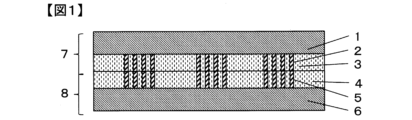
- Figure 1 shows a cross-sectional view of the laminate obtained by W2W
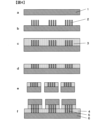
- Figure 2 shows a cross-sectional view of the laminate obtained by C2W.
- Annealing improves the bonding strength by softening the resin layer and diffusing the metal electrodes, improving the reliability of the resulting laminate.
- the annealing temperature can be selected appropriately from 100°C to 350°C, and the annealing time can be selected from 3 minutes to 3 hours depending on the purpose. Of these, annealing in the range of 150°C to 250°C is preferable as it places less strain on the substrate itself.
- the (A) metal wiring and the (B) resin layer can be formed in a process different from that described above.
- the photosensitive resin composition is applied to the substrate body, dried, exposed, developed, and cured to form a patterned (B) resin layer.
- a seed layer of Ti, Ni, or the like is formed by sputtering, and the dry film resist is patterned so that the openings are the same as those of the underlying (B) resin layer, and a copper electrode pattern is formed by electrolytic plating.
- the resist and the seed layer are removed to obtain a substrate having the exposed (A) metal electrodes and (B) resin layer on the same surface. After that, the substrate can be bonded through the smoothing and activation processes. Also, since the (A) metal electrodes and (B) resin layer are already exposed, they may be bonded as they are.
- ⁇ Preparation of Substrate> (1) Preparation of Cu pad and substrate with resin layer (1-1) Formation of metal electrode A Ti/Cu seed layer was formed on an 8-inch silicon wafer by sputtering, and a commercially available dry film resist for plating was laminated and patterned, followed by via processing (5 x 5 rows) of 5 ⁇ m diameter and 10 ⁇ m pitch. Then, Cu was formed to a height of 3 ⁇ m by electrolytic plating. The resist was then removed with a stripping solution, and the seed layer was further removed with an etchant, forming a Cu pad of 5 ⁇ m diameter and 3 ⁇ m height on the 8-inch silicon wafer (see Figures 3-b and 4-b).
- the first substrate was divided into individual pieces (1 mm square) using a DAD3240 dicing saw (manufactured by Disco Corporation) (see FIG. 4-e).
- (4) Activation of the substrate Plasma treatment was performed on the first and second substrates using an Atmospheric Plasma system (manufactured by Ontos Equipment System) with 98% by volume of N2 and 2% by volume of He.
- the total gas flow rate was 15 slpm
- the power was 80 W
- the distance between the plasma device and the substrate surface was 1 mm
- the speed of the plasma device was 1 mm/sec.
- the measured value was converted to adhesive strength per unit area by dividing it by the area of the chip, and the average of the five values was taken as the adhesive strength of the W2W laminate. Furthermore, the same sample was subjected to a die shear test after a PCT treatment for 100 hours under conditions of 121° C., 2 atm, and 100% RH using a pressure cooker test (PCT) device (HAST CHAMBER EHS-211MD, manufactured by Tabai Espec Corp.).
- PCT pressure cooker test
- PCT pressure cooker test
- the degree of peeling of the metal wiring was observed, and 0% peeling was rated as 4, more than 0% but less than 25% peeling was rated as 3, 25% or more but less than 50% peeling was rated as 2, and 50% or more peeling was rated as 1, with 2 or more being evaluated as passing.
- the degree of cracks in the resin layer was observed, and 0 cracks was rated as 4, 1 to 3 cracks was rated as 3, 4 to 10 cracks was rated as 2, and 11 or more cracks was rated as 1, with 2 or more being a pass.
- the resin composition was applied to a 6-inch silicon wafer by spin coating using a coating and developing apparatus Mark-7 so that the film thickness after pre-baking for 3 minutes at 120 ° C. was 5 ⁇ m, and then pre-baked.
- a resin composition containing a photosensitive component photoacid generator
- the entire surface was exposed to 300 mJ / cm 2 using PLA
- the temperature was raised to 220 ° C. at 3.5 ° C.
- the sample was heated to 150°C at a heating rate of 5°C/min to remove adsorbed water, and in the second stage, the sample was air-cooled to room temperature at a heating rate of 5°C/min.
- the main measurement was performed at a heating rate of 5°C/min.
- the thermal expansion coefficient of the target polyimide film was determined as the average value in the temperature range of 50°C to 150°C in this measurement. From the value of the thermal expansion coefficient, the following A, B, and C were judged, with A being good, B being passing, and C being poor.
- A: Thermal expansion coefficient is 20 ppm/K or more and less than 25 ppm/K.
- B Linear expansion coefficient is 10 ppm/K or more and less than 20 ppm/K, and 25 ppm/K or more and less than 40 ppm/K.
- C Linear expansion coefficient is less than 10 ppm/K and more than 40 ppm/K.
- SiDA 1,3-bis(3-aminopropyl)tetramethyldisiloxane
- BAHF 2,2-bis(3-amino-4-hydroxyphenyl)hexafluoropropane
- PDA p-phenylenediamine
- 4,4'-ODA 4,4'-diaminodiphenyl ether
- ODPA 3,3',4,4'-diphenyl ether tetracarboxylic dianhydride
- PMDA pyromellitic dianhydride
- BPDA 3,3',4,4'-biphenyl tetracarboxylic dianhydride
- DFA dimethylformamide dimethyl acetal HA: 2,2-bis[3-(3-aminobenzamido)-4-hydroxyphenyl]hexafluoropropane
- NA 5-norbornene-2,3-dicarboxylic anhydride
- MAP m-aminobenzamido
- YDCN-700-10 Cresol novolac type multifunctional epoxy resin (product name, manufactured by Nippon Steel Chemical & Material Co., Ltd.) having an alkylene oxide group, which is a group represented by formula (1).
- NMP N-methyl-2-pyrrolidone
- GBL ⁇ -butyrolactone
- CHN Cyclohexanone
- PGMEA Propylene glycol methyl ether acetate
- TMB 1,3,5-trimethylbenzene
- MOM 4-[1,1-bis[4-hydroxy-3,5-bis(methoxymethyl)phenyl]ethyl]-2,6-bis(methoxymethyl)phenol (crosslinking agent)
- DCP Dicumyl peroxide
- PAG-102 Photoacid generator (product name, manufactured by BASF)
- VG-3101 Monomeric triphenylmethane epoxy resin (product name, manufactured by Printec Co., Ltd.)
- TP5-280M ⁇ , ⁇ , ⁇ ,-tris(4
- IRGANOX245 Ethylene bis(oxyethylene) bis-(3-(5-tert-butyl-4-hydroxy-m-tolyl)propionate) (antioxidant) (trade name, manufactured by BASF)
- LN Lithium niobate (used as the substrate body, manufactured by Mitsui Metals).
- Synthesis Example 1 Synthesis of polyester (P-1) 148 g of 1,1-bis(4-(2,3-epoxypropyloxy)phenyl)-3-phenylindane, 47 g of acrylic acid, 1 g of TBAA, 2.0 g of tert-butylcatechol, and 244 g of PGMEA were charged and stirred at 120° C. for 5 hours. After cooling to room temperature, 30 g of biphenyltetracarboxylic dianhydride and 1 g of TBAA were added and stirred at 110° C. for 3 hours. After cooling to room temperature, 15 g of tetrahydrophthalic anhydride was added and stirred at 120° C. for 5 hours.
- the flask was immersed in a 40°C oil bath and stirred for 60 minutes, and the oil bath was heated to 115°C over 30 minutes.
- the internal temperature of the solution reached 100°C, and the solution was heated and stirred for 2 hours (internal temperature was 100°C) to obtain polysiloxane (P-2).
- the mixture has a group having a siloxane bond, and the group having a siloxane bond is a group represented by formula (2).
- PGMEA was added so that the solid concentration became 40 wt %.
- Examples 1 to 48, 51 to 55, 58 to 62 [Comparative Examples 1 and 3] Using the resin compositions prepared in the Preparation Examples and Comparative Preparation Examples and commercially available resin compositions, laminates were prepared according to the laminate preparation methods (1) to (5) described above, and the laminates were evaluated according to the physical property measurement methods (6) to (8) for the resin layer and the resin composition. The results of each Example and Comparative Example are shown in Tables 2 and 3.
- Substrate body (silicon wafer, etc.) 2 (A-1) Metal electrode (Cu, etc.) 3 (B-1) Resin layer 4 (B-2) Resin layer or (C) Inorganic insulating layer 5 (A-2) Metal electrode (Cu, etc.) 6. Substrate body (silicon wafer, etc.) 7 First board 8 Second board
Landscapes
- Chemical & Material Sciences (AREA)
- Health & Medical Sciences (AREA)
- Chemical Kinetics & Catalysis (AREA)
- Medicinal Chemistry (AREA)
- Polymers & Plastics (AREA)
- Organic Chemistry (AREA)
- Engineering & Computer Science (AREA)
- Microelectronics & Electronic Packaging (AREA)
- Manufacturing & Machinery (AREA)
- Computer Hardware Design (AREA)
- Laminated Bodies (AREA)
- Formation Of Insulating Films (AREA)
Priority Applications (4)
| Application Number | Priority Date | Filing Date | Title |
|---|---|---|---|
| EP24741495.6A EP4651185A1 (en) | 2023-01-11 | 2024-01-09 | Laminate, semiconductor element, and mems element |
| CN202480006983.1A CN120604330A (zh) | 2023-01-11 | 2024-01-09 | 层叠体、半导体元件及mems元件 |
| JP2024502467A JPWO2024150722A1 (https=) | 2023-01-11 | 2024-01-09 | |
| KR1020257024723A KR20250134616A (ko) | 2023-01-11 | 2024-01-09 | 적층체, 반도체 소자 및 mems 소자 |
Applications Claiming Priority (2)
| Application Number | Priority Date | Filing Date | Title |
|---|---|---|---|
| JP2023-002175 | 2023-01-11 | ||
| JP2023002175 | 2023-01-11 |
Publications (1)
| Publication Number | Publication Date |
|---|---|
| WO2024150722A1 true WO2024150722A1 (ja) | 2024-07-18 |
Family
ID=91896954
Family Applications (1)
| Application Number | Title | Priority Date | Filing Date |
|---|---|---|---|
| PCT/JP2024/000108 Ceased WO2024150722A1 (ja) | 2023-01-11 | 2024-01-09 | 積層体、半導体素子およびmems素子 |
Country Status (6)
| Country | Link |
|---|---|
| EP (1) | EP4651185A1 (https=) |
| JP (1) | JPWO2024150722A1 (https=) |
| KR (1) | KR20250134616A (https=) |
| CN (1) | CN120604330A (https=) |
| TW (1) | TW202435270A (https=) |
| WO (1) | WO2024150722A1 (https=) |
Citations (7)
| Publication number | Priority date | Publication date | Assignee | Title |
|---|---|---|---|---|
| JP2006517344A (ja) | 2003-02-07 | 2006-07-20 | ジプトロニクス・インコーポレイテッド | 室温金属直接ボンディング |
| JP2016009159A (ja) * | 2014-06-26 | 2016-01-18 | 日立化成株式会社 | ポジ型感光性接着剤組成物、接着剤パターン、接着剤層付半導体ウェハ及び半導体装置 |
| WO2018066395A1 (ja) * | 2016-10-05 | 2018-04-12 | 東レ株式会社 | 樹脂組成物、硬化膜、半導体装置およびそれらの製造方法 |
| JP2018165819A (ja) | 2017-03-28 | 2018-10-25 | 東レ株式会社 | 感光性樹脂組成物、感光性シート、ならびにそれらの硬化膜およびその製造方法 |
| JP2021197430A (ja) * | 2020-06-12 | 2021-12-27 | 昭和電工マテリアルズ株式会社 | 半導体装置の製造方法 |
| WO2022071329A1 (ja) * | 2020-09-30 | 2022-04-07 | 昭和電工マテリアルズ株式会社 | 樹脂組成物、半導体装置の製造方法、硬化物、半導体装置及びポリイミド前駆体の合成方法 |
| JP2023151490A (ja) * | 2022-03-31 | 2023-10-16 | Hdマイクロシステムズ株式会社 | ポリイミド前駆体、ハイブリッドボンディング絶縁膜形成材料、半導体装置の製造方法、及び半導体装置 |
-
2024
- 2024-01-08 TW TW113100684A patent/TW202435270A/zh unknown
- 2024-01-09 EP EP24741495.6A patent/EP4651185A1/en active Pending
- 2024-01-09 JP JP2024502467A patent/JPWO2024150722A1/ja active Pending
- 2024-01-09 WO PCT/JP2024/000108 patent/WO2024150722A1/ja not_active Ceased
- 2024-01-09 CN CN202480006983.1A patent/CN120604330A/zh active Pending
- 2024-01-09 KR KR1020257024723A patent/KR20250134616A/ko active Pending
Patent Citations (7)
| Publication number | Priority date | Publication date | Assignee | Title |
|---|---|---|---|---|
| JP2006517344A (ja) | 2003-02-07 | 2006-07-20 | ジプトロニクス・インコーポレイテッド | 室温金属直接ボンディング |
| JP2016009159A (ja) * | 2014-06-26 | 2016-01-18 | 日立化成株式会社 | ポジ型感光性接着剤組成物、接着剤パターン、接着剤層付半導体ウェハ及び半導体装置 |
| WO2018066395A1 (ja) * | 2016-10-05 | 2018-04-12 | 東レ株式会社 | 樹脂組成物、硬化膜、半導体装置およびそれらの製造方法 |
| JP2018165819A (ja) | 2017-03-28 | 2018-10-25 | 東レ株式会社 | 感光性樹脂組成物、感光性シート、ならびにそれらの硬化膜およびその製造方法 |
| JP2021197430A (ja) * | 2020-06-12 | 2021-12-27 | 昭和電工マテリアルズ株式会社 | 半導体装置の製造方法 |
| WO2022071329A1 (ja) * | 2020-09-30 | 2022-04-07 | 昭和電工マテリアルズ株式会社 | 樹脂組成物、半導体装置の製造方法、硬化物、半導体装置及びポリイミド前駆体の合成方法 |
| JP2023151490A (ja) * | 2022-03-31 | 2023-10-16 | Hdマイクロシステムズ株式会社 | ポリイミド前駆体、ハイブリッドボンディング絶縁膜形成材料、半導体装置の製造方法、及び半導体装置 |
Non-Patent Citations (1)
| Title |
|---|
| Y. KAGAWA ET AL.: "Novel stacked CMOS image sensor with advanced Cu2Cu hybrid bonding", IEEE INTERNATIONAL ELECTRON DEVICES MEETING, 2016 |
Also Published As
| Publication number | Publication date |
|---|---|
| KR20250134616A (ko) | 2025-09-11 |
| EP4651185A1 (en) | 2025-11-19 |
| TW202435270A (zh) | 2024-09-01 |
| CN120604330A (zh) | 2025-09-05 |
| JPWO2024150722A1 (https=) | 2024-07-18 |
Similar Documents
| Publication | Publication Date | Title |
|---|---|---|
| CN108780275B (zh) | 感光性膜 | |
| JP7003659B2 (ja) | 樹脂組成物 | |
| CN108137805B (zh) | 树脂及感光性树脂组合物 | |
| JP7073717B2 (ja) | ジアミン化合物、それを用いた耐熱性樹脂および樹脂組成物 | |
| CN107407877B (zh) | 感光性树脂组合物 | |
| US20240045329A1 (en) | Photosensitive resin composition, cured film, electronic component, antenna element, semiconductor package, and compound | |
| JP6776772B2 (ja) | 感光性樹脂組成物 | |
| JP6848491B2 (ja) | ジアミン化合物、それを用いた耐熱性樹脂および樹脂組成物 | |
| WO2024150723A1 (ja) | 積層体の製造方法、樹脂組成物 | |
| JP2013197441A (ja) | 硬化物層付き回路基板の製造方法 | |
| KR102742244B1 (ko) | 알칼리 가용성 수지, 감광성 수지 조성물, 감광성 시트, 경화막, 층간 절연막 또는 반도체 보호막, 경화막의 릴리프 패턴의 제조 방법, 전자 부품 또는 반도체 장치 | |
| WO2024150722A1 (ja) | 積層体、半導体素子およびmems素子 | |
| WO2025249309A1 (ja) | 樹脂組成物、硬化物、積層体、半導体デバイス及び積層体の製造方法 | |
| TW202515927A (zh) | 樹脂、感光性樹脂組成物及該些的硬化物、以及使用上述硬化物的電子部件和顯示裝置 |
Legal Events
| Date | Code | Title | Description |
|---|---|---|---|
| WWE | Wipo information: entry into national phase |
Ref document number: 2024502467 Country of ref document: JP |
|
| 121 | Ep: the epo has been informed by wipo that ep was designated in this application |
Ref document number: 24741495 Country of ref document: EP Kind code of ref document: A1 |
|
| WWE | Wipo information: entry into national phase |
Ref document number: 202480006983.1 Country of ref document: CN |
|
| ENP | Entry into the national phase |
Ref document number: 1020257024723 Country of ref document: KR Free format text: ST27 STATUS EVENT CODE: A-0-1-A10-A15-NAP-PA0105 (AS PROVIDED BY THE NATIONAL OFFICE) |
|
| NENP | Non-entry into the national phase |
Ref country code: DE |
|
| WWE | Wipo information: entry into national phase |
Ref document number: 11202504332W Country of ref document: SG |
|
| WWP | Wipo information: published in national office |
Ref document number: 11202504332W Country of ref document: SG |
|
| WWP | Wipo information: published in national office |
Ref document number: 202480006983.1 Country of ref document: CN |
|
| WWP | Wipo information: published in national office |
Ref document number: 2024741495 Country of ref document: EP |