WO2024150682A1 - 細胞チップ - Google Patents
細胞チップ Download PDFInfo
- Publication number
- WO2024150682A1 WO2024150682A1 PCT/JP2023/046919 JP2023046919W WO2024150682A1 WO 2024150682 A1 WO2024150682 A1 WO 2024150682A1 JP 2023046919 W JP2023046919 W JP 2023046919W WO 2024150682 A1 WO2024150682 A1 WO 2024150682A1
- Authority
- WO
- WIPO (PCT)
- Prior art keywords
- cells
- cell chip
- meth
- cell
- hydrogel
- Prior art date
- Legal status (The legal status is an assumption and is not a legal conclusion. Google has not performed a legal analysis and makes no representation as to the accuracy of the status listed.)
- Ceased
Links
Classifications
-
- C—CHEMISTRY; METALLURGY
- C07—ORGANIC CHEMISTRY
- C07K—PEPTIDES
- C07K14/00—Peptides having more than 20 amino acids; Gastrins; Somatostatins; Melanotropins; Derivatives thereof
- C07K14/435—Peptides having more than 20 amino acids; Gastrins; Somatostatins; Melanotropins; Derivatives thereof from animals; from humans
-
- C—CHEMISTRY; METALLURGY
- C12—BIOCHEMISTRY; BEER; SPIRITS; WINE; VINEGAR; MICROBIOLOGY; ENZYMOLOGY; MUTATION OR GENETIC ENGINEERING
- C12M—APPARATUS FOR ENZYMOLOGY OR MICROBIOLOGY; APPARATUS FOR CULTURING MICROORGANISMS FOR PRODUCING BIOMASS, FOR GROWING CELLS OR FOR OBTAINING FERMENTATION OR METABOLIC PRODUCTS, i.e. BIOREACTORS OR FERMENTERS
- C12M1/00—Apparatus for enzymology or microbiology
- C12M1/34—Measuring or testing with condition measuring or sensing means, e.g. colony counters
-
- C—CHEMISTRY; METALLURGY
- C12—BIOCHEMISTRY; BEER; SPIRITS; WINE; VINEGAR; MICROBIOLOGY; ENZYMOLOGY; MUTATION OR GENETIC ENGINEERING
- C12M—APPARATUS FOR ENZYMOLOGY OR MICROBIOLOGY; APPARATUS FOR CULTURING MICROORGANISMS FOR PRODUCING BIOMASS, FOR GROWING CELLS OR FOR OBTAINING FERMENTATION OR METABOLIC PRODUCTS, i.e. BIOREACTORS OR FERMENTERS
- C12M1/00—Apparatus for enzymology or microbiology
- C12M1/36—Apparatus for enzymology or microbiology including condition or time responsive control, e.g. automatically controlled fermentors
- C12M1/38—Temperature-responsive control
-
- C—CHEMISTRY; METALLURGY
- C12—BIOCHEMISTRY; BEER; SPIRITS; WINE; VINEGAR; MICROBIOLOGY; ENZYMOLOGY; MUTATION OR GENETIC ENGINEERING
- C12N—MICROORGANISMS OR ENZYMES; COMPOSITIONS THEREOF; PROPAGATING, PRESERVING, OR MAINTAINING MICROORGANISMS; MUTATION OR GENETIC ENGINEERING; CULTURE MEDIA
- C12N5/00—Undifferentiated human, animal or plant cells, e.g. cell lines; Tissues; Cultivation or maintenance thereof; Culture media therefor
- C12N5/06—Animal cells or tissues; Human cells or tissues
-
- C—CHEMISTRY; METALLURGY
- C12—BIOCHEMISTRY; BEER; SPIRITS; WINE; VINEGAR; MICROBIOLOGY; ENZYMOLOGY; MUTATION OR GENETIC ENGINEERING
- C12N—MICROORGANISMS OR ENZYMES; COMPOSITIONS THEREOF; PROPAGATING, PRESERVING, OR MAINTAINING MICROORGANISMS; MUTATION OR GENETIC ENGINEERING; CULTURE MEDIA
- C12N5/00—Undifferentiated human, animal or plant cells, e.g. cell lines; Tissues; Cultivation or maintenance thereof; Culture media therefor
- C12N5/10—Cells modified by introduction of foreign genetic material
Definitions
- This disclosure relates to a cell chip suitable for detecting chemical substances.
- Patent Document 1 discloses the use of cells expressing modified olfactory receptors and lipid bilayer membranes containing modified olfactory receptors as odor sensors.
- the objective of the present disclosure is to provide a cell chip that has excellent resistance to drying of cells, cell retention, and production efficiency, and can also be used to detect chemical substances such as odor substances.
- a cell chip including a compartment containing cells and hydrogel could prevent cells from drying out and hold the cells stably.
- problems such as low manufacturing efficiency depending on the type of hydrogel, damage to cells during hydrogel formation, and inability to detect chemical substances due to low permeability of the hydrogel to chemical substances can arise.
- the present disclosure encompasses the following aspects:
- Item 1 A cell chip including a compartment containing cells and a hydrogel containing a (meth)acrylic resin.
- Item 2 The cell chip according to Item 1, wherein the cells are encapsulated in the hydrogel.
- Item 3 The cell chip according to Item 1, wherein the cells are cells that contain a polynucleotide that includes a coding sequence for an olfactory receptor protein.
- Item 4 The cell chip according to Item 3, wherein the olfactory receptor protein is an insect olfactory receptor.
- Item 5 The cell chip according to Item 1, wherein the cells are insect cells.
- Item 6 The cell chip according to Item 1, in which the hydrogel is formed by subjecting a compartment containing a solution of (meth)acrylic monomers and/or oligomers thereof and cells to a polymerization treatment.
- Item 7 The cell chip according to Item 6, wherein the polymerization treatment is UV irradiation.
- Item 8 The cell chip according to Item 6, wherein the concentration of the photopolymerization initiator in the solution of the (meth)acrylic monomer and/or its oligomer is 0.1% by mass or less.
- Item 9 The cell chip according to Item 6, wherein the total concentration of the polyfunctional (meth)acrylic monomer and the oligomer in the solution of the (meth)acrylic monomer and/or its oligomer is 0.1 to 25% by mass.
- Item 10 The cell chip according to Item 1, wherein the number of compartments is 10 to 2000.
- Item 11 The cell chip according to any one of items 1 to 10, which is used for detecting chemical substances.
- Item 11A A method for detecting a chemical substance, comprising contacting a chemical substance with an olfactory receptor on a cell contained in the cell chip according to any one of items 1 to 10.
- Item 11B Use of the cell chip described in any one of items 1 to 10 as a chemical substance detection chip.
- Item 11C Use of the cell chip described in any one of items 1 to 10 for the manufacture of a chemical detection chip.
- Item 12 A method for producing a cell chip according to any one of items 1 to 10, comprising polymerizing a compartment containing cells and a (meth)acrylic resin monomer and/or an oligomer thereof to form a hydrogel.
- Item 13 The method according to Item 12, wherein the polymerization treatment is UV irradiation.
- Item 14 The method according to Item 13, wherein the light source for the UV irradiation is an LED.
- the present disclosure provides a cell chip that has excellent cell drying resistance, cell retention, and manufacturing efficiency, and can also be used to detect chemical substances such as odorants, as well as a manufacturing method thereof.
- the present disclosure relates to a cell chip (sometimes referred to herein as the "cell chip of the present disclosure") that includes a compartment that contains cells and a hydrogel that contains a (meth)acrylic resin. This is described below.
- the cells are not particularly limited. From the viewpoint of suitability for detecting chemical substances, animal cells such as insect cells and mammalian cells are preferred, with insect cells being particularly preferred. Mammalian cells include human-derived HeLa cells, HEK293 cells, HepG2 cells, KBM-7 cells, Chinese hamster-derived CHO cells, mouse-derived NIH3T3 cells, Min6 cells, and the like.
- Insect cells include, for example, SpIm cells derived from Spilosoma imparilis, the Sf cell line derived from Spodoptera frugiperda, the HighFive cell line derived from Trichoplusia ni, AeAe cells derived from Aedes aegypti, S2 cells derived from Drosophila melanogaster, olfactory nerve cells, and the like.
- Splm cells are particularly preferred.
- the cell chip of the present disclosure When the cell chip of the present disclosure is used to detect chemical substances, it is preferable to use cells that contain a polynucleotide that includes a coding sequence for an olfactory receptor protein.
- Olfactory receptor proteins are membrane proteins with seven transmembrane structures that act as odor sensors in living organisms.
- the olfactory receptor protein is particularly preferably an insect olfactory receptor protein.
- Insects from which the insect olfactory receptor protein is derived are preferably dipteran insects such as Culicidae and Drosophilidae; lepidopteran insects such as Bombycidae; Hymenopteran insects such as Apidae; Orthopteran insects such as Acrididae; Hemiptera insects such as Cimexidae, and more preferably dipteran insects such as Culicidae and Drosophilidae; Orthopteran insects such as Acrididae; Hemiptera insects such as Cimexidae.
- insects from the Culicidae family include Anopheles gambiae, Aedes aegypti, and Culex quinquefasciatus.
- insects in the Drosophilidae family include the fruit fly (Drosophila melanogaster), the light brown fruit fly (Drosophila pseudoobscura), and the black fruit fly (Drosophila virillis).
- insects in the Bombycidae family include the silk moth (Bombyx mori), the mulberry silk moth (Bombyx mandarina), and the fig cassock (Trilocha varians).
- insects in the Apidae family include the European honeybee (Apis mellifera), the swarm honeybee (Apis florea), the giant honeybee (Apis dorsata), and the European bumblebee (Bombus terrestris).
- insects in the Acrididae family include the migratory locust (Locusta migratoria), and examples of insects in the Cimex family include the bedbug (Cimex lectularius).
- wild-type insect olfactory receptor proteins include AaOR1, AaOR2, AaOR4, AaOR5, AaOR6, AaOR7, AaOR8, AaOR9, AaOR10a, AaOR15, AaOR22, AaOR24, AaOR25, AaOR26, AaOR27, AaOR28, AaOR30, AaOR34, AaOR36, AaOR38, AaOR41a, AaOR41b, AaOR42, AaOR43, AaOR 44, AaOR47, AaOR49, AaOR50, AaOR52, AaOR54, AaOR58, AaOR59, AaOR60, AaOR61, AaOR64, AaOR65, AaOR66, AaOR67a, AaOR69a, AaOR70, AaOR71, AaOR72a, AaOR73, AaOR74, A aOR75, AaOR77, AaOR78, AaOR79
- Dm indicates that it is derived from Drosophila melanogaster
- Bm indicates that it is derived from Bombyx mori
- Ag indicates that it is derived from Anopheles gambiae
- Aa indicates that it is derived from Aedes aegypti.
- the amino acid sequences and coding sequences of various olfactory receptor proteins, including these, are publicly known or can be easily identified by sequence identity searches based on the publicly known sequences.
- Insect olfactory receptor proteins can contain amino acid mutations so long as the chemical response activity is not significantly reduced. "Not significantly reduced” means, for example, that the chemical response activity of an olfactory receptor protein containing amino acid mutations is, for example, 50% or more, preferably 60% or more, more preferably 70% or more, even more preferably 80% or more, and even more preferably 90% or more, compared to 100% of the chemical response activity of a wild-type olfactory receptor protein.
- chemical substance response activity refers to the property that an olfactory receptor recognizes a chemical substance, and the olfactory receptor complex formed by the olfactory receptor and the olfactory receptor co-receptor is activated and exhibits ion channel activity.
- the chemical substance response activity of an olfactory receptor can be measured using as an index the ion channel activity of the olfactory receptor complex formed by the olfactory receptor and the olfactory receptor co-receptor that have come into contact with a chemical substance.
- a chemical substance is contacted with a cell expressing a protein that changes color or emits light in response to ions (such as calcium ions) that flow into the cell when (a) the olfactory receptor, (b) the olfactory receptor co-receptor, and (c) the olfactory receptor complex responds, and the amount of luminescence of the cell is measured.
- ions such as calcium ions
- the coding sequence of the olfactory receptor protein is not particularly limited, so long as it is a polynucleotide consisting of a base sequence that encodes the olfactory receptor protein of the present disclosure.
- the polynucleotide includes an expression cassette for the olfactory receptor protein.
- the expression cassette is not particularly limited, so long as it is a polynucleotide that is capable of expressing the olfactory receptor protein in a cell.
- a typical example of an expression cassette for an olfactory receptor protein is a polynucleotide that includes a promoter and the coding sequence for the olfactory receptor protein of the present disclosure that is placed under the control of the promoter.
- the hydrogel is not particularly limited as long as it contains a (meth)acrylic resin.
- the content of the (meth)acrylic resin is preferably 50% by mass or more, more preferably 70% by mass or more, even more preferably 80% by mass or more, even more preferably 85% by mass or more, particularly preferably 90% by mass or more, and especially preferably 95% by mass or more (among which, 100% by mass) based on 100% by mass of the solid content constituting the hydrogel.
- the solid content includes the (meth)acrylic resin, cells, and other solid content.
- the term "(meth)acrylic" means methacryl and/or acrylic. Details of the (meth)acrylic resin will be described later.
- the compartment of the cell chip disclosed herein contains cells and a hydrogel containing a (meth)acrylic resin.
- the shape of the compartment is not particularly limited as long as it is capable of retaining cells and hydrogel. From the viewpoints of cell desiccation resistance, cell retention, production efficiency, and chemical substance detectability, it is preferable that the compartment be in the form of a well.
- the material of the compartment is not particularly limited as long as it can hold cells and hydrogel.
- the material can be, for example, resin, metal, etc.
- the arrangement of the cells and the hydrogel in the compartment is not particularly limited, so long as the cells' resistance to drying and cell retention are ensured.
- the cells are encapsulated in the hydrogel.
- the manner of encapsulation is not particularly limited, so long as at least a portion of the cells are isolated from the outside air outside the cell chip by the hydrogel.
- a specific example of the manner of encapsulation is one in which the cells are dispersed in the hydrogel.
- each compartment usually contains a plurality of cells.
- the number of cells (cells) per volume ( cm3 ) of the hydrogel in the compartment is preferably 1 ⁇ 104 to 1 ⁇ 109 cells/ cm3 , more preferably 1 ⁇ 105 to 1 ⁇ 108 cells/ cm3 , and even more preferably 1 ⁇ 106 to 2 ⁇ 107 cells/ cm3 .
- the bottom area of one compartment is preferably 0.5 to 100 mm 2 , more preferably 1 to 30 mm 2 , and even more preferably 1.5 to 10 mm 2 , from the viewpoint of detection sensitivity or production efficiency.
- the number of compartments contained in a cell chip is preferably 10 to 2000, more preferably 30 to 1000, and even more preferably 50 to 500, from the viewpoint of detection sensitivity or manufacturing efficiency.
- the compartment containing cells and a hydrogel containing a (meth)acrylic resin can be obtained by polymerizing the compartment containing cells and a monomer of the (meth)acrylic resin ((meth)acrylic monomer) and/or its oligomer to form a hydrogel.
- the oligomer is not particularly limited, but can be, for example, a polymer formed by polymerization of about 2 to 20 monomers. From the viewpoint of production efficiency, it is preferable to use a monomer rather than an oligomer.
- the compartment containing cells and (meth)acrylic monomers and/or oligomers thereof is preferably a compartment containing a solution of (meth)acrylic monomers and/or oligomers thereof and cells, and is preferably a compartment containing a suspension of cells suspended in a solution of (meth)acrylic monomers and/or oligomers thereof.
- the total content of the (meth)acrylic monomer and its oligomer is preferably 50% by mass or more, more preferably 70% by mass or more, even more preferably 80% by mass or more, even more preferably 85% by mass or more, particularly preferably 90% by mass or more, and especially preferably 95% by mass or more (among which, 100% by mass is the total of the monomer and its oligomer).
- the (meth)acrylic monomer is a monomer containing an acrylic group and/or a methacrylic group.
- the (meth)acrylic monomer contains a hydrophilic structure (e.g., a hydroxyl group, a carboxyl group, an amino group, an amine, a phosphate group, a sulfo group, an amide bond, a polyethylene glycol structure, etc.).
- the (meth)acrylic monomer is usually a monomer containing multiple acrylic and/or methacrylic groups (e.g. 2-5, 2-4, or 2-3 groups) (multifunctional monomer).
- multifunctional monomers include polyethylene glycol diacrylate (Mn500) (PEGDA500), polyethylene glycol diacrylate (Mn1000) (PEGDA1000), N-[tris(3-acrylamidopropoxymethyl)methyl]acrylamide (4AAmST), N,N-bis(2-acrylamidomethyl)acrylamide (3AAmST), N,N'-[oxybis(2,1-ethanediyloxy)-3,1-propanediyl]bisacrylamide (2AAmLN), and N,N'-1,2-ethanediylbis ⁇ N-[2-(acryloylamino)ethyl]acrylamide ⁇ (4AAmLN).
- the polyfunctional monomers can be used alone or in combination of two or more.
- preferred polyfunctional monomers are those having 2 to 3 (more preferably 2) acrylic and/or methacrylic groups, a polyalkylene glycol structure (e.g., a polyethylene glycol structure), and a molecular weight of 100 to 2000 (preferably 200 to 1500, more preferably 300 to 1200).
- examples of such polyfunctional monomers include 2AAmLN, PEGDA500, and PEGDA1000.
- the concentration of the polyfunctional monomer in the solution of the (meth)acrylic monomer and/or its oligomer is preferably 0.1 to 25% by mass from the viewpoints of cell drying resistance, cell retention, production efficiency, and chemical substance detectability.
- the concentration is more preferably 0.2 to 15% by mass, even more preferably 0.5 to 10% by mass, and even more preferably 1 to 8% by mass.
- the concentration is more preferably 1 to 20% by mass, even more preferably 2 to 15% by mass, even more preferably 4 to 12% by mass, and particularly preferably 5 to 10% by mass.
- the (meth)acrylic monomer further contains a monomer having one acrylic and/or methacrylic group (monofunctional monomer).
- monofunctional monomers include (meth)acrylic acid, 2-hydroxyethyl (meth)acrylate, 3-hydroxypropyl (meth)acrylate, 4-hydroxybutyl (meth)acrylate, 2-(2-hydroxyethoxy)ethyl (meth)acrylate, 2- or 3-chloro-2-hydroxypropyl (meth)acrylate, 2-(methacryloyloxy)ethyl 2-(trimethylammonio)ethyl phosphate (MPC), acrylamide, polyethylene glycol monomethyl ether acrylate (PEG acrylate), 4-[(3-methacrylamidopropyl)dimethylammonio]butane-1-sulfonate (MAm4N9S), 2-[[2-(methacryloyloxy)ethyl]dimethylammonio]a acetate (MO3
- the total concentration of the monofunctional monomer and its oligomer in the solution of the (meth)acrylic monomer and/or its oligomer is preferably 0.1 to 20% by mass from the viewpoint of cell drying resistance, cell retention, production efficiency, or chemical substance detectability.
- the concentration is more preferably 0.1 to 10% by mass, even more preferably 0.2 to 5% by mass, and even more preferably 0.3 to 5% by mass.
- the solution of the (meth)acrylic monomer and/or its oligomer preferably contains a polymerization initiator.
- the polymerization initiator include photopolymerization initiators and thermal polymerization initiators, but from the viewpoint of production efficiency or chemical substance detectability, photopolymerization initiators are preferred.
- photopolymerization initiator examples include benzoin, isopropyl benzoin ether, isobutyl benzoin ether, benzophenone, Michler's ketone, chlorothioxanthone, dodecyl thioxanthone, dimethyl thioxanthone, diethyl thioxanthone, acetophenone diethyl ketal, benzyl dimethyl ketal, 1-hydroxycyclohexyl phenyl ketone, 2-hydroxy-2-methyl-1-phenylpropan-1-one, etc., among which benzyl dimethyl ketal, 1-hydroxycyclohexyl phenyl ketone, 2-hydroxy-2-methyl-1-phenylpropan-1-one, etc.
- cationic photopolymerization initiators initiators such as onium salts, tri(substituted)phenylsulfoniums, diazosulfones, and iodoniums are preferably used.
- anionic photopolymerization initiators organometallic initiators such as alkyllithiums are preferably used. The photopolymerization initiators can be used alone or in combination of two or more.
- the concentration of the photopolymerization initiator in the solution of the (meth)acrylic resin monomer and/or its oligomer is preferably 0.1% by mass or less from the viewpoint of cell drying resistance, cell retention, production efficiency, and chemical substance detectability.
- the concentration is more preferably 0.005 to 0.1% by mass, and even more preferably 0.01 to 0.05% by mass.
- the solvent for the solution of the (meth)acrylic resin monomer and/or its oligomer is preferably water.
- the solution preferably contains a buffer.
- a preferred example of the buffer is a phosphate buffer.
- the polymerization treatment is not particularly limited as long as radical polymerization between monomers of the (meth)acrylic resin and/or their oligomers proceeds, but examples include light irradiation and heat treatment. From the viewpoint of production efficiency or chemical substance detectability, the polymerization treatment is preferably light irradiation, and particularly preferably light (preferably ultraviolet light) irradiation.
- the wavelength of the irradiated light is preferably 280 to 400 nm, more preferably 320 to 385 nm, and even more preferably 350 to 380 nm. From the same viewpoint, it is also preferable that the light source is an LED (light-emitting diode).
- the irradiation amount is preferably 50 to 200 mW/cm 2 , and more preferably 80 to 150 mW/cm 2 .
- the irradiation time is preferably 5 to 60 seconds, and more preferably 15 to 45 seconds.
- the water content of the hydrogel without cells is preferably 75 to 99.9% by mass, more preferably 80 to 98% by mass, from the viewpoints of cell drying resistance, cell retention, production efficiency, and chemical substance detectability.
- the cell chip of the present disclosure can be used to detect chemical substances (especially odor substances).
- the chemical substances can be, for example, chemical substances in bodily fluids (e.g., urine).
- bodily fluids e.g., urine
- the chemical substances in the bodily fluid can diffuse through the hydrogel, reach the cells, and come into contact with the olfactory receptors on the cells. This allows the chemical substances to be detected by detecting ions flowing into the cells (for example, by detecting proteins that color or emit light in response to ions).
- Example 1 Production and evaluation of cell chip 1 ⁇ 1-1.
- Preparation of pre-reaction gel solution> 4-[(3-Methacrylamidopropyl)dimethylammonio]butane-1-sulfonate (monomer: MAm4N9S) and N,N'-1,2-Ethanediylbis ⁇ N-[2-(acryloylamino)ethyl]acrylamide ⁇ (crosslinker: 4AAmLN) were dissolved in PBS (Nissui Pharmaceutical Co., Ltd. #05913) aqueous solution to prepare MAm4N9S/4AAmLN aqueous solution.
- Lithium phenyl(2,4,6-trimethylbenzoyl)phosphinate (photopolymerization initiator: LPA) was dissolved in PBS aqueous solution to prepare LPA aqueous solution.
- the above two aqueous solutions were mixed and stirred so that the final concentration of MAm4N9S was 2.1% by mass, the final concentration of 4AAmLN was 5.6% by mass, and the final concentration of LPA was 0.02% by mass, to obtain a pre-reaction gel solution.
- Measurement of storage modulus and loss modulus> The measurements were performed using an elasticity measuring device (MCR302, Kitahama Seisakusho Co., Ltd.). The measurement conditions were as follows: fixture; PP12/P2, plate; SS/P2, measurement temperature; 25°C. Specifically, the hydrogel was placed on the plate, the fixture was lowered, and measurements were performed using strain dispersion measurement (frequency 1 Hz) and frequency dispersion measurement (strain: 0.04%) while applying a pressure of 0.03 N. The storage modulus and loss modulus were measured at a frequency of 0.736 Hz and a strain of 0.04%.
- the fluorescence intensity data (pre-exposure fluorescence intensity and post-exposure fluorescence intensity) of all cell-encapsulated hydrogels containing sensor cells were calculated as relative values based on the fluorescence intensity of the cell-encapsulated hydrogel containing GFP cells.
- the fluorescence intensity was measured using a lumino image analyzer (LAS4000, Fujifilm Corporation).
- the cell-encapsulated hydrogel containing the sensor cells was immersed in Hank's Balanced Salt Solution (1x Hank's Balanced Salt Solution (gibco #14025-092), 20 mM HEPES (gibco #15630-080), 0.1% Bovine Serum Albumin (Sigma #7888)) for 10 minutes, after which the fluorescence intensity was measured and used as the pre-exposure fluorescence intensity.
- Hank's Balanced Salt Solution 1x Hank's Balanced Salt Solution (gibco #14025-092), 20 mM HEPES (gibco #15630-080), 0.1% Bovine Serum Albumin (Sigma #7888)
- the hydrogel containing the sensor cells was immersed in the above-mentioned Hank's solution containing an odorant (the odorant to which the above-mentioned olfactory receptor protein responds: Safranal) at a concentration of 400 nM for 3 minutes, after which the fluorescence intensity was measured and used as the post-exposure fluorescence intensity.
- the value obtained by dividing the post-exposure fluorescence intensity by the pre-exposure fluorescence intensity was used as the sensitivity.
- Example 2 Production and evaluation of cell chip 2 The test was conducted in the same manner as in Example 1, except that the type of monomer, the concentration of monomer, the type of crosslinking agent, the concentration of crosslinking agent, and the type of photopolymerization initiator were changed. As a result, the sensitivity was found to be significantly higher than 1, and it was found that odor substances could be detected.
- Example 3 Production and evaluation of cell chip 3 Tests were conducted in the same manner as in Example 1 using a crosslinking agent containing one or more members selected from the group consisting of N,N'-[oxybis(2,1-ethanediyloxy)-3,1-propanediyl]bisacrylamide (2AAmLN), polyethylene glycol diacrylate (Mn500) (PEGDA500), and polyethylene glycol diacrylate (Mn1000) (PEGDA1000).
- a crosslinking agent containing one or more members selected from the group consisting of N,N'-[oxybis(2,1-ethanediyloxy)-3,1-propanediyl]bisacrylamide (2AAmLN), polyethylene glycol diacrylate (Mn500) (PEGDA500), and polyethylene glycol diacrylate (Mn1000) (PEGDA1000).
- Monomers include 2-(methacryloyloxy)ethyl 2-(trimethylammonio)ethyl phosphate (MPC), acrylamide, polyethylene glycol monomethyl ether acrylate (PEG acrylate), 4-[(3-methacrylamidopropyl)dimethylammonio]butane-1-sulfonate (MAm4N9S), 2-[[2-(methacryloyloxy)ethyl]dimethylammonio]acetate (MO3N6O), 3-[[2-(methacryloyloxy)ethyl]dimethylammonio]propionate (MO3N7O), 3-[[3-acrylamidopropyl]dimethylammonio]propionate (MO3N7O), The following compounds were used alone or in combination: 3-[[2-(methacryloyloxy)ethyl]dimethylammonio]propanoic acid (AAm4N8O), 3-[[2-(methacrylo
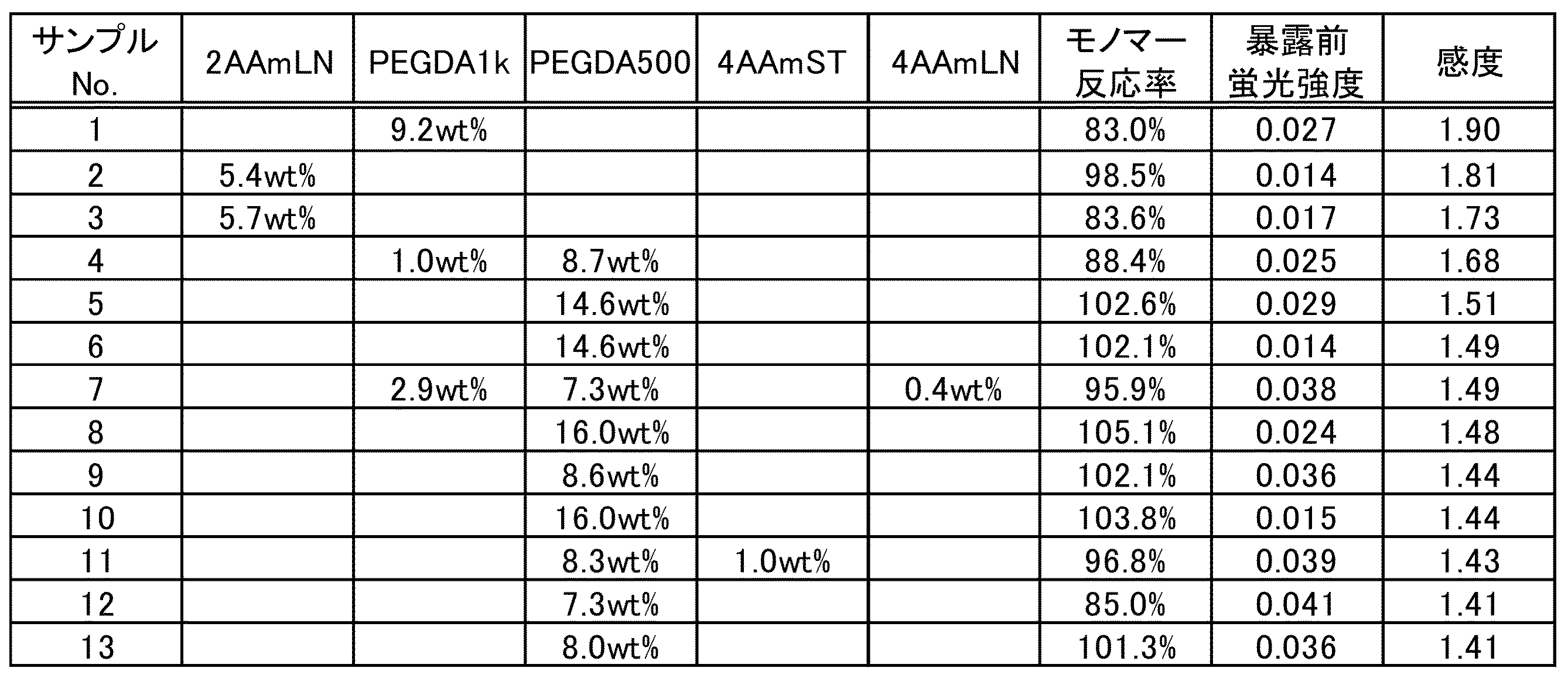
- crosslinker concentration in the gel solution before reaction The crosslinker concentration in the gel solution before reaction, monomer reaction rate, pre-exposure fluorescence intensity, and sensitivity are shown in Table 1.
- blank spaces indicate a concentration of 0.0 wt%. Note that the type and/or composition of monomers differs between samples.
- a pre-exposure fluorescence intensity above a certain level indicates that there are relatively few factors that reduce the fluorescence intensity (such as gel turbidity), and therefore data errors due to such factors can be further reduced, further improving the reliability of the data.
Landscapes
- Health & Medical Sciences (AREA)
- Chemical & Material Sciences (AREA)
- Life Sciences & Earth Sciences (AREA)
- Engineering & Computer Science (AREA)
- Bioinformatics & Cheminformatics (AREA)
- Organic Chemistry (AREA)
- Zoology (AREA)
- Genetics & Genomics (AREA)
- Biotechnology (AREA)
- Wood Science & Technology (AREA)
- Biomedical Technology (AREA)
- Biochemistry (AREA)
- General Health & Medical Sciences (AREA)
- General Engineering & Computer Science (AREA)
- Microbiology (AREA)
- Medicinal Chemistry (AREA)
- Cell Biology (AREA)
- Sustainable Development (AREA)
- Gastroenterology & Hepatology (AREA)
- Biophysics (AREA)
- Toxicology (AREA)
- Molecular Biology (AREA)
- Proteomics, Peptides & Aminoacids (AREA)
- Analytical Chemistry (AREA)
- Compositions Of Macromolecular Compounds (AREA)
- Addition Polymer Or Copolymer, Post-Treatments, Or Chemical Modifications (AREA)
- Apparatus Associated With Microorganisms And Enzymes (AREA)
Abstract
細胞の乾燥耐性、細胞の保持性、及び製造効率に優れ、且つ匂い物質等の化学物質の検出に利用することも可能な細胞チップを提供すること。 細胞と(メタ)アクリル樹脂を含むハイドロゲルとを含む区画を含む、細胞チップ。
Description
本開示は、化学物質検出に好適な細胞チップに関する。
ヒトの特定の疾患や精神状態等を特徴付ける匂い物質群が同定されており、診断マーカーとしての利用価値が高いことから、これらをターゲットとした様々な匂いセンサの開発が盛んになっている。生物の嗅覚受容体は、多様性、感度、選択性等の面で半導体等の従来の匂いセンサ素子にはない優れた特性を有することから、嗅覚受容体をセンサ素子とした新しい匂いセンサの開発が期待されている。
特許文献1では、改変嗅覚受容体を発現する細胞や改変嗅覚受容体を備える脂質二重膜を匂いセンサとして用いることについて開示されている。
嗅覚受容体を備える脂質二重膜を人工的に調製することは、製造効率の観点から好ましくない。そこで、嗅覚受容体を発現する細胞を利用することに着目した。
匂いセンサとして細胞を利用する場合、利用の簡便性の観点からは、細胞をその都度培養して調製して利用するという形態ではなく、予め細胞が容器などに保持されたものを調製しておき、それを必要な場合に利用するという形態が望ましい。後者の形態の場合、細胞の利用時まで細胞を乾燥させないことが必要であり、また製造元から利用場所までの搬送等を考慮すると細胞が安定に保持されていることが重要であり、さらにより均一なものをより効率的に製造できることが重要である。
また、疾患等の判定に用いるという観点からは、互いに異なる嗅覚受容体を発現する複数種の細胞を同時に利用できることが望ましい。この観点から、細胞チップとしての利用が望ましい。
そこで、本開示は、細胞の乾燥耐性、細胞の保持性、及び製造効率に優れ、且つ匂い物質等の化学物質の検出に利用することも可能な細胞チップを提供することを課題とする。
本発明者は研究を進める中で、細胞とハイドロゲルとを含む区画を含む細胞チップであれば、細胞を乾燥から防ぐことができ、且つ細胞を安定に保持できることに着目した。しかし、細胞を保持するようにハイドロゲルを形成する場合、ハイドロゲルの種類によっては、製造効率が低い、ハイドロゲル形成時に細胞がダメージを受けることやハイドロゲルの化学物質透過性が低いこと等により化学物質の検出ができない等の問題が生じる。
本発明者は上記問題を考慮して鋭意研究を進めた結果、驚くべきことに、細胞と(メタ)アクリル樹脂を含むハイドロゲルとを含む区画を含む、細胞チップ、であれば、上記課題を解決できることを見出した。即ち、本開示は、下記の態様を包含する。
項1. 細胞と(メタ)アクリル樹脂を含むハイドロゲルとを含む区画を含む、細胞チップ。
項2. 前記細胞が前記ハイドロゲルに封入されている、項1に記載の細胞チップ。
項3. 前記細胞が、嗅覚受容体タンパク質のコード配列を含むポリヌクレオチドを含む細胞である、項1に記載の細胞チップ。
項4. 前記嗅覚受容体タンパク質が昆虫嗅覚受容体である、項3に記載の細胞チップ。
項5. 前記細胞が昆虫細胞である、項1に記載の細胞チップ。
項6. 前記ハイドロゲルが、(メタ)アクリルモノマー及び/又はそのオリゴマーの溶液及び細胞を含む区画に対して重合処理して形成される、項1に記載の細胞チップ。
項7. 前記重合処理がUV照射である、項6に記載の細胞チップ。
項8. 前記(メタ)アクリルモノマー及び/又はそのオリゴマーの溶液中の光重合開始剤濃度が0.1質量%以下である、項6に記載の細胞チップ。
項9. 前記(メタ)アクリルモノマー及び/又はそのオリゴマーの溶液中の多官能(メタ)アクリルモノマー及び前記オリゴマーの合計濃度が0.1~25質量%である、項6に記載の細胞チップ。
項10. 前記区画の数が10~2000である、項1に記載の細胞チップ。
項11. 化学物質検出用である、項1~10のいずれかに記載の細胞チップ。
項11A. 項1~10のいずれかに記載の細胞チップが含む細胞上の嗅覚受容体に化学物質を接触させることを含む、化学物質検出方法。
項11B. 項1~10のいずれかに記載の細胞チップの、化学物質検出チップとしての使用。
項11C. 項1~10のいずれかに記載の細胞チップの、化学物質検出チップの製造のための使用。
項12. 細胞と(メタ)アクリル樹脂のモノマー及び/又はそのオリゴマーとを含む区画に対して重合処理してハイドロゲルを形成させることを含む、項1~10のいずれかに記載の細胞チップを製造する方法。
項13. 前記重合処理がUV照射である、項12に記載の方法。
項14. 前記UV照射の光源がLEDである、項13に記載の方法。
本開示によれば、細胞の乾燥耐性、細胞の保持性、及び製造効率に優れ、且つ匂い物質等の化学物質の検出に利用することも可能な細胞チップ、及びその製造方法を提供することができる。
本明細書中において、「含有」及び「含む」なる表現については、「含有」、「含む」、「実質的にからなる」及び「のみからなる」という概念を含む。
本開示は、その一態様において、細胞と(メタ)アクリル樹脂を含むハイドロゲルとを含む区画を含む、細胞チップ(本明細書において、「本開示の細胞チップ」と示すこともある。)、に関する。以下に、これについて説明する。
細胞は、特に制限されない。細胞は、化学物質の検出に適しているという観点から、昆虫細胞、哺乳類動物細胞等の動物細胞が好ましく、昆虫細胞が特に好ましい。哺乳類動物細胞としてはヒト由来のHeLa細胞、HEK293細胞、HepG2細胞、KBM-7細胞、チャイニーズハムスター由来のCHO細胞、マウス由来のNIH3T3細胞、Min6細胞等が挙げられる。昆虫細胞としては、例えばSpilosoma imparilis由来のSpIm細胞、Spodoptera frugiperda 由来の Sf細胞系もしくはTrichoplusia ni由来のHighFive細胞系、Aedes aegypti由来のAeAe細胞、Drosophila melanogaster 由来のS2細胞、嗅神経細胞等が挙げられる。これらの中でも、特に好ましくはSplm細胞が挙げられる。
本開示の細胞チップを化学物質の検出に用いる場合、細胞として、嗅覚受容体タンパク質のコード配列を含むポリヌクレオチドを含む細胞を使用することが好ましい。
嗅覚受容体タンパク質は、7回膜貫通構造を有する膜タンパク質であり、生物の匂いセンサとして働く。
嗅覚受容体タンパク質は、化学物質の検出に適しているという観点から、昆虫嗅覚受容体タンパク質が特に好ましい。昆虫嗅覚受容体タンパク質の由来昆虫としては、好ましくはカ科、ショウジョウバエ科等の双翅目昆虫;カイコガ科等の鱗翅目昆虫;ミツバチ科等の膜翅目昆虫;バッタ科等の直翅目昆虫;トコジラミ科等の半翅目昆虫等が挙げられ、さらに好ましくはカ科、ショウジョウバエ科等の双翅目昆虫;バッタ科等の直翅目昆虫;トコジラミ科等の半翅目昆虫が挙げられる。カ科の昆虫としては、例えば、ガンビエハマダラカ(Anopheles gambiae)、ネッタイシマカ(Aedes aegypti)、ネッタイイエカ(Culex quinquefasciatus)等が挙げられる。ショウジョウバエ科の昆虫としては、例えば、キイロショウジョウバエ(Drosophila melanogaster)、ウスグロショウジョウバエ(Drosophila pseudoobscura)、クロショウジョウバエ(Drosophila virillis)等が挙げられる。カイコガ科の昆虫としては、例えば、カイコガ(Bombyx mori)、クワコ(Bombyx mandarina)、イチジクカサン(Trilocha varians)等が挙げられる。ミツバチ科の昆虫としては、例えば、セイヨウミツバチ(Apis mellifera)、ヒメミツバチ(Apis florea)、オオミツバチ(Apis dorsata)、セイヨウオオマルハナバチ(Bombus terrestris)等が挙げられる。バッタ科の昆虫としては、例えば、トノサマバッタ(Locusta migratoria)等が挙げられ、トコジラミ科の昆虫としては、例えば、トコジラミ(Cimex lectularius)等が挙げられる。
野生型の昆虫嗅覚受容体タンパク質として、具体的には、例えば、AaOR1、AaOR2、AaOR4、AaOR5、AaOR6、AaOR7、AaOR8、AaOR9、AaOR10a、AaOR15、AaOR22、AaOR24、AaOR25、AaOR26、AaOR27、AaOR28、AaOR30、AaOR34、AaOR36、AaOR38、AaOR41a、AaOR41b、AaOR42、AaOR43、AaOR44、AaOR47、AaOR49、AaOR50、AaOR52、AaOR54、AaOR58、AaOR59、AaOR60、AaOR61、AaOR64、AaOR65、AaOR66、AaOR67a、AaOR69a、AaOR70、AaOR71、AaOR72a、AaOR73、AaOR74、AaOR75、AaOR77、AaOR78、AaOR79、AaOR81、AaOR83b、AaOR84、AaOR85、AaOR86、AaOR87、AaOR91、AaOR95、AaOR97、AaOR96、AaOR99、AaOR100、AaOR102、AaOR103、AaOR104a、AaOR105、AaOR107、AaOR108、AaOR109、AaOR110、AaOR112、AaOR114、AaOR116、AaOR117、AaOR118、AaOR122、AaOR125、AaOR128、AgOR1、AgOR2、AgOR3、AgOR4、AgOR5、AgOR6、AgOR7、AgOR8、AgOR9、AgOR10、AgOR11a、AgOR12a、AgOR12b、AgOR13、AgOR14、AgOR15、AgOR16a、AgOR17、AgOR18、AgOR20、AgOR21、AgOR23、AgOR25、AgOR26、AgOR27、AgOR28、AgOR30、AgOR34、AgOR36、AgOR37、AgOR38、AgOR39a、AgOR40、AgOR42、AgOR44、AgOR45、AgOR46、AgOR47、AgOR49、AgOR50、AgOR54、AgOR56a、AgOR57、AgOR60、AgOR61、AgOR62、AgOR63、AgOR64、AgOR65、AgOR69、AgOR70、AgOR71、AgOR72、AgOR74、AgOR75、AgOR76a、AmOR1、AmOR3、AmOR9、AmOR10、AmOR13、AmOR41、AmOR51、AmOR52、AmOR55、AmOR71、AmOR73、AmOR78、AmOR85、AmOR89、AmOR90、AmOR114、AmOR115、AmOR118、AmOR120、AmOR121、AmOR161、BmOR1、BmOR2、BmOR3、BmOR4、BmOR5、BmOR8、BmOR9、BmOR10、BmOR13、BmOR17、BmOR18、BmOR23、BmOR24、BmOR25、BmOR35、BmOR36、BmOR42、BmOR45、BmOR49、BmOR51、BmOR52、BmOR55、BmOR56、BmOR61、DmOR1a、DmOR9a、DmOR19a、DmOR22a、DmOR22b、DmOR22c、DmOR24a、DmOR30a、DmOR33a、DmOR33b、DmOR33c、DmOR35a、DmOR42b、DmOR43a、DmOR45a、DmOR45b、DmOR47a、DmOR49b、DmOR59b、DmOR65b、DmOR65c、DmOR67b、DmOR67c、DmOR69a、DmOR71a、DmOR74a、DmOR82a、DmOR83a、DmOR83b、DmOR83c、DmOR85a、DmOR85c、DmOR85e、DmOR85f、DmOR88a、DmOR92a、DmOR94a、DmOR94b、DmOR98b等が挙げられる。これらの名称中、DmはDrosophila melanogaster由来であることを示し、BmはBombyx mori由来であることを示し、AgはAnopheles gambiae由来であることを示し、AaはAedes aegypti由来であることを示す。これらを含む各種嗅覚受容体タンパク質のアミノ酸配列及びコード配列は公知であるか、公知の配列に基づいた配列同一性検索により容易に同定することができる。
昆虫嗅覚受容体タンパク質は、化学物質応答活性が著しく低減しない限りにおいて、アミノ酸変異を含むことができる。「著しく低減しない」とは、例えば、アミノ酸変異を含む嗅覚受容体タンパク質の化学物質応答活性が、野生型嗅覚受容体タンパク質の化学物質応答活性100%に対して、例えば50%以上、好ましくは60%以上、より好ましくは70%以上、さらに好ましくは80%以上、よりさらに好ましくは90%以上である、ことを意味する。
本明細書において、化学物質応答活性とは、嗅覚受容体が化学物質を認識し、その嗅覚受容体と嗅覚受容体共受容体とが形成した嗅覚受容体複合体が活性化されてイオンチャネル活性を示す性質をいう。嗅覚受容体の化学物質応答活性は、化学物質と接触した嗅覚受容体と嗅覚受容体共受容体とが形成する嗅覚受容体複合体のイオンチャネル活性を指標として測定することができる。例えば、(a)嗅覚受容体、(b)嗅覚受容体共受容体、及び (c)嗅覚受容体複合体が応答した場合に細胞内に流入するイオン(カルシウムイオン等)により発色又は発光するタンパク質を発現する細胞と、化学物質とを接触させ、当該細胞の発光量を測定する。測定された発光量が多い程、嗅覚受容体の化学物質の応答活性が高いと判定する。具体的には特許文献1に記載の方法に従って測定することができる。
嗅覚受容体タンパク質のコード配列は、本開示の嗅覚受容体タンパク質をコードする塩基配列からなるポリヌクレオチドである限り、特に制限されない。ポリヌクレオチドは、その一態様において、嗅覚受容体タンパク質の発現カセットを含む。発現カセットは、細胞内で嗅覚受容体タンパク質を発現可能なポリヌクレオチドである限り特に制限されない。嗅覚受容体タンパク質の発現カセットの典型例としては、プロモーター、及びそのプロモーターの制御下に配置された本開示の嗅覚受容体タンパク質のコード配列を含むポリヌクレオチドが挙げられる。
細胞のより具体的な構成については、例えば特許文献1に記載の構成を採用することができる。
ハイドロゲルは、(メタ)アクリル樹脂を含むものであり、その限りにおいて特に制限されない。細胞の乾燥耐性、細胞の保持性、製造効率、又は化学物質検出性の観点から、(メタ)アクリル樹脂の含有量は、ハイドロゲルを構成する固形分100質量%に対して、好ましくは50質量%以上、より好ましくは70質量%以上、さらに好ましくは80質量%以上、よりさらに好ましくは85質量%以上、とりわけ好ましくは90質量%以上、特に好ましくは95質量%以上(中でも、100質量%)である。なお、固形分には、(メタ)アクリル樹脂及び細胞、並びにその他の固形分が含まれる。なお、「(メタ)アクリル」とは、メタクリル及び/又はアクリルを意味する。(メタ)アクリル樹脂の詳細については後述する。
本開示の細胞チップの区画は、細胞と、(メタ)アクリル樹脂を含むハイドロゲルとを含む。
区画の形態は、細胞及びハイドロゲルを保持できる態様である限り特に制限されない。細胞の乾燥耐性、細胞の保持性、製造効率、又は化学物質検出性の観点から、区画は、ウェル状であることが好ましい。
区画の材質は、細胞及びハイドロゲルを保持できるものである限り特に制限されない。材質は、例えば樹脂、金属等であることができる。
区画における、細胞とハイドロゲルとの配置態様は、細胞の乾燥耐性、細胞の保持性が担保される限り、特に制限されない。例えば、区画において、細胞がハイドロゲルに封入されている。封入の態様は、少なくとも一部の細胞がハイドロゲルにより細胞チップ外の外気から遮断されている態様である限り、特に制限されない。封入の具体的態様としては、例えば細胞がハイドロゲル中に分散している態様が挙げられる。
区画は、検出感度の観点から、通常、複数個の細胞を含む。区画におけるハイドロゲルの体積(cm3)当たりの細胞数(個)は、好ましくは1×10⁴~1×10⁹個/cm3、より好ましくは1×105~1×108個/cm3、さらに好ましくは1×106~2×107個/cm3である。
1区画の底面積は、検出感度の観点、又は製造効率の観点から、好ましくは0.5~100mm2、より好ましくは1~30mm2、さらに好ましくは1.5~10mm2である。
細胞チップが含む区画の数は、検出感度の観点、又は製造効率の観点から、好ましくは10~2000個、より好ましくは30~1000個、さらに好ましくは50~500個である。
細胞と(メタ)アクリル樹脂を含むハイドロゲルとを含む区画は、細胞と(メタ)アクリル樹脂のモノマー((メタ)アクリルモノマー)及び/又はそのオリゴマーとを含む区画に対して重合処理してハイドロゲルを形成させることにより得ることができる。なお、オリゴマーは、特に制限されないが、例えばモノマー2~20個程度が重合してなる重合体であることができる。製造効率の観点から、オリゴマーではなくモノマーを使用することが好ましい。
細胞と(メタ)アクリルモノマー及び/又はそのオリゴマーとを含む区画は、製造効率の観点から、(メタ)アクリルモノマー及び/又はそのオリゴマーの溶液及び細胞を含む区画であることが好ましく、(メタ)アクリルモノマー及び/又はそのオリゴマーの溶液に細胞を懸濁させてなる懸濁液を含む区画であることが好ましい。
細胞の乾燥耐性、細胞の保持性、製造効率、又は化学物質検出性の観点から、(メタ)アクリルモノマー及びそのオリゴマーの合計含有量は、モノマー及びそのオリゴマーの合計100質量%に対して、好ましくは50質量%以上、より好ましくは70質量%以上、さらに好ましくは80質量%以上、よりさらに好ましくは85質量%以上、とりわけ好ましくは90質量%以上、特に好ましくは95質量%以上(中でも、100質量%)である。
(メタ)アクリルモノマーは、アクリル基及び/又はメタクリル基を含むモノマーである。(メタ)アクリルモノマーとしては、特に制限されないが、ハイドロゲルの形成性の観点から、親水構造(例えば水酸基、カルボキシ基、アミノ基、アミン、リン酸基、スルホ基、アミド結合、ポリエチレングリコール構造等)を含むことが好ましい。
(メタ)アクリルモノマーとしては、通常、アクリル基及び/又はメタクリル基を複数個(例えば2~5個、2~4、又は2~3個)含むモノマー(多官能モノマー)を使用する。多官能モノマーとしては、例えばポリエチレングリコールジアクリレート(Mn500) (PEGDA500) 、ポリエチレングリコールジアクリレート(Mn1000) (PEGDA1000) 、N-[トリス(3-アクリルアミドプロポキシメチル)メチル]アクリルアミド (4AAmST) 、N,N-ビス(2-アクリルアミドメチル)アクリルアミド(3AAmST) 、N,N'-[オキシビス(2,1-エタンジイルオキシ)-3,1-プロパンジイル]ビスアクリルアミド(2AAmLN) 、N,N'-1,2-エタンジイルビス{N-[2-(アクリロイルアミノ)エチル]アクリルアミド} (4AAmLN)等が挙げられる。多官能モノマーは、1種単独で、又は2種以上を組み合わせて使用することができる。
多官能モノマーとしては、モノマー反応率、ばく露前蛍光強度、感度等の観点から、アクリル基及び/又はメタクリル基の数が2~3(より好ましくは2)であり、ポリアルキレングリコール構造(例えばポリエチレングリコール構造)を有し、且つ分子量が100~2000(好ましくは200~1500、より好ましくは300~1200)である多官能モノマーが好ましい。このような多官能モノマーとしては、例えば2AAmLN、PEGDA500、PEGDA1000等が挙げられる。
(メタ)アクリルモノマー及び/又はそのオリゴマーの溶液中の多官能モノマーの濃度は、細胞の乾燥耐性、細胞の保持性、製造効率、又は化学物質検出性の観点から、好ましくは0.1~25質量%である。当該濃度は、より好ましくは0.2~15質量%、さらに好ましくは0.5~10質量%、よりさらに好ましくは1~8質量%である。また、当該濃度は、モノマー反応率、ばく露前蛍光強度、感度等の観点から、より好ましくは1~20質量%、さらに好ましくは2~15質量%、よりさらに好ましくは4~12質量%、とりわけ好ましくは5~10質量%である。
また、(メタ)アクリルモノマーは、さらに、アクリル基及び/又はメタクリル基が1個であるモノマー(単官能モノマー)を含むことが好ましい。単官能モノマーとしては、例えば(メタ)アクリル酸、(メタ)アクリル酸2-ヒドロキシエチル、(メタ)アクリル酸3-ヒドロキシプロピル、(メタ)アクリル酸4-ヒドロキシブチル、(メタ)アクリル酸2-(2-ヒドロキシエトキシ)エチル、(メタ)アクリル酸2-又は3-クロロ-2-ヒドロキシプロピル、2-(メタクリロイルオキシ)エチル 2-(トリメチルアンモニオ)エチルホスフェート(MPC) 、アクリルアミド、ポリエチレングリコールモノメチルエーテルアクリレート(PEG acrylate) 、4-[(3-メタクリルアミドプロピル)ジメチルアンモニオ]ブタン-1-スルホネート(MAm4N9S)、2-[[2-(メタクリロイルオキシ)エチル]ジメチルアンモニオ]アセテート(MO3N6O) 、3-[[2-(メタクリロイルオキシ)エチル]ジメチルアンモニオ]プロピオネート(MO3N7O) 、3-[(3-アクリルアミドプロピル)ジメチルアンモニオ]プロパン酸(AAm4N8O) 、3-[[2-(メタクリロイルオキシ)エチル]ジメチルアンモニオ]プロパン-1-スルホネート(MO3N7S)、4-[[2-(メタクリロイルオキシ)エチル]ジメチルアンモニオ]ブタン-1-スルホネート(MO3N8S) 、3-[[2-(アクリロイルオキシ)エチル]ジメチルアンモニオ]プロパン-1-スルホネート(AO3N7S) 、3-[(3-メタクリルアミドプロピル)ジメチルアンモニオ]プロパン-1-スルホネート(MAm4N8S)等が挙げられる。単官能モノマーは、1種単独で、又は2種以上を組み合わせて使用することができる。
(メタ)アクリルモノマー及び/又はそのオリゴマーの溶液中の単官能モノマー及びそのオリゴマーの合計濃度は、細胞の乾燥耐性、細胞の保持性、製造効率、又は化学物質検出性の観点から、好ましくは0.1~20質量%である。当該濃度は、より好ましくは0.1~10質量%、さらに好ましくは0.2~5質量%、よりさらに好ましくは0.3~5質量%である。
(メタ)アクリルモノマー及び/又はそのオリゴマーの溶液は、製造効率の観点から、重合開始剤を含有することが好ましい。重合開始剤としては、光重合開始剤、熱重合開始剤等が挙げられるが、製造効率、又は化学物質検出性の観点から、光重合開始剤が好ましい。光重合開始剤として、例えば、ベンゾイン、イソプロピルベンゾインエーテル、イソブチルベンゾインエーテル、ベンゾフェノン、ミヒラーケトン、クロロチオキサントン、ドデシルチオキサントン、ジメチルチオキサントン、ジエチルチオキサントン、アセトフェノンジエチルケタール、ベンジルジメチルケタール、1-ヒドロキシシクロヘキシルフェニルケトン、2-ヒドロキシ-2-メチル-1-フェニルプロパン-1-オン等が挙げられるが、中でもベンジルジメチルケタール、1-ヒドロキシシクロヘキシルフェニルケトン、2-ヒドロキシ-2-メチル-1-フェニルプロパン-1-オンなどが好適に用いられる。それ以外にも、カチオン系光重合開始剤としては、オニウム塩系、トリ(置換)フェニルスルホニウム系、ジアゾスルホン系、ヨードニウム系などの開始剤が好適に用いられる。また、アニオン系光重合開始剤として、アルキルリチウム系などの有機金属系開始剤などが好適に用いることができる。光重合開始剤は、1種単独で、又は2種以上を組み合わせて使用することができる。
(メタ)アクリル樹脂のモノマー及び/又はそのオリゴマーの溶液中の光重合開始剤の濃度は、細胞の乾燥耐性、細胞の保持性、製造効率、又は化学物質検出性の観点から、好ましくは0.1質量%以下である。当該濃度は、より好ましくは0.005~0.1質量%、さらに好ましくは0.01~0.05質量%である。
(メタ)アクリル樹脂のモノマー及び/又はそのオリゴマーの溶液の溶媒は、水であることが好ましい。当該溶液には、緩衝剤が含まれていることが好ましい。緩衝剤としては、化学物質検出性の観点から、好ましくはリン酸緩衝剤が挙げられる。
重合処理は、(メタ)アクリル樹脂のモノマー及び/又はそのオリゴマー同士のラジカル重合が進行する限り特に制限されるものではないが、例えば光照射、熱処理等が挙げられる。重合処理は、製造効率、又は化学物質検出性の観点から、好ましくは光照射であり、特に好ましくは光(好ましくは紫外線)照射である。
照射する光の波長は、製造効率、又は化学物質検出性の観点から、好ましくは280~400nm、より好ましくは320~385nm、さらに好ましくは350~380nmである。また、同様の観点から、光源は、LED(light-emitting diode)であることが好ましい。
照射量は、製造効率、又は化学物質検出性の観点から、好ましくは50~200 mW/cm2、より好ましくは80~150 mW/cm2である。
照射時間は、製造効率、又は化学物質検出性の観点から、好ましくは5~60秒、より好ましくは15~45秒である。
細胞を含まない状態のハイドロゲルの含水率は、細胞の乾燥耐性、細胞の保持性、製造効率、又は化学物質検出性の観点から、好ましくは75~99.9質量%、より好ましくは80~98質量である。
本開示の細胞チップは、化学物質(特に匂い物質)の検出に用いることができる。化学物質は、例えば体液(例えば、尿)中の化学物質であることができる。この場合、例えば本開示の細胞チップの区画に、体液を添加することにより、体液中の化学物質がハイドロゲル中を拡散して細胞に到達し、細胞上の嗅覚受容体に接触することができる。これにより細胞内に流入するイオンを検出する(例えばイオンにより発色又は発光するタンパク質により検出する)ことにより、化学物質を検出することができる。
以下に、実施例に基づいて本開示を詳細に説明するが、本開示はこれらの実施例によって限定されるものではない。
実施例1.細胞チップの製造及び評価1
<1-1.反応前ゲル溶液の調製>
4-[(3-Methacrylamidopropyl)dimethylammonio]butane-1-sulfonate(モノマー:MAm4N9S)及びN,N'-1,2-Ethanediylbis{N-[2-(acryloylamino)ethyl]acrylamide}(架橋剤:4AAmLN)をPBS(日水製薬 #05913)水溶液に溶解させて、MAm4N9S/4AAmLN水溶液を調製した。Lithium Phenyl(2,4,6-trimethylbenzoyl)phosphinate(光重合開始剤:LPA)をPBS水溶液に溶解させて、LPA水溶液を調製した。MAm4N9Sの終濃度が2.1質量%、4AAmLNの終濃度が5.6質量%、且つLPAの終濃度が0.02質量%になるように、上記2種の水溶液を混合及び攪拌して、反応前ゲル溶液を得た。
<1-2.細胞懸濁反応前ゲル溶液の調製>
培養皿に張り付いた昆虫細胞(Spilosoma imparilis由来のSpIm株)(嗅覚受容体タンパク質、嗅覚受容体共受容体タンパク質とカルシウム依存的蛍光タンパク質を発現する遺伝子組換え体:以下センサ細胞、又は蛍光タンパク質(GFP)を発現する遺伝子組換え体:以下GFP細胞)を物理的衝撃で皿面より剥離させ、少量の培地により懸濁して細胞懸濁液を得た。細胞懸濁液を1000rpmで3分間遠心分離により、上清の培地と沈殿した細胞に分けた後、上清を取り除いた。沈殿した細胞を反応前ゲル溶液に再懸濁することで5,000,000細胞/ml濃度の細胞懸濁反応前ゲル溶液を得た。
培養皿に張り付いた昆虫細胞(Spilosoma imparilis由来のSpIm株)(嗅覚受容体タンパク質、嗅覚受容体共受容体タンパク質とカルシウム依存的蛍光タンパク質を発現する遺伝子組換え体:以下センサ細胞、又は蛍光タンパク質(GFP)を発現する遺伝子組換え体:以下GFP細胞)を物理的衝撃で皿面より剥離させ、少量の培地により懸濁して細胞懸濁液を得た。細胞懸濁液を1000rpmで3分間遠心分離により、上清の培地と沈殿した細胞に分けた後、上清を取り除いた。沈殿した細胞を反応前ゲル溶液に再懸濁することで5,000,000細胞/ml濃度の細胞懸濁反応前ゲル溶液を得た。
<1-3.反応率、貯蔵・損失弾性率、Hazeの測定用サンプル作製>
反応前ゲル溶液1 mLを12 well plateの各ウェルに添加した。UV光照射装置(CCS株式会社製 365 nmのLED光源)を用いて、365 nmの波長の光を110 mW/cm2で30秒照射することにより、ハイドロゲルを作製した。
反応前ゲル溶液1 mLを12 well plateの各ウェルに添加した。UV光照射装置(CCS株式会社製 365 nmのLED光源)を用いて、365 nmの波長の光を110 mW/cm2で30秒照射することにより、ハイドロゲルを作製した。
<1-4.暴露前蛍光強度、感度の測定用サンプル作製>
細胞懸濁反応前ゲル溶液5ulを厚さ2mmのアクリル板にあけた直径2mmの穴に充填した。細胞懸濁反応前ゲル溶液はウェル内に大きな気泡を生じることなく充填できた。UV光照射装置(CCS株式会社製 365 nmのLED光源)を用いて、365 nmの波長の光を110 mJ/cm2で30秒照射することにより、細胞封入ハイドロゲルを作製した。
細胞懸濁反応前ゲル溶液5ulを厚さ2mmのアクリル板にあけた直径2mmの穴に充填した。細胞懸濁反応前ゲル溶液はウェル内に大きな気泡を生じることなく充填できた。UV光照射装置(CCS株式会社製 365 nmのLED光源)を用いて、365 nmの波長の光を110 mJ/cm2で30秒照射することにより、細胞封入ハイドロゲルを作製した。
<1-5.モノマー反応率及び含水率の測定>
ハイドロゲルを作製しイオン交換水量で洗浄した後、真空乾燥(60℃、減圧下)した(8時間以上)。乾燥質量からモノマー反応率(=100×乾燥後ハイドロゲル重量/仕込み量)および含水率(=100×(乾燥前ハイドロゲル重量-乾燥後ハイドロゲル重量)/ 乾燥前ハイドロゲル重量)を算出した。
ハイドロゲルを作製しイオン交換水量で洗浄した後、真空乾燥(60℃、減圧下)した(8時間以上)。乾燥質量からモノマー反応率(=100×乾燥後ハイドロゲル重量/仕込み量)および含水率(=100×(乾燥前ハイドロゲル重量-乾燥後ハイドロゲル重量)/ 乾燥前ハイドロゲル重量)を算出した。
<1-6.濁度(Haze)の測定>
コニカミノルタ製シャーレ(CM-A128)にハイドロゲルを入れてイオン交換水をハイドロゲルが浸る程度添加した。ハイドロゲル周辺の空気を抜き、ヘーズメーター(HZ-V3、スガ試験機株式会社製)を用いて、25℃条件下で測定を行った。
コニカミノルタ製シャーレ(CM-A128)にハイドロゲルを入れてイオン交換水をハイドロゲルが浸る程度添加した。ハイドロゲル周辺の空気を抜き、ヘーズメーター(HZ-V3、スガ試験機株式会社製)を用いて、25℃条件下で測定を行った。
<1-7.貯蔵弾性率及び損失弾性率の測定>
弾性測定装置(MCR302、株式会社北浜製作所製)を用いて測定した。測定条件は次のとおりである:治具;PP12/P2、plate;SS/P2、測定温度;25℃。具体的には、ハイドロゲルをplateに配置し、治具を下し、0.03Nの圧力をかけながら、歪分散測定(周波数1Hz)および周波数分散測定(歪:0.04%)で測定した。周波数0.736 Hzおよび歪0.04%の貯蔵弾性率および損失弾性率を使用した。
弾性測定装置(MCR302、株式会社北浜製作所製)を用いて測定した。測定条件は次のとおりである:治具;PP12/P2、plate;SS/P2、測定温度;25℃。具体的には、ハイドロゲルをplateに配置し、治具を下し、0.03Nの圧力をかけながら、歪分散測定(周波数1Hz)および周波数分散測定(歪:0.04%)で測定した。周波数0.736 Hzおよび歪0.04%の貯蔵弾性率および損失弾性率を使用した。
<1-8.感度の測定>
全てのセンサ細胞を含む細胞封入ハイドロゲルの蛍光強度データ(ばく露前蛍光強度及びばく露後蛍光強度)は、GFP細胞を含む細胞封入ハイドロゲルの蛍光強度を基準にした相対値として算出した。蛍光強度は、ルミノ・イメージアナライザー(LAS4000、富士フィルム株式会社製)により測定した。
全てのセンサ細胞を含む細胞封入ハイドロゲルの蛍光強度データ(ばく露前蛍光強度及びばく露後蛍光強度)は、GFP細胞を含む細胞封入ハイドロゲルの蛍光強度を基準にした相対値として算出した。蛍光強度は、ルミノ・イメージアナライザー(LAS4000、富士フィルム株式会社製)により測定した。
センサ細胞を含む細胞封入ハイドロゲルをハンクス液(1x Hank's Balanced Salt Solution(gibco #14025-092), 20mM HEPES(gibco #15630-080), 0.1% Bovine Serum Albumin (Sigma #7888))に10分浸した後、蛍光強度を測定し、ばく露前蛍光強度とした。一方で、センサ細胞を内包したハイドロゲルを匂い物質(上記嗅覚受容体タンパク質が応答する匂い物質:Safranal)を400nM濃度で添加した上述のハンクス液に3分浸した後、蛍光強度を測定し、ばく露後蛍光強度とした。ばく露後蛍光強度をばく露前蛍光強度で除した値を感度とした。
<1-9.測定結果>
測定結果は以下のとおりである。感度が1を大きく超えており、匂い物質を検出可能であることが分かった。
モノマー反応率:99%以上
含水率:91.8%
感度:2.1。
測定結果は以下のとおりである。感度が1を大きく超えており、匂い物質を検出可能であることが分かった。
モノマー反応率:99%以上
含水率:91.8%
感度:2.1。
実施例2.細胞チップの製造及び評価2
モノマーの種類、モノマーの濃度、架橋剤の種類、架橋剤の濃度、光重合開始剤の種類を変える以外は実施例1と同様に試験した。その結果、感度は1を大きく超えており、匂い物質を検出可能であることが分かった。
モノマーの種類、モノマーの濃度、架橋剤の種類、架橋剤の濃度、光重合開始剤の種類を変える以外は実施例1と同様に試験した。その結果、感度は1を大きく超えており、匂い物質を検出可能であることが分かった。
実施例3.細胞チップの製造及び評価3
N,N'-[オキシビス(2,1-エタンジイルオキシ)-3,1-プロパンジイル]ビスアクリルアミド(2AAmLN) 、ポリエチレングリコールジアクリレート(Mn500) (PEGDA500) 、及びポリエチレングリコールジアクリレート(Mn1000) (PEGDA1000)からなる群より選択される1種以上を含む架橋剤を使用して、実施例1と同様に試験した。
N,N'-[オキシビス(2,1-エタンジイルオキシ)-3,1-プロパンジイル]ビスアクリルアミド(2AAmLN) 、ポリエチレングリコールジアクリレート(Mn500) (PEGDA500) 、及びポリエチレングリコールジアクリレート(Mn1000) (PEGDA1000)からなる群より選択される1種以上を含む架橋剤を使用して、実施例1と同様に試験した。
なお、モノマーとしては、2-(メタクリロイルオキシ)エチル 2-(トリメチルアンモニオ)エチルホスフェート(MPC) 、アクリルアミド、ポリエチレングリコールモノメチルエーテルアクリレート(PEG acrylate) 、4-[(3-メタクリルアミドプロピル)ジメチルアンモニオ]ブタン-1-スルホネート(MAm4N9S)、2-[[2-(メタクリロイルオキシ)エチル]ジメチルアンモニオ]アセテート(MO3N6O) 、3-[[2-(メタクリロイルオキシ)エチル]ジメチルアンモニオ]プロピオネート(MO3N7O) 、3-[(3-アクリルアミドプロピル)ジメチルアンモニオ]プロパン酸(AAm4N8O) 、3-[[2-(メタクリロイルオキシ)エチル]ジメチルアンモニオ]プロパン-1-スルホネート(MO3N7S)、4-[[2-(メタクリロイルオキシ)エチル]ジメチルアンモニオ]ブタン-1-スルホネート(MO3N8S) 、3-[[2-(アクリロイルオキシ)エチル]ジメチルアンモニオ]プロパン-1-スルホネート(AO3N7S) 、3-[(3-メタクリルアミドプロピル)ジメチルアンモニオ]プロパン-1-スルホネート(MAm4N8S)を、1種単独、又は2種以上を組み合わせて使用した。
反応前ゲル溶液中の架橋剤の濃度、モノマー反応率、ばく露前蛍光強度、及び感度を表1に示す。表中、空欄は、濃度0.0wt%を示す。なお、サンプル間で、モノマーの種類及び/又は組成は異なる。ばく露前蛍光強度が一定以上であることは、蛍光強度を低下させる要因(ゲルの白濁等)が比較的少ないことを示し、よってこのような要因によるデータ誤差をより低減することができ、データ信頼性をより一層高めることができる。
Claims (14)
- 細胞と(メタ)アクリル樹脂を含むハイドロゲルとを含む区画を含む、細胞チップ。
- 前記細胞が前記ハイドロゲルに封入されている、請求項1に記載の細胞チップ。
- 前記細胞が、嗅覚受容体タンパク質のコード配列を含むポリヌクレオチドを含む細胞である、請求項1に記載の細胞チップ。
- 前記嗅覚受容体タンパク質が昆虫嗅覚受容体である、請求項3に記載の細胞チップ。
- 前記細胞が昆虫細胞である、請求項1に記載の細胞チップ。
- 前記ハイドロゲルが、(メタ)アクリルモノマー及び/又はそのオリゴマーの溶液及び細胞を含む区画に対して重合処理して形成される、請求項1に記載の細胞チップ。
- 前記重合処理がUV照射である、請求項6に記載の細胞チップ。
- 前記(メタ)アクリルモノマー及び/又はそのオリゴマーの溶液中の光重合開始剤濃度が0.1質量%以下である、請求項6に記載の細胞チップ。
- 前記(メタ)アクリルモノマー及び/又はそのオリゴマーの溶液中の多官能(メタ)アクリルモノマー及び前記オリゴマーの合計濃度が0.1~25質量%である、請求項6に記載の細胞チップ。
- 前記区画の数が10~2000である、請求項1に記載の細胞チップ。
- 化学物質検出用である、請求項1~10のいずれかに記載の細胞チップ。
- 細胞と(メタ)アクリル樹脂のモノマー及び/又はそのオリゴマーとを含む区画に対して重合処理してハイドロゲルを形成させることを含む、請求項1~10のいずれかに記載の細胞チップを製造する方法。
- 前記重合処理がUV照射である、請求項12に記載の方法。
- 前記UV照射の光源がLEDである、請求項13に記載の方法。
Applications Claiming Priority (2)
| Application Number | Priority Date | Filing Date | Title |
|---|---|---|---|
| JP2023002739 | 2023-01-11 | ||
| JP2023-002739 | 2023-01-11 |
Publications (1)
| Publication Number | Publication Date |
|---|---|
| WO2024150682A1 true WO2024150682A1 (ja) | 2024-07-18 |
Family
ID=91896996
Family Applications (1)
| Application Number | Title | Priority Date | Filing Date |
|---|---|---|---|
| PCT/JP2023/046919 Ceased WO2024150682A1 (ja) | 2023-01-11 | 2023-12-27 | 細胞チップ |
Country Status (3)
| Country | Link |
|---|---|
| JP (1) | JP2024098966A (ja) |
| TW (1) | TW202444881A (ja) |
| WO (1) | WO2024150682A1 (ja) |
Cited By (5)
| Publication number | Priority date | Publication date | Assignee | Title |
|---|---|---|---|---|
| WO2026034261A1 (ja) * | 2024-08-09 | 2026-02-12 | 住友化学株式会社 | がんの検査剤 |
| WO2026034482A1 (ja) * | 2024-08-09 | 2026-02-12 | 住友化学株式会社 | 判定方法、判定装置及びコンピュータプログラム |
| WO2026034478A1 (ja) * | 2024-08-09 | 2026-02-12 | 住友化学株式会社 | 判定方法、判定装置及びコンピュータプログラム |
| WO2026034263A1 (ja) * | 2024-08-09 | 2026-02-12 | 住友化学株式会社 | がんの検査剤 |
| WO2026034262A1 (ja) * | 2024-08-09 | 2026-02-12 | 住友化学株式会社 | がんの検査剤 |
Families Citing this family (1)
| Publication number | Priority date | Publication date | Assignee | Title |
|---|---|---|---|---|
| JP2026028621A (ja) * | 2024-08-07 | 2026-02-20 | 住友化学株式会社 | 細胞の保存 |
Citations (5)
| Publication number | Priority date | Publication date | Assignee | Title |
|---|---|---|---|---|
| US20110105360A1 (en) * | 2008-03-27 | 2011-05-05 | President And Fellows Of Harvard College | Paper-based cellular arrays |
| US20120088694A1 (en) * | 2010-10-07 | 2012-04-12 | Nanoink, Inc. | Cell assay methods and articles |
| JP2013027376A (ja) * | 2011-07-29 | 2013-02-07 | Ryohei Kanzaki | 匂いセンサ |
| JP2017532061A (ja) * | 2014-08-28 | 2017-11-02 | ステモニックス インコーポレイティド | 細胞アレイの製造方法及び使用方法 |
| US20210302284A1 (en) * | 2020-03-24 | 2021-09-30 | Daegu Gyeongbuk Institute Of Science And Technology | Method and apparatus for cell staining without cell loss |
-
2023
- 2023-12-27 WO PCT/JP2023/046919 patent/WO2024150682A1/ja not_active Ceased
- 2023-12-27 JP JP2023221629A patent/JP2024098966A/ja active Pending
-
2024
- 2024-01-04 TW TW113100448A patent/TW202444881A/zh unknown
Patent Citations (5)
| Publication number | Priority date | Publication date | Assignee | Title |
|---|---|---|---|---|
| US20110105360A1 (en) * | 2008-03-27 | 2011-05-05 | President And Fellows Of Harvard College | Paper-based cellular arrays |
| US20120088694A1 (en) * | 2010-10-07 | 2012-04-12 | Nanoink, Inc. | Cell assay methods and articles |
| JP2013027376A (ja) * | 2011-07-29 | 2013-02-07 | Ryohei Kanzaki | 匂いセンサ |
| JP2017532061A (ja) * | 2014-08-28 | 2017-11-02 | ステモニックス インコーポレイティド | 細胞アレイの製造方法及び使用方法 |
| US20210302284A1 (en) * | 2020-03-24 | 2021-09-30 | Daegu Gyeongbuk Institute Of Science And Technology | Method and apparatus for cell staining without cell loss |
Cited By (5)
| Publication number | Priority date | Publication date | Assignee | Title |
|---|---|---|---|---|
| WO2026034261A1 (ja) * | 2024-08-09 | 2026-02-12 | 住友化学株式会社 | がんの検査剤 |
| WO2026034482A1 (ja) * | 2024-08-09 | 2026-02-12 | 住友化学株式会社 | 判定方法、判定装置及びコンピュータプログラム |
| WO2026034478A1 (ja) * | 2024-08-09 | 2026-02-12 | 住友化学株式会社 | 判定方法、判定装置及びコンピュータプログラム |
| WO2026034263A1 (ja) * | 2024-08-09 | 2026-02-12 | 住友化学株式会社 | がんの検査剤 |
| WO2026034262A1 (ja) * | 2024-08-09 | 2026-02-12 | 住友化学株式会社 | がんの検査剤 |
Also Published As
| Publication number | Publication date |
|---|---|
| TW202444881A (zh) | 2024-11-16 |
| JP2024098966A (ja) | 2024-07-24 |
Similar Documents
| Publication | Publication Date | Title |
|---|---|---|
| JP2024098966A (ja) | 細胞チップ | |
| WO2024150681A1 (ja) | 細胞チップ | |
| CN111801425B (zh) | 用于连续分析物测量的生物相容性涂层 | |
| US20150253333A1 (en) | Cellarium: glucose, ph, and oxygen triple sensor | |
| ES2431291T3 (es) | Métodos para modular receptores de superficie celular para prevenir o reducir la inflamación | |
| Kasák et al. | A polysulfobetaine hydrogel for immobilization of a glucose-binding protein | |
| Mills et al. | Effect of cecropin B on peach pathogens, protoplasts, and cells | |
| WO2019225633A1 (ja) | 生物試料用マイクロチップ、カバー、生物試料封入キットおよび方法 | |
| Smith | The avian embryo in fetal alcohol research | |
| WO2024241938A1 (ja) | 細胞チップ | |
| TW202523835A (zh) | 細胞接觸用溶液或其凝膠 | |
| TW202503062A (zh) | 多核苷酸 | |
| TW202506998A (zh) | 擴大培養昆蟲細胞的方法 | |
| TW202513800A (zh) | 積層體 | |
| TW202530390A (zh) | 細胞接觸用溶液或其凝膠 | |
| TW202525992A (zh) | 細胞用基材 | |
| Ikegaya et al. | Rhizoid differentiation of Spirogyra is regulated by substratum | |
| TW202506997A (zh) | 感測器蛋白之活性測定用細胞的製造方法 | |
| WO2025047731A1 (ja) | 細胞用基材 | |
| TW202525994A (zh) | 細胞晶片 | |
| WO2024195714A1 (ja) | ヒトリガ科の昆虫由来細胞 | |
| Rasmussen et al. | In situ autofluorescence detection of a fouling marine diatom on different surfaces | |
| CA3286045A1 (en) | Cells derived from insect of subfamily arctiinae | |
| JP2025141262A (ja) | 体液に由来する試料 | |
| CN121511938A (zh) | 一种基于秀丽线虫模型对抗衰老功效的评价方法及应用 |
Legal Events
| Date | Code | Title | Description |
|---|---|---|---|
| 121 | Ep: the epo has been informed by wipo that ep was designated in this application |
Ref document number: 23916295 Country of ref document: EP Kind code of ref document: A1 |
|
| NENP | Non-entry into the national phase |
Ref country code: DE |
|
| 122 | Ep: pct application non-entry in european phase |
Ref document number: 23916295 Country of ref document: EP Kind code of ref document: A1 |