WO2024143258A1 - 電力変換システム - Google Patents
電力変換システム Download PDFInfo
- Publication number
- WO2024143258A1 WO2024143258A1 PCT/JP2023/046368 JP2023046368W WO2024143258A1 WO 2024143258 A1 WO2024143258 A1 WO 2024143258A1 JP 2023046368 W JP2023046368 W JP 2023046368W WO 2024143258 A1 WO2024143258 A1 WO 2024143258A1
- Authority
- WO
- WIPO (PCT)
- Prior art keywords
- converter
- output terminal
- input
- unidirectional
- inverter
- Prior art date
- Legal status (The legal status is an assumption and is not a legal conclusion. Google has not performed a legal analysis and makes no representation as to the accuracy of the status listed.)
- Ceased
Links
Images

Classifications
-
- B—PERFORMING OPERATIONS; TRANSPORTING
- B60—VEHICLES IN GENERAL
- B60L—PROPULSION OF ELECTRICALLY-PROPELLED VEHICLES; SUPPLYING ELECTRIC POWER FOR AUXILIARY EQUIPMENT OF ELECTRICALLY-PROPELLED VEHICLES; ELECTRODYNAMIC BRAKE SYSTEMS FOR VEHICLES IN GENERAL; MAGNETIC SUSPENSION OR LEVITATION FOR VEHICLES; MONITORING OPERATING VARIABLES OF ELECTRICALLY-PROPELLED VEHICLES; ELECTRIC SAFETY DEVICES FOR ELECTRICALLY-PROPELLED VEHICLES
- B60L53/00—Methods of charging batteries, specially adapted for electric vehicles; Charging stations or on-board charging equipment therefor; Exchange of energy storage elements in electric vehicles
- B60L53/10—Methods of charging batteries, specially adapted for electric vehicles; Charging stations or on-board charging equipment therefor; Exchange of energy storage elements in electric vehicles characterised by the energy transfer between the charging station and the vehicle
- B60L53/14—Conductive energy transfer
-
- B—PERFORMING OPERATIONS; TRANSPORTING
- B60—VEHICLES IN GENERAL
- B60L—PROPULSION OF ELECTRICALLY-PROPELLED VEHICLES; SUPPLYING ELECTRIC POWER FOR AUXILIARY EQUIPMENT OF ELECTRICALLY-PROPELLED VEHICLES; ELECTRODYNAMIC BRAKE SYSTEMS FOR VEHICLES IN GENERAL; MAGNETIC SUSPENSION OR LEVITATION FOR VEHICLES; MONITORING OPERATING VARIABLES OF ELECTRICALLY-PROPELLED VEHICLES; ELECTRIC SAFETY DEVICES FOR ELECTRICALLY-PROPELLED VEHICLES
- B60L53/00—Methods of charging batteries, specially adapted for electric vehicles; Charging stations or on-board charging equipment therefor; Exchange of energy storage elements in electric vehicles
- B60L53/20—Methods of charging batteries, specially adapted for electric vehicles; Charging stations or on-board charging equipment therefor; Exchange of energy storage elements in electric vehicles characterised by converters located in the vehicle
- B60L53/22—Constructional details or arrangements of charging converters specially adapted for charging electric vehicles
-
- B—PERFORMING OPERATIONS; TRANSPORTING
- B60—VEHICLES IN GENERAL
- B60L—PROPULSION OF ELECTRICALLY-PROPELLED VEHICLES; SUPPLYING ELECTRIC POWER FOR AUXILIARY EQUIPMENT OF ELECTRICALLY-PROPELLED VEHICLES; ELECTRODYNAMIC BRAKE SYSTEMS FOR VEHICLES IN GENERAL; MAGNETIC SUSPENSION OR LEVITATION FOR VEHICLES; MONITORING OPERATING VARIABLES OF ELECTRICALLY-PROPELLED VEHICLES; ELECTRIC SAFETY DEVICES FOR ELECTRICALLY-PROPELLED VEHICLES
- B60L53/00—Methods of charging batteries, specially adapted for electric vehicles; Charging stations or on-board charging equipment therefor; Exchange of energy storage elements in electric vehicles
- B60L53/20—Methods of charging batteries, specially adapted for electric vehicles; Charging stations or on-board charging equipment therefor; Exchange of energy storage elements in electric vehicles characterised by converters located in the vehicle
- B60L53/24—Using the vehicle's propulsion converter for charging
-
- B—PERFORMING OPERATIONS; TRANSPORTING
- B60—VEHICLES IN GENERAL
- B60L—PROPULSION OF ELECTRICALLY-PROPELLED VEHICLES; SUPPLYING ELECTRIC POWER FOR AUXILIARY EQUIPMENT OF ELECTRICALLY-PROPELLED VEHICLES; ELECTRODYNAMIC BRAKE SYSTEMS FOR VEHICLES IN GENERAL; MAGNETIC SUSPENSION OR LEVITATION FOR VEHICLES; MONITORING OPERATING VARIABLES OF ELECTRICALLY-PROPELLED VEHICLES; ELECTRIC SAFETY DEVICES FOR ELECTRICALLY-PROPELLED VEHICLES
- B60L55/00—Arrangements for supplying energy stored within a vehicle to a power network, i.e. vehicle-to-grid [V2G] arrangements
-
- H—ELECTRICITY
- H02—GENERATION; CONVERSION OR DISTRIBUTION OF ELECTRIC POWER
- H02J—ELECTRIC POWER NETWORKS; CIRCUIT ARRANGEMENTS OR SYSTEMS FOR SUPPLYING OR DISTRIBUTING ELECTRIC POWER; SYSTEMS FOR STORING ELECTRIC ENERGY
- H02J3/00—Circuit arrangements for AC mains or AC distribution networks
- H02J3/28—Arrangements for balancing of the load in networks by storage of energy
- H02J3/32—Arrangements for balancing of the load in networks by storage of energy using batteries or super capacitors with converting means
- H02J3/322—Arrangements for balancing of the load in networks by storage of energy using batteries or super capacitors with converting means the battery being on-board an electric or hybrid vehicle, e.g. vehicle to grid arrangements [V2G], power aggregation, use of the battery for network load balancing, coordinated or cooperative battery charging
-
- H—ELECTRICITY
- H02—GENERATION; CONVERSION OR DISTRIBUTION OF ELECTRIC POWER
- H02J—ELECTRIC POWER NETWORKS; CIRCUIT ARRANGEMENTS OR SYSTEMS FOR SUPPLYING OR DISTRIBUTING ELECTRIC POWER; SYSTEMS FOR STORING ELECTRIC ENERGY
- H02J7/00—Circuit arrangements for charging or discharging batteries or for supplying loads from batteries
-
- H—ELECTRICITY
- H02—GENERATION; CONVERSION OR DISTRIBUTION OF ELECTRIC POWER
- H02J—ELECTRIC POWER NETWORKS; CIRCUIT ARRANGEMENTS OR SYSTEMS FOR SUPPLYING OR DISTRIBUTING ELECTRIC POWER; SYSTEMS FOR STORING ELECTRIC ENERGY
- H02J7/00—Circuit arrangements for charging or discharging batteries or for supplying loads from batteries
- H02J7/02—Circuit arrangements for charging or discharging batteries or for supplying loads from batteries for charging batteries from AC mains by converters
-
- B—PERFORMING OPERATIONS; TRANSPORTING
- B60—VEHICLES IN GENERAL
- B60L—PROPULSION OF ELECTRICALLY-PROPELLED VEHICLES; SUPPLYING ELECTRIC POWER FOR AUXILIARY EQUIPMENT OF ELECTRICALLY-PROPELLED VEHICLES; ELECTRODYNAMIC BRAKE SYSTEMS FOR VEHICLES IN GENERAL; MAGNETIC SUSPENSION OR LEVITATION FOR VEHICLES; MONITORING OPERATING VARIABLES OF ELECTRICALLY-PROPELLED VEHICLES; ELECTRIC SAFETY DEVICES FOR ELECTRICALLY-PROPELLED VEHICLES
- B60L2210/00—Converter types
- B60L2210/10—DC to DC converters
-
- B—PERFORMING OPERATIONS; TRANSPORTING
- B60—VEHICLES IN GENERAL
- B60L—PROPULSION OF ELECTRICALLY-PROPELLED VEHICLES; SUPPLYING ELECTRIC POWER FOR AUXILIARY EQUIPMENT OF ELECTRICALLY-PROPELLED VEHICLES; ELECTRODYNAMIC BRAKE SYSTEMS FOR VEHICLES IN GENERAL; MAGNETIC SUSPENSION OR LEVITATION FOR VEHICLES; MONITORING OPERATING VARIABLES OF ELECTRICALLY-PROPELLED VEHICLES; ELECTRIC SAFETY DEVICES FOR ELECTRICALLY-PROPELLED VEHICLES
- B60L2210/00—Converter types
- B60L2210/30—AC to DC converters
-
- H—ELECTRICITY
- H02—GENERATION; CONVERSION OR DISTRIBUTION OF ELECTRIC POWER
- H02J—ELECTRIC POWER NETWORKS; CIRCUIT ARRANGEMENTS OR SYSTEMS FOR SUPPLYING OR DISTRIBUTING ELECTRIC POWER; SYSTEMS FOR STORING ELECTRIC ENERGY
- H02J2207/00—Details of circuit arrangements for charging or discharging batteries or supplying loads from batteries
- H02J2207/20—Charging or discharging characterised by the power electronics converter
Definitions
- This disclosure relates to a power conversion system, and more specifically, to a power conversion system that is connected to a battery and an electrical outlet of an electric vehicle.
- Patent Document 1 discloses a power conversion device equipped in a vehicle. This power conversion device is electrically connected to an inlet, a power outlet, and a power storage device (battery). This power conversion device includes a first AC/DC conversion unit, a DC/AC conversion unit, an isolation transformer, and a second AC/DC conversion unit. This power conversion device is also connected to an inlet via a first relay. This power conversion device is also connected to a power outlet via a second relay. Patent Document 1 also discloses a PM-ECU that controls the power conversion device, the first relay, and the second relay.
- the objective of this disclosure is to provide a power conversion system that can improve system efficiency.
- the inverter has a first DC input terminal and a second DC input terminal connected to the first DC output terminal and the second DC output terminal of the unidirectional AC-DC converter, respectively, and a first AC output terminal and a second AC output terminal connected to an outlet.
- the inverter control unit controls the inverter.
- FIG. 1 is a circuit block diagram of a power conversion system according to a first embodiment.
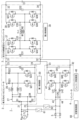
- FIG. 2 is a circuit diagram of the power conversion system.
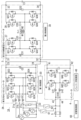
- FIG. 3 is a circuit diagram of a power conversion system according to the second embodiment.
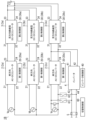
- FIG. 4 is a circuit block diagram of a power conversion system according to the third embodiment.
- the power conversion system 1 includes a unidirectional AC-DC converter 2, a bidirectional isolated DC-DC converter 3, an inverter 4, and an inverter control unit 40.
- the unidirectional AC-DC converter 2 is connected to a power system.
- the bidirectional isolated DC-DC converter 3 is connected to a battery E1 of an electric vehicle.
- the battery E1 is, for example, a 400V lithium-ion battery.
- the inverter 4 is connected to an outlet 5.
- the outlet 5 is, for example, an AC 100V outlet (also called an accessory outlet) placed inside the electric vehicle.
- a plug of a home appliance is connected to the outlet 5.
- the inverter control unit 40 controls the inverter 4.
- the power conversion system 1 further includes a first AC filter provided between the unidirectional AC-DC converter 2 and the AC power source Vs of the power system.
- the unidirectional AC-DC converter 2 is connected to the AC power source Vs via the first AC filter.
- the first AC filter is a noise filter.
- the power conversion system 1 further includes a DC filter provided between the bidirectional isolated DC-DC converter 3 and the battery E1.
- the bidirectional isolated DC-DC converter 3 is connected to the battery E1 via the DC filter.
- the DC filter is a noise filter.
- the power conversion system 1 further includes a second AC filter provided between the inverter 4 and the outlet 5. In this case, the inverter 4 is connected to the outlet 5 via the second AC filter.
- the second AC filter is a noise filter.
- the AC power source Vs is, for example, a commercial power source.
- the charging control unit includes, for example, a charging controller, a charging cable, a charging connector, a power cable, and a power plug.
- the charging controller is interposed between one end of the power cable and one end of the charging cable, and controls charging of the battery E1 of the electric vehicle from an external power source (for example, a commercial power source).
- the charging controller has a Charge Circuit Interrupt Device (CCID).
- CCID Charge Circuit Interrupt Device
- each of the two switching elements Q21, Q22 is, for example, a normally-off n-channel MOSFET (Metal-Oxide-Semiconductor Field Effect Transistor).
- MOSFET Metal-Oxide-Semiconductor Field Effect Transistor
- the diodes connected in anti-parallel to each of the two switching elements Q21, Q22 are parasitic diodes of the n-channel MOSFETs constituting each of the two switching elements Q21, Q22, but are not limited to this and may be external diodes.
- the two switching elements Q21 and Q22 of the AC-DC converter 2 are controlled by the first control unit 20.
- the bidirectional isolated DC-DC converter 3 (hereinafter sometimes abbreviated as DC-DC converter 3) has a first DC input/output terminal 31, a second DC input/output terminal 32, a third DC input/output terminal 33, and a fourth DC input/output terminal 34.
- the first DC input/output terminal 31 of the DC-DC converter 3 is connected to the first DC output terminal 23 of the AC-DC converter 2.
- the second DC input/output terminal 32 of the DC-DC converter 3 is connected to the second DC output terminal 24 of the AC-DC converter 2.
- the third DC input/output terminal 33 of the DC-DC converter 3 is connected to the positive electrode of the battery E1 of the electric vehicle.
- the fourth DC input/output terminal 34 of the DC-DC converter 3 is connected to the negative electrode of the battery E1. That is, in the DC-DC converter 3, the battery E1 is connected between the third DC input/output terminal 33 and the fourth DC input/output terminal 34.
- the DC-DC converter 3 includes a transformer Tr1, a first capacitor C31, a second capacitor C32, a first bridge circuit 37, and a second bridge circuit 38.
- the DC-DC converter 3 also includes a third capacitor C33 and a fourth capacitor C35.
- the transformer Tr1 includes a primary winding N1 and a secondary winding N2.
- the first capacitor C31 is connected between the first DC input/output terminal 31 and the second DC input/output terminal 32 of the DC-DC converter 3.
- the second capacitor C32 is connected between the third DC input/output terminal 33 and the fourth DC input/output terminal of the DC-DC converter 3.
- Each of the first capacitor C31 and the second capacitor C32 is, for example, an electrolytic capacitor.
- the second bridge circuit 38 is connected between the first and second ends of the secondary winding N2 of the transformer Tr1 via a fourth capacitor C35.
- the second bridge circuit 38 has four switching elements Q35, Q36, Q37, and Q38 that are bridge-connected.
- a series circuit of two switching elements Q35 and Q36 and a series circuit of two switching elements Q37 and Q38 are connected in parallel to the second capacitor C32.
- the connection point between the two switching elements Q35 and Q36 is connected to the first end of the secondary winding N2 via the fourth capacitor C35, and the connection point between the two switching elements Q37 and Q38 is connected to the second end of the secondary winding N2.
- the DC-DC converter 3 is capable of a first conversion operation that converts a first input voltage into a first output voltage, and a second conversion operation that converts a second input voltage into a second output voltage.
- the DC-DC converter 3 sets the voltage between the first DC input/output terminal 31 and the second DC input/output terminal 32 as the first input voltage, and sets the voltage between the third DC input/output terminal 33 and the fourth DC input/output terminal 34 as the first output voltage.
- the DC-DC converter 3 converts the first input voltage input between the first DC input/output terminal 31 and the second DC input/output terminal 32 into a first output voltage having a different voltage value from the first input voltage, and outputs it between the third DC input/output terminal 33 and the fourth DC input/output terminal 34.
- the DC-DC converter 3 sets the voltage between the third DC input/output terminal 33 and the fourth DC input/output terminal 34 as the second input voltage, and sets the voltage between the first DC input/output terminal 31 and the second DC input/output terminal 32 as the second output voltage.
- the DC-DC converter 3 converts the second input voltage input between the third DC input/output terminal 33 and the fourth DC input/output terminal 34 into a second output voltage having a different voltage value from the second input voltage, and outputs it between the first DC input/output terminal 31 and the second DC input/output terminal 32.
- the four switching elements Q35 to Q38 of the second bridge circuit 38 are controlled to the off state, and the four switching elements Q31 to Q34 of the first bridge circuit 37 are each switched on and off.
- the four switching elements Q31 to Q34 of the first bridge circuit 37 are each turned on and off. Note that the switching elements Q35 to Q38 may be turned on for part of the period during which current flows.
- the four diodes connected in one-to-one anti-parallel to the four switching elements Q41 to Q44 are parasitic diodes of the n-channel MOSFETs that constitute each of the four switching elements Q41 to Q44, but are not limited to this and may be external diodes.
- the voltage detection circuit 7 detects the input voltage of the AC-DC converter 2. More specifically, the voltage detection circuit 7 is connected between the first AC input terminal 21 and the second AC input terminal 22 of the AC-DC converter 2, and detects the voltage between the first AC input terminal 21 and the second AC input terminal 22 as the input voltage of the AC-DC converter 2.
- the voltage detection circuit 7 is, for example, a resistive voltage divider circuit including a plurality of resistors connected in series.
- the second control unit 30 controls the four switching elements Q31 to Q34 of the first bridge circuit 37 and the four switching elements Q35 to Q38 of the second bridge circuit 38 of the DC-DC converter 3.
- the second control unit 30 generates and outputs control signals for each of the eight switching elements Q31 to Q38 based on, for example, an external command, the input voltage and input current of the DC-DC converter 3, etc.
- the switching control unit 60 controls the first switching unit 61 and the second switching unit 62. When charging is being performed from the DC-DC converter 3 to the battery E1, the switching control unit 60 controls the first switching unit 61 and the second switching unit 62 to the ON state. The switching control unit 60 determines whether charging is being performed from the DC-DC converter 3 to the battery E1 based on, for example, the detected voltage of the voltage detection circuit 7 or the detection result of a sensor that detects whether or not the charging connector is connected to the charging inlet of the electric vehicle.
- the power conversion system 1 for example, when a plug of a home appliance is connected to the outlet 5 while the electric vehicle is running (when charging is stopped), the power conversion system 1 is in a state where it supplies AC voltage to the outlet 5 via the path of the battery E1-bidirectional isolated DC-DC converter 3-inverter 4-outlet 5.
- the switching control unit 60 keeps the first switching unit 61 and the second switching unit 62 controlled to the off state. Therefore, when charging is started from the charging stopped state, AC voltage is supplied to the outlet 5 via the path of the AC power source Vs-unidirectional AC-DC converter 2-inverter 4-outlet 5.
- the power conversion system 1 operates such that the switching control unit 60 immediately controls the first switching unit 61 and the second switching unit 62 to the off state based on the detection result of the voltage detection circuit 7, and supplies AC voltage to the outlet 5 via the path of the battery E1-bidirectional isolated DC-DC converter 3-inverter 4-outlet 5.
- each control unit includes, for example, a computer system.
- the computer system has one or more computers.
- the computer system corresponding to each control unit is mainly composed of a processor and a memory as hardware.
- the processor executes a program recorded in the memory of the computer system, thereby realizing the function of the control unit as the execution subject in this disclosure.
- the program may be pre-recorded in the memory of the computer system, or may be provided through an electric communication line, or may be recorded and provided on a non-transitory recording medium such as a memory card, an optical disk, or a hard disk drive (magnetic disk) that can be read by the computer system.
- the processor of the computer system is composed of one or more electronic circuits including a semiconductor integrated circuit (IC) or a large-scale integrated circuit (LSI).
- the multiple electronic circuits may be integrated in one chip or distributed across multiple chips.
- the multiple chips may be integrated in one device or distributed across multiple devices.
- At least two of the first control unit 20, the second control unit 30, the switching control unit 60, and the inverter control unit 40 may be integrated into a single microcomputer.
- the circuit configuration of the bidirectional isolated DC-DC converter 3 is not limited to the circuit configurations shown in Figs. 2 and 3, and may be other circuit configurations.
- the bidirectional isolated DC-DC converter 3 employs a CLLC circuit that makes the LLC circuit bidirectional, but is not limited to this and may be any DC-DC converter that is isolated and capable of charging and discharging.
- the bidirectional isolated DC-DC converter 3 may be, for example, a DAB converter or an FSFB converter.
Landscapes
- Engineering & Computer Science (AREA)
- Power Engineering (AREA)
- Transportation (AREA)
- Mechanical Engineering (AREA)
- Dc-Dc Converters (AREA)
- Inverter Devices (AREA)
Priority Applications (3)
| Application Number | Priority Date | Filing Date | Title |
|---|---|---|---|
| JP2024567788A JPWO2024143258A1 (https=) | 2022-12-28 | 2023-12-25 | |
| DE112023003394.3T DE112023003394T5 (de) | 2022-12-28 | 2023-12-25 | Energieumwandlungssystem |
| CN202380073516.6A CN120077545A (zh) | 2022-12-28 | 2023-12-25 | 电力转换系统 |
Applications Claiming Priority (2)
| Application Number | Priority Date | Filing Date | Title |
|---|---|---|---|
| JP2022212350 | 2022-12-28 | ||
| JP2022-212350 | 2022-12-28 |
Publications (1)
| Publication Number | Publication Date |
|---|---|
| WO2024143258A1 true WO2024143258A1 (ja) | 2024-07-04 |
Family
ID=91717999
Family Applications (1)
| Application Number | Title | Priority Date | Filing Date |
|---|---|---|---|
| PCT/JP2023/046368 Ceased WO2024143258A1 (ja) | 2022-12-28 | 2023-12-25 | 電力変換システム |
Country Status (4)
| Country | Link |
|---|---|
| JP (1) | JPWO2024143258A1 (https=) |
| CN (1) | CN120077545A (https=) |
| DE (1) | DE112023003394T5 (https=) |
| WO (1) | WO2024143258A1 (https=) |
Cited By (1)
| Publication number | Priority date | Publication date | Assignee | Title |
|---|---|---|---|---|
| US20240396426A1 (en) * | 2023-05-25 | 2024-11-28 | Kabushiki Kaisha Toyota Jidoshokki | Power conversion device |
Citations (2)
| Publication number | Priority date | Publication date | Assignee | Title |
|---|---|---|---|---|
| JP2010093891A (ja) * | 2008-10-06 | 2010-04-22 | Fujitsu Ten Ltd | 電子制御装置、プラグイン車両、及び給電経路切替方法 |
| JP2021052453A (ja) * | 2019-09-24 | 2021-04-01 | 株式会社オートネットワーク技術研究所 | 変換装置及び変換システム |
-
2023
- 2023-12-25 JP JP2024567788A patent/JPWO2024143258A1/ja active Pending
- 2023-12-25 WO PCT/JP2023/046368 patent/WO2024143258A1/ja not_active Ceased
- 2023-12-25 DE DE112023003394.3T patent/DE112023003394T5/de active Pending
- 2023-12-25 CN CN202380073516.6A patent/CN120077545A/zh active Pending
Patent Citations (2)
| Publication number | Priority date | Publication date | Assignee | Title |
|---|---|---|---|---|
| JP2010093891A (ja) * | 2008-10-06 | 2010-04-22 | Fujitsu Ten Ltd | 電子制御装置、プラグイン車両、及び給電経路切替方法 |
| JP2021052453A (ja) * | 2019-09-24 | 2021-04-01 | 株式会社オートネットワーク技術研究所 | 変換装置及び変換システム |
Cited By (2)
| Publication number | Priority date | Publication date | Assignee | Title |
|---|---|---|---|---|
| US20240396426A1 (en) * | 2023-05-25 | 2024-11-28 | Kabushiki Kaisha Toyota Jidoshokki | Power conversion device |
| US12597844B2 (en) * | 2023-05-25 | 2026-04-07 | Kabushiki Kaisha Toyota Jidoshokki | Power conversion device |
Also Published As
| Publication number | Publication date |
|---|---|
| JPWO2024143258A1 (https=) | 2024-07-04 |
| DE112023003394T5 (de) | 2025-05-22 |
| CN120077545A (zh) | 2025-05-30 |
Similar Documents
| Publication | Publication Date | Title |
|---|---|---|
| CN111434513B (zh) | 一种车辆及其能量转换装置与动力系统 | |
| US11855543B2 (en) | Energy conversion device, power system and vehicle | |
| US10193380B2 (en) | Power sources and systems utilizing a common ultra-capacitor and battery hybrid energy storage system for both uninterruptible power supply and generator start-up functions | |
| CN103828185B (zh) | 用于ups系统的双升压转换器 | |
| CN112224057B (zh) | 一种车辆及其能量转换装置与动力系统 | |
| TWI473376B (zh) | 電源供應系統及其控制方法 | |
| CN112224060B (zh) | 一种车辆及其能量转换装置与动力系统 | |
| CN112224050A (zh) | 能量转换装置、动力系统以及车辆 | |
| US11990830B2 (en) | Power conversion system and virtual DC voltage generator circuit | |
| US20240332979A1 (en) | Power conversion system including a second circuit being configured to control a current or power such that the current or the power is synchronized with power ripples caused by the ac power supply or the ac load | |
| US20250175028A1 (en) | Charging and discharging circuit, charging and discharging control method, and vehicle | |
| CN115733201A (zh) | 电源系统 | |
| CN112224058B (zh) | 能量转换装置、动力系统以及车辆 | |
| CN112224051B (zh) | 一种车辆及其能量转换装置与动力系统 | |
| WO2024143258A1 (ja) | 電力変換システム | |
| CN112224064B (zh) | 一种能量转换装置、动力系统及车辆 | |
| WO2013031934A1 (ja) | 電力連系システム | |
| US20250141343A1 (en) | Rectification control system, charger and control method for charger | |
| CN112224052B (zh) | 能量转换装置、动力系统以及车辆 | |
| CN112224055B (zh) | 能量转换装置、动力系统以及车辆 | |
| CN112224038B (zh) | 一种能量转换装置、动力系统及车辆 | |
| CN119582410A (zh) | 基于车辆到负载逆变器模块的车载充电器 | |
| CN113141048B (zh) | 车载充电机电路、车载充电器和电动汽车 | |
| JP2016063702A (ja) | 交流電動機駆動システム | |
| CN120283342A (zh) | 用于运行车辆充电设备的方法和用于充电设备的控制装置 |
Legal Events
| Date | Code | Title | Description |
|---|---|---|---|
| 121 | Ep: the epo has been informed by wipo that ep was designated in this application |
Ref document number: 23912038 Country of ref document: EP Kind code of ref document: A1 |
|
| WWE | Wipo information: entry into national phase |
Ref document number: 112023003394 Country of ref document: DE |
|
| WWE | Wipo information: entry into national phase |
Ref document number: 2024567788 Country of ref document: JP |
|
| WWE | Wipo information: entry into national phase |
Ref document number: 202380073516.6 Country of ref document: CN |
|
| WWP | Wipo information: published in national office |
Ref document number: 112023003394 Country of ref document: DE |
|
| WWP | Wipo information: published in national office |
Ref document number: 202380073516.6 Country of ref document: CN |
|
| 122 | Ep: pct application non-entry in european phase |
Ref document number: 23912038 Country of ref document: EP Kind code of ref document: A1 |