WO2024142173A1 - 最適化装置、最適化方法、及びプログラム - Google Patents
最適化装置、最適化方法、及びプログラム Download PDFInfo
- Publication number
- WO2024142173A1 WO2024142173A1 PCT/JP2022/048011 JP2022048011W WO2024142173A1 WO 2024142173 A1 WO2024142173 A1 WO 2024142173A1 JP 2022048011 W JP2022048011 W JP 2022048011W WO 2024142173 A1 WO2024142173 A1 WO 2024142173A1
- Authority
- WO
- WIPO (PCT)
- Prior art keywords
- new
- objective function
- optimization
- constraint
- variables
- Prior art date
- Legal status (The legal status is an assumption and is not a legal conclusion. Google has not performed a legal analysis and makes no representation as to the accuracy of the status listed.)
- Ceased
Links
Images






Classifications
-
- G—PHYSICS
- G06—COMPUTING OR CALCULATING; COUNTING
- G06N—COMPUTING ARRANGEMENTS BASED ON SPECIFIC COMPUTATIONAL MODELS
- G06N99/00—Subject matter not provided for in other groups of this subclass
Definitions
- Patent Document 1 discloses a software inspection device that inspects software by using a constraint-based optimization solver to determine satisfiability, with input values being the software to be inspected, input value constraint conditions for the software, and software inspection conditions.
- maximizing and minimizing the objective function f(x 1 , x 2 , ..., x ⁇ ) are equivalent through a trivial transformation.
- the optimization problem of minimizing the objective function f(x 1 , x 2 , ..., x ⁇ ) is the optimization problem of maximizing a new objective function ⁇ f(x 1 , x 2 , ..., x ⁇ ) obtained by multiplying the objective function by ⁇ 1.
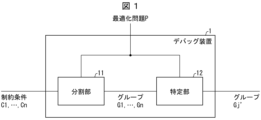
- the debugging device 1 is a device for debugging multiple constraints C1, C2, ..., Cm imposed on an optimization problem P.
- m is an arbitrary natural number equal to or greater than 2 that represents the number of constraints.
- the debugging device 1 for each of an arbitrary number of groups selected from n groups G1 to Gn, it is determined whether or not the combination is inappropriate. In this case, for each combination of an arbitrary number of groups selected from n groups G1, G2, ..., Gn, the identifying unit 12 determines whether or not a solution to the optimization problem P exists under constraints included in groups other than the groups that constitute the combination. Therefore, the number of times that the optimization problem is solved in the debugging device 1 according to the present embodiment is suppressed to 2 n times (since n ⁇ m, 2 n ⁇ 2 m ). Therefore, according to the debugging device 1 according to the present embodiment, the time required to complete the determination can be significantly reduced compared to conventional debugging devices.
- the debugging device 1 may further include an output unit.
- the output unit is configured to present to a user information representing the group Gj' identified by the identification unit 12, information representing the index j' of the group Gj', information representing a constraint condition included in the group Gj, or information representing an index of the constraint condition.
- the output unit may output the information as an image via a display, or as sound via a speaker.
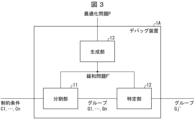
- the debugging device 1A is configured by adding a generating unit 13 to the debugging device 1 according to the first embodiment.
- Fig. 4 is a flow chart showing the flow of the debugging method S1A.
- Debugging method S1A is constructed by adding generation process S13 to debugging method S1 according to the first embodiment.
- the generation process S13 is a process for generating a relaxed problem P' by replacing the variables to be optimized in the optimization problem P from discrete variables to continuous variables.
- the generation process S13 is executed by the generation unit 13.
- the division process S11 may further determine whether or not a solution to the optimization problem P exists.
- the relaxed problem P' generated in the generation process S13 is used to determine whether or not a solution to the optimization problem P exists under the constraint conditions belonging to groups G1, G2, ..., Gj-1, Gj+1, ..., Gn other than group Gj, among the multiple constraint conditions C1, C2, ..., Cm.
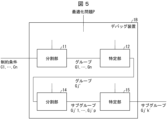
- Fig. 5 is a block diagram showing the configuration of the debugging device 1B.
- the identification unit 15 is a means for identifying a subgroup Gj'k' that, when excluded, will have a solution to the optimization problem P.
- the identification unit 12 repeats, for each k between 1 and q, (1) a selection process for selecting one subgroup Gi'k from the multiple subgroups Gj'1, Gj'2, ..., Gj'q, and (2) a determination process for determining whether or not a solution to the optimization problem P exists under constraint conditions included in the subgroups Gi'1, Gi'2, ..., Gi'k-1, Gi'k+1, ..., Gi'q other than the selected subgroup Gi'k, among the multiple constraint conditions C1, C2, ..., Cm.
- subgroups identified by the identification unit 15 as subgroups Gj'k' that have a solution to the optimization problem P when excluded are subgroups that do not have a solution to the optimization problem P under the constraints contained in subgroups Gi'1, Gi'2, ..., Gi'k'-1, Gi'k'+1, ..., Gi'q other than the subgroup Gi'k'.
- Debugging method S1B is constructed by adding division processing S14 and identification processing S15 to debugging method S1 according to the first embodiment.
- the identification process S15 is a process for identifying a subgroup Gj'k' that, when excluded, will contain a solution to the optimization problem P.
- a subgroup identified in the identification process S15 as a subgroup Gj'k' for which a solution to the optimization problem P exists when excluded is a subgroup for which there is no solution to the optimization problem P under the constraints contained in the subgroups Gi'1, Gi'2, ..., Gi'k'-1, Gi'k'+1, ..., Gi'q other than the subgroup Gi'k'.
- the identification process S15 is executed by the identification unit 15.
- the debugging device 1 according to the first embodiment determines whether or not a constraint condition is appropriate in a group basis, whereas in the debugging device 1 according to the present embodiment, whether or not a constraint condition is appropriate is determined on a subgroup basis. Therefore, the debugging device 1B according to the present embodiment has a further effect of being able to determine whether or not a constraint condition is appropriate in finer units (subgroup units) than the debugging device 1B according to the first embodiment.
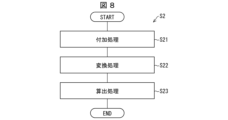
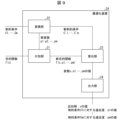
- the conversion unit 22 is configured to convert each constraint condition Ci into a new constraint condition C'i that is imposed on the corresponding new variable pi. In other words, the conversion unit 22 is configured to convert each constraint condition into a new constraint condition that is imposed on the corresponding new variable.
- the optimization problem of maximizing or minimizing the value of the new objective function f'(x, p1, p2, ..., pm) under the new constraint conditions C'1, C'2, ..., C'm is a relaxed problem of the optimization problem of maximizing or minimizing the value of the original objective function f(p1, p2, ..., pm) under the original constraint conditions C1, C2, ..., Cm. Therefore, the optimization problem of maximizing or minimizing the value of the new objective function f'(x, p1, p2, ..., pm) under the new constraint conditions C'1, C'2, ..., C'm always has a solution.
- the optimization device 2 even if the optimization problem of maximizing or minimizing the value of the original objective function f(p1, p2, ..., pm) under the original constraint conditions C1, C2, ..., Cm does not have a solution, an approximate solution (a solution to which the constraint conditions C1, C2, ..., Cm are loosely applied) is always obtained.
- the value of the new variable pi that maximizes or minimizes the value of the new objective function f'(x, p1, p2, ..., pm) represents the degree of violation of the corresponding constraint condition Ci. Therefore, according to the optimization device 2 of this embodiment, it is possible to obtain the degree of violation of each constraint condition Ci along with the above-mentioned approximate solution.
- the optimization device 2A is configured by adding an output unit 24 to the optimization device 2 according to the first embodiment.
- the output unit 24 is a component that realizes the output means in this embodiment.
- the output unit 24 is configured to output the values of the variable vector x other than the new variables p1, p2, ..., pm, among the values calculated by the calculation unit 23, as an approximate solution to the optimization problem that maximizes or minimizes the value of the objective function f(x) under the constraints C1, C2, ..., Cm.
- the output unit 24 is also configured to output the value of each new variable pi, among the values calculated by the calculation unit 23, as the degree of violation of the corresponding constraint Ci.
- the output unit 24 may output these values as an image using a display, or as sound using a speaker.
- Fig. 10 is a flow diagram showing the flow of the optimization method S2A.
- Optimization method S2A is constructed by adding output processing S24 to optimization method S2 according to the first embodiment.
- Output process S24 is a process for outputting the value of the variable vector x, among the values calculated in calculation process S23, as an approximate solution to the optimization problem that maximizes or minimizes the value of the objective function f(x) under the constraints C1, C2, ..., Cm.
- Output process S24 is also a process for outputting the value of each new variable pi, among the values calculated in calculation process S23, as the degree of violation of the corresponding constraint Ci. In output process S24, these values may be output as an image using a display, or as sound using a speaker.
- the optimization device 2A according to this embodiment has an additional effect of being able to inform the user of an approximate solution to the optimization problem that maximizes or minimizes the value of the objective function f(x) under the constraints C1, C2, ..., Cm, together with the degree of violation of each constraint Ci.
- the optimization method S2A according to this embodiment also has an additional effect similar to that of the optimization device 2A according to this embodiment.
- the splitting unit 11 and the identifying unit 12 solve the optimization problem in order to determine whether or not there is a solution.
- the optimization device 2 can be used as a solver for solving the optimization problem.
- the splitting unit 11 and the identifying unit 12 determine that the optimization problem has a solution when the violation degree is 0 for all constraint conditions, and determine that the optimization problem does not have a solution when the violation degree is not 0 for any one constraint condition.
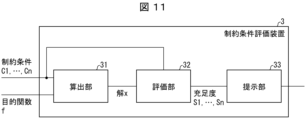
- Fig. 11 is a block diagram showing the configuration of the constraint condition evaluation device 3.
- the constraint evaluation device 3 is a device for evaluating the degree of satisfaction Si of each constraint Ci, which indicates the degree to which the solution of an optimization problem satisfies the constraint Ci, in an optimization problem for maximizing or minimizing the value of an objective function f(x) under m constraints C1, C2, ..., Cm.
- m is any natural number
- i is a natural number between 1 and m
- x ( x1 , x2 , ..., x ⁇ ) is a variable vector.
- the constraint Ci to be evaluated is a constraint that can be expressed as gi(x) ⁇ 0 among the m constraints C1, C2, ..., Cm.
- the constraint condition evaluation device 3 includes a calculation unit 31, an evaluation unit 32, and a presentation unit 33.
- the calculation unit 31 is configured to calculate the value of the variable x that maximizes or minimizes the value of the objective function f(x) under m constraints C1, C2, ..., Cm. In other words, it is configured to solve an optimization problem.
- the evaluation unit 32 is configured to calculate the degree of satisfaction Si for each constraint condition Ci that can be expressed as gi(x) ⁇ 0 among the m constraint conditions C1, C2, ..., Cm.
- the evaluation unit 32 calculates the degree of satisfaction Si, for example, by substituting the value of the variable x calculated by the calculation unit 31 (i.e., the solution to the optimization problem) into gi(x) that appears on the left side of the constraint condition Ci.
- the presentation unit 33 is configured to present to the user the degree of fulfillment Si calculated by the evaluation unit 32 for each constraint condition Ci that can be expressed as gi(x) ⁇ 0 among the m constraint conditions C1, C2, ..., Cm, or an index calculated from the degree of fulfillment Si. For example, the presentation unit 33 sorts the m constraint conditions C1, C2, ..., Cm in descending or ascending order of the degree of fulfillment Si and displays them on the display. Alternatively, the presentation unit 33 creates a graph (e.g., a pie chart) showing the degree of fulfillment Si of each constraint condition Ci, and displays the created graph on the display. Alternatively, the presentation unit 33 creates a heat map showing the degree of fulfillment Si of each constraint condition Ci, and displays the created heat map on the display.
- a graph e.g., a pie chart
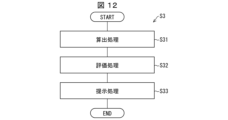
- Flow of constraint evaluation method The flow of the constraint condition evaluation method S3 according to this embodiment will be described with reference to Fig. 12.
- Fig. 12 is a flow diagram showing the flow of the constraint condition evaluation method S3.
- the constraint evaluation method S3 is a method for evaluating the degree of satisfaction Si, which indicates the degree to which the solution of each constraint Ci satisfies the constraint Ci in an optimization problem of maximizing or minimizing the value of the objective function f(x) under m constraints C1, C2, ..., Cm.
- the constraint evaluation method S3 is implemented by the constraint evaluation device 3.
- Calculation process S31 is a process for calculating the value of variable x that maximizes or minimizes the value of objective function f(x) under m constraint conditions C1, C2, ..., Cm. In other words, it is a process for solving an optimization problem.
- calculation process S31 is executed by calculation unit 31.
- the evaluation process S32 is a process for calculating the degree of satisfaction Si for each constraint condition Ci that can be expressed as gi(x) ⁇ 0 among the m constraint conditions C1, C2, ..., Cm.
- the degree of satisfaction Si is calculated by substituting the value of the variable x calculated in the calculation process S31 (i.e., the solution to the optimization problem) into gi(x) that appears on the left side of the constraint condition Ci.
- the evaluation process S32 is executed by the evaluation unit 32.
- the presentation process S33 is a process for presenting to the user the degree of satisfaction Si calculated in the evaluation process S32 for each constraint condition Ci that can be expressed as gi(x) ⁇ 0 among the m constraint conditions C1, C2, ..., Cm, or an index calculated from the degree of satisfaction Si.
- the m constraint conditions C1, C2, ..., Cm are sorted in descending or ascending order of the degree of satisfaction Si and displayed on the display.
- a graph e.g., a pie chart
- the created graph is displayed on the display.
- the presentation process S33 a heat map showing the degree of satisfaction Si of each constraint condition Ci is created, and the created heat map is displayed on the display.
- the presentation process S33 is executed by the presentation unit 33.
- the satisfaction degree Si of the above-mentioned constraint condition Ci becomes a large value when the solution of the optimization problem satisfies the constraint condition Ci with a margin, and becomes a small value when the solution of the optimization problem barely satisfies the constraint condition Ci.
- the constraint condition evaluation device 3 of this embodiment it is possible to present the satisfaction degree Si having such a property to the user. This allows the user to judge whether each constraint condition Ci is an appropriate constraint or an inappropriate constraint condition by referring to the satisfaction degree Si. This allows the debugging work of the constraint conditions C1, C2, ..., Cm to be efficiently carried out.
- the processor C1 may be, for example, a CPU (Central Processing Unit), GPU (Graphic Processing Unit), DSP (Digital Signal Processor), MPU (Micro Processing Unit), FPU (Floating point number Processing Unit), PPU (Physics Processing Unit), TPU (Tensor Processing Unit), quantum processor, microcontroller, or a combination of these.
- the memory C2 may be, for example, a flash memory, HDD (Hard Disk Drive), SSD (Solid State Drive), or a combination of these.
- the program P can also be recorded on a non-transitory, tangible recording medium M that can be read by the computer C.
- a recording medium M can be, for example, a tape, a disk, a card, a semiconductor memory, or a programmable logic circuit.
- the computer C can obtain the program P via such a recording medium M.
- the program P can also be transmitted via a transmission medium.
- a transmission medium can be, for example, a communications network or broadcast waves.
- the computer C can also obtain the program P via such a transmission medium.
- (Appendix 2) The optimization device according to claim 1, further comprising an output means for outputting values of variables other than the new variables among the values calculated by the calculation means as a solution to an optimization problem that maximizes or minimizes a value of an objective function under a constraint condition, wherein the output means outputs the value of each new variable among the values calculated by the calculation means as a degree of violation of a corresponding constraint condition.
Landscapes
- Engineering & Computer Science (AREA)
- Theoretical Computer Science (AREA)
- Physics & Mathematics (AREA)
- Computing Systems (AREA)
- General Engineering & Computer Science (AREA)
- General Physics & Mathematics (AREA)
- Mathematical Physics (AREA)
- Software Systems (AREA)
- Complex Calculations (AREA)
- Debugging And Monitoring (AREA)
- Feedback Control In General (AREA)
Priority Applications (2)
| Application Number | Priority Date | Filing Date | Title |
|---|---|---|---|
| PCT/JP2022/048011 WO2024142173A1 (ja) | 2022-12-26 | 2022-12-26 | 最適化装置、最適化方法、及びプログラム |
| JP2024566962A JP7831644B2 (ja) | 2022-12-26 | 2022-12-26 | 最適化装置、最適化方法、及びプログラム |
Applications Claiming Priority (1)
| Application Number | Priority Date | Filing Date | Title |
|---|---|---|---|
| PCT/JP2022/048011 WO2024142173A1 (ja) | 2022-12-26 | 2022-12-26 | 最適化装置、最適化方法、及びプログラム |
Publications (1)
| Publication Number | Publication Date |
|---|---|
| WO2024142173A1 true WO2024142173A1 (ja) | 2024-07-04 |
Family
ID=91716665
Family Applications (1)
| Application Number | Title | Priority Date | Filing Date |
|---|---|---|---|
| PCT/JP2022/048011 Ceased WO2024142173A1 (ja) | 2022-12-26 | 2022-12-26 | 最適化装置、最適化方法、及びプログラム |
Country Status (2)
| Country | Link |
|---|---|
| JP (1) | JP7831644B2 (https=) |
| WO (1) | WO2024142173A1 (https=) |
Citations (4)
| Publication number | Priority date | Publication date | Assignee | Title |
|---|---|---|---|---|
| JPH11259450A (ja) * | 1998-03-09 | 1999-09-24 | Hitachi Ltd | 最適な出力決定方法および装置 |
| JP2017027597A (ja) * | 2015-07-15 | 2017-02-02 | カラフル・ボード株式会社 | ファッションコーディネートリコメンドシステム |
| CN113031451A (zh) * | 2021-05-31 | 2021-06-25 | 浙江中控技术股份有限公司 | 一种适用于流程工业预测控制的稳态优化方法 |
| WO2022003943A1 (ja) * | 2020-07-03 | 2022-01-06 | 日本電気株式会社 | 解精度保証アニーリング計算装置、方法及びプログラム |
Family Cites Families (1)
| Publication number | Priority date | Publication date | Assignee | Title |
|---|---|---|---|---|
| JP2021144569A (ja) | 2020-03-13 | 2021-09-24 | アズビル株式会社 | 意思決定支援装置、意思決定支援方法およびプログラム |
-
2022
- 2022-12-26 WO PCT/JP2022/048011 patent/WO2024142173A1/ja not_active Ceased
- 2022-12-26 JP JP2024566962A patent/JP7831644B2/ja active Active
Patent Citations (4)
| Publication number | Priority date | Publication date | Assignee | Title |
|---|---|---|---|---|
| JPH11259450A (ja) * | 1998-03-09 | 1999-09-24 | Hitachi Ltd | 最適な出力決定方法および装置 |
| JP2017027597A (ja) * | 2015-07-15 | 2017-02-02 | カラフル・ボード株式会社 | ファッションコーディネートリコメンドシステム |
| WO2022003943A1 (ja) * | 2020-07-03 | 2022-01-06 | 日本電気株式会社 | 解精度保証アニーリング計算装置、方法及びプログラム |
| CN113031451A (zh) * | 2021-05-31 | 2021-06-25 | 浙江中控技术股份有限公司 | 一种适用于流程工业预测控制的稳态优化方法 |
Also Published As
| Publication number | Publication date |
|---|---|
| JP7831644B2 (ja) | 2026-03-17 |
| JPWO2024142173A1 (https=) | 2024-07-04 |
Similar Documents
| Publication | Publication Date | Title |
|---|---|---|
| Tang et al. | Cutqc: using small quantum computers for large quantum circuit evaluations | |
| Adams | HPGMG 1.0: A benchmark for ranking high performance computing systems | |
| JP2017021772A (ja) | コピュラ理論に基づく特徴選択 | |
| Klotz | Identification, assessment, and correction of ill-conditioning and numerical instability in linear and integer programs | |
| JPWO2008126184A1 (ja) | 文書重要度算出プログラム | |
| South et al. | Verifiable evaluations of machine learning models using zkSNARKs | |
| US9317387B2 (en) | Methods and systems for reducing metrics used to monitor resources | |
| Juaristi et al. | Benchmarking post-quantum cryptography in Ethereum-based blockchains | |
| US20230273771A1 (en) | Secret decision tree test apparatus, secret decision tree test system, secret decision tree test method, and program | |
| JP7776026B2 (ja) | デバッグ装置、デバッグ方法、及びプログラム | |
| WO2024142173A1 (ja) | 最適化装置、最適化方法、及びプログラム | |
| US9529688B2 (en) | Performance evaluation device and performance evaluation method | |
| JP5311085B2 (ja) | リスク分析システム及びリスク分析方法 | |
| CN107210005B (zh) | 矩阵/密钥生成装置、矩阵/密钥生成系统、矩阵结合装置、矩阵/密钥生成方法、程序 | |
| Xiao | Power-free values of binary forms and the global determinant method | |
| Sirvent et al. | A Monte Carlo evaluation of several tests for the selection of variables in DEA models | |
| US20200272772A1 (en) | Indicator calculation device, indicator calculation method, and non-transitory recording medium | |
| JP5600694B2 (ja) | クラスタリング装置及び方法及びプログラム | |
| Petrov | Information systems reliability in traditional entropy and novel hierarchy | |
| JP2013025349A (ja) | 特徴選択装置、方法、及び、プログラム | |
| KR20130085062A (ko) | 리스크 관리 장치 | |
| Stentoft | American option pricing using simulation and regression: numerical convergence results | |
| Furini et al. | Hybrid SDP bounding procedure | |
| Akbar et al. | A Monte Carlo Simulation Analysis of Panel Stationarity Tests under a Single Framework | |
| Aldarmini et al. | Information-theoretic Quantification of Inherent Discrimination Bias in Training Data for Supervised Learning |
Legal Events
| Date | Code | Title | Description |
|---|---|---|---|
| 121 | Ep: the epo has been informed by wipo that ep was designated in this application |
Ref document number: 22969967 Country of ref document: EP Kind code of ref document: A1 |
|
| WWE | Wipo information: entry into national phase |
Ref document number: 2024566962 Country of ref document: JP |
|
| NENP | Non-entry into the national phase |
Ref country code: DE |
|
| 122 | Ep: pct application non-entry in european phase |
Ref document number: 22969967 Country of ref document: EP Kind code of ref document: A1 |