WO2024122136A1 - タイヤ用ポリエチレンテレフタレートコード及びタイヤ - Google Patents
タイヤ用ポリエチレンテレフタレートコード及びタイヤ Download PDFInfo
- Publication number
- WO2024122136A1 WO2024122136A1 PCT/JP2023/032246 JP2023032246W WO2024122136A1 WO 2024122136 A1 WO2024122136 A1 WO 2024122136A1 JP 2023032246 W JP2023032246 W JP 2023032246W WO 2024122136 A1 WO2024122136 A1 WO 2024122136A1
- Authority
- WO
- WIPO (PCT)
- Prior art keywords
- pet
- cord
- polyethylene terephthalate
- tire
- crystallinity
- Prior art date
- Legal status (The legal status is an assumption and is not a legal conclusion. Google has not performed a legal analysis and makes no representation as to the accuracy of the status listed.)
- Ceased
Links
Images
Classifications
-
- B—PERFORMING OPERATIONS; TRANSPORTING
- B60—VEHICLES IN GENERAL
- B60C—VEHICLE TYRES; TYRE INFLATION; TYRE CHANGING; CONNECTING VALVES TO INFLATABLE ELASTIC BODIES IN GENERAL; DEVICES OR ARRANGEMENTS RELATED TO TYRES
- B60C9/00—Reinforcements or ply arrangement of pneumatic tyres
-
- B—PERFORMING OPERATIONS; TRANSPORTING
- B60—VEHICLES IN GENERAL
- B60C—VEHICLE TYRES; TYRE INFLATION; TYRE CHANGING; CONNECTING VALVES TO INFLATABLE ELASTIC BODIES IN GENERAL; DEVICES OR ARRANGEMENTS RELATED TO TYRES
- B60C9/00—Reinforcements or ply arrangement of pneumatic tyres
- B60C9/18—Structure or arrangement of belts or breakers, crown-reinforcing or cushioning layers
- B60C9/20—Structure or arrangement of belts or breakers, crown-reinforcing or cushioning layers built-up from rubberised plies each having all cords arranged substantially parallel
- B60C9/22—Structure or arrangement of belts or breakers, crown-reinforcing or cushioning layers built-up from rubberised plies each having all cords arranged substantially parallel the plies being arranged with all cords disposed along the circumference of the tyre
-
- D—TEXTILES; PAPER
- D02—YARNS; MECHANICAL FINISHING OF YARNS OR ROPES; WARPING OR BEAMING
- D02G—CRIMPING OR CURLING FIBRES, FILAMENTS, THREADS, OR YARNS; YARNS OR THREADS
- D02G3/00—Yarns or threads, e.g. fancy yarns; Processes or apparatus for the production thereof, not otherwise provided for
- D02G3/02—Yarns or threads characterised by the material or by the materials from which they are made
- D02G3/04—Blended or other yarns or threads containing components made from different materials
-
- D—TEXTILES; PAPER
- D02—YARNS; MECHANICAL FINISHING OF YARNS OR ROPES; WARPING OR BEAMING
- D02G—CRIMPING OR CURLING FIBRES, FILAMENTS, THREADS, OR YARNS; YARNS OR THREADS
- D02G3/00—Yarns or threads, e.g. fancy yarns; Processes or apparatus for the production thereof, not otherwise provided for
- D02G3/44—Yarns or threads characterised by the purpose for which they are designed
- D02G3/48—Tyre cords
Definitions
- the present invention relates to polyethylene terephthalate cord for tires and tires.
- the belt reinforcing layer In order to improve the high-speed durability of tires, it is known to provide a belt reinforcing layer on the outer periphery of the belt arranged in the tread portion, in which organic fiber cords are arranged substantially parallel to the tire circumferential direction.
- the belt reinforcing layer contributes to improving high-speed durability and can also contribute to reducing noise during driving.
- nylon fibers such as nylon 66 and nylon 6 have generally been used as the material for the organic fiber cords that make up the belt reinforcing layer.
- nylon fiber cords such as nylon 66 and nylon 6
- polyethylene terephthalate cords which are more elastic and less expensive than nylon fiber cords (see, for example, Patent Document 1).
- an object of the present invention is to solve the above-mentioned problems of the conventional technology and to provide a polyethylene terephthalate cord which, when used as a tire component, can further reduce noise during running while maintaining high tire durability.
- Another object of the present invention is to provide a tire which maintains high durability while further reducing noise during running.
- the gist of the present invention which solves the above problems, is as follows:
- a polyethylene terephthalate cord for a tire comprising: At least two types of polyethylene terephthalate drawn yarns having different crystallinity, Of the two types of polyethylene terephthalate drawn yarns, the one with a lower crystallinity is designated PET drawn yarn A, and the one with a higher crystallinity is designated PET drawn yarn B,
- PET drawn yarn A has a crystallinity of less than 45.0%
- PET drawn yarn B has a crystallinity of 40.0% or more
- a polyethylene terephthalate cord characterized in that a constituent ratio of the PET drawn yarn A in the cord is 1 mass % or more and 99 mass % or less.
- a polyethylene terephthalate cord for a tire comprising: At least two types of polyethylene terephthalate drawn yarns having different terminal carboxyl group concentrations (CEG), Of the two types of polyethylene terephthalate drawn yarns, the one with a higher terminal carboxyl group concentration is designated PET drawn yarn A, and the one with a lower terminal carboxyl group concentration is designated PET drawn yarn B,
- the PET drawn yarn A has a crystallinity of less than 45.0%
- the PET drawn yarn B has a crystallinity of 40.0% or more
- a polyethylene terephthalate cord characterized in that a constituent ratio of the PET drawn yarn A in the cord is 1 mass % or more and 99 mass % or less.
- [4] A polyethylene terephthalate cord according to any one of [1] to [3], in which the composition ratio of the PET stretched yarn A in the cord is 25% by mass or more and 75% by mass or less.
- a polyethylene terephthalate cord which, when used in a tire component, can further reduce noise during running while maintaining high tire durability.
- a tire which maintains high durability while further reducing noise during running.
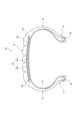
- FIG. 1 is a cross-sectional view of a tire according to one embodiment of the present invention.
- the present invention will be described in detail below with reference to the embodiments.
- the compounds described in this specification may be derived partially or entirely from fossil resources, from biological resources such as plant resources, or from recycled resources such as used tires, or may be derived from a mixture of two or more of fossil resources, biological resources, and recycled resources.
- the polyethylene terephthalate cord according to the first embodiment of the present invention is A polyethylene terephthalate cord for tires, comprising: At least two types of polyethylene terephthalate drawn yarns having different crystallinity, Of the two types of polyethylene terephthalate drawn yarns, the one with a lower crystallinity is designated PET drawn yarn A, and the one with a higher crystallinity is designated PET drawn yarn B,
- PET drawn yarn A has a crystallinity of less than 45.0%
- the PET drawn yarn B has a crystallinity of 40.0% or more
- the cord is characterized in that a constituent ratio of the PET drawn yarn A in the cord is 1% by mass or more and 99% by mass or less.
- the polyethylene terephthalate cord of the second embodiment of the present invention is A polyethylene terephthalate cord for tires, comprising: At least two types of polyethylene terephthalate drawn yarns having different terminal carboxyl group concentrations (CEG), Of the two types of polyethylene terephthalate drawn yarns, the one with a higher terminal carboxyl group concentration is designated PET drawn yarn A, and the one with a lower terminal carboxyl group concentration is designated PET drawn yarn B.
- the PET drawn yarn A has a crystallinity of less than 45.0%
- the PET drawn yarn B has a crystallinity of 40.0% or more
- the cord is characterized in that a constituent ratio of the PET drawn yarn A in the cord is 1% by mass or more and 99% by mass or less.
- the present invention relates to a polyethylene terephthalate cord (hereinafter, sometimes referred to as a "PET cord”) using at least two kinds of PET drawn yarns differing in crystallinity or terminal carboxyl group concentration (CEG), and one of the key features of the present invention is that the crystallinity of these at least two kinds of PET drawn yarns is optimized. Since the PET cord of the present invention has been optimized as described above, when used in a tire component, it is possible to reduce noise during running while maintaining tire durability.
- CEG terminal carboxyl group concentration
- PET cord of the present invention reduces noise during running while maintaining tire durability. That is, in fibers with low crystallinity, the presence of amorphous parts creates a damping effect, and noise reduction is expected, but the presence of amorphous parts can cause decomposition and destruction, resulting in insufficient durability. Therefore, by combining fibers with low and high crystallinity and optimizing the crystallinity values of each, it is believed that it is possible to reduce noise during running while maintaining tire durability.
- the PET cord of the present invention may be composed of only two types of PET drawn yarns, or may be composed of these two types of PET drawn yarns and an additional type of drawn yarn.
- the PET cord is composed of three or more types of PET drawn yarns, two types of PET drawn yarns with different crystallinity or terminal carboxyl group concentration (CEG) can be arbitrarily selected and one can be regarded as drawn yarn A and the other as drawn yarn B, as appropriate.
- CEG terminal carboxyl group concentration
- the PET drawn yarn constituting the PET cord of the present invention may be made of recycled PET resin.
- Methods for recycling PET products include a chemical recycling method in which PET products such as PET bottles and clothing are depolymerized into monomers or intermediates and then polymerized again into a high-purity PET resin, and a mechanical recycling method in which the PET products are crushed, melted, and recycled.
- PET resins recycled by the mechanical recycling method are low in production cost and relatively easy to obtain.
- the PET drawn yarns using the mechanically recycled PET resins tend to have a lower crystallinity and/or a higher terminal carboxyl group concentration (CEG) than other PET drawn yarns.
- CEG carboxyl group concentration
- the PET resin which is the constituent material of the PET drawn yarn, by paying attention to its origin and production conditions.
- the crystallinity of the PET drawn yarn can be adjusted, for example, by appropriately changing the conditions during production (drawing), such as the drawing speed, temperature, time, etc.
- the terminal carboxyl group concentration (CEG) of the PET drawn yarn can be adjusted, for example, by appropriately changing the conditions during polymerization, such as the catalyst type, temperature, time, etc.
- the present invention can be expected to use a certain amount of recycled PET resin, particularly mechanically recycled PET resin, which can be advantageous from the standpoint of production costs and environmental protection.
- the terminal carboxyl group concentration (CEG) of PET oriented yarn can be measured by the titration method described in Analytic. Chem., 26, 1614 (1954).
- PET drawn yarn A is the drawn yarn having a lower crystallinity or a higher terminal carboxyl group concentration among (at least) two kinds of PET drawn yarns constituting the PET cord.
- the PET drawn yarn A may be drawn, and the draw ratio is not particularly limited.
- the crystallinity of PET stretched yarn A must be less than 45.0%. Even if the crystallinity of PET stretched yarn A is relatively low or the terminal carboxyl group concentration is relatively high, if the crystallinity of PET stretched yarn A is 45.0% or more, the raw materials or manufacturing methods for the PET resin will be limited, the options will be fewer, and there is a risk of restrictions on the use of recycled PET. In addition, from the viewpoint of further reducing noise during tire running, it is preferable that the crystallinity of PET stretched yarn A is less than 40.0%. On the other hand, the lower limit of the crystallinity of PET stretched yarn A is not particularly limited, but from the viewpoint of suppressing excessive performance deterioration, it is preferable that it is 35.0% or more.
- the PET stretched yarn A preferably has a terminal carboxyl group concentration (CEG) of 21 eq/ton or more. If the CEG of the PET stretched yarn A is 21 eq/ton or more, noise during running can be reduced more effectively.
- the upper limit of the CEG of the PET stretched yarn A is not particularly limited, but from the viewpoint of obtaining a good balance between tire durability and noise during running, it is preferably 30 eq/ton or less.
- the PET resin constituting PET stretched yarn A may be mechanically recycled PET resin, chemically recycled PET resin, or biomass PET resin. Also, part of the PET resin constituting PET stretched yarn A may be mechanically recycled PET resin, chemically recycled PET resin, or biomass PET resin (PET resin derived from biomass raw materials). In particular, it is preferable that part or all of the PET resin constituting PET stretched yarn A is mechanically recycled PET resin.
- the PET drawn yarn A preferably has a fineness of 200 to 3000 dtex. If the fineness of the PET drawn yarn A is 200 dtex or more, sufficient strength can be ensured, and if it is 3000 dtex or less, the effect of weight increase due to larger diameter can be sufficiently suppressed.
- the composition ratio of PET stretched yarn A is 1% by mass or more and 99% by mass or less. If the composition ratio is less than 1% by mass or more than 99% by mass, there is a risk that at least one of the tire durability and running noise may deteriorate. Furthermore, from the viewpoint of obtaining a better balance between tire durability and running noise, the composition ratio of PET stretched yarn A in the PET cord is preferably 25% by mass or more, 30% by mass or more, 40% by mass or more, or 45% by mass or more, and is preferably 75% by mass or less, 60% by mass or less, or 55% by mass or less.
- PET stretched yarn B The PET drawn yarn B is the drawn yarn having a higher crystallinity or a lower terminal carboxyl group concentration among (at least) two kinds of PET drawn yarns constituting the PET cord.
- the PET drawn yarn B may be drawn, and the draw ratio is not particularly limited.
- the crystallinity of PET stretched yarn B must be 40.0% or more. Even if the crystallinity of PET stretched yarn B is relatively high or the terminal carboxyl group concentration is relatively low, if the crystallinity of PET stretched yarn B is less than 40.0%, the durability of the tire may deteriorate. From the viewpoint of further improving the durability of the tire, the crystallinity of PET stretched yarn B is preferably 40.5% or more. On the other hand, the upper limit of the crystallinity of PET stretched yarn B is not particularly limited, but from the viewpoint of avoiding an excessive increase in manufacturing costs, it is preferably 45.0% or less.
- the terminal carboxyl group concentration (CEG) of PET stretched yarn B is 20 eq/ton or less.
- the lower limit of the CEG of PET stretched yarn B is not particularly limited, but from the viewpoint of productivity, it is preferable that it is 10 eq/ton or more.
- the PET resin constituting PET stretched yarn B may be non-recycled PET resin (petroleum-derived PET resin, PET resin derived from normal manufacturing methods), mechanically recycled PET resin, chemically recycled PET resin, or biomass PET resin. Also, part of the PET resin constituting PET stretched yarn B may be mechanically recycled PET resin, chemically recycled PET resin, or biomass PET resin. In particular, it is preferable that part or all of the PET resin constituting PET stretched yarn B is chemically recycled PET resin.
- the PET stretched yarn B preferably has a fineness of 200 to 3000 dtex. If the fineness of the PET stretched yarn B is 200 dtex or more, sufficient strength can be ensured, and if it is 3000 dtex or less, the effect of weight increase due to larger diameter can be sufficiently suppressed.
- the composition ratio of PET stretched yarn B is essentially required to be 99% by mass or less, and is preferably 1% by mass or more. If the composition ratio is 1% by mass or more, a better balance between tire durability and running noise can be achieved. From the same viewpoint, the composition ratio of PET stretched yarn B in the PET cord is more preferably 25% by mass or more, 30% by mass or more, 40% by mass or more, or 45% by mass or more, and is preferably 75% by mass or less, 60% by mass or less, or 55% by mass or less.
- the method for producing the PET cord of the present invention is not particularly limited.
- a plurality of drawn filaments X made of PET
- a plurality of drawn filaments Y made of PET
- a crystallinity or CEG different from the drawn filaments X are prepared, and these are bundled to obtain one PET drawn yarn Y.
- a plurality of drawn filaments Z made of PET
- the PET cord of the present invention can be obtained by twisting together these PET drawn yarns in a number ratio that gives a predetermined composition ratio.
- the above-mentioned PET drawn yarn X may be obtained by bundling drawn filaments X having a predetermined crystallinity or CEG with other drawn filaments.
- the crystallinity/CEG of the PET drawn yarn X may be different from the crystallinity/CEG of the drawn filaments X.
- the PET cord may have a single twist structure or a twisted structure (such as a double twist structure).
- a single twist structure for example, a twisted cord can be obtained by aligning specific PET stretched yarns and twisting them in one direction.
- a double twist structure for example, a twisted cord can be obtained by first twisting specific PET stretched yarns, then combining multiple of these yarns and twisting them in the opposite direction.
- the PET cord preferably has a total fineness of 1000 to 3500 dtex. If the total fineness of the PET cord is 1000 dtex or more, when used in a tire, particularly in the belt reinforcing layer, it can exhibit a sufficient elastic modulus to improve durability against protrusion input and to suppress the protrusion of the belt. Furthermore, if the total fineness of the PET cord is 3500 dtex or less, when used in a tire, particularly in the belt reinforcing layer, it can be densely packed and sufficient rigidity per unit width can be ensured.
- the PET cord is preferably treated with an adhesive composition.
- the adhesive composition may, for example, be an adhesive composition that contains a thermoplastic polymer (A) that has at least one crosslinkable functional group as a pendant group and that does not substantially contain addition-reactive carbon-carbon double bonds in its main chain structure, a heat-reactive water-based urethane resin (B), and an epoxy compound (C), and optionally further contains a rubber latex (D).
- A thermoplastic polymer
- B heat-reactive water-based urethane resin
- C epoxy compound
- D rubber latex
- RFL resin a resin made by mixing resorcin, formaldehyde, and latex.
- RFL resin a resin made by mixing resorcin, formaldehyde, and latex.
- RFL resin can exhibit sufficient cord-elastomer adhesive strength at room temperature, but the adhesive strength can be extremely reduced at high temperatures of 130°C or higher.
- thermoplastic polymer (A) that has at least one functional group with crosslinkability as a pendant group and does not substantially contain an addition-reactive carbon-carbon double bond in its main chain structure, a thermally reactive water-based urethane resin (B), and an epoxy compound (C), it is possible to sufficiently ensure adhesion to the elastomer (coating rubber) without hardening the organic fiber cord, even at high temperatures of 180°C or higher.
- the main chain of the thermoplastic polymer (A) is mainly a linear structure, and examples of the main chain include ethylenic addition polymers such as acrylic polymers, vinyl acetate polymers, and vinyl acetate-ethylene polymers; urethane polymers; etc.
- the thermoplastic polymer (A) is not limited to the above-mentioned ethylenic addition polymers and urethane polymers as long as it has the function of suppressing the resin fluidity at high temperatures and ensuring the fracture strength of the resin by crosslinking the functional groups of the pendant groups.
- the functional group of the pendant group of the thermoplastic polymer (A) is preferably an oxazolin group, a bismaleimide group, a (blocked)isocyanate group, an aziridine group, a carbodiimide group, a hydrazino group, an epoxy group, an epithio group, or the like.
- thermoplastic polymer (A), heat-reactive water-based urethane resin (B), epoxy compound (C), and rubber latex (D) can be those described in Japanese Patent Application No. 2023-040157 and Japanese Patent Application No. 2023-030762, respectively.
- thermoplastic polymer (A), heat-reactive aqueous urethane resin (B), and epoxy compound (C) it is preferable to use a mixture (adhesive composition) of the thermoplastic polymer (A), heat-reactive aqueous urethane resin (B), and epoxy compound (C) as the first bath treatment liquid, and to use a normal RFL resin liquid as the second bath treatment liquid.
- the proportion (dry mass ratio) of the thermoplastic polymer (A) is preferably 2 to 75%
- the proportion (dry mass ratio) of the heat-reactive aqueous urethane resin (B) is preferably 15 to 87%
- the proportion (dry mass ratio) of the epoxy compound (C) is preferably 11 to 70%
- the proportion (dry mass ratio) of the rubber latex (D) is preferably 20% or less.
- dip treatment liquid that does not contain resorcinol and formalin as an adhesive composition for PET cords.
- dip treatment liquids include a composition that contains a rubber latex (a) having an unsaturated diene, and one or more compounds (b) selected from a compound having a polyether skeleton structure and an amine functional group, a compound having an acrylamide structure, a polypeptide, a polylysine, and a carbodiimide.
- dip treatment liquids include a composition that contains, in addition to the rubber latex (a) having an unsaturated diene and the compound (b), one or more compounds selected from an aqueous compound (c) having a (thermally dissociable blocked) isocyanate group, a polyphenol (d), and a polyvalent metal salt (e).
- compositions that contain polyphenols (I) and aldehydes (II).
- such compositions may further contain at least one of an isocyanate compound (III) and a rubber latex (IV).
- the adhesive composition used to treat (coat) the PET cord contains polyphenols (I) and aldehydes (II), so that good adhesive properties can be achieved even when resorcin is not used due to environmental considerations.
- the adhesive composition contains polyphenols (I) as a resin component, and thus the adhesiveness to the PET cord can be improved.
- the polyphenols (I) are typically water-soluble polyphenols, and are not particularly limited as long as they are polyphenols other than resorcin (resorcinol).
- the number of aromatic rings or the number of hydroxyl groups can be appropriately selected.
- the polyphenols (I) preferably have two or more hydroxyl groups, and more preferably have three or more hydroxyl groups.
- the polyphenol or polyphenol condensate is water-soluble in the adhesive composition (dip treatment liquid) containing moisture. This allows the polyphenols to be uniformly distributed in the adhesive composition, thereby realizing better adhesion.
- the polyphenols (I) are polyphenols containing multiple (two or more) aromatic rings, the aromatic rings each have two or three hydroxyl groups at the ortho, meta, or para positions.
- polyphenols (I) for example, those described as polyphenol compounds in WO2022/130879 can be used. These polyphenols (I) may be used alone or in combination of two or more.
- the adhesive composition contains aldehydes (II) as a resin component in addition to the polyphenols (I), and thus can achieve high adhesion together with the polyphenols (I).
- the aldehydes (II) are not particularly limited and can be appropriately selected according to the required performance. In this specification, the aldehydes (II) also include derivatives of aldehydes that are generated from aldehydes.
- the aldehydes (II) include, for example, monoaldehydes such as formaldehyde, acetaldehyde, butylaldehyde, acrolein, propionaldehyde, chloral, butylaldehyde, caproaldehyde, and allylaldehyde, aliphatic dialdehydes such as glyoxal, malonaldehyde, succinaldehyde, glutaraldehyde, and adipaldehyde, aldehydes having an aromatic ring, and dialdehyde starch. These aldehydes (II) may be used alone or in combination of two or more.
- the aldehydes (II) are preferably aldehydes having an aromatic ring or contain aldehydes having an aromatic ring. This is because better adhesion can be obtained.
- the aldehydes (II) are preferably free of formaldehyde.
- "free of formaldehyde” means, for example, that the formaldehyde content in the total mass of the aldehydes is less than 0.5 mass%.
- polyphenols (I) and aldehydes (II) are in a condensed state, and the mass ratio of polyphenols to aldehydes having aromatic rings (content of aldehydes having aromatic rings/content of polyphenols) is preferably 0.1 or more and 3 or less.
- the hardness and adhesiveness of the resin which is the product of the condensation reaction between polyphenols and aldehydes having aromatic rings, become more suitable.
- the mass ratio of polyphenols to aldehydes having aromatic rings in the adhesive composition is more preferably 0.25 or more, and more preferably 2.5 or less.
- the above mass ratio is the mass of the dried product (solid content ratio).
- the total content of the polyphenols (I) and the aldehydes (II) in the adhesive composition is preferably 3 to 30% by mass. In this case, better adhesion can be ensured without deteriorating workability, etc. From the same viewpoint, the total content of the polyphenols (I) and the aldehydes (II) in the adhesive composition is more preferably 5% by mass or more and more preferably 25% by mass or less. The total content is the mass of the dry matter (solid content ratio).
- the adhesive composition preferably further contains an isocyanate compound (III) in addition to the polyphenols (I) and aldehydes (II) described above.
- the adhesive composition can have a further improved adhesiveness due to a synergistic effect with the polyphenols (I) and the aldehydes (II).
- the isocyanate compound (III) is a compound that has the effect of promoting adhesion to the resin material (e.g., phenol/aldehyde resin obtained by condensing polyphenols (I) and aldehydes (II)) that is the adherend of the adhesive composition, and is a compound that has an isocyanate group as a polar functional group.
- the resin material e.g., phenol/aldehyde resin obtained by condensing polyphenols (I) and aldehydes (II)
- These isocyanate compounds (III) may be used alone or in combination of two or more types.
- the isocyanate compound (III) is not particularly limited, but from the viewpoint of further improving adhesion, it is preferable that the isocyanate compound (III) contains a (blocked) isocyanate group-containing aromatic compound.
- the adhesive composition contains a (blocked) isocyanate group-containing aromatic compound
- the (blocked) isocyanate group-containing aromatic compound is distributed in a position near the interface between the PET cord and the adhesive composition, resulting in a further adhesion promoting effect, and this effect can further enhance the adhesion of the adhesive composition to the PET cord.
- the content of the isocyanate compound (III) in the adhesive composition is not particularly limited, but from the viewpoint of more reliably ensuring excellent adhesion, it is preferably 5 to 65 mass %. From the same viewpoint, the content of the isocyanate compound (III) in the adhesive composition is more preferably 10 mass % or more and more preferably 45 mass % or less. The above content is the mass of the dry matter (solid content ratio).
- the adhesive composition may further contain substantially a rubber latex (IV) in addition to the polyphenols (I), aldehydes (II) and isocyanate compound (III), which allows the adhesive composition to have higher adhesion to rubber members.
- the rubber latex (IV) is not particularly limited, and examples thereof include natural rubber (NR), as well as synthetic rubbers such as polyisoprene rubber (IR), styrene-butadiene copolymer rubber (SBR), polybutadiene rubber (BR), ethylene-propylene-diene rubber (EPDM), chloroprene rubber (CR), halogenated butyl rubber, acrylonitrile-butadiene rubber (NBR), and vinylpyridine-styrene-butadiene copolymer rubber (Vp). These rubber latexes (IV) may be used alone or in combination of two or more.
- synthetic rubbers such as polyisoprene rubber (IR), styrene-butadiene copolymer rubber (SBR), polybutadiene rubber (BR), ethylene-propylene-diene rubber (EPDM), chloroprene rubber (CR), halogenated butyl rubber, acrylonitrile-butadiene rubber (NBR), and
- the content of rubber latex (IV) in the adhesive composition is preferably 20% by mass or more, more preferably 25% by mass or more, and is preferably 70% by mass or less, more preferably 60% by mass or less.
- the method for producing the adhesive composition is not particularly limited, but examples thereof include a method of mixing raw materials such as polyphenols (I), aldehydes (II), and rubber latex (IV) and maturing them, or a method of mixing polyphenols (I) and aldehydes (II) and maturing them, and then adding rubber latex (IV) and maturing them.
- the method for producing the adhesive composition may be a method of adding rubber latex (IV), maturing them, and then adding the isocyanate compound (III).
- the PET cord is for tires, i.e., can be applied to tire components.
- tire components include, but are not limited to, carcasses, belt reinforcing layers, bead reinforcing layers, and side reinforcing layers.
- the PET cord is preferably used in the belt reinforcing layer of a tire from the viewpoint of more reliably reducing noise during running while sufficiently suppressing the influence on the durability of the tire.
- the belt reinforcing layer will be described in detail below.
- the tire of the present invention comprises a belt disposed in a tread portion, and a belt reinforcing layer for reinforcing the belt, and the above-mentioned PET cord is used in the belt reinforcing layer.
- FIG. 1 is a cross-sectional view of a tire according to one embodiment of the present invention.
- the tire 100 shown in FIG. 1 includes a pair of bead portions 10, a pair of sidewall portions 20, a tread portion 30, a carcass 50 extending in a toroidal shape between bead cores 40 embedded in the bead portions 10, a belt 60 disposed in the tread portion 30 (more specifically, disposed on the tire radial outer side of the crown portion of the carcass 50), a belt reinforcing layer (also called a "cap layer”) 70A disposed on the tire radial outer side of the belt 60 so as to cover the entire belt 60, and a pair of belt reinforcing layers (also called “layer layers”) 70B disposed so as to cover only both ends of the belt reinforcing layer 70A.
- the tire according to this embodiment uses the above-mentioned PET cord for one or both of the belt reinforcing layers 70A and 70B.
- the belt reinforcing layers 70A and 70B are formed by coating organic fiber cords (reinforcing material) arranged substantially parallel to the tire circumferential direction (for example, at an angle of 0 to 5° to the tire circumferential direction) with an elastomer.
- the belt reinforcing layers 70A and 70B are formed by continuously winding narrow strips prepared by coating organic fiber cords with an elastomer in a spiral shape in the tire circumferential direction.
- the tire of this embodiment uses the above-mentioned PET cord as such an organic fiber cord.
- the tire of the present invention is not particularly limited other than using the above-mentioned PET cord in the belt reinforcing layer, and can be manufactured according to a conventional method.
- the belt 60 is configured of two belt layers 60A and 60B, but the tire of the present invention is not limited to this, and the belt 60 may be configured of a single belt layer.
- the tire 100 shown in FIG. 1 includes the belt reinforcing layer 70A and the belt reinforcing layer 70B, the tire of the present invention is not limited to this, and either the belt reinforcing layer 70A or the belt reinforcing layer 70B may be omitted.
- the belt reinforcing layer 70A is configured as a single layer, but the tire of the present invention is not limited to this, and the belt reinforcing layer 70A may be configured as two or more layers.
- the belt reinforcing layer 70B is configured as a single layer, but the tire of the present invention is not limited to this, and the belt reinforcing layer 70B may be configured as two or more layers.
- the PET cord When the PET cord is coated with an elastomer to produce a belt reinforcing layer, it is preferable to first dip the PET cord under high tension (adhesive treatment). This increases the elasticity of the cord and further improves the durability of the tire.
- the adhesive treatment can be composed of dry treatment, hot treatment, normalization treatment, etc., and can be carried out by adjusting the cord tension, temperature, and time as appropriate.
- the adhesive treatment can be either one-bath treatment or two-bath treatment, but two-bath treatment is preferable.
- the dip treatment liquid used in the above dip treatment may be, for example, an RFL (resorcinol-formalin-latex) adhesive containing resorcinol, formalin, rubber latex, and the like.
- RFL resorcinol-formalin-latex
- a dip treatment liquid that does not contain resorcinol and formalin.
- Such a dip treatment liquid can be, for example, a composition containing (a) a rubber latex having an unsaturated diene, and (b) a compound having a skeleton structure made of polyether and an amine functional group.
- such a dip treatment liquid can be, for example, a composition containing, in addition to the above-mentioned (a) component and the above-mentioned (b) component, (c) an aqueous compound having a (thermally dissociable blocked) isocyanate group, (d) a polyphenol, and (e) one or more compounds selected from a polyvalent metal salt.
- the density of the PET cords in the belt reinforcement layer is preferably 20 cords/50 mm or more and 70 cords/50 mm or less. In this case, it is possible to maintain the internal pressure and appropriately control the rigidity.
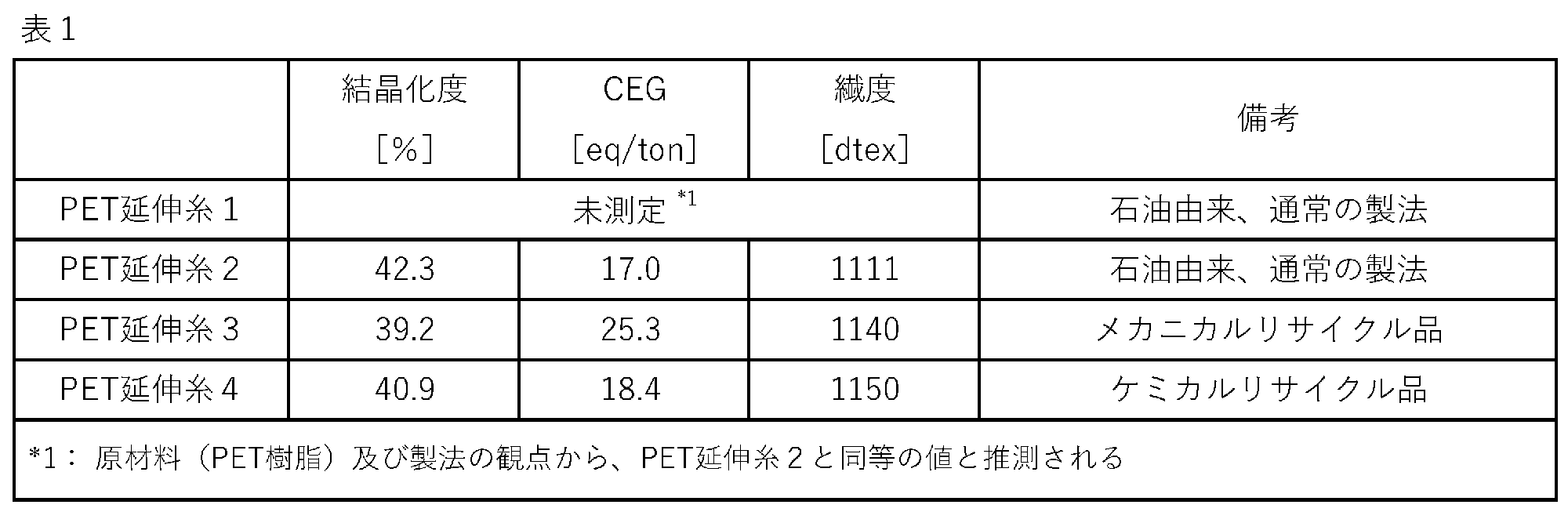
- the PET drawn yarn shown in Table 1 was prepared.
- Example 2 The above PET stretched yarns were twisted together in the composition ratio shown in Table 2 to produce a PET cord. Specifically, in Example 1, one PET stretched yarn 3 and one PET stretched yarn 4 were twisted together to produce a PET cord, and in the other examples, two PET stretched yarns of the same type were twisted together to produce a PET cord. The PET cord was then dipped in a dipping liquid. The total fineness of the PET cord after dipping is also shown in Table 2.
- the breaking strength of the obtained PET cords was measured using a tensile tester.
- the PET cords other than Conventional Example 1 were covered with an elastomer, vulcanized at 160°C for 90 minutes, and then the breaking strength after thermal degradation was measured using a tensile tester in the same manner as above. Note that, since the PET cord of Conventional Example 1 is made of drawn yarn with the same physical properties as the PET cord of Conventional Example 2, calculations were made based on the measured values of Conventional Example 2. These results are also shown in Table 2.
- the PET cords of Conventional Example 1, Comparative Example 1, and Example 1 were covered with an elastomer to prepare belt reinforcing layers 70A and 70B (see FIG. 1), and a tire (size 195/65R15) having the structure shown in FIG. 1 was manufactured.
- the cord placement density in the belt reinforcing layer was as shown in Table 2.
- the following evaluations were carried out using the produced tires. The results are shown in Table 2.
- the tires were stored for 28 days at 70° C. under an air pressure of 350 kPa. After storage, the tires were subjected to a drum test at a speed of 120 km/h under an air pressure of 220 kPa and a load of 525 kg. For each example, if the tire was able to run 10,000 km without failure, it was evaluated as "completed,” and if not, it was evaluated as "not completed.”
- a polyethylene terephthalate cord which, when used in a tire component, can further reduce noise during running while maintaining high tire durability.
- a tire which maintains high durability while further reducing noise during running.
Landscapes
- Engineering & Computer Science (AREA)
- Mechanical Engineering (AREA)
- Textile Engineering (AREA)
- Tires In General (AREA)
Abstract
タイヤ部材に用いた際、タイヤの高い耐久性を維持しながら、走行時騒音の一層の低減を図ることが可能な、ポリエチレンテレフタレートコードを提供する。結晶化度又は末端カルボキシル基濃度(CEG)が異なる少なくとも2種のポリエチレンテレフタレート延伸糸を含み、前記2種のポリエチレンテレフタレート延伸糸のうち、結晶化度が低い又は末端カルボキシル基濃度が高い方をPET延伸糸A、他方をPET延伸糸Bとし、前記PET延伸糸Aは、結晶化度が45.0%未満であり、前記PET延伸糸Bは、結晶化度が40.0%以上であり、前記コードにおける前記PET延伸糸Aの構成比率が、1質量%以上99質量%以下である、ことを特徴とする、ポリエチレンテレフタレートコード。
Description
本発明は、タイヤ用ポリエチレンテレフタレートコード及びタイヤに関するものである。
タイヤの高速耐久性を向上させることを目的として、トレッド部に配置されたベルトの外周側に、有機繊維コードをタイヤ周方向に実質的に平行に配列してなるベルト補強層を設けることが知られている。この構造において、ベルト補強層は、高速耐久性の改善に寄与するとともに、走行時騒音の低減にも寄与し得る。
かかるベルト補強層を構成する有機繊維コードの材料としては、ナイロン66やナイロン6などに代表される汎用のナイロン繊維が、これまで一般に用いられてきた。しかし近年、ナイロン繊維コードに比べて高弾性であり、かつ安価なポリエチレンテレフタレートコードを使用することが提案されている(例えば、特許文献1参照)。
ここで、従来のポリエチレンテレフタレートコードをベルト補強層に用いたタイヤにおいては、耐久性を維持しつつも、走行時騒音をより一層向上させるという要求があり、この点で、コード自体について改良の余地があった。
そこで、本発明は、上記従来技術の問題を解決し、タイヤ部材に用いた際、タイヤの高い耐久性を維持しながら、走行時騒音の一層の低減を図ることが可能な、ポリエチレンテレフタレートコードを提供することを課題とする。
また、本発明は、高い耐久性を維持しながらも走行時騒音の一層の低減が図られたタイヤを提供することを課題とする。
また、本発明は、高い耐久性を維持しながらも走行時騒音の一層の低減が図られたタイヤを提供することを課題とする。
上記課題を解決する本発明の要旨構成は、以下の通りである。
[1] タイヤ用のポリエチレンテレフタレートコードであって、
結晶化度が異なる少なくとも2種のポリエチレンテレフタレート延伸糸を含み、
前記2種のポリエチレンテレフタレート延伸糸のうち、結晶化度が低い方をPET延伸糸A、結晶化度が高い方をPET延伸糸Bとし、
前記PET延伸糸Aは、結晶化度が45.0%未満であり、
前記PET延伸糸Bは、結晶化度が40.0%以上であり、
前記コードにおける前記PET延伸糸Aの構成比率が、1質量%以上99質量%以下である、ことを特徴とする、ポリエチレンテレフタレートコード。
結晶化度が異なる少なくとも2種のポリエチレンテレフタレート延伸糸を含み、
前記2種のポリエチレンテレフタレート延伸糸のうち、結晶化度が低い方をPET延伸糸A、結晶化度が高い方をPET延伸糸Bとし、
前記PET延伸糸Aは、結晶化度が45.0%未満であり、
前記PET延伸糸Bは、結晶化度が40.0%以上であり、
前記コードにおける前記PET延伸糸Aの構成比率が、1質量%以上99質量%以下である、ことを特徴とする、ポリエチレンテレフタレートコード。
[2] タイヤ用のポリエチレンテレフタレートコードであって、
末端カルボキシル基濃度(CEG)が異なる少なくとも2種のポリエチレンテレフタレート延伸糸を含み、
前記2種のポリエチレンテレフタレート延伸糸のうち、末端カルボキシル基濃度が高い方をPET延伸糸A、末端カルボキシル基濃度が低い方をPET延伸糸Bとし、
前記PET延伸糸Aは、結晶化度が45.0%未満であり、
前記PET延伸糸Bは、結晶化度が40.0%以上であり、
前記コードにおける前記PET延伸糸Aの構成比率が、1質量%以上99質量%以下である、ことを特徴とする、ポリエチレンテレフタレートコード。
末端カルボキシル基濃度(CEG)が異なる少なくとも2種のポリエチレンテレフタレート延伸糸を含み、
前記2種のポリエチレンテレフタレート延伸糸のうち、末端カルボキシル基濃度が高い方をPET延伸糸A、末端カルボキシル基濃度が低い方をPET延伸糸Bとし、
前記PET延伸糸Aは、結晶化度が45.0%未満であり、
前記PET延伸糸Bは、結晶化度が40.0%以上であり、
前記コードにおける前記PET延伸糸Aの構成比率が、1質量%以上99質量%以下である、ことを特徴とする、ポリエチレンテレフタレートコード。
[3] 前記PET延伸糸Aの結晶化度が40.0%未満である、[1]又は[2]に記載のポリエチレンテレフタレートコード。
[4] 前記コードにおける前記PET延伸糸Aの構成比率が、25質量%以上75質量%以下である、[1]~[3]のいずれかに記載のポリエチレンテレフタレートコード。
[5] タイヤのベルト補強層用である、[1]~[4]のいずれかに記載のポリエチレンテレフタレートコード。
[6] トレッド部に配置されたベルトと、前記ベルトを補強するベルト補強層とを具えるタイヤにおいて、
[1]~[5]のいずれかに記載のポリエチレンテレフタレートコードを、前記ベルト補強層に用いたことを特徴とする、タイヤ。
[1]~[5]のいずれかに記載のポリエチレンテレフタレートコードを、前記ベルト補強層に用いたことを特徴とする、タイヤ。
本発明によれば、タイヤ部材に用いた際、タイヤの高い耐久性を維持しながら、走行時騒音の一層の低減を図ることが可能な、ポリエチレンテレフタレートコードを提供することができる。
また、本発明によれば、高い耐久性を維持しながらも走行時騒音の一層の低減が図られたタイヤを提供することができる。
また、本発明によれば、高い耐久性を維持しながらも走行時騒音の一層の低減が図られたタイヤを提供することができる。
以下に、本発明を、実施形態に基づいて詳細に例示説明する。
なお、本明細書に記載されている化合物は、部分的に、又は全てが化石資源由来であってもよく、植物資源等の生物資源由来であってもよく、使用済タイヤ等の再生資源由来であってもよい。また、化石資源、生物資源、再生資源のいずれか2つ以上の混合物由来であってもよい。
なお、本明細書に記載されている化合物は、部分的に、又は全てが化石資源由来であってもよく、植物資源等の生物資源由来であってもよく、使用済タイヤ等の再生資源由来であってもよい。また、化石資源、生物資源、再生資源のいずれか2つ以上の混合物由来であってもよい。
<ポリエチレンテレフタレートコード>
本発明の第1の実施形態のポリエチレンテレフタレートコードは、
タイヤ用のポリエチレンテレフタレートコードであって、
結晶化度が異なる少なくとも2種のポリエチレンテレフタレート延伸糸を含み、
前記2種のポリエチレンテレフタレート延伸糸のうち、結晶化度が低い方をPET延伸糸A、結晶化度が高い方をPET延伸糸Bとし、
前記PET延伸糸Aは、結晶化度が45.0%未満であり、
前記PET延伸糸Bは、結晶化度が40.0%以上であり、
前記コードにおける前記PET延伸糸Aの構成比率が、1質量%以上99質量%以下である、ことを特徴とする。
本発明の第1の実施形態のポリエチレンテレフタレートコードは、
タイヤ用のポリエチレンテレフタレートコードであって、
結晶化度が異なる少なくとも2種のポリエチレンテレフタレート延伸糸を含み、
前記2種のポリエチレンテレフタレート延伸糸のうち、結晶化度が低い方をPET延伸糸A、結晶化度が高い方をPET延伸糸Bとし、
前記PET延伸糸Aは、結晶化度が45.0%未満であり、
前記PET延伸糸Bは、結晶化度が40.0%以上であり、
前記コードにおける前記PET延伸糸Aの構成比率が、1質量%以上99質量%以下である、ことを特徴とする。
また、本発明の第2の実施形態のポリエチレンテレフタレートコードは、
タイヤ用のポリエチレンテレフタレートコードであって、
末端カルボキシル基濃度(CEG)が異なる少なくとも2種のポリエチレンテレフタレート延伸糸を含み、
前記2種のポリエチレンテレフタレート延伸糸のうち、末端カルボキシル基濃度が高い方をPET延伸糸A、末端カルボキシル基濃度が低い方をPET延伸糸Bとし、
前記PET延伸糸Aは、結晶化度が45.0%未満であり、
前記PET延伸糸Bは、結晶化度が40.0%以上であり、
前記コードにおける前記PET延伸糸Aの構成比率が、1質量%以上99質量%以下である、ことを特徴とする。
タイヤ用のポリエチレンテレフタレートコードであって、
末端カルボキシル基濃度(CEG)が異なる少なくとも2種のポリエチレンテレフタレート延伸糸を含み、
前記2種のポリエチレンテレフタレート延伸糸のうち、末端カルボキシル基濃度が高い方をPET延伸糸A、末端カルボキシル基濃度が低い方をPET延伸糸Bとし、
前記PET延伸糸Aは、結晶化度が45.0%未満であり、
前記PET延伸糸Bは、結晶化度が40.0%以上であり、
前記コードにおける前記PET延伸糸Aの構成比率が、1質量%以上99質量%以下である、ことを特徴とする。
即ち、本発明は、結晶化度又は末端カルボキシル基濃度(CEG)が異なる少なくとも2種のPET延伸糸を用いたポリエチレンテレフタレートコード(以下、「PETコード」と称することがある。)に関するものであり、また、これら少なくとも2種のPET延伸糸の結晶化度の適正化を図ったことを、ポイントの一つとしたものである。
かかる本発明のPETコードは、上記の通りの適正化が図られているため、タイヤ部材に用いた際、タイヤ耐久性を維持しながら、走行時騒音の低減を図ることができる。
かかる本発明のPETコードは、上記の通りの適正化が図られているため、タイヤ部材に用いた際、タイヤ耐久性を維持しながら、走行時騒音の低減を図ることができる。
本発明のPETコードがタイヤ耐久性を維持しながら、走行時騒音の低減を図ることが理由は、以下のように推察される。即ち、結晶化度の低い繊維では、非晶部の存在により減衰効果が働き、騒音低減が期待されるが、非晶部の存在が分解及び破壊の起因となり、耐久性が不十分となり得る。そこで、結晶化度の低い繊維と結晶化度の高い繊維とを組み合わせることを基とし、これらの結晶化度の値の適正化をそれぞれ図ることで、タイヤ耐久性を維持しつつ、走行時騒音を低減することができるものと推察される。
本発明のPETコードは、2種のPET延伸糸のみで構成されていてもよく、これら2種のPET延伸糸と、更なる種の延伸糸とで構成されていてもよい。なお、上記PETコードが3種以上のPET延伸糸で構成される場合には、結晶化度又は末端カルボキシル基濃度(CEG)が異なる2種のPET延伸糸を任意に着目して、適宜、一方を延伸糸A、他方を延伸糸Bと見なすことができる。
本発明のPETコードを構成するPET延伸糸には、リサイクルPET樹脂を用いてもよい。PET製品のリサイクル手法として、ペットボトルや衣料品などのPET製品をモノマー又は中間体に解重合したのち、再度純度の高いPET樹脂に重合するケミカルリサイクル法と、PET製品を粉砕、溶融して再生するメカニカルリサイクル法とが挙げられる。通常、メカニカルリサイクル法により再生されるPET樹脂(メカニカルリサイクルPET樹脂)は、製造コストが低く、入手も比較的容易である。しかし、メカニカルリサイクルPET樹脂は、原料のPET製品に含まれる様々な不純物が残存し得るため、当該メカニカルリサイクルPET樹脂を用いたPET延伸糸は、他のPET延伸糸に比べて、結晶化度が低くなる傾向及び/又は末端カルボキシル基濃度(CEG)が高くなる傾向にある。従って、本発明のPETコードを製造するに当たっては、PET延伸糸の構成材料であるPET樹脂を、その由来及び製造条件に着目して選択することが有用である。
また、PET延伸糸の結晶化度は、例えば、製造時(延伸時)における延伸速度、温度、時間等の条件を適宜変えることで調整することができる。PET延伸糸の末端カルボキシル基濃度(CEG)は、例えば、重合の際の触媒種、温度、時間等の条件を適宜変えることで調整することができる。
また、PET延伸糸の結晶化度は、例えば、製造時(延伸時)における延伸速度、温度、時間等の条件を適宜変えることで調整することができる。PET延伸糸の末端カルボキシル基濃度(CEG)は、例えば、重合の際の触媒種、温度、時間等の条件を適宜変えることで調整することができる。
また、上記に鑑みれば、本発明においては、リサイクルPET樹脂、特にはメカニカルリサイクルPET樹脂の一定量の使用を見込むことができるため、製造コストや環境保護の観点からも有利となり得る。
PET延伸糸の結晶化度(XC)は、繊維密度(ρ)を密度勾配管を用いて測定し、PETの結晶密度、ρC=1.455 g/cm3 (Polymer, 1, 330-339 (1960))、非晶密度、ρa=1.335 g/cm3 (Proc. Roy. Soc., A226, 531-542 (1954))の数値を用い、次式から計算することができる。

PET延伸糸の末端カルボキシル基濃度(CEG)は、Analytic. Chem., 26, 1614 (1954) に記載の滴定による方法によって測定することができる。
(PET延伸糸A)
PET延伸糸Aは、PETコードを構成する(少なくとも)2種のPET延伸糸のうち、結晶化度が低い方、又は、末端カルボキシル基濃度が高い方の延伸糸である。PET延伸糸Aは、延伸されていればよく、その延伸比率は特に限定されない。
PET延伸糸Aは、PETコードを構成する(少なくとも)2種のPET延伸糸のうち、結晶化度が低い方、又は、末端カルボキシル基濃度が高い方の延伸糸である。PET延伸糸Aは、延伸されていればよく、その延伸比率は特に限定されない。
PET延伸糸Aは、結晶化度が45.0%未満であることを要する。PET延伸糸Aの結晶化度が相対的に低い、又は、末端カルボキシル基濃度が相対的に高い場合であっても、PET延伸糸Aの結晶化度が45.0%以上であると、PET樹脂の原料又は製法が限られ、その選択肢が少なくなり、リサイクルPETの活用に制限が生じる虞がある。また、PET延伸糸Aの結晶化度は、タイヤの走行時騒音を一層低減する観点から、40.0%未満であることが好ましい。一方、PET延伸糸Aの結晶化度の下限としては、特に限定されないが、過度な性能悪化を抑制する観点から、35.0%以上であることが好ましい。
PET延伸糸Aは、末端カルボキシル基濃度(CEG)が21eq/ton以上であることが好ましい。PET延伸糸AのCEGが21eq/ton以上であれば、より効果的に走行時騒音を低減することができる。一方、PET延伸糸AのCEGの上限としては、特に限定されないが、タイヤ耐久性及び走行時騒音の良好なバランスを得る観点から、30eq/ton以下であることが好ましい。
PET延伸糸Aは、構成材料であるPET樹脂が、メカニカルリサイクルPET樹脂、ケミカルリサイクルPET樹脂又はバイオマスPET樹脂であってもよい。また、PET延伸糸Aは、構成材料であるPET樹脂の一部が、メカニカルリサイクルPET樹脂、ケミカルリサイクルPET樹脂又はバイオマスPET樹脂(バイオマス原料由来のPET樹脂)であってもよい。特に、PET延伸糸Aは、構成材料であるPET樹脂の一部又は全部が、メカニカルリサイクルPET樹脂であることが好ましい。
PET延伸糸Aは、繊度が200~3000dtexであることが好ましい。上記PET延伸糸Aの繊度が200dtex以上であれば、より十分な強度を確保することができ、また、3000dtex以下であれば、大径化に伴う重量増加の影響を十分に抑制することができる。
本発明のPETコードにおいては、PET延伸糸Aの構成比率が、1質量%以上99質量%以下である。上記構成比率が1質量%未満又は99質量%超であると、タイヤ耐久性及び走行時騒音の少なくともいずれかが悪化する虞がある。また、PETコードにおけるPET延伸糸Aの構成比率は、タイヤ耐久性及び走行時騒音の一層良好なバランスを得る観点から、25質量%以上、30質量%以上、40質量%以上、又は45質量%以上であることが好ましく、また、75質量%以下、60質量%以下、又は55質量%以下であることが好ましい。
(PET延伸糸B)
PET延伸糸Bは、PETコードを構成する(少なくとも)2種のPET延伸糸のうち、結晶化度が高い方、又は、末端カルボキシル基濃度が低い方の延伸糸である。PET延伸糸Bは、延伸されていればよく、その延伸比率は特に限定されない。
PET延伸糸Bは、PETコードを構成する(少なくとも)2種のPET延伸糸のうち、結晶化度が高い方、又は、末端カルボキシル基濃度が低い方の延伸糸である。PET延伸糸Bは、延伸されていればよく、その延伸比率は特に限定されない。
PET延伸糸Bは、結晶化度が40.0%以上であることを要する。PET延伸糸Bの結晶化度が相対的に高い、又は、末端カルボキシル基濃度が相対的に低い場合であっても、PET延伸糸Bの結晶化度が40.0%未満であると、タイヤの耐久性が悪化する虞がある。また、PET延伸糸Bの結晶化度は、タイヤの耐久性をより向上させる観点から、40.5%以上であることが好ましい。一方、PET延伸糸Bの結晶化度の上限としては、特に限定されないが、過度な製造コストの上昇を回避する観点から、45.0%以下であることが好ましい。
PET延伸糸Bは、タイヤ耐久性及び走行時騒音の良好なバランスを得る観点から、末端カルボキシル基濃度(CEG)が20eq/ton以下であることが好ましい。一方、PET延伸糸BのCEGの下限としては、特に限定されないが、生産性の観点から、10eq/ton以上であることが好ましい。
PET延伸糸Bは、構成材料であるPET樹脂が、非リサイクルPET樹脂(石油由来のPET樹脂、通常の製造方法に由来するPET樹脂)、メカニカルリサイクルPET樹脂、ケミカルリサイクルPET樹脂又はバイオマスPET樹脂であってもよい。また、PET延伸糸Bは、構成材料であるPET樹脂の一部が、メカニカルリサイクルPET樹脂、ケミカルリサイクルPET樹脂又はバイオマスPET樹脂であってもよい。特に、PET延伸糸Bは、構成材料であるPET樹脂の一部又は全部が、ケミカルリサイクルPET樹脂であることが好ましい。
PET延伸糸Bは、繊度が200~3000dtexであることが好ましい。上記PET延伸糸Bの繊度が200dtex以上であれば、より十分な強度を確保することができ、また、3000dtex以下であれば、大径化に伴う重量増加の影響を十分に抑制することができる。
本発明のPETコードにおいては、PET延伸糸Bの構成比率が、99質量%以下であることを実質的に要し、また、1質量%以上であることが好ましい。上記構成比率が1質量%以上であれば、タイヤ耐久性及び走行時騒音のバランスをより良好なものとすることができる。同様の観点から、PETコードにおけるPET延伸糸Bの構成比率は、25質量%以上、30質量%以上、40質量%以上、又は45質量%以上であることがより好ましく、また、75質量%以下、60質量%以下、又は55質量%以下であることが好ましい。
(製造方法)
本発明のPETコードの製造方法は、特に限定されない。例えば、まず、所定の結晶化度又はCEGを有する延伸フィラメントX(PET製)を複数本準備し、これらを束ねて1本のPET延伸糸Xを得る。また、上記延伸フィラメントXとは異なる結晶化度又はCEGを有する延伸フィラメントY(PET製)を複数本準備し、これらを束ねて1本のPET延伸糸Yを得る。更に、必要に応じ、別の結晶化度又はCEGを有する延伸フィラメントZ(PET製)を複数本準備し、これらを束ねて1本のPET延伸糸Zを得る。次いで、これらのPET延伸糸について、所定の構成比率となるような本数割合で各々用いて撚り合わせることで、本発明のPETコードを得ることができる。
本発明のPETコードの製造方法は、特に限定されない。例えば、まず、所定の結晶化度又はCEGを有する延伸フィラメントX(PET製)を複数本準備し、これらを束ねて1本のPET延伸糸Xを得る。また、上記延伸フィラメントXとは異なる結晶化度又はCEGを有する延伸フィラメントY(PET製)を複数本準備し、これらを束ねて1本のPET延伸糸Yを得る。更に、必要に応じ、別の結晶化度又はCEGを有する延伸フィラメントZ(PET製)を複数本準備し、これらを束ねて1本のPET延伸糸Zを得る。次いで、これらのPET延伸糸について、所定の構成比率となるような本数割合で各々用いて撚り合わせることで、本発明のPETコードを得ることができる。
また、例えば上記のPET延伸糸Xは、所定の結晶化度又はCEGを有する延伸フィラメントXと、それ以外の延伸フィラメントとを束ねて得てもよい。この場合、PET延伸糸Xの結晶化度/CEGは、延伸フィラメントXの結晶化度/CEGと、相違し得る。
PET延伸糸Yについても、上記と同様である。
PET延伸糸Yについても、上記と同様である。
上記PETコードは、片撚り構造でもよいし、撚り合わせ構造(双撚り構造等)でもよい。片撚り構造である場合、例えば、所定のPET延伸糸を引き揃えて、一方の方向に撚りをかけることで、撚糸コードとして得ることができる。また、双撚り構造である場合、例えば、所定のPET延伸糸に下撚りをかけ、次いでこれを複数合わせて、逆方向に上撚りをかけることで、撚糸コードとして得ることができる。
上記PETコードは、総繊度が1000~3500dtexであることが好ましい。上記PETコードの総繊度が1000dtex以上であると、タイヤ、特にはベルト補強層に用いた際、突起入力に対する耐久性の向上効果及びベルトの迫り出し抑制効果を得るのに十分な弾性率が発揮できる。また、上記PETコードの総繊度が3500dtex以下であると、タイヤ、特にはベルト補強層に用いた際、打ち込みを密にでき、単位幅当りの剛性を十分に確保できる。
(接着剤組成物)
上記PETコードは、接着剤組成物を用いて接着剤処理したものであることが好ましい。
上記PETコードは、接着剤組成物を用いて接着剤処理したものであることが好ましい。
前記接着剤組成物としては、例えば、ペンダント基として架橋性を有する官能基を少なくとも1つ有し、付加反応性のある炭素-炭素二重結合を主鎖構造に実質的に含有しない熱可塑性重合体(A)、熱反応型水性ウレタン樹脂(B)及びエポキシ化合物(C)を含み、任意にゴムラテックス(D)を更に含有する接着剤組成物が挙げられる。PETコードをかかる接着剤組成物で接着剤処理することで、高温下での当該PETコードとエラストマー(被覆ゴム)との接着性を向上させることができる。
従来、有機繊維コードの接着剤処理としては、エポキシ又はイソシアネートをコード表面に塗布し、その上にレゾルシンとホルムアルデヒドとラテックスとを混合してなる樹脂(以下、RFL樹脂と称す)で処理する、所謂2浴処理が行われている。しかしながら、このような手段では、1浴に用いる樹脂が非常に固くなり、有機繊維コードヘの歪み入力が増大し、コード疲労性が低下することがある。また、このようなRFL樹脂は、常温では充分なコード-エラストマー間接着力を発現させることができるが、130℃以上の高温下では極端に接着力が低下することがある。これに対し、ペンダント基として架橋性を有する官能基を少なくとも1つ有し、付加反応性のある炭素-炭素二重結合を主鎖構造に実質的に含有しない熱可塑性重合体(A)と、熱反応型水性ウレタン樹脂(B)と、エポキシ化合物(C)とが混在した1浴混合液(接着剤組成物)を用いることで、有機繊維コードを硬化させることなく、且つ180℃以上の高温下でもエラストマー(被覆ゴム)との接着を充分に確保することができる。
前記熱可塑性重合体(A)の主鎖は、直鎖状構造を主体とし、該主鎖としては、例えば、アクリル系重合体、酢酸ビニル系重合体、酢酸ビニル・エチレン系重合体等のエチレン性付加重合体;ウレタン系高分子重合体;等が好ましい。但し、熱可塑性重合体(A)は、ペンダント基の官能基が架橋することにより、高温下での樹脂流動性を抑制し、樹脂の破壊強力を確保するという機能を有していればよく、上述したエチレン性付加重合体及びウレタン系高分子重合体に限定されるものではない。
また、前記熱可塑性重合体(A)のペンダント基の官能基としては、オキソザリン基、ビスマレイミド基、(ブロックド)イソシアネート基、アジリジン基、カルボジイミド基、ヒドラジノ基、エポキシ基、エピチオ基等が好ましい。
なお、上述した熱可塑性重合体(A)、熱反応型水性ウレタン樹脂(B)、エポキシ化合物(C)、及びゴムラテックス(D)については、それぞれ、特願2023-040157に記載されたもの、特願2023-030762に記載されたものを用いることができる。
上記PETコードの接着剤処理においては、前記熱可塑性重合体(A)、熱反応型水性ウレタン樹脂(B)、及びエポキシ化合物(C)の3種の混合液(接着剤組成物)を1浴処理液として用い、2浴処理液としては通常のRFL樹脂の液を用いるのが好ましい。また、上記接着剤処理においては、前記熱可塑性重合体(A)、熱反応型水性ウレタン樹脂(B)、エポキシ化合物(C)、及びゴムラテックス(D)の混合液(接着剤組成物)を用いて1浴のみで処理することも可能である。
なお、上記接着剤組成物において、熱可塑性重合体(A)の割合(乾燥質量比率)は、2~75%であることが好ましく、熱反応型水性ウレタン樹脂(B)の割合(乾燥質量比率)は、15~87%であることが好ましく、エポキシ化合物(C)の割合(乾燥質量比率)は、11~70%であることが好ましく、ゴムラテックス(D)の割合(乾燥質量比率)は、20%以下であることが好ましい。
一方で、環境保護の観点からは、PETコードの接着剤組成物として、レゾルシン及びホルマリンを含有しないディップ処理液を用いることが好ましい。このようなディップ処理液としては、例えば、不飽和ジエンを有するゴムラテックス(a)と、ポリエーテルからなる骨格構造及びアミン官能基を含有する化合物、アクリルアミド構造を有する化合物、ポリペプチド、ポリリジン、及びカルボジイミドから選択される1種以上の化合物(b)と、を含有する組成物が挙げられる。また、このようなディップ処理液としては、例えば、上記不飽和ジエンを有するゴムラテックス(a)及び化合物(b)に加えて、更に、(熱解離性ブロックド)イソシアネート基を有する水性化合物(c)、ポリフェノール(d)、及び、多価金属塩(e)から選択される1種以上を含有する組成物が挙げられる。
そのほか、レゾルシン及びホルマリンを含有しないディップ処理液としては、ポリフェノール類(I)及びアルデヒド類(II)を含有する組成物も挙げられる。また、かかる組成物は、ポリフェノール類(I)及びアルデヒド類(II)に加えて、イソシアネート化合物(III)及びゴムラテックス(IV)の少なくともいずれかを更に含有してもよい。
上記PETコードを接着剤処理する(コーティングする)接着剤組成物が、ポリフェノール類(I)及びアルデヒド類(II)を含有することで、環境への負荷を考慮してレゾルシンを用いない場合であっても、良好な接着性を発現することができる。
〔ポリフェノール類(I)〕
前記接着剤組成物が、樹脂成分としてポリフェノール類(I)を含有することで、PETコードとの接着性を高めることができる。ここで、ポリフェノール類(I)は、典型的には水溶性のポリフェノール類であり、レゾルシン(レゾルシノール)以外のポリフェノールであれば、特に限定されない。ポリフェノール類(I)において、芳香環の数、又は水酸基の数は、適宜選択することができる。
前記接着剤組成物が、樹脂成分としてポリフェノール類(I)を含有することで、PETコードとの接着性を高めることができる。ここで、ポリフェノール類(I)は、典型的には水溶性のポリフェノール類であり、レゾルシン(レゾルシノール)以外のポリフェノールであれば、特に限定されない。ポリフェノール類(I)において、芳香環の数、又は水酸基の数は、適宜選択することができる。
前記ポリフェノール類(I)は、より優れた接着性を実現する観点からは、2つ以上の水酸基を有することが好ましく、3つ以上の水酸基を有することがより好ましい。前記ポリフェノール類が3つ以上の水酸基を有することにより、水分を含む接着剤組成物(ディップ処理液)にポリフェノール又はポリフェノールの縮合物が水溶する。これによって、ポリフェノール類は、接着剤組成物内に均一に分布できるので、より優れた接着性を実現できる。更に、ポリフェノール類(I)が、複数個(2個以上)の芳香環を含むポリフェノールである場合、それらの芳香環では、各々、2個又は3個の水酸基がオルト位、メタ位又はパラ位に存在する。
前記ポリフェノール類(I)としては、例えば、WO2022/130879においてポリフェノール化合物として記載されたものを用いることができる。これらポリフェノール類(I)は、1種単独で用いてもよいし、2種以上を組み合わせて用いてもよい。
〔アルデヒド類(II)〕
前記接着剤組成物が、上述したポリフェノール類(I)に加えて、樹脂成分としてアルデヒド類(II)を含有することで、上述したポリフェノール類(I)と共に高い接着性を実現できる。ここで、アルデヒド類(II)は、特に限定されず、要求される性能に応じて、適宜選択することができる。なお、本明細書において、アルデヒド類(II)には、アルデヒド類が発生源であるアルデヒド類の誘導体も含まれる。
前記接着剤組成物が、上述したポリフェノール類(I)に加えて、樹脂成分としてアルデヒド類(II)を含有することで、上述したポリフェノール類(I)と共に高い接着性を実現できる。ここで、アルデヒド類(II)は、特に限定されず、要求される性能に応じて、適宜選択することができる。なお、本明細書において、アルデヒド類(II)には、アルデヒド類が発生源であるアルデヒド類の誘導体も含まれる。
前記アルデヒド類(II)として、例えば、ホルムアルデヒド、アセトアルデヒド、ブチルアルデヒド、アクロレイン、プロピオンアルデヒド、クロラール、ブチルアルデヒド、カプロアルデヒド、アリルアルデヒド等のモノアルデヒド、或いは、グリオキザール、マロンアルデヒド、スクシンアルデヒド、グルタルアルデヒド、アジポアルデヒド等の脂肪族ジアルデヒド類、芳香環を有するアルデヒド、ジアルデヒドデンプン等が挙げられる。これらアルデヒド類(II)は、1種単独で用いてもよいし、2種以上を組み合わせて用いてもよい。
前記アルデヒド類(II)は、芳香環を有するアルデヒド類である又は芳香環を有するアルデヒド類を含むことが好ましい。より優れた接着性を得ることができるためである。また、前記アルデヒド類(II)は、ホルムアルデヒドを含まないことが好ましい。ここで、「ホルムアルデヒドを含まない」とは、例えば、アルデヒド類の総質量中の、ホルムアルデヒドの含有量が0.5質量%未満であることを意味する。
前記接着剤組成物では、ポリフェノール類(I)及びアルデヒド類(II)が縮合された状態であり、ポリフェノール類と芳香環を有するアルデヒド類との質量比(芳香環を有するアルデヒド類の含有量/ポリフェノール類の含有量)が、0.1以上3以下であることが好ましい。この場合、ポリフェノール類と芳香環を有するアルデヒド類との間で起こる縮合反応の生成物である樹脂の硬度、接着性がより適したものになるからである。同様の観点から、前記接着剤組成物における、ポリフェノール類と芳香環を有するアルデヒド類との質量比(芳香環を有するアルデヒド類の含有量/ポリフェノール類の含有量)は、0.25以上であることがより好ましく、また、2.5以下であることがより好ましい。
なお、上記質量比は、乾燥物の質量(固形分比)である。
なお、上記質量比は、乾燥物の質量(固形分比)である。
また、前記接着剤組成物における、ポリフェノール類(I)及びアルデヒド類(II)の合計含有量は、3~30質量%であることが好ましい。この場合、作業性等を悪化させることなく、より優れた接着性を確保できるためである。同様の観点から、前記接着剤組成物における、ポリフェノール類(I)及びアルデヒド類(II)の合計含有量は、5質量%以上であることがより好ましく、また、25質量%以下であることがより好ましい。
なお、上記合計含有量は、乾燥物の質量(固形分比)である。
なお、上記合計含有量は、乾燥物の質量(固形分比)である。
〔イソシアネート化合物(III)〕
前記接着剤組成物は、上述したポリフェノール類(I)及びアルデヒド類(II)に加えて、イソシアネート化合物(III)を更に含有することが好ましい。この場合、ポリフェノール類(I)及びアルデヒド類(II)との相乗効果によって、接着剤組成物の接着性を一層高めることができる。
前記接着剤組成物は、上述したポリフェノール類(I)及びアルデヒド類(II)に加えて、イソシアネート化合物(III)を更に含有することが好ましい。この場合、ポリフェノール類(I)及びアルデヒド類(II)との相乗効果によって、接着剤組成物の接着性を一層高めることができる。
ここで、イソシアネート化合物(III)は、接着剤組成物の被着体である樹脂材料(例えば、ポリフェノール類(I)及びアルデヒド類(II)を縮合させたフェノール/アルデヒド樹脂)への接着を促進させる作用を有する化合物であって、極性官能基としてイソシアネート基を有する化合物である。これらイソシアネート化合物(III)は、1種単独で用いてもよいし、2種以上を組み合わせて用いてもよい。
前記イソシアネート化合物(III)は、特に限定はされないが、接着性をより向上できる観点から、(ブロックド)イソシアネート基含有芳香族化合物を含むことが好ましい。前記接着剤組成物が(ブロックド)イソシアネート基含有芳香族化合物を含有することによって、PETコードと接着剤組成物との界面近傍の位置に(ブロックド)イソシアネート基含有芳香族化合物が分布する結果、一層の接着性促進効果が得られ、この効果により、接着剤組成物の、PETコードとの接着性がより高度化し得る。
前記(ブロックド)イソシアネート基含有芳香族化合物については、特願2023-040157に記載されたもの、特願2023-030762に記載されたものを用いることができる。
前記接着剤組成物における、イソシアネート化合物(III)の含有量は、特に限定はされないが、より確実に優れた接着性を確保する観点から、5~65質量%であることが好ましい。同様の観点から、前記接着剤組成物におけるイソシアネート化合物(III)の含有量は、10質量%以上であることがより好ましく、また、45質量%以下であることがより好ましい。
なお、上記含有量は、乾燥物の質量(固形分比)である。
なお、上記含有量は、乾燥物の質量(固形分比)である。
〔ゴムラテックス(IV)〕
前記接着剤組成物は、上述したポリフェノール類(I)、アルデヒド類(II)及びイソシアネート化合物(III)に加えて、実質的にはゴムラテックス(IV)を更に含有することができる。これによって、接着剤組成物は、ゴム部材との接着性をより高めることができる。
前記接着剤組成物は、上述したポリフェノール類(I)、アルデヒド類(II)及びイソシアネート化合物(III)に加えて、実質的にはゴムラテックス(IV)を更に含有することができる。これによって、接着剤組成物は、ゴム部材との接着性をより高めることができる。
ここで、ゴムラテックス(IV)としては、特に限定はされず、天然ゴム(NR)の他、ポリイソプレンゴム(IR)、スチレン-ブタジエン共重合体ゴム(SBR)、ポリブタジエンゴム(BR)、エチレン-プロピレン-ジエンゴム(EPDM)、クロロプレンゴム(CR)、ハロゲン化ブチルゴム、アクリロニリトル-ブタジエンゴム(NBR)、又はビニルピリジン-スチレン-ブタジエン共重合体ゴム(Vp)等の合成ゴムが挙げられる。これらゴムラテックス(IV)は、1種単独で用いてもよいし、2種以上を組み合わせて用いてもよい。
前記ゴムラテックス(IV)を含有する接着剤組成物を調製するに際しては、イソシアネート化合物(III)を配合する前に、ゴムラテックス(IV)をフェノール類(I)及びアルデヒド類(II)と混合させることが好ましい。
前記接着剤組成物における、ゴムラテックス(IV)の含有量は、20質量%以上であることが好ましく、25質量%以上であることがより好ましく、また、70質量%以下であることが好ましく、60質量%以下であることがより好ましい。
なお、前記接着剤組成物の製造方法は、特に限定はされないが、例えば、ポリフェノール類(I)、アルデヒド類(II)、及びゴムラテックス(IV)等の原材料を混合し、熟成する方法、又は、ポリフェノール類(I)とアルデヒド類(II)とを混合して熟成した後に、ゴムラテックス(IV)を更に加えて熟成する方法、等が挙げられる。前記接着剤組成物の製造方法は、原材料にイソシアネート化合物(III)が含まれる場合、ゴムラテックス(IV)を加え、熟成した後に、イソシアネート化合物(III)を加える方法であってもよい。
(用途)
上記PETコードは、タイヤ用であり、即ち、タイヤ部材に適用することができる。タイヤ部材としては、特に限定されず、例えば、カーカス、ベルト補強層、ビード部補強層、サイド部補強層等が挙げられる。上記PETコードは、これらの中でも、タイヤの耐久性に影響を十分に抑制しつつ、より確実に走行時騒音の低減を図る観点から、タイヤのベルト補強層に用いることが好ましい。なお、ベルト補強層については、以下で詳述する。
上記PETコードは、タイヤ用であり、即ち、タイヤ部材に適用することができる。タイヤ部材としては、特に限定されず、例えば、カーカス、ベルト補強層、ビード部補強層、サイド部補強層等が挙げられる。上記PETコードは、これらの中でも、タイヤの耐久性に影響を十分に抑制しつつ、より確実に走行時騒音の低減を図る観点から、タイヤのベルト補強層に用いることが好ましい。なお、ベルト補強層については、以下で詳述する。
<タイヤ>
本発明のタイヤは、トレッド部に配置されたベルトと、前記ベルトを補強するベルト補強層とを具え、上述したPETコードを、ベルト補強層に用いたことを特徴とする。以下、本発明のタイヤの一実施形態を、図面を参照しながら詳細に例示説明する。
本発明のタイヤは、トレッド部に配置されたベルトと、前記ベルトを補強するベルト補強層とを具え、上述したPETコードを、ベルト補強層に用いたことを特徴とする。以下、本発明のタイヤの一実施形態を、図面を参照しながら詳細に例示説明する。
図1は、本発明の一実施形態のタイヤの断面図である。図1に示すタイヤ100は、一対のビード部10と、一対のサイドウォール部20と、トレッド部30と、ビード部10に埋設されたビードコア40間にトロイド状に延在させたカーカス50と、トレッド部30に配置した(より詳しくは、カーカス50のクラウン部のタイヤ径方向外側に配置した)ベルト60と、該ベルト60のタイヤ径方向外側でベルト60の全体を覆うように配置したベルト補強層(「キャップ層」とも呼ばれる。)70Aと、該ベルト補強層70Aの両端部のみを覆うように配置した一対のベルト補強層(「レイヤー層」とも呼ばれる。)70Bと、を具える。そして、本実施形態のタイヤは、ベルト補強層70A,70Bの一方又は両方に、上述したPETコードを用いている。
具体的に、図1に示すタイヤ100において、ベルト補強層70A,70Bは、タイヤ周方向に対し実質的に平行(例えば、タイヤ周方向に対する角度が0~5°)に配列した有機繊維コード(補強材)をエラストマーで被覆してなる。また、該ベルト補強層70A,70Bは、有機繊維コードをエラストマーで被覆して準備した幅狭のストリップを、タイヤ周方向に連続して螺旋状に巻回して形成されている。そして、本実施形態のタイヤは、かかる有機繊維コードとして、上述したPETコードを用いている。本発明においては、上述したPETコードをベルト補強層に用いることで、タイヤ耐久性を維持しながら、走行時騒音の低減を図ることができる。なお、本発明のタイヤは、上述したPETコードをベルト補強層に用いること以外、特に限定されず、常法に従って作製することができる。
図1に示すタイヤ100は、ベルト60が、二枚のベルト層60A,60Bで構成されているが、本発明のタイヤは、これに限定されず、ベルト60が一枚のベルト層で構成されていてもよい。
また、図1に示すタイヤ100は、ベルト補強層70A及びベルト補強層70Bを具えるが、本発明のタイヤは、これに限定されず、ベルト補強層70A及びベルト補強層70Bのいずれか一方が省略されていてもよい。
また、図1に示すタイヤ100においては、ベルト補強層70Aが一層で構成されているが、本発明のタイヤは、これに限定されず、ベルト補強層70Aが二層以上で構成されていてもよい。
また、図1に示すタイヤ100においては、ベルト補強層70Bが一層で構成されているが、本発明のタイヤは、これに限定されず、ベルト補強層70Bが二層以上で構成されていてもよい。
また、図1に示すタイヤ100は、ベルト補強層70A及びベルト補強層70Bを具えるが、本発明のタイヤは、これに限定されず、ベルト補強層70A及びベルト補強層70Bのいずれか一方が省略されていてもよい。
また、図1に示すタイヤ100においては、ベルト補強層70Aが一層で構成されているが、本発明のタイヤは、これに限定されず、ベルト補強層70Aが二層以上で構成されていてもよい。
また、図1に示すタイヤ100においては、ベルト補強層70Bが一層で構成されているが、本発明のタイヤは、これに限定されず、ベルト補強層70Bが二層以上で構成されていてもよい。
上記PETコードをエラストマーで被覆してベルト補強層を作製する際には、あらかじめ、当該PETコードを高張力下でディップ処理(接着剤処理)することが好ましい。これにより、コードの高弾性化を図り、タイヤの耐久性を一層向上させることができる。接着剤処理は、ドライ処理、ホット処理、ノルマライズ処理等から構成され、コード張力、温度及び時間を適宜調節して行うことができる。上記接着剤処理は、1浴処理、2浴処理のいずれであってもよいが、2浴処理であることが好ましい。
上記ディップ処理に用いるディップ処理液としては、例えば、レゾルシン、ホルマリン及びゴムラテックス等を含むRFL(レゾルシン・ホルマリン・ラテックス)接着剤が挙げられる。
一方で、環境の視点からは、ディップ処理液として、レゾルシン及びホルマリンを含有しないディップ処理液を用いることが好ましい。そのようなディップ処理液としては、例えば、(a)不飽和ジエンを有するゴムラテックス、及び(b)ポリエーテルからなる骨格構造及びアミン官能基を含有する化合物を含む組成物が挙げられる。また、そのようなディップ処理液としては、例えば、上記(a)成分及び上記(b)成分に加え、更に、(c)(熱解離性ブロックド)イソシアネート基を有する水性化合物、(d)ポリフェノール、及び(e)多価金属塩から選択される1種以上の化合物を含む組成物、が挙げられる。
一方で、環境の視点からは、ディップ処理液として、レゾルシン及びホルマリンを含有しないディップ処理液を用いることが好ましい。そのようなディップ処理液としては、例えば、(a)不飽和ジエンを有するゴムラテックス、及び(b)ポリエーテルからなる骨格構造及びアミン官能基を含有する化合物を含む組成物が挙げられる。また、そのようなディップ処理液としては、例えば、上記(a)成分及び上記(b)成分に加え、更に、(c)(熱解離性ブロックド)イソシアネート基を有する水性化合物、(d)ポリフェノール、及び(e)多価金属塩から選択される1種以上の化合物を含む組成物、が挙げられる。
ベルト補強層における上記PETコードの打込密度は、20本/50mm以上70本/50mm以下であることが好ましい。この場合、内圧保持及び適切な剛性コントロールを図ることができる。
以下に、実施例を挙げて本発明を更に詳しく説明するが、本発明は下記の実施例に何ら限定されるものではない。
表1に示すPET延伸糸を準備した。
上記のPET延伸糸を、表2に示す構成比率で撚り合わせ、PETコードを作製した。具体的に、実施例1では、1本のPET延伸糸3と、1本のPET延伸糸4とを撚り合わせてPETコードを作製し、それ以外の例では、同種である2本のPET延伸糸を撚り合わせてPETコードを作製した。次いで、ディップ液を用い、かかるPETコードをディップ処理した。ディップ処理後のPETコードの総繊度も表2に示す。
また、得られたPETコードについて、引張試験機により破断強力を測定した。また、従来例1以外のPETコードについては、エラストマーで被覆し、160℃90分間加硫後、上記と同様に引張試験機により熱劣化後破断強力を測定した。なお、従来例1のPETコードについては、従来例2のPETコードと同等の物性を有する延伸糸から構成されているため、従来例2の測定値を基に計算した。これらの結果も表2に示す。
従来例1、比較例1及び実施例1のPETコードについて、エラストマーで被覆してベルト補強層70A、70B(図1参照)を作製し、図1に示す構造を有するタイヤ(サイズ195/65R15)を作製した。なお、ベルト補強層におけるコード打込密度は、表2に示す通りとした。
作製したタイヤを用いて、以下の評価を行った。それぞれの結果を表2に示す。
また、従来例2及び比較例2についてはタイヤを作製していないが、PET繊維の物性から、従来例1と同等の結果が得られると予測できるため、その旨を表2に示す。
作製したタイヤを用いて、以下の評価を行った。それぞれの結果を表2に示す。
また、従来例2及び比較例2についてはタイヤを作製していないが、PET繊維の物性から、従来例1と同等の結果が得られると予測できるため、その旨を表2に示す。
(高速耐久性)
タイヤについて、空気圧180kPa、荷重495kgとし、170km/hの速度から一定の間隔で速度を上げながらドラム試験を行い、故障に至るまでの時間を測定した。各例について、従来例1の時間を基準とし、従来例1よりも判然として長い場合は「良」、従来例1の時間よりも判然として短い場合は「不良」と評価した。また、従来例1と同等である場合は「同等」と評価した。
タイヤについて、空気圧180kPa、荷重495kgとし、170km/hの速度から一定の間隔で速度を上げながらドラム試験を行い、故障に至るまでの時間を測定した。各例について、従来例1の時間を基準とし、従来例1よりも判然として長い場合は「良」、従来例1の時間よりも判然として短い場合は「不良」と評価した。また、従来例1と同等である場合は「同等」と評価した。
(劣化後耐久性)
タイヤを、空気圧350kPaとして、70℃の環境下で28日間保管した。保管後のタイヤについて、空気圧220kPa、荷重525kgとし、120km/hの速度でドラム試験を行った。各例について、故障することなく10,000kmの走行が達成できた場合は「完走」、そうでない場合は「完走未達」と評価した。
タイヤを、空気圧350kPaとして、70℃の環境下で28日間保管した。保管後のタイヤについて、空気圧220kPa、荷重525kgとし、120km/hの速度でドラム試験を行った。各例について、故障することなく10,000kmの走行が達成できた場合は「完走」、そうでない場合は「完走未達」と評価した。
(走行時騒音)
空気圧を180kPa、230kPaの2通り、走行速度を50km/h、80km/hの2通りとし、全組み合わせの4通りの条件にて、下記の測定を行った。
各条件につき、160Hz~3.15kHzの周波数範囲内における14点(1kHz未満から8点、1kHz以上から6点)の騒音レベル(dBA)を測定し、56点(14点×4通りの条件)の平均値を算出した。各例について、従来例1の平均値を基準とし、従来例1よりも判然として小さい場合は「良」、従来例1よりも判然として大きい場合は「不良」と評価した。また、従来例1と同等である場合は「同等」と評価した。
空気圧を180kPa、230kPaの2通り、走行速度を50km/h、80km/hの2通りとし、全組み合わせの4通りの条件にて、下記の測定を行った。
各条件につき、160Hz~3.15kHzの周波数範囲内における14点(1kHz未満から8点、1kHz以上から6点)の騒音レベル(dBA)を測定し、56点(14点×4通りの条件)の平均値を算出した。各例について、従来例1の平均値を基準とし、従来例1よりも判然として小さい場合は「良」、従来例1よりも判然として大きい場合は「不良」と評価した。また、従来例1と同等である場合は「同等」と評価した。
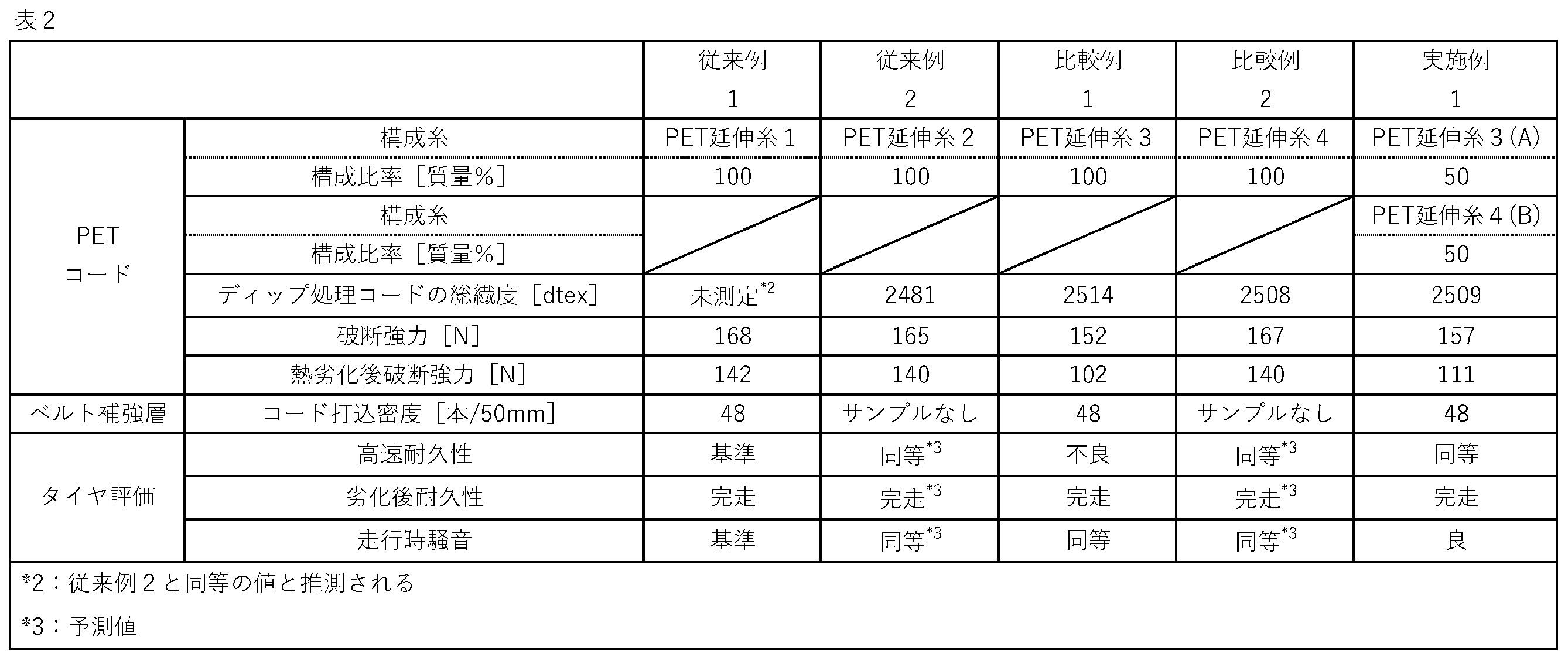
表1、2より、本発明に従う実施例のPETコードをタイヤに用いることで、耐久性(高速耐久性、劣化後耐久性)は従来例対比で同等に保持しながら、走行時騒音の低減が図れたことが分かる。特に、実施例1のPETコードについて、破断強力が従来例対比でやや劣っているにも関わらず、耐久性を十分に維持しつつ走行時騒音を低減できたことは、予測できない効果といえる。
本発明によれば、タイヤ部材に用いた際、タイヤの高い耐久性を維持しながら、走行時騒音の一層の低減を図ることが可能な、ポリエチレンテレフタレートコードを提供することができる。
また、本発明によれば、高い耐久性を維持しながらも走行時騒音の一層の低減が図られたタイヤを提供することができる。
また、本発明によれば、高い耐久性を維持しながらも走行時騒音の一層の低減が図られたタイヤを提供することができる。
100:タイヤ、 10:ビード部、 20:サイドウォール部、 30:トレッド部、40:ビードコア、 50:カーカス、 60:ベルト、 60A:ベルト層(第1ベルト層)、 60B:ベルト層(第2ベルト層)、 70A:ベルト補強層(キャップ層)、 70B:ベルト補強層(レイヤー層)
Claims (6)
- タイヤ用のポリエチレンテレフタレートコードであって、
結晶化度が異なる少なくとも2種のポリエチレンテレフタレート延伸糸を含み、
前記2種のポリエチレンテレフタレート延伸糸のうち、結晶化度が低い方をPET延伸糸A、結晶化度が高い方をPET延伸糸Bとし、
前記PET延伸糸Aは、結晶化度が45.0%未満であり、
前記PET延伸糸Bは、結晶化度が40.0%以上であり、
前記コードにおける前記PET延伸糸Aの構成比率が、1質量%以上99質量%以下である、ことを特徴とする、ポリエチレンテレフタレートコード。 - タイヤ用のポリエチレンテレフタレートコードであって、
末端カルボキシル基濃度(CEG)が異なる少なくとも2種のポリエチレンテレフタレート延伸糸を含み、
前記2種のポリエチレンテレフタレート延伸糸のうち、末端カルボキシル基濃度が高い方をPET延伸糸A、末端カルボキシル基濃度が低い方をPET延伸糸Bとし、
前記PET延伸糸Aは、結晶化度が45.0%未満であり、
前記PET延伸糸Bは、結晶化度が40.0%以上であり、
前記コードにおける前記PET延伸糸Aの構成比率が、1質量%以上99質量%以下である、ことを特徴とする、ポリエチレンテレフタレートコード。 - 前記PET延伸糸Aの結晶化度が40.0%未満である、請求項1又は2に記載のポリエチレンテレフタレートコード。
- 前記コードにおける前記PET延伸糸Aの構成比率が、25質量%以上75質量%以下である、請求項1~3のいずれかに記載のポリエチレンテレフタレートコード。
- タイヤのベルト補強層用である、請求項1~4のいずれかに記載のポリエチレンテレフタレートコード。
- トレッド部に配置されたベルトと、前記ベルトを補強するベルト補強層とを具えるタイヤにおいて、
請求項1~5のいずれかに記載のポリエチレンテレフタレートコードを、前記ベルト補強層に用いたことを特徴とする、タイヤ。
Priority Applications (1)
| Application Number | Priority Date | Filing Date | Title |
|---|---|---|---|
| JP2024562588A JPWO2024122136A1 (ja) | 2022-12-08 | 2023-09-04 |
Applications Claiming Priority (2)
| Application Number | Priority Date | Filing Date | Title |
|---|---|---|---|
| JP2022-196644 | 2022-12-08 | ||
| JP2022196644 | 2022-12-08 |
Publications (1)
| Publication Number | Publication Date |
|---|---|
| WO2024122136A1 true WO2024122136A1 (ja) | 2024-06-13 |
Family
ID=91378732
Family Applications (1)
| Application Number | Title | Priority Date | Filing Date |
|---|---|---|---|
| PCT/JP2023/032246 Ceased WO2024122136A1 (ja) | 2022-12-08 | 2023-09-04 | タイヤ用ポリエチレンテレフタレートコード及びタイヤ |
Country Status (2)
| Country | Link |
|---|---|
| JP (1) | JPWO2024122136A1 (ja) |
| WO (1) | WO2024122136A1 (ja) |
Cited By (1)
| Publication number | Priority date | Publication date | Assignee | Title |
|---|---|---|---|---|
| WO2026089471A1 (ko) * | 2024-10-25 | 2026-04-30 | 에이치에스효성첨단소재 주식회사 | 내열성 고강력 폴리에틸렌테레프탈레이트 원사 및 타이어 코드 |
Citations (4)
| Publication number | Priority date | Publication date | Assignee | Title |
|---|---|---|---|---|
| JPS57191103A (en) * | 1981-05-20 | 1982-11-24 | Bridgestone Corp | Radial tire |
| US20110024016A1 (en) * | 2008-03-31 | 2011-02-03 | Kolon Industries Inc. | Undrawn polyethylene terephthalate (pet) fiber, drawn pet fiber, and tire-cord comprising the same |
| WO2022111927A1 (de) * | 2020-11-25 | 2022-06-02 | Continental Reifen Deutschland Gmbh | Gummierter festigkeitsträger für elastomere erzeugnisse, insbesondere fahrzeugreifen, wobei der festigkeitsträger wenigstens ein erstes garn aufweist, verfahren zur herstellung des gummierten festigkeitsträgers und fahrzeugreifen aufweisend wenigstens einen gummierten festigkeitsträger |
| JP2022540380A (ja) * | 2019-07-05 | 2022-09-15 | コーロン インダストリーズ インク | タイヤコード用原糸およびタイヤコード |
-
2023
- 2023-09-04 JP JP2024562588A patent/JPWO2024122136A1/ja active Pending
- 2023-09-04 WO PCT/JP2023/032246 patent/WO2024122136A1/ja not_active Ceased
Patent Citations (4)
| Publication number | Priority date | Publication date | Assignee | Title |
|---|---|---|---|---|
| JPS57191103A (en) * | 1981-05-20 | 1982-11-24 | Bridgestone Corp | Radial tire |
| US20110024016A1 (en) * | 2008-03-31 | 2011-02-03 | Kolon Industries Inc. | Undrawn polyethylene terephthalate (pet) fiber, drawn pet fiber, and tire-cord comprising the same |
| JP2022540380A (ja) * | 2019-07-05 | 2022-09-15 | コーロン インダストリーズ インク | タイヤコード用原糸およびタイヤコード |
| WO2022111927A1 (de) * | 2020-11-25 | 2022-06-02 | Continental Reifen Deutschland Gmbh | Gummierter festigkeitsträger für elastomere erzeugnisse, insbesondere fahrzeugreifen, wobei der festigkeitsträger wenigstens ein erstes garn aufweist, verfahren zur herstellung des gummierten festigkeitsträgers und fahrzeugreifen aufweisend wenigstens einen gummierten festigkeitsträger |
Cited By (1)
| Publication number | Priority date | Publication date | Assignee | Title |
|---|---|---|---|---|
| WO2026089471A1 (ko) * | 2024-10-25 | 2026-04-30 | 에이치에스효성첨단소재 주식회사 | 내열성 고강력 폴리에틸렌테레프탈레이트 원사 및 타이어 코드 |
Also Published As
| Publication number | Publication date |
|---|---|
| JPWO2024122136A1 (ja) | 2024-06-13 |
Similar Documents
| Publication | Publication Date | Title |
|---|---|---|
| CN107207833B (zh) | 高刚性的橡胶组合物 | |
| EP4434766A1 (en) | Pneumatic tire | |
| CN100491141C (zh) | 充气子午线轮胎 | |
| JP2015020741A (ja) | 空気入りタイヤ | |
| JPWO2008010531A1 (ja) | 空気入りタイヤ | |
| KR20050002580A (ko) | 폴리에스터 코드 및 런플랫 타이어에서의 그의 용도 | |
| CN121340825A (zh) | 用于充气车辆轮胎、优选地用于充气车辆轮胎的带束箍带层的加强层 | |
| KR20140126705A (ko) | 경량화된 벨트 구조체를 갖는 래디얼 타이어 | |
| JP2011218982A (ja) | 空気入りラジアルタイヤ | |
| JP2004308027A (ja) | ゴム補強用ポリケトン繊維コード及びそれを用いたタイヤ | |
| EP4579012A1 (en) | Hybrid cord, rubber-fiber composite, and tire | |
| CA2121668A1 (en) | Rubber/polyester cord composite and tire with component thereof | |
| US5291930A (en) | Pneumatic radial tires including fiber/resin belt cords having elliptical or rectangular cross-sectional shape | |
| JPH04110208A (ja) | 空気入りラジアルタイヤ | |
| CN120813739A (zh) | 钢丝、镀覆钢丝、轮胎的带束层用增强帘线和轮胎 | |
| US20260070374A1 (en) | Hybrid cord, rubber-fiber composite, and tire | |
| WO2024043136A1 (ja) | ポリアミド繊維コード、ゴム-繊維複合体、及びタイヤ | |
| JP2025127915A (ja) | 空気入りタイヤ | |
| JP2025127921A (ja) | タイヤ | |
| WO2024180857A1 (ja) | タイヤ | |
| WO2024070779A1 (ja) | Pet繊維-ゴム複合体及びタイヤ | |
| JP2025127918A (ja) | タイヤ | |
| JP2025127925A (ja) | タイヤ | |
| EP4313626B1 (en) | Tyre for vehicle wheels | |
| WO2024219007A1 (ja) | タイヤ補強層用有機繊維コードおよびそれを用いた航空機タイヤ |
Legal Events
| Date | Code | Title | Description |
|---|---|---|---|
| 121 | Ep: the epo has been informed by wipo that ep was designated in this application |
Ref document number: 23900262 Country of ref document: EP Kind code of ref document: A1 |
|
| WWE | Wipo information: entry into national phase |
Ref document number: 2024562588 Country of ref document: JP |
|
| NENP | Non-entry into the national phase |
Ref country code: DE |
|
| 122 | Ep: pct application non-entry in european phase |
Ref document number: 23900262 Country of ref document: EP Kind code of ref document: A1 |