WO2024116554A1 - 吸収性物品 - Google Patents
吸収性物品 Download PDFInfo
- Publication number
- WO2024116554A1 WO2024116554A1 PCT/JP2023/033882 JP2023033882W WO2024116554A1 WO 2024116554 A1 WO2024116554 A1 WO 2024116554A1 JP 2023033882 W JP2023033882 W JP 2023033882W WO 2024116554 A1 WO2024116554 A1 WO 2024116554A1
- Authority
- WO
- WIPO (PCT)
- Prior art keywords
- activated carbon
- absorbent
- absorbent article
- absorbent body
- amount
- Prior art date
- Legal status (The legal status is an assumption and is not a legal conclusion. Google has not performed a legal analysis and makes no representation as to the accuracy of the status listed.)
- Ceased
Links
Images
Classifications
-
- A—HUMAN NECESSITIES
- A61—MEDICAL OR VETERINARY SCIENCE; HYGIENE
- A61F—FILTERS IMPLANTABLE INTO BLOOD VESSELS; PROSTHESES; DEVICES PROVIDING PATENCY TO, OR PREVENTING COLLAPSING OF, TUBULAR STRUCTURES OF THE BODY, e.g. STENTS; ORTHOPAEDIC, NURSING OR CONTRACEPTIVE DEVICES; FOMENTATION; TREATMENT OR PROTECTION OF EYES OR EARS; BANDAGES, DRESSINGS OR ABSORBENT PADS; FIRST-AID KITS
- A61F13/00—Bandages or dressings; Absorbent pads
- A61F13/15—Absorbent pads, e.g. sanitary towels, swabs or tampons for external or internal application to the body; Supporting or fastening means therefor; Tampon applicators
- A61F13/53—Absorbent pads, e.g. sanitary towels, swabs or tampons for external or internal application to the body; Supporting or fastening means therefor; Tampon applicators characterised by the absorbing medium
- A61F13/534—Absorbent pads, e.g. sanitary towels, swabs or tampons for external or internal application to the body; Supporting or fastening means therefor; Tampon applicators characterised by the absorbing medium having an inhomogeneous composition through the thickness of the pad
- A61F13/535—Absorbent pads, e.g. sanitary towels, swabs or tampons for external or internal application to the body; Supporting or fastening means therefor; Tampon applicators characterised by the absorbing medium having an inhomogeneous composition through the thickness of the pad inhomogeneous in the plane of the pad, e.g. core absorbent layers being of different sizes
Definitions
- This disclosure relates to absorbent articles.
- Patent Document 1 discloses that it has identified malodorous components (phenolic compounds and indoles) that contribute more to urine odor than ammonia, and also discloses absorbent articles (sanitary products) that contain a ⁇ -glucuronidase inhibitor that inhibits the activity of ⁇ -glucuronidase, an enzyme involved in the generation of the above-mentioned malodorous components.
- malodorous components phenolic compounds and indoles
- absorbent articles sanitary products
- a ⁇ -glucuronidase inhibitor that inhibits the activity of ⁇ -glucuronidase, an enzyme involved in the generation of the above-mentioned malodorous components.
- Patent Document 1 can suppress the generation of odorous components (phenolic compounds and indoles) other than the ammonia odor caused by urine. However, from the perspective of effectively suppressing the odor of urine, it is not sufficient to merely suppress the generation of the above odorous components (phenolic compounds and indoles).
- one aspect of the present disclosure aims to provide an absorbent article that can more effectively suppress urine odor.
- This disclosure includes the following aspects 1 to 21.
- an absorbent article according to one aspect of the present disclosure includes a deodorizer separate from the absorbent (water-absorbent polymer). The absorbent and the deodorizer are arranged so as to satisfy the above formula (1).
- urine containing ammonia can be effectively absorbed by the absorbent body in the same way as conventional general absorbent articles, and the above-mentioned trimethylamine and methyl mercaptan can also be effectively absorbed by the deodorant. As a result, the odor of urine can be more effectively suppressed.
- the deodorant is disposed closer to the skin than the absorbent.
- the deodorant is disposed so as to cover the absorbent from the skin side, so that the diffusion of odorous components from the absorbent side to the skin side can be suitably suppressed.
- the amount of the water-absorbing polymer contained in the absorbent body is 12.9 g to 35.2 g.
- the absorbent body has an upper-layer absorbent body arranged on the skin side, and a lower-layer absorbent body arranged on the opposite side of the upper-layer absorbent body from the skin side, each of the upper absorbent body and the lower absorbent body includes the water-absorbing polymer and pulp fibers; a polymer ratio is a ratio of the mass of the water-absorbent polymer to the total mass of the water-absorbent polymer and the pulp fibers, and the polymer ratio of the upper absorbent body is lower than the polymer ratio of the lower absorbent body.
- urine in the upper absorbent core, urine can be suitably diffused in planar directions (longitudinal and width directions).
- gel blocking in the upper absorbent core can be suppressed, and the obstruction of urine entry into the lower absorbent core can be suppressed.
- the top sheet has an abdominal side portion facing the wearer's abdomen, a crotch portion facing the wearer's crotch, and a back side portion facing the wearer's back,
- the water-absorbent polymer layer is arranged so as to overlap the back side portion.
- the brightness of the area in which the deodorant is disposed is 80 or more and 90 or less.
- the deodorant is an activated carbon material containing activated carbon particles
- the activated carbon particles contained in the activated carbon member have an average particle size of 17 ⁇ m or more,
- the pore volume of the activated carbon particles contained in the activated carbon member is 0.55 mL/g or more;
- the basis weight of the activated carbon particles contained in the activated carbon member is 3.0 g/ m2 or less.
- the basis weight of the activated carbon particles contained in the activated carbon member is 0.2 g/ m2 or more. 14.
- the pore volume of the activated carbon particles contained in the activated carbon member is 1.2 mL/g or less.
- the average particle size of the activated carbon particles contained in the activated carbon member is 50 ⁇ m or less. 16.
- the top sheet has an abdominal side portion facing the wearer's abdomen, a crotch portion facing the wearer's crotch, and a back side portion facing the wearer's back
- the deodorant has a pair of deodorant sheets extending from the abdominal portion to the dorsal portion via the crotch portion along a longitudinal direction in which the abdominal portion and the dorsal portion face each other with the crotch portion in between, and arranged to be spaced apart from each other and face each other in a width direction perpendicular to the longitudinal direction.
- the absorbent body In the region between the pair of deodorant sheets, the absorbent body is provided with a slit extending in the longitudinal direction and recessed in a thickness direction in which the top sheet and the absorbent body face each other. 18.
- the deodorant is an activated carbon material containing activated carbon particles, Further comprising a sheet member disposed between the top sheet and the activated carbon member.
- the activated carbon member is disposed between the absorbent body and the sheet member.
- the absorbent article of claim 19 According to the above-mentioned configuration, when the components constituting the absorbent article are stacked to manufacture the absorbent article, the activated carbon member can be surrounded and supported by the absorbent body and the sheet member at a relatively early stage, thereby reducing the risk that activated carbon particles will fall off from the activated carbon member and reach the top sheet during manufacturing.
- the sheet member is a tissue. 21.
- the present disclosure provides an absorbent article that can more effectively suppress urine odor.
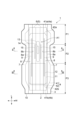
- FIG. 1 is a plan view of an absorbent article according to one embodiment.
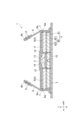
- 2 is a cross-sectional view of the absorbent article taken along line II-II in FIG. 1.
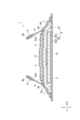
- 3 is a cross-sectional view of the absorbent article taken along line III-III in FIG. 1.
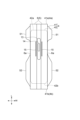
- 2 is a plan view showing an example of the configuration of an absorbent body and an activated carbon sheet of the absorbent article of FIG. 1.
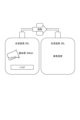
- FIG. FIG. 2 is a diagram showing a schematic diagram of a procedure for a deodorizing function test.
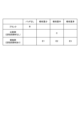
- 1 is a table showing the correspondence between samples used in a deodorizing function test.
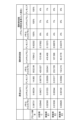
- 1 is a table showing the concentration and threshold dilution ratio of each odor component of each sample measured in the above-mentioned deodorizing function test.
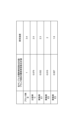
- 1 is a table showing the value obtained by dividing the total threshold dilution factor of each sample by the total threshold dilution factor of the blank example, and the odor intensity measured by an odor sensory test.
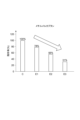
- 1 is a graph showing the odor remaining rate of methyl mercaptan for each sample measured in the above-mentioned deodorizing function test (a ratio when the comparative example is taken as 100%).
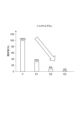
- 1 is a graph showing the trimethylamine odor remaining rate (proportion when the comparative example is taken as 100%) of each sample measured in the above-mentioned deodorizing function test.
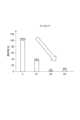
- 1 is a graph showing the ammonia odor remaining rate (proportion when the comparative example is taken as 100%) of each sample measured in the above-mentioned deodorizing function test.
- the configuration of an absorbent article 1 will be described with reference to Figs. 1 to 4.
- the "skin side” refers to the side facing the wearer's skin when the absorbent article 1 is in use (worn).
- the “non-skin side” refers to the side opposite the wearer's skin when the absorbent article 1 is in use (worn).
- the “wearer” refers to a person who wears the absorbent article 1.
- the longitudinal direction of the absorbent article 1 in a stretched state see Figs.
- the longitudinal direction L is a direction extending from the front side of the wearer's body to the rear side of the body when the absorbent article 1 is in use.
- the longitudinal direction L is a direction (front-rear direction) in which the abdominal side portion P1 and the back side portion P3 face each other across the crotch portion P2 described later.
- the width direction W is a direction that coincides with the left-right direction of a wearer when the absorbent article 1 is in use.
- the thickness direction T is a layering direction of materials (such as a topsheet 2, a backsheet 3, and an absorbent body 4, which will be described later) that constitute the absorbent article 1.
- the absorbent article 1 is divided into a ventral portion P1, a crotch portion P2, and a back portion P3.
- the ventral portion P1 is an area that faces the wearer's abdomen when in use.
- the back portion P3 is an area that faces the wearer's back when in use.
- the crotch portion P2 is located between the ventral portion P1 and the back portion P3 in the longitudinal direction L, and is an area that faces the wearer's crotch (inseam) when in use.
- the width of the crotch portion P2 is smaller than the width of the ventral portion P1 and the width of the back portion P3.
- the absorbent article 1 is formed in a gourd shape with the crotch portion P2 narrowed in the width direction W.
- the shapes of the ventral portion P1, the crotch portion P2, and the back portion P3 of the absorbent article 1 are not limited to the above.
- the dimension of the absorbent article 1 in the longitudinal direction L is, for example, 350 mm to 960 mm.
- the dimension of the absorbent article 1 in the width direction W is, for example, 160 mm to 600 mm.
- the absorbent article 1 is an article that has a deodorizing function that absorbs odorous components caused by urine.
- the absorbent article 1 is a urine pad.
- the absorbent article 1 has a top sheet 2, a back sheet 3, an absorbent body 4, and an activated carbon member 5 (deodorizing agent).
- the top sheet 2 is a liquid-permeable sheet that is placed on the wearer's skin side.
- the top sheet 2 is a sheet that faces the wearer's skin when in use.
- the top sheet 2 can be formed, for example, from a liquid-permeable nonwoven or woven fabric, a synthetic resin film with liquid-permeable holes, or a composite sheet of these.
- the back sheet 3 is a liquid-impermeable sheet that is placed on the non-skin side of the wearer.
- the back sheet 3 can be formed, for example, from a liquid-impermeable nonwoven fabric, a synthetic resin film, or a composite sheet of these.
- the absorbent body 4 is a member that has liquid absorption and liquid retention properties.
- the absorbent body 4 contains a water-absorbent polymer.
- the absorbent body 4 is placed on the side of the top sheet 2 that is not in contact with the wearer's skin.
- the absorbent body 4 is located between the top sheet 2 and the back sheet 3.
- the absorbent body 4 may contain materials other than water-absorbent polymers (e.g., pulp fibers, synthetic fibers, etc.).
- the top sheet 2, back sheet 3, absorbent body 4, and other components may be joined together using known materials such as adhesives.
- the amount of water-absorbent polymer contained in the absorbent body 4 can be adjusted as appropriate, taking into consideration the absorption performance of the absorbent body 4, etc.
- the amount of water-absorbent polymer contained in the absorbent body 4 is set in the range of 12.9 g to 35.2 g. By setting the amount of water-absorbent polymer within the above range, it is possible to prevent the absorbent article 1 from becoming too thick while still achieving sufficient water absorption and deodorizing performance.
- the absorbent body 4 has an upper absorbent body 41 arranged on the skin side, and a lower absorbent body 42 arranged on the non-skin side of the upper absorbent body 41.
- the upper absorbent body 41 has a gourd shape that is narrowed in the width direction W at the crotch area P2. More specifically, as shown in FIG. 4, the upper absorbent body 41 has a protruding portion 51 that protrudes outward in the width direction W beyond the activated carbon member 5 at the ventral area P1, and a protruding portion 52 that protrudes outward in the width direction W beyond the activated carbon member 5 at the dorsal area P3.
- the upper absorbent body 41 has a shape that is roughly similar to the shape of the absorbent article 1 (a shape that is one size smaller than the absorbent article 1).
- the lower absorbent body 42 has a rectangular shape with a dimension in the longitudinal direction L longer than the dimension in the width direction W.
- Both ends (front end 41a and rear end 41b) of the upper absorbent body 41 in the longitudinal direction L are located outside of both ends (front end 42a and rear end 42b) of the lower absorbent body 42 in the longitudinal direction L. That is, the upper absorbent body 41 is formed wider on both sides of the longitudinal direction L than the lower absorbent body 42.
- both ends (i.e., the outer ends of the protrusions 51, 52) of the upper absorbent body 41 in the width direction W at the ventral portion P1 and the rear portion P3 are located outside of both ends of the lower absorbent body 42 in the width direction W. That is, the upper absorbent body 41 is formed wider on both sides of the width direction W than the lower absorbent body 42.
- both ends (front end 4a and rear end 4b) of the absorbent body 4 in the longitudinal direction L coincide with both ends (front end 41a and rear end 41b) of the upper absorbent body 41 in the longitudinal direction L.
- the entire lower absorbent body 42 overlaps with the upper absorbent body 41. In this way, by covering the entire lower absorbent body 42 from the skin side with the upper absorbent body 41, it is possible to effectively prevent the urine odor generated from the lower absorbent body 42 from diffusing toward the skin side.
- the lower absorbent body 42 has an absorbent core 421 and a core wrap 422 that encases the absorbent core 421.
- the thickness, basis weight, etc. of the upper absorbent body 41 and the lower absorbent body 42 can be appropriately adjusted taking into consideration the absorption performance, etc. of the absorbent body 4.
- the absorbent body 4 may be a single layer or three or more layers. Examples of materials for the upper absorbent body 41 and the absorbent core 421 include polymer absorbents, pulp fibers, etc.
- both the upper absorbent body 41 and the lower absorbent body 42 contain absorbent polymer (highly absorbent polymer) and pulp fibers.
- the amount of absorbent polymer contained in the upper absorbent body 41 is greater than the amount of absorbent polymer contained in the lower absorbent body 42.
- the polymer ratio of the upper absorbent body 41 is lower than that of the lower absorbent body 42. That is, the pulp fiber ratio of the upper absorbent body 41 (the ratio of the mass of the pulp fiber to the total mass) is higher than that of the lower absorbent body 42.
- urine can be suitably diffused in the planar direction (longitudinal direction L and width direction W) in the upper absorbent body 41.
- the activated carbon member 5 it is possible to widely and effectively utilize the activated carbon member 5. That is, urine can be distributed over a wide area of the activated carbon member 5.
- gel blocking can be suppressed in the upper absorbent body 41, and the obstruction of urine entry into the lower absorbent body 42 can be suppressed.
- the activated carbon member 5 is arranged separately from the absorbent body 4 in the absorbent article 1.
- the activated carbon member 5 contains a plurality of activated carbon particles.
- the activated carbon member 5 is arranged closer to the skin than the absorbent body 4.
- the activated carbon member 5 also has a pair of activated carbon sheets 6 (deodorant sheets).
- the pair of activated carbon sheets 6 extend continuously from the abdominal side portion P1 through the crotch portion P2 to the dorsal side portion P3 along the longitudinal direction L, and are arranged to face each other at a distance in the width direction W.
- the urinary odor absorption performance (deodorant performance) of the activated carbon member 5 can be effectively exhibited.
- the color of the urine absorbed in the center of the absorbent body 4 (the area between the pair of activated carbon sheets 6) can be more accurately confirmed.
- the absorbent article 1 having the above configuration it is possible to suppress the urine odor and for the wearer or caregiver to accurately confirm the location where the urine leakage has occurred. This makes it possible to grasp the wearing state of the absorbent article 1, identify the cause of the urine leakage, and suppress the recurrence of the urine leakage.
- by being able to accurately check the color of urine it becomes possible to accurately grasp the wearer's health condition.
- the activated carbon sheet 6 is a liquid-permeable sheet that holds activated carbon particles.
- the activated carbon sheet 6 is formed in a substantially rectangular shape.
- the activated carbon sheet 6 has a configuration in which activated carbon particles are supported on a sheet body formed of fibers, for example.
- An example of the activated carbon sheet 6 is a mixed paper made of natural fibers such as pulp or synthetic fibers such as polyethylene and activated carbon particles.
- Examples of activated carbon (activated carbon particles) contained in the activated carbon sheet 6 include carbonized materials such as coconut shells, bamboo, and wood (coconut shell charcoal, bamboo charcoal, charcoal, etc.).
- the activated carbon sheet 6 may further contain a deodorizing material other than activated carbon (for example, a known deodorizing material such as zeolite, silica gel, alumina, and porous glass).
- the thickness, basis weight, amount (number) of activated carbon particles, etc. of the activated carbon sheet 6 can be appropriately adjusted in consideration of the deodorizing performance of the activated carbon sheet 6.
- the thickness of the activated carbon sheet 6 is preferably 0.1 to 10 mm, more preferably 0.2 to 5 mm, from the viewpoint of retaining a sufficient amount of activated carbon particles (lower limit) and from the viewpoint of not hardening the absorbent article 1 (upper limit).
- the basis weight of the activated carbon particles contained in the activated carbon sheet 6 is preferably 0.2 g/m 2 or more from the viewpoint of fully exerting the deodorizing function (lower limit).
- the basis weight of the activated carbon particles contained in the activated carbon sheet 6 is preferably 8.0 g/m 2 or less from the viewpoint of not hardening the absorbent article 1 (upper limit). Furthermore, as described later, from the viewpoint of keeping the brightness of the area in which the activated carbon member 5 (activated carbon sheet 6) is arranged in the absorbent article 1 in the thickness direction T within a range of 80 to 90 . As an example, from the standpoint of the deodorizing function and brightness as described above, the basis weight of the activated carbon particles contained in the activated carbon sheet 6 may be set to about 2.4 g/m 2 .
- the brightness of the area where the activated carbon member 5 (activated carbon sheet 6) is arranged be set to 80 or more and 90 or less when viewed from the skin side of the top sheet 2 in the thickness direction T.
- brightness is an index (L value) of brightness with the maximum value (white) being "100" and the minimum value (black) being "0".
- the lightness (L value) can be measured, for example, using a commercially available color difference meter (for example, a color difference meter CR-300 manufactured by Konica Minolta, Inc.) on a white calibration plate (for example, CR-A43 (L value 96.7) manufactured by Konica Minolta, Inc.).
- the activated carbon particles of the activated carbon sheet 6 have a particle size distribution in which at least 90% by volume of the particles, preferably 95% by volume of the particles, have a particle size of 1 ⁇ m or more and 60 ⁇ m or less.
- the activated carbon particles can be easily inserted between the constituent fibers of the sheet body of the activated carbon sheet 6, and the activated carbon particles can be easily supported by the sheet body.
- the majority of the activated carbon particles 1 ⁇ m or more in particle size even if some of the activated carbon particles fall off from the sheet body, the fallen particles are less likely to pass through the surface sheet 2.
- the ratio of particles with a particle size of 10 ⁇ m or less is less than 20% and the ratio of particles with a particle size of 30 ⁇ m or more is less than 10%.
- the average particle size of the activated carbon particles of the activated carbon sheet 6 may be set to 17 ⁇ m or more, the pore volume of the activated carbon particles of the activated carbon sheet 6 may be set to 0.55 mL/g or more, and the basis weight of the activated carbon particles of the activated carbon sheet 6 may be set to 3.0 g/m 2 or less.
- the pore volume of the activated carbon particles can be measured using known methods such as pore distribution measurement by mercury porosimetry and BET multipoint method by nitrogen gas adsorption. When charcoal is used as the material for the activated carbon particles, activated carbon particles with a relatively large pore volume (for example, 1.17 mL/g) are obtained. On the other hand, when coconut shell is used as the material for the activated carbon particles, the pore volume is generally smaller than that when charcoal is used, but activated carbon particles with a desired pore volume can be easily formed by adjusting the time of steam inactivation.
- the above-mentioned brightness condition can be easily satisfied by suppressing the density and amount of activated carbon particles in the activated carbon sheet 6 so that the pore volume is a certain amount or more (0.55 mL/g or more) and the basis weight of the activated carbon particles is a certain amount or less (3.0 g/ m2 or less).
- the activated carbon sheet 6 passes through the rolls of the production machine during production, friction occurs between the activated carbon sheet 6 and the rolls, and the activated carbon itself present on the sheet surface of the activated carbon sheet 6 may be subjected to an impact and fall off.
- the above-mentioned “flying up of activated carbon particles” refers to the particles that fall off in this way remaining in the air without falling to the ground.
- the ratio of activated carbon particles having a particle size of 10 ⁇ m or less to 18% or less it is preferable to set the pore volume of the activated carbon particles to 1.2 mL/g or less.
- the particle size distribution (particle size distribution) of the activated carbon can be measured under predetermined conditions, for example, using a laser diffraction/scattering particle size distribution measuring device (for example, LA-920 manufactured by Horiba, Ltd.).
- the measurement conditions for the particle size distribution are as follows. Measurement cell: flow cell Particle size standard: volume Dispersion medium: 90% ethanol aqueous solution Transmittance: 70-90% Sample concentration: 0.1%
- the average particle size of the activated carbon particles of the activated carbon sheet 6 is set to 50 ⁇ m or less. From the same viewpoint, it is preferable that the ratio of activated carbon particles having a particle size of 45 ⁇ m or more is set to 0.5% or less.
- the absorbent article 1 has a pair of side sheets 7. Each side sheet 7 is joined to both ends of the top sheet 2 in the width direction W on the skin side of the top sheet 2 and extends in the longitudinal direction L.
- a pair of leak prevention walls 8 is formed by the inner parts of each of the pair of side sheets 7 in the width direction W.
- the pair of leak prevention walls 8 extend along the longitudinal direction L on both sides of the width direction W of the top sheet 2.
- the pair of leak prevention walls 8 are arranged at a predetermined interval in the width direction W.
- the outer end of each leak prevention wall 8 in the width direction W is a fixed end 8a fixed to the top sheet 2.
- the inner end of each leak prevention wall 8 in the width direction W is a free end 8b.
- An elastic member 9 such as rubber thread extending in the longitudinal direction L is arranged near the free end 8b of the leak prevention wall 8.
- the side sheet 7 (including the leak prevention wall 8) can be formed of, for example, a hydrophobic sheet, a hydrophobic nonwoven fabric, etc.
- the fixed end 8a of the leak-proof wall 8 is positioned further outward in the width direction W than the outer ends 6a of each of the pair of activated carbon sheets 6 in the width direction W.
- the activated carbon sheet 6 in the width direction W, is not positioned outward from the position where the leak-proof wall 8 blocks urine, but is positioned in the area where urine is mainly present. Therefore, the activated carbon sheet 6 can be used widely and effectively, and the activated carbon sheet 6 can efficiently suppress the odor of urine.
- the absorbent article 1 has an exterior sheet 10.
- the exterior sheet 10 is a liquid-impermeable sheet that is located on the non-skin side of the back sheet 3.
- the exterior sheet 10 can be formed, for example, from the same material as the back sheet 3.
- the absorbent article 1 has a diffusion sheet 11.
- the diffusion sheet 11 is a sheet member disposed between the top sheet 2 and the activated carbon member 5.
- the diffusion sheet 11 is formed in a substantially rectangular shape with a dimension in the longitudinal direction L longer than the dimension in the width direction W.
- the size of the diffusion sheet 11 in the width direction W and the longitudinal direction L is approximately the same as the combined size of the pair of activated carbon sheets 6 and the area between the pair of activated carbon sheets 6. Examples of the diffusion sheet 11 include nonwoven fabrics and tissues.
- the diffusion sheet 11 can diffuse urine widely in the planar direction (width direction W and longitudinal direction L).
- the diffusion sheet 11 covers the activated carbon sheet 6 from the skin side, even if some of the activated carbon particles fall off from the sheet body of the activated carbon sheet 6, the fallen activated carbon particles can be prevented from reaching the top sheet 2.
- the brightness of the area where the activated carbon sheet 6 is disposed can be reduced when the area is viewed from the skin side of the top sheet 2. This allows the amount of activated carbon particles that can be added to the activated carbon sheet 6 to be increased within the range that satisfies the above-mentioned brightness condition (brightness (L value) is 80 or more and 90 or less), thereby improving the deodorizing function.
- the activated carbon sheet 6 is disposed between the absorbent body 4 and the diffusion sheet 11. That is, when manufacturing the absorbent article 1 by overlapping each member that constitutes the absorbent article 1, the activated carbon sheet 6 can be surrounded and supported by the absorbent body 4 and the diffusion sheet 11 at a relatively early stage. This reduces the risk that activated carbon particles will fall off from the sheet body of the activated carbon sheet 6 and reach the surface sheet 2 when, for example, an intermediate product (a configuration including at least the absorbent body 4, the activated carbon sheet 6, and the diffusion sheet 11) during the manufacturing process is transported.
- an intermediate product a configuration including at least the absorbent body 4, the activated carbon sheet 6, and the diffusion sheet 11
- the diffusion sheet 11 by forming the diffusion sheet 11 from tissue with a relatively high fiber density, activated carbon particles that have fallen off from the sheet body of the activated carbon sheet 6 can be suitably held by the diffusion sheet 11, so that the risk of the activated carbon particles reaching the surface sheet 2 can be more effectively reduced.
- the absorbent article 1 has a water-absorbent polymer sheet 12 (water-absorbent polymer layer) containing a water-absorbent polymer.
- the water-absorbent polymer sheet 12 is provided between the surface sheet 2 and the activated carbon member 5.
- the water-absorbent polymer sheet 12 is provided between the surface sheet 2 and the diffusion sheet 11.
- the water-absorbent polymer sheet 12 is formed in a substantially rectangular shape and is arranged so as to overlap with the back side portion P3.
- the water-absorbent polymer sheet 12 contains, for example, a superabsorbent polymer (SAP) and a wrap sheet containing the superabsorbent polymer.
- SAP superabsorbent polymer
- the content of the superabsorbent polymer in the entire water-absorbent polymer sheet 12 is, for example, 80 mass% or more, preferably 90 mass% or more.
- Examples of the wrap sheet include liquid-permeable nonwoven fabrics and tissues.
- the water-absorbent polymer sheet 12 is disposed so as to overlap with the back portion P3, the above-mentioned odor diffusion prevention effect can be more suitably exhibited, particularly when the wearer's main posture when wearing the absorbent article 1 is a seated posture or a lying posture on his/her back.
- the water-absorbent polymer sheet 12 can suitably prevent the diffusion of the odor of urine absorbed mainly in the back portion P3 of the absorbent body 4 to the skin side when the wearer takes the above-mentioned sitting posture or lying posture.
- the absorbent 4 in the region between the pair of activated carbon sheets 6 when viewed from the thickness direction T, the absorbent 4 has slits 13, 14 that extend in the longitudinal direction L and are recessed in the thickness direction T.
- the slit 13 is provided in the upper absorbent 41, and the slit 14 is provided in the lower absorbent 42.
- the slits 13 of the upper absorbent layer 41 are recessed in the thickness direction T from the skin side to the non-skin side.
- the slits 13 are through holes that penetrate the upper absorbent layer 41 in the thickness direction T.
- the slits 13 are formed in the longitudinal direction L in the range from the crotch portion P2 to the rear of the abdominal portion P1 (urination area A1).
- the urination area A1 is the area where the wearer's urine is mainly excreted.
- Slits 14 of the lower absorbent body 42 are recessed in the thickness direction T from the skin side to the non-skin side.
- slits 14 are through holes that penetrate the lower absorbent body 42 in the thickness direction T.
- Slits 14 are formed in the urination area A1 like slits 13. When viewed from the thickness direction T, slits 14 are formed in the inner range of slits 13 in the longitudinal direction L and width direction W.
- Urine excreted by the wearer is mainly guided to the slits 13, 14 and quickly reaches the upper absorbent body 41 and the lower absorbent body 42 through the slits 13, 14 without passing through the pair of activated carbon sheets 6.
- the urine is quickly absorbed by the upper absorbent body 41 and the lower absorbent body 42 and diffused in the planar direction (width direction W and length direction L).
- the pair of activated carbon sheets 6 located closer to the skin than the upper absorbent body 41 and the lower absorbent body 42 can effectively block or suppress the urine odor generated from the upper absorbent body 41 and the lower absorbent body 42.
- the urine odor absorbed by the absorbent body 4 can be effectively suppressed from diffusing to the skin side.
- a pair of embossed sections 15 are formed on both outer sides of the slits 13, 14 in the width direction W, extending along the longitudinal direction L and extending in the thickness direction T from the upper absorbent body 41 toward the lower absorbent body 42.
- urine can be quickly and widely spread in the longitudinal direction L, allowing it to be quickly absorbed by the absorbent body 4.
- the deodorizing function test includes the steps of preparing artificial urine, pouring in the artificial urine, leaving it, and measuring it, which are described below.
- artificial urine preparation process First, artificial urine is prepared.
- the artificial urine is a liquid that contains ammonia and is blended to further contain malodorous components other than ammonia.
- a total of 300 ml of artificial urine is prepared, containing 0.05 ml of ammonia, 0.5 ml of trimethylamine, 0.20 ml of methyl mercaptan, and 299.25 ml of physiological saline.
- the artificial urine preparation process is carried out under a constant temperature condition (for example, 17°C to 18°C) in a windless space (room, etc.) where the power of an air conditioner or other air conditioner is turned off.
- a series of processes from the artificial urine preparation process to the introduction process are carried out individually under the same conditions for each sample (blank example B, comparative example C, and examples E1 to E3 described later). Specifically, the following series of processes are carried out individually for each sample. That is, after preparing the artificial urine in a windless environment at 17°C to 18°C in the artificial urine preparation process, an introduction process is carried out in which the artificial urine is immediately introduced into the test sample as soon as possible without leaving a time.
- the above-mentioned artificial urine is formulated based on the following findings obtained by the present inventors. That is, through intensive research, the present inventors have found that odor components originating from urine may contain malodorous components other than the ammonia odor. More specifically, the present inventors have found that urine excreted from a person (e.g., elderly people, etc., hereinafter referred to as "specific wearer") whose urine contains a higher than average number of bacteria or protein due to, for example, urinary tract infection or decreased renal function may contain a large amount of trimethylamine and methyl mercaptan as malodorous components.
- a person e.g., elderly people, etc., hereinafter referred to as "specific wearer”
- methyl mercaptan which has an acidic odor, has an odor similar to a stool odor (fart odor), so when such malodorous components are generated, an unpleasant odor will fill the room in which the specific wearer lives.
- adverse effects such as a decrease in the appetite of the specific wearer and a family member of the specific wearer (e.g., elderly people) who comes to visit and leaves immediately due to the bad odor in the room may occur.
- the inventors devised the deodorizing function test of this embodiment, and invented an absorbent article 1 that can reduce the degree of harm caused by the odor of urine excreted by a specific wearer by arranging the absorbent body 4 and activated carbon member 5 as described above to exhibit a certain level of deodorizing function in the deodorizing function test.
- the five samples used in this embodiment will be described with reference to Figure 6.
- the five samples include three examples E1 to E3, one comparative example C, and a blank example B.
- Examples E1 to E3 are absorbent articles (urine absorption pads) having the same structure as absorbent article 1 shown in Figures 1 to 4. Examples E1 to E3 differ from each other in the amount of absorbent polymer contained in absorbent body 4, but have the same other configurations.
- Example E1 corresponds to "small absorption amount (up to 800cc)", and the amount of absorbent polymer contained in absorbent body 4 of Example E1 is 18.1g (upper layer (upper layer absorbent body 41; same below): 10.8g, lower layer (lower layer absorbent body 42; same below): 7.3g).
- Example E2 corresponds to “medium absorption amount (up to 1000cc)", and the amount of absorbent polymer contained in absorbent body 4 of Example E2 is 24.0g (upper layer: 15.4g, lower layer: 8.6g).
- Example E3 corresponds to "high absorption capacity (up to 1500cc)" and contains 35.2g of water-absorbent polymer in the absorbent body 4 of Example E3 (upper layer: 19.9g, lower layer: 15.3g).
- Examples E1 to E3 have a common configuration in which they include an activated carbon member 5 (activated carbon sheet 6) containing activated carbon particles having the following particle size distribution.
- the content of activated carbon particles in the activated carbon member 5 of Examples E1 to E3 is 12 mass % relative to the basis weight of the sheet body of the activated carbon sheet 6.
- the material of the activated carbon particles is coconut shell.
- Comparative Example C is an absorbent article (urine pad) having a structure in which the activated carbon member 5 is omitted from the absorbent article 1 shown in Figures 1 to 4.
- the amount of water-absorbent polymer contained in the absorbent body 4 of Comparative Example C is the same as that of Example E2 (absorption amount).
- Comparative Example C is an absorbent article in which the activated carbon member 5 is omitted from Example E2.
- Blank example B is an example that does not include an absorbent article.
- blank example B is an example in which the artificial urine is left as it is without being absorbed by the absorbent article.
- the sealed container is filled with synthetic air and left for a predetermined period of time (3 hours in this embodiment).
- the temperature inside the sealed container is adjusted to a temperature close to human body temperature (e.g., 40°C) so that the temperature is close to the temperature when the specific wearer wears the pad.
- the sealed container is left for 3 hours with the temperature inside the sealed container maintained at 38°C.
- the air in the sealed container after the above-mentioned leaving period has passed is sampled.
- the air in the sealed container is moved to another location such as a Freck Sampler (registered trademark). Then, the amount of each odor component contained in the sampled air is measured.
- the amount of the first odor component is measured for each of Examples E1 to E3 and Comparative Example C.
- the amount of the first odor component is the amount of odor components including a basic odor caused by ammonia or trimethylamine and an acidic odor caused by methyl mercaptan in a sealed container after three hours have passed while the artificial urine is absorbed in an absorbent article in the sealed container.
- the amount of the second odor component is measured for Blank Example B.
- the amount of the second odor component is the amount of odor components in the sealed container after three hours have passed while the artificial urine is left in the sealed container without being absorbed in an absorbent article.
- the index (unit) of the amount of the first odor component and the amount of the second odor component is not particularly limited.
- the sum of the threshold dilution factors (odor concentrations) of each odor component (ammonia, trimethylamine, and methyl mercaptan) (total threshold dilution factor) is used as the index (unit) of the amount of the first odor component and the amount of the second odor component.
- Figure 7 is a table showing the concentration (ppm) and threshold dilution factor (absolute value and percentage based on blank example B) of each odor component of each sample (B, C, E1-E3) measured in the above-mentioned deodorizing function test.
- Figure 8 is a table showing the "total threshold dilution factor of each sample (B, C, E1-E3) / total threshold dilution factor of blank example B" and odor intensity measured in the above-mentioned deodorizing function test.
- Figures 9, 10, and 11 are graphs showing the odor remaining rate of methyl mercaptan, trimethylamine, and ammonia for each sample (C, E1-E3) measured in the above-mentioned deodorizing function test (percentage when the odor remaining rate of comparative example C is set to "100%).”
- Example E1 exhibited a higher deodorizing effect than Comparative Example C by providing the absorbent body 4 and the activated carbon member 5.
- the "total value of the threshold dilution factor of each sample/total value of the threshold dilution factor of blank example B" is only “0.075” in Comparative Example C, whereas it is “0.032” in Example E1, “0.015” in Example E2, and “0.007” in Example E3, demonstrating a very high deodorizing effect.
- the total value of the threshold dilution factor of each sample is the sum of the threshold dilution factor of methyl mercaptan, the threshold dilution factor of trimethylamine, and the threshold dilution factor of ammonia of the corresponding sample, and is an index corresponding to the amount of the first odor component described above.
- the total value of the threshold dilution factor of Example E1 is "745.18", which is the sum of the threshold dilution factor of methyl mercaptan "328.641", the threshold dilution factor of trimethylamine "416.406”, and the threshold dilution factor of ammonia "0.13373”.
- the odor intensity shown in Fig. 8 is the odor intensity obtained by an odor sensory test based on a six-level odor intensity rating method.
- the odor intensity "2.5" of the Comparative Example and the odor intensity "2.3” of Example E1 appear to be almost the same numerically (i.e., the numerical difference is very small at "0.2"). However, since the odor intensity is actually proportional to the logarithm of the intensity of the stimulus according to the Weber-Fechner law, the difference between the odor intensity "2.5” and the odor intensity "2.3” is greater than it appears.
- Example E1 exhibits a deodorizing effect corresponding to a value of "0.032" in the above-mentioned index "amount of first odor component/amount of second odor component” that is lower than the value of "0.075" in Comparative Example C (i.e., a deodorizing effect higher than Comparative Example C), and thus obtains a lower value for odor intensity than Comparative Example C.
- Comparative Example C did not satisfy the condition of the following formula (1), while Examples E1 to E3 satisfied the condition of the following formula (1).
- Examples E1 to E3 were able to more effectively reduce the amount of odorous components (total threshold dilution factor) after a certain period of time (3 hours) had elapsed since urine was excreted into the absorbent article 1 than Blank Example B and Comparative Example C.
- Example E1 in which at least the "amount of the first odor component amount to the second odor component amount" is less than 0.04, an odor intensity of "2.3", which is less than "2.5”, was measured.
- the odor of the absorbent article 1 after absorbing urine can be suppressed to an odor that is less than the offensive odor defined in the Offensive Odor Prevention Act.
- Example E3 the odor intensity can be reduced to "2" or less by further satisfying the condition of the following formula (3).Furthermore, in Example E3, the odor intensity can be reduced to less than "2" by further satisfying the condition of the following formula (4).
- the friction fastness of the activated carbon sheet 6 according to this embodiment will be described. It is preferable that the activated carbon sheet 6 has a friction fastness that is judged to pass the friction fastness test described below.
- Test load 200 gf Friction element: 20 x 20 mm, R45 mm ⁇ Stroke: 120mm ⁇ Reciprocating speed: 30 cpm
- a film with a lightness (L value) of a specified value (e.g., 80) or more after 20 back and forth movements of the friction element is deemed to pass, and one with a lightness (L value) below the specified value is deemed to fail, thereby making it possible to evaluate the fall-off of activated carbon particles (pass/fail judgment based on the standard of difficulty of falling off).
- Example 1 The above-mentioned shedding evaluation was carried out for Examples 1 to 4 (activated carbon sheet 6) in Table 1 below. Note that for each of Examples 1 to 4, the thickness (basis weight) of the sheet body of the activated carbon sheet 6 is 20 gsm. Also, the activated carbon sheet 6 of Example 1 is a sheet having the same configuration as the activated carbon sheet 6 used in the above-mentioned Examples E1 to E3.
- the absorbent article 1 includes both the absorbent 4 (water-absorbent polymer) and the activated carbon member 5 as a deodorant.
- the deodorant is arranged to satisfy the above formula (1). That is, according to the absorbent article 1, urine containing ammonia can be effectively absorbed by the absorbent 4 in the same manner as in conventional general absorbent articles, and trimethylamine and methyl mercaptan can also be effectively absorbed by the activated carbon member 5. As a result, the odor of urine can be more effectively suppressed. That is, according to the absorbent article 1, not only the odor of ammonia but also the odor peculiar to the urine of a specific wearer (for example, the acidic odor of methyl mercaptan, etc.) can be effectively deodorized.
- the total threshold dilution factor value obtained by adding up the respective threshold dilution factors of ammonia, trimethylamine, and methyl mercaptan is used as the first odor component amount and the second odor component amount, which are indices for confirming whether or not an absorbent article has a certain deodorizing function (i.e., deodorizing performance to the extent that the above formula (1) is satisfied).
- the first odor component amount and the second odor component amount can be measured by a known odor analysis method, and it is possible to reliably and easily determine whether or not a certain deodorizing function is satisfied.
- the activated carbon member 5 is also positioned closer to the skin than the absorbent 4. Odor components contained in urine that are poorly soluble in water (for example, the acidic component methyl mercaptan) cannot be fully absorbed by the water-absorbent polymer contained in the absorbent 4, and tend to volatilize and diffuse towards the skin. For this reason, by positioning the activated carbon member 5 so as to cover the absorbent 4 from the skin side, it is possible to effectively suppress the diffusion of odor components from the absorbent 4 side to the skin side.
- each component is not limited to the above embodiment.
- the material and shape of each component are not limited to the above-mentioned material and shape, and various materials and shapes can be adopted.
- some of the components included in the configuration of the above-mentioned embodiment (FIGS. 1 to 4) may be changed or omitted, or other components may be added. That is, within the range that satisfies the above formula (1) in the above-mentioned deodorizing function test, some of the components of the absorbent article 1 (mainly the absorber 4 and the activated carbon member 5) may be appropriately changed or omitted, or other components may be added to the absorbent article 1.
- the activated carbon sheet 6 extends continuously along the longitudinal direction L, but the activated carbon sheet 6 may be divided at a midpoint in the longitudinal direction L.
- a deodorizer other than activated carbon for example, a deodorizer having the effect of absorbing trimethylamine and methyl mercaptan as described above may be used instead of the activated carbon member 5.
- the absorbent article 1 which is a urine absorption pad
- the absorbent article is not limited to the above.
- Other examples of absorbent articles include diapers (tape type, pants type, etc.), incontinence pads, etc.
- 1...absorbent article 2...surface sheet, 4...absorbent body, 5...activated carbon member (deodorant), 6...activated carbon sheet (deodorant sheet), 12...water-absorbent polymer sheet (water-absorbent polymer layer), 13, 14...slits, 41...upper absorbent body, 42...lower absorbent body, P1...ventral portion, P2...crotch portion, P3...dorsal portion.
Landscapes
- Health & Medical Sciences (AREA)
- Epidemiology (AREA)
- Engineering & Computer Science (AREA)
- Biomedical Technology (AREA)
- Heart & Thoracic Surgery (AREA)
- Vascular Medicine (AREA)
- Life Sciences & Earth Sciences (AREA)
- Animal Behavior & Ethology (AREA)
- General Health & Medical Sciences (AREA)
- Public Health (AREA)
- Veterinary Medicine (AREA)
- Absorbent Articles And Supports Therefor (AREA)
Abstract
Description
尿に起因する臭気成分を吸収する消臭機能を有する吸収性物品であって、
着用者の肌に面する液透過性の表面シートと、
前記表面シートに対して前記肌側とは反対側に配置され、吸水性ポリマーを含む吸収体と、
前記吸収体とは別に配置される消臭剤と、を備え、
密閉空間内でアンモニア0.05ml、トリメチルアミン0.5ml、及びメチルメルカプタン0.20mlを含む300mlの疑似尿を前記吸収性物品に吸収させた状態で3時間経過後の前記密閉空間内のアンモニア又はトリメチルアミンに起因する塩基性臭とメチルメルカプタンに起因する酸性臭とを含む臭気成分の量である第1臭気成分量を測定すると共に、前記密閉空間内で前記疑似尿を前記吸収性物品に吸収させずに放置した状態で3時間経過後の前記密閉空間内の前記臭気成分の量である第2臭気成分量を測定する消臭機能試験において、下記式(1)で示される条件を満たすように、前記吸収体に含まれる前記吸水性ポリマーと前記消臭剤とが配置されている、吸収性物品。
前記第1臭気成分量/前記第2臭気成分量≦0.07 ・・・(1)
前記吸収体に含まれる前記吸水性ポリマーと前記消臭剤とは、前記消臭機能試験において、下記式(2)で示される条件を満たすように配置されている、
態様1の吸収性物品。
前記第1臭気成分量/前記第2臭気成分量≦0.04 ・・・(2)
態様2によれば、より一層効果的に尿の臭気を抑制することができる。
前記吸収体に含まれる前記吸水性ポリマーと前記消臭剤とは、前記消臭機能試験において、下記式(3)で示される条件を満たすように配置されている、
態様1の吸収性物品。
前記第1臭気成分量/前記第2臭気成分量≦0.03 ・・・(3)
態様3によれば、より一層効果的に尿の臭気を抑制することができる。
前記吸収体に含まれる前記吸水性ポリマーと前記消臭剤とは、前記消臭機能試験において、下記式(4)で示される条件を満たすように配置されている、
態様1に記載の吸収性物品。
前記第1臭気成分量/前記第2臭気成分量≦0.01 ・・・(4)
態様4によれば、より一層効果的に尿の臭気を抑制することができる。
前記第1臭気成分量及び前記第2臭気成分量は、アンモニア、トリメチルアミン、及びメチルメルカプタンの各々の閾希釈倍数を合計した閾希釈倍数合計値である、
態様1~4のいずれかの吸収性物品。
上記構成によれば、公知の臭気分析手法によって第1臭気成分量及び第2臭気成分量を測定できると共に、一定の消臭機能を満たすか否かの判断を確実且つ容易に行うことができる。
前記消臭剤は、前記吸収体よりも前記肌側に配置されている、
態様1~5のいずれかの吸収性物品。
上記構成によれば、吸収体を肌側から覆うように消臭剤が配置されることにより、吸収体側から肌側への臭気成分の拡散を好適に抑制することができる。
前記吸収体に含まれる前記吸水性ポリマーの量は、12.9g~35.2gである、
態様1~6のいずれかの吸収性物品。
吸水性ポリマーの量を上記範囲内に設定することにより、十分な吸水性能及び消臭性能を発揮させつつ、吸収性物品が厚くなり過ぎることを防ぐことができる。
前記吸収体は、前記肌側に配置される上層吸収体と、前記上層吸収体に対して前記肌側とは反対側に配置される下層吸収体と、を有し、
前記上層吸収体に含まれる前記吸水性ポリマーの量は、前記下層吸収体に含まれる前記吸水性ポリマーの量よりも多い、
態様1~7のいずれかの吸収性物品。
上記構成によれば、尿の臭気が肌側に拡散することをより一層好適に抑制することができる。
前記吸収体は、前記肌側に配置される上層吸収体と、前記上層吸収体に対して前記肌側とは反対側に配置される下層吸収体と、を有し、
前記上層吸収体および前記下層吸収体の各々は、前記吸水性ポリマー及びパルプ繊維を含み、
前記吸水性ポリマー及び前記パルプ繊維の合計質量に対する前記吸水性ポリマーの質量の比率をポリマー比率とすると、前記上層吸収体の前記ポリマー比率は、前記下層吸収体の前記ポリマー比率よりも低い、
態様1~8のいずれかの吸収性物品。
上記構成によれば、上層吸収体において、平面方向(長手方向及び幅方向)に好適に尿を拡散させることができる。また、上層吸収体においてゲルブロッキングが生じることを抑制し、下層吸収体への尿の進入が阻害されることを抑制することができる。
吸水性ポリマーを含み、前記表面シートと前記消臭剤との間に配置される吸水性ポリマー層を更に備える、
態様1~9のいずれかの吸収性物品。
上記構成によれば、吸収体に吸収された尿の臭気が肌側に拡散することをより一層好適に抑制できる。
前記表面シートは、前記着用者の腹部に対向する腹側部と、前記着用者の股間に対向する股間部と、前記着用者の背部に対向する背側部と、を有し、
前記吸水性ポリマー層は、前記背側部と重なるように配置されている、
態様10の吸収性物品。
上記構成によれば、着用者が吸収性物品を着用する際に主に取る姿勢が着座姿勢や仰向けでの寝姿勢である場合に、上述した臭気の拡散防止効果をより好適に発揮することができる。
前記表面シートと前記吸収体とが対向する方向である厚さ方向において前記表面シートの前記肌側から見た場合に、前記消臭剤が配置された領域の明度は、80以上90以下である、
態様1~11のいずれかの吸収性物品。
上記構成によれば、吸収性物品の着用者、或いは着用者を介護する介護者に消臭剤の存在を効果的に認識させることができ、着用者又は介護者に消臭剤による消臭機能に対する安心感を与えることができる。
前記消臭剤は、活性炭粒子を含む活性炭部材であり、
前記活性炭部材に含まれる前記活性炭粒子の平均粒径は、17μm以上であり、
前記活性炭部材に含まれる前記活性炭粒子の細孔容積は、0.55mL/g以上であり、
前記活性炭部材に含まれる前記活性炭粒子の坪量は、3.0g/m2以下である、
態様12の吸収性物品。
上記構成によれば、上述した明度条件を満たしつつ、活性炭粒子の脱落、製造時における活性炭粒子の舞い上がり等を好適に抑制できる吸収性物品を容易に実現することができる。
前記活性炭部材に含まれる前記活性炭粒子の坪量は、0.2g/m2以上である、
態様13の吸収性物品。
上記構成によれば、活性炭部材の消臭機能をより好適に発揮させることができる。
前記活性炭部材に含まれる前記活性炭粒子の細孔容積は、1.2mL/g以下である、
態様13又は14の吸収性物品。
上記構成によれば、活性炭粒子の密度を一定以上確保することにより、製造時における活性炭粒子の舞い上がりを好適に抑制することができる。
前記活性炭部材に含まれる前記活性炭粒子の平均粒径は、50μm以下である、
態様13~15のいずれかの吸収性物品。
上記構成によれば、活性炭粒子の脱落を好適に抑制することができる。
前記表面シートは、前記着用者の腹部に対向する腹側部と、前記着用者の股間に対向する股間部と、前記着用者の背部に対向する背側部と、を有し、
前記消臭剤は、前記股間部を挟んで前記腹側部と前記背側部とが対向する方向である長手方向に沿って前記腹側部から前記股間部を介して前記背側部まで延びると共に、前記長手方向に直交する幅方向において互いに離間して対向するように配置された一対の消臭剤シートを有する、
態様1~16のいずれかの吸収性物品。
上記構成によれば、消臭剤を複数に分割して配置することにより、消臭剤による尿の臭気の吸収性能(消臭性能)を効果的に発揮させることができる。
前記一対の消臭剤シートの間の領域において、前記吸収体には、前記長手方向に延びると共に、前記表面シートと前記吸収体とが対向する方向である厚さ方向に窪むスリットが設けられている、
態様17の吸収性物品。
上記構成によれば、吸収体に吸収された尿の臭気が肌側に拡散することを好適に抑制できる。
前記消臭剤は、活性炭粒子を含む活性炭部材であり、
前記表面シートと前記活性炭部材との間に配置されたシート部材を更に備える、
態様1~18のいずれかの吸収性物品。
上記構成によれば、表面シートの肌側から見た場合の活性炭部材が配置された領域の明度を低減させることができる。これにより、上述した明度条件を満たす範囲で配置可能な活性炭粒子の量を増やすことができ、消臭機能を向上させることができる
前記活性炭部材は、前記吸収体と前記シート部材との間に配置されている、
態様19の吸収性物品。
上記構成によれば、吸収性物品を構成する各部材を重ね合わせて吸収性物品を製造する際において、比較的初期の段階で活性炭部材を吸収体とシート部材とによって包囲及び支持することができる。これにより、製造時において、活性炭部材から活性炭粒子が脱落して表面シートに到達するリスクを低減できる。
前記シート部材は、ティッシュである、
態様19又は20の吸収性物品。
上記構成によれば、活性炭部材から脱落した活性炭粒子が表面シートに到達するリスクをより効果的に低減できる。
まず、図1~図4を参照して、一実施形態に係る吸収性物品1の構成について説明する。なお、本実施形態において、「肌側」とは、吸収性物品1の使用状態(着用状態)において着用者の肌に面する側である。「非肌側」とは、吸収性物品1の使用状態(着用状態)において着用者の肌側とは反対側である。「着用者」とは吸収性物品1を着用する者である。また、本実施形態では、吸収性物品1の伸長状態(図1及び図4参照)における長手方向を長手方向Lと表し、長手方向Lに直交する方向であって吸収性物品1の伸長状態における幅方向を幅方向Wと表し、長手方向L及び幅方向Wに直交する方向を厚さ方向T(図2及び図3参照)と表す。長手方向Lは、吸収性物品1の使用状態において、着用者の身体前側から身体後側に延びる方向である。言い換えれば、長手方向Lは、後述する股間部P2を挟んで腹側部P1と背側部P3とが対向する方向(前後方向)である。幅方向Wは、吸収性物品1の使用状態において、着用者の左右方向と一致する方向である。厚さ方向Tは、吸収性物品1を構成する資材(後述する表面シート2、裏面シート3、吸収体4等)の積層方向である。
・測定セル:フローセル
・粒子径基準:体積
・分散媒体:90質量%のエタノール水溶液
・透過率:70~90%
・試料濃度:0.1%
図5~図11を参照して、本実施形態に係る吸収性物品1に関する消臭機能試験について説明する。吸収性物品1において、吸収体4及び活性炭部材5は、以下に詳述する消臭機能試験において一定の条件を満たすように配置されている。言い換えれば、吸収性物品1は、図1~図4を参照して説明したような吸収体4及び活性炭部材5の配置構成を備えることによって、消臭機能試験において一定の条件(後述する式(1))を満たすように構成されている。
まず、疑似尿を用意する。疑似尿は、アンモニアを含むと共にアンモニア以外の悪臭成分を更に含むように配合された液体である。本実施形態では一例として、アンモニア0.05ml、トリメチルアミン0.5ml、メチルメルカプタン0.20ml、及び生理食塩水299.25mlを含む計300mlの疑似尿が用意される。なお、疑似尿準備工程は、例えばエアコン等の空調の電源がオフにされた無風の空間(部屋等)において、一定の温度条件下(例えば、17℃~18℃)で実施される。また、疑似尿準備工程から投入工程までの一連の処理は、各サンプル(後述するブランク例B、比較例C、及び実施例E1~E3)間で同一の条件下で個別に実施される。具体的には、下記の一連の処理が、サンプル毎に個別に実施される。すなわち、疑似尿準備工程において17℃~18℃の無風の環境下で疑似尿を調整した後、なるべく時間を空けずに直ちに当該疑似尿を試験対象のサンプルに投入する投入工程を実施する。
続いて、密閉容器(密閉空間)内において、試験対象のサンプルである吸収性物品(パッド)の吸収面(排尿領域A1)に疑似尿を投入し、密閉容器内に所定量(本実施形態では50L)の合成空気を充填する。なお、後述するブランク試験(ブランク例B)では、密閉容器内に、疑似尿のみを投入し、密閉容器内に合成空気50Lを充填する。なお、投入工程は、後述する放置工程でサンプルが放置される環境(放置環境)で実施される。すなわち、上述した疑似尿準備工程において17℃~18℃の環境で調整(生成)された疑似尿は、生成された後直ちに放置環境に運ばれ、サンプルに投入される。
<粒度分布>
・粒径10μm以下:18%
・粒径20μm以下:77%
・粒径45μm以上:0.50%
・平均粒径:17μm
続いて、密閉容器内に合成空気を充填してから所定期間(本実施形態では3時間)放置する。上記の放置期間(3時間)において、密閉容器内の温度は、特定着用者がパッドを装着しているときの温度に近い温度となるように、人の体温に近い温度(例えば40℃等)に調整される。本実施形態では、密閉容器内の温度を38℃に維持した状態で、3時間放置する。
続いて、上記の放置期間が経過した後の密閉容器内の空気を採取する。例えば、密閉容器内の空気をフレックサンプラー(登録商標)等の別の場所に移動させる。その後、採取された空気に含まれる各臭気成分の量を測定する。
(臭気強度)
臭気強度=0:無臭(臭いを感知できない)
臭気強度=1:臭いを感知できる程度の臭い(検知閾値)
臭気強度=2:何の臭いであるかわかる程度の臭い(認知閾値)
臭気強度=3:容易に感知できる臭い
臭気強度=4:強い臭い
臭気強度=5:非常に強い臭い
第1臭気成分量/第2臭気成分量≦0.01 ・・・(4)
まず、市販の摩擦堅牢度測定器(テスター産業株式会社製、AB301)を用いて、活性炭シート6の表面を、先端にフィルムを取り付けた摩擦子で擦る。続いて、当該摩擦子の往復回数が20回となったときに、摩擦子の先端に取り付けられたフィルムの明度を、市販の色差計(例えば、コニカミノルタ株式会社製、色彩色差計CR-300)を用いて、白色校正板(例えば、コニカミノルタ株式会社製、CR-A43(L値96.7))の上で測定する。
・試験荷重 :200gf
・摩擦子 :20×20mm、R45mm
・ストローク:120mm
・往復速度 :30cpm

次に、吸収性物品1の作用効果について説明する。吸収性物品1は、消臭剤として吸収体4(吸水性ポリマー)及び活性炭部材5の両方を含む。そして、この消臭剤は、上記式(1)を満たすように配置されている。すなわち、吸収性物品1によれば、アンモニアを含む尿を従来の一般的な吸収性物品と同様に吸収体4によって効果的に吸収することができると共に、トリメチルアミン及びメチルメルカプタンについても活性炭部材5によって効果的に吸収することができる。その結果、尿の臭気をより効果的に抑制することができる。すなわち、吸収性物品1によれば、アンモニア臭だけでなく、特定着用者の尿に特有の臭気(例えばメチルメルカプタン等の酸性臭)を効果的に消臭することができる。
以上、本開示の実施形態について説明したが、本開示は、上記実施形態に限られない。各構成の材料及び形状には、上述した材料及び形状に限らず、様々な材料及び形状を採用することができる。また、上述した実施形態(図1~図4)の構成に含まれる一部の構成は、変更又は省略されてもよいし、他の構成が付加されてもよい。すなわち、上述した消臭機能試験で上記式(1)を満たす範囲において、上述した吸収性物品1の構成(主に吸収体4及び活性炭部材5の構成)の一部は、適宜変更又は省略されてもよいし、上述した吸収性物品1に他の構成が付加されてもよい。例えば、上記実施形態では、活性炭シート6は長手方向Lに沿って連続的に延びていたが、活性炭シート6は、長手方向Lの途中位置で分割されてもよい。また、活性炭部材5に代えて、活性炭以外の消臭剤(例えば、上述したトリメチルアミン及びメチルメルカプタンを吸収する効果を有する消臭剤)が用いられてもよい。
Claims (21)
- 尿に起因する臭気成分を吸収する消臭機能を有する吸収性物品であって、
着用者の肌に面する液透過性の表面シートと、
前記表面シートに対して前記肌側とは反対側に配置され、吸水性ポリマーを含む吸収体と、
前記吸収体とは別に配置される消臭剤と、を備え、
密閉空間内でアンモニア0.05ml、トリメチルアミン0.5ml、及びメチルメルカプタン0.20mlを含む300mlの疑似尿を前記吸収性物品に吸収させた状態で3時間経過後の前記密閉空間内のアンモニア又はトリメチルアミンに起因する塩基性臭とメチルメルカプタンに起因する酸性臭とを含む臭気成分の量である第1臭気成分量を測定すると共に、前記密閉空間内で前記疑似尿を前記吸収性物品に吸収させずに放置した状態で3時間経過後の前記密閉空間内の前記臭気成分の量である第2臭気成分量を測定する消臭機能試験において、下記式(1)で示される条件を満たすように、前記吸収体に含まれる前記吸水性ポリマーと前記消臭剤とが配置されている、吸収性物品。
前記第1臭気成分量/前記第2臭気成分量≦0.07 ・・・(1) - 前記吸収体に含まれる前記吸水性ポリマーと前記消臭剤とは、前記消臭機能試験において、下記式(2)で示される条件を満たすように配置されている、
請求項1に記載の吸収性物品。
前記第1臭気成分量/前記第2臭気成分量≦0.04 ・・・(2) - 前記吸収体に含まれる前記吸水性ポリマーと前記消臭剤とは、前記消臭機能試験において、下記式(3)で示される条件を満たすように配置されている、
請求項1に記載の吸収性物品。
前記第1臭気成分量/前記第2臭気成分量≦0.03 ・・・(3) - 前記吸収体に含まれる前記吸水性ポリマーと前記消臭剤とは、前記消臭機能試験において、下記式(4)で示される条件を満たすように配置されている、
請求項1に記載の吸収性物品。
前記第1臭気成分量/前記第2臭気成分量≦0.01 ・・・(4) - 前記第1臭気成分量及び前記第2臭気成分量は、アンモニア、トリメチルアミン、及びメチルメルカプタンの各々の閾希釈倍数を合計した閾希釈倍数合計値である、
請求項1~4のいずれか一項に記載の吸収性物品。 - 前記消臭剤は、前記吸収体よりも前記肌側に配置されている、
請求項1に記載の吸収性物品。 - 前記吸収体に含まれる前記吸水性ポリマーの量は、12.9g~35.2gである、
請求項1に記載の吸収性物品。 - 前記吸収体は、前記肌側に配置される上層吸収体と、前記上層吸収体に対して前記肌側とは反対側に配置される下層吸収体と、を有し、
前記上層吸収体に含まれる前記吸水性ポリマーの量は、前記下層吸収体に含まれる前記吸水性ポリマーの量よりも多い、
請求項1に記載の吸収性物品。 - 前記吸収体は、前記肌側に配置される上層吸収体と、前記上層吸収体に対して前記肌側とは反対側に配置される下層吸収体と、を有し、
前記上層吸収体および前記下層吸収体の各々は、前記吸水性ポリマー及びパルプ繊維を含み、
前記吸水性ポリマー及び前記パルプ繊維の合計質量に対する前記吸水性ポリマーの質量の比率をポリマー比率とすると、前記上層吸収体の前記ポリマー比率は、前記下層吸収体の前記ポリマー比率よりも低い、
請求項1に記載の吸収性物品。 - 吸水性ポリマーを含み、前記表面シートと前記消臭剤との間に配置される吸水性ポリマー層を更に備える、
請求項1に記載の吸収性物品。 - 前記表面シートは、前記着用者の腹部に対向する腹側部と、前記着用者の股間に対向する股間部と、前記着用者の背部に対向する背側部と、を有し、
前記吸水性ポリマー層は、前記背側部と重なるように配置されている、
請求項10に記載の吸収性物品。 - 前記表面シートと前記吸収体とが対向する方向である厚さ方向において前記表面シートの前記肌側から見た場合に、前記消臭剤が配置された領域の明度は、80以上90以下である、
請求項1に記載の吸収性物品。 - 前記消臭剤は、活性炭粒子を含む活性炭部材であり、
前記活性炭部材に含まれる前記活性炭粒子の平均粒径は、17μm以上であり、
前記活性炭部材に含まれる前記活性炭粒子の細孔容積は、0.55mL/g以上であり、
前記活性炭部材に含まれる前記活性炭粒子の坪量は、3.0g/m2以下である、
請求項12に記載の吸収性物品。 - 前記活性炭部材に含まれる前記活性炭粒子の坪量は、0.2g/m2以上である、
請求項13に記載の吸収性物品。 - 前記活性炭部材に含まれる前記活性炭粒子の細孔容積は、1.2mL/g以下である、
請求項13に記載の吸収性物品。 - 前記活性炭部材に含まれる前記活性炭粒子の平均粒径は、50μm以下である、
請求項13に記載の吸収性物品。 - 前記表面シートは、前記着用者の腹部に対向する腹側部と、前記着用者の股間に対向する股間部と、前記着用者の背部に対向する背側部と、を有し、
前記消臭剤は、前記股間部を挟んで前記腹側部と前記背側部とが対向する方向である長手方向に沿って前記腹側部から前記股間部を介して前記背側部まで延びると共に、前記長手方向に直交する幅方向において互いに離間して対向するように配置された一対の消臭剤シートを有する、
請求項1に記載の吸収性物品。 - 前記一対の消臭剤シートの間の領域において、前記吸収体には、前記長手方向に延びると共に、前記表面シートと前記吸収体とが対向する方向である厚さ方向に窪むスリットが設けられている、
請求項17に記載の吸収性物品。 - 前記消臭剤は、活性炭粒子を含む活性炭部材であり、
前記表面シートと前記活性炭部材との間に配置されるシート部材を更に備える、
請求項1に記載の吸収性物品。 - 前記活性炭部材は、前記吸収体と前記シート部材との間に配置されている、
請求項19に記載の吸収性物品。 - 前記シート部材は、ティッシュである、
請求項20に記載の吸収性物品。
Priority Applications (1)
| Application Number | Priority Date | Filing Date | Title |
|---|---|---|---|
| CN202380081616.3A CN120265238A (zh) | 2022-11-29 | 2023-09-19 | 吸收性物品 |
Applications Claiming Priority (2)
| Application Number | Priority Date | Filing Date | Title |
|---|---|---|---|
| JP2022-190065 | 2022-11-29 | ||
| JP2022190065A JP2024077862A (ja) | 2022-11-29 | 2022-11-29 | 吸収性物品 |
Publications (1)
| Publication Number | Publication Date |
|---|---|
| WO2024116554A1 true WO2024116554A1 (ja) | 2024-06-06 |
Family
ID=91323492
Family Applications (1)
| Application Number | Title | Priority Date | Filing Date |
|---|---|---|---|
| PCT/JP2023/033882 Ceased WO2024116554A1 (ja) | 2022-11-29 | 2023-09-19 | 吸収性物品 |
Country Status (3)
| Country | Link |
|---|---|
| JP (1) | JP2024077862A (ja) |
| CN (1) | CN120265238A (ja) |
| WO (1) | WO2024116554A1 (ja) |
Citations (4)
| Publication number | Priority date | Publication date | Assignee | Title |
|---|---|---|---|---|
| JP2001029384A (ja) * | 1999-05-20 | 2001-02-06 | Kao Corp | 吸収性物品 |
| JP2001309942A (ja) * | 2000-05-01 | 2001-11-06 | Kao Corp | 吸収性物品 |
| JP2012055698A (ja) * | 2010-09-09 | 2012-03-22 | Lotte Samkang Co Ltd | 消臭剤組成物及びこれを含有する生理用ナプキン |
| JP2019213624A (ja) * | 2018-06-11 | 2019-12-19 | 花王株式会社 | 吸収性物品 |
-
2022
- 2022-11-29 JP JP2022190065A patent/JP2024077862A/ja active Pending
-
2023
- 2023-09-19 WO PCT/JP2023/033882 patent/WO2024116554A1/ja not_active Ceased
- 2023-09-19 CN CN202380081616.3A patent/CN120265238A/zh active Pending
Patent Citations (4)
| Publication number | Priority date | Publication date | Assignee | Title |
|---|---|---|---|---|
| JP2001029384A (ja) * | 1999-05-20 | 2001-02-06 | Kao Corp | 吸収性物品 |
| JP2001309942A (ja) * | 2000-05-01 | 2001-11-06 | Kao Corp | 吸収性物品 |
| JP2012055698A (ja) * | 2010-09-09 | 2012-03-22 | Lotte Samkang Co Ltd | 消臭剤組成物及びこれを含有する生理用ナプキン |
| JP2019213624A (ja) * | 2018-06-11 | 2019-12-19 | 花王株式会社 | 吸収性物品 |
Also Published As
| Publication number | Publication date |
|---|---|
| JP2024077862A (ja) | 2024-06-10 |
| CN120265238A (zh) | 2025-07-04 |
Similar Documents
| Publication | Publication Date | Title |
|---|---|---|
| EP1053732B1 (en) | Absorbent article | |
| KR940000805B1 (ko) | 1회용 이중층 흡수심 및 이를 포함하는 1회용 흡수용품 | |
| KR100648559B1 (ko) | 감소된 칸디다 알비칸스 생존도를 갖는 흡수제품 | |
| AU757561B2 (en) | Absorbent article having high breathability | |
| US8183430B2 (en) | Absorbent article | |
| KR100308550B1 (ko) | 제어된피부수화효과를갖는일회용흡수제품 | |
| RU2302226C2 (ru) | Индикатор влажности, предназначенный для предупреждения пользователя о мочеиспускании | |
| JP6192841B2 (ja) | 捕捉層を有する吸収性物品 | |
| US20060167424A1 (en) | Absorbent article having pulpless absorbent core | |
| EP2640329B1 (en) | Absorbent article | |
| PL197154B1 (pl) | Struktura chłonna do wyrobów chłonnych zawierająca częściowo zobojętniony materiał superchłonny oraz wyrób chłonny zawierający taką strukturę chłonną | |
| US20040122389A1 (en) | Use of hygroscopic treatments to enhance dryness in an absorbent article | |
| JP2014079284A (ja) | 吸収性物品 | |
| RU2296547C2 (ru) | Подгузник-трусы одноразового использования | |
| EP1959892B1 (en) | Absorbent article | |
| JP2024077862A (ja) | 吸収性物品 | |
| JP7493553B2 (ja) | 吸収性物品 | |
| JP2002539851A (ja) | 湿潤時に皮膚温度を維持する高空気交換率の吸収性物品 | |
| AU2020448172B2 (en) | Absorbent article comprising a lubricant agent | |
| JP2008206997A (ja) | 吸収性物品 | |
| TW202529714A (zh) | 吸收性物品 | |
| JP2025176346A (ja) | 吸収性物品 | |
| JP2021053230A (ja) | 吸収性物品 | |
| KR20110079359A (ko) | 피부연화제 및 왁스를 포함하는 로션 제제 흡착 패드 | |
| MXPA01001078A (en) | Absorbent article which has a high air exchange rate and maintains skin temperature when wet |
Legal Events
| Date | Code | Title | Description |
|---|---|---|---|
| 121 | Ep: the epo has been informed by wipo that ep was designated in this application |
Ref document number: 23897213 Country of ref document: EP Kind code of ref document: A1 |
|
| WWE | Wipo information: entry into national phase |
Ref document number: CN2023800816163 Country of ref document: CN Ref document number: 202380081616.3 Country of ref document: CN |
|
| WWE | Wipo information: entry into national phase |
Ref document number: 2501003482 Country of ref document: TH |
|
| NENP | Non-entry into the national phase |
Ref country code: DE |
|
| WWP | Wipo information: published in national office |
Ref document number: 202380081616.3 Country of ref document: CN |
|
| 122 | Ep: pct application non-entry in european phase |
Ref document number: 23897213 Country of ref document: EP Kind code of ref document: A1 |