WO2024116262A1 - 生体信号計測システム - Google Patents
生体信号計測システム Download PDFInfo
- Publication number
- WO2024116262A1 WO2024116262A1 PCT/JP2022/043897 JP2022043897W WO2024116262A1 WO 2024116262 A1 WO2024116262 A1 WO 2024116262A1 JP 2022043897 W JP2022043897 W JP 2022043897W WO 2024116262 A1 WO2024116262 A1 WO 2024116262A1
- Authority
- WO
- WIPO (PCT)
- Prior art keywords
- sensor device
- modulated signal
- piezoelectric element
- biopotential
- unit
- Prior art date
- Legal status (The legal status is an assumption and is not a legal conclusion. Google has not performed a legal analysis and makes no representation as to the accuracy of the status listed.)
- Ceased
Links
Images






Classifications
-
- A—HUMAN NECESSITIES
- A61—MEDICAL OR VETERINARY SCIENCE; HYGIENE
- A61B—DIAGNOSIS; SURGERY; IDENTIFICATION
- A61B5/00—Measuring for diagnostic purposes; Identification of persons
- A61B5/24—Detecting, measuring or recording bioelectric or biomagnetic signals of the body or parts thereof
- A61B5/30—Input circuits therefor
- A61B5/307—Input circuits therefor specially adapted for particular uses
- A61B5/308—Input circuits therefor specially adapted for particular uses for electrocardiography [ECG]
-
- A—HUMAN NECESSITIES
- A61—MEDICAL OR VETERINARY SCIENCE; HYGIENE
- A61B—DIAGNOSIS; SURGERY; IDENTIFICATION
- A61B5/00—Measuring for diagnostic purposes; Identification of persons
- A61B5/24—Detecting, measuring or recording bioelectric or biomagnetic signals of the body or parts thereof
- A61B5/316—Modalities, i.e. specific diagnostic methods
- A61B5/318—Heart-related electrical modalities, e.g. electrocardiography [ECG]
- A61B5/332—Portable devices specially adapted therefor
Definitions
- the present invention relates to a biosignal measurement system that measures biosignals such as electrocardiogram signals.
- electrocardiogram measurement which is a type of bioelectric potential measurement
- electrocardiogram measurement which is a type of bioelectric potential measurement
- the biosignal measurement system is installed in compression wear or the like worn by the person.
- device 301 is attached to the part of compression wear 302 that corresponds to the center of the torso, and electrodes 304 that are placed so as to contact the left and right waist areas are connected to device 301 by wiring 303 that is laid through compression wear 302 (Non-Patent Document 1).
- Attaching electrodes to the torso of the person being measured causes discomfort due to the feeling of pressure and is very troublesome to attach, which makes the person being measured feel uncomfortable. Therefore, it is possible to attach the electrodes to places other than the torso, such as the limbs. However, when attaching electrodes to the right and left hands of the person being measured, or to the right and left feet, wiring is required to connect the left and right electrodes, which may limit the activities of the person being measured.
- the present invention has been made to solve the above problems, and aims to provide a biosignal measurement system that can easily measure bioelectric potentials by eliminating wiring and separating the device into two devices.
- the biosignal measurement system of the present invention comprises a first sensor device configured to be attached to one of the right and left sides of a subject to be measured, and a second sensor device configured to be attached to the other of the right and left sides, the first sensor device comprising a first electrode configured to detect a biopotential of the subject to be measured, a first amplifier configured to amplify the biopotential detected by the first electrode, a first transmitter configured to modulate a carrier wave according to the biopotential amplified by the first amplifier and wirelessly transmit a first modulated signal to the second sensor device, a first piezoelectric element configured to receive elastic waves transmitted from the second sensor device and convert them into a second modulated signal, a first receiver configured to demodulate the second modulated signal to extract information on the biopotential, and a second receiver configured to receive the biopotential amplified by the first amplifier and the raw signal output from the first receiver.
- the second sensor device is characterized in that it comprises a second electrode configured to detect the bioelectric potential of the subject, a second amplifier configured to amplify the bioelectric potential detected by the second electrode, a second transmitter configured to modulate a carrier wave according to the bioelectric potential amplified by the second amplifier, a second piezoelectric element configured to convert the second modulated signal output from the second transmitter into an elastic wave and transmit it to the first sensor device, a second receiver configured to demodulate the first modulated signal transmitted from the first sensor device to extract information on the bioelectric potential, and a second reference potential generator configured to generate a reference potential for the second amplifier based on the bioelectric potential amplified by the second amplifier and the bioelectric potential output from the second receiver.
- the present invention by connecting the first sensor device and the second sensor device by wireless communication, it is possible to eliminate the need for wiring connecting the first sensor device and the second sensor device. This reduces the discomfort of the measurement subject caused by wiring and eliminates the need for physical constraint on the measurement subject.
- the biopotentials detected by the first and second sensor devices are transmitted and received to each other, making it possible to standardize the reference potential for potential measurement by the first and second sensor devices, thereby improving the measurement accuracy of the electrocardiogram signal.
- the possibility of interference can be reduced by transmitting biopotential information from the first sensor device to the second sensor device by electrical signals and transmitting biopotential information from the second sensor device to the first sensor device by elastic waves.
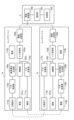
- FIG. 1 is a block diagram showing the configuration of a biosignal measuring system according to a first embodiment of the present invention.
- FIG. 2 is a circuit diagram showing the configuration of an amplifier unit according to the first embodiment of the present invention.
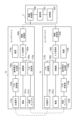
- FIG. 3 is a block diagram showing the configuration of a biosignal measuring system according to a second embodiment of the present invention.
- FIG. 4 is a block diagram showing the configuration of a biosignal measuring system according to a third embodiment of the present invention.
- FIG. 5 is a block diagram showing the configuration of a biosignal measuring system according to a fourth embodiment of the present invention.
- FIG. 6 is a block diagram showing another configuration of the biosignal measuring system according to the fourth embodiment of the present invention.
- FIG. 1 is a block diagram showing the configuration of a biosignal measuring system according to a first embodiment of the present invention.
- FIG. 2 is a circuit diagram showing the configuration of an amplifier unit according to the first embodiment of the present invention.
- FIG. 3 is a block diagram showing the
- FIG. 7 is a block diagram showing the configuration of a biosignal measuring system according to a fifth embodiment of the present invention.
- FIG. 8 is a block diagram showing an example of the configuration of a computer that realizes the biosignal measuring systems according to the first to fifth embodiments of the present invention.
- FIG. 9 is a diagram showing the configuration of a conventional biosignal measuring system.
- Fig. 1 is a block diagram showing the configuration of a biosignal measurement system according to a first embodiment of the present invention.
- the biosignal measurement system is composed of a sensor device 1a attached to the right side of a subject, a sensor device 1b attached to the left side, and a biosignal generating device 2.
- the sensor device 1a includes an electrode 101a that contacts the skin on the right side of the subject, an amplifier 102a that amplifies the bioelectric potential detected by the electrode 101a, an AD converter 103a that converts the amplified bioelectric potential into digital data, a wireless transmitter 104a that wirelessly transmits the digital data output from the AD converter 103a to the biosignal generating device 2, a transmitter 105a that modulates a carrier wave according to the bioelectric potential amplified by the amplifier 102a and transmits the modulated signal to the sensor device 1b, and a transmitter 106a that demodulates the modulated signal transmitted from the sensor device 1b.
- a receiver 106a that extracts bioelectric potential information
- a reference potential generator 109a that generates a reference potential for the amplifier 102a
- a power source 110a that supplies power to the amplifier 102a
- the AD converter 103a the wireless transmitter 104a, the transmitter 105a, the receiver 106a, and the reference potential generator 109a
- an electrode 111a that comes into contact with the skin on the right side of the subject and transmits the modulated signal output from the transmitter 105a to the sensor device 1b via the subject's body
- a piezoelectric element 112a that receives the elastic waves transmitted from the sensor device 1b and converts them into an electrical signal.
- the sensor device 1b includes an electrode 101b that contacts the skin on the left side of the subject, an amplifier 102b that amplifies the bioelectric potential detected by the electrode 101b, an AD converter 103b that converts the amplified bioelectric potential into digital data, a wireless transmitter 104b that wirelessly transmits the digital data output from the AD converter 103b to the biosignal generating device 2, a transmitter 107b that modulates a carrier wave according to the bioelectric potential amplified by the amplifier 102b and transmits the modulated signal to the sensor device 1a, and a transmitter 108b that demodulates the modulated signal transmitted from the sensor device 1a to obtain information on the bioelectric potential.
- the device is equipped with a receiver 108b that extracts the information, a reference potential generator 109b that generates a reference potential for the amplifier 102b, a power source 110b that supplies power to the amplifier 102b, the AD converter 103b, the wireless transmitter 104b, the transmitter 107b, the receiver 108b, and the reference potential generator 109b, a piezoelectric element 113b that converts the modulated signal output from the transmitter 107b into an elastic wave and transmits it to the sensor device 1a via the body of the subject, and an electrode 114b that comes into contact with the skin on the left side of the subject and receives the modulated signal from the sensor device 1a via the body of the subject.
- the biosignal generating device 2 includes a wireless receiving unit 200 that receives digital data transmitted from the sensor devices 1a and 1b, a calculation unit 201 that calculates an electrocardiogram signal, and a memory unit 202 that stores the electrocardiogram signal calculated by the calculation unit 201.
- sensor devices 1a, 1b are attached to at least two locations on the limbs as measurement sites that are comfortable for the subject. By adopting such a mounting form for sensor devices 1a, 1b, it is possible to significantly reduce the feeling of pressure and discomfort caused by wearing clothing.
- the biosignal measurement system can be used not only for electrocardiograms, but also for measuring myoelectricity, electroencephalograms, etc.
- the sensor devices 1a and 1b are in the shape of, for example, gloves, rings, socks, slippers, or wristbands.
- the person being measured wears the sensor devices 1a and 1b on their right and left hands, respectively, like gloves or rings.
- the person being measured wears the sensor devices 1a and 1b on their right and left feet, respectively, like socks, or slippers, respectively.
- the person being measured wears the sensor devices 1a and 1b on their right and left hands, respectively, like wristbands.
- Electrodes 101a, 101b, 111a, and 114b can be made of various materials and have various configurations. Any electrode can be used, including Ag/AgCl electrodes used in medical applications, conductive cloth electrodes, and metal electrodes.
- the bioelectric potential detected by the electrodes 101a and 101b is a very weak signal, so signal amplification by the amplifiers 102a and 102b is necessary.
- the amplifiers 102a and 102b require a high input impedance to reduce loss of the bioelectric potential.
- the resistance that determines the input impedance also affects the gain setting and further contributes directly as thermal noise, lowering the signal-to-noise (SN) ratio of the bioelectric potential.
- SN signal-to-noise
- a non-inverting amplifier circuit has the characteristic that noise is less likely to increase even when configured with a high input impedance. Therefore, it is effective to use a non-inverting amplifier circuit as the amplifiers 102a and 102b. It is also possible to provide a low-pass filter in the amplifiers 102a and 102b.
- the reference potential of the two amplifiers 102a and 102b is common.
- the reference potentials of the amplifiers 102a and 102b may not match, which may result in a deterioration in measurement accuracy.
- bioelectric potential information is transmitted and received between sensor devices 1a and 1b, and the reference potential Vref is made common in the amplifiers 102a and 102b of each sensor device 1a and 1b.
- the bioelectric potential detected by electrode 101b of sensor device 1b and amplified by amplifier 102b is converted into an elastic wave by piezoelectric element 113b and transmitted to sensor device 1a via the body of the person being measured.
- the receiver 106a of sensor device 1a demodulates the signal transmitted from sensor device 1b and received by piezoelectric element 112a to extract information on the bioelectric potential.
- the reference potential generating unit 109a of the sensor device 1a generates the reference potential Vref by calculating the additive average of the biopotential detected by the electrode 101a and amplified by the amplifier 102a and the biopotential output from the receiver 106a (the biopotential transmitted from the sensor device 1b).
- FIG. 2 is a circuit diagram showing an example of the configuration of the amplifier 102a.
- the amplifier 102a is composed of an operational amplifier A1 and resistors R1 and R2.
- a reference potential Vref is supplied from a reference potential generating unit 109a to one end of resistor R1 of the amplifier 102a.
- the bioelectric potential detected by electrode 101a of sensor device 1a and amplified by amplifier 102a is wirelessly transmitted to sensor device 1b by transmitter 105a and electrode 111a.
- Receiver 108b of sensor device 1b demodulates the signal transmitted from sensor device 1a and received by electrode 114b to extract bioelectric potential information.
- the reference potential generating unit 109b of the sensor device 1b generates a reference potential Vref by calculating the average of the biopotential detected by the electrode 101b and amplified by the amplifier 102b and the biopotential output from the receiver 108b (the biopotential transmitted from the sensor device 1a), and supplies the reference potential Vref to the amplifier 102b.
- the amplifier 102b has the same configuration as the amplifier 102a.
- Each of the reference potential generating units 109a and 109b is preferably configured, for example, from a single-stage operational amplifier.
- the AD conversion unit 103a of the sensor device 1a converts the bioelectric potential amplified by the amplifier unit 102a into digital data.
- the wireless transmission unit 104a wirelessly transmits the bioelectric potential data output from the AD conversion unit 103a to the biosignal generating device 2.
- the AD conversion unit 103b of the sensor device 1b converts the bioelectric potential amplified by the amplifier unit 102b into digital data.
- the wireless transmission unit 104b wirelessly transmits the bioelectric potential data output from the AD conversion unit 103b to the biosignal generating device 2.
- any wireless communication standard can be applied between the wireless transmitting units 104a, 104b and the wireless receiving unit 200 of the biosignal generating device 2, such as carrier communication, Wi-Fi (registered trademark), Bluetooth (registered trademark), etc.
- a short-range communication standard such as Bluetooth
- a smartphone or other terminal close to the subject can be used as the biosignal generating device 2.
- Wi-Fi or the like a server device or the like can be used as the biosignal generating device 2.
- the calculation unit 201 of the biosignal generating device 2 calculates the difference between the biopotential transmitted from the sensor device 1a and the biopotential transmitted from the sensor device 1b as an electrocardiogram signal.
- the electrocardiogram signal is stored in the storage unit 202.
- human body communication which uses the body of the person being measured as a transmission path, is used as a method for transmitting and receiving data between the sensor devices 1a and 1b.
- Power for communication accounts for a large portion of the power consumed by the sensor devices 1a and 1b.
- the signal strength attenuates inversely proportional to the square of the propagation distance.
- the signal attenuation is limited to inversely proportional to the propagation distance. For this reason, the use of human body communication makes it possible to transmit data with less transmission power. Transmitting and receiving data via the human body can contribute to reducing power consumption.
- there is less electric field radiation into the external environment so there is no need to adjust the transmission frequency to a specific frequency as in radio wave communication.
- the transmitter 105a of the sensor device 1a modulates a carrier wave according to the bioelectric potential amplified by the amplifier 102a, and transmits the modulated signal from the electrode 111a to the sensor device 1b via the body of the person being measured.
- the piezoelectric element 112a of the sensor device 1a receives the elastic waves transmitted from the sensor device 1b via the body of the person being measured and converts them into an electrical signal.
- the receiver 106a demodulates the modulated signal output from the piezoelectric element 112a to extract information about the bioelectric potential.
- the transmitter 107b of sensor device 1b modulates a carrier wave according to the bioelectric potential amplified by amplifier 102b, and outputs the modulated signal to piezoelectric element 113b.
- Piezoelectric element 113b converts the modulated signal output from transmitter 107b into an elastic wave (ultrasound) and radiates it to the body of the person being measured. This elastic wave is transmitted to sensor device 1a via the body of the person being measured.
- the receiver 108b of sensor device 1b demodulates the modulated signal transmitted from electrode 111a of sensor device 1a and received by electrode 114b, and extracts information about the bioelectric potential.
- Piezoelectric elements 112a and 113b are elements that have a piezoelectric effect; when a voltage is input, a pressure corresponding to the voltage is generated, and when pressure is input, a voltage is generated.
- Examples of materials for piezoelectric elements 112a and 113b include lead zirconate titanate (PZT), which is made of lead titanate and lead zirconate, and organic piezoelectric thin films.
- PZT does not require a large amount of power to convert signals, so it can consume less power than the power consumed when transmitting electrical signals directly, such as in communication between electrodes 111a and 114b.
- Organic piezoelectric thin films are physically flexible. For this reason, using organic piezoelectric thin films as the material for piezoelectric elements 112a and 113b can increase the adhesion between sensor devices 1a and 1b and the person being measured, allowing for more stable measurements, making this an ideal choice for the present invention.
- Piezoelectric elements 112a, 113b have a structure in which a piezoelectric body is sandwiched between two electrodes. Normally, the electrodes of piezoelectric elements 112a, 113b are insulated for protection. In this embodiment, the electrodes of piezoelectric elements 112a, 113b on the subject side are not insulated for protection, so that the electrodes of piezoelectric elements 112a, 113b on the subject side can be used as electrodes 101a, 101b for measuring electrocardiogram signals. This eliminates the need to prepare electrodes 101a, 101b separately, which is expected to lead to miniaturization, which is important for wearable devices.
- the frequency of the bioelectric potential is about 1 kHz.
- Elastic waves are ideal for human body communication because they propagate through tissues such as bones and flesh and travel within the body of the person being measured. Since the higher the frequency, the stronger the signal attenuation, so traditionally, ultrasonic frequencies are between 1 MHz and 10 MHz, and bone conduction frequencies are between 1 Hz and 100 kHz. Therefore, in this embodiment as well, it is considered best to use frequencies within this range.
- Human body communication has the advantage of being able to confine electrical signals and elastic waves within the human body, reducing two-way interference with the outside world. This means that it is also expected to be advantageous in terms of preventing leakage of biological signals, as it makes it harder for information to be intercepted.
- analog wireless communication is performed between sensor devices 1a and 1b in order to match the reference potential Vref, which has become unstable due to the division of the sensor devices.
- Analog wireless communication does not involve any processing that generates delay time, such as digital calculations. For this reason, it is possible to realize a circuit configuration that prevents oscillation and unstable operation when sensor devices 1a and 1b are coupled.
- the possibility of interference can be reduced by using elastic wave communication for either the transmission from sensor device 1a to sensor device 1b or the transmission from sensor device 1b to sensor device 1a.
- FIG. 3 is a block diagram showing the configuration of a biosignal measurement system according to the second embodiment of the present invention. This embodiment describes a specific example of the first embodiment.
- the sensor device 1a of this embodiment includes an electrode 101a, an amplifier 102a, an AD converter 103a, a wireless transmitter 104a, an FM (Frequency Modulation) transmitter 115a for frequency-modulating a carrier wave in response to the bioelectric potential amplified by the amplifier 102a and transmitting the modulated signal to the sensor device 1b, an FM receiver 116a for demodulating the modulated signal transmitted from the sensor device 1b to extract information on the bioelectric potential, a reference potential generator 109a, a power source 110a for supplying power to the amplifier 102a, the AD converter 103a, the wireless transmitter 104a, the FM transmitter 115a, the FM receiver 116a, and the reference potential generator 109a, an electrode 111a, and a piezoelectric element 112a.
- an electrode 101a an amplifier 102a, an AD converter 103a, a wireless transmitter 104a, an FM (Frequency Modulation) transmitter 115a for frequency-modulating a carrier wave in response to the bio
- the sensor device 1b of this embodiment includes an electrode 101b, an amplifier 102b, an AD converter 103b, a wireless transmitter 104b, an FM transmitter 117b that frequency-modulates a carrier wave in response to the bioelectric potential amplified by the amplifier 102b and transmits the modulated signal to the sensor device 1a, an FM receiver 118b that demodulates the modulated signal transmitted from the sensor device 1a to extract information on the bioelectric potential, a reference potential generator 109b, a power source 110b that supplies power to the amplifier 102b, the AD converter 103b, the wireless transmitter 104b, the FM transmitter 117b, the FM receiver 118b, and the reference potential generator 109b, a piezoelectric element 113b, and an electrode 114b.
- the FM transmitter 115a of the sensor device 1a FM-modulates the carrier wave according to the bioelectric potential amplified by the amplifier 102a, and transmits the modulated signal from the electrode 111a through the body of the person being measured to the sensor device 1b.
- the FM receiver 116a demodulates the modulated signal output from the piezoelectric element 112a to extract information about the bioelectric potential.
- the FM transmitter 117b of the sensor device 1b FM-modulates the carrier wave according to the bioelectric potential amplified by the amplifier 102b, and outputs the modulated signal to the piezoelectric element 113b.
- the FM receiver 118b demodulates the modulated signal transmitted from the electrode 111a of the sensor device 1a and received by the electrode 114b, and extracts information about the bioelectric potential.
- the other configurations are the same as those of the first embodiment.
- FM modulation can transmit signals at maximum amplitude, making it particularly suitable for the human body, where the amount of signal attenuation varies depending on the state.
- FM modulation changes the carrier frequency, it is necessary to ensure that the frequencies of the modulated signals do not overlap. Even if the carrier frequencies of sensor devices 1a and 1b are sufficiently separated so that they do not overlap, harmonics that are integer multiples of the carrier frequency may be superimposed on the modulated signal, so careful design is required.
- sensor devices 1a and 1b When two-way communication is performed between sensor devices 1a and 1b using electrical signals, if the frequencies of the modulated signals overlap, there is a possibility that strong waves will dominate. In other words, the received signal may be drowned out by the transmitted signal from the device itself, resulting in a failure of information transmission. For example, if sensor device 1a oscillates in the 10 MHz band, specifically between 9.5 MHz and 10.5 MHz, and sensor device 1b oscillates in such a way that the frequency of the modulated signal falls between 19 MHz and 21 MHz in addition to the 10 MHz band, there is a possibility that information transmission will fail. The same effect will occur with third and higher harmonics, but higher harmonics are generally attenuated, so the effect will be less.
- the possibility of interference can be reduced by transmitting bioelectric potential information from sensor device 1a to sensor device 1b by electrical signals and transmitting bioelectric potential information from sensor device 1b to sensor device 1a by elastic waves.
- the modulation width of the FM modulation can be maximized, the signal-to-noise ratio of the transmission signal can be dramatically improved, and robust bioelectric potential measurement can be achieved.
- sensor devices 1a and 1b can perform bidirectional communication using the same carrier frequency, so it is only necessary to select whether the contact point between the human body and the device is an electrode or a piezoelectric element. This eliminates the need for circuit elements to output different carrier frequencies, making it possible to improve mass productivity and reduce costs.
- Fig. 4 is a block diagram showing the configuration of a biosignal measurement system according to the third embodiment of the present invention.
- the sensor device 1a of this embodiment includes an electrode 101a, an amplifier 102a, an AD converter 103a, a wireless transmitter 104a, an FM transmitter 115a, an FM receiver 116a, a reference potential generator 109a, a power source 110a, and piezoelectric elements 112a and 119a.
- the sensor device 1b of this embodiment includes an electrode 101b, an amplifier 102b, an AD converter 103b, a wireless transmitter 104b, an FM transmitter 117b, an FM receiver 118b, a reference potential generator 109b, a power source 110b, and piezoelectric elements 113b and 120b.
- the piezoelectric element 119a of the sensor device 1a converts the modulated signal output from the FM transmitter 115a into an elastic wave (ultrasound wave) and radiates it to the body of the person being measured. This elastic wave is transmitted to the sensor device 1b via the body of the person being measured.
- the piezoelectric element 120b of the sensor device 1b receives the elastic waves transmitted from the sensor device 1a through the body of the subject and converts them into an electrical signal.
- the FM receiver 118b demodulates the modulated signal output from the piezoelectric element 120b to extract bioelectric potential information.
- the other configurations are the same as those of the second embodiment.
- Biopotentials are signals with a frequency of around 1 kHz, so if the modulated signal is made a sufficiently high frequency, it is possible to properly separate the biopotential and the modulated signal by filtering. However, the higher the frequency of the modulated signal, the greater the attenuation, and in order to reduce power consumption, it is necessary to lower the frequency and reduce the transmission output. Therefore, a trade-off occurs between the signal quality of the biopotential and the frequency of the modulated signal.
- the modulated signal is not superimposed on the bioelectric potential, so the signal-to-noise ratio of the bioelectric potential does not deteriorate and bioelectric signal measurement can be performed with low power.
- the advantage of being able to use the same carrier frequency as explained in the second embodiment is lost, and different carrier frequencies must be used for sensor devices 1a and 1b.
- the frequency of the modulated signal transmitted from sensor device 1a to sensor device 1b must be different from the frequency of the modulated signal transmitted from sensor device 1b to sensor device 1a.
- the electrode of the piezoelectric element 112a or 119a on the subject side in the sensor device 1a can be used as the electrode 101a for measuring an electrocardiogram signal.
- the electrode of the piezoelectric element 113b or 120b on the subject side in the sensor device 1b can be used as the electrode 101b for measuring an electrocardiogram signal.
- Fig. 5 is a block diagram showing the configuration of a biosignal measuring system according to a fourth embodiment of the present invention.
- a transmitting antenna 121a is provided in place of the electrode 111a of FIG. 1, and a receiving antenna 122b is provided in place of the electrode 114b.
- the transmitting unit 105a of the sensor device 1a modulates a carrier wave according to the bioelectric potential amplified by the amplifying unit 102a, and transmits the modulated signal from the transmitting antenna 121a to the sensor device 1b.
- the receiving unit 108b of the sensor device 1b demodulates the modulated signal transmitted from the sensor device 1a and received by the receiving antenna 122b to extract information about the bioelectric potential.
- the piezoelectric element 113b of the sensor device 1b radiates elastic waves to the body of the person being measured.
- the piezoelectric element 113b radiates elastic waves (ultrasound waves) into space toward the sensor device 1a.
- the piezoelectric element 112a of the sensor device 1a receives the elastic waves transmitted from the sensor device 1b through space and converts them into an electrical signal.
- This embodiment may be applied to the second embodiment.
- the configuration in this case is shown in FIG. 6.
- the FM transmitter 115a of the sensor device 1a FM modulates a carrier wave in response to the bioelectric potential amplified by the amplifier 102a, and transmits the modulated signal from the transmitting antenna 121a to the sensor device 1b.
- the FM receiver 118b of the sensor device 1b demodulates the modulated signal transmitted from the sensor device 1a and received by the receiving antenna 122b to extract information about the bioelectric potential.
- the operation of the piezoelectric elements 112a and 113b is the same as that of the configuration of FIG. 5.
- the piezoelectric element 119a of the sensor device 1a may radiate elastic waves (ultrasound waves) into space toward the sensor device 1b.
- the piezoelectric element 120b of the sensor device 1b receives the elastic waves transmitted from the sensor device 1a through space and converts them into an electrical signal.
- the operation of the piezoelectric elements 112a and 113b is the same as the configuration in FIG. 5.
- the biosignal generating device 2 is provided separately from the sensor devices 1a and 1b, but the configuration of the biosignal generating device 2 may be implemented in either one of the sensor devices 1a or 1b.
- Fig. 7 is a block diagram showing the configuration of a biosignal measuring system according to a fifth embodiment of the present invention.
- the wireless transmitting unit 104b of the sensor device 1b is not necessary.
- the wireless receiving unit 200 provided in the sensor device 1b receives the biopotential data transmitted from the sensor device 1a.
- the calculation unit 201 calculates the difference between the biopotential transmitted from the sensor device 1a and the biopotential output from the AD conversion unit 103b as an electrocardiogram signal.
- the electrocardiogram signal is stored in the memory unit 202.
- the configuration of the biosignal generating device 2 is provided in the sensor device 1b, but it goes without saying that it may be provided in the sensor device 1a.
- the configuration of Fig. 7 shows an example in which this embodiment is applied to the configuration of Fig. 1, but this embodiment may also be applied to the configurations of Figs. 3 to 6.
- the sensor device 1a may be attached to the left side of the subject, and the sensor device 1b may be attached to the right side.
- the electrodes 101a, 101b, 111a, 114b and the piezoelectric elements 112a, 113b, 119a, 120b that were in contact with the skin of the person being measured may be configured in a non-contact manner so as not to come into contact with the skin.
- the sensor devices 1a and 1b can be worn over the clothing of the person being measured, further reducing the burden on the person being measured and enabling biosignal measurement that does not interfere with daily activities.
- the calculation unit 201 and memory unit 202 described in the first to fifth embodiments can be realized by a computer equipped with a CPU (Central Processing Unit), a memory device, and an interface, and a program that controls these hardware resources.
- a computer equipped with a CPU (Central Processing Unit), a memory device, and an interface, and a program that controls these hardware resources.
- An example of the configuration of this computer is shown in Figure 8.
- the computer comprises a CPU 400, a storage device 401, and an interface device (I/F) 402.
- the I/F 402 is connected to the hardware of the wireless receiving unit 200, etc.
- a program for implementing the method of the present invention is stored in the storage device 401.
- the CPU 400 executes the processes described in the first to fifth embodiments in accordance with the program stored in the storage device 401.
- at least a part of the calculation unit 201 may be configured with hardware logic such as an FPGA (field-programmable gate array).
- the biosignal measurement system of the present invention comprises a first sensor device configured to be attached to one of the right and left sides of a subject to be measured, and a second sensor device configured to be attached to the other of the right and left sides, the first sensor device comprising a first electrode configured to detect a biopotential of the subject to be measured, a first amplifier configured to amplify the biopotential detected by the first electrode, a first transmitter configured to modulate a carrier wave in accordance with the biopotential amplified by the first amplifier and wirelessly transmit a first modulated signal to the second sensor device, a first piezoelectric element configured to receive elastic waves transmitted from the second sensor device and convert them into a second modulated signal, a first receiver configured to demodulate the second modulated signal to extract information on the biopotential, and a first amplifier configured to amplify the biopotential amplified by the first amplifier and the first receiver configured to wirelessly transmit the first modulated signal to the second sensor device.
- the second sensor device includes a second electrode configured to detect the biopotential of the subject, a second amplifier configured to amplify the biopotential detected by the second electrode, a second transmitter configured to modulate a carrier wave according to the biopotential amplified by the second amplifier, a second piezoelectric element configured to convert the second modulated signal output from the second transmitter into an elastic wave and transmit it to the first sensor device, a second receiver configured to demodulate the first modulated signal transmitted from the first sensor device to extract information on the biopotential, and a second reference potential generating unit configured to generate a reference potential for the second amplifier based on the biopotential amplified by the second amplifier and the biopotential output from the second receiver.
- the biosignal measurement system of the present invention comprises a first sensor device configured to be attached to one of the right and left sides of a subject to be measured, and a second sensor device configured to be attached to the other of the right and left sides, the first sensor device comprising a first electrode configured to detect a biopotential of the subject to be measured, a first amplifier configured to amplify the biopotential detected by the first electrode, a first transmitter configured to modulate a carrier wave in accordance with the biopotential amplified by the first amplifier, a first piezoelectric element configured to convert a first modulated signal output from the first transmitter into an elastic wave and transmit it to the second sensor device, a second piezoelectric element configured to receive the elastic wave transmitted from the second sensor device and convert it into a second modulated signal, a first receiver configured to demodulate the second modulated signal to extract information on the biopotential, and a reference voltage of the first amplifier based on the biopotential amplified by the first amplifier and the biopotential output from the first
- the second sensor device includes a second electrode configured to detect the bioelectric potential of the subject, a second amplifier configured to amplify the bioelectric potential detected by the second electrode, a second transmitter configured to modulate a carrier wave according to the bioelectric potential amplified by the second amplifier, a third piezoelectric element configured to convert the second modulated signal output from the second transmitter into an elastic wave and transmit it to the first sensor device, a fourth piezoelectric element configured to receive the elastic wave transmitted from the first sensor device and convert it into a first modulated signal, a second receiver configured to demodulate the first modulated signal output from the fourth piezoelectric element to extract information on the bioelectric potential, and a second reference potential generator configured to generate a reference potential for the second amplifier based on the bioelectric potential amplified by the second amplifier and the bioelectric potential output from the second receiver, and the first modulated signal and the second modulated signal have different frequencies.
- the first sensor device further includes a third electrode for transmitting the first modulated signal output from the first transmission unit to the second sensor device via the body of the subject
- the second sensor device further includes a fourth electrode for receiving the first modulated signal from the first sensor device via the body of the subject
- the second piezoelectric element radiates an elastic wave converted from the second modulated signal output from the second transmission unit to the body of the subject
- the first piezoelectric element receives the elastic wave from the second sensor device via the body of the subject and converts it into a second modulated signal.
- the first sensor device further includes a transmitting antenna for wirelessly transmitting the first modulated signal output from the first transmitting unit to the second sensor device
- the second sensor device further includes a receiving antenna for receiving the first modulated signal transmitted from the first sensor device
- the second piezoelectric element radiates an elastic wave converted from the second modulated signal output from the second transmitting unit into space toward the first sensor device
- the first piezoelectric element receives the elastic wave from the second sensor device through space and converts it into a second modulated signal.
- the first piezoelectric element radiates elastic waves converted from the first modulated signal output from the first transmission unit to the body of the subject
- the fourth piezoelectric element receives elastic waves from the first sensor device through the body of the subject and converts them into a first modulated signal
- the third piezoelectric element radiates elastic waves converted from the second modulated signal output from the second transmission unit to the body of the subject
- the second piezoelectric element receives elastic waves from the second sensor device through the body of the subject and converts them into a second modulated signal.
- the first piezoelectric element radiates elastic waves converted from the first modulated signal output from the first transmission unit into space toward the second sensor device
- the fourth piezoelectric element receives elastic waves from the first sensor device through space and converts them into a first modulated signal
- the third piezoelectric element radiates elastic waves converted from the second modulated signal output from the second transmission unit into space toward the first sensor device
- the second piezoelectric element receives elastic waves from the second sensor device through space and converts them into a second modulated signal.
- the biosignal measurement system described in appendix 1 or 2 further comprises a biosignal generating device
- the first sensor device further comprises a third transmitting unit configured to wirelessly transmit the biopotential data amplified by the first amplifier to the biosignal generating device
- the second sensor device further comprises a fourth transmitting unit configured to wirelessly transmit the biopotential data amplified by the second amplifier to the biosignal generating device
- the biosignal generating device comprises a third receiving unit configured to receive the biopotential data transmitted from the first and second sensor devices, and a calculation unit configured to calculate an electrocardiogram signal of the measurement subject based on the biopotential transmitted from the first sensor device and the biopotential transmitted from the second sensor device.
- the first sensor device further includes a third transmitting unit configured to wirelessly transmit the biopotential data amplified by the first amplifier to the second sensor device
- the second sensor device further includes a third receiving unit configured to receive the biopotential data transmitted from the third transmitting unit, and a calculation unit configured to calculate an electrocardiogram signal of the measurement subject based on the biopotential transmitted from the first sensor device and the biopotential amplified by the second amplifier.
- the present invention can be applied to technology for measuring biological signals.
Landscapes
- Health & Medical Sciences (AREA)
- Life Sciences & Earth Sciences (AREA)
- Heart & Thoracic Surgery (AREA)
- Medical Informatics (AREA)
- Biophysics (AREA)
- Pathology (AREA)
- Engineering & Computer Science (AREA)
- Biomedical Technology (AREA)
- Cardiology (AREA)
- Physics & Mathematics (AREA)
- Molecular Biology (AREA)
- Surgery (AREA)
- Animal Behavior & Ethology (AREA)
- General Health & Medical Sciences (AREA)
- Public Health (AREA)
- Veterinary Medicine (AREA)
- Measurement And Recording Of Electrical Phenomena And Electrical Characteristics Of The Living Body (AREA)
Priority Applications (2)
| Application Number | Priority Date | Filing Date | Title |
|---|---|---|---|
| JP2024561005A JPWO2024116262A1 (https=) | 2022-11-29 | 2022-11-29 | |
| PCT/JP2022/043897 WO2024116262A1 (ja) | 2022-11-29 | 2022-11-29 | 生体信号計測システム |
Applications Claiming Priority (1)
| Application Number | Priority Date | Filing Date | Title |
|---|---|---|---|
| PCT/JP2022/043897 WO2024116262A1 (ja) | 2022-11-29 | 2022-11-29 | 生体信号計測システム |
Publications (1)
| Publication Number | Publication Date |
|---|---|
| WO2024116262A1 true WO2024116262A1 (ja) | 2024-06-06 |
Family
ID=91323151
Family Applications (1)
| Application Number | Title | Priority Date | Filing Date |
|---|---|---|---|
| PCT/JP2022/043897 Ceased WO2024116262A1 (ja) | 2022-11-29 | 2022-11-29 | 生体信号計測システム |
Country Status (2)
| Country | Link |
|---|---|
| JP (1) | JPWO2024116262A1 (https=) |
| WO (1) | WO2024116262A1 (https=) |
Citations (3)
| Publication number | Priority date | Publication date | Assignee | Title |
|---|---|---|---|---|
| US20170055862A1 (en) * | 2015-08-24 | 2017-03-02 | Korea Institute Of Science And Technology | Apparatus and method for measuring electrocardiogram using wireless communication |
| JP2020171677A (ja) * | 2019-04-12 | 2020-10-22 | バイオトロニック エスエー アンド カンパニー カーゲーBIOTRONIK SE & Co. KG | 電気的インタフェースを有することなく超音波を使用して直接的タイミング情報を提供する心臓内通信 |
| US20210244337A1 (en) * | 2019-05-08 | 2021-08-12 | Boe Technology Group Co., Ltd. | Electrocardiograph acquisition circuit, device, method and system |
-
2022
- 2022-11-29 JP JP2024561005A patent/JPWO2024116262A1/ja active Pending
- 2022-11-29 WO PCT/JP2022/043897 patent/WO2024116262A1/ja not_active Ceased
Patent Citations (3)
| Publication number | Priority date | Publication date | Assignee | Title |
|---|---|---|---|---|
| US20170055862A1 (en) * | 2015-08-24 | 2017-03-02 | Korea Institute Of Science And Technology | Apparatus and method for measuring electrocardiogram using wireless communication |
| JP2020171677A (ja) * | 2019-04-12 | 2020-10-22 | バイオトロニック エスエー アンド カンパニー カーゲーBIOTRONIK SE & Co. KG | 電気的インタフェースを有することなく超音波を使用して直接的タイミング情報を提供する心臓内通信 |
| US20210244337A1 (en) * | 2019-05-08 | 2021-08-12 | Boe Technology Group Co., Ltd. | Electrocardiograph acquisition circuit, device, method and system |
Also Published As
| Publication number | Publication date |
|---|---|
| JPWO2024116262A1 (https=) | 2024-06-06 |
Similar Documents
| Publication | Publication Date | Title |
|---|---|---|
| Droitcour et al. | Signal-to-noise ratio in Doppler radar system for heart and respiratory rate measurements | |
| JP5841951B2 (ja) | データ収集システム | |
| WO2006062112A1 (ja) | 人体経由情報伝達システム及び送受信器 | |
| US10463302B1 (en) | Leadless electrocardiogram monitor | |
| JP2018074581A (ja) | 容量性差動回路およびデジタルシグマデルタ帰還回路を備えるadc | |
| CN101330869A (zh) | 用于监测人体心率和/或心率变化的装置及包括该装置的腕表 | |
| JP6215637B2 (ja) | 生体情報収集装置 | |
| US20170303808A1 (en) | Capacitive Electrocardiography (ECG) Systems | |
| CA3132984C (en) | Leadless electrocardiogram monitor | |
| JP6215644B2 (ja) | 心拍・心電計 | |
| WO2024116262A1 (ja) | 生体信号計測システム | |
| JP6453722B2 (ja) | 生体センサー装置 | |
| Hong et al. | A wireless ECG acquisition and classification system for body sensor networks | |
| JP6386621B2 (ja) | 心拍・心電計 | |
| JP7800681B2 (ja) | 生体信号計測システム | |
| JP7768369B2 (ja) | 生体信号計測システム | |
| WO2024089758A1 (ja) | 生体信号計測システム | |
| JP6386620B2 (ja) | 心拍・心電計 | |
| JP2011072452A (ja) | 電位差測定装置 | |
| JP7841599B2 (ja) | 生体信号計測システム | |
| US20260026730A1 (en) | Biosignal measurement system | |
| WO2024052977A1 (ja) | 生体信号計測システム | |
| KR101881131B1 (ko) | 휴대용 인체통신 심전도 수집 장치 | |
| JP2016087061A (ja) | 生体情報計測装置 | |
| KR100731676B1 (ko) | 이동 환경에서의 심장 전기 활동 측정을 위한 전극 패치 |
Legal Events
| Date | Code | Title | Description |
|---|---|---|---|
| 121 | Ep: the epo has been informed by wipo that ep was designated in this application |
Ref document number: 22967097 Country of ref document: EP Kind code of ref document: A1 |
|
| WWE | Wipo information: entry into national phase |
Ref document number: 2024561005 Country of ref document: JP |
|
| NENP | Non-entry into the national phase |
Ref country code: DE |
|
| 122 | Ep: pct application non-entry in european phase |
Ref document number: 22967097 Country of ref document: EP Kind code of ref document: A1 |