WO2024105877A1 - シミュレーション装置、及びシミュレーション方法 - Google Patents
シミュレーション装置、及びシミュレーション方法 Download PDFInfo
- Publication number
- WO2024105877A1 WO2024105877A1 PCT/JP2022/042827 JP2022042827W WO2024105877A1 WO 2024105877 A1 WO2024105877 A1 WO 2024105877A1 JP 2022042827 W JP2022042827 W JP 2022042827W WO 2024105877 A1 WO2024105877 A1 WO 2024105877A1
- Authority
- WO
- WIPO (PCT)
- Prior art keywords
- bottleneck
- simulation
- human model
- human
- simulation device
- Prior art date
- Legal status (The legal status is an assumption and is not a legal conclusion. Google has not performed a legal analysis and makes no representation as to the accuracy of the status listed.)
- Ceased
Links
Images


Classifications
-
- G—PHYSICS
- G06—COMPUTING OR CALCULATING; COUNTING
- G06Q—INFORMATION AND COMMUNICATION TECHNOLOGY [ICT] SPECIALLY ADAPTED FOR ADMINISTRATIVE, COMMERCIAL, FINANCIAL, MANAGERIAL OR SUPERVISORY PURPOSES; SYSTEMS OR METHODS SPECIALLY ADAPTED FOR ADMINISTRATIVE, COMMERCIAL, FINANCIAL, MANAGERIAL OR SUPERVISORY PURPOSES, NOT OTHERWISE PROVIDED FOR
- G06Q10/00—Administration; Management
- G06Q10/04—Forecasting or optimisation specially adapted for administrative or management purposes, e.g. linear programming or "cutting stock problem"
Definitions
- the present invention relates to a simulation device and a simulation method for simulating people flow.
- Patent Document 1 which is related to a people flow simulation system, the aim is to simulate interactions due to differences in moving directions and to accurately simulate movement, proposing that "the ratio of the number of mobile agents moving in one direction at a selected edge to the number of mobile agents moving in the other direction is calculated for each direction, and the width in the direction in which the mobile agents are heading is calculated from the ratio of the number of mobile agents to the width of the edge, and for each mobile agent, the population density is calculated based on the length ahead from the mobile agent's position and the area of the section calculated from the width in the direction in which the agent is heading, and the mobile agents in each direction that exist in that section.
- the moving speed of each mobile agent is calculated based on the free walking speed in the agent information, the calculated population density, and predetermined parameters.”
- the walking speed is determined based on the number of people moving within the edge and the number of people moving in the opposite direction, but there is no mention of determining the direction of movement to avoid contact in crowded areas. For this reason, for example, in environments where there are obstacles or narrow areas, these can become bottlenecks, and a complete deadlock can occur when a counterflow occurs toward the bottleneck.
- the present invention aims to provide a simulation device and a simulation method that can deal with bottlenecks and obtain highly convincing people flow simulation results.
- the present invention provides a "simulation device for simulating people flow, the simulation device having a memory unit and a simulation control unit, the memory unit stores layout information, and a human model that holds at least destination information indicating where the human model is heading within the layout information and current position information, and the control unit changes movement control of the human model from a case where a bottleneck is not detected when a bottleneck that restricts the flow rate of the human model is detected within a certain range ahead in the direction of movement of the human model.”
- the present invention provides a "simulation method for simulating people flow, the simulation method comprising a storage method and a simulation control method, the storage method storing an arbitrary layout and a human model that holds at least destination information indicating where in the layout the person is heading and current position information, and the control method is characterized in that, when a bottleneck area with a narrow passage width is detected within the visual field of the human model, the effect of avoiding oncoming people is strengthened more than usual.”
- FIG. 1 is a diagram showing an example of the configuration of a simulation device according to an embodiment of the present invention.
- FIG. 1 shows the inside of a building as an example of an environment to be simulated.
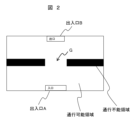
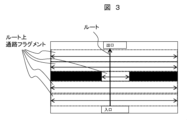
- FIG. 3 is a diagram showing the establishment of passage fragments in the building of FIG. 2 .
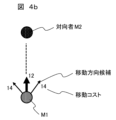
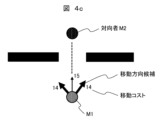
- FIG. 13 is a diagram showing the concept of determining the movement direction of a human model in a normal state. 13 is a diagram showing that an oncoming vehicle M2 has been detected ahead in the direction of movement. 13 is a diagram showing that an oncoming person M2 is detected in the direction of movement at a bottleneck portion.
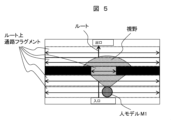
- FIG. FIG. 1 is a diagram showing a first method for identifying a bottleneck.
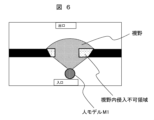
- FIG. 13 is a diagram showing a second method for identifying a bottleneck.
- FIG. 11 is a diagram showing a processing flow in a preparatory stage.
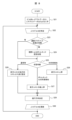
- FIG. 4 is a diagram showing a processing flow during a simulation.
- FIG. 1 is a diagram showing an example of the configuration of a simulation device according to a first embodiment of the present invention.
- the simulation device 1 is configured by connecting a storage unit DB, a calculation unit 12, and an input/output device 13 to a bus 14.
- the storage unit DB stores layout information D1 of the environment to be simulated, and a human model D2 that moves in that environment. Functionally expressing the processing content of the calculation unit 12, it can be said that the calculation unit 12 has each of the processing units, a bottleneck detection unit 121, a human movement direction determination unit 122, and a human movement execution unit 123.
- the input/output device 13 includes an input unit 131 that sets the appropriate simulation conditions, and an output unit (display unit) 132 that outputs the input setting data and simulation results.
- the building shown in the plan view of Figure 2 which is an example of an environment to be simulated, has multiple entrances A and B. Entrance A faces, for example, an external corridor, and entrance B is where an elevator is installed to move to each floor in the building. Although the illustration is simplified here, other entrances may include stairs, and there may be multiple entrances. Note that because the building in Figure 2 has a security gate G installed between entrances A and B, the area on the plan view is divided into passable and non-passable areas.
- the setup procedure is roughly divided into three steps.
- First, the architectural layout is set by referring to architectural drawings and setting the layout of each floor in the building as well as the floor dimensions and height.
- the building facilities are set by arranging various building facilities such as elevators, escalators, security gates, automatic doors, etc. and setting the specifications for each.
- the movement of people is set by setting the entrances and doorways for rooms and setting the number of people moving from where to where and how many people.
- layout information D1 is formed in the memory unit of Figure 1 as shown in Figure 2, and in more detail in the present invention, it is formed and stored as shown in Figure 3.
- Figure 2 the layout and floor dimensions and height of each floor in the building are set, but in Figure 3, the area between entrances A and B is further divided into multiple areas in the direction of people movement, and information including distances in perpendicular directions is provided. This is done by setting multiple passage fragments on the route of people movement (for example, the shortest distance between entrances A and B), and calculating the horizontal distance for each passage fragment.
- entrances and room doorways are set, and the number of people moving from where to where is set. Note that information on entrances and room doorways is managed as part of the layout information D1.
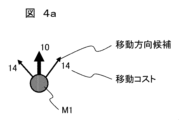
- Figure 4a is a diagram showing the concept for determining the movement direction of a human model under normal circumstances.
- eight directions front, back, left, right, left, front, back
- a cost is set for each direction.
- the cost is set by size, and normally, if 10 is set in the forward direction, a value greater than 10 is set for the other directions.
- the front and the left and right forward directions are shown in Figure 4a, but the left and right forward directions are set to 14, which is greater than 10. After such settings, the direction with the lowest cost is set as the traveling direction.
- the cost of the detection direction is revised to be higher than the initial setting value of 10, for example to 12.
- the revised cost is set to 12
- the direction of movement of the human model can be set to take evasive action in the left or right forward direction, etc., in accordance with the principle that the direction with the lowest cost is the direction of travel.
- information on the human model M1 in which human movement settings have been made is stored for each individual person.
- This information includes the number of people in a time series, their respective entry and exit routes, destinations, cost information by direction, walking speed, etc.
- the bottleneck detection unit 121 in the calculation unit 12 detects bottlenecks on the route to the destination.
- a bottleneck is a location or position where, for example, an obstacle or narrow section is present in the environment, which can cause a counterflow and lead to congestion or jams, and a place that is likely to show such a tendency is set as a bottleneck environment.
- the human model M1 moves along a route (a straight line with the shortest distance) from its current position (e.g., building entrance/exit A) to its destination, entrance/exit B, and the presence or absence of a bottleneck on this route is set in advance.
- its current position e.g., building entrance/exit A
- its destination e.g., entrance/exit B
- the presence or absence of a bottleneck on this route is set in advance.
- Method 2 of bottleneck identification is a method that does not use the advance preparation information (distance information for each passage fragment) in Figure 3.
- distance information for each passage fragment distance information for each passage fragment
- Figure 6 when determining the direction of movement of a person during the simulation, if there is an area of a certain area or more that the person cannot enter within a certain range ahead (field of vision), it is determined to be a bottleneck.
- the bottleneck detection unit 121 in the calculation unit 12 detects bottlenecks in the preparation stage before the simulation is executed, or detects bottlenecks during the simulation.
- the people movement direction determination unit 122 in FIG. 1 determines the direction of people movement in the simulation by setting costs.
- the cost operation when an oncoming person is detected in the movement direction as described in FIG. 4b is also a process performed by the people movement direction determination unit 122.
- an oncoming person M2 is detected in the movement direction at a bottleneck.
- the person movement direction determination unit 122 detects that such a situation has occurred in the simulation and executes a cost operation as shown in Figure 4c. This serves to strengthen the lane formation effect (parameters for avoiding oncoming people) when a bottleneck is detected in the person's travel direction. Specifically, when a bottleneck is detected, a larger cost than usual is applied in the direction where the oncoming person M2 is located, making it easier to determine the next movement direction.
- the avoidance direction should be determined according to the principle of keeping to the right of way, which creates a lane formation effect for the entire environment and makes it cheaper. Also, the narrower the bottleneck, the higher the cost should be set. Furthermore, in Figure 6, the area in the field of view where the oncoming vehicle M2 is located should also be treated as a no-entry area. When determining the direction of movement, the cost applied in the direction where the oncoming vehicle M2 is located should be inversely proportional to the size of the no-entry area in the field of view.
- the forward cost is set lower than the cost for other directions, and the cost is increased depending on the presence of oncoming vehicles or bottlenecks, with the direction with the lower cost being the direction of travel; however, this may be reversed.
- the same can be done by setting the forward cost higher than the cost for other directions, and the cost is decreased depending on the presence of oncoming vehicles or bottlenecks, with the direction with the higher cost being the direction of travel.
- the present invention is characterized in that when a bottleneck is detected ahead of a person's movement direction during person movement processing, the effectiveness of avoiding oncoming vehicles is increased more than usual.
- the effectiveness of avoiding oncoming vehicles is also increased by increasing the cost of the location where the oncoming vehicle is located and the location ahead of the oncoming vehicle in inverse proportion to the width of the bottleneck.
- the effectiveness of avoiding oncoming vehicles is also increased by increasing the cost of the location where the oncoming vehicle is located and the location ahead of the oncoming vehicle in inverse proportion to the area of the impassable area within the person's field of vision.
- Example 2 a simulation method is described.
- Figure 7 shows the process flow in the preparatory stage, and
- Figure 8 shows the process flow during the simulation.
- the building layout is set, in processing step S12 the building facilities are set, and in processing step S13 the movement of people is set.
- layout information D1 and a human model D2 are formed in processing step S14, and each is stored in the memory unit.
- processing step S15 it is determined whether or not to perform aisle fragment processing. If so, in processing step S16, the aisle fragment processing is executed to identify the width, and then in processing step S17, it is determined that the position is a bottleneck based on the identified width, and this is stored as part of the layout information D1.
- FIG 8 which shows the processing during the simulation, first in processing step S21, layout information D1 of the environment in which people flow processing is performed and human model D2 are obtained. In processing step S22, the processing is repeated while changing the human model M1 and the processing time up to processing step S30. Note that the environment, and therefore the layout, are assumed to be specified.
- processing step S23 it is determined whether or not the passing fragment process has been performed. If it has not been performed, in processing step S24, bottleneck recognition processing based on the field of view is performed. If it has been performed, or after processing step S24 has been performed, the process moves to processing step S25.
- the current state is judged based on the presence of an oncoming person M2 for the selected human model M1 and the bottleneck confirmation state. This distinguishes between three states: normal (no bottleneck, no oncoming person), oncoming person detected, and oncoming person detected and bottleneck state.
- the cost in the forward direction is set lower than in other directions in processing step S26, and when it is detected that an oncoming vehicle M2 is present in the direction of movement, the cost in the forward direction is increased in processing step S28, and when an oncoming vehicle is detected and a bottleneck condition exists, the cost in the forward direction is significantly increased in processing step S27.
- processing step S29 where a direction of travel is determined according to the cost, and the human model is moved in the determined direction of travel.
- This process is the process of the human movement execution unit 123 in FIG. 1.
- Processing step S30 is a process for determining the end of the repetition, and the above process is repeated for the set number of human models over the simulation period while changing the time. This repetitive process is also executed on the time axis, resulting in a simulation of the flow of people over time.
Landscapes
- Engineering & Computer Science (AREA)
- Business, Economics & Management (AREA)
- Human Resources & Organizations (AREA)
- Economics (AREA)
- Strategic Management (AREA)
- Marketing (AREA)
- Game Theory and Decision Science (AREA)
- Entrepreneurship & Innovation (AREA)
- Development Economics (AREA)
- Operations Research (AREA)
- Quality & Reliability (AREA)
- Tourism & Hospitality (AREA)
- Physics & Mathematics (AREA)
- General Business, Economics & Management (AREA)
- General Physics & Mathematics (AREA)
- Theoretical Computer Science (AREA)
- Management, Administration, Business Operations System, And Electronic Commerce (AREA)
Abstract
Description
Claims (6)
- 人流を模擬するシミュレーション装置であって、
前記シミュレーション装置は記憶部と、シミュレーションの制御部とを備え、
前記記憶部は、レイアウト情報と、前記レイアウト情報内においてどこに向かうかを示す目的地情報と現在の位置情報を少なくとも保持する人モデルを記憶し、
前記制御部は、前記人モデルの移動方向前方の一定範囲内に人モデルの流量が制限されるボトルネックが検出される場合に、前記ボトルネックを検出していない場合から前記人モデルの移動制御を変更することを特徴とする、シミュレーション装置。 - 請求項1に記載のシミュレーション装置であって、
前記制御部は、前記ボトルネックを検出するボトルネック検出部と、前記人モデルの周囲の複数方向にコストを設定し、前記コストの大小により移動方向を決定する人移動方向決定部と、シミュレーション上で前記人モデルを移動させる人移動実行部を備え、
前記人移動方向決定部は、前記人モデルが現在位置から目的位置に至るルート上に対向者を検知するときに前記人モデルの前方方向の前記コストを第1の値に変更し、前記ボトルネックを検出しかつ前記ルート上に前記対向者を検知するときに前記人モデルの前方方向のコストを第2の値に変更することを特徴とするシミュレーション装置。 - 請求項2に記載のシミュレーション装置であって、
前記ボトルネック検出部は、検出したボトルネックの位置情報を前記記憶部に保存し、前記人移動方向決定部は、前記記憶部に記憶された前記ボトルネックの位置情報を参照することを特徴とするシミュレーション装置。 - 請求項2に記載のシミュレーション装置であって、
前記ボトルネック検出部は、シミュレーション中における、前記人モデルの移動方向決定時に前方の一定範囲内に前記人モデルの侵入できない領域が一定面積以上あれば、当該領域を前記ボトルネックとして検出することを特徴とするシミュレーション装置。 - 請求項2に記載のシミュレーション装置であって、
前記ボトルネックにより前記人モデルの通過幅が狭まるときに、通過幅に応じて前記第2の値を可変にすることを特徴とするシミュレーション装置。 - 人流を模擬するシミュレーション方法であって、
前記シミュレーション方法は記憶方法と、シミュレーションの制御方法とを備え、
前記記憶方法は、任意のレイアウト、及び前記レイアウト内のどこに向かうかを示す目的地情報と現在の位置情報を少なくとも保持する人モデルを記憶し、
前記制御方法は前記人モデルの視野の範囲に通路幅が狭いボトルネック領域が検出される場合に、対向者を避ける効果を通常より強めることを特徴とする、シミュレーション方法。
Priority Applications (3)
| Application Number | Priority Date | Filing Date | Title |
|---|---|---|---|
| CN202280101783.5A CN120188178A (zh) | 2022-11-18 | 2022-11-18 | 模拟装置以及模拟方法 |
| PCT/JP2022/042827 WO2024105877A1 (ja) | 2022-11-18 | 2022-11-18 | シミュレーション装置、及びシミュレーション方法 |
| JP2024558618A JPWO2024105877A1 (ja) | 2022-11-18 | 2022-11-18 |
Applications Claiming Priority (1)
| Application Number | Priority Date | Filing Date | Title |
|---|---|---|---|
| PCT/JP2022/042827 WO2024105877A1 (ja) | 2022-11-18 | 2022-11-18 | シミュレーション装置、及びシミュレーション方法 |
Publications (1)
| Publication Number | Publication Date |
|---|---|
| WO2024105877A1 true WO2024105877A1 (ja) | 2024-05-23 |
Family
ID=91084116
Family Applications (1)
| Application Number | Title | Priority Date | Filing Date |
|---|---|---|---|
| PCT/JP2022/042827 Ceased WO2024105877A1 (ja) | 2022-11-18 | 2022-11-18 | シミュレーション装置、及びシミュレーション方法 |
Country Status (3)
| Country | Link |
|---|---|
| JP (1) | JPWO2024105877A1 (ja) |
| CN (1) | CN120188178A (ja) |
| WO (1) | WO2024105877A1 (ja) |
Citations (3)
| Publication number | Priority date | Publication date | Assignee | Title |
|---|---|---|---|---|
| WO2018211599A1 (ja) * | 2017-05-16 | 2018-11-22 | 富士通株式会社 | シミュレーションプログラム、シミュレーション方法およびシミュレーション装置 |
| JP2020077222A (ja) * | 2018-11-08 | 2020-05-21 | 株式会社日立製作所 | 歩行者シミュレーション装置 |
| JP2021135705A (ja) * | 2020-02-26 | 2021-09-13 | トヨタテクニカルディベロップメント株式会社 | 情報処理装置、情報処理方法及び情報処理プログラム |
-
2022
- 2022-11-18 CN CN202280101783.5A patent/CN120188178A/zh active Pending
- 2022-11-18 JP JP2024558618A patent/JPWO2024105877A1/ja active Pending
- 2022-11-18 WO PCT/JP2022/042827 patent/WO2024105877A1/ja not_active Ceased
Patent Citations (3)
| Publication number | Priority date | Publication date | Assignee | Title |
|---|---|---|---|---|
| WO2018211599A1 (ja) * | 2017-05-16 | 2018-11-22 | 富士通株式会社 | シミュレーションプログラム、シミュレーション方法およびシミュレーション装置 |
| JP2020077222A (ja) * | 2018-11-08 | 2020-05-21 | 株式会社日立製作所 | 歩行者シミュレーション装置 |
| JP2021135705A (ja) * | 2020-02-26 | 2021-09-13 | トヨタテクニカルディベロップメント株式会社 | 情報処理装置、情報処理方法及び情報処理プログラム |
Also Published As
| Publication number | Publication date |
|---|---|
| CN120188178A (zh) | 2025-06-20 |
| JPWO2024105877A1 (ja) | 2024-05-23 |
Similar Documents
| Publication | Publication Date | Title |
|---|---|---|
| Zhu et al. | Behavioral, data-driven, agent-based evacuation simulation for building safety design using machine learning and discrete choice models | |
| Bernardini et al. | Intelligent evacuation guidance systems for improving fire safety of Italian-style historical theatres without altering their architectural characteristics | |
| Hidas | Modelling vehicle interactions in microscopic simulation of merging and weaving | |
| Ronchi et al. | Modelling total evacuation strategies for high-rise buildings | |
| Ban | A game theoretical approach for modelling merging and yielding behaviour at freeway on-ramp sections | |
| Marzouk et al. | Integrated agent-based simulation and multi-criteria decision making approach for buildings evacuation evaluation | |
| Abdelghany et al. | A hybrid simulation-assignment modeling framework for crowd dynamics in large-scale pedestrian facilities | |
| JP6143077B2 (ja) | 避難行動予測システム及び避難行動予測プログラム | |
| Chu et al. | SAFEgress: a flexible platform to study the effect of human and social behaviors on egress performance | |
| Pascucci et al. | A discrete choice model for solving conflict situations between pedestrians and vehicles in shared space | |
| Boguslawski et al. | A dynamic approach for evacuees' distribution and optimal routing in hazardous environments | |
| JP3371226B2 (ja) | 媒体効果確認シミュレータ、媒体による効果のシミュレーション方法、および、記憶媒体 | |
| Babojelić et al. | Modelling of driver and pedestrian behaviour–a historical review | |
| Ronchi et al. | Assessment of total evacuation systems for tall buildings | |
| Haghpanah et al. | Application of bug navigation algorithms for large-scale agent-based evacuation modeling to support decision making | |
| Shao et al. | A Discretionary Lane‐Changing Decision‐Making Mechanism Incorporating Drivers’ Heterogeneity: A Signalling Game‐Based Approach | |
| JP2017224201A (ja) | シミュレーションプログラム、シミュレーション方法およびシミュレーション装置 | |
| WO2024105877A1 (ja) | シミュレーション装置、及びシミュレーション方法 | |
| CN110347157A (zh) | 一种巡检路径规划方法、装置、设备及存储介质 | |
| JPH07225612A (ja) | 時間軸を探索空間に取り入れた経路探索方法,及び装置 | |
| Nassar et al. | Assessing sign occlusion in buildings using discrete event simulation | |
| WO2024105878A1 (ja) | シミュレーション装置、及びシミュレーション方法 | |
| WO2012069272A1 (de) | Verfahren und system zur routenberechnung | |
| Andresen | Wayfinding and perception abilities for pedestrian simulations | |
| CN115285146A (zh) | 车辆交互方法、装置、电子设备及自动驾驶车辆 |
Legal Events
| Date | Code | Title | Description |
|---|---|---|---|
| 121 | Ep: the epo has been informed by wipo that ep was designated in this application |
Ref document number: 22965853 Country of ref document: EP Kind code of ref document: A1 |
|
| WWE | Wipo information: entry into national phase |
Ref document number: 2024558618 Country of ref document: JP |
|
| WWE | Wipo information: entry into national phase |
Ref document number: 202280101783.5 Country of ref document: CN |
|
| NENP | Non-entry into the national phase |
Ref country code: DE |
|
| WWP | Wipo information: published in national office |
Ref document number: 202280101783.5 Country of ref document: CN |
|
| 122 | Ep: pct application non-entry in european phase |
Ref document number: 22965853 Country of ref document: EP Kind code of ref document: A1 |