WO2024100950A1 - 送信装置 - Google Patents
送信装置 Download PDFInfo
- Publication number
- WO2024100950A1 WO2024100950A1 PCT/JP2023/029311 JP2023029311W WO2024100950A1 WO 2024100950 A1 WO2024100950 A1 WO 2024100950A1 JP 2023029311 W JP2023029311 W JP 2023029311W WO 2024100950 A1 WO2024100950 A1 WO 2024100950A1
- Authority
- WO
- WIPO (PCT)
- Prior art keywords
- communication
- parameter
- transmitting device
- information
- calculation unit
- Prior art date
- Legal status (The legal status is an assumption and is not a legal conclusion. Google has not performed a legal analysis and makes no representation as to the accuracy of the status listed.)
- Ceased
Links
Images




Classifications
-
- H—ELECTRICITY
- H04—ELECTRIC COMMUNICATION TECHNIQUE
- H04L—TRANSMISSION OF DIGITAL INFORMATION, e.g. TELEGRAPHIC COMMUNICATION
- H04L27/00—Modulated-carrier systems
-
- H—ELECTRICITY
- H04—ELECTRIC COMMUNICATION TECHNIQUE
- H04W—WIRELESS COMMUNICATION NETWORKS
- H04W28/00—Network traffic management; Network resource management
- H04W28/16—Central resource management; Negotiation of resources or communication parameters, e.g. negotiating bandwidth or QoS [Quality of Service]
- H04W28/18—Negotiating wireless communication parameters
-
- H—ELECTRICITY
- H04—ELECTRIC COMMUNICATION TECHNIQUE
- H04W—WIRELESS COMMUNICATION NETWORKS
- H04W28/00—Network traffic management; Network resource management
- H04W28/16—Central resource management; Negotiation of resources or communication parameters, e.g. negotiating bandwidth or QoS [Quality of Service]
- H04W28/24—Negotiating SLA [Service Level Agreement]; Negotiating QoS [Quality of Service]
-
- H—ELECTRICITY
- H04—ELECTRIC COMMUNICATION TECHNIQUE
- H04W—WIRELESS COMMUNICATION NETWORKS
- H04W52/00—Power management, e.g. Transmission Power Control [TPC] or power classes
- H04W52/04—Transmission power control [TPC]
- H04W52/18—TPC being performed according to specific parameters
- H04W52/24—TPC being performed according to specific parameters using SIR [Signal to Interference Ratio] or other wireless path parameters
-
- H—ELECTRICITY
- H04—ELECTRIC COMMUNICATION TECHNIQUE
- H04W—WIRELESS COMMUNICATION NETWORKS
- H04W84/00—Network topologies
- H04W84/02—Hierarchically pre-organised networks, e.g. paging networks, cellular networks, WLAN [Wireless Local Area Network] or WLL [Wireless Local Loop]
- H04W84/10—Small scale networks; Flat hierarchical networks
-
- H—ELECTRICITY
- H04—ELECTRIC COMMUNICATION TECHNIQUE
- H04W—WIRELESS COMMUNICATION NETWORKS
- H04W84/00—Network topologies
- H04W84/18—Self-organising networks, e.g. ad-hoc networks or sensor networks
- H04W84/20—Leader-follower arrangements
Definitions
- the present invention relates to a transmitting device.
- This application claims priority to Japanese Patent Application No. 2022-178234, filed in Japan on November 7, 2022, the contents of which are incorporated herein by reference.
- the effect may not be sufficient if the battery capacity of the device is sufficiently large or if the device is connected to a power supply source.
- one of the original functions of a wireless communication system is wireless communication function.
- the power reduced due to wireless communication interference is better distributed not simply to suppress power consumption but to improve wireless communication function.
- resources become surplus due to restrictions on a specific function of the wireless communication system it is possible to save (or store) the surplus resources rather than using them, but it is unclear whether this will be effective enough.
- the present invention aims to provide a wireless communication technology that, when a specific function of a wireless communication system is restricted, can improve wireless communication functions by allocating surplus resources to other uses.
- One aspect of the present invention is a transmitting device that performs information communication with one or more receiving devices, the transmitting device including: a communication history information acquiring unit that acquires communication history information in which communication parameters for performing the information communication are associated with a degradation rate, which is a value based on radio waves transmitted using the communication parameters when transmitting information to the receiving device and radio waves received from the receiving device; a calculation unit that calculates values of the communication parameters including a second parameter and a third parameter based on the acquired communication history information so that a first parameter, which is a value obtained as a result of the information communication, is approximately constant; and an output unit that outputs the calculated communication parameters, wherein both the second parameter and the third parameter are related to the information communication.
- the second parameter is a parameter that is controlled according to the communication environment
- the third parameter is a parameter related to communication quality
- the calculation unit calculates the value of the communication parameter so that the difference between the value of the first parameter and a preset target value becomes small.
- the target value is a constant value.
- the transmitting device further includes a receiving unit that receives information indicating whether reception was successful or not from a specific receiving device among one or more receiving devices that are communication targets, and the calculation unit calculates the value of the communication parameter based on the information acquired by the receiving unit.
- the calculation unit calculates the total data transfer volume received by one or more receiving devices that are communication targets based on the information acquired by the receiving unit, and calculates the communication parameters so as to increase the total data transfer volume received by the receiving devices.
- the calculation unit calculates the frequency of reception by one or more receiving devices that are communication targets based on the information acquired by the receiving unit, and calculates the communication parameters so as to increase the frequency of reception by the receiving devices.
- the calculation unit calculates the communication parameters so as to maximize the total number of receiving devices that are communication targets.
- the first parameter includes at least one of the power consumption of the transmitting device, the success rate of the information communication, the quality of the received data, the bit error rate, or the packet error rate.
- the second parameters include at least one of a communication channel, a transmission power, a packet size, and a modulation method.
- the third parameter includes at least one of a transmission frequency, a bandwidth, an encoding method, and a transmission power.
- the calculation unit changes the second parameter to reduce the first parameter, which is the power consumption of the transmission device, and changes the third parameter to increase the first parameter.
- the calculation unit calculates the communication parameters to improve the communication quality of the receiving device that is present within a predetermined physical range.
- the calculation unit reduces the transmission power as the second parameter when the communication environment deteriorates, and increases the transmission power as the third parameter when the communication environment is good.
- the second parameter and the third parameter each include a plurality of components
- the calculation unit selects one combination from among the combinations of the plurality of components included in the second parameter and the third parameter, respectively.
- the calculation unit uses a machine learning algorithm to learn based on the deterioration rate obtained as a result of the information communication using the communication parameters output by the output unit.
- the machine learning algorithm is a reinforcement learning algorithm.
- the calculation unit is trained using a multi-armed bandit algorithm.
- the calculation unit learns using the TOW algorithm.
- the information communication is wireless communication conforming to the BLE (Bluetooth Low Energy) standard.
- One aspect of the present invention is a transmitting device according to any one of (1) to (20) above, wherein the communication method used for the information communication includes advertising defined in the BLE standard, and the second parameters include at least a communication channel as an advertising channel defined in the BLE standard.
- the wireless communication function when a specific function of a wireless communication system is restricted, the wireless communication function can be improved by allocating the resources that become surplus due to the restriction to other functions.
- FIG. 2 is a diagram for explaining an example of a device configuration of a communication system according to an embodiment.
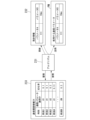
- FIG. 2 is a diagram for explaining an example of information communication in the communication system according to the embodiment.
- FIG. 2 is a block diagram showing an example of a functional configuration of a transmission device according to an embodiment.
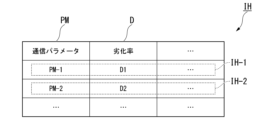
- FIG. 4 is a diagram illustrating an example of communication history information according to the embodiment.
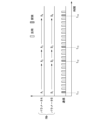
- 6 is a timing chart showing an example of control of communication parameters according to the embodiment.
- 1 is a first timing chart for explaining details of an example of control of communication parameters according to an embodiment
- 11 is a second timing chart for explaining details of an example of control of communication parameters according to the embodiment.
- the communication system 1 is a diagram for explaining an example of a device configuration of a communication system according to an embodiment.
- the communication system 1 will be explained with reference to the diagram.
- the communication system 1 includes a transmitting device 20 and a receiving device 30.
- the transmitting device 20 and the receiving device 30 communicate information with each other.
- the communication system 1 may include a plurality of transmitting devices 20 and a plurality of receiving devices 30.
- each transmitting device 20 communicates information with one or more receiving devices 30.
- a case where one transmitting device 20 and a plurality of receiving devices 30 are included will be described as an example of the communication system 1.
- receiving devices 30-1, 30-2, and 30-3 are included as an example of the receiving devices 30 will be described.
- the transmitting device 20 and the receiving device 30 communicate information with each other through short-range wireless communication.
- Bluetooth registered trademark
- BLE Bluetooth Low Energy
- the short-distance wireless communication in this embodiment is not limited to an example of BLE, and various communication methods can be adopted.
- the short-distance wireless communication may be Wi-Fi (registered trademark), IrDA (Infrared Data Association), TransferJet (registered trademark), ZigBee (registered trademark), NFC (Near Field Communication), etc.
- the wireless communication is not limited to short distances, and may be LPWA (Low Power Wide Area), etc.
- the transmitting device 20 may be a peripheral (or a broadcaster) and the receiving device 30 may be a central (or a scanner).
- the transmitting device 20, which is a peripheral transmits transmission information IS without identifying the receiving device 30.
- the receiving device 30 that is present near the transmitting device 20 receives the transmission information IS, it transmits reception information IR.
- the information communication between the transmitting device 20 and the receiving device 30 may be a communication method in which a plurality of communication channels are defined within a predetermined frequency band.
- the transmitting device 20 and the receiving device 30 may exchange information using advertisement packets in wireless communication conforming to the BLE standard.
- the transmitting device 20 transmits the transmission information IS based on the communication parameters calculated by the algorithm 231.
- the communication parameters may be, for example, a frequency band used for communication, a signal transmission interval or number of transmissions, or transmission power.
- the transmitting device 20 includes a control unit 21 and a wireless communication unit 22 .
- the wireless communication unit 22 controls radio waves to be transmitted from the antenna 221 based on communication parameters acquired from the control unit 21.
- the wireless communication unit 22 also outputs information based on the radio waves received by the antenna 221 to the control unit 21.
- the control unit 21 includes an algorithm 231 and calculates communication parameters. By including the algorithm 231, the control unit 21 calculates communication parameters based on communication history information 233. The control unit 21 updates the calculated communication parameters as guideline information 232 as needed. The control unit 21 outputs the calculated communication parameters to the wireless communication unit 22. Furthermore, the control unit 21 acquires information on radio waves received by the antenna 221 from the wireless communication unit 22. The control unit 21 updates the guideline information 232 based on the deterioration rate included in the acquired radio wave information.
- the deterioration rate is a value indicating the degree of deterioration of communication quality, and may be calculated, for example, based on whether the transmission information IS transmitted by the transmitting device 20 reaches any of the receiving devices 30.
- the deterioration rate may be a value indicating whether communication between the transmitting device 20 and the receiving device 30 is successful or not.
- the deterioration rate may be a binary value.
- the control unit 21 calculates it based on a control signal (e.g., an ACK signal) that is returned when the receiving device 30 correctly receives the transmission information IS.
- the control signal is received by the wireless communication unit 22.
- the wireless communication unit 22 can also be said to be a receiving unit that receives information indicating the deterioration rate.
- the receiving unit receives information indicating whether reception was successful or not from a specific receiving device 30 among one or more receiving devices 30 that are communication targets.
- the presence or absence of a scan response request to a BLE advertising packet may be used as the deterioration rate, or the presence or absence of a connection request from the central (i.e., the receiving device 30) may be used as the deterioration rate.
- the receiving device 30 may communicate whether or not it has correctly received the transmission information IS using a different communication means rather than wireless communication. If the receiving device 30 has correctly received the transmission information IS, the control unit 21 sets the deterioration rate to a low value. If the receiving device 30 has correctly received the transmission information IS, the control unit 21 may set the deterioration rate to 0 (zero).
- the deterioration rate may be based on information regarding the strength of radio waves contained in the radio waves received by the antenna 221 from the receiving device 30.
- the information regarding the strength of radio waves may be, for example, RSSI (Received Signal Strength Indicator) or the like.
- the receiving device 30 has a radio wave strength measuring unit (not shown) and measures the radio wave strength when the transmission information IS is received.
- the receiving device 30 transmits the measured radio wave strength to the transmitting device 20 as reception information IR.
- the control unit 21 sets the deterioration rate higher as the radio wave strength contained in the received reception information IR is lower. In other words, a smaller deterioration rate indicates that the radio waves transmitted to the receiving device 30 are not degraded.
- the deterioration rate may be calculated from the error rate when the receiving device 30 receives information encoded with an error detection code or an error correction code.
- the control unit 31 included in the receiving device 30 calculates the error rate of the transmission information IS obtained from the transmitting device 20.
- the receiving device 30 transmits the calculated error rate to the transmitting device 20 as the reception information IR.
- the control unit 21 included in the transmitting device 20 sets the deterioration rate higher as the error rate included in the received reception information IR is higher.
- the signal transmitted to the receiving device 30 based on the output communication parameters is encoded using an encoding method with an error detection function, and the degradation rate is based on the error rate when the signal received from the receiving device 30 is decoded.
- the receiving device 30 includes a control unit 31 and a wireless communication unit 32 .
- the wireless communication unit 32 receives radio waves from the transmission device 20 via the antenna 321.
- the control unit 31 calculates the radio wave intensity (RSSI) and the error rate of the received radio waves based on the information of the received radio waves input from the wireless communication unit 32.
- the wireless communication unit 32 outputs the radio wave intensity, the error rate, and the like calculated by the control unit 31 as reception information IR.
- the transmitting device 20 and the receiving device 30 may have the same device configuration. That is, in the communication system 1, a device that behaves as a transmitter at a certain point in time is referred to as the transmitting device 20, and a device that receives radio waves transmitted by the transmitting device 20 is referred to as the receiving device 30. In the following description, when there is no need to distinguish between the transmitting device 20 and the receiving device 30, they are also referred to as the communication device 10.
- the transmission device 20 includes a control unit 21 and a wireless communication unit 22.
- the transmission device 20 includes a central processing unit (CPU) (not shown), a storage device such as a read only memory (ROM) or a random access memory (RAM) connected by a bus, and functions as a device including the control unit 21 and the wireless communication unit 22 by executing a transmission program.
- the control unit 21 includes a communication history information acquisition unit 211 , a calculation unit 212 , an output unit 213 , and a memory control unit 215 .
- all or part of the functions of the transmitting device 20 may be realized using hardware such as an ASIC (Application Specific Integrated Circuit), a PLD (Programmable Logic Device), or an FPGA (Field-Programmable Gate Array).
- the transmission program may be recorded on a computer-readable recording medium. Examples of computer-readable recording media include portable media such as flexible disks, optical magnetic disks, ROMs, and CD-ROMs, and storage devices such as hard disks built into a computer system.
- the transmission program may be transmitted via a telecommunications line.
- the communication history information acquisition unit 211 acquires the communication history information IH.
- the communication history information IH is stored in the communication history information storage unit 25.
- the communication history information storage unit 25 may be provided in the transmitting device 20, or may be provided in a device connected to the transmitting device 20 via a specified communication network.
- the communication history information storage unit 25 may be configured to include a volatile RAM (Random Access Memory) or a non-volatile ROM (Read Only Memory).
- the figure shows an example of a case where the communication history information storage unit 25 is provided in a device connected to the transmitting device 20 via a specified communication network.
- the communication history information IH is information that associates the communication parameters PM for performing information communication with the deterioration rate D when the information communication is performed using the communication parameters PM.
- the deterioration rate D is a value based on the radio waves transmitted using the communication parameters PM when transmitting information to the receiving device 30, and the radio waves received from the receiving device 30.
- FIG. 4 is a diagram showing an example of communication history information according to the embodiment.
- the communication history information IH will be described with reference to the figure.
- the communication history information storage unit 25 stores communication history information IH in association with a communication parameter PM and a deterioration rate D.
- the communication parameter PM-1 and the deterioration rate D1 are associated with each other and stored as communication history information IH-1
- the communication parameter PM-2 and the deterioration rate D2 are associated with each other and stored as communication history information IH-2.
- the calculation unit 212 determines communication parameters based on the accumulated communication parameters PM and the deterioration rate D, which is the result of information communication using the communication parameters PM.
- FIG. 5 is a diagram showing an example of communication parameters according to an embodiment. Elements included in the communication parameters PM will be described with reference to the figure. Note that the communication parameters PM need only include at least parameters used in information communication, and the description given with reference to the figure does not limit the aspects of this embodiment.
- the communication parameters PM include a first parameter PM1, a second parameter PM2, and a third parameter PM3.
- the first parameter PM1 is a value obtained as a result of the transmitting device 20 performing information communication using the second parameter PM2 and the third parameter PM3.
- the value obtained as a result of performing information communication does not require actual measurement, but includes a value that would be obtained as a result if information communication were performed.
- the parameter value included in the first parameter PM1 may be a measured value or an estimated value.
- the first parameter PM1 includes at least one of "power consumption”, “success rate”, “bit rate” and "BER/PER".
- Power consumption is the value of power that would be consumed when the transmitting device 20 performs information communication using the corresponding second parameter PM2 and third parameter PM3.
- Successess rate is the probability that information communication will be successful when the transmitting device 20 performs information communication using the corresponding second parameter PM2 and third parameter PM3.
- the “success rate” may be calculated from a measured value based on past history, or may be an estimated value calculated by a predetermined calculation method.
- the "bit rate” is the number of bits transmitted per unit time when the transmitting device 20 performs information communication using the corresponding second parameter PM2 and third parameter PM3.
- the “bit rate” may also be the number of bits of received data obtained from the receiving device 30 per unit time as a result of transmission by the transmitting device 20 (i.e., the quality of the received data).
- the "BER/PER” indicates either the BER (Bit Error Rate; bit error rate or code error rate) or the PER (Packet Error Rate; packet error rate) when the transmitting device 20 performs information communication using the corresponding second parameter PM2 and third parameter PM3. Note that the details of the parameters included in the first parameter PM1 are not limited to the example shown in the figure, and the first parameter PM1 may include various other parameters.
- the second parameter PM2 is related to the information communication performed by the transmitting device 20.
- the second parameter PM2 is a parameter controlled according to the communication environment of the information communication performed by the transmitting device 20. Specifically, the second parameter PM2 is a parameter controlled to maintain the information communication when the communication environment deteriorates or improves.
- the second parameter PM2 includes at least one of "communication channel", "transmission power", "packet size” and "modulation method".
- the "communication channel” indicates the channel used for the information communication. For example, in the case of BLE advertising as an example of the information communication according to this embodiment, the advertising channels include three channels, 37ch (2402MHz), 38ch (2426MHz) and 39ch (2480MHz).
- the "communication channel” indicates which channel is used for the information communication.
- the "communication channel” does not have to be one, and may indicate which of multiple channels is enabled.
- the “packet size” is the size of the packet used for the information communication.
- the “transmission power” indicates the power of the radio wave transmitted by the transmitting device 20.
- the “packet size” may be selectable, for example, from 20 Bytes to 512 Bytes.
- the “packet size” may be the maximum transmission unit (MTU), which is the upper limit size of a packet in BLE.
- the “modulation method” may be selectable from modulation methods such as GFSK, DQPSK, or 8PS.
- the "modulation method" may be fixed to GFSK or may include setting values such as a modulation index and symbol timing.
- the details of the parameters included in the second parameter PM2 are not limited to the example shown in the figure, and the second parameter PM2 may include various other parameters.
- the third parameter PM3 is related to the information communication performed by the transmitting device 20.
- the third parameter PM3 is a parameter related to the communication quality of the information communication performed by the transmitting device 20.
- the third parameter PM3 is a parameter for improving or lowering the communication quality.
- the third parameter PM3 includes at least one of "transmission frequency", "bandwidth", and "encoding method".
- "Transmission frequency” is the frequency at which packets used in information communication are transmitted. Increasing the "transmission frequency” can improve the communication quality, and decreasing the "transmission frequency” can decrease the communication quality. Taking BLE advertising as an example of information communication according to this embodiment, the "transmission frequency” may be the advertising interval.
- “Bandwidth” is the width of the frequency used by the channel used for information communication.
- Encoding method is the encoding method used for information communication. “Bandwidth” and “encoding method” may or may not be configurable depending on the communication standard of the information communication. Note that the details of the parameters included in the third parameter PM3 are not limited to the example shown in the figure, and the third parameter PM3 may include various other parameters.
- transmission power may be included in the third parameter PM3 in addition to or instead of being included in the second parameter PM2. Increasing the transmission power improves communication quality because radio waves can be transmitted over long distances. On the other hand, decreasing the transmission power reduces communication quality because radio waves can only be transmitted close by. In other words, communication quality can be controlled by controlling the transmission power.
- the calculation unit 212 calculates the communication parameters PM used when communicating with the receiving device 30 based on the communication history information IH acquired by the communication history information acquisition unit 211.
- the communication history information IH includes a deterioration rate D based on the information acquired by the receiving unit.
- the calculation unit 212 can be said to calculate the value of the communication parameters PM based on the information acquired by the receiving unit.
- the communication parameters PM include a first parameter PM1, a second parameter PM2, and a third parameter PM3.
- the first parameter PM1 indicates a value obtained as a result of information communication, so the calculation unit 212 calculates the second parameter PM2 and the third parameter PM3. Specifically, the calculation unit 212 calculates the value of the second parameter PM2 and the value of the third parameter PM3 so that the first parameter PM is approximately constant.
- the approximately constant range may be a range in which the value of the first parameter PM1 obtained by combining the value of the second parameter PM2 and the value of the third parameter PM3 can be the value closest to the set value.
- the first parameter PM1 may be made an approximately constant value.
- the substantially constant range may be within a predetermined threshold value.
- the predetermined threshold value may have a certain width.
- the threshold value may be set to a lower limit value and an upper limit value in addition to a central value.
- the calculation unit 212 compares the value of the first parameter PM1 with a predetermined threshold value (central value).
- the threshold value may also be described as a target value.
- the calculation unit 212 determines the values of the second parameter PM2 and the third parameter PM3 so that the difference obtained as a result of the comparison is small.
- the calculation unit 212 may end the calculation when the value of the first parameter PM1 falls within a range determined by the upper limit value and the lower limit value of the threshold value as a result of the calculation, and determine the values of the second parameter PM2 and the third parameter PM3.
- the threshold (target value) of the first parameter PM1 may be a predetermined fixed value, or may be changed by some parameter.
- the threshold of the first parameter PM1 may be a value that changes over time as the transmitting device 20 deteriorates.
- the threshold may be configured to increase as power consumption increases, since power consumption generally increases with the product lifespan.
- the threshold value of the first parameter PM1 may be configured to be arbitrarily set by the user.
- the user can arbitrarily set whether to prioritize communication quality (communication quality priority mode) or power consumption (eco mode), etc. This setting may be performed at the time of shipment from the factory, or may be performed at any timing by equipping the transmitting device 20 with a predetermined operation acquisition means.
- the calculation unit 212 performs a calculation to improve the communication quality. Specifically, improving the communication quality may mean increasing the total amount of data transfer received by one or more receiving devices 30 that are communication targets. In this case, the calculation unit 212 calculates the total amount of data transfer received by one or more receiving devices 30 that are communication targets based on the communication history information IH, and calculates the communication parameter PM so that the total amount of data transfer received by the receiving device 30 increases.
- the calculation performed by the calculation unit 212 may be, for example, calculating the communication parameter PM that will increase the total amount of data based on whether an OK or NG response has been returned from n receiving devices 30 (n is a natural number equal to or greater than 1) out of the target receiving devices 30.
- the calculation unit 212 may calculate the communication parameter PM so that the total number of receiving devices 30 that are communication targets (the total number of receiving devices 30 that return a response) is maximized.
- the calculation unit 212 increases the transmission frequency at which radio waves are transmitted, for example, in order to improve communication quality. In other words, the calculation unit 212 increases the transmission frequency, thereby increasing the frequency at which the receiving device 30 receives radio waves. In this case, the calculation unit 212 calculates the frequency at which one or more receiving devices 30, which are communication targets, receive radio waves, and calculates a communication parameter PM so as to increase the frequency at which the receiving device 30 receives radio waves.
- the calculation unit 212 calculates the communication parameters PM using a machine learning algorithm.
- the machine learning algorithm may be a reinforcement learning algorithm that uses state information, such as Q-learning or deep reinforcement learning.
- state information such as Q-learning or deep reinforcement learning.
- the machine learning algorithm uses the deterioration rate D as a reward and learns the communication parameters PM for maximizing the reward.
- the machine learning algorithm may be a trained model that has been trained in advance. During initial operation, the machine learning algorithm may be untrained, and when the machine learning algorithm is untrained, the result may be determined by a random number.
- the machine learning algorithm learns based on the communication history information IH.
- the communication history information IH is information that associates the communication parameters PM output by the output unit 213 with the deterioration rate D obtained as a result of communicating information using the communication parameters PM.
- the calculation unit 212 learns based on the deterioration rate D obtained as a result of communicating information using the communication parameters PM output by the output unit 213.
- a location information beacon can be exemplified as an example of information transmitted by the transmitting device 20.
- Specific examples of location information beacons include beacons that include promotional information and information necessary to access the promotional information, and beacons that include information necessary to provide audio guidance.
- the specific distribution range may be the range reached by radio waves, and is physically defined in advance based on the location of the transmitting device 20.
- the calculation unit 212 calculates the communication parameter PM to improve the communication quality of the receiving device 30 that is present within a predetermined physical range.
- the calculation unit 212 outputs parameter information IP including the calculated communication parameters PM to the output unit 213.
- the output unit 213 outputs parameter information IP including the communication parameters PM calculated by the calculation unit 212 to the wireless communication unit 22 .
- the wireless communication unit 22 communicates information with the receiving device 30 based on the communication parameters PM included in the parameter information IP output by the output unit 213 .
- the memory control unit 215 acquires the degradation information ID including the degradation rate D from the wireless communication unit 22.
- the memory control unit 215 associates the acquired degradation information ID with the communication parameters PM and stores it in the communication history information storage unit 25 as communication history information IH.
- the memory control unit 215 acquires parameter information IP from at least one of the output unit 213 or the wireless communication unit 22, generates communication history information IH by associating the communication parameters PM included in the acquired parameter information IP with the degradation rate D, and stores the generated communication history information IH in the communication history information storage unit 25.
- [Series of operations of the transmitting device] 6 is a diagram for explaining a series of operations of the transmission device according to the embodiment. An example of the operation of the transmission device 20 will be described with reference to the same figure.
- the transmission device 20 is provided with an algorithm 231.
- the communication history information 233 is an example of the communication history information IH stored in the communication history information storage unit 25.
- the algorithm 231 accumulates communication history information 233 based on the communication parameters PM used by the transmitting device 20 for communication.
- the communication history information 233 associates a communication parameter identifier (parameter identifier) PMID that identifies the communication parameters PM, a deterioration rate D, and a time.
- the time is the time when information communication was performed using the communication parameters PM identified by the parameter identifier PMID, or the time when the deterioration rate D was obtained as a result of performing information communication.
- the algorithm 231 searches for communication parameters PM. Specifically, the algorithm 231 repeats a "search” operation to learn suitable communication parameters and a "use” operation to communicate using the communication parameters PM determined in the search, thereby deriving optimal communication parameters at the time of information communication. For example, when the algorithm 231 verifies interference in wireless communication, it adjusts the communication parameters to reduce power consumption while allocating the reduced power consumption to other functions, thereby improving wireless communication functions without increasing power consumption.
- FIG. 7 is a diagram for explaining the search and utilization of communication parameters according to the embodiment.
- the “search” and “utilization” of the algorithm 231 will be explained with reference to the same figure.
- “Parameter A” and “Parameter B” are examples of communication parameters PM. That is, in the example described with reference to the same figure, the communication parameters PM have two parameters. The change in each parameter over time is shown with the horizontal axis representing time.
- “Communication” shows whether the algorithm 231 is “exploring” or “utilizing” with the horizontal axis representing time.
- “Exploration” is shown with a solid rectangle, and “utilization” is shown with a hollow rectangle.
- the algorithm 231 performs "search”.
- the algorithm 231 determines the value of parameter A to be "A1" and the value of parameter B to be "B1".
- the transmitting device 20 performs information communication using the determined communication parameters PM. That is, from time t11 to time t12, the algorithm 231 performs "utilization”.
- the algorithm 231 "searches" for more suitable communication parameters PM based on the communication history information IH accumulated as a result of being "utilized” from time t11 to time t12 .
- the algorithm 231 changes the value of parameter A from “A1” to “A2” and the value of parameter B from “B1" to “B2". From time t12 to time t13 , the transmitting device 20 performs information communication using the determined communication parameters PM.
- the algorithm 231 searches" for more suitable communication parameters PM based on the communication history information IH accumulated as a result of being "utilized” from time t11 to time t12 and from time t12 to time t13 .
- the algorithm 231 changes the value of parameter A from “A2" to "A3” and the value of parameter B from "B2" to "B3".
- the transmitting device 20 performs information communication using the determined communication parameters PM.
- the algorithm 231 repeats "search” and "utilization” to derive suitable communication parameters PM, and performs information communication based on the derived communication parameters PM.
- the timings for performing the "search" ie, time t11 , time t12 , time t13 , and time t14 , are predetermined timings determined by the algorithm 231.
- the timings for performing the "search” may be irregular, as in this example, or may be regular.
- the algorithm 231 is a machine learning algorithm. More specifically, the algorithm 231 may be a MAB (Multi Armed Bandit) algorithm or the like. That is, the calculation unit 212 may learn using the MAB algorithm (multi-armed bandit algorithm). By using the MAB algorithm, the transmitting device 20 can reliably transmit information to the receiving device 30 with low power consumption.
- MAB Multi Armed Bandit
- the MAB algorithm will be described below.
- the MAB algorithm is an algorithm used to solve the problem of maximizing rewards within a limited number of trials when there are multiple slot machines with unknown reward probabilities.
- the amount of reward must be set in consideration of the trade-off between the power consumption required for transmission and whether or not the receiving device 30 has correctly received information.
- the transmitting device 20 obtains the amount of power required for communication using a predetermined method.
- the transmitting device 20 may measure the amount of power actually consumed, for example, by including a power meter (not shown).
- the transmitting device 20 may also store a power consumption correspondence table (not shown) in which communication parameters PM are associated with estimated amounts of power consumption, and obtain the amount of power by referring to the power consumption correspondence table.
- algorithm 231 which is the MAB algorithm, determines the communication parameters PM so as to reduce power consumption, making it possible to suppress the amount of power required for transmission. Since a lower degradation rate D means that information was transmitted with higher quality (i.e., more reliably), it is desirable to increase the amount of reward as the degradation rate D decreases.
- the algorithm 231 configures the communication history information IH using the calculated deterioration rate D.
- the communication history information IH may be time-series data of the deterioration rate D.
- the algorithm 231 determines suitable communication parameters PM based on the communication history information IH, which is time-series data of the deterioration rate D.
- the communication history information IH may be a single value calculated based on the deterioration rate D accumulated in the past.
- the communication history information IH may be acquired from another device.
- the other device may be, for example, the receiving device 30. That is, in another example, the receiving device 30 stores the communication history information IH instead of the transmitting device 20. In this case, the receiving device 30 may count the number of times that it was able to receive information from the transmitting device 20 without missing any information, and estimate the degradation rate based on the counted number. In this case, the receiving device 30 transmits the communication history information IH to the transmitting device 20 at a predetermined timing.
- the algorithm 231 changes the communication parameters PM at time 3 and tries it (i.e., performs a search).
- the communication history information IH is added and updated (i.e., accumulated) each time a new communication parameter PM is applied.
- the algorithm 231 updates the guideline information 232 based on the accumulated communication history information 233.
- the guideline information 232 includes information required to determine how to set the communication parameters PM.
- the algorithm 231 determines the communication parameters PM based on the updated guideline information 232, and performs communication using the determined communication parameters PM.
- the algorithm 231 learns the communication history of the transmitting device 20 based on the communication history information IH, and updates the guideline information 232 for determining the communication parameters PM.
- the MAB algorithm described above or the like is used for "learning” and “updating the guideline.”
- the “updating of the guideline” may be performed every time the transmitting device 20 transmits information, i.e., every time the communication history information IH is updated, or may be performed after a predetermined amount of communication history information IH has been accumulated.
- the algorithm 231 can select one from all possible combinations of the communication parameters PM.
- the algorithm 231 calculates the communication parameters PM by selecting one combination from among combinations of multiple components included in the communication parameters PM.
- the communication parameters PM have components x, y, and z.
- the algorithm can determine the communication parameters PM by selecting one from 18 (3 x 2 x 3) combinations. With this configuration, the algorithm 231 can easily select the optimal communication parameters PM consisting of multiple elements.
- the algorithm 231 may use an upper confidence bound (UCB) algorithm.
- the calculation unit 212 performs learning using the UCB algorithm.
- a lighter TOW (Tug Of War) algorithm can be used as the algorithm 231.
- the calculation unit 212 learns using the TOW algorithm.
- the UCB algorithm referred to here includes the UCB1 algorithm, the UCB1-tuned algorithm, and the like.
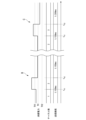
- [Communication standard] 8 is a timing chart showing an example of the timing of data transmitted by a transmitting device according to an embodiment.
- a communication standard used by the communication system 1 will be described.
- three channels, 37ch (2402MHz), 38ch (2426MHz), and 39ch (2480MHz), which are advertising channels used for advertising BLE, are shown as communication channels.
- the horizontal axis shows the time change of data transmitted to each channel.
- the wireless communication unit 22 outputs data A to 37ch at time t21 , to 38ch at time t22 , and to 39ch at time t23 . After outputting data A to each channel, the wireless communication unit 22 outputs data A again to each channel after the advertising interval period. Specifically, the wireless communication unit 22 outputs data A to 37ch at time t24 , to 38ch at time t25 , and to 39ch at time t26 . The wireless communication unit 22 repeats the transmission of data A to each channel until a predetermined number of transmissions is reached.
- the predetermined number of transmissions and the advertising interval period may be preferably included in the communication parameters PM. Furthermore, the predetermined number of transmissions and the advertising interval period may more preferably be included in the third parameter PM3.
- advertisement processing is performed for each of the multiple advertising channels that exist. For example, it is performed separately for the three advertising channels, 37, 38, and 39.
- each channel may interfere with other radio waves present in space. If interference occurs on all three channels, or if the receiving device 30 is not ready to receive, a situation will occur in which the information transmitted by the transmitting device 20 does not reach the receiving device 30. To prepare for such a situation, packets in which the same data is encoded are periodically transmitted multiple times. Note that a case in which the receiving device is not ready to receive is when the BLE receiving side (central) performs intermittent reception operations to reduce power consumption, for example.
- the channel mask is a communication parameter for determining a channel to be used when using a communication method in which multiple channels are defined within a band to be used.
- the communication parameters PM may include a channel mask for determining a channel to be used.
- the channel specified by the channel mask may be a channel that is not used for communication.
- the communication channel may be an advertising channel defined in the BLE standard.
- the advertising may be connection-available advertising.
- the deterioration rate D may be a value calculated based on whether or not a connection request has been responded to.
- the calculation unit 212 determines the communication parameters PM so that the deterioration rate D decreases when communication is performed with a specific counterpart receiving device 30 via a channel mask included in the calculated communication parameters PM.
- BLE advertising processing is performed separately for the three advertising channels 37, 38, and 39. At this time, if channel 38 is masked, advertising processing is performed using channels 37 and 39, and if channels 38 and 39 are masked, advertising processing is performed using channel 37.
- channels 38 and 39 are masked, advertising processing is performed using channel 37.
- the fewer channels used the less power required for transmission can be reduced, but on the other hand, there is a trade-off in that the probability that information cannot be transmitted due to interference increases.
- transmitting device 20 cannot know the state of the communications environment in advance, by "utilizing" and “searching" for channel masks, it is possible to adapt to the communications environment in which it is located and select a suitable channel mask that transmits information with optimal power consumption.
- the channel mask it is preferable to adjust the channel mask so that more channels are used for information communication when the degradation rate D increases. Also, when the degradation rate D is deemed to be sufficiently small, it is preferable to reduce the channels used for communication and suppress power consumption. These are contradictory, and it is preferable for algorithm 231 to appropriately update the channel mask, taking into account the trade-off between reliable information transmission and power consumption.
- advertising may accept a scan request.
- the central receiving the advertising packet may send a scan request, and the degradation rate D may be calculated based on whether the scan request is responded to.
- the degradation rate D may be calculated based on the number of times a specific receiving device 30 receives the advertising packet.
- the transmitting device 20 determines the number of channels to be used using a channel mask, and improves communication functions by using the excess power consumption resulting from the reduced number of channels to change other parameter values included in the communication parameters PM.
- the components of the transmitting device 20 have been described as the communication parameters PM, the components of the receiving device 30 may also be used as communication parameters.
- the components of the receiving device 30 may be, for example, the ON duty ratio of the communication section of the receiving device 30, the number of stages of a multi-stage amplifier, the response speed of a reply to a received packet, etc.
- [An example of communication parameter control] 9 is a timing chart showing an example of control of communication parameters according to an embodiment.
- a specific example of control of communication parameters PM will be described with reference to the same figure.
- the horizontal axis shows the time for the temporal changes of the communication environment, power consumption, number of channels, and transmission frequency.
- Power consumption is an example of a first parameter PM1
- the number of channels is an example of a second parameter PM2
- the transmission frequency is an example of a third parameter PM3.
- the same figure shows an example of advertising in the BLE standard, so it can be said that the second parameter PM2 includes at least a communication channel as an advertising channel defined in the BLE standard.
- the transmitting device 20 can indirectly determine the communication environment based on the degradation rate D stored in the communication history information storage unit 25, but it is not necessary to determine the communication environment.
- the communication environment changes in an analog manner from moment to moment due to various external factors, but in the illustrated example, for the sake of explanation, it is represented by two values, good or bad. Examples of external factors that affect the communication environment include the communication time period, day of the week, seasonal and weather changes, the presence of other devices, etc.
- the transmitting device 20 reduces the number of channels used as communication channels from 3 to 1, so power consumption decreases. However, the transmitting device 20 simultaneously or almost simultaneously increases the transmission frequency from 1/200 ms to 1/100 ms, so power consumption increases. As a result of the transmitting device 20 changing the number of channels and the transmission frequency simultaneously or almost simultaneously, power consumption increases. The details of the change in power consumption at time point A will be described with reference to FIG. 10.
- FIG. 10 is a first timing chart for explaining details of an example of communication parameter control according to an embodiment.
- the figure shows details of the power consumption, number of channels, and time-dependent changes in transmission frequency at time point A.
- the transmitting device 20 controls the number of channels, which is the second parameter PM2, and the transmission frequency, which is the third parameter PM3, so that the power consumption, which is the first parameter PM1, is approximately equal to the threshold value TH.
- An upper threshold value TH1 and a lower threshold value TH2 may be set as approximately the same range.
- the transmitting device 20 increases the transmission frequency within a range in which the power consumption is between the upper threshold TH1 and the lower threshold TH2, thereby improving the communication quality. Specifically, at time t32, the transmitting device 20 increases the transmission frequency from 1/200 [ms] to 1/100 [ms], thereby increasing the power consumption.
- the increased power consumption at time t32 is between the upper threshold TH1 and the lower threshold TH2, it can be said that it is in approximately the same range as the value before time t31.
- a predetermined time is provided between the change in the number of channels and the change in the transmission frequency for the sake of explanation, but the change in the number of channels and the change in the transmission frequency may be performed simultaneously.
- the control of the second parameter PM2, the number of channels, and the third parameter PM3, the transmission frequency, is performed by the calculation unit 212.
- the calculation unit 212 changes the second parameter PM2 (e.g., the number of channels) to reduce the first parameter PM1 (e.g., the power consumption of the transmitting device 20), and changes the third parameter PM3 (e.g., the transmission frequency) to increase the first parameter PM1.
- the calculation unit 212 may determine the values of the second parameter PM2 and the third parameter PM3 based on a table prepared in advance.
- the table prepared in advance may determine the value of the first parameter PM1 according to a combination of multiple values that the second parameter PM2 may contain as components and multiple values that the third parameter PM3 may contain as components.
- the calculation unit 212 may select one combination from the combinations of multiple components included in the second parameter PM2 and the third parameter PM3, respectively.
- the transmitting device 20 increases the number of channels used as communication channels from 1 to 2, so power consumption increases. However, the transmitting device 20 simultaneously or almost simultaneously increases the transmission frequency from 1/100 ms to 1/150 ms, so power consumption decreases. As a result of the transmitting device 20 changing the number of channels and the transmission frequency simultaneously or almost simultaneously, power consumption decreases.
- the transmitting device 20 increases the number of channels used as communication channels from 2 to 3, so power consumption increases.
- the transmitting device 20 simultaneously or almost simultaneously increases the transmission frequency from 1/150 [ms] to 1/200 [ms], so power consumption decreases.
- the transmitting device 20 changing the number of channels and the transmission frequency simultaneously or almost simultaneously, power consumption decreases. The details of the change in power consumption at time points B and C will be described with reference to FIG. 11.
- FIG. 11 is a second timing chart for explaining details of an example of communication parameter control according to an embodiment. The figure shows details of the changes over time in power consumption, number of channels, and transmission frequency at time points B and C.
- the transmitting device 20 reduces the transmission frequency within a range where the power consumption is between the upper threshold TH1 and the lower threshold TH2, thereby degrading the communication quality. Specifically, at time t42, the transmitting device 20 reduces the transmission frequency from 1/100 [ms] to 1/150 [ms], thereby reducing the power consumption.
- the reduced power consumption at time t42 is between the upper threshold TH1 and the lower threshold TH2, and therefore can be said to be in approximately the same range as the value before time t41.
- the transmission device 20 increases the number of channels from 1 to 2, but the degradation rate D is not sufficiently improved, so at time C, the number of channels is further increased from 2 to 3, and the degradation rate D is further improved.
- the number of channels used for information communication is 2, and the transmission frequency is 1/150 [ms].
- the power consumption is between the upper threshold TH1 and the lower threshold TH2.
- the transmitting device 20 reduces the transmission frequency within a range where the power consumption is between the upper threshold TH1 and the lower threshold TH2, thereby degrading the communication quality.
- the transmitting device 20 reduces the transmission frequency from 1/150 [ms] to 1/200 [ms], thereby reducing the power consumption.
- the reduced power consumption at time t52 is between the upper threshold TH1 and the lower threshold TH2, and therefore can be said to be in approximately the same range as the value before time t51.
- time point D Details regarding time point D are the same as those for time point A, so we will omit the explanation here.
- the calculation unit 212 may determine the degree of the communication environment based on the degradation rate D, and change the transmission power based on the determined degree. That is, the transmission power may be the second parameter PM2 for reducing the first parameter PM1, or the third parameter PM3 for increasing the first parameter PM1. In this case, the calculation unit 212 may reduce the transmission power as the second parameter PM2 when the communication environment has deteriorated, and may increase the transmission power as the third parameter PM3 when the communication environment is good.
- the transmitting device 20 and the receiving device 30 may communicate information by wired communication.
- the communication parameters may include a communication interval, a transmission power, and, if the communication is multiplexed, a channel. In this case, information can be transmitted with minimum power consumption while avoiding interference from other devices connected on the same line.
- An example of wired communication may be a one-to-multiple or many-to-multiple wired communication method such as a bus connection, a star connection, or a mesh connection. Specifically, communication methods such as the Internet, I2C (Inter-Integrated Circuit), SPI (Serial Peripheral Interface), and CAN (Controller Area Network) may be used.
- the transmitting device 20 includes the communication history information acquiring unit 211, and acquires the communication history information IH in which the communication parameters PM for performing information communication and the deterioration rate D, which is a value based on the radio waves transmitted using the communication parameters PM when transmitting information to the receiving device 30 and the radio waves received from the receiving device 30, are associated with each other. Furthermore, the transmitting device 20 includes the computing unit 212, and based on the acquired communication history information IH, calculates the values of the communication parameters PM including the second parameter PM2 and the third parameter PM3 so that the first parameter PM1, which is a value obtained as a result of the information communication, is substantially constant, and includes the output unit 213, and outputs the calculated communication parameters PM.
- both the second parameter PM2 and the third parameter PM3 are related to information communication. Even if a specific function of the wired communication system is restricted, the transmitting device 20 can keep the measured value obtained as a result of the information communication constant by adjusting the parameters related to the information communication. Therefore, according to this embodiment, the surplus resources can be allocated to other resources, and as a result, the wireless communication function can be improved.
- examples of wireless communication functions improved by the transmitting device 20 include redundancy, amount of information, and reception frequency.
- the required degree of redundancy varies depending on the environment in which the transmitting device 20 is placed, but this degree cannot be known in advance. Therefore, according to this embodiment, the transmitting device 20 appropriately selects communication parameters PM to adapt to the environment in which it is placed. At that time, the transmitting device 20 changes the balance between redundancy/information amount and reception frequency so as to keep the value of the first parameter PM1 constant. By performing such processing, it is possible to maximize communication functions according to the surrounding environment while keeping the value of the first parameter PM1 constant.
- the second parameter PM2 is a parameter that is controlled in response to the communication environment
- the third parameter PM3 is a parameter related to communication quality. That is, the transmitting device 20 keeps the value obtained as a result of information communication constant by controlling the parameter that is controlled in response to the communication environment and the parameter related to communication quality. Therefore, according to this embodiment, even if the communication environment changes, the transmitting device 20 can improve communication quality while keeping the value obtained as a result of information communication constant in response to the changed communication environment.
- the calculation unit 212 calculates the value of the communication parameter PM so that the difference between the value of the first parameter PM1 and a preset threshold TH is small. Therefore, according to this embodiment, the transmission device 20 can maintain the value obtained as a result of information communication at a predetermined constant value. Furthermore, the calculation unit 212 can maintain the value of the first parameter PM1 constant by comparing the difference between the value of the first parameter PM1 and a preset threshold with the threshold, thereby making the calculation easier.
- the threshold value of the first parameter PM1 is a constant value.
- the threshold value of the first parameter PM1 is a constant value that does not change over time. Therefore, according to this embodiment, the transmitting device 20 can always keep the value obtained as a result of information communication constant.
- the transmitting device 20 includes a receiving unit, and receives information indicating whether reception was successful or not from a specific receiving device 30 among one or more receiving devices 30 that are communication targets, and the calculation unit 212 calculates the value of the communication parameter PM based on the information acquired by the receiving unit.
- the information acquired by the receiving unit can also be said to be a value obtained as a result of information communication. Therefore, according to this embodiment, the transmitting device 20 can perform control based on actual feedback, and can more accurately maintain the value of the first parameter PM1 constant.
- the calculation unit 212 calculates the total data transfer amount received by one or more receiving devices 30 that are communication targets based on the information acquired by the receiving unit, and calculates the communication parameter PM so as to increase the total data transfer amount received by the receiving device 30. Therefore, according to this embodiment, the transmitting device 20 can improve responsiveness by increasing the data transfer amount received by the receiving device 30. Also, according to this embodiment, the transmitting device 20 can increase the number of receiving devices 30 to which radio waves are transmitted.
- the calculation unit 212 calculates the frequency of reception by one or more receiving devices 30 that are communication targets based on the information acquired by the receiving unit, and calculates the communication parameter PM so as to increase the frequency of reception by the receiving device 30. Therefore, according to this embodiment, the transmitting device 20 can increase the amount of data transfer and improve responsiveness by improving the frequency of reception by the receiving device 30. Also, according to this embodiment, the transmitting device 20 can increase the number of receiving devices 30 to which radio waves are transmitted.
- the calculation unit 212 calculates the communication parameter PM so that the total number of receiving devices 30 to which communication is targeted is maximized. Therefore, according to this embodiment, the transmitting device 20 can maximize the number of receiving devices 30 to which radio waves are targeted.
- the first parameter PM1 includes at least one of the power consumption of the transmitting device 20, the success rate of information communication, the quality of received data, the bit error rate, or the packet error rate. Therefore, according to this embodiment, the transmitting device 20 can improve communication quality while keeping constant at least one of the power consumption, the success rate of information communication, the quality of received data, the bit error rate, or the packet error rate.
- the second parameter PM2 includes at least one of the communication channel, transmission power, packet size, and modulation method. Therefore, according to this embodiment, the transmitting device 20 can adjust at least one of the values of the transmission power, packet size, and modulation method while keeping the value of the first parameter PM1 constant.
- the third parameter PM3 includes at least one of the transmission frequency, the bandwidth, the encoding method, and the transmission power. Therefore, according to this embodiment, the transmitting device 20 can adjust at least one of the values of the transmission frequency, the bandwidth, the encoding method, and the transmission power while keeping the value of the first parameter PM1 constant.
- the calculation unit 212 changes the second parameter PM2 to reduce the first parameter PM1, which is the power consumption of the transmitting device 20, and changes the third parameter PM3 to increase the first parameter PM1. Therefore, according to this embodiment, even if the power consumption of the first parameter PM1 is reduced by changing the second parameter PM2, the transmitting device 20 can increase the power consumption of the first parameter PM1 by changing the third parameter PM3, and as a result, the power consumption of the transmitting device 20 can be kept constant.
- the calculation unit 212 calculates the communication parameters PM so as to improve the communication quality of the receiving device 30 present within a preset physical range.
- the preset physical range is, for example, within the range where radio waves can reach.
- the calculation unit 212 can prevent interference with other stores or other sections by improving the communication quality of the receiving device 30 present within the preset physical range.
- the transmitting device 20 uses the reduced power consumption by restricting the channels used according to the surrounding environment and adaptively changing the transmission strength of the beacon, for example, to improve the transmission frequency of the beacon. By performing such communication parameter selection PM, the transmission frequency of the beacon can be improved without reducing the battery life, and the frequency with which the transmitting device 20 receives the beacon can be improved.
- the beacon can be received earlier than usual when approaching a specific store, and promotional information can be quickly presented to the user.
- a voice guidance beacon can immediately suggest voice guidance to the user when approaching the section in which it is installed, thereby improving the user experience.
- the location information beacons transmitted by the transmitting device 20 include beacons that include information necessary to prevent loss of items, to grasp locations over a wide area, and to provide traffic congestion information.
- the channels used may be limited according to the surrounding environment as explained above, and the power usage reduced thereby may be used, for example, to improve the frequency of beacon transmission or transmission strength.
- the communication parameters PM By selecting the communication parameters PM in this way, it is possible to improve the frequency of beacon transmission without reducing battery life. Furthermore, by selecting the communication parameters PM in this way, it is possible to make the beacon reach as wide an area as possible, and to improve the frequency with which receivers over a wide area receive the beacon.
- a beacon designed to prevent loss can notify the user of its presence from as far away as possible and as quickly as possible, even if the object to which the device is attached is located far from the user.
- location beacons can be broadcast to a sufficient distance within a large area, and the location update rate can be increased.
- a beacon used to provide traffic congestion information can similarly transmit beacons far away and frequently, so the intervals at which transmitting devices 20 can be installed can be increased, reducing the effort and cost of installation and the costs associated with maintenance.
- the transmitting device 20 may use the reduced power consumption by adapting to the communication environment to increase the transmission strength of the beacon.
- the calculation unit 212 when the communication environment deteriorates, the calculation unit 212 reduces the transmission power as the second parameter PM2, and when the communication environment is good, the calculation unit 212 increases the transmission power as the third parameter PM3. That is, according to this embodiment, the transmission power can be either the second parameter PM2 or the third parameter PM3. Therefore, according to this embodiment, the value of the transmission power can be kept constant while keeping the value of the first parameter PM1 constant.
- the second parameter PM2 and the third parameter PM3 each include multiple components.
- the calculation unit 212 performs calculations by selecting one combination from among the combinations of multiple components included in the second parameter PM2 and the third parameter PM3, respectively. Therefore, according to the transmission device 20, even if the communication parameter PM includes multiple elements, it is possible to simplify the algorithm to one that selects one from multiple combinations, thereby making the algorithm 231 lighter.
- the calculation unit 212 uses a machine learning algorithm to learn based on the deterioration rate D obtained as a result of communicating information using the communication parameters PM output by the output unit 213. Therefore, by being equipped with the calculation unit 212, the transmission device 20 does not simply select communication parameters, but repeats utilization and search. Therefore, according to the transmission device 20, by repeating utilization and search, even if the surrounding environment in which the transmission device 20 is placed changes, it is possible to communicate information while maintaining reliability and suppressing power consumption.
- the machine learning algorithm is a reinforcement learning algorithm. Since the transmitting device 20 performs learning using a reinforcement learning algorithm based on the results of its own communications, learning does not require much time. Therefore, according to this embodiment, it is possible to reduce the cost and effort required for learning. Furthermore, by using a reinforcement learning algorithm, the transmitting device 20 can perform learning that is specialized for the location where the transmitting device 20 is installed.
- the calculation unit 212 learns using the MAB algorithm (multi-armed bandit algorithm). Therefore, the transmission device 20 can be made lighter, smaller, and have a longer life.
- the calculation unit 212 learns using a lightweight TOW algorithm. Therefore, according to the transmission device 20, even a microcomputer with low specifications can operate the algorithm 231.
- the information communication performed between the transmitting device 20 and the receiving device 30 is wireless communication that complies with the BLE standard. Because BLE has low power consumption, the transmitting device 20 can suppress power consumption by performing wireless communication that complies with BLE. Furthermore, the transmitting device 20 can perform information communication with the receiving device 30 that complies with BLE by performing wireless communication that complies with BLE.
- the information communication carried out between the transmitting device 20 and the receiving device 30 is advertising defined in the BLE standard.
- the communication channel is an advertising channel defined in the BLE standard. According to the transmitting device 20, by masking the advertising channel, it is possible to transmit a BLE advertising packet to the surrounding receiving device 30 (central) with the minimum necessary power consumption.
- each device and each part of each device in the communication system 1 in the above-mentioned embodiment may be realized by recording a program for realizing these functions on a computer-readable recording medium, and having a computer system read and execute the program recorded on the recording medium.
- the "computer system” referred to here includes hardware such as the OS and peripheral devices.
- “computer-readable recording medium” refers to portable media such as flexible disks, optical magnetic disks, ROMs, and CD-ROMs, as well as storage units such as hard disks built into computer systems.
- “computer-readable recording medium” may also include devices that dynamically store programs for a short period of time, such as communication lines when transmitting programs via networks such as the Internet or communication lines such as telephone lines, and devices that store programs for a certain period of time, such as volatile memory within a computer system that serves as a server or client in such cases.
- the above-mentioned programs may be ones that realize some of the functions described above, or may be ones that can realize the functions described above in combination with programs already recorded in the computer system.
- the wireless communication function when a specific function of a wireless communication system is restricted, the wireless communication function can be improved by allocating the resources that become surplus due to the restriction to other functions.
- 1...communication system 10...communication device, 20...transmitting device, 30...receiving device, 21...controller, 211...communication history information acquisition unit, 212...calculation unit, 213...output unit, 215...storage control unit, 22...wireless communication unit, 221...antenna, 231...algorithm, 232...guideline information, 233...communication history information, 25...communication history information storage unit, 31...controller, 32...wireless communication unit, 321...antenna, IH...communication history information, PM...communication parameter, PM1...first parameter, PM2...second parameter, PM3...third parameter, D...deterioration rate
Landscapes
- Engineering & Computer Science (AREA)
- Computer Networks & Wireless Communication (AREA)
- Signal Processing (AREA)
- Quality & Reliability (AREA)
- Mobile Radio Communication Systems (AREA)
Abstract
送信装置は、一以上の受信装置との間で情報通信を行う送信装置であって、前記情報通信を行うための通信パラメータと、前記受信装置に情報を送信する際に前記通信パラメータを用いて送信された電波と前記受信装置から受信した電波とに基づく値である劣化率とが対応付けられた通信履歴情報を取得する通信履歴情報取得部と、取得した前記通信履歴情報に基づき、前記情報通信の結果として得られる値である第1のパラメータが略一定となるよう第2のパラメータと第3のパラメータとを含む前記通信パラメータの値を演算する演算部と、演算された前記通信パラメータを出力する出力部とを備え、前記第2のパラメータ及び前記第3のパラメータは、いずれも前記情報通信に関連するものである。
Description
本発明は、送信装置に関する。
本願は、2022年11月7日に日本に出願された特願2022-178234について優先権を主張し、その内容をここに援用する。
本願は、2022年11月7日に日本に出願された特願2022-178234について優先権を主張し、その内容をここに援用する。
従来、送信装置と受信装置とを備える無線通信システムにおいて、送信装置から受信装置へ情報を送信する際、周波数が異なる複数のチャネルを使用して無線通信する方法があった。このような無線通信システムにおいて、無線通信の干渉が検出された場合、検出されたチャネルを使用しないことにより、不要な電力消費を防ぐ技術があった(例えば、特許文献1を参照)。
上述したような従来技術により電力消費量が軽減された場合であっても、装置のバッテリ容量が十分に大きい場合や、装置が電力供給源に接続されているような場合においては、十分にその効果が得られない場合があった。ここで、無線通信システムの本来の機能の1つは無線通信機能である。無線通信の干渉が生じたことにより軽減された電力は、単に電力消費を抑止するためではなく、無線通信機能を向上させるために分配された方がよい場合がある。また、上述したような消費電力の一例に限定されず、無線通信システムが有する特定の機能が制限されたことにより、リソースが余剰となってしまう場合がある。余剰となったリソースを使用せず、節約する(又は蓄える)ことも考えられるが、十分にその効果が得られるか否かは不明である。
そこで、本発明は、無線通信システムが有する特定の機能が制限された場合、制限されたことにより余剰となったリソースを他に割り当てることにより無線通信機能を向上させることが可能な無線通信技術を提供することを目的とする。
(1)本発明の一態様は、一以上の受信装置との間で情報通信を行う送信装置であって、前記情報通信を行うための通信パラメータと、前記受信装置に情報を送信する際に前記通信パラメータを用いて送信された電波と前記受信装置から受信した電波とに基づく値である劣化率とが対応付けられた通信履歴情報を取得する通信履歴情報取得部と、取得した前記通信履歴情報に基づき、前記情報通信の結果として得られる値である第1のパラメータが略一定となるよう第2のパラメータと第3のパラメータとを含む前記通信パラメータの値を演算する演算部と、演算された前記通信パラメータを出力する出力部とを備え、前記第2のパラメータ及び前記第3のパラメータは、いずれも前記情報通信に関連するものである送信装置である。
(2)本発明の一態様は、上記(1)に記載の送信装置において、前記第2のパラメータとは、通信環境に応じて制御されるパラメータであって、前記第3のパラメータとは、通信品質に関連するパラメータである。
(3)本発明の一態様は、上記(1)又は(2)に記載の送信装置において、前記演算部は、前記第1のパラメータの値と予め設定された目標値との差分が小さくなるよう前記通信パラメータの値を演算するものである。
(4)本発明の一態様は、上記(3)に記載の送信装置において、前記目標値は一定の値である。
(5)本発明の一態様は、上記(1)から(4)のいずれかに記載の送信装置において、通信対象である一以上の前記受信装置のうち所定の前記受信装置から受信を成功したか否かを示す情報を受信する受信部を更に備え、前記演算部は、前記受信部により取得された情報に基づき、前記通信パラメータの値を演算するものである。
(6)本発明の一態様は、上記(5)に記載の送信装置において、前記演算部は、前記受信部により取得された情報に基づき、通信対象である一以上の前記受信装置が受信する合計のデータ転送量を演算し、前記受信装置が受信する合計のデータ転送量が増加するよう前記通信パラメータを演算するものである。
(7)本発明の一態様は、上記(5)又は(6)に記載の送信装置において、前記演算部は、前記受信部により取得された情報に基づき、通信対象である一以上の前記受信装置が受信する頻度を演算し、前記受信装置が受信する頻度が増加するよう前記通信パラメータを演算するものである。
(8)本発明の一態様は、上記(5)から(7)のいずれかに記載の送信装置において、前記演算部は、通信対象である前記受信装置の総数が最大になるように前記通信パラメータを演算するものである。
(9)本発明の一態様は、上記(1)から(8)のいずれかに記載の送信装置において、前記第1のパラメータには、送信装置の消費電力、前記情報通信の成功率、受信データの品質、符号誤り率又はパケット誤り率の少なくともいずれかが含まれるものである。
(10)本発明の一態様は、上記(1)から(9)のいずれかに記載の送信装置において、前記第2のパラメータには、通信チャネル、送信電力、パケットサイズ、変調方式の少なくともいずれかが含まれるものである
(11)本発明の一態様は、上記(1)から(10)のいずれかに記載の送信装置において、前記第3のパラメータには、送信頻度、帯域幅、符号化方式、送信電力の少なくともいずれかが含まれるものである。
(12)本発明の一態様は、上記(1)から(11)のいずれかに記載の送信装置において、前記演算部は、送信装置の消費電力である前記第1のパラメータを小さくするよう前記第2のパラメータを変化させ、前記第1のパラメータを大きくするよう前記第3のパラメータを変化させるものである。
(13)本発明の一態様は、上記(1)から(12)のいずれかに記載の送信装置において、前記演算部は、予め設定された物理的な範囲内に存在する前記受信装置の通信品質を向上させるよう前記通信パラメータを演算するものである。
(14)本発明の一態様は、上記(1)から(13)のいずれかに記載の送信装置において、前記演算部は、通信環境が悪化した場合、前記第2のパラメータとして送信電力を小さくし、通信環境が良好な場合、前記第3のパラメータとして送信電力を大きくするものである。
(15)本発明の一態様は、上記(1)から(14)のいずれかに記載の送信装置において、前記第2のパラメータ及び前記第3のパラメータは、それぞれ複数の構成要素を含み、前記演算部は、前記第2のパラメータ及び前記第3のパラメータにそれぞれ含まれる複数の構成要素の組み合わせのうち、一つの組み合わせを選択するものである。
(16)本発明の一態様は、上記(1)から(15)のいずれかに記載の送信装置において、前記演算部は、機械学習アルゴリズムを用いて、前記出力部により出力された前記通信パラメータを用いて前記情報通信した結果得られる前記劣化率に基づき学習されるものである。
(17)本発明の一態様は、上記(16)に記載の送信装置において、前記機械学習アルゴリズムは、強化学習アルゴリズムである。
(18)本発明の一態様は、上記(16)に記載の送信装置において、前記演算部は、多腕バンディットアルゴリズムを用いて学習されるものである。
(19)本発明の一態様は、上記(16)に記載の送信装置において、前記演算部は、TOWアルゴリズムを用いて学習されるものである。
(20)本発明の一態様は、上記(1)から(19)のいずれかに記載の送信装置において、前記情報通信は、BLE(Bluetooth Low Energy)規格に準拠する無線通信である。
(21)本発明の一態様は、上記(1)から(20)のいずれかに記載の送信装置において、前記情報通信に用いられる通信方法には、BLE規格で定義されるアドバタイジングが含まれ、前記第2のパラメータには、BLE規格で定義されるアドバタイジングチャネルとしての通信チャネルが少なくとも含まれるものである。
本発明によれば、無線通信システムが有する特定の機能が制限された場合、制限されたことにより余剰となったリソースを他に割り当てることにより無線通信機能を向上させることができる。
[通信システム]
以下、本発明の実施形態について、図面を参照しながら説明する。以下において説明する実施形態は一例に過ぎず、本発明が適用される実施形態は、以下の実施形態に限定されない。
以下、本発明の実施形態について、図面を参照しながら説明する。以下において説明する実施形態は一例に過ぎず、本発明が適用される実施形態は、以下の実施形態に限定されない。
図1は、実施形態に係る通信システムの装置構成の一例について説明するための図である。同図を参照しながら、通信システム1について説明する。
通信システム1は、送信装置20と、受信装置30とを備える。送信装置20と受信装置30とは、互いに情報通信を行う。通信システム1は、複数の送信装置20と、複数の受信装置30とを備えていてもよい。この場合、それぞれの送信装置20は、一以上の受信装置30との間で情報通信を行う。同図を参照しながら、通信システム1の一例として、一の送信装置20と、複数の受信装置30とを備える場合について説明する。具体的には、受信装置30の一例として、受信装置30-1と、受信装置30-2と、受信装置30-3とを備える場合について説明する。
通信システム1は、送信装置20と、受信装置30とを備える。送信装置20と受信装置30とは、互いに情報通信を行う。通信システム1は、複数の送信装置20と、複数の受信装置30とを備えていてもよい。この場合、それぞれの送信装置20は、一以上の受信装置30との間で情報通信を行う。同図を参照しながら、通信システム1の一例として、一の送信装置20と、複数の受信装置30とを備える場合について説明する。具体的には、受信装置30の一例として、受信装置30-1と、受信装置30-2と、受信装置30-3とを備える場合について説明する。
送信装置20と受信装置30とは、互いに近距離無線通信により情報通信を行う。以降の説明において、送信装置20と受信装置30とは、近距離無線通信の一例として、ブルートゥース(登録商標)(Bluetooth)の規格に準拠する無線通信、特にBLE(Bluetooth Low Energy)の規格に準拠する無線通信により情報通信を行う場合の一例について説明する。
本実施形態における近距離無線通信は、BLEの一例に限定されず、種々の通信方式を採用可能である。例えば、近距離無線通信とは、Wi-Fi(登録商標)、IrDA(Infrared Data Association)、TransferJet(登録商標)、ZigBee(登録商標)、NFC(Near Field Communication)等であってもよい。あるいは、無線通信は近距離に限定されず、LPWA(Low Power Wide Area)などであってもよい。
本実施形態における近距離無線通信は、BLEの一例に限定されず、種々の通信方式を採用可能である。例えば、近距離無線通信とは、Wi-Fi(登録商標)、IrDA(Infrared Data Association)、TransferJet(登録商標)、ZigBee(登録商標)、NFC(Near Field Communication)等であってもよい。あるいは、無線通信は近距離に限定されず、LPWA(Low Power Wide Area)などであってもよい。
通信システム1がBLEの規格に準拠する無線通信により情報通信を行う場合、送信装置20はペリフェラル(あるいはブロードキャスタ)であり、受信装置30は、セントラル(あるいはスキャナ)であってもよい。
ペリフェラルである送信装置20は、受信装置30を特定せずに送信情報ISを送信する。送信装置20の付近に存在する受信装置30は、送信情報ISを受信した場合に、受信情報IRを送信する。
送信装置20及び受信装置30の間で行われる情報通信とは、所定の周波数帯域の中で複数の通信チャネルが定義された通信方法であってもよい。例えば、送信装置20と受信装置30とは、BLEの規格に準拠する無線通信におけるアドバタイズパケットを用いて情報のやり取りを行ってもよい。
ペリフェラルである送信装置20は、受信装置30を特定せずに送信情報ISを送信する。送信装置20の付近に存在する受信装置30は、送信情報ISを受信した場合に、受信情報IRを送信する。
送信装置20及び受信装置30の間で行われる情報通信とは、所定の周波数帯域の中で複数の通信チャネルが定義された通信方法であってもよい。例えば、送信装置20と受信装置30とは、BLEの規格に準拠する無線通信におけるアドバタイズパケットを用いて情報のやり取りを行ってもよい。
図2は、実施形態に係る通信システムの情報通信の一例について説明するための図である。同図を参照しながら、通信システム1が備える送信装置20と受信装置30との間で行われる情報通信の一例について説明する。
送信装置20は、アルゴリズム231により算出された通信パラメータに基づき、送信情報ISを送信する。通信パラメータとは、例えば、通信に使用する周波数帯、信号の送信間隔や送信回数、又は送信電力等であってよい。
送信装置20は、アルゴリズム231により算出された通信パラメータに基づき、送信情報ISを送信する。通信パラメータとは、例えば、通信に使用する周波数帯、信号の送信間隔や送信回数、又は送信電力等であってよい。
送信装置20は、制御部21と、無線通信部22とを備える。
無線通信部22は、制御部21から取得した通信パラメータに基づき、アンテナ221から送信する電波を制御する。また、無線通信部22は、アンテナ221により受信した電波に基づく情報を制御部21に出力する。
無線通信部22は、制御部21から取得した通信パラメータに基づき、アンテナ221から送信する電波を制御する。また、無線通信部22は、アンテナ221により受信した電波に基づく情報を制御部21に出力する。
制御部21は、アルゴリズム231を備え、通信パラメータを演算する。制御部21は、アルゴリズム231を備えることにより、通信履歴情報233に基づき通信パラメータを演算する。制御部21は、演算した通信パラメータを指針情報232として随時更新する。制御部21は、演算した通信パラメータを、無線通信部22に出力する。
また、制御部21は、無線通信部22から、アンテナ221により受信した電波の情報を取得する。制御部21は、取得した電波の情報に含まれる劣化率に基づいて、指針情報232を更新する。
また、制御部21は、無線通信部22から、アンテナ221により受信した電波の情報を取得する。制御部21は、取得した電波の情報に含まれる劣化率に基づいて、指針情報232を更新する。
劣化率とは、通信品質の劣化の程度を示す値であり、例えば、送信装置20が送信した送信情報ISがいずれかの受信装置30に到達したか否かに基づいて算出されてもよい。すなわち、劣化率とは、送信装置20と受信装置30との間で通信が成功したか否かを示す値であってもよい。この場合、劣化率は、2値であってもよい。劣化率が2値である場合、制御部21は、受信装置30が正しく送信情報ISを受け取った場合に返送する制御信号(例えば、ACK信号)等によって算出される。当該制御信号は、無線通信部22により受信される。したがって、無線通信部22は、劣化率を示す情報を受信する受信部であるということもできる。換言すれば、受信部は、通信対象である一以上の受信装置30のうち所定の受信装置30から受信を成功したか否かを示す情報を受信する。
制御信号の他の実施形態として、BLEのアドバタイズパケットに対するスキャンレスポンス要求の有無を劣化率として用いてもよい、また、セントラル(すなわち、受信装置30)からのコネクション要求の有無を劣化率として用いてもよい。受信装置30が無線通信を介さず、異なる通信手段を用いて、正しく送信情報ISを受け取ったか否かを伝えてもよい。制御部21は、受信装置30が正しく送信情報ISを受け取った場合、劣化率を低く設定する。制御部21は、受信装置30が正しく送信情報ISを受け取った場合、劣化率を0(ゼロ)に設定してもよい。
また、他の実施形態として、劣化率とは、アンテナ221が受信装置30から受信した電波に含まれる電波の強度に関する情報に基づいていてもよい。電波の強度に関する情報とは、例えば、RSSI(Received Signal Strength Indicator)等であってもよい。この場合、受信装置30は、不図示の電波強度測定部を備え、送信情報ISを受信した時の電波強度を測定する。受信装置30は、測定した電波強度を送信装置20に受信情報IRとして送信する。制御部21は、受信した受信情報IRに含まれる電波強度が低いほど、劣化率を高く設定する。すなわち、劣化率は、小さいほど、受信装置30に送信した電波が劣化していないことを示す。
さらに、他の実施形態として、劣化率は、誤り検出符号あるいは誤り訂正符号により符号化された情報を受信装置30が受け取った際に、その誤り率から算出されたものであってもよい。この場合、受信装置30が備える制御部31は、送信装置20から取得した送信情報ISの誤り率を算出する。受信装置30は、算出した誤り率を受信情報IRとして送信装置20に送信する。送信装置20が備える制御部21は、受信した受信情報IRに含まれる誤り率が高いほど、劣化率を高く設定する。
換言すれば、出力された通信パラメータに基づいて受信装置30に送信される信号は誤り検出機能を持つ符号化方式で符号化されており、劣化率は、受信装置30から受信した信号を復号した際の誤り率に基づく。
換言すれば、出力された通信パラメータに基づいて受信装置30に送信される信号は誤り検出機能を持つ符号化方式で符号化されており、劣化率は、受信装置30から受信した信号を復号した際の誤り率に基づく。
受信装置30は、制御部31と、無線通信部32とを備える。
無線通信部32は、アンテナ321を介して送信装置20から電波を受信する。制御部31は、無線通信部32から入力された、受信した電波の情報に基づいて、受信した電波の電波強度(RSSI)や、誤り率等を算出する。無線通信部32は、制御部31により算出された電波強度や、誤り率等を受信情報IRとして出力する。
無線通信部32は、アンテナ321を介して送信装置20から電波を受信する。制御部31は、無線通信部32から入力された、受信した電波の情報に基づいて、受信した電波の電波強度(RSSI)や、誤り率等を算出する。無線通信部32は、制御部31により算出された電波強度や、誤り率等を受信情報IRとして出力する。
ここで、送信装置20と受信装置30とは、同様の装置構成を有していてもよい。すなわち、通信システム1において、ある時点で送信側のふるまいを行う装置を送信装置20と呼称し、送信装置20により送信された電波を受信する装置を受信装置30と呼称する。以降の説明において、送信装置20と受信装置30とを区別しない場合は、通信装置10とも記載する。
[送信装置の機能構成]
図3は、実施形態に係る送信装置の機能構成の一例を示すブロック図である。同図を参照しながら、送信装置20の機能構成について説明する。通信システム1の説明において既に説明した構成については、同様の符号を付すことにより、説明を省略する場合がある。送信装置20は、制御部21と、無線通信部22とを備える。送信装置20は、バスで接続された不図示のCPU(Central Processing Unit)、ROM(Read only memory)又はRAM(Random access memory)等の記憶装置等を備え、送信プログラムを実行することによって制御部21と、無線通信部22とを備える装置として機能する。
制御部21は、通信履歴情報取得部211と、演算部212と、出力部213と、記憶制御部215とを備える。
図3は、実施形態に係る送信装置の機能構成の一例を示すブロック図である。同図を参照しながら、送信装置20の機能構成について説明する。通信システム1の説明において既に説明した構成については、同様の符号を付すことにより、説明を省略する場合がある。送信装置20は、制御部21と、無線通信部22とを備える。送信装置20は、バスで接続された不図示のCPU(Central Processing Unit)、ROM(Read only memory)又はRAM(Random access memory)等の記憶装置等を備え、送信プログラムを実行することによって制御部21と、無線通信部22とを備える装置として機能する。
制御部21は、通信履歴情報取得部211と、演算部212と、出力部213と、記憶制御部215とを備える。
なお、送信装置20の各機能の全てまたは一部は、ASIC(Application Specific Integrated Circuit)、PLD(Programmable Logic Device)又はFPGA(Field-Programmable Gate Array)等のハードウェアを用いて実現されてもよい。送信プログラムは、コンピュータ読み取り可能な記録媒体に記録されてもよい。コンピュータ読み取り可能な記録媒体とは、例えばフレキシブルディスク、光磁気ディスク、ROM、CD-ROM等の可搬媒体、コンピュータシステムに内蔵されるハードディスク等の記憶装置である。送信プログラムは、電気通信回線を介して送信されてもよい。
通信履歴情報取得部211は、通信履歴情報IHを取得する。通信履歴情報IHは、通信履歴情報記憶部25に記憶される。通信履歴情報記憶部25は、送信装置20に備えられていてもよいし、送信装置20と所定の通信ネットワークで接続された装置に備えられていてもよい。通信履歴情報記憶部25が送信装置20に備えられる場合、通信履歴情報記憶部25は、揮発性のRAM(Random Access Memory)を含んで構成されてもよいし、不揮発性のROM(Read Only Memory)を含んで構成されてもよい。同図には、送信装置20と所定の通信ネットワークで接続された装置に備えられる場合の一例を示す。通信履歴情報IHとは、情報通信を行うための通信パラメータPMと、当該通信パラメータPMを用いて情報通信を行った際の劣化率Dとが対応付けられた情報である。劣化率Dとは、受信装置30に情報を送信する際に通信パラメータPMを用いて送信された電波と、受信装置30から受信した電波とに基づく値である。例えば、劣化率Dは、劣化率D=(受信した電波の電波強度/送信した電波の電波強度)により定義されてもよい。
ここで、図を参照しながら、通信履歴情報記憶部25に記憶される通信履歴情報IHについて説明する。
図4は、実施形態に係る通信履歴情報の一例を示す図である。同図を参照しながら、通信履歴情報IHについて説明する。同図に示すように、通信履歴情報記憶部25には、通信パラメータPMと劣化率Dとが対応付けられて、通信履歴情報IHとして記憶される。同図に示す一例において、具体的には、通信パラメータPM-1と、劣化率D1とが対応づけられて通信履歴情報IH-1として記憶され、通信パラメータPM-2と、劣化率D2とが対応づけられて通信履歴情報IH-2として記憶されている。演算部212は、累積された通信パラメータPMと、通信パラメータPMを用いて情報通信を行った結果である劣化率Dとに基づいて通信パラメータを決定する。
図4は、実施形態に係る通信履歴情報の一例を示す図である。同図を参照しながら、通信履歴情報IHについて説明する。同図に示すように、通信履歴情報記憶部25には、通信パラメータPMと劣化率Dとが対応付けられて、通信履歴情報IHとして記憶される。同図に示す一例において、具体的には、通信パラメータPM-1と、劣化率D1とが対応づけられて通信履歴情報IH-1として記憶され、通信パラメータPM-2と、劣化率D2とが対応づけられて通信履歴情報IH-2として記憶されている。演算部212は、累積された通信パラメータPMと、通信パラメータPMを用いて情報通信を行った結果である劣化率Dとに基づいて通信パラメータを決定する。
図5は、実施形態に係る通信パラメータの一例を示す図である。同図を参照しながら、通信パラメータPMに含まれる要素について説明する。なお、通信パラメータPMには、情報通信に用いられるパラメータが少なくとも含まれていればよく、同図を参照しながら行う説明は、本実施形態の態様を何ら限定するものではない。通信パラメータPMには、第1のパラメータPM1と、第2のパラメータPM2と、第3のパラメータPM3とが含まれる。
第1のパラメータPM1とは、送信装置20が、第2のパラメータPM2及び第3のパラメータPM3を用いて情報通信を行った結果として得られる値である。情報通信を行った結果として得られる値とは、実際に計測を必要とするものではなく、情報通信を行ったとした場合に結果として得られるであろう値を含む。すなわち、第1のパラメータPM1に含まれるパラメータの値は、測定値であってもよいし、推定値であってもよい。第1のパラメータPM1には、“消費電力”、“成功率”、“ビットレート”及び“BER/PER”の少なくともいずれかが含まれる。“消費電力”とは、送信装置20が、対応する第2のパラメータPM2及び第3のパラメータPM3を用いて情報通信を行った際に消費するであろう電力の値である。“成功率”とは、送信装置20が、対応する第2のパラメータPM2及び第3のパラメータPM3を用いて情報通信を行った際に情報通信が成功する確率である。“成功率”は、過去の履歴に基づく測定値から演算されてもよいし、所定の演算方法により演算される推定値であってもよい。“ビットレート”とは、送信装置20が、対応する第2のパラメータPM2及び第3のパラメータPM3を用いて情報通信を行った際に、単位時間あたりに送信されるビット数である。また、“ビットレート”とは、送信装置20が送信した結果として単位時間あたりに受信装置30から得られる受信データのビット数(すなわち、受信データの品質)であってもよい。“BER/PER”とは、送信装置20が、対応する第2のパラメータPM2及び第3のパラメータPM3を用いて情報通信を行った際のBER(Bit Error Rate;ビット誤り率又は符号誤り率)又はPER(Packet Error Rate;パケット誤り率)のいずれかを示す。なお、第1のパラメータPM1に含まれるパラメータの詳細については、図示した一例に限定されるものではなく、第1のパラメータPM1には、他の様々なパラメータが含まれていてもよい。
第2のパラメータPM2は、送信装置20が行う情報通信に関連するものである。第2のパラメータPM2とは、送信装置20が行う情報通信の通信環境に応じて制御されるパラメータである。具体的には、第2のパラメータPM2とは、通信環境が悪化した場合、又は良好となった場合に、情報通信を維持するために制御されるパラメータである。第2のパラメータPM2には、“通信チャネル”、“送信電力”、“パケットサイズ”及び“変調方式”の少なくともいずれかが含まれる。“通信チャネル”は、情報通信に用いられるチャネルを示す。例えば本実施形態に係る情報通信の一例としてBLEのアドバタイジングを例に挙げるとアドバタイズチャネルとしては37ch(2402MHz)、38ch(2426MHz)及び39ch(2480MHz)の3チャンネルが挙げられる。“通信チャネル”とは、いずれのチャネルにより情報通信を行うかを示すものである。なお、“通信チャネル”は1つでなくてもよく、複数チャネルのうちいずれを有効とするかをしめすものであってもよい。“パケットサイズ”とは、情報通信に用いられるパケットのサイズである。“送信電力”は、送信装置20により送信される電波の電力を示す。“パケットサイズ”は、例えば20[Byte(バイト)]から512[Byte]の中で選択できるものであってもよい。“パケットサイズ”とは、BLEにおけるパケットの上限サイズであるMTU(Maximum Transmission Unit)であってもよい。“変調方式”とは、GFSK、DQPSK又は8PS等の変調方式の中から選択できるものであってもよい。また、本実施形態に係る情報通信の一例としてBLEのアドバタイジングを例に挙げると、“変調方式”とは、GFSKに固定されていてもよく、変調指数やシンボルタイミング等の設定値をふくむものであってもよい。なお、第2のパラメータPM2に含まれるパラメータの詳細については、図示した一例に限定されるものではなく、第2のパラメータPM2には、他の様々なパラメータが含まれていてもよい。
第3のパラメータPM3は、送信装置20が行う情報通信に関連するものである。第3のパラメータPM3とは、送信装置20が行う情報通信の通信品質に関連するパラメータである。具体的には、第3のパラメータPM3とは、通信品質を向上又は低下させるためのパラメータである。第3のパラメータPM3には、“送信頻度”、“帯域幅”及び“符号化方式”の少なくともいずれかが含まれる。“送信頻度”とは、情報通信に用いられるパケットが送信される頻度である。“送信頻度”を上げると通信品質を向上させることができ、“送信頻度”を下げると通信品質を低下させることができる。本実施形態に係る情報通信の一例としてBLEのアドバタイジングを例に挙げると、“送信頻度”とは、アドバタイジング・インターバルであってもよい。“帯域幅”とは、情報通信に用いられるチャネルが使用する周波数の幅である。“符号化方式”とは、情報通信に用いられる符号化の方式である。“帯域幅”や“符号化方式”については、情報通信の通信規格により、設定可能な場合と不可能な場合とがある。なお、第3のパラメータPM3に含まれるパラメータの詳細については、図示した一例に限定されるものではなく、第3のパラメータPM3には、他の様々なパラメータが含まれていてもよい。
なお、“送信電力”は、第2のパラメータPM2に含まれることに加えて、又は代えて、第3のパラメータPM3に含まれていてもよい。送信電力を大きくすれば、遠くまで電波を飛ばすことができるようになるため通信品質は向上する。一方、送信電力を小さくすれば、近くまでしか電波を飛ぶすことができないため通信品質は低下する。すなわち、送信電力を制御することにより、通信品質を制御することができるためである。
図3に戻り、演算部212は、通信履歴情報取得部211により取得された通信履歴情報IHに基づき、受信装置30との通信を行う際に用いられる通信パラメータPMを演算する。通信履歴情報IHには、受信部が取得した情報に基づく劣化率Dが含まれている。すなわち演算部212は、受信部により取得された情報に基づき、通信パラメータPMの値を演算するということもできる。
通信パラメータPMには、第1のパラメータPM1、第2のパラメータPM2及び第3のパラメータPM3が含まれる。第1のパラメータPM1は、情報通信の結果として得られる値を示すため、演算部212は、第2のパラメータPM2と第3のパラメータPM3とを演算する。具体的には、演算部212は、第1のパラメータPMが略一定となるよう第2のパラメータPM2の値と第3のパラメータPM3の値とを演算する。ここで、略一定の範囲とは、第2のパラメータPM2の値と第3のパラメータPM3の値との組み合わせにより得られる第1のパラメータPM1の値のうち、最も設定値に近い値とすることができる範囲であってもよい。例えば、第2のパラメータPM2の値と第3のパラメータPM3の値とをいかように組み合わせたとしても、第1のパラメータPM1を完全に一定の値とすることができない場合がある。このような場合、第1のパラメータPM1を略一定の値としてもよい。
また、略一定の範囲のその他の一例としては、予め定められた閾値の範囲内であってもよい。換言すれば予め定められた閾値には所定の幅があってもよい。この場合、当該閾値の設定としては、中心値に加え下限値と上限値とが定められていてもよい。この場合、演算部212は、第1のパラメータPM1の値と予め設定された閾値(中心値)とを比較する。以下の説明において、当該閾値を目標値とも記載する場合がある。演算部212は、比較した結果として得られた差分が小さくなるよう第2のパラメータPM2及び第3のパラメータPM3の値を決定する。演算部212は、演算の結果、第1のパラメータPM1の値が、閾値の上限値及び下限値により定められた範囲内となった場合に演算を終了し、第2のパラメータPM2及び第3のパラメータPM3の値を決定してもよい。
ここで、第1のパラメータPM1の閾値(目標値)は、予め定められた一定の固定値であってもよいし、何らかのパラメータによって変更されてもよい。例えば、第1のパラメータPM1の閾値は、送信装置20の劣化に伴い、時間に応じて変化する値であってもよい。例えば第1のパラメータPM1に消費電力が含まれる場合、消費電力は製品寿命と共に増大することが一般的であるため、消費電力の増大と共に閾値が上昇するよう構成されていてもよい。
また、その他の一例として、第1のパラメータPM1の閾値は、ユーザにより任意に設定できるよう構成されていてもよい。ユーザは、第1のパラメータPM1の閾値を任意の値とすることにより、通信品質を優先するのか(通信品質優先モード)、消費電力を優先するのか(エコモード)等を任意に設定することができる。当該設定は、工場出荷時に行われてもよいし、送信装置20が所定の操作取得手段を備えることにより、いかなるタイミングで行われてもよい。
演算部212は、通信品質を向上させるための演算を行う。通信品質の向上とは、具体的には、通信対象である一以上の受信装置30が受信する合計のデータ転送量が増加することであってもよい。この場合、演算部212は通信履歴情報IHに基づき、通信対象である一以上の受信装置30が受信する合計のデータ転送量を演算し、受信装置30が受信する合計のデータ転送量が増加するよう通信パラメータPMを演算する。演算部212が行う演算とは、例えば対象となる受信装置30のうち、n個(nは1以上の自然数)の受信装置30からOK又はNGの応答が返されたかに基づき、合計のデータ量が増加するであろう通信パラメータPMを演算することであってもよい。また、上述した一例に加えて、又は代えて、演算部212は、通信対象である受信装置30の総数(応答が返ってくる受信装置30の総数)が最大になるように通信パラメータPMを演算してもよい。
演算部212は、通信品質を向上させるため、例えば電波を送信する送信頻度を増加させる。換言すれば、演算部212は、送信頻度を大きくすることにより、受信装置30が電波を受信する頻度を向上させる。この場合、演算部212は、通信対象である一以上の受信装置30が電波を受信する頻度を演算し、受信装置30が電波を受信する頻度が増加するよう通信パラメータPMを演算する。
次に、演算部212の演算についてより具体的に説明する。演算部212は、機械学習アルゴリズムを用いて、通信パラメータPMを演算する。機械学習アルゴリズムは、たとえばQ学習、深層強化学習などの状態情報を用いる強化学習アルゴリズムであってよい。機械学習アルゴリズムが強化学習アルゴリズムである場合、機械学習アルゴリズムは劣化率Dを報酬として、報酬が最大化するための通信パラメータPMを学習する。ここで、機械学習アルゴリズムは、予め学習された学習済モデルであってもよい。初回動作時は、機械学習アルゴリズムが未学習である場合があり、機械学習アルゴリズムは未学習の場合、乱数によって結果が決められてもよい。
機械学習アルゴリズムは、通信履歴情報IHに基づき、学習される。通信履歴情報IHとは、出力部213により出力された通信パラメータPMと、当該通信パラメータPMを用いて情報通信した結果得られる劣化率Dとが対応付けられた情報である。すなわち、演算部212は、出力部213により出力された通信パラメータPMを用いて情報通信した結果得られる劣化率Dに基づき学習される。
ここで、送信装置20が送信する情報の一例として、位置情報ビーコンを例示することができる。位置情報ビーコンの具体例としては、販促情報やそれにアクセスするために必要な情報を含めたビーコン、音声案内を行うために必要な情報を含めたビーコン等を例示することができる。これらの用途では、店舗や特定の区画など、装置が設置されている位置から特定の範囲にのみビーコンがブロードキャストされることが望ましい。すなわち、演算部212は、特定の配信範囲の中における情報通信の品質向上を行うことが望ましい。特定の配信範囲とは、電波の届く範囲であってもよく、送信装置20の存在する位置に基づき、予め物理的に定義される。すなわち、演算部212は、予め設定された物理的な範囲内に存在する受信装置30の通信品質を向上させるよう通信パラメータPMを演算する。
演算部212は、演算した通信パラメータPMが含まれるパラメータ情報IPを、出力部213に出力する。
出力部213は、演算部212により演算された通信パラメータPMが含まれるパラメータ情報IPを、無線通信部22出力する。
無線通信部22は、出力部213により出力されたパラメータ情報IPに含まれる通信パラメータPMに基づいて、受信装置30との間で情報通信を行う。
無線通信部22は、出力部213により出力されたパラメータ情報IPに含まれる通信パラメータPMに基づいて、受信装置30との間で情報通信を行う。
記憶制御部215は、無線通信部22から、劣化率Dが含まれる劣化情報IDを取得する。記憶制御部215は、取得した劣化情報IDを、通信パラメータPMと対応づけて、通信履歴情報IHとして通信履歴情報記憶部25に記憶させる。記憶制御部215は、出力部213又は無線通信部22のうち少なくともいずれか一方からパラメータ情報IPを取得し、取得したパラメータ情報IPに含まれる通信パラメータPMと劣化率Dとを対応付けることにより通信履歴情報IHを生成し、生成した通信履歴情報IHを通信履歴情報記憶部25に記憶させる。
[送信装置の一連の動作]
図6は、実施形態に係る送信装置の一連の動作について説明するための図である。同図を参照しながら、送信装置20の動作の一例について説明する。アルゴリズム231は、送信装置20に備えられる。通信履歴情報233とは、通信履歴情報記憶部25に記憶された通信履歴情報IHの一例である。
図6は、実施形態に係る送信装置の一連の動作について説明するための図である。同図を参照しながら、送信装置20の動作の一例について説明する。アルゴリズム231は、送信装置20に備えられる。通信履歴情報233とは、通信履歴情報記憶部25に記憶された通信履歴情報IHの一例である。
アルゴリズム231は、送信装置20が通信に用いた通信パラメータPMに基づき、通信履歴情報233を蓄積する。通信履歴情報233には、通信パラメータPMを識別する通信パラメータ識別子(パラメータ識別子)PMIDと、劣化率Dと、時刻とが対応づけられる。時刻とは、当該パラメータ識別子PMIDにより識別される通信パラメータPMを用いて情報通信を行った時刻、又は情報通信を行った結果として劣化率Dを得た時刻である。
アルゴリズム231は、通信パラメータPMを探索する。具体的には、アルゴリズム231は、好適な通信パラメータを学習する動作である「探索」と、探索において決定した通信パラメータPMを使用し、通信を行う動作である「活用」を繰り返しながら、情報通信を行う時点において最適な通信パラメータを導く。アルゴリズム231は、例えば無線通信の干渉を検証すると、消費電力を抑制するために通信パラメータを調整しつつ、抑制された消費電力を他の機能に割り当てることにより、消費電力を上昇させることなく無線通信機能を向上させる。
図7は、実施形態に係る通信パラメータの探索と活用について説明するための図である。同図を参照しながら、アルゴリズム231の「探索」と「活用」について説明する。
“パラメータA”及び“パラメータB”は、通信パラメータPMの一例である。すなわち、同図を参照しながら説明する一例において、通信パラメータPMは、2つのパラメータを有する。それぞれのパラメータの時間変化を、横軸を時間として示す。“通信”は、アルゴリズム231が「探索」又は「活用」のいずれを行っているかについて、横軸を時間として示す。「探索」は黒塗りの矩形にて、「活用」は白抜きの矩形にて示す。
“パラメータA”及び“パラメータB”は、通信パラメータPMの一例である。すなわち、同図を参照しながら説明する一例において、通信パラメータPMは、2つのパラメータを有する。それぞれのパラメータの時間変化を、横軸を時間として示す。“通信”は、アルゴリズム231が「探索」又は「活用」のいずれを行っているかについて、横軸を時間として示す。「探索」は黒塗りの矩形にて、「活用」は白抜きの矩形にて示す。
時刻t11において、アルゴリズム231は、「探索」を行う。アルゴリズム231は、パラメータAの値を“A1”に、パラメータBの値を“B1”に決定する。時刻t11から時刻t12にかけて、送信装置20は、決定された通信パラメータPMを用いて情報通信を行う。すなわち、時刻t11から時刻t12にかけて、「活用」を行う。
時刻t12において、アルゴリズム231は、時刻t11から時刻t12にかけて「活用」された結果、蓄積された通信履歴情報IHに基づき、より好適な通信パラメータPMを「探索」する。探索の結果、アルゴリズム231は、パラメータAの値を“A1”から“A2”に、パラメータBの値を“B1”から“B2”に決定する。時刻t12から時刻t13にかけて、送信装置20は、決定された通信パラメータPMを用いて情報通信を行う。
時刻t12において、アルゴリズム231は、時刻t11から時刻t12にかけて「活用」された結果、蓄積された通信履歴情報IHに基づき、より好適な通信パラメータPMを「探索」する。探索の結果、アルゴリズム231は、パラメータAの値を“A1”から“A2”に、パラメータBの値を“B1”から“B2”に決定する。時刻t12から時刻t13にかけて、送信装置20は、決定された通信パラメータPMを用いて情報通信を行う。
時刻t13において、アルゴリズム231は、時刻t11から時刻t12、及び時刻t12から時刻t13にかけて「活用」された結果、蓄積された通信履歴情報IHに基づき、より好適な通信パラメータPMを「探索」する。探索の結果、アルゴリズム231は、パラメータAの値を“A2”から“A3”に、パラメータBの値を“B2”から“B3”に決定する。時刻t13から時刻t14にかけて、送信装置20は、決定された通信パラメータPMを用いて情報通信を行う。
上述したように、アルゴリズム231は、「探索」と「活用」とを繰り返しながら、好適な通信パラメータPMを導き、導いた通信パラメータPMに基づき情報通信を行う。
なお、図7に示した一例では、「探索」を行うタイミングである時刻t11、時刻t12、時刻t13、及び時刻t14、はアルゴリズム231により決定された所定のタイミングである。「探索」を行うタイミングは、この一例のように、不定期であってもよいし、定期的なタイミングであってもよい。
なお、図7に示した一例では、「探索」を行うタイミングである時刻t11、時刻t12、時刻t13、及び時刻t14、はアルゴリズム231により決定された所定のタイミングである。「探索」を行うタイミングは、この一例のように、不定期であってもよいし、定期的なタイミングであってもよい。
図6に戻り、アルゴリズム231について説明する。アルゴリズム231は、具体的には機械学習アルゴリズムである。より具体的には、アルゴリズム231はMAB(Multi Armed Bandit、多腕バンディット)アルゴリズム等であってもよい。すなわち、演算部212は、MABアルゴリズム(多腕バンディットアルゴリズム)を用いて学習されてもよい。
MABアルゴリズムを用いることにより、送信装置20は、少ない消費電力で、確実に受信装置30に向けて情報を発信することができる。
MABアルゴリズムを用いることにより、送信装置20は、少ない消費電力で、確実に受信装置30に向けて情報を発信することができる。
[MABアルゴリズム]
以下、MABアルゴリズムについて説明する。MABアルゴリズムは、報酬を得られる確率が明らかでないスロットマシンが複数台ある場合に、限られた試行回数の中で報酬を最大化する問題を解くために使用されるアルゴリズムである。このMABアルゴリズムを用いて好適な通信パラメータPMを決定するためには、送信に必要な電力消費と、受信装置30が正しく情報を受信したか否かのトレードオフを考慮して報酬量を設定しなければならない。
以下、MABアルゴリズムについて説明する。MABアルゴリズムは、報酬を得られる確率が明らかでないスロットマシンが複数台ある場合に、限られた試行回数の中で報酬を最大化する問題を解くために使用されるアルゴリズムである。このMABアルゴリズムを用いて好適な通信パラメータPMを決定するためには、送信に必要な電力消費と、受信装置30が正しく情報を受信したか否かのトレードオフを考慮して報酬量を設定しなければならない。
送信装置20は、所定の方法により、通信に要した電力量を取得する。送信装置20は、例えば不図示の電力測定器を備えることにより、実際に消費される電力量を測定してもよい。また、送信装置20は、通信パラメータPMと、電力消費推定量とが対応づけられた不図示の電力消費量対応表を記憶し、電力消費量対応表を参照することにより電力量を取得してもよい。
電力消費は少ない方がより好ましいため、電力消費が増えるにしたがって報酬量を減少することが望ましい。電力消費が増えるにしたがって報酬量を減少することにより、MABアルゴリズムであるアルゴリズム231は、電力消費を低減させるように通信パラメータPMを決定することとなり、送信に要する電力量を抑止することができる。劣化率Dは低いほど高品質に(すなわち、確実に)情報を送信できたことを意味するため、劣化率Dが低いほど報酬量を増加させることが望ましい。
アルゴリズム231は、算出された劣化率Dを用いて、通信履歴情報IHを構成する。例えば、通信履歴情報IHは、劣化率Dの時系列データであってよい。アルゴリズム231は、劣化率Dの時系列データである通信履歴情報IHに基づき、好適な通信パラメータPMを決定する。
なお、通信履歴情報IHは過去に蓄積された劣化率Dに基づき算出された単一の値であってもよい。
なお、通信履歴情報IHは過去に蓄積された劣化率Dに基づき算出された単一の値であってもよい。
他の一例として、通信履歴情報IHを送信装置20に保持する一例に代えて、他の装置から通信履歴情報IHを取得してもよい。他の装置とは、例えば、受信装置30であってもよい。すなわち、他の一例において、受信装置30は、送信装置20に代えて通信履歴情報IHを保持する。この場合、受信装置30は、送信装置20から取りこぼさずに情報を受信できた回数をカウントし、カウントした回数に基づいて劣化率を推定してもよい。この場合、受信装置30は、所定のタイミングにおいて送信装置20に通信履歴情報IHを送信する。
図6に示す通信履歴情報IHにおいて、時刻とは、値が大きくなるほど直近の情報である。すなわち、時刻1、時刻2、時刻3、…、時刻Nと値が大きくなるほど直近の情報である。同図に示す一例の場合、時刻1、及び時刻2において、劣化率Dが十分小さかったため、アルゴリズム231は時刻3において通信パラメータPMを変更して試行する(すなわち、探索を行う。)。通信履歴情報IHは、新たな通信パラメータPMを適用するごとに追加・更新される(すなわち、蓄積される。)。アルゴリズム231は、蓄積された通信履歴情報233に基づいて、指針情報232を更新する。
指針情報232は、通信パラメータPMをどのように設定するかを判断するために要する情報を含む。アルゴリズム231は、更新された指針情報232に基づいて通信パラメータPMを決定し、決定された通信パラメータPMを活用して通信を行う。
アルゴリズム231は、通信履歴情報IHに基づき、送信装置20の通信履歴を学習し、通信パラメータPMを決定するための指針情報232を更新する。「学習」と「指針の更新」には、上述したMABアルゴリズム等を用いる。「指針の更新」は、送信装置20が情報を送信するたびに、すなわち通信履歴情報IHが更新されるたびに行ってもよいし、所定の量の通信履歴情報IHが蓄積された後に行ってもよい。
また、通信パラメータPMが、その構成要素として複数のパラメータを有し、さらに各パラメータが離散値により構成されている場合、アルゴリズム231は通信パラメータPMが取り得る全ての組み合わせから一つを選ぶことができる。すなわち、アルゴリズム231は、通信パラメータPMに含まれる複数の構成要素の組み合わせのうち、一つの組み合わせを選択することにより、通信パラメータPMを演算する。
具体的には、通信パラメータPMが、構成要素x、構成要素y及び構成要素zを有する場合について説明する。例えば、構成要素xがx1、x2及びx3の三値であり、構成要素yがy1及びy2の二値であり、構成要素zがz1、z2及びz3の三値であった場合、アルゴリズムは18(3×2×3)の組み合わせから一つを選ぶことにより通信パラメータPMを決定できる。このように構成することにより、アルゴリズム231は、容易に複数要素からなる通信パラメータPMを最適に選択することができる。
具体的には、通信パラメータPMが、構成要素x、構成要素y及び構成要素zを有する場合について説明する。例えば、構成要素xがx1、x2及びx3の三値であり、構成要素yがy1及びy2の二値であり、構成要素zがz1、z2及びz3の三値であった場合、アルゴリズムは18(3×2×3)の組み合わせから一つを選ぶことにより通信パラメータPMを決定できる。このように構成することにより、アルゴリズム231は、容易に複数要素からなる通信パラメータPMを最適に選択することができる。
ここで、アルゴリズム231は、ある程度複雑な通信パラメータPMの組み合わせである場合には、UCB(Upper Confidence Bound)アルゴリズムを用いることができる。この場合、演算部212は、UCBアルゴリズムを用いて学習される。
また、アルゴリズム231は、スペックが低いマイコンで動作させる必要がある場合には、より軽量なTOW(Tug Of War)アルゴリズムを用いることができる。この場合、演算部212は、TOWアルゴリズムを用いて学習される。
なお、ここでいうUCBアルゴリズムは、UCB1アルゴリズムと、UCB1-tunedアルゴリズムなどを含む。
また、アルゴリズム231は、スペックが低いマイコンで動作させる必要がある場合には、より軽量なTOW(Tug Of War)アルゴリズムを用いることができる。この場合、演算部212は、TOWアルゴリズムを用いて学習される。
なお、ここでいうUCBアルゴリズムは、UCB1アルゴリズムと、UCB1-tunedアルゴリズムなどを含む。
[通信規格]
図8は、実施形態に係る送信装置が送出するデータのタイミングの一例を示すタイミングチャートである。同図を参照しながら、通信システム1が用いる通信規格の一例について説明する。同図に示す一例においては、通信システム1がBLEの通信規格を用いる場合が示されている。同図には、通信チャネルとして、BLEのアドバタイズに用いられるアドバタイズチャネルである37ch(2402MHz)、38ch(2426MHz)、39ch(2480MHz)の3チャンネルが示されている。同図には、それぞれのチャネルに送信されるデータの時間変化について、横軸を時間軸として示されている。
図8は、実施形態に係る送信装置が送出するデータのタイミングの一例を示すタイミングチャートである。同図を参照しながら、通信システム1が用いる通信規格の一例について説明する。同図に示す一例においては、通信システム1がBLEの通信規格を用いる場合が示されている。同図には、通信チャネルとして、BLEのアドバタイズに用いられるアドバタイズチャネルである37ch(2402MHz)、38ch(2426MHz)、39ch(2480MHz)の3チャンネルが示されている。同図には、それぞれのチャネルに送信されるデータの時間変化について、横軸を時間軸として示されている。
無線通信部22は、データAを、時刻t21において37chに出力し、時刻t22において38chに出力し、時刻t23において39chに出力する。無線通信部22は、それぞれのチャネルにデータAを出力した後、アドバタイジング・インターバルの期間を空けて、再度それぞれのチャネルにデータAを出力する。具体的には、無線通信部22は、データAを、時刻t24において37chに出力し、時刻t25において38chに出力し、時刻t26において39chに出力する。無線通信部22は、所定の送信回数になるまでデータAの各チャネルに対する送信を繰り返す。所定の送信回数や、アドバタイジング・インターバルの期間は、好適には通信パラメータPMに含まれていてもよい。また、所定の送信回数やアドバタイジング・インターバルの期間は、より好適には第3のパラメータPM3に含まれていてもよい。
BLEによれば、アドバタイズメント処理は、複数存在するアドバタイズチャネルのそれぞれに対して実行される処理であり、例えば、37、38、39チャネルの3つのアドバタイズチャネルに対して別個に実行される。ここで、各チャネルは、空間中に存在する他の電波と干渉する場合がある。3チャネルともに干渉が発生した場合、又は受信装置30の受信準備が整っていない場合、送信装置20により送信された情報が、受信装置30に到達しない事態が発生する。このような事態に備え、同一のデータを符号化したパケットを複数回にわたって定期的に送信する。なお、受信装置の受信準備が整っていない場合とは、BLEの受信側(セントラル)において、消費電力を抑えるために断続的に受信動作を行う場合等である。
[チャネルマスク]
次に、通信パラメータPMの一例であるチャネルマスクについて説明する。チャネルマスクとは、使用帯域の中で複数のチャネルが定義された通信方法を用いる場合、使用するチャネルを決めるための通信パラメータである。使用帯域の中で複数のチャネルが定義された通信方法を用いる場合、通信パラメータPMとして、使用するチャネルを決めるためのチャネルマスクを含んでもよい。
次に、通信パラメータPMの一例であるチャネルマスクについて説明する。チャネルマスクとは、使用帯域の中で複数のチャネルが定義された通信方法を用いる場合、使用するチャネルを決めるための通信パラメータである。使用帯域の中で複数のチャネルが定義された通信方法を用いる場合、通信パラメータPMとして、使用するチャネルを決めるためのチャネルマスクを含んでもよい。
換言すれば、チャネルマスクにより指定されるチャネルは通信に使用されないチャネルであってもよい。具体的には、本実施形態における通信方法が、BLE規格で定義されるアドバタイジングである場合、通信チャネルとは、BLE規格で定義されるアドバタイジングチャネルであってもよい。アドバタイジングとは、コネクション可能なアドバタイジングであってもよい。劣化率Dとは、コネクション要求が返答されたかどうかに基づいて算出される値であってもよい。演算部212は、演算した通信パラメータPMに含まれるチャネルマスクを介して特定の相手方の受信装置30に通信を行った際に、劣化率Dが減少するように通信パラメータPMを決定する。
例えば、BLEのアドバタイズ処理は、37、38、39チャネルの3つのアドバタイズチャネルに対して別個に実行される。このとき、38チャネルをマスクすれば37チャネル及び39チャネルによりアドバタイズ処理が行われ、38チャネル及び39チャネルがマスクされれば37チャネルによりアドバタイズ処理が行われる。このとき、当然使用チャネルが少ないほど送信に必要な電力が削減できるが、一方で干渉によって情報が伝達できない確率が増加するといったトレードオフの関係が生じる。
送信装置20の置かれた環境が干渉の少ない通信環境であれば、チャネルマスクによって使用するチャネル数を最小限に抑え、かつ最も干渉の確率の少ないチャネルに限定することが考えられる。また、送信装置20の置かれた環境が干渉の多い通信環境であれば消費電力を犠牲にしてでも使用するチャネルを多く使用することが考えられる。送信装置20は前もって通信環境の状況を知ることはできないが、チャネルマスクの「活用」と「探索」によって、置かれている通信環境に適応し、好適な電力消費で情報を送信するような好適なチャネルマスクを選択することができる。
ここで、単純化された手続きとしては、劣化率Dが増加したときには情報通信に使用するチャネルが増えるようにチャネルマスクを調整するのが好適である。また、劣化率Dが十分に小さいとみなせるときは、通信に使用するチャネルを減少させて電力消費を抑えることが好適である。これらは相反するものであって、アルゴリズム231は情報の確実な伝送と消費電力のトレードオフを考慮して、適切にチャネルマスクを更新することが好適である。
一例として、アドバタイジングはスキャン要求を受け入れてもよい。この場合、アドバタイジングパケットを受信したセントラルはスキャン要求を発送でき、劣化率Dは、スキャン要求が返答されたかどうかに基づいて算出される。また、送信装置20が、複数の受信装置30と通信する場合、劣化率Dは、特定の一又は複数の受信装置30がアドバタイジングパケットを受信した数に基づいて算出されてもよい。
送信装置20は、チャネルマスクによって使用するチャネル数を決定し、チャネル数が少なくなったことにより余剰となった消費電力を用いて、通信パラメータPMに含まれる他のパラメータ値を変化させることにより、通信機能を向上させる。
[送信電力]
送信電力が通信パラメータPMに含まれる場合において、劣化率Dが増加したときには電波の強度を増加させ、劣化率Dが十分に小さいとみなせるときは、電波の強度を減少させることが望ましい。通信環境に適応して電波の強度を加減することにより、所要電力を削減するためである。
送信電力が通信パラメータPMに含まれる場合において、劣化率Dが増加したときには電波の強度を増加させ、劣化率Dが十分に小さいとみなせるときは、電波の強度を減少させることが望ましい。通信環境に適応して電波の強度を加減することにより、所要電力を削減するためである。
なお、通信パラメータPMとして、送信装置20が有する構成要素について説明してきたが、受信装置30が有する構成要素を通信パラメータとしてもよい。受信装置30が有する構成要素とは、例えば、受信装置30の通信部のONデューティー比、多段増幅器の段数、受信パケットに対する返答の応答速度等であってもよい。
[通信パラメータの制御の一例]
図9は、実施形態に係る通信パラメータの制御の一例を示すタイミングチャートである。同図を参照しながら、通信パラメータPMの制御の具体例について説明する。同図には、通信環境、消費電力、チャネル数及び送信頻度の時間的な変化について、横軸を時間として示されている。消費電力は第1のパラメータPM1の一例であり、チャネル数は第2のパラメータPM2の一例であり、送信頻度は第3のパラメータPM3の一例である。なお、同図には、BLE規格におけるアドバタイジングの一例を示しているため、第2のパラメータPM2には、BLE規格で定義されるアドバタイジングチャネルとしての通信チャネルが少なくとも含まれるということもできる。
図9は、実施形態に係る通信パラメータの制御の一例を示すタイミングチャートである。同図を参照しながら、通信パラメータPMの制御の具体例について説明する。同図には、通信環境、消費電力、チャネル数及び送信頻度の時間的な変化について、横軸を時間として示されている。消費電力は第1のパラメータPM1の一例であり、チャネル数は第2のパラメータPM2の一例であり、送信頻度は第3のパラメータPM3の一例である。なお、同図には、BLE規格におけるアドバタイジングの一例を示しているため、第2のパラメータPM2には、BLE規格で定義されるアドバタイジングチャネルとしての通信チャネルが少なくとも含まれるということもできる。
なお、送信装置20は、通信履歴情報記憶部25に記憶される劣化率Dに基づき、間接的に通信環境を判定するということもできるが、通信環境を判定しなくてもよい。通信環境は、実際には、様々な外的要因により時々刻々とアナログ的に変化するものであるが、図視する一例では、説明のため、良好又は悪化の2値で表している。通信環境を左右するための外的要因としては、通信時間帯、曜日、季節や天候の変化や、他の機器の存在等を例示することができる。
時点Aにおいて、送信装置20は通信チャネルとして用いるチャネル数を3チャネルから1チャネルに減少させているため、消費電力は低下する。しかしながら、送信装置20は、同時に、又は略同時に送信頻度を1/200[ms]から1/100[ms]に増やしているため、消費電力は上昇する。送信装置20は、チャネル数と送信頻度を同時又は略同時に変化させた結果、消費電力は上昇している。時点Aにおける消費電力の切り替わりの詳細について、図10を参照しながら説明する。
図10は、実施形態に係る通信パラメータの制御の一例の詳細について説明するための第1のタイミングチャートである。同図には、時点Aにおける消費電力、チャネル数及び送信頻度の時間的な変化の詳細を示す。同図に示す一例では、送信装置20は、第1のパラメータPM1である消費電力が閾値THと略同一となるように、第2のパラメータPM2であるチャネル数と、第3のパラメータPM3である送信頻度とを制御する。略同一の範囲として、上限閾値TH1及び下限閾値TH2が設けられていてもよい。
時刻t31以前において、情報通信に用いられるチャネル数は3チャネルであり、送信頻度は1/200[ms]である。この状態において消費電力は上限閾値TH1及び下限閾値TH2の間である。時刻t31において、チャネル数が3チャネルから1チャネルに減少すると、消費電力が低下し、下限閾値TH2以下となる。この場合、送信装置20は、消費電力が上限閾値TH1及び下限閾値TH2の間となる範囲内で送信頻度を上昇させ、通信品質を向上させる。具体的には、送信装置20は、時刻t32において、送信頻度を1/200[ms]から1/100[ms]に増やし、消費電力を上昇させる。時刻t32において上昇した消費電力は、上限閾値TH1及び下限閾値TH2の間であるため、時刻t31以前における値と略同一の範囲といえる。なお、図示する一例では、説明のためチャネル数の変更と送信頻度の変更との間に所定の時間を設けたが、チャネル数の変更と送信頻度の変更は同時に行われてもよい。
第2のパラメータPM2であるチャネル数と、第3のパラメータPM3である送信頻度の制御は、演算部212によって行われる。演算部212は、第1のパラメータPM1(例えば、送信装置20の消費電力)を小さくするよう第2のパラメータPM2(例えば、チャネル数)を変化させ、第1のパラメータPM1を大きくするよう第3のパラメータPM3(例えば、送信頻度)を変化させる。
なお、演算部212は、予め用意されたテーブルに基づいて、第2のパラメータPM2及び第3のパラメータPM3の値を決定してもよい。例えば、予め用意されたテーブルには、第2のパラメータPM2が構成要素として含みうる複数の値と、第3のパラメータPM3が構成要素として含みうる複数の値との組み合わせに応じて、第1のパラメータPM1の値が定められていてもよい。この場合、演算部212は、第2のパラメータPM2及び第3のパラメータPM3にそれぞれ含まれる複数の構成要素の組み合わせのうち、一つの組み合わせを選択すればよい。
図9に戻り、時点Bにおいて、送信装置20は通信チャネルとして用いるチャネル数を1チャネルから2チャネルに増やしているため、消費電力は上昇する。しかしながら、送信装置20は、同時に、又は略同時に送信頻度を1/100[ms]から1/150[ms]に増やしているため、消費電力は減少する。送信装置20は、チャネル数と送信頻度を同時又は略同時に変化させた結果、消費電力は減少している。
また、時点Cにおいて、送信装置20は通信チャネルとして用いるチャネル数を2チャネルから3チャネルに増やしているため、消費電力は上昇する。しかしながら、送信装置20は、同時に、又は略同時に送信頻度を1/150[ms]から1/200[ms]に増やしているため、消費電力は減少する。送信装置20は、チャネル数と送信頻度を同時又は略同時に変化させた結果、消費電力は減少している。時点B及び時点Cにおける消費電力の切り替わりの詳細について、図11を参照しながら説明する。
図11は、実施形態に係る通信パラメータの制御の一例の詳細について説明するための第2のタイミングチャートである。同図には、時点B及び時点Cにおける消費電力、チャネル数及び送信頻度の時間的な変化の詳細を示す。
時刻t41以前において、情報通信に用いられるチャネル数は1チャネルであり、送信頻度は1/100[ms]である。この状態において消費電力は上限閾値TH1及び下限閾値TH2の間である。時刻t41において、チャネル数が1チャネルから2チャネルに増加すると、消費電力が上昇し、上限閾値TH1以上となる。この場合、送信装置20は、消費電力が上限閾値TH1及び下限閾値TH2の間となる範囲内で送信頻度を減少させ、通信品質を低下させる。具体的には、送信装置20は、時刻t42において、送信頻度を1/100[ms]から1/150[ms]に減らし、消費電力を減少させる。時刻t42において減少した消費電力は、上限閾値TH1及び下限閾値TH2の間であるため、時刻t41以前における値と略同一の範囲といえる。図示する一例では、送信装置20は、チャネル数を1チャネルから2チャネルに増やしたが、劣化率Dが十分に改善されなかったため、時点Cにおいてチャネル数を2チャネルから3チャネルに更に増やし、劣化率Dの更なる改善を行う。
時刻t51以前において、情報通信に用いられるチャネル数は2チャネルであり、送信頻度は1/150[ms]である。この状態において消費電力は上限閾値TH1及び下限閾値TH2の間である。時刻t51において、チャネル数が2チャネルから3チャネルに増加すると、消費電力が上昇し、上限閾値TH1以上となる。この場合、送信装置20は、消費電力が上限閾値TH1及び下限閾値TH2の間となる範囲内で送信頻度を減少させ、通信品質を低下させる。具体的には、送信装置20は、時刻t52において、送信頻度を1/150[ms]から1/200[ms]に減らし、消費電力を減少させる。時刻t52において減少した消費電力は、上限閾値TH1及び下限閾値TH2の間であるため、時刻t51以前における値と略同一の範囲といえる。
時点Dにおける詳細については、時点Aと同様のため、説明を省略する。
なお、演算部212は、劣化率Dに基づいて通信環境の程度を判定し、判定された程度に基づいて送信電力を変化させてもよい。すなわち、送信電力は、第1のパラメータPM1を小さくするための第2のパラメータPM2ともなり得るし、第1のパラメータPM1を大きくするための第3のパラメータPM3ともなり得る。この場合、演算部212は、通信環境が悪化した場合、第2のパラメータPM2として送信電力を小さくし、通信環境が良好な場合、第3のパラメータPM3として送信電力を大きくしてもよい。
以上、送信装置20と受信装置30とが、無線通信により情報通信を行う場合の一例について説明したが、本実施形態は無線通信の一例に限定されない。送信装置20と受信装置30とは、有線通信により情報通信を行ってもよい。送信装置20と受信装置30とが有線通信により情報通信を行う場合、通信間隔、送信電力、通信が多重化されている場合はそのチャネルが通信パラメータとして含まれうる。
この場合、同一線路で接続される他の装置からの干渉を避けながら最小の電力消費で情報を送信することができる。有線通信の一例としては、バス接続、スター接続、メッシュ接続などの一体多、多対多の有線通信方式であってもよい。具体的には、インターネット、I2C(Inter-Integrated Circuit)、SPI(Serial Peripheral Interface)、CAN(Controller Area Network)等の通信方式であってもよい。
この場合、同一線路で接続される他の装置からの干渉を避けながら最小の電力消費で情報を送信することができる。有線通信の一例としては、バス接続、スター接続、メッシュ接続などの一体多、多対多の有線通信方式であってもよい。具体的には、インターネット、I2C(Inter-Integrated Circuit)、SPI(Serial Peripheral Interface)、CAN(Controller Area Network)等の通信方式であってもよい。
[実施形態のまとめ]
以上説明した実施形態によれば、送信装置20は、通信履歴情報取得部211を備えることにより、情報通信を行うための通信パラメータPMと、受信装置30に情報を送信する際に通信パラメータPMを用いて送信された電波と受信装置30から受信した電波とに基づく値である劣化率Dとが対応付けられた通信履歴情報IHを取得する。また、送信装置20は、演算部212を備えることにより、取得した通信履歴情報IHに基づき、情報通信の結果として得られる値である第1のパラメータPM1が略一定となるよう第2のパラメータPM2と第3のパラメータPM3とを含む通信パラメータPMの値を演算し、出力部213を備えることにより、演算された通信パラメータPMを出力する。また、第2のパラメータPM2及び第3のパラメータPM3は、いずれも情報通信に関連するものである。送信装置20は、線通信システムが有する特定の機能が制限された場合であっても、情報通信に関連するパラメータを調整することにより、情報通信の結果として得られる計測される値を一定に保つことができる。よって、本実施形態によれば、余剰となったリソースを他に割り当てることができ、結果として無線通信機能を向上させることができる。
以上説明した実施形態によれば、送信装置20は、通信履歴情報取得部211を備えることにより、情報通信を行うための通信パラメータPMと、受信装置30に情報を送信する際に通信パラメータPMを用いて送信された電波と受信装置30から受信した電波とに基づく値である劣化率Dとが対応付けられた通信履歴情報IHを取得する。また、送信装置20は、演算部212を備えることにより、取得した通信履歴情報IHに基づき、情報通信の結果として得られる値である第1のパラメータPM1が略一定となるよう第2のパラメータPM2と第3のパラメータPM3とを含む通信パラメータPMの値を演算し、出力部213を備えることにより、演算された通信パラメータPMを出力する。また、第2のパラメータPM2及び第3のパラメータPM3は、いずれも情報通信に関連するものである。送信装置20は、線通信システムが有する特定の機能が制限された場合であっても、情報通信に関連するパラメータを調整することにより、情報通信の結果として得られる計測される値を一定に保つことができる。よって、本実施形態によれば、余剰となったリソースを他に割り当てることができ、結果として無線通信機能を向上させることができる。
なお、本実施形態に係る送信装置20が向上させる無線通信機能としては、冗長性、情報量、受信頻度等を例示することができる。冗長性については、送信装置20の置かれた環境によって必要な程度が異なるが、その程度を事前に知ることはできない。そこで、本実施形態によれば、送信装置20は、自身が配置された環境に適応して通信パラメータPMを適切に選択する。その際に、送信装置20は、第1のパラメータPM1の値を一定に保つように、冗長性・情報量と受信頻度のバランスを変更する。このような処理を行うことにより、第1のパラメータPM1の値を一定に保ちながら、周囲の環境に応じて通信機能を最大化することができる。
また、以上説明した実施形態によれば、第2のパラメータPM2とは、通信環境に応じて制御されるパラメータであって、第3のパラメータPM3とは、通信品質に関連するパラメータである。すなわち、送信装置20は、通信環境に応じて制御されるパラメータと、通信品質に関連するパラメータとを制御することにより、情報通信の結果として得られる値を一定に保つ。よって、本実施形態によれば、送信装置20は、通信環境が変化した場合であっても、変化した通信環境に応じて、情報通信の結果として得られる値を一定に保ちながら、通信品質を向上させることができる。
また、以上説明した実施形態によれば、演算部212は、第1のパラメータPM1の値と予め設定された閾値THとの差分が小さくなるよう通信パラメータPMの値を演算する。よって、本実施形態によれば、送信装置20は、情報通信の結果として得られる値を、予め定めた一定の値に保つことができる。また、演算部212は、第1のパラメータPM1の値と予め設定された閾値との差分と閾値との比較により、第1のパラメータPM1の値を一定に保つため、演算を容易にすることができる。
また、以上説明した実施形態によれば、第1のパラメータPM1の閾値は一定の値である。すなわち、第1のパラメータPM1の閾値は経時変化しない一定の値である。したがって、本実施形態によれば、送信装置20は、情報通信の結果として得られる値を常に一定に保つことができる。
また、以上説明した実施形態によれば、送信装置20は、受信部を備えることにより、通信対象である一以上の受信装置30のうち所定の受信装置30から受信を成功したか否かを示す情報を受信し、演算部212は、受信部により取得された情報に基づき、通信パラメータPMの値を演算する。受信部により取得された情報とは、情報通信の結果として得られる値であるともいうことができる。したがって、本実施形態によれば、送信装置20は、実際のフィードバックに基づいた制御をすることができるため、より精度よく第1のパラメータPM1の値を一定に保つことができる。
また、以上説明した実施形態によれば、演算部212は、受信部により取得された情報に基づき、通信対象である一以上の受信装置30が受信する合計のデータ転送量を演算し、受信装置30が受信する合計のデータ転送量が増加するよう通信パラメータPMを演算する。したがって、本実施形態によれば、送信装置20は、受信装置30が受信するデータ転送量を向上させることにより、応答性を向上させることができる。また、本実施形態によれば、送信装置20は、電波を送信する対象となる受信装置30の数を増やすことができる。
また、以上説明した実施形態によれば、演算部212は、受信部により取得された情報に基づき、通信対象である一以上の受信装置30が受信する頻度を演算し、受信装置30が受信する頻度が増加するよう通信パラメータPMを演算する。したがって、本実施形態によれば、送信装置20は、受信装置30が受信する頻度を向上させることにより、データ転送量を増加させ、応答性を向上させることができる。また、本実施形態によれば、送信装置20は、電波を送信する対象となる受信装置30の数を増やすことができる。
また、以上説明した実施形態によれば、演算部212は、通信対象である受信装置30の総数が最大になるように通信パラメータPMを演算する。したがって、本実施形態によれば、送信装置20は、電波を送信する対象となる受信装置30の数を最大に増やすことができる。
また、以上説明した実施形態によれば、第1のパラメータPM1には、送信装置20の消費電力、情報通信の成功率、受信データの品質、符号誤り率又はパケット誤り率の少なくともいずれかが含まれる。したがって、本実施形態によれば、送信装置20は、消費電力、情報通信の成功率、受信データの品質、符号誤り率又はパケット誤り率の少なくともいずれかを一定に保ったまま、通信品質を向上させることができる。
また、以上説明した実施形態によれば、第2のパラメータPM2には、通信チャネル、送信電力、パケットサイズ、変調方式の少なくともいずれかが含まれる。したがって、本実施形態によれば、送信装置20は、第1のパラメータPM1の値を一定に保ったまま、送信電力、パケットサイズ、変調方式の少なくともいずれかの値を調整することができる。
また、以上説明した実施形態によれば、第3のパラメータPM3には、送信頻度、帯域幅、符号化方式、送信電力の少なくともいずれかが含まれる。したがって、本実施形態によれば、送信装置20は、第1のパラメータPM1の値を一定に保ったまま、送信頻度、帯域幅、符号化方式、送信電力の少なくともいずれかの値を調整することができる。
また、以上説明した実施形態によれば、演算部212は、送信装置20の消費電力である第1のパラメータPM1を小さくするよう第2のパラメータPM2を変化させ、第1のパラメータPM1を大きくするよう第3のパラメータPM3を変化させる。したがって、本実施形態によれば、送信装置20は、第2のパラメータPM2を変化させたことにより第1のパラメータPM1としての消費電力が小さくなった場合であっても、第3のパラメータPM3を変化させることにより第1のパラメータPM1としての消費電力を大きくし、結果として送信装置20の消費電力を一定に保つことができる。
また、以上説明した実施形態によれば、演算部212は、予め設定された物理的な範囲内に存在する受信装置30の通信品質を向上させるよう通信パラメータPMを演算する。予め設定された物理的な範囲内とは、例えば電波の届く範囲内である。演算部212は、予め設定された物理的な範囲内に存在する受信装置30の通信品質を向上させることにより、他店舗や他区画への干渉を防ぐことができる。特定の範囲内での効率的なブロードキャストが必要である場合、送信装置20は、周囲環境に応じて使用チャネルを制限したり、ビーコンの送出強度を適応的に変化させたりしながら、それらによって削減された使用電力を、たとえばビーコンの送出頻度を向上させるために使用する。このような通信パラメータ選択PMを行うことにより、電池寿命を低下させずにビーコンの送出頻度を向上させ、送信装置20がビーコンを受信する頻度を向上させることができる。これにより、たとえば販促ビーコンであれば、特定の店舗に近づいたときに通常よりも早くビーコンを受信し迅速に販促情報をユーザに提示することができる。また、音声案内ビーコンも同様に、設置された区画に近づいた際に即座にユーザに音声案内を提案することができ、ユーザ体験の向上を図ることができる。
また、送信装置20が送信する位置情報ビーコンには、モノの紛失防止や広範囲における位置把握、渋滞情報の案内を行うために必要な情報を含めたビーコンなどもある。これらの用途では、ビーコンが届く範囲を特定せず、可能な限り広い範囲の受信機を対象にビーコンがブロードキャストされることが望ましい。このような広範囲でのブロードキャストが望ましい場合、上述した説明の通り周囲環境に応じて使用チャネルを制限し、それらによって削減された使用電力を、たとえばビーコンの送出頻度や送信強度を向上させるために使用してもよい。このような通信パラメータPMの選択を行うことにより、電池寿命を低下させずにビーコンの送出頻度を向上させることができる。また、このような通信パラメータPMの選択を行うことにより、可能な限り広い範囲にビーコンを届くようにさせ、広い範囲の受信機がビーコンを受信する頻度を向上させることができる。
また、ビーコンが届く範囲を特定しないことにより、たとえば紛失防止を目的としたビーコンであれば、装置を取り付けた物体がユーザから遠い場所に存在していたとしても、可能な限り遠くから早くユーザにその存在を伝えることができる。また、位置把握ビーコンなども、広大な敷地内で十分な距離にブロードキャストでき、かつその位置の更新レートを高めることができる。さらに、渋滞情報の案内などに用いるビーコンであれば、同様に遠くまで高頻度にビーコンを届けることができるため、送信装置20を設置する間隔を広げることができ設置の手間やコスト、メンテナンスに伴うコストを低減させることができる。
ここで、ビーコンの頻度を向上させる必要がない用途も考えられる。例えば、ヒトの見守りや探索の用途では、ビーコンの頻度を向上させる必要がない場合もある。このようなビーコンの頻度を向上させる必要がない場合には、送信装置20は、通信環境に適応することで削減された使用電力を、ビーコンの送信強度を向上させるために使用してもよい。
また、以上説明した実施形態によれば、演算部212は、通信環境が悪化した場合、第2のパラメータPM2として送信電力を小さくし、通信環境が良好な場合、第3のパラメータPM3として送信電力を大きくする。すなわち、本実施形態によれば、送信電力は、第2のパラメータPM2及び第3のパラメータPM3のいずれのパラメータにもなり得る。したがって、本実施形態によれば、第1のパラメータPM1の値を一定に保ちつつ、送信電力の値を一定に保つことができる。
また、以上説明した実施形態によれば、第2のパラメータPM2及び第3のパラメータPM3は、それぞれ複数の構成要素を含む。演算部212は、第2のパラメータPM2及び第3のパラメータPM3にそれぞれ含まれる複数の構成要素の組み合わせのうち、一つの組み合わせを選択することにより演算を行う。したがって、送信装置20によれば、通信パラメータPMが複数の要素を含む場合であっても、複数の組み合わせのうちから1つを選ぶようなアルゴリズムに単純化することができ、アルゴリズム231を軽量化することができる。
また、以上説明した実施形態によれば、演算部212は、機械学習アルゴリズムを用いて、出力部213により出力された通信パラメータPMを用いて情報通信した結果得られる劣化率Dに基づき学習される。したがって、送信装置20は、演算部212を備えることにより、単なる通信パラメータの選択ではなく、活用と探索を繰り返す。したがって、送信装置20によれば、活用と探索を繰り返すことによって、送信装置20が置かれた周囲の環境が変化した場合であっても、信頼性を維持し、消費電力を抑止したまま、情報通信することができる。
また、以上説明した実施形態によれば、機械学習アルゴリズムとは、強化学習アルゴリズムである。送信装置20は、自身が通信を行った結果に基づき、強化学習アルゴリズムにより学習を行うため、学習に時間を要しない。したがって、本実施形態によれば、学習を行うためのコストと手間を省くことができる。更に、送信装置20は、強化学習アルゴリズムを用いることにより、送信装置20が配置された場所に特化した学習を行うことができる。
また、以上説明した実施形態によれば、演算部212は、MABアルゴリズム(多腕バンディットアルゴリズム)を用いて学習される。したがって、送信装置20には、装置の軽量化、小型化、長寿命化をすることができる。
また、以上説明した実施形態によれば、演算部212は、軽量なTOWアルゴリズムを用いて学習される。したがって、送信装置20によれば、スペックが低いマイコン等であっても、アルゴリズム231を動作させることができる。
また、以上説明した実施形態によれば、送信装置20と受信装置30との間で行われる情報通信は、BLE規格に準拠する無線通信である。BLEは、消費電力が小さいため、送信装置20は、BLEに準拠した無線通信を行うことにより、消費電力を抑止することができる。また、送信装置20は、BLEに準拠した無線通信を行うことにより、BLEに準拠した受信装置30と情報通信を行うことができる。
また、以上説明した実施形態によれば、送信装置20と受信装置30との間で行われる情報通信は、BLE規格で定義されるアドバタイジングである。また、通信チャネルとは、BLE規格で定義されるアドバタイジングチャネルである。送信装置20によれば、アドバタイジングチャネルをマスクすることにより、BLEアドバタイズパケットを必要最小限の消費電力により、周囲に存在する受信装置30(セントラル)に送信することができる。
なお、上述した実施形態における通信システム1が備える各装置、及び各装置が備える各部の機能全体あるいはその一部は、これらの機能を実現するためのプログラムをコンピュータ読み取り可能な記録媒体に記録して、この記録媒体に記録されたプログラムをコンピュータシステムに読み込ませ、実行することによって実現しても良い。なお、ここでいう「コンピュータシステム」とは、OSや周辺機器等のハードウェアを含むものとする。
また、「コンピュータ読み取り可能な記録媒体」とは、フレキシブルディスク、光磁気ディスク、ROM、CD-ROM等の可搬媒体、コンピュータシステムに内蔵されるハードディスク等の記憶部のことをいう。さらに「コンピュータ読み取り可能な記録媒体」とは、インターネット等のネットワークや電話回線等の通信回線を介してプログラムを送信する場合の通信線のように、短時間の間、動的にプログラムを保持するもの、その場合のサーバやクライアントとなるコンピュータシステム内部の揮発性メモリのように、一定時間プログラムを保持しているものも含んでも良い。また上記プログラムは、前述した機能の一部を実現するためのものであっても良く、さらに前述した機能をコンピュータシステムにすでに記録されているプログラムとの組み合わせで実現できるものであっても良い。
以上、本発明の実施形態について説明したが、本発明は、上記実施形態に限定されるものではなく、本発明の趣旨を逸脱しない範囲において種々の変更を加えることが可能である。
本発明によれば、無線通信システムが有する特定の機能が制限された場合、制限されたことにより余剰となったリソースを他に割り当てることにより無線通信機能を向上させることができる。
1…通信システム、10…通信装置、20…送信装置、30…受信装置、21…制御部、211…通信履歴情報取得部、212…演算部、213…出力部、215…記憶制御部、22…無線通信部、221…アンテナ、231…アルゴリズム、232…指針情報、233…通信履歴情報、25…通信履歴情報記憶部、31…制御部、32…無線通信部、321…アンテナ、IH…通信履歴情報、PM…通信パラメータ、PM1…第1のパラメータ、PM2…第2のパラメータ、PM3…第3のパラメータ、D…劣化率
Claims (21)
- 一以上の受信装置との間で情報通信を行う送信装置であって、
前記情報通信を行うための通信パラメータと、前記受信装置に情報を送信する際に前記通信パラメータを用いて送信された電波と前記受信装置から受信した電波とに基づく値である劣化率とが対応付けられた通信履歴情報を取得する通信履歴情報取得部と、
取得した前記通信履歴情報に基づき、前記情報通信の結果として得られる値である第1のパラメータが略一定となるよう第2のパラメータと第3のパラメータとを含む前記通信パラメータの値を演算する演算部と、
演算された前記通信パラメータを出力する出力部とを備え、
前記第2のパラメータ及び前記第3のパラメータは、いずれも前記情報通信に関連するものである
送信装置。 - 前記第2のパラメータとは、通信環境に応じて制御されるパラメータであって、
前記第3のパラメータとは、通信品質に関連するパラメータである
請求項1に記載の送信装置。 - 前記演算部は、前記第1のパラメータの値と予め設定された目標値との差分が小さくなるよう前記通信パラメータの値を演算する
請求項1又は請求項2に記載の送信装置。 - 前記目標値は一定の値である
請求項3に記載の送信装置。 - 通信対象である一以上の前記受信装置のうち所定の前記受信装置から受信を成功したか否かを示す情報を受信する受信部を更に備え、
前記演算部は、前記受信部により取得された情報に基づき、前記通信パラメータの値を演算する
請求項1又は請求項2に記載の送信装置。 - 前記演算部は、前記受信部により取得された情報に基づき、通信対象である一以上の前記受信装置が受信する合計のデータ転送量を演算し、前記受信装置が受信する合計のデータ転送量が増加するよう前記通信パラメータを演算する
請求項5に記載の送信装置。 - 前記演算部は、前記受信部により取得された情報に基づき、通信対象である一以上の前記受信装置が受信する頻度を演算し、前記受信装置が受信する頻度が増加するよう前記通信パラメータを演算する
請求項5に記載の送信装置。 - 前記演算部は、通信対象である前記受信装置の総数が最大になるように前記通信パラメータを演算する
請求項1又は請求項2に記載の送信装置。 - 前記第1のパラメータには、送信装置の消費電力、前記情報通信の成功率、受信データの品質、符号誤り率又はパケット誤り率の少なくともいずれかが含まれる
請求項1又は請求項2に記載の送信装置。 - 前記第2のパラメータには、通信チャネル、送信電力、パケットサイズ、変調方式の少なくともいずれかが含まれる
請求項1又は請求項2に記載の送信装置。 - 前記第3のパラメータには、送信頻度、帯域幅、符号化方式、送信電力の少なくともいずれかが含まれる
請求項1又は請求項2に記載の送信装置。 - 前記演算部は、送信装置の消費電力である前記第1のパラメータを小さくするよう前記第2のパラメータを変化させ、前記第1のパラメータを大きくするよう前記第3のパラメータを変化させる
請求項1又は請求項2に記載の送信装置。 - 前記演算部は、予め設定された物理的な範囲内に存在する前記受信装置の通信品質を向上させるよう前記通信パラメータを演算する
請求項1又は請求項2に記載の送信装置。 - 前記演算部は、通信環境が悪化した場合、前記第2のパラメータとして送信電力を小さくし、通信環境が良好な場合、前記第3のパラメータとして送信電力を大きくする
請求項1又は請求項2に記載の送信装置。 - 前記第2のパラメータ及び前記第3のパラメータは、それぞれ複数の構成要素を含み、
前記演算部は、前記第2のパラメータ及び前記第3のパラメータにそれぞれ含まれる複数の構成要素の組み合わせのうち、一つの組み合わせを選択する
請求項1又は請求項2に記載の送信装置。 - 前記演算部は、機械学習アルゴリズムを用いて、前記出力部により出力された前記通信パラメータを用いて前記情報通信した結果得られる前記劣化率に基づき学習される
請求項1又は請求項2に記載の送信装置。 - 前記機械学習アルゴリズムは、強化学習アルゴリズムである
請求項16に記載の送信装置。 - 前記演算部は、多腕バンディットアルゴリズムを用いて学習される
請求項16に記載の送信装置。 - 前記演算部は、TOWアルゴリズムを用いて学習される
請求項16に記載の送信装置。 - 前記情報通信は、BLE(Bluetooth Low Energy)規格に準拠する無線通信である
請求項1又は請求項2に記載の送信装置。 - 前記情報通信に用いられる通信方法には、BLE規格で定義されるアドバタイジングが含まれ、
前記第2のパラメータには、BLE規格で定義されるアドバタイジングチャネルとしての通信チャネルが少なくとも含まれる
請求項1又は請求項2に記載の送信装置。
Applications Claiming Priority (2)
| Application Number | Priority Date | Filing Date | Title |
|---|---|---|---|
| JP2022178234A JP2024067858A (ja) | 2022-11-07 | 2022-11-07 | 送信装置 |
| JP2022-178234 | 2022-11-07 |
Publications (1)
| Publication Number | Publication Date |
|---|---|
| WO2024100950A1 true WO2024100950A1 (ja) | 2024-05-16 |
Family
ID=91032124
Family Applications (1)
| Application Number | Title | Priority Date | Filing Date |
|---|---|---|---|
| PCT/JP2023/029311 Ceased WO2024100950A1 (ja) | 2022-11-07 | 2023-08-10 | 送信装置 |
Country Status (2)
| Country | Link |
|---|---|
| JP (1) | JP2024067858A (ja) |
| WO (1) | WO2024100950A1 (ja) |
Citations (2)
| Publication number | Priority date | Publication date | Assignee | Title |
|---|---|---|---|---|
| JP2010539748A (ja) * | 2007-09-11 | 2010-12-16 | テレフオンアクチーボラゲット エル エム エリクソン(パブル) | 任意の搬送フォーマット選択アルゴリズムのためのcqi調整 |
| JP2012244317A (ja) * | 2011-05-18 | 2012-12-10 | Nippon Telegr & Teleph Corp <Ntt> | 無線通信装置および送信電力制御方法 |
-
2022
- 2022-11-07 JP JP2022178234A patent/JP2024067858A/ja active Pending
-
2023
- 2023-08-10 WO PCT/JP2023/029311 patent/WO2024100950A1/ja not_active Ceased
Patent Citations (2)
| Publication number | Priority date | Publication date | Assignee | Title |
|---|---|---|---|---|
| JP2010539748A (ja) * | 2007-09-11 | 2010-12-16 | テレフオンアクチーボラゲット エル エム エリクソン(パブル) | 任意の搬送フォーマット選択アルゴリズムのためのcqi調整 |
| JP2012244317A (ja) * | 2011-05-18 | 2012-12-10 | Nippon Telegr & Teleph Corp <Ntt> | 無線通信装置および送信電力制御方法 |
Also Published As
| Publication number | Publication date |
|---|---|
| JP2024067858A (ja) | 2024-05-17 |
Similar Documents
| Publication | Publication Date | Title |
|---|---|---|
| KR101127498B1 (ko) | 비코닝 프로토콜을 사용하여 데이터 속도와 송신 전력을 동적으로 적응시키는 시스템 및 방법 | |
| CN104980247B (zh) | 自适应调整调制编码方式和参考信号图样的方法、基站、终端和系统 | |
| US10140114B2 (en) | Method for wirelessly updating firmware in a wide area network | |
| US8107989B2 (en) | Apparatus and method for transmit power control in a wireless network | |
| US9526106B2 (en) | Method and apparatus for transmitting data in wireless communication system | |
| US11533689B2 (en) | System and method for controlling dynamic transmit power in a mesh network | |
| US9439064B2 (en) | Methods for group management, scheduling, and rate selection for MU-MIMO using user location and other system parameters | |
| CN105723777B (zh) | 使用超低功率节点的无线接口的无线信道分配 | |
| US20250047409A1 (en) | Adaptive Satellite Wireless Communication Parameter Selections | |
| KR20220106821A (ko) | 정보 피드백 방법, 장치, 통신 노드 및 저장 매체 | |
| US20190342639A1 (en) | Consumption meter and remote reading method in a utility network with link management | |
| CN108141863A (zh) | 用于传送信号的方法和用于发送信号的发送终端 | |
| US20090286486A1 (en) | Transmit channel in wideband high frequency wireless system using multiple transmit antenna, and method thereof | |
| WO2024100950A1 (ja) | 送信装置 | |
| US8320269B2 (en) | Scalable delay-power control algorithm for bandwidth sharing in wireless networks | |
| KR102086452B1 (ko) | 채널 품질 지시자 메커니즘을 가진 무선 통신 시스템 및 그 동작 방법 | |
| US10833795B2 (en) | System, apparatus and method for optimizing configuration of a wireless transmitter | |
| JP5412527B2 (ja) | 無線通信ネットワークにおける使用のための通信装置及び方法 | |
| KR20120063744A (ko) | 무선 네트워크에서의 분산 송신 전력 제어 방법 및 장치 | |
| JP7784078B2 (ja) | 送信装置、通信システム、送信方法及びプログラム | |
| EP4038753A1 (en) | Reception and decoding of data in a radio network | |
| US10251188B2 (en) | Base station and radio resource dynamic allocation method for narrowband internet of thing system | |
| EP3314795A1 (en) | Method for transmitting a sequence of sets of data from a communication device to an access point | |
| US20170156021A1 (en) | Control method and apparatus for collision avoidance in low-power wireless sensor communication | |
| Kim et al. | Distributed transmission power control for network programming in wireless sensor networks |
Legal Events
| Date | Code | Title | Description |
|---|---|---|---|
| 121 | Ep: the epo has been informed by wipo that ep was designated in this application |
Ref document number: 23888305 Country of ref document: EP Kind code of ref document: A1 |
|
| NENP | Non-entry into the national phase |
Ref country code: DE |
|
| 122 | Ep: pct application non-entry in european phase |
Ref document number: 23888305 Country of ref document: EP Kind code of ref document: A1 |