WO2024079901A1 - 処理制御システム、処理制御装置、および処理制御方法 - Google Patents
処理制御システム、処理制御装置、および処理制御方法 Download PDFInfo
- Publication number
- WO2024079901A1 WO2024079901A1 PCT/JP2022/038456 JP2022038456W WO2024079901A1 WO 2024079901 A1 WO2024079901 A1 WO 2024079901A1 JP 2022038456 W JP2022038456 W JP 2022038456W WO 2024079901 A1 WO2024079901 A1 WO 2024079901A1
- Authority
- WO
- WIPO (PCT)
- Prior art keywords
- processing unit
- processing
- frames
- analysis target
- target data
- Prior art date
- Legal status (The legal status is an assumption and is not a legal conclusion. Google has not performed a legal analysis and makes no representation as to the accuracy of the status listed.)
- Ceased
Links
Images







Classifications
-
- G—PHYSICS
- G06—COMPUTING OR CALCULATING; COUNTING
- G06F—ELECTRIC DIGITAL DATA PROCESSING
- G06F9/00—Arrangements for program control, e.g. control units
- G06F9/06—Arrangements for program control, e.g. control units using stored programs, i.e. using an internal store of processing equipment to receive or retain programs
- G06F9/46—Multiprogramming arrangements
- G06F9/50—Allocation of resources, e.g. of the central processing unit [CPU]
Definitions
- the present invention relates to a processing control system, a processing control device, and a processing control method.
- Patent Document 1 a sequence of image frames is divided and distributed to multiple processing devices, and the super-resolution processing is then combined, thereby distributing the super-resolution processing.
- Patent Document 2 delays in metadata transfer are prevented by calculating the priority of metadata and allocating wireless bandwidth to a lower-level server that transfers the metadata according to the priority.
- One aspect of the present invention has been made in consideration of the above problems, and one example of its objective is to provide a processing control system, a processing control device, and a processing control method that can respond to fluctuations in communication bandwidth.
- a processing control system is a processing control system that controls a first processing unit and a second processing unit capable of communicating with the first processing unit, the first processing unit analyzes at least a portion of the data to be analyzed and transmits at least a portion of the data to be analyzed to the second processing unit, and the second processing unit analyzes at least a portion of the data to be analyzed transmitted from the first processing unit, and the processing control system includes a load prediction means for predicting the processing load of the data to be analyzed in the first processing unit, a bandwidth prediction means for predicting the communication bandwidth between the first processing unit and the second processing unit, and a switching control means for controlling whether the first processing unit or the second processing unit will analyze the data to be analyzed based on the predicted processing load and the predicted communication bandwidth.
- a processing control device is a processing control device that controls a first processing unit and a second processing unit capable of communicating with the first processing unit, the first processing unit analyzes at least a portion of the data to be analyzed and transmits at least a portion of the data to be analyzed to the second processing unit, the second processing unit analyzes at least a portion of the data to be analyzed transmitted from the first processing unit, and the processing control device includes a load prediction unit that predicts the processing load of the data to be analyzed in the first processing unit, a bandwidth prediction unit that predicts the communication bandwidth between the first processing unit and the second processing unit, and a switching control unit that controls whether the first processing unit or the second processing unit will analyze the data to be analyzed based on the predicted processing load and the predicted communication bandwidth.
- a processing control method is a processing control system that controls a first processing unit and a second processing unit capable of communicating with the first processing unit, and executes a load prediction process that predicts the processing load of data to be analyzed in the first processing unit, a bandwidth prediction process that predicts the communication bandwidth between the first processing unit and the second processing unit, and a switching control process that controls whether the first processing unit or the second processing unit will analyze the data to be analyzed based on the predicted processing load and the predicted communication bandwidth, in which the first processing unit analyzes at least a portion of the data to be analyzed and transmits at least a portion of the data to be analyzed to the second processing unit, and the second processing unit analyzes at least a portion of the data to be analyzed transmitted from the first processing unit.
- FIG. 1 is a block diagram showing an example of the configuration of a process control system according to a first embodiment.
- 1 is a block diagram showing an example of the configuration of a processing system controlled by a processing control system.
- FIG. 2 is a flowchart showing an example of the flow of a process control method S100 according to the first embodiment.
- FIG. 2 is a block diagram showing an example of the configuration of a process control device 200 according to the first embodiment.
- FIG. 11 is a block diagram showing an example of the configuration of a process control system according to a second embodiment.
- 1 is a schematic diagram illustrating an example of analysis target data output from an imaging device.
- 1 is a schematic diagram illustrating an example of analysis target data output from an imaging device.
- FIG. 11 shows a graph illustrating a communication bandwidth prediction result by a bandwidth prediction means.
- FIG. 13 is a block diagram showing an example of the configuration of a process control system according to a third embodiment.
- FIG. 13 is a block diagram showing an example of the configuration of a process control system according to a fourth embodiment.
- FIG. 13 is a block diagram showing an example of the configuration of a process control system according to a fifth embodiment.
- FIG. 13 is a block diagram showing an example of the configuration of a process control system according to a sixth embodiment.
- FIG. 23 is a block diagram showing an example of the configuration of a process control system according to a seventh embodiment.
- FIG. 23 is a block diagram showing an example of the configuration of a process control system according to an eighth embodiment.
- FIG. 23 is a block diagram showing an example of the configuration of a process control system according to a tenth embodiment.
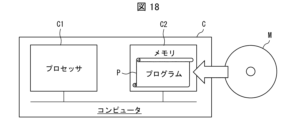
- FIG. 1 is a block diagram illustrating an example of the configuration of a computer.
- Fig. 1 is a block diagram showing an example of the configuration of a process control system 100 according to a first embodiment.
- the process control system 100 has a load prediction means 101, a bandwidth prediction means 102, and a switching control means 110, and controls the processing system.
- FIG. 2 is a block diagram showing an example of the configuration of a processing system controlled by a processing control system.
- the processing system 1 has a first processing unit 20 and a second processing unit 30.
- the first processing unit 20 is connected to, for example, a camera or a sensor such as LiDAR (Light Detection and Ranging), and acquires data to be analyzed from the camera or sensor.
- the data to be analyzed may be video data captured by a camera. It is sufficient for the video data to include the analysis target within the angle of view of the video.
- the analysis target may be, for example, a worker (person) working at a construction site, work equipment (object), and the behavior (movement) of the worker and work equipment.
- the analysis target data may also be sensing data from a sensor that detects the analysis target.
- the first processing unit 20 and the second processing unit 30 may each be configured with one or more computers.
- the first processing unit 20 and the second processing unit 30 are capable of communicating via a network NW, and share the task of analyzing the data to be analyzed.
- the network NW may be wireless or wired, and if wireless, may be a wireless communication system such as Wi-Fi, LTE, 4G, or 5G.
- the first processing unit 20 may be an edge processing unit
- the second processing unit 30 may be a cloud processing unit.
- edge refers to a place where data is collected.
- the first processing unit 20, which is an edge processing unit, is an information processing device (computer) or a group of information processing devices installed at or around the location where the analysis target is present (e.g., a construction site, a factory, etc.), and acquires analysis target data from a camera, a sensor, etc. installed at the location where the analysis target is present.
- the first processing unit 20 may be integrated with a camera, a sensor, etc.
- cloud refers to a place where data is processed, stored, etc.
- the second processing unit 30, which is a cloud processing unit, may be an information processing device (computer) or a group of information processing devices installed at a location that can provide large computational resources, such as a data center or a server farm.
- the second processing unit 30 may be a processing unit located at a location connected to the first processing unit 20 via a network, and may be a computational resource connected to a base station such as 5G (e.g., MEC (Multi-access Edge Computing)), or a server installed in an office at the site (on-premises server), etc.
- 5G e.g., MEC (Multi-access Edge Computing)
- server installed in an office at the site (on-premises server), etc.
- the sharing of the analysis of the data to be analyzed between the first processing unit 20 and the second processing unit 30 can be performed in various ways.
- the sharing of the analysis of the data to be analyzed between the first processing unit 20 that has acquired the data to be analyzed may be performed in a manner in which the data to be analyzed is analyzed in the first processing unit 20 that has acquired the data to be analyzed, the first processing unit 20 that has acquired the data to be analyzed preprocesses the data to be analyzed, and the second processing unit 30 analyzes the preprocessed data to be analyzed, and the first processing unit 20 performs processing such as compression on the data to be analyzed, and the second processing unit 30 analyzes the data to be analyzed.
- the sharing of the analysis of the data to be analyzed may be selected according to the computing power of the first processing unit 20, from among a first sharing method in which the first processing unit 20 generates an analysis result of the data to be analyzed, a second sharing method in which the first processing unit 20 calculates the feature amount of the data to be analyzed, the first processing unit 20 transmits the feature amount from the first processing unit 20 to the second processing unit 30, and the second processing unit 30 generates an analysis result from the feature amount, and a third sharing method in which the first processing unit 20 transmits the data to be analyzed between the second processing unit 30, and the second processing unit 30 generates an analysis result from the data to be analyzed.
- the criteria used to select the sharing method may also be the computational cost, the importance of the data to be analyzed, the risk level indicated by the data to be analyzed, the compression efficiency of each data to be analyzed, communication quality, etc.
- the first processing unit 20 analyzes at least a portion of the acquired analysis target data and transmits at least a portion of the analysis target data to the second processing unit 30.
- the analysis target data transmitted to the second processing unit 30 is at least a portion of the analysis target data (remaining portion of the analysis target data) for which not all processing for analysis has been completed in the first processing unit 20.
- the first processing unit 20 transmits at least a portion of the analysis target data (e.g., at least a portion of the remaining portion of the analysis target data) to the second processing unit 30 via the network NW.
- the second processing unit 30 receives and analyzes the analysis target data (e.g., at least a portion of the remaining portion of the analysis target data) transmitted from the first processing unit 20.
- the data to be analyzed transmitted from the first processing unit 20 to the second processing unit 30 may have been preprocessed in the first processing unit 20.
- the first processing unit 20 may calculate features of the data to be analyzed and transmit the features to the second processing unit 30, which may then analyze the features.
- the data to be analyzed also includes data (e.g., features) that are preprocessed from the data to be analyzed.
- analyzing the data to be analyzed refers to generating an analysis result of the data to be analyzed, and only preprocessing the data to be analyzed does not constitute analyzing the data to be analyzed.
- the analysis of the data to be analyzed includes, for example, detection, identification, tracking, and time series analysis of the analysis target (objects, people) on the video.
- AI may be used to process the data to be analyzed.
- One or both of the first processing unit 20 and the second processing unit 30 may use AI.
- the processing control system 100 controls the processing system 1, in particular the first processing unit 20 and the second processing unit 30.
- the load prediction means 101 predicts the processing load of the data to be analyzed in the first processing unit 20.
- the processing load is, for example, the usage of computational resources (the usage of the CPU or GPU required to process the data to be analyzed per unit time) used to process the data to be analyzed (including processing for analysis and preprocessing) in the first processing unit 20.
- the load prediction means 101 can predict the future processing load, for example, by monitoring the temporal change in the processing load of the data to be analyzed in the first processing unit 20 (for example, the number of people to be processed, the size of the people to be processed, the usage of computational resources, the processing speed, or a combination thereof).
- the processing load may be predicted based on the processing speed of the data to be analyzed (the amount of data to be analyzed processed per unit time).
- the bandwidth prediction means 102 predicts the communication bandwidth between the first processing unit 20 and the second processing unit 30.
- the communication bandwidth is, for example, the data transfer speed (amount of data transferred per unit time) that can be transferred between the first processing unit 20 and the second processing unit 30.
- the bandwidth prediction means 102 can predict the future communication bandwidth, for example, by monitoring the change over time in the communication bandwidth (e.g., the transfer speed) between the first processing unit 20 and the second processing unit 30.
- the switching control means 110 controls whether the first processing unit 20 or the second processing unit 30 will analyze the data to be analyzed, based on the processing load predicted by the load prediction means 101 and the communication bandwidth predicted by the bandwidth prediction means 102.
- the switching control means 110 switches the analysis of the data to be analyzed from the first processing unit 20 to the second processing unit 30.
- the required data transfer speed e.g., the transfer speed from a camera, etc.
- the lower limit of the predicted transmittable bandwidth lower limit bandwidth Bmin described below
- the first processing unit 20 may analyze the data portion to be analyzed and not transmit the data portion to the second processing unit 30.
- the first processing unit 20 does not analyze the data portion to be analyzed, but transmits it to the second processing unit 30 after processing to determine suitability.
- the second processing unit 30 analyzes at least a portion of the analysis target data transmitted from the first processing unit 20.
- the processing control system 100 controls whether the first processing unit 20 or the second processing unit 30 will analyze the data to be analyzed, based on the predicted processing load and communication bandwidth. Therefore, according to the processing control system 100 according to this embodiment, it is possible to switch between processing by the first processing unit 20 and the second processing unit 30, based on the communication bandwidth.
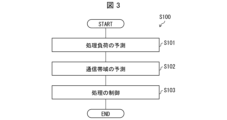
- Fig. 3 is a flow diagram showing the flow of the process control method S100 according to the first embodiment.
- step S101 the load prediction means 101 predicts the processing load of the data to be analyzed in the first processing unit 20.
- step S102 the bandwidth prediction means 102 predicts the communication bandwidth between the first processing unit 20 and the second processing unit 30.
- step S103 the switching control means 110 controls whether the first processing unit 20 or the second processing unit 30 will analyze the data to be analyzed, based on the processing load predicted by the load prediction means 101 and the communication bandwidth predicted by the bandwidth prediction means 102.
- Fig. 4 is a block diagram showing the configuration of the processing control device 200 according to the first embodiment.
- the processing control device 200 has a load prediction unit 201, a bandwidth prediction unit 202, and a switching control unit 210, and controls the processing system 1 (a first processing unit 20 that acquires data to be analyzed, and a second processing unit 30 that can communicate with the first processing unit 20).
- the load prediction unit 201 has a function equivalent to the load prediction means 101, and predicts the processing load of the data to be analyzed in the first processing unit 20.
- the bandwidth prediction unit 202 has a function equivalent to the bandwidth prediction means 102, and predicts the communication bandwidth between the first processing unit 20 and the second processing unit 30.
- the switching control unit 210 has a function equivalent to the switching control means 110, and controls whether the first processing unit 20 or the second processing unit 30 will analyze the data to be analyzed, based on the processing load predicted by the load prediction unit 201 and the communication bandwidth predicted by the bandwidth prediction unit 202.
- the load prediction unit 201, the bandwidth prediction unit 202, and the switching control unit 210 may be a computer device in which processing is performed by a processor executing a program stored in a memory.
- the load prediction unit 201, the bandwidth prediction unit 202, and the switching control unit 210 may be a single computer device, or may be a computer device group in which multiple computer devices operate in cooperation with each other, or a server device group in which multiple server devices operate in cooperation with each other.
- at least a portion of the load prediction unit 201, the bandwidth prediction unit 202, and the switching control unit 210 may be provided in the second processing unit 30. According to the processing control device 200, it is possible to obtain the same effect as the processing control system 100.
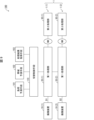
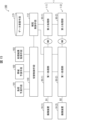
- FIG. 5 is a block diagram showing an example of the configuration of a processing control system 100 according to the second embodiment.
- the processing control system 100 has a load prediction means 101, a bandwidth prediction means 102, and a switching control means 110, and controls processing systems 1(1) and 1(2).
- the processing system 1 has a processing system 1(1) (imaging device 10(1), first processing unit 20(1), second processing unit 30(1)), a processing system 1(2) (imaging device 10(2), first processing unit 20(2)), and a second processing unit 30(2)) that are controlled independently of one another by a processing control system 100.
- a processing system 1(1) imaging device 10(1), first processing unit 20(1), second processing unit 30(1)
- a processing system 1(2) imaging device 10(2), first processing unit 20(2)
- second processing unit 30(2) that are controlled independently of one another by a processing control system 100.
- two processing systems 1(1) and (2) are shown, but there may be three or more processing systems 1(i) (i: positive integer).
- the sharing of the processing of the data to be analyzed between the first processing unit 20 and the second processing unit 30 is carried out, for example, as follows.
- the first processing unit 20(1) is controlled by the processing control system 100 to process at least a portion of the data to be analyzed D1 acquired from the imaging device 10(1) and transmit at least a portion of the data to be analyzed D1 to the second processing unit 30(1).
- the data to be analyzed transmitted to the second processing unit 30(1) at this time is at least a portion of the data to be analyzed (the remainder of the data to be analyzed) for which not all processing for analysis has been completed in the first processing unit 20(1).
- the first processing unit 20(1) transmits, for example, at least a portion of the remainder of the data to be analyzed D1 processed by the first processing unit 20(1) to the second processing unit 30(1).
- the second processing unit 30(1) receives and processes the analysis target data D1 (i.e., at least a portion of the analysis target data, e.g., at least a portion of the remaining analysis target data unprocessed by the first processing unit 20(1)) transmitted from the first processing unit 20(1).
- the first processing unit 20(1) transmits at least a portion of the intermediate data (e.g., feature quantities) obtained as a result of processing the analysis target data in the first processing unit 20 to the second processing unit 30(1), and the second processing unit 30(1) may perform further processing on at least a portion of the received intermediate data.
- the intermediate data e.g., feature quantities
- the analysis target data D1 output from the imaging device 10(1) is processed by the first processing unit 20(1) and the second processing unit 30(1) in a shared manner.
- the analysis target data D2 output from the imaging device 10(2) is processed by the first processing unit 20(2) and the second processing unit 30(2) in a shared manner.
- the amount of analysis target data per unit time i.e., the bandwidth (e.g., transfer rate) required to transmit the analysis target data
- the bandwidth e.g., transfer rate
- the wider the bandwidth allocated for transmitting the analysis target data the more important that analysis target data is considered to be. This is because allocating a wider bandwidth for transmitting important analysis target data increases the amount of information that can be obtained from important analysis target data.
- imaging devices 10(1) and 10(2) may be referred to as imaging device 10 without distinction.
- first processing units 20(1) and 20(2) may be referred to as first processing unit 20
- second processing units 30(1) and 30(2) may be referred to as second processing unit 30.
- FIG. 6 is a schematic diagram showing an example of data to be analyzed output from the imaging device 10.
- the data to be analyzed has multiple frames that are consecutive in time series.
- the first processing unit 20 and the second processing unit 30 process the data to be analyzed for each unit frame set, which is the processing unit and consists of a predetermined number N of frames.
- the frames in the unit frame set, which is the processing unit are assigned numbers in order from 1 to N (predetermined number).
- the predetermined number N is the number of frames that make up the unit frame set.
- the first processing unit 20 and the second processing unit 30 process the data to be analyzed for each unit frame set. As described above, the first processing unit 20 and the second processing unit 30 share the processing of the data to be analyzed. For this reason, while one of the first processing unit 20 and the second processing unit 30 is processing the unit frame set of the data to be analyzed, the processing of the data to be analyzed may be switched to the other. In this case, neither the first processing unit 20 nor the second processing unit 30 has the data for the entire unit frame set, making it difficult to complete the processing of the unit frame set.
- the first processing unit 20 and the second processing unit 30 process the data to be analyzed for each unit frame set and extract features.
- the features include, for example, information for detecting and identifying the analysis target (object, person) in the video.
- the first processing unit 20 and the second processing unit 30 track the analysis target and perform time series analysis based on the features, and, for example, analyze the work content (e.g., leveling work, moving work) of a person (worker) and output the analysis results.
- the first processing unit 20 and the second processing unit 30 may extract features for each frame, perform analysis for each unit frame set based on the features, and output the analysis results.
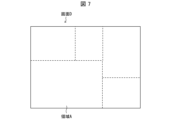
- FIG. 7 shows an example of an image represented by the data to be analyzed.
- the image screen D is divided into multiple areas A as a result of processing by the first processing unit 20 and the second processing unit 30.
- the first processing unit 20 or the second processing unit 30 may divide the image represented by the data to be analyzed into multiple areas based on the feature amount, and analyze the work content of a person (worker) for each area.
- the results of this analysis can be displayed, together with the analyzed video, for example, on a terminal held by a supervisor (as an example, a site supervisor) via communication from the first processing unit 20 or the second processing unit 30.
- a supervisor as an example, a site supervisor
- the supervisor can check the video of the work site together with the results of the work analysis, accurately grasp the status of the work, and give accurate instructions to the site.
- the first processing unit 20 or the second processing unit 30 determines the reliability of the analysis result. This reliability is acquired by the processing result acquisition means 103 described later. Reliability is an index that indicates how confident there is in the predicted analysis result. When analyzing data to be analyzed by AI, the reliability of the analysis result can also be evaluated to make the analysis more reliable. In this case, a reliability parameter is output along with the analysis result. Note that the first processing unit 20 or the second processing unit 30 may determine, for example, that if the reliability is high at a certain time, there is a high possibility that the same analysis result will be stably output at the next time, and that if the reliability is low, there is a high possibility that a different analysis result will be output at the next time.
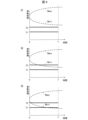
- FIG. 8 shows graphs G1 to G3 that represent examples of the results of the prediction of the communication bandwidth between the first processing unit 20 and the second processing unit 30 by the bandwidth prediction means 102.
- Graphs G1 to G3 each show an example of the temporal variation of the communication bandwidth from the present time.
- the upper and lower limits of the predicted communication bandwidth are shown as upper limit bandwidth Bmax and lower limit bandwidth Bmin. Over time, the upper limit bandwidth Bmax increases and the lower limit bandwidth Bmin decreases, widening the range of the predicted bandwidth. This means that the certainty of the predicted bandwidth decreases as we move from the present time into the future.
- the time range of prediction by the bandwidth prediction means 102 is sufficient to be from the current time to the time (unit time) T corresponding to the unit frame set. This is because the processing of the data to be analyzed is done for each unit frame set, and therefore switching the processing of the data to be analyzed after unit time T does not affect the processing of the unit frame set currently being processed. In other words, the value of the lower limit bandwidth Bmin unit time T in the future can be used to determine whether to switch processing at the current time.
- Graphs G1 to G3 each have a smaller predicted communication bandwidth. That is, the lower limit bandwidth Bmin after unit time T becomes smaller in the order of graphs G1 to G3.
- the predicted data amounts F1 and F2 refer to the amount of data (transfer rate, i.e., bandwidth) planned to be processed by the second processing unit 30, and are, for example, the remaining amount of data processed by the first processing unit 20 from the amount of data to be analyzed.
- the two predicted data amounts F1 and F2 are set to be constant.
- the switching control means 110 controls whether the first processing unit 20 or the second processing unit 30 will analyze the data to be analyzed, based on the processing load predicted by the load prediction unit 201 and the communication bandwidth predicted by the bandwidth prediction means 102. For example, if the processing load predicted by the first processing unit 20 approaches the limit of the processing speed of the first processing unit 20 during analysis by the first processing unit 20, the switching control means 110 switches the analysis of the data to be analyzed from the first processing unit 20 to the second processing unit 30. For example, if the required processing speed of the data to be analyzed (for example, predicted data volume F) approaches the predicted bandwidth (lower limit bandwidth Bmin) during analysis by the second processing unit 30, the switching control means 110 switches the analysis of the data to be analyzed from the second processing unit 30 to the first processing unit 20.
- the required processing speed of the data to be analyzed for example, predicted data volume F
- the switching control means 110 switches the analysis of the data to be analyzed from the second processing unit 30 to the first processing unit 20.
- the lower limit band Bmin predicted after time T is larger than the predicted data amount F (F1, F2), so in either case of the predicted data amount F1 or F2, the entire amount is not analyzed by the first processing unit 20, but can be transmitted from the first processing unit 20 to the second processing unit 30 and analyzed by the second processing unit 30.
- the predicted data amount when the predicted data amount is F1, the entire amount can be analyzed by the first processing unit 20, but when the predicted data amount is F2, it is difficult to analyze the entire amount by the first processing unit 20.
- graph G3 in either case of the predicted data amount F1 or F2, it is difficult to analyze the entire amount by the first processing unit 20. In such a case, it is conceivable to transmit the remaining part of the analysis target data, within the range that matches the lower limit band Bmin, from the first processing unit 20 to the second processing unit 30 for analysis.
- the switching control means 110 may determine a portion of the analysis target data to be discarded from the analysis target data.
- the first processing unit 20 does not analyze this portion of the analysis target data, and does not transmit it to the second processing unit 30.
- the analysis target data portion is discarded. Note that discarding the analysis target data can be rephrased as not analyzing the analysis target data.
- the switching control means 110 may determine which portion of the data to be analyzed is to be discarded based on the communication bandwidth predicted by the bandwidth prediction means 102. For example, the switching control means 110 determines to discard a portion of the data to be analyzed (e.g., a frame) whose data volume is greater than the sum of the predicted processing load and the predicted communication bandwidth.
- the switching control means 110 may determine which portions of the analysis target data to discard based on the communication bandwidth allocated for transmitting the analysis target data D1, D2. As described above, different bandwidths are allocated for transmitting the analysis target data D1, D2 output from the imaging devices 10(1), 10(2). The switching control means 110, for example, determines that the analysis target data portions of the analysis target data having a large allocated communication bandwidth are less important, and determines that they should be discarded preferentially when the overall available bandwidth is reduced.
- the second embodiment has been described above as a process control system 100, but the process control system 100 according to the second embodiment may be mounted on a single device as a process control device. Furthermore, the operation of the process control system 100 according to the second embodiment may be the process control method according to the second embodiment.
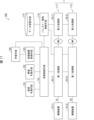
- FIG. 9 is a block diagram showing an example of the configuration of a processing control system 100 according to the third embodiment.
- the processing control system 100 has a load prediction means 101, a bandwidth prediction means 102, a processing result acquisition means 103, and a switching control means 110, and controls processing systems 1(1) and 1(2).
- the processing control system 100 according to this embodiment differs from the second embodiment in that the switching control means 110 determines which analysis target data to discard based on reliability.
- the processing result acquisition means 103 acquires the reliability of the processing of the data to be analyzed, for example, from the first processing unit 20 or the second processing unit 30. As described above, the first processing unit 20 or the second processing unit 30 can analyze the data to be analyzed using AI and determine the reliability of the analysis results. The processing result acquisition means 103 can acquire the reliability of the processing of the data to be analyzed, along with the analysis results, from the first processing unit 20 or the second processing unit 30.
- the switching control means 110 determines which part of the data to be analyzed is to be discarded based on the reliability acquired by the processing result acquisition means 103. For example, the processing result acquisition means 103 determines that a part of the data to be analyzed that was relatively reliable at a previous time is likely to have the same result at the current time, and decides to suspend processing of that part of the data to be analyzed and discard it. This makes it possible to obtain an analysis result based on the analysis result at the previous time for the part of the data to be analyzed that is relatively reliable, and an analysis result at the current time for the part of the data to be analyzed that is less reliable.
- the third embodiment has been described above as a process control system 100, but the process control system 100 according to the third embodiment may be mounted on a single device as a process control device. Furthermore, the operation of the process control system 100 according to the third embodiment may be the process control method according to the third embodiment.
- FIG. 10 is a block diagram showing an example of the configuration of a processing control system 100 according to the fourth embodiment.
- the processing control system 100 has a load prediction means 101, a bandwidth prediction means 102, an importance determination means 104, and a switching control means 110, and controls processing systems 1(1) and 1(2).
- the processing control system 100 according to this embodiment differs from the second embodiment in that the switching control means 110 determines which analysis target data to discard based on importance.
- the importance determination means 104 determines the importance of each part of the analysis target data.
- the importance is, for example, the priority of the processing of the analysis target contained in the analysis target data, and corresponds to the importance or risk of the process indicated in the analysis target data.
- the importance can be determined based on AI analysis of the detection and identification of the analysis target in the first processing unit 20 or the second processing unit 30. Note that the importance may be determined using a learning model that has learned the importance of the detection results of the analysis target.
- the importance determination means 104 may determine the importance of each part by inputting input data in which the feature amounts of each part of the data to be analyzed are calculated and each feature amount is combined into the trained model.
- the trained model used may receive input data in which the feature amounts of each part are combined, generate relationship information indicating the relationship between the feature amounts of each part based on the input data, and output the importance of each area based on the relationship information and the input data.
- the relationship information indicates the degree to which areas other than the area are related to the importance of each area.
- the relationship information indicates the relationship between areas such that the relationship is large for areas necessary for determining the importance of the area and small for areas not necessary for determining the importance of a specific area.
- the trained model includes, for example, one or more layers that generate relationship information based on input data, and one or more layers that generate the importance of each region based on the relationship information and the input data.
- the trained model can be trained, for example, by reinforcement learning using training input images labeled with an analysis result and an analysis engine that analyzes the input images using the importance.
- the switching control means 110 determines which parts of the data to be analyzed are to be discarded based on the importance determined by the importance determination means 104. For example, the switching control means 110 determines to process the parts of the data to be analyzed that are relatively important, and to discard the parts of the data to be analyzed that are relatively less important. This makes it possible to obtain analysis results based on the parts of the data to be analyzed that are relatively important.
- the fourth embodiment has been described above as a process control system 100, but the process control system 100 according to the fourth embodiment may be mounted on a single device to form a process control device. Furthermore, the operation of the process control system 100 according to the fourth embodiment may be the process control method according to the fourth embodiment.
- FIG. 11 is a block diagram showing an example of the configuration of a processing control system 100 according to the fifth embodiment.
- the processing control system 100 has a load prediction means 101, a bandwidth prediction means 102, a switching control means 110, and a buffer control means 111, and controls processing systems 1(1) and 1(2).
- the processing control system 100 according to this embodiment differs from the second embodiment in that it includes a buffer control means 111.
- the buffer control means 111 determines the number of buffer frames that is equal to or less than a predetermined number of frames that make up a unit frame set. By setting the number of buffer frames appropriately, the resources of the first processing unit 20 and the second processing unit 30 can be used effectively.
- the buffer control means 111 causes one of the first processing unit 20 and the second processing unit 30 that is not analyzing the data to be analyzed to buffer frames for the buffer frame number.
- the buffer control means 111 causes it to analyze the data to be analyzed using the buffered frames for the buffer frame number. This makes it possible to complete the analysis for a unit frame set using the buffered frames, even if the analysis is switched in the middle of the unit frame set.
- the first processing unit 20 buffers frames equal to the buffer frame count. Then, when the analysis of the data to be analyzed is switched from the second processing unit 30 to the first processing unit 20, the first processing unit 20 uses the buffered frames to analyze the data to be analyzed.
- the buffer control means 111 may determine the number of buffer frames based on the communication bandwidth predicted by the bandwidth prediction means 102. For example, if the communication bandwidth is narrow, the number of buffer frames is increased, and if the communication bandwidth is wide, the number of buffer frames is decreased. This makes it possible to reduce frame loss even when the predicted communication bandwidth is narrow.
- the buffer control means 111 may determine the number of buffer frames based on the communication bandwidth allocated for transmitting the data to be analyzed. For example, if the allocated communication bandwidth is large, the number of buffer frames is increased, and if the allocated communication bandwidth is small, the number of buffer frames is decreased. This makes it possible to prevent missed processing of portions of the data to be analyzed that are considered important and have a large amount of allocated communication bandwidth.
- the fifth embodiment has been described above as a process control system 100, but the process control system 100 according to the fifth embodiment may be mounted on a single device to form a process control device. Furthermore, the operation of the process control system 100 according to the fifth embodiment may be the process control method according to the fifth embodiment.
- FIG. 12 is a block diagram showing an example of the configuration of a processing control system 100 according to the sixth embodiment.
- the processing control system 100 has a load prediction means 101, a bandwidth prediction means 102, a processing result acquisition means 103, a switching control means 110, and a buffer control means 111, and controls processing systems 1(1) and 1(2).
- the processing control system 100 according to this embodiment differs from the fifth embodiment in that the buffer control means 111 determines the number of buffer frames based on reliability.
- the processing result acquisition means 103 acquires the reliability of the processing of the analysis target data determined by the first processing unit 20 or the second processing unit 30, as described above.
- the buffer control means 111 determines the number of buffer frames based on the reliability acquired by the processing result acquisition means 103. For example, the buffer control means 111 increases the number of buffer frames when the reliability of the processing of the data to be analyzed is high, and decreases the number of buffer frames when the reliability is low. This makes it possible to prevent the loss of highly reliable data to be analyzed.
- the sixth embodiment has been described above as a process control system 100, but the process control system 100 according to the sixth embodiment may be mounted on a single device to form a process control device. Furthermore, the operation of the process control system 100 according to the sixth embodiment may be the process control method according to the sixth embodiment.
- FIG. 13 is a block diagram showing an example of the configuration of a processing control system 100 according to the seventh embodiment.
- the processing control system 100 according to the seventh embodiment has a load prediction means 101, a bandwidth prediction means 102, an importance determination means 104, a switching control means 110, and a buffer control means 111, and controls processing systems 1(1) and 1(2).
- the processing control system 100 according to this embodiment differs from the fifth embodiment in that the buffer control means 111 determines the number of buffer frames based on the importance.
- the importance determination means 104 determines the importance of each portion of the data to be analyzed.
- the buffer control means 111 determines the number of buffer frames based on the importance determined by the importance determination means 104. For example, the buffer control means 111 increases the number of buffer frames when the data to be analyzed is highly important, and decreases the number of buffer frames when the data to be analyzed is less important. This makes it possible to prevent the loss of important data to be analyzed.
- the seventh embodiment has been described above as a process control system 100, but the process control system 100 according to the seventh embodiment may be mounted on a single device to form a process control device. Furthermore, the operation of the process control system 100 according to the seventh embodiment may be the process control method according to the seventh embodiment.
- FIG. 14 is a block diagram showing an example of the configuration of a processing control system 100 according to the eighth embodiment.
- the processing control system 100 according to the eighth embodiment has a load prediction means 101, a bandwidth prediction means 102, a switching control means 110, a complementary control means 112, and a data storage means 115, and controls processing systems 1(1) and 1(2).
- the processing control system 100 according to this embodiment differs from the second embodiment in that it has a complementary control means 112.
- the complementation control means 112 causes the first processing unit 20 and the second processing unit 30 to complement frames that were being processed in the unit frame set before the switch from a state in which the data to be analyzed was not being processed to a state in which the data to be analyzed was being processed. This makes it possible to analyze the unit frame set by complementing frames, even if the analysis is switched in the middle of the unit frame set.
- the data storage means 115 may be disposed outside the second processing unit 30 and store the processing results of the second processing unit 30.
- the processing results of the second processing unit 30 may be stored by the second processing unit 30 itself, instead of by the data storage means 115.
- it will be expressed as the second processing unit 30 storing the processing results, regardless of whether the data storage means 115 is present or not.
- the data storage means 115 may be disposed outside the first processing unit 20 and store the processing results of the first processing unit 20.
- the processing results of the first processing unit 20 may be stored by the first processing unit 20 itself, instead of by the data storage means 115.
- it will be expressed as the first processing unit 20 storing the processing results, regardless of whether the data storage means 115 is present or not.
- the methods for completing the unit frame set include (1) duplication and (2) extraction.
- the data storage means 115 is not required.
- the complement control means 112 complements the frame that was being processed before the switch by duplicating the frame that is to be processed first after the switch. For example, consider a case where the processing of the data to be analyzed is switched to the second processing unit 30 immediately after the first processing unit 20 processes the i-th frame of the unit frame set. In this case, the second processing unit 30 complements the unit frame set by duplicating the "i+1"-th frame that is to be processed first after the switch to make it the 1st to i-th frames, and processes the unit frame set. This allows the unit frame set to be analyzed reliably.
- the first processing unit 20 complements the unit frame set and analyzes the unit frame set by duplicating the "i+1"-th frame, which is the first to be processed after the switch, and making it the 1st to i-th frames. This ensures that the unit frame set can be analyzed.
- the first processing unit 20 and the second processing unit 30 retain the processing results of the frames.
- the complement control means 112 complements the frames that were processed before the switch by extracting, from these retained processing results, processing results that are similar to the processing result of the frame that will be processed first after the switch. For example, consider a case where the processing of the data to be analyzed is switched to the second processing unit 30 immediately after the first processing unit 20 processes the i-th frame of the unit frame set. In this case, the second processing unit 30 complements and analyzes the frames that make up the unit frame set by extracting past processing results that are similar to the "i+1"-th frame that will be processed first after the switch and making them the 1st to i-th frames. This allows the unit frame set to be analyzed reliably.
- the first processing unit 20 extracts past processing results similar to the "i+1"-th frame that is processed first after the switch and sets these as frames 1 to i, thereby complementing and analyzing the frames that make up the unit frame set. This allows the unit frame set to be analyzed reliably.
- the eighth embodiment has been described above as a process control system 100, but the process control system 100 according to the eighth embodiment may be mounted on a single device to form a process control device. Furthermore, the operation of the process control system 100 according to the eighth embodiment may be the process control method according to the eighth embodiment.
- the complement control means 112 determines an upper limit frame number that is an upper limit of the number of frames to be complemented. If the number of frames to be complemented exceeds the upper limit frame number, the complement control means 112 does not complement the frames that were being processed before the switch.
- the number of frames to be complemented is the value "N-i" obtained by subtracting i from the predetermined number N of unit frame sets. If the number of frames to be complemented "N-i" is equal to or less than p, the second processing unit 30 complements the frames and analyzes the unit frame set. If the number of frames to be complemented "N-i" exceeds p, the second processing unit 30 does not complement the frames and does not analyze this unit frame set.
- the number of frames to be complemented is the value "N-i" obtained by subtracting i from the predetermined number N of unit frame sets. If the number of frames to be complemented "N-i" is equal to or less than p, the first processing unit 20 complements the frames and analyzes the unit frame set. If the number of frames to be complemented "N-i" exceeds p, the first processing unit 20 does not complement the frames and does not analyze this unit frame set.
- the complementary control means 112 may determine the upper limit number of frames based on the allocated communication bandwidth. For example, if the communication bandwidth allocated for transmitting the portion of data to be analyzed is large, the complementary control means 112 increases the upper limit number of frames, and if the communication bandwidth allocated for transmitting the portion of data to be analyzed is small, the complementary control means 112 decreases the upper limit number of frames. This makes it possible to prevent missing out on analysis of portions of data to be analyzed that are considered important and have a large amount of allocated communication bandwidth.
- the ninth embodiment has been described above as a process control system 100, but the process control system 100 according to the ninth embodiment may be mounted on a single device as a process control device. Furthermore, the operation of the process control system 100 according to the ninth embodiment may be the process control method according to the ninth embodiment.
- FIG. 15 is a block diagram showing an example of the configuration of a processing control system 100 according to the tenth embodiment.
- the processing control system 100 has a load prediction means 101, a bandwidth prediction means 102, a processing result acquisition means 103, a switching control means 110, and a complement control means 112, and controls processing systems 1(1) and 1(2).
- the processing control system 100 according to this embodiment differs from the eighth embodiment in that the complement control means 112 determines the upper limit number of frames for complementation based on reliability.
- the processing result acquisition means 103 acquires the reliability of the processing of the data to be analyzed, and the complementary control means 112 determines the upper limit number of frames based on the reliability acquired by the processing result acquisition means 103. For example, the complementary control means 112 increases the upper limit number of frames when the reliability of the processing of the data to be analyzed is high, and decreases the upper limit number of frames when the reliability is low. This makes it possible to prevent the loss of highly reliable data to be analyzed.
- the tenth embodiment has been described above as a process control system 100, but the process control system 100 according to the tenth embodiment may be mounted on a single device to form a process control device. Furthermore, the operation of the process control system 100 according to the tenth embodiment may be the process control method according to the tenth embodiment.
- FIG. 16 is a block diagram showing an example of the configuration of a processing control system 100 according to an eleventh embodiment.
- the processing control system 100 has a load prediction means 101, a bandwidth prediction means 102, an importance determination means 104, a switching control means 110, a complement control means 112, and a data storage means 115, and controls processing systems 1(1) and 1(2).
- the processing control system 100 according to this embodiment differs from the eighth embodiment in that the complement control means 112 determines the upper limit number of frames for complementation based on importance.
- the importance determination means 104 determines the importance of each part of the data to be analyzed, and the complementary control means 112 determines the upper limit of the number of frames based on the importance determined by the importance determination means 104. For example, the complementary control means 112 increases the upper limit of the number of frames when the data to be analyzed is highly important, and decreases the upper limit of the number of frames when the data to be analyzed is less important. This makes it possible to prevent the loss of important data to be analyzed.
- the eleventh embodiment has been described above as a process control system 100, but the process control system 100 according to the eleventh embodiment may be mounted on a single device as a process control device. Furthermore, the operation of the process control system 100 according to the ninth embodiment may be the process control method according to the eleventh embodiment.
- FIG. 17 is a block diagram showing an example of the configuration of a processing control system 100 according to the twelfth embodiment.
- the processing control system 100 has a load prediction means 101, a bandwidth prediction means 102, a learning means 105, a switching control means 110, a buffer/completion control means 113, and a data storage means 115, and controls processing systems 1(1) and 1(2).
- the processing control system 100 according to this embodiment differs from the fifth and eighth embodiments in that it includes a buffer/completion control means 113.
- the buffer/complement control means 113 has a function that combines the buffer control means 111 and the complement control means 112, and can switch between buffering control of the data to be analyzed by the buffer control means 111 and complement control of the data to be analyzed by the complement control means 112. Note that the process control system 100 may have the buffer control means 111 and the complement control means 112 instead of the buffer/complement control means 113.
- the learning means 105 learns whether buffering control or complementary control should be used and how to determine the number of buffer frames in buffering control and the upper limit number of frames in complementary control based on the communication bandwidth predicted by the bandwidth prediction means 102.
- the learning means 105 selects buffering control or complementary control based on the results of this learning.
- the twelfth embodiment has been described above as a process control system 100, but the process control system 100 according to the twelfth embodiment may be mounted on a single device to form a process control device. Furthermore, the operation of the process control system 100 according to the twelfth embodiment may be the process control method according to the twelfth embodiment.
- Each configuration according to the first to twelfth embodiments may be realized by (1) one or more pieces of hardware, (2) one or more pieces of software, (3) a combination of hardware and software, or (4) a cloud server.
- Each device, function, and process may be realized by at least one computer having at least one processor and at least one memory.
- An example of such a computer hereinafter referred to as computer C
- each function described in the first to twelfth embodiments may be realized by storing a program for implementing the processing control method described in the first to twelfth embodiments in memory C2, and having processor C read and execute program P stored in memory C2.
- the program P includes a set of instructions for causing the computer C to execute one or more of the functions described in the first to twelfth embodiments when the program P is loaded into the computer C.
- the program P is stored in the memory C2.
- the processor C1 may be, for example, a CPU (Central Processing Unit).
- the memory 1602 may be, for example, a Read Only Memory (ROM), a Random Access Memory (RAM), a flash memory, a Solid State Drive (SSD), etc.
- the program P can also be recorded on a non-transitory, tangible recording medium M that can be read by the computer C.
- a recording medium M can be, for example, a tape, a disk, a card, a semiconductor memory, or a programmable logic circuit.
- the computer C can obtain the program P via such a recording medium M.
- the program P can also be transmitted via a transmission medium.
- a transmission medium can be, for example, a communications network or broadcast waves.
- the computer C can also obtain the program P via such a transmission medium.
- a process control system for controlling a first processing unit that acquires analysis target data from an imaging device and a second processing unit that is capable of communicating with the first processing unit, The first processing unit processes at least a portion of the analysis target data and transmits at least a portion of the analysis target data to the second processing unit; The second processing unit processes at least a part of the analysis target data transmitted from the first processing unit,
- the process control system includes: a load prediction means for predicting a processing load of the analysis target data in the first processing unit; A bandwidth prediction means for predicting a communication bandwidth between the first processing unit and the second processing unit; a switching control means for controlling whether the first processing unit or the second processing unit processes the analysis target data based on the predicted processing load and the predicted communication bandwidth;
- a process control system comprising:
- the analysis target data has a plurality of frames that are consecutive in time series, the first processing unit and the second processing unit process the analysis target data for each unit frame set, which is a processing unit and is made up of a predetermined number of frames;
- the process control system includes a buffer control means;
- the buffer control means determining a number of buffer frames equal to or less than the predetermined number;
- the processing control system includes an importance determination means for determining the importance of each portion of the analysis target data, 4.
- the analysis target data has a plurality of frames that are consecutive in time series, the first processing unit and the second processing unit process the analysis target data for each unit frame set, which is a processing unit and is made up of a predetermined number of frames;
- the process control system includes a complementary control means;
- a processing control device that controls a first processing unit that acquires analysis target data from an imaging device and a second processing unit that is capable of communicating with the first processing unit, The first processing unit processes at least a portion of the analysis target data and transmits at least a portion of the analysis target data to the second processing unit; The second processing unit processes at least a part of the analysis target data transmitted from the first processing unit,
- the processing control device includes: a load prediction unit that predicts a processing load of the analysis target data in the first processing unit; a bandwidth prediction unit that predicts a communication bandwidth between the first processing unit and the second processing unit; a switching control unit that controls whether the first processing unit or the second processing unit processes the analysis target data based on the predicted processing load and the predicted communication bandwidth;
- a processing control device comprising:
- the analysis target data has a plurality of frames that are consecutive in time series, the first processing unit and the second processing unit process the analysis target data for each unit frame set, which is a processing unit and is made up of a predetermined number of frames;
- the processing control device includes a buffering control unit, The buffering control unit includes: determining a number of buffer frames equal to or less than the predetermined number;
- the processing control device described in Appendix 8 wherein one of the first processing unit and the second processing unit that is not processing the data to be analyzed buffers frames of the buffer frame number, and when that processing unit is switched to process the data to be analyzed, the processing unit analyzes the data to be analyzed using the buffered frames of the buffer frame number.
- the processing control device includes an importance determination unit that determines the importance of each portion of the analysis target data; 11.
- the buffering control unit determines the number of buffer frames based on the importance.
- the analysis target data has a plurality of frames that are consecutive in time series, the first processing unit and the second processing unit process the analysis target data for each unit frame set, which is a processing unit and is made up of a predetermined number of frames;
- the processing control device includes: The processing control device described in Appendix 8, further comprising a complementation processing control unit that, when switching from a state in which the data to be analyzed is not being processed to a state in which the data to be analyzed is processed, causes the first processing unit and the second processing unit to complement frames in a unit frame set that had been processed before the switching.
- the analysis target data has a plurality of frames that are consecutive in time series, the first processing unit and the second processing unit process the analysis target data for each unit frame set, which is a processing unit and is made up of a predetermined number of frames;
- the processing control method includes: the buffer control means determines a number of buffer frames equal to or less than the predetermined number; and the buffer control means causes one of the first processing means and the second processing means, which is not processing the data to be analyzed, to buffer frames of the number of buffer frames, and when the processing means is switched to process the data to be analyzed, causes the processing means to analyze the data to be analyzed using the buffered frames of the number of buffer frames.
- the processing control method includes: an importance determining means for determining the importance of each portion of the analysis target data; and said buffer control means for determining said number of buffer frames based on said importance; 18.
- the process control method of claim 17, comprising:
- the analysis target data has a plurality of frames that are consecutive in time series, the first processing unit and the second processing unit process the analysis target data for each unit frame set, which is a processing unit and is made up of a predetermined number of frames;
- the processing control method is described in Appendix 15, and includes a complementary control means that, when the first processing unit and the second processing unit switch from a state in which the data to be analyzed is not being processed to a state in which the data to be analyzed is processed, complements frames in a unit frame set that were being processed before the switching.
- a communication band is allocated for transmitting the analysis target data, 2.
- the processing control system includes a processing result acquisition means for acquiring a reliability of processing of the analysis target data, 2.
- the processing control system includes an importance determination means for determining the importance of each portion of the analysis target data; 2. The processing control system according to claim 1, wherein the switching control means determines a portion of the analysis target data to be discarded in the analysis target data based on the importance.
- a communication band is allocated for transmitting the analysis target data, 4.
- the processing control system includes a processing result acquisition means for acquiring a reliability of processing of the analysis target data, 4.
- the complementary control means includes: determining an upper limit number of frames, which is an upper limit of the number of frames to be complemented; 7. The processing control system according to claim 6, wherein if the number of frames to be complemented exceeds the upper limit number of frames, the frames that were being processed before the switching are not complemented.
- a communication band is allocated for transmitting the analysis target data, 28.
- the processing control system includes a processing result acquisition means for acquiring a reliability of processing of the analysis target data, 28.
- the processing control system includes an importance determination means for determining the importance of each portion of the analysis target data; 28.
- a processing control system for controlling a first processing unit and a second processing unit capable of communicating with the first processing unit,
- the first processing unit analyzes at least a portion of the analysis target data and transmits at least a portion of the analysis target data to the second processing unit;
- the second processing unit analyzes at least a portion of the analysis target data transmitted from the first processing unit,
- the process control system includes: At least one processor, the processor comprising: a load prediction process for predicting a processing load of the analysis target data in the first processing unit; A bandwidth prediction process for predicting a communication bandwidth between the first processing unit and the second processing unit; a switching control process for controlling whether the first processing unit or the second processing unit analyzes the analysis target data based on the predicted processing load and the predicted communication bandwidth;
- a process control system that performs the above steps.
- the processing control system may further include at least one memory, and this memory may store a program for causing the processor to execute the load prediction process, the bandwidth prediction process, and the switching control process.
- the program may also be recorded on a computer-readable, non-transitory, tangible recording medium.
- a processing control device that controls a first processing unit and a second processing unit capable of communicating with the first processing unit, The first processing unit analyzes at least a portion of the analysis target data and transmits at least a portion of the analysis target data to the second processing unit; The second processing unit analyzes at least a portion of the analysis target data transmitted from the first processing unit,
- the processing control device includes: At least one processor, the processor comprising: a load prediction process for predicting a processing load of the analysis target data in the first processing unit; A bandwidth prediction process for predicting a communication bandwidth between the first processing unit and the second processing unit; a switching control process for controlling whether the first processing unit or the second processing unit analyzes the analysis target data based on the predicted processing load and the predicted communication bandwidth; A processing control device that executes the above.
- the processing control device may further include at least one memory, and this memory may store a program for causing the processor to execute the load prediction process, the bandwidth prediction process, and the switching control process.
- the program may also be recorded on a computer-readable, non-transitory, tangible recording medium.
- Processing control system 101
- Load prediction means 102
- Bandwidth prediction means 103
- Processing result acquisition means 104
- Importance determination means 110
- Switching control means 111
- Buffer control means 112
- Complementary control means 113
- Buffer/complementary control means 115
- Data storage means
Landscapes
- Engineering & Computer Science (AREA)
- Software Systems (AREA)
- Theoretical Computer Science (AREA)
- Physics & Mathematics (AREA)
- General Engineering & Computer Science (AREA)
- General Physics & Mathematics (AREA)
- Data Exchanges In Wide-Area Networks (AREA)
- Computer And Data Communications (AREA)
Priority Applications (2)
| Application Number | Priority Date | Filing Date | Title |
|---|---|---|---|
| PCT/JP2022/038456 WO2024079901A1 (ja) | 2022-10-14 | 2022-10-14 | 処理制御システム、処理制御装置、および処理制御方法 |
| JP2024551038A JPWO2024079901A1 (https=) | 2022-10-14 | 2022-10-14 |
Applications Claiming Priority (1)
| Application Number | Priority Date | Filing Date | Title |
|---|---|---|---|
| PCT/JP2022/038456 WO2024079901A1 (ja) | 2022-10-14 | 2022-10-14 | 処理制御システム、処理制御装置、および処理制御方法 |
Publications (1)
| Publication Number | Publication Date |
|---|---|
| WO2024079901A1 true WO2024079901A1 (ja) | 2024-04-18 |
Family
ID=90669324
Family Applications (1)
| Application Number | Title | Priority Date | Filing Date |
|---|---|---|---|
| PCT/JP2022/038456 Ceased WO2024079901A1 (ja) | 2022-10-14 | 2022-10-14 | 処理制御システム、処理制御装置、および処理制御方法 |
Country Status (2)
| Country | Link |
|---|---|
| JP (1) | JPWO2024079901A1 (https=) |
| WO (1) | WO2024079901A1 (https=) |
Cited By (1)
| Publication number | Priority date | Publication date | Assignee | Title |
|---|---|---|---|---|
| CN118741255A (zh) * | 2024-08-30 | 2024-10-01 | 深圳大唐宝昌燃气发电有限公司 | 基于5g的监测数据传输方法及水泵房监测数据传输系统 |
Citations (3)
| Publication number | Priority date | Publication date | Assignee | Title |
|---|---|---|---|---|
| WO2020004380A1 (ja) * | 2018-06-27 | 2020-01-02 | 日本電気株式会社 | 割当装置、システム、タスク割当方法及びプログラム |
| WO2021070215A1 (ja) * | 2019-10-07 | 2021-04-15 | 日本電気株式会社 | 映像分析方法、映像分析システム及び情報処理装置 |
| WO2021260839A1 (ja) * | 2020-06-24 | 2021-12-30 | 日本電信電話株式会社 | 情報処理装置、情報処理方法、およびプログラム |
-
2022
- 2022-10-14 JP JP2024551038A patent/JPWO2024079901A1/ja active Pending
- 2022-10-14 WO PCT/JP2022/038456 patent/WO2024079901A1/ja not_active Ceased
Patent Citations (3)
| Publication number | Priority date | Publication date | Assignee | Title |
|---|---|---|---|---|
| WO2020004380A1 (ja) * | 2018-06-27 | 2020-01-02 | 日本電気株式会社 | 割当装置、システム、タスク割当方法及びプログラム |
| WO2021070215A1 (ja) * | 2019-10-07 | 2021-04-15 | 日本電気株式会社 | 映像分析方法、映像分析システム及び情報処理装置 |
| WO2021260839A1 (ja) * | 2020-06-24 | 2021-12-30 | 日本電信電話株式会社 | 情報処理装置、情報処理方法、およびプログラム |
Cited By (1)
| Publication number | Priority date | Publication date | Assignee | Title |
|---|---|---|---|---|
| CN118741255A (zh) * | 2024-08-30 | 2024-10-01 | 深圳大唐宝昌燃气发电有限公司 | 基于5g的监测数据传输方法及水泵房监测数据传输系统 |
Also Published As
| Publication number | Publication date |
|---|---|
| JPWO2024079901A1 (https=) | 2024-04-18 |
Similar Documents
| Publication | Publication Date | Title |
|---|---|---|
| JP7566027B2 (ja) | モデル訓練方法および装置 | |
| CN108933993B (zh) | 短信缓存队列选择方法、装置、计算机设备和存储介质 | |
| CN112422441B (zh) | 基于quic传输协议的拥塞控制方法和系统 | |
| US20220292819A1 (en) | Computer Vision Systems and Methods for Acceleration of High-Resolution Mobile Deep Vision With Content-Aware Parallel Offloading | |
| US20140139690A1 (en) | Information processing apparatus, camera having communication function, and information processing method | |
| WO2020172852A1 (en) | Computing resource scheduling method, scheduler, internet of things system, and computer readable medium | |
| CN112532530B (zh) | 一种拥塞通知信息调整的方法及设备 | |
| CN116824443A (zh) | 基于时空语义过滤的端边协同实时视频分析方法 | |
| JP6807042B2 (ja) | 情報処理装置、情報処理方法およびプログラム | |
| CN112636995A (zh) | 一种前传网络资源分配方法及装置 | |
| Elouali et al. | Data transmission reduction formalization for cloud offloading-based IoT systems | |
| WO2024079901A1 (ja) | 処理制御システム、処理制御装置、および処理制御方法 | |
| WO2022237484A1 (zh) | 一种推理系统、方法、装置及相关设备 | |
| JPWO2024079901A5 (https=) | ||
| WO2024079904A1 (ja) | 処理制御システム、処理制御装置、および処理制御方法 | |
| CN119336550B (zh) | 一种信息系统灰度发布迁移方法及系统 | |
| CN111817902B (zh) | 一种控制带宽的方法和系统 | |
| US20260040175A1 (en) | Intelligent seamless handover in cellular networks | |
| CN117170886B (zh) | 一种面向大连接视频分析的连续学习资源调度方法及装置 | |
| US20260127874A1 (en) | Processing control system, processing control device, and processing control method | |
| EP4348423B1 (en) | A computer software module arrangement, a circuitry arrangement, an arrangement and a method for improved autonomous adaptation of software monitoring of realtime systems | |
| WO2024079903A1 (ja) | 重要度判定システム、重要度判定装置、および重要度判定方法 | |
| US20250238268A1 (en) | Furcifer: A Context Adaptive Middleware for Real-world Object Detection Exploiting Local, Edge, and Split Computing in the Cloud Continuum | |
| CN118413485B (zh) | 数据传输的控制方法和装置、存储介质及电子设备 | |
| CN116777621B (zh) | 一种贸易业务风险防控方法及其防控系统 |
Legal Events
| Date | Code | Title | Description |
|---|---|---|---|
| 121 | Ep: the epo has been informed by wipo that ep was designated in this application |
Ref document number: 22962118 Country of ref document: EP Kind code of ref document: A1 |
|
| WWE | Wipo information: entry into national phase |
Ref document number: 2024551038 Country of ref document: JP |
|
| NENP | Non-entry into the national phase |
Ref country code: DE |
|
| 122 | Ep: pct application non-entry in european phase |
Ref document number: 22962118 Country of ref document: EP Kind code of ref document: A1 |