WO2024047860A1 - 情報処理システム及び情報処理方法 - Google Patents
情報処理システム及び情報処理方法 Download PDFInfo
- Publication number
- WO2024047860A1 WO2024047860A1 PCT/JP2022/033087 JP2022033087W WO2024047860A1 WO 2024047860 A1 WO2024047860 A1 WO 2024047860A1 JP 2022033087 W JP2022033087 W JP 2022033087W WO 2024047860 A1 WO2024047860 A1 WO 2024047860A1
- Authority
- WO
- WIPO (PCT)
- Prior art keywords
- user
- information
- server
- virtual space
- virtual
- Prior art date
- Legal status (The legal status is an assumption and is not a legal conclusion. Google has not performed a legal analysis and makes no representation as to the accuracy of the status listed.)
- Ceased
Links
Images




Classifications
-
- A—HUMAN NECESSITIES
- A63—SPORTS; GAMES; AMUSEMENTS
- A63F—CARD, BOARD, OR ROULETTE GAMES; INDOOR GAMES USING SMALL MOVING PLAYING BODIES; VIDEO GAMES; GAMES NOT OTHERWISE PROVIDED FOR
- A63F13/00—Video games, i.e. games using an electronically generated display having two or more dimensions
- A63F13/30—Interconnection arrangements between game servers and game devices; Interconnection arrangements between game devices; Interconnection arrangements between game servers
- A63F13/35—Details of game servers
- A63F13/352—Details of game servers involving special game server arrangements, e.g. regional servers connected to a national server or a plurality of servers managing partitions of the game world
-
- G—PHYSICS
- G06—COMPUTING OR CALCULATING; COUNTING
- G06F—ELECTRIC DIGITAL DATA PROCESSING
- G06F16/00—Information retrieval; Database structures therefor; File system structures therefor
- G06F16/20—Information retrieval; Database structures therefor; File system structures therefor of structured data, e.g. relational data
- G06F16/21—Design, administration or maintenance of databases
-
- G—PHYSICS
- G06—COMPUTING OR CALCULATING; COUNTING
- G06F—ELECTRIC DIGITAL DATA PROCESSING
- G06F16/00—Information retrieval; Database structures therefor; File system structures therefor
- G06F16/20—Information retrieval; Database structures therefor; File system structures therefor of structured data, e.g. relational data
- G06F16/27—Replication, distribution or synchronisation of data between databases or within a distributed database system; Distributed database system architectures therefor
-
- G—PHYSICS
- G06—COMPUTING OR CALCULATING; COUNTING
- G06F—ELECTRIC DIGITAL DATA PROCESSING
- G06F16/00—Information retrieval; Database structures therefor; File system structures therefor
- G06F16/20—Information retrieval; Database structures therefor; File system structures therefor of structured data, e.g. relational data
- G06F16/29—Geographical information databases
-
- G—PHYSICS
- G06—COMPUTING OR CALCULATING; COUNTING
- G06Q—INFORMATION AND COMMUNICATION TECHNOLOGY [ICT] SPECIALLY ADAPTED FOR ADMINISTRATIVE, COMMERCIAL, FINANCIAL, MANAGERIAL OR SUPERVISORY PURPOSES; SYSTEMS OR METHODS SPECIALLY ADAPTED FOR ADMINISTRATIVE, COMMERCIAL, FINANCIAL, MANAGERIAL OR SUPERVISORY PURPOSES, NOT OTHERWISE PROVIDED FOR
- G06Q50/00—Information and communication technology [ICT] specially adapted for implementation of business processes of specific business sectors, e.g. utilities or tourism
- G06Q50/10—Services
-
- G—PHYSICS
- G06—COMPUTING OR CALCULATING; COUNTING
- G06T—IMAGE DATA PROCESSING OR GENERATION, IN GENERAL
- G06T19/00—Manipulating three-dimensional [3D] models or images for computer graphics
Definitions
- the present invention relates to technology for sharing information in a virtual space.
- Patent Document 1 discloses a technology that uses so-called XR (eXtended Reality) technology to provide a user with an image of a virtual space.
- XR extended Reality
- the present invention provides a technology for sharing information in multiple virtual spaces.
- One aspect of the present disclosure provides an acquisition means for acquiring, for each of a plurality of users and a plurality of virtual spaces, virtual position information indicating the position of the user in the virtual space and real time information, and identification information of the user. , a storage means for storing the virtual position information and the time information in a database.
- the acquisition means acquires state information indicating the state of the user in the virtual space, and the storage means stores identification information of the user, the virtual position information, the time information, and the state information in a database. It's okay.
- the acquisition means acquires behavior information indicating the user's behavior in the virtual space, and the storage means stores the user's identification information, the virtual position information, the time information, and the behavior information in a database. It's okay.
- the behavior information may indicate behavior defined in the virtual space.
- the acquisition means acquires real position information indicating the user's position in the reality, and the storage means stores the user's identification information, the virtual position information, the time information, and the real position information in a database. You may.
- the virtual space may be layered, and the virtual position information may indicate a layer in which the user is located in the virtual space and a position in the layer.
- This information processing system may include estimation means for estimating the relationship between the first user and the second user using information stored in the database.
- Another aspect of the present disclosure provides a step of acquiring, for each of a plurality of users and a plurality of virtual spaces, virtual position information indicating the position of the user in the virtual space and real time information, and identifying the user.
- An information processing method is provided, the method comprising: storing information, the virtual location information, and the time information in a database.
- Yet another aspect of the present disclosure includes a step of causing a computer to acquire, for each of a plurality of users and a plurality of virtual spaces, virtual position information indicating the position of the user in the virtual space and real time information;
- a program is provided for causing the user's identification information, the virtual location information, and the time information to be stored in a database.
- information can be shared in multiple virtual spaces.
- FIG. 1 is a diagram showing an overview of a 3D data system 1 according to an embodiment.
- 1 is a diagram illustrating a functional configuration of a 3D data system 1.
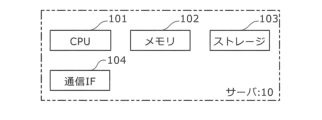
- FIG. 1 is a diagram illustrating a hardware configuration of a server 10.
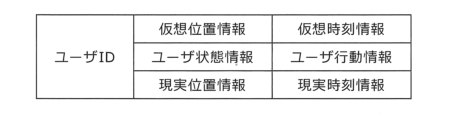
- FIG. 2 is a diagram illustrating information recorded on a server 20.
- 3 is a diagram illustrating data recorded in a database 111.
- FIG. 1 is a diagram showing an overview of a 3D data system 1 according to an embodiment.
- the 3D data system 1 is a system for sharing information in multiple virtual spaces.
- the 3D data system 1 includes a server 10, a server 20, a server 30, and a user terminal 40.
- the server 20 and the server 30 provide different virtual spaces.
- the term "virtual space" includes the so-called metaverse.
- the virtual space provided by the server 20 will be referred to as virtual space VS[1]
- the virtual space provided by server 30 will be referred to as VS[2].
- the server 20 and the server 30 may be managed and operated by different businesses.
- the server 10 provides 3D data to each virtual space.
- the 3D data here includes data indicating a 3D model (so-called avatar) of a human being who is a user of each virtual space.
- the server 10 has a database that records 3D data of each of a plurality of users.
- the server 10 provides 3D data in response to requests from other devices, such as the server 20 or the server 30.
- the server 10 acquires the user's action history in each virtual space and records the acquired information.
- the server 10 provides other devices with part or all of the recorded information or information obtained from the analysis results of the recorded information.
- the user terminal 40 is a computer device operated by the user U, and is a client in the 3D data system 1.
- the user can log into the virtual space VS[1] and the virtual space VS[2] from the user terminal 40.
- the number of virtual spaces and the number of user terminals 40 in the 3D data system 1 are not limited to the example in FIG. 1.
- the 3D data system 1 may share information in three or more virtual spaces. Further, a plurality of user terminals 40 may access the 3D data system 1.
- FIG. 2 is a diagram illustrating the functional configuration of the 3D data system 1.
- the 3D data system 1 includes a storage means 11, an acquisition means 12, an analysis means 13, a communication means 14, a storage means 41, a communication means 42, and a control means 43.
- the storage means 11, the acquisition means 12, the analysis means 13, and the communication means 14 are installed in the server 10, and the storage means 41, the communication means 42, and the control means 43 are installed in the user terminal 40.
- the acquisition means 12 acquires, from the servers 20 and 30, the behavior history of each of the users and the virtual spaces of the user in the virtual space.
- the action history includes at least virtual position information indicating the user's position in the virtual space and real time information.
- the storage means 11 stores various data and programs.
- the storage means 11 stores a database 111 and a database 112.
- the database 111 is a database for recording the user's behavior history in the virtual space, which is acquired by the acquisition means 12.
- the database 112 is a database in which 3D data of each of a plurality of users is recorded.
- the analysis means 13 analyzes (or processes) data recorded in the database 111.
- the processing performed by the analysis means 13 includes, for example, a process of estimating the degree of intimacy between users from data recorded in the database 111 (that is, an example of the estimation means).
- the communication means 14 communicates with other devices. In this example, the communication means 14 transmits information indicating the results processed by the analysis means 13 to other devices such as the user terminal 40.
- the storage means 41 stores various data.
- the communication means 42 communicates with other devices such as the server 10, the server 20, and the server 30.
- the control means 43 performs various controls.
- FIG. 3 is a diagram illustrating the hardware configuration of the server 10.
- the server 10 is a computer device having a CPU (Central Processing Unit) 101, a memory 102, a storage 103, and a communication IF 104.
- the CPU 101 is a calculation device that performs various calculations according to programs.
- the memory 102 is a main storage device that functions as a work area when the CPU 101 executes a program, and includes, for example, RAM (Random Access Memory).
- the storage 103 is a nonvolatile auxiliary storage device that stores various data and programs, and includes, for example, an SSD (Solid State Drive) or an HDD (Hard Disk Drive).
- the communication IF is a device that communicates with other devices according to a predetermined communication standard (eg, Ethernet), and includes, for example, a NIC (Network Interface Card).
- a NIC Network Interface Card
- the programs stored in the storage 103 include a program for causing a computer to function as a server in the 3D data system 1 (hereinafter referred to as a "server program").
- server program a program for causing a computer to function as a server in the 3D data system 1
- the functions shown in FIG. 2 are implemented in the computer.
- the CPU 101 executes the server program
- the functions shown in FIG. 2 are implemented in the computer.
- the communication IF 104 is an example of the acquisition means 12 and the communication means 14
- the CPU 101 is an example of the analysis means 13. This is an example.
- the user terminal 40 is a computer device, such as a personal computer, a smartphone, etc., which has a CPU, memory, storage, communication IF, input device (for example, touch screen or keyboard, etc.), and output device (for example, liquid crystal display, etc.). , or a tablet terminal.
- the programs stored in the storage include a program for causing a computer to function as a client in the 3D data system 1 (hereinafter referred to as a "client program").
- client program a program for causing a computer to function as a client in the 3D data system 1
- the communication IF is an example of the communication means
- the CPU is an example of the control means 43.
- the virtual space VS is a virtual space built on a server, and is formed by 3DCG.
- 3DCG means that the combination and position of 3D objects of buildings (buildings, roads, bridges, etc.) are defined.
- Users can participate in this world with a self-confident alter ego called an avatar. The user can move within the virtual space and communicate with other users via the avatar. Additionally, users can shop, create and sell objects in the virtual space through their avatars.
- FIG. 4 is a diagram illustrating information recorded on the server 20.
- the server 20 records the behavior history of each user in the virtual space VS[1].
- the action history includes, for example, the following information (1) to (6).
- (6) The actual time when the user was at the position (5).
- the user's location information includes the coordinates where the user's avatar is located in the virtual space VS[1]. Coordinates are defined in the virtual space VS[1].
- the virtual space VS[1] is hierarchical. For example, the first level is outdoors, the second level is a common area within a building (such as a lobby or hallway), and the third level is inside a room in the building.
- the location information includes a layer identifier and coordinates in that layer.
- the time information in the virtual space VS[1] includes the time in the virtual space VS[1].
- a time different from reality may be defined.
- the period of change between day and night may be different from reality.
- the period of change between day and night is three times faster than in reality, for example one period every 8 hours.
- the user state information indicates the user state of the user (or avatar) in the virtual space VS[1].
- user states are defined.
- the user status indicates the status of the user in the virtual space VS[1].
- User status includes, for example, active (or online) and stopped (or offline).
- a plurality of states are defined in the virtual space VS[1], and the user state indicates which state the avatar is in.
- States defined in virtual space include, for example, states that follow the same physical laws as reality and states that partly follow physical laws that are different from reality (for example, being able to fly, being able to pass through walls, being invisible to other users, etc.) .
- the state defined in the virtual space may be, for example, a state in which some of the abilities are enhanced (for example, a state in which arm strength, jumping power, eyesight, or hearing are enhanced compared to a normal human), or an avatar's appearance.
- the user state information may include the user state in reality instead of or in addition to the user state in the virtual space VS[1].
- Actual user states include, for example, on vacation, in a meeting, while traveling, and while having a meal.
- the user behavior information indicates the behavior taken by the user in the virtual space VS[1].
- the behavior information indicates the behavior taken by the avatar in the virtual space VS[1].
- the behavior information indicates movement of the avatar.
- the avatar's movements include, for example, the avatar raising its right hand, the avatar running, and the avatar jumping.
- the behavior information indicates details of the avatar's movement, for example, the trajectory of the right wrist when the avatar raises its right hand.
- the behavior information may be binary information indicating whether the avatar has made a predetermined movement.
- the user's real position information indicates the user's real position when the avatar is at position (1) in the virtual space VS[1].
- the actual position indicates the position of the user terminal 40 logged into the virtual space VS[1].
- the position of the user terminal 40 is measured, for example, by a positioning function (for example, using GPS) that the user terminal 40 has.
- the actual time information includes the actual time when the user was at the position (5).
- the actual time indicates the time of the user terminal 40.
- the time of the user terminal 40 is obtained, for example, by a timekeeping function that the user terminal 40 has.
- the action history is associated with the user ID.
- the user ID is identification information for identifying a user in the virtual space VS[1].
- the user ID is assigned, for example, by the administrator of the virtual space VS[1].
- the server 20 records this information in response to a predetermined event.
- This event includes, for example, an event in which a user logs into virtual space VS[1], an event in which a user logs out from virtual space VS[1], and an event in which an avatar takes a predetermined action in virtual space VS[1].
- the server 30 records the behavior history of each user in the virtual space VS[2].
- FIG. 5 is a sequence chart showing the operation of the 3D data system 1.
- the server 10 acquires the behavior history of the user A in the virtual space VS[1] from the server 20.
- This data includes user A's identification information (user ID) and behavior history.
- the process of step S1 is executed in response to a predetermined event.
- the event that triggers step S1 is, for example, an event that a predetermined amount of time has passed since the behavior history was last acquired, an event that the current time has reached a predetermined time, or an event that occurs from a user accessing the server 10. This is an event in which there is a request to obtain behavior history.
- the server 20 may transmit the behavior history in response to a request from the server 10, or may transmit the behavior history spontaneously even without a request from the server 10.
- the event in step S1 may be executed when the server 20 requests the server 10 to provide 3D data.
- the server 10 has a database in which 3D data of each of a plurality of users is recorded. This 3D data represents a 3D model of the user.
- the server 20 requests the server 10 to transmit the 3D data of the user who has logged into the virtual space VS[1].
- the server 10 provides the requested user's 3D data to the server 20.
- the server 20 uses this 3D data to display the user's avatar in virtual space.
- the server 20 receives the 3D data, it transmits the user's most recent action history to the server 10.
- the server 20 transmits the user's action history during the login period to the server 10.
- the server 20 transmits part or all of the action history that it has stored to the server 10. Which part of the stored action history is selected and transmitted to the server 10 is determined, for example, in response to a request from the server 10. For example, the server 10 requests the behavior history of a specific user (user A in this example), and the server 20 transmits the requested behavior history of the user to the server 10. Alternatively, the server 10 requests the action history of a specific date and time (this date and time may be indicated by the time in the virtual space VS[1] or may be indicated by the time in reality), and the server 20 , sends the action history (of all users) at the requested date and time to the server 10. Note that the example of selecting the behavior history to be transmitted to the server 10 is not limited to this, and the behavior history may be narrowed down under any conditions.
- step S2 the server 10 records the behavior history acquired from the server 20 in the database 111.
- step S3 the server 10 acquires the behavior history of the user A in the virtual space VS[2] from the server 30.
- the specific method of acquiring the behavior history from the server 30 is the same as the example of acquiring the behavior history in the virtual space VS[1] from the server 20.
- step S4 the server 10 records the action history acquired from the server 30 in the database 111.
- processing in steps S1 and S2 and the processing in steps S3 and S4 are not limited to being performed in this order.
- the processing in step S1 and the processing in step S3 may be executed in response to independent events, or may have different execution frequencies.
- FIG. 6 is a diagram illustrating data recorded in the database 111.
- Database 111 has multiple records. Each record includes a virtual space ID, a user ID (virtual space), and an action history.
- the virtual space ID is identification information that identifies a virtual space.
- the virtual space ID is given by the administrator of the server 10, for example.
- the user ID (virtual space) is identification information that identifies the user in the virtual space.
- the user ID (virtual space) is the same as the user ID in FIG.
- Each record is associated with a user ID (3D model).
- the user ID (3D model) is identification information that identifies the user in providing 3D data.
- the user ID (3D model) is given by the administrator of the server 10.
- the server 10 has a database (not shown) in which the correspondence between user IDs (virtual space) and user IDs (3D models) is recorded.
- the server 10 receives the action history from the server 20 or the server 30, it refers to this database, specifies the corresponding user ID (3D model), and records it in the database 111 together with the specified user ID (3D model).
- step S5 the server 10 analyzes the data recorded in the database 111.
- This analysis includes, for example, a process of estimating relationships between users.
- the process of step S5 is started, for example, in response to a request from the user terminal 40.
- the process of estimating the relationship between users includes, for example, the process of extracting users whose intimacy level with the specified user is equal to or higher than a reference level.
- User intimacy is a parameter indicating the degree of intimacy between two users. Intimacy is measured by, for example, the frequency and amount of conversations between two people, the frequency with which two people approach each other within a predetermined distance (e.g., 1 m) in a virtual space, the closed space defined in the virtual space (e.g., a room ), the amount of time the two of you spent together, the details of the actions you took together in the virtual space (for example, dancing together is more intimate than taking a walk together), and any contact confirmed.
- the server 10 calculates the degree of intimacy between the user specified by the user terminal 40 (for example, user A) and other users.
- the server 10 extracts users whose calculated intimacy exceeds a standard. This criterion may be defined in the 3D data system 1 or may be specified by the user terminal 40.
- the process of estimating the relationship between users includes the process of calculating the degree of intimacy between two specified users. These two users are specified by the user terminal 40, for example.
- the analysis of data recorded in the database 111 includes prediction of a specific user's behavior in the virtual space.
- Behavior prediction includes, for example, predicting when, in which virtual space, and where a specified user's avatar will appear.
- the user to be predicted is specified by the user terminal 40, for example. This prediction is performed using, for example, machine learning.
- the server 10 inputs the target user identification information, the date and time at which the behavior is to be predicted, and its attribute information into the trained machine learning model.
- the machine learning model outputs information indicating where in which virtual space a specified user will appear at a specified date and time.
- This machine learning model uses, for example, behavior history up to a certain period and attribute information for that period as input, and behavior history for a subsequent period and attribute information for the subsequent period as output.
- This is a machine learning model that performs machine learning by giving as follows.
- the date/time or period attribute information refers to, for example, the day of the week or weekdays/holidays.
- step S6 the server 10 transmits the analysis result to the user terminal 40.
- the analysis result includes, for example, identification information of a user whose calculated degree of intimacy exceeds a standard and attribute information of the user.
- the user's attribute information includes, for example, events related to the user, such as information indicating the user's birthday.
- the user receives the results of analyzing a database that cross-sectionally records the actions of a certain user in multiple virtual spaces.
- the action history may include any of the following information.
- Information between users This is, for example, identification information of another user whose positional relationship with the target user's avatar satisfies a predetermined condition in the virtual space.
- the predetermined condition is that the state of being within a predetermined distance (for example, 1 m) continues for a predetermined time (for example, 15 minutes). Alternatively, this condition is that the cumulative time of being within a predetermined distance exceeds a threshold.
- the information between users may include the contents (audio data or text data) of conversations with other users.
- the object seen by the avatar may be a billboard, a television program, a play, or a concert.
- the server 10 can obtain information regarding the user's preferences.
- the user's behavior history is recorded in the virtual space VS in association with user identification information related to the event.
- the method of recording the action history is not limited to the one exemplified in the embodiment.
- a virtual camera corresponding to the avatar of the user logged into the virtual space VS is set. The virtual camera shoots an image corresponding to the field of view from the avatar or an image corresponding to the field of view overlooking the avatar.
- the server that provides the virtual space VS records the video taken by the virtual camera in association with the user's identification information.
- the server provides the video data to the server 10 or another server in response to a predetermined event (for example, an event in which a request is received from the server 10).
- a predetermined event for example, an event in which a request is received from the server 10.
- the server 10 or another server analyzes this video data and generates the user's behavior history from this video data.
- the server 10 or another server records the generated behavior history.
- the server 10 records the action history in a database (database 112) separate from 3D data.
- the server 10 may record the action history in the same database (database 111) as the 3D data.
- the server 10 may write the behavior history of a certain user into the 3D data of that user. That is, in this case, the 3D data of a certain user includes the user's action history in addition to the 3D model of the user.
- the server 10 transmits 3D data of a certain user to the user terminal 40, the 3D data includes the user's action history.
- the user terminal 40 can extract and analyze behavior history from 3D data.
- Analysis of Behavior History involves analyzing user preferences, such as what kind of clothes they like, what kind of music they like, what kind of food they like, what places they like, and what activities they like. This includes analyzing information such as whether you like someone and what kind of personality they have. Such information is used, for example, for the following purposes.
- (a) Inviting a friend to a restaurant For example, when a certain user's avatar is at a restaurant in the virtual space VS [1], the server 20 invites the user to the restaurant to have a meal with the user.
- the server 10 is requested to extract the . This request includes identification information and attribute information of the restaurant.
- the server 10 extracts users whose attribute information of the restaurant matches their preferences from among the user's friends. A user whose attribute information matches his/her preference is, for example, a user who likes food and drink provided at the restaurant.
- the server 10 transmits the extracted user attribute information to the server 20. If the extracted user is logged into the virtual space, the server 20 invites the extracted user to the restaurant.
- the server 20 may invite other users to the restaurant after obtaining permission from at least one of the inviting user and the invited user.
- the 3D data system 1 can obtain information regarding a certain user's preferences from the analysis results of the behavior history.
- the 3D data system 1 can provide the information obtained in this way to an advertising provider in virtual space or in reality.
- An advertisement provider in virtual space or in real life can provide advertisements according to the user's preferences.
- the 3D data system 1 can obtain information regarding a certain user's personality from the analysis results of the behavior history.
- the 3D data system 1 can provide the information thus obtained to an educational service provider in virtual space or reality.
- An educational service provider in a virtual space or in reality can provide educational services according to the user's personality. For example, when learning a certain theme, the service provider can decide which of subject A or subject B should be studied first, depending on the user's personality.
- the 3D data system 1 can obtain information regarding a certain user's preferences from the analysis results of the behavior history.
- the 3D data system 1 can provide the information obtained in this way to an activity provider in a virtual space or in reality.
- a virtual space or real activity provider can provide activities according to the user's preferences. For example, an activity provider can suggest a user who likes baseball to participate in an event related to baseball.
- the relationship between the functions and hardware in the 3D data system 1 is not limited to that illustrated in the embodiment.
- a plurality of physical devices may work together to function as the server 10.
- various databases may be stored in a device separate from the server 10.
- the server 10 only needs to have means for accessing this database.
- the server 10 may be a physical server or a virtual server (including a so-called cloud server).
- the server 20, the server 30, or another server may have some of the functions described as being possessed by the server 10 in the embodiment. That is, some of the functions of the server 10 may be omitted.
- the server 10 may not include the analysis means 13. In this case, the server 10 outputs data recorded in the database 111 or the database 112 in response to a request from another device.
- the program executed by the CPU 101 etc. may be provided in a state recorded on a computer-readable non-temporary recording medium such as a DVD-ROM, or may be provided in a state that can be downloaded via a computer network such as the Internet. may be done.
Landscapes
- Engineering & Computer Science (AREA)
- Theoretical Computer Science (AREA)
- Databases & Information Systems (AREA)
- Physics & Mathematics (AREA)
- General Physics & Mathematics (AREA)
- General Engineering & Computer Science (AREA)
- Business, Economics & Management (AREA)
- Data Mining & Analysis (AREA)
- Multimedia (AREA)
- Tourism & Hospitality (AREA)
- Health & Medical Sciences (AREA)
- General Business, Economics & Management (AREA)
- Remote Sensing (AREA)
- Economics (AREA)
- General Health & Medical Sciences (AREA)
- Human Resources & Organizations (AREA)
- Marketing (AREA)
- Primary Health Care (AREA)
- Strategic Management (AREA)
- Computing Systems (AREA)
- Computer Graphics (AREA)
- Computer Hardware Design (AREA)
- Software Systems (AREA)
- Information Retrieval, Db Structures And Fs Structures Therefor (AREA)
- Processing Or Creating Images (AREA)
- Management, Administration, Business Operations System, And Electronic Commerce (AREA)
- Information Transfer Between Computers (AREA)
Priority Applications (3)
| Application Number | Priority Date | Filing Date | Title |
|---|---|---|---|
| JP2022554250A JP7281241B1 (ja) | 2022-09-02 | 2022-09-02 | 情報処理システム及び情報処理方法 |
| PCT/JP2022/033087 WO2024047860A1 (ja) | 2022-09-02 | 2022-09-02 | 情報処理システム及び情報処理方法 |
| JP2023076604A JP2024035786A (ja) | 2022-09-02 | 2023-05-08 | 情報処理システム及び情報処理方法 |
Applications Claiming Priority (1)
| Application Number | Priority Date | Filing Date | Title |
|---|---|---|---|
| PCT/JP2022/033087 WO2024047860A1 (ja) | 2022-09-02 | 2022-09-02 | 情報処理システム及び情報処理方法 |
Publications (1)
| Publication Number | Publication Date |
|---|---|
| WO2024047860A1 true WO2024047860A1 (ja) | 2024-03-07 |
Family
ID=86395904
Family Applications (1)
| Application Number | Title | Priority Date | Filing Date |
|---|---|---|---|
| PCT/JP2022/033087 Ceased WO2024047860A1 (ja) | 2022-09-02 | 2022-09-02 | 情報処理システム及び情報処理方法 |
Country Status (2)
| Country | Link |
|---|---|
| JP (2) | JP7281241B1 (https=) |
| WO (1) | WO2024047860A1 (https=) |
Families Citing this family (2)
| Publication number | Priority date | Publication date | Assignee | Title |
|---|---|---|---|---|
| JP7420428B1 (ja) | 2023-09-22 | 2024-01-23 | クラスター株式会社 | プログラム、情報処理装置および情報処理方法 |
| WO2025191641A1 (ja) * | 2024-03-11 | 2025-09-18 | 株式会社Nttドコモ | レコメンド装置 |
Citations (3)
| Publication number | Priority date | Publication date | Assignee | Title |
|---|---|---|---|---|
| JP2010051813A (ja) * | 2009-10-23 | 2010-03-11 | Square Enix Co Ltd | ネットワークゲームシステム |
| US20110014985A1 (en) * | 2009-07-16 | 2011-01-20 | Electronics And Telecommunications Research Institute | System and method for delivering and managing contents in multiple metaverse |
| WO2021200073A1 (ja) * | 2020-03-30 | 2021-10-07 | 株式会社バンダイナムコエンターテインメント | サーバシステムおよびシステム |
Family Cites Families (1)
| Publication number | Priority date | Publication date | Assignee | Title |
|---|---|---|---|---|
| US8433656B1 (en) * | 2007-06-13 | 2013-04-30 | Qurio Holdings, Inc. | Group licenses for virtual objects in a distributed virtual world |
-
2022
- 2022-09-02 WO PCT/JP2022/033087 patent/WO2024047860A1/ja not_active Ceased
- 2022-09-02 JP JP2022554250A patent/JP7281241B1/ja active Active
-
2023
- 2023-05-08 JP JP2023076604A patent/JP2024035786A/ja active Pending
Patent Citations (3)
| Publication number | Priority date | Publication date | Assignee | Title |
|---|---|---|---|---|
| US20110014985A1 (en) * | 2009-07-16 | 2011-01-20 | Electronics And Telecommunications Research Institute | System and method for delivering and managing contents in multiple metaverse |
| JP2010051813A (ja) * | 2009-10-23 | 2010-03-11 | Square Enix Co Ltd | ネットワークゲームシステム |
| WO2021200073A1 (ja) * | 2020-03-30 | 2021-10-07 | 株式会社バンダイナムコエンターテインメント | サーバシステムおよびシステム |
Also Published As
| Publication number | Publication date |
|---|---|
| JPWO2024047860A1 (https=) | 2024-03-07 |
| JP2024035786A (ja) | 2024-03-14 |
| JP7281241B1 (ja) | 2023-05-25 |
Similar Documents
| Publication | Publication Date | Title |
|---|---|---|
| US12285692B2 (en) | Classifying gaming activity to identify desirable behavior | |
| US11571624B2 (en) | Adjusting individualized content made available to users of an online game based on user gameplay information | |
| US10463960B1 (en) | System and method for determining and acting on a user's value across different platforms | |
| US20210295579A1 (en) | Systems and Methods for Generating an Interactive Avatar Model | |
| US9589380B2 (en) | Avatar-based unsolicited advertisements in a virtual universe | |
| US8613646B2 (en) | Systems and methods for controlling player characters in an interactive multiplayer story | |
| US20210065314A1 (en) | Social matching, selection, and interaction system and method | |
| US9569801B1 (en) | System and method for uniting user accounts across different platforms | |
| US11052318B2 (en) | System and method for predicting in-game activity at account creation | |
| JP7177456B2 (ja) | 相性度が高いユーザのプレイ動画を出力する、動画情報出力方法、プログラム、および動画情報出力装置 | |
| JP2024035786A (ja) | 情報処理システム及び情報処理方法 | |
| US20160112364A1 (en) | Systems and Methods for Mobile Matchmaking Requiring Users to Chat before Successively Revealing Identities | |
| US12205000B2 (en) | Methods and systems for cross-platform user profiling based on disparate datasets using machine learning models | |
| WO2022104317A1 (en) | System and method for providing pairings for live digital interactions | |
| CN121844333A (zh) | 视频游戏片段的自动创建和推荐 | |
| JP6885638B2 (ja) | 相性度が高いユーザのプレイ動画を出力する、動画情報出力方法、プログラム、および動画情報出力装置 | |
| US9205330B2 (en) | Temporal ranking in virtual worlds | |
| Yee | Changing the rules: social architectures in virtual worlds | |
| US20260014477A1 (en) | Session scheduler | |
| JP7780162B1 (ja) | 情報処理装置、情報処理方法及びプログラム | |
| CA2992829A1 (en) | Method for outputting message using game result information window |
Legal Events
| Date | Code | Title | Description |
|---|---|---|---|
| ENP | Entry into the national phase |
Ref document number: 2022554250 Country of ref document: JP Kind code of ref document: A |
|
| 121 | Ep: the epo has been informed by wipo that ep was designated in this application |
Ref document number: 22957454 Country of ref document: EP Kind code of ref document: A1 |
|
| NENP | Non-entry into the national phase |
Ref country code: DE |
|
| 122 | Ep: pct application non-entry in european phase |
Ref document number: 22957454 Country of ref document: EP Kind code of ref document: A1 |