WO2024042602A1 - 量子デバイス及び量子デバイスの製造方法 - Google Patents
量子デバイス及び量子デバイスの製造方法 Download PDFInfo
- Publication number
- WO2024042602A1 WO2024042602A1 PCT/JP2022/031682 JP2022031682W WO2024042602A1 WO 2024042602 A1 WO2024042602 A1 WO 2024042602A1 JP 2022031682 W JP2022031682 W JP 2022031682W WO 2024042602 A1 WO2024042602 A1 WO 2024042602A1
- Authority
- WO
- WIPO (PCT)
- Prior art keywords
- quantum device
- quantum
- color center
- nanopillar
- nanopillars
- Prior art date
- Legal status (The legal status is an assumption and is not a legal conclusion. Google has not performed a legal analysis and makes no representation as to the accuracy of the status listed.)
- Ceased
Links
Images







Classifications
-
- H—ELECTRICITY
- H05—ELECTRIC TECHNIQUES NOT OTHERWISE PROVIDED FOR
- H05B—ELECTRIC HEATING; ELECTRIC LIGHT SOURCES NOT OTHERWISE PROVIDED FOR; CIRCUIT ARRANGEMENTS FOR ELECTRIC LIGHT SOURCES, IN GENERAL
- H05B33/00—Electroluminescent light sources
- H05B33/12—Light sources with substantially two-dimensional [2D] radiating surfaces
- H05B33/18—Light sources with substantially two-dimensional [2D] radiating surfaces characterised by the nature or concentration of the activator
-
- B—PERFORMING OPERATIONS; TRANSPORTING
- B82—NANOTECHNOLOGY
- B82Y—SPECIFIC USES OR APPLICATIONS OF NANOSTRUCTURES; MEASUREMENT OR ANALYSIS OF NANOSTRUCTURES; MANUFACTURE OR TREATMENT OF NANOSTRUCTURES
- B82Y20/00—Nanooptics, e.g. quantum optics or photonic crystals
-
- H—ELECTRICITY
- H05—ELECTRIC TECHNIQUES NOT OTHERWISE PROVIDED FOR
- H05B—ELECTRIC HEATING; ELECTRIC LIGHT SOURCES NOT OTHERWISE PROVIDED FOR; CIRCUIT ARRANGEMENTS FOR ELECTRIC LIGHT SOURCES, IN GENERAL
- H05B33/00—Electroluminescent light sources
- H05B33/02—Details
- H05B33/06—Electrode terminals
-
- H—ELECTRICITY
- H05—ELECTRIC TECHNIQUES NOT OTHERWISE PROVIDED FOR
- H05B—ELECTRIC HEATING; ELECTRIC LIGHT SOURCES NOT OTHERWISE PROVIDED FOR; CIRCUIT ARRANGEMENTS FOR ELECTRIC LIGHT SOURCES, IN GENERAL
- H05B33/00—Electroluminescent light sources
- H05B33/10—Apparatus or processes specially adapted to the manufacture of electroluminescent light sources
-
- H—ELECTRICITY
- H05—ELECTRIC TECHNIQUES NOT OTHERWISE PROVIDED FOR
- H05B—ELECTRIC HEATING; ELECTRIC LIGHT SOURCES NOT OTHERWISE PROVIDED FOR; CIRCUIT ARRANGEMENTS FOR ELECTRIC LIGHT SOURCES, IN GENERAL
- H05B33/00—Electroluminescent light sources
- H05B33/12—Light sources with substantially two-dimensional [2D] radiating surfaces
- H05B33/14—Light sources with substantially two-dimensional [2D] radiating surfaces characterised by the chemical or physical composition or the arrangement of the electroluminescent material, or by the simultaneous addition of the electroluminescent material in or onto the light source
- H05B33/145—Arrangements of the electroluminescent material
-
- H—ELECTRICITY
- H05—ELECTRIC TECHNIQUES NOT OTHERWISE PROVIDED FOR
- H05B—ELECTRIC HEATING; ELECTRIC LIGHT SOURCES NOT OTHERWISE PROVIDED FOR; CIRCUIT ARRANGEMENTS FOR ELECTRIC LIGHT SOURCES, IN GENERAL
- H05B33/00—Electroluminescent light sources
- H05B33/12—Light sources with substantially two-dimensional [2D] radiating surfaces
- H05B33/20—Light sources with substantially two-dimensional [2D] radiating surfaces characterised by the chemical or physical composition or the arrangement of the material in which the electroluminescent material is embedded
-
- H—ELECTRICITY
- H05—ELECTRIC TECHNIQUES NOT OTHERWISE PROVIDED FOR
- H05B—ELECTRIC HEATING; ELECTRIC LIGHT SOURCES NOT OTHERWISE PROVIDED FOR; CIRCUIT ARRANGEMENTS FOR ELECTRIC LIGHT SOURCES, IN GENERAL
- H05B33/00—Electroluminescent light sources
- H05B33/12—Light sources with substantially two-dimensional [2D] radiating surfaces
- H05B33/26—Light sources with substantially two-dimensional [2D] radiating surfaces characterised by the composition or arrangement of the conductive material used as an electrode
-
- H—ELECTRICITY
- H10—SEMICONDUCTOR DEVICES; ELECTRIC SOLID-STATE DEVICES NOT OTHERWISE PROVIDED FOR
- H10H—INORGANIC LIGHT-EMITTING SEMICONDUCTOR DEVICES HAVING POTENTIAL BARRIERS
- H10H20/00—Individual inorganic light-emitting semiconductor devices having potential barriers, e.g. light-emitting diodes [LED]
- H10H20/80—Constructional details
- H10H20/81—Bodies
- H10H20/811—Bodies having quantum effect structures or superlattices, e.g. tunnel junctions
-
- G—PHYSICS
- G02—OPTICS
- G02F—OPTICAL DEVICES OR ARRANGEMENTS FOR THE CONTROL OF LIGHT BY MODIFICATION OF THE OPTICAL PROPERTIES OF THE MEDIA OF THE ELEMENTS INVOLVED THEREIN; NON-LINEAR OPTICS; FREQUENCY-CHANGING OF LIGHT; OPTICAL LOGIC ELEMENTS; OPTICAL ANALOGUE/DIGITAL CONVERTERS
- G02F1/00—Devices or arrangements for the control of the intensity, colour, phase, polarisation or direction of light arriving from an independent light source, e.g. switching, gating or modulating; Non-linear optics
- G02F1/01—Devices or arrangements for the control of the intensity, colour, phase, polarisation or direction of light arriving from an independent light source, e.g. switching, gating or modulating; Non-linear optics for the control of the intensity, phase, polarisation or colour
-
- G—PHYSICS
- G06—COMPUTING OR CALCULATING; COUNTING
- G06N—COMPUTING ARRANGEMENTS BASED ON SPECIFIC COMPUTATIONAL MODELS
- G06N10/00—Quantum computing, i.e. information processing based on quantum-mechanical phenomena
- G06N10/40—Physical realisations or architectures of quantum processors or components for manipulating qubits, e.g. qubit coupling or qubit control
Definitions
- the present disclosure relates to a quantum device and a method for manufacturing a quantum device.
- quantum computers are known that use the electron spin level of the color center of diamond as a quantum bit. Such quantum computers convert information about electron spins into photon information and perform optical reading.
- a quantum computer includes multiple qubits. During calculation, it is desirable that the emission wavelengths between the color centers match in order to ensure the indistinguishability of the photons required to form entanglement between a plurality of qubits. However, the emission wavelength of a color center differs on the order of GHz in terms of frequency due to defects or distortions around the color center. Although techniques for adjusting the emission wavelength of color centers have been proposed in the past, it is difficult to arrange multiple quantum bits with a high degree of integration.
- An object of the present disclosure is to provide a quantum device and a method for manufacturing a quantum device that can improve the degree of integration of quantum bits.
- a waveguide having a first surface and extending in a first direction parallel to the first surface; and a plurality of nanopillars connected to the first surface and aligned in the first direction. , a color center formed on each of the plurality of nanopillars, and an electrode pair provided for each color center, each of the plurality of nanopillars being inclined from the first direction, A quantum device is provided that extends in a second direction inclined from the normal direction of the surface, and in which an electric field is applied from the electrode pair to the color center.
- the degree of integration of quantum bits can be improved.
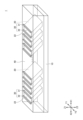
- FIG. 1 is a perspective view showing a quantum device according to a first embodiment.
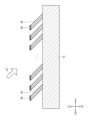
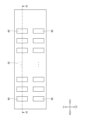
- FIG. 2 is a plan view showing the quantum device according to the first embodiment.
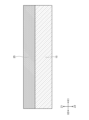
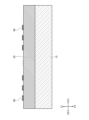
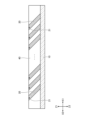
- FIG. 3 is a cross-sectional view showing the quantum device according to the first embodiment.
- FIG. 4 is a cross-sectional view (part 1) showing the method for manufacturing the quantum device according to the first embodiment.
- FIG. 5 is a cross-sectional view (Part 2) showing the method for manufacturing the quantum device according to the first embodiment.
- FIG. 6 is a cross-sectional view (Part 3) showing the method for manufacturing the quantum device according to the first embodiment.
- FIG. 7 is a cross-sectional view (Part 4) showing the method for manufacturing the quantum device according to the first embodiment.
- FIG. 1 is a perspective view showing a quantum device according to a first embodiment.
- FIG. 2 is a plan view showing the quantum device according to the first embodiment.
- FIG. 3 is a cross-sectional view showing the quantum device according to the first embodiment.
- FIG. 8 is a cross-sectional view (part 5) showing the method for manufacturing the quantum device according to the first embodiment.
- FIG. 9 is a cross-sectional view (part 6) showing the method for manufacturing the quantum device according to the first embodiment.
- FIG. 10 is a cross-sectional view (part 7) showing the method for manufacturing the quantum device according to the first embodiment.
- FIG. 11 is a cross-sectional view (part 8) showing the method for manufacturing the quantum device according to the first embodiment.
- FIG. 12 is a plan view (part 1) showing the method for manufacturing the quantum device according to the first embodiment.
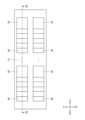
- FIG. 13 is a plan view (part 2) showing the method for manufacturing the quantum device according to the first embodiment.
- FIG. 14 is a plan view (Part 3) showing the method for manufacturing the quantum device according to the first embodiment.
- FIG. 3) showing the method for manufacturing the quantum device according to the first embodiment.
- FIG. 15 is a plan view (part 4) showing the method for manufacturing the quantum device according to the first embodiment.
- FIG. 16 is a top view showing an example of how to use the quantum device according to the first embodiment.
- FIG. 17 is a cross-sectional view showing an example of how to use the quantum device according to the first embodiment.
- FIG. 18 is a diagram (part 1) showing the relationship between the electric field strength F and the amount of change ⁇ E in the optical transition frequency.
- FIG. 19 is a diagram (part 2) showing the relationship between the electric field strength F and the amount of change ⁇ E in the optical transition frequency.
- FIG. 20 is a diagram showing the relationship between wavelength and transmittance of various metals.
- FIG. 21 is a diagram showing a quantum computing device according to the second embodiment.
- the X1-X2 direction, the Y1-Y2 direction, and the Z1-Z2 direction are mutually orthogonal directions.
- a plane including the X1-X2 direction and the Y1-Y2 direction is referred to as an XY plane
- a plane including the Y1-Y2 direction and the Z1-Z2 direction is referred to as a YZ plane
- a plane including the Z1-Z2 direction and the X1-X2 direction. is written as the ZX plane.
- the Z1-Z2 direction is referred to as the vertical direction, with the Z1 side being the upper side and the Z2 side being the lower side.
- planar view refers to viewing the object from the Z1 side
- planar shape refers to the shape of the object viewed from the Z1 side.
- FIG. 1 is a perspective view showing a quantum device according to a first embodiment.
- FIG. 2 is a plan view showing the quantum device according to the first embodiment.
- FIG. 3 is a cross-sectional view showing the quantum device according to the first embodiment.
- FIG. 3 corresponds to a cross-sectional view taken along line III-III in FIG. 2.
- the quantum device 1 mainly includes a slab waveguide 10, a plurality of nanopillars 20, a plurality of electrode pairs 30, and an embedded member 40.
- the slab waveguide 10 extends in the X1-X2 direction.
- the slab waveguide 10 has an upper surface 11 perpendicular to the Z1-Z2 direction.
- the cross section of the slab waveguide 10 perpendicular to the X1-X2 direction has a rectangular shape.
- the dimension (height) of this cross section in the Z1-Z2 direction is, for example, about 100 nm.
- the refractive index of the slab waveguide 10 is lower than that of diamond.
- the slab waveguide 10 is made of sapphire, and the upper surface 11 is the c-plane of sapphire.
- Slab waveguide 10 is an example of a waveguide.
- the X1-X2 direction is an example of the first direction.
- the upper surface 11 is an example of the first surface.
- the nanopillar 20 is made of diamond. Nanopillar 20 is provided on top surface 11 and connected to top surface 11 . The plurality of nanopillars 20 are arranged in the X1-X2 direction. The nanopillars 20 extend in a second direction inclined from the X1-X2 direction.
- the second direction is a direction between the X1-X2 direction and the Z1-Z2 direction, and the nanopillars 20 are inclined so that the more they go upward (Z1 side), the more they go toward the X2 side.
- the second direction is parallel to the [111] direction of the diamond. When viewed from a direction perpendicular to the upper surface 11, the second direction overlaps with the X1-X2 direction.
- Nanopillar 20 has an upper surface 22 parallel to upper surface 11 of slab waveguide 10 .
- the dimension of the upper surface 22 in the X1-X2 direction is about 100 nm
- the dimension in the Y1-Y2 direction is about 200 nm.
- the distance between the upper surface 11 and the upper surface 22 is, for example, about 250 nm to 1000 nm.
- the upper surface 22 is the (110) plane of diamond.
- the cross section of the nanopillar 20 perpendicular to the second direction has a rectangular shape. This cross section has long sides parallel to the Y1-Y2 direction.
- Each of the plurality of nanopillars 20 includes a color center 21.
- Color center 21 is located near top surface 22.
- the distance of the color center 21 from the upper surface 22 is 100 nm or less.
- the color center 21 is, for example, a nitrogen-vacancy center (NV center) composed of nitrogen atoms and vacancies. That is, the color center 21 is a composite defect of nitrogen atoms and vacancies.
- the direction in which nitrogen atoms and vacancies are lined up (hereinafter sometimes referred to as "defect axis direction”) is parallel to the [111] direction of diamond.
- Nanopillar 20 containing color center 21 can function as a quantum bit.
- the embedding member 40 is provided on the upper surface 11 of the slab waveguide 10 and fills the gaps between the plurality of nanopillars 20.
- the upper surface of the embedded member 40 is flush with the upper surface 22 of the nanopillar 20.
- the refractive index of the embedded member 40 is lower than that of diamond.
- the embedded member 40 is made of silicon oxide (SiO 2 ).
- the side surface of the nanopillar 20 is in direct contact with the embedded member 40. Nanopillar 20 is surrounded by embedded member 40 .
- Electrode pair 30 is provided for each nanopillar 20.
- Electrode pair 30 includes electrodes 31 and 32.
- electrodes 31 and 32 are provided on embedded member 40 .
- the color center 21 is located between the electrodes 31 and 32 in plan view. When viewed from the color center 21, the electrode 31 is on the X1 side, and the electrode 32 is on the X2 side.
- the material of the electrodes 31 and 32 is not particularly limited, but is preferably a material that absorbs little light in the visible light region, which is the signal wavelength.
- the material of the electrodes 31 and 32 is, for example, gold (Au), silver (Ag), or copper (Cu).
- 4 to 11 are cross-sectional views showing a method for manufacturing the quantum device 1 according to the first embodiment.
- 12 to 15 are plan views showing a method for manufacturing the quantum device 1 according to the first embodiment.
- a sapphire substrate 15 and a diamond substrate 25 are prepared, and the upper surface of the sapphire substrate 15 and the lower surface of the diamond substrate 25 are bonded.
- the sizes of the sapphire substrate 15 and the diamond substrate 25 are such that, for example, a plurality of quantum devices 1 can be formed in the Y1-Y2 direction.
- the upper surface of the sapphire substrate 15 is a c-plane
- the upper surface of the diamond substrate 25 is a (110) plane.
- the diamond substrate 25 for example, a high quality synthetic diamond substrate is used.
- room temperature bonding that does not use glue, such as surface activated room temperature bonding, is desirable.
- the upper surface of the sapphire substrate 15 and the lower surface of the diamond substrate 25 are brought into an active state using argon ions or the like in a vacuum, that is, a state in which dangling bonds are exposed, and the upper surface of the sapphire substrate 15 and the lower surface of the diamond substrate are Paste the bottom surface of 25. Bonding may be performed using a glue that does not have an absorption band in the visible light region.
- the sapphire substrate 15 is an example of a first substrate
- the diamond substrate 25 is an example of a second substrate.
- the diamond substrate 25 is polished so that the thickness of the diamond substrate 25 matches the distance between the top surface 22 of the nanopillar 20 and the top surface 11 of the slab waveguide 10. Polishing is, for example, mechanical polishing, chemical mechanical polishing, dry etching, or the like.
- a mask 60 is formed on the upper surface of the diamond substrate 25 at a portion that will become the upper surface 22 of the nanopillar 20.
- the mask 60 is, for example, a silicon nitride (SiN) film.
- SiN silicon nitride
- Mask 60 can be formed, for example, by photolithography.
- FIG. 6 corresponds to a cross-sectional view taken along line VI-VI in FIG. 12.
- FIGS. 7 and 13 reactive ion etching (RIE) using oxygen (O 2 ) ions 61 incident from a direction parallel to the [111] direction of the diamond substrate 25 is performed.
- RIE reactive ion etching
- a plurality of nanopillars 20 are formed from a diamond substrate 25.
- the upper surface of the diamond substrate 25 is inclined at 28.5 degrees with respect to the incident direction of the O 2 ions 61.
- the nanopillars 20 are formed to extend parallel to the [111] direction of the diamond.
- SiN film As the mask 60, high durability can be obtained.
- FIG. 7 corresponds to a cross-sectional view taken along line VII-VII in FIG. 13.
- the embedded member 40 can be formed by, for example, a chemical vapor deposition (CVD) method.
- a color center 21 is formed in each nanopillar 20.
- nitrogen ions are implanted.
- the acceleration voltage is adjusted so that the color center 21 can be formed near the upper surface 22 of the nanopillar 20.
- the dose amount is 10 10 /cm 2 or less.
- several levels of color centers 21 are formed for each nanopillar 20.
- annealing treatment is performed at 1000° C. or higher in vacuum or in an inert gas atmosphere. For example, it is desirable to set the processing time so that the light emission characteristics of the color center 21 (light emission intensity per color center 21) is optimized.
- the sapphire substrate 15 is thinned, and a slab waveguide 10 is formed from the sapphire substrate 15.
- the thickness of the slab waveguide 10 is, for example, about 100 nm.
- FIGS. 11 and 14 an electrode pair 30 including electrodes 31 and 32 is formed for each nanopillar 20. At this time, wiring (not shown) connected to the electrode pair 30 is also formed. The electrode pair 30 and the wiring are formed on the embedded member 40.
- FIG. 11 corresponds to a cross-sectional view taken along the line XI-XI in FIG. 14.
- a plurality of quantum devices 1 are obtained by dividing the structure shown in FIGS. 11 and 14 in the Y1-Y2 direction. Division can be performed, for example, by laser ablation or a dry process.
- the quantum device 1 according to the first embodiment can be manufactured.
- the color center 21 is a silicon-vacancy center (SiV center) composed of silicon and vacancies, a germanium-vacancy center (GeV center) composed of germanium and vacancies, and a silicon-vacancy center (SiV center) composed of silicon and vacancies.
- SiV center silicon-vacancy center
- GeV center germanium-vacancy center
- SiV center silicon-vacancy center
- FIG. 16 is a top view showing an example of how to use the quantum device 1 according to the first embodiment.
- FIG. 17 is a cross-sectional view showing an example of how to use the quantum device 1 according to the first embodiment.
- a DC power source 35 is individually connected to each electrode pair 30.
- the negative electrode of the DC power source 35 is connected to the electrode 31, and the positive electrode of the DC power source 35 is connected to the electrode 32. Therefore, an electric field is applied to the color center 21 from the electrode pair 30.
- This electric field includes a component perpendicular to the defect axis of the color center 21 (hereinafter sometimes referred to as a "perpendicular component").
- the color center 21 is irradiated with a laser beam 26 in the visible light range.
- the wavelength of the laser beam 26 is, for example, 520 nm to 720 nm.
- the color center 21 emits light when irradiated with the laser beam 26. Since the nanopillar 20 is surrounded by the embedded member 40 having a lower refractive index than diamond, the light generated at the color center 21 is confined within the nanopillar 20. This light then propagates within the nanopillar 20 as a signal light 27 along the second direction in which the nanopillar 20 extends (a direction parallel to the [111] direction of the diamond). At this time, the signal light 27 travels inside the nanopillar 20 in a single mode of only the TE mode, which has an electric field amplitude component only in the direction (Y1-Y2 direction) parallel to the long side of the cross section perpendicular to the second direction of the nanopillar 20. propagate. That is, the signal light 27 propagates within the nanopillar 20 in a single mode in the second direction.
- the total reflection angle at the interface 50 between the diamond nanopillar 20 and the slab waveguide 10 made of sapphire is 46.8°
- the signal light 27 within the nanopillar 20 The angle ⁇ 1 between the traveling direction and the interface 50 is 28.5°. That is, the angle ⁇ 1 is smaller than the total reflection angle. Therefore, the signal light 27 that has propagated to the interface 50 is guided from the nanopillar 20 to the slab waveguide 10 with high efficiency. Further, the signal light 27 guided to the slab waveguide 10 propagates within the slab waveguide 10 while maintaining a single mode of TE mode.
- the electrode pair 30 and the wiring are formed on the embedded member 40. Therefore, compared to the case where a metal electrode pair 30 or wiring is formed on the nanopillar 20, the signal light 27 is more easily confined within the nanopillar 20, and optical loss due to metal can be reduced.
- Equation 1 ⁇ is the amount of change in the dipole moment between the base and excited levels, ⁇ is the amount of change in the polarizability tensor between the base and excited levels, and ⁇ is the dielectric constant of diamond.
- the optical transition frequency of the color center 21 can be adjusted in a range of about 5 GHz by applying an electric field using the electrode pair 30.
- the emission wavelength at the color center 21 can be adjusted.
- the degree of integration is lower than in a configuration in which the quantum bits and the waveguide are arranged in one plane. can be improved.
- the dimensions of the top surface 22 are 100 nm, the dimensions of the electrodes 31 and 32 are 30 nm, the distance between adjacent top surfaces 22 is 200 nm, and the dimension of the top surface 22 in the Y1-Y2 direction is 200 nm. shall be.
- the dimension of the region for securing two quantum bits in the X1-X2 direction is 460 nm
- the dimension in the Y1-Y2 direction is 200 nm
- the area is 0.092 ⁇ m 2 .
- the occupied area per qubit is 0.046 ⁇ m 2 .
- the exclusive area per quantum bit of the superconducting quantum computer described in Non-Patent Document 5 is 90,000 ⁇ m 2 .
- the exclusive area per quantum bit can be made smaller by about seven orders of magnitude.
- the distance between the nanopillars 20 in a plane parallel to the top surface 11 can be narrowed, and the degree of integration of qubits can be reduced. can be improved.
- the electrodes 31 and 32 included in the electrode pair 30 are preferably made of a material that absorbs little light in the visible light region.
- FIG. 20 is a diagram showing the relationship between wavelength and transmittance of various metals.
- FIG. 20 shows the transmittance of Au, Ag, Cu, and Al films with a thickness of 5 nm calculated using the Drude model. As shown in FIG. 20, higher transmittance can be obtained with Au, Ag, or Cu than with Al.
- the second direction does not need to be parallel to the [111] direction of the diamond.
- the angle ⁇ 1 is smaller than the total reflection angle at the interface 50.
- FIG. 21 is a diagram showing a quantum computing device according to the second embodiment.
- the quantum computing device 2 functions as a quantum computer.
- the quantum computing device 2 includes quantum modules 70 and 80, a plurality of control systems 72 and 82, optical switches 73 and 83, and single photon detectors 74 and 84.
- the quantum computing device 2 further includes a cooler 90, a control section 91, an AD converter 92, a beam splitter 93, and a comparator 94.
- the quantum modules 70 and 80 , the control systems 72 and 82 , the optical switches 73 and 83 , the single photon detectors 74 and 84 , the AD converter 92 , the beam splitter 93 , and the comparator 94 are connected to the cooler 90 . contained inside.
- the temperature inside the cooler 90 is 4K or less.
- the control unit 91 outputs a control analog signal to the AD converter 92, the AD converter 92 converts the analog signal into a digital signal, and the digital signal is input to the control systems 72 and 82.
- the control unit 91 is, for example, a personal computer.
- Quantum module 70 includes a plurality of qubits 71
- quantum module 80 includes the same number of qubits 81 as qubits 71 .
- Qubits 71 and 81 correspond to nanopillar 20 including color center 21 in quantum device 1 .
- a control system 72 is provided for each quantum bit 71, and a control system 82 is provided for each quantum bit 81.
- the control system 72 controls the magnetic field, electric field, and microwave applied to the corresponding quantum bit 71, and irradiates the corresponding quantum bit 71 with laser light.
- the control system 82 controls the magnetic field, electric field, and microwave applied to the corresponding quantum bit 81, and irradiates the corresponding quantum bit 81 with laser light.
- the application of a magnetic field is used to form the state of the color center 21 that performs quantum manipulation.
- the application of microwaves is used to control the state of the color center 21.
- Laser light irradiation is used to read out the state of the color center 21 (single photon generation).
- Application of an electric field is used to control the emission wavelength of the color center 21. In controlling the electric field, the electric field is controlled via the electrode pair 30.
- the signal light (photons) generated by the quantum module 70 is input to the optical switch 73, and the optical switch 73 outputs the signal light to the single photon detector 74 or the beam splitter 93. Further, the signal light (photons) generated by the quantum module 80 is input to the optical switch 83, and the optical switch 83 outputs the signal light to the single photon detector 84 or the beam splitter 93. The signal light input to the beam splitter 93 is output to single photon detectors 74 and 84. In this way, the signal light generated in the quantum module 70 has two paths: one is guided directly to the single photon detector 74, and the other is guided to the single photon detector 74 via the beam splitter 93. It is switched by the optical switch 73. Similarly, the signal light generated in the quantum module 80 has two paths: one is guided directly to the single photon detector 84 and the other is guided to the single photon detector 84 via the beam splitter 93. is switched by the optical switch 83.
- the optical switch 73 or 83 when reading the state of a single quantum bit, directs the signal light from the quantum module 70 or 80 to the single photon detector 74 or 84. For example, during the entanglement operation between the spins of the color center corresponding to the multi-gate operation, the optical switch 73 or 83 causes the signal light to be sent from the quantum module 70 or 80 to the single photon detector 74 or 84 via the beam splitter 93. light is guided. At this time, nanopillars 20 having the same optical path length from the beam splitter 93 are used between the quantum module 70 and the quantum module 80.
- the comparator 94 is used during the entanglement operation, and compares the single photon detection signals after being split by the beam splitter 93 (Which of the single photon detectors 74 or 84 detects them and in what order?) .
- the result of analyzing the output from the comparator 94 corresponds to the result of the calculation by the quantum calculation device 2.
- HOM interference is a phenomenon in which when photons are incident on a beam splitter from two ports, the photons are always detected by only one detector.
- the quantum device 1 according to the first embodiment is used in the quantum modules 70 and 80, so the degree of integration of quantum bits can be improved. Furthermore, a highly reliable and practical quantum computing device 2 can be obtained.
- Quantum device 2 Quantum operation device 10: Slab waveguide 11: Top surface 15: Sapphire substrate 20: Nanopillar 21: Color center 22: Top surface 25: Diamond substrate 30: Electrode pair 31, 32: Electrode 40: Embedded member 50 :interface
Landscapes
- Engineering & Computer Science (AREA)
- Chemical & Material Sciences (AREA)
- Nanotechnology (AREA)
- Physics & Mathematics (AREA)
- Life Sciences & Earth Sciences (AREA)
- Biophysics (AREA)
- Optics & Photonics (AREA)
- Crystallography & Structural Chemistry (AREA)
- Manufacturing & Machinery (AREA)
- Optical Modulation, Optical Deflection, Nonlinear Optics, Optical Demodulation, Optical Logic Elements (AREA)
Priority Applications (4)
| Application Number | Priority Date | Filing Date | Title |
|---|---|---|---|
| EP22956430.7A EP4579753A4 (en) | 2022-08-23 | 2022-08-23 | QUANTUM DEVICE AND METHOD FOR MANUFACTURING A QUANTUM DEVICE |
| PCT/JP2022/031682 WO2024042602A1 (ja) | 2022-08-23 | 2022-08-23 | 量子デバイス及び量子デバイスの製造方法 |
| JP2024542470A JPWO2024042602A1 (https=) | 2022-08-23 | 2022-08-23 | |
| US19/040,672 US20250185129A1 (en) | 2022-08-23 | 2025-01-29 | Quantum device and method for manufacturing quantum device |
Applications Claiming Priority (1)
| Application Number | Priority Date | Filing Date | Title |
|---|---|---|---|
| PCT/JP2022/031682 WO2024042602A1 (ja) | 2022-08-23 | 2022-08-23 | 量子デバイス及び量子デバイスの製造方法 |
Related Child Applications (1)
| Application Number | Title | Priority Date | Filing Date |
|---|---|---|---|
| US19/040,672 Continuation US20250185129A1 (en) | 2022-08-23 | 2025-01-29 | Quantum device and method for manufacturing quantum device |
Publications (1)
| Publication Number | Publication Date |
|---|---|
| WO2024042602A1 true WO2024042602A1 (ja) | 2024-02-29 |
Family
ID=90012729
Family Applications (1)
| Application Number | Title | Priority Date | Filing Date |
|---|---|---|---|
| PCT/JP2022/031682 Ceased WO2024042602A1 (ja) | 2022-08-23 | 2022-08-23 | 量子デバイス及び量子デバイスの製造方法 |
Country Status (4)
| Country | Link |
|---|---|
| US (1) | US20250185129A1 (https=) |
| EP (1) | EP4579753A4 (https=) |
| JP (1) | JPWO2024042602A1 (https=) |
| WO (1) | WO2024042602A1 (https=) |
Citations (5)
| Publication number | Priority date | Publication date | Assignee | Title |
|---|---|---|---|---|
| JP2007526639A (ja) | 2004-03-02 | 2007-09-13 | ザ ユニバーシティー オブ メルボルン | 光子源 |
| US20110309265A1 (en) | 2010-04-19 | 2011-12-22 | President And Fellows Of Harvard College | Diamond nanowires |
| US20120161663A1 (en) | 2009-07-23 | 2012-06-28 | Commissariat A L'energie Atomique | Electrically driven single photon source |
| JP2015529328A (ja) | 2012-08-22 | 2015-10-05 | プレジデント アンド フェローズ オブ ハーバード カレッジ | ナノスケール走査センサ |
| WO2022118366A1 (ja) * | 2020-12-01 | 2022-06-09 | 富士通株式会社 | 量子回路、量子コンピュータ及び量子回路の製造方法 |
Family Cites Families (2)
| Publication number | Priority date | Publication date | Assignee | Title |
|---|---|---|---|---|
| US9082673B2 (en) * | 2009-10-05 | 2015-07-14 | Zena Technologies, Inc. | Passivated upstanding nanostructures and methods of making the same |
| KR102318555B1 (ko) * | 2020-03-19 | 2021-10-29 | 한국과학기술연구원 | 광소자용 역나노콘과 그 제조방법 |
-
2022
- 2022-08-23 JP JP2024542470A patent/JPWO2024042602A1/ja active Pending
- 2022-08-23 EP EP22956430.7A patent/EP4579753A4/en active Pending
- 2022-08-23 WO PCT/JP2022/031682 patent/WO2024042602A1/ja not_active Ceased
-
2025
- 2025-01-29 US US19/040,672 patent/US20250185129A1/en active Pending
Patent Citations (5)
| Publication number | Priority date | Publication date | Assignee | Title |
|---|---|---|---|---|
| JP2007526639A (ja) | 2004-03-02 | 2007-09-13 | ザ ユニバーシティー オブ メルボルン | 光子源 |
| US20120161663A1 (en) | 2009-07-23 | 2012-06-28 | Commissariat A L'energie Atomique | Electrically driven single photon source |
| US20110309265A1 (en) | 2010-04-19 | 2011-12-22 | President And Fellows Of Harvard College | Diamond nanowires |
| JP2015529328A (ja) | 2012-08-22 | 2015-10-05 | プレジデント アンド フェローズ オブ ハーバード カレッジ | ナノスケール走査センサ |
| WO2022118366A1 (ja) * | 2020-12-01 | 2022-06-09 | 富士通株式会社 | 量子回路、量子コンピュータ及び量子回路の製造方法 |
Non-Patent Citations (9)
| Title |
|---|
| A. SIPAHIGIL ET AL., SCIENCE, vol. 354, 2016, pages 847 |
| AGHAEIMEIBODI S.; VUCKOVIC J.: "Quantum Photonics with SnV Centers in Diamond", 2021 IEEE INTERNATIONAL ELECTRON DEVICES MEETING (IEDM), IEEE, 11 December 2021 (2021-12-11), XP034096669, DOI: 10.1109/IEDM19574.2021.9720697 * |
| AGHAEIMEIBODI SHAHRIAR, RIEDEL DANIEL, RUGAR ALISON E., DORY CONSTANTIN, VUČKOVIĆ JELENA: "Electrical Tuning of Tin-Vacancy Centers in Diamond", PHYSICAL REVIEW APPLIED, AMERICAN PHYSICAL SOCIETY, US, vol. 15, no. 6, 1 June 2021 (2021-06-01), US , pages 064010, XP093142174, ISSN: 2331-7019, DOI: 10.1103/PhysRevApplied.15.064010 * |
| C. T. NGUYEN, REV. LETT., vol. 123, 2019, pages 183602 |
| J. LISENFELD, NPJ QUANTUM INFORMATION, vol. 5, 2019, pages 105 |
| L. D. SANTIS ET AL., PHYSICAL REVIEW LETTERS, vol. 127, 2021, pages 147402 |
| PH. TAMARAT ET AL., PHYSICAL REVIEW LETTERS, vol. 97, 2006, pages 083002 |
| See also references of EP4579753A4 |
| VOLKOVA KSENIIA, HEUPEL JULIA, TROFIMOV SERGEI, BETZ FRIDTJOF, COLOM RÉMI, MACQUEEN ROWAN W., AKHUNDZADA SAPIDA, REGINKA MEIKE, EH: "Optical and Spin Properties of NV Center Ensembles in Diamond Nano-Pillars", NANOMATERIALS, MDPI, vol. 12, no. 9, 1 January 2022 (2022-01-01), pages 1516, XP093142172, ISSN: 2079-4991, DOI: 10.3390/nano12091516 * |
Also Published As
| Publication number | Publication date |
|---|---|
| EP4579753A4 (en) | 2025-10-15 |
| US20250185129A1 (en) | 2025-06-05 |
| EP4579753A1 (en) | 2025-07-02 |
| JPWO2024042602A1 (https=) | 2024-02-29 |
Similar Documents
| Publication | Publication Date | Title |
|---|---|---|
| Montblanch et al. | Layered materials as a platform for quantum technologies | |
| Thomaschewski et al. | On-chip detection of optical spin–orbit interactions in plasmonic nanocircuits | |
| Xu et al. | Quantum plasmonics: new opportunity in fundamental and applied photonics | |
| Li et al. | Large-area, lithography-free super absorbers and color filters at visible frequencies using ultrathin metallic films | |
| Parzefall et al. | Light at the end of the tunnel | |
| Rath et al. | Superconducting single-photon detectors integrated with diamond nanophotonic circuits | |
| Lončar et al. | Quantum photonic networks in diamond | |
| JP5363679B2 (ja) | 光変調素子 | |
| US12511564B2 (en) | Systems, devices, articles, and methods to interact with information stored in orbital states associated with silicon defects | |
| CN104111565B (zh) | 一种基于表面等离激元法诺共振的微纳光开关及使用它的级联光开关 | |
| US20260096251A1 (en) | Systems, devices, articles and methods including luminescent local defects in semiconductors with local information states | |
| Zheng et al. | Active control of excitonic strong coupling and electroluminescence in electrically driven plasmonic nanocavities | |
| JPWO2002017011A1 (ja) | 励起子ポラリトン光スイッチ | |
| Kutovyi et al. | Efficient single-photon sources based on chlorine-doped ZnSe nanopillars with growth controlled emission energy | |
| Panchenko et al. | In‐Plane Detection of Guided Surface Plasmons for High‐Speed Optoelectronic Integrated Circuits | |
| WO2024042602A1 (ja) | 量子デバイス及び量子デバイスの製造方法 | |
| WO2023233473A1 (ja) | 量子デバイス及び量子デバイスの製造方法 | |
| JP7586318B2 (ja) | 光導波路、量子演算装置及び光導波路の製造方法 | |
| US20260126590A1 (en) | Quantum device and method for manufacturing quantum device | |
| CN117424651A (zh) | 基于自旋轨道耦合效应实现相干光的路由分发及装置 | |
| Lobanov et al. | Control of light polarization by voltage in excitonic metasurface devices | |
| Whitney | Electrically-tunable light-matter interactions in quantum materials | |
| Lin | Photonic devices using coupled plasmonic structures | |
| EP4729999A1 (en) | Waveguide with recess for opto-electronic devices and coupled waveguides and method for producing the same | |
| Brückerhoff-Plückemann et al. | All-optical chips |
Legal Events
| Date | Code | Title | Description |
|---|---|---|---|
| 121 | Ep: the epo has been informed by wipo that ep was designated in this application |
Ref document number: 22956430 Country of ref document: EP Kind code of ref document: A1 |
|
| WWE | Wipo information: entry into national phase |
Ref document number: 2024542470 Country of ref document: JP |
|
| WWE | Wipo information: entry into national phase |
Ref document number: 2022956430 Country of ref document: EP |
|
| NENP | Non-entry into the national phase |
Ref country code: DE |
|
| ENP | Entry into the national phase |
Ref document number: 2022956430 Country of ref document: EP Effective date: 20250324 |
|
| WWP | Wipo information: published in national office |
Ref document number: 2022956430 Country of ref document: EP |