WO2024029545A1 - イオタアルミナの製造方法及びイオタアルミナ - Google Patents
イオタアルミナの製造方法及びイオタアルミナ Download PDFInfo
- Publication number
- WO2024029545A1 WO2024029545A1 PCT/JP2023/028191 JP2023028191W WO2024029545A1 WO 2024029545 A1 WO2024029545 A1 WO 2024029545A1 JP 2023028191 W JP2023028191 W JP 2023028191W WO 2024029545 A1 WO2024029545 A1 WO 2024029545A1
- Authority
- WO
- WIPO (PCT)
- Prior art keywords
- sodium
- aluminum
- iota
- alumina
- test example
- Prior art date
- Legal status (The legal status is an assumption and is not a legal conclusion. Google has not performed a legal analysis and makes no representation as to the accuracy of the status listed.)
- Ceased
Links
Images









Classifications
-
- C—CHEMISTRY; METALLURGY
- C01—INORGANIC CHEMISTRY
- C01F—COMPOUNDS OF THE METALS BERYLLIUM, MAGNESIUM, ALUMINIUM, CALCIUM, STRONTIUM, BARIUM, RADIUM, THORIUM, OR OF THE RARE-EARTH METALS
- C01F7/00—Compounds of aluminium
- C01F7/02—Aluminium oxide; Aluminium hydroxide; Aluminates
- C01F7/04—Preparation of alkali metal aluminates; Aluminium oxide or hydroxide therefrom
- C01F7/14—Aluminium oxide or hydroxide from alkali metal aluminates
-
- C—CHEMISTRY; METALLURGY
- C01—INORGANIC CHEMISTRY
- C01F—COMPOUNDS OF THE METALS BERYLLIUM, MAGNESIUM, ALUMINIUM, CALCIUM, STRONTIUM, BARIUM, RADIUM, THORIUM, OR OF THE RARE-EARTH METALS
- C01F7/00—Compounds of aluminium
- C01F7/02—Aluminium oxide; Aluminium hydroxide; Aluminates
- C01F7/04—Preparation of alkali metal aluminates; Aluminium oxide or hydroxide therefrom
-
- C—CHEMISTRY; METALLURGY
- C01—INORGANIC CHEMISTRY
- C01F—COMPOUNDS OF THE METALS BERYLLIUM, MAGNESIUM, ALUMINIUM, CALCIUM, STRONTIUM, BARIUM, RADIUM, THORIUM, OR OF THE RARE-EARTH METALS
- C01F7/00—Compounds of aluminium
- C01F7/02—Aluminium oxide; Aluminium hydroxide; Aluminates
- C01F7/42—Preparation of aluminium oxide or hydroxide from metallic aluminium, e.g. by oxidation
-
- C—CHEMISTRY; METALLURGY
- C01—INORGANIC CHEMISTRY
- C01P—INDEXING SCHEME RELATING TO STRUCTURAL AND PHYSICAL ASPECTS OF SOLID INORGANIC COMPOUNDS
- C01P2002/00—Crystal-structural characteristics
- C01P2002/20—Two-dimensional structures
-
- C—CHEMISTRY; METALLURGY
- C01—INORGANIC CHEMISTRY
- C01P—INDEXING SCHEME RELATING TO STRUCTURAL AND PHYSICAL ASPECTS OF SOLID INORGANIC COMPOUNDS
- C01P2002/00—Crystal-structural characteristics
- C01P2002/70—Crystal-structural characteristics defined by measured X-ray, neutron or electron diffraction data
- C01P2002/72—Crystal-structural characteristics defined by measured X-ray, neutron or electron diffraction data by d-values or two theta-values, e.g. as X-ray diagram
-
- C—CHEMISTRY; METALLURGY
- C01—INORGANIC CHEMISTRY
- C01P—INDEXING SCHEME RELATING TO STRUCTURAL AND PHYSICAL ASPECTS OF SOLID INORGANIC COMPOUNDS
- C01P2004/00—Particle morphology
- C01P2004/01—Particle morphology depicted by an image
- C01P2004/03—Particle morphology depicted by an image obtained by SEM
-
- C—CHEMISTRY; METALLURGY
- C01—INORGANIC CHEMISTRY
- C01P—INDEXING SCHEME RELATING TO STRUCTURAL AND PHYSICAL ASPECTS OF SOLID INORGANIC COMPOUNDS
- C01P2004/00—Particle morphology
- C01P2004/10—Particle morphology extending in one dimension, e.g. needle-like
-
- C—CHEMISTRY; METALLURGY
- C01—INORGANIC CHEMISTRY
- C01P—INDEXING SCHEME RELATING TO STRUCTURAL AND PHYSICAL ASPECTS OF SOLID INORGANIC COMPOUNDS
- C01P2004/00—Particle morphology
- C01P2004/20—Particle morphology extending in two dimensions, e.g. plate-like
-
- C—CHEMISTRY; METALLURGY
- C01—INORGANIC CHEMISTRY
- C01P—INDEXING SCHEME RELATING TO STRUCTURAL AND PHYSICAL ASPECTS OF SOLID INORGANIC COMPOUNDS
- C01P2004/00—Particle morphology
- C01P2004/54—Particles characterised by their aspect ratio, i.e. the ratio of sizes in the longest to the shortest dimension
-
- C—CHEMISTRY; METALLURGY
- C01—INORGANIC CHEMISTRY
- C01P—INDEXING SCHEME RELATING TO STRUCTURAL AND PHYSICAL ASPECTS OF SOLID INORGANIC COMPOUNDS
- C01P2004/00—Particle morphology
- C01P2004/60—Particles characterised by their size
- C01P2004/61—Micrometer sized, i.e. from 1-100 micrometer
-
- C—CHEMISTRY; METALLURGY
- C01—INORGANIC CHEMISTRY
- C01P—INDEXING SCHEME RELATING TO STRUCTURAL AND PHYSICAL ASPECTS OF SOLID INORGANIC COMPOUNDS
- C01P2004/00—Particle morphology
- C01P2004/60—Particles characterised by their size
- C01P2004/62—Submicrometer sized, i.e. from 0.1-1 micrometer
Definitions
- the present invention relates to a method for producing iota alumina and iota alumina.
- Patent Document 1 discloses a method for producing tabular iota alumina by oxidizing an alkali metal halogenoaluminate melt with oxygen gas or oxygen-containing gas at a temperature of 400°C to 800°C. (Patent Document 1).
- the need to introduce oxygen-containing gas into the melt during heating required a reactor that was capable of gas exchange during heating.
- the present invention provides a method for producing iota alumina that involves simple steps at low temperatures, and iota alumina in which the crystal habit obtained by the production method is rod-like or needle-like.
- the method for producing iota alumina according to the first aspect is a reaction in which a solid raw material containing an alkali metal compound, a fluoride, at least one material selected from an aluminum compound and aluminum is mixed and heat-treated. and a washing step of introducing the product produced in the reaction step into a polar solvent.
- the alkali metal compound includes sodium aluminum dioxide (NaAlO 2 ), sodium borates, sodium hydride (NaH), sodium borohydride (NaBH 4 ), and sodium oxide (Na 2 O) and It may be at least one selected from potassium aluminum (KAlO 2 ), potassium borates, potassium hydride (KH), potassium borohydride (KBH 4 ), and potassium oxide (K 2 O).
- the sodium borates are selected from sodium metaborate ( NaBO2 ), sodium tetraborate ( Na2B4O7 ) and sodium diborate ( Na4B2O5 ). At least one or more types may be used.
- the potassium borates are selected from potassium metaborate ( KBO2 ), potassium tetraborate ( K2B4O7 ) and potassium diborate ( K4B2O5 ) . At least one or more types may be used.
- the fluoride is sodium fluoride (NaF), sodium hexafluoride aluminate (Na 3 AlF 6 ), potassium fluoride (KF), potassium aluminum fluoride (KAlF 4 ), hexafluoride It may be at least one selected from potassium aluminate (K 3 AlF 6 ), aluminum fluoride (AlF 3 ), and lithium fluoride (LiF).
- the aluminum compound may be at least one selected from sodium aluminum dioxide (NaAlO 2 ), potassium aluminum dioxide (KAlO 2 ), alumina (Al 2 O 3 ), and aluminum fluoride. good.
- the polar solvent may be water.
- the polar solvent is water
- the product and the water may be stirred at a temperature of 80°C or higher and 100°C or lower.
- the iota alumina of the first embodiment has a rod-like, needle-like, or plate-like crystal habit.
- the average aspect ratio of the iota alumina crystals may be 3 or more and 30 or less.
- the iota alumina has a rod-like or needle-like crystal habit, and may contain sodium.
- the iota alumina has a rod-like or tabular crystal habit, and may contain potassium.
- the first aspect it is possible to provide a method for producing iota alumina that involves a low temperature and simple process.
- FIG. 1A is an SEM (Scanning Electron Microscope) backscattered electron image of a cross section of a lumpy reaction product washed by stirring with water at 80° C. or higher and 100° C. or lower for 1 hour.
- FIG. 1B is an enlarged SEM backscattered electron image related to range IB shown in FIG. 1A.
- FIG. 1C is an enlarged SEM backscattered electron image of iota alumina crystal obtained by observing the surface of the product according to FIG. 1A.
- FIG. 1D is an enlarged SEM backscattered electron image of iota alumina crystal obtained by observing the surface of the product according to FIG. 1A at a different location from FIG. 1C.
- FIG. 1A is an SEM (Scanning Electron Microscope) backscattered electron image of a cross section of a lumpy reaction product washed by stirring with water at 80° C. or higher and 100° C. or lower for 1 hour.
- FIG. 1E is an enlarged SEM backscattered electron image showing an iota alumina crystal whose aspect ratio is measured in the range IE shown in FIG. 1C.
- FIG. 1F is an enlarged SEM backscattered electron image showing an iota alumina crystal whose aspect ratio in the range IF shown in FIG. 1D was measured.
- FIG. 1G is an enlarged SEM backscattered electron image of iota alumina crystals produced using potassium metaborate (KBO 2 ) as the alkali metal compound.
- FIG. 1H is an enlarged SEM backscattered electron image of iota alumina crystals produced using potassium metaborate (KBO 2 ) as the alkali metal compound.
- FIG. 1E is an enlarged SEM backscattered electron image showing an iota alumina crystal whose aspect ratio is measured in the range IE shown in FIG. 1C.
- FIG. 1F is an enlarged SEM backscattered electron
- FIG. 2 is a SEM backscattered electron image of powdered iota alumina crystal obtained by high-temperature washing of the reaction product with boiling water.
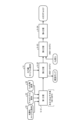
- FIG. 3 is a process diagram showing a first manufacturing method of iota alumina.
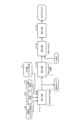
- FIG. 4 is a process diagram showing a second manufacturing method of iota alumina.
- FIG. 5 is a process diagram showing a third manufacturing method of iota alumina.
- FIG. 6 is a process diagram showing a fourth manufacturing method of iota alumina.
- FIG. 7 is a partial cross-sectional view showing an example of a closed container used in the first to fourth manufacturing methods.
- FIG. 3 is a process diagram showing a first manufacturing method of iota alumina.
- FIG. 4 is a process diagram showing a second manufacturing method of iota alumina.
- FIG. 5 is a process diagram showing a third manufacturing method of iota alumina
- FIG. 8 is a partial cross-sectional view showing another example of the closed container used in the first to fourth manufacturing methods.
- FIG. 9 is a partial cross-sectional view showing another example of the closed container used in the first to fourth manufacturing methods.
- FIG. 10 is a partial sectional view showing another example of the closed container used in the first to fourth manufacturing methods.
- FIG. 11A is a front view photograph of an external appearance of a stirrer using the closed container 10B shown in FIG. 8 and equipped with a plate-shaped (blade) stirrer.
- FIG. 11B is an external side photograph of a stirrer using the closed container 10B shown in FIG. 8 and equipped with a plate-shaped (blade) stirrer.
- FIG. 11A is a front view photograph of an external appearance of a stirrer using the closed container 10B shown in FIG. 8 and equipped with a plate-shaped (blade) stirrer.
- FIG. 11B is an external side photograph of a stirrer using the closed container 10B shown in FIG
- FIG. 12A is a photograph of a plate-like (blade) stirrer taken out of the closed container shown in FIG. 8 after stirring for a predetermined period of time.
- FIG. 12B is a photograph of the reaction product taken out of the closed container shown in FIG. 8 after stirring for a predetermined period of time.
- FIG. 13A is a photograph of the closed container shown in FIG. 10 before iota alumina is produced by rotating the horizontal wide paddle (WP) stirrer.
- FIG. 13B is a photograph after producing iota alumina by rotating the horizontal wide paddle (WP) stirrer in the closed container shown in FIG.
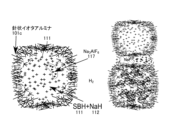
- FIG. 14A is a schematic reaction diagram illustrating the iota alumina production reaction.
- FIG. 14B is a schematic reaction diagram illustrating the iota alumina production reaction.
- FIG. 14C is a schematic reaction diagram illustrating the iota alumina production reaction.
- FIG. 14D is a schematic reaction diagram illustrating the iota alumina production reaction.
- FIG. 14E is a schematic reaction diagram illustrating the iota alumina production reaction.
- FIG. 14F is a schematic reaction diagram illustrating the iota alumina production reaction.
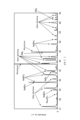
- FIG. 15 is a diagram showing the X-ray diffraction pattern of the product according to Test Example 1.
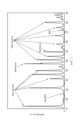
- FIG. 16 is a diagram showing the X-ray diffraction pattern of the product according to Test Example 3.
- FIG. 15 is a diagram showing the X-ray diffraction pattern of the product according to Test Example 1.
- FIG. 16 is a diagram showing the X-ray diffraction pattern of the product according to Test Example 3.
- FIG. 15 is a diagram showing the X-
- FIG. 17 is a diagram showing the X-ray diffraction pattern of the product according to Test Example 4.
- FIG. 18 is a diagram showing the X-ray diffraction pattern of the product according to Test Example 6.
- FIG. 19 is a diagram showing the X-ray diffraction pattern of the product according to Test Example 7.
- FIG. 20 is a diagram showing the X-ray diffraction pattern of the product according to Test Example 8.
- FIG. 21 is a diagram showing the X-ray diffraction pattern of the product according to Test Example 18.
- FIG. 22 is a diagram showing the X-ray diffraction pattern of the product according to Test Example 24.
- the method for producing iota-alumina includes a reaction step and an extraction step.
- the reaction step is a step in which solid raw materials are mixed and heat treated.
- the solid raw material includes an alkali metal compound, a fluoride, an aluminum compound, and at least one material selected from aluminum.
- Alkali metal compounds that are raw materials include sodium aluminum dioxide (NaAlO 2 ), sodium borates, sodium hydride (NaH), sodium borohydride (NaBH 4 ), sodium oxide (Na 2 O), potassium aluminum dioxide ( At least one selected from KAlO 2 ), potassium borates, potassium hydride (KH), potassium borohydride (KBH 4 ), and potassium oxide (K 2 O) can be used.
- Sodium (Na 4 B 2 O 5 ), potassium metaborate (KBO 2 ( K 3 (B 3 O 6 ))), potassium tetraborate (K 2 B 4 O 7 ) and sodium diborate (K 4 B 2 O 5 ) or a combination of at least two or more types, but is not limited thereto.
- sodium metaborate powder When using sodium metaborate as the sodium borate, powdered sodium metaborate powder (sodium metaborate powder) is used.
- the particle size of the sodium metaborate powder is preferably 100 ⁇ m or less.
- Sodium metaborate powder can be obtained by pulverizing the powder to a certain degree of fineness and then passing it through a sieve with an opening of 100 ⁇ m. If the particle size of the sodium metaborate powder exceeds 100 ⁇ m, the production efficiency of sodium borohydride may decrease.
- the particle size of the sodium metaborate powder is more preferably less than 100 ⁇ m.
- the sodium metaborate powder is preferably obtained by passing it through a sieve with an opening of less than 100 ⁇ m (for example, a sieve with an opening of 50 ⁇ m or less).
- a sieve with an opening of 50 ⁇ m or less for example, a sieve with an opening of 50 ⁇ m or less.
- the sodium metaborate powder contains water, it is preferable that the amount of the sodium metaborate powder be increased by the mass of the water relative to the amount required for the synthesis of sodium borohydride.
- Potassium borates used as raw materials include potassium metaborate (KBO 2 ), potassium tetraborate (K 2 B 4 O 7 ), potassium diborate (K 4 B 2 O 5 ), or a combination of at least two of them. Examples include, but are not limited to.
- the raw material aluminum powder materials, fragments of scrap materials, etc. can be used.
- scrap materials such as chips and waste materials can be used as the aluminum pieces.
- the aluminum fragments contain as little impurity metals nobler than aluminum as possible.
- the amount of aluminum is preferably 110% or more in molar ratio with respect to the amount required for sodium borohydride synthesis. Part of the excess aluminum is consumed by reaction with moisture, but as the reaction progresses and the amount of aluminum as a raw material decreases, it also contributes to increasing the chance of contact with sodium metaborate. The yield can be improved. It should be noted that the excessively charged aluminum can be recovered and reused as aluminum metal in the sodium borohydride cleaning step.
- the average particle size of the aluminum powder is, for example, 1 ⁇ m or more, and the maximum particle size is preferably 10 mm or less. If the average particle size of the aluminum powder is less than 1 ⁇ m, the powder may easily explode and become difficult to handle, and the particles may tend to adhere to each other and become agglomerated together. When the average particle size is larger than 10 mm, the specific surface area per mass becomes small, the reaction area decreases, and the initial reaction rate may be extremely reduced.
- the average particle size of the aluminum powder is more preferably 5 ⁇ m or more and 5 mm or less. Note that the average particle size is obtained as a particle size of a sphere equivalent diameter using a laser diffraction type particle size distribution measuring device.
- the raw material aluminum compound at least one selected from sodium aluminum dioxide (NaAlO 2 ), potassium aluminum dioxide (KAlO 2 ), alumina (Al 2 O 3 ), and aluminum fluoride (AlF 3 ) is used. I can do it.
- Fluorides that are raw materials include sodium fluoride (NaF), sodium hexafluoroaluminate (Na 3 AlF 6 ), potassium fluoride (KF), potassium aluminum fluoride (KAlF 4 ), potassium hexafluoroaluminate. (K 3 AlF 6 ), aluminum fluoride (AlF 3 ), and lithium fluoride (LiF).
- sodium fluoride which is an alkali metal fluoride, is particularly preferred.
- fluoride By adding fluoride, crystallization of iota alumina progresses favorably. Specifically, fluoride promotes the decomposition reaction of sodium aluminum dioxide (NaAlO 2 ), which is an intermediate product, thereby improving the yield of iota alumina, which is a product of the decomposition reaction, and improving the yield of iota alumina. Crystallization progresses well.
- NaAlO 2 sodium aluminum dioxide
- the total molar ratio of all the alkali metals and alkaline earth metals of the raw materials to the boron (B) of the sodium borate may be described as A/B (molar ratio).
- the A/B (molar ratio) of the raw materials is preferably less than 2.65.
- A/B is 2.65 or more, the amount of sodium ions in the reaction system becomes excessive and the yield decreases.
- a product containing iota alumina is obtained by heat treatment of the solid raw material.
- the heating temperature in the reaction step is higher than 450°C. If the heating temperature is 450° C. or lower, the crystallization of iota alumina will not proceed sufficiently. Moreover, the heating temperature in the reaction step is less than 710°C. When the heating temperature is 710° C. or higher, sodium aluminum dioxide (NaAlO 2 ) as an impurity is produced, resulting in a decrease in yield. Moreover, when the heating temperature becomes 710° C. or higher, sodium borohydride (NaBH 4 ) is decomposed, the amount of melted sodium borohydride decreases, and the amount of reaction decreases.
- NaAlO 2 sodium aluminum dioxide
- NaBH 4 sodium borohydride
- the heating temperature in the reaction step is preferably 490°C or higher and 610°C or lower.
- the heating temperature is preferably 490°C or higher and 610°C or lower.
- a sufficient reaction rate can be obtained and the production efficiency of iota alumina is excellent.
- NaBH 4 sodium borohydride
- the reaction step is performed in a hydrogen-containing gas atmosphere.
- the hydrogen gas pressure is preferably in the range of 0.5 MPa or more and 10 MPa or less, and more preferably in the range of 0.6 MPa or more and 1 MPa or less.
- a production reaction occurs by heating the solid raw material, and iota alumina is produced.
- the production reaction of iota alumina will be explained in detail below.
- sodium metaborate (NaBO 2 ) comes into contact with aluminum (Al) particles by stirring, and the sodium metaborate adheres to the aluminum (Al) particles. Due to this adhesion, the aluminum oxide film on the aluminum (Al) surface absorbs sodium oxide (Na 2 O) and becomes sodium aluminum dioxide (NaAlO 2 ).
- the sodium aluminum dioxide (NaAlO 2 ) produced here is converted into iota aluminium by the catalytic action of fluoride ions. In this way, at the early stage of the reaction, an iota-aluminated oxide film layer with a thickness of about 100 nm to 2000 nm is formed on the surface of the aluminum grains. This allows sodium ions to easily pass through the oxide film on the aluminum (Al) surface.
- sodium oxide (Na 2 O) is produced.
- aluminum (Al) is oxidized by sodium oxide (Na 2 O) inside the oxide film layer to become aluminum oxide (Al 2 O 3 ).
- Aluminum oxide (Al 2 O 3 ) generated on the aluminum surface is fine and highly active and functions as a Lewis acid, and the surrounding sodium oxide (Na 2 O) acts as a Lewis base, causing aluminum oxide ( Al 2 O 3 ) is neutralized to become sodium aluminum dioxide (NaAlO 2 ).
- sodium aluminum dioxide (NaAlO 2 ) crystallizes into iota alumina (Na 0.67 Al 6 O 9.33 ) under the catalytic action of fluoride ions, and discharges sodium oxide (Na 2 O).
- iota alumina is generated inside the initial aluminum oxide film and grows into an iota alumina layer containing sodium oxide (Na 2 O).
- iota alumina is produced in the presence of four types of ions: aluminum ions, oxygen ions, sodium ions, and fluoride ions dissolved in sodium borohydride.
- ions aluminum ions, oxygen ions, sodium ions, and fluoride ions dissolved in sodium borohydride.
- sodium borohydride is in a liquid state, the diffusion of the four types of ions is promoted and the growth of iota alumina is accelerated, so that iota alumina with a large aspect ratio is easily formed.
- the crystal habit of iota alumina crystals is often needle-like or rod-like. It is presumed that the reason why iota alumina becomes a needle-like crystal is due to a reaction in which it grows while expelling sodium oxide (Na 2 O) during the crystallization process. In other words, since the direction in which crystals grow is prioritized in the direction of low sodium oxide (Na 2 O) concentration, iota alumina will have a shape that extends in one direction, and it is assumed that the crystal habit of iota alumina crystals will be acicular or rod-shaped. be done.
- sodium oxide (Na 2 O) is reduced to sodium (Na).
- Sodium (Na) reduces hydrogen (H 2 ) to become sodium hydride (NaH).
- Sodium hydride (NaH) reacts with sodium metaborate (NaBO 2 ) to produce sodium borohydride (NaBH 4 ) and sodium oxide (Na 2 O).
- NaAlF layer mainly consists of sodium hexafluoroaluminate (Na 3 AlF 6 ), which forms lower aluminum fluoride (estimated to be AlF 1.5 ) at the interface with aluminum.
- Lower aluminum fluoride (AlF 1.5 ) has very strong reducing properties and reduces sodium oxide (Na 2 O), and in a hydrogen atmosphere, it combines sodium hydride (NaH) and aluminum oxide (Al 2 O 3 ) with fluoride. Produces sodium (NaF).
- AlF 1.5 some of the lower aluminum fluoride (AlF 1.5 ) moves into the system as it has pressure as a gas, and together with sodium hydride, which also becomes a gas, it is trapped in the sodium metaborate (NaBO 2 ) particles. Promotes the reduction reaction to sodium borohydride (NaBH 4 ). As a result, fluoride also contributes to the movement of aluminum into the system.
- Sodium borohydride (NaBH 4 ) becomes a melt at 490° C. or higher.
- the molten sodium borohydride (NaBH 4 ) fills the iota alumina layer and forms sodium hydride, sodium oxide, sodium ions, aluminum ions, fluoride ions, oxygen ions, and metaborate ions (BO 2 ⁇ ). dissolve.
- the molten sodium borohydride (NaBH 4 ) becomes a mass transfer medium and a reaction field, allowing each ion to move in and out of the oxide layer outside the aluminum particles. This creates conditions that allow the reaction to occur inside or outside the iota alumina layer of the aluminum (Al) particles or on the surface of the sodium metaborate (NaBO 2 ) particles.
- the aluminum (Al) particles and the sodium metaborate (NaBO 2 ) particles are brought into contact with each other by stirring, and substances including raw materials, product intermediates, and products are repeatedly attached and dispersed on the particle surfaces.
- particles of sodium borohydride (NaBH 4 ), sodium hydride (NaH), sodium oxide (Na 2 O), sodium metaborate (NaBO 2 ), and aluminum ions cannot be moved to each other by simple diffusion. A high transfer speed such as this is achieved, and the reaction for producing sodium borohydride (NaBH 4 ) is promoted.
- the washing step is a step in which the mixture of solid raw materials is introduced into a polar solvent. This step makes it possible to increase the concentration of iota alumina (Na 0.67 Al 6 O 9.33 ) from the reaction product. This yields iota alumina with few impurities.
- the polar solvent is, for example, water, and preferably pure water such as ion-exchanged water.
- sodium borohydride (NaBH 4 ) which is a water-soluble impurity, can be suitably removed from the reaction product.
- the polar solvent is water, substances with solubility in water such as sodium borohydride (NaBH 4 ), sodium hydride (NaH), sodium fluoride (NaF), lower aluminum fluoride (AlF 1. 5 ), sodium borates and sodium aluminum dioxide (NaAlO 2 ) can be removed from the reaction product.
- the water used as the polar solvent is not limited to pure water, and may be an acidic or alkaline aqueous solution.
- the water used as the polar solvent preferably has a pH of 2 or more and 11 or less.
- the pH of water used as a polar solvent is 9 or more.
- the washing step is preferably performed at a temperature of 80°C or higher and 100°C or lower. In this case, the elution rate of impurities can be improved. Further, the washing step may be performed at room temperature. In this case, bulk iota alumina is obtained in which needle-like or rod-like iota alumina crystals occupy the majority.
- high temperature refers to a temperature of 80°C to 100°C
- normal temperature refers to a temperature of 5°C to 35°C. Point.
- FIG. 1A is an SEM (Scanning Electron Microscope) backscattered electron image of a cross section of a lumpy reaction product washed by stirring with water at 80° C. or higher and 100° C. or lower for 1 hour.
- FIG. 1B is an enlarged SEM backscattered electron image related to range IB shown in FIG. 1A.
- the reaction product according to FIG. 1A is a product according to Test Example 7, which will be described later.
- the lumpy product is obtained by bonding particles that were originally aluminum particles together as the generated sodium borohydride (NaBH 4 ) becomes a melt. As shown in FIG.
- the particles have a dense oxide layer on the surface, and the oxide inside is iota alumina and has a needle shape (whisker shape).
- the spaces between the layered iota alumina layers appeared as a result of sodium borohydride being eluted during washing. Unreacted aluminum remains in the center.
- FIG. 1C is an enlarged SEM backscattered electron image of iota alumina crystal obtained by observing the surface of the product according to FIG. 1A.
- FIG. 1D is an enlarged SEM backscattered electron image of iota alumina crystal obtained by observing the surface of the product according to FIG. 1A at a different location from FIG. 1C. If the growth rate of iota alumina is high, the shape will be long and thin as shown in FIG. 1C, and if it is slow, the shape will be thick as shown in FIG. 1D.
- the acicular iota alumina crystal thus obtained has a width of 0.05 ⁇ m or more and 0.5 ⁇ m or less, a length of 0.5 ⁇ m or more and 4 ⁇ m or less, and an aspect ratio of 3.4 or more and 24.5 or less. Met.
- the aspect ratio refers to the ratio of the length W to the width H, that is, the value obtained by dividing the length W by the width H.
- FIG. 1E is an enlarged SEM backscattered electron image showing an iota alumina crystal according to range IE shown in FIG. 1C. As shown in FIG. 1E, in the SEM backscattered electron image, the length W in the extending direction of the iota alumina crystal C is measured, and the width H is measured in the direction perpendicular to the electron image. With this, the aspect ratio of one iota alumina crystal C can be calculated.
- the average aspect ratio of the iota alumina crystal is 3 or more and 30 or less.
- the average aspect ratio of iota alumina crystals refers to the arithmetic average of the aspect ratios of a plurality of iota alumina crystals.
- FIG. 1F is an enlarged SEM backscattered electron image showing an iota alumina crystal whose aspect ratio in the range IF shown in FIG. 1D was measured. As shown in Fig. 1F, in calculating the average aspect ratio, among the crystal habits appearing in the SEM backscattered electron image in a predetermined range, a plurality of clearly appearing linear structures are extracted as iota alumina crystals C. .
- the imaging range of the SEM backscattered electron image used for calculating the average aspect ratio is a range in which at least 10 iota alumina crystals C are extracted.
- the average aspect ratio calculated for at least one imaging range is 3 or more and 30 or less, the average aspect ratio of the iota alumina crystal is 3 or more and 30 or less. It can be said that there is.
- FIG. 1G and FIG. 1H are enlarged SEM backscattered electron images of iota alumina crystals related to a product using potassium metaborate (KBO 2 ) as an alkali metal compound as a raw material.
- the reaction product according to FIGS. 1G and 1H is a product according to Test Example 25, which will be described later.
- FIG. 1H is an enlarged SEM backscattered electron image obtained by observation in a different region from FIG. 1G.
- potassium borates are used as a raw material, flat iota alumina shown in FIG. 1G and rod-like iota alumina shown in FIG. 1H are obtained.
- the tabular iota alumina crystal thus obtained has a thickness of 0.018 ⁇ m or more and 0.047 ⁇ m or less, a width of 0.499 ⁇ m or more and 1.111 ⁇ m or less, and an aspect ratio of 12.8 or more and 60. It was 5 or less.
- the width of the tabular iota-alumina refers to the thickness of the iota-alumina crystal
- the width of the tabular iota-alumina refers to the length in the direction perpendicular to the thickness.
- the average aspect ratio in the imaging range of FIG. 1G was calculated to be 25.4.
- the rod-shaped iota alumina crystal thus obtained has a width of 0.298 ⁇ m or more and 0.400 ⁇ m or less, a length of 0.879 ⁇ m or more and 1.444 ⁇ m or less, and an aspect ratio of 2.4 or more and 4. It was less than 0.
- the average aspect ratio in the imaging range of FIG. 1F was calculated to be 3.34.
- FIG. 2 is a SEM backscattered electron image of powdered iota alumina crystal obtained by washing the reaction product with boiling water.
- water as a polar solvent may be boiled. That is, the reaction product may be washed by boiling with water.
- powdered iota alumina having needle-like or rod-like iota alumina crystals on the surface and having a particle size of about 1 ⁇ m to about 100 ⁇ m is obtained.
- the polar solvent is not limited to water, and diglyme (diethylene glycol dimethyl ether) may also be used. Even in this case, the impurity sodium borohydride (NaBH 4 ) can be suitably removed from the reaction product.
- first to fourth manufacturing methods which are specific examples of the iota alumina manufacturing method according to the present embodiment, will be described in detail.
- the steps will be explained using sodium fluoride as the fluoride and sodium metaborate (NaBO 2 ) separated as crystals as sodium borate.
- NaBO 2 sodium metaborate
- FIG. 3 is a process diagram showing a first manufacturing method of iota alumina.
- the first production method for producing sodium borohydride involves mixing aluminum powder and fluoride powder, pre-heating the mixture at a temperature of 100°C to 330°C, and then mixing it with sodium borate and sealing the mixture. After being charged into a container, the reaction product is reacted at a temperature of 490° C. or higher and 610° C. or lower in a closed container filled with hydrogen gas, and the reaction product is washed.
- the sodium borates and the aluminum powder react while each remains in a solid phase. As shown in FIG.
- the first production method for producing sodium borohydride includes steps from the first step (S-11) to the fourth step (S-14).
- the first step (S-11) to the third step (S-13) are an example of a "reaction step”
- the fourth step (S-14) is an example of a "cleaning step”.
- steps are the first step (S-11). That is, in the first step, aluminum and sodium fluoride are premixed and heated, and then all the raw materials are mixed and charged into a closed container.
- this first step by performing the treatment in an atmosphere with a humidity of 10% or less, it is possible to prevent moisture in the air from adhering to the aluminum and fluoride and oxidation of the aluminum.
- the timing for filling the sealed container with a non-oxidizing gas atmosphere may be after charging the raw materials into the sealed container. , or before charging.
- the temperature inside the closed container when adding raw materials, and workability is good if it is less than 100°C.
- a container As the closed container in the first step, a container is used that has heat resistance and pressure resistance that can withstand high temperatures (for example, 610° C.) and high pressure (for example, 10 MPa), and that can secure a closed space for filling with gas.
- the closed container is equipped with stirring means. Details of the airtight container will be described later.
- the second step (S-12) shown in Figure 3 is to mix all the raw materials and charge them into a sealed container, heat the inside of the sealed container to 400°C or more and 610°C or less, and then In this step, residual moisture contained in the sodium chloride and aluminum powder is degassed, and the moisture that cannot be degassed is reacted with aluminum to convert into hydrogen gas and an aluminum oxide film, thereby removing moisture.
- Aluminum fluoride (AlF 3 ) produced in the first step becomes cryolite (Na 3 AlF 6 ) by high-temperature heating to form a NaAlF layer.
- the second step is a step in which vaporized moisture (that is, residual moisture contained in the raw material in the sealed container) reacts with aluminum, or deaeration is performed using a vacuum pump to remove moisture from the reaction system, and the surface of the aluminum is removed.
- vaporized moisture that is, residual moisture contained in the raw material in the sealed container
- deaeration is performed using a vacuum pump to remove moisture from the reaction system, and the surface of the aluminum is removed.
- cryolite Na 3 AlF 6
- AlF 3 aluminum fluoride
- the third step (S-13) shown in FIG. 3 is a step in which the inside of the closed container is heated to 490° C. or more and 610° C. or less, and hydrogen gas is introduced.
- the oxide film and sodium aluminum dioxide (NaAlO 2 ) on the aluminum surface change into acicular iota alumina due to the diffusion of sodium oxide and the crystallization effect of aluminum oxide by fluoride, and the sodium oxide forms on the aluminum (Al) surface.
- aluminum begins to produce sodium hydride (NaH) due to its reducing action.
- the sodium borohydride reaction begins when sodium hydride (NaH) diffuses through iota alumina and comes into contact with sodium borate.
- sodium borohydride fills the iota-alumina layer
- sodium hydride (NaH), sodium oxide (Na 2 O), aluminum ions, borate ions, etc. can move using sodium borohydride as a solvent, forming "particles".
- the stirring reaction begins. In particle stirring reactions, mass transfer is possible only through contact between particles, so weak stirring is sufficient. Stirring was carried out by rotating the stirring means in the closed container. In this way, a reaction product was obtained.
- the particle agitation reaction involves bringing the powders into contact with each other while in a solid state to react on the aluminum surface, and then moving the product and raw materials through diffusion to continue the reaction and synthesize.
- kinetic energy can be applied by stirring.
- reaction As the reaction progresses, the amount of hydrogen in the reaction vessel decreases, but the reaction rate increases by increasing the hydrogen gas pressure.
- the reaction here is shown by the following reaction formula (2). 4Al+6H 2 +3NaBO 2 ⁇ 3NaBH 4 +2Al 2 O 3 ...(2)
- the sealed container used in the first to second steps may be used as is, or another sealed container may be used. That is, the first to third steps may be carried out as steps in one closed container, or may be carried out as steps in separate closed containers.
- the fourth step (S-14) shown in FIG. 3 is a step of washing the reaction product with a polar solvent.
- the polar solvent is water.
- the reaction product is stirred with water at a temperature of 50°C or more and 100°C or less for 30 minutes or more.
- the reaction products are converted into polar solvents such as sodium borohydride (NaBH 4 ), sodium hydride (NaH), sodium fluoride (NaF), lower aluminum fluoride (AlF 1.5 ), sodium borates, and carbon dioxide.
- Sodium aluminum (NaAlO 2 ) is eluted. Thereafter, the reaction product is removed from the solvent and dried under reduced pressure.
- cryolite Na 3 AlF 6
- aluminum can be further dissolved in addition to the above substances.
- iota alumina and aluminum hydroxide remain as solids, iota alumina can be taken out more easily.
- iota alumina can be produced.
- FIG. 4 is a process diagram showing a second manufacturing method of iota alumina.
- the second production method for producing sodium borohydride is to mix aluminum powder 52, sodium hydroxide powder 55, and fluoride powder 54, preheat-treat the mixture at a temperature of 100°C to 330°C, and then After mixing with sodium acid powder 51 and charging it into a closed container, it is heated at 400° C. or higher and 610° C. or lower, water is removed with a vacuum pump, and then hydrogen gas is introduced and the mixture is placed in a closed container filled with hydrogen gas. , the reaction is carried out at 490°C or higher and 610°C or lower.
- the sodium borate powder 51 and the aluminum powder 52 react while each remains in a solid state.
- the second production method for producing sodium borohydride includes steps from the first step (S-21) to the fourth step (S-24), as shown in FIG.
- the first step (S-21) to the third step (S-23) are an example of a "reaction step”
- the fourth step (S-24) is an example of a "cleaning step”.
- Al aluminum
- NaF sodium fluoride
- oxidation of the aluminum is prioritized since there is a lot of moisture from the sodium hydroxide and there is sodium oxide on the surface of the aluminum. Therefore, only a small amount of reaction occurs to produce aluminum fluoride from hydrogen fluoride.
- the heat-treated powder is cooled, it is mixed with sodium borate powder.
- a non-oxidizing gas is introduced into the closed container to fill the inside with a non-oxidizing gas atmosphere.
- the inside of the sealed container may be filled with a non-oxidizing gas atmosphere either after or before charging the raw materials into the sealed container.
- the third step (S-23) shown in FIG. 4 is a step in which the inside of the closed container is heated to 490° C. or more and 610° C. or less, and hydrogen gas is introduced.
- the oxide film and sodium aluminum dioxide (NaAlO 2 ) on the aluminum surface change into acicular iota alumina due to the diffusion of sodium oxide and the crystallization of aluminum oxide by fluoride, and the sodium oxide forms on the aluminum (Al) surface.
- it reaches this temperature it is subjected to the reducing action of aluminum and begins to produce sodium hydride (NaH).
- the fourth step (S-24) shown in FIG. 4 is a step of washing the reaction product with a polar solvent.
- the polar solvent is water.
- the reaction product is stirred with water at a temperature of 80°C or more and 100°C or less for 30 minutes or more.
- the reaction products are converted into polar solvents such as sodium borohydride (NaBH 4 ), sodium hydride (NaH), sodium fluoride (NaF), lower aluminum fluoride (AlF 1.5 ), sodium borates, and carbon dioxide.
- Sodium aluminum (NaAlO 2 ) is eluted. Thereafter, the reaction product is removed from the solvent and dried under reduced pressure.
- FIG. 5 is a process diagram showing a third manufacturing method of iota alumina.
- the third production method of producing sodium borohydride aluminum powder 52 and sodium hydroxide powder 55 are mixed and preheated at a temperature of 100°C to 330°C, and then fluoride powder 54 and borohydride are mixed.
- sodium acid powder 51 and charging it into a closed container it is heated at 400°C or more and 610°C or less and moisture is removed with a vacuum pump, and then hydrogen gas is introduced and placed in a closed container filled with hydrogen gas. , the reaction is carried out at 490°C or higher and 610°C or lower.
- the sodium borate powder 51 and the aluminum powder 52 react while each remains in a solid state.
- the third production method for producing sodium borohydride includes steps from the first step (S-31) to the fourth step (S-34), as shown in FIG.
- the first step (S-31) to the third step (S-33) are an example of a "reaction step”
- the fourth step (S-34) is an example of a "cleaning step”.
- a non-oxidizing gas is introduced into the closed container to fill the inside with a non-oxidizing gas atmosphere.
- the above steps are the first step (S-31). That is, in the first step, aluminum and sodium hydroxide are premixed and heated, and then all the raw materials are mixed and charged into a closed container. In this first step, by performing the treatment in an atmosphere with a humidity of 10% or less, it is possible to prevent moisture in the air from adhering to the aluminum, sodium hydroxide, and fluoride, and oxidation of the aluminum.
- the inside of the sealed container may be filled with a non-oxidizing gas atmosphere either after or before charging the raw materials into the sealed container.
- the second step is a step of reacting residual moisture contained in the raw material in the closed container with aluminum, or a step of degassing with a vacuum pump to remove moisture from the reaction system.
- sodium borohydride fills the iota-alumina layer
- sodium hydride (NaH), sodium oxide (Na 2 O), aluminum ions, borate ions, etc. can move using sodium borohydride as a solvent, forming "particles".
- the stirring reaction begins. In particle stirring reactions, mass transfer is possible only through contact between particles, so weak stirring is sufficient. Stirring was carried out by rotating the stirring means in the closed container. In this way, a reaction product was obtained.
- the fourth step (S-34) shown in FIG. 5 is a step of washing the reaction product with a polar solvent.
- the polar solvent is water.
- the reaction product is stirred with water at a temperature of 80°C or more and 100°C or less for 30 minutes or more.
- the reaction products are converted into polar solvents such as sodium borohydride (NaBH 4 ), sodium hydride (NaH), sodium fluoride (NaF), lower aluminum fluoride (AlF 1.5 ), sodium borates, and carbon dioxide.
- Sodium aluminum (NaAlO 2 ) is eluted. Thereafter, the reaction product is removed from the solvent and dried under reduced pressure.
- FIG. 6 is a process diagram showing a fourth manufacturing method of iota alumina.
- the fourth production method for producing sodium borohydride includes, in the first step, mixing aluminum powder 52, sodium hydroxide powder 55, fluoride powder 54, and sodium borate powder 51, and placing the mixture in a closed container. After filling it with non-oxidizing gas, it is sealed, and in the second step, the sealed container is heated to 400°C or higher and 610°C or lower, allowing the moisture generated from the raw materials to react with the fluoride, producing gaseous fluoride. After hydrogen hydride is generated and reacted with aluminum to produce aluminum fluoride on the aluminum surface, the reaction is carried out at a temperature of 490° C.
- the fourth method for producing sodium borohydride includes steps from the first step (S-41) to the fourth step (S-44), as shown in FIG.
- the first step (S-41) to the third step (S-43) are an example of a "reaction step”
- the fourth step (S-44) is an example of a "cleaning step”.
- the above steps are the first step (S-41).
- the timing for introducing the non-oxidizing gas may be after or before charging the raw material into the closed container. Note that the method of mixing the raw materials is not limited to this, and it is also possible to mix all the raw materials of aluminum powder 52, sodium hydroxide powder 55, fluoride powder 54, and sodium borate powder 51 at the same time and rub them together. good.
- This is a process in which residual moisture contained in aluminum powder and fluoride powder is removed by reacting with aluminum (Al), and the high temperature moisture is used to react with fluoride to generate hydrogen fluoride (HF) vapor. It is also a step to generate aluminum fluoride on the aluminum surface. At this time, sodium hydroxide becomes sodium oxide. Further, some sodium oxide reacts with the oxide film on the surface of aluminum to become sodium aluminum dioxide (NaAlO 2 ).
- the second step is a step in which residual moisture contained in the raw material in the sealed container is removed to produce aluminum fluoride.
- the third step (S-43) shown in FIG. 6 is a step in which the inside of the closed container is heated to 490° C. or more and 610° C. or less, and hydrogen gas is introduced.
- the oxide film and sodium aluminum dioxide (NaAlO 2 ) on the surface of aluminum change into acicular iota-alumina due to the diffusion of sodium oxide and the crystallization effect of aluminum oxide by fluoride, and the sodium oxide changes to aluminum (NaAlO 2 ).
- it reaches the Al) surface it is subjected to the reducing action of aluminum and begins to generate sodium hydride (NaH).
- the NaAlF layer generates lower aluminum fluoride (AlF 1.5 ) at the interface with Al, which moves within the system as a strong reducing substance and a substance that can be moved as vapor, and is converted into sodium oxide (Na 2 O). It reacts with NaH to produce sodium hydride (NaH) and alumina, which assists in the production of sodium borohydride.
- NaH sodium hydride
- alumina sodium hydride
- Stirring was carried out by rotating the stirring means in the closed container. In this way, a reaction product was obtained.
- the fourth step (S-44) shown in FIG. 6 is a step of washing the reaction product with a polar solvent.
- the polar solvent is water.
- the reaction product is stirred with water at a temperature of 80°C or more and 100°C or less for 30 minutes or more.
- the reaction products are converted into polar solvents such as sodium borohydride (NaBH 4 ), sodium hydride (NaH), sodium fluoride (NaF), lower aluminum fluoride (AlF 1.5 ), sodium borates, and carbon dioxide.
- Sodium aluminum (NaAlO 2 ) is eluted. Thereafter, the reaction product is removed from the solvent and dried under reduced pressure.
- closed container Here, an example of a closed container that can be used in the first to fourth manufacturing methods will be described.
- FIG. 7 is a partial cross-sectional view showing an example of a closed container used in the first to fourth manufacturing methods.
- the airtight container 10A includes a cylindrical container body 12 with a round bottom and a detachable disc-shaped lid 14 that seals the container body 12.
- a temperature-adjustable heater 16 is disposed outside the lower part of the container body 12, and the contents of the container body 12 are heated by the heater 16.
- an O-ring 18 is disposed on the upper end surface of the container body 12 to ensure tight contact with the lid 14 to ensure internal airtightness, and when the lid 14 is closed, the lid 14 is closed.
- the O-ring 18 is in close contact with the container body 12.
- the lid portion 14 has an opening in the center, and a cylindrical portion is provided upright near the opening, and a motor 20 is disposed above the cylindrical portion.
- the stirring device includes a motor 20, a stirring rod 22 connected to the rotating shaft of the motor 20, and a plurality of pin-shaped stirring elements 22A provided in a direction orthogonal to the axis of the stirring rod 22.
- the lid part 14 is further provided with a first pipe 24 and a second pipe 30 that communicate with the inside of the container body 12, and the first pipe 24 is connected to a hydrogen gas supply source ( (not shown) is connected to a vacuum pump (not shown) via an exhaust valve 28. That is, when the hydrogen gas supply valve 26 is opened, hydrogen gas is supplied into the container 12, and when the exhaust valve 28 is opened, the inside of the container body 12 is evacuated. Further, the second pipe 30 is connected to a pressure gauge 32, and the pressure inside the container body 12 can be determined by the pressure gauge 32.
- FIG. 8 is a partial cross-sectional view showing another example of the sealed container used in the first to fourth manufacturing methods. The difference from the sealed container 10A in FIG. A plurality of plate-shaped scrapers 35 are provided at the lower end of the stirring rod 22 to form a multi-blade scraper (MB).
- MB multi-blade scraper
- FIG. 11A is an external front photograph of a stirrer equipped with a plate-shaped (blade) stirrer using the closed container 10B shown in FIG. 8.
- FIG. 11B is an external side photograph of a stirrer using the closed container 10B shown in FIG. 8 and equipped with a plate-shaped (blade) stirrer.
- FIG. 12A is a photograph of a plate-like (blade) stirrer taken out of the closed container shown in FIG. 8 after stirring for a predetermined period of time.
- FIG. 12B is a photograph of the reaction product taken out of the closed container shown in FIG. 8 after stirring for a predetermined period of time.
- FIG. 12A a dumpling-like reaction product on the blade and an adhesion layer attached to the container wall can be confirmed.
- FIG. 9 is a partial sectional view showing another example of the sealed container used in the first to fourth manufacturing methods. The difference from the sealed container 10A in FIG. A ribbon-shaped scraper 36 is provided at the lower end of the stirring rod 22.
- FIG. 10 is a partial sectional view showing another example of the closed container used in the first to fourth manufacturing methods.
- the airtight container 10D shown in FIG. 10 is the airtight container shown in FIG. 7 in that the container body 12 is of a horizontal type, and the stirring rod 22 rotating inside the container body 12b is provided with a wide paddle stirrer 37 via a support part. It is different from container 10A.
- the wide paddle stirrer 37 like the closed container 10D is used for stirring, when the wide paddle stirrer 37 rotates, the raw material is scooped up by the paddle surface. While scooping up the raw material on this paddle surface or while the scooped up raw material falls, particles of the raw material collide with each other and a good particle agitation reaction proceeds.
- FIG. 13A is a photograph of the closed container shown in FIG. 10 before iota alumina is produced by rotating the horizontal wide paddle (WP) stirrer.
- FIG. 13B is a photograph after producing iota alumina by rotating the horizontal wide paddle (WP) stirrer in the closed container shown in FIG.
- the present embodiment is not limited to the above.
- a ball mill capable of heating and introducing hydrogen gas may be used as the closed container.
- the action of fluoride is to promote the production of sodium hydride (NaH) to improve the amount of iota alumina produced.
- fluoride has two effects on aluminum.
- the first effect is the effect of promoting crystallization of alumina. Thereby, it is possible to suppress the dissolution of aluminum ions from alumina. Since aluminum ions are reduced from the reaction system, the sodium ion concentration in the reaction system can be relatively increased. As a result, when the sodium ion activity increases, the reducing power of aluminum increases and the production of sodium hydride (NaH) can be increased.
- the second action is to form a NaAlF layer on the surface of the aluminum grains, producing lower aluminum fluoride (AlF 1.5 ) having a strong reducing power.
- Lower aluminum fluoride migrates outward from the aluminum surface and reduces sodium oxide (Na 2 O). This increases the amount of sodium hydride (NaH) produced.
- lower aluminum fluoride (AlF 1.5 ) has a pressure as a gas at the iota alumina production reaction temperature, and is also movable as a gas.
- Sodium hydride (NaH) similarly has a pressure as a gas, and moves to the sodium borate particles together with lower aluminum fluoride (AlF 1.5 ) to generate sodium borohydride.
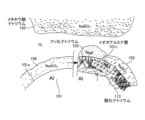
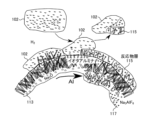
- FIGS. 14A to 14F are reaction schematic diagrams illustrating the iota alumina production reaction.
- the effects of fluoride in each step will be explained below with reference to reaction schematic diagrams (FIGS. 14A to 14F) using the first to fourth manufacturing methods using sodium fluoride (NaF) as examples.
- NaF sodium fluoride
- FIGS. 14A to 14F details the production process of iota alumina. Note that the action described below is not limited to sodium fluoride. That is, even fluorides other than sodium fluoride turn into fluoride ions in the reaction system, so they exhibit the same effect as sodium fluoride.
- This reaction produces sodium hydride (NaH) 112 and aluminum oxide (Al 2 O 3 ), and the aluminum oxide immediately turns into sodium aluminum dioxide (NaAlO 2 ). Due to the catalytic action of fluoride ions, sodium aluminum dioxide (NaAlO 2 ) is decomposed into iota alumina (Na 0.67 Al 6 O 9.33 ) 101c and sodium oxide (Na 2 O) 113. Sodium hydride (NaH) reacts with boric acid (B 2 O 3 ) to produce sodium borohydride (NaBH 4 ) 111 and sodium oxide (Na 2 O).
- sodium borohydride (NaBH 4 ) containing sodium hydride (NaH) reacts with boric acid and (B 2 O 3 ), and oxidizes with sodium borohydride (NaBH 4 ).
- the reaction produces sodium (Na 2 O).
- sodium oxide (Na 2 O) comes into contact with the aluminum particles again with stirring, resulting in a circulating reaction.
- Reaction peak period (rd step) As shown in FIG. 14E, a particle-stirring reaction occurs by exchanging substances on the surfaces of the aluminum particles and sodium metaborate particles with each other by stirring. As the particles repeatedly come into contact with each other, the aluminum particles 101 are supplied with sodium metaborate (NaBO 2 ) 102 and a reaction product, sodium oxide (Na 2 O), from the particles of sodium metaborate 102 . On the other hand, the particles of sodium metaborate (NaBO 2 ) 102 are supplied with reaction products (sodium borohydride (NaBH 4 ) 111 and sodium hydride (NaH) 112) from the aluminum 101 particles.
- reaction products sodium borohydride (NaBH 4 ) 111 and sodium hydride (NaH) 112
- Particle agitation causes these substances to be exchanged at a high speed, so that the particle agitation reaction progresses, and the aluminum particles gradually take in fragments of sodium metaborate and grow.
- the sodium metaborate particles also take in sodium hydride and change into sodium borohydride (NaBH 4 ) and sodium oxide.
- reaction 3rd step As shown in FIG. 14F, in the latter half of the reaction, the raw materials aluminum, sodium oxide (Na 2 O), and boric acid (B 2 O 3 ) are consumed, and the particles are combined with the products sodium borohydride (NaBH 4 ) and iota. It becomes alumina. The reaction rate decreases as the concentration decreases, as less sodium hydride is produced by the reduction of sodium oxide by aluminum.
- the aluminum (Al) 101 particles and the sodium metaborate particles are combined with the reaction products of sodium borohydride (NaBH 4 ) 111 and acicular iota alumina (Na 0.67 Al 6 O 9.33 ) 101c. It becomes a layer.
- Table 1 is a table showing the materials and manufacturing conditions of Test Examples 1 to 25.
- products according to Test Examples 1 to 25 were synthesized using the materials and manufacturing conditions shown in Table 1.
- Na/B or Na/B ratio refers to A/B (molar ratio) when the alkali metal and alkaline earth metal contained in the raw material is only sodium (Na)
- the K/B ratio refers to A/B (molar ratio) when potassium (K) is the only alkali metal and alkaline earth metal contained in the raw material.
- pure water refers to ion exchange water, and the pH of the ion exchange water is 5.5 or more and 7.5 or less.
- Table 2 is a list of substances detected in the products obtained by the production methods according to Test Examples 1 to 23.
- Table 3 is a list of substances detected in the products obtained by the production methods according to Test Examples 24 and 25.
- Powder X-ray diffraction measurements were performed on the products of Test Examples 1 to 25, and the substances shown in Table 2 or Table 3 were identified. Here, the powder X-ray diffraction measurements were performed in air at normal temperature and normal pressure, that is, at a temperature of 5° C. or higher and 35° C. or lower and 1 atm, unless otherwise specified.
- the intensity of the peak derived from the contained substance in the diffraction pattern of the product depends on the component ratio of the contained substance in the product, so it appears as a strong peak.
- Test Example 1 is a comparative example. As shown in Table 1, the raw materials were 6.98 g of sodium metaborate (NaBO 2 ) powder, 8.01 g of sodium tetraborate (Na 2 B 4 O 7 ) powder, and 2.0 g of sodium fluoride powder (NaF). 17 g and 11.45 g of aluminum (Al) powder were placed in a closed container equipped with a stirring means. Here, the Na/B ratio in Test Example 1 was 0.89. As a reaction step, the inside of the closed container was heated to 510° C., hydrogen gas was introduced, and the mixture was stirred by a stirring means inside the closed container. The maximum partial pressure of hydrogen gas in the reaction process was 0.75 MPa. The minimum partial pressure of hydrogen gas in the reaction process was 0.6 MPa. In Test Example 1, no washing step was performed. Through the above steps, a product according to Test Example 1 was obtained.
- FIG. 15 is a diagram showing the X-ray diffraction pattern of the product according to Test Example 1.
- Test Example 1 a product containing iota alumina (Na 0.67 Al 6 O 9.33 ) as a main component was obtained.
- Table 2 and FIG. 15 from the product according to Test Example 1, iota alumina (Na 0.67 Al 6 O 9.33 ), sodium borohydride (NaBH 4 ) and , sodium metaborate (NaBO 2 ), and aluminum (Al) were detected, and sodium hexafluoroaluminate (Na 3 AlF 6 ) and sodium tetraborate (Na 2 B 4 ) were detected as components for AlB 2 C determination.
- Test Example 1 aluminum diboride (AlB 2 ) was detected as a component judged as D. From the results of Test Example 1, it can be seen that iota alumina can be produced even when the Na/B ratio is 0.89. On the other hand, in Test Example 1, it is considered that sodium borohydride (NaBH 4 ) was not removed because the cleaning step was not performed.
- NaBH 4 sodium borohydride
- Test Example 2 is an example. As shown in Table 1, 1.95 g of sodium metaborate (NaBO 2 ) powder, 0.05 g of potassium fluoride (KF) powder, and 1.06 g of aluminum (Al) powder are used as raw materials using a stirring means. It was placed in a sealed container. Here, the Na/B ratio in Test Example 2 was 1.03. In the reaction step, the inside of the closed container was heated to 569° C., hydrogen gas was introduced, and the mixture was stirred by a stirring means inside the closed container. The maximum partial pressure of hydrogen gas in the reaction process was 0.90 MPa. The minimum partial pressure of hydrogen gas in the reaction process was 0.51 MPa. In Test Example 2, cleaning with pure water at high temperature was performed as the cleaning process. Through the above steps, a product according to Test Example 2 was obtained.
- Test Example 2 a product containing iota alumina (Na 0.67 Al 6 O 9.33 ) as a main component was obtained. As shown in Table 2, from the product according to Test Example 2, iota alumina (Na 0.67 Al 6 O 9.33 ) and aluminum (Al) were detected as A-rated components. The results of Test Example 2 show that iota alumina can be produced even when potassium fluoride (KF) is used as a raw material as a fluoride.
- KF potassium fluoride
- Test Example 3 is a comparative example. As shown in Table 1, as raw materials, 17.46 g of sodium metaborate (NaBO 2 ) powder, 1.44 g of aluminum fluoride (AlF 3 ) powder, and 11.45 g of aluminum (Al) powder were mixed with stirring means. It was placed in a sealed container. Here, the Na/B ratio in Test Example 3 was 1.00. In the reaction step, the inside of the closed container was heated to 510° C., hydrogen gas was introduced, and the mixture was stirred by a stirring means inside the closed container. The maximum partial pressure of hydrogen gas in the reaction process was 0.75 MPa. The minimum partial pressure of hydrogen gas in the reaction process was 0.56 MPa. In Test Example 3, no washing step was performed. Through the above steps, a product according to Test Example 3 was obtained.
- FIG. 16 is a diagram showing the X-ray diffraction pattern of the product according to Test Example 3.
- Test Example 3 a product containing iota alumina (Na 0.67 Al 6 O 9.33 ) as a main component was obtained.
- sodium borohydride (NaBH 4 ), iota alumina (Na 0.67 Al 6 O 9.33 ) and , aluminum (Al) were detected, sodium metaborate (NaBO 2 ) was detected as a component judged as B, and sodium hexafluoroaluminate (Na 3 AlF 6 ) was detected as a component judged as C.
- Test Example 3 show that iota alumina can be produced even when aluminum fluoride (AlF 3 ) is used as a raw material as a fluoride.
- AlF 3 aluminum fluoride
- Test Example 3 since the washing step was not performed, it is considered that sodium borohydride (NaBH 4 ) and sodium metaborate (NaBO 2 ) were not removed.
- Test Example 4 is an example. As shown in Table 1, 17.46 g of sodium metaborate (NaBO 2 ) powder, 1.81 g of sodium hexafluoroaluminate (Na 3 AlF 6 ), and 11.45 g of aluminum (Al) powder were used as raw materials. , and placed in a closed container equipped with stirring means. Here, the Na/B ratio in Test Example 4 was 1.10. As a reaction step, the inside of the closed container was heated to 510° C., hydrogen gas was introduced, and the mixture was stirred by a stirring means inside the closed container. The maximum partial pressure of hydrogen gas in the reaction process was 0.75 MPa. The minimum partial pressure of hydrogen gas in the reaction process was 0.54 MPa. In Test Example 4, washing with diglyme was performed as the washing step. Through the above steps, a product according to Test Example 4 was obtained.
- FIG. 17 is a diagram showing the X-ray diffraction pattern of the product according to Test Example 4.
- Test Example 4 a product containing iota alumina (Na 0.67 Al 6 O 9.33 ) as a main component was obtained.
- iota alumina Na 0.67 Al 6 O 9.33
- aluminum was detected as a component of B rating.
- Al sodium metaborate
- Na 3 AlF 6 sodium hexafluoroaluminate
- the results of Test Example 4 show that iota alumina can be produced even when sodium hexafluoroaluminate (Na 3 AlF 6 ) is used as the raw material as the fluoride.
- Test Example 5 is an example. As shown in Table 1, 1.48 g of sodium tetraborate (Na 2 B 4 O 7 ) powder, 0.83 g of sodium fluoride (NaF), and 1.27 g of aluminum (Al) powder were used as raw materials. The mixture was placed in a closed container equipped with stirring means. Here, the Na/B ratio in Test Example 5 was 1.17. As a reaction step, the inside of the closed container was heated to 500° C., hydrogen gas was introduced, and the mixture was stirred by a stirring means inside the closed container. The maximum partial pressure of hydrogen gas in the reaction process was 0.86 MPa. The minimum partial pressure of hydrogen gas in the reaction process was 0.63 MPa. In Test Example 5, washing with diglyme was performed as the washing step. Through the above steps, a product according to Test Example 5 was obtained.
- Test Example 5 a product containing iota alumina (Na 0.67 Al 6 O 9.33 ) as a main component was obtained. As shown in Table 2, from the product according to Test Example 5, iota alumina (Na 0.67 Al 6 O 9.33 ) was detected as a component of A rating, and aluminum (Al) was detected as a component of B rating. was detected. The results of Test Example 5 show that iota alumina can be produced even when sodium tetraborate (Na 2 B 4 O 7 ) is used as a raw material as an alkali metal compound.
- sodium tetraborate Na 2 B 4 O 7
- Test Example 6 is a comparative example. As shown in Table 1, as raw materials, 17.46 g of sodium metaborate (NaBO 2 ) powder, 2.17 g of sodium fluoride (NaF), and 11.45 g of aluminum (Al) powder were mixed in a sealed container with a stirring means. charged into a container. Here, the Na/B ratio in Test Example 6 was 1.19. As a reaction step, the inside of the closed container was heated to 490° C., hydrogen gas was introduced, and the mixture was stirred by a stirring means inside the closed container. The maximum partial pressure of hydrogen gas in the reaction process was 0.75 MPa. The minimum partial pressure of hydrogen gas in the reaction process was 0.64 MPa. In Test Example 6, no washing step was performed. Through the above steps, a product according to Test Example 6 was obtained.
- FIG. 18 is a diagram showing the X-ray diffraction pattern of the product according to Test Example 6.
- Test Example 6 a product containing iota alumina (Na 0.67 Al 6 O 9.33 ) as a main component was obtained.
- sodium borohydride (NaBH 4 ) iota alumina (Na 0.67 Al 6 O 9.33 ) and was detected, and aluminum (Al) and sodium metaborate (NaBO 2 ) were detected as components judged as B.
- Sodium hexafluoroaluminate (Na 3 AlF 6 ) was detected as a component judged as C.
- Test Example 6 show that iota alumina can be produced when the heating temperature is 490°C. On the other hand, in Test Example 6, since the washing step was not performed, it is considered that sodium borohydride (NaBH 4 ) and sodium metaborate (NaBO 2 ) were not removed.
- NaBH 4 sodium borohydride
- NaBO 2 sodium metaborate
- Test Example 7 is an example. As shown in Table 1, the product according to Test Example 7 is obtained by washing the product according to Test Example 6 by stirring it with pure water for 1 hour at a high temperature of 80°C or higher and 100°C or lower. Obtained.
- FIG. 19 is a diagram showing the X-ray diffraction pattern of the product according to Test Example 7.
- Test Example 7 a product containing iota alumina (Na 0.67 Al 6 O 9.33 ) as a main component was obtained.
- iota alumina (Na 0.67 Al 6 O 9.33 ) was detected as a component judged as A, and 6 as a component judged as C.
- Sodium fluoroaluminate (Na 3 AlF 6 ) was detected, and aluminum (Al) was detected as a component with a D rating.
- the X-ray diffraction pattern of Test Example 7 matches the PDF (registered trademark) (Powder Diffraction File) number 01-070-7114 data of iota alumina (Na 0.67 Al 6 O 9.33 ), indicating that there are no crystal defects. It shows that there is no. Additionally, as a result of semi-quantitative analysis based on the Rietveld method of the X-ray diffraction chart, the product contained 95% by mass of iota alumina, 5% by mass of sodium hexafluoroaluminate, and 1% by mass or less of aluminum (Al). It was.
- the specific surface area of the product calculated by the BET (Brunauer-Emmett-Teller) method was 54 m 2 g ⁇ 1 .
- the results of Test Example 7 show that sodium borohydride (NaBH 4 ) and sodium metaborate (NaBO 2 ) can be removed by washing with pure water. Further, as a result of observing the product according to Test Example 7 with a SEM, 80 iota alumina crystals were extracted from the imaging range, and the average aspect ratio of the iota alumina crystals was calculated to be 10.8.
- Test Example 8 is a comparative example. As shown in Table 1, the raw materials include 17.46 g of sodium metaborate (NaBO 2 ) powder, 0.31 g of sodium hydroxide (NaOH), 1.86 g of sodium fluoride (NaF), and aluminum (Al) powder. 11.45g was used.
- sodium hydroxide (NaOH) and aluminum (Al) powder were rubbed together and mixed, and after reacting at 240°C for 1 hour, the resulting mixture and sodium metaborate (NaBO 2 ) powder were mixed. and sodium fluoride (NaF) were placed in a closed container equipped with stirring means.
- the Na/B ratio in Test Example 8 was 1.20.
- the inside of the closed container was heated to 530° C., hydrogen gas was introduced, and the mixture was stirred using a stirring means inside the closed container.
- the maximum partial pressure of hydrogen gas in the reaction process was 0.75 MPa.
- the minimum partial pressure of hydrogen gas in the reaction process was 0.65 MPa.
- no washing step was performed. Through the above steps, a product according to Test Example 8 was obtained.
- FIG. 20 is a diagram showing the X-ray diffraction pattern of the product according to Test Example 8.
- Test Example 8 a product containing iota alumina (Na 0.67 Al 6 O 9.33 ) as a main component was obtained.
- Table 2 and FIG. 20 from the product according to Test Example 8, sodium borohydride (NaBH 4 ), iota alumina (Na 0.67 Al 6 O 9.33 ) and was detected, aluminum (Al) was detected as a component of B determination, and sodium hexafluoroaluminate (Na 3 AlF 6 ) and sodium fluoride (NaF) were detected as components of C determination.
- NaBH 4 sodium borohydride
- Al aluminum
- Na 3 AlF 6 sodium hexafluoroaluminate
- NaF sodium fluoride
- Test Example 8 show that iota alumina can be produced even when dehydration is performed using sodium hydroxide. On the other hand, in Test Example 8, since the washing step was not performed, it is considered that sodium borohydride (NaBH 4 ) was not removed.
- Test Example 9 is an example. As shown in Table 1, the product according to Test Example 9 was obtained by washing the product according to Test Example 8 with diglyme as a washing step.
- Test Example 9 a product containing iota alumina (Na 0.67 Al 6 O 9.33 ) as a main component was obtained.
- iota alumina (Na 0.67 Al 6 O 9.33 ) and aluminum (Al) were detected as components classified as A, and as components classified as C.
- sodium hexafluoroaluminate (Na 3 AlF 6 ), and sodium fluoride (NaF) were detected.
- the results of Test Example 9 show that sodium borohydride (NaBH 4 ) can be removed by washing with diglyme.
- Test Example 10 is an example. As shown in Table 1, the raw materials include 17.46 g of sodium metaborate (NaBO 2 ) powder, 0.29 g of sodium hydroxide (NaOH), 1.86 g of sodium fluoride (NaF), and aluminum (Al) powder. 11.45g was used. In Test Example 10, sodium hydroxide (NaOH) and aluminum (Al) powder were rubbed together and mixed, and after reacting at 240°C for 1 hour, the resulting mixture and sodium metaborate (NaBO 2 ) powder were mixed. and sodium fluoride (NaF) were placed in a closed container equipped with stirring means. Here, the Na/B ratio in Test Example 10 was 1.19.
- Test Example 10 a product containing iota alumina (Na 0.67 Al 6 O 9.33 ) as a main component was obtained.
- iota alumina Na 0.67 Al 6 O 9.33
- Table 2 aluminum (Al) and iota alumina (Na 0.67 Al 6 O 9.33 ) were detected as components classified as A in the product according to Test Example 10, and as components classified as B.
- Sodium hexafluoroaluminate (Na 3 AlF 6 ) was detected, and aluminum hydroxide was detected as a component of C determination.
- the results of Test Example 10 show that iota alumina can be produced when the heating temperature is 470°C.
- Al(OH) 3 aluminum hydroxide
- NaBO 2 sodium metaborate
- Test Example 11 is an example. As shown in Table 1, the raw materials include 5.82 g of sodium metaborate (NaBO 2 ) powder, 0.10 g of sodium hydroxide (NaOH), 0.62 g of sodium fluoride (NaF), and aluminum (Al) powder. 3.82g was used. In Test Example 11, sodium hydroxide (NaOH) and aluminum (Al) powder were rubbed together and mixed, and after reacting at 240°C for 1 hour, the resulting mixture and sodium metaborate (NaBO 2 ) powder were mixed. and sodium fluoride (NaF) were placed in a closed container equipped with stirring means. Here, the Na/B ratio in Test Example 11 was 1.20.
- the inside of the closed container was heated to 560° C., hydrogen gas was introduced, and the mixture was stirred by a stirring means inside the closed container.
- the maximum partial pressure of hydrogen gas in the reaction process was 0.75 MPa.
- the minimum partial pressure of hydrogen gas in the reaction process was 0.63 MPa.
- cleaning with pure water at high temperature was performed as the cleaning process. Through the above steps, a product according to Test Example 11 was obtained.
- Test Example 11 a product containing iota alumina (Na 0.67 Al 6 O 9.33 ) as a main component was obtained.
- Table 2 as a result of semi-quantitative analysis using the Rietveld method, 81% by mass of iota alumina (Na 0.67 Al 6 O 9.33 ) was found as a component of A in the product of Test Example 11. was detected, 7% by mass of aluminum (Al) and 8% by mass of aluminum hydroxide were detected as components for B determination, and 2% by mass of sodium hexafluoroaluminate (Na 3 AlF 6 ) was detected.
- the results of Test Example 11 show that iota alumina can be produced when the heating temperature is 560°C.
- Al(OH) 3 aluminum hydroxide
- NaBO 2 sodium metaborate
- Al(OH) 3 aluminum hydroxide
- Test Example 12 is an example. As shown in Table 1, as raw materials, 1.94 g of sodium metaborate (NaBO 2 ) powder, 0.83 g of sodium fluoride (NaF), and 1.48 g of aluminum (Al) powder were mixed in a sealed container with a stirring means. charged into a container. Here, the Na/B ratio in Test Example 12 was 1.67. In the reaction step, the inside of the closed container was heated to 495° C., hydrogen gas was introduced, and the mixture was stirred by a stirring means inside the closed container. The maximum partial pressure of hydrogen gas in the reaction process was 0.89 MPa. The minimum partial pressure of hydrogen gas in the reaction process was 0.45 MPa. In Test Example 12, washing with diglyme was performed as the washing step. Through the above steps, a product according to Test Example 12 was obtained.
- Test Example 12 a product containing iota alumina (Na 0.67 Al 6 O 9.33 ) as a main component was obtained.
- iota alumina (Na 0.67 Al 6 O 9.33 ) and aluminum (Al) were detected as components classified as A, and as components classified as B.
- Sodium hexafluoroaluminate (Na 3 AlF 6 ) and sodium aluminate (NaAlO 2 ) were detected as components.
- the results of Test Example 12 show that iota alumina can be produced when the heating temperature is 495°C.
- Test Example 13 is a comparative example. As shown in Table 1, 1.94 g of sodium metaborate (NaBO 2 ) powder and 1.28 g of aluminum (Al) powder were charged as raw materials into a closed container equipped with a stirring means. Here, an alumina ball (diameter 5 mm) was placed in a closed container as a stirring medium, and the weight ratio of the stirring medium to the raw material was set to 50. Here, the Na/B ratio in Test Example 13 was 1.00.
- the inside of the closed container was heated to 330° C., hydrogen gas was introduced, and the mixture was stirred while being rolled and crushed at a rotational speed of 1150 rpm using a stirring means inside the closed container. The maximum partial pressure of hydrogen gas in the reaction process was 0.78 MPa. The minimum partial pressure of hydrogen gas in the reaction process was 0.59 MPa. In Test Example 13, no washing step was performed. Through the above steps, a product according to Test Example 13 was obtained.
- Test Example 13 a product containing aluminum (Al) as a main component was obtained.
- sodium metaborate (NaBO 2 ) and aluminum (Al) were detected in the product according to Test Example 13 as A-rated components. Iota alumina (Na 0.67 Al 6 O 9.33 ) was not detected.
- sodium metaborate (NaBO 2 ) and aluminum (Al) were detected as components classified as A.
- iota alumina Na 0.67 Al 6 O 9.33
- Test Example 13 the temperature in the reaction step was as low as 330° C., and it is believed that the production of iota alumina did not occur because the material was rolled and crushed.
- sodium aluminum boric acid Na 2 Al 2 B 2 O 7
- Test Example 14 is an example. As shown in Table 1, the product according to Test Example 14 was prepared by stirring the product according to Test Example 6 with a 2% by mass sodium hydroxide (NaOH) aqueous solution at 80°C or higher and 100°C or lower for 1 hour as a washing step. obtained by washing.
- NaOH sodium hydroxide
- Test Example 14 a product containing aluminum hydroxide (Al(OH) 3 ) as a main component was obtained.
- the product of Test Example 14 contained 38% by mass of iota alumina (Na 0.67 Al 6 O 9.33 ) as a result of semi-quantitative analysis using the Rietveld method based on an X-ray diffraction chart. , contained 62% by mass of aluminum hydroxide (Al(OH) 3 ).
- the results of Test Example 14 show that iota alumina can be produced when a 2% by mass aqueous sodium hydroxide solution is used as the solvent in the washing step.
- Test Example 15 is a comparative example. As shown in Table 1, 2.94 g of sodium diborate (Na 4 B 2 O 5 ) powder, 0.83 g of sodium fluoride (NaF), and 1.28 g of aluminum (Al) powder were used as raw materials. The mixture was placed in a closed container equipped with stirring means. Here, the Na/B ratio in Test Example 15 was 2.65. In the reaction step, the inside of the closed container was heated to 495° C., hydrogen gas was introduced, and the mixture was stirred by a stirring means inside the closed container. The maximum partial pressure of hydrogen gas in the reaction process was 0.86 MPa. The minimum partial pressure of hydrogen gas in the reaction process was 0.61 MPa. In Test Example 15, washing with diglyme was performed as the washing step. Through the above steps, a product according to Test Example 15 was obtained.
- Test Example 15 a product containing sodium aluminum dioxide (NaAlO 2 ) as a main component was obtained.
- sodium aluminum dioxide (NaAlO 2 ) and sodium fluoride (NaF) were detected as components with A rating, and iota alumina as components with B rating. (Na 0.67 Al 6 O 9.33 ) and aluminum (Al) were detected.
- Na/B is as large as 2.65, sodium ions are present in excess in the reaction system, and sodium aluminate (NaAlO 2 ) is stably present, resulting in iota alumina (Na 0. 67 Al 6 O 9.33 ) was not sufficiently produced.
- Test Example 16 is a comparative example. As shown in Table 1, 5.85 g of sodium metaborate (NaBO 2 ) powder and 9.54 g of aluminum (Al) powder were charged as raw materials into a closed container equipped with a stirring means. Here, the Na/B ratio in Test Example 16 was 1.00. In the reaction step, the inside of the closed container was heated to 710° C., hydrogen gas was introduced, and the mixture was stirred by a stirring means inside the closed container. The maximum partial pressure of hydrogen gas in the reaction process was 1.05 MPa. The minimum partial pressure of hydrogen gas in the reaction process was 0.89 MPa. In Test Example 16, sublimate was generated because the temperature in the reaction step was high. Therefore, the product that remained in the closed container without sublimating was used as the product according to Test Example 16. In Test Example 16, no washing step was performed. Through the above steps, a product according to Test Example 16 was obtained.
- Test Example 16 a product containing sodium aluminum dioxide (NaAlO 2 ) as a main component was obtained. As shown in Table 2, from the product according to Test Example 16, aluminum (Al) was detected as a component judged as A, and sodium aluminum dioxide (NaAlO 2 ) and iota alumina (Na 0. 67 Al 6 O 9.33 ) was detected. In Test Example 16, since the temperature in the reaction step was as high as 710° C., it is thought that a large amount of sodium aluminum dioxide, which is an impurity, was produced, resulting in a decrease in the yield of iota alumina.
- Test Example 17 is a comparative example. As shown in Table 1, the raw materials include 17.46 g of sodium metaborate (NaBO 2 ) powder, 0.28 g of sodium hydroxide (NaOH), 1.86 g of sodium fluoride (NaF), and aluminum (Al) powder. 11.45g was used.
- sodium hydroxide (NaOH) and aluminum (Al) powder were rubbed together and mixed, and after reacting at 240°C for 1 hour, the resulting mixture and sodium metaborate (NaBO 2 ) powder were mixed. and sodium fluoride (NaF) were placed in a closed container equipped with stirring means.
- the Na/B ratio in Test Example 17 was 1.19.
- test Example 17 As a reaction step, the inside of the closed container was heated to 450° C., hydrogen gas was introduced, and the mixture was stirred by a stirring means inside the closed container.
- the maximum partial pressure of hydrogen gas in the reaction process was 0.76 MPa.
- the minimum partial pressure of hydrogen gas in the reaction process was 0.69 MPa.
- cleaning with pure water at high temperature was performed as the cleaning step. Through the above steps, a product according to Test Example 17 was obtained.
- Test Example 17 a product containing aluminum (Al) as a main component was obtained. As shown in Table 2, as a result of semi-quantitative analysis using the XRD Rietveld method, 83% by mass of aluminum (Al) was detected as a component of A classification from the product of Test Example 17, and 83% by mass of aluminum (Al) was detected as a component of B classification. As a result, 8% by mass of iota alumina (Na 0.67 Al 6 O 9.33 ) and 7% by mass of sodium hexafluoroaluminate (Na 3 AlF 6 ) were detected, and 3% by mass as a component for C determination. Aluminum hydroxide (Al(OH) 3 ) was detected. In Test Example 17, the temperature in the reaction step was as low as 450° C., so it is thought that sufficient crystallization of iota alumina did not occur.
- Test Example 18 is a comparative example. As shown in Table 1, after mixing 17.46 g of sodium metaborate (NaBO 2 ) powder, 2.06 g of sodium hydroxide (NaOH), and 11.45 g of aluminum (Al) powder as raw materials, Prebaking treatment was performed at 510° C. for 5 hours in a hydrogen gas atmosphere of 35 MPa. The prebaked mixture was placed in a closed container equipped with stirring means. Here, the Na/B ratio in Test Example 18 was 1.19. As a reaction step, the inside of the closed container was heated to 510° C., hydrogen gas was introduced, and the mixture was stirred by a stirring means inside the closed container. The maximum partial pressure of hydrogen gas in the reaction process was 0.74 MPa. The minimum partial pressure of hydrogen gas in the reaction process was 0.69 MPa. In Test Example 18, no washing step was performed. Through the above steps, a product according to Test Example 18 was obtained.
- FIG. 21 is a diagram showing the X-ray diffraction pattern of the product according to Test Example 18.
- sodium fluoride (NaF) and aluminum boronide (AlB 2 ) were detected as components classified as A in the product of Test Example 18, and as components classified as B.
- iota alumina Na 0.67 Al 6 O 9.33 .
- NaAlO 2 sodium aluminum dioxide
- Test Example 19 is an example. As shown in Table 1, as raw materials, 19.40 g of sodium metaborate (NaBO 2 ) powder, 2.41 g of sodium fluoride (NaF), and 10.60 g of aluminum (Al) powder were mixed in a sealed container with a stirring means. charged into a container. Here, the Na/B ratio of Test Example 19 was 1.19. Further, the amount of aluminum (Al) powder was 100% of the amount of sodium metaborate (NaBO 2 ). In the reaction step, the inside of the closed container was heated to 580° C., hydrogen gas was introduced, and the mixture was stirred by a stirring means inside the closed container. The maximum partial pressure of hydrogen gas in the reaction process was 0.81 MPa. The minimum partial pressure of hydrogen gas in the reaction process was 0.78 MPa. In Test Example 19, as a cleaning step, cleaning was performed with pure water at high temperature for 60 minutes. Through the above steps, a product according to Test Example 19 was obtained.
- Test Example 19 a product containing iota alumina (Na 0.67 Al 6 O 9.33 ) as a main component was obtained. As shown in Table 2, as a result of semi-quantitative analysis using the XRD Rietveld method, 36% by mass of iota alumina (Na 0.67 Al 6 O 9.33 ) and 64% by mass of aluminum hydroxide (Al(OH)3) were detected. The results of Test Example 19 show that iota alumina can be produced when the heating temperature is 580°C.
- Test Example 20 is an example. As shown in Table 1, as raw materials, 19.40 g of sodium metaborate (NaBO 2 ) powder, 2.41 g of sodium fluoride (NaF), and 10.60 g of aluminum (Al) powder were mixed in a sealed container with a stirring means. charged into a container. Here, the Na/B ratio in Test Example 20 was 1.19. Further, the amount of aluminum (Al) powder was 100% of the amount of sodium metaborate (NaBO 2 ). As a reaction step, the inside of the closed container was heated to 610° C., hydrogen gas was introduced, and the mixture was stirred by a stirring means inside the closed container. The maximum partial pressure of hydrogen gas in the reaction process was 0.81 MPa. The minimum partial pressure of hydrogen gas in the reaction process was 0.78 MPa. In Test Example 20, as a cleaning step, cleaning with pure water was performed at room temperature of 22°C. Through the above steps, a product according to Test Example 20 was obtained.
- Test Example 20 a product containing aluminum (Al) as a main component was obtained.
- Al aluminum
- Table 2 As a result of semi-quantitative analysis using the XRD Rietveld method, 59% by mass of aluminum (Al) and 28% by mass of iota alumina (Na 0 .67 Al 6 O 9.33 ) was detected, 9% by mass of sodium hexafluoroaluminate (Na 3 AlF 6 ) was detected as a component of B classification, and 5% of sodium hexafluoride aluminate (Na 3 AlF 6 ) was detected as a component of C classification.
- Aluminum diboride (AlB 2 ) was detected.
- Test Example 20 show that iota alumina can be produced when the heating temperature is 610°C.
- aluminum hydroxide (Al(OH) 3 ) was not produced because the reaction temperature was as high as 610°C. It is presumed that this is because the water did not become strongly alkaline during the cleaning process due to the change to oxides.
- Test Example 21 is an example. As shown in Table 1, as raw materials, 17.46 g of sodium metaborate (NaBO 2 ) powder, 2.42 g of sodium fluoride (NaF), and 11.45 g of aluminum (Al) powder were placed in a closed container equipped with a stirring means. It was loaded into Here, the Na/B ratio in Test Example 21 was 1.22. As a reaction step, the inside of the closed container was heated to 510° C., hydrogen gas was introduced, and the mixture was stirred by a stirring means inside the closed container. The maximum partial pressure of hydrogen gas in the reaction process was 0.84 MPa. The minimum partial pressure of hydrogen gas in the reaction process was 0.78 MPa. In Test Example 21, as a cleaning step, cleaning was performed with pure water at a high temperature of 100° C. for 60 minutes. Through the above steps, a product according to Test Example 21 was obtained.
- Test Example 21 a product containing iota alumina (Na 0.67 Al 6 O 9.33 ) as a main component was obtained.
- Table 2 as a result of semi-quantitative analysis using the XRD Rietveld method from the product according to Test Example 21, 80% by mass of iota alumina (Na 0.67 Al 6 O 9.33 ) was determined as an A component. was detected, and 20% by mass of aluminum hydroxide (Al(OH) 3 ) was detected as a component judged as B.
- Al(OH) 3 aluminum hydroxide
- Test Example 21 in the washing process, water became alkaline due to sodium metaborate (NaBO 2 ) remaining in the product, and aluminum (Al) was dissolved at a high temperature of 100°C, resulting in aluminum hydroxide (Al(OH) ) 3 ) was formed, and sodium hexafluoroaluminate (Na 3 AlF 6 ) was also dissolved.
- Test Example 22 is an example. As shown in Table 1, as raw materials, 17.46 g of sodium metaborate (NaBO 2 ) powder, 2.42 g of sodium fluoride (NaF), and 11.45 g of aluminum (Al) powder were placed in a closed container equipped with a stirring means. It was loaded into Here, the Na/B ratio in Test Example 22 was 1.22. In the reaction step, the inside of the closed container was heated to 510° C., hydrogen gas was introduced, and the mixture was stirred by a stirring means inside the closed container. The maximum partial pressure of hydrogen gas in the reaction process was 0.84 MPa. The minimum partial pressure of hydrogen gas in the reaction process was 0.78 MPa. In Test Example 22, as a cleaning step, cleaning was performed with pure water for 60 minutes at room temperature of 25°C. Through the above steps, a product according to Test Example 22 was obtained.
- Test Example 22 a product containing iota alumina (Na 0.67 Al 6 O 9.33 ) as a main component was obtained.
- the product of Test Example 22 contained 79% by mass of iota alumina (Na 0.67 Al 6 O 9.33 ) as a component judged as A. was detected, and 16% by mass of aluminum (Al) and 6% by mass of sodium hexafluoroaluminate (Na 3 AlF 6 ) were detected as components classified as B.
- Test Example 22 show that iota alumina (Na 0.67 Al 6 O 9.33 ) can be extracted even if the temperature of the polar solvent used in the washing step is set to room temperature.
- iota alumina Na 0.67 Al 6 O 9.33
- water alkalization occurs due to dissolution of sodium metaborate (NaBO 2 ) remaining in the product during the washing process at room temperature
- the dissolution reaction of aluminum was mild due to the room temperature. Therefore, it is considered that the production of aluminum hydroxide (Al(OH) 3 ) was suppressed.
- Test Example 23 is an example. As shown in Table 1, as raw materials, 17.46 g of sodium metaborate (NaBO 2 ) powder, 2.42 g of sodium fluoride (NaF), and 11.45 g of aluminum (Al) powder were placed in a closed container equipped with a stirring means. It was loaded into Here, the Na/B ratio in Test Example 23 was 1.22. As a reaction step, the inside of the closed container was heated to 510° C., hydrogen gas was introduced, and the mixture was stirred by a stirring means inside the closed container. The maximum partial pressure of hydrogen gas in the reaction process was 0.84 MPa. The minimum partial pressure of hydrogen gas in the reaction process was 0.78 MPa.
- Test Example 23 as a washing step, washing was performed for 60 minutes with 50 ml of 0.24 mol/L (0.875 mass %) hydrochloric acid at room temperature. The pH after washing was 6. Through the above steps, a product according to Test Example 23 was obtained.
- Test Example 23 a product containing iota alumina (Na 0.67 Al 6 O 9.33 ) as a main component was obtained. As shown in Table 2, as a result of semi-quantitative analysis using the XRD Rietveld method, 78% by mass of iota alumina (Na 0.67 Al 6 O 9.33 ) was determined as an A component from the product according to Test Example 23. was detected, and 17% by mass of aluminum (Al) and 4% by mass of sodium hexafluoroaluminate (Na 3 AlF 6 ) were detected as components classified as B. The results of Test Example 23 show that iota alumina can be extracted even if the water in the washing step is made acidic.
- Test Example 23 when washing with 0.24 mol/L hydrochloric acid (HCl) at room temperature, the pH became 6 due to a neutralization reaction with sodium metaborate (NaBO 2 ) remaining in the reaction product. As a result, the dissolution of aluminum did not occur during the cleaning process, which suppressed the production of aluminum hydroxide (Al(OH) 3 ) and slightly decreased the amount of sodium hexafluoroaluminate (Na 3 AlF 6 ). It will be done.
- HCl hydrochloric acid
- NaBO 2 sodium metaborate
- Test example 24 is a comparative example. As shown in Table 1, as raw materials, 7.24 g of potassium metaborate (KBO 2 ) powder, 1.00 g of potassium fluoride (KF), and 3.82 g of aluminum (Al) powder were mixed in a sealed container with a stirring means. charged into a container. Here, the K/B ratio of Test Example 24 was 1.19. Further, the amount of aluminum (Al) powder was 160% of the amount of potassium metaborate (KBO 2 ). In the reaction step, the inside of the closed container was heated to 522° C., hydrogen gas was introduced, and the mixture was stirred by a stirring means inside the closed container. The maximum partial pressure of hydrogen gas in the reaction process was 0.78 MPa. The minimum partial pressure of hydrogen gas in the reaction process was 0.68 MPa. In Test Example 24, no washing step was performed. Through the above steps, a product according to Test Example 24 was obtained.
- FIG. 22 is a diagram showing the X-ray diffraction pattern of the product according to Test Example 24.
- Test Example 24 a product containing potassium metaborate (KBO 2 ) as a main component was obtained.
- KBO 2 potassium metaborate
- Al aluminum
- iota alumina KBO 2
- B rating 0.67 Al 6 O 9.33
- KH 4 potassium borohydride
- K 3 AlF 6 potassium hexafluoroaluminate
- Test Example 25 is an example. As shown in Table 1, as raw materials, 7.24 g of potassium metaborate (KBO 2 ) powder, 1.00 g of potassium fluoride (KF), and 3.82 g of aluminum (Al) powder were mixed in a sealed container with a stirring means. charged into a container. Here, the K/B ratio of Test Example 25 was 1.19. Further, the amount of aluminum (Al) powder was 160% of the amount of potassium metaborate (KBO 2 ). In the reaction step, the inside of the closed container was heated to 522° C., hydrogen gas was introduced, and the mixture was stirred by a stirring means inside the closed container. The maximum partial pressure of hydrogen gas in the reaction process was 0.78 MPa. The minimum partial pressure of hydrogen gas in the reaction process was 0.68 MPa. In Test Example 25, the cleaning step was performed using pure water at room temperature. Through the above steps, a product according to Test Example 25 was obtained.
- Test Example 25 a product containing iota alumina (K 0.67 Al 6 O 9.33 ) as a main component was obtained.
- Table 2 from the product according to Test Example 25, 35% by mass of aluminum (Al) and 36% by mass of iota alumina (K 0.67 Al 6 O 9.33 ) were found as components judged as A. 14% by mass of potassium hexafluoroaluminate (K 3 AlF 6 ) and 15% by mass of aluminum hydroxide (Al(OH) 3 ) were detected as components classified as B.
- the results of Test Example 25 show that iota alumina (K 0.67 Al 6 O 9.33 ) can be produced even when potassium is used instead of sodium as the alkali metal.
- Iota alumina (Na 0.67 Al 6 O 9.33 or K 0.67 Al 6 O 9.33 ) has never been mass-produced and is not even sold as a reagent as of July 2022. This is due to the lack of an inexpensive and highly pure manufacturing method. According to this method, using the principle of producing iota alumina (Na 0.67 Al 6 O 9.33 ) from sodium aluminum dioxide (NaAlO 2 ) through the catalytic action of fluorine ions, aluminum and boron, which are inexpensive materials, are used.
- needle-like (whisker-like) iota alumina (Na 0.67 Al 6 O 9.33 ) can be produced together with sodium borohydride (NaBH 4 ), which is a valuable material.
- Inexpensive iota alumina (Na 0.67 Al 6 O 9.33 ) can be used as a raw material for producing beta alumina ( ⁇ " alumina).
- acicular (whisker-like) iota alumina Na 0 .67 Al 6 O 9.33 or K 0.67 Al 6 O 9.33 ) can be used as a composite material to improve the strength of resins and metals.
Landscapes
- Chemical & Material Sciences (AREA)
- Organic Chemistry (AREA)
- Life Sciences & Earth Sciences (AREA)
- Geology (AREA)
- Inorganic Chemistry (AREA)
- Compounds Of Alkaline-Earth Elements, Aluminum Or Rare-Earth Metals (AREA)
Priority Applications (6)
| Application Number | Priority Date | Filing Date | Title |
|---|---|---|---|
| KR1020257002653A KR20250026863A (ko) | 2022-08-02 | 2023-08-01 | 이오타 알루미나의 제조 방법 및 이오타 알루미나 |
| CN202380057156.0A CN119654294A (zh) | 2022-08-02 | 2023-08-01 | ι-氧化铝的制造方法和ι-氧化铝 |
| AU2023317307A AU2023317307A1 (en) | 2022-08-02 | 2023-08-01 | Method for producing iota-alumina, and iota-alumina |
| US18/994,852 US20260015248A1 (en) | 2022-08-02 | 2023-08-01 | Method for producing iota alumina and iota alumina |
| EP23850099.5A EP4566994A1 (en) | 2022-08-02 | 2023-08-01 | Method for producing iota-alumina, and iota-alumina |
| JP2024539182A JP7800705B2 (ja) | 2022-08-02 | 2023-08-01 | イオタアルミナの製造方法及びイオタアルミナ |
Applications Claiming Priority (2)
| Application Number | Priority Date | Filing Date | Title |
|---|---|---|---|
| JP2022123428 | 2022-08-02 | ||
| JP2022-123428 | 2022-08-02 |
Publications (1)
| Publication Number | Publication Date |
|---|---|
| WO2024029545A1 true WO2024029545A1 (ja) | 2024-02-08 |
Family
ID=89849416
Family Applications (1)
| Application Number | Title | Priority Date | Filing Date |
|---|---|---|---|
| PCT/JP2023/028191 Ceased WO2024029545A1 (ja) | 2022-08-02 | 2023-08-01 | イオタアルミナの製造方法及びイオタアルミナ |
Country Status (8)
| Country | Link |
|---|---|
| US (1) | US20260015248A1 (https=) |
| EP (1) | EP4566994A1 (https=) |
| JP (1) | JP7800705B2 (https=) |
| KR (1) | KR20250026863A (https=) |
| CN (1) | CN119654294A (https=) |
| AU (1) | AU2023317307A1 (https=) |
| TW (1) | TWI897006B (https=) |
| WO (1) | WO2024029545A1 (https=) |
Cited By (1)
| Publication number | Priority date | Publication date | Assignee | Title |
|---|---|---|---|---|
| WO2025169990A1 (ja) * | 2024-02-07 | 2025-08-14 | 日本軽金属株式会社 | 水素化ホウ素カリウムの製造方法 |
Citations (1)
| Publication number | Priority date | Publication date | Assignee | Title |
|---|---|---|---|---|
| JPH05201723A (ja) | 1991-06-13 | 1993-08-10 | Merck Patent Gmbh | 平板状のイオタ型−アルミナの製造方法 |
-
2023
- 2023-08-01 EP EP23850099.5A patent/EP4566994A1/en active Pending
- 2023-08-01 CN CN202380057156.0A patent/CN119654294A/zh active Pending
- 2023-08-01 JP JP2024539182A patent/JP7800705B2/ja active Active
- 2023-08-01 US US18/994,852 patent/US20260015248A1/en active Pending
- 2023-08-01 WO PCT/JP2023/028191 patent/WO2024029545A1/ja not_active Ceased
- 2023-08-01 KR KR1020257002653A patent/KR20250026863A/ko active Pending
- 2023-08-01 AU AU2023317307A patent/AU2023317307A1/en active Pending
- 2023-08-02 TW TW112129085A patent/TWI897006B/zh active
Patent Citations (1)
| Publication number | Priority date | Publication date | Assignee | Title |
|---|---|---|---|---|
| JPH05201723A (ja) | 1991-06-13 | 1993-08-10 | Merck Patent Gmbh | 平板状のイオタ型−アルミナの製造方法 |
Non-Patent Citations (3)
| Title |
|---|
| "Mullite-type Na0.67A1609.33 and a discussion of iota alumina", JOURNAL OF THE EUROPEAN CERAMIC SOCIETY, vol. 40, 2020, pages 4276 - 4280 |
| ARYAL SITARAM, RULIS PAUL, OUYANG LIZHI, CHING W. Y.: "Structure and properties of the low-density phase ι-Al2O3 from first principles", PHYSICAL REVIEW B, AMERICAN PHYSICAL SOCIETY, US, vol. 84, no. 17, 1 November 2011 (2011-11-01), US , XP093134963, ISSN: 1098-0121, DOI: 10.1103/PhysRevB.84.174123 * |
| LENZ STEPHAN; SCHNEIDER HARTMUT; FISCHER REINHARD X.: "Mullite-type Na0.67Al6O9.33 and a discussion of iota-alumina", JOURNAL OF THE EUROPEAN CERAMIC SOCIETY, ELSEVIER, AMSTERDAM, NL, vol. 40, no. 12, 25 April 2020 (2020-04-25), AMSTERDAM, NL, pages 4276 - 4280, XP086196970, ISSN: 0955-2219, DOI: 10.1016/j.jeurceramsoc.2020.03.038 * |
Cited By (1)
| Publication number | Priority date | Publication date | Assignee | Title |
|---|---|---|---|---|
| WO2025169990A1 (ja) * | 2024-02-07 | 2025-08-14 | 日本軽金属株式会社 | 水素化ホウ素カリウムの製造方法 |
Also Published As
| Publication number | Publication date |
|---|---|
| KR20250026863A (ko) | 2025-02-25 |
| TWI897006B (zh) | 2025-09-11 |
| CN119654294A (zh) | 2025-03-18 |
| JP7800705B2 (ja) | 2026-01-16 |
| AU2023317307A1 (en) | 2025-01-30 |
| EP4566994A1 (en) | 2025-06-11 |
| JPWO2024029545A1 (https=) | 2024-02-08 |
| TW202417379A (zh) | 2024-05-01 |
| US20260015248A1 (en) | 2026-01-15 |
Similar Documents
| Publication | Publication Date | Title |
|---|---|---|
| US20260054983A1 (en) | Sodium borohydride production method | |
| EP4011825B1 (en) | Method for producing sodium borohydride | |
| WO2024029545A1 (ja) | イオタアルミナの製造方法及びイオタアルミナ | |
| JP7647775B2 (ja) | 水素化ホウ素ナトリウムの製造方法 | |
| RU2856520C2 (ru) | Способ получения йота-оксида алюминия и йота-оксид алюминия | |
| TWI801114B (zh) | 硼氫化鈉的製造方法 | |
| WO2025169990A1 (ja) | 水素化ホウ素カリウムの製造方法 | |
| WO2025169991A1 (ja) | イオタアルミナの製造方法及びイオタアルミナ | |
| RU2793158C1 (ru) | Способ получения боргидрида натрия | |
| CA3149799C (en) | Sodium borohydride production method |
Legal Events
| Date | Code | Title | Description |
|---|---|---|---|
| 121 | Ep: the epo has been informed by wipo that ep was designated in this application |
Ref document number: 23850099 Country of ref document: EP Kind code of ref document: A1 |
|
| WWE | Wipo information: entry into national phase |
Ref document number: 2024539182 Country of ref document: JP |
|
| WWE | Wipo information: entry into national phase |
Ref document number: 18994852 Country of ref document: US |
|
| WWE | Wipo information: entry into national phase |
Ref document number: 817936 Country of ref document: NZ Ref document number: AU2023317307 Country of ref document: AU |
|
| ENP | Entry into the national phase |
Ref document number: 20257002653 Country of ref document: KR Kind code of ref document: A |
|
| WWE | Wipo information: entry into national phase |
Ref document number: 202380057156.0 Country of ref document: CN |
|
| WWE | Wipo information: entry into national phase |
Ref document number: 202517006756 Country of ref document: IN |
|
| WWE | Wipo information: entry into national phase |
Ref document number: 2025101791 Country of ref document: RU |
|
| ENP | Entry into the national phase |
Ref document number: 2023317307 Country of ref document: AU Date of ref document: 20230801 Kind code of ref document: A |
|
| REG | Reference to national code |
Ref country code: BR Ref legal event code: B01A Ref document number: 112024027346 Country of ref document: BR |
|
| WWP | Wipo information: published in national office |
Ref document number: 202517006756 Country of ref document: IN |
|
| WWP | Wipo information: published in national office |
Ref document number: 1020257002653 Country of ref document: KR |
|
| WWP | Wipo information: published in national office |
Ref document number: 2025101791 Country of ref document: RU |
|
| WWE | Wipo information: entry into national phase |
Ref document number: 2023850099 Country of ref document: EP |
|
| NENP | Non-entry into the national phase |
Ref country code: DE |
|
| ENP | Entry into the national phase |
Ref document number: 2023850099 Country of ref document: EP Effective date: 20250303 |
|
| WWP | Wipo information: published in national office |
Ref document number: 202380057156.0 Country of ref document: CN |
|
| REG | Reference to national code |
Ref country code: BR Ref legal event code: B01E Ref document number: 112024027346 Country of ref document: BR Free format text: APRESENTE NOVAS FOLHAS DO RELATORIO DESCRITIVO E RESUMO ADAPTADAS AOS ARTS. 26 E 40 DA PORTARIANO 14/2024, UMA VEZ QUE O CONTEUDO ENVIADO ENCONTRA-SE FORA DA NORMA: OS DOCUMENTOSDEVEM SER INICIADOS PELO TITULO CENTRALIZADO SEM O USO DE PALAVRAS ADICIONAIS (RELATORIODESCRITIVO DE PATENTE DE INVENCAO...). A EXIGENCIA DEVE SER RESPONDIDA EM ATE 60 (SESSENTA)DIAS DE SUA PUBLICACAO E DEVE SER REALIZADA POR MEIO DA PETICAO GRU CODIGO DE SERVICO 207 |
|
| WWP | Wipo information: published in national office |
Ref document number: 2023850099 Country of ref document: EP |
|
| ENP | Entry into the national phase |
Ref document number: 112024027346 Country of ref document: BR Kind code of ref document: A2 Effective date: 20241227 |
|
| WWP | Wipo information: published in national office |
Ref document number: 18994852 Country of ref document: US |
|
| WWG | Wipo information: grant in national office |
Ref document number: 2025101791 Country of ref document: RU |