WO2023282149A1 - 飛行時間型質量分析方法、飛行時間型質量分析装置、および飛行時間型質量分析プログラム - Google Patents
飛行時間型質量分析方法、飛行時間型質量分析装置、および飛行時間型質量分析プログラム Download PDFInfo
- Publication number
- WO2023282149A1 WO2023282149A1 PCT/JP2022/026006 JP2022026006W WO2023282149A1 WO 2023282149 A1 WO2023282149 A1 WO 2023282149A1 JP 2022026006 W JP2022026006 W JP 2022026006W WO 2023282149 A1 WO2023282149 A1 WO 2023282149A1
- Authority
- WO
- WIPO (PCT)
- Prior art keywords
- time
- flight
- ions
- mass
- ion
- Prior art date
- Legal status (The legal status is an assumption and is not a legal conclusion. Google has not performed a legal analysis and makes no representation as to the accuracy of the status listed.)
- Ceased
Links
Images


Classifications
-
- H—ELECTRICITY
- H01—ELECTRIC ELEMENTS
- H01J—ELECTRIC DISCHARGE TUBES OR DISCHARGE LAMPS
- H01J49/00—Particle spectrometers or separator tubes
-
- H—ELECTRICITY
- H01—ELECTRIC ELEMENTS
- H01J—ELECTRIC DISCHARGE TUBES OR DISCHARGE LAMPS
- H01J49/00—Particle spectrometers or separator tubes
- H01J49/26—Mass spectrometers or separator tubes
- H01J49/34—Dynamic spectrometers
- H01J49/40—Time-of-flight spectrometers
Definitions
- the present invention relates to a time-of-flight mass spectrometry method, a time-of-flight mass spectrometer, and a time-of-flight mass spectrometry program for ion mixtures orbiting in closed orbits.
- Patent Document 1 A time-of-flight mass spectrometer having a flight space in which ions to be analyzed circulate or reciprocate in the same trajectory is known as a conventional technology (Patent Document 1).
- various ions are generally separated by mass-to-charge ratio according to the flight time of ions accelerated by an electric field until they reach the detector. Since the difference in flight times for two types of ions having a certain difference in mass-to-charge ratio increases as the flight distance of the ions increases, it is preferable to secure the flight distance as long as possible in order to increase the mass resolution. However, since it is generally difficult to increase the linear flight distance due to restrictions such as the size of the device, various configurations have been proposed to effectively increase the flight distance.
- a time-of-flight mass spectrometer that effectively lengthens the flight distance by forming an eight-shaped closed orbit.
- the greater the number of times the ions circulate in the orbit the number of revolutions
- the longer the flight distance and accordingly the overall flight time the mass resolution improves.
- An object of one aspect of the present invention is to provide a time-of-flight mass spectrometry method, a time-of-flight mass spectrometer, and a time-of-flight mass spectrometer capable of performing analysis over a wide range of mass-to-charge ratios with fewer measurements than in the past. It is to realize an analysis program.
- Another object of one aspect of the present invention is to realize a time-of-flight mass spectrometry method, a time-of-flight mass spectrometer, and a time-of-flight mass spectrometry program that do not require analysis by finely dividing the mass-to-charge ratio range. That's what it is.
- the flight time of the ions obtained by starting to extract the ions circulating in the closed orbit from the closed orbit at the first extraction start time
- the time-of-flight acquisition unit, determination unit, candidate calculation unit, and determination unit provided in the time-of-flight mass spectrometer according to each aspect of the present invention may be implemented by a computer.
- the time-of-flight acquisition unit, the determination unit, and the candidate calculation unit which allow a computer to perform calculations related to the time-of-flight mass spectrometer by operating as respective units (software elements) included in the time-of-flight mass spectrometer;
- the control program for the determination unit and a computer-readable recording medium recording it are also included in the scope of the present invention.
- a time-of-flight mass spectrometry method capable of performing analysis over a wide range of mass-to-charge ratios with fewer measurements than in the past Analysis programs can be implemented.
- a time-of-flight mass spectrometry method, a time-of-flight mass spectrometer, and a time-of-flight mass spectrometry program that do not require analysis by finely dividing the mass-to-charge ratio range are realized. be able to.
- FIG. 1 is a schematic configuration diagram of a main part of a time-of-flight mass spectrometer according to an embodiment
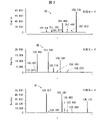
- FIG. 2 is a graph showing time-of-flight spectral waveforms measured in 24-lap mode, 30-lap mode, and 50-lap mode in the time-of-flight mass spectrometer.
- FIG. 3 is a schematic configuration diagram for explaining the half-circle mode operation of the time-of-flight mass spectrometer.
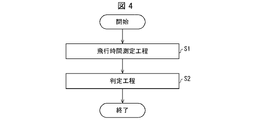
- 1 is a flow chart of a time-of-flight mass spectrometry method according to one embodiment.
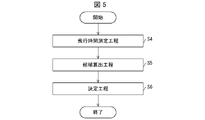
- 1 is a flow chart of a time-of-flight mass spectrometry method according to one embodiment.
- FIG. 1 is a schematic configuration diagram of a main part of a time-of-flight mass spectrometer 1 according to this embodiment.
- FIG. 2 is a graph showing time-of-flight spectral waveforms W1, W2, and W3 measured in the 24-lap mode, the 30-lap mode, and the 50-lap mode in the mass spectrometer 1.
- the horizontal axis indicates flight time
- the vertical axis indicates the number of ions detected per unit time. Note that the scales of the horizontal axis in FIG. 2 are not aligned among W1, W2, and W3.
- the mass spectrometer 1 includes a flight device 5, an information processing device 6, an ion source 10, and an ion detector 9.
- the flight device 5 comprises an injection section 7 and an extraction section 8 .
- the flight device 5 is provided with four electric sector electric fields (sector paths) E1, E2, E3, and E4 whose turning angles are smaller than 180°.
- the figure 8 closed orbit 2 closed orbit 2 (closed orbit) is formed.
- This circular orbit 2 is composed of four circular orbits A1, A2, A3, and A4 of the four electric sector electric fields E1, E2, E3, and E4, and four rectilinear orbits A12, A23, A34, and A41 connecting the electric sectors. It is
- the mass spectrometer 1 analyzes the mass-to-charge ratio (mass divided by electric charge) of ions circulating in this orbital orbit 2 .
- the ion source 10 supplies one type of ions contained in the sample, or supplies an ion mixture containing multiple types of ions.
- the injection section 7 produces a sector electric field to introduce the ions or ion mixture supplied from the ion source 10 into the circular orbit 2 .
- the outlet of the injection part 7 is arranged on a rectilinear trajectory A41 between the electric sectors E1 and E4.
- Extraction unit 8 generates a sector electric field at a predetermined timing to extract ions or ion mixtures circulating in orbit 2 to the outside of orbit 2 .
- the extractor 8 is arranged on a rectilinear trajectory A23 between the electric sectors E2 and E3.
- the ion detector 9 detects one or a plurality of types of ions extracted from the circular orbit 2 by the extractor 8 .
- the ion detector 9 outputs the spectrum waveform of the flight time of the detected ions to the information processing device 6 .
- injection section 7 and extraction section 8 may be configured to be shared with any of the sector electric fields E1, E2, E3, and E4.
- the information processing device 6 includes a time-of-flight measurement unit 3, a determination unit 4, a candidate calculation unit 11, and a determination unit 12. Detailed processing of each part of the information processing device 6 will be described later.
- the time-of-flight measurement unit 3 measures (specifies) the time-of-flight of each ion from the spectrum waveform of the time-of-flight of the detected ions.
- the time-of-flight measuring unit 3 may acquire the measured time-of-flight of each ion.
- the time-of-flight measurement unit 3 outputs the measured time-of-flight to the determination unit 4 and the candidate calculation unit 11 .
- the determination unit 4 determines the presence or absence of the ion i depending on whether the measured time of flight matches the time of flight of the ion i obtained from Equation (1) described later.
- the determination unit 4 stores the predetermined formula (1).
- the candidate calculation unit 11 obtains a plurality of mass-to-charge ratio candidates A 1 [m a1 , .
- a plurality of mass-to-charge ratio candidates A 2 [m b1 , . . . m bw ] are obtained.
- the candidate calculation unit 11 outputs a plurality of mass-to-charge ratio candidates A 1 and a plurality of mass-to-charge ratio candidates A 2 to the determination unit 12 .
- the determination unit 12 obtains a mass - to-charge ratio candidate m1 having the same value from the plurality of mass-to - charge ratio candidates A1 and the plurality of mass-to-charge ratio candidates A2 , thereby determining the mass - to-charge ratio candidate m1 of the ion to be measured. Determined as the mass-to-charge ratio.
- the ion mixture passes through the hole formed in the extracting portion 8 where the electrode potential is off, straight trajectory A23, circular trajectory A3 of the sector electric field E3 where the electrode potential is on, straight trajectory A34, electrode potential fly in this order in the circular orbit A4 of the sector electric field E4 with is on.
- it flies on the straight orbit A41 through the hole formed in the injection part 7 whose electrode potential is turned off, and circulates the orbital orbit 2 repeatedly.
- the electrode potential of the extractor 8 is turned on, and the ion mixture passes through the extractor 8 and reaches the ion detector 9 .
- FIG. 3 is a schematic configuration diagram for explaining the operation of the time-of-flight mass spectrometer 1 in the half-circle mode. Components similar to those described above are labeled with similar reference numerals and their detailed description will not be repeated.
- An ion mixture supplied from an ion source 10 is introduced into the orbital orbit 2 through an injection section 7 whose electrode potential is turned on. Then, the ion mixture passes through the rectilinear orbit A41, the circular orbit A1, the rectilinear orbit A12, the circular orbit A2, and the rectilinear orbit A23, and passes through the extracting unit 8 where the electrode potential is turned on, to the circular orbit 2. , and reaches the ion detector 9 . In this way, the ion mixture reaches the ion detector 9 after going halfway around the circular orbit 2 . For example, if the ion mixture contains ions of H 2 , He, CH 4 and N 2 , no overtaking will occur in the half-turn mode shown in FIG.
- an ion gate had to be arranged and controlled so that only ions with a specific number of revolutions (that is, ions with a specific mass-to-charge ratio range) were introduced into the ion detector 9 .
- An ion gate excludes ions whose mass-to-charge ratio is outside a predetermined range. It is also possible to limit the ions introduced or circulated by the injection section or the extraction section.
- Mass spectrometry method by mass spectrometer 1 This embodiment relates to a new data collection/peak assignment algorithm for the multi-turn mass spectrometer 1 and a device equipped with the algorithm.
- the multi-orbit mass spectrometer 1 separates ion mixtures with different mass-to-charge ratios in closed orbits (orbital orbits 2), and starts extracting orbiting ions from the closed orbits to the ion detector 9 at a predetermined extraction start time. do. After the start of extraction, the ions that have reached the inlet of the extraction section 8 are sequentially extracted, and the extracted ions reach the ion detector 9 in sequence. Therefore, the width of the spectrum waveform of the obtained time-of-flight is equal to or less than the time required for the ions having the maximum mass-to-charge ratio in the ion mixture to make one round in a closed orbit.
- T flight time
- Lk flight distance in half-circle mode
- n number of laps
- Lc lap distance
- m mass-to-charge ratio
- Kamc atomic mass constant
- e elemental charge
- Vacc acceleration voltage
- t 0 a predetermined constant (device delay time)
- the acceleration voltage Vacc in equation (2) is obtained by measuring the flight times of any one type of ion at two or more different numbers of laps, or the flight times of multiple types of ions, and formula (2) is can be obtained using
- the flight distance Lk in the half-circle mode of Equation (2) is known, the ion circulation time that can be accurately calculated from the flight times obtained from the different number of revolutions of the single ion, It can be easily calculated using the difference from the obtained flight time.
- the flight distance Lk in the half-circle mode is unique to the mass spectrometer 1 and does not change unless the ion source 10 or the ion detector 9 is replaced.
- the flight distance Lk in the half-circle mode does not have to be a distance that flies exactly half the closed orbit, but means a distance that ions fly from the ion source 10 to the ion detector 9 without going around the closed orbit.
- the measured values for ions flying close to the electrode at the time of ion extraction may not be accurate. Differences from calculated values or effects such as undetected ions may occur.
- This theoretical flight time t can be obtained from the above-mentioned formula (2). That is, the time-of-flight T of ions in the time-of-flight mass spectrometer 1 is expressed by the following function f using the number of revolutions n of the closed orbit and the mass-to-charge ratio m of the ions.
- FIG. 4 is a flow chart of the time-of-flight mass spectrometry method according to this embodiment.
- This time-of-flight mass spectrometry method measures the time-of-flight of one or more types of ions contained in a sample, and determines from the measured time-of-flight whether or not specific ions are contained in the sample. .
- a case of supplying an ion mixture containing a plurality of types of ions from a sample will be described below, only one type of ions may be supplied (measured).
- the mass spectrometer 1 is pre-calibrated.
- the acceleration voltage Vacc and constant t0 in equation (2) have already been determined. That is, the function f of equation (1) is known.
- Calibration can be performed, for example, by measuring the time of flight of any one type of ion in two or more different round trips or the time of flight of multiple types of ions.
- the flight device 5 starts extracting the plurality of types of ions orbiting the closed orbit from the closed orbit at a first extraction start time when a first period has elapsed since the ion source 10 supplied the plurality of types of ions.
- the ion detector 9 detects multiple types of ions. For example, if the first take-out start time is such that CO 2 + is taken out after 24 revolutions, the time-of-flight spectrum waveform indicated by W1 in FIG. 2 is obtained. In FIG. 2, the time-of-flight numerical value ( ⁇ s) corresponding to each peak is shown.
- the time-of-flight measurement unit 3 measures (obtains) the time-of-flight of each ion from the spectral waveform of the time-of-flight (first time-of-flight measurement step, S1).
- the determination unit 4 obtains the flight time of the specific ion i from Equation (1). From the mass-to-charge ratio of the ion i, the determining unit 4 can specify the number of revolutions n1 of the closed orbit of the ion i when extraction is started at the first extraction start time. Alternatively, the first extraction start time may be set to the timing at which the ions i are extracted after making a predetermined number of circulations n1. The determination unit 4 obtains the flight time T i,n1 of the ion i that has circulated the number of times n 1 from equation (1). The determination unit 4 determines whether or not each measured flight time of the ions matches the flight time T i,n1 of the ion i.
- the determination unit 4 determines that the sample contains the ion i (determination step, S2). If the measured time-of-flight Ta of any ion does not match the time-of-flight T i,n1 of the ion i, the determination unit 4 determines that there is no ion i in the sample.
- the determination unit 4 may determine the presence or absence of another ion j from the spectral waveform of the same flight time. Assume that the first extraction start time is the timing at which the ion j is extracted after making a predetermined number of circulations n2 (n 1 ⁇ n 2 ). The determination unit 4 obtains the time of flight Tj,n2 of the ion j that has circulated the number of times n2 from equation (1). The determination unit 4 determines whether or not each measured flight time of the ions matches the flight time Tj,n2 of the ion j.
- the determination unit 4 determines that the sample contains the ion j (determination step, S2). If the measured time-of-flight Ta of any ion does not match the time-of-flight Tj,n2 of ion j, the determination unit 4 determines that there is no ion j in the sample.
- the time-of-flight spectrum waveform of W1 in FIG. 2 is obtained by measurement.
- This spectral waveform was obtained by starting extraction at such a timing (condition) that the CO 2 + ions i were extracted after making 24 laps.
- 125.643 ⁇ s can be obtained as the flight time of the CO 2 + ions i that have made 24 laps in this mass spectrometer 1 . If there is a peak corresponding to (coincident with) 125.643 ⁇ s in the measured time-of-flight spectral waveform W1, the determination unit 4 determines that the sample contains CO 2 + ions (or CO 2 before ionization). can be determined to be included.
- the O 2 + ion j is taken out after making 28 rounds. From equation (1), 124.477 ⁇ s can be obtained as the time of flight of the O 2 + ion j that has made 28 laps in this mass spectrometer 1 . If there is a peak corresponding to (coincident with) 124.477 ⁇ s in the measured time-of-flight spectrum waveform W1, the determination unit 4 determines that O 2 + ions (or O 2 before ionization) are present in the sample. can be determined to be included. Similarly, the determination unit 4 can determine whether or not any ion (or a substance before being ionized) was contained in the sample.
- calibration of the mass spectrometer 1 (determination of equation (1) or equation (2)) can be performed using specific ions, and the flight time of each ion i, j to be determined is not necessarily It is not necessary to measure in advance.
- the flight times T i,n1 and T j,n2 of each ion i,j can be obtained by calculation from equation (1) or equation (2). Therefore, it is not necessary to fly a sample in advance and measure the time of flight for each ion to be determined. That is, the mass spectrometer 1 can determine a wide range of ion species by calculation.
- the determination unit 4 determines whether or not the flight time Ta and the flight time T i,n1 match each other. It may be determined whether the mass-to-charge ratio obtained from and the mass-to-charge ratio of ion i match each other. Both determinations are synonymous.
- Table 1 shows the time-of-flight (TOF) of each ion contained in the ion mixture according to the time-of-flight spectral waveforms W1, W2, and W3 measured in each of the 24-lap mode, the 30-lap mode, and the 50-lap mode shown in FIG. indicates
- the 24-lap mode is a measurement mode in which the extraction unit 8 starts extraction at a predetermined time so that the CO 2 + ions are extracted from the closed orbit after making 24 rounds of the closed orbit.
- TOF is the measured time of flight of an ion
- lap is the number of round trips of the ion
- exact mass is the exact mass of the ion
- ion is the ion species.
- the assigned mass is the ion mass number calculated from the time of flight and the number of laps using Equation (1).
- the error of the mass number (assigned mass) of each ion calculated using equation (1) from the measured time-of-flight to the exact mass number of the ion (error) is approximately plus or minus 0.5 mDa. (millidalton) or less.
- the mass number (or mass-to-charge ratio) of each ion obtained from equation (1) approximately matches the exact mass number (or mass-to-charge ratio) of that ion.
- the peak in the time-of-flight spectral waveform may overlap with the peaks of other ions, making it difficult to determine the ion species.
- the presence or absence of ions i can be determined more accurately by measuring the time of flight under a second condition (for example, 30-lap mode or 50-lap mode) with a different number of laps than the first condition.
- the flight device 5 starts extracting the plurality of types of ions orbiting the closed orbit from the closed orbit at a second extraction start time that is a second period after the ion source 10 supplies the plurality of types of ions.
- the second extraction start time is such that the CO 2 + is extracted after 30 revolutions, the time-of-flight spectral waveform indicated by W2 in FIG. 2 is obtained.
- the time-of-flight measurement unit 3 measures (obtains) the time-of-flight of each ion from the spectrum waveform of the time-of-flight (second time-of-flight measurement step, S1).
- the determination unit 4 obtains the flight time of the specific ion i from Equation (1). From the mass-to-charge ratio of the ion i, the determination unit 4 can specify the number of revolutions n 3 of the closed orbit of the ion i when extraction is started at the second extraction start time (n 1 ⁇ n 3 ). Alternatively, the third extraction start time may be set to the timing at which the ions i are extracted after circulating a predetermined number of times n3. The determination unit 4 obtains the time of flight T i,n3 of the ion i that has circulated the number of times n 3 from equation (1). The determination unit 4 determines whether or not each measured flight time of the ions matches the flight time T i,n3 of the ion i.
- the determining unit 4 determines that the ion i is present in the sample (determining step, S2 ). If the measured time-of-flight Tb of any ion does not match the time-of-flight T i,n3 of the ion i, the determination unit 4 determines that there is no ion i in the sample.
- the number of cycles of each ion is different from that under the first condition.
- two time-of-flight peaks that were close together under the first condition can be measured far apart under the second condition.
- the presence or absence of specific ions can be determined more accurately by performing measurements under a plurality of (two or more) conditions with different numbers of laps.
- the mass spectrometer 1 simultaneously measures a plurality of types of ions with different numbers of laps as a spectrum waveform with a single time-of-flight without excluding them. Then, the time of flight obtained from the equation (1) using the ion mass-to-charge ratio and the number of revolutions corresponding to the extraction start time is used for the determination. Therefore, the presence or absence of specific ions can be accurately determined from the time-of-flight spectral waveform obtained without excluding ions having mass-to-charge ratios outside the predetermined range.
- the ions to be measured are predetermined.
- the Waterworks Law stipulates the measurement of 16 types of volatile organic compounds (VOC). Since the ions to be measured are known, using formula (1), it is possible to easily and uniquely calculate the number of laps and the flight time of each ion under an arbitrarily selected condition (extraction start time). Therefore, the mass spectrometer 1 can be suitably used for measurement/detection of specific substances stipulated by various laws.
- Mass spectrometry method 2 Another mass spectrometry method in the mass spectrometer 1 will be described. Mass spectrometry method 2 described below is particularly useful when both the detected ion species and the mass-to-charge ratio are unknown.
- FIG. 5 is a flowchart of a time-of-flight mass spectrometry method according to mass spectrometry method 2 of this embodiment.
- the flight device 5 starts extracting the ions to be measured orbiting the closed orbit from the closed orbit at the first extraction start time when the first period has elapsed since the ion source 10 supplied the ions.
- the ion detector 9 detects ions.
- the time-of-flight measurement unit 3 measures (acquires) the time-of-flight Ta of ions corresponding to the first extraction start time from the spectrum waveform of the time-of-flight obtained corresponding to the first extraction start time (first time-of-flight measurement step, S4).
- the ion source 10 supplies the same ions to be measured again.
- the flight device 5 starts extracting the ions to be measured orbiting the closed orbit from the closed orbit at a second extraction start time after a second period has elapsed since the ion source 10 supplied the ions.
- the second period and the second removal start time are different from the first period and the first removal start time, respectively.
- the ion detector 9 detects ions.
- the time-of-flight measurement unit 3 measures the time-of-flight Tb of the ions corresponding to the second extraction start time from the spectrum waveform of the time-of-flight obtained corresponding to the second extraction start time (second time-of-flight measurement step, S4).
- the second extraction start time is such a timing as to obtain a time of flight Tb different from the time of flight Ta for ions to be measured.
- the flight time Ta and the flight time Tb are different from each other. That is, the number of laps na in the closed orbit of ions when the time of flight Ta is obtained is different from the number of laps nb in the closed orbit of ions when the time of flight Tb is obtained. However, since the ion species is unknown, the number of turns na and nb is also unknown.
- the candidate calculation unit 11 obtains a mass-to-charge ratio candidate m a1 for the time of flight Ta from equation (1), assuming that the number of laps is na1 . Further, the candidate calculation unit 11 obtains the candidate ma2 of the mass-to-charge ratio when it is assumed that another number of laps is n a2 for the flight time Ta from the equation (1). In this way, the candidate calculation unit 11 calculates a plurality of mass-to-charge ratio candidates A 1 [m a1 , . . . m av ] is obtained (candidate calculation step, S5). [n a1 , . . . n av ] represents a list or set whose elements are n a1 , .
- the determining unit 12 selects a plurality of mass-to-charge ratio candidates A 1 [m a1 , . . . m av ] and a plurality of mass-to-charge ratio candidates A 2 [m b1 , . (common) mass-to - charge ratio candidate m1 is obtained. For example, if both the plurality of mass-to - charge ratio candidates A1 and the plurality of mass-to-charge ratio candidates A2 include candidates that match the correct mass-to-charge ratio of the ion to be measured, then the plurality of mass-to-charge ratio candidates Any one of candidate A1 should match with any one of multiple mass-to-charge ratio candidates A2 .
- the determination unit 12 compares each of the plurality of mass-to-charge ratio candidates A 1 [m a1 , . . . m av ] with each of the plurality of mass-to-charge ratio candidates A 2 [m b1 , . Obtain mass - to-charge ratio candidates m1 whose values match each other.
- the determination unit 12 determines the mass-to-charge ratio candidate m1 as the mass - to-charge ratio of the ion to be measured (determining step, S6). Note that when the mass-to-charge ratio candidates m av and m bw match each other, the number of turns n av and n bw are different from each other.
- the candidate calculation unit 11 obtains another mass-to-charge ratio candidate corresponding to another candidate number of laps for the flight time Ta and/or the flight time Tb. If there is a mass-to-charge ratio candidate whose value matches the added mass-to-charge ratio candidate, the determining unit 12 determines that candidate as the mass-to-charge ratio of the ion to be measured. The candidate calculation unit 11 may add candidates for the number of turns and perform calculations until candidates for the mass-to-charge ratio that match each other are obtained. In this manner, the candidate calculation unit 11 may increase the mass-to-charge ratio candidates step by step.
- the determining unit 12 determines that no substance having a mass-to-charge ratio within the predetermined range has been detected. You can judge.
- the time-of-flight measurement unit 3 obtains a plurality of flight times Ta, Tc, . . . corresponding to a plurality of ion species. Similarly, the time-of-flight measuring unit 3 obtains a plurality of times-of-flight Tb, Td, . At this point, it is unknown whether the ions with the flight times Ta and the ions with the flight times Tb are the same ions, or the ions with the flight times Ta and the ions with the flight times Td are the same ions.
- the candidate calculation unit 11 calculates a plurality of mass-to-charge ratio candidates A 1 , A 2 , A 3 , A 4 by assuming the number of laps for each flight time Ta, Tb, Tc, Td, . . . from Equation (1). get ...
- the determining unit 12 selects a candidate that matches any one of the candidates A1 obtained corresponding to the first removal start time from among the candidates A2 , A4, . . . obtained corresponding to the second removal start time. seek.
- the determination unit 12 selects a candidate that matches any of the candidates A3 obtained corresponding to the first removal start time from among the candidates A2 , A4, . . . obtained corresponding to the second removal start time. seek.
- the determining unit 12 can obtain a plurality of “candidates for mass-to-charge ratios having the same value” m 1 , m 2 , .
- the determining unit 12 determines a plurality of mass-to-charge ratio candidates m 1 , m 2 , . . . as mass-to-charge ratios of a plurality of ions to be measured.
- the mass spectrometry method 2 of the present embodiment a plurality of ion species with different number of revolutions are detected in a mixed state, and even if the number of revolutions is unknown, the extraction start time is different 2 From the results of the measurements, the mass-to-charge ratios of multiple ion species can be determined. Also, the mass spectrometer 1 can determine the mass-to-charge ratio for unknown ion species.
- the mass spectrometer 1 In the mass spectrometer 1, there is no need to exclude ions whose mass-to-charge ratio is outside the predetermined range when measuring the time-of-flight.
- the mass spectrometer 1 can perform analysis over a wide range of mass-to-charge ratios with a much smaller number of measurements than conventional ones. Therefore, the mass spectrometer 1 is used for medical (medicine, dentistry, forensic medicine), food (food processing, residual agricultural chemicals), environment (global warming monitor, environmental monitor), safety and security (dangerous substance detection, illegal drug detection), And it is easy to bring to the site (on-site) related to planetary exploration, etc., and mass spectrometry can be easily performed on-site.
- the present invention is not limited to this.
- the mass spectrometer only needs to have a closed orbit, for example, for a mass spectrometer with a reflection-type orbit in which ion mirrors (reflectrons) are arranged to face each other and the ion mixture flies back and forth.
- the present invention can also be applied to
- the information processing device 6 may also be connected to the ion source 10, the flight device 5, and the ion detector 9 via any wired or wireless transmission medium.
- the ion source 10, flight device 5, and ion detector 9 calibration information, injection and extraction timing information, and ion mixture time-of-flight spectral information can be transmitted via any transmission medium, wired or wireless, to It is transmitted to the information processing device 6 .
- the information processor 6 operates to analyze the mass of the ion mixture based on these information transmitted via any transmission medium, wired or wireless.
- the flight time measurement unit 3 of the information processing device 6 may acquire the measured flight time from another device.
- the information processing device 6 may be a server and receives the measured time-of-flight and calibration information for the ion source 10, the flight device 5, and the ion detector 9 from other devices via a network (equation information for determining (1)) and the like may be acquired.
- the function of the information processing device 6 (hereinafter also referred to as "apparatus") provided in the time-of-flight mass spectrometer 1 is a program for causing a computer to function as the apparatus, and each control block ( In particular, it can be realized by a program for causing a computer to function as the time-of-flight measurement unit 3, the determination unit 4, the candidate calculation unit 11, and the determination unit 12).
- the device comprises a computer having at least one control device (eg processor) and at least one storage device (eg memory) as hardware for executing the program.
- control device eg processor
- storage device eg memory
- the above program may be recorded on one or more computer-readable recording media, not temporary.
- the recording medium may or may not be included in the device.
- the program may be supplied to the device via any transmission medium, wired or wireless.
- control blocks can be realized by logic circuits.
- integrated circuits in which logic circuits functioning as the control blocks described above are formed are also included in the scope of the present invention.
- control blocks described above it is also possible to implement the functions of the control blocks described above by, for example, a quantum computer.
- the flight times of a plurality of ions are obtained in a state in which a plurality of ions having different numbers of orbits are mixed, obtained by starting extraction from the closed orbit at the first extraction start time. Then, in the determination step, whether or not the obtained flight times of the plurality of ions match the flight times T i,n1 of the ions i that have circulated the number of times n 1 , which are obtained from the above equation (1). The presence or absence of the ion i may be determined depending on whether the ion i is present or not.
- the first extraction start time may be the timing at which the ions i are extracted after making the number of circulations n1.
- the acquired time-of-flight Ta is matched with the time-of-flight Tj,n2 of the ion j that has circulated the number of times n 2 , obtained from the above equation (1).
- the presence or absence of the ions j may be determined depending on whether or not the ion j is present.
- the presence or absence of multiple types of ions can be determined using one measurement result.
- ions are extracted from the closed orbit at a second extraction start time, which is the timing at which the ion i is extracted after making the number of revolutions n 3 .
- the presence or absence of the ion i may be determined according to whether or not the time of flight T i,n3 of the ion i is matched.
- the mass-to-charge ratio of the ion whose time of flight is measured by comparing a plurality of candidates for the mass-to-charge ratio obtained by assuming candidates for the number of laps from the two measurement results. can. Therefore, even when the mass-to-charge ratio of the ion species to be determined varies over a wide range, the mass-to-charge ratio can be determined efficiently and accurately. Further, even if the times of flight of a plurality of ion species with different numbers of revolutions are simultaneously measured, the mass-to-charge ratio of the ions can be determined.
- the mass-to-charge ratio of ions can be determined from the time-of-flight spectrum waveform obtained without finely dividing the mass-to-charge ratio range. Therefore, it is possible to perform analysis over a wide range of mass-to-charge ratios with a smaller number of measurements than in the past.
- the closed orbit may be a multi-turn orbit or a multi-reflection orbit.
- ions may be circulated without excluding ions having a mass-to-charge ratio outside a predetermined range.
- the flight time of the ions obtained by starting to extract the ions circulating in the closed orbit from the closed orbit at the first extraction start time
- the time-of-flight acquisition unit, determination unit, candidate calculation unit, and determination unit provided in the time-of-flight mass spectrometer according to each aspect of the present invention may be implemented by a computer.
- the time-of-flight acquisition unit, the determination unit, and the candidate calculation unit which allow a computer to perform calculations related to the time-of-flight mass spectrometer by operating as respective units (software elements) included in the time-of-flight mass spectrometer;
- the control program for the determination unit and a computer-readable recording medium recording it are also included in the scope of the present invention.
- Mass spectrometer time-of-flight mass spectrometer
- Orbital orbit closed orbit
- Flight time measurement unit flight time acquisition unit
- determination unit flight device
- determination unit determination unit
- flight device information processing device
- injection unit extraction unit
- ion detector 10
- determination unit 12 candidate calculation unit A1 to A4 circular orbits A12, A23, A34, A41 rectilinear orbits E1 to E4 sector electric field
Landscapes
- Chemical & Material Sciences (AREA)
- Analytical Chemistry (AREA)
- Other Investigation Or Analysis Of Materials By Electrical Means (AREA)
Abstract
従来よりも少ない測定回数で以て幅広い質量電荷比範囲に亘る分析を行う。質量分析装置(1)は、イオンの飛行時間Tが、閉軌道の周回数n、および前記イオンの質量電荷比mを用いて、「T=f(m,n) …式(1)」で表現され、前記閉軌道を周回するイオンを、第1取出開始時刻に前記閉軌道から取り出し開始することで得られる、前記イオンの飛行時間Taを取得する飛行時間測定部(3)と、取得された飛行時間Taが、前記式(1)から得られる、周回数n1を周回したイオンiの飛行時間Ti,n1に一致するか否かに応じて、前記イオンiの有無を判定する判定部(4)とを備える。
Description
本発明は、閉軌道を周回するイオン混合物に係る飛行時間型質量分析方法、飛行時間型質量分析装置、および飛行時間型質量分析プログラムに関する。
分析対象であるイオンが同一の軌道を周回または往復運動する飛行空間を有する飛行時間型質量分析装置が従来技術として知られている(特許文献1)。
飛行時間型質量分析装置では、一般的に、電場により加速したイオンの検出器に到達するまでの飛行時間に応じて各種イオンを質量電荷比毎に分離する。或る質量電荷比の差を有する2種類のイオンに対する飛行時間の差はイオンの飛行距離が長いほど大きくなるから、質量分解能を高くするためには、できるだけ飛行距離を長く確保することが好ましい。しかしながら、一般に、装置のサイズなどの制約によって直線的な飛行距離を長くとることは困難であるため、従来より、飛行距離を実効的に長くするような各種の構成が提案されている。
例えば、8の字状の閉じた周回型軌道を形成することで、飛行距離を実効的に長くしている飛行時間型質量分析装置が知られている。このような飛行時間型質量分析装置では、イオンが周回型軌道を周回する回数(周回数)が多いほど飛行距離が長くなり、それに伴って飛行時間も全体として長くなるため、一般的には、周回数を多くするほど質量分解能が向上する。
しかしながら、上記のように周回型軌道を周回させる構成では、質量電荷比の小さなイオンほど速い速度で軌道を周回するため、周回を繰り返す間に質量電荷比の小さなイオンが周回遅れを生じた質量電荷比の大きなイオンに追いついたり追い越したりしてしまう。こうして異なる周回数を以て周回したイオンが混在して検出器に到達した場合、イオンの周回数が分からない限りそのイオンの質量電荷比を推定することができない。
こうした問題を避けるために、従来、周回型軌道を周回させるイオンの質量電荷比範囲を制限し、上記のように周回遅れになるほど質量電荷比に差があるような複数種のイオンを同時に測定しないようにしている。そのため、低質量電荷比から高質量電荷比まで広い範囲に亘って分析を行いたい場合には、質量電荷比範囲を細かく区分して多数回の分析を行わなければならず、全体の測定時間が長くなって測定スループットが低下し、分析効率が悪いという問題があった。また、分析対象の試料が微量であって多数回の分析を行うことが困難である場合には、そもそも上記のような広い質量範囲に亘っての分析が不可能であるという問題があった。
本発明の一態様の目的は、従来よりも少ない測定回数で以て幅広い質量電荷比範囲に亘る分析を行うことができる飛行時間型質量分析方法、飛行時間型質量分析装置、および飛行時間型質量分析プログラムを実現することにある。
本発明の一態様の他の目的は、質量電荷比範囲を細かく区分して分析を行う必要のない飛行時間型質量分析方法、飛行時間型質量分析装置、および飛行時間型質量分析プログラムを実現することにある。
本発明の一態様に係る飛行時間型質量分析方法は、イオンの飛行時間Tが、閉軌道の周回数n、および前記イオンの質量電荷比mを用いて、「T=f(m,n) …式(1)」で表現される飛行時間型質量分析装置において、前記閉軌道を周回するイオンを、第1取出開始時刻に前記閉軌道から取り出し開始することで得られる、前記イオンの飛行時間Taを取得する第1飛行時間取得工程と、取得された飛行時間Taが、前記式(1)から得られる、周回数n1を周回したイオンiの飛行時間Ti,n1に一致するか否かに応じて、前記イオンiの有無を判定する判定工程とを含む。
本発明の一態様に係る飛行時間型質量分析方法は、イオンの飛行時間Tが、閉軌道の周回数n、および前記イオンの質量電荷比mを用いて、「T=f(m,n) …式(1)」で表現される飛行時間型質量分析装置において、前記閉軌道を周回するイオンを、第1取出開始時刻に前記閉軌道から取り出し開始することで得られる、前記イオンの飛行時間Taを取得する第1飛行時間取得工程と、前記イオンについて飛行時間Taとは異なる飛行時間が得られる第2取出開始時刻に前記閉軌道から取り出し開始することで得られる、前記イオンの飛行時間Tbを取得する第2飛行時間取得工程と、前記式(1)から、飛行時間Taについて複数の周回数候補[na1,…nav]に対応する複数の質量電荷比候補A1[ma1,…mav]を得て、前記式(1)から、飛行時間Tbについて複数の周回数候補[nb1,…nbw]に対応する複数の質量電荷比候補A2[mb1,…mbw]を得る候補算出工程と、複数の質量電荷比候補A1および複数の質量電荷比候補A2から値の一致する質量電荷比候補m1を得ることで、質量電荷比候補m1を前記イオンの質量電荷比として決定する決定工程とを含む。
本発明の一態様に係る飛行時間型質量分析装置は、イオンの飛行時間Tが、閉軌道の周回数n、および前記イオンの質量電荷比mを用いて、「T=f(m,n) …式(1)」で表現される飛行時間型質量分析装置において、前記閉軌道を周回するイオンを、第1取出開始時刻に前記閉軌道から取り出し開始することで得られる、前記イオンの飛行時間Taを取得する飛行時間取得部と、取得された飛行時間Taが、前記式(1)から得られる、周回数n1を周回したイオンiの飛行時間Ti,n1に一致するか否かに応じて、前記イオンiの有無を判定する判定部とを備える。
本発明の一態様に係る飛行時間型質量分析装置は、イオンの飛行時間Tが、閉軌道の周回数n、および前記イオンの質量電荷比mを用いて、「T=f(m,n) …式(1)」で表現される飛行時間型質量分析装置において、前記閉軌道を周回するイオンを、第1取出開始時刻に前記閉軌道から取り出し開始することで得られる、前記イオンの飛行時間Taを取得し、前記イオンについて飛行時間Taとは異なる飛行時間が得られる第2取出開始時刻に前記閉軌道から取り出し開始することで得られる、前記イオンの飛行時間Tbを取得する飛行時間取得部と、前記式(1)から、飛行時間Taについて複数の周回数候補[na1,…nav]に対応する複数の質量電荷比候補A1[ma1,…mav]を得て、前記式(1)から、飛行時間Tbについて複数の周回数候補[nb1,…nbw]に対応する複数の質量電荷比候補A2[mb1,…mbw]を得る候補算出部と、複数の質量電荷比候補A1および複数の質量電荷比候補A2から値の一致する質量電荷比候補m1を得ることで、質量電荷比候補m1を前記イオンの質量電荷比として決定する決定部とを備える。
本発明の各態様に係る飛行時間型質量分析装置に設けられた飛行時間取得部、判定部、候補算出部、および、決定部は、コンピュータによって実現してもよく、この場合には、コンピュータを前記飛行時間型質量分析装置が備える各部(ソフトウェア要素)として動作させることにより前記飛行時間型質量分析装置に係る演算をコンピュータにて実現させる前記飛行時間取得部、前記判定部、前記候補算出部、および、前記決定部の制御プログラム、およびそれを記録したコンピュータ読み取り可能な記録媒体も、本発明の範疇に入る。
本発明の一態様によれば、従来よりも少ない測定回数で以て幅広い質量電荷比範囲に亘る分析を行うことができる飛行時間型質量分析方法、飛行時間型質量分析装置、および飛行時間型質量分析プログラムを実現することができる。
また、本発明の一態様によれば、質量電荷比範囲を細かく区分して分析を行う必要のない飛行時間型質量分析方法、飛行時間型質量分析装置、および飛行時間型質量分析プログラムを実現することができる。
以下、本発明の一実施形態について、詳細に説明する。
(質量分析装置1の構成)
図1は本実施形態に係る飛行時間型の質量分析装置1の要部の概略構成図である。図2は、質量分析装置1において24周モード、30周モード、および50周モード、で測定した飛行時間のスペクトル波形W1・W2・W3を示すグラフである。図2の横軸は飛行時間、縦軸は単位時間に検出されたイオン数を示す。なお、図2の横軸の目盛りはW1とW2とW3とで揃っていない。
図1は本実施形態に係る飛行時間型の質量分析装置1の要部の概略構成図である。図2は、質量分析装置1において24周モード、30周モード、および50周モード、で測定した飛行時間のスペクトル波形W1・W2・W3を示すグラフである。図2の横軸は飛行時間、縦軸は単位時間に検出されたイオン数を示す。なお、図2の横軸の目盛りはW1とW2とW3とで揃っていない。
質量分析装置1は、飛行装置5、情報処理装置6、イオン源10、およびイオン検出器9を備える。飛行装置5は、注入部7および取出部8を備える。また、飛行装置5は、旋回角度が180°よりも小さい4つの扇形電場(扇形経路)E1・E2・E3・E4を備える。この扇形電場E1・E2・E3・E4が8の字の湾曲部分に配置されることにより、8の字状の閉じた周回型軌道2(閉軌道)が形成される。この周回型軌道2は、4つの扇形電場E1・E2・E3・E4の円周軌道A1・A2・A3・A4と、扇形電場間を結ぶ4つの直進軌道A12・A23・A34・A41とから構成されている。質量分析装置1は、この周回型軌道2を周回するイオンの質量電荷比(質量を電荷で除したもの)を分析する。
イオン源10は、試料に含まれる1つの種類のイオンを供給する、または複数種類のイオンを含むイオン混合物を供給する。注入部7は、扇形電場を生じさせて、イオン源10から供給されたイオンまたはイオン混合物を周回型軌道2に導入する。注入部7の出口は、扇形電場E1・E4の間の直進軌道A41に配置される。取出部8は、所定のタイミングで扇形電場を生じさせて、周回型軌道2を周回するイオンまたはイオン混合物を周回型軌道2の外部に取り出す。取出部8は、扇形電場E2・E3の間の直進軌道A23に配置される。イオン検出器9は、取出部8により周回型軌道2から取り出された1つまたは複数種類のイオンを検出する。イオン検出器9は、検出したイオンの飛行時間のスペクトル波形を情報処理装置6に出力する。
なお、注入部7および取出部8は、扇形電場E1・E2・E3・E4の何れかと共有するように構成してもよい。
情報処理装置6は、飛行時間測定部3、判定部4、候補算出部11、および決定部12を備える。情報処理装置6の各部の詳細な処理は後述する。
飛行時間測定部3(飛行時間取得部)は、検出したイオンの飛行時間のスペクトル波形から、各イオンの飛行時間を測定(特定)する。飛行時間測定部3は、各イオンの測定された飛行時間を取得するものであればよい。飛行時間測定部3は、測定した飛行時間を判定部4および候補算出部11に出力する。
判定部4は、測定された飛行時間が、後述の式(1)から得られるイオンiの飛行時間に一致するか否かに応じて、イオンiの有無を判定する。判定部4は、予め決定された式(1)を記憶している。
候補算出部11は、後述の式(1)から、飛行時間Taについて複数の質量電荷比候補A1[ma1,…mav]を得て、式(1)から、別の飛行時間Tbについて複数の質量電荷比候補A2[mb1,…mbw]を得る。候補算出部11は、複数の質量電荷比候補A1と複数の質量電荷比候補A2とを決定部12に出力する。
決定部12は、複数の質量電荷比候補A1および複数の質量電荷比候補A2から値の一致する質量電荷比候補m1を得ることで、質量電荷比候補m1を測定対象のイオンの質量電荷比として決定する。
以下では、閉軌道は周回型軌道(多重周回型軌道)として形成されている例を用いて説明するが、これに限らず、閉軌道は、イオンが往復する多重反射型軌道として形成されていてもよい。
(質量分析装置1の動作)
このように構成された質量分析装置1の動作を説明する。イオン源10からイオン混合物が、電極電位がオンになっている注入部7に向かって出射されると、イオン混合物は注入部7を通って周回型軌道2に導入される。イオン混合物は、電極電位がオンの扇形電場E1の円周軌道A1、直進軌道A12、電極電位がオンの扇形電場E2の円周軌道A2をこの順番に飛行する。そして、イオン混合物は、電極電位がオフになっている取出部8に形成された孔を通って、直進軌道A23、電極電位がオンの扇形電場E3の円周軌道A3、直進軌道A34、電極電位がオンの扇形電場E4の円周軌道A4をこの順番に飛行する。次に、電極電位がオフになった注入部7に形成された孔を通って直進軌道A41を飛行し、周回型軌道2を繰り返し周回する。
このように構成された質量分析装置1の動作を説明する。イオン源10からイオン混合物が、電極電位がオンになっている注入部7に向かって出射されると、イオン混合物は注入部7を通って周回型軌道2に導入される。イオン混合物は、電極電位がオンの扇形電場E1の円周軌道A1、直進軌道A12、電極電位がオンの扇形電場E2の円周軌道A2をこの順番に飛行する。そして、イオン混合物は、電極電位がオフになっている取出部8に形成された孔を通って、直進軌道A23、電極電位がオンの扇形電場E3の円周軌道A3、直進軌道A34、電極電位がオンの扇形電場E4の円周軌道A4をこの順番に飛行する。次に、電極電位がオフになった注入部7に形成された孔を通って直進軌道A41を飛行し、周回型軌道2を繰り返し周回する。
イオン混合物を周回型軌道2から取り出すときは、取出部8の電極電位がオンにされ、イオン混合物は取出部8を通ってイオン検出器9に到達する。
図3は飛行時間型の質量分析装置1の半周モードの動作を説明するための概略構成図である。前述した構成要素と同様の構成要素には同様の参照符号を付し、それらの詳細な説明は繰り返さない。
イオン源10から供給されたイオン混合物は、電極電位がオンになっている注入部7を通って周回型軌道2に導入される。そして、イオン混合物は、直進軌道A41、円周軌道A1、直進軌道A12、円周軌道A2、および直進軌道A23を通って、電極電位がオンになっている取出部8を通って周回型軌道2から取り出されてイオン検出器9に到達する。このようにして、イオン混合物は、周回型軌道2を半周してイオン検出器9に到達する。例えば、イオン混合物がH2、He、CH4、およびN2のイオンを含む場合、図3に示す半周モードでは周回型軌道2を1周しないので追い越しは発生しない。
しかしながら、図1に示すように、N2のイオンが周回型軌道2を1周して取出部8の入り口に到達するとき、N2のイオンを追い越した4周目のH2、3周目のHeのイオンがN2のイオンの前に現れる。このため、従来はイオンゲートを配置して特定の周回数のイオン(すなわち特定の質量電荷比の範囲のイオン)のみがイオン検出器9に導入されるよう制御しなければならなかった。イオンゲートは、質量電荷比が所定範囲外であるイオンを除外するものである。なお、注入部または取出部によって導入または周回させるイオンを制限することもできる。
(質量分析装置1による質量分析方法)
本実施形態は、多重周回型の質量分析装置1の新しいデータ収集・ピークアサインアルゴリズム並びにそのアルゴリズムを搭載した装置に関するものである。
本実施形態は、多重周回型の質量分析装置1の新しいデータ収集・ピークアサインアルゴリズム並びにそのアルゴリズムを搭載した装置に関するものである。
多重周回型の質量分析装置1は、質量電荷比の異なるイオン混合物を閉軌道(周回型軌道2)で分離し、所定の取出開始時刻に周回するイオンを閉軌道からイオン検出器9に取り出し開始する。取り出し開始してから取出部8の入口に到達したイオンから順次取り出され、取り出されたイオンは順次イオン検出器9に到達する。このため、得られる飛行時間のスペクトル波形の幅は、イオン混合物中の最大質量電荷比のイオンが閉軌道を1周する時間以下になる。
従来は、スペクトル波形から得られるそれぞれのイオンピークが、何周したイオンに対応するかを特定することができないと思われていたため,イオンゲートを利用して特定の周回数のイオンのみが検出器に導入されるよう制御するなどの測定方法がとられてきた。
しかしながら、多重周回型の質量分析装置1のイオンの飛行時間は極めて正確に下記の式(2)に従うことがわかった。

ここで、
T: 飛行時間、
Lk:半周モードの飛行距離、
n: 周回数、
Lc: 周回距離、
m: 質量電荷比、
Kamc: atomic mass constant(原子質量定数)、
e: elemental charge(電気素量)、
Vacc:加速電圧、
t0:予め決定された定数(装置による遅延時間)、
である。
T: 飛行時間、
Lk:半周モードの飛行距離、
n: 周回数、
Lc: 周回距離、
m: 質量電荷比、
Kamc: atomic mass constant(原子質量定数)、
e: elemental charge(電気素量)、
Vacc:加速電圧、
t0:予め決定された定数(装置による遅延時間)、
である。
式(2)の加速電圧Vaccは、任意の1種類のイオンの2以上の異なる周回数でのそれぞれの飛行時間、もしくは複数種類のイオンでの任意の飛行時間を計測すると、式(2)を用いて求めることができる。
同様に、式(2)の半周モードの飛行距離Lkは、周回距離Lcが既知であることから、単一イオンの異なる周回数から得られる飛行時間から正確に計算可能なイオンの周回時間と、得られた飛行時間との差を用いて容易に算出することができる。この半周モードの飛行距離Lkは、質量分析装置1に固有でありイオン源10やイオン検出器9の交換といった作業を行わない限り変化することはない。半周モードの飛行距離Lkは正確に閉軌道の半分を飛行する距離でなくてよく、閉軌道を周回することなくイオン源10からイオン検出器9までイオンが飛行する距離を意味する。
このようにして、特定の分析条件における半周モードの飛行距離Lkおよび加速電圧Vaccが既知である場合、指定した質量電荷比mをもつイオンが閉軌道を特定の周回数nを周回した場合の飛行時間は、数学的に一意に決定することが可能である。したがって、可能性のある全てのイオン種について計算された飛行時間と得られた飛行時間とを比べることによって、試料に含まれるイオン種を特定することが可能である。また現在、通常市販されている計算機の能力であれば、例えば得られた飛行時間と想定される飛行時間精度に対応する質量数2000以下程度のすべての可能なイオン種(化学組成)を計算することは容易である。
実際の測定系では、イオンの取り出しを制御する電場の印加の時間遅延または取り出し前後の電場のゆらぎなどの影響により、イオン取り出し時点で電極に近い位置を飛行しているイオンに対して測定値と計算値との相違、もしくはイオンを未検出とするなどの影響が起こり得る。また、計算上のあるいは実際の飛行時間について、2種以上のイオンが接近する場合において単一の測定波形では正確に判定することが困難な場合が考えられる。この問題は、現在測定した周回数とは異なる周回数のスペクトル波形を用いることで回避することができる。
試料となるイオン混合物中に存在するイオン種が既知、もしくは推定できる場合、そのイオンの理論上の質量電荷比から、特定の周回測定条件におけるそのイオンの飛行距離Lおよびそのイオンの周回数nは、以下の式(3)および式(4)の計算により一意に決定できる。
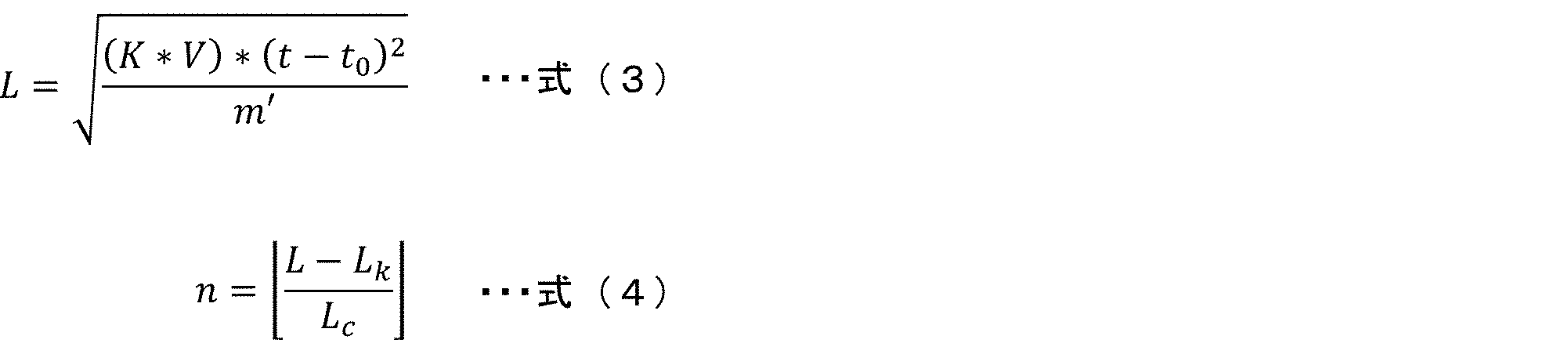
ここで、
K:定数、
V、t0:予め決定された定数、
t:存在すると考えられるイオンの理論上の飛行時間、
m’:存在すると考えられるイオンの理論質量数、
である。
K:定数、
V、t0:予め決定された定数、
t:存在すると考えられるイオンの理論上の飛行時間、
m’:存在すると考えられるイオンの理論質量数、
である。
この理論上の飛行時間tは、前述した式(2)により求めることができる。すなわち、飛行時間型の質量分析装置1におけるイオンの飛行時間Tは、閉軌道の周回数n、イオンの質量電荷比mを用いて、下記のように関数fで表現される。
T=f(m,n) …式(1)
それゆえ、質量電荷比mを有する特定のイオンiが閉軌道をある周回数nを周回した条件下での飛行時間Tは、式(1)から計算によって得られる。また、所定のタイミングで取り出し開始したときに、周回数n1のイオンiと共に計測される、周回数n2のイオンjの飛行時間も式(1)から計算により得られる。
それゆえ、質量電荷比mを有する特定のイオンiが閉軌道をある周回数nを周回した条件下での飛行時間Tは、式(1)から計算によって得られる。また、所定のタイミングで取り出し開始したときに、周回数n1のイオンiと共に計測される、周回数n2のイオンjの飛行時間も式(1)から計算により得られる。
周回型軌道を周回させる構成では、質量電荷比の小さなイオンほど速い速度で軌道を周回するため、周回を繰り返す間に質量電荷比の小さなイオンが周回遅れを生じた質量電荷比の大きなイオンを追い越し得る。このようにして、互いに異なる周回数を周回した複数種のイオンが混在した状態でイオン検出器に到達する。
飛行時間型質量分析装置の属する技術分野の当業者の本願出願時の技術常識は、イオンの飛行時間は、誤差が大きく式(2)に正確に従うものではない、というものであった。それゆえ、従来は、質量分析装置で測定された試料中のイオンが特定のイオンiであるかを判別するために、質量分析装置でサンプルとしてイオンiの飛行時間を予め測定しておく必要があった。そして、測定された試料中のイオンの飛行時間と、同じ周回数で飛行したサンプルのイオンiの飛行時間とを比較することで、試料中のイオンがイオンiであるか否かを判別していた。この従来の方法では、別のイオンjであるかを判別するためには、別のイオンjをサンプルとして実際に測定した飛行時間が必要になる。つまり、特定しようとする各イオン種について、実際の飛行時間の測定が予め必要になると考えられていた。また、比較対象のサンプルの飛行時間を得るために、異なる周回数のイオンを同時に検出しないよう、質量電荷比が所定範囲外であるイオンを除外する必要があった。
また従来は、1回の測定で周回数の異なる複数種のイオンを検出してしまうと、正確にイオンを特定できないと当業者に考えられていた。複数種のイオンを含むイオン混合物については、異なる周回数のイオンを検出しないようにイオンゲートを用いて質量範囲を細かく区分して多数回の分析を行うことが当業者の技術常識であった。周回数の異なる複数種のイオンを含む飛行時間のスペクトル波形を用いて、各イオンの質量電荷比を特定する構成に想到した当業者はこれまで存在しなかった。
(質量分析方法1)
図4は本実施形態に係る飛行時間型質量分析方法のフローチャートである。この飛行時間型質量分析方法は、試料に含まれる1つまたは複数種類のイオンの飛行時間を測定し、測定された飛行時間から特定のイオンが試料の中に含まれているか否かを判定する。以下では試料から複数種類のイオンを含むイオン混合物を供給する場合について説明するが、供給される(測定される)イオンは1種類であってもよい。
図4は本実施形態に係る飛行時間型質量分析方法のフローチャートである。この飛行時間型質量分析方法は、試料に含まれる1つまたは複数種類のイオンの飛行時間を測定し、測定された飛行時間から特定のイオンが試料の中に含まれているか否かを判定する。以下では試料から複数種類のイオンを含むイオン混合物を供給する場合について説明するが、供給される(測定される)イオンは1種類であってもよい。
前提条件として、質量分析装置1は、予め較正済みであるものとする。例えば、式(2)の加速電圧Vacc、定数t0が決定済みである。すなわち、式(1)の関数fが既知である。較正は、例えば任意の1種類のイオンの2以上の異なる周回数での各飛行時間、もしくは複数種類のイオンの各飛行時間を測定することで、行うことができる。
飛行装置5は、閉軌道を周回する複数種類のイオンを、イオン源10が複数種類のイオンを供給してから第1期間経過した第1取出開始時刻に閉軌道から取り出し開始する。イオン検出器9は、複数種類のイオンを検出する。例えば、第1取出開始時刻が、CO2
+が24周回してから取り出されるようなタイミングであった場合、図2のW1に示す飛行時間のスペクトル波形が得られる。図2において、各ピークに対応する飛行時間の数値(μs)が示されている。
飛行時間測定部3は、飛行時間のスペクトル波形から、各イオンの飛行時間を測定(取得)する(第1飛行時間測定工程、S1)。
判定部4は、特定のイオンiの飛行時間を式(1)から得る。判定部4は、イオンiの質量電荷比から、第1取出開始時刻で取り出し開始した場合のイオンiの閉軌道の周回数n1を特定することができる。または、第1取出開始時刻は、イオンiが予め決められた周回数n1を周回して取り出されるタイミングに設定されていてもよい。判定部4は、式(1)から、周回数n1を周回したイオンiの飛行時間Ti,n1を求める。判定部4は、測定されたイオンの各飛行時間がイオンiの飛行時間Ti,n1に一致するか否かを判定する。測定されたあるイオンの飛行時間Taがイオンiの飛行時間Ti,n1に一致する場合、判定部4は、試料中にイオンiが有ると判定する(判定工程、S2)。測定されたいずれのイオンの飛行時間Taもイオンiの飛行時間Ti,n1に一致しない場合、判定部4は、試料中にイオンiが無いと判定する。
また、判定部4は、同じ飛行時間のスペクトル波形から別のイオンjの有無を判定してもよい。第1取出開始時刻は、イオンjが予め決められた周回数n2を周回して取り出されるタイミングであるとする(n1≠n2)。判定部4は、式(1)から、周回数n2を周回したイオンjの飛行時間Tj,n2を求める。判定部4は、測定されたイオンの各飛行時間がイオンjの飛行時間Tj,n2に一致するか否かを判定する。測定されたあるイオンの飛行時間Taがイオンjの飛行時間Tj,n2に一致する場合、判定部4は、試料中にイオンjが有ると判定する(判定工程、S2)。測定されたいずれのイオンの飛行時間Taもイオンjの飛行時間Tj,n2に一致しない場合、判定部4は、試料中にイオンjが無いと判定する。
例えば、測定によって図2のW1の飛行時間のスペクトル波形が得られたとする。このスペクトル波形は、CO2
+イオンiが24周回して取り出されるようなタイミング(条件)で取り出し開始することで得られたものである。式(1)より、この質量分析装置1で24周回したCO2
+イオンiの飛行時間として125.643μsを得ることができる。測定された飛行時間のスペクトル波形W1の中に125.643μsに対応する(一致する)ピークがあれば、判定部4は、試料の中にCO2
+イオン(もしくはイオン化される前のCO2)が含まれていたと判定することができる。またこの条件下では、例えば、O2
+イオンjは、28周回して取り出される。式(1)より、この質量分析装置1で28周回したO2
+イオンjの飛行時間として124.477μsを得ることができる。測定された飛行時間のスペクトル波形W1の中に124.477μsに対応する(一致する)ピークがあれば、判定部4は、試料の中にO2
+イオン(もしくはイオン化される前のO2)が含まれていたと判定することができる。同様に、判定部4は、任意のイオンについて、該イオン(またはイオン化される前の物質)が試料の中に含まれていたか否かを判定することができる。
本実施形態では、質量分析装置1の較正(式(1)または式(2)の決定)は、特定のイオンを用いて行うことができ、必ずしも判定対象の各イオンi,jの飛行時間を予め測定しておく必要はない。各イオンi,jの飛行時間Ti,n1、Tj,n2は式(1)または式(2)から計算によって求めることができる。それゆえ、判定対象の各イオンについて予めサンプルを飛行させて飛行時間を測定しておく必要はない。すなわち、質量分析装置1は、計算によって広範なイオン種について判定を行うことができる。
なお、上記の説明では、判定部4は、飛行時間Taと飛行時間Ti,n1とが互いに一致するか否かを判定したが、周回数n1および飛行時間Taを用いて式(1)から得られた質量電荷比と、イオンiの質量電荷比とが互いに一致するか否かを判定してもよい。両者の判定は同義である。
表1は、図2に示す24周モード、30周モード、および50周モード毎に測定した飛行時間のスペクトル波形W1・W2・W3に係るイオン混合物に含まれる各イオンの飛行時間(TOF)等を示す。なお、24周モードは、CO2
+イオンが閉軌道を24周して閉軌道から取り出されるように、取出部8が所定の時刻に取り出しを開始する測定モードである。30周モード、50周モードについても同様である。
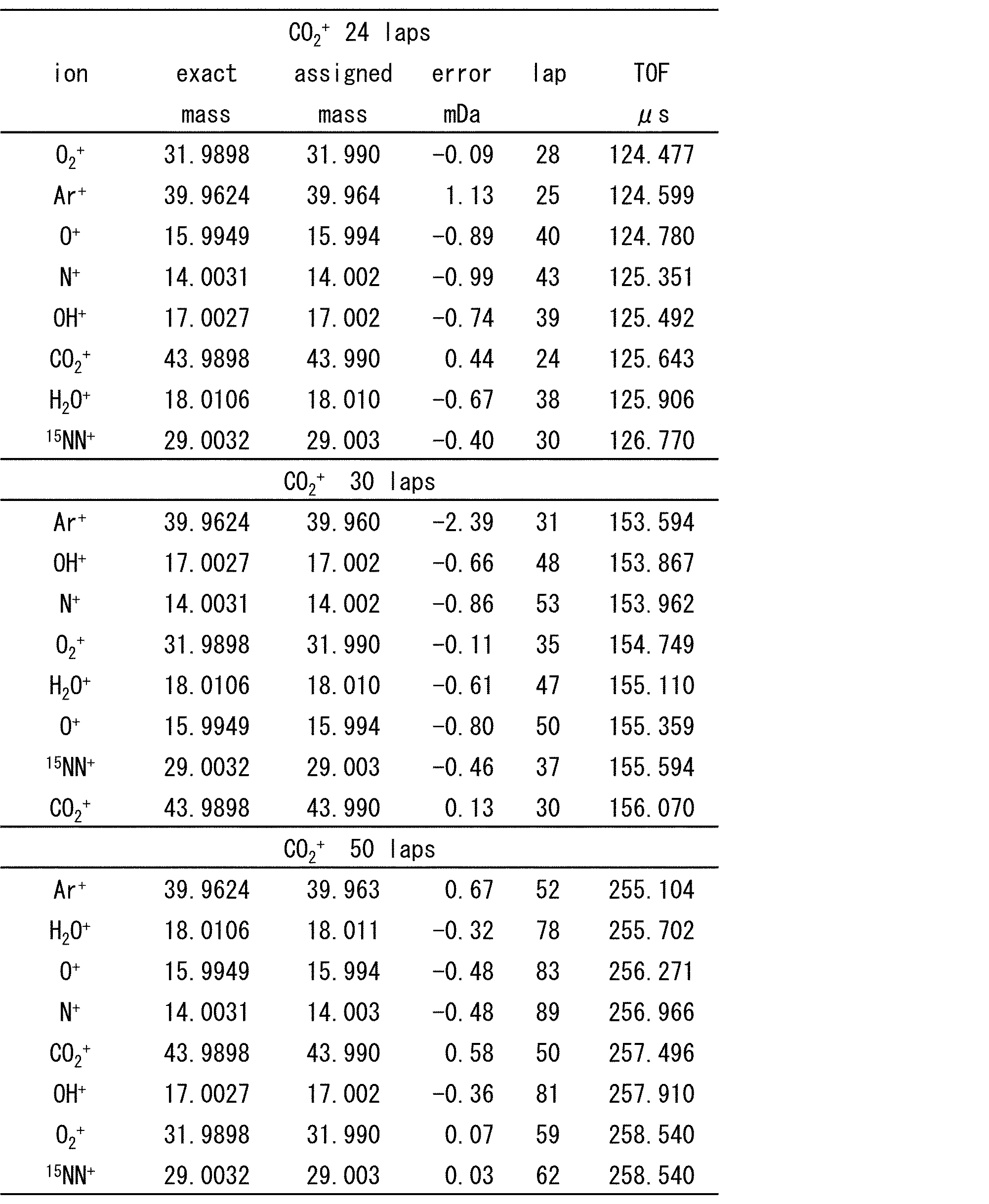
TOFはイオンの測定された飛行時間、lapはイオンの周回数、exact massはイオンの正確な質量数、ionはイオン種を表す。assigned massは飛行時間および周回数から式(1)を用いて計算されたイオンの質量数である。
測定された飛行時間から式(1)を用いて計算された各イオンの質量数(assigned mass)の、該イオンの正確な質量数(exact mass)に対する誤差(error)は概ねプラスマイナス0.5mDa(ミリダルトン)以下である。式(1)から得られた各イオンの質量数(または質量電荷比)は、該イオンの正確な質量数(または質量電荷比)に概ね一致している。
なお、第1の条件(例えば24周モード)での測定では飛行時間のスペクトル波形におけるピークが、他のイオンのピークと重なってイオン種の判定が難しい場合がある。その場合、第1の条件とは異なる周回数の第2の条件(例えば30周モードまたは50周モード)で飛行時間を測定することで、より正確にイオンiの有無を判定することができる。
例えば、飛行装置5は、閉軌道を周回する複数種類のイオンを、イオン源10が複数種類のイオンを供給してから第2期間経過した第2取出開始時刻に閉軌道から取り出し開始する。例えば、第2取出開始時刻が、CO2
+が30周回してから取り出されるようなタイミングであった場合、図2のW2に示す飛行時間のスペクトル波形が得られる。
飛行時間測定部3は、飛行時間のスペクトル波形から、各イオンの飛行時間を測定(取得)する(第2飛行時間測定工程、S1)。
判定部4は、特定のイオンiの飛行時間を式(1)から得る。判定部4は、イオンiの質量電荷比から、第2取出開始時刻で取り出し開始した場合のイオンiの閉軌道の周回数n3を特定することができる(n1≠n3)。または、第3取出開始時刻は、イオンiが予め決められた周回数n3を周回して取り出されるタイミングに設定されていてもよい。判定部4は、式(1)から、周回数n3を周回したイオンiの飛行時間Ti,n3を求める。判定部4は、測定されたイオンの各飛行時間がイオンiの飛行時間Ti,n3に一致するか否かを判定する。第2の条件下で測定されたあるイオンの飛行時間Tbがイオンiの飛行時間Ti,n3に一致する場合、判定部4は、試料中にイオンiが有ると判定する(判定工程、S2)。測定されたいずれのイオンの飛行時間Tbもイオンiの飛行時間Ti,n3に一致しない場合、判定部4は、試料中にイオンiが無いと判定する。
第2の条件下では、第1の条件下とは各イオンの周回数が異なる。そのため、第1の条件下では接近していた飛行時間の2つのピークが、第2の条件下では離れて測定され得る。このように、周回数の異なる複数(2つ以上)の条件下で測定することで、特定のイオンの有無をより正確に判定することができる。
質量分析装置1は、周回数の異なる複数種類のイオンを、除外することなく同時に1つの飛行時間のスペクトル波形として計測する。そして、イオンの質量電荷比と取り出し開始時刻に応じた周回数とを用いて式(1)から得られる飛行時間を、判定に用いる。そのため、質量電荷比が所定範囲外であるイオンを除外することなく得られた飛行時間のスペクトル波形から、特定のイオンの有無を正確に判定することができる。
測定対象イオンが予め定められているケースは少なくない。例えば、水道法では16種類の揮発性有機化合物(VOC)の測定が定められている。測定対象イオンが既知であるので、式(1)を用いれば容易に、任意に選択した条件(取出開始時刻)で、各イオンの周回数、および飛行時間を、一意に計算することができる。それゆえ、各種の法律で規定されている特定の物質の測定/検出について、質量分析装置1を好適に使用することができる。
(質量分析方法2)
質量分析装置1における別の質量分析方法について説明する。以下に説明する質量分析方法2は、検出されたイオン種、質量電荷比が共に不明であるような場合に特に有用である。
質量分析装置1における別の質量分析方法について説明する。以下に説明する質量分析方法2は、検出されたイオン種、質量電荷比が共に不明であるような場合に特に有用である。
図5は本実施形態の質量分析方法2に係る飛行時間型質量分析方法のフローチャートである。
飛行装置5は、閉軌道を周回する測定対象のイオンを、イオン源10がイオンを供給してから第1期間経過した第1取出開始時刻に閉軌道から取り出し開始する。ここでは簡単のために測定対象のイオンは1種類であるとする。イオン検出器9は、イオンを検出する。
飛行時間測定部3は、第1取出開始時刻に対応して得られた飛行時間のスペクトル波形から、第1取出開始時刻に対応するイオンの飛行時間Taを測定(取得)する(第1飛行時間測定工程、S4)。
次にイオン源10は、再度同じ測定対象のイオンを供給する。飛行装置5は、閉軌道を周回する測定対象のイオンを、イオン源10がイオンを供給してから第2期間経過した第2取出開始時刻に閉軌道から取り出し開始する。第2期間および第2取出開始時刻は、それぞれ第1期間および第1取出開始時刻とは異なる。イオン検出器9は、イオンを検出する。
飛行時間測定部3は、第2取出開始時刻に対応して得られた飛行時間のスペクトル波形から、第2取出開始時刻に対応するイオンの飛行時間Tbを測定する(第2飛行時間測定工程、S4)。第2取出開始時刻は、測定対象のイオンについて、飛行時間Taとは異なる飛行時間Tbが得られるようなタイミングである。
飛行時間Taと飛行時間Tbとは互いに異なる。すなわち、飛行時間Taが得られたときのイオンの閉軌道の周回数naと、飛行時間Tbが得られたときのイオンの閉軌道の周回数nbとは互いに異なる。ただし、イオン種が不明であるので、各周回数na、nbも不明である。
候補算出部11は、式(1)から、飛行時間Taについて、周回数がna1であると仮定した場合の質量電荷比の候補ma1を計算によって得る。また、候補算出部11は、式(1)から、飛行時間Taについて、別の周回数がna2であると仮定した場合の質量電荷比の候補ma2を計算によって得る。このように、候補算出部11は、式(1)から、飛行時間Taについて、複数の周回数候補[na1,…nav]に対応する複数の質量電荷比の候補A1[ma1,…mav]を得る(候補算出工程、S5)。[na1,…nav]は、na1,…navを要素とするリストまたは集合を表す。複数の周回数候補[na1,…nav]の中には、測定対象のイオンの正しい周回数に一致するものが含まれている可能性がある。それゆえ、複数の質量電荷比の候補A1[ma1,…mav]の中には測定対象のイオンの正しい質量電荷比に一致するものが含まれている可能性がある。複数の周回数候補[na1,…nav]の数を増やせば、複数の質量電荷比の候補A1[ma1,…mav]の中に測定対象のイオンの正しい質量電荷比に一致するものが含まれている可能性は高くなる。周回数候補[na1,…nav]として、例えば1周(重いイオンの場合)からX周(最も軽いH+の場合)迄が考え得る。それゆえ、質量分析装置1について、有限個の周回数候補に対応する質量電荷比の候補を計算すれば、質量電荷比の候補A1の中に測定対象のイオンの正しい質量電荷比に一致するものが必ず含まれる。
同様に、候補算出部11は、式(1)から、飛行時間Tbについて、周回数がnb1,nb2…であると仮定した場合の質量電荷比の候補mb1,mb2…を計算によって得る。このように、候補算出部11は、式(1)から、飛行時間Tbについて、複数の周回数候補[nb1,…nbw]に対応する複数の質量電荷比の候補A2[mb1,…mbw]を得る(候補算出工程、S5)。計算する周回数の候補は、飛行時間Taと飛行時間Tbとで異なっていてもよい。すなわち、v=wでも、v≠wでもよい。A1と同様に、複数の質量電荷比の候補A2[mb1,…mbw]の中には測定対象のイオンの正しい質量電荷比に一致するものが含まれている可能性がある。
決定部12は、複数の質量電荷比の候補A1[ma1,…mav]と、複数の質量電荷比の候補A2[mb1,…mbw]との中から、互いに値が一致する(共通する)質量電荷比候補m1を得る。例えば、複数の質量電荷比の候補A1および複数の質量電荷比の候補A2の両方に測定対象のイオンの正しい質量電荷比に一致する候補が含まれていれば、複数の質量電荷比の候補A1のいずれか1つの候補と、複数の質量電荷比の候補A2のいずれか1つの候補とが一致するはずである。逆に、値が一致する2つの候補が存在しない場合、複数の質量電荷比の候補A1および複数の質量電荷比の候補A2の少なくとも一方に、測定対象のイオンの正しい質量電荷比に一致する候補が含まれていないと考えられる。決定部12は、複数の質量電荷比の候補A1[ma1,…mav]のそれぞれと、複数の質量電荷比の候補A2[mb1,…mbw]のそれぞれとを比較し、互いに値が一致する質量電荷比候補m1を得る。決定部12は、質量電荷比候補m1を測定対象のイオンの質量電荷比として決定する(決定工程、S6)。なお、質量電荷比の候補mavとmbwとが互いに一致した場合、それぞれの周回数navとnbwとは互いに異なる。
値が一致する2つの候補が存在しない場合、候補算出部11は、飛行時間Taおよび/または飛行時間Tbについて、さらに別の周回数の候補に対応する別の質量電荷比の候補を得る。決定部12は、追加された質量電荷比の候補と値が一致する質量電荷比の候補があれば、その候補を測定対象のイオンの質量電荷比として決定する。候補算出部11は、互いに値が一致する質量電荷比の候補が得られるまで、周回数の候補を追加して計算してもよい。このように、候補算出部11は、段階的に質量電荷比の候補を増やしていってもよい。
また、予め設定された周回数の候補の範囲において、互いに値が一致する質量電荷比の候補が得られなければ、決定部12は、所定の範囲の質量電荷比を有する物質は検出されなかったと判断してもよい。
測定対象のイオンが複数種類であっても同様に判定を行うことができる。第1取出開始時刻に対応して得られた飛行時間のスペクトル波形に複数のピークが現れる場合、飛行時間測定部3は、複数のイオン種に対応する複数の飛行時間Ta、Tc…を得る。同様に、飛行時間測定部3は、第2取出開始時刻に対応して得られた飛行時間のスペクトル波形からも、複数のイオン種に対応する複数の飛行時間Tb、Td…を得る。この時点で、飛行時間Taのイオンと飛行時間Tbのイオンとが同じイオンなのか、飛行時間Taのイオンと飛行時間Tdのイオンとが同じイオンなのかは不明である。
候補算出部11は、式(1)から、各飛行時間Ta、Tb、Tc、Td…について、周回数を仮定して、複数の質量電荷比の候補A1,A2,A3,A4…を得る。決定部12は、第1取出開始時刻に対応して得られた候補A1のいずれかと一致する候補を、第2取出開始時刻に対応して得られた候補A2,A4…の中から探す。決定部12は、第1取出開始時刻に対応して得られた候補A3のいずれかと一致する候補を、第2取出開始時刻に対応して得られた候補A2,A4…の中から探す。決定部12は、飛行時間のスペクトル波形の複数のピークに対応して、複数の“互いに値が一致する質量電荷比の候補”m1、m2…を得ることができる。決定部12は、複数の質量電荷比候補m1、m2…を測定対象の複数のイオンの質量電荷比として決定する。
このように、本実施形態の質量分析方法2によれば、互いに周回数が異なる複数のイオン種が混在した状態で検出され、かつ、周回数が不明であっても、取出開始時刻が異なる2回の測定結果から、複数のイオン種の質量電荷比を決定することができる。また、質量分析装置1は、未知のイオン種について、質量電荷比を決定することができる。
なお、上記の各部において、2つの値の差の絶対値が所定値以下であれば、2つの値は互いに一致すると判定してよい。
質量分析装置1では、飛行時間の測定に当たって、質量電荷比が所定範囲外であるイオンを除外する必要がない。質量分析装置1では、従来よりも格段に少ない測定回数で以て幅広い質量電荷比範囲に亘る分析を行うことができる。このため、質量分析装置1は、医療(医学、歯学、法医学)、食品(食品加工、残留農薬)、環境(温暖化モニター、環境モニター)、安全・安心(危険物質検知、違法薬物検知)、および惑星探査等に係る現場(オンサイト)に持ち込むことが容易であり、現場で容易に質量分析を行うことができる。
なお、周回型軌道2を備えた質量分析装置1を例に挙げて説明したが、本発明はこれに限定されない。質量分析装置は閉軌道を備えていればよく、例えば、イオンミラー(リフレクトロン)を互いに対向させて配置してイオン混合物を往復(周回)飛行させる反射型軌道を備えた質量分析装置に対しても本発明を適用することができる。
また、情報処理装置6は、有線または無線の任意の伝送媒体を介してイオン源10、飛行装置5、およびイオン検出器9に接続されてもよい。この場合、イオン源10、飛行装置5、およびイオン検出器9の較正情報、注入および取り出しのタイミング情報、およびイオン混合物の飛行時間のスペクトル情報が、有線または無線の任意の伝送媒体を介して、情報処理装置6に伝送される。情報処理装置6は、有線または無線の任意の伝送媒体を介して伝送されたこれらの情報に基づいてイオン混合物の質量を分析するように動作する。
また、情報処理装置6の飛行時間測定部3は、測定された飛行時間を他の装置から取得してもよい。例えば、情報処理装置6は、サーバであってもよく、ネットワークを介して他の装置から、測定された飛行時間、および、イオン源10、飛行装置5、並びにイオン検出器9の較正情報(式(1)を決定するための情報)等を取得してもよい。
〔ソフトウェアによる実現例〕
飛行時間型の質量分析装置1に設けられた情報処理装置6(以下、「装置」とも呼ぶ)の機能は、当該装置としてコンピュータを機能させるためのプログラムであって、当該装置の各制御ブロック(特に、飛行時間測定部3、判定部4、候補算出部11、および、決定部12)としてコンピュータを機能させるためのプログラムにより実現することができる。
飛行時間型の質量分析装置1に設けられた情報処理装置6(以下、「装置」とも呼ぶ)の機能は、当該装置としてコンピュータを機能させるためのプログラムであって、当該装置の各制御ブロック(特に、飛行時間測定部3、判定部4、候補算出部11、および、決定部12)としてコンピュータを機能させるためのプログラムにより実現することができる。
この場合、上記装置は、上記プログラムを実行するためのハードウェアとして、少なくとも1つの制御装置(例えばプロセッサ)と少なくとも1つの記憶装置(例えばメモリ)を有するコンピュータを備えている。この制御装置と記憶装置により上記プログラムを実行することにより、上記各実施形態で説明した各機能が実現される。
上記プログラムは、一時的ではなく、コンピュータ読み取り可能な、1または複数の記録媒体に記録されていてもよい。この記録媒体は、上記装置が備えていてもよいし、備えていなくてもよい。後者の場合、上記プログラムは、有線または無線の任意の伝送媒体を介して上記装置に供給されてもよい。
また、上記各制御ブロックの機能の一部または全部は、論理回路により実現することも可能である。例えば、上記各制御ブロックとして機能する論理回路が形成された集積回路も本発明の範疇に含まれる。この他にも、例えば量子コンピュータにより上記各制御ブロックの機能を実現することも可能である。
〔まとめ〕
本発明の一態様に係る飛行時間型質量分析方法は、イオンの飛行時間Tが、閉軌道の周回数n、および前記イオンの質量電荷比mを用いて、「T=f(m,n) …式(1)」で表現される飛行時間型質量分析装置において、前記閉軌道を周回するイオンを、第1取出開始時刻に前記閉軌道から取り出し開始することで得られる、前記イオンの飛行時間Taを取得する第1飛行時間取得工程と、取得された飛行時間Taが、前記式(1)から得られる、周回数n1を周回したイオンiの飛行時間Ti,n1に一致するか否かに応じて、前記イオンiの有無を判定する判定工程とを含む。
本発明の一態様に係る飛行時間型質量分析方法は、イオンの飛行時間Tが、閉軌道の周回数n、および前記イオンの質量電荷比mを用いて、「T=f(m,n) …式(1)」で表現される飛行時間型質量分析装置において、前記閉軌道を周回するイオンを、第1取出開始時刻に前記閉軌道から取り出し開始することで得られる、前記イオンの飛行時間Taを取得する第1飛行時間取得工程と、取得された飛行時間Taが、前記式(1)から得られる、周回数n1を周回したイオンiの飛行時間Ti,n1に一致するか否かに応じて、前記イオンiの有無を判定する判定工程とを含む。
上記の特徴によれば、例えば互いに異なる周回数の複数のイオン種の飛行時間を同時に測定していたとしても、特定のイオンの有無を正確に判定することができる。そのため、質量電荷比範囲を細かく区分せずに得られた飛行時間のスペクトル波形から、特定のイオンの有無を正確に判定することができる。それゆえ、従来よりも少ない測定回数で以て幅広い質量電荷比範囲に亘る分析を行うことができる。
前記第1飛行時間取得工程では、前記第1取出開始時刻に前記閉軌道から取り出し開始することで得られる、周回数が互いに異なる複数のイオンが混在した状態での複数のイオンの飛行時間を取得し、前記判定工程では、取得された前記複数のイオンの各飛行時間が、前記式(1)から得られる、周回数n1を周回したイオンiの飛行時間Ti,n1に一致するか否かに応じて、前記イオンiの有無を判定してもよい。
前記第1取出開始時刻は、前記イオンiが周回数n1を周回して取り出されるタイミングであってもよい。
n1≠n2として、前記判定工程では、さらに、取得された前記飛行時間Taが、前記式(1)から得られる、周回数n2を周回したイオンjの飛行時間Tj,n2に一致するか否かに応じて、前記イオンjの有無を判定する構成であってもよい。
上記の特徴によれば、1つの測定結果を用いて、複数種類のイオンの有無を判定することができる。
前記飛行時間型質量分析方法は、n1≠n3として、前記イオンiが周回数n3を周回して取り出されるタイミングである第2取出開始時刻に前記閉軌道からイオンを取り出し開始することで得られる、前記イオンの飛行時間Tbを取得する第2飛行時間取得工程を含み、前記判定工程では、取得された前記飛行時間Tbが、前記式(1)から得られる、周回数n3を周回したイオンiの飛行時間Ti,n3に一致するか否かに応じて、前記イオンiの有無を判定する構成であってもよい。
本発明の一態様に係る飛行時間型質量分析方法は、イオンの飛行時間Tが、閉軌道の周回数n、および前記イオンの質量電荷比mを用いて、「T=f(m,n) …式(1)」で表現される飛行時間型質量分析装置において、前記閉軌道を周回するイオンを、第1取出開始時刻に前記閉軌道から取り出し開始することで得られる、前記イオンの飛行時間Taを取得する第1飛行時間取得工程と、前記イオンについて飛行時間Taとは異なる飛行時間が得られる第2取出開始時刻に前記閉軌道から取り出し開始することで得られる、前記イオンの飛行時間Tbを取得する第2飛行時間取得工程と、前記式(1)から、飛行時間Taについて複数の周回数候補[na1,…nav]に対応する複数の質量電荷比候補A1[ma1,…mav]を得て、前記式(1)から、飛行時間Tbについて複数の周回数候補[nb1,…nbw]に対応する複数の質量電荷比候補A2[mb1,…mbw]を得る候補算出工程と、複数の質量電荷比候補A1および複数の質量電荷比候補A2から値の一致する質量電荷比候補m1を得ることで、質量電荷比候補m1を前記イオンの質量電荷比として決定する決定工程とを含む。
上記の特徴によれば、2つの測定結果から周回数候補を仮定して得られる複数の質量電荷比の候補を比較することで、飛行時間が測定されたイオンの質量電荷比を決定することができる。それゆえ、判定対象のイオン種の質量電荷比が広範に渡る場合でも、効率よく正確に質量電荷比を決定することができる。また、例えば互いに異なる周回数の複数のイオン種の飛行時間を同時に測定していたとしても、イオンの質量電荷比を決定することができる。そのため、質量電荷比範囲を細かく区分せずに得られた飛行時間のスペクトル波形から、イオンの質量電荷比を決定することができる。それゆえ、従来よりも少ない測定回数で以て幅広い質量電荷比範囲に亘る分析を行うことができる。
前記閉軌道は、多重周回型軌道または多重反射型軌道であってもよい。
前記飛行時間型質量分析装置において、質量電荷比が所定範囲外であるイオンを除外することなくイオンを周回させてもよい。
本発明の一態様に係る飛行時間型質量分析装置は、イオンの飛行時間Tが、閉軌道の周回数n、および前記イオンの質量電荷比mを用いて、「T=f(m,n) …式(1)」で表現される飛行時間型質量分析装置において、前記閉軌道を周回するイオンを、第1取出開始時刻に前記閉軌道から取り出し開始することで得られる、前記イオンの飛行時間Taを取得する飛行時間取得部と、取得された飛行時間Taが、前記式(1)から得られる、周回数n1を周回したイオンiの飛行時間Ti,n1に一致するか否かに応じて、前記イオンiの有無を判定する判定部とを備える。
本発明の一態様に係る飛行時間型質量分析装置は、イオンの飛行時間Tが、閉軌道の周回数n、および前記イオンの質量電荷比mを用いて、「T=f(m,n) …式(1)」で表現される飛行時間型質量分析装置において、前記閉軌道を周回するイオンを、第1取出開始時刻に前記閉軌道から取り出し開始することで得られる、前記イオンの飛行時間Taを取得し、前記イオンについて飛行時間Taとは異なる飛行時間が得られる第2取出開始時刻に前記閉軌道から取り出し開始することで得られる、前記イオンの飛行時間Tbを取得する飛行時間取得部と、前記式(1)から、飛行時間Taについて複数の周回数候補[na1,…nav]に対応する複数の質量電荷比候補A1[ma1,…mav]を得て、前記式(1)から、飛行時間Tbについて複数の周回数候補[nb1,…nbw]に対応する複数の質量電荷比候補A2[mb1,…mbw]を得る候補算出部と、複数の質量電荷比候補A1および複数の質量電荷比候補A2から値の一致する質量電荷比候補m1を得ることで、質量電荷比候補m1を前記イオンの質量電荷比として決定する決定部とを備える。
本発明の各態様に係る飛行時間型質量分析装置に設けられた飛行時間取得部、判定部、候補算出部、および、決定部は、コンピュータによって実現してもよく、この場合には、コンピュータを前記飛行時間型質量分析装置が備える各部(ソフトウェア要素)として動作させることにより前記飛行時間型質量分析装置に係る演算をコンピュータにて実現させる前記飛行時間取得部、前記判定部、前記候補算出部、および、前記決定部の制御プログラム、およびそれを記録したコンピュータ読み取り可能な記録媒体も、本発明の範疇に入る。
本発明は上述した各実施形態に限定されるものではなく、請求項に示した範囲で種々の変更が可能であり、異なる実施形態にそれぞれ開示された技術的手段を適宜組み合わせて得られる実施形態についても本発明の技術的範囲に含まれる。
1 質量分析装置(飛行時間型質量分析装置)
2 周回型軌道(閉軌道)
3 飛行時間測定部(飛行時間取得部)
4 判定部
5 飛行装置
6 情報処理装置
7 注入部
8 取出部
9 イオン検出器
10 イオン源
11 決定部
12 候補算出部
A1~A4 円周軌道
A12、A23、A34、A41 直進軌道
E1~E4 扇形電場
2 周回型軌道(閉軌道)
3 飛行時間測定部(飛行時間取得部)
4 判定部
5 飛行装置
6 情報処理装置
7 注入部
8 取出部
9 イオン検出器
10 イオン源
11 決定部
12 候補算出部
A1~A4 円周軌道
A12、A23、A34、A41 直進軌道
E1~E4 扇形電場
Claims (12)
- イオンの飛行時間Tが、閉軌道の周回数n、および前記イオンの質量電荷比mを用いて、
T=f(m,n) …式(1)
で表現される飛行時間型質量分析装置において、前記閉軌道を周回するイオンを、第1取出開始時刻に前記閉軌道から取り出し開始することで得られる、前記イオンの飛行時間Taを取得する第1飛行時間取得工程と、
取得された飛行時間Taが、前記式(1)から得られる、周回数n1を周回したイオンiの飛行時間Ti,n1に一致するか否かに応じて、前記イオンiの有無を判定する判定工程とを含むことを特徴とする飛行時間型質量分析方法。 - 前記第1飛行時間取得工程では、前記第1取出開始時刻に前記閉軌道から取り出し開始することで得られる、周回数が互いに異なる複数のイオンが混在した状態での複数のイオンの飛行時間を取得し、
前記判定工程では、取得された前記複数のイオンの各飛行時間が、前記式(1)から得られる、周回数n1を周回したイオンiの飛行時間Ti,n1に一致するか否かに応じて、前記イオンiの有無を判定する、請求項1に記載の飛行時間型質量分析方法。 - 前記第1取出開始時刻は、前記イオンiが周回数n1を周回して取り出されるタイミングである、請求項1または2に記載の飛行時間型質量分析方法。
- n1≠n2として、
前記判定工程では、さらに、取得された前記飛行時間Taが、前記式(1)から得られる、周回数n2を周回したイオンjの飛行時間Tj,n2に一致するか否かに応じて、前記イオンjの有無を判定する、請求項1または2に記載の飛行時間型質量分析方法。 - n1≠n3として、
前記イオンiが周回数n3を周回して取り出されるタイミングである第2取出開始時刻に前記閉軌道からイオンを取り出し開始することで得られる、前記イオンの飛行時間Tbを取得する第2飛行時間取得工程を含み、
前記判定工程では、取得された前記飛行時間Tbが、前記式(1)から得られる、周回数n3を周回したイオンiの飛行時間Ti,n3に一致するか否かに応じて、前記イオンiの有無を判定する、請求項1または2に記載の飛行時間型質量分析方法。 - イオンの飛行時間Tが、閉軌道の周回数n、および前記イオンの質量電荷比mを用いて、
T=f(m,n) …式(1)
で表現される飛行時間型質量分析装置において、前記閉軌道を周回するイオンを、第1取出開始時刻に前記閉軌道から取り出し開始することで得られる、前記イオンの飛行時間Taを取得する第1飛行時間取得工程と、
前記イオンについて飛行時間Taとは異なる飛行時間が得られる第2取出開始時刻に前記閉軌道から取り出し開始することで得られる、前記イオンの飛行時間Tbを取得する第2飛行時間取得工程と、
前記式(1)から、飛行時間Taについて複数の周回数候補[na1,…nav]に対応する複数の質量電荷比候補A1[ma1,…mav]を得て、前記式(1)から、飛行時間Tbについて複数の周回数候補[nb1,…nbw]に対応する複数の質量電荷比候補A2[mb1,…mbw]を得る候補算出工程と、
複数の質量電荷比候補A1および複数の質量電荷比候補A2から値の一致する質量電荷比候補m1を得ることで、質量電荷比候補m1を前記イオンの質量電荷比として決定する決定工程とを含むことを特徴とする飛行時間型質量分析方法。 - 前記閉軌道は、多重周回型軌道または多重反射型軌道である請求項1、2または6に記載の飛行時間型質量分析方法。
- 前記飛行時間型質量分析装置において、質量電荷比が所定範囲外であるイオンを除外することなくイオンを周回させる請求項1、2または6に記載の飛行時間型質量分析方法。
- イオンの飛行時間Tが、閉軌道の周回数n、および前記イオンの質量電荷比mを用いて、
T=f(m,n) …式(1)
で表現される飛行時間型質量分析装置において、前記閉軌道を周回するイオンを、第1取出開始時刻に前記閉軌道から取り出し開始することで得られる、前記イオンの飛行時間Taを取得する飛行時間取得部と、
取得された飛行時間Taが、前記式(1)から得られる、周回数n1を周回したイオンiの飛行時間Ti,n1に一致するか否かに応じて、前記イオンiの有無を判定する判定部とを備えることを特徴とする飛行時間型質量分析装置。 - イオンの飛行時間Tが、閉軌道の周回数n、および前記イオンの質量電荷比mを用いて、
T=f(m,n) …式(1)
で表現される飛行時間型質量分析装置において、前記閉軌道を周回するイオンを、第1取出開始時刻に前記閉軌道から取り出し開始することで得られる、前記イオンの飛行時間Taを取得し、前記イオンについて飛行時間Taとは異なる飛行時間が得られる第2取出開始時刻に前記閉軌道から取り出し開始することで得られる、前記イオンの飛行時間Tbを取得する飛行時間取得部と、
前記式(1)から、飛行時間Taについて複数の周回数候補[na1,…nav]に対応する複数の質量電荷比候補A1[ma1,…mav]を得て、前記式(1)から、飛行時間Tbについて複数の周回数候補[nb1,…nbw]に対応する複数の質量電荷比候補A2[mb1,…mbw]を得る候補算出部と、
複数の質量電荷比候補A1および複数の質量電荷比候補A2から値の一致する質量電荷比候補m1を得ることで、質量電荷比候補m1を前記イオンの質量電荷比として決定する決定部とを備えることを特徴とする飛行時間型質量分析装置。 - 請求項9に記載の飛行時間型質量分析装置としてコンピュータを機能させるための飛行時間型質量分析プログラムであって、前記飛行時間取得部、および、前記判定部としてコンピュータを機能させるための飛行時間型質量分析プログラム。
- 請求項10に記載の飛行時間型質量分析装置としてコンピュータを機能させるための飛行時間型質量分析プログラムであって、前記飛行時間取得部、前記候補算出部、および、前記決定部としてコンピュータを機能させるための飛行時間型質量分析プログラム。
Priority Applications (1)
| Application Number | Priority Date | Filing Date | Title |
|---|---|---|---|
| JP2023533563A JP7531948B2 (ja) | 2021-07-09 | 2022-06-29 | 飛行時間型質量分析方法、飛行時間型質量分析装置、および飛行時間型質量分析プログラム |
Applications Claiming Priority (2)
| Application Number | Priority Date | Filing Date | Title |
|---|---|---|---|
| JP2021114594 | 2021-07-09 | ||
| JP2021-114594 | 2021-07-09 |
Publications (1)
| Publication Number | Publication Date |
|---|---|
| WO2023282149A1 true WO2023282149A1 (ja) | 2023-01-12 |
Family
ID=84801614
Family Applications (1)
| Application Number | Title | Priority Date | Filing Date |
|---|---|---|---|
| PCT/JP2022/026006 Ceased WO2023282149A1 (ja) | 2021-07-09 | 2022-06-29 | 飛行時間型質量分析方法、飛行時間型質量分析装置、および飛行時間型質量分析プログラム |
Country Status (2)
| Country | Link |
|---|---|
| JP (1) | JP7531948B2 (ja) |
| WO (1) | WO2023282149A1 (ja) |
Citations (1)
| Publication number | Priority date | Publication date | Assignee | Title |
|---|---|---|---|---|
| JP2005116343A (ja) * | 2003-10-08 | 2005-04-28 | Shimadzu Corp | 質量分析方法及び質量分析装置 |
-
2022
- 2022-06-29 JP JP2023533563A patent/JP7531948B2/ja active Active
- 2022-06-29 WO PCT/JP2022/026006 patent/WO2023282149A1/ja not_active Ceased
Patent Citations (1)
| Publication number | Priority date | Publication date | Assignee | Title |
|---|---|---|---|---|
| JP2005116343A (ja) * | 2003-10-08 | 2005-04-28 | Shimadzu Corp | 質量分析方法及び質量分析装置 |
Also Published As
| Publication number | Publication date |
|---|---|
| JP7531948B2 (ja) | 2024-08-13 |
| JPWO2023282149A1 (ja) | 2023-01-12 |
Similar Documents
| Publication | Publication Date | Title |
|---|---|---|
| Shvartsburg et al. | Modeling the resolution and sensitivity of FAIMS analyses | |
| JP6494588B2 (ja) | 滞留時間の決定または確認のための窓処理質量分析データの使用 | |
| US20080201095A1 (en) | Method for Calibrating an Analytical Instrument | |
| EP2641260B1 (en) | Controlling hydrogen-deuterium exchange on a spectrum by spectrum basis | |
| JP4182844B2 (ja) | 質量分析装置 | |
| US11699578B2 (en) | Method of mass spectrometry | |
| JP7717849B2 (ja) | 質量スペクトル中の分子種を同定するための方法及び装置 | |
| JP2013537312A (ja) | 生成イオンスペクトルのデータ独立取得および参照スペクトルライブラリ照合 | |
| Schury et al. | Wide-band mass measurements with a multi-reflection time-of-flight mass spectrograph | |
| JP4182853B2 (ja) | 質量分析方法及び質量分析装置 | |
| US9437407B2 (en) | Mass spectrometry for multiplexed quantitation using multiple frequency notches | |
| EP4139673B1 (en) | Methods to compare data within and between cohorts | |
| WO2014116711A1 (en) | Methods and apparatuses involving mass spectrometry to identify proteins in a sample | |
| JP2024534094A (ja) | イオン分析における及びイオン分析に関する改良 | |
| EP3218703B1 (en) | Determining the identity of modified compounds | |
| WO2023282149A1 (ja) | 飛行時間型質量分析方法、飛行時間型質量分析装置、および飛行時間型質量分析プログラム | |
| EP2372357A1 (en) | Identification of Substances by Ion Mobility Spectrometry | |
| JP4857000B2 (ja) | 質量分析システム | |
| McCowan et al. | Q value for the double-β decay of Xe 136 | |
| JP4106444B2 (ja) | 生体高分子自動同定方法 | |
| EP3523818B1 (en) | System and method for real-time isotope identification | |
| WO2008059567A1 (en) | Mass spectrometry method and mass spectrometry apparatus | |
| GRAAL Collaboration. et al. | Eta photoproduction on the neutron at GRAAL: Measurement of the differential cross section | |
| Hondo et al. | A Method for Expanding Mass Range on a Multi-Turn Time-of-Flight Mass Spectrometer by a Lap Superimposed Spectrum | |
| Wang | Nuclear Mass Measurement and Evaluation Relevant to Astrophysics |
Legal Events
| Date | Code | Title | Description |
|---|---|---|---|
| 121 | Ep: the epo has been informed by wipo that ep was designated in this application |
Ref document number: 22837565 Country of ref document: EP Kind code of ref document: A1 |
|
| WWE | Wipo information: entry into national phase |
Ref document number: 2023533563 Country of ref document: JP |
|
| NENP | Non-entry into the national phase |
Ref country code: DE |
|
| 122 | Ep: pct application non-entry in european phase |
Ref document number: 22837565 Country of ref document: EP Kind code of ref document: A1 |