WO2023276192A1 - 吸収性物品 - Google Patents
吸収性物品 Download PDFInfo
- Publication number
- WO2023276192A1 WO2023276192A1 PCT/JP2021/043635 JP2021043635W WO2023276192A1 WO 2023276192 A1 WO2023276192 A1 WO 2023276192A1 JP 2021043635 W JP2021043635 W JP 2021043635W WO 2023276192 A1 WO2023276192 A1 WO 2023276192A1
- Authority
- WO
- WIPO (PCT)
- Prior art keywords
- region
- waist region
- absorbent article
- base point
- front waist
- Prior art date
- Legal status (The legal status is an assumption and is not a legal conclusion. Google has not performed a legal analysis and makes no representation as to the accuracy of the status listed.)
- Ceased
Links
Images


Classifications
-
- A—HUMAN NECESSITIES
- A61—MEDICAL OR VETERINARY SCIENCE; HYGIENE
- A61F—FILTERS IMPLANTABLE INTO BLOOD VESSELS; PROSTHESES; DEVICES PROVIDING PATENCY TO, OR PREVENTING COLLAPSING OF, TUBULAR STRUCTURES OF THE BODY, e.g. STENTS; ORTHOPAEDIC, NURSING OR CONTRACEPTIVE DEVICES; FOMENTATION; TREATMENT OR PROTECTION OF EYES OR EARS; BANDAGES, DRESSINGS OR ABSORBENT PADS; FIRST-AID KITS
- A61F13/00—Bandages or dressings; Absorbent pads
- A61F13/15—Absorbent pads, e.g. sanitary towels, swabs or tampons for external or internal application to the body; Supporting or fastening means therefor; Tampon applicators
- A61F13/45—Absorbent pads, e.g. sanitary towels, swabs or tampons for external or internal application to the body; Supporting or fastening means therefor; Tampon applicators characterised by the shape
- A61F13/49—Absorbent pads, e.g. sanitary towels, swabs or tampons for external or internal application to the body; Supporting or fastening means therefor; Tampon applicators characterised by the shape specially adapted to be worn around the waist, e.g. diapers or nappies
- A61F13/496—Absorbent pads, e.g. sanitary towels, swabs or tampons for external or internal application to the body; Supporting or fastening means therefor; Tampon applicators characterised by the shape specially adapted to be worn around the waist, e.g. diapers or nappies in the form of pants or briefs
Definitions
- the present invention relates to pants-type absorbent articles.
- absorbent articles such as pants-type disposable diapers are known.
- the absorbent article described in Patent Document 1 divides the waist region arranged around the wearer's waist into a plurality of zones, different stresses for each zone, and arranges the waist region so as to fit the shape of the body. It is an object.
- the front waist area of the absorbent article may move toward the crotch area due to vertical movement of the legs. More specifically, the deformation base point of the body when moving the legs up and down is the depression of the lower abdomen. When the wearer moves his/her legs up and down, the area on the crotch side is more likely to move than the depression of the lower abdomen, and the absorbent core is likely to move to the crotch side along with the movement of the leg. In addition, when the wearer moves the legs up and down while holding the absorbent core in the crotch region between the legs, the absorbent core may move repeatedly in the front-rear direction.
- the wearing assistant such as a mother may get a feeling that the absorbent article is likely to shift during wearing or that the absorbent article is not suitable for long-term use.
- the waist circumference covering the bulge on the side of the waist opening is shorter than the dent in the lower abdomen, the area covering the bulge will move toward the dent in the lower abdomen with the shorter waist circumference. to move. Therefore, it may not be possible to continue covering the swelling of the abdomen with the absorbent article.
- an absorbent article that suppresses the shift of the front waist region toward the crotch region, suppresses the swelling of the front waist region, and easily covers the abdomen is desired.
- An absorbent article includes a longitudinal direction and a width direction perpendicular to each other, a front waist region, a rear waist region, a crotch region disposed between the front waist region and the rear waist region, and the It has a side joint portion that joins the front waist region and the back waist region, and an absorbent core provided at least in the crotch region.
- a bending base point for bending the front waist region in the front-rear direction is provided in a lower abdomen region located 50 to 80% behind the front edge of the front waist region with respect to the total length of the front waist region in the front-rear direction. .
- the length of the first region in the natural state in the width direction is the bisection. It is longer than the length in the width direction in the natural state of the second region located on the crotch side of the regions.
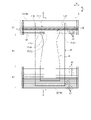
- FIG. 1 is a schematic front view of an absorbent article according to this embodiment.
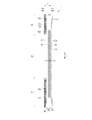
- FIG. 2 is a schematic plan view of an absorbent article according to this embodiment.
- 3 is a cross-sectional view taken along line AA shown in FIG. 2.
- FIG. 4 is a diagram schematically showing a state in which the absorbent article is attached to the wearer.
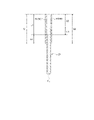
- FIG. 5 is a schematic side view of an absorbent article folded in two.
- An absorbent article is arranged between the front-rear direction and the width direction perpendicular to each other, a front waist region, a rear waist region, and the front waist region and the rear waist region. a crotch region, a side joint portion that joins the front waist region and the back waist region, and an absorbent core provided at least in the crotch region.
- a bending base point for bending the front waist region in the front-rear direction is provided in a lower abdomen region located 50 to 80% behind the front edge of the front waist region with respect to the total length of the front waist region in the front-rear direction. .
- the length in the width direction in the natural state of the first region located on the waist opening side is the bisection. It is longer than the length in the width direction in the natural state of the second region located on the crotch side of the regions.
- the lower abdomen region is arranged 50 to 80% rearward of the front edge of the front waist region with respect to the full length of the front waist region in the front-rear direction, and is arranged to face the depression of the lower abdomen.
- the front waist area fits into the dent in the lower abdomen, and since the waist size of the front waist area is longer toward the waist opening side than the bending point, the entire front waist area is Shaped to follow the contours of the body. Therefore, it becomes easy to keep the abdomen covered while suppressing the swelling of the front waist region. It is difficult for the wearing assistant to feel that the absorbent article is likely to shift during the wearing process or that the absorbent article is not suitable for long-term use, and a sense of security can be provided even for long-term use.
- the narrow portion of the front waist region having the shortest length in the width direction in the natural state of the absorbent article is provided in the lower abdomen region.
- the girth dimension of the wearer's lower abdominal cavity is relatively short on the ventral side. According to this aspect, since the narrow portion is arranged in the recess of the lower abdomen, the front waist region can more easily conform to the shape of the body.
- the narrow portion is spaced apart from the bending base point in the front-rear direction. According to this aspect, since the narrow portion and the bending base point are separated from each other, they are independent of each other and can be suppressed from following each other too much. Therefore, positional displacement of the narrow portion can be suppressed.
- the narrow portion is located closer to the waist opening than the bending base point.
- the force can be divided by the bending base point in the region on the crotch side of the narrow portion.
- the narrow portion is less likely to follow the movement of the leg and is less likely to be out of position, so that it is less likely to be out of place even with vigorous movement.
- the width in the natural state of the third region extending between the bending base point and the rear edge of the front waist region is equal to the width of the second region in the natural state. Longer than direction length.
- the third region is located on the crotch side of the recess of the lower abdomen and is arranged at the base of the leg. According to this aspect, by increasing the length of the natural state of the third region, it is possible to reduce the feeling of tightness around the leg, and to reduce the vibration (force applied in the direction of deviation) when moving the leg throughout the front waist region. It's hard to tell.
- the third region includes a third front region that bisects the third region in the front-rear direction and is located on the waist opening side, and a third region that bisects the third region in the front-rear direction. and a third rear region that is equally divided and located on the crotch side.
- the length in the width direction of the third front region in its natural state is shorter than the length in the width direction of the third rear region in its natural state.
- the length of the absorbent article in the width direction gradually increases from the bending base point toward the crotch side. Therefore, it becomes difficult to hinder the movement of the wearer's legs. Without tightening around the wearer's abdomen and legs, the wearer can easily move his/her legs, and yet the wearer's legs are not easily slipped.
- the bending base point is configured by the front edge of the absorbent core.
- the front edge of the absorbent core constitutes the bending base point, the front waist region is more easily deformed at the bending base point. Since the absorbent core does not exist on the waist opening side of the bending base point, it is possible to suppress the absorbent core on the waist opening side from slipping down from the depression of the lower abdomen, and to suppress the loose absorbent core from gathering in the crotch region. .
- a discontinuous elastic member that is discontinuous is arranged across the pair of side joints in the front waist region.
- the number of discontinuous elastic members on the waist opening side of the bending base point is smaller than the number of discontinuous elastic members on the crotch side of the bending base point.
- the fit in the vicinity of the front edge of the front waist region is ensured, and the fit in the vicinity of the front edge of the front waist region is reduced. It is possible to suppress the slippage of the entire front waist region.
- the front waist region is divided into 10 equal parts in the front-rear direction, and has a high contraction region with the highest contraction force in the width direction.
- the bending base point is provided in the high-shrinkage region. According to this aspect, by arranging the bending base point in the high-contraction region, the bending base point fits into the depression of the lower abdomen, and the bending base point can be prevented from slipping in the front-rear direction.
- the contractile force of the region located on the crotch side is lower than the contractile force of the region located on the crotch side. According to this aspect, the contractile force gradually decreases from the high contraction region toward the waist opening side. Therefore, it is possible to arrange the stress according to the shape of the baby's body, which has a protruding stomach. Therefore, the entire front waist region is less likely to slide down.
- a folding line for folding the absorbent article in two extends along the width direction in the crotch region.
- the longitudinal length of the absorbent core in the front waist region is 1/2 or less of the entire length of the front waist region in the longitudinal direction.
- a first distance from the front edge of the absorbent core to the front edge of the front waist region is longer than a second distance from the rear edge of the absorbent core to the rear edge of the back waist region.
- the difference between the distance from the fold line to the rear edge of the absorbent core and the distance from the fold line to the front edge of the absorbent core is shorter than the length of the absorbent core in the front waist region in the front-rear direction.
- no absorbent core is present in more than half of the entire front waist region in the front-rear direction.
- the length of the absorbent core in the front waist region is shorter than the length of the absorbent core in the back waist region.
- the absorbent core in the front waist region is less likely to be affected by the movement of the legs, and it is possible to suppress the migration of the absorbent core to the crotch side.
- the difference between the distance from the fold line to the rear edge of the absorbent core and the distance from the fold line to the front edge of the absorbent core is greater than the length of the absorbent core in the front waist region in the front-rear direction. is also short.
- the length of the absorbent core in the rear waist region extending upward (toward the back) can be made relatively shorter than the absorbent core in the front waist region. That is, the length of the absorbent core in the rear waist region is not extremely longer than that in the front waist region. Therefore, when the user tries to pull up the absorbent article around the wearer's waist by grasping the vicinity of the side joints, the pulling force can be transmitted to both the absorbent core in the rear waist region and the absorbent core in the front waist region. Therefore, the entire absorbent article can be placed in an appropriate position to cover the waist.
- FIG. 1 is a schematic front view of an absorbent article according to this embodiment.
- FIG. 2 is a schematic plan view of an absorbent article according to this embodiment.
- 3 is a cross-sectional view taken along line AA shown in FIG. 2.
- each member may be spaced apart in the thickness direction T for convenience of explanation, but they are in contact with each other in the thickness direction T in an actual product.
- the outer portion in the present invention is a portion occupying a certain range in the width direction W including the outer edge in the width direction W, and the outer edge is the outer edge in the width direction W.
- the inner portion in the present invention is a portion occupying a certain range in the width direction W including the inner edge in the width direction W, and the inner edge is the inner edge in the width direction W.
- front end portion and the rear end portion in the present invention are portions occupying a certain range in the front-rear direction L including edges in the front-rear direction L, and the front end edge and the rear end edge are edges in the front-rear direction L.
- the outer edge includes a leading edge and a trailing edge, and the outer edge includes a leading edge and a trailing edge.
- the absorbent article 1 has a front-rear direction L and a width direction W perpendicular to the front-rear direction L.
- the front-rear direction L is defined by the direction extending to the front side of the body and the rear side of the body.
- the front-rear direction L is a direction extending front-rear in the unfolded absorbent article 1 .
- the absorbent article 1 has a thickness direction T in which both the front-rear direction L and the width direction W are perpendicular to each other.
- the thickness direction T extends to the skin side T1 toward the wearer and the non-skin side T2 opposite to the skin side.
- the absorbent article 1 has a front waist region S1, a back waist region S2, and a crotch region S3.
- the front waist region S1 is a region arranged around the wearer's front waist (abdomen).
- the back waist region S2 is a region arranged on the back side of the wearer.
- the crotch region S3 is a region that is arranged between the front waist region S1 and the back waist region and that is arranged at the wearer's crotch.
- the absorbent article 1 may have an absorbent main body 20 and an exterior body 50 .
- the absorbent main body 20 may be configured as a separate body from the exterior body 50 .
- the absorbent main body 20 is arranged at least in the crotch region S3.
- the absorbent main body 20 may extend in the longitudinal direction L from the crotch region S3 to the front waist region S1, and may extend in the longitudinal direction L from the crotch region S3 to the back waist region S2.
- the absorbent main body 20 may overlap the outer body 50 in the thickness direction T in the front waist region S1 and the back waist region S2.
- the absorbent main body 20 has an absorbent core 21 arranged at least in the crotch region S3.
- the absorbent core 21 comprises an absorbent material that absorbs liquids.
- the absorbent core 21 may be covered with a core wrap 22 .
- the absorbent main body 20 comprises a skin sheet 25 located on the skin side T1 of the absorbent core 21, a liquid-impermeable sheet 26 located on the non-skin side T2 of the absorbent core 21, and the liquid-impermeable sheet 26. and a body sheet 27 disposed on the non-skin side T2.
- the skin sheet 25 and the body sheet 27 may be made of nonwoven fabric, for example.
- the liquid-impermeable sheet 26 may be made of, for example, a film.
- the exterior body 50 may have a front exterior body 51 arranged in the front waist region S1 and a back exterior body 52 arranged in the rear waist region S2.
- the front exterior body 51 and the rear exterior body 52 may be spaced apart in the front-rear direction L, or may be connected to each other.
- the length in the front-rear direction L of the rear exterior body 52 may be longer than that of the front exterior body 51 .
- the post-exterior body 52 may extend further to the crotch side than the side joints 60 .
- the absorbent article 1 is provided with side joints 60 that join the front waist region S1 and the rear waist region S2.
- the side joint portion 60 is a portion where the outer portion of the front exterior body 51 that constitutes the front waist region S1 and the outer portion of the rear exterior body 52 that constitutes the rear waist region S2 are engaged with each other.
- the absorbent article 1 in the state where the side joints 60 are formed, the absorbent article 1 has a waist opening 62 through which the wearer's torso is passed and a pair of legs into which the wearer's legs are respectively inserted.
- a turning opening 66 is formed.
- the waist opening 62 may be defined by a front edge S1F of the front waist region S1 and a rear edge S2R of the rear waist region S2.
- the side joint portion 60 may extend along the front-rear direction L in each of the front exterior body 51 and the rear exterior body 52 .
- the boundary between the front waist region S ⁇ b>1 and the crotch region S ⁇ b>3 may be defined by the rear edges of the side joints 60 provided in the front exterior body 51 .
- a boundary between the back waist region S2 and the crotch region S3 may be defined by the front edge of the side joints 60 provided on the back exterior body 52 .
- the crotch region S3 may be a region in which the leg openings 66 are provided.
- the leg openings 66 may be portions recessed inward in the width direction W from the outer edge of the absorbent article 1 .
- the front exterior body 51 and the rear exterior body 52 may have a plurality of exterior sheets such as nonwoven fabric.
- the exterior sheet may have a first exterior sheet 55 and a second exterior sheet 56 positioned on the non-skin surface side T2 of the first exterior sheet 55 .
- the first exterior sheet 55 and the second exterior sheet 56 may be composed of the same folded sheet, or may be composed of different pairs of sheets.
- the exterior sheet may be arranged on the non-skin surface side T2 of the absorbent main body 20 .
- the front exterior body 51 and the back exterior body 52 may have a cover sheet 57 positioned closer to the skin surface side T1 than the absorbent main body 20 .
- the cover sheet 57 may be configured by a portion in which at least one of the exterior sheets is folded back toward the skin surface side T1, or may be configured by a sheet separate from the exterior sheet.
- An elastic member that is stretchable in the width direction W may be arranged between the first exterior sheet 55 and the second exterior sheet 56 .
- the elastic members include a continuous elastic member 81 extending continuously in the width direction W between the pair of side joints 60 and a discontinuous elastic member discontinuous between the pair of side joints 60. 82 and .
- the discontinuous elastic member 82 is cut at the center of the absorbent article in the width direction W and is not continuous in the width direction.
- the elastic force of the area where the continuous elastic member 81 is arranged may be higher than the elastic force of the area where the discontinuous elastic member 82 is arranged.
- the elastic member may be composed of, for example, a thread rubber stretchable in the width direction W or an elastic sheet stretchable in the width direction W.
- the elastic member may be constituted by the front exterior body 51 itself constituted by, for example, a stretchable sheet.
- the elastic member of the present embodiment is made of rubber thread.
- the absorbent article 1 is configured to suppress bulging of the front waist region S1 and to easily keep covering the abdomen.
- the front waist region S1 has a plurality of regions obtained by dividing the front waist region S1 in the front-rear direction L. As shown in FIG. The plurality of regions have a first region to a tenth region obtained by dividing the full length of the front waist region S1 in the front-rear direction L into 10 equal parts.
- the front waist region S1 has a lower abdomen region F15 located 50 to 80% behind the front edge S1F of the front waist region S1 with respect to the entire length of the front waist region S1 in the longitudinal direction L.
- the abdomen region F15 is composed of the sixth to eighth regions.
- Each region in the present embodiment is defined by the ratio of the length of the absorbent article 1 in the stretched state.
- FIG. 4 is a diagram schematically showing a state in which the absorbent article 1 is worn by a wearer.
- FIG. 4 is a diagram showing the wearing state on the ventral side in a state in which the legs are spread while sitting.
- the line of the wearer's body is indicated by the dashed-dotted line BL.
- a depression extending in the width direction W is formed in the abdomen of the wearer on the abdominal side.
- the depression in the lower abdomen curves upward from the center in the width direction W toward the outer side in the width direction W, and is likely to be clearly formed especially in infants.
- the girth dimension in the lower abdominal cavity is relatively short.
- the depression of the lower abdomen is arranged so as to face the lower abdomen region F15.
- the part of the body located on the crotch side of the dent in the lower abdomen is likely to deform as the legs move.
- the size of the waist region of the abdomen gradually increases toward the upper side.
- the depression of the lower abdomen is the boundary where body movement changes and the boundary where the waist size changes.
- the absorbent article 1 is provided with a bending base point 71 for bending the front waist region S1 in the front-rear direction L.
- the bending base point 71 is arranged in the abdomen region F15. Since the bending base point 71 is provided in the lower abdomen region F15, the lower abdomen region F15 deforms with the bending base point 71 as a base point, and the absorbent article 1 tends to break up following body movements. Specifically, when the body moves with the dent in the lower abdomen as a base point due to the vertical movement of the legs, the bending base point 71 is deformed to divide the movement on the crotch side, and the waist opening 62 is located above the bending base point 71. The area on the side becomes difficult to follow.
- the bending base point 71 is positioned closer to the waist opening 62 than the lower abdomen region F15, the movement with the lower abdomen dent as the base point is less likely to be interrupted.
- the area on the side of the waist opening 62 (the area from the dent in the lower abdomen to the bending base point 71) also follows the dent in the lower abdomen, and the area where the front waist region S1 slides down becomes wide.
- the bending base point 71 is located on the crotch side of the lower abdomen region F15, the deformation starting from the depression of the lower abdomen is propagated to the waist opening 62 side without being divided by the bending base point 71, and the front.
- the region where the waist region S1 slides down becomes wide.
- the bending base point 71 is provided in the lower abdomen region F15, the deformation due to the movement of the leg is divided, and the shift of the entire front waist region S1 due to the deformation due to the movement of the leg can be suppressed.
- the absorbent article 1 has a region obtained by bisecting the bending base point 71 and the front edge S1F of the front waist region S1 in the front-rear direction L.
- the bisected region has a first region F11 located on the waist opening 62 side and a second region F12 located on the crotch side.
- the first area F11 and the second area F12 are defined by the ratio of the length of the absorbent article 1 in the stretched state.
- the length in the width direction W of the first region F11 in the natural state is longer than the length in the width direction W of the second region F12 in the natural state. That is, the waist size of the front waist region S1 increases from the bending base point 71 toward the waist opening 62 side.
- the front waist region S1 fits into the recess of the lower abdomen by being deformed at the bending base point 71, and the width direction W of the front waist region S1 is longer than the bending base point 71 toward the waist opening 62 side. Therefore, the entire front waist region S1 has a shape that follows the contour of the body. Therefore, it is possible to prevent the entire front waist region S1 from slipping down due to the size of the front waist region S1 not matching the outer shape of the wearer's body. Therefore, it becomes easy to keep covering the abdomen while suppressing bulging of the front waist region S1.
- the wearing assistant imagines the performance and feeling of wearing the absorbent article from the appearance of the absorbent article when worn.
- the wearer is convinced that the absorbent article 1 is easy to shift during wearing and that the absorbent article 1 is suitable for long-term use. get Even in long-term use, the wearer is less likely to feel uneasiness about deterioration of wearing comfort and leakage, and can use the device with peace of mind.
- the bending base point 71 fits into the recess of the lower abdomen, making it difficult for the bending base point 71 to slip forward or backward. Therefore, even if the rear waist region S2 is pulled up after fitting the front waist region S1 to the shape of the body, the front waist region S1 is less likely to shift, and wearability can be improved.
- the legs and waist are inserted into the waist opening 62 of the pants-type absorbent article 1.
- Easy to install and improve wearability The ease of the wearing operation makes it possible for the wearing assistant to feel that the absorbent article is an absorbent article that anyone can easily wear in an appropriate position. Therefore, it is possible to obtain a sense of security in the wearing operation, and it is easier to obtain a sense of security in using the absorbent article 1 .
- the length of the natural state in the present invention is measured by separating the side joints 60 of the pants-type absorbent article and developing it under an atmosphere of 20°C ⁇ 2°C and a relative humidity of 60% ⁇ 5% RH. After leaving the article for 60 minutes, it can be measured by applying a measuring instrument such as a tape measure. Moreover, when the length in the width direction varies within each region, the length of the longest portion may be compared.
- the bending base point 71 may be a deformation base point for bending the front waist region S1 in the front-rear direction L, and may extend parallel to the width direction W or may be inclined in the width direction W.
- the bending base point 71 may have a difference in rigidity between the waist opening side and the crotch side with the bending base point 71 interposed therebetween.
- the bending base points 71 provided in the lower abdomen region F15 are extracted, and the first region F11 and the first region F11 are measured using the bending base points 71 as a reference.
- Two regions F12 can be defined.
- the bending base point 71 located closest to the waist opening side is extracted, and the first region F11 is measured using the bending base point 71 as a reference. and a second region F12.
- the front edge of the bending base point 71 and the front edge S1F of the front waist region S1 are bisected.
- a first area F11 and a second area F12 can be defined.
- the configuration of the bending base point 71 is not limited, and for example, the front edge 21F of the absorbent core 21, the slit or low basis weight portion formed in the absorbent core 21, the portion where the absorbent core 21 is divided in the front-rear direction L, the skin A portion where the number of layers of a sheet such as a face sheet changes can be exemplified.
- the bending base point 71 may be formed by a portion having low bending rigidity in the front-rear direction L in the front waist region S1.
- a region in which at least one of the weakened portions is provided can be exemplified.
- the bending base point 71 may be configured by the front edge 21F of the absorbent core 21 .
- the front edge 21F of the absorbent core 21, which has relatively high rigidity, constitutes the bending base point 71, so that the front waist region S1 is more easily deformed at the bending base point 71.
- the absorbent core 21 does not exist on the waist opening 62 side of the bending base point 71, it is possible to suppress the absorbent core 21 on the waist opening 62 side from slipping down from the depression of the lower abdomen, thereby preventing the absorbent core 21 from slipping. Gathering on the crotch region S3 side can be suppressed.
- the area on the side of the waist opening 62 with respect to the bending base point 71 is not provided with an absorbent core and has relatively low rigidity, so that it is easy to roll up at the time of disposal.
- the absorbent article can be folded at the bending base point 71, and the whole can be wrapped in the area on the side of the waist opening 62 from the bending base point 71, so that the absorbent article after use can be compactly rolled and discarded. Become. By reducing the volume of waste, it is possible to reduce the physical burden of discarding the equipment and the mental burden of producing a large amount of waste. In addition, the wearing assistant can get a feeling that the absorbent article is eco-friendly.
- the bending base point 71 may be configured by a region having the lowest bending rigidity in the front-rear direction L among the first to tenth regions of the front waist region S1. "Rigidity in the longitudinal direction" of each region can be measured, for example, by the following method.
- a digital force gauge 200gf (2N) manufactured by SHIMPO model number FGP-0.2
- a force gauge stand manufactured by SHIMPO model number GS-50X-H
- the front waist region S1 in the natural state is stretched to a constant width.
- the constant width of the front waist region S1 is 60% of the widthwise length of the front waist region S1 in the stretched state.
- a front waist region S1 which is to be a test piece, is pasted on an acrylic plate for pasting a force gauge stand.
- the acrylic plate is recessed in a U-shape.
- the width of the recessed portion of the U-shape is 115 mm.
- the absorbent article is arranged so that the portion up to the mark located on the edge side protrudes from the end of the U-shaped concave portion of the acrylic plate toward the digital force gauge side.
- the test piece is arranged so that the widthwise center of the tip of the digital force gauge faces the widthwise center of the first region.
- An acrylic plate having a thickness of 2 mm is placed thereon, and a weight of 3.5 kg is placed on the acrylic plate.
- the tip size of the digital force gauge is 10 mm x 30 mm.
- a first region of the front waist region S1 is pressed by the tip of the digital force gauge.
- the pressing conditions are 100 mm/min and 5 mm, and the data acquisition interval is 10 times/Sec.
- a digital force gauge is used to measure the stiffness of the area from the front edge of the front waist region of the absorbent article to the mark located 10% behind. Measure once and set the value as the stiffness value of the region. Thus, the stiffness of the first region of the front waist region S1 is measured. Then, to measure the stiffness of the next region, cut the region from the front edge of the front waist region S1 of the absorbent article to the mark located 10% behind. By a similar process, the stiffness of the area from the mark positioned 10% behind the front edge of the front waist region S1 of the absorbent article to the mark positioned 20% behind is measured. This measurement is repeated 10 times, and the stiffness (N) of the area obtained by equally dividing the entire length of the front waist region S1 into 10 in the front-rear direction L is measured.
- the area closer to the waist opening 62 than the bending base point 71 can easily continue to cover the bulge of the wearer's abdomen. More specifically, the region closer to the waist opening 62 than the bending base point 71 may be configured to be less likely to sag in the front-rear direction L than the bending base point 71, and may be provided with an elastic sheet. The bulge of the abdomen extending upward from the depression of the lower abdomen can be easily kept covered by the front waist region S1. Therefore, it is possible to further suppress the swelling of the front waist region S1.
- the narrow portion 75 which has the shortest length in the width direction of the front waist region S1 in the natural state, may be provided in the lower abdomen region F15.
- the depression of the lower abdomen has a short girth dimension.
- the narrow portion 75 when worn, the narrow portion 75 fits into the recess of the lower abdomen, making it difficult for the narrow portion 75 to slip forward or backward. Therefore, even if the rear waist region S2 is pulled up after fitting the front waist region S1 to the shape of the body, the front waist region S1 is less likely to shift, and wearability can be improved.
- the narrow portion 75 can be defined by the shortest portion in the width direction by visual inspection in the same manner as the measurement of the length in the natural state described above.
- the narrow portion 75 of the present embodiment is configured by a portion where the continuous elastic member 81 is arranged, and is provided in the seventh region.
- the eighth region provided with the bending base point 71 and the high-contraction region fits into the depression of the lower abdomen
- the seventh region provided with the narrow portion 75 fits the depression of the lower abdomen. It is attached to the waist opening side.
- the seventh region provided with the narrow portion 75 fits into the depression of the lower abdomen
- the eighth region provided with the bending base point 71 and the high contraction region fits into the depression of the lower abdomen. It may be worn on the crotch side.
- the narrow portion 75 may be spaced apart from the bending base point 71 in the front-rear direction L. Since the narrow portion 75 and the bending base point 71 are separated from each other, they are independent of each other and can be suppressed from following each other too much. Therefore, displacement of the narrow portion 75 can be suppressed.
- the distance in the front-rear direction L between the narrow portion 75 and the bending base point 71 may preferably be 10 mm or less, more preferably 5 mm or less.
- a continuous elastic member 81 different from the continuous elastic member 81 forming the narrow portion 75 may be arranged between the narrow portion 75 and the bending base point 71 .
- Contraction of the continuous elastic member 81 can separate the narrow portion 75 and the bending base point 71 , effectively preventing them from following each other too much.
- the narrow portion 75 may be located closer to the waist opening 62 than the bending base point 71 is.
- the force can be divided by the bending base point 71 in the area on the crotch side of the narrow portion 75 .
- the narrow portion 75 is less likely to follow the movement of the leg and is less likely to be displaced, so that it is less likely to be displaced even with vigorous movement.
- the absorbent article 1 has a third region F13 extending between the bending base point 71 and the rear edge of the front waist region S1 in the front waist region S1. That is, in the front waist region S1, the first region F11, the second region F12, the bending base point 71, and the third region F13 are arranged in this order from the front edge S1F toward the crotch side.
- the third region F13 is a region sandwiched between the rear edge of the bending base point 71 and the rear edge of the front waist region S1.
- the length in the width direction W of the third region F13 in the natural state may be longer than the length in the width direction W of the second region F12.
- the third region is located on the crotch side of the recess of the lower abdomen and is arranged at the base of the leg.
- the third area F13 has an area obtained by bisecting the third area F13 in the front-rear direction L.
- the bisected region has a third front region F131 positioned on the waist opening 62 side and a third rear region F132 positioned on the crotch side.
- the widthwise length of the third front region in the natural state may be shorter than the widthwise length of the third rear region in the natural state.
- the length in the width direction W of the front waist region gradually increases from the bending base point 71 toward the crotch side. Therefore, it becomes difficult to hinder the movement of the wearer's legs. Without tightening the wearer's (especially infant's) abdomen and legs, the wearer's legs can be easily moved, and the wearer's legs are not easily slipped.
- the difference between the length in the width direction of the first region F11 in the natural state of the absorbent article and the length in the width direction W of the second region F12 is the length in the width direction W of the first region F11 in the stretched state of the absorbent article 1. 9% or more of the height, or 15 mm or more.
- the abdomen of an infant often bulges upward from the depression of the lower abdomen, and the amount of change in the circumference of the abdomen on the upper side is greater than the depression of the lower abdomen.
- the shape of the absorbent article in the natural state is similar to that of an infant (especially a young infant). It is easy to fit the body shape, and it is easy to follow without tightening against the body.
- the difference between the length in the width direction W of the second region F12 in the natural state of the absorbent article 1 and the length in the width direction W of the narrow portion 75 having the shortest length in the width direction W of the front waist region S1 is It may be 15% or more of the length in the width direction W of the second region F12 in the stretched state of the absorbent article 1, or 25 mm or more.
- Infants' ventral girth is locally shortened in the lower abdomen. According to this aspect, since the change in the width direction of the absorbent article in the depression of the lower abdomen is large, it is easier to fit the absorbent article into the depression of the lower abdomen.
- the absorbent article 1 may be designed to have a suitable shrinkage force for each region of the front waist region S1, and the first to tenth regions may have different shrinkage forces in the width direction W. By increasing the contractile force of this region, it is configured to fit the abdomen of the wearer and facilitate continued coverage of the abdomen.
- the "contraction force" of each region is measured by the following method. First, when measuring the contractile force of each region, a test piece to be measured is prepared. When the absorbent article 1 has side joints 60, the side joints 60 are released and the absorbent article 1 is unfolded. Next, the length in the width direction W and the length in the front-rear direction L are measured in the stretched state in which the absorbent article 1 is stretched, and lines are drawn at the boundaries.
- test pieces are cut out by dividing the front waist region S1 into 10 in the front-rear direction L, and both ends of the cut test pieces are clamped by chucks (clamping tools) of a tensile tester.
- the distance between chucks is set to 50 mm.
- the other chuck is moved so as to change the distance between the chucks.
- the moving speed of the chuck at this time is 300 mm/min.
- the stress applied to the chuck is measured while the chuck is moving, and the stress (N) obtained at 60% (constant width) from the stretched state is defined as "contraction force". In this way, the contractile force in the width direction of the first to tenth regions can be obtained.
- the front waist region S1 has a high contraction region with the highest contractile force in the width direction among the first to tenth regions.
- the high contraction region may be located in the lower abdomen region F15. Positioning the high-shrinkage region in the lower abdomen region F15 allows the high-shrinkage region to fit into the recess of the lower abdomen, making it difficult for the absorbent article to shift in the front-rear direction L, thereby further suppressing the absorbent article 1 from slipping down.
- a continuous elastic member 81 may be provided in the high shrinkage region.
- the bending base point 71 may be provided in the high shrinkage region. That is, the bending base point 71 is arranged in the region having the highest contractile force in the width direction among the first region to the tenth region.
- the bending base point 71 fits into the recess of the lower abdomen, and the bending base point 71 can be prevented from slipping in the front-rear direction L.
- the dent in the lower abdomen is apt to cause expansion and contraction of the skin due to changes in the wearer's posture.
- the high-contraction region is arranged to face the depression of the lower abdomen, and is likely to receive a force that deforms in the front-rear direction L due to changes in the wearer's posture.
- a bending base point 71 serving as a deformation base point in the front-rear direction L is provided in the high contraction region. Therefore, the high contraction region deforms at the bending base point 71, and the front waist region S1 easily follows the deformation of the body. Thereby, it is possible to prevent the entire front waist region S1 from shifting downward.
- the contractile force in the region located on the waist opening side is compared with the crotch. It may be lower than the contractile force of the flanking regions.
- the high contraction region of the present embodiment is configured by the eighth region.
- the contractile force of the first region When comparing the contractile forces of the first region to the seventh region located closer to the waist opening than the eighth region, the contractile force of the first region ⁇ the contractile force of the second region, the contractile force of the second region ⁇ third region Contraction force of region, contraction force of region 3 ⁇ contraction force of region 4, contraction force of region 4 ⁇ contraction force of region 5, contraction force of region 5 ⁇ contraction force of region 6, and contraction force of region 6 Either the contraction force of the region ⁇ contraction force of the seventh region may be satisfied.
- the contractile force gradually decreases from the high contraction area toward the waist opening side. Therefore, it is possible to arrange the stress according to the shape of the baby's body, which has a protruding stomach. Therefore, it becomes more difficult for the entire front waist region S1 to slide down.
- the contractile force of the first region ⁇ the contractile force of the second region ⁇ the contractile force of the third region ⁇ the contractile force of the fourth region ⁇ the contractile force of the fifth region ⁇ the contractile force of the sixth region ⁇ the contractile force of the seventh region contraction force may be satisfied.
- the shrinkage force of the region corresponding to the part with the long waist size is high, the region will shift to the part with the short waist size due to the shrinkage, and the absorbent article is likely to shift.
- the contractile force of the front waist region S1 matches the shape of the body, displacement of the absorbent article can be suppressed.
- the contractile force in the width direction of the region located on the crotch side of the bending starting point 71 may be lower than the contractile force in the width direction of the region located on the waist opening 62 side of the bending starting point 71 .
- the number of discontinuous elastic members 82 on the waist opening side of the bending base point 71 may be less than the number of discontinuous elastic members 82 on the crotch side of the bending base point 71 . Since the discontinuous elastic member 82 is not continuous in the width direction W, the discontinuous elastic member 82 may easily separate from the body.
- the number of discontinuous elastic members on the front edge side of the front waist region S1 is too large from the bending base point 71, it may not be possible to ensure a sufficient fit to the body in the vicinity of the front edge of the front waist region S1. As a result, distortion occurs in the vicinity of the front edge of the front waist region S1 due to the fact that it does not follow the movement of the body. It may become However, since the number of non-continuous elastic members 82 on the side of the waist opening 62 is smaller than the bending base point 71, the fit in the vicinity of the front edge of the front waist region S1 is secured, and the slack in the vicinity of the front edge of the front waist region S1 is secured.
- the discontinuous elastic member may be arranged only on the crotch side of the bending starting point 71, and the continuous elastic member 81 may be arranged only on the waist opening 62 side of the bending starting point 71. may have been
- FIG. 5 is a schematic side view of an absorbent article folded in two.
- the length L4 in the front-rear direction L of the absorbent core in the front waist region S1 may be 1/2 or less of the entire length in the front-rear direction L of the front waist region S1. Since the end of the absorbent core on the abdomen side is located on the crotch side of the half of the front waistline, the absorbent core in the front waistline region S1 is less likely to be affected by the movement of the legs, and it is possible to suppress the migration of the absorbent core to the crotch side.
- the first distance L1 from the front edge of the absorbent core to the front edge of the front waist region S1 may be longer than the second distance L2 from the rear edge of the absorbent core to the rear edge of the rear waist region. That is, a region in which the absorbent core 21 does not exist is wide in the front waist region S1. As a result, since the soft region in the front waist region S1 is widened, the absorbent core in the front waist region S1 is less likely to be affected by the movement of the legs, and it is possible to suppress the migration of the absorbent core to the crotch side.
- a difference L3 between the distance from the folding line FL to the rear edge of the absorbent core and the distance from the folding line to the front edge of the absorbent core is shorter than the length L4 of the absorbent core in the longitudinal direction L in the front waist region S1. .
- no absorbent core is present in more than half of the entire front waist region in the front-rear direction.
- the length of the absorbent core in the rear waist region extending upward (toward the back) can be made relatively shorter than the absorbent core in the front waist region. That is, the length of the absorbent core in the rear waist region is not extremely longer than that in the front waist region.
- the pulling force can be transmitted to both the absorbent core in the rear waist region and the absorbent core in the front waist region. Therefore, the entire absorbent article can be placed in an appropriate position to cover the waist.
Landscapes
- Health & Medical Sciences (AREA)
- Epidemiology (AREA)
- Engineering & Computer Science (AREA)
- Biomedical Technology (AREA)
- Heart & Thoracic Surgery (AREA)
- Vascular Medicine (AREA)
- Life Sciences & Earth Sciences (AREA)
- Animal Behavior & Ethology (AREA)
- General Health & Medical Sciences (AREA)
- Public Health (AREA)
- Veterinary Medicine (AREA)
- Absorbent Articles And Supports Therefor (AREA)
Abstract
Description
着用時、特に長時間吸収性物品を使用していると、脚の上下の動き等に起因して吸収性物品の前胴回り域が股下域側に移動してしまうことがあった。より詳細には、脚を上下に動かす際の身体の変形基点は、下腹部の凹みとなる。着用者が脚を上下に動かすと、下腹部の凹みよりも股下側の領域が動き易く、当該脚の動きに伴って吸収コアが股下側に移動し易い。また、着用者が脚によって股下域の吸収コアを挟んだ状態で脚を上下に動かすことによっても、吸収コアが前後方向に繰り返し移動することがある。吸収コアの移動に起因して、吸収性物品の股下域が膨らんだり、吸収性物品の前胴回り域が過度にたくれたりする。その結果、母親等の装着補助者は、装着過程でずれやすい吸収性物品である心証や、長時間の使用に適しない吸収性物品である心証を得ることがあった。
一態様に係る吸収性物品は、互いに直交する前後方向及び幅方向と、前胴回り域と、後胴回り域と、前記前胴回り域と前記後胴回り域との間に配置された股下域と、前記前胴回り域と前記後胴回り域とを接合するサイド接合部と、少なくとも前記股下域に設けられた吸収コアと、を有する。前記前後方向に前記前胴回り域を曲げる折曲基点は、前記前胴回り域の前端縁から前記前胴回り域の前記前後方向の全長に対する50~80%後方に位置する下腹部領域に設けられている。前記折曲基点と前記前胴回り域の前端縁を前記前後方向に二等分した領域のうちウエスト開口側に位置する第1領域の自然状態の前記幅方向の長さは、前記二等分した領域のうち股下側に位置する第2領域の自然状態の前記幅方向の長さよりも長い。下腹部領域は、前胴回り域の前端縁から前記前胴回り域の前記前後方向の全長に対する50~80%後方に配置されており、下腹部の凹みに対向して配置される。下腹部領域に折曲基点が設けられていることにより、脚の動きによる変形を分断し、当該脚の動きによる変形よって前胴回り域全体がずれることを抑制できる。また、折曲基点で変形することで下腹部の凹みに前胴回り域がフィットし、また、折曲基点よりもウエスト開口側に向かって前胴回り域の胴回り寸法が長いため、前胴回り域全体が身体の外形に沿う形状となる。よって、前胴回り域のたくれを抑制するとともに腹部を覆い続け易くなる。装着過程でずれやすい吸収性物品である心証や、長時間の使用に適しない吸収性物品である心証を装着補助者に与え難く、長時間の使用に対しても安心感を付与できる。
実施形態に係る吸収性物品1について、図1から図5を用いて説明する。吸収性物品1は、例えば、パンツ型の使い捨ておむつ、又はショーツ型の生理用ナプキンなどである。実施形態の吸収性物品1は、パンツ型の使い捨ておむつである。図1は、本実施形態に係る吸収性物品の模式正面図である。図2は、本実施形態に係る吸収性物品の模式平面図である。図3は、図2に示すA-A線に沿った断面図である。なお、図面は模式的なものであり、各寸法の比率等は現実のものとは異なる場合があることに留意すべきである。模式断面図において、説明の便宜上、各部材が厚さ方向Tにおいて離間していることがあるが、実際の製品においては厚さ方向Tに接している。なお、本発明における外側部とは、幅方向Wにおける外縁を含む幅方向Wに一定の範囲を占める部分であり、外側縁とは、幅方向Wにおける外縁である。本発明における内側部とは、幅方向Wにおける内縁を含む幅方向Wに一定の範囲を占める部分であり、内側縁とは、幅方向Wにおける内縁である。また、本発明における前端部及び後端部は、前後方向Lにおける縁を含む前後方向Lに一定の範囲を占める部分であり、前端縁及び後端縁は、前後方向Lにおける縁である。外端部は、前端部及び後端部を含んでおり、外端縁は、前端縁及び後端縁を含んでいる。
Claims (11)
- 互いに直交する前後方向及び幅方向と、
前胴回り域と、
後胴回り域と、
前記前胴回り域と前記後胴回り域との間に配置された股下域と、
前記前胴回り域と前記後胴回り域とを接合するサイド接合部と、
少なくとも前記股下域に設けられた吸収コアと、を有する吸収性物品であって、
前記前後方向に前記前胴回り域を曲げる折曲基点は、前記前胴回り域の前端縁から前記前胴回り域の前記前後方向の全長に対する50~80%後方に位置する下腹部領域に設けられており、
前記折曲基点と前記前胴回り域の前端縁を前記前後方向に二等分した領域のうちウエスト開口側に位置する第1領域の自然状態の前記幅方向の長さは、前記二等分した領域のうち股下側に位置する第2領域の自然状態の前記幅方向の長さよりも長い、吸収性物品。 - 前記吸収性物品の自然状態において前記前胴回り域の前記幅方向の長さが最も短い幅狭部分は、前記下腹部領域に設けられている、請求項1に記載の吸収性物品。
- 前記幅狭部分は、前記折曲基点と前記前後方向に離間して配置されている、請求項2に記載の吸収性物品。
- 前記幅狭部分は、前記折曲基点よりもウエスト開口側に位置する、請求項3に記載の吸収性物品。
- 前記折曲基点と前記前胴回り域の後端縁との間に延びる第3領域の自然状態の前記幅方向の長さは、前記第2領域の自然状態の前記幅方向の長さよりも長い、請求項1から請求項4のいずれか1項に記載の吸収性物品。
- 前記第3領域は、前記第3領域を前記前後方向に二等分し、かつウエスト開口側に位置する第3前領域と、前記第3領域を前記前後方向に二等分し、かつ股下側に位置する第3後領域と、を有し、
前記第3前領域の自然状態の前記幅方向の長さは、前記第3後領域の自然状態の前記幅方向の長さよりも短い、請求項5に記載の吸収性物品。 - 前記折曲基点は、前記吸収コアの前端縁によって構成されている、請求項1から請求項6のいずれか1項に記載の吸収性物品。
- 前記前胴回り域には、前記一対のサイド接合部間を跨がって連続しない非連続弾性部材が配置されており、
前記折曲基点よりもウエスト開口側の前記非連続弾性部材の本数は、前記折曲基点よりも股下側の前記非連続弾性部材の本数よりも少ない、請求項1から請求項7のいずれか1項に記載の吸収性物品。 - 前記前胴回り域を前記前後方向に10等分した領域において最も前記幅方向の収縮力が高い高収縮領域を有し、
前記折曲基点は、前記高収縮領域に設けられている、請求項1から請求項8のいずれか1項に記載の吸収性物品。 - 前記前胴回り域を前記前後方向に10等分した領域のうち前記高収縮領域よりもウエスト開口側に位置する領域において前記幅方向の収縮力を比較すると、ウエスト開口側に位置する領域の収縮力が股下側に位置する領域の収縮力よりも低い、請求項9に記載の吸収性物品。
- 前記吸収性物品を2つ折りするための折り線が、前記股下域で前記幅方向に沿って延びており、
前記前胴回り域における前記吸収コアの前後方向の長さは、前記前胴回り域の前記前後方向の全域に対する1/2以下であり、
前記吸収コアの前端縁から前記前胴回り域の前端縁までの第1距離は、前記吸収コアの後端縁から前記後胴回り域の後端縁までの第2距離よりも長く、
前記折り線から前記吸収コアの後端縁までの距離と、前記折り線から前記吸収コアの前端縁までの距離との差分は、前記前胴回り域における前記吸収コアの前後方向の長さよりも短い、請求項1から請求項10のいずれか1項に記載の吸収性物品。
Priority Applications (1)
| Application Number | Priority Date | Filing Date | Title |
|---|---|---|---|
| CN202180099612.9A CN117500463A (zh) | 2021-06-30 | 2021-11-29 | 吸收性物品 |
Applications Claiming Priority (2)
| Application Number | Priority Date | Filing Date | Title |
|---|---|---|---|
| JP2021-109320 | 2021-06-30 | ||
| JP2021109320A JP2023006620A (ja) | 2021-06-30 | 2021-06-30 | 吸収性物品 |
Publications (1)
| Publication Number | Publication Date |
|---|---|
| WO2023276192A1 true WO2023276192A1 (ja) | 2023-01-05 |
Family
ID=84691076
Family Applications (1)
| Application Number | Title | Priority Date | Filing Date |
|---|---|---|---|
| PCT/JP2021/043635 Ceased WO2023276192A1 (ja) | 2021-06-30 | 2021-11-29 | 吸収性物品 |
Country Status (3)
| Country | Link |
|---|---|
| JP (1) | JP2023006620A (ja) |
| CN (1) | CN117500463A (ja) |
| WO (1) | WO2023276192A1 (ja) |
Citations (1)
| Publication number | Priority date | Publication date | Assignee | Title |
|---|---|---|---|---|
| JP2020000754A (ja) * | 2018-06-29 | 2020-01-09 | ユニ・チャーム株式会社 | 吸収性物品及びシート部材 |
Family Cites Families (1)
| Publication number | Priority date | Publication date | Assignee | Title |
|---|---|---|---|---|
| JP7217148B2 (ja) * | 2018-12-28 | 2023-02-02 | ユニ・チャーム株式会社 | 吸収性物品 |
-
2021
- 2021-06-30 JP JP2021109320A patent/JP2023006620A/ja active Pending
- 2021-11-29 CN CN202180099612.9A patent/CN117500463A/zh active Pending
- 2021-11-29 WO PCT/JP2021/043635 patent/WO2023276192A1/ja not_active Ceased
Patent Citations (1)
| Publication number | Priority date | Publication date | Assignee | Title |
|---|---|---|---|---|
| JP2020000754A (ja) * | 2018-06-29 | 2020-01-09 | ユニ・チャーム株式会社 | 吸収性物品及びシート部材 |
Also Published As
| Publication number | Publication date |
|---|---|
| JP2023006620A (ja) | 2023-01-18 |
| JP2024046688A (ja) | 2024-04-03 |
| CN117500463A (zh) | 2024-02-02 |
Similar Documents
| Publication | Publication Date | Title |
|---|---|---|
| CN104203176B (zh) | 一次性尿布 | |
| JP6449135B2 (ja) | 使い捨て着用物品 | |
| CN108883004B (zh) | 吸收性物品 | |
| CN101803977A (zh) | 一次性穿着物品 | |
| KR102153151B1 (ko) | 일회용 기저귀 | |
| TWI563989B (zh) | Disposable disposable diaper | |
| JP2004057413A (ja) | 立位での装着が容易なおむつ | |
| JP7706620B2 (ja) | 吸収性物品 | |
| CN104203184B (zh) | 一次性尿布 | |
| JP7217148B2 (ja) | 吸収性物品 | |
| JP5140374B2 (ja) | 吸収性着用物品およびその製造方法 | |
| JP2023006620A (ja) | 吸収性物品 | |
| WO2023120279A1 (ja) | パンツ型の吸収性物品 | |
| CN116916865B (zh) | 短裤型吸收性物品 | |
| CN116634978B (zh) | 短裤型一次性尿布 | |
| CN112566596B (zh) | 一次性尿布 | |
| TWI742003B (zh) | 短褲型紙尿布 | |
| JP4557462B2 (ja) | ショーツ | |
| EP2044913A1 (en) | Absorptive article | |
| JP7558758B2 (ja) | 吸収性物品 | |
| JP7080302B1 (ja) | パンツ型使い捨ておむつ | |
| JP7137928B2 (ja) | 吸収性物品 | |
| WO2020065942A1 (ja) | 吸収性物品 | |
| CN116568248A (zh) | 吸收性物品 | |
| CN114901228A (zh) | 吸收性物品 |
Legal Events
| Date | Code | Title | Description |
|---|---|---|---|
| 121 | Ep: the epo has been informed by wipo that ep was designated in this application |
Ref document number: 21948495 Country of ref document: EP Kind code of ref document: A1 |
|
| WWE | Wipo information: entry into national phase |
Ref document number: 202180099612.9 Country of ref document: CN |
|
| WWE | Wipo information: entry into national phase |
Ref document number: 2301008605 Country of ref document: TH |
|
| WWE | Wipo information: entry into national phase |
Ref document number: 202417000807 Country of ref document: IN |
|
| NENP | Non-entry into the national phase |
Ref country code: DE |
|
| 122 | Ep: pct application non-entry in european phase |
Ref document number: 21948495 Country of ref document: EP Kind code of ref document: A1 |