WO2023238327A1 - 生体信号計測システム - Google Patents
生体信号計測システム Download PDFInfo
- Publication number
- WO2023238327A1 WO2023238327A1 PCT/JP2022/023295 JP2022023295W WO2023238327A1 WO 2023238327 A1 WO2023238327 A1 WO 2023238327A1 JP 2022023295 W JP2022023295 W JP 2022023295W WO 2023238327 A1 WO2023238327 A1 WO 2023238327A1
- Authority
- WO
- WIPO (PCT)
- Prior art keywords
- biopotential
- information
- electrode
- biosignal
- measured
- Prior art date
- Legal status (The legal status is an assumption and is not a legal conclusion. Google has not performed a legal analysis and makes no representation as to the accuracy of the status listed.)
- Ceased
Links
Images




Classifications
-
- A—HUMAN NECESSITIES
- A61—MEDICAL OR VETERINARY SCIENCE; HYGIENE
- A61B—DIAGNOSIS; SURGERY; IDENTIFICATION
- A61B5/00—Measuring for diagnostic purposes; Identification of persons
- A61B5/0002—Remote monitoring of patients using telemetry, e.g. transmission of vital signals via a communication network
- A61B5/0004—Remote monitoring of patients using telemetry, e.g. transmission of vital signals via a communication network characterised by the type of physiological signal transmitted
- A61B5/0006—ECG or EEG signals
-
- A—HUMAN NECESSITIES
- A61—MEDICAL OR VETERINARY SCIENCE; HYGIENE
- A61B—DIAGNOSIS; SURGERY; IDENTIFICATION
- A61B5/00—Measuring for diagnostic purposes; Identification of persons
- A61B5/0002—Remote monitoring of patients using telemetry, e.g. transmission of vital signals via a communication network
- A61B5/0015—Remote monitoring of patients using telemetry, e.g. transmission of vital signals via a communication network characterised by features of the telemetry system
- A61B5/0024—Remote monitoring of patients using telemetry, e.g. transmission of vital signals via a communication network characterised by features of the telemetry system for multiple sensor units attached to the patient, e.g. using a body or personal area network
-
- A—HUMAN NECESSITIES
- A61—MEDICAL OR VETERINARY SCIENCE; HYGIENE
- A61B—DIAGNOSIS; SURGERY; IDENTIFICATION
- A61B5/00—Measuring for diagnostic purposes; Identification of persons
- A61B5/0002—Remote monitoring of patients using telemetry, e.g. transmission of vital signals via a communication network
- A61B5/0026—Remote monitoring of patients using telemetry, e.g. transmission of vital signals via a communication network characterised by the transmission medium
- A61B5/0028—Body tissue as transmission medium, i.e. transmission systems where the medium is the human body
-
- A—HUMAN NECESSITIES
- A61—MEDICAL OR VETERINARY SCIENCE; HYGIENE
- A61B—DIAGNOSIS; SURGERY; IDENTIFICATION
- A61B5/00—Measuring for diagnostic purposes; Identification of persons
- A61B5/24—Detecting, measuring or recording bioelectric or biomagnetic signals of the body or parts thereof
- A61B5/25—Bioelectric electrodes therefor
- A61B5/279—Bioelectric electrodes therefor specially adapted for particular uses
- A61B5/28—Bioelectric electrodes therefor specially adapted for particular uses for electrocardiography [ECG]
- A61B5/282—Holders for multiple electrodes
-
- A—HUMAN NECESSITIES
- A61—MEDICAL OR VETERINARY SCIENCE; HYGIENE
- A61B—DIAGNOSIS; SURGERY; IDENTIFICATION
- A61B5/00—Measuring for diagnostic purposes; Identification of persons
- A61B5/24—Detecting, measuring or recording bioelectric or biomagnetic signals of the body or parts thereof
- A61B5/30—Input circuits therefor
-
- A—HUMAN NECESSITIES
- A61—MEDICAL OR VETERINARY SCIENCE; HYGIENE
- A61B—DIAGNOSIS; SURGERY; IDENTIFICATION
- A61B5/00—Measuring for diagnostic purposes; Identification of persons
- A61B5/24—Detecting, measuring or recording bioelectric or biomagnetic signals of the body or parts thereof
- A61B5/30—Input circuits therefor
- A61B5/307—Input circuits therefor specially adapted for particular uses
- A61B5/308—Input circuits therefor specially adapted for particular uses for electrocardiography [ECG]
-
- A—HUMAN NECESSITIES
- A61—MEDICAL OR VETERINARY SCIENCE; HYGIENE
- A61B—DIAGNOSIS; SURGERY; IDENTIFICATION
- A61B5/00—Measuring for diagnostic purposes; Identification of persons
- A61B5/68—Arrangements of detecting, measuring or recording means, e.g. sensors, in relation to patient
- A61B5/6801—Arrangements of detecting, measuring or recording means, e.g. sensors, in relation to patient specially adapted to be attached to or worn on the body surface
- A61B5/6813—Specially adapted to be attached to a specific body part
- A61B5/6824—Arm or wrist
-
- A—HUMAN NECESSITIES
- A61—MEDICAL OR VETERINARY SCIENCE; HYGIENE
- A61B—DIAGNOSIS; SURGERY; IDENTIFICATION
- A61B5/00—Measuring for diagnostic purposes; Identification of persons
- A61B5/72—Signal processing specially adapted for physiological signals or for diagnostic purposes
- A61B5/7203—Signal processing specially adapted for physiological signals or for diagnostic purposes for noise prevention, reduction or removal
-
- A—HUMAN NECESSITIES
- A61—MEDICAL OR VETERINARY SCIENCE; HYGIENE
- A61B—DIAGNOSIS; SURGERY; IDENTIFICATION
- A61B5/00—Measuring for diagnostic purposes; Identification of persons
- A61B5/72—Signal processing specially adapted for physiological signals or for diagnostic purposes
- A61B5/7225—Details of analogue processing, e.g. isolation amplifier, gain or sensitivity adjustment, filtering, baseline or drift compensation
Definitions
- the present invention relates to a biosignal measurement system for measuring biosignals such as electrocardiographic waveforms.
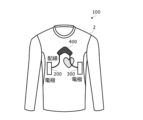
- a device 400 for measuring bioelectric potential is attached to the center of the torso, and electrodes (200, 200, 300).
- the effort involved in attaching the electrode may cause the wearer to feel repellent, and the pressure exerted by the clothing may cause discomfort to the wearer.
- the wiring connecting the left and right electrodes forms a handcuff-like loop, which restricts the wearer's body movements and makes it difficult to There is a problem that there is a constraint.
- the purpose of the present invention is to solve the above-mentioned problems, and the purpose of the present invention is to eliminate the discomfort of the wearer and the restraint on the body when wearing an electrode device, and to perform biosignal measurement that allows natural measurement of biosignals.
- the purpose is to provide a system.
- the biosignal measurement system of the present invention includes an electrode that measures biopotential, an amplification circuit that amplifies the measured biopotential, and converts the amplified biopotential into digital data.
- a quantization circuit that generates biopotential information using a quantization circuit, a wireless transmitter that transmits the biopotential information, and a plurality of electrode devices that include a power source that supplies power to the amplification circuit, the quantization circuit, and the wireless transmitter. and a wireless receiver that receives the biopotential information transmitted from the wireless transmitter of the electrode device, and generates a biosignal waveform using the biopotential information in at least two of the plurality of electrode devices. and a biological signal generation device having an arithmetic circuit.
- biosignal measurement system that can perform natural measurement of biosignals by eliminating the wearer's discomfort and physical restraint when wearing an electrode device.
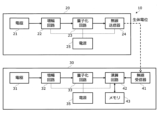
- FIG. 1 is a diagram showing a configuration example of a biological signal measurement system according to a first embodiment of the present invention.
- FIG. 2 is a diagram showing a conceptual diagram of a biological signal measurement system according to an embodiment of the present invention.
- FIG. 3 is a diagram showing a configuration example of a biological signal measurement system according to a second embodiment of the present invention.
- FIG. 4 is an example of a measurement circuit used in a conventional biological signal measurement system.
- FIG. 5 is a diagram showing a configuration example of a biological signal measurement system according to the third embodiment of the present invention.
- FIG. 6 is a diagram showing another configuration example of the biological signal measurement system according to the third embodiment of the present invention.
- FIG. 7 is a configuration example of a conventional biological signal measurement system.
- FIG. 1 is a diagram showing a configuration example of a biological signal measurement system according to a first embodiment of the present invention.
- the biosignal measurement system 10 of the present embodiment generates a biosignal waveform using a plurality of electrode devices (20, 30) that measure biopotential and biopotential information in the plurality of electrode devices (20, 30).
- a biological signal generation device 40 is provided.
- the electrode devices (20, 30) include electrodes (21, 31) that measure biopotentials, amplifier circuits (22, 32) that amplify the measured biopotentials, and convert the amplified biopotentials into digital data. It includes a quantization circuit (23, 33) that generates biopotential information and a wireless transmitter (24, 34) that transmits the biopotential information. ), and a power source (35) for powering the wireless transmitter (24, 34).
- the biosignal generating device 40 includes a radio receiver 41 that receives biopotential information transmitted from a radio transmitter (24, 34) of an electrode device (20, 30), and a radio signal generator in at least two of the plurality of electrode devices. It has an arithmetic circuit 42 that generates a biosignal waveform using biopotential information, and a memory 43 that stores the generated biosignal waveform.
- FIG. 2 shows a conceptual diagram of the biological signal measurement system 10 according to the present embodiment.
- a biological signal measurement system 10 when generating an electrocardiogram as a biological signal, it is necessary to arrange a plurality of electrode devices at positions that sandwich the heart.
- As a way of wearing the electrode device that is comfortable for the wearer 1 to use it is conceivable to wear the electrode device on at least two places on the limbs such as the hands and feet, for example. By adopting such a manner of wearing the electrode device, it is possible to significantly reduce the feeling of pressure and discomfort caused by wearing clothing.
- Each electrode device (20, 30) measures an in-phase component that appears as a noise component and an out-of-phase component that appears as a biopotential. There is a problem in that the biopotential signals that can be measured by the electrodes (21, 31) of each electrode device (20, 30) are weak and have an extremely poor signal-to-noise ratio.
- a plurality of measured biopotential signals are transmitted to the biopotential signal generating device 40 using wireless communication, and the biopotential signal generating device 40 calculates a difference between the biopotential signals. conduct.
- the in-phase component that appears as a noise component is removed and a biosignal is generated, thereby improving the S/N ratio.
- biopotential information is transmitted from a plurality of electrode devices (20, 30) that measure biopotential to a biosignal generation device that generates a biosignal waveform using wireless communication. It is configured to be used. As a result, it is possible to provide a biological signal measurement system that can perform natural measurement of biological signals by eliminating the wearer's discomfort and physical restraint caused by physical wiring when wearing an electrode device. .
- FIG. 2 a case has been described in which an electrocardiogram, which is one of the biological signals, is measured. It can also be applied to signal measurement.
- the biological signal measurement system of this embodiment it is expected that it will be possible to eliminate the discomfort of the wearer due to the physical wiring of the electrode device, increase the degree of freedom in electrode placement, and expand the range of gadgets that can be implemented. can.
- electrodes (21, 31) of the electrode devices (20, 30) electrodes made of various materials and configurations can be used. Any electrode can be used, including Ag/AgCl electrodes used in medical applications, conductive cloth electrodes, and metal electrodes.
- usability can be further improved by using cloth or metal electrodes that do not need to be directly attached to the wearer's body, and by creating a non-contact electrode configuration in which the electrodes are worn over clothing. .
- biopotential information is a very weak signal, it is necessary to amplify the signal using an amplification circuit (22, 32) using a filter circuit or an operational amplifier.
- the amplifier circuits (22, 32) of the electrode devices (20, 30) require high input impedance to reduce biopotential losses.
- the resistance that determines the input impedance also affects the gain setting and directly contributes as thermal noise, resulting in a decrease in the S/N ratio of the biopotential.
- a non-inverting amplifier circuit has a characteristic that noise does not easily increase even if it has a high input impedance configuration. It is effective to use a non-inverting amplifier circuit as the amplifier circuit (22, 32). By employing a non-inverting amplifier circuit, it is possible to realize a system configuration equivalent to that of an instrumentation amplifier that has a high ability to suppress common-mode components that appear as noise components.
- any wireless standard such as carrier communication, Wi-Fi (registered trademark), Bluetooth (registered trademark), etc. can be used.
- the biosignal generation device 40 that receives the biopotential information transmitted by the electrode devices (20, 30) may be selected according to the communication standard to be used.
- a short-range communication standard such as Bluetooth
- a device carried by the wearer such as a smartphone can be used;
- a short-range communication standard such as Wi-Fi
- a device such as a server can also be used. It is possible.
- an electrocardiographic signal waveform that is one of the biological signals
- a waveform called a 12-lead electrocardiographic signal waveform used for medical purposes.
- electrodes are attached to 10 locations around the limbs and ribs of the human body, and the potential difference between a plurality of pairs of electrodes is measured.
- a large number of cables become entangled with the wearer's body, causing great discomfort to the wearer, so measurements are not often performed in positions other than the lying position.
- the biological signal measurement system of this embodiment as a system that generates a 12-lead electrocardiographic signal waveform, all of the large number of cables described above can be removed. This will eliminate the discomfort caused by multiple cables for the wearer, and will also make it possible to constantly measure 12-lead electrocardiographic signal waveforms in daily life, and is expected to contribute to the advancement of medical care. .
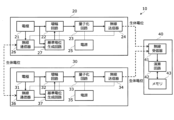
- FIG. 3 is a diagram showing a configuration example of a biological signal measurement system according to a second embodiment of the present invention.
- the functions required of the biosignal generation device 40 are to receive biopotential information transmitted from a plurality of electrode devices (20, 30), and to generate biosignals through arithmetic processing using the received biopotential information. It is. As in the configuration example of FIG. 3, the functions of the biological signal generation device 40 may be implemented in any electrode device 30.
- the electrode device 30 in which the function of the biological signal generation device 40 is implemented is referred to as a master device
- the electrode device 20 that transmits a signal of the measured potential to the master device is referred to as a slave device.
- the wireless receiver 41 of the base unit receives information on the biopotential measured by the slave unit, and the arithmetic circuit 42 receives information on the biopotential measured by the base unit and information on the biopotential measured by the slave unit. to generate biological signals.
- the generated biosignal is stored in the memory 43 of the base device and can be used when analyzing the biosignal, and the same functions as the biosignal generation device 40 of the first embodiment can be realized.
- the biosignal generation device 40 is not required as a separate device from the electrode device, so it is not necessary to carry a device such as a smartphone, and it is possible to measure biosignals without any restrictions on the user. .
- ⁇ Third embodiment> As described in the first embodiment and the second embodiment, usability is improved by using a plurality of electrode devices (20, 30) without physical wiring. On the other hand, since the electrode devices are not connected by physical wiring, a problem arises in that the reference potentials in the amplifier circuits (22, 32) of each electrode device (20, 30) do not match.
- An instrumentation amplifier as shown in FIG. 4 is a commonly used measurement circuit in systems where conventional physical wiring exists.
- the potential at the connection point of the inverting input terminals of these two non-inverting amplifier circuits converges to the average value of the two input potentials, and becomes the reference potential of the two non-inverting amplifier circuits.
- there is no physical wiring between the electrode devices (20, 30) and the inverting input terminals of the amplifier circuits (22, 32) of the electrode devices (20, 30) are connected by physical wiring.
- the reference potentials of the amplifier circuits (22, 32) of the respective electrode devices (20, 30) may not match, which may deteriorate measurement accuracy.
- FIG. 5 is a diagram showing a configuration example of a biological signal measurement system according to the third embodiment of the present invention.
- a common reference potential generated by a reference potential generation circuit (27, 37) provided in each electrode device (20, 30) is used. This enables signal amplification in which the reference potential of the amplifier circuit (22, 32) is shared between multiple electrode devices (20, 30), improving the measurement accuracy of biological signals, and ensuring good biological signals. finally obtained.
- the electrode device (20, 30) of this embodiment includes a wireless communication device (26, 36) for transmitting and receiving biopotential information with other electrode devices, and a biopotential measured by its own electrode device.
- the reference potential generation circuit (27, 37) may generate the reference potential by using the average of the biopotential measured by itself and the biopotential received from other electrode devices.
- the reference potential of the amplification circuit (22, 32) in each electrode device (20, 30) is physically adjusted by transmitting and receiving biopotential information for generating a reference potential using wireless communication. It can be shared without having any connection. This improves the S/N ratio of biological signals and improves the measurement accuracy of biological signals, while eliminating the wearer's discomfort and physical restraint caused by physical wiring when attaching the electrode device. I can do it.
- Wireless communication modules are widely available and can be implemented easily and at low cost.
- the transmitting side circuit of the wireless communication device (26, 36) may include a modulating circuit and an antenna
- the receiving side circuit may include a demodulating circuit and an antenna.
- each electrode device (20, 30) by setting the carrier frequencies of the radio waves to be transmitted to different frequencies, biopotential information can be transmitted and received without interference.
- Optical communication may be used as another method for transmitting and receiving biopotentials between electrode devices.
- optical communication it is possible to transmit and receive stable signals by reducing the influence of existing widely used wireless communication, and it is expected that security will be improved by making communication less likely to be intercepted.
- a method using optical communication can be implemented by providing a modulator and an E/O converter as a transmitting side circuit of a communication device, and an O/E converter and a demodulator as a receiving side circuit. Similar to the case of using wireless communication using radio waves, by setting the wavelengths of the light used in each electrode device (20, 30) to be different, the biopotential can be transmitted and received without interference.
- Magnetic communication used in wireless earphones and the like is also suitable for this embodiment.
- signals are transmitted through mutual induction between a device and another device due to changes in the magnetic field caused by passing current through a coil.
- the magnetic field is permeable to human body components such as moisture, and communication can be performed with low interference, so even when worn on the human body, stable biopotential information can be transmitted and received.
- the transmitting circuit of the communication device must include a modulator, a voltage-current converter such as a transconductance amplifier, and a coil serving as an antenna, and the receiving circuit must include a coil, transimpedance amplifier, etc. It is sufficient to include a current-voltage converter and a demodulator.
- each electrode device (20, 30) includes electrode #1 (21, 31) (first electrode) for measuring biopotential, as shown in , electrode #2 (28, 38) (second electrode) for performing human body communication.
- Power for communication accounts for most of the power consumption of the electrode devices (20, 30).
- signal strength attenuates in inverse proportion to the square of the propagation distance.
- transmission occurs through the human body, the attenuation remains inversely proportional to the propagation distance, so by using human body communication, transmission can be performed with less transmission power. Transmitting and receiving biopotential information via the human body can contribute to reducing power consumption.
- the communication device (26, 36) in FIG. 6 digitally modulates the carrier signal using a signal obtained by sampling the biological signal provided from the electrode #1 (21, 31), and performs digital modulation on the carrier signal. 28, 38) to the human body, which is a transmission path.
- the digitally modulated biosignals transmitted from other electrode devices are received and demodulated from electrode #2 for human body communication (28, 38), and the demodulated biosignals are transferred to the reference potential generation circuit (27, 37). ).
- each electrode device ( 20, 30) In the reference potential generation circuit (27, 37) of FIG. 6, each electrode device ( 20, 30), a common reference potential can be generated.
- the sampling rate of biopotential signals for generating reference potentials and the sampling rate of biopotential signals for generating biosignals can be made independent. This has the advantage of increasing the degree of freedom in design.
- interference can be avoided by using different carrier frequencies for each electrode device.
- the frequency band By setting the frequency band to be used from several MHz to about 100 MHz based on the electrical properties of the human body, human body communication with low loss can be realized.
- an electrode for measuring biopotential, an electrode for transmitting biopotential, and an electrode for receiving biopotential may be provided, respectively.
- the number of electrodes can be reduced by providing bandpass filters with different passbands in one electrode. By reducing the number of electrodes, the number of parts that come into contact with the human body is reduced, which has the effect of improving the comfort of the wearer.
- the present invention can be used for a bioelectrode that is used on a daily basis to acquire biosignals such as electrocardiographic signals and a biosignal measurement system using the bioelectrode.
Landscapes
- Health & Medical Sciences (AREA)
- Life Sciences & Earth Sciences (AREA)
- Engineering & Computer Science (AREA)
- Animal Behavior & Ethology (AREA)
- Public Health (AREA)
- Biophysics (AREA)
- Pathology (AREA)
- Biomedical Technology (AREA)
- Heart & Thoracic Surgery (AREA)
- Medical Informatics (AREA)
- Molecular Biology (AREA)
- Surgery (AREA)
- Veterinary Medicine (AREA)
- General Health & Medical Sciences (AREA)
- Physics & Mathematics (AREA)
- Signal Processing (AREA)
- Computer Networks & Wireless Communication (AREA)
- Cardiology (AREA)
- Physiology (AREA)
- Artificial Intelligence (AREA)
- Computer Vision & Pattern Recognition (AREA)
- Psychiatry (AREA)
- Power Engineering (AREA)
- Measurement And Recording Of Electrical Phenomena And Electrical Characteristics Of The Living Body (AREA)
Priority Applications (3)
| Application Number | Priority Date | Filing Date | Title |
|---|---|---|---|
| US18/872,609 US20260033765A1 (en) | 2022-06-09 | 2022-06-09 | Biosignal measurement system |
| JP2024526156A JP7800681B2 (ja) | 2022-06-09 | 2022-06-09 | 生体信号計測システム |
| PCT/JP2022/023295 WO2023238327A1 (ja) | 2022-06-09 | 2022-06-09 | 生体信号計測システム |
Applications Claiming Priority (1)
| Application Number | Priority Date | Filing Date | Title |
|---|---|---|---|
| PCT/JP2022/023295 WO2023238327A1 (ja) | 2022-06-09 | 2022-06-09 | 生体信号計測システム |
Publications (1)
| Publication Number | Publication Date |
|---|---|
| WO2023238327A1 true WO2023238327A1 (ja) | 2023-12-14 |
Family
ID=89117762
Family Applications (1)
| Application Number | Title | Priority Date | Filing Date |
|---|---|---|---|
| PCT/JP2022/023295 Ceased WO2023238327A1 (ja) | 2022-06-09 | 2022-06-09 | 生体信号計測システム |
Country Status (3)
| Country | Link |
|---|---|
| US (1) | US20260033765A1 (https=) |
| JP (1) | JP7800681B2 (https=) |
| WO (1) | WO2023238327A1 (https=) |
Cited By (1)
| Publication number | Priority date | Publication date | Assignee | Title |
|---|---|---|---|---|
| WO2025233989A1 (ja) * | 2024-05-07 | 2025-11-13 | Ntt株式会社 | 計測デバイスおよび計測システム |
Citations (7)
| Publication number | Priority date | Publication date | Assignee | Title |
|---|---|---|---|---|
| JPH06197878A (ja) * | 1992-11-05 | 1994-07-19 | Yokogawa Electric Corp | 心電計測システム |
| WO2012085996A1 (ja) * | 2010-12-20 | 2012-06-28 | 富士通株式会社 | 電位計測装置 |
| US20170055862A1 (en) * | 2015-08-24 | 2017-03-02 | Korea Institute Of Science And Technology | Apparatus and method for measuring electrocardiogram using wireless communication |
| WO2018198286A1 (ja) * | 2017-04-27 | 2018-11-01 | マクセル株式会社 | 生体認証装置、生体認証システム、及び携帯端末 |
| US10463302B1 (en) * | 2019-03-08 | 2019-11-05 | The Access Technologies | Leadless electrocardiogram monitor |
| WO2019225244A1 (ja) * | 2018-05-24 | 2019-11-28 | パナソニックIpマネジメント株式会社 | 生体信号取得用電極、生体信号取得用電極対及び生体信号測定システム |
| US20210244337A1 (en) * | 2019-05-08 | 2021-08-12 | Boe Technology Group Co., Ltd. | Electrocardiograph acquisition circuit, device, method and system |
-
2022
- 2022-06-09 WO PCT/JP2022/023295 patent/WO2023238327A1/ja not_active Ceased
- 2022-06-09 JP JP2024526156A patent/JP7800681B2/ja active Active
- 2022-06-09 US US18/872,609 patent/US20260033765A1/en active Pending
Patent Citations (7)
| Publication number | Priority date | Publication date | Assignee | Title |
|---|---|---|---|---|
| JPH06197878A (ja) * | 1992-11-05 | 1994-07-19 | Yokogawa Electric Corp | 心電計測システム |
| WO2012085996A1 (ja) * | 2010-12-20 | 2012-06-28 | 富士通株式会社 | 電位計測装置 |
| US20170055862A1 (en) * | 2015-08-24 | 2017-03-02 | Korea Institute Of Science And Technology | Apparatus and method for measuring electrocardiogram using wireless communication |
| WO2018198286A1 (ja) * | 2017-04-27 | 2018-11-01 | マクセル株式会社 | 生体認証装置、生体認証システム、及び携帯端末 |
| WO2019225244A1 (ja) * | 2018-05-24 | 2019-11-28 | パナソニックIpマネジメント株式会社 | 生体信号取得用電極、生体信号取得用電極対及び生体信号測定システム |
| US10463302B1 (en) * | 2019-03-08 | 2019-11-05 | The Access Technologies | Leadless electrocardiogram monitor |
| US20210244337A1 (en) * | 2019-05-08 | 2021-08-12 | Boe Technology Group Co., Ltd. | Electrocardiograph acquisition circuit, device, method and system |
Cited By (1)
| Publication number | Priority date | Publication date | Assignee | Title |
|---|---|---|---|---|
| WO2025233989A1 (ja) * | 2024-05-07 | 2025-11-13 | Ntt株式会社 | 計測デバイスおよび計測システム |
Also Published As
| Publication number | Publication date |
|---|---|
| US20260033765A1 (en) | 2026-02-05 |
| JP7800681B2 (ja) | 2026-01-16 |
| JPWO2023238327A1 (https=) | 2023-12-14 |
Similar Documents
| Publication | Publication Date | Title |
|---|---|---|
| Droitcour et al. | Signal-to-noise ratio in Doppler radar system for heart and respiratory rate measurements | |
| JP6713482B2 (ja) | アクティブ電極,センサ・システム,および電位差検出方法 | |
| US20180263521A1 (en) | System and method for emg signal acquisition | |
| Besnoff et al. | Battery-free multichannel digital ECG biotelemetry using UHF RFID techniques | |
| Tang et al. | An active concentric electrode for concurrent EEG recording and body-coupled communication (BCC) data transmission | |
| Xiang et al. | Electronics of a wearable ECG with level crossing sampling and human body communication | |
| KR20130091195A (ko) | 생체신호 측정용 전극 및 그 제조방법과, 생체신호 측정 시스템 | |
| JPWO2008078380A1 (ja) | 電極装置、心電図測定装置 | |
| WO2019163374A1 (ja) | 生体信号計測装置、脳波計、及び、制御方法 | |
| WO2023238327A1 (ja) | 生体信号計測システム | |
| Mahalakshmi et al. | Healthcare Visible Light Communication | |
| US10028661B2 (en) | Buffered body return receiver | |
| EP3928692A1 (en) | Sensor device for potential and impedance measurements | |
| Hong et al. | A wireless ECG acquisition and classification system for body sensor networks | |
| KR20130050671A (ko) | 뇌파 측정 장치 | |
| JP7768369B2 (ja) | 生体信号計測システム | |
| Liu et al. | Survey of wearable EEG and ECG acquisition technologies for body area network | |
| WO2014021886A1 (en) | Apparatus and method for measuring electrophysiological signals using dry electrodes | |
| Sheeraz et al. | A wearable EEG acquisition device with flexible silver ink screen printed dry sensors | |
| JP4281380B2 (ja) | 生体信号測定装置 | |
| JPWO2017013995A1 (ja) | 生体信号検出装置 | |
| KR20040081627A (ko) | 암기력 자가 증진 트레이닝 시스템 | |
| Feng et al. | A design and implementation of an ambulatory electrocardiogram (ECG) acquisition circuit for emergency application | |
| JP2008086392A (ja) | 生体情報検出装置 | |
| WO2024052977A1 (ja) | 生体信号計測システム |
Legal Events
| Date | Code | Title | Description |
|---|---|---|---|
| 121 | Ep: the epo has been informed by wipo that ep was designated in this application |
Ref document number: 22945829 Country of ref document: EP Kind code of ref document: A1 |
|
| WWE | Wipo information: entry into national phase |
Ref document number: 2024526156 Country of ref document: JP |
|
| WWE | Wipo information: entry into national phase |
Ref document number: 18872609 Country of ref document: US |
|
| NENP | Non-entry into the national phase |
Ref country code: DE |
|
| 122 | Ep: pct application non-entry in european phase |
Ref document number: 22945829 Country of ref document: EP Kind code of ref document: A1 |
|
| WWP | Wipo information: published in national office |
Ref document number: 18872609 Country of ref document: US |