WO2023233925A1 - 吸収体及び吸収性物品 - Google Patents
吸収体及び吸収性物品 Download PDFInfo
- Publication number
- WO2023233925A1 WO2023233925A1 PCT/JP2023/017275 JP2023017275W WO2023233925A1 WO 2023233925 A1 WO2023233925 A1 WO 2023233925A1 JP 2023017275 W JP2023017275 W JP 2023017275W WO 2023233925 A1 WO2023233925 A1 WO 2023233925A1
- Authority
- WO
- WIPO (PCT)
- Prior art keywords
- water
- resin particles
- absorbing
- layer
- absorbent
- Prior art date
- Legal status (The legal status is an assumption and is not a legal conclusion. Google has not performed a legal analysis and makes no representation as to the accuracy of the status listed.)
- Ceased
Links
Images


Classifications
-
- A—HUMAN NECESSITIES
- A61—MEDICAL OR VETERINARY SCIENCE; HYGIENE
- A61F—FILTERS IMPLANTABLE INTO BLOOD VESSELS; PROSTHESES; DEVICES PROVIDING PATENCY TO, OR PREVENTING COLLAPSING OF, TUBULAR STRUCTURES OF THE BODY, e.g. STENTS; ORTHOPAEDIC, NURSING OR CONTRACEPTIVE DEVICES; FOMENTATION; TREATMENT OR PROTECTION OF EYES OR EARS; BANDAGES, DRESSINGS OR ABSORBENT PADS; FIRST-AID KITS
- A61F13/00—Bandages or dressings; Absorbent pads
- A61F13/15—Absorbent pads, e.g. sanitary towels, swabs or tampons for external or internal application to the body; Supporting or fastening means therefor; Tampon applicators
- A61F13/53—Absorbent pads, e.g. sanitary towels, swabs or tampons for external or internal application to the body; Supporting or fastening means therefor; Tampon applicators characterised by the absorbing medium
-
- B—PERFORMING OPERATIONS; TRANSPORTING
- B01—PHYSICAL OR CHEMICAL PROCESSES OR APPARATUS IN GENERAL
- B01J—CHEMICAL OR PHYSICAL PROCESSES, e.g. CATALYSIS OR COLLOID CHEMISTRY; THEIR RELEVANT APPARATUS
- B01J20/00—Solid sorbent compositions or filter aid compositions; Sorbents for chromatography; Processes for preparing, regenerating or reactivating thereof
- B01J20/28—Solid sorbent compositions or filter aid compositions; Sorbents for chromatography; Processes for preparing, regenerating or reactivating thereof characterised by their form or physical properties
- B01J20/28014—Solid sorbent compositions or filter aid compositions; Sorbents for chromatography; Processes for preparing, regenerating or reactivating thereof characterised by their form or physical properties characterised by their form
- B01J20/28033—Membrane, sheet, cloth, pad, lamellar or mat
- B01J20/28035—Membrane, sheet, cloth, pad, lamellar or mat with more than one layer, e.g. laminates, separated sheets
-
- A—HUMAN NECESSITIES
- A61—MEDICAL OR VETERINARY SCIENCE; HYGIENE
- A61F—FILTERS IMPLANTABLE INTO BLOOD VESSELS; PROSTHESES; DEVICES PROVIDING PATENCY TO, OR PREVENTING COLLAPSING OF, TUBULAR STRUCTURES OF THE BODY, e.g. STENTS; ORTHOPAEDIC, NURSING OR CONTRACEPTIVE DEVICES; FOMENTATION; TREATMENT OR PROTECTION OF EYES OR EARS; BANDAGES, DRESSINGS OR ABSORBENT PADS; FIRST-AID KITS
- A61F13/00—Bandages or dressings; Absorbent pads
- A61F13/15—Absorbent pads, e.g. sanitary towels, swabs or tampons for external or internal application to the body; Supporting or fastening means therefor; Tampon applicators
- A61F13/53—Absorbent pads, e.g. sanitary towels, swabs or tampons for external or internal application to the body; Supporting or fastening means therefor; Tampon applicators characterised by the absorbing medium
- A61F13/534—Absorbent pads, e.g. sanitary towels, swabs or tampons for external or internal application to the body; Supporting or fastening means therefor; Tampon applicators characterised by the absorbing medium having an inhomogeneous composition through the thickness of the pad
-
- A—HUMAN NECESSITIES
- A61—MEDICAL OR VETERINARY SCIENCE; HYGIENE
- A61F—FILTERS IMPLANTABLE INTO BLOOD VESSELS; PROSTHESES; DEVICES PROVIDING PATENCY TO, OR PREVENTING COLLAPSING OF, TUBULAR STRUCTURES OF THE BODY, e.g. STENTS; ORTHOPAEDIC, NURSING OR CONTRACEPTIVE DEVICES; FOMENTATION; TREATMENT OR PROTECTION OF EYES OR EARS; BANDAGES, DRESSINGS OR ABSORBENT PADS; FIRST-AID KITS
- A61F13/00—Bandages or dressings; Absorbent pads
- A61F13/15—Absorbent pads, e.g. sanitary towels, swabs or tampons for external or internal application to the body; Supporting or fastening means therefor; Tampon applicators
- A61F13/53—Absorbent pads, e.g. sanitary towels, swabs or tampons for external or internal application to the body; Supporting or fastening means therefor; Tampon applicators characterised by the absorbing medium
- A61F13/534—Absorbent pads, e.g. sanitary towels, swabs or tampons for external or internal application to the body; Supporting or fastening means therefor; Tampon applicators characterised by the absorbing medium having an inhomogeneous composition through the thickness of the pad
- A61F13/537—Absorbent pads, e.g. sanitary towels, swabs or tampons for external or internal application to the body; Supporting or fastening means therefor; Tampon applicators characterised by the absorbing medium having an inhomogeneous composition through the thickness of the pad characterised by a layer facilitating or inhibiting flow in one direction or plane, e.g. a wicking layer
-
- B—PERFORMING OPERATIONS; TRANSPORTING
- B01—PHYSICAL OR CHEMICAL PROCESSES OR APPARATUS IN GENERAL
- B01J—CHEMICAL OR PHYSICAL PROCESSES, e.g. CATALYSIS OR COLLOID CHEMISTRY; THEIR RELEVANT APPARATUS
- B01J20/00—Solid sorbent compositions or filter aid compositions; Sorbents for chromatography; Processes for preparing, regenerating or reactivating thereof
- B01J20/22—Solid sorbent compositions or filter aid compositions; Sorbents for chromatography; Processes for preparing, regenerating or reactivating thereof comprising organic material
- B01J20/26—Synthetic macromolecular compounds
- B01J20/261—Synthetic macromolecular compounds obtained by reactions only involving carbon to carbon unsaturated bonds
-
- B—PERFORMING OPERATIONS; TRANSPORTING
- B01—PHYSICAL OR CHEMICAL PROCESSES OR APPARATUS IN GENERAL
- B01J—CHEMICAL OR PHYSICAL PROCESSES, e.g. CATALYSIS OR COLLOID CHEMISTRY; THEIR RELEVANT APPARATUS
- B01J20/00—Solid sorbent compositions or filter aid compositions; Sorbents for chromatography; Processes for preparing, regenerating or reactivating thereof
- B01J20/28—Solid sorbent compositions or filter aid compositions; Sorbents for chromatography; Processes for preparing, regenerating or reactivating thereof characterised by their form or physical properties
- B01J20/28014—Solid sorbent compositions or filter aid compositions; Sorbents for chromatography; Processes for preparing, regenerating or reactivating thereof characterised by their form or physical properties characterised by their form
- B01J20/28016—Particle form
-
- B—PERFORMING OPERATIONS; TRANSPORTING
- B01—PHYSICAL OR CHEMICAL PROCESSES OR APPARATUS IN GENERAL
- B01J—CHEMICAL OR PHYSICAL PROCESSES, e.g. CATALYSIS OR COLLOID CHEMISTRY; THEIR RELEVANT APPARATUS
- B01J20/00—Solid sorbent compositions or filter aid compositions; Sorbents for chromatography; Processes for preparing, regenerating or reactivating thereof
- B01J20/28—Solid sorbent compositions or filter aid compositions; Sorbents for chromatography; Processes for preparing, regenerating or reactivating thereof characterised by their form or physical properties
- B01J20/28014—Solid sorbent compositions or filter aid compositions; Sorbents for chromatography; Processes for preparing, regenerating or reactivating thereof characterised by their form or physical properties characterised by their form
- B01J20/28023—Fibres or filaments
-
- B—PERFORMING OPERATIONS; TRANSPORTING
- B01—PHYSICAL OR CHEMICAL PROCESSES OR APPARATUS IN GENERAL
- B01J—CHEMICAL OR PHYSICAL PROCESSES, e.g. CATALYSIS OR COLLOID CHEMISTRY; THEIR RELEVANT APPARATUS
- B01J20/00—Solid sorbent compositions or filter aid compositions; Sorbents for chromatography; Processes for preparing, regenerating or reactivating thereof
- B01J20/30—Processes for preparing, regenerating, or reactivating
- B01J20/32—Impregnating or coating ; Solid sorbent compositions obtained from processes involving impregnating or coating
- B01J20/3231—Impregnating or coating ; Solid sorbent compositions obtained from processes involving impregnating or coating characterised by the coating or impregnating layer
- B01J20/3242—Layers with a functional group, e.g. an affinity material, a ligand, a reactant or a complexing group
- B01J20/3268—Macromolecular compounds
- B01J20/3272—Polymers obtained by reactions otherwise than involving only carbon to carbon unsaturated bonds
-
- B—PERFORMING OPERATIONS; TRANSPORTING
- B01—PHYSICAL OR CHEMICAL PROCESSES OR APPARATUS IN GENERAL
- B01J—CHEMICAL OR PHYSICAL PROCESSES, e.g. CATALYSIS OR COLLOID CHEMISTRY; THEIR RELEVANT APPARATUS
- B01J20/00—Solid sorbent compositions or filter aid compositions; Sorbents for chromatography; Processes for preparing, regenerating or reactivating thereof
- B01J20/30—Processes for preparing, regenerating, or reactivating
- B01J20/32—Impregnating or coating ; Solid sorbent compositions obtained from processes involving impregnating or coating
- B01J20/3231—Impregnating or coating ; Solid sorbent compositions obtained from processes involving impregnating or coating characterised by the coating or impregnating layer
- B01J20/3242—Layers with a functional group, e.g. an affinity material, a ligand, a reactant or a complexing group
- B01J20/3268—Macromolecular compounds
- B01J20/3276—Copolymers
-
- A—HUMAN NECESSITIES
- A61—MEDICAL OR VETERINARY SCIENCE; HYGIENE
- A61F—FILTERS IMPLANTABLE INTO BLOOD VESSELS; PROSTHESES; DEVICES PROVIDING PATENCY TO, OR PREVENTING COLLAPSING OF, TUBULAR STRUCTURES OF THE BODY, e.g. STENTS; ORTHOPAEDIC, NURSING OR CONTRACEPTIVE DEVICES; FOMENTATION; TREATMENT OR PROTECTION OF EYES OR EARS; BANDAGES, DRESSINGS OR ABSORBENT PADS; FIRST-AID KITS
- A61F13/00—Bandages or dressings; Absorbent pads
- A61F13/15—Absorbent pads, e.g. sanitary towels, swabs or tampons for external or internal application to the body; Supporting or fastening means therefor; Tampon applicators
- A61F13/53—Absorbent pads, e.g. sanitary towels, swabs or tampons for external or internal application to the body; Supporting or fastening means therefor; Tampon applicators characterised by the absorbing medium
- A61F2013/530481—Absorbent pads, e.g. sanitary towels, swabs or tampons for external or internal application to the body; Supporting or fastening means therefor; Tampon applicators characterised by the absorbing medium having superabsorbent materials, i.e. highly absorbent polymer gel materials
Definitions
- the present invention relates to an absorbent body and an absorbent article.
- Patent Document 1 describes an absorbent article that includes a liquid-permeable topsheet, a liquid-impermeable backsheet, and an absorbent body disposed between the topsheet and the backsheet.
- the absorbent body includes an upper absorbent core, a lower absorbent core on the non-skin contact side of the upper absorbent core, and an upper absorbent core penetration portion provided to penetrate the upper absorbent core in the thickness direction. and a second sheet disposed so as to partially contact the upper layer sheet constituting the absorbent article, the upper layer sheet being disposed so as to cover at least a portion of the skin contacting side of the upper layer absorbent core.
- An absorbent article is disclosed in which the upper layer sheet and/or the second sheet are disposed so as to pass through the upper absorbent core penetrating portion.
- An object of the present invention is to provide an absorbent body that is a multilayer type absorbent body including a plurality of water absorbing layers, yet has both a high absorption rate and a small amount of reversion, and an absorbent article equipped with the absorbent body. .
- the first water absorbing layer includes a first water absorbing layer and a second water absorbing layer laminated on the first water absorbing layer, and the first water absorbing layer has a water retention amount of physiological saline of 32 to 80 g/g, and has a lockup high
- the second water-absorbing layer contains water-absorbing resin particles (I) having a lock-up height of 1.6 cm or less, and the second water-absorbing layer contains water-absorbing resin particles (II) having a lock-up height of more than 1.6 cm. ), and the 1-minute value of the lock-up height is measured by the following procedure.
- the content of the water-absorbing resin particles (I) contained in the first water-absorbing layer is 5 to 95% by mass, based on the total amount of water-absorbing resin particles contained in the first water-absorbing layer, and The absorbent body according to [1], wherein the content of the water-absorbing resin particles (II) contained in the second water-absorbing layer is 60 to 100% by mass based on the total amount of water-absorbing resin particles contained in the layer. .
- an absorbent body that is a multilayer type absorbent body that includes a plurality of water absorbing layers, yet has both a high absorption rate and a small amount of reversion.
- the content of each component in the composition means the total amount of the plurality of substances present in the composition, unless otherwise specified.
- Room temperature refers to 25 ⁇ 2°C.
- layer includes a structure having a shape formed on the entire surface as well as a structure having a shape formed in a part of the layer.
- Physiological saline refers to a 0.9% by mass aqueous sodium chloride solution.
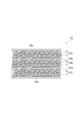
- FIG. 1 is a sectional view showing an example of an absorbent body.
- the absorbent body 50 shown in FIG. 1 includes sheet-like shape retaining members 20a, 20b and water absorbing layers 10A, 10B.
- the water absorbing layer 10B is laminated on the water absorbing layer 10A with a separator 25 in between.
- the water absorbing layer 10B and the water absorbing layer 10A may be laminated without interposing the separator 25.
- the water-absorbing layers 10A and 10B each contain a plurality of water-absorbing resin particles 1, and may further contain a fibrous material 3.
- the water absorption layers 10A and 10B are surrounded by shape retaining members 20a and 20b.
- the absorbent body 50 has a separator 25 between the shape retaining members 20a and 20b.
- the water-absorbing layer 10A is a first water-absorbing layer containing water-absorbing resin particles (I) having a water retention amount of physiological saline of 32 to 80 g/g and a lock-up height of 1 minute of 1.6 cm or less. It is.
- the water absorbent layer 10A (first water absorbent layer) may be placed on the wearer side (i.e., the side where the liquid to be absorbed enters). , may be placed on the side opposite to the wearer's side.
- the lower limit of the water retention amount of physiological saline of the water-absorbing resin particles (I) is 34 g/g or more, 36 g/g or more, 38 g/g or more, 40 g/g or more, or It may be 42 g/g or more.
- the upper limit of the water retention amount of physiological saline of the water-absorbing resin particles (I) is 75 g/g or less, 70 g/g or less, from the viewpoint of more effectively suppressing the occurrence of gel blocking phenomenon, which is a factor that worsens the absorption rate. , 65 g/g or less, 60 g/g or less, 55 g/g or less, 50 g/g or less, or 45 g/g or less.
- the water retention amount of physiological saline of the water-absorbing resin particles (I) is 32 to 70 g/g, 32 to 60 g/g, and 34 to 50 g/g from the viewpoint of achieving both better absorption speed and better reversion amount. , or 36 to 46 g/g.
- the "water retention amount of physiological saline" in this specification is measured by the method described in the Examples below.
- the 1-minute value of the lock-up height of the water-absorbing resin particles (I) is determined by 1. from the viewpoint of more effectively suppressing the occurrence of the gel blocking phenomenon and achieving both a better absorption rate and a better amount of reversion. It may be 4 cm or less, 1.2 cm or less, 1.0 cm or less, 0.8 cm or less, 0.6 cm or less, 0.4 cm or less, 0.2 cm or less, or 0.1 cm or less.
- the 1-minute value of the lock-up height of the water-absorbing resin particles (I) may be, for example, 0 cm or more or 0.1 cm or more.
- the "1 minute value of lockup height" in this specification is measured by the following procedure. (1) Arrange 0.200 g of water-absorbing resin particles over the entire bottom surface of a cylinder with an inner diameter of 2.0 cm and a depth of 8.0 cm to form a particle layer, and set the height of the particle layer to H0 [cm]. . (2) 20 g of physiological saline is added to the particle layer to swell the particle layer. (3) Record the height of the particle layer 1 minute after adding the entire amount of saline as H1', and calculate the 1-minute value of the lock-up height from the formula: H1'-H0. Calculate [cm]. The details of the measurement procedure are as described in the examples below.
- the 1-minute value of the lock-up height can be determined, for example, by a method of forming a coating layer covering at least a part of the surface of the water-absorbing resin particles, or by adjusting the shape, particle diameter, or specific surface area of the water-absorbing resin particles. Or, it can be adjusted within the above-mentioned range by a method that combines these methods arbitrarily.
- the water absorption speed of the water absorbent resin particles (I) by the Vortex method may be 100 seconds or more, 120 seconds or more, or 140 seconds or more, suppressing the occurrence of gel blocking phenomenon, and providing excellent absorption speed and excellent reversion amount. From the viewpoint of achieving both, the time may be more than 150 seconds, 170 seconds or more, 190 seconds or more, 210 seconds or more, 230 seconds or more, 250 seconds or more, 270 seconds or more, or 290 seconds or more.
- the water absorption rate of the water absorbent resin particles (I) by the Vortex method may be, for example, 350 seconds or less, or 300 seconds or less. In this specification, "water absorption rate by Vortex method" is measured by the method described in the Examples below.
- the shape of the water-absorbing resin particles (I) is not particularly limited, and may be, for example, true spherical, irregularly shaped, approximately spherical, crushed, or granular.
- the shape may be an agglomeration of spherical or approximately spherical particles.
- one type of particles may be used alone, or multiple types of particles may be used, each having different physical properties in at least one of the water retention amount of physiological saline and the lock-up height per minute value. May be used in combination.
- the water-absorbing resin particles (I) contain polymer particles.
- the polymer particles may include, for example, a crosslinked polymer containing an ethylenically unsaturated monomer as a monomer unit.
- the polymer particles can be produced, for example, by a method including a step of polymerizing a monomer containing an ethylenically unsaturated monomer. Examples of polymerization methods include reverse phase suspension polymerization, aqueous solution polymerization, bulk polymerization, and precipitation polymerization.
- the ethylenically unsaturated monomer may be a water-soluble ethylenically unsaturated monomer.
- water-soluble ethylenically unsaturated monomers include (meth)acrylic acid and its salts, 2-(meth)acrylamido-2-methylpropanesulfonic acid and its salts, (meth)acrylamide, N,N-dimethyl (meth)acrylamide, 2-hydroxyethyl (meth)acrylate, N-methylol (meth)acrylamide, polyethylene glycol mono(meth)acrylate, N,N-diethylaminoethyl (meth)acrylate, N,N-diethylaminopropyl (meth)acrylate Examples include acrylate, diethylaminopropyl (meth)acrylamide, and the like. When the ethylenically unsaturated monomer has an amino group, the amino group may be quaternized. Ethylenically unsaturated monomers may be used
- the acidic group may be neutralized with an alkaline neutralizing agent before use in the polymerization reaction.
- the degree of neutralization of the ethylenically unsaturated monomer by the alkaline neutralizing agent is, for example, 10 to 100 mol%, 50 to 90 mol%, or 60 to 80 mol% of the acidic groups in the ethylenically unsaturated monomer. It may be %.
- the alkaline neutralizer include alkali metal salts such as sodium hydroxide, sodium carbonate, sodium bicarbonate, potassium hydroxide, and potassium carbonate; ammonia, and the like.
- the alkaline neutralizers may be used alone or in combination of two or more.
- the alkaline neutralizer may be used in the form of an aqueous solution to simplify the neutralization operation.
- the polymer particles may further contain monomer units derived from monomers other than the above-mentioned ethylenically unsaturated monomers.
- the proportion of monomer units derived from ethylenically unsaturated monomers may be 70 to 100 mol% based on the total amount of monomer units constituting the polymer particles.
- the proportion of monomer units derived from ethylenically unsaturated monomers is 80 to 100 mol%, 85 to 100 mol%, 90 to 100 mol%, or It may be 95 to 100 mol%.
- the proportion of monomer units derived from (meth)acrylic acid and its salts may be 70 to 100 mol% with respect to the total amount of monomer units constituting the crosslinked polymer in the polymer particles.
- the proportion of monomer units derived from (meth)acrylic acid and its salts is 80 to 100 mol%, 85 to 100 mol%, based on the total amount of monomer units constituting the crosslinked polymer in the polymer particles. It may be 90 to 100 mol% or 95 to 100 mol%.
- the crosslinked polymer constituting the polymer particles may be crosslinked with an internal crosslinking agent.
- the internal crosslinking agent is usually added to the reaction solution during the polymerization reaction. When an internal crosslinking agent is used, it is easy to control the water absorption characteristics (water retention amount of physiological saline, water absorption rate by Vortex method, etc.) of the water absorbent resin particles (I).
- the polymer particles may be crosslinked with a surface crosslinking agent.
- the surface crosslinking agent mainly crosslinks the polymer near the surface of the polymer particles.
- a surface crosslinking agent it is easy to control the water absorption characteristics (water retention amount of physiological saline, water absorption rate by Vortex method, etc.) of the water absorbent resin particles.
- the polymer particles may be composed essentially only of the crosslinked polymer, but may further contain various additional components selected from, for example, gel stabilizers, metal chelating agents, fluidity improvers (lubricants), etc. May contain. Additional components can be placed within the polymer particles, on the surface of the polymer particles, or both. Additional ingredients may be flow improvers (lubricants).
- the fluidity improver may include inorganic particles. Examples of the inorganic particles include silica particles such as amorphous silica. When the water-absorbing resin particles include inorganic particles, the content of the inorganic particles is 0.05 parts by mass or more, 0.1 parts by mass or more, 0.2 parts by mass or more, based on 100 parts of the total mass of the polymer particles.
- the water-absorbing resin particles (I) may be classified using a sieve or may not be classified.
- the water-absorbing resin particles may have a particle diameter of less than 850 ⁇ m.
- the particle size of less than 850 ⁇ m means that it can pass through a JIS standard sieve with a mesh size of 850 ⁇ m.
- the water-absorbing resin particles (I) may have a particle diameter of 250 ⁇ m or more.
- a particle diameter of 250 ⁇ m or more means that the particle does not pass through a JIS standard sieve with a mesh size of 250 ⁇ m.
- the water-absorbing resin particles are water-absorbing resin particles having a particle size of 250 ⁇ m or more and less than 850 ⁇ m (water-absorbing resin particles that pass through a JIS standard sieve with an opening of 850 ⁇ m but do not pass through a JIS standard sieve with an opening of 250 ⁇ m). Good too.
- the water-absorbing resin particles (I) may be substantially composed only of polymer particles, but for example, they may be coated resin particles having a polymer particle and a coating layer covering at least a part of the surface thereof. good. By forming a coating layer that covers at least a portion of the surface of the polymer particles, it becomes easier to obtain water-absorbing resin particles with a low 1-minute lock-up height.
- the coating layer includes a homopolymer, copolymer, or a mixture thereof containing a substituted or unsubstituted alkene as a monomer unit, and a homopolymer, copolymer, or a mixture thereof containing an alkylene oxide as a monomer unit. It's okay to stay.
- Copolymers containing unsubstituted alkenes as constituent units are copolymers containing only two or more unsubstituted alkenes as monomer units, or copolymers containing one or more unsubstituted alkenes and monomers other than unsubstituted alkenes. It may be a copolymer containing as a monomer unit, or a copolymer containing one type of unsubstituted alkene and a monomer other than the unsubstituted alkene as a monomer unit.
- unsubstituted alkenes constituting the copolymer examples include ethylene, propylene, and butene.
- the unsubstituted alkene may be ethylene and/or propylene, or may be ethylene.
- the monomers other than the unsubstituted alkene constituting the copolymer may be water-soluble ethylenically unsaturated monomers.
- This water-soluble ethylenically unsaturated monomer can be similar to the compounds listed as water-soluble ethylenically unsaturated monomers constituting the polymer particles, including (meth)acrylic acid and/or It may be the salt.
- the copolymer containing an unsubstituted alkene as a monomer unit may be a copolymer containing ethylene and a water-soluble ethylenically unsaturated monomer as a monomer unit, and may be a copolymer containing ethylene and a (meth)acrylic acid and/or its It may be a copolymer containing a salt as a monomer unit, or a copolymer containing ethylene and an acrylate as a monomer unit, or a copolymer containing ethylene and a sodium acrylate, potassium acrylate, or ammonium acrylate.
- ethylene-sodium acrylate copolymer ethylene-potassium acrylate copolymer, or ethylene-ammonium acrylate
- ethylene-sodium acrylate copolymer ethylene-sodium acrylate copolymer, ethylene-potassium acrylate copolymer, or ethylene-ammonium acrylate
- ethylene-sodium acrylate copolymer ethylene-sodium acrylate copolymer, ethylene-potassium acrylate copolymer, or ethylene-ammonium acrylate
- the polymer containing alkylene oxide as a monomer unit may be a polyalkylene oxide (homopolymer) containing only one type of alkylene oxide as a monomer unit, or may be a polyalkylene oxide (homopolymer) containing two or more types of alkylene oxide as a monomer unit. It may be a polyalkylene oxide (copolymer) containing one or more alkylene oxides and a monomer other than alkylene oxide as a monomer unit.
- the polymer containing alkylene oxide as a monomer unit may be a polyalkylene oxide containing only one type of alkylene oxide as a monomer unit.
- alkylene oxide examples include ethylene oxide or propylene oxide.
- the alkylene oxide may especially be ethylene oxide.
- the polymer containing alkylene oxide as a monomer unit is a homopolymer containing ethylene oxide as a monomer unit (polyethylene glycol), a copolymer containing ethylene oxide and propylene oxide as monomer units, or a combination thereof. It may also be polyethylene glycol.
- the total content of the coating layer may be, for example, 1 to 40 parts by weight based on 100 parts by weight of the polymer particles on which the coating layer is formed.
- the coating layer can be formed on at least a portion of the surface, for example, by bringing the polymer particles into contact with the coating material.
- the coating material is, for example, a component capable of forming the above-mentioned coating layer or a forming material of the component.
- the coating layer can be formed, for example, by (1) a method using an eggplant flask, (2) a method using a sprayer, or (3) a method using various granulators.
- granulators used for producing coated resin particles include a rolling granulator, an agitating granulator, and a fluidized bed granulator.
- an inclined, shallow circular container equipped with the tumbling granulator is rotated, and the polymer particles are supplied into the circular container, and an appropriate amount of the coating material is added thereto. Then, due to the solvent or dispersion medium contained in the coating material, some of the particles being rolled are aggregated and a coating layer is formed on the surface thereof. Note that the addition step of adding the polymer particles and the coating material may be performed multiple times as necessary.
- the polymer particles When using a stirring granulator, the polymer particles are put into a mixer equipped with the stirring granulator, mixed by stirring, and the coating material is added. Then, due to the liquid medium contained in the coating material, some of the particles being stirred are aggregated and a coating layer is formed on the surface thereof.
- the addition step of adding the polymer particles and coating material may be performed multiple times if necessary. Note that excessive aggregation of the polymer particles can be suppressed by controlling the shearing force of the mixer.
- a fluidized bed granulator When using a fluidized bed granulator, first, polymer particles are placed in a container equipped with the fluidized bed granulator that can blow hot air from the bottom, and the polymer particles are fluidized in advance. Thereafter, when the coating material is sprayed from a nozzle provided in the container, a part of the polymer particles being stirred are aggregated by the liquid medium contained in the coating material, and a coating layer is formed on the surface of the polymer particles. The coating material may be sprayed multiple times if necessary. Excessive agglomeration of the polymer particles can be suppressed by adjusting the amount and/or frequency of spraying the coating material.
- a fluidized bed granulator FBD/SG manufactured by YENCHEN MACHINERY
- the content of the water-absorbing resin particles (I) contained in the first water-absorbing layer is determined to have a better balance between absorption speed and reversion, based on the total amount of water-absorbing resin particles contained in the first water-absorbing layer. Therefore, it may be 5 to 95% by weight, 5 to 75% by weight, 10 to 55% by weight, 10 to 45% by weight, 15 to 35% by weight, or 15 to 25% by weight.
- the first water-absorbing layer may further contain water-absorbing resin particles other than the water-absorbing resin particles (I).
- Water-absorbing resin particles other than water-absorbing resin particles (I) have a water retention capacity of physiological saline of less than 32 g/g or more than 80 g/g, or a lock-up height of 1 minute of more than 1.6 cm. It is a resin particle.
- the first water-absorbing layer may further include water-absorbing resin particles (II) having a 1-minute lock-up height of more than 1.6 cm.
- the 1-minute value of the lock-up height of the water-absorbing resin particles (II) is 1.7 cm or more, 1.8 cm or more, 1.9 cm or more, 2.0 cm or more, 2.2 cm or more, 2.4 cm or more, or 2. .6 cm or more, 4.5 cm or less, 4.0 cm or less, 3.5 cm or less, 3.0 cm or less, 2.8 cm or less, 2.6 cm or less, 2.4 cm or less, 2.2 cm or less, 2. It may be 0 cm or less, or 1.8 cm or less.
- the 1-minute value of the lock-up height of the water-absorbing resin particles (II) is, for example, more than 1.6 cm and less than 4.5 cm, more than 1.6 cm and less than 4.0 cm, more than 1.6 cm and less than 3.5 cm, and 1.6 cm. It may be more than 3.0 cm, more than 1.6 cm and less than 2.8 cm, more than 1.6 cm and less than 2.6 cm, or more than 1.6 cm and not more than 2.4 cm.
- the water retention amount of physiological saline of the water-absorbing resin particles (II) may be, for example, 32 to 80 g/g.
- the lower limit of the water retention amount of physiological saline of the water-absorbing resin particles (II) may be 34 g/g or more, 36 g/g or more, or 38 g/g or more, which is said to achieve both a high absorption rate and a small amount of reversion. Since the effect is further improved, it is preferably 40 g/g or more, or 42 g/g or more.
- the upper limit of the water retention amount of physiological saline of the water-absorbing resin particles (II) is, for example, 75 g/g or less, 70 g/g or less, 65 g/g or less, 60 g/g or less, 55 g/g or less, 50 g/g or less, Or it may be 45g/g or less.
- the water retention amount of physiological saline of the water absorbent resin particles (II) may be less than 32 g/g or more than 80 g/g.
- the water retention amount of physiological saline of the water-absorbing resin particles (II) may be, for example, 20 g/g or more and less than 32 g/g, 25 g/g or more and less than 32 g/g, or 28 g/g or more and less than 32 g/g, It may be more than 80 g/g and not more than 90 g/g, or more than 80 g/g and not more than 85 g/g.
- the water retention capacity of the physiological saline of the water-absorbing resin particles (II) further improves the effect of achieving both a high absorption rate and a small amount of reversion. It may be larger than the water retention capacity.
- the difference Xb-Xa between the water retention amount Xb (g/g) of physiological saline of the water-absorbent resin particles (II) and the water retention amount Xa (g/g) of physiological saline of the water-absorbent resin particles (I) is: For example, it may be 1 or more, and may be 1-15, 1-12, 1-10, 1-5, or 1-3.
- the water absorption rate of the water absorbent resin particles (II) by the Vortex method is, for example, 150 seconds or less, 120 seconds or less, 90 seconds or less, 80 seconds or less, 70 seconds or less, 60 seconds or less, 50 seconds or less, or 40 seconds or less. It's good.
- the water absorption rate of the water-absorbing resin particles (II) by the Vortex method may be, for example, 15 seconds or more, 20 seconds or more, 25 seconds or more, 30 seconds or more, or 35 seconds or more.
- the first water-absorbing layer instead of or together with the water-absorbing resin particles (II), has a water retention amount of physiological saline of less than 32 g/g or more than 80 g/g, and has a lock-up height. It may further contain water-absorbing resin particles (III) having a 1-minute value of 1.6 cm or less.
- the water retention amount of physiological saline of the water-absorbing resin particles (III) may be, for example, 20 g/g or more and less than 32 g/g, 25 g/g or more and less than 32 g/g, or 28 g/g or more and less than 32 g/g, It may be more than 80 g/g and not more than 90 g/g, or more than 80 g/g and not more than 85 g/g.
- the 1-minute value of the lock-up height of the water-absorbing resin particles (III) may be, for example, within the numerical range exemplified for the water-absorbing resin particles (I).
- the water absorption rate of the water absorbent resin particles (III) by the Vortex method is, for example, 150 seconds or less, 120 seconds or less, 90 seconds or less, 80 seconds or less, 70 seconds or less, 60 seconds or less, 50 seconds or less, or 40 seconds or less. It's good.
- the water absorption rate of the water-absorbing resin particles (III) by the Vortex method may be, for example, 15 seconds or more, 20 seconds or more, 25 seconds or more, 30 seconds or more, or 35 seconds or more.
- the total content of water-absorbing resin particles other than the water-absorbing resin particles (I) contained in the first water-absorbing layer is Based on the total amount of water-absorbing resin particles contained in the water-absorbing layer, 5% by mass or more, 10% by mass or more, 20% by mass or more, 30% by mass or more, 40% by mass or more, 50% by mass or more, 60% by mass or more, It may be 70% by mass or more, or 75% by mass or more.
- the content of the water-absorbing resin particles (III) contained in the first water-absorbing layer is 95% by mass or less, 85% by mass or less, 75% by mass or less, based on the total amount of water-absorbing resin particles contained in the first water-absorbing layer. , 65% by weight or less, 55% by weight or less, 45% by weight or less, 35% by weight or less, or 25% by weight or less.
- the content of the water-absorbing resin particles (II) contained in the first water-absorbing layer may be the above-mentioned total content.
- Water-absorbing resin particles (II) and (III) are other than adjusting the water retention amount of physiological saline to less than 32 g/g or more than 80 g/g, or the 1-minute value of lock-up height to more than 1.6 cm. can be obtained by the same method as the water absorbent resin particles (I).
- the first water-absorbing layer may include water-absorbing resin particles (I) and water-absorbing resin particles (II).
- the total mass of the water-absorbing resin particles contained in the first water-absorbing layer is, for example, 5% by mass or more, 10% by mass or more, 15% by mass or more, 20% by mass or more, 25% by mass or more, based on the total mass of the first water-absorbing layer. It may be at least 30% by mass, at least 35% by mass, at least 40% by mass, at least 45% by mass, at least 50% by mass, or at least 55% by mass, and at most 100% by mass, at most 95% by mass, 90% by mass or more It may be less than or equal to 85% by weight, less than or equal to 80% by weight, less than or equal to 75% by weight, less than or equal to 70% by weight, or less than or equal to 65% by weight.
- the sum of the mass of the water-absorbing resin particles (I) and the mass of the water-absorbing resin particles (II) may be within the mass range described as the total mass of the water-absorbing resin particles included in the first water-absorbing layer.
- the first water absorption layer may or may not contain a fibrous material.
- fibrous material has an amorphous shape as a whole, and does not include a fibrous material formed into a sheet shape, such as a nonwoven fabric.
- Fibrous materials include, for example, crushed pulp (crushed pulp); finely pulverized wood pulp; cotton; cotton linters; rayon; cellulose fibers such as cellulose acetate; synthetic fibers such as polyamide, polyester, and polyolefin. and mixtures of these fibers.
- the fibrous materials may be used alone or in combination of two or more. Hydrophilic fibers can be used as the fibrous material.
- the content of the fibrous material is, for example, 5% by mass based on the total mass of the water-absorbing resin particles and the mass of the fibrous material in the first water-absorbing layer.
- the content may be 10% by mass or more, 15% by mass or more, 20% by mass or more, 25% by mass or more, 30% by mass or more, or 35% by mass or more.
- the content of the fibrous material is 100% by mass or less, 95% by mass or less, 90% by mass or less, 85% by mass, based on the total mass of the water-absorbing resin particles in the first water-absorbing layer and the mass of the fibrous material. % or less, 80% by weight or less, 75% by weight or less, 70% by weight or less, 65% by weight or less, 60% by weight or less, 55% by weight or less, 50% by weight or less, or 45% by weight or less.
- the water-absorbing layer 10B is a second water-absorbing layer containing the above-mentioned water-absorbing resin particles (II).
- the second water-absorbing layer may be placed on the wearer's side (that is, the side where the liquid to be absorbed enters), and the second water-absorbing layer may be placed on the wearer's side (i.e., the side where the liquid to be absorbed enters). may be placed on the opposite side.
- the content of water-absorbing resin particles (II) contained in the second water-absorbing layer may be 60 to 100% by mass.
- the lower limit of the content of water-absorbing resin particles (II) contained in the second water-absorbing layer is 65% by mass or more, 70% by mass or more, and 75% by mass based on the total amount of water-absorbing resin particles contained in the second water-absorbing layer. % or more, 80 mass % or more, 85 mass % or more, 90 mass % or more, or 95 mass % or more.
- the upper limit of the content of water-absorbing resin particles (II) contained in the second water-absorbing layer is 100% by mass or less, for example, 95% by mass, based on the total amount of water-absorbing resin particles contained in the second water-absorbing layer.
- the content may be 90% by mass or less, or 85% by mass or less.
- the second water-absorbing layer may further contain water-absorbing resin particles other than the water-absorbing resin particles (II), and may not further contain water-absorbing resin particles other than the water-absorbing resin particles (II).
- the water-absorbing resin particles other than the water-absorbing resin particles (II) are water-absorbing resin particles whose lock-up height in 1 minute is 1.6 cm or less.
- the second water-absorbing layer further contains water-absorbing resin particles other than the water-absorbing resin particles (II)
- the second water-absorbing layer contains, for example, the above-mentioned water-absorbing resin particles (I) and/or the above-mentioned water-absorbing resin particles. (III) may be further included.
- the second water-absorbing layer further contains water-absorbing resin particles other than water-absorbing resin particles (II)
- the compositions (combination of water-absorbing resin particles, etc.) of the first water-absorbing layer and the second water-absorbing layer are the same. There may be one or different.
- the content of water-absorbing resin particles other than water-absorbing resin particles (II) is less than 35% by mass, 30% by mass or less, less than 25% by mass, based on the total amount of water-absorbing resin particles contained in the second water-absorbing layer. It may be 20% by weight or less, 15% by weight or less, 10% by weight or less, 5% by weight or less, or 1% by weight or less.
- the lower limit of the content of water-absorbing resin particles other than water-absorbing resin particles (II) contained in the second water-absorbing layer is It may be 1% by mass or more, 5% by mass or more, 10% by mass or more, 15% by mass or more, or 20% by mass or more, based on the total amount of water-absorbing resin particles contained in the second water-absorbing layer.
- the content of water-absorbing resin particles (I) contained in the second water-absorbing layer may be the above-mentioned "content of water-absorbing resin particles other than water-absorbing resin particles (II)".
- the total mass of the water-absorbing resin particles contained in the second water-absorbing layer is, for example, 5% by mass or more, 10% by mass or more, 15% by mass or more, 20% by mass or more, 25% by mass or more, based on the total mass of the second water-absorbing layer. It may be at least 30% by mass, at least 35% by mass, at least 40% by mass, at least 45% by mass, at least 50% by mass, or at least 55% by mass, and at most 100% by mass, at most 95% by mass, 90% by mass or more It may be less than or equal to 85% by weight, less than or equal to 80% by weight, less than or equal to 75% by weight, less than or equal to 70% by weight, or less than or equal to 65% by weight.
- the second water absorption layer may or may not contain a fibrous material.
- the fibrous material that may be included in the second water-absorbing layer may be the same as the fibrous material exemplified in the first water-absorbing layer.
- the content of the fibrous material is, for example, 5% by mass based on the total mass of the water-absorbing resin particles and the mass of the fibrous material in the second water-absorbing layer.
- the content may be 10% by mass or more, 15% by mass or more, 20% by mass or more, 25% by mass or more, 30% by mass or more, or 35% by mass or more.
- the content of the fibrous material is 100% by mass or less, 95% by mass or less, 90% by mass or less, 85% by mass, based on the total mass of the water-absorbing resin particles in the second water-absorbing layer and the mass of the fibrous material.
- % or less 80% by weight or less, 75% by weight or less, 70% by weight or less, 65% by weight or less, 60% by weight or less, 55% by weight or less, 50% by weight or less, or 45% by weight or less.
- At least one of the first water-absorbing layer and the second water-absorbing layer may contain a fibrous material, and both the first water-absorbing layer and the second water-absorbing layer may contain a fibrous material. In the absorbent body 50, both the first water absorbing layer and the second water absorbing layer do not need to contain fibrous materials.
- the ratio (S1 /S2 ⁇ 100) further improves the effect of achieving both high absorption speed and small amount of reversion, so 20% to 100%, 30% to 100%, 40% to 100%, 50% to It may be 100%, 60%-100%, 70%-100%, 80%-100%, 85%-100%, 90%-100% or 95%-100%.
- the shape retaining members 20a and 20b are sheets provided so as to surround the water-absorbing resin particles 1 and the fibrous material 3 added as necessary.
- the shape-retaining member 20b is placed in contact with the water-absorbing layer 10A on the side of the water-absorbing layer 10A opposite to the water-absorbing layer 10B side.
- the shape-retaining member 20a is disposed on the side opposite to the water-absorbing layer 10A in contact with the water-absorbing layer 10B. That is, the water absorption layers 10A and 10B are arranged between the shape retaining member 20a and the shape retaining member 20b.
- the water-absorbing layers 10A, 10B do not need to be completely surrounded by the shape-retaining members 20a, 20b, and for example, the ends of the water-absorbing layers 10A and/or 10B may be exposed to the outside.
- the shape retaining members 20a and 20b may be two separate sheets or may be a single folded sheet.
- the shape-retaining members 20a and 20b may be made of nonwoven fabric such as air-laid nonwoven fabric, or tissue paper.
- An adhesive layer containing an adhesive may be provided between the shape-retaining member 20b and the water-absorbing layer 10A or between the shape-retaining member 20a and the water-absorbing layer 10B, if necessary.
- adhesives include hot melt adhesives.
- hot melt adhesives include ethylene-vinyl acetate copolymer, styrene-isoprene-styrene block copolymer, styrene-butadiene-styrene block copolymer, styrene-ethylene-butylene-styrene block copolymer, and styrene-ethylene-propylene-styrene block copolymer.
- a mixture of a base polymer such as amorphous polypropylene, and a tackifier, a plasticizer, an antioxidant, etc.
- the separator 25 is provided to divide the water absorption layers 10A and 10B into two regions.
- the separator 25 may be a nonwoven fabric such as an air-laid nonwoven fabric, an air-through nonwoven fabric, a spunbond nonwoven fabric, or a spunlace nonwoven fabric, or may be tissue paper.
- the separator 25 may be, for example, a single air-through nonwoven fabric, a laminate of two tissue papers, or a laminate of tissue paper and an airlaid nonwoven fabric.
- FIG. 1 is an example, and the structure of the absorber is not limited thereto.
- the absorbent body may further include one or more water absorbing layers (other water absorbing layers) other than the water absorbing layers 10A and 10B.
- the total number of water absorption layers in the absorber may be, for example, 2-5, 2-4 or 2-3.
- the other water-absorbing layer may be a first water-absorbing layer containing water-absorbing resin particles (I) or a second water-absorbing layer containing water-absorbing resin particles (II), other than the first water-absorbing layer and the second water-absorbing layer. It may be a water absorption layer (third water absorption layer).
- the third water-absorbing layer may be, for example, a water-absorbing layer that does not contain both the water-absorbing resin particles (I) and the water-absorbing resin particles (II) but contains the water-absorbing resin particles (III) described above.
- the absorbent body may include a plurality of at least one of the first water absorption layer and the second water absorption layer.
- the absorbent body may include, for example, one first water-absorbing layer and two second water-absorbing layers.
- FIG. 2 is a cross-sectional view showing another example of the absorber.
- the absorbent body 51 shown in FIG. 2 includes sheet-like shape retaining members 20a, 20b and water absorbing layers 10A, 10B, 10C.
- the water absorption layer 10A, the water absorption layer 10B, and the water absorption layer 10C are laminated in this order.
- the absorbent body 51 has separators 25a and 25b between the shape retaining members 20a and 20b. Separator 25a is provided to divide water absorption layers 10A and 10B into two regions.
- Separator 25b is provided to divide water absorption layers 10B and 10C into two regions.
- At least one layer is a first water-absorbing layer containing water-absorbing resin particles (I), and at least one layer is a second water-absorbing layer containing water-absorbing resin particles (II).
- None of the water absorption layers 10A, 10B, and 10C may be the third water absorption layer, and one layer among the water absorption layers 10A, 10B, and 10C may be the third water absorption layer.
- the absorbent body 51 may be, for example, an absorbent body in which the water absorption layer 10A is the first water absorption layer, the water absorption layers 10B and 10C are both the second water absorption layer, and the water absorption layers 10A and 10B are both the first water absorption layer.
- the absorbent layer may be a layer, and the absorbent layer 10C may be the second absorbent layer, and the absorbent layer 10A and 10C may be the first absorbent layer, and the absorbent layer 10B is the second absorbent layer.
- it may be an absorbent body in which the water-absorbing layer 10B is the first water-absorbing layer, and the water-absorbing layers 10A and 10C are both the second water-absorbing layers.
- the first water-absorbing layer may be placed on the wearer's side
- the second water-absorbing layer may be placed on the wearer's side
- the third water-absorbing layer may be placed on the wearer's side.
- the water-absorbing layer may be placed on the wearer's side.
- the basis weight of the water-absorbing resin particles in the absorbent body 50 is 75 g/m 2 or more and 100 g/m 2 or more, since the effect of achieving both a high absorption rate and a small amount of reversion is further improved.
- the basis weight of the water-absorbing resin particles is, for example, 50 to 450 g/m 2 , 100 to 400 g/m 2 , 150 to 375 g, since the effect of achieving both a high absorption rate and a small amount of reversion is further improved. /m 2 , 200-350 g/m 2 , or 225-325 g/m 2 .
- the basis weight of the water-absorbing resin particles is the total mass of the water-absorbing resin particles per unit area of the absorbent body.
- the shape of the absorbent body according to this embodiment may be, for example, a sheet shape.
- the thickness of the absorbent body (for example, the thickness of a sheet-like absorbent body) may be 0.1 to 20 mm or 0.3 to 15 mm.
- the absorbent body 50 (or the absorbent body 51) can be manufactured, for example, by a method that includes laminating a first water absorbing layer, a second water absorbing layer, and other layers as necessary.
- the first water-absorbing layer and the second water-absorbing layer can each be manufactured by a method that includes surrounding water-absorbing resin particles with a sheet-like shape-retaining member and applying pressure as necessary.
- absorbent articles include sanitary materials, agricultural and horticultural materials such as water retention agents and soil conditioners, and industrial materials such as water stop agents and anti-condensation agents.
- sanitary materials include diapers (e.g. disposable diapers), toilet training pants, incontinence pads, sanitary materials (sanitary napkins, tampons, etc.), sweat pads, pet wipes, portable toilet parts, and animal excrement disposal materials. Can be mentioned.
- Absorbent articles may be disposable.
- FIG. 3 is a sectional view showing an example of an absorbent article.
- the absorbent article 100 shown in FIG. 3 includes an absorbent core 50, a liquid-permeable sheet 30, and a liquid-impermeable sheet 40.
- the liquid-impermeable sheet 40, the absorbent body 50, and the liquid-permeable sheet 30 are laminated in this order.
- the specific embodiment of the absorbent body 50 shown in FIG. Layer 10A may be the second water-absorbing layer, and water-absorbing layer 10B may be the first water-absorbing layer.
- the liquid permeable sheet 30 may be a sheet formed from resin or fiber commonly used in the technical field.
- Liquid permeable sheet 30 may be a nonwoven fabric, a porous sheet, or a combination thereof.
- a nonwoven fabric is a sheet of fibers that are intertwined without being woven.
- the nonwoven fabric may be a nonwoven fabric (short fiber nonwoven fabric) composed of short fibers (i.e., staples) or a nonwoven fabric (long fiber nonwoven fabric) composed of long fibers (ie, filaments).
- the staple may generally have a fiber length of several hundred mm or less, although it is not limited thereto.
- the liquid-permeable sheet 30 is made of, for example, polyolefin such as polyethylene (PE) and polypropylene (PP), polyethylene terephthalate (PET), polytriester, etc., from the viewpoint of liquid permeability, flexibility, and strength when used in absorbent articles. May contain polyesters such as methylene terephthalate (PTT) and polyethylene naphthalate (PEN), polyamides such as nylon, synthetic resins such as rayon, recycled fibers such as cupro, acetate, or synthetic fibers containing these synthetic resins. However, it may be a natural fiber including cotton, silk, hemp, or pulp (cellulose). From the viewpoint of increasing the strength of the liquid permeable sheet 30, the liquid permeable sheet 30 may contain synthetic fibers.
- the synthetic fibers may in particular be polyolefin fibers, polyester fibers or combinations thereof. These materials may be used alone or in combination of two or more kinds.
- the liquid permeable sheet 30 is a thermal bond nonwoven fabric, an air-through nonwoven fabric, a resin bond nonwoven fabric, a spunbond nonwoven fabric, a melt blown nonwoven fabric, an airlaid nonwoven fabric, a spunlace nonwoven fabric, a point bonded nonwoven fabric, or a laminate of two or more types of nonwoven fabrics selected from these. There may be.
- These nonwoven fabrics can be made of, for example, the above-mentioned synthetic fibers or natural fibers.
- a laminate of two or more types of nonwoven fabrics may include, for example, a spunbond nonwoven fabric, a meltblown nonwoven fabric, and a spunbond nonwoven fabric, and may be a spunbond/meltblown/spunbond nonwoven fabric that is a composite nonwoven fabric in which these are laminated in this order.
- a thermal bond nonwoven fabric, an air-through nonwoven fabric, a spunbond nonwoven fabric, or a spunbond/meltblown/spunbond nonwoven fabric may be used.
- spunbond/meltblown/spunbond nonwoven fabric two or more layers of meltblown nonwoven fabric may be provided between two layers of spunbond nonwoven fabric.
- the nonwoven fabric used as the liquid permeable sheet 30 desirably has appropriate hydrophilicity from the viewpoint of liquid absorption performance of the absorbent article. From that point of view, the liquid permeable sheet 30 meets the paper pulp test method No. 1 by the Paper and Pulp Technology Association.
- the nonwoven fabric may have a hydrophilicity of 5 to 200 as measured according to the measuring method of No. 68 (2000).
- the hydrophilicity of the nonwoven fabric may be from 10 to 150. Paper pulp test method no. For details of No. 68, for example, WO2011/086843 can be referred to.
- the above-mentioned nonwoven fabric having hydrophilic properties may be formed by, for example, fibers that exhibit moderate hydrophilicity such as rayon fibers, or may be formed by making hydrophobic chemical fibers such as polyolefin fibers and polyester fibers hydrophilic. It may also be formed from treated fibers.
- Examples of methods for obtaining a nonwoven fabric containing hydrophobic chemical fibers that have been made hydrophilic include a method for obtaining a nonwoven fabric using a spunbond method using a mixture of hydrophobic chemical fibers and a hydrophilic agent; Examples include a method in which a hydrophilic agent is included when a spunbond nonwoven fabric is made from fibers, and a method in which a spunbond nonwoven fabric obtained using hydrophobic chemical fibers is impregnated with a hydrophilic agent.
- hydrophilizing agents include aliphatic sulfonates, anionic surfactants such as higher alcohol sulfate ester salts, cationic surfactants such as quaternary ammonium salts, polyethylene glycol fatty acid esters, polyglycerin fatty acid esters, Examples include nonionic surfactants such as sorbitan fatty acid esters, silicone surfactants such as polyoxyalkylene-modified silicones, and stain release agents made of polyester, polyamide, acrylic, or urethane resins.
- the liquid permeable sheet 30 is suitably bulky and has a basis weight, from the viewpoint of imparting good liquid permeability, flexibility, strength, and cushioning properties to the absorbent article, and from the viewpoint of increasing the liquid absorption rate of the absorbent article. It may also be a nonwoven fabric with a large amount.
- the basis weight of the nonwoven fabric used for the liquid permeable sheet 30 may be 5 to 200 g/m 2 , 8 to 150 g/m 2 , or 10 to 100 g/m 2 .
- the thickness of the nonwoven fabric used for the liquid permeable sheet 30 may be 20 to 1400 ⁇ m, 50 to 1200 ⁇ m, or 80 to 1000 ⁇ m.
- the liquid permeable sheet 30 may be composed of two or more sheets, and may have its surface embossed or perforated in order to improve liquid diffusivity.
- the embossing and perforation can be carried out using known methods.
- the liquid permeable sheet 30 may contain a skin lotion, a humectant, an antioxidant, an anti-inflammatory agent, a pH adjuster, etc. to reduce irritation to the skin.
- the shape of the liquid-permeable sheet 30 depends on the shapes of the absorbent body and the absorbent article, it may be shaped to cover the absorbent body 50 (or the absorbent body 51) to prevent liquid leakage.
- the liquid-impermeable sheet 40 is arranged at the outermost side of the absorbent article 100 on the opposite side from the liquid-permeable sheet 30.
- the liquid-impermeable sheet 40 is disposed below the shape-retaining member a20 in contact with the shape-retaining member 20a.
- the liquid-impermeable sheet 40 has, for example, a main surface wider than the main surface of the absorber 50 (or absorber 51), and the outer edge of the liquid-impermeable sheet 40 body 51).
- the liquid-impermeable sheet 40 prevents the liquid absorbed by the absorber 50 (or absorber 51) from leaking out from the liquid-impermeable sheet 40 side.
- liquid-impermeable sheet 40 examples include sheets made of synthetic resin such as polyethylene, polypropylene, and polyvinyl chloride, and spunbond/meltblown/spunbond (SMS) sheets made of water-resistant melt-blown nonwoven fabric sandwiched between high-strength spunbond nonwoven fabrics. ) A sheet made of a nonwoven fabric such as a nonwoven fabric, and a sheet made of a composite material of these synthetic resins and a nonwoven fabric (eg, spunbond nonwoven fabric, spunlace nonwoven fabric).
- the liquid-impermeable sheet 40 may have air permeability from the viewpoint of reducing stuffiness when worn and reducing discomfort to the wearer.
- the liquid-impermeable sheet 40 a sheet made of a synthetic resin mainly composed of low-density polyethylene (LDPE) resin can be used.
- the liquid-impermeable sheet 40 may be, for example, a sheet made of a synthetic resin with a basis weight of 10 to 50 g/m 2 .
- a filler may be added to the resin sheet, or the liquid-impermeable sheet 40 may be embossed. Calcium carbonate or the like is used as the filler.
- Each member constituting the absorbent article 100 may be bonded.
- the absorbent body 50 or the absorbent body 51
- the liquid-permeable sheet 30 liquid is guided to the absorbent body more smoothly, and an absorbent article with excellent leakage prevention can be easily obtained.
- bonding methods include known methods such as adhesives, heat sealing, and ultrasonic sealing.
- the absorbent article 100 can be manufactured, for example, by a method that includes arranging the absorbent body 50 between the liquid-permeable sheet 30 and the liquid-impermeable sheet 40.
- a laminate in which the liquid-impermeable sheet 40, the absorbent body 50, and the liquid-permeable sheet 30 are stacked in this order is pressurized if necessary.
- FIG. 3 is an example, and the structure of the absorbent article is not limited thereto.
- the shape of the absorbent article is determined as appropriate depending on the use. For example, when the absorbent article is a urine pad or a sanitary napkin, the absorbent article may be generally rectangular, oval, hourglass-shaped, or battledore-shaped.
- the absorbent article may have other members as appropriate depending on the purpose and function.
- hydroxylethyl cellulose thickener, Sumitomo Seika Co., Ltd., HEC AW-15F
- 0.0736 g 0.0736 g (0.272 mmol) of potassium persulfate (water-soluble radical polymerization initiator)
- ethylene glycol diglycidyl ether A first-stage monomer aqueous solution was prepared by adding and dissolving 0.0101 g (0.0580 mmol) (internal crosslinking agent).
- the entire amount of the second-stage monomer aqueous solution was added to the first-stage reaction mixture to obtain a reaction liquid. While stirring the reaction solution, the inside of the system was sufficiently purged with nitrogen. After that, the separable flask was immersed in a 70°C water bath to raise the temperature of the reaction solution, and the second stage polymerization was carried out for 5 minutes to form the second stage reaction mixture (polymer particles before surface crosslinking). Obtained.
- the temperature of the second stage reaction mixture was raised in an oil bath at 125°C, and 255 g of water was added to the system by azeotropic distillation of n-heptane and water while refluxing the n-heptane. I took it outside. Subsequently, 0.0884 g (0.5075 mmol) of ethylene glycol diglycidyl ether was added as a surface crosslinking agent, and the mixture was maintained at 83° C. for 2 hours to obtain a dispersion of surface crosslinked polymer particles.
- sucrose stearate surfactant, manufactured by Mitsubishi Chemical Foods Co., Ltd., Ryoto Sugar Ester S-370, HLB: 3
- surface activity was obtained.
- a drug solution was obtained.
- a reaction solution was obtained by adding 7.356 g of the obtained surfactant solution to a separable flask. Then, while stirring the reaction solution at a rotation speed of 400 rpm, the inside of the separable flask system was sufficiently purged with nitrogen.
- the separable flask was immersed in a 70° C. water bath to raise the temperature of the reaction solution, and polymerization was performed for 10 minutes to obtain a reaction mixture (polymer particles before surface crosslinking).
- the temperature of the reaction mixture was raised in an oil bath at 125°C, and 118 g of water was extracted from the system by azeotropic distillation of n-heptane and water while refluxing the n-heptane. The lower part was slightly in contact with the oil bath, and the internal temperature was adjusted to 83°C.
- the temperature of the dispersion of the above-mentioned surface-crosslinked polymer particles was raised in an oil bath at 125° C., and the n-heptane was evaporated and dried to obtain polymer particles (dried product).
- the polymer particles were passed through a sieve with an opening of 850 ⁇ m, and 0.5% by mass of amorphous silica (Oriental Silicas Corporation, Tokusil NP-S, hydrophilic) was added to the polymer particles.
- 91.6 g of spherical water-absorbing resin particles (8) were obtained.
- the water absorbent resin particles (8) correspond to water absorbent resin particles I.
- Water-absorbing resin particles (9) were obtained by collecting from a commercially available diaper sold in Japan (manufactured by Cainz Co., Ltd., trade name: Care Feel Refreshing, Light and Thin Pants Type L Size).
- the water absorbent resin particles (9) correspond to the water absorbent resin particles L.
- a round bottom cylindrical separable flask with an inner diameter of 11 cm and an internal volume of 2 L was prepared, equipped with a reflux condenser, a thermometer, and a stirrer (stirring blades having four inclined paddle blades with a blade diameter of 5 cm).
- a reflux condenser a thermometer
- a stirrer stirrer (stirring blades having four inclined paddle blades with a blade diameter of 5 cm).
- 100 g of ethylene-acrylic acid copolymer (SKglobal chemical: Primacol 5980i) was added. Thereafter, the entire amount of the aforementioned sodium hydroxide aqueous solution was added. Thereafter, the beaker used to prepare the aqueous sodium hydroxide solution was washed with 50.0 g of ion-exchanged water, and the washing water was added to the separable flask to obtain a reaction solution.
- the reaction solution was immersed in a 103°C oil bath while stirring at a stirrer rotation speed of 500 rpm, and the internal temperature was raised to 95°C. Thereafter, the temperature of the oil bath was appropriately adjusted so that the internal temperature was 95 to 97°C, and the temperature was maintained for 4 hours.
- the separable flask was taken out of the oil bath and allowed to cool at room temperature until the internal temperature reached 35°C. After confirming that the internal temperature was below 35°C, the reaction solution was filtered through a nylon mesh with an opening of 108 ⁇ m, and the filtrate was a 10% water-dispersed emulsion of ethylene-sodium acrylate copolymer with a degree of neutralization of 95%. I got the material.
- 500.0 g of water-absorbing resin particles (3) were placed in a container of a fluidized bed granulator, and hot air at 50° C. was blown from the bottom of the container.
- 505 g of coating material (1) was sprayed onto the water-absorbing resin particles that were being blown up by air while drying. After spraying the coating material, it was dried at 50° C. for 30 minutes. After drying, coated resin particles were obtained.
- 50.0 g of the obtained coated resin particles were spread in a metal bat measuring 26 cm long and 20 cm wide, and the bat was covered with aluminum foil.
- the coated resin particles were perforated in aluminum foil and heated for 60 minutes in a hot air dryer (ADVANTEC, FV-320) set at 100° C. to obtain 50.0 g of water-absorbing resin particles B having a coating layer.
- the water retention amount (room temperature) of physiological saline of the water-absorbing resin particles was measured according to the following procedure. First, a cotton bag (Membrane Broad No. 60, width 100 mm x length 200 mm) in which 2.0 g of water-absorbing resin particles was weighed was placed in a beaker with an internal volume of 500 mL. After pouring 500 g of physiological saline into the cotton bag containing the water-absorbing resin particles at once to prevent lumps, tie the top of the cotton bag with a rubber band and leave it for 30 minutes to swell the water-absorbing resin particles. Ta.
- the cotton bag was dehydrated for 1 minute using a dehydrator (manufactured by Kokusan Co., Ltd., product number: H-122) set so that the centrifugal force was 167G.
- the mass Wa [g] of the bag was measured.
- the same operation was performed without adding the water absorbent resin particles, the empty mass Wb [g] of the cotton bag when wet was measured, and the water retention amount of physiological saline of the water absorbent resin particles was calculated from the following formula.
- Water retention amount [g/g] (Wa-Wb)/2.0
- the upper and lower sides of the absorbent core are sandwiched between two pieces of tissue paper with the same area as the absorbent core and a basis weight of 16 g/ m2 , and a load of 141 kPa is applied to the entire body for 30 seconds to press it.
- a water absorbing layer A was prepared.
- water absorbent layer B containing water absorbent resin particles in the proportions shown in Table 2 was prepared.
- An absorbent body was produced by stacking the water-absorbing layers so that the four outer sides of the water-absorbing layers overlapped and the water-absorbing layers A and B were layered from above.
- An absorbent body was produced by stacking the water-absorbing layers one above the other so that the four outer sides of the water-absorbing layers overlapped. Further, an air-through type porous liquid-permeable polyethylene sheet having the same area as the absorber and a basis weight of 22 g/m 2 was placed on the upper surface of the absorber to obtain an absorbent article.
- a total amount of 0% was applied to the airlaid nonwoven fabric 2.
- .2 g of hot melt adhesive (Henkel Japan Ltd., ME-765E) was applied in 14 straight lines at 10 mm intervals.
- the adhesive application pattern was a spiral stripe. During application, the four outer peripheral sides (width 1 cm) of the air-laid nonwoven fabric 2 were covered to prevent the adhesive from being applied.
- a water-absorbing layer D was prepared by uniformly scattering 7.2 g of water-absorbing resin particles over a 12 cm x 40 cm central area of the surface of the air-laid nonwoven fabric 2 to which the hot melt was attached.
- a water-absorbing layer C was prepared by uniformly scattering 7.2 g of water-absorbing resin particles at the ratio shown in Table 4 over a 12 cm x 40 cm central area of the surface of the air-laid nonwoven fabric 1 to which the hot melt was adhered.
- the air-laid non-woven fabric 1 and the air-laid non-woven fabric 2 are Align both ends so that the adhesive-coated surface is inside, sandwich with release paper, and laminate at 110°C and 0.1 MPa using a laminating machine (Hashima Co., Ltd., Straight Linear Fussing Press, model HP-600LFS).
- An absorbent body was produced by pressing and pasting together.
- the area in which the water-absorbing resin particles are scattered in the absorber is 12 cm x 40 cm. Furthermore, an air-through type porous liquid-permeable polyethylene sheet having the same area as the absorber and having a basis weight of 22 g/m 2 was placed on the upper surface of the absorber to obtain an absorbent article.
- the absorbent article includes an air-through type porous liquid-permeable polyethylene sheet, a water-absorbing layer C, an air-through nonwoven fabric, and a water-absorbing layer D arranged in this order.
- a water absorbing layer E was prepared.
- An air-laid nonwoven fabric (KNH Enterprise Co., Ltd.) with a basis weight of 40 g/m 2 was cut into two pieces of 14 cm x 42 cm to form air-laid nonwoven fabrics 1 and 2, respectively.
- a total amount of 0% was applied to the airlaid nonwoven fabric 2.
- .2 g of hot melt adhesive (Henkel Japan Ltd., ME-765E) was applied in 14 straight lines at 10 mm intervals.
- the adhesive application pattern was a spiral stripe. During application, the four outer peripheral sides (width 1 cm) of the air-laid nonwoven fabric 2 were covered to prevent the adhesive from being applied.
- 0.2 g of hot melt was applied to the air-laid nonwoven fabric 1 in the same manner as above without covering the outer periphery.
- the air-laid non-woven fabric 2 and the air-laid non-woven fabric 1 are aligned with both ends so that the adhesive-applied side faces inside, sandwiched between release paper, and laminated using a laminating machine (Hashima Co., Ltd., Straight Linear Fussing Press, model HP-600LFS) for 110 minutes.
- the water absorbing layer F was produced by pressing and bonding under the conditions of 0.1 MPa and 0.03 °C.
- An absorbent body was produced by overlapping the water-absorbing layer E in which the water-absorbing resin particles were sprayed and the water-absorbing layer F in which the water-absorbing resin particles were sprayed so as to coincide with each other. Furthermore, an air-through type porous liquid-permeable polyethylene sheet having the same area as the absorber and having a basis weight of 22 g/m 2 was placed on the upper surface of the absorber to obtain an absorbent article.
- the absorbent article has an air-through type porous liquid-permeable polyethylene sheet, a water-absorbing layer E, an air-through nonwoven fabric, and a water-absorbing layer F arranged in this order from the top.
- an absorbent article is produced by arranging the air-through porous liquid-permeable polyethylene sheet, the water-absorbing layer F, the air-through nonwoven fabric, and the water-absorbing layer E in this order from above. And so.
- a water absorbing layer G was prepared.
- water-absorbing layers H and I containing water-absorbing resin particles in the proportions shown in Table 7 were prepared.
- An absorbent body was produced by stacking the water-absorbing layers so that the four outer sides of the water-absorbing layers overlapped and the water-absorbing layer G, the water-absorbing layer H, and the water-absorbing layer I were layered from above. Further, an air-through type porous liquid-permeable polyethylene sheet having the same area as the absorber and a basis weight of 22 g/m 2 was placed on the upper surface of the absorber to obtain an absorbent article.
- Example 1 An absorbent article was produced by the manufacturing method of Production Example A using 4.8 g of water-absorbing resin particles A and 1.2 g of water-absorbing resin particles B as the water-absorbing resin particles of water-absorbing layer A and water-absorbing layer B.
- Example 2 Production example using 4.8 g of water absorbent resin particles A and 1.2 g of water absorbent resin particles B as water absorbent resin particles of water absorbent layer A, and 6.0 g of water absorbent resin particles A as water absorbent resin particles of water absorbent layer B.
- An absorbent article was produced using the production method A.
- Example 3 Production example using 6.0 g of water absorbent resin particles A as the water absorbent resin particles of water absorbent layer A, 4.8 g of water absorbent resin particles A, and 1.2 g of water absorbent resin particles B as the water absorbent resin particles of water absorbent layer B.
- An absorbent article was produced using the production method A.
- Example 4 Production example using 5.4 g of water absorbent resin particles A and 0.6 g of water absorbent resin particles B as water absorbent resin particles of water absorbent layer A, and 6.0 g of water absorbent resin particles A as water absorbent resin particles of water absorbent layer B. An absorbent article was produced using the production method A.
- Example 5 Production example using 3.6 g of water absorbent resin particles A and 2.4 g of water absorbent resin particles B as water absorbent resin particles of water absorbent layer A, and 6.0 g of water absorbent resin particles A as water absorbent resin particles of water absorbent layer B.
- An absorbent article was produced using the production method A.
- Example 6 Production example using 1.2 g of water-absorbing resin particles A and 4.8 g of water-absorbing resin particles B as water-absorbing resin particles of water-absorbing layer A, and 6.0 g of water-absorbing resin particles A as water-absorbing resin particles of water-absorbing layer B. An absorbent article was produced using the production method A.
- Example 7 Production example using 4.8 g of water absorbent resin particles A and 1.2 g of water absorbent resin particles C as water absorbent resin particles of water absorbent layer A, and 6.0 g of water absorbent resin particles A as water absorbent resin particles of water absorbent layer B. An absorbent article was produced using the production method A.
- Example 8 Production example using 4.8 g of water absorbent resin particles A and 1.2 g of water absorbent resin particles D as water absorbent resin particles of water absorbent layer A, and 6.0 g of water absorbent resin particles A as water absorbent resin particles of water absorbent layer B. An absorbent article was produced using the production method A.
- Example 9 Production example using 4.8g of water-absorbing resin particles A and 1.2g of water-absorbing resin particles E as water-absorbing resin particles of water-absorbing layer A, and 6.0 g of water-absorbing resin particles A as water-absorbing resin particles of water-absorbing layer B. An absorbent article was produced using the production method A.
- Example 10 Production example using 4.8 g of water absorbent resin particles A and 1.2 g of water absorbent resin particles G as water absorbent resin particles of water absorbent layer A, and 6.0 g of water absorbent resin particles A as water absorbent resin particles of water absorbent layer B. An absorbent article was produced using the production method A.
- Example 11 Production example using 4.8 g of water absorbent resin particles A and 1.2 g of water absorbent resin particles H as water absorbent resin particles of water absorbent layer A, and 6.0 g of water absorbent resin particles A as water absorbent resin particles of water absorbent layer B. An absorbent article was produced using the production method A.
- Example 12 Production example using 4.8 g of water absorbent resin particles A and 1.2 g of water absorbent resin particles I as water absorbent resin particles of water absorbent layer A, and 6.0 g of water absorbent resin particles A as water absorbent resin particles of water absorbent layer B. An absorbent article was produced using the production method A.
- Example 13 Production example using 4.8 g of water absorbent resin particles L and 1.2 g of water absorbent resin particles B as water absorbent resin particles of water absorbent layer A, and 6.0 g of water absorbent resin particles A as water absorbent resin particles of water absorbent layer B.
- An absorbent article was produced using the production method A.
- Example 14 As the water-absorbing resin particles of water-absorbing layer A, 1.92 g of water-absorbing resin particles A and 0.48 g of water-absorbing resin particles B were used, and the crushed pulp of water-absorbing layer A was changed to 1.6 g, and the water absorption of water-absorbing layer B An absorbent article was produced by the production method of Production Example A, except that 9.6 g of water-absorbent resin particles A were used as the absorbent resin particles, and the crushed pulp of the water-absorbing layer B was changed to 6.4 g.
- Example 15 As the water-absorbing resin particles of water-absorbing layer A, 7.68 g of water-absorbing resin particles A and 1.92 g of water-absorbing resin particles B were used, and the crushed pulp of water-absorbing layer A was changed to 6.4 g, and the water absorption of water-absorbing layer B An absorbent article was produced by the production method of Production Example A, except that 2.4 g of water-absorbent resin particles A were used as the water-absorbing resin particles, and the crushed pulp of the water-absorbing layer B was changed to 1.6 g.
- Example 16 An absorbent article was produced in the same manner as in Example 2, except that the amount of crushed pulp in water absorption layer A was changed to 14.0 g, and the amount of crushed pulp in water absorption layer B was changed to 14.0 g.
- Example 17 Production example using 4.8 g of water absorbent resin particles A and 2.4 g of water absorbent resin particles B as water absorbent resin particles of water absorbent layer C, and 7.2 g of water absorbent resin particles A as water absorbent resin particles of water absorbent layer D. An absorbent article was produced using the production method B.
- Example 18 Production example using 4.8 g of water absorbent resin particles A and 2.4 g of water absorbent resin particles D as water absorbent resin particles of water absorbent layer C, and 7.2 g of water absorbent resin particles A as water absorbent resin particles of water absorbent layer D.
- An absorbent article was produced using the production method B.
- Example 19 Production example using 4.8 g of water absorbent resin particles A and 2.4 g of water absorbent resin particles F as water absorbent resin particles of water absorbent layer C, and 7.2 g of water absorbent resin particles A as water absorbent resin particles of water absorbent layer D.
- An absorbent article was produced using the production method B.
- Example 20 Production example using 5.76 g of water absorbent resin particles A and 1.44 g of water absorbent resin particles B as water absorbent resin particles of water absorbent layer E, and 7.2 g of water absorbent resin particles A as water absorbent resin particles of water absorbent layer F.
- An absorbent article was produced using the manufacturing method C.
- Example 21 Production example using 5.76 g of water absorbent resin particles A and 1.44 g of water absorbent resin particles B as water absorbent resin particles of water absorbent layer E, and 7.2 g of water absorbent resin particles A as water absorbent resin particles of water absorbent layer F.
- An absorbent article was produced by the production method D.
- Water-absorbing resin particles in water-absorbing layer G include 2.8 g of water-absorbing resin particles A and 1.2 g of water-absorbing resin particles B
- water-absorbing resin particles in water-absorbing layer H include 4.0 g of water-absorbing resin particles
- water absorbing layer I contains 2.8 g of water-absorbing resin particles.
- An absorbent article was produced by the manufacturing method of Manufacturing Example E using 4.0 g of water absorbent resin particles A as the absorbent resin particles.
- Water-absorbing resin particles of water-absorbing layer G are water-absorbing resin particles A of 4.0 g
- water-absorbing resin particles of water-absorbing layer H are water-absorbing resin particles of A of 4.0 g
- water-absorbing resin particles of water-absorbing layer I are water-absorbing resin particles.
- An absorbent article was manufactured using the manufacturing method of Manufacturing Example E using 4.0 g of A.
- the ratio (S1/S2 ⁇ 100) of the area S1 of the region 1 where the other water absorbing layer is provided and which overlaps with the region 2 to the area S2 of the region 2 where the other water absorbing layer is provided is: It was 100%.
- the above-mentioned "one water-absorbing layer” is water-absorbing layer B in Production Example A, water-absorbing layer D in Production Example B, water-absorbing layer F in Production Examples C and D, and water-absorbing layer H or water-absorbing layer I in Production Example E.
- the above-mentioned "other water-absorbing layer” is water-absorbing layer A in Production Example A, water-absorbing layer C in Production Example B, water-absorbing layer E in Production Examples C and D, and water-absorbing layer G in Production Example E.
- the basis weight of the water-absorbing resin particles was 250 g/m 2 in the absorber produced by the method of Production Example A, and 300 g/m 2 in the absorbers produced by the methods of Production Examples B, C, D, and E.
- test solution 9866.0 g of distilled water, 100.0 g of sodium chloride, 3.0 g of calcium chloride dihydrate, 6.0 g of magnesium chloride hexahydrate, 1% by mass Triton X solution (Triton X manufactured by Fujifilm Wako Pure Chemical Industries, Ltd.) A test solution was prepared by mixing 25.0 g of a mixture of -100 and water) and 0.25 g of Food Blue No. 1 (for coloring).
- the absorbent body of the example includes a water absorbing layer containing water absorbent resin particles whose water retention amount and lock-up height of saline are adjusted to predetermined values. It achieved both high speed and a small amount of backtracking.
- SYMBOLS 1 Water-absorbing resin particles, 3... Fibrous material, 10A, 10B, 10C... Water-absorbing layer, 20a, 20b... Shape-retaining member, 25, 25a, 25b... Separator, 30... Liquid-permeable sheet, 40... Liquid-impermeable adhesive sheet, 50, 51...absorbent body, 100...absorbent article.
Landscapes
- Chemical & Material Sciences (AREA)
- Health & Medical Sciences (AREA)
- Analytical Chemistry (AREA)
- Organic Chemistry (AREA)
- Chemical Kinetics & Catalysis (AREA)
- Heart & Thoracic Surgery (AREA)
- Engineering & Computer Science (AREA)
- Biomedical Technology (AREA)
- Epidemiology (AREA)
- Vascular Medicine (AREA)
- Life Sciences & Earth Sciences (AREA)
- Animal Behavior & Ethology (AREA)
- General Health & Medical Sciences (AREA)
- Public Health (AREA)
- Veterinary Medicine (AREA)
- Absorbent Articles And Supports Therefor (AREA)
- Orthopedics, Nursing, And Contraception (AREA)
Priority Applications (5)
| Application Number | Priority Date | Filing Date | Title |
|---|---|---|---|
| CN202380022673.4A CN118714989A (zh) | 2022-05-30 | 2023-05-08 | 吸收体及吸收性物品 |
| US18/868,034 US20250360490A1 (en) | 2022-05-30 | 2023-05-08 | Absorbent body and absorbent article |
| JP2024524272A JPWO2023233925A1 (https=) | 2022-05-30 | 2023-05-08 | |
| KR1020247029850A KR20250012534A (ko) | 2022-05-30 | 2023-05-08 | 흡수체 및 흡수성 물품 |
| EP23815686.3A EP4509106A1 (en) | 2022-05-30 | 2023-05-08 | Absorbent body and absorbent article |
Applications Claiming Priority (2)
| Application Number | Priority Date | Filing Date | Title |
|---|---|---|---|
| JP2022087450 | 2022-05-30 | ||
| JP2022-087450 | 2022-05-30 |
Publications (1)
| Publication Number | Publication Date |
|---|---|
| WO2023233925A1 true WO2023233925A1 (ja) | 2023-12-07 |
Family
ID=89026270
Family Applications (1)
| Application Number | Title | Priority Date | Filing Date |
|---|---|---|---|
| PCT/JP2023/017275 Ceased WO2023233925A1 (ja) | 2022-05-30 | 2023-05-08 | 吸収体及び吸収性物品 |
Country Status (6)
| Country | Link |
|---|---|
| US (1) | US20250360490A1 (https=) |
| EP (1) | EP4509106A1 (https=) |
| JP (1) | JPWO2023233925A1 (https=) |
| KR (1) | KR20250012534A (https=) |
| CN (1) | CN118714989A (https=) |
| WO (1) | WO2023233925A1 (https=) |
Families Citing this family (2)
| Publication number | Priority date | Publication date | Assignee | Title |
|---|---|---|---|---|
| WO2022212841A1 (en) * | 2021-04-02 | 2022-10-06 | Basf Corporation | Adsorbent bed with increased hydrothermal stability |
| EP4620444A4 (en) * | 2022-12-20 | 2026-04-01 | Sumitomo Seika Chemicals | ABSORBER AND ABSORBENT ITEM |
Citations (6)
| Publication number | Priority date | Publication date | Assignee | Title |
|---|---|---|---|---|
| WO2011086843A1 (ja) | 2010-01-13 | 2011-07-21 | 住友精化株式会社 | 吸水シート構成体 |
| JP2019141309A (ja) | 2018-02-20 | 2019-08-29 | 王子ホールディングス株式会社 | 吸収性物品 |
| WO2021039715A1 (ja) * | 2019-08-26 | 2021-03-04 | 住友精化株式会社 | 吸水シート及び吸収性物品 |
| WO2021075508A1 (ja) * | 2019-10-18 | 2021-04-22 | 住友精化株式会社 | 吸収性物品及び補助シート |
| WO2021117780A1 (ja) * | 2019-12-13 | 2021-06-17 | 住友精化株式会社 | 吸水性樹脂粒子及び吸収体 |
| JP2021122734A (ja) * | 2020-02-07 | 2021-08-30 | 株式会社日本触媒 | 吸水性シートおよびそれを含む吸収性物品 |
-
2023
- 2023-05-08 JP JP2024524272A patent/JPWO2023233925A1/ja active Pending
- 2023-05-08 WO PCT/JP2023/017275 patent/WO2023233925A1/ja not_active Ceased
- 2023-05-08 CN CN202380022673.4A patent/CN118714989A/zh active Pending
- 2023-05-08 EP EP23815686.3A patent/EP4509106A1/en not_active Withdrawn
- 2023-05-08 US US18/868,034 patent/US20250360490A1/en active Pending
- 2023-05-08 KR KR1020247029850A patent/KR20250012534A/ko active Pending
Patent Citations (6)
| Publication number | Priority date | Publication date | Assignee | Title |
|---|---|---|---|---|
| WO2011086843A1 (ja) | 2010-01-13 | 2011-07-21 | 住友精化株式会社 | 吸水シート構成体 |
| JP2019141309A (ja) | 2018-02-20 | 2019-08-29 | 王子ホールディングス株式会社 | 吸収性物品 |
| WO2021039715A1 (ja) * | 2019-08-26 | 2021-03-04 | 住友精化株式会社 | 吸水シート及び吸収性物品 |
| WO2021075508A1 (ja) * | 2019-10-18 | 2021-04-22 | 住友精化株式会社 | 吸収性物品及び補助シート |
| WO2021117780A1 (ja) * | 2019-12-13 | 2021-06-17 | 住友精化株式会社 | 吸水性樹脂粒子及び吸収体 |
| JP2021122734A (ja) * | 2020-02-07 | 2021-08-30 | 株式会社日本触媒 | 吸水性シートおよびそれを含む吸収性物品 |
Also Published As
| Publication number | Publication date |
|---|---|
| JPWO2023233925A1 (https=) | 2023-12-07 |
| CN118714989A (zh) | 2024-09-27 |
| EP4509106A1 (en) | 2025-02-19 |
| KR20250012534A (ko) | 2025-01-24 |
| US20250360490A1 (en) | 2025-11-27 |
Similar Documents
| Publication | Publication Date | Title |
|---|---|---|
| US9962459B2 (en) | Ultrathin fluid-absorbent cores | |
| EP2934413B1 (en) | Fluid-absorbent article | |
| US8669410B2 (en) | Fluid-absorbent articles | |
| US8710293B2 (en) | Ultrathin fluid-absorbent cores | |
| US9480968B2 (en) | Fluid-absorbent articles | |
| US8895800B2 (en) | Fluid absorbent articles | |
| JP2005536291A (ja) | 吸収性物品のためのコア、及び該コアの製造方法 | |
| US20210290453A1 (en) | Fluid-absorbent core | |
| US20210298962A1 (en) | Feminine hygiene absorbent article | |
| US20240366826A1 (en) | Absorber | |
| WO2016207444A1 (en) | New absorbent article comprising an acquisition/distribution layer and process for making it | |
| WO2023233925A1 (ja) | 吸収体及び吸収性物品 | |
| WO2022209441A1 (ja) | 吸収体 | |
| WO2025070173A1 (ja) | 吸収体、及び吸収体の製造方法 | |
| EP4620444A1 (en) | Absorber and absorbent article | |
| JP2022182695A (ja) | 吸収体及びその製造方法 | |
| JPS62133183A (ja) | 吸水性複合体の製造法 | |
| JP2022182697A (ja) | 吸収体及びその製造方法 | |
| WO2022255301A1 (ja) | 吸収性物品 | |
| JPH10337305A (ja) | 吸収体及び吸収性物品 |
Legal Events
| Date | Code | Title | Description |
|---|---|---|---|
| 121 | Ep: the epo has been informed by wipo that ep was designated in this application |
Ref document number: 23815686 Country of ref document: EP Kind code of ref document: A1 |
|
| WWE | Wipo information: entry into national phase |
Ref document number: 2024524272 Country of ref document: JP |
|
| WWE | Wipo information: entry into national phase |
Ref document number: 202380022673.4 Country of ref document: CN |
|
| WWE | Wipo information: entry into national phase |
Ref document number: 202447084964 Country of ref document: IN |
|
| WWE | Wipo information: entry into national phase |
Ref document number: 2023815686 Country of ref document: EP Ref document number: 23815686.3 Country of ref document: EP |
|
| WWE | Wipo information: entry into national phase |
Ref document number: 18868034 Country of ref document: US |
|
| ENP | Entry into the national phase |
Ref document number: 2023815686 Country of ref document: EP Effective date: 20241114 |
|
| NENP | Non-entry into the national phase |
Ref country code: DE |
|
| WWP | Wipo information: published in national office |
Ref document number: 18868034 Country of ref document: US |
|
| WWW | Wipo information: withdrawn in national office |
Ref document number: 2023815686 Country of ref document: EP |