WO2023233699A1 - 連合学習システム、連合学習方法および連合学習プログラム - Google Patents
連合学習システム、連合学習方法および連合学習プログラム Download PDFInfo
- Publication number
- WO2023233699A1 WO2023233699A1 PCT/JP2023/001789 JP2023001789W WO2023233699A1 WO 2023233699 A1 WO2023233699 A1 WO 2023233699A1 JP 2023001789 W JP2023001789 W JP 2023001789W WO 2023233699 A1 WO2023233699 A1 WO 2023233699A1
- Authority
- WO
- WIPO (PCT)
- Prior art keywords
- learning
- client terminals
- model
- federated
- individual analysis
- Prior art date
- Legal status (The legal status is an assumption and is not a legal conclusion. Google has not performed a legal analysis and makes no representation as to the accuracy of the status listed.)
- Ceased
Links
Images





Classifications
-
- G—PHYSICS
- G06—COMPUTING OR CALCULATING; COUNTING
- G06N—COMPUTING ARRANGEMENTS BASED ON SPECIFIC COMPUTATIONAL MODELS
- G06N20/00—Machine learning
-
- G—PHYSICS
- G06—COMPUTING OR CALCULATING; COUNTING
- G06F—ELECTRIC DIGITAL DATA PROCESSING
- G06F16/00—Information retrieval; Database structures therefor; File system structures therefor
- G06F16/20—Information retrieval; Database structures therefor; File system structures therefor of structured data, e.g. relational data
- G06F16/24—Querying
- G06F16/245—Query processing
- G06F16/2458—Special types of queries, e.g. statistical queries, fuzzy queries or distributed queries
-
- G—PHYSICS
- G06—COMPUTING OR CALCULATING; COUNTING
- G06N—COMPUTING ARRANGEMENTS BASED ON SPECIFIC COMPUTATIONAL MODELS
- G06N20/00—Machine learning
- G06N20/20—Ensemble learning
-
- G—PHYSICS
- G06—COMPUTING OR CALCULATING; COUNTING
- G06N—COMPUTING ARRANGEMENTS BASED ON SPECIFIC COMPUTATIONAL MODELS
- G06N3/00—Computing arrangements based on biological models
- G06N3/02—Neural networks
- G06N3/04—Architecture, e.g. interconnection topology
- G06N3/045—Combinations of networks
-
- G—PHYSICS
- G06—COMPUTING OR CALCULATING; COUNTING
- G06N—COMPUTING ARRANGEMENTS BASED ON SPECIFIC COMPUTATIONAL MODELS
- G06N3/00—Computing arrangements based on biological models
- G06N3/02—Neural networks
- G06N3/04—Architecture, e.g. interconnection topology
- G06N3/0464—Convolutional networks [CNN, ConvNet]
-
- G—PHYSICS
- G06—COMPUTING OR CALCULATING; COUNTING
- G06N—COMPUTING ARRANGEMENTS BASED ON SPECIFIC COMPUTATIONAL MODELS
- G06N3/00—Computing arrangements based on biological models
- G06N3/02—Neural networks
- G06N3/04—Architecture, e.g. interconnection topology
- G06N3/0475—Generative networks
-
- G—PHYSICS
- G06—COMPUTING OR CALCULATING; COUNTING
- G06N—COMPUTING ARRANGEMENTS BASED ON SPECIFIC COMPUTATIONAL MODELS
- G06N3/00—Computing arrangements based on biological models
- G06N3/02—Neural networks
- G06N3/08—Learning methods
-
- G—PHYSICS
- G06—COMPUTING OR CALCULATING; COUNTING
- G06N—COMPUTING ARRANGEMENTS BASED ON SPECIFIC COMPUTATIONAL MODELS
- G06N3/00—Computing arrangements based on biological models
- G06N3/02—Neural networks
- G06N3/08—Learning methods
- G06N3/084—Backpropagation, e.g. using gradient descent
-
- G—PHYSICS
- G06—COMPUTING OR CALCULATING; COUNTING
- G06N—COMPUTING ARRANGEMENTS BASED ON SPECIFIC COMPUTATIONAL MODELS
- G06N3/00—Computing arrangements based on biological models
- G06N3/02—Neural networks
- G06N3/08—Learning methods
- G06N3/09—Supervised learning
-
- G—PHYSICS
- G06—COMPUTING OR CALCULATING; COUNTING
- G06N—COMPUTING ARRANGEMENTS BASED ON SPECIFIC COMPUTATIONAL MODELS
- G06N3/00—Computing arrangements based on biological models
- G06N3/02—Neural networks
- G06N3/08—Learning methods
- G06N3/096—Transfer learning
-
- G—PHYSICS
- G06—COMPUTING OR CALCULATING; COUNTING
- G06N—COMPUTING ARRANGEMENTS BASED ON SPECIFIC COMPUTATIONAL MODELS
- G06N3/00—Computing arrangements based on biological models
- G06N3/02—Neural networks
- G06N3/08—Learning methods
- G06N3/098—Distributed learning, e.g. federated learning
Definitions
- the present invention relates to a federated learning system, a federated learning method, and a federated learning program that perform federated learning.
- federated learning which allows models to learn in a distributed environment without centrally managing information on a server, is attracting attention from the perspective of protecting personal information.
- Patent Document 1 discloses a concept of federated learning that specifies clients and measures similarity of training data in a manner that is more suitable for application in a federated learning environment.
- the apparatus for federated learning disclosed in Patent Document 1 below receives parameterization updates related to predetermined parameterizations of a neural network from a plurality of clients, and, depending on the similarity between the parameterization updates, Perform federated learning of neural networks.
- Patent Document 1 determines whether or not to accept data used for integrated learning on a client-by-client basis, and cannot determine whether or not data used for integrated learning is accepted for each client's data sample. cannot be controlled on a data sample basis.
- the present invention aims to provide a model suitable for each client terminal participating in federated learning.
- a federated learning system which is one aspect of the invention disclosed in this application, includes a plurality of client terminals each having a learning data set, a server capable of communicating with the plurality of client terminals, and a server capable of communicating with the plurality of client terminals.
- a federated learning system that executes federated learning in which each of the plurality of client terminals learns a model using the learning data set, and the server uses the learning result to repeat a process of integrating the models of each of the plurality of client terminals,
- the learning data set includes one or more data samples including a client ID for identifying the client terminal, a first explanatory variable, and a first objective variable, and executes calculation processing by each of the plurality of client terminals.
- each of the plurality of client terminals uses an individual analysis model that calculates a predicted value of the first objective variable from the first explanatory variable, the first explanatory variable, and the first objective variable.
- the server integrates a plurality of first learning results from the first learning process from the plurality of client terminals, and generates a first learning result related to an integrated individual analysis model that integrates the individual analysis models of each of the plurality of client terminals.
- a model suitable for each client terminal participating in federated learning can be provided. Problems, configurations, and effects other than those described above will become clear from the description of the following examples.
- FIG. 1 is an explanatory diagram showing an example of federated learning according to this embodiment.
- FIG. 2 is an explanatory diagram showing an example of a learning data set.
- FIG. 3 is an explanatory diagram showing an example of federated learning of a similarity calculation model.
- FIG. 4 is an explanatory diagram showing an example of federated learning of individual analysis models.
- FIG. 5 is an explanatory diagram showing a specific example of the learning weight calculation shown in FIG. 4.
- FIG. 6 is an explanatory diagram showing a specific example of the weighted model learning 411t shown in FIG. 4.
- FIG. 7 is an explanatory diagram showing a specific example of the weighted model learning 412t shown in FIG. 4.
- FIG. 1 is an explanatory diagram showing an example of federated learning according to this embodiment.
- FIG. 2 is an explanatory diagram showing an example of a learning data set.
- FIG. 3 is an explanatory diagram showing an example of federated learning of a similarity calculation model.
- FIG. 8 is an explanatory diagram showing a specific example of the weighted model learning 413t shown in FIG. 4.
- FIG. 9 is a sequence diagram of federated learning in the federated learning system.
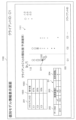
- FIG. 10 is an explanatory diagram showing an example of a management screen.
- FIG. 11 is an explanatory diagram showing an example of an information display screen.
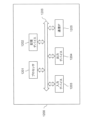
- FIG. 12 is a block diagram showing an example of the hardware configuration of a server and a client terminal.
- FIG. 1 is an explanatory diagram showing an example of federated learning according to this embodiment.
- the server S and the client terminal Ck are communicably connected via a network such as the Internet, a LAN (Local Area Network), or a WAN (Wide Area Network).
- a network such as the Internet, a LAN (Local Area Network), or a WAN (Wide Area Network).
- the client terminals C1 to C3 have learning data sets D1 to D3. If these are not distinguished, they are referred to as learning data set Dk.
- the learning data set Dk is a combination of learning data serving as an explanatory variable and correct data serving as a target variable. It is assumed that the learning data set Dk is prohibited from being taken out from the client terminal Ck or the base where the client terminal Ck is installed.
- the client terminal Ck is a computer that provides the learning data set Dk to the predictive model, performs individual learning, and sends learning results such as model parameters of the learned predictive model or their gradients to the server S each time the learning is performed.
- the server S is a computer that uses learning results from the client terminal Ck to integrate prediction models for each client terminal Ck to generate an integrated prediction model, and transmits the integrated prediction model to the client terminal Ck.
- the client terminal Ck provides the learning data set Dk to the integrated prediction model from the server S to learn the prediction model. By repeating such learning, the federated learning system 100 executes federated learning.
- the federated learning system 100 executes two types of federated learning. One is the federated learning FL1 of the similarity calculation model, and the other is the federated learning FL2 of the individual analysis model.
- the federated learning FL1 of the similarity calculation model generates an integrated similarity calculation model M1 that integrates the similarity calculation models from each client terminal Ck by executing the above-described federated learning using the similarity calculation model as a prediction model. It is federated learning.
- the similarity calculation model is a learning data set Dk (hereinafter referred to as client terminal Cj to distinguish it from Ck) of the learning target client terminal Ck (hereinafter referred to as client terminal Cj to distinguish it from Ck) among the client terminals C1 to CK.
- training data set Dj training data set Dj
- the i-th (i is an integer satisfying 1 ⁇ i ⁇ Nj, where Nj is the total number of data samples in the learning data set Dj) of the learning data set Dj
- This is a prediction model that calculates the similarity with the learning data set Dk for each data sample (hereinafter referred to as data sample i).
- the similarity calculation model is a model that calculates a propensity score to which a client ID that uniquely identifies the client terminal Ck is assigned as a variable.
- k will be used for any client terminal and its learning data set, but j will be used for the client terminal to be learned and its learning data set.
- the influence of each data sample i on the federated learning can be adjusted in the federated learning FL2 of the individual analysis model.
- the federated learning FL2 of individual analysis models is federated learning that generates individual analysis models M21 to M23 that integrate the individual analysis models for the client terminal Cj obtained from each of the client terminals C1 to C3.
- FIG. 2 is an explanatory diagram showing an example of the learning data set Dk.
- the learning data set Dk includes fields such as a client ID (sometimes referred to as "CID" in the following figures) 201, a data ID 202, and an explanatory variable 203 (sometimes referred to as explanatory variable X). and a target variable 204 (sometimes referred to as target variable y).
- a combination of values of each field in the same row becomes an entry that defines one data sample.
- Each of the learning data sets D1 to D3 is, for example, a collection of data samples of patient groups for each hospital.
- the client ID 201 is identification information that uniquely identifies the client terminal Ck.
- the value of the client ID 201 is expressed as Ck.
- the data ID 202 is identification information that uniquely identifies a data sample.
- the value of the data ID 202 is expressed in Dki. i is a number unique to that data sample.
- Data ID 202 identifies, for example, a patient.
- the explanatory variable 203 is learning data used in federated learning FL2 of the individual analysis model, and includes one or more feature quantities x1, x2,... (If these are not distinguished, they are simply written as feature quantity x.) .
- the feature amount x is, for example, the elongation, weight, blood pressure, etc. of the patient specified by the data ID 202.
- the objective variable 204 is correct data used in federated learning FL2 of the individual analysis model.
- FIG. 3 is an explanatory diagram showing an example of the federated learning FL1 of the similarity calculation model.
- the combination of the explanatory variable 203 and the objective variable 204 of the learning data set Dk becomes the explanatory variable 301, and the client ID 201 becomes the objective variable 302.
- the server S has a base similarity calculation model (hereinafter referred to as base similarity calculation model) M10.
- the base similarity calculation model M10 may be an untrained neural network or a trained neural network in which model parameters ⁇ k t such as weights and biases are set.
- t is a natural number in ascending order starting from 1 and indicating the number of executions of federated learning FL1 of the similarity calculation model.
- the server S transmits the base similarity calculation model M10 to the client terminals C1 to C3.
- the base similarity calculation model M10 may be constructed by setting the following to an untrained neural network.
- the base similarity calculation model M10 becomes the learning target similarity calculation model M11t of the first federated learning FL1 at the client terminal Ck.
- the client terminal Ck executes model learning 31kt (311t to 313t) in the t-th federated learning FL1. Specifically, for example, the client terminal Ck provides the explanatory variable 301 and objective variable 302 of the learning data set D1 to the learning target similarity calculation model M1kt (M11t to M13t) to individually learn.
- the client terminal Ck transmits to the server S the learning result 32kt (321t to 323t), which is the model parameter ⁇ k t or its gradient gs k t when updating the learning target similarity calculation model M1kt.
- the server S executes the integrated learning 330t in the t-th federated learning FL1 using the learning result 32kt, and generates the next integrated similarity calculation model M1(t+1). Specifically, for example, the server S generates the integrated similarity calculation model M1(t+1) using the integrated result of integrating the learning results 32kt, and generates the integrated similarity calculation model M1(t+1) or its integrated model parameter ⁇ . t+1 is sent to the client terminal Ck. As a result, the learning target similarity calculation model M1kt in the next federated learning FL1 is set in the client terminal Ck.
- federated learning FL1 is repeatedly executed.
- the server S terminates the federated learning FL1 and uses the latest integrated similarity calculation model M1. (t+1) is output as the integrated similarity calculation model M1 and transmitted to the client terminals C1 to C3.
- the above formula (1) is a calculation formula that defines a similarity calculation model, and is executed by the model learning 31jt of the client terminal Cj.
- the function h is a learning target similarity calculation model M1jt (M11t to M13t) defined by an explanatory variable 301 that is a combination of an explanatory variable 203 (X) and an objective variable 204 (y), and a model parameter ⁇ j t .
- [p j ] t is a predicted probability indicating which learning data set Dk each data sample i of the learning data set Dj of the client terminal Cj is similar to in the t-th federated learning FL1.
- the predicted probability [p j ] t is an N j ⁇ K matrix. That is, the row vector [p ji ] t , which is a combination of K elements in the i-th row of this matrix, is a predicted probability indicating the similarity between the data sample i of the learning data set Dj and the learning data set D1, and the learning data A predicted probability indicating the similarity between the data sample i of the set Dj and the learning data set D2, a predicted probability indicating the similarity between the data sample i of the learning data set Dj and the learning data set D3, ..., data of the learning dataset Dj This is a predicted probability indicating the degree of similarity between sample i and learning data set DK.
- the above formula (2) is the loss function H ( ⁇ j t ) calculated by the model learning 31jt of the client terminal Cj in the t-th federated learning FL1.
- p ji is the degree of similarity of data sample i of training data set Dj to training data sets D1 to D3. This degree of similarity p ji has a range of, for example, 0.0 to 1.0, and the larger the value, the more similar it is.
- p ji (1.0, 0, 0), indicating that the data sample i is a data sample in the learning data set D1.
- p ji (0, 1.0, 0), indicating that the data sample i is a data sample within the learning data set D2.
- p ji (1.0, 0, 0), indicating that the data sample i is a data sample in the learning data set D3.
- [p ji ] t is the predicted probability in the t-th federated learning LF1.
- the row is the predicted probability indicating how similar the data sample i is to the learning data sets D1 to D3. It is a vector.
- N j is the total number of data samples i in the training data set Dj.
- the function loss is an error function of the data sample i, and the average value of the error function loss of each data sample i becomes the loss function H( ⁇ j t ).
- the above formula (3) is a calculation formula that defines the gradient gs j t of the model parameter ⁇ j t , and is executed by the model learning 31jt of the client terminal Cj.
- ⁇ is the learning rate.
- the above formula (4) is a calculation formula for updating the integrated model parameter ⁇ j t to the integrated model parameter ⁇ j t+1 , and is executed by the integrated learning 330t of the server S.
- the server S receives the gradient gs j t as the learning result 32jt from the client terminal Cj, and executes the above equation (4).
- the integrated model parameter ⁇ t in the first term on the right side of the above equation (4) is an integrated model parameter calculated as a result of executing the above equation (4) in the previous federated learning FL1.
- the above formula (5) is a calculation formula for updating the model parameter ⁇ j t to the model parameter ⁇ j t+1 , and is executed by the integrated learning 330t of the server S. This is executed by the model learning 31jt of the client terminal Cj.
- the client terminal Cj transmits the updated model parameter ⁇ j t+1 to the server S as the learning result 32jt.
- the above equation (6) is a calculation equation for calculating the integrated model parameter ⁇ t+1 using the updated model parameter ⁇ j t+ 1 of the above equation (5), and is executed by the integrated learning 330t of the server S.
- N is the total number of data samples i of client terminals C1 to CJ.
- the federated learning system 100 calculates the integrated model parameter ⁇ t+1 using either the updating method according to the above equation (4) or the updating method using equations (5) and (6).
- the above equation (1) is updated by the server S transmitting the integrated similarity calculation model M1(t+1) or its integrated model parameter ⁇ t+1 to the client terminals C1 to C3.
- the above formula (6) is a calculation formula that defines the integrated similarity calculation model M1 (t+1), which is generated by the integrated learning 330 of the server S, transmitted to the client terminal Ck, and used in the next federated learning FL1. This becomes the learning target similarity calculation model M1kt.
- the above formula (8) is a calculation formula that defines the integrated similarity calculation model M1 when federated learning FL1 is completed. Since this is the same equation as the above equation (7) at the end of federated learning FL1, "t+1" was deleted from the above equation (7).
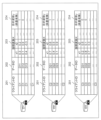
- FIG. 4 is an explanatory diagram showing an example of federated learning FL2 of the individual analysis model.
- the client terminal C1 executes learning weight calculation 401. Specifically, for example, the client terminal Cj inputs the explanatory variable 301 of the learning data set Dj into the integrated similarity calculation model M1 (formula (8) above) generated in FIG. A predicted probability [p j ] indicating which learning data set Dk each data sample i of Dj is similar to is calculated. The client terminal Cj calculates the learning weight w j using the calculated predicted probability [p j ].
- the server S has a base individual analysis model (hereinafter referred to as base individual analysis model) M20.
- the base individual analysis model M20 may be an untrained neural network or a trained neural network in which model parameters ⁇ t such as weights and biases are set.
- the server S transmits the base individual analysis model M20 to the client terminal Ck.
- the base individual analysis model M20 may be constructed by setting the learning neural network.
- the base individual analysis model M20 becomes the learning target individual analysis model M2j-kt of the first federated learning FL2 at the client terminal Ck.
- t is an ascending natural number starting from 1 and indicating the number of executions of federated learning FL2 of the individual analysis model.
- the client terminal C1 holds the learning target individual analysis models M21-1t to M21-3t.
- the client terminal C2 holds the learning target individual analysis models M22-1t to M22-3t.
- the client terminal C3 holds the learning target individual analysis models M23-1t to M23-3t.
- the client terminal Cj executes model learning 41jt by weighting. Specifically, for example, the client terminal Cj inputs the explanatory variables 203 of the learning data set Dj into each of the learning target individual analysis models M2j-kt, thereby determining the objective for each learning target individual analysis model M2j-kt. A predicted value [y j k ] of the variable 204 is calculated. The client terminal Cj calculates a loss function F ( ⁇ j kt ) for each learning target individual analysis model M2j-kt using the learning weight w j , the objective variable y, the predicted value [y j k ], and the model parameter ⁇ j kt do.
- F loss function
- the client terminal Cj calculates the gradient ga j kt of the model parameter ⁇ j kt as the individual analysis model learning result 42j ⁇ kt, and updates the model parameter ⁇ j kt to the model parameter ⁇ j k(t+1) .
- the model parameter ⁇ j k(t+1) is also included in the individual analysis model learning result 42j-kt.
- the individual analysis model learning result 421-1t is the model parameter ⁇ 1 it or its gradient ga 1 it updated in the learning target individual analysis model M21-lt.
- the individual analysis model learning result 421-2t is the model parameter ⁇ 1 2t or its gradient ga 1 2t updated in the learning target individual analysis model M21-2t.
- the individual analysis model learning result 421-3t is the model parameter ⁇ 1 3t or its gradient ga 1 3t updated in the learning target individual analysis model M21-3t.
- the individual analysis model learning result 422-1t is the model parameter ⁇ 2 it or its gradient ga 2 it updated in the learning target individual analysis model M22-lt.
- the individual analysis model learning result 422-2t is the model parameter ⁇ 2 2t or its gradient ga 2 2t updated in the learning target individual analysis model M22-2t.
- the individual analysis model learning result 422-3t is the model parameter ⁇ 2 3t or its gradient ga 2 3t updated in the learning target individual analysis model M22-3t.
- the individual analysis model learning result 423-1t is the model parameter ⁇ 3 it or its gradient ga 3 it updated in the learning target individual analysis model M23-lt.
- the individual analysis model learning result 423-2t is the model parameter ⁇ 3 2t or its gradient ga 3 2t updated in the learning target individual analysis model M23-2t.
- the individual analysis model learning result 423-3t is the model parameter ⁇ 3 3t or its gradient ga 3 3t updated in the learning target individual analysis model M23-3t.
- the server S receives the individual analysis model learning results 42j-kt from the client terminal Ck. Specifically, for example, the server S receives individual analysis model learning results 421-1t to 421-3t from the client terminal C1, and receives individual analysis model learning results 422-1t to 422-3t from the client terminal C2. , receives individual analysis model learning results 423-1t to 423-3t from client terminal C3.
- the server S executes the integrated learning 430t in the t-th federated learning FL2, and generates the next individual analysis model M2k(t+1). Specifically, for example, the server S integrates the individual analysis model learning results 421-1t, 422-1t, and 423-1t to generate the individual analysis model M21(t+1). Further, the server S integrates the individual analysis model learning results 421-2t, 422-2t, and 423-2t to generate an individual analysis model M22(t+1). Further, the server S integrates the individual analysis model learning results 421-3t, 422-3t, and 423-3t to generate an individual analysis model M23(t+1).
- the server S transmits the individual analysis model M2j(t+1) or its integrated model parameter ⁇ j t+1 to the client terminal Ck.
- the learning target individual analysis model M2j-kt in the next federated learning FL2 is set in the client terminal Ck.
- the server S transmits the individual analysis model M21(t+1) or its integrated model parameter ⁇ 1 t+1 to the client terminals C1 to C3.
- the client terminal C1 sets the learning target individual analysis model M21-1t in the next federated learning FL2
- the client terminal C2 sets the learning target individual analysis model M21-1t in the next federated learning FL2.
- the client terminal C3 sets the individual analysis model M22-1t, and sets the individual analysis model M23-1t to be learned in the next federated learning FL2.
- the server S transmits the individual analysis model M22(t+1) or its integrated model parameter ⁇ 2 t+1 to the client terminals C1 to C3.
- the client terminal C1 sets the learning target individual analysis model M21-2t in the next federated learning FL2
- the client terminal C2 sets the learning target individual analysis model M21-2t in the next federated learning FL2.
- the client terminal C3 sets the learning target individual analysis model M23-2t in the next federated learning FL2.
- the server S transmits the individual analysis model M23(t+1) or its integrated model parameter ⁇ 3 t+1 to the client terminals C1 to C3.
- the client terminal C1 sets the learning target individual analysis model M21-3t in the next federated learning FL2
- the client terminal C2 sets the learning target individual analysis model M21-3t in the next federated learning FL2.
- the client terminal C3 sets the individual analysis model M22-3t, and sets the individual analysis model M23-3t to be learned in the next federated learning FL2.
- federated learning FL2 is repeatedly executed.
- the server S ends federated learning FL2 and updates the latest
- the individual analysis model M2k (t+1) is output as the individual analysis model M2k and transmitted to the client terminal Ck.
- the server S outputs the individual analysis model M21 (t+1) as the individual analysis model M21, and transmits it to the client terminal C1. Further, the server S outputs the individual analysis model M22 (t+1) as the individual analysis model M22, and transmits it to the client terminal C2. Further, the server S outputs the individual analysis model M23 (t+1) as the individual analysis model M23, and transmits it to the client terminal C3.
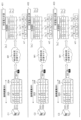
- FIG. 5 is an explanatory diagram showing a specific example of the learning weight calculation 40k (401 to 403) shown in FIG.
- the learning data set D1 has D11 and D12 as data samples i
- the learning data set D2 has D21 and D22 as data samples i
- the learning data set D3 has D11 and D12 as data samples i. It has D31 and D32.
- the client terminal Cj inputs the explanatory variable 301 of the learning data set Dj into the integrated similarity calculation model M1 to calculate the predicted probability [p j ].
- the predicted probability [p ji ] is a row vector indicating a predicted probability indicating how similar a certain data sample i of the learning data set Dj is to each learning data set Dk.
- the client terminal C1 inputs the explanatory variable 301 of the learning data set D1 into the integrated similarity calculation model M1, and calculates the predicted probability [p 1 ].
- the predicted probability [p 11 ] corresponding to the data sample D11 is calculated, and the explanatory variable 301 of the data sample D12 is input into the integrated similarity calculation model M1.
- the predicted probability [p 12 ] corresponding to the data sample D12 is calculated.
- the client terminal C1 calculates learning weights w 1 1 , w 1 2 , w 1 3 for each of the predicted probabilities [p 1 1 ], [ p 1 2 ] , and [p 1 3 ].
- the client terminal C2 inputs the explanatory variable 301 of the learning data set D2 to the integrated similarity calculation model M1, and calculates the predicted probability [p 2 ].
- the predicted probability [p 21 ] corresponding to the data sample D21 is calculated, and the explanatory variable 301 of the data sample D22 is input into the integrated similarity calculation model M1.
- the predicted probability [p 22 ] corresponding to the data sample D22 is calculated.
- the client terminal C2 calculates learning weights w 2 1 , w 2 2 , and w 2 3 for each of the predicted probabilities [p 2 1 ], [p 2 2 ], and [p 2 3 ].
- the client terminal C3 inputs the explanatory variable 301 of the learning data set D3 to the integrated similarity calculation model M1 to calculate the predicted probability [p 3 ].
- the predicted probability [p 31 ] corresponding to the data sample D31 is calculated, and the explanatory variable 301 of the data sample D32 is input into the integrated similarity calculation model M1.
- the predicted probability [p 32 ] corresponding to the data sample D32 is calculated.
- the client terminal C3 calculates learning weights w 3 1 , w 3 2 , and w 3 3 for each of the predicted probabilities [p 3 1 ], [p 3 2 ] , and [p 3 3 ].
- the formula used to calculate the learning weight w j k in the federated learning FL2 of the individual analysis model is defined below.
- w ji k on the left side is a learning weight applied to the similarity relationship between the data sample i of the learning data set Dj and the learning data set Dk.
- [p ji k ] on the right side is a predicted probability indicating how similar the data sample i of the training data set Dj is to the training data set Dk.
- a set of learning weights w ji k of all data samples i of the learning data set Dj is the learning weight w j k .
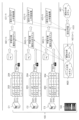
- FIG. 6 is an explanatory diagram showing a specific example of the weighted model learning 411t shown in FIG. 4.
- the client terminal C1 updates the learning target individual analysis model M21-1t using the explanatory variable 203 and objective variable 204 of the learning data set D1, and the learning weight w 1 1 , and updates the individual analysis model learning result 421-1t. Output.
- the client terminal C2 updates the learning target individual analysis model M22-1t using the explanatory variable 203 and objective variable 204 of the learning data set D2, and the learning weight w 2 1 , and updates the individual analysis model learning result 422-1t. Output.
- the client terminal C3 updates the learning target individual analysis model M23-1t using the explanatory variable 203 and objective variable 204 of the learning data set D3, and the learning weight w 3 1 , and updates the individual analysis model learning result 423-1t. Output.
- the server S integrates the individual analysis model learning results 421-1t, 422-1t, and 423-1t in the integrated learning 430t to generate the next individual analysis model M21 (t+1).
- the server S transmits the individual analysis model M21(t+1) or its integrated model parameter ⁇ 1 t+1 to the client terminals C1 to C3.
- the client terminal C1 sets the learning target individual analysis model M21-1t in the next federated learning FL2
- the client terminal C2 sets the learning target individual analysis model M21-1t in the next federated learning FL2.
- the client terminal C3 sets the individual analysis model M22-1t, and sets the individual analysis model M23-1t to be learned in the next federated learning FL2.
- the individual analysis model M21 is an individual analysis model of the client terminal C1 determined at the end of the federated learning FL2.
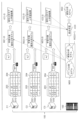
- FIG. 7 is an explanatory diagram showing a specific example of the weighted model learning 412t shown in FIG. 4.
- the client terminal C1 updates the learning target individual analysis model M21-2t using the explanatory variable 203 and objective variable 204 of the learning data set D1, and the learning weight w 1 2 , and updates the individual analysis model learning result 421-2t. Output.
- the client terminal C2 updates the learning target individual analysis model M22-2t using the explanatory variable 203, the objective variable 204, and the learning weight w 2 2 of the learning data set D2, and obtains the individual analysis model learning result 422-2t. Output.
- the client terminal C3 updates the learning target individual analysis model M23-2t using the explanatory variable 203, the objective variable 204, and the learning weight w 3 2 of the learning data set D3, and obtains the individual analysis model learning result 423-2t. Output.
- the server S integrates the individual analysis model learning results 421-2t, 422-2t, and 423-2t in the integrated learning 430t to generate the next individual analysis model M22(t+1).
- the server S transmits the individual analysis model M22(t+1) or its integrated model parameter ⁇ 2 t+1 to the client terminals C1 to C3.
- the client terminal C1 sets the learning target individual analysis model M21-2t in the next federated learning FL2
- the client terminal C2 sets the learning target individual analysis model M21-2t in the next federated learning FL2.
- the client terminal C3 sets the learning target individual analysis model M23-2t in the next federated learning FL2.
- the individual analysis model M22 is an individual analysis model of the client terminal C2 determined at the end of the federated learning FL2.
- FIG. 8 is an explanatory diagram showing a specific example of the weighted model learning 413t shown in FIG. 4.
- the client terminal C1 updates the learning target individual analysis model M21-3t using the explanatory variable 203 and objective variable 204 of the learning data set D1, and the learning weight w 1 3 , and updates the individual analysis model learning result 421-3t. Output.
- the client terminal C2 updates the learning target individual analysis model M22-3t using the explanatory variable 203, the objective variable 204, and the learning weight w 2 3 of the learning data set D2, and obtains the individual analysis model learning result 422-3t. Output.
- the client terminal C3 updates the learning target individual analysis model M23-3t using the explanatory variable 203 and objective variable 204 of the learning data set D3, and the learning weight w 3 3 , and updates the individual analysis model learning result 423-3t. Output.
- the server S integrates the individual analysis model learning results 421-3t, 422-3t, and 423-3t in the integrated learning 430t to generate the next individual analysis model M23(t+1).
- the server S transmits the individual analysis model M23(t+1) or its integrated model parameter ⁇ 3 t+1 to the client terminals C1 to C3.
- the client terminal C1 sets the learning target individual analysis model M21-3t in the next federated learning FL2
- the client terminal C2 sets the learning target individual analysis model M21-3t in the next federated learning FL2.
- the client terminal C3 sets the individual analysis model M22-3t, and sets the individual analysis model M23-3t to be learned in the next federated learning FL2.
- the individual analysis model M23 is an individual analysis model of the client terminal C3 determined at the end of the federated learning FL2.
- the above equation (10) defines the individual analysis model M2j.
- x j is the explanatory variable 203 of the learning data set Dj
- ⁇ j is the integrated model parameter of the individual analysis model M2j.
- [y j ] is the predicted value of the objective variable 204 of the learning data set Dj.
- the above equation (11) defines the loss function F( ⁇ j kt ) in the learning target individual analysis model M2j-kt in the t-th federated learning FL2.
- y ji is the objective variable 204 of a certain data sample i of the training data set Dj, and [y ji ] is its predicted value. [y ji ] of all data samples i of the learning data set Dj is [y j ].
- w ji k is a learning weight calculated by the above equation (9).
- the above equation (12) defines the gradient ga j kt of the model parameter ⁇ j kt in the t-th federated learning FL2.
- the gradient ga j kt is calculated at the client terminal Cj.
- the above formula (13) is a calculation formula for updating each model parameter ⁇ j kt in the t-th federated learning FL2, and is executed in the weighted model learning 41jt of the client terminal Cj.
- P j t is the sum of P j kt of the client terminal Ck in the t-th federated learning FL2, as shown in the above equation (14).
- P j kt is the sum of predicted probabilities [p ji k ] t at the client terminal Cj in the t-th federated learning FL2.
- the client terminal Cj transmits the updated model parameters ⁇ j 1 (t+1) to ⁇ j 3 (t+1) to the server S as individual analysis model learning results 42j-1t, 42j-2t, and 42j1-3t.
- the server S stores individual analysis model learning results 421-1t (updated model parameters ⁇ 1 1(t+1) ), individual analysis model learning results 422-1t (updated model parameters ⁇ 2 1(t+1) ) ), the individual analysis model learning results 423-1t (updated model parameters ⁇ 3 1(t+1) ) are averaged and integrated, for example, to obtain the updated integrated model parameters ⁇ 1 ( t+1) is calculated, and an individual analysis model M21(t+1) is generated.
- the server S in the integrated learning 430t, the server S generates individual analysis model learning results 421-2t (updated model parameters ⁇ 2 1 (t+1) ), individual analysis model learning results 422-2t (updated model parameters ⁇ 2 2 (t+1) ), the individual analysis model learning results 423-2t (updated model parameters ⁇ 3 2(t+1) ) are averaged and integrated, for example, to obtain the updated integrated model parameters ⁇ for the client terminal C2. 2 (t+1) is calculated, and an individual analysis model M22 (t+1) is generated.
- the server S performs individual analysis model learning results 421-3t (updated model parameters ⁇ 3 1 (t+1) ), individual analysis model learning results 422-3t (updated model parameters ⁇ 2 3 (t+1) ), the individual analysis model learning results 423-3t (updated model parameters ⁇ 3 3(t+1) ) are averaged and integrated, for example, to obtain the updated integrated model parameters ⁇ for the client terminal C2. 3 (t+1) is calculated, and an individual analysis model M23 (t+1) is generated.
- the above equation (16) calculates each model parameter in the t-th federated learning FL2 when the gradient ga j kt and the predicted probability [p ji k ] t are received from the client terminal Cj as the individual analysis model learning result 42j-kt. This is a calculation formula for updating ⁇ j kt , and is executed by the integrated learning 430t of the server S.
- the above equation (17) calculates the integrated model parameter ⁇ in the t-th federated learning FL2 when the gradient ga j kt and the predicted probability [p ji k ] t are received from the client terminal Cj as the individual analysis model learning result 42j-kt.
- This is a calculation formula for updating j t , and is executed by the integrated learning 430t of the server S.
- the server S generates the individual analysis model M21(t+1) using the updated integrated model parameter ⁇ 1 t+1 .
- the server S generates an individual analysis model M22(t+1) using the updated integrated model parameter ⁇ 2 t+1 .
- the server S generates an individual analysis model M23(t+1) using the updated integrated model parameter ⁇ 3 t+1 .
- FIG. 9 is a sequence diagram of federated learning in the federated learning system 100.
- the server S transmits the client ID 201 to each client terminal Ck (step S901).
- the client terminal Ck associates the client ID 201 with the learning data set Dk.
- the federated learning system 100 executes federated learning FL1 of the similarity calculation model (step S902), and executes federated learning FL2 of the individual analysis model (step S903).
- the server S transmits similarity calculation model information (integrated similarity calculation model M1(t+1) or its integrated model parameter ⁇ t+1 ) to the client terminal Ck (step S921).
- the client terminal Ck learns the learning target similarity calculation model using the learning data set Dj and the similarity calculation model information (step S922).
- the client terminal Ck transmits the learning result 32jt in step S922 to the server S (step S923).
- the server S executes integrated learning 330t of the similarity calculation model (step S924).
- the server S determines whether the end condition of the integrated learning 330t of the similarity calculation model (step S924) is satisfied (step S925).
- the server S transmits the updated similarity calculation model information to the client terminal Ck (step S921).
- the server S transmits the updated similarity calculation model information to the client terminal Ck (step S926).
- the client terminal Ck sets the integrated similarity calculation model M1 using the updated similarity calculation model information, and ends the federated learning FL1 of the similarity calculation model (step S902).
- the client terminal Cj executes the learning weight calculation 40j using the learning data set Dj and the integrated similarity calculation model M1, and calculates the learning weight wj (step S930 ).
- the server S transmits individual analysis model information (individual analysis model M2j(t+1) or its integrated model parameter ⁇ j t+1 ) to the client terminal Ck (step S931).
- the client terminal Cj executes the weighted model learning 41jt and transmits the individual analysis model learning result 42j-kt to the server S (step S933).
- the server S executes integrated learning 430t of the individual analysis model using the individual analysis model learning result 42j-kt (step S934).
- the server S determines whether the termination condition of the integrated learning 430t of the individual analysis model (step S934) is satisfied (step S925).
- the server S transmits the updated individual analysis model information to the client terminal Ck (step S931).
- the server S transmits the updated individual analysis model information to the client terminal Ck (step S936).
- the client terminal Ck generates the individual analysis model M2j using the updated individual analysis model information, and ends the federated learning FL2 (step S903) of the individual analysis model.
- FIG. 10 is an explanatory diagram showing an example of a management screen.
- the management screen 1000 is displayed on the server S.
- the management screen 1000 displays a learned model list 1001, a model parameter list 1002, and a client learning contribution list 1003.
- the learned model list 1001 is tabular data that associates the client ID 201 with the ID of the individual analysis model M2j (individual analysis model ID).
- the model parameter list 1002 is tabular data that defines the values of model parameters ⁇ j of the individual analysis model M2j.
- the client learning contribution list 1003 is tabular data that associates the client ID 201 with the contribution 1030 of the client terminal Cj.
- the contribution degree 1030 is calculated by the following formula.
- the degree of contribution 1030 is an index value indicating how much the learning data set Dk of the client terminal Ck contributes to the learning of the individual analysis model.
- R j k on the left side of the above equation (18) is the contribution 1030 of the client terminal Cj.
- P j on the right side is the sum of P j k of the client terminal Ck at the end of federated learning FL2 (see equation (14) above).
- P j k is the sum of predicted probabilities [p j k ] at the client terminal Cj at the end of federated learning FL2 (see equation (14) above).
- the contribution degree 1030 of the client terminal Cj is calculated by the server S.
- FIG. 11 is an explanatory diagram showing an example of an information display screen.
- the information display screen 1100 is a screen that displays individual analysis model information regarding the client terminal Cj, and is displayed on the server S or the client terminal Cj.
- the information display screen 1100 displays a client learning contribution list 1003, a data sample i specified from the learning data set D1 of the client terminal C1 (in FIG. 11, D11 as an example), and a specified data sample D11 of the client terminal C1.
- the horizontal axis of the predicted probability distribution 1101 is the client ID 201, and the vertical axis is the predicted probability of the specified data sample D11 and the learning data set Dk specified by the client ID 201.
- the round dot is the data sample i in the learning data set D1 of the client terminal C1, and indicates the predicted probability with respect to the client terminal Ck. Note that the data sample i specified by the cursor 1102 is the data sample D11, and the predicted probability with respect to the learning data set D1 is shown.
- FIG. 12 is a block diagram showing an example of the hardware configuration of the server S and the client terminal Ck (hereinafter referred to as computer 1200).
- Computer 1200 includes a processor 1201, a storage device 1202, an input device 1203, an output device 1204, and a communication interface (communication IF) 1205.
- Processor 1201, storage device 1202, input device 1203, output device 1204, and communication IF 1205 are connected by bus 1206.
- Processor 1201 controls computer 1200.
- Storage device 1202 becomes a work area for processor 1201.
- the storage device 1202 is a non-temporary or temporary recording medium that stores various programs and data.
- Examples of the storage device 1202 include ROM (Read Only Memory), RAM (Random Access Memory), HDD (Hard Disk Drive), and flash memory.
- Input device 1203 inputs data. Examples of the input device 1203 include a keyboard, mouse, touch panel, numeric keypad, scanner, microphone, and sensor.
- Output device 1204 outputs data. Examples of the output device 1204 include a display, a printer, and a speaker.
- Communication IF 1205 connects to a network and transmits and receives data.
- the client terminal Ck can also predict the similarity with other learning data sets Dk without passing the data sample i to other client terminals Ck or the server S. Therefore, leakage of the data sample i itself can be prevented.
- the server S participated in federated learning FL1 and FL2, but may not participate in federated learning FL1 and only participate in federated learning FL2.
- the client terminal Ck may acquire the results of federated learning FL1 (integrated similarity calculation model M1 or learning weight wk) in which other servers participated from the other servers.
- the server S may participate in federated learning FL1 and not participate in federated learning FL2.
- the client terminal Ck acquires the result of the federated learning FL1 (the integrated similarity calculation model M1 or the learning weight wk) from the server S.
- the integrated learning 430t will be executed by another server.
- the server S can send a program, which is a process to be executed by the client terminal Ck, to the client terminal Ck, for example, as a container.
- the federated learning system 100 can also be configured as shown in [1] to [11] below.
- the federated learning system 100 includes a plurality of client terminals C1 to C3 each having a learning data set D1 to D3, and a server S capable of communicating with the plurality of client terminals C1 to C3, Each of the client terminals C1 to C3 learns a model using the learning data sets D1 to D3, and the server S uses the learning results to integrate the models of each of the plurality of client terminals C1 to C3. Perform iterative federated learning.
- the learning data set Dk has one or more data samples i including a client ID 201 that specifies the client terminal Ck, a first explanatory variable 203, and a first objective variable 204.
- the federated learning system 100 executes calculation processing (learning weight calculations 401 to 403) by each of the plurality of client terminals C1 to C3, and also performs first learning processing (weighting calculation) by each of the plurality of client terminals C1 to C3. 411t to 413t) and the first update process (integrated learning 330t) by the server S are repeated until the first termination condition is satisfied.
- each of the plurality of client terminals C1 to C3 uses a similarity calculation model for calculating the similarity between the data sample i and the plurality of learning data sets D1 to D3.
- the degree of similarity predicted probability [p ji k ] t ) between the data sample i and the plurality of training data sets D1 to D3 is calculated.
- each of the plurality of client terminals C1 to C3 performs an individual analysis to calculate a predicted value of the first objective variable 204 from the first explanatory variable 203.
- model learning target individual analysis models M21-1t, M22-1t, M23-1t
- the first explanatory variable 203 the first objective variable 204
- specific similarity predicted probability [p ji 1 ] t
- D1 specific learning data set
- the server S collects a plurality of first learning results ( 421-1t, 422-1t, 423-1t), and the individual analysis models (learning target individual analysis models M21-1t, M22-1t, M23-1t) of each of the plurality of client terminals C1 to C3.
- First integrated information integrated individual analysis model M21 (t+1) or integrated model parameter ⁇ 1 t +1 ) regarding the integrated integrated individual analysis model M21 (t+1 ) is generated.
- the server S uses the first integrated information (integrated individual analysis model) until the first termination condition is satisfied.
- M21(t+1) or the integrated model parameter ⁇ 1 t+1 ) is transmitted to each of the plurality of client terminals C1 to C3.
- each of the plurality of client terminals C1 to C3 acquires the first integrated information (integrated individual analysis model M21(t+1) or integrated model parameter ⁇ 1 t+1 ) to update the individual analysis models (learning target individual analysis models M21-1t, M22-1t, M23-1t), and update the first explanatory variable 203, the first objective variable 204, and the specific similarity (
- the updated individual analysis models (learning target individual analysis models M21-1t, M22-1t, M23-1t) are learned based on the predicted probability [p ji 1 ] t ).
- the server S collects the first integrated information (integrated individual analysis).
- the model M21(t+1) or the integrated model parameter ⁇ 1 t+1 ) is transmitted to the specific client terminal having the specific learning data set.
- each of the plurality of client terminals C1 to C3 uses the similarity calculation model (learning target similarity calculation By inputting the combination of the first explanatory variable 203 and the first objective variable 204 of the data sample i as the second explanatory variable 301 into the models M11t to M13t), the similarity (predicted probability [p ji k ] t ).
- each of the plurality of client terminals C1 to C3 calculates the specific similarity (predicted probability [p ji 1 ] t ), the learning weights (w 1 1 , w 2 1 , w 3 1 ) are calculated.
- each of the plurality of client terminals C1 to C3 uses the individual analysis models (learning target individual analysis models M21-1t, M22-1t, M23-1t). ), the first explanatory variable 203, the first objective variable 204, and the specific similarity ( Based on the learning weights (w 1 1 , w 2 1 , w 3 1 ) corresponding to the predicted probability [p ji 1 ] t ), the individual analysis models (learning target individual analysis models M21-1t, M22-1t , M23-1t).
- the federated learning system 100 of [1] above performs a second learning process (model learning 311t to 313t) by each of the plurality of client terminals C1 to C3 prior to the first federated learning process (FL2).
- a second federated learning process (FL1) is executed in which the second integrated process (integrated learning 330t) by the server S is repeated until the second termination condition is satisfied.
- each of the plurality of client terminals C1 to C3 sets the combination of the first explanatory variable 203 and the first objective variable 204 as a second explanatory variable 301,
- the learning target similarity calculation models M11t to M13t are learned using the client ID 201 as the second objective variable 302.
- the server S uses the learning target similarity calculation models M11t to M13t from the plurality of client terminals C1 to C3 by the second learning process (model learning 311t to 313t). Second integrated information ( An integrated similarity calculation model M1(t+1) or its integrated model parameter ⁇ t+1 ) is generated.
- the server S stores the second integrated information (integrated similarity calculation model M1(t+1) or its integrated model
- the parameter ⁇ t+1 ) is transmitted to each of the plurality of client terminals C1 to C3.
- each of the plurality of client terminals C1 to C3 uses the second integrated information (integrated similarity calculation model M1(t+1) or its integrated model parameter ⁇ t+1 ).
- the learning target similarity calculation models M11t to M13t are updated, and the updated learning target similarity calculation models M11t to M13t are learned based on the second explanatory variable 301 and the second objective variable 302. .
- the server S outputs the first integrated information (integrated model parameter ⁇ j ) at the end of the first federated learning process (FL2) (model parameter List 1002).
- the server S has the specific similarity (predicted probability [p ji 1 ]) and the similarity (predicted probability [p ji k ]). Based on this, a degree of contribution 1030 indicating how much the specific learning data set D1 contributes to the learning of the integrated individual analysis model M21 is calculated.
- the federated learning system 100 includes a plurality of client terminals C1 to C3 each having a learning data set D1 to D3, and a server S capable of communicating with the plurality of client terminals C1 to C3, Each of the client terminals C1 to C3 learns a model using the learning data sets D1 to D3, and the server S uses the learning results to integrate the models of each of the plurality of client terminals C1 to C3. Perform iterative federated learning.
- the learning data set Dk has one or more data samples i including a client ID 201 that specifies the client terminal Ck, a first explanatory variable 203, and a first objective variable 204.
- the federated learning system 100 performs a second learning process (model learning 311t to 313t) by each of the plurality of client terminals C1 to C3 and a second integration process (integrated learning 330t) by the server S based on a second termination condition.
- a second federated learning process (FL1) is executed which is repeated until the condition is satisfied.
- each of the plurality of client terminals C1 to C3 sets the combination of the first explanatory variable 203 and the first objective variable 204 as a second explanatory variable 301,
- the learning target similarity calculation models M11t to M13t are learned using the client ID 201 as the second objective variable 302.
- the server S uses the learning target similarity calculation models M11t to M13t from the plurality of client terminals C1 to C3 by the second learning process (model learning 311t to 313t). Second integrated information (integrated A similarity calculation model M1(t+1) or its integrated model parameter ⁇ t+1 ) is generated.
- the present invention is not limited to the embodiments described above, and includes various modifications and equivalent configurations within the spirit of the appended claims.
- the embodiments described above have been described in detail to explain the present invention in an easy-to-understand manner, and the present invention is not necessarily limited to having all the configurations described.
- a part of the configuration of one embodiment may be replaced with the configuration of another embodiment.
- the configuration of another embodiment may be added to the configuration of one embodiment.
- other configurations may be added, deleted, or replaced with some of the configurations of each embodiment.
- each of the above-mentioned configurations, functions, processing units, processing means, etc. may be realized in part or in whole by hardware, for example by designing an integrated circuit, and a processor realizes each function. It may also be realized by software by interpreting and executing a program.
- Information such as programs, tables, files, etc. that realize each function is recorded in storage devices such as memory, hard disk, SSD (Solid State Drive), or IC (Integrated Circuit) card, SD card, and DVD (Digital Versatile Disc). It can be stored on a medium.
- storage devices such as memory, hard disk, SSD (Solid State Drive), or IC (Integrated Circuit) card, SD card, and DVD (Digital Versatile Disc). It can be stored on a medium.
- control lines and information lines shown are those considered necessary for explanation, and do not necessarily show all control lines and information lines necessary for implementation. In reality, almost all configurations can be considered interconnected.
Landscapes
- Engineering & Computer Science (AREA)
- Theoretical Computer Science (AREA)
- Physics & Mathematics (AREA)
- Software Systems (AREA)
- Data Mining & Analysis (AREA)
- General Engineering & Computer Science (AREA)
- General Physics & Mathematics (AREA)
- Mathematical Physics (AREA)
- Artificial Intelligence (AREA)
- Evolutionary Computation (AREA)
- Computing Systems (AREA)
- Computational Linguistics (AREA)
- Life Sciences & Earth Sciences (AREA)
- Health & Medical Sciences (AREA)
- Biomedical Technology (AREA)
- Biophysics (AREA)
- General Health & Medical Sciences (AREA)
- Molecular Biology (AREA)
- Computer Vision & Pattern Recognition (AREA)
- Medical Informatics (AREA)
- Fuzzy Systems (AREA)
- Probability & Statistics with Applications (AREA)
- Databases & Information Systems (AREA)
- Information Retrieval, Db Structures And Fs Structures Therefor (AREA)
Priority Applications (2)
| Application Number | Priority Date | Filing Date | Title |
|---|---|---|---|
| US18/868,352 US20250335822A1 (en) | 2022-06-02 | 2023-01-20 | Federated learning system, federated learning method, and federated learning program |
| EP23815463.7A EP4535246A1 (en) | 2022-06-02 | 2023-01-20 | Federated learning system, federated learning method and federated learning program |
Applications Claiming Priority (2)
| Application Number | Priority Date | Filing Date | Title |
|---|---|---|---|
| JP2022090195A JP7840212B2 (ja) | 2022-06-02 | 2022-06-02 | 連合学習システム、連合学習方法および連合学習プログラム |
| JP2022-090195 | 2022-06-02 |
Publications (1)
| Publication Number | Publication Date |
|---|---|
| WO2023233699A1 true WO2023233699A1 (ja) | 2023-12-07 |
Family
ID=89025976
Family Applications (1)
| Application Number | Title | Priority Date | Filing Date |
|---|---|---|---|
| PCT/JP2023/001789 Ceased WO2023233699A1 (ja) | 2022-06-02 | 2023-01-20 | 連合学習システム、連合学習方法および連合学習プログラム |
Country Status (4)
| Country | Link |
|---|---|
| US (1) | US20250335822A1 (enExample) |
| EP (1) | EP4535246A1 (enExample) |
| JP (1) | JP7840212B2 (enExample) |
| WO (1) | WO2023233699A1 (enExample) |
Families Citing this family (1)
| Publication number | Priority date | Publication date | Assignee | Title |
|---|---|---|---|---|
| JP7788938B2 (ja) * | 2022-05-26 | 2025-12-19 | 株式会社日立製作所 | 分析装置、分析方法、および分析プログラム |
Citations (3)
| Publication number | Priority date | Publication date | Assignee | Title |
|---|---|---|---|---|
| JP2021149370A (ja) * | 2020-03-18 | 2021-09-27 | セコム株式会社 | 分散機械学習装置、分散機械学習方法、分散機械学習プログラム及びデータ処理システム |
| JP2022524662A (ja) * | 2019-03-22 | 2022-05-09 | インターナショナル・ビジネス・マシーンズ・コーポレーション | 蒸留を用いたそれぞれのターゲット・クラスを有するモデルの統合 |
| JP2022090195A (ja) | 2020-12-07 | 2022-06-17 | 太陽誘電株式会社 | セラミック電子部品、実装基板およびセラミック電子部品の製造方法 |
-
2022
- 2022-06-02 JP JP2022090195A patent/JP7840212B2/ja active Active
-
2023
- 2023-01-20 WO PCT/JP2023/001789 patent/WO2023233699A1/ja not_active Ceased
- 2023-01-20 EP EP23815463.7A patent/EP4535246A1/en active Pending
- 2023-01-20 US US18/868,352 patent/US20250335822A1/en active Pending
Patent Citations (3)
| Publication number | Priority date | Publication date | Assignee | Title |
|---|---|---|---|---|
| JP2022524662A (ja) * | 2019-03-22 | 2022-05-09 | インターナショナル・ビジネス・マシーンズ・コーポレーション | 蒸留を用いたそれぞれのターゲット・クラスを有するモデルの統合 |
| JP2021149370A (ja) * | 2020-03-18 | 2021-09-27 | セコム株式会社 | 分散機械学習装置、分散機械学習方法、分散機械学習プログラム及びデータ処理システム |
| JP2022090195A (ja) | 2020-12-07 | 2022-06-17 | 太陽誘電株式会社 | セラミック電子部品、実装基板およびセラミック電子部品の製造方法 |
Also Published As
| Publication number | Publication date |
|---|---|
| JP2023177487A (ja) | 2023-12-14 |
| US20250335822A1 (en) | 2025-10-30 |
| EP4535246A1 (en) | 2025-04-09 |
| JP7840212B2 (ja) | 2026-04-03 |
Similar Documents
| Publication | Publication Date | Title |
|---|---|---|
| CN113722474A (zh) | 文本分类方法、装置、设备及存储介质 | |
| CN113705092B (zh) | 基于机器学习的疾病预测方法及装置 | |
| CN108257670B (zh) | 医学解释模型的建立方法和装置 | |
| CN113821668A (zh) | 数据分类识别方法、装置、设备及可读存储介质 | |
| CN116964678A (zh) | 使用以蛋白质结构嵌入为条件的生成模型预测蛋白质氨基酸序列 | |
| CN114298299A (zh) | 基于课程学习的模型训练方法、装置、设备及存储介质 | |
| CN119167281A (zh) | 一种上机考试的考生考场异常行为分析方法和系统 | |
| US20140006447A1 (en) | Generating epigenentic cohorts through clustering of epigenetic suprisal data based on parameters | |
| JP2016194914A (ja) | 混合モデル選択の方法及び装置 | |
| CN113330462B (zh) | 使用软最近邻损失的神经网络训练 | |
| CN113821968A (zh) | 持续学习的方法和装置 | |
| McJames et al. | Bayesian causal forests for multivariate outcomes: Application to Irish data from an international large scale education assessment | |
| JP2023177487A (ja) | 連合学習システム、連合学習方法および連合学習プログラム | |
| EP4407524A1 (en) | Federated learning system, federated learning method, and federated learning program | |
| JP2020177508A (ja) | 予測システム、予測方法、および予測プログラム | |
| CN117114111B (zh) | 一种肺癌筛查患者就医行为偏好推测方法 | |
| JP7788938B2 (ja) | 分析装置、分析方法、および分析プログラム | |
| Tripathi et al. | Machine Learning and Its Application in Educational Area | |
| Bandarigodage et al. | Navigating Free Online IT Courses: A Study of Completion in open. uom. lk | |
| CN116956171A (zh) | 基于ai模型的分类方法、装置、设备及存储介质 | |
| Palma et al. | cellFlow: a generative flow-based model for single-cell count data | |
| US20240120024A1 (en) | Machine learning pipeline for genome-wide association studies | |
| JP7689669B2 (ja) | 音質分析方法、音質分析プログラム、および該音質分析プログラムを記憶したコンピュータ読取可能な記憶媒体 | |
| US20250174313A1 (en) | Methods and systems for alchemical binding free energy calculations | |
| Bhattarai | Machine Learning Approach for Prediction of Bone Mineral Density and Fragility Fracture in Osteoporosis |
Legal Events
| Date | Code | Title | Description |
|---|---|---|---|
| 121 | Ep: the epo has been informed by wipo that ep was designated in this application |
Ref document number: 23815463 Country of ref document: EP Kind code of ref document: A1 |
|
| WWE | Wipo information: entry into national phase |
Ref document number: 18868352 Country of ref document: US |
|
| WWE | Wipo information: entry into national phase |
Ref document number: 2023815463 Country of ref document: EP |
|
| NENP | Non-entry into the national phase |
Ref country code: DE |
|
| ENP | Entry into the national phase |
Ref document number: 2023815463 Country of ref document: EP Effective date: 20250102 |
|
| WWP | Wipo information: published in national office |
Ref document number: 2023815463 Country of ref document: EP |
|
| WWP | Wipo information: published in national office |
Ref document number: 18868352 Country of ref document: US |