WO2023219468A1 - 파킨슨병 치료제 용도의 도파민-히알루론산 결합체 - Google Patents
파킨슨병 치료제 용도의 도파민-히알루론산 결합체 Download PDFInfo
- Publication number
- WO2023219468A1 WO2023219468A1 PCT/KR2023/006500 KR2023006500W WO2023219468A1 WO 2023219468 A1 WO2023219468 A1 WO 2023219468A1 KR 2023006500 W KR2023006500 W KR 2023006500W WO 2023219468 A1 WO2023219468 A1 WO 2023219468A1
- Authority
- WO
- WIPO (PCT)
- Prior art keywords
- dopamine
- composition
- disease
- hyaluronic acid
- preventing
- Prior art date
- Legal status (The legal status is an assumption and is not a legal conclusion. Google has not performed a legal analysis and makes no representation as to the accuracy of the status listed.)
- Ceased
Links
Images






Classifications
-
- A—HUMAN NECESSITIES
- A61—MEDICAL OR VETERINARY SCIENCE; HYGIENE
- A61K—PREPARATIONS FOR MEDICAL, DENTAL OR TOILETRY PURPOSES
- A61K31/00—Medicinal preparations containing organic active ingredients
- A61K31/13—Amines
- A61K31/135—Amines having aromatic rings, e.g. ketamine, nortriptyline
- A61K31/137—Arylalkylamines, e.g. amphetamine, epinephrine, salbutamol, ephedrine or methadone
-
- A—HUMAN NECESSITIES
- A61—MEDICAL OR VETERINARY SCIENCE; HYGIENE
- A61K—PREPARATIONS FOR MEDICAL, DENTAL OR TOILETRY PURPOSES
- A61K47/00—Medicinal preparations characterised by the non-active ingredients used, e.g. carriers or inert additives; Targeting or modifying agents chemically bound to the active ingredient
- A61K47/50—Medicinal preparations characterised by the non-active ingredients used, e.g. carriers or inert additives; Targeting or modifying agents chemically bound to the active ingredient the non-active ingredient being chemically bound to the active ingredient, e.g. polymer-drug conjugates
- A61K47/51—Medicinal preparations characterised by the non-active ingredients used, e.g. carriers or inert additives; Targeting or modifying agents chemically bound to the active ingredient the non-active ingredient being chemically bound to the active ingredient, e.g. polymer-drug conjugates the non-active ingredient being a modifying agent
- A61K47/56—Medicinal preparations characterised by the non-active ingredients used, e.g. carriers or inert additives; Targeting or modifying agents chemically bound to the active ingredient the non-active ingredient being chemically bound to the active ingredient, e.g. polymer-drug conjugates the non-active ingredient being a modifying agent the modifying agent being an organic macromolecular compound, e.g. an oligomeric, polymeric or dendrimeric molecule
- A61K47/61—Medicinal preparations characterised by the non-active ingredients used, e.g. carriers or inert additives; Targeting or modifying agents chemically bound to the active ingredient the non-active ingredient being chemically bound to the active ingredient, e.g. polymer-drug conjugates the non-active ingredient being a modifying agent the modifying agent being an organic macromolecular compound, e.g. an oligomeric, polymeric or dendrimeric molecule the organic macromolecular compound being a polysaccharide or a derivative thereof
-
- A—HUMAN NECESSITIES
- A61—MEDICAL OR VETERINARY SCIENCE; HYGIENE
- A61P—SPECIFIC THERAPEUTIC ACTIVITY OF CHEMICAL COMPOUNDS OR MEDICINAL PREPARATIONS
- A61P25/00—Drugs for disorders of the nervous system
- A61P25/14—Drugs for disorders of the nervous system for treating abnormal movements, e.g. chorea, dyskinesia
- A61P25/16—Anti-Parkinson drugs
Definitions
- the present invention relates to a composition for treating Parkinson's disease containing dopamine-hyaluronic acid, and specifically to a composition for treating Parkinson's disease that supplies dopamine to nerve cells as a dopamine mimetic.
- Dopamine is one of the neurotransmitters and transmits signals through the nigrostriatal pathway. Dopamine signals are involved in various physiological functions such as movement, reward, learning, and memory, and dopamine-related diseases that occur in the central nervous system include social phobia, Tourette syndrome, Parkinson's disease, schizophrenia, and attention deficit hyperactivity disorder. Dopamine is also a hormone secreted by the hypothalamus and inhibits the secretion of prolactin from the anterior pituitary gland. Dopamine has the effect of increasing heart rate and blood pressure and can be used as an intravenous drug that acts on the sympathetic nervous system.
- Parkinson's disease is a neurodegenerative disease that occurs when dopamine is not secreted normally due to degeneration of dopaminergic neurons in the substantia nigra of the midbrain. Neurons in the substantia nigra send dopaminergic axons to the caudate nucleus or putamen, which excite D1 receptors and inhibit D2 receptors. In Parkinson's disease, dopamine is lost in both types of receptors, resulting in movement disorders such as tremor, muscle stiffness and slowness of body movements, bradykinesia, and postural instability.
- L-DOPA levodopa
- ROS reactive oxygen species
- the purpose of the present invention is to provide a composition for preventing or treating Parkinson's disease containing a dopamine-hyaluronic acid conjugate, which acts as a dopamine mimetic.
- the present invention provides a composition for preventing or treating brain diseases, comprising a dopamine-hyaluronic acid conjugate as an active ingredient.
- the dopamine-hyaluronic acid complex may include a structural unit represented by the following formula (1).
- the dopamine-hyaluronic acid conjugate can be delivered to the brain or nerve cells and act as a dopamine mimetic as a neurotransmitter.
- the dopamine-hyaluronic acid conjugate may be a linear polymer.
- Dopamine may be covalently bound at 0.5 to 10 mol% relative to the total number of moles of gluconic acid included in the dopamine-hyaluronic acid conjugate.
- composition for preventing or treating brain diseases may include the dopamine-hyaluronic acid conjugate at a concentration of 1 to 200 ⁇ M.
- composition for preventing or treating brain diseases may be in the form of a formulation for oral administration or a formulation for parenteral administration.
- the dosage form of the preparation for oral administration may be tablets, pills, hard/soft capsules, solutions, suspensions, emulsifiers, syrups, granules, or elixirs.
- the formulation for parenteral administration may be administered by intracerebral injection.
- composition for preventing or treating brain diseases may be a composition for preventing or treating Parkinson's disease.
- composition for treating Parkinson's disease containing the dopamine-hyaluronic acid conjugate according to the present invention has the effect of treating Parkinson's disease-induced movement disorders by replenishing dopamine in nerve cells.
- the present invention has less cytotoxicity due to autoxidation when administered for a long period of time, providing significantly lower neuronal cell death and excellent intracellular stability.
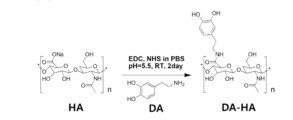
- FIG 1 schematically shows the structure of dopamine-hyaluronic acid conjugate (DA-HA).
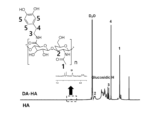
- Figure 2 shows the structure of DA-HA measured using H-NMR (Proton nuclear magnetic resonance).
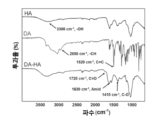
- Figure 3 shows the structures of HA, DA, and DA-HA measured using an attenuated total reflectance (ATR-FTIR) spectrum.
- Figure 4 shows a schematic of a GFP imaging experiment performed on AAV-GFAP104-GRAB DA2m transfected astrocytes.
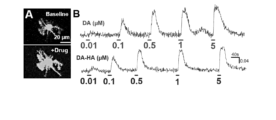
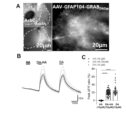
- Figure 5A shows the fluorescence intensity of GRAB DA2m after addition of control (top; baseline) and DA (bottom), measured using GFP imaging.
- FIG. 5B shows GFP transients (GFP) using GFP imaging, with doses of 0.01, 0.1, 0.5, 1, and 5 ⁇ M of DA (top) and DA-HA (bottom) in AAV-GFAP104-GRAB DA2m transfected astrocytes. transient).
- Figure 6B shows normalized GRABDA2m transients of 1 ⁇ M DA and 1 ⁇ M DA-HA in the same astrocytes.
- Figure 6C shows a graph quantifying the peak of the transient phenomenon in Figure 6B.
- Figure 7A shows the expression level of AAV-GFAP104-GRABDA2m virus in NAc (nucleus accumbens). Dashed lines represent the accumbens core (AcbC) and accumbens shell (Acbsh).
- Figure 7B shows transients when GRAB DA2M was treated with 10 ⁇ M HA, DA-HA and DA, with the red line representing the average value.
- Figure 7C shows a graph quantifying the peak of the transient phenomenon of 7B.
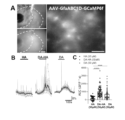
- Figure 8A shows the expression level of AAV-GfaABC1D-GCaMP6f virus in nerve cells.
- Figure 8B shows Ca2+ transients when GCaMP6f was treated with 50 ⁇ M HA, DA-HA, and DA.
- the red line represents the average value.
- Figure 8C shows a graph quantifying the peak of the Ca 2+ transient phenomenon in 8B.
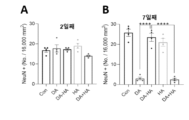
- Figure 9 shows the number of NeuN + cells at A) 2 days and B) 7 days when neurons were treated with 10 ⁇ M DA, 10 ⁇ M DA-HA, 120 ⁇ M HA, and 10 ⁇ M DA + 120 ⁇ M HA, respectively.
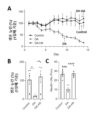
- Figure 10A shows changes in the number of surviving neurons over time upon DA and DA-HA treatments, respectively, for 14 days.
- Figure 10B shows a graph quantifying the percentage of surviving neurons on day 14 in Figure 10A.
- Figure 10C shows a graph quantifying the number of neurons on day 14 in Figure 10A through NeuN + staining.
- Figure 11 shows a graph quantifying A) sEPSC frequency, B) eEPSC amplitude, C) decay time, and D) rise time of neurons treated with control, DA, and DA-HA, respectively.
- Figure 12 shows the degree of auto-oxidation in neurons treated with DA and DA-HA for 24 hours.
- Figure 13 shows a schematic diagram of an experiment measuring autoxidation and cell viability of DIV 14 cortical cultured neurons treated with 1, 10, 50, and 100 ⁇ M DA and DA-HA daily for 7 days.
- Figure 14 shows a graph quantifying the cell oxidation level according to concentration during A) DA treatment, B) DA-HA treatment, and C) 100 ⁇ M DA and DA-HA treatment, respectively.
- Figure 15 shows a graph quantifying the cell viability according to concentration during A) DA treatment, B) DA-HA treatment, and C) cell viability level when treated with 100 ⁇ M DA and DA-HA, respectively.
- Figure 17A shows a graph quantifying the auto-oxidation level of neurons treated with 200 ⁇ M of DA, L-DOPA, 6-OHDA, and DA-HA at 0, 24, 48, and 72 hours, respectively, and Figure 17B is 0 hours; Figure 17C quantifies the auto-oxidation level of neurons at 72 hours, and Figure 17D quantifies the auto-oxidation level of neurons at 49 days.
- Figure 18 shows a schematic diagram of an experiment examining cell viability and levels of auto-oxidation in A) cells without auto-oxidation and B) cells in which auto-oxidation occurs.
- Figure 19A shows a graph quantifying cell viability when nerve cells were treated with 200 ⁇ M DA, L-DOPA, 6-OHDA, and DA-HA, respectively, in conditions without auto-oxidation.
- Figure 19B shows a graph quantifying the level of neuronal oxidation in conditions without auto-oxidation.
- Figure 19C shows a graph quantifying cell viability when nerve cells were treated with 200 ⁇ M DA, L-DOPA, 6-OHDA, and DA-HA, respectively, under auto-oxidizing conditions for 48 hours.
- Figure 19D shows a graph quantifying the level of auto-oxidation according to the presence or absence of nerve cells under auto-oxidation conditions for 48 hours.
- Figure 20A shows a schematic diagram of an experiment in which a drug was injected into the mouse substantia nigra pars compacta (SNpc).
- Figure 20B shows a graph quantifying the optical density when saline, 5Mm of DA, HA, DA-HA, 6-OHDA, and 50mM of 6-OHDA were injected into SNpc, respectively.
- Figure 21 shows fluorescence images of striatum (top) and SNpc (bottom) obtained through tyrosine hydroxylase fluorescence staining for each type of material injected in Figure 20B.
- Figure 22 shows the experimental schedule and detailed schematic for surgery and apomorphine-induced rotation testing.
- Figure 23 shows the results of an apomorphine-induced rotation test performed 10 minutes after vehicle (0.02% ascorbic acid), 2.5 Mm of DA-HA, L-DOPA, and DA were each injected into the striatum.
- the numerical range used in the present invention includes the lower limit and upper limit and all values within the range, increments logically derived from the shape and width of the defined range, all double-limited values, and numerical ranges defined in different forms. Includes all possible combinations of upper and lower limits. Unless otherwise specified in the specification of the present invention, values outside the numerical range that may occur due to experimental error or rounding of values are also included in the defined numerical range.
- prevention and treatment used in this specification should be interpreted in the broadest sense, and “prevention” refers to treatment in patients who may be exposed to or susceptible to a disease but have not yet experienced or displayed symptoms of the disease. This means preventing one or more of the clinical symptoms of the disease from progressing. “Treatment” means any action that arrests or reduces the development of a disease or one or more clinical symptoms thereof.
- the present disclosure provides a composition for preventing or treating brain diseases, comprising a dopamine-hyaluronic acid conjugate as an active ingredient.
- the dopamine-hyaluronic acid conjugate may be represented by the following formula (1).
- the dopamine-hyaluronic acid conjugate is in the form of a linear polymer, in which the repeating units represented by Formula 1 may be connected in one chain, and a form containing some branched chains of the polymer main chain can also be dissolved in water, so that it is a linear polymer. It can be included in the category of.
- the dopamine-hyaluronic acid complex may have a weight average molecular weight of 800 to 2,000,000 g/mol, specifically 1,000 to 1,500,000 g/mol, but is not limited thereto.
- the brain diseases include Parkinson's disease, attention deficit hyperactivity disorder (ADHD), Tourette syndrome, schizophrenia, bipolar disorder and addiction. It may be, and specifically, it may be Parkinson's disease.
- ADHD attention deficit hyperactivity disorder
- Tourette syndrome schizophrenia, bipolar disorder and addiction. It may be, and specifically, it may be Parkinson's disease.
- Parkinson's disease occurs when dopamine is not secreted normally due to degeneration of dopamine neurons in the substantia nigra of the midbrain. Neurons in the substantia nigra send dopaminergic axons to the caudate nucleus or putamen, which excite D1 receptors and inhibit D2 receptors. In Parkinson's disease, dopamine is lost in both types of receptors, resulting in movement disorders such as tremor, muscle stiffness and slowness of body movements, bradykinesia, and postural instability.
- Dopamine-hyaluronic acid conjugate is a dopamine mimic that supplements insufficient dopamine secretion in the substantia nigra of the midbrain, and can transmit signals between cells as a neurotransmitter by binding to dopamine receptors.
- the toxicity of dopamine and dopamine derivatives such as L-DOPA is mainly caused by intracellular free radicals or extracellular oxidation of reactive oxygen species (ROS).
- ROS reactive oxygen species
- dopamine enters the cell through a monoamine transporter dopamine induces cytotoxicity by forming radicals through the unpaired free electrons of superoxide generated by decomposition by monoamine oxidase.
- Extracellular oxidation causes cytotoxicity in various cell types such as midbrain, cerebral cortex, and astrocytes, and extrinsic oxidation of dopamine induces non-specific cell death.
- Hyaluronic acid is a biosynthetic natural substance that exists in large quantities in the skin of animals, etc., and is a hydrophilic substance with many hydroxyl groups (-OH).
- the composition for preventing or treating Parkinson's disease prevents oxidation of the amino and hydroxy groups of dopamine by binding dopamine to the carboxyl group of hyaluronic acid.
- the dopamine-hyaluronic acid conjugate formed as a result has low cytotoxicity and significantly fewer side effects such as cell oxidation, so it may be suitable for use as a novel composition for preventing or treating Parkinson's disease.
- composition for preventing or treating brain diseases of the present disclosure may have 0.5 to 10 mol% of dopamine covalently bound to the total number of moles of gluconic acid contained in the dopamine-hyaluronic acid conjugate, but is not limited thereto.
- composition for preventing or treating brain diseases according to the present disclosure may include 1 to 200 ⁇ M of the dopamine-hyaluronic acid conjugate, but is not limited thereto.
- the dopamine-hyaluronic acid conjugate of the present disclosure can be delivered to the brain or nerve cells and act as a dopamine mimetic as a neurotransmitter.
- Dopamine mimetics act to activate dopamine receptors in the absence or absence of dopamine. , could become a major treatment candidate for Parkinson's disease.
- composition for preventing or treating brain diseases according to the present disclosure can be applied in any formulation containing a dopamine-hyaluronic acid conjugate as an active ingredient, and can be prepared as an oral or parenteral formulation.
- Formulations for oral administration containing the composition of the present disclosure as an active ingredient include, for example, tablets, troches, lozenges, water-soluble or oily suspensions, powders or granules, emulsions, hard or soft capsules, syrups or elixirs. can do.
- binders such as lactose, saccharose, sorbitol, mannitol, starch, amylopectin, cellulose or gelatin, excipients such as dicalcium phosphate, disintegrants such as corn starch or sweet potato starch, and stear.
- It may contain a lubricant such as magnesium acid, calcium stearate, sodium stearyl fumarate, or polyethylene glycol wax, and in the case of a capsule formulation, it may further contain a liquid carrier such as fatty oil in addition to the above-mentioned substances.
- a lubricant such as magnesium acid, calcium stearate, sodium stearyl fumarate, or polyethylene glycol wax
- a liquid carrier such as fatty oil in addition to the above-mentioned substances.
- Formulations for parenteral administration containing the composition of the present disclosure as an active ingredient include intradermal, intramuscular, intraperitoneal, intravenous, subcutaneous, intranasal, epidural, intracerebral, intracerebroventricular, intrathecal, and transdermal injections. It may be in a form, specifically for intracerebral injection or intracerebroventricular injection (ICV).
- the composition of the present invention can be mixed in water with a stabilizer or buffer to prepare a solution or suspension, and the composition can be formulated for unit administration in ampoules or vials.
- the formulation for parenteral administration can be administered by intracerebral injection, and specifically, it can be administered by intracerebral injection into the substantia nigra pars compacta (SNpc). Accordingly, dopamine deficiency in the substantia nigra dense part can be effectively improved, and brain disease prevention and treatment effects can be obtained.
- SNpc substantia nigra pars compacta
- the formulation for parenteral administration can be formulated into a composition for rectal administration, such as a suppository or enema containing a common suppository base such as cocoa butter or other glycerides, for suppository injection or injection through the respiratory tract.
- a composition for rectal administration such as a suppository or enema containing a common suppository base such as cocoa butter or other glycerides, for suppository injection or injection through the respiratory tract.
- a composition for rectal administration such as a suppository or enema containing a common suppository base such as cocoa butter or other glycerides
- a propellant such as an aerosol, a propellant, etc. may be mixed with additives to disperse the water-dispersed concentrate or wet powder.
- the pharmaceutical composition according to the present invention is administered in a pharmaceutically effective amount.
- pharmaceutically effective amount means an amount sufficient to treat the disease with a reasonable benefit/risk ratio applicable to medical treatment, and the effective dose level is determined by the type, severity, and activity of the patient's disease. , may be determined based on factors including sensitivity to the drug, time of administration, route of administration and excretion rate, duration of treatment, concurrently used drugs, and other factors well known in the field of medicine.
- the pharmaceutical composition according to the present invention may be administered as an individual therapeutic agent or in combination with other therapeutic agents, may be administered sequentially or simultaneously with conventional therapeutic agents, and may be administered singly or multiple times. Considering all of the above factors, it is important to administer an amount that can achieve maximum effect with the minimum amount without side effects, and this can be easily determined by a person skilled in the art.
- the dopamine-hyaluronic acid conjugate for use as a treatment for Parkinson's disease according to the present invention and the composition for preventing and treating brain diseases containing the same will be described in more detail through specific examples.
- the following examples are only a reference for explaining the present invention in detail, and the present invention is not limited thereto, and may be implemented in various forms. Additionally, the terms used in the description in the present invention are only intended to effectively describe specific embodiments and are not intended to limit the present invention.
- hyaluronic acid to be used in the synthesis of dopamine-hyaluronic acid (DA-HA) conjugate was purchased from Hyundai Bioland (product name: sodium hyalunate).
- Dopamine (DA) was conjugated with the carboxyl group of hyaluronic acid (HA), as shown in Figure 1.
- Figure 2 the structure of the DA-HA conjugate was investigated using 1H-NMR (Proton nuclear magnetic resonance), with the proton of the aromatic ring of DA at 6.6 to 6.9 ppm and the N-acetyl group of HA at 1.9 ppm. A peak appeared at ppm.
- DA-HA dopamine-hyaluronic acid conjugate
- GRAB DA2m a fluorescent sensor that detects DA, was used as an exogenous dopamine receptor.
- AAV-GFAP104-GRAB DA2m clone was transfected into rat primary cultured astrocytes, and real-time fluorescence imaging was performed.
- fluorescence transients increased with increasing doses of DA or DA-HA.
- AAV-GFAP104-GRAB DA2m virus was injected into the nucleus accumbens (NAc), which includes the core (accumbens core; AcbC) and shell (accumbens shell; Acbsh) regions, and fluorescence was detected. Imaging experiments were performed. As shown in Figure 7, both 10 ⁇ M DA and DA-HA (but not HA) induced similar fluorescence transient peak amplitudes in the same region of interest, showing that DA-HA exhibits similar pharmacological properties to DA ex vivo .
- DA is known to induce Ca 2+ transients in astrocytes within the nucleus accumbens (NAc).
- NAc nucleus accumbens
- DA-HA also generates Ca 2+ transients in the nucleus accumbens (NAc)
- astrocytes were monitored by injecting AAV-GfaABC1D-GCaMP6f virus. As shown in Figure 8, it was confirmed that both 50 ⁇ M DA and DA-HA induce the same Ca 2+ transient phenomenon, and it can be seen that they functionally activate endogenous DA receptors in astrocytes.
- ROS reactive oxygen species
- rat primary neurons were treated with 10 ⁇ M DA-HA or 10 ⁇ M DA, respectively, daily for 14 days, and NeuN and MAP2 were monitored on day 14.
- the DA-HA treatment group did not show significant neuronal death for 14 days, but the percentage of surviving nerve cells in the DA treatment group was significantly reduced ( Figures 10A and 10B).
- Figure 10C which shows the number of surviving neurons on day 14, DA significantly decreased the proportion of surviving neurons compared to the control group, but DA-HA did not.
- DIV 14 cortical cultured neurons treated with 1, 10, 50, and 100 ⁇ M DA and DA-HA daily for 7 days in neuronal medium were measured by measuring the OD at 405 nm and 450 nm, respectively. Autooxidation and cell viability were sequentially monitored from neuronal cultures. As shown in Figure 14, DA showed increased autoxidation in a concentration-dependent manner, whereas DA-HA did not ( Figures 14A and 14B). As shown in Figure 14C, at 100 ⁇ M concentration, DA showed significantly higher auto-oxidation than DA-HA, while DA-HA showed almost no auto-oxidation compared to the control.
- cell oxidation level/cell viability was defined as cell safety, and cell stability was calculated by dividing the OD at 450 nm by the OD at 405 nm for each well of the same culture plate as in the above experiment.
- DA-HA showed higher cell safety compared to DA.
- 6-OHDA showed a significant improvement in cell viability under pre-autoxidation conditions (Figure 19C), which indicates that unlike DA and L-DOPA, 6-OHDA itself is toxic, but the oxidized form of 6-OHDA is not toxic. This suggests that it may be less.
- DA-HA did not kill dopaminergic neurons in the substantia nigra and maintains safety.
- DA-HA was directly injected into the substantia nigra pars compacta of mice, as shown in Figure 20A. 14 days after injection of saline, 5 mM DA, HA, DA-HA, 6-OHDA, or 50 mM 6-OHDA, dopaminergic neurons were examined in the cell body (SNpc) and striatum (axon). To this end, tyrosine hydroxylase immunostaining, which labels dopaminergic neurons, was performed.
- DA-HA had the effect of alleviating Parkinson's disease motor symptoms
- a 6-OHDA-induced mouse model of Parkinson's disease was used.
- guide cannulas were inserted bilaterally into the mouse substantia nigra pars compacta and striatum, and an apomorphine-induced rotation test was performed 14 days after surgery.
- Figure 23 it was found that injecting 2 ⁇ l of 2.5 Mm DA-HA or 2.5 mM DA into the striatum for 10 minutes in the left hemisphere significantly reduced the counterclockwise rotation induced by apomorphine within 10 minutes after drug injection. did. This indicates that DA-HA restored dopamine signaling in the striatum ipsilateral to the 6-OHDA lesion.
- DA-HA is a substance that can immediately relieve Parkinson's disease motor symptoms in animal models of Parkinson's disease.
Landscapes
- Health & Medical Sciences (AREA)
- Public Health (AREA)
- Animal Behavior & Ethology (AREA)
- Chemical & Material Sciences (AREA)
- Medicinal Chemistry (AREA)
- Pharmacology & Pharmacy (AREA)
- Veterinary Medicine (AREA)
- Life Sciences & Earth Sciences (AREA)
- Bioinformatics & Cheminformatics (AREA)
- General Health & Medical Sciences (AREA)
- Engineering & Computer Science (AREA)
- Neurosurgery (AREA)
- Biomedical Technology (AREA)
- Epidemiology (AREA)
- Neurology (AREA)
- Emergency Medicine (AREA)
- Psychology (AREA)
- Chemical Kinetics & Catalysis (AREA)
- General Chemical & Material Sciences (AREA)
- Nuclear Medicine, Radiotherapy & Molecular Imaging (AREA)
- Organic Chemistry (AREA)
- Pharmaceuticals Containing Other Organic And Inorganic Compounds (AREA)
Abstract
본 발명은 도파민-히알루론산을 포함한 파킨슨병 치료용 조성물에 관한 것으로, 구체적으로 도파민 모방체로서 신경세포에 도파민을 공급하는 치료용 조성물에 관한 것이다. 상기 조성물은 신경세포에 도파민을 보충하여 파킨슨병 유발 운동 장애 치료 효과를 가지며, 기존의 파킨슨병 치료용도로 뇌에 공급한 도파민 및 이의 유도체와 달리, 장기간 투여 시에도 자동 산화로 인한 세포 독성이 적고, 현저히 낮은 세포 사멸 및 우수한 세포내 안정성을 제공한다.
Description
본 발명은 도파민-히알루론산을 포함한 파킨슨병 치료용 조성물에 관한 것으로, 구체적으로 도파민 모방체로서 신경세포에 도파민을 공급하는 치료용 조성물에 관한 것이다.
도파민(Dopamine; DA)는 신경전달물질 중의 하나로써, 흑질선조체 신경경로(nigrostriatal pathway)를 통해 신호를 전달한다. 도파민 신호는 운동, 보상, 학습 및 기억과 같은 다양한 생리적 기능에 관여하며, 중추신경계에서 나타나는 도파민 관련 질환은 사회공포증, 뚜렛증후군, 파킨슨병, 조현병, 주의력결핍 과잉행동장애가 있다. 도파민은 또한 시상하부에 의해 분비되는 호르몬으로써 뇌하수체 전엽에서 프로락틴의 분비를 억제한다. 도파민은 심장 박동수와 혈압을 증가시키는 효과를 내며 교감 신경계에 작용하는 정맥주사 약물로서 사용할 수 있다.
파킨슨병은 신경퇴행성질환의 하나로, 중뇌의 흑색질의 도파민 신경 세포의 퇴행으로 인하여 도파민이 정상적으로 분비되지 않아 발생한다. 흑색질의 신경 세포는 꼬리핵 또는 피각으로 도파민성 축색을 보내는데, 이 축색들은 D1 수용기는 흥분시키고, D2 수용기는 억제한다. 파킨슨병은 이 두 종류의 수용기 모두에서 도파민이 상실되면서, 진전(떨림), 근육의 강직 및 몸동작이 느려지는 운동완서, 자세 불안 등의 운동 장애가 나타난다.
파킨슨병의 치료를 위해, 뇌에서 부족한 도파민을 대신할 수 있는 다양한 약물이 개발되고 있다. 도파민은 뇌혈관장벽을 통과할 수 없기 때문에, 혈액-뇌 장벽을 쉽게 통과하는 도파민의 전구물질 L-DOPA(levodopa)를 이용한 치료가 대표적이다. 하지만, L-DOPA를 이용한 장기치료는 L-DOPA 유발성 운동이상증 (LID; L-DOPA-induced dyskinesia)이라는 심각한 부작용을 유발한다. 도파민 및 이의 유도체는 세포 외 활성산소종(ROS; reactive oxygen species) 및 세포 내 자동 산화(autoxidation)에 의해 비특이적 세포 사멸을 유발한다.
이에 따라, 세포 독성이 낮고 생체적합성이 높은 파킨슨병 치료제의 필요성이 강조되고 있다.
본 발명은 도파민 모방체의 역할로서, 도파민-히알루론산 결합체를 포함하는 파킨슨병 예방 또는 치료용 조성물을 제공하는 것을 목적으로 한다.
본 발명은 도파민-히알루론산 결합체를 유효성분으로 포함하는, 뇌질환 예방 또는 치료용 조성물을 제공한다.
상기 도파민-히알루론산 결합체는 하기 화학식 1로 표현되는 구조단위를 포함할 수 있다.
[화학식 1]

상기 도파민-히알루론산 결합체는 뇌 또는 신경세포에 전달되어, 신경전달물질로서 도파민 모방체의 역할을 할 수 있다.
상기 도파민-히알루론산 결합체는 선형 고분자일 수 있다.
상기 도파민-히알루론산 결합체에 포함되는 글루콘산 총 몰수에 대해 도파민이 0.5 내지 10 몰%로 공유결합 되어 있을 수 있다.
본 발명의 일 양태에 따른 뇌질환 예방 또는 치료용 조성물은 상기 도파민-히알루론산 결합체를 1 내지 200 μM 농도로 포함할 수 있다.
상기 뇌질환 예방 또는 치료용 조성물은 경구 투여용 제제 또는 비경구 투여용 제제의 제형일 수 있다.
상기 경구 투여용 제제의 제형은 정제, 환제, 경·연질 캅셀제, 액제, 현탁제, 유화제, 시럽제, 과립제, 또는 엘릭서제(elixirs)일 수 있다.
상기 비경구 투여용 제제는 뇌내 주사로 투여될 수 있다.
본 발명의 일 양에 따른 뇌질환 예방 또는 치료용 조성물은 파킨슨병 예방 또는 치료용 조성물일 수 있다.
본 발명에 따른 도파민-히알루론산 결합체를 포함하는 파킨슨병 치료용 조성물은 신경세포에 도파민을 보충하여 파킨슨병 유발 운동 장애 치료 효과를 가진다.
또한 본 발명은 기존의 도파민 및 이의 유도체와 달리, 장기간 투여할 때 자동 산화(autoxidation)로 인한 세포 독성이 적어, 현저히 낮은 신경 세포 사멸 및 우수한 세포내 안정성을 제공한다.
도 1은 도파민-히알루론산 결합체(DA-HA) 구조를 도식적으로 나타낸다.
도 2는 H-NMR(Proton nuclear magnetic resonance)을 이용하여 측정한 DA-HA의 구조를 나타낸다.
도 3은 ATR-FTIR(Attenuated total reflectance) 스펙트럼을 이용하여 측정한, HA, DA, 및 DA-HA의 구조를 나타낸다.
도 4는 AAV-GFAP104-GRAB DA2m 형질 감염된 성상 세포에 대해 수행한, GFP 이미징 실험의 개략도를 나타낸다.
도 5A는 GFP 이미징을 이용하여 측정한, GRAB DA2m의 대조군(상단; baseline)과 DA(하단)를 추가한 후의 형광 강도를 나타낸다.
도 5B는 GFP 이미징을 이용하여, AAV-GFAP104-GRAB DA2m 형질 감염된 성상 세포에서 0.01, 0.1, 0.5, 1 및 5μM의 DA (상단) 및 DA-HA (하단)의 용량을 갖는 GFP 과도 현상(GFP transient)을 나타낸다.
도 6A는 DA(빨간색, n = 3) 및 DA-HA(파란색, n = 4)에 의한 GFP 과도 현상 및 EC50의 정규화된 피크에 대한 농도 의존 곡선을 나타낸다.
도 6B는 동일한 성상 세포에서 1μM DA 및 1μM DA-HA의 정규화된 GRABDA2m 과도 현상(transient)을 나타낸다.
도 6C는 도6B의 과도현상의 피크를 수치화한 그래프를 나타낸다.
도 7A은 NAc(nucleus accumbens)에서 AAV-GFAP104-GRABDA2m 바이러스의 발현정도를 나타낸다. 점선은 측좌 코어(accumbens core; AcbC) 및 측좌 쉘(accumbens shell; Acbsh)을 나타낸다.
도 7B는 GRAB DA2M를 10μM HA, DA-HA 및 DA로 처리하였을 때, 과도 현상을 나타내며, 빨간색 선은 평균값을 나타낸다.
도 7C는 7B의 과도현상의 피크를 수치화한 그래프를 나타낸다.
도 8A은 신경세포에서 AAV-GfaABC1D-GCaMP6f 바이러스의 발현정도를 나타낸다.
도 8B는 GCaMP6f를 50μM HA, DA-HA 및 DA로 처리하였을 때, Ca2+ 과도 현상을 나타낸다. 빨간색 선은 평균값을 나타낸다.
도 8C는 8B의 Ca2+ 과도현상의 피크를 수치화한 그래프를 나타낸다.
도 9는 신경세포에 각각 10μM DA, 10μM DA-HA, 120μM HA 및 10μM DA + 120μM HA을 처리하여 배양할 때, A) 2일 및 B) 7일에서 NeuN+ 세포수를 나타낸다.
도 10A는 14일 동안 각각 DA 및 DA-HA 처리 시 시간에 따른 생존 뉴런 수의 변화를 나타낸다.
도 10B는 도 10A에서 14일차의 생존 뉴런 비율을 수치화한 그래프를 나타낸다.
도 10C는 NeuN+ 염색을 통해, 도 10A에서 14일차의 신경세포의 개수를 수치화한 그래프를 나타낸다.
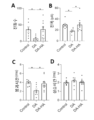
도 11는 각각 대조군, DA 및 DA-HA를 처리한 신경세포의 A) sEPSC 진동수, B) eEPSC 진폭 C) 붕괴시간, D) 상승시간을 수치화한 그래프를 나타낸다.
도 12는 DA 및 DA-HA를 처리한 신경세포에서 24시간 동안 자동 산화 정도를 나타낸다.
도 13은 7일 동안 매일 1, 10, 50 및 100 μM DA 및 DA-HA를 처리한 DIV 14 피질 배양 신경세포의 자동 산화 및 세포 생존 능력을 측정한 실험의 개략도를 나타낸다.
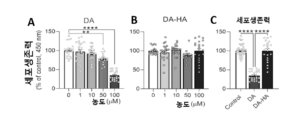
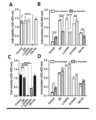
도 14는 A) DA 처리시, B) DA-HA 처리시 농도에 따른 세포 산화 수준 및 C) 각각 100μM의 DA 및 DA-HA 처리시, 세포의 산화 수준을 수치화한 그래프를 나타낸다.
도 15는 A) DA 처리시, B) DA-HA 처리시 농도에 따른 세포 생존력 및 C) 각각 100μM의 DA 및 DA-HA 처리시, 세포 생존력 수준을 수치화한 그래프를 나타낸다.
도 16은 A) DA 처리시, B) DA-HA 처리시 농도에 따른 세포 안전성(=세포 산화 수준/세포 생존력) 및 C) 각각 100μM의 DA 및 DA-HA 처리시, 세포 안전성 수준을 수치화한 그래프를 나타낸다.
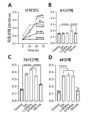
도 17A는 0, 24, 48 및 72시간에 각각 200μM의 DA, L-DOPA, 6-OHDA 및 DA-HA을 처리한 신경세포의 자동 산화 수준을 수치화한 그래프를 나타내고, 도 17B는 0시간, 도 17C는 72시간, 도 17D는 49일에서의 신경세포의 자동 산화 수준을 수치화하였다.
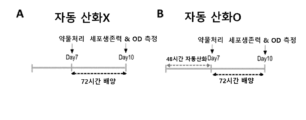
도 18에서 A)자동 산화가 없는 세포 및 B) 자동 산화가 발생하는 세포에서의 세포 생존율 및 자동 산화 수준을 조사하는 실험에 대한 개략도를 나타낸다.
도 19A는 자동 산화가 없는 조건에서의 신경세포에 각각 200 μM DA, L-DOPA, 6-OHDA 및 DA-HA를 처리하였을 때, 세포 생존력을 수치화한 그래프를 나타낸다.
도 19B는 자동 산화가 없는 조건에서의 신경세포 산화 수준을 수치화한 그래프를 나타낸다.
도 19C는 48시간 자동 산화 조건에서의 신경세포에 각각 200 μM DA, L-DOPA, 6-OHDA 및 DA-HA를 처리하였을 때, 세포 생존력을 수치화한 그래프를 나타낸다.
도 19D는 48시간 자동산화조건에서 신경 세포의 유무에 따른 자동 산화 수준을 수치화한 그래프를 나타낸다.
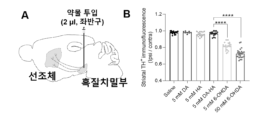
도 20A는 마우스 흑질 치밀부(substantia nigra pars compacta; SNpc)에 약물을 주입한 실험 개략도를 나타낸다.
도 20B는 SNpc에 각각 식염수, 5Mm의 DA, HA, DA-HA, 6-OHDA 및 50mM의 6-OHDA를 주입하였을 때, 광학 밀도를 수치화한 그래프를 나타낸다.
도 21은 도20B에서 각각 주입한 물질의 종류 별로 티로신 하이드록실라제 형광염색을 통해 얻은 striatum (상단) 및 SNpc (하단)의 형광 이미지를 나타낸다.
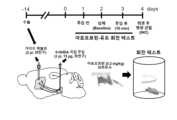
도 22는 수술 및 아포모르핀 유도 회전 테스트에 대한 실험 일정 및 세부 개략도를 나타낸다.
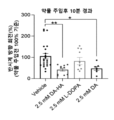
도 23는 비히클(0.02 % 아스코르브 산), 2.5 Mm의 DA-HA, L-DOPA 및 DA를 각각 선조체에 주입 한 후 10분간, 아포모르핀 유도 회전 테스트를 수행한 결과를 나타낸다.
이하에서 본 발명에 대하여 구체적으로 설명한다. 본 명세서에서 사용되는 용어는 따로 정의하지 않는 경우 해당 분야에서 통상의 지식을 가진 자가 일반적으로 이해하는 내용으로 해석되어야 할 것이다. 본 명세서의 도면 및 실시예는 통상의 기술자가 본 발명을 쉽게 이해하고 실시하기 위한 것으로 도면 및 실시예에서 발명의 요지를 흐릴 수 있는 내용은 생략될 수 있으며, 본 발명이 도면 및 실시예로 한정되는 것은 아니다.
본 명세서에서 이용되는 단수 형태는 문맥에서 특별한 지시가 없는 한 복수 형태도 포함하는 것으로 의도할 수 있다.
또한, 본 발명서에서 사용되는 수치 범위는 하한치와 상한치와 그 범위 내에서의 모든 값, 정의되는 범위의 형태와 폭에서 논리적으로 유도되는 증분, 이중 한정된 모든 값 및 서로 다른 형태로 한정된 수치 범위의 상한 및 하한의 모든 가능한 조합을 포함한다. 본 발명의 명세서에서 특별한 정의가 없는 한 실험 오차 또는 값의 반올림으로 인해 발생할 가능성이 있는 수치범위 외의 값 역시 정의된 수치범위에 포함된다.
본 명세서에서 포함하다, 가지다, 구비하다 등의 용어는 명세서 상에 기재된 특징, 또는 구성요소가 존재함을 의미하는 것이고, 특별히 한정하지 않는 한, 하나 이상의 다른 특징들 또는 구성요소가 부가될 가능성을 미리 배제하는 것은 아니다.
본 명세서에서 사용되는 용어 "예방", 및 "치료"는 최광의의 개념으로 해석되어야 하며, "예방"이란, 질환에 노출되거나 질환에 걸리기 쉬울 수 있으나 질환의 증상을 아직 경험하거나 드러내지 아니한 환자에게서 질환의 임상적 증상 중 하나 이상이 진행되지 아니하도록 하는 것을 의미한다. "치료"란, 질환 또는 이의 하나 이상의 임상적 증상의 발달을 저지 또는 감소시키는 모든 행위를 의미한다.
본 개시는 도파민-히알루론산 결합체를 유효성분으로 포함하는, 뇌질환 예방 또는 치료용 조성물을 제공한다.
상기 도파민-히알루론산 결합체는 하기 화학식 1로 표시될 수 있다.
[화학식 1]

상기 도파민-히알루론산 결합체는 선형 고분자 형태로, 상기 화학식 1로 표시되는 반복 단위들이 하나의 사슬로 연결되어 있을 수 있고, 고분자 주쇄 중 분지쇄가 일부 포함되는 형태도 물에 용해될 수 있다면 선형 고분자의 범주에 포함될 수 있다.
상기 도파민-히알루론산 결합체는 중량평균분자량이 800 내지 2,000,000 g/mol일 수 있으며, 구체적으로는 1,000 내지 1,500,000 g/mol 일 수 있으나 이에 제한되지 않는다.
상기 뇌질환은 파킨슨병(Parkinson's disease), 주의력결핍 과잉행동장애(attention deficit hyperactivity disorder, ADHD), 투렛증후군(Tourette syndrome), 조현병(schizophrenia), 양극성 장애(bipolar disorder) 및 중독(addiction)일 수 있으며, 구체적으로 파킨슨병일 수 있다.
파킨슨병은 중뇌의 흑색질의 도파민 신경 세포의 퇴행으로 인하여 도파민이 정상적으로 분비되지 않아 발생한다. 흑색질의 신경 세포는 꼬리핵 또는 피각으로 도파민성 축색을 보내는데, 이 축색들은 D1 수용기는 흥분시키고, D2 수용기는 억제한다. 파킨슨병은 이 두 종류의 수용기 모두에서 도파민이 상실되면서, 진전(떨림), 근육의 강직 및 몸동작이 느려지는 운동완서, 자세 불안 등의 운동 장애가 나타난다.
도파민-히알루론산 결합체는 도파민 모방체로 중뇌의 흑색질에서 부족한 도파민 분비를 보충하며, 도파민 수용체에 결합하여 신경전달물질로서 세포와 세포 사이의 신호를 전달할 수 있다.
도파민 및 L-DOPA와 같은 도파민 유도체의 독성은 주로 반응성 산소종(reactive oxygen species; ROS)의 세포내 자유 라디칼 또는 세포외 산화에 의해 유발된다. 한편, 도파민이 모노아민 수송체를 통해 세포 내부로 유입되면 도파민은 모노아민 산화효소에 의해 분해되어 생성된 슈퍼옥사이드의 짝을 이루지 않은 자유 전자를 통해 라디칼을 형성하여 세포독성을 유도한다. 세포 외 산화는 중뇌, 대뇌 피질, 성상 세포와 같은 다양한 세포 유형에서 세포 독성을 유발하며, 도파민의 외부 산화는 비특이적 세포 사멸을 유도한다.
히알루론산(hyaluronic acid)은 동물 등의 피부에 많이 존재하는 생체 합성 천연 물질로, 수산화기(-OH)를 많이 가지고 있는 친수성 물질이다.
본 개시에 따른 파킨슨병 예방 또는 치료용 조성물은 도파민이 히알루론산의 카복시기에 결합하여, 도파민의 아미노기 및 하이드록시기가 산화되는 것을 방지한다. 이에 따라 형성된 도파민-히알루론산 결합체는 세포 독성이 낮으며, 세포 산화작용 등의 부작용이 현저히 적어 신규한 파킨슨병 예방 또는 치료용 조성물로 사용하기 적합할 수 있다.
본 개시의 뇌질환 예방 또는 치료용 조성물은 도파민-히알루론산 결합체에 포함되는 글루콘산 총 몰수에 대해 도파민이 0.5 내지 10 몰%로 공유결합되어 있을 수 있으나, 이에 한정되는 것은 아니다.
본 개시에 따른 뇌질환 예방 또는 치료용 조성물은 도파민-히알루론산 결합체를 1 내지 200μM 포함할 수 있으나, 이에 한정되는 것은 아니다.
본 개시의 도파민-히알루론산 결합체는 뇌 또는 신경세포에 전달되어, 신경전달물질로서 도파민 모방체의 역할을 할 수 있다.
"도파민 모방체(mimetics)", "도파민 작용체(agonist)", "도파민 유도체", "도파민 유사체" 및 "도파민 효능제"는 도파민이 부족하거나 거의 없는 상태에서 도파민 수용체를 활성화시키는 작용을 하며, 파킨슨병의 주요 치료제 후보군이 될 수 있다.
본 개시에 따른 뇌질환 예방 또는 치료용 조성물은 도파민-히알루론산 결합체를 유효성분으로 포함하는 어떠한 제형으로도 적용가능하며, 경구용 또는 비경구용 제형으로 제조할 수 있다.
본 개시의 조성물을 유효성분으로 포함하는 경구 투여용 제형으로는, 예를 들어 정제, 트로키제, 로렌지, 수용성 또는 유성현탁액, 조제분말 또는 과립, 에멀젼, 하드 또는 소프트 캡슐, 시럽 또는 엘릭시르제로 제제화할수 있다. 정제 및 캡슐 등의 제형으로 제제화하기 위해, 락토오스, 사카로오스, 솔비톨, 만니톨, 전분, 아밀로 펙틴, 셀룰로오스 또는 젤라틴과 같은 결합제, 디칼슘 포스페이트와 같은 부형제, 옥수수 전분 또는 고구마 전분과 같은 붕괴제, 스테아르산 마스네슘, 스테아르산 칼슘, 스테아릴푸마르산 나트륨 또는 폴리에틸렌글리콜 왁스와 같은 윤활유를 포함할 수 있으며, 캡슐제형의 경우 상기 언급한 물질 외에도 지방유와 같은 액체 담체를 더 함유할 수 있다.
본 개시의 조성물을 유효성분으로 포함하는 비경구 투여용 제형으로는, 피부내, 근육내, 복강내, 정맥내, 피하, 비강내, 경막외, 뇌내, 뇌실내, 수막강내, 경피 주사용 형태일 수 있으며, 구체적으로 뇌내 주사(intracerebral injection) 또는 뇌실내 주사(intraceverbroventricular injection; ICV)용 형태 일 수 있다. 주사용 제형으로 제제화하기 위해서는 본 발명의 조성물을 안정제 또는 완충제와 함께 물에서 혼합하여 용액 또는 현탁액으로 제조하고, 이를 앰플 또는 바이알의 단위 투여용으로 제제화할 수 있다.
상기 비경구 투여용 제제는 뇌내 주사로 투여될 수 있으며, 구체적으로 흑질 치밀부(substantia nigra pars compacta; SNpc)에 뇌내 주사하여 투여될 수 있다. 이에 따라 상기 흑질 치밀부의 도파민 결핍을 효과적으로 호전시키고, 뇌질환 예방 및 치료효과를 얻을 수 있다.
상기 비경구 투여용 제형으로, 좌제 주입방식 또는 호흡기를 통하여 좌제로 주입하기 위해서는, 코코아버터 또는 다른 글리세라이드 등 통상의 좌약 베이스를 포함하는 좌약 또는 관장제와 같은 직장투여용 조성물로 제제화할 수 있다. 에어로졸제 등의 스프레이용으로 제형화하는 경우, 수분산된 농축물 또는 습윤 분말이 분산되도록 추진제 등이 첨가제와 함께 배합될 수 있다.
본 발명에 따른 약학 조성물은 약학적으로 유효한 양으로 투여한다.
본 발명에 있어서, "약학적으로 유효한 양"은 의학적 치료에 적용 가능한 합리적인 수혜/위험 비율로 질환을 치료하기에 충분한 양을 의미하며, 유효용량 수준은 환자의 질환의 종류, 중증도, 약물의 활성, 약물에 대한 민감도, 투여 시간, 투여 경로 및 배출 비율, 치료기간, 동시 사용되는 약물을 포함한 요소 및 기타 의학 분야에 잘알려진 요소에 따라 결정될 수 있다. 본 발명에 따른 약학 조성물은 개별 치료제로 투여하거나 다른 치료제와 병용하여 투여될 수 있고 종래의 치료제와는 순차적 또는 동시에 투여될 수 있으며, 단일 또는 다중 투여될 수있다. 상기한 요소들을 모두 고려하여 부작용 없이 최소한의 양으로 최대 효과를 얻을 수 있는 양을 투여하는것이 중요하며, 이는 당업자에 의해 용이하게 결정될 수 있다.
이하, 구체적인 실시예를 통해 본 발명에 따른 파킨슨병 치료제 용도의 도파민-히알루론산 결합체, 이를 포함하는 뇌질환 예방 및 치료용 조성물에 대하여 더욱 상세히 설명한다. 다만 하기 실시예는 본 발명을 상세히 설명하기 위한 하나의 참조일 뿐 본 발명이 이에 한정되는 것은 아니며, 여러 형태로 구현될 수 있다. 또한 본 발명에서 설명에 사용되는 용어는 단지 특정 실시예를 효과적으로 기술하기 위함이고, 본 발명을 제한하는 것으로 의도되지 않는다.
[제조예 1] 도파민-히알루론산(DA-HA) 결합체의 합성
본 발명에서는 도파민-히알루론산(DA-HA) 결합체의 합성에 사용할 히알루론산을 현대바이오랜드(제품명: sodium hyalunate)에서 구입하였다. 도파민(DA)는 도 1에 나타난 것과 같이, 히알루론산(HA)의 카르복실기와 접합되었다. 도 2에서 나타낸 것과 같이, DA-HA 접합체의 구조는 1H-NMR(Proton nuclear magnetic resonance)을 사용하여 조사하였으며, DA의 방향족 고리의 양성자는 6.6 내지 6.9 ppm에서, HA의 N-아세틸 그룹은 1.9 ppm에서 피크가 나타났다. 또한, 도 3에서 나타난 FTIR-ATR25을 사용한 구조 분석에서, DA-HA 결합을 나타내는 1720, 1630 및 1410 cm-1의 피크 변화를 측정했다. 이는 DA-HA가 도 1에서 나타난 구조대로 적합하게 결합된 것을 보여준다. 결과적으로, 표 1과 같이, 1g의 HA 당, 5.33, 23.59, 35.33 및 39.02 mg의 DA가 결합할 때, DA 대 HA의 몰비가 각각 0.1, 0.2, 0.5 및 1 으로 결합한다. 이러한 결과는 DA-HA의 합성이 적합하게 이뤄짐을 보여준다.
| 샘플 |
DA/HA 몰비 (DA/HA residue) |
DA-HA 결합한 도파민 비율 (%) |
DA/HA 질량비 (mg/g) |
mmol(DA) /g(HA) 비율 |
수율 (%) |
| DA-HA |
0.1 | 1.13 | 5.33 | 0.03 | 59.79 |
| 0.2 | 5.01 | 23.59 | 0.12 | 60.32 | |
| 0.5 | 7.51 | 35.33 | 0.19 | 59.91 | |
| 1 | 8.29 | 39.02 | 0.21 | 47.61 |
[실험예 1] 도파민-히알루론산 결합체(DA-HA)의 도파민 모방체 기능
<외인성 도파민 센서 GRAB DA2m을 이용한 DA-HA 감지>
도파민-히알루론산 결합체(DA-HA)가 도파민(DA)과 유사한 약리학적 특성을 나타내는지 조사하기 위해, DA를 감지하는 형광 센서인 GRAB DA2m을 외인성 도파민 수용체로 사용하였다. 도 4에서 나타낸 것과 같이, AAV-GFAP104-GRAB DA2m 클론을 쥐의 일차 배양 성상세포에 형질 감염시키고, 실시간 형광 이미징을 수행했다. 도 5에서 나타낸 것과 같이, 형광 과도 현상(Fluorescence transients)은 DA 또는 DA-HA의 용량이 증가함에 따라 증가했다.
도 6A에서 나타낸 것과 같이, DA와 DA-HA의 절반 최대 유효 농도(EC 50)는 각각 0.077 μM과 0.062 μM로 유사한 EC 50값을 나타낸다. 또한 동일한 세포에서 동일한 농도의 DA 및 DA-HA에 의한 GRAB DA2m 과도 현상의 유사한 변화를 관찰하였다 (도 6B 및 도 6C). 이러한 결과는 DA-HA가 in vitro에서 도파민 수용체와 결합하는 DA 모방체 역할을 한다는 것을 보여준다.
ex vivo에서도 이와 같은 결과를 확인하기 위해, AAV-GFAP104-GRAB DA2m 바이러스를 코어(accumbens core; AcbC) 및 쉘(accumbens shell; Acbsh) 영역을 포함하는 측좌핵(nucleus accumbens; NAc)에 주입하고 형광 이미징 실험을 수행했다. 도 7에서와 같이, 10 μM DA와 DA-HA 모두(HA는 아님) 동일한 관심 영역에서 유사한 형광 천이 피크 진폭을 유도했으며, DA-HA가 ex vivo에서도 DA와 유사한 약리학적 특성을 나타냄을 보여준다.
<내인성 세포내 도파민 수용체를 이용한 DA-HA 감지>
DA는 측좌핵(NAc)내의 성상 세포에 Ca2+ 과도현상을 유도하는 것으로 알려져있다. DA-HA 또한, 측좌핵(NAc)내에서 Ca2+ 과도 현상을 발생시키는지 알아보기 위해, 성상세포에 AAV-GfaABC1D-GCaMP6f 바이러스를 주입하여 모니터링했다. 도 8에서 나타난 것과 같이, 50 μM DA와 DA-HA은 모두 동일한 Ca2+ 과도 현상을 유도함을 확인하였으며, 성상세포에서 내인성 DA 수용체를 기능적으로 활성화함을 알 수 있다.
[실험예 2] 신경세포에 대한 DA-HA의 장기간 안정성 검증
<DA-HA 결합이 신경세포 안정성에 미치는 영향>
DA의 장기간 접종 시, 활성 산소(reactive oxygen species; ROS)가 형성되어 쥐 피질 신경 세포가 사멸한다. DA-HA 또한 세포 사멸을 유도하는지 조사하기 위해, 10 μM의 DA, 10 μM의 DA-HA, 120 μM의 HA, DA 및 HA을 각각 신경세포에 주입한 후, 2일차와 7일차의 세포의 수를 비교하였다. 도 9에서 나타낸 것과 같이, DA를 주입한 신경세포는 2일째(도 9A)와 비교하여, 7일째(도 9B) 그 수가 급격히 감소하는 것을 관찰했으나, DA-HA와 HA는 7일째 유의미하게 신경 세포가 사멸하지 않았다. 또한, DA 및 HA의 가교결합이 신경세포 보호효과에 중요한지 알아보기 위해, 가교 결합되지 않은 HA 및 DA와 신경세포를 함께 배양했다. 도 9에서 나타낸 것과 같이, 결합되지 않은 HA 및 DA 처리군이 DA 처리군과 유사한 수준의 독성을 나타냄을 발견했으며, 이는 DA-HA의 접합이 DA-HA의 보호 효과에 중요함을 보여준다.
<DA-HA의 신경세포 내 장기간 안정성 실험>
DA-HA의 세포내 장기간 안정성을 조사하기 위해, 10 μM DA-HA 또는 10 μM DA를 각각 쥐의 1차 신경세포에 14일 동안 매일 처리하였고, 14일째에는 NeuN과 MAP2를 모니터링하였다. 도 10에 의하면, DA-HA 처리 그룹은 14일간 유의미한 신경 세포 사멸을 보이지 않았지만, DA 처리 그룹은 생존한 신경 세포의 비율이 유의미하게 감소하였다(도 10A 및 도 10B). 14일째 생존한 신경 세포수를 나타내는 도 10C에 의하면, DA는 대조군에 비해 생존한 신경세포의 비율이 유의미하게 감소했지만, DA-HA는 그렇지 않았다. 이러한 결과는 DA와 달리 DA-HA가 뉴런세포를 안정적으로 오래 지속하는 보호 효과가 있음을 나타낸다.
<시냅스 전달에서 DA-HA의 신경세포 보호 효과>
신경세포에 대한 DA-HA의 보호 효과를 평가하기 위해, 자발적 흥분성 시냅스 후 전류(spontaneous excitatory postsynaptic current; sEPSC)를 이용하여, 글루탐산 시냅스 활동(glutamatergic synaptic activities)을 측정하였다. 도 11에 의하면, DA를 처리한 신경세포는 sEPSC 진동수(frequency)와 진폭(amplitude)이 유의미하게 감소한 반면, DA-HA을 처리한 신경세포는 sEPSC 진동수 및 진폭에서 유의미한 감소를 나타내지 않았다(도 11A 및 도 11B). 글루탐산의 방출 역학을 면밀히 조사하기 위해, 각 평균 sEPSC의 상승(Rise time) 및 붕괴 시간(Decay time)을 측정하였는데, DA-HA을 처리한 신경 세포는 sEPSC의 동역학적 특성의 변화를 나타내지 않는 반면, DA는 감쇠 시간의 상당한 감소를 나타냄을 발견했다(도 11C 및 도 11D). 이러한 결과는 DA-HA가 시냅스 신호 전달에 대해 장기간 보호 효과를 나타냄을 보여준다. 종합하면, DA와 달리 DA-HA는 배양된 신경세포에서 장기적으로 안정성을 가짐을 알 수 있다.
[실험예 3] DA-HA에 의한 세포 산화와 세포 생존력 확인
<DA-HA에 의한 세포 외 자동 산화(autoxidation) 정도 측정>
세포 외 산화에 대한 DA-HA의 안정성을 고려하기 위해, 노미펜신(nomifensine)을 사용하여, DA로 유도된 세포내 ROS의 영향을 제거하였다. 세포 외 산화정도를 조사하기 위해, 배양 배지에 아스코르브산에 민감한 자가산화 검출을 위한 간단한 분석 시스템을 구축했다. 세포 외에서 발생하는 자동 산화와 세포 생존력 사이의 관계를 조사하기 전, 뉴런이 없는 신경 기저 배양 배지에서만 DA와 DA-HA 사이의 자동 산화 수준을 평가하고 비교했다. 도 12에서 나타난 것과 같이, DA와 DA-HA 모두 최대 10 μM 농도까지 자동 산화가 나타나지 않았다. 하지만 50 μM이상의 높은 농도에서는 24시간 및 72시간 모두 DA-HA는 DA보다 훨씬 적은 자동 산화를 나타냈으며, 이는 DA-HA가 DA에 비해 자동 산화에 대한 저항성이 매우 높다는 것을 의미한다.
<자동 산화와 세포 생존력(cell viability) 사이의 관계>
도 13에서 나타난 것과 같이, 신경세포 배지에 7일 동안 매일 1, 10, 50 및 100 μM의 DA 및 DA-HA를 처리한 DIV 14 피질 배양 신경세포를 각각 405 nm 및 450 nm에서 OD를 측정함으로써 뉴런 배양으로부터 자동 산화 및 세포 생존 능력을 순차적으로 모니터링했다. 도 14에서 나타난 것과 같이, DA는 농도 의존적 방식으로 자동 산화가 증가한 반면, DA-HA는 그렇지 않은 것으로 나타났다(도 14A 및 도 14B). 도 14C와 같이, 100 μM 농도에서 DA는 DA-HA보다 상당히 높은 자동 산화를 보인 반면, DA-HA는 대조군과 비교하여 거의 자동 산화를 나타내지 않았다. 또한, 도 15에서 나타난 것과 같이, 세포 생존력은 자동 산화 결과와 동일하게 DA는 농도가 높아짐에 따라 세포 생존력이 감소한 반면, DA-HA는 그렇지 않았다 (도 15A 및 도 15B). 100 μM 농도에서는 DA는 세포 생존력의 현저한 감소를 보인 반면 DA-HA는 그렇지 않았다.
도 16에서는, 세포 산화 수준/세포 생존력을 세포 안전성으로 정의하여, 상기 실험과 동일한 배양 플레이트의 각 웰에 대해 450nm에서의 OD를 405nm에서의 OD로 나누어 세포 안정성을 계산하였다. 도 16A 및 도 16B에 의하면, DA-HA는 DA에 비해 높은 세포 안전성을 보였다. 이를 종합하면, 자동 산화가 세포 독성 및 세포 안정성과 연관성이 있으며, DA와 달리 DA-HA는 높은 세포 안정성을 가진다는 것을 알 수 있다.
<DA, DA 유사체 및 DA-HA의 자동산화 및 세포 생존력 측정>
DA에 의한 자동산화가 세포 생존력과 음의 상관관계가 있다는 사실에 기초하여, 산화된 형태의 DA가 직접적으로 신경세포의 사멸을 유발한다는 가설을 세웠다. 이 가설을 입증하기 위해, L-DOPA 및 6-OHDA를 포함하여 자동 산화가 일어나는 DA 및 그 유도체를 사용했다. 시간 경과에 따른 자동 산화정도를 조사할때, 도 18에 나타난 것과 같이, 0시간에는 6-OHDA만이 상당히 높은 자동 산화를 보였다. 48시간까지 모든 DA와 그 유도체들은 72시간에 자동 산화 및 포화의 최대 수준에 도달했으며, 이는 모두 대조군보다 상당히 높았다. L-DOPA가 가장 높은 자동 산화 수준을 보인 반면 DA-HA는 가장 낮은 것을 알 수 있다. 49일 배양 후에도 동일한 패턴이 지속되었다. 이러한 결과를 바탕으로 하기의"사전 자동산화"용어를 48시간 배양 후 자동산화 상태의 DA 또는 그 유도체로 정의하였다.
자동 산화가 세포 독성에 중요한지 여부를 직접 조사하기 위해, 도 18에 나타난 것과 같이, 사전 자동 산화 형태의 DA 및 그 유도체의 존재에 따른 세포 생존력 및 자동 산화 수준을 측정하였다. 동시에 세포 독성에 신경 세포 흡수(neuronal uptake)가 미치는 영향을 조사하기 위해, 신경세포 유무에 따른 자동 산화를 비교했다. 도 19A에서 나타난 것과 같이, 사전 자동산화 조건이 없는 경우, 6-OHDA만이 세포 생존력이 완전한 감소했다. 사전 자동 산화 조건에서는 DA와 L-DOPA는 완전한 감소와 함께 세포 생존력의 현저한 감소를 나타냈으며, DA와 L-DOPA의 자동 산화가 직접 신경 세포 사멸을 유발할 가능성을 높였다. 한편, 6-OHDA는 사전 자동 산화 조건 하에서 세포 생존력의 상당한 개선을 보여주었고(도 19C), 이는 DA 및 L-DOPA와 달리 6-OHDA 자체가 독성이 있지만 6-OHDA의 산화된 형태는 독성이 덜할 수 있음을 시사한다.
대조적으로, DA-HA는 사전 자동산화와 상관없이 세포독성을 나타내지 않았다(도 19A 및 도 19C). 이러한 결과는 적어도 DA 및 L-DOPA의 경우 사전 자동 산화가 세포 독성에 중요하다는 것을 나타낸다.
[실험예 4] DA-HA에 의한 도파민성 신경 세포의 사멸 조사
흑질에서 DA-HA가 도파민성 신경세포를 사멸시키지 않고, 안전성을 유지하는지 조사하기 위해, 도 20A와 같이, 마우스 흑질 치밀부에 DA-HA를 직접 주입했다. 식염수, 5 mM의 DA, HA, DA-HA, 6-OHDA 또는 50 mM의 6-OHDA를 각각 주사하고 14일이 지난 후, 세포체(SNpc) 및 선조체(축삭 돌기)에서 도파민성 신경세포를 조사하기 위해, 도파민성 신경세포를 표지하는 티로신 하이드록실라제 면역염색을 수행했다. 도 20B에서 나타난 것과 같이, 마우스 흑질 치밀부 및 선조체 영역 모두에서 DA-HA 및 식염수의 티록신 하이드록실라제 면역형광 비율이 각 그룹 간 유의한 차이를 보이지 않았음을 발견했으며, 이는 마우스 흑질 치밀부 영역의 도파민성 뉴런에 DA-HA가 독성이 나타나지 않음을 나타낸다. DA와 HA에서도 유사한 결과가 얻어졌다. 대조적으로, 6-OHDA는 용량이 증가함에 따라, 면역형광에서 상당한 감소를 보였다. 이에 따라, 6-OHDA와 달리 DA-HA는 생체 내에서 도파민성 신경세포 사멸을 일으키지 않아 생체 내 안전성을 가지는 것을 알 수 있다.
[실험예 5] 파킨슨병에서 DA-HA의 아포모르핀-유발 회전 동작의 완화 효과
DA-HA가 파킨슨병 운동 증상을 완화하는 효과를 가졌는지 입증하기 위해, 파킨슨병의 6-OHDA 유도 마우스 모델을 사용했다. 도 22에서 나타난 것과 같이, 마우스 흑질 치밀부, 가이드 캐뉼라를 선조체로 양측 삽입하였고, 수술 14일 후 아포모르핀 유도 회전 테스트를 수행했다. 도 23에 의하면, 좌반구에 2.5 Mm의 DA-HA 또는 2.5 mM의 DA를 10분 동안 2 μl 선조체에 주입하면 약물 주입 후 10분 이내에 아포모르핀에 의해 유발되는 시계 반대 방향 회전이 크게 감소한다는 것을 발견했다. 이는 DA-HA가 6-OHDA 병변의 동측 선조체에서 도파민 신호를 회복시켰음을 나타낸다. 대조적으로, 동일한 용량의 L-DOPA는 약물 주입 후 10분 이내에 아포모르핀에 의해 유도된 시계 반대 방향 회전에 유의한 변화를 보이지 않았으며, 이는 L-DOPA의 파킨슨병 치료 효과가 즉각적으로 나타나지 않음을 나타낸다. 이에 따라, DA-HA가 파킨슨병의 동물 모델에서 즉시 파킨슨병 운동 증상을 완화할 수 있는 물질임을 알 수 있다.
Claims (10)
- 도파민-히알루론산 결합체를 유효성분으로 포함하는, 뇌질환 예방 또는 치료용 조성물.
- 제1항에 있어서,상기 도파민-히알루론산 결합체는 하기 화학식 1로 표현되는 구조단위를 포함하는 것인, 뇌질환 예방 또는 치료용 조성물.[화학식 1]

- 제1항에 있어서,상기 도파민-히알루론산 결합체는 뇌 또는 신경세포에 전달되어, 신경전달물질로서 도파민 모방체의 역할을 하는, 뇌질환 예방 및 치료용 조성물.
- 제1항에 있어서,상기 도파민-히알루론산 결합체는 선형 고분자인, 뇌질환 예방 또는 치료용 조성물.
- 제1항에 있어서,상기 도파민-히알루론산 결합체에 포함되는 글루콘산 총 몰수에 대해 도파민이 0.5 내지 10 몰%로 공유결합된, 뇌질환 예방 또는 치료용 조성물.
- 제1항에 있어서,상기 도파민-히알루론산 결합체를 1 내지 200 μM 농도로 포함하는, 뇌질환 예방 또는 치료용 조성물.
- 제1항에 있어서,상기 뇌질환 예방 또는 치료용 조성물은 경구 투여용 제제 또는 비경구 투여용 제제의 제형인, 뇌질환 예방 또는 치료용 조성물.
- 제7항에 있어서,상기 경구 투여용 제제의 제형은 정제, 환제, 경·연질 캅셀제, 액제, 현탁제, 유화제, 시럽제, 과립제, 또는 엘릭서제(elixirs)인, 뇌질환 예방 또는 치료용 조성물.
- 제7항에 있어서,상기 비경구 투여용 제제는 뇌내 주사로 투여되는, 뇌질환 예방 또는 치료용 조성물.
- 제1항 내지 제9항 중 어느 한 항에 있어서,상기 뇌질환은 파킨슨병인, 뇌질환 예방 또는 치료용 조성물.
Applications Claiming Priority (4)
| Application Number | Priority Date | Filing Date | Title |
|---|---|---|---|
| KR10-2022-0058461 | 2022-05-12 | ||
| KR20220058461 | 2022-05-12 | ||
| KR1020230061218A KR20230159305A (ko) | 2022-05-12 | 2023-05-11 | 파킨슨병 치료제 용도의 도파민-히알루론산 결합체(da-ha) |
| KR10-2023-0061218 | 2023-05-11 |
Publications (1)
| Publication Number | Publication Date |
|---|---|
| WO2023219468A1 true WO2023219468A1 (ko) | 2023-11-16 |
Family
ID=88730790
Family Applications (1)
| Application Number | Title | Priority Date | Filing Date |
|---|---|---|---|
| PCT/KR2023/006500 Ceased WO2023219468A1 (ko) | 2022-05-12 | 2023-05-12 | 파킨슨병 치료제 용도의 도파민-히알루론산 결합체 |
Country Status (1)
| Country | Link |
|---|---|
| WO (1) | WO2023219468A1 (ko) |
Citations (1)
| Publication number | Priority date | Publication date | Assignee | Title |
|---|---|---|---|---|
| US20050153928A1 (en) * | 2002-05-07 | 2005-07-14 | Holick Michael F. | Conjugates comprising a central nervous system-active drug linked to glucuronic acid or glucosamine through an amide bond and uses thereof |
-
2023
- 2023-05-12 WO PCT/KR2023/006500 patent/WO2023219468A1/ko not_active Ceased
Patent Citations (1)
| Publication number | Priority date | Publication date | Assignee | Title |
|---|---|---|---|---|
| US20050153928A1 (en) * | 2002-05-07 | 2005-07-14 | Holick Michael F. | Conjugates comprising a central nervous system-active drug linked to glucuronic acid or glucosamine through an amide bond and uses thereof |
Non-Patent Citations (4)
| Title |
|---|
| GUO MAN, MENG YINGCAI, QIN XIAOQUN, ZHOU WENHU: "Dopamine-Grafted Hyaluronic Acid Coated Hyperbranched Poly(β-Amino Esters)/DNA Nano-Complexes for Enhanced Gene Delivery and Biosafety", CRYSTALS, vol. 11, no. 4, 30 May 2023 (2023-05-30), pages 347, XP093106302, DOI: 10.3390/cryst11040347 * |
| KIM SUNPIL, KIM YE-JI, PARK KYOUNG HWAN, HUH KANG MOO, KANG SUN-WOONG, LEE C. JUSTIN, WOO DONG HO: "Dopamine-Modified Hyaluronic Acid (DA-HA) As A Novel Dopamine-Mimetics With Minimal Autoxidation And Cytotoxicity", BIORXIV, 22 August 2022 (2022-08-22), pages 1 - 43, XP093106305, Retrieved from the Internet <URL:https://www.biorxiv.org/content/10.1101/2022.08.21.504712v1.full.pdf> [retrieved on 20231128], DOI: 10.1101/2022.08.21.504712 * |
| LINH T B NGUYEN; CHIA-CHEN HSU; HUA YE; ZHANFENG CUI: "Development of aninjectable hydrogel containing hyaluronic acid for neural regeneration", BIOMEDICAL MATERIALS, INSTITUTE OF PHYSICS PUBLISHING, BRISTOL, GB, vol. 15, no. 5, 16 July 2020 (2020-07-16), GB , pages 055005, XP020356425, ISSN: 1748-605X, DOI: 10.1088/1748-605X/ab8c43 * |
| SENTHILKUMAR, K.S. SARAVANAN, K.S. CHANDRA, G. SINDHU, K.M. JAYAKRISHNAN, A. MOHANAKUMAR, K.P.: "Unilateral implantation of dopamine-loaded biodegradable hydrogel in the striatum attenuates motor abnormalities in the 6-hydroxydopamine model of hemi-parkinsonism", BEHAVIOURAL BRAIN RESEARCH., ELSEVIER, AMSTERDAM., NL, vol. 184, no. 1, 18 September 2007 (2007-09-18), NL , pages 11 - 18, XP022255981, ISSN: 0166-4328, DOI: 10.1016/j.bbr.2007.06.025 * |
Similar Documents
| Publication | Publication Date | Title |
|---|---|---|
| Zigmond et al. | I. Parkinson's disease: studies with an animal model | |
| Hantraye et al. | Stable parkinsonian syndrome and uneven loss of striatal dopamine fibres following chronic MPTP administration in baboons | |
| Swerdlow et al. | Regionally selective effects of intracerebral dopamine infusion on sensorimotor gating of the startle reflex in rats | |
| Goldberg et al. | Dextrorphan and dextromethorphan attenuate hypoxic injury in neuronal culture | |
| Tomitaka et al. | Bilateral blockade of NMDA receptors in anterior thalamus by dizocilpine (MK‐801) injures pyramidal neurons in rat retrosplenial cortex | |
| Datta et al. | Endogenous and exogenous nitric oxide in the pedunculopontine tegmentum induces sleep | |
| Sakai et al. | Effect of bilateral 6-OHDA lesions of the substantia nigra on locomotor activity in the rat | |
| JP5088997B2 (ja) | Nmdaアンタゴニストとしてのキセノン | |
| de la Puente-Redondo et al. | Efficacy of maropitant for treatment and prevention of emesis caused by intravenous infusion of cisplatin in dogs | |
| US10588905B2 (en) | Compositions and methods for treatment of fragile X syndrome | |
| Onn et al. | Alterations in electrophysiological activity and dye coupling of striatal spiny and aspiny neurons in dopamine‐denervated rat striatum recorded in vivo | |
| Zhang et al. | Prepulse inhibition in rats with temporary inhibition/inactivation of ventral or dorsal hippocampus | |
| Setlow et al. | Involvement of the posteroventral caudate-putamen in memory consolidation in the Morris water maze | |
| WO2023211146A1 (ko) | 2'-fl을 함유하는 도파민 감소로 말미암아 발생하는 질환의 개선, 예방 또는 치료용 조성물 | |
| McMahon et al. | Antagonism of 5-hydroxytryptamine4 receptors attenuates hyperactivity induced by cocaine: putative role for 5-hydroxytryptamine4 receptors in the nucleus accumbens shell | |
| Cools et al. | Role of dopamine D1 and D2 receptors in the nucleus accumbens in jaw movements of rats: a critical role of the shell | |
| WO2021006663A1 (ko) | O-사이클릭 피토스핑고신-1-포스페이트를 포함하는 파킨슨병의 예방 또는 치료용 조성물 | |
| Pascaud et al. | Effect of selective sigma ligands on duodenal alkaline secretion in the rat. | |
| Wiedemann et al. | B-HT920-a novel dopamine autoreceptor agonist in the treatment of patients with schizophrenia | |
| WO2023014113A1 (ko) | 안구건조증 치료를 위한 레코플라본 함유 점안 조성물 | |
| KR20230159305A (ko) | 파킨슨병 치료제 용도의 도파민-히알루론산 결합체(da-ha) | |
| Liberge et al. | Role of hypothalamic cholecystokinin octapeptide in the colonic motor response to a meal in rats | |
| Krupitskii et al. | Efficacy and safety of the use of baclofen in the treatment of alcohol dependent (a double-blind, randomized, placebo-controlled pilot study) | |
| DE69511453T2 (de) | Verwendung einer Kombination von Antineoplastonen zur Herstellung eines Arzneimittels zur Behandlung der Neurofibromatose | |
| Singh et al. | Sustained improvement in tardive dyskinesia with diazepam: indirect evidence for corticolimbic involvement |
Legal Events
| Date | Code | Title | Description |
|---|---|---|---|
| 121 | Ep: the epo has been informed by wipo that ep was designated in this application |
Ref document number: 23803891 Country of ref document: EP Kind code of ref document: A1 |
|
| NENP | Non-entry into the national phase |
Ref country code: DE |
|
| 122 | Ep: pct application non-entry in european phase |
Ref document number: 23803891 Country of ref document: EP Kind code of ref document: A1 |