WO2023181453A1 - 災害対策計画立案システム及び災害対策計画立案方法 - Google Patents
災害対策計画立案システム及び災害対策計画立案方法 Download PDFInfo
- Publication number
- WO2023181453A1 WO2023181453A1 PCT/JP2022/033570 JP2022033570W WO2023181453A1 WO 2023181453 A1 WO2023181453 A1 WO 2023181453A1 JP 2022033570 W JP2022033570 W JP 2022033570W WO 2023181453 A1 WO2023181453 A1 WO 2023181453A1
- Authority
- WO
- WIPO (PCT)
- Prior art keywords
- power
- power outage
- disaster
- amount
- unit
- Prior art date
- Legal status (The legal status is an assumption and is not a legal conclusion. Google has not performed a legal analysis and makes no representation as to the accuracy of the status listed.)
- Ceased
Links
Images











Classifications
-
- G—PHYSICS
- G06—COMPUTING OR CALCULATING; COUNTING
- G06Q—INFORMATION AND COMMUNICATION TECHNOLOGY [ICT] SPECIALLY ADAPTED FOR ADMINISTRATIVE, COMMERCIAL, FINANCIAL, MANAGERIAL OR SUPERVISORY PURPOSES; SYSTEMS OR METHODS SPECIALLY ADAPTED FOR ADMINISTRATIVE, COMMERCIAL, FINANCIAL, MANAGERIAL OR SUPERVISORY PURPOSES, NOT OTHERWISE PROVIDED FOR
- G06Q10/00—Administration; Management
- G06Q10/04—Forecasting or optimisation specially adapted for administrative or management purposes, e.g. linear programming or "cutting stock problem"
-
- G—PHYSICS
- G06—COMPUTING OR CALCULATING; COUNTING
- G06Q—INFORMATION AND COMMUNICATION TECHNOLOGY [ICT] SPECIALLY ADAPTED FOR ADMINISTRATIVE, COMMERCIAL, FINANCIAL, MANAGERIAL OR SUPERVISORY PURPOSES; SYSTEMS OR METHODS SPECIALLY ADAPTED FOR ADMINISTRATIVE, COMMERCIAL, FINANCIAL, MANAGERIAL OR SUPERVISORY PURPOSES, NOT OTHERWISE PROVIDED FOR
- G06Q50/00—Information and communication technology [ICT] specially adapted for implementation of business processes of specific business sectors, e.g. utilities or tourism
- G06Q50/06—Energy or water supply
-
- H—ELECTRICITY
- H02—GENERATION; CONVERSION OR DISTRIBUTION OF ELECTRIC POWER
- H02J—ELECTRIC POWER NETWORKS; CIRCUIT ARRANGEMENTS OR SYSTEMS FOR SUPPLYING OR DISTRIBUTING ELECTRIC POWER; SYSTEMS FOR STORING ELECTRIC ENERGY
- H02J3/00—Circuit arrangements for AC mains or AC distribution networks
-
- Y—GENERAL TAGGING OF NEW TECHNOLOGICAL DEVELOPMENTS; GENERAL TAGGING OF CROSS-SECTIONAL TECHNOLOGIES SPANNING OVER SEVERAL SECTIONS OF THE IPC; TECHNICAL SUBJECTS COVERED BY FORMER USPC CROSS-REFERENCE ART COLLECTIONS [XRACs] AND DIGESTS
- Y04—INFORMATION OR COMMUNICATION TECHNOLOGIES HAVING AN IMPACT ON OTHER TECHNOLOGY AREAS
- Y04S—SYSTEMS INTEGRATING TECHNOLOGIES RELATED TO POWER NETWORK OPERATION, COMMUNICATION OR INFORMATION TECHNOLOGIES FOR IMPROVING THE ELECTRICAL POWER GENERATION, TRANSMISSION, DISTRIBUTION, MANAGEMENT OR USAGE, i.e. SMART GRIDS
- Y04S10/00—Systems supporting electrical power generation, transmission or distribution
- Y04S10/50—Systems or methods supporting the power network operation or management, involving a certain degree of interaction with the load-side end user applications
Definitions
- the present invention relates to a disaster countermeasure planning system and a disaster countermeasure planning method that support advance countermeasures to suppress power outages when a disaster occurs.
- Contingency plans by power transmission and distribution companies include temporarily changing the power generation plants that supply power to each area under their jurisdiction (generator replacement) based on damage estimates caused by power outages.
- generator replacement based on damage estimates caused by power outages.
- DER distributed energy resources
- Patent Documents 1 and 2 have been proposed as various conventional techniques related to disaster countermeasure methods that take into account the impact on society of power outages during disasters.
- Patent Document 1 Japanese Unexamined Patent Application Publication No. 2010-020434 discloses that the location input by the input means is determined by referring to the data stored in the natural disaster data storage means, the power line data storage means, and the power outage accident cause data storage means. Means for calculating the number of power outage accidents for each cause of power outage under the conditions, power line lead-in method and power receiving method; and means for determining the range of influence of one power outage by referring to data stored in the power line data storage means.
- a power outage evaluation device is disclosed that includes means for calculating an average power outage time from the number of power outages per unit.
- Patent Document 2 Japanese Unexamined Patent Publication No. 2007-221975 discloses a power distribution system evaluation device that includes an input section, a display section, a processing section, and a storage section.
- the input section inputs the accident section and power outage time.
- the power outage section specifying section of the processing section identifies the power outage section from the fault section from the input section and the power distribution system data in the storage section.
- the power amount calculation unit identifies the consumers within the power outage zone from the power outage zone identified by the power outage zone identifying unit and the power distribution equipment data, and calculates the power consumption of each customer in the consumer data and the power outage time input by the input unit. Calculate the amount of power supply disruption from this.
- the loss charge calculation unit calculates the loss amount of electricity charges for each consumer based on the electricity charge per unit power of the customer data and the amount of power supply disruption calculated by the power amount calculation unit, and calculates a value that is the sum of the loss amounts. shall be considered a loss charge.
- the display section displays the loss charge calculated by the loss charge calculation section.
- Patent Document 1 describes a method for estimating the loss amount of a customer's factory production due to a power outage by assuming a fixed amount of loss per hour due to the stoppage of the customer's production equipment. There is.
- the amount of loss per hour due to a power outage is not fixed, but varies depending on the type of consumer such as a general household or business operator, and the scale of the business.
- the amount of loss changes depending on the duration of the power outage. For example, in the case of a business that has storage batteries as a BCP (Business Continuity Plan) measure, losses can be suppressed for a certain period of time, but the amount of loss per hour increases from the point when the power outage becomes prolonged and the storage battery level reaches zero. will rise. Furthermore, if there is no advance notice of a power outage, the customer will not be able to take emergency measures in preparation for a power outage, so the amount of loss per hour may be significantly higher than if there is advance notice.
- BCP Business Continuity Plan
- Patent Document 2 is a method for quantitatively estimating the impact of power outages based on the reduction in wheeling revenue of power transmission and distribution companies due to power outages. It does not take into account losses other than wheeling income, such as penalties for power outages and incentives for avoiding power outages under the revenue cap system.
- the purpose of the present invention is to provide a disaster countermeasure planning system and a disaster countermeasure planning method that can formulate a contingency plan.
- the disaster countermeasure planning system includes a calculation unit that executes calculation processing and a storage unit that is accessible to the calculation unit, and the calculation unit creates a plan for countermeasures in preparation for a predetermined disaster.
- the planning department includes predicted values for the duration and amount of power outages in areas where power outages are expected due to the disaster, and the duration and amount of power outages in the event that countermeasures are taken in the area.
- At least the benefits of the countermeasures are determined based on each predicted value, first information including the time required for electricity consumers affected by a power outage in the area to take advance countermeasures, and second information regarding losses associated with the disaster. It is characterized by evaluating.
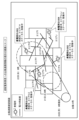
- FIG. 1 may be an example of a screen image of typhoon course information that a power transmission and distribution company confirms when predicting the arrival of a typhoon in this embodiment.
- the power transmission and distribution business operator shall be responsible for the occurrence of typhoons within the area under its jurisdiction (in this specification, "area” may mean the area under the jurisdiction of the power transmission and distribution business operator, unless otherwise specified). It is possible to check the areas where flying is expected and the power plants that may be affected, and create a contingency plan based on this information. Electric power may be supplied from each power plant to each area via a power supply line in FIG. 1 .
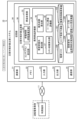
- FIG. 2 is a diagram showing an example of the configuration of the disaster countermeasure planning system 10 according to the present embodiment.
- the disaster countermeasure planning system 10 may include a storage unit 26 that can be accessed by a calculation unit 21, which will be described later, and is configured with an appropriate non-volatile storage element such as a hard disk drive.
- the program stored in the memory 22 and storage unit 26, which are composed of volatile storage elements such as RAM, is read out to the memory 22 and executed, thereby performing overall control of the system itself, as well as performing various judgments, and a CPU (Central Processing Unit). It may be provided with an arithmetic unit 21 that performs arithmetic processing and control processing such as the like.
- an input section 23 such as a keyboard and a mouse that receives user input
- an output section 24 such as a display that outputs processing results
- an output section 24 that connects to the communication network 11 and connects with other devices such as an external user terminal 12.
- It may include a communication unit 25 such as a network interface that handles communication processing.
- Each functional unit of the storage unit 26 is implemented by the calculation unit 21 executing a program, and includes a content plan assumption unit 31, a power outage time/power outage amount estimation unit 32, a benefit improvement unit 33, and a cost-benefit evaluation unit 34. It includes a disaster countermeasure planning unit 30 which is a planning unit. The planning section is responsible for formulating a plan for measures to prepare for a predetermined disaster. The disaster countermeasure planning unit 30 may be a functional unit that implements a disaster countermeasure planning function, which will be described later.
- the term Conte Plan is a simplified version of Contingency Plan. In the following, the term “conte plan” is a simplified contingency plan. Therefore, even if the term “conte plan” is replaced with the term “contingency plan”, the meaning is the same.
- the cost-benefit evaluation section 34 may include a consumer loss calculation section 35, a total loss calculation section 36, a total cost calculation section 37, and a total benefit evaluation section 38.
- the storage unit 26 can hold information such as a power source list 100, area demand forecast value 101, operating cost unit price for each power source 102, required advance countermeasure time for each customer 104, and estimated unit price for power outage cost for each case 105 as a database. .
- This disaster countermeasure planning system 10 may be a local server installed at a specific location, or may be provided as a cloud server in the form of SaaS (Software as a Service).
- SaaS Software as a Service
- the communication network 11 is connected to the user terminals 12 of power transmission and distribution companies.
- the user terminal 12 can receive input of generator information, power supply vehicle information, etc. in the target area from the power transmission and distribution company.
- This disaster countermeasure planning function calculates the predicted values for the duration and amount of power outages in each area, including areas where power outages are predicted to occur due to the disaster, and the expected contingency plan.
- the predicted value of the amount of power outage that is, the predicted value of the power outage time and amount of power outage when countermeasures are taken in the area, includes the predicted value of each, the type of customer in each area, and the time during which customers can take precautionary measures.
- Good information that is, primary information including the time required for power consumers affected by power outages in the area to take advance countermeasures, as well as information on sales losses for power transmission and distribution companies, countermeasure costs, and power outage losses for customers.
- the method may include an evaluation unit that evaluates at least the benefit of the countermeasure based on information that may be included, that is, second information regarding losses associated with the disaster.
- the above-mentioned evaluation unit may evaluate the total benefit of a hypothetical contingency plan, and may have a function of identifying a contingency plan that improves the benefit based on the evaluation results. good. Note that "benefit” means profit even including disadvantages.
- FIG. 3 is a software configuration diagram of the disaster countermeasure planning system 10 related to the disaster countermeasure planning function.
- the storage unit 26 of the disaster countermeasure planning system 10 stores, as programs, an equipment failure prediction unit 39, a renewable energy power generation amount prediction unit 43, a conte plan assumption unit 31, a power outage time -
- a disaster countermeasure planning unit 30 including a power outage estimation unit 32, a cost-benefit evaluation unit 34, and a benefit improvement unit 33 may be retained.
- the solid lines may indicate the flow of processing
- the broken lines may indicate the flow of data as a guide.
- not all necessary lines connecting components are shown, and some lines are omitted. The processing flow and data flow between the components can be properly performed even if lines are not shown in the diagram.
- the conte plan assumption unit 31 is a processing unit that assumes a contingency plan, and may include a power supply allocation assumption unit 40, a power vehicle dispatch area assumption unit 41, and a storage battery operation area assumption unit 42.
- the power supply allocation assumption unit 40 may be a processing unit that uses the power supply list 100 to assume the allocation of areas to which each power plant supplies power.
- the power supply vehicle dispatch area assumption unit 41 may be a processing unit that uses the power supply vehicle information 106 to assume the allocation of areas to which each power supply vehicle supplies power.
- the storage battery operating area assumption unit 42 may be a processing unit that uses the area-based storage battery information 107 to assume the allocation of areas to which each storage battery supplies power.
- the renewable energy power generation amount prediction unit 43 can perform a process of predicting the renewable energy power generation amount in each area using the area renewable energy power supply introduction amount 108 and the weather forecast value 109.
- the equipment failure prediction unit 39 can perform a process of predicting failures of power plants, power supply lines, etc. in each area using the power supply list 100 and the weather prediction values 109.
- the power outage time/power outage amount estimating unit 32 uses the assumed contingency plan, the area demand forecast value 101, and the renewable energy power generation amount prediction which is the value of the renewable energy power generation amount in each area predicted by the renewable energy power generation amount prediction unit 43.
- This is a processing unit that performs processing to estimate the power outage time and amount of power outage in each area using the equipment failure prediction results that are the results predicted by the equipment failure prediction unit 39, and the processing results are the power outage times shown in FIG. - Can be stored in the power outage estimation result 111.
- the cost-benefit evaluation unit 34 includes a wheeling revenue reduction calculation unit 44, a power outage penalty calculation unit 45, a customer loss calculation unit 35, a total loss calculation unit 36, a power supply operating cost calculation unit 46, and a power supply replacement/grid reconfiguration cost calculation unit. unit 47, a power supply vehicle operating cost calculation unit 48, a total cost calculation unit 37, and a total benefit evaluation unit 38.
- the wheeling income reduction amount calculation unit 44 can perform a process of calculating the wheeling income reduction amount based on the estimated result of the amount of power outage in each area.
- the power outage penalty calculation unit 45 can perform a process of calculating a loss based on the power outage penalty based on the estimation result of the amount of power outage in each area.
- the customer loss calculation unit 35 may be a processing unit that performs a process of calculating customer damage based on the estimation result of the amount of power outage in each area.
- the power supply operating cost calculation unit 46 is a processing unit that calculates the operating cost of each power source using the power supply allocation of the assumed contingency plan, the power supply list 100, the area demand forecast value 101, and the operating cost unit price for each power supply 102. It's good. Note that in FIG. 3, lines indicating data transmission from the power supply list 100 and the area demand forecast value 101 are omitted in the power supply operating cost calculation unit 46.
- the power supply replacement/system reconfiguration cost calculation unit 47 may be a processing unit that calculates the cost of power supply replacement using the power supply allocation of the assumed contingency plan and the power supply replacement cost unit price 110.
- the power supply vehicle operating cost calculation unit 48 may be a processing unit that calculates the cost for dispatching and operating a power supply vehicle using the power supply vehicle dispatch allocation and the power supply vehicle operating unit price 114 of the assumed contingency plan.
- the total loss calculation unit 36 is a processing unit that calculates the total loss based on the wheeling income reduction amount calculation result, the power outage penalty calculation result, and the consumer loss calculation result, which are the processing results of the wheeling income reduction amount calculation unit 44 described above. It's good.
- the total cost calculation unit 37 calculates the power supply operating cost calculation result, which is the result of calculating the power supply operating cost by the power supply operating cost calculation unit 46, and the power supply replacement cost calculated by the power supply replacement/system reconfiguration cost calculation unit 47. It may be a processing unit that calculates the total cost based on the power supply replacement cost calculation result, which is the result, and the power supply vehicle operating cost calculation result, which is the result of calculating the power supply vehicle operating cost by the power supply vehicle operating cost calculation unit 48.
- the total benefit evaluation unit 38 is a processing unit that evaluates the total benefit based on the total loss calculated by the total loss calculation unit 36 and the total cost calculated by the total cost calculation unit 37.
- the evaluation results may be stored in the initial contingency plan evaluation results 116. That is, the second information regarding the loss due to the disaster described above may be information including the sales loss of the power transmission and distribution company, the cost required for the countermeasures, and the power outage loss of the power consumer.
- the sales loss of the power transmission and distribution company may include a reduction in wheeling revenue and/or a power outage penalty amount.
- the cost required for the above-mentioned measures may include the cost required for power supply operation and/or the cost for operating distributed power supply.
- the benefit improvement unit 33 is a processing unit that performs processing to search for a new contingency plan that improves the total benefit based on the total benefit evaluation result evaluated by the total benefit evaluation unit 38, and the processing result is a contingency plan. It may be stored in the optimization result 112.
- FIG. 4 is a software configuration diagram of the customer loss calculation unit 35.
- a customer disaster countermeasure preparation time calculation section 50 In order to calculate customer losses, a customer disaster countermeasure preparation time calculation section 50, a preliminary measure availability determination section 51, a power outage cost calculation section 52, and a total power outage cost calculation section 53 for all customers may be retained.
- the customer disaster countermeasure preparation time calculation unit 50 can calculate the customer's disaster countermeasure preparation time using the power outage time/power outage amount estimation results 111.
- the advance countermeasure availability determining unit 51 determines whether advance countermeasures can be taken for each customer using the customer disaster countermeasure preparation time calculated by the consumer disaster countermeasure preparation time calculation unit 50 and the required advance countermeasure time 104 for each customer. can.
- the power outage cost calculation unit 52 calculates the customer's loss due to a power outage using the data of whether or not the customer can take advance measures and the expected unit price of power outage cost by case 105, which is the result of the determination by the advance measure determination unit 51.
- the all-customer total power outage cost calculation unit 53 sums up the loss due to power outage of each customer calculated by the power outage cost calculation unit 52, calculates the total power outage cost for all customers, and the processing result is the customer loss calculation result 113. may be stored in
- Section 3-1 "Various Processes for Disaster Countermeasure Plan Formulation” shows the overall processing procedure for disaster countermeasure plan formulation.
- Section 3-2 Various Processes for Calculating Customer Loss” provides detailed processing procedures for calculating customer loss.
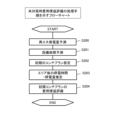
- FIG. 5 is a flowchart showing the overall processing procedure by the disaster countermeasure planning unit of the disaster countermeasure plan drafting system 10.
- the disaster countermeasure planning unit 30 of the disaster countermeasure plan drafting system 10 performs cost-benefit evaluation when no countermeasures are taken (step S100), provisional content plan assumption (step S101), estimation of power outage time and amount of power outage for each area (step S102), provisional
- the cost-benefit evaluation of the content plan step S103
- the calculation of the degree of improvement step S104
- the check of the default termination conditions step S105
- selection of the content plan with the highest degree of improvement as the best plan step S106 are executed in order. You may do so.
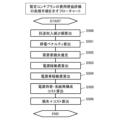
- FIG. 6 is a flowchart showing the processing procedure for cost-benefit evaluation when no measures are taken (step S100).
- the renewable energy power generation amount prediction unit 43 calculates the solar power generation amount for each area using the area renewable energy power introduction amount 108 and the weather forecast value 109. Prediction processing can be performed (step S200).
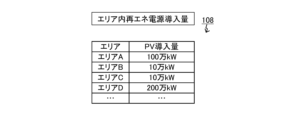
- the in-area renewable energy power supply introduction amount 108 may have an area displayed as an "area” and a "PV introduction amount" which is the solar power generation introduction amount for each area set in the format shown in FIG. 11, for example.
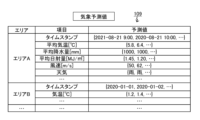
- the predicted weather value 109 stores predicted weather values such as average temperature, average precipitation, average solar radiation, wind speed, and weather at each time for each area in the format shown in FIG. 12, for example.
- the timing of prediction is arranged in chronological order in the "prediction value" corresponding to the "time stamp".
- the predicted values of each meteorological element are arranged in accordance with the timing of the above-mentioned prediction.
- the amount of solar power generated by each area can be predicted by, for example, multiplying the predicted amount of solar radiation in the area by the amount of solar power generation installed with a predetermined coefficient weight. can be calculated.
- the time period is a time range between a certain time and a certain time, and the predicted value of renewable energy power generation amount is calculated as the total value of the power generation amount in the relevant time period.
- the equipment failure prediction unit 39 can perform a process of predicting failures of power plants, power supply lines, etc. in each area using the power supply list 100 and the weather prediction values 109 (step S201).
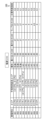
- the power supply list 100 is, for example, in the format shown in FIG. 13, and includes a "power plant ID” that indicates a code that identifies a power plant, an "area” that is the area in which the power plant is located for each power plant, and information on which disasters, etc. are derived.
- "Normal supply area” which is the area where the power plant supplies electricity during normal times
- "Type” which indicates the energy source used for power generation
- "Maximum output” which is the maximum output of the power plant
- During disaster "Vulnerability level” (which may be the vulnerability level of the power plant in the event of a disaster), etc. may be stored.
- Equipment failure prediction is based on the area and disaster vulnerability of each power plant in the power source list 100, and the wind speed for each time zone in each area in the weather forecast value 109, for example, using the following formula (1).
- the failure probability for each time is calculated, and if the failure probability is equal to or greater than the threshold value, it can be determined that there is a "failure", and if it is less than the threshold, it can be determined that there is "no failure”.
- various elements such as precipitation and snowfall can be adopted as weather elements listed as items in the weather prediction value 109.
- the symbol t may be used within the scope of this formula.
- the power source list 100 shown in FIG. 13 includes items such as power plant ID, which is shown as an example in this figure.
- the various data tables listed for the description of the present invention, including the power source list 100, are not limited to the exemplified items, and can include various necessary items.
- the content plan assumption unit 31 assumes the allocation of each asset for each area in the power supply allocation assumption unit 40, the power supply vehicle dispatch area assumption unit 41, and the storage battery operation area assumption unit 42, so that the initial A contingency plan can be assumed (step S202).
- the power supply allocation assumption unit 40 assumes the allocation of an initial area indicating the area to which each power plant initially supplies power. Specifically, the normal supply destination area in the power supply list 100 may be assigned as the supply destination of each power plant.
- the power supply vehicle dispatch area assumption unit 41 assumes the allocation of initial areas to which each power supply vehicle will supply power based on the power supply vehicle information 106. FIG.
- the power supply vehicle information 106 is an example of the power supply vehicle information 106, including a "power supply vehicle ID” indicating a code that identifies the power supply vehicle, an "initial dispatch area” indicating the area to which the power supply vehicle is initially dispatched for each power supply vehicle, and the power source It stores information such as ⁇ maximum output,'' which indicates the maximum output of the vehicle, and ⁇ available capacity,'' which is the capacity of power that the power supply vehicle can supply.
- the assumption of the initial power supply vehicle dispatch area may be determined by referring to the information on the initial dispatch area of the power supply vehicle information 106, for example.
- the storage battery operation area assumption unit 42 assumes whether each storage battery is in operation or not, based on the area-specific storage battery information 107.
- area-specific storage battery information 107 including a "storage battery ID” that indicates a code that identifies a storage battery, an "area” that is the area where the storage battery is placed for each storage battery, and a “storage battery ID” that indicates the maximum output of the storage battery. Information such as “maximum output” and "capacity” which is the capacity of the storage battery is stored.
- the initial assumption of storage battery operation/non-operation may be made by assuming, for example, that all storage batteries listed in the area-based storage battery information 107 are in operation. Through the above processing, it is possible to assume the power plants, power supply vehicles, and storage batteries allocated to each area as a contingency plan.
- the power outage time/outage amount estimating unit 32 performs the set power supply plan using the assumed contingency plan, the area demand forecast value 101, the renewable energy power generation amount forecast value, and the equipment failure prediction result. Processing for estimating the presence or absence of power outages and the amount of power outages in each area for each future time period can be performed (step S203).
- the amount of electricity supplied in the area is calculated and compared with the predicted area demand. It is possible to estimate the presence or absence of power outages and the amount of power outages for each time period.
- the Maximum output x time in list 100 can be calculated as the amount of power that the power plant can supply to the area during the time period. For example, when a maximum power of 27 (GW) is supplied for one hour, the amount of power supplied during that time period is 27 (GWh).
- the information on the allocated power supply vehicle in the assumed contingency plan and "maximum output of the power supply vehicle information 106 in FIG. 14 x time" can be calculated as the amount of power that the power supply vehicle can supply during the relevant time period.
- the propriety of supply may be determined based on how many hours have elapsed since the power supply start time during the time period set at this time for supplying power. For example, if the elapsed time from the power supply start time is T, the total amount of power supplied up to the relevant time period is calculated by "maximum output of the power supply vehicle x T", and this value and the supplyable capacity in the power supply vehicle information 106 are calculated.
- the information on the storage battery allocated in the assumed contingency plan and "maximum output of area-specific storage battery information 107 in FIG. 15 x time" are calculated as the amount of power that the storage battery can supply during the relevant time period.
- the propriety of supply may be determined based on how many hours have elapsed since the power supply start time during the time period set at this time for supplying power. For example, if the elapsed time from the power supply start time is T, the total amount of power supplied up to the relevant time period is calculated by "maximum output of the storage battery x T", and this value is compared with the capacity in the area-specific storage battery information 107.
- total power supply amount up to the relevant time period ⁇ capacity it is determined that power cannot be supplied, and if “total power supply amount up to the relevant time period ⁇ capacity”, it can be determined that power supply is possible. Note that the symbol T is used within the scope of this formula.
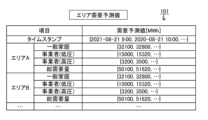
- FIG. 16 is an example of the area demand forecast value 101, which shows the demand forecast value for each customer type (general household, business (high voltage), business (low voltage)), total demand, and total demand for each time period in each area. The amount may be stored. Compare the amount of electricity supplied in each time period in the area with the total demand in the area according to the area demand forecast value 101, and if “power supply ⁇ total demand”, there will be no power outage, and “power supply ⁇ total demand”.
- the total demand amount can be estimated as the amount of power outage in the relevant time period. Further, by referring to the predicted demand value for each customer type (general household, business (high voltage), business (low voltage)) in the area demand forecast value 101, it is possible to estimate the amount of power outage for each customer type.
- the estimation results of power outage presence/absence/power outage amount in each area estimated in this way may be stored in the power outage time/power outage amount estimation result 111 in the format shown in FIG. 22 .
- the cost-benefit evaluation unit 34 can evaluate the costs and benefits that occur based on the assumed initial contingency plan and the power outage time/power outage amount estimation results 111 (step S204).
- FIG. 7 is a flowchart showing details of the processing procedure for the cost-benefit evaluation (step S204) of the initial content plan.
- the wheeling revenue reduction amount calculation unit 44 first performs processing to calculate the wheeling revenue reduction amount based on the estimated results of the power outage duration and amount of power outage in each area. (Step S300). Specifically, first, the wheeling fee unit price (yen/kWh) may be set for each consumer type (general household, business (high voltage), business (low voltage)). Next, as shown in Equation (2), by multiplying the power outage time/power outage amount estimation result 111 with the amount of power outage for each customer type, the amount of reduction in wheeling revenue for each customer type can be calculated. Note that the symbol t is used within the scope of this formula.
- incomeLoss_trans a is the reduction amount of wheeling income in area a
- PLoss a,c,t is the total power outage amount (MWh) in time period t for customer type c in area a
- unitPrice c is This is the average wheeling fee unit price (yen/kWh) for customer type c.
- the amount of reduction in wheeling income can be calculated using the following formula. Note that the symbol t is used in this formula.
- the reduction in wheeling income for all consumers can be calculated.
- the power outage penalty calculation unit 45 can perform a process of calculating a loss based on the power outage penalty based on the estimation result of the amount of power outage in each area (step S301). Specifically, first, the respective values of the penalty unit price (yen/kWh) and the allowable power outage amount (MWh) are set. These values may be set to any value greater than or equal to 0. Next, as shown in Equation (6), the power outage penalty can be calculated by multiplying the deviation amount of the total power outage amount from the allowable power outage amount for the entire target time period by the penalty unit price.
- penalty a is the power outage penalty for area a
- Loss_allowable is the allowable power outage amount (MWh) in the revenue cap
- unitPenalty is the penalty unit price (yen/MWh).
- the consumer loss calculation unit 35 can perform a process of calculating the damage to the consumer based on the estimation result of the amount of power outage in each area (step S302). Details of the customer loss calculation process will be described later in Section 3-2 "Various processes for customer loss calculation".
- the power supply operating cost calculation unit 46 can calculate the operating cost of each power supply using the power supply allocation of the contingency plan assumed by the power supply allocation assumption unit 40, the power supply list 100, and the area demand forecast value 101.
- Step S303 the operating power stations assigned to the area and determined in step S201 can be extracted.
- the total demand amount of the area demand forecast value of the area can be taken as the amount of power generated by the power station in each time period.
- the amount of power generated by each power plant can be calculated by referring to the power supply list 100 and dividing the total demand proportionally according to the ratio of the maximum output of the assigned power plants.
- the coefficients a g , b g , c g of the cost function of the assigned power plant may be extracted.
- the cost function is a function that calculates the cost of power generation according to the amount of power generated by the generator and the characteristics of the generator. Then, using the coefficients (a g , b g , c g ) of the generator cost function, the cost required for operation in each time period can be calculated using the following equation.
- cost_gene g is the operating cost (in yen) of power source g
- P g is the amount of power generated by generator g.
- the power supply vehicle operating cost calculation unit 48 uses the allocation of the power supply vehicle dispatch area of the contingency plan assumed by the power supply vehicle dispatch area assumption unit 41 and the power supply vehicle operating unit cost 114 to dispatch and operate the power supply vehicle.
- This cost can be calculated (step S304). Specifically, first, extract the power supply vehicles assigned to the area. Then, with reference to the power supply vehicle operating unit cost 114 in FIG. 19, the coefficients a Veh , b Veh , and c Veh of the cost function of the assigned power supply vehicle may be extracted, respectively. Then, using the coefficients of the cost function (a Veh , b Veh , c Veh ), the cost required for operation in each time period can be calculated using the following equation.
- cost_gene g is the operating cost (in yen) of power source g
- P g is the amount of power generated by generator g.
- the total loss calculation unit 36 calculates the total loss using the following formula based on the transportation revenue reduction amount calculation result, the power outage penalty calculation result that is the calculation result of the power outage penalty calculation unit 45, and the consumer loss calculation result 113. can.
- TotalLoss is the total loss
- incomeLoss_trans a is the reduced amount of wheeling income in area a
- penalty a is the power outage penalty in area a
- consumerLoss a is the consumer loss in area a
- w 1 and w 2 may be arbitrarily set weighting coefficients.
- the total cost calculation unit 37 can calculate the total cost using the following formula based on the power supply operating cost calculation result and the power supply vehicle operating cost calculation result.
- TotalCost is the total cost
- cost_gene g is the operating cost (yen) of power source a
- cost_reconst g is the power replacement cost (yen) of power source a.
- cost_reconst g is an operational cost that occurs when a power plant is allocated to an area different from normal times, but it may be set to 0 in the case of the initial plan.
- the total benefit evaluation unit 38 can calculate a comprehensive evaluation value, that is, a comprehensive evaluation value of the initial content plan, using the following formula based on the above-described calculated total loss and total cost (step S305).
- the above-mentioned result may be stored in the initial content plan evaluation result 116 (step S305), and the process may be terminated.
- FIG. 20 is an example of the initial content plan evaluation result 116.
- source power plant ID representing the source power plant that is a contingency plan
- assigned power supply vehicle ID represents the assigned power supply vehicle.
- assigned storage battery ID representing information on the assigned storage battery, and calculation results of each value in cost-benefit evaluation may be stored.
- the cost-benefit evaluation unit 34 may end the cost-benefit evaluation process when no measures are taken.
- the disaster countermeasure planning system 10 When the disaster countermeasure planning system 10 completes the process of cost-benefit evaluation when no measures are taken (step S100), it may perform the process of assuming a provisional content plan (step S101).
- FIG. 8 is a flowchart showing the processing procedure regarding the provisional content plan assumption in S101.
- the contingency plan assumption unit 31 makes a provisional contingency plan by assuming the allocation of each asset for each area in a power supply allocation assumption unit 40, a power supply vehicle dispatch area assumption unit 41, and a storage battery operation area assumption unit 42. It can be assumed that
- the power supply allocation assumption unit 40 may first assume the allocation of areas to which each power plant supplies power (step S400). Specifically, a single or multiple supply destination areas different from the normal supply area in the power supply list 100 can be randomly assigned as the supply destination of each power plant.
- "randomly allocated" means that a user such as a power transmission company allocates as appropriate.
- the power supply vehicle dispatch area assumption unit 41 assumes the allocation of areas to which each power supply vehicle will supply power based on the power supply vehicle information 106 (step S401). Assuming the power supply vehicle dispatch area, for example, a single or multiple supply destination areas different from the initial dispatch area of the power supply vehicle information 106 can be randomly assigned as the supply destination of each power supply vehicle.
- step S402 the storage battery operation area assumption unit 42 assumes whether each storage battery is in operation or not, based on the area-specific storage battery information 107 (step S402). Assuming whether the storage battery is in operation or not, for example, operation or non-operation can be randomly set for each storage battery in the area-specific storage battery information 107.
- the power plant, power supply vehicle, and storage battery allocated to each area may be assumed as a temporary contingency plan, and the process of assuming a temporary contingency plan may be completed.
- the power outage time/power outage amount estimating unit 32 performs the set power supply plan using the assumed contingency plan, the area demand forecast value 101, the renewable energy power generation forecast value, and the equipment failure prediction result. Processing for estimating the presence or absence of power outages and the amount of power outages in each area for each future time period can be performed (step S102).
- the amount of electricity supplied in the area is calculated and compared with the predicted area demand. It is possible to estimate the presence or absence of power outages and the amount of power outages for each time period.
- the assigned power plant determines whether the assigned power plant can be operated based on the information on the power plant assigned to the area in the assumed contingency plan and the equipment failure prediction results, and if it is possible to operate, the "Maximum output x time in list 100" can be calculated as the amount of power that the power plant can supply to the area during the time period.
- the information on the allocated power supply vehicle in the assumed contingency plan and "maximum output of the power supply vehicle information 106 in FIG. 14 x time" can be calculated as the amount of power that the power supply vehicle can supply during the relevant time period.
- the propriety of supply may be determined based on how many hours have elapsed since the power supply start time during the time period set at this time for supplying power. For example, if the elapsed time from the power supply start time is T, the total amount of power supplied up to the relevant time period is calculated by "maximum output of the power supply vehicle x T", and this value and the supplyable capacity in the power supply vehicle information 106 are calculated.
- the information on the allocated storage battery in the assumed contingency plan and "maximum output of area-specific storage battery information 107 in FIG. 15 x time" can be calculated as the amount of power that the storage battery can supply during the relevant time period.
- the propriety of supply may be determined based on how many hours have elapsed since the power supply start time during the time period set at this time for supplying power. For example, if the elapsed time from the power supply start time is T, the total amount of power supplied up to the relevant time period is calculated by "maximum output of the storage battery x T", and this value is compared with the capacity in the area-specific storage battery information 107.
- FIG. 16 is an example of the area demand forecast value 101, which shows the demand forecast value for each customer type (general household, business (high voltage), business (low voltage)), total demand, and total demand for each time period in each area. amount is stored.
- the total demand amount can be estimated as the amount of power outage in the relevant time period. Further, by referring to the predicted demand value for each customer type (general household, business (high voltage), business (low voltage)) in the area demand forecast value 101, it is possible to estimate the amount of power outage for each customer type.
- the estimation results of the power outage presence/absence and amount of power outage in each area estimated in this way can be stored in the power outage time/power outage amount estimation result 111 in the format shown in FIG. 22.
- the cost-benefit evaluation unit 34 can evaluate the costs and benefits that will occur based on the assumed provisional contingency plan and the power outage estimation result (step S103).
- FIG. 9 is a flowchart showing details of the cost-benefit evaluation processing procedure (step S103) of the provisional contingency plan.
- the wheeling revenue reduction amount calculation unit 44 performs processing to calculate the wheeling revenue reduction amount based on the estimation result of the amount of power outage in each area (step S500). . Specifically, first, the wheeling fee unit price (yen/kWh) is set for each consumer type (general household, business (high voltage), business (low voltage)). Next, as shown in Equation (2), by multiplying the power outage time/power outage amount estimation result 111 with the amount of power outage for each customer type, it is possible to calculate the amount of reduction in wheeling revenue for each customer type.
- the power outage penalty calculation unit 45 can perform a process of calculating a loss based on the power outage penalty based on the estimation result of the amount of power outage in each area (step S501). Specifically, first, the penalty unit price (yen/kWh) and the allowable power outage amount (MWh) can be set to arbitrary values. This arbitrary value may be any value appropriately selected by the electric power company itself. Next, as shown in Equation (6), the power outage penalty can be calculated by multiplying the deviation amount of the total power outage amount from the allowable power outage amount for the entire target time period by the penalty unit price.
- the consumer loss calculation unit 35 can perform a process of calculating the consumer loss based on the estimation result of the amount of power outage in each area (step S502). Details of the customer loss calculation process will be described later in Section 3-2 "Various processes for customer loss calculation".
- the power supply operation cost calculation unit 46 can calculate the operation cost of each power supply using the power supply allocation of the assumed contingency plan, the power supply list 100, and the area demand forecast value 101 (step S503). Specifically, first, the operating power plants assigned to the area and determined in step S201 can be extracted. When one power generator is assigned to one area, the total demand amount of the area demand forecast value of the area can be taken as the amount of power generated by the power station in each time period. When multiple generators are assigned to one area, the amount of power generated by each power plant is calculated by referring to the power supply list 100 and dividing the total demand proportionally according to the ratio of the maximum output of the assigned power plants. Can be done.
- the cost function coefficient a g the cost function coefficient b g , and the cost function coefficient c g of the assigned power plant are extracted. Then, using the coefficients (a g , b g , c g ) of the generator cost function, the cost required for operation in each time period can be calculated using equation (7).
- the power supply vehicle operating cost calculation unit 48 calculates the cost for dispatching and operating the power supply vehicle using the allocation for power supply vehicle dispatch of the contingency plan assumed in step S401 and the power supply vehicle operating unit price 114 ( Step S504). Specifically, first, the power supply vehicles assigned to the area can be extracted. Next, with reference to the power supply vehicle operating unit price 114 in FIG. 19, the cost function coefficient a Veh , cost function coefficient b Veh , and cost function coefficient c Veh of the assigned power supply vehicle can be extracted. Next, using the coefficients (a Veh , b Veh , c Veh ) of the cost function, the cost required for operation in each time period can be calculated using equation (8).
- the power source replacement/system reconfiguration cost calculation unit 47 can calculate the cost for power source replacement/system reconfiguration (step S505). Specifically, first, the power plants assigned to the area can be extracted. Next, referring to the power supply replacement cost unit price 110 in FIG. 18, the operating cost for changing the supply area can be extracted. If the power allocation in the assumed contingency plan is different from the normal supply area, it can be determined that additional operation costs will be incurred for changing the supply area for the generator.
- the total loss calculation unit 36 can calculate the total loss using formula (9) based on the wheeling revenue reduction amount calculation result, the power outage penalty calculation result, and the consumer loss calculation result.
- the total cost calculation unit 37 calculates the total cost based on the power supply operating cost calculation result, the power supply vehicle operating cost calculation result, and the power supply replacement cost calculation result obtained from the processing in the power supply replacement/system reconfiguration cost calculation unit 47. It can be calculated using formula (10).
- the total benefit evaluation unit 38 calculates the overall evaluation value, that is, the overall evaluation value of the provisional content plan, based on the total loss calculated by the total loss calculation unit 36 and the total cost calculated by the total cost calculation unit 37, using formula (11). (Step S506).
- the disaster countermeasure planning system 10 can perform the process of calculating the degree of improvement (step S104).
- the degree of improvement is calculated by calculating the difference between the comprehensive evaluation value (total benefit) of the provisional content plan calculated in S103 and the comprehensive evaluation value (total benefit) of the initial content plan calculated in S101. It is possible to calculate the degree of improvement in the overall evaluation value.
- a contingency plan with a high overall evaluation value can be searched for (step S105).
- This search may be performed via the benefit improvement unit 33.
- This search is a process that uses a metaheuristic method such as a greedy method or a genetic algorithm to increase the degree of improvement by using the degree of improvement as an evaluation function and generating a new provisional content plan so that the evaluation function is improved. may be performed.
- the disaster countermeasure planning unit 30 can evaluate a plurality of countermeasures based on the set conditions, generate a countermeasure with a high benefit evaluation value from among them, and output the countermeasure. You can also do it.
- This output can be performed by the output unit 24, or can be displayed on the user terminal 12 of the power distribution company via the communication network 11 via the communication unit 25.
- This disaster countermeasure planning system evaluates multiple countermeasures.
- Such a configuration performs optimization processing, and can obtain an optimal plan under given conditions.
- the planning department generates and/or outputs countermeasures that keep the ratio of the cost required for the countermeasures of the power transmission and distribution company to the power outage loss of the power consumer within a specified range. good.
- contingency plans in which ⁇ , which is the difference between the customer loss of the initial contingency plan and the customer loss of the interim contingency plan, is greater than or equal to an arbitrarily determined threshold may be adopted; A penalty for deviation may be given to the evaluation value of the contingency plan that falls below a threshold value.
- the arbitrarily determined threshold value described above may be a threshold value arbitrarily determined by the power transmission and distribution company as appropriate.
- Figure 29 is a comparison image of consumer losses and countermeasure costs for power transmission and distribution companies.
- the power transmission and distribution company's countermeasure cost ⁇ is expressed as “transmission and distribution countermeasure cost”
- the consumer loss ⁇ is expressed as “consumer loss impact degree (total).”
- the “transmission and distribution countermeasure costs” and “customer loss impact (total)” presented as countermeasures are based on the provisional contingency plan.
- the “consumer loss impact level (total)” presented when no countermeasures are taken is from the initial contingency plan.
- the difference between the customer loss of the initial contingency plan and the customer loss of the interim contingency plan is shown as ⁇ .
- step S105 If the predetermined end condition is reached in step S105, the contingency plan with the highest degree of improvement can be adopted as the best plan during the search process (step S106). Then, the result can be stored in the Conte Plan optimization result 112, and the process can be ended.
- Figure 21 is an example of the content plan optimization result 112, which includes information on the source power plant, assigned power supply vehicle, and assigned storage battery, which is a contingency plan for each area, and the calculation results of each value in cost-benefit evaluation. It may be stored.
- the screen shown in FIG. 27 can be displayed on the power transmission and distribution business operator's terminal.
- the predicted value of the amount of power outage in each area at the specified date and time, the estimated operation/stop status of each power plant, and the supply destination in the contingency plan may be visually shown.
- the total benefit in the contingency plan, the benefit improvement amount compared to the initial contingency plan, and customer loss may be displayed together with the details thereof.
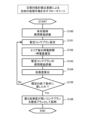
- FIG. 10 is a flowchart showing the processing procedure for customer loss calculation by the disaster countermeasure planning system 10.
- the customer loss calculation unit 35 of the disaster countermeasure planning system 10 performs a process of reading the customer power outage estimation result (step S600), a process of calculating the customer disaster countermeasure preparation time (step S601), a process of determining whether advance countermeasures are possible (step S602), The power outage cost calculation process (step S603), the conditional branching process regarding "Have all customers been processed?" (step S604), and the total power outage cost calculation process for all customers (step S605) can be executed in order. can.
- the customer disaster countermeasure preparation time calculation unit 50 shown in FIG. 4 first reads the data of the power outage time/power outage amount estimation result 111 (step S600).
- the customer disaster countermeasure preparation time calculation unit 50 can calculate the disaster countermeasure preparation time for each customer type (step S601). Specifically, the time when a power outage first occurs, that is, the time at which the power outage starts to occur, can be extracted by referring to the information on whether a power outage has occurred in the power outage duration/power outage amount estimation result 111. Then, by taking the difference between the power outage start time and the current time, it is possible to calculate the preparation time for disaster countermeasures.
- the advance countermeasure availability determination unit 51 uses the disaster countermeasure preparation time of each customer calculated by the consumer disaster countermeasure preparation time calculation unit 50 and the required advance countermeasure time for each customer 104 to determine the advance countermeasures of each customer. It is determined whether or not it is possible (step S602).
- FIG. 23 is an example of the required advance countermeasure time 104 for each consumer, and the required advance countermeasure time for each consumer is set for each consumer type. Specifically, if "disaster countermeasure preparation time of a consumer ⁇ the required advance countermeasure time of the customer", then the consumer of the concerned customer type can take advance countermeasures; If the amount of time required for the customer to take advance measures, it can be determined that advance measures are not possible for the customer of the customer type.
- the power outage cost calculation unit 52 calculates the amount of power outage for each time period of the customer obtained from the above-mentioned power outage time/power outage amount estimation result 111, the result of determining whether the advance countermeasure is possible or not, determined by the above-mentioned advance countermeasure determination unit 51, and Using the case-specific power outage cost assumed unit price 105, the cost of the power outage for the consumer, that is, the power outage cost can be calculated (step S603).
- FIG. 24 is an example of the case-by-case power outage cost assumed unit price 105, and a loss amount unit price may be set according to the power outage time length for each customer type and whether or not advance measures can be taken.
- loss unit prices may be set depending on the type of day, such as weekdays, weekends, holidays, etc.
- FIG. 26 is an image of how the estimated unit price of power outage cost for each case changes depending on the length of time.
- power outage losses to power consumers are calculated based on the amount of power outages mentioned above and the amount of power consumers affected by power outages in areas where power outages are expected to occur in advance. It may be calculated based on information including the time required for the countermeasure, that is, the above-mentioned first information.
- the time required for the above-mentioned advance measures may depend on the type of power consumer, and may be different for each type of power consumer.
- the above-mentioned first information may include the type of electric power consumer.
- the above-mentioned first information may include information on the amount of loss per unit time that depends on the type of electricity consumer, and may include information on the amount of loss per unit time that varies depending on the type of electricity consumer. It may also include. With this configuration, it is possible to formulate a more accurate disaster countermeasure plan that takes into account the amount of loss related to advance countermeasures based on the type of customer.
- the elapsed time from the start time of power outage occurrence extracted as described above to each time period is defined as the power outage duration in that time period.
- the product of the estimated unit price of power outage cost according to the time (day type), length of power outage, and availability of advance measures for each time period, and the amount of power outage for the customer type in that time period.
- the economic scale may be an economical scale such as a small shop or a general household compared to a factory. Here, these scales may be expressed numerically. Through this process, for example, it is possible to evaluate losses based on differences in economic scale depending on the type of consumer.
- Figure 28 illustrates an example of loss evaluation based on this difference in economic scale.
- the graph on the left is an image showing the amount of power outage loss and the normal economic scale for customers A, B, and C, and the vertical axis is the loss amount and the normal economic scale. It can be anything that represents.
- the graph on the left of FIG. 28 normalizes the loss amount of each consumer A, B, and C by dividing the loss amount of each consumer by the respective normal economic scale as the loss impact degree.
- FIG. 28 for example, it can be seen that consumer A has a relatively small loss impact degree, and consumer C has a relatively large loss impact degree. In this way, it has the effect of being able to estimate the impact of loss depending on the customer.
- Equation (12) An example of how to calculate the consumer cost is shown in Equation (12).
- consumerLoss a is the cost of the consumer in area a
- Ploss a,c,t1 is the total power outage (MWh) in time period t1 for consumer type c in area a
- unitLoss(c ,s,t2,pr) is the power outage cost unit price (yen/kWh) that depends on customer type c, period s, power outage duration t2, and availability of advance measures pr
- EC c is the power outage cost unit price (yen/kWh) for customer type c during normal times.
- the economic scale may be sufficient. Note that the symbols t1 and t2 may be used within the scope of this formula.
- the planning unit may calculate the power outage loss of the power consumer based on the economic scale of the power consumer during normal times.
- step S604 the all-customer total power outage cost calculation unit 53 calculates the power outage cost for each customer.
- the total power outage cost for all customers is calculated by summing up the losses caused by the loss, and the processing result is stored in the customer loss calculation result 113, and the process can be ended (step S605).
- An example of the customer loss calculation result 113 is shown in FIG.
- the power transmission and distribution business operator may directly control power plants, power supply vehicles, and storage batteries, or may share control information with other businesses, such as power generation businesses or external parties.
- the contingency plan may be operated indirectly by transmitting it to the operator of the power supply vehicle or storage battery.
- the disaster countermeasure planning system of the present embodiment can calculate predicted values of power outage duration and amount in each area when a disaster occurs, Based on the predicted value of the duration and amount of power outages when a contingency plan for power sources is implemented, the type of customers in each area, and the amount of time customers can take precautions, we can calculate the reduction in consignment revenue and the amount of power outage penalties. Accurately evaluate the sales losses of power transmission and distribution companies, countermeasure costs such as generator replacement and distributed power supply operation costs, and economic losses due to power outages for customers, and develop contingency plans based on such economic losses. It is possible to evaluate the total benefit and formulate a contingency plan to improve the total benefit, thereby improving the cost effectiveness of power transmission and distribution companies.
- the present invention is not limited to the embodiments described above, and includes various modifications and equivalent configurations within the scope of the appended claims.
- the embodiments described above have been described in detail to explain the present invention in an easy-to-understand manner, and the present invention is not necessarily limited to having all the configurations described.
- a part of the configuration of one embodiment may be replaced with the configuration of another embodiment.
- the configuration of one embodiment may be added to the configuration of another embodiment.
- other configurations may be added, deleted, or replaced with a part of the configuration of each embodiment.
- each of the above-mentioned configurations, functions, processing units, processing means, etc. may be realized in part or in whole by hardware, for example by designing an integrated circuit, and a processor realizes each function. It may also be realized by software by interpreting and executing a program.
- Information such as programs, tables, files, etc. that realize each function can be stored in a storage device such as a memory, hard disk, or SSD (Solid State Drive), or in a recording medium such as an IC card, SD card, or DVD.
- a storage device such as a memory, hard disk, or SSD (Solid State Drive)
- a recording medium such as an IC card, SD card, or DVD.
- control lines and information lines shown are those considered necessary for explanation, and do not necessarily show all control lines and information lines necessary for implementation. In reality, almost all configurations can be considered interconnected.
- Wheeling revenue reduction calculation unit 45... Outage penalty calculation unit, 46... Power supply operating cost calculation unit, 47... Power supply replacement/system reconfiguration cost calculation unit, 48... Power supply vehicle operating cost calculation unit, 50...Customer disaster countermeasure preparation time calculation unit, 51...Advance countermeasure availability determination unit, 52...Outage cost calculation unit, 53...All customers total power outage cost calculation unit
Landscapes
- Engineering & Computer Science (AREA)
- Business, Economics & Management (AREA)
- Economics (AREA)
- Human Resources & Organizations (AREA)
- Strategic Management (AREA)
- Physics & Mathematics (AREA)
- General Business, Economics & Management (AREA)
- Health & Medical Sciences (AREA)
- Marketing (AREA)
- Theoretical Computer Science (AREA)
- General Physics & Mathematics (AREA)
- Tourism & Hospitality (AREA)
- Quality & Reliability (AREA)
- Development Economics (AREA)
- Game Theory and Decision Science (AREA)
- Operations Research (AREA)
- Power Engineering (AREA)
- Entrepreneurship & Innovation (AREA)
- Public Health (AREA)
- Water Supply & Treatment (AREA)
- General Health & Medical Sciences (AREA)
- Primary Health Care (AREA)
- Management, Administration, Business Operations System, And Electronic Commerce (AREA)
- Supply And Distribution Of Alternating Current (AREA)
Priority Applications (1)
| Application Number | Priority Date | Filing Date | Title |
|---|---|---|---|
| CN202280090536.XA CN118633100A (zh) | 2022-03-25 | 2022-09-07 | 灾害对策计划制定系统以及灾害对策计划制定方法 |
Applications Claiming Priority (2)
| Application Number | Priority Date | Filing Date | Title |
|---|---|---|---|
| JP2022-049288 | 2022-03-25 | ||
| JP2022049288A JP7680391B2 (ja) | 2022-03-25 | 2022-03-25 | 災害対策計画立案システム及び災害対策計画立案方法 |
Publications (1)
| Publication Number | Publication Date |
|---|---|
| WO2023181453A1 true WO2023181453A1 (ja) | 2023-09-28 |
Family
ID=88100434
Family Applications (1)
| Application Number | Title | Priority Date | Filing Date |
|---|---|---|---|
| PCT/JP2022/033570 Ceased WO2023181453A1 (ja) | 2022-03-25 | 2022-09-07 | 災害対策計画立案システム及び災害対策計画立案方法 |
Country Status (3)
| Country | Link |
|---|---|
| JP (1) | JP7680391B2 (https=) |
| CN (1) | CN118633100A (https=) |
| WO (1) | WO2023181453A1 (https=) |
Cited By (2)
| Publication number | Priority date | Publication date | Assignee | Title |
|---|---|---|---|---|
| WO2025079252A1 (ja) * | 2023-10-13 | 2025-04-17 | 日本電信電話株式会社 | ネットワーク管理装置、方法およびプログラム |
| CN121214651A (zh) * | 2025-12-01 | 2025-12-26 | 厦门闽投科技服务有限公司 | 一种基于大数据的输电线路灾害预警方法及系统 |
Citations (3)
| Publication number | Priority date | Publication date | Assignee | Title |
|---|---|---|---|---|
| JP2010020434A (ja) * | 2008-07-09 | 2010-01-28 | Shimizu Corp | 停電評価装置 |
| JP2014002537A (ja) * | 2012-06-18 | 2014-01-09 | Osaka Gas Co Ltd | 事業継続リスク評価システム及びコンピュータプログラム |
| JP2015042071A (ja) * | 2013-08-22 | 2015-03-02 | 株式会社日立製作所 | 配電系統設備評価装置及び配電系統設備評価方法 |
-
2022
- 2022-03-25 JP JP2022049288A patent/JP7680391B2/ja active Active
- 2022-09-07 WO PCT/JP2022/033570 patent/WO2023181453A1/ja not_active Ceased
- 2022-09-07 CN CN202280090536.XA patent/CN118633100A/zh active Pending
Patent Citations (3)
| Publication number | Priority date | Publication date | Assignee | Title |
|---|---|---|---|---|
| JP2010020434A (ja) * | 2008-07-09 | 2010-01-28 | Shimizu Corp | 停電評価装置 |
| JP2014002537A (ja) * | 2012-06-18 | 2014-01-09 | Osaka Gas Co Ltd | 事業継続リスク評価システム及びコンピュータプログラム |
| JP2015042071A (ja) * | 2013-08-22 | 2015-03-02 | 株式会社日立製作所 | 配電系統設備評価装置及び配電系統設備評価方法 |
Cited By (2)
| Publication number | Priority date | Publication date | Assignee | Title |
|---|---|---|---|---|
| WO2025079252A1 (ja) * | 2023-10-13 | 2025-04-17 | 日本電信電話株式会社 | ネットワーク管理装置、方法およびプログラム |
| CN121214651A (zh) * | 2025-12-01 | 2025-12-26 | 厦门闽投科技服务有限公司 | 一种基于大数据的输电线路灾害预警方法及系统 |
Also Published As
| Publication number | Publication date |
|---|---|
| JP2023142394A (ja) | 2023-10-05 |
| CN118633100A (zh) | 2024-09-10 |
| JP7680391B2 (ja) | 2025-05-20 |
Similar Documents
| Publication | Publication Date | Title |
|---|---|---|
| Mirhosseini et al. | Asset management and maintenance programming for power distribution systems: A review | |
| Firouz et al. | Optimal preventive maintenance policy for electric power distribution systems based on the fuzzy AHP methods | |
| Anderson et al. | Integrating the value of electricity resilience in energy planning and operations decisions | |
| US7698233B1 (en) | System and method for determining expected unserved energy to quantify generation reliability risks | |
| US11551176B2 (en) | Methods and systems for determining economic viability of microgrid | |
| Kalantari et al. | Security-constrained unit commitment with uncertain wind generation: The loadability set approach | |
| US10535025B2 (en) | Criticality profile for industrial asset | |
| US20140365022A1 (en) | Managing Time-Substitutable Electricity Usage using Dynamic Controls | |
| CN110462648B (zh) | 运行维护管理方法、记录介质以及运行维护管理系统 | |
| US8751291B2 (en) | Economic analysis of grid infrastructure | |
| EA008413B1 (ru) | Устройство распределительной электрической сети с сегментацией секторами передачи постоянного тока с учётом рынка сбыта электрической энергии и оптимальное планирование её передачи | |
| WO2023181453A1 (ja) | 災害対策計画立案システム及び災害対策計画立案方法 | |
| JPWO2017170018A1 (ja) | 電力制御装置、電力制御方法、およびプログラム | |
| JP7839327B2 (ja) | 環境価値管理装置 | |
| de Vasconcelos et al. | Methodology for inspection scheduling in power distribution networks based on power quality indexes | |
| JP7722906B2 (ja) | 電力調達計画作成システム、電力調達計画作成方法、取引システム、及びプログラム | |
| Gupta et al. | Value assessment method for expansion planning of generators and transmission networks: a non-iterative approach | |
| Motta et al. | A new method for analysing financial damages caused by grid faults on individual customers | |
| Dehnavi et al. | A novel day-ahead and real-time model of transmission congestion management using uncertainties prioritizing | |
| JP7824862B2 (ja) | 統合エネルギマネジメントを支援する装置、システム及び方法 | |
| Moghadam et al. | Long‐term and multi‐objective maintenance scheduling of medium voltage overhead lines based on LP metric method | |
| JP7262255B2 (ja) | 監視システムおよび電力同時同量監視方法 | |
| Pavić et al. | Energy and reserve co‐optimisation–reserve availability, lost opportunity and uplift compensation cost | |
| JP7516023B2 (ja) | 電力調達支援方法及びシステム | |
| JP2019097252A (ja) | 系統運用者側コンピュータ、発電事業者側コンピュータ、電力システム、制御方法及びプログラム |
Legal Events
| Date | Code | Title | Description |
|---|---|---|---|
| 121 | Ep: the epo has been informed by wipo that ep was designated in this application |
Ref document number: 22933583 Country of ref document: EP Kind code of ref document: A1 |
|
| WWE | Wipo information: entry into national phase |
Ref document number: 202280090536.X Country of ref document: CN |
|
| WWE | Wipo information: entry into national phase |
Ref document number: 18842587 Country of ref document: US |
|
| NENP | Non-entry into the national phase |
Ref country code: DE |
|
| 122 | Ep: pct application non-entry in european phase |
Ref document number: 22933583 Country of ref document: EP Kind code of ref document: A1 |