WO2023175809A1 - 状態予測システム、状態予測方法および記録媒体 - Google Patents
状態予測システム、状態予測方法および記録媒体 Download PDFInfo
- Publication number
- WO2023175809A1 WO2023175809A1 PCT/JP2022/012105 JP2022012105W WO2023175809A1 WO 2023175809 A1 WO2023175809 A1 WO 2023175809A1 JP 2022012105 W JP2022012105 W JP 2022012105W WO 2023175809 A1 WO2023175809 A1 WO 2023175809A1
- Authority
- WO
- WIPO (PCT)
- Prior art keywords
- racehorse
- prediction
- information
- state
- future
- Prior art date
- Legal status (The legal status is an assumption and is not a legal conclusion. Google has not performed a legal analysis and makes no representation as to the accuracy of the status listed.)
- Ceased
Links
Images






Classifications
-
- G—PHYSICS
- G06—COMPUTING OR CALCULATING; COUNTING
- G06Q—INFORMATION AND COMMUNICATION TECHNOLOGY [ICT] SPECIALLY ADAPTED FOR ADMINISTRATIVE, COMMERCIAL, FINANCIAL, MANAGERIAL OR SUPERVISORY PURPOSES; SYSTEMS OR METHODS SPECIALLY ADAPTED FOR ADMINISTRATIVE, COMMERCIAL, FINANCIAL, MANAGERIAL OR SUPERVISORY PURPOSES, NOT OTHERWISE PROVIDED FOR
- G06Q50/00—Information and communication technology [ICT] specially adapted for implementation of business processes of specific business sectors, e.g. utilities or tourism
- G06Q50/34—Betting or bookmaking, e.g. Internet betting
Definitions
- the present invention relates to a state prediction system and the like.
- racehorses In horse racing, which is a publicly managed competition, auctions of racehorses are held. Since racehorses are sold at auctions while they are young, buyers need to predict the racehorse's future condition before making a bid. However, there are cases where the racehorse you purchase does not grow as expected. There are also cases where a rider retires because he or she is unable to race enough due to injury. Therefore, it is desirable to have a system that can predict the future condition of racehorses.
- the racehorse potential ability prediction system disclosed in Patent Document 1 uses a learning model to predict lifetime prize money.
- Patent Document 1 When the potential ability prediction system of Patent Document 1 predicts the future state of a racehorse, it may be difficult to interpret the prediction results.
- the condition prediction system of the present invention uses an acquisition means for acquiring information about racehorses and a prediction model that predicts the future condition of racehorses from the information about racehorses.
- the present invention includes a prediction means for predicting the future state of a racehorse from information about the horse, and an output means for outputting the result of the prediction and the reason for the prediction.
- the condition prediction method of the present invention acquires information about the racehorse, uses a prediction model that predicts the future condition of the racehorse from the information about the racehorse, and calculates the future condition of the racehorse from the acquired information about the racehorse.
- the prediction result and the reason for the prediction are output.
- the recording medium of the present invention uses a process of acquiring information about racehorses and a prediction model that predicts the future state of racehorses from the information about racehorses, and predicts the future state of racehorses from the acquired information about racehorses.
- a prediction program that causes a computer to execute a process of predicting a state, a process of outputting a result of the prediction, and a reason for the prediction is recorded non-temporarily.
- FIG. 1 is a diagram showing an example of a configuration of a first embodiment of the present invention.
- FIG. 1 is a diagram showing an example of the configuration of a prediction system according to a first embodiment of the present invention. It is a figure showing an example of a display screen in a 1st embodiment of the present invention. It is a figure showing an example of a display screen in a 1st embodiment of the present invention. It is a figure showing an example of a display screen in a 1st embodiment of the present invention. It is a figure showing an example of a display screen in a 1st embodiment of the present invention. It is a figure showing an example of a display screen in a 1st embodiment of the present invention. It is a figure showing an example of a display screen in a 1st embodiment of the present invention.
- FIG. 1st embodiment of the present invention It is a figure showing an example of a display screen in a 1st embodiment of the present invention. It is a figure showing an example of a display screen in a 1st embodiment of the present invention. It is a figure showing an example of a display screen in a 1st embodiment of the present invention. It is a figure showing an example of a display screen in a 1st embodiment of the present invention. It is a figure showing an example of a display screen in a 1st embodiment of the present invention. It is a figure showing an example of an operation flow of a prediction system of a 1st embodiment of the present invention. It is a figure showing an example of composition of a prediction system of a 2nd embodiment of the present invention. A diagram showing an example of an operation flow of a prediction system according to a second embodiment of the present invention. It is a figure showing the example of composition of other embodiments of the present invention.
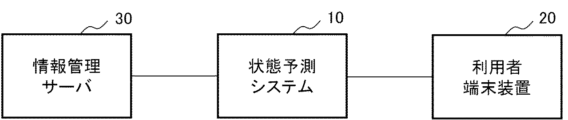
- FIG. 1 is a diagram showing an example of a racehorse prediction system.
- the racehorse prediction system includes a state prediction system 10, a user terminal device 20, and an information management server 30.
- the state prediction system 10 is connected to a user terminal device 20 via a network. Further, the state prediction system 10 is connected to the information management server 30 via a network.
- the condition prediction system 10 is a system that predicts the future condition of racehorses. For example, the condition prediction system 10 predicts the future condition of a racehorse before an auction.
- the racehorse before the auction is, for example, a racehorse owned by a producer.
- the condition prediction system 10 may predict the future condition of racehorses that have not reached the age to run in races.
- the future state of the racehorse is, for example, information regarding the evaluation of the racehorse in the future rather than at the time of prediction.
- the future state of a racehorse is, for example, at least one of auction price, health condition, maintenance costs, race results, and earned prize money.
- the auction price is the successful bid price of a racehorse in an auction.
- the health condition is, for example, the presence or absence of an injury in the future.
- the future condition of a racehorse is determined by changes in body weight, changes in muscle mass, training time, trainers suitable for racehorses, stables to outsource, jockeys suitable for racehorses, suitable race types, leg quality, etc. It may be at least one of the following: suitable race distance, preferred race development, first race start time, last race start time, and race entry period.
- the future state of a racehorse is not limited to the above.
- the condition prediction system 10 predicts the future condition of the racehorse, for example, using a prediction model that predicts the future condition of the racehorse from information about the racehorse.
- the state prediction system 10 then outputs the prediction result and the reason for the prediction.
- Information regarding racehorses is, for example, information that can affect the future condition of racehorses.
- the information regarding the racehorse is, for example, at least one of parent horse information, biological information of the racehorse at the time of prediction, and breeding history.
- Information regarding racehorses is not limited to the above.
- the reason for prediction is, for example, information on which the prediction model is based when predicting the future state of the racehorse.
- the reason for prediction is, for example, an item of information about a racehorse that has a greater influence on the prediction result of the future state of the racehorse than other items when the prediction model predicts the future state of the racehorse. .
- the predictive model is, for example, a trained model generated using a machine learning algorithm.
- the state prediction system 10 learns, for example, the relationship between information about racehorses that have run in races in the past and the future state of the racehorses. Then, the condition prediction system 10 generates a prediction model that predicts the future condition of the racehorse from the information regarding the racehorse to be predicted.
- the prediction model may be a learning model generated outside the state prediction system 10. The prediction model will be explained later.
- the user terminal device 20 is, for example, a terminal device owned by a person who uses the prediction results of the state prediction system 10.
- a person who uses the prediction results is, for example, a person who makes a bid in a racehorse auction.
- the person using the prediction result may be an auctioneer or an auction organizer.
- the person who uses the prediction results may be a person who invests in racehorses owned by corporations or individuals.
- a person who invests in racehorses owned by a corporation or an individual is also called a single owner.
- the person using the prediction result may be a reporter or a commentator.
- the person who uses the prediction result is not limited to the above example.
- the information management server 30 is, for example, a server that holds information regarding racehorses.
- the state prediction system 10 acquires information regarding racehorses from the information management server 30, for example. Then, the condition prediction system 10 receives the acquired information regarding the racehorse as input and predicts the future condition of the racehorse using the prediction model. After predicting the future state of the racehorse, the state prediction system 10 outputs the prediction result and the reason for the prediction to the user terminal device 20, for example.
- the state prediction system 10 may acquire information regarding racehorses from a plurality of information management servers 30. Further, the state prediction system 10 may acquire information regarding the racehorse input by the user of the user terminal device 20 from the user terminal device 20.
- the state prediction system 10 may output prediction results and prediction reasons to a plurality of user terminal devices 20.
- the state prediction system 10 may output the prediction result and the reason for the prediction to the user terminal devices 20 used by a plurality of users.
- the number of user terminal devices 20 and information management servers 30 may be set as appropriate.
- FIG. 2 is a diagram showing an example of the configuration of the state prediction system 10. As shown in FIG.
- the state prediction system 10 includes an acquisition section 11 , a prediction section 12 , an output section 13 , a generation section 14 , and a storage section 15 .
- the acquisition unit 11 acquires information regarding racehorses.
- Information regarding racehorses is, for example, information that can affect the future state of racehorses.
- the acquisition unit 11 acquires information about the parent horse, biological information about the horse, and breeding history as information about the racehorse. When the racehorse to be predicted is running in a race, the acquisition unit 11 may acquire the race record of the racehorse to be predicted.
- Information on the parent horse includes, for example, name, gender, breeder, trainer, stable, presence of injuries, history of training times, times for each race distance, race results, winnings, leg quality, stamina evaluation, and auction price. At least one or more.
- the race results include, for example, at least one of the following: race course, race distance, weather, ranking, race development, field characteristics, number of runners, ranking, and earned prize money in races in which the racer ran in the past.
- the race record may include the age at the time of first race and the age at retirement.
- the parent horse information may include information on sibling horses of the racehorse to be predicted. Information on sibling horses includes, for example, name, gender, breeder, trainer, stable, presence or absence of injuries, training time by age, time by race distance, race record, winnings, leg quality, and auction price. One or more. Parent horse information and sibling horse information are not limited to the above.
- the biological information includes at least one of sex, weight, weight change, blood data, and muscle mass. Biometric information is not limited to the above.
- the training history is, for example, at least one of the history of the producer, trainer, and training time. The history of the trainer and training time is acquired when training has started. The training history is not limited to the above.
- the acquisition unit 11 may acquire the selection results of the prediction models from the user terminal device 20.
- the selection result of the prediction model is input to the user terminal device 20 by, for example, an operation by a person who uses the prediction result. Further, the acquisition unit 11 may acquire from the user terminal device 20 a selection of display items that is input to the user terminal device 20 through an operation by a person who uses the prediction results.
- the acquisition unit 11 may acquire information regarding the racehorse and the future condition of the racehorse as training data for generating the prediction model.
- the acquisition unit 11 stores, for example, the acquired information regarding the racehorse and the future state of the racehorse in the storage unit 15.
- the prediction unit 12 predicts the future state of the racehorse from the acquired information about the racehorse using a prediction model that predicts the future state of the racehorse from the information about the racehorse. Furthermore, the prediction unit 12 extracts the reason why the prediction model predicted the future state of the racehorse as the prediction reason. For example, the prediction unit 12 acquires parameters used when the prediction model predicts the future state of the racehorse. The prediction unit 12 then extracts the reason for the prediction from the parameters that make a large contribution to predicting the future state of the racehorse.
- the prediction unit 12 predicts at least one of the auction price of the racehorse, the maintenance cost of the purchased racehorse, and the prize money that the purchased racehorse will win as the future state of the racehorse.
- the auction price of a racehorse is the winning bid price in an auction of a racehorse.
- Racehorse maintenance costs are expenses paid to continue owning a racehorse.
- the maintenance cost of a racehorse is, for example, the cost of feeding, maintaining health, and training the racehorse.
- the cost of maintaining a racehorse may be the cost of entrusting a purchased racehorse to a stable.
- the maintenance costs for racehorses are not limited to the above.
- the amount of prize money that the purchased racehorse will receive is the amount of prize money that the purchased racehorse will receive when it runs in a race in the future.
- the prediction unit 12 may predict, as the future state of the racehorse, the amount of prize money and maintenance costs that the purchased racehorse will receive for each age of the horse.
- the prediction unit 12 may predict the amount of prize money and maintenance costs that the purchased racehorse will receive on a monthly basis.
- the period for predicting the amount of prize money and maintenance costs that a purchased racehorse will receive may be set as appropriate.
- the prediction unit 12 predicts the future income and expenditure as the future state of the racehorse based on the auction price of the racehorse, the maintenance cost of the purchased racehorse, and the prize money that the purchased racehorse will win. Good too.
- the prediction unit 12 predicts, for example, the auction price of the racehorse, the maintenance cost of the purchased racehorse up to a certain point in the future, and the prize money that the purchased racehorse will win.
- the prediction unit 12 then predicts the income and expenditure at a certain point in the future by subtracting the auction price of the racehorse and the accumulated amount of maintenance costs of the purchased racehorse from the total prize money that the purchased racehorse will win. do.
- the prediction unit 12 predicts future income and expenditure, for example, on a monthly basis.
- the interval for predicting future income and expenditure is not limited to monthly intervals, and may be determined as appropriate according to the preferences of the person using the prediction results of the state
- the prediction unit 12 uses the purchase price of the racehorse, the maintenance cost of the purchased racehorse, and the prize money that the purchased racehorse will earn. You can also predict future income and expenditure.
- the maintenance cost for the purchased racehorse may be a predetermined amount per month or year. Further, the future state of the racehorse predicted by the prediction model is not limited to the above example.
- the prediction unit 12 may predict the future state of the racehorse using a prediction model depending on the purpose of prediction. For example, when the purpose of prediction is to predict an auction price, the prediction unit 12 predicts the auction price from information regarding the racehorse using a prediction model that predicts the auction price as the future state of the racehorse. Further, for example, when the purpose of prediction is to predict the winning prize money, the prediction unit 12 predicts the winning prize money from information about the racehorse using a prediction model that predicts the winning prize money as the future state of the racehorse. .
- the prediction unit 12 may predict the recommendation level from information regarding the racehorse using a prediction model that predicts the recommendation level for purchasing the racehorse as the future state of the racehorse.
- the degree of recommendation for purchase is calculated using, for example, an index set in advance by an expert who evaluates racehorses.
- the prediction unit 12 may predict the future state of the racehorse using a prediction model that places weight on items that are important to the user.
- the prediction unit 12 may determine the prediction result by weighting the prediction result of each prediction model.
- the prediction unit 12 weights the prediction results of each prediction model, for example, depending on which of the plurality of prediction models the results of which prediction model is prioritized.
- the prediction unit 12 may predict the recommendation level from information regarding the racehorse using a prediction model that predicts the recommendation level for purchasing a racehorse according to the items that are important to the person using the prediction results. For example, when a person using the prediction results places emphasis on pedigree, the prediction unit 12 predicts the recommendation level from information about the racehorse using a prediction model that places weight on data related to the pedigree at the time of prediction.
- the prediction unit 12 may predict the future state of the racehorse using a prediction model according to the age of the racehorse to be predicted.
- the prediction unit 12 predicts the future state of the racehorse using, for example, a prediction model for 0-year-olds, a prediction model for 1-year-olds, and a prediction model for 2-year-olds.
- the age classification when making a prediction using a prediction model according to age is not limited to the above.
- the prediction unit 12 may predict the future state of the racehorse using a prediction model according to the attributes of the person using the prediction results.
- the attribute of the person who uses the prediction result is, for example, a beginner, an intermediate, or an expert.
- the attributes of the person who uses the prediction results may be classified as an auction organizer, an auction participant, a horse owner, a trainer, or a reporter.
- the classification of attributes of persons using prediction results is not limited to the above example.
- the output unit 13 outputs the prediction result of the racehorse's future state and the reason for the prediction.
- the output unit 13 outputs the prediction result of the future state of the racehorse and the reason for the prediction to the user terminal device 20, for example.
- the output unit 13 may output the prediction result and the reason for prediction to a display device (not shown) connected to the state prediction system 10. Further, the output unit 13 may output the prediction result of the future state of the racehorse and the reason for the prediction to a server that distributes auction information, for example.
- the output unit 13 may output the prediction results of the plurality of items.
- the output unit 13 outputs, for example, the auction price and the amount of the won prize money as a result of predicting the future state of the racehorse.
- the output unit 13 outputs, for example, the reason for predicting the auction price and the reason for predicting the amount of prize money to be won as the prediction reason. Outputs .
- the output unit 13 may output prediction results of future states of items other than the auction price and reasons for the prediction for each price range of the auction price.
- the output unit 13 may output the prediction result regarding the future income and expenditure as information for each lapse of time.
- the output unit 13 outputs, for example, information regarding the income and expenditure for each age of the horse as a graph.
- the output unit 13 outputs, for example, a graph showing the cumulative amount of expenditure and the cumulative amount of income for each age of the horse.
- the output unit 13 may output a graph showing the difference between the cumulative amount of expenditure and the cumulative amount of income for each age of the horse as the income and expenditure.
- the output unit 13 uses the investment amount as a single horse owner instead of the auction price, and outputs information on expenditures and income according to the investment amount. It's okay.
- the output unit 13 may output information on items that are important in predicting the future state of the racehorse, which is added to the prediction result as reference information, among the information regarding the racehorse, along with the prediction result. Items to be emphasized in predicting the future state of a racehorse are, for example, items that have a high frequency of influencing the future state of the racehorse. Furthermore, when outputting information on items that are important in predicting the future state of a racehorse, the output unit 13 may output data that highlights items that correspond to the reason for the prediction. The output unit 13 may output, as reference information, items selected by a person who uses the prediction results from among the information regarding racehorses.
- the output unit 13 may output information about the parent horse of the racehorse to be predicted.
- the output unit 13 may output information about the parent horse of the racehorse to be predicted, when the age of the racehorse to be predicted is less than a standard.
- the output unit 13 outputs information on the parent horse's race record and breeding history as reference information, for example, when the racehorse to be predicted is at an age where there is little information on the race record and breeding history.
- the age standard and the items to be output are set in advance.
- the output unit 13 may output performance data of racehorses having similar attributes to the racehorse to be predicted, as reference information.
- a racehorse with similar attributes is, for example, a racehorse whose auction price and breeding history are similar to the racehorse to be predicted.
- the racehorse with similar attributes may be a racehorse with a similar pedigree to the racehorse to be predicted. Racehorses with similar attributes are not limited to the above example.
- the output unit 13 outputs, as reference information, information on races in which racehorses having attributes similar to those of the racehorse to be predicted have run, and the winning prize money.
- the output unit 13 may output data that highlights items selected by the person using the prediction results among the reference information. Highlighting is performed, for example, by changing at least one of the color, font size, font thickness, and decoration around the font from other items.
- the output unit 13 outputs, for example, at least one item among age, sex, weight, father horse, mother horse, producer, and training history as reference information.
- the output unit 13 may output highlighted data corresponding to the prediction reason when there is an item corresponding to the prediction reason among the reference information items.
- the output unit 13 may output an item that is a negative factor for the prediction result as the reason for the prediction.
- Negative factors are items that have a large influence on the prediction that the racehorse's evaluation will be lowered, among the items that have a large influence on the future state of the racehorse.
- a large influence means, for example, that when a certain item is changed, the fluctuation in the prediction result of the future state of the racehorse is larger than that of other items.
- the publicly managed competition is horse racing, for example, if the parent horse has a history of injury or illness, items related to health status are extracted as negative factors.
- the output unit 13 may output the prediction reason as a text.
- the output unit 13 outputs a sentence indicating the reason for the prediction, for example, based on information regarding a racehorse that has a high degree of influence on the prediction of the future state of the racehorse. For example, the relationship between information about a racehorse that has a high degree of influence on the prediction of the future state of the racehorse and a sentence indicating the reason for the prediction is set in advance.
- the output unit 13 may output a sentence such as "This horse is recommended because it is expected to win a lot of prize money" as the reason for prediction. good.
- the output unit 13 may output an image of the racehorse along with the prediction result and the reason for the prediction. Further, the output unit 13 may output an image of the racehorse being trained together with the prediction result and the reason for the prediction. Further, the output unit 13 may output an image of the parent horse or sibling horse of the racehorse to be predicted. The image may be a still image or a moving image.
- the output unit 13 may output the prediction result and the reason for the prediction superimposed on the image of the racehorse. Further, the output unit 13 may output either the prediction result or the prediction reason superimposed on the image of the racehorse.
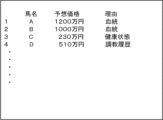
- FIG. 3 shows an example of a display screen of a prediction result of a racehorse's future state.
- the example of the display screen in FIG. 3 is a display screen of a prediction result when an auction price is predicted as a prediction result of a racehorse's future state.
- horse names, predicted prices, and reasons are displayed as a list for racehorses to be predicted.
- the predicted price is the auction price predicted by the prediction model.
- this is the prediction reason that the prediction model outputs together with the prediction result.
- the prediction reason may include multiple items.
- FIG. 4 shows an example of a display screen that further displays the amount of prize money won by a racehorse in the example of the display screen of FIG. 3.
- the prediction result of the auction price is displayed as the expected price
- the prediction result of the prize amount to be won is displayed as the prediction of the amount to be won.
- FIG. 5 shows an example of a display screen that further displays information regarding the racehorse to be predicted in the example of the display screen of FIG. 3.
- the names of the breeder, father horse, and mother horse of the racehorse to be predicted are further displayed.
- the information regarding racehorses that is displayed together with the prediction results is not limited to the above example.
- FIG. 6 shows an example of a display screen that displays changes in income and expenditure regarding racehorses as a graph.
- a graph is displayed in which the horizontal axis represents the age of the racehorse to be predicted, and the vertical axis represents the amount of money representing expenditures and income.
- the auction price, expenditures representing the cumulative amount of expenses necessary for maintenance, and income representing the cumulative amount of won prizes are displayed as a graph.
- the graph indicated by a broken line indicates the cumulative amount of the auction price and the expenses necessary for maintenance.
- the graph indicated by a solid line indicates the cumulative amount of earned prize money.
- the reason for prediction may be displayed in a superimposed manner on the graph in the example display screen of FIG.
- the graph in the example display screen of FIG. 6 may be displayed in combination with another example display screen.
- FIG. 7 shows an example of a display screen that further displays negative factors as prediction reasons in the example of the display screen of FIG. 3.
- the plus factor indicates a positive factor.
- a positive factor is an item that has a large influence on the prediction that the price will be high among the items that have a large influence on the prediction result of the auction price.
- negative factors are shown as negative factors. Negative factors are items that have a large influence on the prediction that the price will be low, among the items that have a large influence on the prediction result of the auction price.
- FIG. 8 shows, in the example of the display screen in FIG. 3, the predicted auction price of a racehorse with a low auction price, the predicted reason why the auction price is low, and the high evaluation that is opposite to the predicted reason.
- An example of a display screen showing related factors is shown.
- the example of the display screen in FIG. 8 is a display screen that displays, for a racehorse with a low predicted price, the reason why the price is low and the factors that increase the evaluation.
- an expected price indicating the prediction result of the auction price and a price reason indicating the reason for the prediction are displayed.
- factors that increase the prediction result are displayed as evaluation reasons.
- a factor that increases the evaluation is, for example, an item that causes the winning prize to be high while the auction price is low. For example, if the health condition is lowering the auction price, but the increased training time is expected to increase the prize money, the training time will be displayed as a factor that will increase the evaluation.
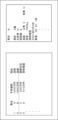
- FIG. 9 shows an example of a display screen that further displays reference information in the example of the display screen of FIG. 3.
- the prediction result and the reason for the prediction are displayed in the left frame.
- information regarding racehorse B is shown as reference information in the right frame.
- the horse's age, breeder, trainer, pedigree, weight, and training history are displayed as reference information. Items displayed as reference information are not limited to the above.
- reference information about the selected runner is displayed in the reference information column. Good too.
- FIG. 10 shows an example of a display screen that outputs an image of a racehorse in the example of the display screen of FIG. 9.
- an image of a racehorse is displayed on the left side of the lower row.
- the image of the selected racehorse may be displayed in the image display area.
- an image of the parent horse of the racehorse to be predicted may be displayed.
- the image of the parent horse of the racehorse to be predicted may be an image when the parent horse ran in a race in the past.
- a video during training may be displayed as the image of the racehorse.
- the image of the racehorse is acquired from the information management server 30, for example.
- FIG. 11 shows an example of a display screen in which a prediction result and a reason for prediction are displayed superimposed on an image of a racehorse in the example of the display screen of FIG. 10.
- a good pedigree is displayed as the reason for prediction.
- the prediction reason displayed on the image of the racehorse may be a plurality of items. Further, either the prediction result or the prediction reason may be displayed superimposed on the image of the racehorse.
- the generation unit 14 When generating a prediction model in the state prediction system 10, the generation unit 14 generates a prediction model that predicts the future state of the racehorse from information regarding the racehorse. For example, the generation unit 14 learns the relationship between information about racehorses and the future state of the racehorse, and generates a prediction model that predicts the future state of the racehorse from the information about the racehorse. The generation unit 14 may generate a prediction model that predicts a plurality of items regarding the future state of the racehorse. The generation unit 14 generates, for example, a prediction model that predicts an auction price and an acquired prize.
- the generation unit 14 may generate each of the plurality of prediction models used by the prediction unit 12 for prediction.
- the generation unit 14 When generating a prediction model for 0-year-olds, the generation unit 14, for example, learns the relationship between information about the racehorse, including the race record of the parent horse, and the future state of the racehorse, and generates the prediction model. .
- the generation unit 14 When generating a prediction model for a one-year-old, the generation unit 14, for example, learns the relationship between information about the racehorse, including biological information of the racehorse, and the future state of the racehorse, and generates the prediction model. do.
- the biological information of the racehorse includes, for example, one or more of sex, coat, gait, weight, body length, change in weight, change in physical condition, blood data, and personality.
- the biological information of racehorses is not limited to the above.
- the generation unit 14 When generating a prediction model for a 2-year-old horse, the generation unit 14 generates the prediction model by learning, for example, the relationship between information about the racehorse including its training history and its future state.
- the generation unit 14 When generating a prediction model according to the items that the user of the prediction results places importance on, the generation unit 14 generates, for example, the relationship between information about the racehorse, including information on the items that the user places emphasis on, and the future state of the racehorse. Learn and generate predictive models. When generating a predictive model that emphasizes pedigree, the generation unit 14 learns, for example, the relationship between the biological information of the parent horse, information about the racehorse including the parent horse's race record, and the future state of the racehorse. and generate a predictive model. When generating a prediction model according to the items of the prediction results that the user considers important, the generation unit 14 may generate the prediction model by increasing the weight of the items that the user considers important. When increasing the weight of the item that the user places importance on, the generation unit 14 generates a prediction model such that, for example, the coefficient of the feature amount regarding the item that the user places importance on is larger than the coefficient of the feature amount regarding other items. generate
- the generation unit 14 generates a predictive model using, for example, a learning algorithm based on factorized asymptotic Bayesian inference.
- the generation unit 14 uses information about the racehorse as input data and the future state of the racehorse as correct answer data, and generates a case according to decision tree-style rules. Divide.
- the generation unit 14 then generates a learning model that predicts the future state of the racehorse using a linear model that combines different explanatory variables in each case.
- the generation unit 14 generates a learning model by sequentially optimizing data case classification conditions, generating a predictive model by optimizing combinations of explanatory variables, and deleting unnecessary predictive models.
- This method of generating a learning model is also called heterogeneous mixture learning because it makes predictions by combining prediction models based on combinations of different explanatory variables.
- By generating a prediction model using heterogeneous mixture learning it becomes possible to explain the prediction results of the future state of the racehorse using conditions that have a strong influence on the prediction results, which improves the explainability of the prediction results. will improve.
- a method of heterogeneous mixture learning is disclosed in, for example, US Patent Application Publication No. 2014/0222741.
- the learning algorithm used for machine learning to generate a predictive model is not limited to the above example.
- the generation unit 14 may generate a learning model that predicts the future state of a racehorse from information about the racehorse by deep learning using a neural network.
- the generation unit 14 for example, varies the data of each item and selects items that have a large impact on the future condition of the racehorse based on changes in the future condition of the racehorse.
- the generation unit 14 changes the data of each item and extracts an item that has a large influence on the future state of the racehorse as the reason for prediction.
- the storage unit 15 stores, for example, a prediction model. When a plurality of prediction models are used, the storage unit 15 stores the plurality of prediction models. Further, when the state prediction system 10 generates a prediction model, the storage unit 15 may store data that is used as teacher data and associates information regarding the racehorse with the future state of the racehorse. Further, when adding reference information to the prediction result, the storage unit 15 may store data used as the reference information. Note that the prediction model used by the prediction unit 12 may be stored in a storage means other than the storage unit 15.
- the user terminal device 20 acquires the prediction result and the reason for the prediction from the state prediction system 10. Then, the user terminal device 20 outputs the prediction result and the reason for the prediction to, for example, a display device (not shown).
- the user terminal device 20 When a prediction model is selected by the user, the user terminal device 20 obtains, for example, the name of the prediction model input by the user's operation as the selection result of the prediction model. Then, the user terminal device 20 outputs the name of the input prediction model to the state prediction system 10.
- a smartphone, a tablet computer, a notebook computer, or a desktop computer is used as the user terminal device 20.
- the terminal device used for the user terminal device 20 is not limited to the above example.
- the information management server 30 is, for example, a server that stores or manages information regarding racehorses.
- the information management server 30 may be a plurality of servers installed according to the content of information regarding racehorses.
- Information regarding racehorses may be stored in a storage device managed by the information management server 30. Further, the information management server 30 may store images of racehorses.
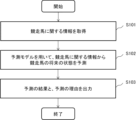
- FIG. 12 is a diagram showing an example of an operation flow when the state prediction system 10 predicts the future state of a racehorse.
- the acquisition unit 11 acquires information regarding a racehorse whose future state is to be predicted (step S11).
- the acquisition unit 11 acquires information regarding racehorses from the information management server 30, for example.
- the prediction unit 12 uses the prediction model that predicts the future state of the racehorse from the information about the racehorse to predict the future state of the racehorse from the information about the racehorse acquired by the acquisition unit 11.
- the future state is predicted (step S12).
- the output unit 13 When the future state of the racehorse is predicted, the output unit 13 outputs the prediction result and the reason for the prediction (step S13). The output unit 13 outputs the prediction result and the reason for the prediction to the user terminal device 20, for example.
- the user terminal device 20 that has received the prediction result and the prediction reason displays the prediction result and the prediction reason on the display device, for example.
- FIG. 13 is a diagram illustrating an example of an operation flow when the state prediction system 10 generates a prediction model.
- the acquisition unit 11 acquires information regarding the racehorse and the future state of the racehorse (step S21).
- the generation unit 14 learns the relationship between the information about the racehorse and the future state of the racehorse, and calculates the future state of the racehorse from the information about the racehorse.
- a prediction model that predicts the state of is generated (step S22). After generating the prediction model, the generation unit 14 stores the generated prediction model in the storage unit 15 (step S23).
- the state prediction system 10 of the racehorse prediction system of this embodiment acquires information about racehorses and uses a prediction model to predict the future state of the racehorses. Then, the state prediction system 10 outputs the prediction result and the reason for the prediction to the user terminal device 20, for example. By outputting the reason for the prediction together with the prediction result of the future state of the racehorse, a person using the prediction result can easily interpret the prediction result of the future state of the racehorse. Therefore, by using the condition prediction system 10, it is possible to easily interpret the results of predicting the future condition of the racehorse.
- the condition prediction system 10 can, for example, show the difference between the auction price and maintenance costs and the won prize money as the income and expenditure, so that a person using the prediction results can see the racehorse's profit. It is possible to output information for reference when considering. Further, when outputting information regarding the income and expenditure of a racehorse as a graph, the state prediction system 10 can output information regarding the income and expenditure, which is a prediction result, in a format that is easy for the user to visually understand.
- the state prediction system 10 can, for example, use a prediction model that corresponds to the items that the person using the prediction results places importance on, so that the state prediction system 10 can use the prediction model that corresponds to the items that the person using the prediction results places importance on.
- the reason for the prediction can be output together with the prediction result.
- the state prediction system 10 can output an appropriate prediction result and the reason for the prediction according to the age of the preliminary racehorse, for example.
- the state prediction system 10 When outputting reference information together with the prediction result, the state prediction system 10 adds and outputs the reference information to the prediction result and the reason for the prediction, so that a person using the prediction result can understand the reason for the prediction and the reference information. You can refer to the information to more easily interpret the reason for the prediction.
- FIG. 14 is a diagram showing an example of the configuration of the state prediction system 100 of this embodiment.
- the state prediction system 100 includes an acquisition section 101, a prediction section 102, and an output section 103.
- the acquisition unit 101 acquires information regarding racehorses.
- the prediction unit 102 predicts the future state of the racehorse from the acquired information about the racehorse using a prediction model that predicts the future state of the racehorse from the information about the racehorse.
- the output unit 103 outputs the prediction result and the reason for the prediction.
- the acquisition unit 11 of the first embodiment is an example of the acquisition unit 101. Further, the acquisition unit 101 is one aspect of an acquisition means.
- the prediction unit 12 of the first embodiment is an example of the prediction unit 102. Furthermore, the prediction unit 102 is one aspect of prediction means.
- the output unit 13 of the first embodiment is an example of the output unit 103. Furthermore, the output unit 103 is one aspect of output means.
- FIG. 15 is a diagram illustrating an example of the operation flow of the state prediction system 100.
- the acquisition unit 101 acquires information regarding racehorses (step S101).
- the prediction unit 102 predicts the future condition of the racehorse from the acquired information regarding the racehorse using a prediction model that predicts the future condition of the racehorse from the information regarding the racehorse. Predict (step S102).
- the output unit 103 outputs the prediction result and the reason for the prediction (step S103).
- the state prediction system 100 of this embodiment predicts the future state of a racehorse using a prediction model. Then, the condition prediction system 10 outputs the prediction result of the future condition of the racehorse and the reason for the prediction. As a result, the condition prediction system 10 can facilitate the interpretation of prediction results of the racehorse's future condition.
- FIG. 16 shows an example of the configuration of a computer 200 that executes a computer program that performs each process in the state prediction system 10 of the first embodiment and the state prediction system 100 of the second embodiment.
- the computer 200 includes a CPU (Central Processing Unit) 201, a memory 202, a storage device 203, an input/output I/F (Interface) 204, and a communication I/F 205.
- CPU Central Processing Unit
- the CPU 201 reads computer programs for performing each process from the storage device 203 and executes them.
- the CPU 201 may be configured by a combination of multiple CPUs. Further, the CPU 201 may be configured by a combination of a CPU and other types of processors. For example, the CPU 201 may be configured by a combination of a CPU and a GPU (Graphics Processing Unit).
- the memory 202 is configured with a DRAM (Dynamic Random Access Memory) or the like, and temporarily stores computer programs executed by the CPU 201 and data being processed.
- the storage device 203 stores computer programs executed by the CPU 201.
- the storage device 203 is configured by, for example, a nonvolatile semiconductor storage device. Other storage devices such as a hard disk drive may be used as the storage device 203.
- the input/output I/F 204 is an interface that receives input from a worker and outputs display data and the like.
- the communication I/F 205 is an interface that transmits and receives data between the user terminal device 20 and the information management server 30. Further, the user terminal device 20 and the information management server 30 may also have similar configurations.
- the computer program used to execute each process can also be stored and distributed in a computer-readable recording medium that non-temporarily records program data.
- a computer-readable recording medium for example, a magnetic tape for data recording or a magnetic disk such as a hard disk can be used.
- an optical disc such as a CD-ROM (Compact Disc Read Only Memory) can also be used.
- a nonvolatile semiconductor memory device may be used as the recording medium.
Landscapes
- Business, Economics & Management (AREA)
- Health & Medical Sciences (AREA)
- Economics (AREA)
- General Health & Medical Sciences (AREA)
- Human Resources & Organizations (AREA)
- Marketing (AREA)
- Primary Health Care (AREA)
- Strategic Management (AREA)
- Tourism & Hospitality (AREA)
- Physics & Mathematics (AREA)
- General Business, Economics & Management (AREA)
- General Physics & Mathematics (AREA)
- Engineering & Computer Science (AREA)
- Theoretical Computer Science (AREA)
- Management, Administration, Business Operations System, And Electronic Commerce (AREA)
Priority Applications (2)
| Application Number | Priority Date | Filing Date | Title |
|---|---|---|---|
| PCT/JP2022/012105 WO2023175809A1 (ja) | 2022-03-17 | 2022-03-17 | 状態予測システム、状態予測方法および記録媒体 |
| JP2024507329A JP7729465B2 (ja) | 2022-03-17 | 2022-03-17 | 状態予測システム、状態予測方法および状態予測プログラム |
Applications Claiming Priority (1)
| Application Number | Priority Date | Filing Date | Title |
|---|---|---|---|
| PCT/JP2022/012105 WO2023175809A1 (ja) | 2022-03-17 | 2022-03-17 | 状態予測システム、状態予測方法および記録媒体 |
Publications (1)
| Publication Number | Publication Date |
|---|---|
| WO2023175809A1 true WO2023175809A1 (ja) | 2023-09-21 |
Family
ID=88022544
Family Applications (1)
| Application Number | Title | Priority Date | Filing Date |
|---|---|---|---|
| PCT/JP2022/012105 Ceased WO2023175809A1 (ja) | 2022-03-17 | 2022-03-17 | 状態予測システム、状態予測方法および記録媒体 |
Country Status (2)
| Country | Link |
|---|---|
| JP (1) | JP7729465B2 (https=) |
| WO (1) | WO2023175809A1 (https=) |
Citations (4)
| Publication number | Priority date | Publication date | Assignee | Title |
|---|---|---|---|---|
| JP2006004362A (ja) * | 2004-06-21 | 2006-01-05 | Nec Mobiling Ltd | 通信ネットワークを利用した共同出資型オークションシステム、共同入札方法、サーバおよびプログラム |
| WO2019142597A1 (ja) * | 2018-01-19 | 2019-07-25 | ソニー株式会社 | 情報処理装置、情報処理方法及びプログラム |
| JP2020149583A (ja) * | 2019-03-15 | 2020-09-17 | 株式会社インター通信社 | 競走馬の潜在的能力予測プログラム、競走馬の潜在的能力予測方法、及び、競走馬の潜在的能力予測システム、並びに、種牡馬候補提示プログラム、種牡馬候補提示方法、及び、種牡馬候補提示システム、更にはこれらに用いられる予測生涯獲得賞金データベース作成プログラム |
| WO2021171591A1 (ja) * | 2020-02-28 | 2021-09-02 | 裕造 園生 | 情報処理方法、情報処理装置、およびプログラム |
-
2022
- 2022-03-17 WO PCT/JP2022/012105 patent/WO2023175809A1/ja not_active Ceased
- 2022-03-17 JP JP2024507329A patent/JP7729465B2/ja active Active
Patent Citations (4)
| Publication number | Priority date | Publication date | Assignee | Title |
|---|---|---|---|---|
| JP2006004362A (ja) * | 2004-06-21 | 2006-01-05 | Nec Mobiling Ltd | 通信ネットワークを利用した共同出資型オークションシステム、共同入札方法、サーバおよびプログラム |
| WO2019142597A1 (ja) * | 2018-01-19 | 2019-07-25 | ソニー株式会社 | 情報処理装置、情報処理方法及びプログラム |
| JP2020149583A (ja) * | 2019-03-15 | 2020-09-17 | 株式会社インター通信社 | 競走馬の潜在的能力予測プログラム、競走馬の潜在的能力予測方法、及び、競走馬の潜在的能力予測システム、並びに、種牡馬候補提示プログラム、種牡馬候補提示方法、及び、種牡馬候補提示システム、更にはこれらに用いられる予測生涯獲得賞金データベース作成プログラム |
| WO2021171591A1 (ja) * | 2020-02-28 | 2021-09-02 | 裕造 園生 | 情報処理方法、情報処理装置、およびプログラム |
Also Published As
| Publication number | Publication date |
|---|---|
| JP7729465B2 (ja) | 2025-08-26 |
| JPWO2023175809A1 (https=) | 2023-09-21 |
Similar Documents
| Publication | Publication Date | Title |
|---|---|---|
| Seip et al. | Anger motivates costly punishment of unfair behavior | |
| Xu et al. | Entrepreneurial learning and disincentives in crowdfunding markets | |
| US9208251B2 (en) | Computer-based evaluation tool for selecting personalized content for users | |
| CN113570395B (zh) | 信息处理方法、装置、计算机可读介质及电子设备 | |
| CN113570397B (zh) | 一种模型训练设备、方法、装置及介质 | |
| Hu et al. | Innovation contests: Attracting new solvers and new high‐quality solutions | |
| Mengov | Decision science: A human-oriented perspective | |
| JP7729465B2 (ja) | 状態予測システム、状態予測方法および状態予測プログラム | |
| JP2020149583A (ja) | 競走馬の潜在的能力予測プログラム、競走馬の潜在的能力予測方法、及び、競走馬の潜在的能力予測システム、並びに、種牡馬候補提示プログラム、種牡馬候補提示方法、及び、種牡馬候補提示システム、更にはこれらに用いられる予測生涯獲得賞金データベース作成プログラム | |
| JP7304836B2 (ja) | 広告制作支援プログラム、広告制作支援装置及び広告制作支援方法 | |
| Nicholls et al. | Get active now or later? The association between physical activity and risk and time preferences | |
| Mueller et al. | Excited and aroused: The predictive importance of simple choice process metrics. | |
| Bredow et al. | Market value, quality of the pool of potential mates, and singles' confidence about marrying | |
| JP7798170B2 (ja) | 予測システム、予測方法および予測プログラム | |
| KR20240063632A (ko) | 제품들 간 경쟁 관계를 추론하는 데이터 처리 방법 및 장치 | |
| Dale et al. | Silence is golden. Suggested donations in voluntary contribution games | |
| JP7816490B2 (ja) | 意思決定支援システム、意思決定支援方法および意思決定支援プログラム | |
| US20240296396A1 (en) | Program organization system, program organization method, and recording medium | |
| Carlberg | Excel Sales Forecasting for Dummies | |
| US20240296381A1 (en) | Program information providing apparatus, program information providing method, and recording medium | |
| JP7778459B1 (ja) | 行動提案装置、行動提案方法、及びプログラム | |
| Yuan | Supply side optimisation in online display advertising | |
| JP7803402B2 (ja) | 時間割引率推定装置、機械学習方法、時間割引率分析方法、及びプログラム | |
| Drichoutis et al. | The effects of induced mood on preference reversals and bidding behavior in experimental auctions | |
| Rekart et al. | Making Decisions: Why We Buy Lottery Tickets |
Legal Events
| Date | Code | Title | Description |
|---|---|---|---|
| 121 | Ep: the epo has been informed by wipo that ep was designated in this application |
Ref document number: 22932085 Country of ref document: EP Kind code of ref document: A1 |
|
| ENP | Entry into the national phase |
Ref document number: 2024507329 Country of ref document: JP Kind code of ref document: A |
|
| NENP | Non-entry into the national phase |
Ref country code: DE |
|
| 122 | Ep: pct application non-entry in european phase |
Ref document number: 22932085 Country of ref document: EP Kind code of ref document: A1 |