WO2023166579A1 - ラベリング支援システム、ラベリング支援方法およびラベリング支援プログラム - Google Patents
ラベリング支援システム、ラベリング支援方法およびラベリング支援プログラム Download PDFInfo
- Publication number
- WO2023166579A1 WO2023166579A1 PCT/JP2022/008750 JP2022008750W WO2023166579A1 WO 2023166579 A1 WO2023166579 A1 WO 2023166579A1 JP 2022008750 W JP2022008750 W JP 2022008750W WO 2023166579 A1 WO2023166579 A1 WO 2023166579A1
- Authority
- WO
- WIPO (PCT)
- Prior art keywords
- data
- cluster
- labeling
- common points
- unit
- Prior art date
- Legal status (The legal status is an assumption and is not a legal conclusion. Google has not performed a legal analysis and makes no representation as to the accuracy of the status listed.)
- Ceased
Links
Images




Classifications
-
- G—PHYSICS
- G06—COMPUTING OR CALCULATING; COUNTING
- G06F—ELECTRIC DIGITAL DATA PROCESSING
- G06F16/00—Information retrieval; Database structures therefor; File system structures therefor
- G06F16/20—Information retrieval; Database structures therefor; File system structures therefor of structured data, e.g. relational data
- G06F16/28—Databases characterised by their database models, e.g. relational or object models
- G06F16/284—Relational databases
- G06F16/285—Clustering or classification
-
- G—PHYSICS
- G06—COMPUTING OR CALCULATING; COUNTING
- G06F—ELECTRIC DIGITAL DATA PROCESSING
- G06F16/00—Information retrieval; Database structures therefor; File system structures therefor
- G06F16/70—Information retrieval; Database structures therefor; File system structures therefor of video data
- G06F16/75—Clustering; Classification
-
- G—PHYSICS
- G06—COMPUTING OR CALCULATING; COUNTING
- G06F—ELECTRIC DIGITAL DATA PROCESSING
- G06F16/00—Information retrieval; Database structures therefor; File system structures therefor
- G06F16/90—Details of database functions independent of the retrieved data types
- G06F16/906—Clustering; Classification
-
- G—PHYSICS
- G16—INFORMATION AND COMMUNICATION TECHNOLOGY [ICT] SPECIALLY ADAPTED FOR SPECIFIC APPLICATION FIELDS
- G16Y—INFORMATION AND COMMUNICATION TECHNOLOGY SPECIALLY ADAPTED FOR THE INTERNET OF THINGS [IoT]
- G16Y40/00—IoT characterised by the purpose of the information processing
- G16Y40/20—Analytics; Diagnosis
Definitions
- the present invention relates to a labeling support system, a labeling support method, and a labeling support program that support labeling of unlabeled data.
- Patent Literature 1 describes a sensor data classification device that classifies sensor data obtained from a large number of sensors according to their characteristics.
- the device described in Patent Document 1 associates a set of sensor data divided for each preset time interval with a sensor identifier and a divided section identifier, and extracts a plurality of types of feature parameters from the data included in the set of divided data. calculate.
- the data to be classified is video, it takes time to confirm the data.
- data to be classified includes a plurality of sensor data, determining which data should be focused on becomes a complicated task.
- an object of the present invention is to provide a labeling support system, a labeling support method, and a labeling support program that can support labeling work for clusters in which unlabeled data are classified.
- a labeling support system includes classification means for generating a plurality of clusters by classifying data to be labeled by unsupervised learning, and for each generated cluster, searching for common points of data included in the cluster. It is characterized by comprising search means and output means for outputting information on the searched common points for each cluster.
- a computer classifies data to be labeled by unsupervised learning to generate a plurality of clusters, and for each generated cluster, the computer identifies common points of data included in the cluster. and the computer outputs information about the found common points for each cluster.
- a labeling support program provides a computer with a classification process for generating a plurality of clusters by classifying data to be labeled by unsupervised learning, and for each generated cluster, a common point of data included in the cluster. It is characterized by executing search processing for searching and output processing for outputting information on the searched common points for each cluster.
- FIG. 1 is a block diagram showing a configuration example of an embodiment of a labeling support system according to the present invention
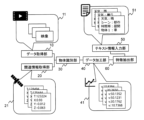
- FIG. FIG. 4 is an explanatory diagram showing an example of data used in the labeling support system
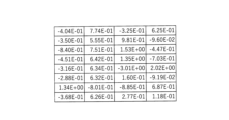
- FIG. 4 is an explanatory diagram showing an example of feature amounts
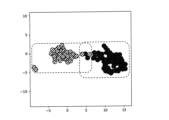
- FIG. 10 is an explanatory diagram showing an example of visualization of dimension-reduced data in a graph
- It is explanatory drawing which shows the example which displayed the contribution degree for every sensor by the graph.
- FIG. 4 is an explanatory diagram showing an example of distribution of sensor values within a cluster
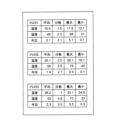
- FIG. 4 is an explanatory diagram showing an example of statistics within a cluster; 4 is a flow chart showing an operation example of the labeling support system; 1 is a block diagram showing an overview of a labeling support system according to the present invention; FIG. 1 is a schematic block diagram showing a configuration of a computer according to at least one embodiment; FIG.
- unlabeled data is not limited to moving images, and may be still images, music data, text data, and the like. Further, unlabeled data (data to be labeled) may be hereinafter referred to as unclassified data.
- FIG. 1 is a block diagram showing a configuration example of one embodiment of a labeling support system according to the present invention.
- the labeling support system 1 of this embodiment includes a data acquisition unit 10, a related information acquisition unit 20, an object identification unit 30, a data processing unit 40, a text information input unit 50, a feature extraction unit 60, and a feature storage.
- a unit 70 , a visualization processing unit 80 , and an input/output device 90 are provided.
- the data acquisition unit 10 acquires data to be labeled (that is, unclassified data). For example, when a camera (not shown) captures an image of a traveling vehicle, the data acquisition unit 10 may acquire a moving image of the vehicle captured by the camera as data to be labeled.
- the data acquired by the data acquisition unit 10 is not limited to data acquired in real time.
- the data acquisition unit 10 may acquire the data to be labeled, for example, from a storage server (not shown) in which the data to be labeled is stored.
- the related information acquisition unit 20 acquires information related to data to be labeled (hereinafter referred to as related information).
- the related information is information indicating the situation in which the data to be labeled is generated. (hereinafter referred to as sensor data).
- the data to be labeled is video data captured by an in-vehicle camera (drive recorder), it is acquired based on GPS (Global Positioning System) information representing the vehicle position and CAN (Controller Area Network) as related information. and the information to be provided.
- GPS Global Positioning System
- CAN Controller Area Network
- sensor data acquired in this case are velocity, acceleration, and position (latitude, longitude, altitude, etc.).
- sensor data when a video showing the operating status of a thermal power plant is used as the data to be labeled, sensor data includes, for example, fuel flow rate, pressure, temperature, rotation speed, and power generation amount.
- sensor data when images showing farm conditions are used as data to be labeled, sensor data includes time, temperature, humidity, pH, soil water content, solar radiation, wind direction/speed, water level, and the like.
- the object identification unit 30 identifies objects included in the acquired data and generates information specifying the identified objects (hereinafter referred to as an object list). For example, when the object to be identified is a vehicle, the object identification unit 30 identifies the vehicle from the data acquired by the data acquisition unit 10, and identifies the vehicle (for example, coordinates indicating the position in the image). may be generated as an object list. Methods for identifying objects from images and videos are widely known, and detailed description thereof is omitted here.
- the data processing unit 40 processes the data (more specifically, the object list) into a form that can be used when the feature extraction unit 60, which will be described later, performs processing. Specifically, the data processing unit 40 processes the data so as to improve the accuracy of feature extraction and clustering.
- the data processing unit 40 for example, thins data, interpolates missing values, excludes outliers, and deletes unnecessary data items. Further, for example, when the data to be labeled is video data, the data processing unit 40 may convert the video data into numerical time-series data.
- the text information input unit 50 accepts input of text data including information to be added to each data to be labeled (hereinafter referred to as additional information).
- the additional information is information indicating the content of the labeling target data that can be acquired other than the related information. Categories indicating additional information include, for example, weather, types of plants, traffic participants, and the like. Examples of categorical values for weather include sunny, cloudy, rain, and snow. Examples of categorical values for plant types include rice, wheat, and barley. ⁇ Pedestrians, etc.
- labeling target data associated with additional information is also simply referred to as labeling target data.
- FIG. 2 is an explanatory diagram showing an example of data used in the labeling support system 1 of this embodiment.
- the example shown in FIG. 2 indicates that the data acquisition unit 10 has acquired the image 11 as data to be labeled, and the related information acquisition unit 20 has acquired related information 21 regarding the location where the image 11 was shot.
- the data processing unit 40 processes the video 11 and the related information 21 (more specifically, the object list generated by the object identification unit 30) to generate numerical time series data 41. indicate that Furthermore, the example shown in FIG. 2 indicates that the text information input unit 50 has received input of text data 51 including information on the weather, scene, time period, and objects as additional information.
- the feature extraction unit 60 extracts features from each data to be labeled.
- the feature extraction unit 60 of the present embodiment automatically classifies each data to be labeled including additional information by unsupervised learning to generate a plurality of clusters. Any method can be used to generate clusters by unsupervised learning, and examples thereof include the k-means method and the Gaussian mixture model.
- the feature extraction unit 60 extracts the feature amount of each data included in the generated cluster.
- the feature extraction unit 60 may extract, for example, additional information included in the text data as a feature amount.
- the feature extraction unit 60 may extract feature amounts indicated by numerical time-series data.
- the feature extraction unit 60 may extract feature amounts based on sensor values included in the data to be labeled (more specifically, numerical time-series data).
- any method can be used to extract feature values from numerical time-series data. For example, for each cluster generated by the k-means method, the feature extraction unit 60 extracts a feature amount called the distance (cluster distance feature) from the center of gravity of the numerical time series data included in the cluster to each data. good.
- the feature extracting unit 60 can be said to be a classifying means because it classifies data to be labeled by unsupervised learning.
- the object identification unit 30 identifies the object from the information obtained by the data acquisition unit 10 and the related information acquisition unit 20, and the data processing unit 40 uses the identification result, and the feature extraction unit 60 uses the identification result.
- the data acquisition unit 10 may directly acquire data in the format used by the feature extraction unit 60 and input the acquired data to the feature extraction unit 60 .
- the labeling support system 1 does not have to include the related information acquisition unit 20, the object identification unit 30, and the data processing unit 40.
- the feature storage unit 70 stores feature amounts of each data extracted by the feature extraction unit 60 .
- the manner in which the feature storage unit 70 stores the feature amount for each data is arbitrary.
- FIG. 3 is an explanatory diagram showing an example of feature amounts stored in the feature storage unit 70. As shown in FIG. In the example shown in FIG. 3, the vertical direction represents one feature point, and the horizontal direction represents the feature amount (category value) of each category (for example, weather, traffic participants, types of plants, etc.).
- the feature storage unit 70 is implemented by, for example, a magnetic disk.
- the visualization processing unit 80 performs processing for visualizing information that contributes to the labeling work for the generated clusters.
- the visualization processing unit 80 includes a search unit 81 and an output unit 82 .
- the search unit 81 searches for common points of labeling target data included in the cluster. Specifically, the search unit 81 extracts the feature amount of each data included in the generated cluster, and searches for common points of the extracted feature amounts of each data. The search unit 81 may search for a common point of category values in each extracted category as a feature amount, or may search for a common point of feature amounts extracted based on numerical time-series data.
- the searching unit 81 may set the category value as the common point when the rate of common category values among the data in the cluster exceeds a predetermined threshold.
- the ratio can be calculated based on the ratio of the number of data containing common points to the number of data in the cluster.
- the searching unit 81 may search for a common point for the category values of all categories, or may search for a common point for the category values of any part of the categories.
- the search unit 81 searches for the most common category value (for example, the mode value if it is a numerical value) as a common point for each category indicated by the data to be labeled. good too. Then, the searching unit 81 may specify the category value having the highest ratio of the most common category values as the common point.
- the most common category value for example, the mode value if it is a numerical value
- the searching unit 81 may calculate the degree of contribution of the sensor value to the feature amount. For example, when the relationship between the sensor value of the data to be labeled and the feature amount is represented by a linear expression of the sensor values, the search unit 81 takes the weight of the sensor value included in the linear expression as the degree of contribution. Large sensor values may be identified as commonalities.
- the output unit 82 outputs information about the found common points.
- the output unit 82 may output and display the information on the common points searched for each cluster to the input/output device 90, or may output and store the information in a storage unit (not shown) included in the labeling support system 1. may
- the output unit 82 may output one common point with the highest degree of commonality among the searched common points. For example, when a category value is specified as a common point, the output unit 82 may output the name of the category value and the category value (for example, "weather: sunny"). Further, for example, when a sensor value is specified as a common point, the output unit 82 may output the sensor value and the name of the sensor that obtained the sensor value.
- the output unit 82 may output the name of the sensor value and the sensor value, with the sensor value having the largest degree of contribution as a common point.
- the output unit 82 may output a plurality of common point candidates searched in the cluster according to the degree of commonality of the common points. For example, the output unit 82 may output the degree of commonality itself, or may output the common points with the highest degree of commonality as labeling candidates in a ranking format up to a predetermined rank.
- the output unit 82 may directly label and output the information indicating the found common points to the unclassified data (that is, the data to be labeled) in each cluster. In this case, the output unit 82 may label and output information indicating the common point with the highest degree of commonality.
- the output unit 82 draws a graph on the input/output device 90 of the data to be labeled that has been dimensionally reduced (lowered) so that a person can observe how the data to be labeled is clustered. can be visualized.
- the output unit 82 for example, by UMAP (Uniform Manifold Approximation and Projection) or the like, dimensionality reduction of the data to be labeled to two-dimensional or three-dimensional, the dimensionality-reduced data, even if visualized as a graph such as a distribution map. good.
- the output unit 82 may display the data classified into the same cluster in a manner different from that of other clusters (for example, by changing the color, changing the symbol, etc.).
- FIG. 4 is an explanatory diagram showing an example of visualizing the dimension-reduced data in a graph.
- the graph illustrated in FIG. 4 shows an example in which the data reduced to two dimensions by UMAP are displayed in different manners (hatching, blacking, etc.) for each cluster to which they belong.
- the output unit 82 may display the range of data included in the cluster so that the range can be specified.
- the output unit 82 may display all the data, or may determine whether or not to display only data that satisfies a specific condition.
- the output unit 82 targets clusters that satisfy a specific condition (for example, clusters whose number of data is greater than a predetermined number) or unclassified data (that is, unlabeled data), whether to display them or not. You can decide whether to display it or not.
- the output unit 82 may display the contribution of each sensor in the cluster in a graph.
- FIG. 5 is an explanatory diagram showing an example in which the degree of contribution of each sensor is displayed graphically.
- the feature value of each cluster is calculated using sensor values indicating temperature, humidity, and water level, and the contribution of each sensor value used to calculate the feature value is displayed in a bar graph. is.
- the feature amount of cluster 2 indicates that the contribution of the sensor value indicating the water level is higher than that of other clusters.
- the display of the degree of contribution for each sensor is not limited to the bar graph illustrated in FIG.
- FIG. 6 is an explanatory diagram showing an example of distribution of sensor values within a cluster.
- the data to be labeled includes temperature, humidity, and water level as sensor values, and as illustrated in FIG. 6, a graph showing the distribution of each sensor value is displayed. Note that the vertical axis direction of the graph illustrated in FIG. 6 indicates the number of elements, and the horizontal axis direction indicates the sensor value.
- the display of the distribution of sensor values in the cluster is not limited to the distribution chart illustrated in FIG. 6, and may be, for example, a frequency distribution table or a histogram.
- the output unit 82 may output statistics within the cluster.
- FIG. 7 is an explanatory diagram showing an example of statistics within a cluster. The statistics illustrated in FIG. 7 show an example of outputting the average, variance, maximum value, and minimum value of each sensor value included in the data in the cluster for each cluster. Note that the output statistic is an example, and any other statistic such as median or mode may be output.
- the input/output device 90 displays the output result from the output unit 82.
- the input/output device 90 also receives input from the user regarding the displayed result, and executes processing according to the input. For example, when receiving an input specifying a cluster from the user, the input/output device 90 may display detailed information about the specified cluster. Specifically, the input/output device 90 may display the statistical information generated by the output unit 82 for the specified cluster.
- the input/output device 90 may be realized by a tablet terminal or the like. Alternatively, the input/output device 90 may be realized by a device having a display device and a pointing device.
- the input/output device 90 accepts an input specifying a target cluster from the user, and receives information about the accepted cluster (for example, FIG. 5, FIG. 6, information illustrated in FIG. 7) may be displayed.
- the unit 81 and the output unit 82) are realized by a computer processor (for example, a CPU (Central Processing Unit)) that operates according to a program (labeling support program).
- a computer processor for example, a CPU (Central Processing Unit)
- CPU Central Processing Unit
- program labeling support program
- the program is stored in a storage unit (not shown) of the labeling support system 1, the processor reads the program, and according to the program, the data acquisition unit 10, the related information acquisition unit 20, the object identification unit 30, the data processing It may operate as the unit 40, the text information input unit 50, the feature extraction unit 60, and the visualization processing unit 80 (more specifically, the search unit 81 and the output unit 82).
- the functions of the labeling support system 1 may be provided in a SaaS (Software as a Service) format.
- the unit 81 and the output unit 82) may each be realized by dedicated hardware. Also, part or all of each component of each device may be implemented by general-purpose or dedicated circuitry, processors, etc., or combinations thereof. These may be composed of a single chip, or may be composed of multiple chips connected via a bus. A part or all of each component of each device may be implemented by a combination of the above-described circuits and the like and programs.
- each component of the labeling support system 1 is realized by a plurality of information processing devices, circuits, etc.
- the plurality of information processing devices, circuits, etc. may be centrally arranged, They may be distributed.
- the information processing device, circuits, and the like may be implemented as a form in which each is connected via a communication network, such as a client-server system, a cloud computing system, or the like.
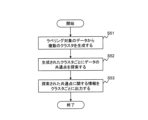
- FIG. 8 is a flowchart showing an operation example of the labeling support system 1.
- FIG. 8 is an operation example when the data acquisition unit 10 directly acquires data in a format used by the feature extraction unit 60 and inputs the acquired data to the feature extraction unit 60 .
- the feature extraction unit 60 generates a plurality of clusters from data to be labeled (step S51).
- the searching unit 81 searches for a common point of data for each generated cluster (step S52). Then, the output unit 82 outputs information about the found common points for each cluster (step S53).
- the feature extraction unit 60 classifies data to be labeled by unsupervised learning to generate a plurality of clusters, and the search unit 81 classifies each generated cluster into Find commonalities in the data contained in . Then, the output unit 82 outputs information about the found common points for each cluster.
- Such a configuration can assist the labeling task for clusters into which unlabeled data have been classified.
- the output unit 82 automatically labels the data to be labeled and outputs labeling candidates, thereby reducing the cost of labeling by a person and allowing a person to understand the reason why the label is given. I can grasp it.
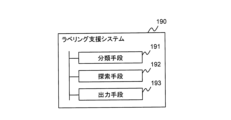
- FIG. 9 is a block diagram showing the outline of the labeling support system according to the present invention.
- a labeling support system 190 (for example, labeling support system 1) according to the present invention includes classification means 191 (for example, feature extraction unit 60) that generates a plurality of clusters by classifying data to be labeled by unsupervised learning; Search means 192 (e.g., feature extraction unit 60) for searching common points of data included in each cluster, and output means 193 (e.g., , and an output unit 82).
- classification means 191 for example, feature extraction unit 60
- Search means 192 e.g., feature extraction unit 60
- output means 193 e.g., , and an output unit 82.
- the classification means 191 may extract the feature amount of each data included in the generated cluster, and the search means 192 may search for common points of the feature amounts extracted for each data in the cluster.
- the classification means 191 extracts a feature amount based on the sensor value included in the data to be labeled, the search means 192 calculates the contribution of the sensor value to the feature amount, and the output means 193 The largest sensor value may be output as the common point.
- the output means 193 may graphically display the contribution of each sensor in the cluster.
- the output means 193 may label and output information indicating the found common points for the labeling target data in each cluster.
- the output means 193 may output a plurality of common points searched within the cluster according to the degree of commonality of the common points.
- the output means 193 may output the common points with the highest degree of commonality as labeling candidates in a ranking format up to a predetermined rank.
- FIG. 10 is a schematic block diagram showing the configuration of a computer according to at least one embodiment.
- a computer 1000 comprises a processor 1001 , a main storage device 1002 , an auxiliary storage device 1003 and an interface 1004 .
- the labeling support system 190 described above is implemented in the computer 1000.
- the operation of each processing unit described above is stored in the auxiliary storage device 1003 in the form of a program (labeling support program).
- the processor 1001 reads out the program from the auxiliary storage device 1003, develops it in the main storage device 1002, and executes the above processing according to the program.
- the secondary storage device 1003 is an example of a non-transitory tangible medium.
- Other examples of non-transitory tangible media include magnetic disks, magneto-optical disks, CD-ROMs (Compact Disc Read-only memory), DVD-ROMs (Read-only memory), connected via interface 1004, A semiconductor memory etc. are mentioned.
- the computer 1000 receiving the distribution may develop the program in the main storage device 1002 and execute the above process.
- the program may be for realizing part of the functions described above.
- the program may be a so-called difference file (difference program) that implements the above-described functions in combination with another program already stored in the auxiliary storage device 1003 .
- Classification means for generating a plurality of clusters by classifying data to be labeled by unsupervised learning; search means for searching for a common point of the data included in each generated cluster;
- a labeling support system comprising output means for outputting information about the found common points for each of the clusters.
- the classification means extracts the feature amount of each data included in the generated cluster, The labeling support system according to appendix 1, wherein the searching means searches for a common point of the feature values extracted for each data in the cluster.
- the classification means extracts a feature amount based on the sensor value included in the data to be labeled,
- the search means calculates a contribution of the sensor value to the feature quantity,
- the labeling support system according to appendix 1 or appendix 2, wherein the output means outputs the sensor value having the largest contribution as a common point.
- Appendix 4 The labeling support system according to appendix 3, wherein the output means graphically displays the degree of contribution of each sensor in the cluster.
- a computer generates a plurality of clusters by classifying data to be labeled by unsupervised learning, The computer searches for common points of the data included in each cluster generated, A labeling support method, wherein the computer outputs information about the found common points for each of the clusters.
- a classification process that generates multiple clusters by classifying the data to be labeled by unsupervised learning, a search process for searching for a common point of the data included in each generated cluster; and A program storage medium storing a labeling support program for executing output processing for outputting information about the found common points for each of the clusters.
- Appendix 11 to the computer, In the classification process, extract the feature amount of each data included in the generated cluster, 11.
- the program storage medium according to appendix 10 which stores a labeling support program for searching for common points of feature values extracted for each data in a cluster in search processing.
- a classification process that generates multiple clusters by classifying the data to be labeled by unsupervised learning, a search process for searching for a common point of the data included in each generated cluster; and A labeling support program for executing output processing for outputting information about the found common points for each of the clusters.
- labeling support system 10 data acquisition unit 20 related information acquisition unit 30 object identification unit 40 data processing unit 50 text information input unit 60 feature extraction unit 70 feature storage unit 80 visualization processing unit 81 search unit 82 output unit 90 input/output device
Landscapes
- Engineering & Computer Science (AREA)
- Databases & Information Systems (AREA)
- Theoretical Computer Science (AREA)
- Physics & Mathematics (AREA)
- General Engineering & Computer Science (AREA)
- General Physics & Mathematics (AREA)
- Data Mining & Analysis (AREA)
- Health & Medical Sciences (AREA)
- Biomedical Technology (AREA)
- General Health & Medical Sciences (AREA)
- Computing Systems (AREA)
- Multimedia (AREA)
- Information Retrieval, Db Structures And Fs Structures Therefor (AREA)
Priority Applications (3)
| Application Number | Priority Date | Filing Date | Title |
|---|---|---|---|
| PCT/JP2022/008750 WO2023166579A1 (ja) | 2022-03-02 | 2022-03-02 | ラベリング支援システム、ラベリング支援方法およびラベリング支援プログラム |
| JP2024504061A JP7758150B2 (ja) | 2022-03-02 | 2022-03-02 | ラベリング支援システム、ラベリング支援方法およびラベリング支援プログラム |
| US18/836,438 US20250156446A1 (en) | 2022-03-02 | 2022-03-02 | Labeling assistance system, labeling assistance method, and labeling assistance program |
Applications Claiming Priority (1)
| Application Number | Priority Date | Filing Date | Title |
|---|---|---|---|
| PCT/JP2022/008750 WO2023166579A1 (ja) | 2022-03-02 | 2022-03-02 | ラベリング支援システム、ラベリング支援方法およびラベリング支援プログラム |
Publications (1)
| Publication Number | Publication Date |
|---|---|
| WO2023166579A1 true WO2023166579A1 (ja) | 2023-09-07 |
Family
ID=87883222
Family Applications (1)
| Application Number | Title | Priority Date | Filing Date |
|---|---|---|---|
| PCT/JP2022/008750 Ceased WO2023166579A1 (ja) | 2022-03-02 | 2022-03-02 | ラベリング支援システム、ラベリング支援方法およびラベリング支援プログラム |
Country Status (3)
| Country | Link |
|---|---|
| US (1) | US20250156446A1 (https=) |
| JP (1) | JP7758150B2 (https=) |
| WO (1) | WO2023166579A1 (https=) |
Citations (2)
| Publication number | Priority date | Publication date | Assignee | Title |
|---|---|---|---|---|
| JP2008084151A (ja) * | 2006-09-28 | 2008-04-10 | Just Syst Corp | 情報表示装置および情報表示方法 |
| JP2008084203A (ja) * | 2006-09-28 | 2008-04-10 | Nec Corp | ラベル付与システム、ラベル付与方法およびラベル付与プログラム |
Family Cites Families (3)
| Publication number | Priority date | Publication date | Assignee | Title |
|---|---|---|---|---|
| EP3534303A4 (en) | 2016-10-26 | 2019-11-06 | Sony Corporation | INFORMATION PROCESSOR AND INFORMATION PROCESSING METHOD |
| JP7087851B2 (ja) | 2018-09-06 | 2022-06-21 | 株式会社リコー | 情報処理装置、データ分類方法およびプログラム |
| JP7355299B2 (ja) | 2019-06-14 | 2023-10-03 | Awl株式会社 | 学習用データセット生成システム、学習サーバ、及び学習用データセット生成プログラム |
-
2022
- 2022-03-02 US US18/836,438 patent/US20250156446A1/en active Pending
- 2022-03-02 WO PCT/JP2022/008750 patent/WO2023166579A1/ja not_active Ceased
- 2022-03-02 JP JP2024504061A patent/JP7758150B2/ja active Active
Patent Citations (2)
| Publication number | Priority date | Publication date | Assignee | Title |
|---|---|---|---|---|
| JP2008084151A (ja) * | 2006-09-28 | 2008-04-10 | Just Syst Corp | 情報表示装置および情報表示方法 |
| JP2008084203A (ja) * | 2006-09-28 | 2008-04-10 | Nec Corp | ラベル付与システム、ラベル付与方法およびラベル付与プログラム |
Non-Patent Citations (1)
| Title |
|---|
| HATTORI, TAKASHI ET AL.: "Human Action Classification by Utilizing Correlation of Observation Data from Massive Sensors", IEICE TECHNICAL REPORT, vol. 106, no. 396, 23 November 2006 (2006-11-23), pages 29 - 34, XP009548668 * |
Also Published As
| Publication number | Publication date |
|---|---|
| JPWO2023166579A1 (https=) | 2023-09-07 |
| US20250156446A1 (en) | 2025-05-15 |
| JP7758150B2 (ja) | 2025-10-22 |
Similar Documents
| Publication | Publication Date | Title |
|---|---|---|
| Sun et al. | SHIFT: a synthetic driving dataset for continuous multi-task domain adaptation | |
| Wang et al. | YOLOv3‐Litchi Detection Method of Densely Distributed Litchi in Large Vision Scenes | |
| Li et al. | Street tree segmentation from mobile laser scanning data | |
| CN110956137A (zh) | 点云数据的目标检测方法、系统及介质 | |
| CN114596555A (zh) | 障碍物点云数据筛选方法、装置、电子设备及存储介质 | |
| CN113942521B (zh) | 一种智能车路系统下驾驶员风格辨识方法 | |
| JP6685856B2 (ja) | 農作業計画支援装置及び農作業計画支援方法 | |
| Zhai et al. | GAN-BiLSTM network for field-road classification on imbalanced GNSS recordings | |
| CN114743104B (zh) | 一种便携式甘蔗田间测产系统 | |
| CN110798805A (zh) | 基于gps轨迹的数据处理方法、装置及存储介质 | |
| CN115830399B (zh) | 分类模型训练方法、装置、设备、存储介质和程序产品 | |
| Yu et al. | Multi-temporal remote sensing of land cover change and urban sprawl in the coastal city of Yantai, China | |
| CN114003672A (zh) | 一种道路动态事件的处理方法、装置、设备和介质 | |
| CN109918449A (zh) | 一种基于物联网的农业灾害信息遥感提取方法及系统 | |
| JP4926266B2 (ja) | 学習データ作成装置、学習データ作成方法及びプログラム | |
| Desai et al. | Evaluating the performance of the yolo object detection framework on coco dataset and real-world scenarios | |
| JP7758149B2 (ja) | ラベリング支援システム、ラベリング支援方法およびラベリング支援プログラム | |
| Bayr et al. | Satellite-based forest monitoring: Spatial and temporal forecast of growing index and short-wave infrared band | |
| US20240135705A1 (en) | Utilizing machine learning models to classify vehicle trajectories and collect road use data in real-time | |
| WO2023166579A1 (ja) | ラベリング支援システム、ラベリング支援方法およびラベリング支援プログラム | |
| EP3696686A1 (en) | Feature value generation device, feature value generation method, and feature value generation program | |
| CN115907159B (zh) | 一种相似路径台风的确定方法、装置、设备及介质 | |
| Liu et al. | Oil palm tree detection and counting in aerial images based on Faster R-CNN | |
| CN117332302A (zh) | 一种驾驶场景的分类方法、装置、电子设备及存储介质 | |
| CN105227902B (zh) | 一种智能实战监控方法 |
Legal Events
| Date | Code | Title | Description |
|---|---|---|---|
| 121 | Ep: the epo has been informed by wipo that ep was designated in this application |
Ref document number: 22929727 Country of ref document: EP Kind code of ref document: A1 |
|
| ENP | Entry into the national phase |
Ref document number: 2024504061 Country of ref document: JP Kind code of ref document: A |
|
| WWE | Wipo information: entry into national phase |
Ref document number: 18836438 Country of ref document: US |
|
| NENP | Non-entry into the national phase |
Ref country code: DE |
|
| 122 | Ep: pct application non-entry in european phase |
Ref document number: 22929727 Country of ref document: EP Kind code of ref document: A1 |
|
| WWP | Wipo information: published in national office |
Ref document number: 18836438 Country of ref document: US |