WO2023162467A1 - 情報処理方法、情報処理装置及び情報処理プログラム - Google Patents
情報処理方法、情報処理装置及び情報処理プログラム Download PDFInfo
- Publication number
- WO2023162467A1 WO2023162467A1 PCT/JP2022/048513 JP2022048513W WO2023162467A1 WO 2023162467 A1 WO2023162467 A1 WO 2023162467A1 JP 2022048513 W JP2022048513 W JP 2022048513W WO 2023162467 A1 WO2023162467 A1 WO 2023162467A1
- Authority
- WO
- WIPO (PCT)
- Prior art keywords
- design parameter
- state
- correction
- parameter correction
- sensor
- Prior art date
- Legal status (The legal status is an assumption and is not a legal conclusion. Google has not performed a legal analysis and makes no representation as to the accuracy of the status listed.)
- Ceased
Links
Images





Classifications
-
- G—PHYSICS
- G06—COMPUTING OR CALCULATING; COUNTING
- G06F—ELECTRIC DIGITAL DATA PROCESSING
- G06F30/00—Computer-aided design [CAD]
- G06F30/20—Design optimisation, verification or simulation
- G06F30/27—Design optimisation, verification or simulation using machine learning, e.g. artificial intelligence, neural networks, support vector machines [SVM] or training a model
-
- G—PHYSICS
- G06—COMPUTING OR CALCULATING; COUNTING
- G06N—COMPUTING ARRANGEMENTS BASED ON SPECIFIC COMPUTATIONAL MODELS
- G06N20/00—Machine learning
-
- G—PHYSICS
- G06—COMPUTING OR CALCULATING; COUNTING
- G06F—ELECTRIC DIGITAL DATA PROCESSING
- G06F2119/00—Details relating to the type or aim of the analysis or the optimisation
- G06F2119/02—Reliability analysis or reliability optimisation; Failure analysis, e.g. worst case scenario performance, failure mode and effects analysis [FMEA]
Definitions
- the present disclosure relates to technology for optimizing design parameters for developing sensors.
- the parameters of the machine learning model were optimized.
- the analysis apparatus of Patent Document 1 obtains analysis results analyzed by an analysis model that analyzes a target event using a plurality of parameters, and performs a Bayesian optimization method based on the obtained analysis results. Evaluate the combination of multiple parameters when the event is analyzed by the analysis model, and based on the evaluation results for each combination of multiple evaluated parameters, select the combination of parameters for the analysis model from among the multiple parameter combinations. have decided.
- the machine learning device of Patent Document 2 acquires basic learning information, which is a basic learning result, from the outside, and learns a learning target by tuning the acquired basic learning information.
- the machine learning device tunes the basic learning information by executing the first active learning using a teacher data set prepared in advance, and determines whether or not image processing is necessary for each image based on the teacher data set. Then, a processed image is generated by performing necessary image processing on each image determined to be processed, and the image data of each generated processed image is used as training data for the second active learning.
- the basic learning information is tuned by executing
- JP 2019-215750 A Japanese Patent No. 6861124
- the present disclosure has been made to solve the above problems, and aims to provide a technology that can optimize the feature amount input to the machine learning model.
- An information processing method is an information processing method in a computer, in which a feature amount indicating a feature of a measurement target measured by a sensor is obtained, and the feature amount is input to a machine learning model to obtain the measurement target. to improve the state prediction accuracy of the machine learning model, acquire a plurality of design parameter correction methods for correcting the design parameters of the sensor, and obtain a plurality of design parameter correction methods for correcting the design parameters of the sensor, and the feature amount and the prediction result of the state. Based on this, an optimum design parameter correction method is determined from among the plurality of design parameter correction methods, and the determined optimum design parameter correction method is output.
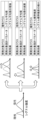
- FIG. 10 is a diagram for explaining an example of development aimed at improving accuracy in determining whether virus infection is positive or negative in an antigen test sensor.
- 1 is a diagram showing the configuration of a sensor development system according to an embodiment of the present disclosure
- FIG. It is a block diagram which shows the structure of the correction method determination part in this Embodiment.
- 7 is a first flowchart for explaining design parameter optimization processing of the information processing device according to the embodiment of the present disclosure
- 9 is a second flowchart for explaining design parameter optimization processing of the information processing device according to the embodiment of the present disclosure;
- FIG. 4 is a schematic diagram for explaining calculation of design parameters in the present embodiment;
- FIG. 4 is a schematic diagram for explaining calculation of a prediction error in the embodiment;
- FIG. 4 is a schematic diagram for explaining calculation of a correction cost value according to the present embodiment. It is a figure which shows an example of a flower kind class, a feature-value, a design parameter, and a development cost coefficient in this experiment.
- FIG. 10 is a diagram showing an example of a design parameter correction method based on the results of design parameter optimization processing under the first to fifth conditions;
- FIG. 11 is a schematic diagram for explaining calculation of a correction cost value in a modified example of the present embodiment;
- Patent Literature 1 describes optimizing an analysis model, it does not consider tuning of teacher data.
- Patent Document 2 mentioned above mentions not only the optimization of the learning model but also the generation of teacher data in order to improve the accuracy of the learning model.
- Patent Document 2 discloses that image data of each processed image generated by applying necessary image processing to each image is used as teacher data.
- Patent Document 2 does not consider optimizing sensor design parameters for acquiring teacher data, and it is difficult to acquire teacher data for realizing a more accurate learning model. .
- An information processing method is an information processing method in a computer, in which a feature amount indicating a feature of a measurement target measured by a sensor is obtained, and the feature amount is input to a machine learning model. By doing so, the state of the object to be measured is predicted, the state prediction accuracy of the machine learning model is improved, and a plurality of design parameter correction methods for correcting the design parameters of the sensor are acquired, and the feature amount and the An optimum design parameter correction method is determined from among the plurality of design parameter correction methods based on the state prediction result, and the determined optimum design parameter correction method is output.
- the state prediction accuracy of the machine learning model is improved, and the optimum design parameter correction method is determined from among a plurality of design parameter correction methods for correcting the design parameter of the sensor.
- the optimal design parameter correction method is output. Therefore, the developer of the sensor corrects the design of the sensor using the output optimum design parameter correction method, thereby optimizing the feature amount input to the machine learning model. Further, by learning a machine learning model using the optimized feature amount, the accuracy of machine learning can be improved.
- the design parameter for each of the plurality of design parameter correction methods is determined based on the feature quantity and the prediction result of the state.
- a parameter correction amount may be calculated, and the optimum design parameter correction method may be identified from among the plurality of design parameter correction methods based on the correction amount.
- the optimum design parameter correction method is specified from among the plurality of design parameter correction methods based on the design parameter correction amount for each of the plurality of design parameter correction methods. Therefore, for example, the design parameter correction method with the smallest design parameter correction amount can be specified as the optimum design parameter correction method.
- the prediction result of the state is further based on the prediction result of the state and the correct state corresponding to the feature amount input to the machine learning model.
- the distance may be calculated as the prediction error, and in calculating the correction amount of the design parameter, the correction amount in the design parameter space may be calculated based on the calculated prediction error and the calculated design parameter.
- the amount of correction in the design parameter space can be calculated from the prediction error, which is the distance between the incorrect answer points and the correct answer points.
- the correction cost value for each of the plurality of design parameter correction methods is calculated by multiplying the correction amount for each of the plurality of design parameter correction methods by the development cost coefficient for each of the plurality of design parameter correction methods. be. Then, the design parameter correction method that minimizes the calculated correction cost value is specified as the optimum design parameter correction method.
- the development cost of the sensor can be reduced by specifying the design parameter correction method with the lowest development cost as the optimum design parameter correction method.
- the correction cost value for each of the plurality of design parameter correction methods is further multiplied by a correction coefficient
- the optimum In identifying the design parameter modification method the design parameter modification method that minimizes the modification cost value multiplied by the correction coefficient is identified as the optimum design parameter modification method, and in the prediction of the state, the identified optimum design Predicting the state of the measurement object by inputting the feature amount obtained from the sensor using the design parameter corrected by the parameter correction method into the machine learning model, further predicting the state prediction result, Based on the correct state corresponding to the feature amount input to the machine learning model, it is determined whether the prediction result of the state is the correct state, and in determining the optimum design parameter correction method Furthermore, the correction coefficient may be updated when it is determined that the prediction result of the state is not the correct state.
- the correction cost value for each of the plurality of design parameter correction methods is multiplied by the correction coefficient, and the correction coefficient is repeatedly updated until it is determined that the prediction result of the state is the correct state. Development costs can be suppressed.
- the design parameter is an average value of the distribution of the feature quantity
- the design parameter correction method comprises: may be shifting the mean value of the distribution of
- the design parameter is the standard deviation of the distribution of the feature quantity
- the design parameter correction method comprises: It may be to reduce the standard deviation of the distribution of.
- the feature quantity input to the machine learning model can be optimized by changing the design of the sensor so as to reduce the standard deviation of the distribution of the feature quantity.
- the present disclosure can be implemented not only as an information processing method for executing characteristic processing as described above, but also for information processing having a characteristic configuration corresponding to the characteristic processing executed by the information processing method. It can also be implemented as a device or the like. Moreover, it can also be realized as a computer program that causes a computer to execute characteristic processing included in such an information processing method. Therefore, the following other aspects can also achieve the same effect as the information processing method described above.
- An information processing apparatus includes a feature amount acquisition unit that acquires a feature amount indicating a feature of a measurement target measured by a sensor, and by inputting the feature amount into a machine learning model.
- a prediction unit that predicts the state of the object to be measured;
- a correction method acquisition unit that acquires a plurality of design parameter correction methods for improving the state prediction accuracy of the machine learning model and correcting the design parameters of the sensor;
- a correction method determination unit for determining an optimum design parameter correction method from among the plurality of design parameter correction methods based on the feature quantity and the state prediction result; and an output unit for outputting.
- An information processing program acquires a feature amount indicating a feature of a measurement object measured by a sensor, and inputs the feature amount into a machine learning model to obtain the state of the measurement object. to improve the state prediction accuracy of the machine learning model, acquire a plurality of design parameter correction methods for correcting the design parameters of the sensor, and obtain a plurality of design parameter correction methods for correcting the design parameters of the sensor, based on the feature quantity and the state prediction result , determining an optimum design parameter correction method from among the plurality of design parameter correction methods, and causing the computer to function to output the determined optimum design parameter correction method.
- a non-transitory computer-readable recording medium records an information processing program, and the information processing program has characteristics indicating characteristics of a measurement target measured by a sensor. and predicting the state of the object to be measured by inputting the feature quantity into a machine learning model, improving the state prediction accuracy of the machine learning model, and correcting the design parameters of the sensor. obtaining the design parameter correction method of, determining the optimum design parameter correction method from among the plurality of design parameter correction methods based on the feature amount and the state prediction result, and determining the optimum design The computer functions to output the parameter correction method.
- the first is the machine learning learning parameter optimization process.
- This is a process of creating a learning model using sensor measurement values obtained using a sensor under development as learning data, and optimizing the learning parameters to improve the accuracy of the learning model. This process has been performed conventionally, and proposals for optimization methods of learning parameters and new learning models have already been made.
- the second is the sensor design parameter optimization process.
- the design of the sensor will be modified so that data more suitable for state discrimination can be obtained from the sensor. process. This process is also used in the development of sensors that do not use machine learning for status determination, for example in the development of antigen test sensors that detect specific viruses.
- Figure 1 is a diagram for explaining an example of development aimed at improving the accuracy of determining positive or negative viral infection in an antigen test sensor.
- the developer of the antigen test sensor selects the item with the lowest development cost (easy to develop) from the above development contents according to the development situation. This process corresponds to the sensor design parameter optimization process.
- the focus of this disclosure is the development of a sensor that uses a machine learning model for state discrimination. This is an enlarged version so that it is performed for each feature amount.
- the antigen test sensor has only one signal channel, and in terms of machine learning, it has only one feature amount.
- the development cost value used in the design parameter optimization process is related to the numerical value of the development effect required by sensor development.
- the development cost increases as the required amount of shift of the average signal intensity value increases. Therefore, a development cost coefficient to be multiplied by the effect amount of development is used to calculate the value of the development cost.
- a development cost coefficient exists for each development content of each feature amount, and they are not necessarily the same.
- the development cost factor is set by the situation of the sensor under development or the development environment. For example, a development cost coefficient with a very large value is set for a development content that is extremely difficult or impossible to implement.
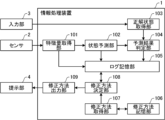
- FIG. 2 is a diagram showing the configuration of the sensor development system according to the embodiment of the present disclosure.
- the sensor development system shown in FIG. 2 includes an information processing device 1, a sensor 2, an input unit 3, and a presentation unit 4.
- Sensor 2 is a sensor to be developed. Sensor 2 outputs measurement data of at least one channel.
- the sensor 2 is, for example, an antigen test sensor that outputs measurement data of one channel, or an odor sensor that outputs measurement data of multiple channels.
- the input unit 3 is, for example, a keyboard, mouse and touch panel.
- the input unit 3 receives an input from the user (developer) of the correct state of the measurement object measured by the sensor 2 .
- the information processing apparatus 1 includes a feature amount acquisition unit 101, a state prediction unit 102, a correct state acquisition unit 103, a prediction result determination unit 104, a log storage unit 105, a correction method storage unit 106, a correction method acquisition unit 107, and a correction method determination unit. 108 and a correction method output unit 109 .
- the processor is composed of, for example, a central processing unit (CPU).
- the log storage unit 105 and the correction method storage unit 106 are realized by memory.
- the memory is composed of, for example, ROM (Read Only Memory) or EEPROM (Electrically Erasable Programmable Read Only Memory).
- the correction method determination unit 108 is realized by a processor and memory.
- the information processing device 1 may be, for example, a computer or a server.
- the information processing device 1 is communicably connected to the sensor 2 through a wired connection or a wireless connection.
- the feature quantity acquisition unit 101 acquires a feature quantity indicating the characteristics of the measurement target measured by the sensor 2 .
- the sensor 2 converts raw data obtained by measuring the object to be measured into a feature quantity, and outputs the feature quantity to the information processing device 1 .
- the sensor 2 may output raw data obtained by measuring the object to be measured to the information processing device 1 .
- the feature amount acquisition unit 101 acquires the feature amount by converting the raw data output from the sensor 2 into the feature amount.
- the feature quantity acquisition unit 101 outputs the acquired feature quantity to the state prediction unit 102 and the log storage unit 105 .
- the state prediction unit 102 predicts the state of the measurement target by inputting the feature quantity acquired by the feature quantity acquisition unit 101 into the machine learning model. State prediction section 102 determines whether the object to be measured is in the first state or the second state.
- the machine learning model is machine-learned so that the feature quantity is input data, the state of the measurement object is output data, and the state of the measurement object is output when the feature quantity is input.
- a machine learning model is generated by, for example, Light GBM (Gradient Boosting Machine). Also, the machine learning model may be generated by, for example, deep learning.
- the state prediction unit 102 outputs the state prediction result to the prediction result determination unit 104 and the log storage unit 105 .
- the state prediction unit 102 may acquire a learned machine learning model stored in advance in the memory.
- the information processing device 1 may also include a learning unit.
- the learning unit may learn the machine learning model using the feature quantity acquired by the feature quantity acquisition unit 101 and the correct state of the measurement target acquired by the correct state acquisition unit 103 as teacher data.
- the correct answer state acquisition unit 103 acquires the correct answer state corresponding to the feature quantity input to the machine learning model.
- the correct answer state acquisition unit 103 acquires the correct answer state of the measurement target from the input unit 3 .
- the prediction result determination unit 104 determines whether or not the state prediction result is the correct state based on the state prediction result by the state prediction unit 102 and the correct state acquired by the correct state acquisition unit 103. do.
- the prediction result determination unit 104 outputs to the log storage unit 105 determination result information indicating whether or not the state prediction result is a correct state.
- the log storage unit 105 stores the feature amount acquired by the feature amount acquisition unit 101, the state of the measurement target predicted by the state prediction unit 102, and the prediction result of the state determined by the prediction result determination unit 104 as a correct state. It is stored as log information in association with determination result information indicating whether or not.
- the log storage unit 105 stores a plurality of pieces of log information.
- the correction method storage unit 106 stores in advance a plurality of design parameter correction methods for improving the state prediction accuracy of the machine learning model and correcting the design parameters of the sensor 2 .
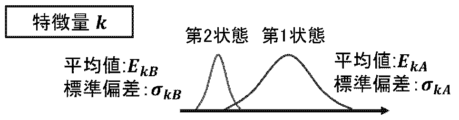
- the design parameter is the mean value of the feature quantity distribution or the standard deviation of the feature quantity distribution. If the design parameter is the mean value of the distribution of the feature quantity, the design parameter correction method is to shift the mean value of the distribution of the feature quantity. That is, the design parameter correction method is to enhance or attenuate the mean value of the distribution of feature quantities. Also, when the design parameter is the standard deviation of the distribution of the feature quantity, the design parameter correction method is to reduce the standard deviation of the distribution of the feature quantity.
- the design parameter correction method includes a first design parameter correction method of increasing a first average value of the distribution of feature quantities whose prediction results are in the first state, and a second average of the distribution of feature quantities whose prediction results are in the second state. a second design parameter modification method for reducing the value (the second average value is smaller than the first average value); and a fourth design parameter modification method for reducing a second standard deviation (the second standard deviation is smaller than the first standard deviation) of the distribution of the feature quantities whose prediction results are in the second state.
- the correction method storage unit 106 stores a plurality of design parameter correction methods according to the sensor 2 to be developed.
- design parameters and design parameter correction method are examples and are not limited to the above.
- the correction method acquisition unit 107 acquires a plurality of design parameter correction methods for improving the state prediction accuracy of the machine learning model and correcting the design parameters of the sensor 2 .
- the correction method acquisition unit 107 acquires a plurality of design parameter correction methods from the correction method storage unit 106 .
- the correction method determination unit 108 selects an optimum design parameter correction method from among a plurality of design parameter correction methods based on the feature quantity acquired by the feature quantity acquisition unit 101 and the state prediction result by the state prediction unit 102. decide.
- the correction method determination unit 108 calculates a design parameter correction amount for each of a plurality of design parameter correction methods based on the feature amount and the state prediction result.
- a correction method determination unit 108 identifies an optimum design parameter correction method from among a plurality of design parameter correction methods based on the design parameter correction amount.
- the modification method determination unit 108 may specify the optimum design parameter modification amount from among the design parameter modification amounts for each of a plurality of design parameter modification methods.
- the modification method output unit 109 outputs the optimal design parameter modification method determined by the modification method determination unit 108.
- the correction method output unit 109 outputs the optimum design parameter correction method to the presentation unit 4 . Further, the correction method output unit 109 may output the optimum design parameter correction amount to the presentation unit 4 . Furthermore, the correction method output unit 109 may output the feature amount to be corrected and the state to be corrected to the presentation unit 4 .
- the presentation unit 4 presents the user (developer) with the optimum design parameter correction method output by the correction method output unit 109 .
- the presentation unit 4 is, for example, a display device such as a liquid crystal display device.
- the presentation unit 4 displays the optimum design parameter correction method.
- the presentation unit 4 may present the user (developer) with the optimal design parameter correction amount output by the correction method output unit 109 . Further, the presentation unit 4 may present the feature amount to be corrected and the state to be corrected to the user (developer).
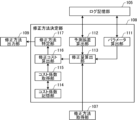
- FIG. 3 is a block diagram showing the configuration of the correction method determination unit 108 according to this embodiment.
- the correction method determination unit 108 includes a parameter calculation unit 111, a prediction error calculation unit 112, a correction amount calculation unit 113, a cost coefficient storage unit 114, a cost coefficient acquisition unit 115, a correction cost calculation unit 116, and a correction method identification unit 117.
- the parameter calculation unit 111 calculates design parameters for each of a plurality of design parameter correction methods.
- the parameter calculation unit 111 calculates the average value of the distribution of the feature quantity whose prediction result is the first state as the design parameter for the first design parameter correction method.
- the parameter calculation unit 111 calculates the average value of the distribution of the feature quantity whose prediction result is the second state as the design parameter for the second design parameter correction method.
- the parameter calculation unit 111 calculates the standard deviation of the distribution of the feature amount whose prediction result is the first state as the design parameter for the third design parameter correction method.
- the parameter calculation unit 111 calculates the standard deviation of the distribution of the feature amount whose prediction result is the second state as the design parameter for the fourth design parameter correction method.
- the prediction error calculation unit 112 calculates an incorrect answer point on the feature value space of the feature value corresponding to the prediction result determined not to be correct by the prediction result determination unit 104 and the correct state by the prediction result determination unit 104.
- the distance between the feature amount corresponding to the prediction result determined to be present and the correct answer point on the feature amount space is calculated as the prediction error.
- the correction amount calculation unit 113 calculates the design parameter correction amount on the design parameter space based on the prediction error calculated by the prediction error calculation unit 112 and the design parameters calculated by the parameter calculation unit 111 .
- the cost coefficient storage unit 114 preliminarily stores development cost coefficients that are set for each of a plurality of design parameter correction methods and that are set according to the costs necessary for developing the sensor 2 .
- the cost coefficient storage unit 114 stores development cost coefficients for each of a plurality of design parameter correction methods.
- the cost coefficient acquisition unit 115 acquires a development cost coefficient that is set for each of a plurality of design parameter correction methods and that is set according to the cost necessary for developing the sensor 2 .
- the cost coefficient acquisition unit 115 acquires development cost coefficients corresponding to each of a plurality of design parameter correction methods from the cost coefficient storage unit 114 .
- the correction cost calculation unit 116 adds the design parameter correction amount for each of the plurality of design parameter correction methods calculated by the correction amount calculation unit 113 to the development cost coefficient for each of the plurality of design parameter correction methods acquired by the cost coefficient acquisition unit 115. By multiplying by , a correction cost value for each of a plurality of design parameter correction methods is calculated.
- the correction method identification unit 117 identifies the design parameter correction method that minimizes the correction cost value calculated by the correction cost calculation unit 116 as the optimum design parameter correction method.
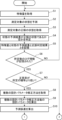
- FIG. 4 is a first flowchart for explaining design parameter optimization processing of the information processing device 1 according to the embodiment of the present disclosure
- FIG. 9 is a second flowchart for explaining parameter optimization processing
- step S ⁇ b>1 the feature amount acquisition unit 101 acquires feature amounts indicating the features of the measurement target measured by the sensor 2 .
- step S2 the state prediction unit 102 predicts the state of the measurement target by inputting the feature quantity acquired by the feature quantity acquisition unit 101 into the learned machine learning model.
- step S3 the correct state acquisition unit 103 acquires the correct state of the measurement target corresponding to the feature quantity input to the machine learning model.
- step S4 the prediction result determination unit 104 determines that the state prediction result is a correct state based on the state prediction result of the state prediction unit 102 and the correct state acquired by the correct state acquisition unit 103. It is determined whether or not.
- step S5 the prediction result determination unit 104 obtains the feature amount acquired by the feature amount acquisition unit 101, the state prediction result by the state prediction unit 102, and the prediction result determination result by the prediction result determination unit 104. are associated with each other and stored in the log storage unit 105 .
- step S6 the correction method acquisition unit 107 determines whether or not a predetermined number of pieces of log information have been stored in the log storage unit 105.
- step S6 if it is determined that the predetermined number of pieces of log information are not stored in the log storage unit 105 (NO in step S6), the process returns to step S1.
- step S7 the correction method acquisition unit 107 determines the probability that the prediction result of the state was the correct state. is lower than a predetermined probability.
- step S7 if it is determined that the percentage of correct answers is equal to or higher than the predetermined probability (NO in step S7), the process ends.
- step S8 the correction method acquisition unit 107 stores a plurality of design parameter correction methods corresponding to the sensor 2 in the correction method storage unit 106. Get from
- the correct answer rate is lower than a predetermined probability, and when it is determined that the correct answer rate is lower than the predetermined probability, a plurality of design parameter correction methods are acquired.
- the disclosure is not specifically limited in this respect.
- the log information stored in the log storage unit 105 may be presented to the user (developer), and an input of an instruction for executing the design parameter optimization process may be received from the user who has confirmed the log information. .
- step S9 the parameter calculator 111 calculates design parameters for each of the plurality of design parameter correction methods.
- step S10 the prediction error calculation unit 112 calculates an incorrect answer point on the feature value space of the feature value corresponding to the prediction result determined not to be correct by the prediction result determination unit 104, and the prediction result determination A prediction error is calculated that indicates the distance between the feature quantity corresponding to the prediction result determined to be correct by the unit 104 and the correct answer point on the feature quantity space.
- step S11 the correction amount calculation unit 113 calculates a plurality of design parameters in the design parameter space based on the prediction error calculated by the prediction error calculation unit 112 and the design parameters calculated by the parameter calculation unit 111.
- a design parameter correction amount is calculated for each parameter correction method.
- step S ⁇ b>12 the cost coefficient acquisition unit 115 acquires development cost coefficients for each of the plurality of design parameter correction methods from the cost coefficient storage unit 114 .
- step S ⁇ b>13 the correction cost calculation unit 116 adds the design parameter correction amounts for each of the plurality of design parameter correction methods calculated by the correction amount calculation unit 113 to the plurality of design parameters acquired by the cost coefficient acquisition unit 115 .
- a correction cost value for each of a plurality of design parameter correction methods is calculated by multiplying the development cost coefficient for each correction method.
- step S14 the modification method identification unit 117 selects a design parameter modification amount that minimizes the modification cost value calculated by the modification cost calculation unit 116, among the design parameter modification amounts for each of the plurality of design parameter modification methods.
- the optimum design parameter correction amount is specified, and the design parameter correction method corresponding to the optimum design parameter correction amount is specified as the optimum design parameter correction method.
- step S ⁇ b>15 the correction method output unit 109 outputs the optimum design parameter correction amount and the optimum design parameter correction method identified by the correction method identification unit 117 to the presentation unit 4 .
- the presentation unit 4 presents the optimum design parameter correction amount and the optimum design parameter correction method output by the correction method output unit 109 to the user (developer).
- the state prediction accuracy of the machine learning model is improved, and the optimum design parameter correction method is determined from a plurality of design parameter correction methods for correcting the design parameters of the sensor.
- a design parameter modification method is output. Therefore, the developer of the sensor 2 corrects the design of the sensor 2 using the output optimum design parameter correction method, thereby optimizing the feature amount input to the machine learning model. Further, by learning a machine learning model using the optimized feature amount, the accuracy of machine learning can be improved.
- the presentation unit 4 presents to the user (developer) the optimal design parameter correction amount and the optimal design parameter correction method with the minimum correction cost value, but the present disclosure is particularly It is not limited to this.
- the presentation unit 4 may further present the design parameter correction amount and the design parameter correction method with the second smallest correction cost value to the user (developer), and the design parameter correction amount and the design parameter correction method with the third smallest correction cost value.
- a parameter correction method may be further presented to the user (developer).
- the presenting unit 4 may present not only the optimum design parameter correction amount and the optimum design parameter correction method, but also the feature amount to be corrected and the state to be corrected.
- the design parameter ⁇ is calculated by the following method.
- FIG. 6 is a schematic diagram for explaining calculation of design parameters in the present embodiment.
- the parameter calculator 111 classifies each feature amount of each state (class) of the learning data, and calculates two design parameters, the average value and the standard deviation of each distribution.
- the design parameter ⁇ is the average value and standard deviation of multiple feature quantities of multiple states (classes). Therefore, the design parameter ⁇ takes the form of a vector having a length of number of states*number of features*number of design parameters (two items of mean and standard deviation).
- the parameter calculation unit 111 calculates the mean value E kA and standard deviation ⁇ kA of the distribution of feature quantity k in the first state, and the mean value E kB and standard deviation ⁇ kB of the distribution of feature quantity k in the second state.
- the prediction error ⁇ ( ⁇ n) is calculated by the following method.
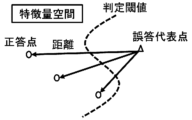
- FIG. 7 is a schematic diagram for explaining calculation of prediction errors in the present embodiment.
- the prediction error calculation unit 112 extracts a plurality of records that are erroneously determined in the state prediction of the machine learning model.
- the prediction error calculation unit 112 selects the record with the smallest probability value of the erroneously determined state class from among the plurality of extracted records, and uses it as an erroneous answer representative point.
- the prediction error calculation unit 112 extracts a plurality of records determined to be correct answers from among the records of the same state class as the incorrect answer representative score, and sets them as correct answer points.
- triangular points indicate incorrect answer representative points
- circle points indicate correct answer points. Between the incorrect answer representative score and the correct answer score, there is a decision threshold of the machine learning model.
- the prediction error calculation unit 112 calculates the distance between each correct answer point of the plurality of extracted records and the incorrect answer representative point on the feature amount space as a prediction error ⁇ ( ⁇ n).
- ⁇ n indicates the learning parameter of the machine learning model
- ⁇ ( ⁇ n) indicates the prediction error of the machine learning model when the learning parameter is ⁇ .
- the prediction error ⁇ ( ⁇ n) takes the form of a vector with multiple distance values.
- the design parameter correction amount ⁇ is calculated by the following method.
- the correction amount calculation unit 113 calculates the design parameter correction amount ⁇ required to acquire learning data that increases the prediction accuracy based on the following formula (1).
- ⁇ ⁇ ( ⁇ n)/ ⁇ (1)
- ⁇ indicates the design parameter correction amount
- ⁇ indicates the design parameter.
- the correction method determining unit 108 performs calculations with the learning parameters fixed. Therefore, in equation (1), the learning parameter ⁇ is fixed to ⁇ n after updating n times, that is, after the machine learning model has been sufficiently optimized.
- the correction amount calculation unit 113 converts ⁇ ( ⁇ n), which is the distance on the feature quantity space, into the design parameter, which is the distance on the design parameter space. It is converted into a correction amount ⁇ .
- the design parameter correction amount ⁇ is a value obtained by partially differentiating ⁇ ( ⁇ n) with ⁇ . Therefore, the design parameter correction amount ⁇ is represented by a matrix having the same number of rows as the length of ⁇ ( ⁇ n) and the same number of columns as the length of ⁇ .
- correction cost value C( ⁇ ) is calculated by the following method.
- FIG. 8 is a schematic diagram for explaining calculation of the correction cost value in the present embodiment.
- the correction cost calculation unit 116 calculates the correction cost value C( ⁇ ) of the design parameter correction amount ⁇ based on the following formula (2).
- C( ⁇ ) ⁇ * ⁇ (2)
- ⁇ is the development cost factor and C( ⁇ ) is the correction cost value.
- the development cost coefficient ⁇ is set for each design parameter correction method. So ⁇ is a vector of the same length as ⁇ . Since C( ⁇ ) is a matrix ⁇ multiplied by ⁇ , it is a vector with the same length as ⁇ ( ⁇ n).
- the calculation of the above formula (2) indicates that the design parameter correction amount ⁇ , which is the distance on the design parameter space, is converted into the correction cost value C( ⁇ ), which is the distance on the cost space.
- the modification method identification unit 117 calculates the optimal design parameter modification method solution based on the following equation (3).
- ⁇ min is the design parameter correction amount that minimizes the correction cost value C( ⁇ ).
- the modification method identification unit 117 identifies the design parameter modification amount that minimizes the modification cost value C( ⁇ ) as the optimum design parameter modification amount. Further, the correction method specifying unit 117 specifies the design parameter correction method corresponding to the design parameter correction amount that minimizes the correction cost value C( ⁇ ) as the optimum design parameter correction method.
- the correction method identification unit 117 identifies the design parameter correction amount that minimizes the correction cost value representing the distance between the incorrect answer representative point and the correct answer point in the cost space as the optimum design parameter correction amount.
- the amount of design parameter correction that minimizes the development cost required for sensor development is calculated, and the design parameter correction method that minimizes development cost is specified.
- the design change of the sensor 2 that can acquire learning data that improves the discrimination accuracy can be made at the lowest development cost.
- the design parameter optimization process requires the state prediction error data of the machine learning model
- a machine learning model is prepared in advance using the data acquired by the sensor as the learning data.
- the state prediction results are partially erroneous.
- Design parameter optimization processing is performed based on this state prediction error data, and it is assumed that the sensor design has been changed according to the processing result that minimizes the development cost. sensor acquisition data is created.
- Machine learning is performed again using the sensor data obtained after the design change as learning data, and if it can be confirmed that the prediction accuracy of the machine learning model has improved, the design parameter optimization process will further increase the state prediction accuracy. It is verified that the design parameter correction method that can acquire learning data was identified as expected.
- the Iris dataset was used as dummy data for the measurement data acquired from the sensor under development.
- the Iris data set is table data with 150 records, and has 4 feature values and 3 flower type classes.
- the three flower-type classes of the Iris data set are regarded as states of measurement objects to be predicted, and the four feature quantities are regarded as four-channel signals of the sensor.
- the four features include sepal length, sepal width, petal length, and petal width.
- the three flower species classes include setosa, versicolor, and virginica.
- the machine learning model required for the design parameter optimization process was created on the Light GBM (Gradient Boosting Machine).
- the created machine learning model was created to misjudge only 1 record out of 150 records.
- the correct flower type class is "versicolor”
- the erroneously determined flower type class is "virginica”.
- development cost coefficients There are 24 development cost coefficients as there are the same number as the design parameters of the sensor. Also, a different development cost coefficient is set for each of a plurality of conditions.
- Fig. 9 is a diagram showing an example of flower type classes, feature values, design parameters, and development cost coefficients in this experiment.
- ⁇ represents the mean value and ⁇ represents the standard deviation.
- the development cost coefficient relating to the determination result class (virginica) of the erroneously determined record is weighted.
- the development cost coefficients of all mean values ⁇ and standard deviations ⁇ are set to 1.
- the development cost coefficient for the average value ⁇ is set to 1000, and the development cost coefficient for the standard deviation ⁇ is set to 1.
- the development cost coefficient for the average value ⁇ is set to 1
- the development cost coefficient for the standard deviation ⁇ is set to 1000.
- the development cost coefficient for the mean value ⁇ and standard deviation ⁇ of versicolor is set to 1000, and the development cost coefficient for the mean value ⁇ and standard deviation ⁇ of other flower type classes is set to 1.
- the development cost coefficient of the average value ⁇ and standard deviation ⁇ of virginica is set to 1000, and the development cost coefficient of the average value ⁇ and standard deviation ⁇ of other flower type classes is set to 1. ing.
- the design parameter optimization process was performed on the first to fifth conditions above, and the design parameter correction method that minimizes the correction cost value was identified.
- FIG. 10 is a diagram showing an example of a design parameter correction method based on the results of design parameter optimization processing for the first to fifth conditions.
- the flower type class to be corrected is versicolor
- the feature value to be corrected is petal length
- the design parameter to be corrected is the average value.
- the flower type class to be corrected is versicolor
- the feature amount to be corrected is petal length
- the design parameter to be corrected is standard deviation.
- the flower type class to be corrected is virginica
- the feature amount to be corrected is petal length
- the design parameter to be corrected is the average value.
- the design parameter correction method was the same for the 1st, 3rd and 5th conditions.
- the first condition is the design parameter correction method specified under the condition that the development cost factor is not weighted, and the design parameters listed therein do not include the items weighted by the third and fifth conditions. Because. Among the design parameters other than the design parameters weighted by the third and fifth conditions, the design parameter that minimizes the correction cost value is found. Therefore, the weighting in the 3rd and 5th conditions does not affect the selection of the design parameter modification method that minimizes the modification cost value, and the results of the 3rd and 5th conditions are the same as the results of the 1st condition. It is thought that
- the results of the 2nd and 4th conditions were different from the results of the 1st condition. This is because the design parameters weighted by the second and fourth conditions are included in the calculation result of the first condition, so the weighted design change items are excluded as high costs in the second and fourth conditions, It is believed that the other design parameter modification method was selected as the design parameter modification method with the lowest modification cost value.
- the design parameter optimization process can identify the design parameter correction method that reflects the 1st to 5th conditions of the development cost coefficient.
- FIG. 11 is a schematic diagram for explaining calculation of the correction cost value in the modified example of the present embodiment.
- the correction method specifying unit 117 specifies the design parameter correction amount that minimizes the correction cost value representing the distance between the incorrect answer representative point and the correct answer point in the cost space as the optimum design parameter correction amount. are doing.
- the modification method specifying unit 117 in the modified example of the present embodiment multiplies the modification cost value by a correction coefficient having a magnitude that does not exceed the determination threshold, repeats state prediction while gradually increasing the correction coefficient, and performs machine learning.
- a correction coefficient value at which the model determination result is switched may be searched for.
- the modification method determination unit 108 may further include a correction coefficient multiplication unit that multiplies the modification cost value for each of the plurality of design parameter modification methods calculated by the modification cost calculation unit 116 by a correction coefficient.
- the correction method identification unit 117 may identify the design parameter correction method that minimizes the correction cost value multiplied by the correction coefficient as the optimum design parameter correction method. Then, the state prediction unit 102 inputs the feature amount obtained from the sensor 2 using the design parameters corrected by the optimum design parameter correction method specified by the correction method specifying unit 117 into the machine learning model. state can be predicted.
- the prediction result determination unit 104 determines whether the state prediction result is a correct state based on the state prediction result by the state prediction unit 102 and the correct state corresponding to the feature amount input to the machine learning model. It may be determined whether The correction method determination unit 108 may further include an update unit that updates the correction coefficient when the prediction result determination unit 104 determines that the state prediction result is not the correct state. At this time, the updating unit updates the correction coefficient so as to be higher than the current correction coefficient. The updating unit repeats updating of the correction coefficient until it is determined that the prediction result of the state is the correct state, thereby further suppressing the development cost.
- each component may be implemented by dedicated hardware or by executing a software program suitable for each component.
- Each component may be realized by reading and executing a software program recorded in a recording medium such as a hard disk or a semiconductor memory by a program execution unit such as a CPU or processor.
- the program may be executed by another independent computer system by recording the program on a recording medium and transferring it, or by transferring the program via a network.
- LSI Large Scale Integration
- circuit integration is not limited to LSIs, and may be realized by dedicated circuits or general-purpose processors.
- An FPGA Field Programmable Gate Array
- reconfigurable processor that can reconfigure the connections and settings of the circuit cells inside the LSI may be used.
- a processor such as a CPU executing a program.
- each step shown in the above flowchart is executed is for illustrative purposes in order to specifically describe the present disclosure, and may be an order other than the above as long as the same effect can be obtained. . Also, some of the above steps may be executed concurrently (in parallel) with other steps.
- the technology according to the present disclosure can optimize the feature quantity input to the machine learning model, so it is useful as a technology for optimizing design parameters for developing sensors.
Landscapes
- Engineering & Computer Science (AREA)
- Theoretical Computer Science (AREA)
- Evolutionary Computation (AREA)
- Physics & Mathematics (AREA)
- Software Systems (AREA)
- General Physics & Mathematics (AREA)
- Artificial Intelligence (AREA)
- Computer Vision & Pattern Recognition (AREA)
- Medical Informatics (AREA)
- General Engineering & Computer Science (AREA)
- Geometry (AREA)
- Computer Hardware Design (AREA)
- Data Mining & Analysis (AREA)
- Computing Systems (AREA)
- Mathematical Physics (AREA)
- Indication And Recording Devices For Special Purposes And Tariff Metering Devices (AREA)
Abstract
Description
上記の特許文献1には、解析モデルを最適化することについては記載されているが、教師データのチューニングについては考慮されていない。
センサの新規開発において、センサの測定値から測定対象の状態を判別するために機械学習が広く使われるようになってきている。センサ開発者は、センサの付加価値向上のため、より高精度な状態判別の実証に向けて開発を進めるが、状態判別の高精度化に向けた開発プロセスは、大きく二つある。
上記の式(1)において、Δξは、設計パラメータ修正量を示し、ξは、設計パラメータを示す。なお、修正方法決定部108は、学習パラメータを固定した状態で計算を行う。そのため、式(1)では学習パラメータθは、n回更新した後、すなわち機械学習モデルの最適化が十分に行われた後のθnに固定されている。修正量算出部113は、予測誤差ε(θn)を設計パラメータξにより偏微分することにより、特徴量空間上での距離であるε(θn)を、設計パラメータ空間上での距離である設計パラメータ修正量Δξに変換している。設計パラメータ修正量Δξは、ε(θn)をξにより偏微分した値となる。そのため、設計パラメータ修正量Δξは、ε(θn)の長さと同じ行数であり、ξの長さと同じ列数である行列で表される。
上記の式(2)において、κは、開発コスト係数であり、C(Δξ)は、修正コスト値である。開発コスト係数κは、設計パラメータ修正方法毎に設定される。そのため、κはξと同じ長さのベクトルである。C(Δξ)は、行列であるΔξにκを掛けたものであるので、ε(θn)と同じ長さのベクトルとなる。上記の式(2)の計算は、設計パラメータ空間上の距離である設計パラメータ修正量Δξを、コスト空間上の距離である修正コスト値C(Δξ)に変換していることを示す。

Claims (9)
- コンピュータにおける情報処理方法であって、
センサによって測定された測定対象の特徴を示す特徴量を取得し、
前記特徴量を機械学習モデルに入力することで前記測定対象の状態を予測し、
前記機械学習モデルの状態予測精度を向上させるともに、前記センサの設計パラメータを修正するための複数の設計パラメータ修正方法を取得し、
前記特徴量と前記状態の予測結果とに基づいて、前記複数の設計パラメータ修正方法の中から、最適な設計パラメータ修正方法を決定し、
決定した前記最適な設計パラメータ修正方法を出力する、
情報処理方法。 - 前記最適な設計パラメータ修正方法の決定において、
前記特徴量と前記状態の予測結果とに基づいて、前記複数の設計パラメータ修正方法毎の前記設計パラメータの修正量を算出し、
前記修正量に基づいて、前記複数の設計パラメータ修正方法の中から、前記最適な設計パラメータ修正方法を特定する、
請求項1記載の情報処理方法。 - さらに、前記状態の予測結果と、前記機械学習モデルに入力された前記特徴量に対応する正解の状態とに基づいて、前記状態の予測結果が前記正解の状態であるか否かを判定し、
前記最適な設計パラメータ修正方法の決定において、
さらに、前記複数の設計パラメータ修正方法毎の前記設計パラメータを算出し、
さらに、前記正解の状態ではないと判定された予測結果に対応する特徴量の特徴量空間上における誤答点と、前記正解の状態であると判定された予測結果に対応する特徴量の特徴量空間上における正答点との距離を予測誤差として算出し、
前記設計パラメータの修正量の算出において、算出した前記予測誤差と、算出した前記設計パラメータとに基づいて、設計パラメータ空間上における前記修正量を算出する、
請求項2記載の情報処理方法。 - 前記最適な設計パラメータ修正方法の決定において、
さらに、前記複数の設計パラメータ修正方法毎に設定されるとともに、前記センサの開発に必要なコストに応じて設定される開発コスト係数を取得し、
さらに、前記複数の設計パラメータ修正方法毎の前記修正量に、前記複数の設計パラメータ修正方法毎の前記開発コスト係数を乗算することにより、前記複数の設計パラメータ修正方法毎の修正コスト値を算出し、
前記最適な設計パラメータ修正方法の特定において、算出した前記修正コスト値が最小となる設計パラメータ修正方法を最適な設計パラメータ修正方法として特定する、
請求項2又は3記載の情報処理方法。 - 前記最適な設計パラメータ修正方法の決定において、さらに、前記複数の設計パラメータ修正方法毎の前記修正コスト値に補正係数を乗算し、
前記最適な設計パラメータ修正方法の特定において、前記補正係数が乗算された前記修正コスト値が最小となる設計パラメータ修正方法を最適な設計パラメータ修正方法として特定し、
前記状態の予測において、特定した前記最適な設計パラメータ修正方法によって修正された前記設計パラメータを用いた前記センサから得られる前記特徴量を前記機械学習モデルに入力することで前記測定対象の状態を予測し、
さらに、前記状態の予測結果と、前記機械学習モデルに入力された前記特徴量に対応する正解の状態とに基づいて、前記状態の予測結果が前記正解の状態であるか否かを判定し、
前記最適な設計パラメータ修正方法の決定において、さらに、前記状態の予測結果が前記正解の状態ではないと判定された場合、前記補正係数を更新する、
請求項4記載の情報処理方法。 - 前記設計パラメータは、前記特徴量の分布の平均値であり、
前記設計パラメータ修正方法は、前記特徴量の分布の前記平均値をシフトさせることである、
請求項1~3のいずれか1項に記載の情報処理方法。 - 前記設計パラメータは、前記特徴量の分布の標準偏差であり、
前記設計パラメータ修正方法は、前記特徴量の分布の前記標準偏差を縮小させることである、
請求項1~3のいずれか1項に記載の情報処理方法。 - センサによって測定された測定対象の特徴を示す特徴量を取得する特徴量取得部と、
前記特徴量を機械学習モデルに入力することで前記測定対象の状態を予測する予測部と、
前記機械学習モデルの状態予測精度を向上させるともに、前記センサの設計パラメータを修正するための複数の設計パラメータ修正方法を取得する修正方法取得部と、
前記特徴量と前記状態の予測結果とに基づいて、前記複数の設計パラメータ修正方法の中から、最適な設計パラメータ修正方法を決定する修正方法決定部と、
決定した前記最適な設計パラメータ修正方法を出力する出力部と、
を備える情報処理装置。 - センサによって測定された測定対象の特徴を示す特徴量を取得し、
前記特徴量を機械学習モデルに入力することで前記測定対象の状態を予測し、
前記機械学習モデルの状態予測精度を向上させるともに、前記センサの設計パラメータを修正するための複数の設計パラメータ修正方法を取得し、
前記特徴量と前記状態の予測結果とに基づいて、前記複数の設計パラメータ修正方法の中から、最適な設計パラメータ修正方法を決定し、
決定した前記最適な設計パラメータ修正方法を出力するようにコンピュータを機能させる、
情報処理プログラム。
Priority Applications (3)
| Application Number | Priority Date | Filing Date | Title |
|---|---|---|---|
| JP2024502879A JPWO2023162467A1 (ja) | 2022-02-22 | 2022-12-28 | |
| CN202280092202.6A CN118891639A (zh) | 2022-02-22 | 2022-12-28 | 信息处理方法、信息处理装置以及信息处理程序 |
| US18/810,756 US20250005239A1 (en) | 2022-02-22 | 2024-08-21 | Information processing method, information processing device, and non-transitory computer readable recording medium storing information processing program |
Applications Claiming Priority (4)
| Application Number | Priority Date | Filing Date | Title |
|---|---|---|---|
| US202263312682P | 2022-02-22 | 2022-02-22 | |
| US63/312,682 | 2022-02-22 | ||
| JP2022169951 | 2022-10-24 | ||
| JP2022-169951 | 2022-10-24 |
Related Child Applications (1)
| Application Number | Title | Priority Date | Filing Date |
|---|---|---|---|
| US18/810,756 Continuation US20250005239A1 (en) | 2022-02-22 | 2024-08-21 | Information processing method, information processing device, and non-transitory computer readable recording medium storing information processing program |
Publications (1)
| Publication Number | Publication Date |
|---|---|
| WO2023162467A1 true WO2023162467A1 (ja) | 2023-08-31 |
Family
ID=87765322
Family Applications (1)
| Application Number | Title | Priority Date | Filing Date |
|---|---|---|---|
| PCT/JP2022/048513 Ceased WO2023162467A1 (ja) | 2022-02-22 | 2022-12-28 | 情報処理方法、情報処理装置及び情報処理プログラム |
Country Status (3)
| Country | Link |
|---|---|
| US (1) | US20250005239A1 (ja) |
| JP (1) | JPWO2023162467A1 (ja) |
| WO (1) | WO2023162467A1 (ja) |
Citations (2)
| Publication number | Priority date | Publication date | Assignee | Title |
|---|---|---|---|---|
| JP2018109876A (ja) * | 2017-01-04 | 2018-07-12 | 株式会社東芝 | センサ設計支援装置、センサ設計支援方法およびコンピュータプログラム |
| KR20220011453A (ko) * | 2020-07-21 | 2022-01-28 | 울산과학기술원 | 머신 러닝을 이용하여 복합재 센서의 설계 파라미터를 설정하는 방법 |
-
2022
- 2022-12-28 JP JP2024502879A patent/JPWO2023162467A1/ja active Pending
- 2022-12-28 WO PCT/JP2022/048513 patent/WO2023162467A1/ja not_active Ceased
-
2024
- 2024-08-21 US US18/810,756 patent/US20250005239A1/en active Pending
Patent Citations (2)
| Publication number | Priority date | Publication date | Assignee | Title |
|---|---|---|---|---|
| JP2018109876A (ja) * | 2017-01-04 | 2018-07-12 | 株式会社東芝 | センサ設計支援装置、センサ設計支援方法およびコンピュータプログラム |
| KR20220011453A (ko) * | 2020-07-21 | 2022-01-28 | 울산과학기술원 | 머신 러닝을 이용하여 복합재 센서의 설계 파라미터를 설정하는 방법 |
Also Published As
| Publication number | Publication date |
|---|---|
| US20250005239A1 (en) | 2025-01-02 |
| JPWO2023162467A1 (ja) | 2023-08-31 |
Similar Documents
| Publication | Publication Date | Title |
|---|---|---|
| Shi et al. | Variable selection and validation in multivariate modelling | |
| US20220108054A1 (en) | System for universal hardware-neural network architecture search (co-design) | |
| Arbet et al. | Lessons and tips for designing a machine learning study using EHR data | |
| JP7361187B2 (ja) | 医療データの自動化された検証 | |
| CN111446002A (zh) | 一种基于人工智能的新型冠状病毒患者病况分类系统 | |
| US20220036223A1 (en) | Processing apparatus, processing method, and non-transitory storage medium | |
| Anguita-Ruiz et al. | Beyond the single-outcome approach: A comparison of outcome-wide analysis methods for exposome research | |
| Jardim et al. | A cautionary note on phylogenetic signal estimation from imputed databases | |
| CN117597741A (zh) | 试制条件提出系统、试制条件提出方法 | |
| Kalpana et al. | An ensemble heterogeneous transformer model for an effective diagnosis of multiple plant diseases | |
| KR102541510B1 (ko) | 국가건강검진 자료를 이용한 자살 예측 모델 구축 방법 | |
| WO2023162467A1 (ja) | 情報処理方法、情報処理装置及び情報処理プログラム | |
| JPWO2023162467A5 (ja) | ||
| CN118891639A (zh) | 信息处理方法、信息处理装置以及信息处理程序 | |
| Arias-Giraldo et al. | enmpa: An R package for ecological niche modeling using presence-absence data and generalized linear models | |
| Velluet et al. | Practical identifiability of plant growth models: a unifying framework and its specification for three local indices | |
| Hui et al. | Uncovering the consequences of batch effect associated missing values in omics data analysis | |
| Airlangga | Comparative analysis of machine learning models for chronic disease indicator classification using US chronic disease indicators dataset | |
| Prendez et al. | Measuring Parameter Uncertainty by Identifying Fungible Estimates in SEM | |
| Karna et al. | Unified dimensionality reduction techniques in chronic liver disease detection | |
| KR102952359B1 (ko) | 인공지능 모델 검증 및 보강 방법, 및 이를 이용하는 서버 | |
| CN114360724A (zh) | 健康管理知识图谱构建方法、服务提供方法及相关装置 | |
| Cunha et al. | Agile-based Requirements Engineering for Machine Learning: A Case Study on Personalized Nutrition | |
| Ke et al. | Evaluation of Bayesian network scoring functions in polychotomous data analysis | |
| CN111144503A (zh) | 一种多分类结果的评分方法及装置 |
Legal Events
| Date | Code | Title | Description |
|---|---|---|---|
| 121 | Ep: the epo has been informed by wipo that ep was designated in this application |
Ref document number: 22928982 Country of ref document: EP Kind code of ref document: A1 |
|
| ENP | Entry into the national phase |
Ref document number: 2024502879 Country of ref document: JP Kind code of ref document: A |
|
| WWE | Wipo information: entry into national phase |
Ref document number: 202280092202.6 Country of ref document: CN |
|
| NENP | Non-entry into the national phase |
Ref country code: DE |
|
| 122 | Ep: pct application non-entry in european phase |
Ref document number: 22928982 Country of ref document: EP Kind code of ref document: A1 |