WO2023136116A1 - 化合物及びその製造方法、並びに、複合材料 - Google Patents
化合物及びその製造方法、並びに、複合材料 Download PDFInfo
- Publication number
- WO2023136116A1 WO2023136116A1 PCT/JP2022/047939 JP2022047939W WO2023136116A1 WO 2023136116 A1 WO2023136116 A1 WO 2023136116A1 JP 2022047939 W JP2022047939 W JP 2022047939W WO 2023136116 A1 WO2023136116 A1 WO 2023136116A1
- Authority
- WO
- WIPO (PCT)
- Prior art keywords
- atomic ratio
- composition formula
- amount
- compound
- thermal expansion
- Prior art date
- Legal status (The legal status is an assumption and is not a legal conclusion. Google has not performed a legal analysis and makes no representation as to the accuracy of the status listed.)
- Ceased
Links
Images




Classifications
-
- C—CHEMISTRY; METALLURGY
- C01—INORGANIC CHEMISTRY
- C01B—NON-METALLIC ELEMENTS; COMPOUNDS THEREOF; METALLOIDS OR COMPOUNDS THEREOF NOT COVERED BY SUBCLASS C01C
- C01B25/00—Phosphorus; Compounds thereof
- C01B25/16—Oxyacids of phosphorus; Salts thereof
- C01B25/26—Phosphates
- C01B25/45—Phosphates containing plural metal, or metal and ammonium
Definitions
- the present invention relates to a novel compound exhibiting a negative coefficient of thermal expansion that decreases in volume as the temperature rises, a method for producing the same, and a composite material using the novel compound.
- thermal expansion control techniques attention is paid to a technique of controlling the overall thermal expansion coefficient by combining materials having negative thermal expansion coefficients (also referred to as “negative thermal expansion materials”).
- negative thermal expansion materials examples include ⁇ -eucryptite, zirconium tungstate (ZrW 2 O 8 ), zirconium phosphate tungstate (Zr 2 WO 4 (PO 4 ) 2 ), Zn x Cd 1-x (CN). 2 , manganese nitride, bismuth-nickel-iron oxide, etc. are known.
- Patent Document 1 discloses Bi 1-x Sb x NiO 3 (where x is 0.02 ⁇ x ⁇ 0.20) as a new negative thermal expansion material.
- Patent document 2 describes Zr 2-a M a S x P 2 O 12+ ⁇ (M is Ti, Ce, Sn, Mn, Hf, Ir, Pb, Pd, Cr) as a new negative thermal expansion material. is at least one selected, a is 0 ⁇ a ⁇ 2, x is 0.4 ⁇ x ⁇ 1, and ⁇ is a value determined so as to satisfy the charge neutrality condition.
- M is Ti, Ce, Sn, Mn, Hf, Ir, Pb, Pd, Cr
- the negative thermal expansion material disclosed in Patent Document 2 exhibits a negative thermal expansion coefficient in the range from room temperature to 500 ° C., and the larger the sulfur content (x), the negative thermal expansion is particularly at 100 to 180 ° C. It is attracting attention as a useful material because it is a material that exhibits a high density and can achieve low density.
- certain applications require materials that exhibit a negative coefficient of thermal expansion, especially in the temperature range of 200°C to 400°C. For example, since the melting point of solder used for joining electric or electronic parts is around 170 to 300°C, it is necessary to control the coefficient of thermal expansion particularly in the temperature range of 200 to 400°C. There is a need for materials that exhibit
- the present invention provides a compound having a composition different from that of conventional compounds and exhibiting a negative coefficient of thermal expansion, preferably a new compound exhibiting an excellent negative coefficient of thermal expansion particularly in the temperature range of 200°C to 400°C. is intended to provide
- the present invention provides a composition formula ( 1 ) ZrwMxSzP2O12 + ⁇ (wherein M is Al, Fe, Ga, Y, In, Nb, Bi, Si, La, one or more elements selected from Pr, Nd, Sm, Eu, Gd, Tb, Dy, Ho, Er, Tm, Yb, Ge and Lu, 0 ⁇ w ⁇ 4, x is is the sum of the amounts (atomic ratio) of the elements constituting M, 0 ⁇ x ⁇ 3, 0 ⁇ z ⁇ 2, and ⁇ is a value determined so as to satisfy the charge neutrality condition). .
- the present invention also provides a composition formula (2) Zr 2-x-y M x S z P 2 O 12+ ⁇ (wherein M is Al, Fe, Ga, Y, In, Nb, Bi, Si, Ge, La, One or more elements selected from Pr, Nd, Sm, Eu, Gd, Tb, Dy, Ho, Er, Tm, Yb, and Lu.x is the amount of elements constituting M ( atomic ratio), 0 ⁇ x ⁇ 3, y is a value determined by the amount of Zr defects, -2 ⁇ y ⁇ 1, 0 ⁇ z ⁇ 2, 0 ⁇ 2-xy ⁇ 4, ⁇ is a value determined so as to satisfy the charge neutrality condition).
- the present invention also provides a composition formula (3) Zr 2-x-y M x S z P 2-a Q a O 12+ ⁇ (wherein M is Al, Fe, Ga, Y, In, Nb, Bi, Si, one or more elements selected from Ge, La, Pr, Nd, Sm, Eu, Gd, Tb, Dy, Ho, Er, Tm, Yb and Lu; One or two or more elements selected from x is the total amount (atomic ratio) of the elements constituting M, 0 ⁇ x ⁇ 3, and y is a value determined by the amount of Zr defects , ⁇ 2 ⁇ y ⁇ 1, 0 ⁇ z ⁇ 2, 0 ⁇ 2-xy ⁇ 4, a is the total amount (atomic ratio) of the elements constituting Q, and 0 ⁇ a ⁇ 2 , ⁇ is a value determined so as to satisfy the charge neutrality condition).
- M is Al, Fe, Ga, Y, In, Nb, Bi, Si, one or more elements selected from Ge, La, Pr, N
- the present invention also provides a composition formula (4) Zr 2-x1-x2-y M1 x1 M2 x2 S z P 2 O 12+ ⁇ (wherein M1 is Al, Fe, Ga, Y, In, Nb, Bi, Si, one or more selected from Ge, La, Pr, Nd, Sm, Eu, Gd, Tb, Dy, Ho, Er, Tm, Yb and Lu, and M2 is Al, Cr, Fe, Ga, Y, In, Nb, Bi, Si, Ge, La, Pr, Nd, Sm, Eu, Gd, Tb, Dy, Ho, Er, Tm, Yb, Lu, Ti, Ce, Sn, Mn, Hf, One or more elements selected from Ir, Pb and Pd, which are different from M1, x1 is the total amount (atomic ratio) of the elements constituting M1, and x2 is the total value of the amount (atomic ratio) of the elements constituting M2, 0 ⁇ x1+x2 ⁇ 3, 0 ⁇ x1 ⁇ 2,
- the present invention also provides a composition formula (5) Zr 2-x1-x2-y M1 x1 M2 x2 S z P 2-a Q a O 12+ ⁇ (wherein M1 is Al, Fe, Ga, Y, In, Nb, one or more selected from Bi, Si, Ge, La, Pr, Nd, Sm, Eu, Gd, Tb, Dy, Ho, Er, Tm, Yb and Lu, M2 is Al, Cr, Fe, Ga, Y, In, Nb, Bi, Si, Ge, La, Pr, Nd, Sm, Eu, Gd, Tb, Dy, Ho, Er, Tm, Yb, Lu, Ti, Ce, Sn, one or more selected from Mn, Hf, Ir, Pb, Pd, W and Mo, which is an element different from M1, and Q is selected from Si and Ge One or more elements, x1 is the total amount (atomic ratio) of the elements that make up M1, x2 is the total amount (atomic ratio) of the elements that make up M
- All of the compounds proposed by the present invention that is, the compounds represented by the above compositional formulas (1) to (5) exhibit negative coefficients of thermal expansion. Therefore, it is possible to control the coefficient of thermal expansion of a composite material which is a mixture by mixing with a material exhibiting a positive coefficient of thermal expansion (referred to as a “positive thermal expansion material”).
- All of the compounds proposed by the present invention that is, the compounds represented by the above compositional formulas (1) to (5), can exhibit an excellent negative coefficient of thermal expansion, particularly in the temperature range of 200°C to 400°C. . Therefore, it can be suitably used for controlling the coefficient of thermal expansion in the temperature range of 200°C to 400°C. For example, it is possible to control the coefficient of thermal expansion in the temperature range of 200° C. to 400° C. of a composite material obtained by mixing with a positive thermal expansion material.
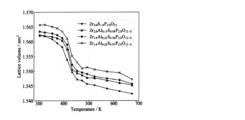
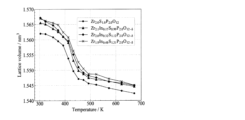
- FIG. 2 is a graph showing the relationship between temperature and lattice constant for Zr 2-xy Al x S z P 2 O 12+ ⁇ prepared in Examples 1-1 to 1-3.
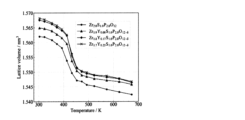
- 2 is a graph showing the relationship between temperature and lattice constant for Zr 2-xy Y x S z P 2 O 12+ ⁇ prepared in Examples 2-1 to 2-3.
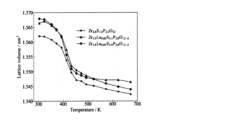
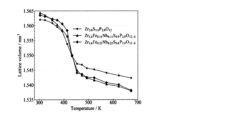
- FIG. 4 is a graph showing the relationship between temperature and lattice constant for Zr 2-xy Fe x S z P 2 O 12+ ⁇ produced in Example 3-1.
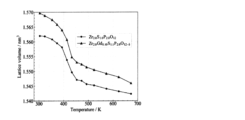
- FIG. FIG. 4 is a graph showing the relationship between temperature and lattice constant for Zr 2-x ⁇ y La x S z P 2 O 12+ ⁇ prepared in Examples 4-1 and 4-2.
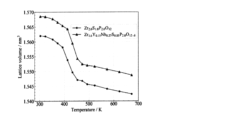
- FIG. 4 is a graph showing the relationship between temperature and lattice constant for Zr 2-xy Gd x S z P 2 O 12+ ⁇ produced in Example 5-1.
- FIG. 4 is a graph showing the relationship between temperature and lattice constant for Zr 2-xy In x S z P 2 O 12+ ⁇ produced in Examples 6-1 to 6-3.
- FIG. 4 is a graph showing the relationship between temperature and lattice constant for Zr 2-xy Nb x S z P 2 O 12+ ⁇ produced in Examples 7-1 and 7-2.
- FIG. FIG. 10 is a graph showing the relationship between temperature and lattice constant for Zr 2-xy Fe x1 Nb x2 S z P 2 O 12+ ⁇ produced in Examples 8-1 and 8-2.
- FIG. 10 is a graph showing the relationship between temperature and lattice constant for Zr 2-xy Y x1 Nb x2 S z P 2 O 12+ ⁇ produced in Examples 9-1 and 9-2.
- FIG. 10 is a graph showing the relationship between temperature and lattice constant for Zr 2-xy Gd x1 Nb x2 S z P 2 O 12+ ⁇ produced in Example 10-1.
- FIG. 10 is a graph showing the relationship between temperature and lattice constant for Zr 2-x-y Si x S z P 2 O 12+ ⁇ produced in Example 11-1.
- FIG. 10 is a graph showing the relationship between temperature and lattice constant for Zr 2-x-y Si x S z P 2 O 12+ ⁇ produced in Example 11-1.
- a compound according to an example of the embodiment of the present invention (referred to as “the present compound 1”) has a composition formula (1) ZrwMxSzP2O12 + ⁇ (wherein M is Al, Fe , Ga, Y , In, Nb, Bi, Si, La, Pr, Nd, Sm, Eu, Gd, Tb, Dy, Ho, Er, Tm, Yb, Ge and Lu. 0 ⁇ w ⁇ 4, x is the total amount (atomic ratio) of the elements constituting M, 0 ⁇ x ⁇ 3, 0 ⁇ z ⁇ 2, ⁇ satisfies the charge neutrality condition. determined value).
- Elements that can constitute M in the composition formula (1) include Al, Fe, Ga, Y, In, Nb, Bi, Si, La, Pr, Nd, Sm, Eu, Gd, Tb, Dy, Ho, Er , Tm, Yb, Ge and Lu, and these can constitute M of the composition formula (1) as one or a combination of two or more.
- w indicating the amount of Zr (atomic ratio) may be 0 ⁇ w ⁇ 4 from the viewpoint of maintaining the crystal structure, especially 1 or more or 3 or less, Among them, it can be 1.5 or more or 2.2 or less.
- x indicating the amount (atomic ratio) of the M element is the total amount (atomic ratio) of the elements constituting M, and from the viewpoint of maintaining the crystal structure , 0 ⁇ x ⁇ 3, preferably 0.1 or more or 2 or less, especially 0.2 or more or 0.7 or less.
- composition formula (1) of the present compound 1 “z” indicating the amount (atomic ratio) of S (sulfur) may be 0 ⁇ z ⁇ 2, especially 0.2, from the viewpoint of maintaining the crystal structure. It can be greater than or equal to 1.5, or less than or equal to 1.5, preferably greater than or equal to 0.3 or less than or equal to 1.
- ⁇ indicating the amount (atomic ratio) of O (oxygen) is a value determined to satisfy the charge neutrality condition, and is usually ⁇ 2.50 or more. 0.00 or less. -2.00 or more or -0.50 or less, -1.50 or more or -0.00 or less, -1.00 or more or -0.50 or less, -1.33 or more or -0. It may be 80 or less.
- the "charge neutrality condition” does not have to be completely neutral, and a composition with oxygen deficiency or oxygen excess within the allowable range for a compound is allowed.
- a compound according to an example of the embodiment of the present invention (referred to as “this compound 2”) has a composition formula (2) Zr 2-xy M x S z P 2 O 12+ ⁇ (wherein M is Al, Fe, one or two selected from Ga, Y, In, Nb, Bi, Si, Ge, La, Pr, Nd, Sm, Eu, Gd, Tb, Dy, Ho, Er, Tm, Yb and Lu x is the total amount (atomic ratio) of the elements constituting M, 0 ⁇ x ⁇ 3, y is a value determined by the amount of Zr defects, ⁇ 2 ⁇ y ⁇ 1, 0 ⁇ z ⁇ 2, 0 ⁇ 2 ⁇ xy ⁇ 4, ⁇ is a value determined so as to satisfy the charge neutrality condition).
- composition formula ( 2 ) relates to the present compound 1 represented by the composition formula ( 1 ).
- Elements that can constitute M in the composition formula (2) include trivalent Al, Fe, Ga, Y, In, La, Gd, and other rare earth elements.
- Other rare earth elements include Pr, Nd, Sm, Eu, Tb, Dy, Ho, Er, Tm, Yb and Lu.
- Other elements that can constitute M include tetravalent Si and Ge, and pentavalent Nb and Bi. These can constitute M of the compositional formula (2) as one type or a combination of two or more types.
- composition formula (2) of the present compound 2 “2-xy” indicating the amount of Zr (atomic ratio) may be 0 ⁇ 2-xy ⁇ 4 from the viewpoint of maintaining the crystal structure. , preferably 1 or more or 3 or less, among which 1.5 or more or 2.2 or less.
- x is the total value of the amount (atomic ratio) of the elements constituting M, preferably 0 ⁇ x ⁇ 3, especially 0.1 or more or 2 or less, more preferably 0.2 or more or 1 or less, more preferably 0.3 or more or 0.7 or less.
- composition formula (2) of the present compound 2 "z” indicating the amount (atomic ratio) of S (sulfur) is preferably 0 ⁇ z ⁇ 2, especially 0.1 or more or 1.5 or less, Above all, it is more preferably 0.2 or more or 1.2 or less, more preferably 0.3 or more or 1 or less.
- a compound according to another example of the embodiment of the present invention (referred to as “this compound 3”) has a composition formula (3) Zr 2-x-y M x S z P 2-a Q a O 12+ ⁇ (wherein, M is selected from Al, Fe, Ga, Y, In, Nb, Bi, Si, Ge, La, Pr, Nd, Sm, Eu, Gd, Tb, Dy, Ho, Er, Tm, Yb and Lu Q is one or two or more elements selected from Si and Ge.
- x is the total amount (atomic ratio) of the elements constituting M , where 0 ⁇ x ⁇ 3, y is a value determined by the amount of Zr defects, -2 ⁇ y ⁇ 1, 0 ⁇ z ⁇ 2, 0 ⁇ 2-xy ⁇ 4, a constitutes Q It is a compound represented by the total amount of elements (atomic ratio), 0 ⁇ a ⁇ 2, and ⁇ being a value determined so as to satisfy the charge neutrality condition.
- the composition formula (3) relates to the present compound 1 represented by the composition formula (1), in which a part of the zirconium site of “Zr 2 S z P 2 O 12+ ⁇ ” is substituted with the M element, and a part of the phosphorus site is is a composition estimated to be replaced by the Q element, and is a composition formula showing the atomic ratio of each element when the atomic ratio of P (phosphorus) is normalized by "2".
- M in the composition formula (3) is, as described above, an element M that is presumed to substitute a part of the zirconium site, and an element that can constitute M is M in the composition formula (2) are the same as the elements that can constitute
- elements that can constitute Q are one or more elements selected from Si and Ge. These Si and Ge can be assumed to replace part of the zirconium sites and part of the phosphorus sites. When P is normalized by 2, since Zr is larger than 2, it is considered that P is missing, so it is estimated that Si or Ge is substituted for part of the phosphorus site. can be done. This point is the same for this compound 5 as well.
- “a” indicating the amount (atomic ratio) of Q is the total value of the amounts (atomic ratio) of the elements constituting Q, and preferably 0 ⁇ a ⁇ 2. It is more preferably 0.1 or more or 1 or less, more preferably 0.2 or more or 0.5 or less, and more preferably 0.3 or less.
- a compound according to still another example of the embodiment of the present invention (referred to as “this compound 4”) has a composition formula (4) Zr 2-x1-x2-y M1 x1 M2 x2 S z P 2 O 12+ ⁇ (wherein , M1 is selected from Al, Fe, Ga, Y, In, Nb, Bi, Si, Ge, La, Pr, Nd, Sm, Eu, Gd, Tb, Dy, Ho, Er, Tm, Yb and Lu and M2 is Al, Cr, Fe, Ga, Y, In, Nb, Bi, Si, Ge, La, Pr, Nd, Sm, Eu, Gd, Tb, Dy, Ho , Er, Tm, Yb, Lu, Ti, Ce, Sn, Mn, Hf, Ir, Pb and Pd, and is an element different from M1.
- M1 is selected from Al, Fe, Ga, Y, In, Nb, Bi, Si, Ge, La, Pr, Nd, Sm, Eu, Gd, Tb
- x2 is the sum of the amounts (atomic ratio) of the elements that make up M2, 0 ⁇ x1+x2 ⁇ 3, 0 ⁇ x1 ⁇ 2, 0 ⁇ x2 ⁇ 2, y is a value determined by the defect amount of Zr, -2 ⁇ y ⁇ 1, 0 ⁇ z ⁇ 2, 0 ⁇ 2-x1-x2-y ⁇ 4, ⁇ satisfies the charge neutrality condition. It is a compound represented by a value determined by
- Composition formula (4) relates to the present compound 1 represented by composition formula (1), and it is presumed that a part of the zirconium site of "Zr 2 S z P 2 O 12+ ⁇ " is replaced by M1 element and M2 element. It is a composition formula showing the atomic ratio of each element when the atomic ratio of P (phosphorus) is normalized by "2".
- the elements that can constitute M1 are the same as the elements that can constitute M in the composition formula (2).
- elements that can constitute M2 include Al, Cr, Fe, Ga, Y, In, Nb, Bi, Si, La, Pr, Nd, Sm, Eu, Gd, Tb, Dy, one or more elements selected from Ho, Er, Tm, Yb, Lu, Ti, Ce, Sn, Mn, Hf, Ir, Pb and Pd and different from M1; can be done.
- composition formula (4) of the present compound 4 “2-x1-x2-y” indicating the amount (atomic ratio) of Zr is 0 ⁇ 2-x1-x2-y ⁇ 4 from the viewpoint of maintaining the crystal structure. 3 or less, 0.1 or more or 2 or less, 0.2 or more or 1 or less, 0.3 or more or 0.7 or less.
- x1 is the total amount (atomic ratio) of the elements constituting M1
- x2 is the amount (atomic ratio) of the elements constituting M2. It is the total value, and 0 ⁇ x1+x2 ⁇ 3, preferably 0 ⁇ x1 ⁇ 2, among which 0.1 or more or 1 or less, among which 0.2 or more or 0.75 or less, among which 0.3 or more Alternatively, it is more preferably 0.5 or less. Further, it is preferable that 0 ⁇ x2 ⁇ 2. preferable.
- composition formula (4) The meanings and numerical ranges of "y”, "z” and “ ⁇ ” in composition formula (4) are the same as in composition formula (2) above.
- a compound according to still another example of the embodiment of the present invention (referred to as “this compound 5”) has a composition formula (5) Zr 2-x1-x2-y M1 x1 M2 x2 S z P 2-a Q a O 12 + ⁇ (wherein M1 is Al, Fe, Ga, Y, In, Nb, Bi, Si, Ge, La, Pr, Nd, Sm, Eu, Gd, Tb, Dy, Ho, Er, Tm, Yb and Lu is one or more selected from among, and M2 is Al, Cr, Fe, Ga, Y, In, Nb, Bi, Si, Ge, La, Pr, Nd, Sm, Eu, Gd, Tb , Dy, Ho, Er, Tm, Yb, Lu, Ti, Ce, Sn, Mn, Hf, Ir, Pb, Pd, W and Mo, wherein the M1 Q is one or more elements selected from Si and Ge.x1 is the total amount (atomic ratio) of the elements constituting M
- composition formula (5) relates to the present compound 1 represented by the composition formula (1), in which a part of the zirconium site of "Zr 2 S z P 2 O 12+ ⁇ " is substituted with the M1 element and the M2 element, and the phosphorus
- a composition formula showing the atomic ratio of each element when the atomic ratio of P (phosphorus) is normalized by "2" is.
- the elements that can constitute M1 and the elements that can constitute M2 in the composition formula (5) are the same as the elements that can constitute M1 and the elements that can constitute M2 in the composition formula (4).
- the elements that can constitute Q in the composition formula (5) are the same as the elements that can constitute Q in the composition formula (3).
- composition formula (5) The meanings and numerical ranges of "x1", “x2”, “x1+x2" and "2-x1-x2-y” in composition formula (5) are the same as in composition formula (4).
- composition formula (5) The meaning and numerical range of "a" in composition formula (5) are the same as in composition formula (3).
- composition formula (5) The meanings and numerical ranges of "y”, "z” and “ ⁇ ” in composition formula (5) are the same as in composition formula (2) above.
- the amount of each element except oxygen that is, the amount of Zr, M, S, P and Q can be measured by ICP-OES after dissolving the entire amount. Since it is difficult to strictly measure the amount of oxygen, a composition ratio that is estimated to be electrically neutral from the chemical ratios of elements other than oxygen is used.
- Crystal phases present in Compounds 1, 2, 3, 4 and 5 include ⁇ -Zr 2 SP 2 O 12 phase (ICDD card number: 04-017-0937 or/and ICDD card number: 00-038-0489 ), and this crystal is the main phase, that is, X-ray diffraction obtained by analyzing the present compounds 1, 2, 3, 4 and 5 by X-ray diffraction method (XRD, Cu ray source) In the pattern, it is preferable that the peak intensity derived from this crystal is the highest. In other words, it may partially contain other crystal phases. For example, a ⁇ phase ( ⁇ -Zr 2 SP 2 O 12 (ICDD card: 04-007-8019)) may be partially contained in addition to the ⁇ phase ( ⁇ -Zr 2 SP 2 O 12 ).
- the present compounds 1, 2, 3, 4 and 5 exhibit negative coefficients of thermal expansion.
- the temperature range of room temperature (30 ° C.) to 100 ° C. the temperature range of room temperature (30 ° C.) to 200 ° C.
- the temperature range of room temperature (30 ° C.) to 300 ° C. the temperature range of room temperature (30 ° C.) to 400 ° C. It exhibits a negative coefficient of thermal expansion.
- the present compounds 1, 2, 3, 4 and 5 are characterized by exhibiting a remarkably excellent negative coefficient of thermal expansion in the temperature range of 200°C to 400°C. Specifically, when heated to 200°C to 400°C, the volume at 400°C can shrink by 0.1% to 0.5% relative to the volume at 200°C.
- M including M1 and M2
- x is preferably 0.05 or more and 1 or less in Compounds 1, 2 and 3.
- the volume at 400°C can shrink by 0.1% to 0.3% relative to the volume at 200°C when heated to 200°C to 400°C.
- x is preferably 0.05 or more and 0.05 or more. If it is 5 or less, when heated to 200°C to 400°C, the volume at 400°C can shrink by 0.3% to 0.5% relative to the volume at 200°C.
- M (including M1 and M2) in Compounds 1, 2, 3, 4 and 5 is Nb, preferably x in Compounds 1, 2 and 3 is 0.1 to 0.1. If it is 5 or less, when heated to 200°C to 400°C, the volume at 400°C can shrink by 0.2% to 0.5% relative to the volume at 200°C.
- the present compounds 1, 2, 3, 4 and 5 are characterized by exhibiting a remarkably excellent negative coefficient of thermal expansion even in the temperature range of 100°C to 200°C. Specifically, when heated to 100°C to 200°C, the volume at 200°C can shrink by 0.5% to 1.5% relative to the volume at 100°C.
- M (including M1 and M2) in the present compounds 1, 2, 3, 4 and 5 is Fe and Nb
- M1 and M2 are preferably Fe and Nb
- a1 and a2 are 0.2 or more and 0.5 or less
- the volume at 200 ° C. is 1.1% to the volume at 100 ° C. It can shrink by 1.3%.
- M (including M1 and M2) in compounds 1, 2, 3, 4 and 5 is La
- x in compounds 1, 2 and 3 is 0.05 or more and 0.05 or more. If it is 1 or less, when heated to 100°C to 200°C, the volume at 200°C can shrink by 0.9% to 1.1% relative to the volume at 100°C.
- M (including M1 and M2) is Fe and Nb
- M1 and M2 are Fe and Nb
- a1 and a2 are 0.05 or more and 0.2 or less, when heated to 100 ° C. to 200 ° C., the volume at 200 ° C. is 1.0% to the volume at 100 ° C. It can shrink by 1.2%.
- the present compounds 1, 2, 3, 4 and 5 are represented by the "compositional formula Zr 2 SP 2 O 12.00 + ⁇ Zirconium phosphate sulfate is thought to exhibit a negative coefficient of thermal expansion due to different contraction mechanisms, the framework mechanism and the phase transition mechanism.
- the shrinkage is mainly due to the framework mechanism.
- the contraction is mainly due to the framework mechanism.
- the framework mechanism is one of the mechanisms by which a material thermally contracts. As the bond angles of atoms change, the atomic groups are folded to fill the small spaces in the crystal structure, making the crystal smaller. mechanism.
- the phase transition mechanism is one of the mechanisms by which a material thermally shrinks, and it is a mechanism that achieves volume reduction through continuous phase transition in a specific temperature range using a method such as element substitution. .
- Zr raw materials include zirconium oxychloride and its hydrates, zirconium chloride and its hydrates, zirconium oxyacetate and its hydrates, zirconium acetate and its hydrates, zirconium sulfate and its hydrates, and oxynitric acid.
- zirconium or its hydrate, zirconium nitrate or its hydrate, zirconium carbonate or its hydrate, zirconium ammonium carbonate or its hydrate, sodium zirconium carbonate or its hydrate, potassium zirconium carbonate or its hydrate, etc. can be used. However, it is not limited to these.
- Phosphorus raw materials include phosphoric acid (H 3 PO 4 ), diammonium hydrogen phosphate ((NH 4 ) 2 HPO 4 ), ammonium dihydrogen phosphate (NH 4 H 2 PO 4 ), ammonium phosphate (NH 4 ( PO 4 ) 3 ), pyrophosphoric acid, polyphosphoric acid and the like can be used. However, it is not limited to these.
- M raw material M1 raw material, M2 raw material, and Q raw material
- a compound containing the element M a compound containing the element M1, a compound containing the element M2, a compound containing the element Q, for example, a sulfate of each element, a solution thereof, and a chloride Salts or solutions thereof, nitrates, acetates, oxides, polyacids or salts thereof, and hydrates thereof can be mentioned.
- a compound containing the element M for example, a sulfate of each element, a solution thereof, and a chloride Salts or solutions thereof, nitrates, acetates, oxides, polyacids or salts thereof, and hydrates thereof
- ammonium sulfate, sulfur powder, etc. can be blended as S (sulfur) raw materials as needed.
- Step 1 Regarding the mixing of the raw materials, the Zr raw material, the phosphorus raw material, the sulfuric acid, the M raw material, or the M1 raw material and M2 raw material, and if necessary, the Q raw material and water may be mixed at once, or After dissolving the Zr raw material, the phosphorus raw material, the M raw material or the M1 raw material, the M2 raw material, and optionally the Q raw material in distilled water, sulfuric acid may be mixed with these aqueous solutions.
- Step 2 the obtained mixture (aqueous solution) is hydrothermally treated to obtain a hydrothermally treated mixture.
- the mixture (aqueous solution) is placed in a sealable container, heated to a temperature of 100 to 230 ° C., preferably 130 ° C. or higher, more preferably 180 ° C. or higher, and under pressure. It may be left still for 0.5 to 4 days, especially for 3 hours or longer.
- the post-hydrothermal treatment mixture obtained by hydrothermal treatment may be subjected to solid-liquid separation and washing, if necessary.
- solid-liquid separation water may be added for solid-liquid separation, or washing may be performed by passing water through the washing method. At this time, washing may be repeated as necessary.
- washing may be repeated as necessary. By this washing, the excess S component can be washed away. However, the excess S component may be burned off by baking without washing.
- Step 3 the hydrothermally treated mixture obtained by the hydrothermal treatment is dried. Drying of the hydrothermally treated mixture may be carried out by heating the hydrothermally treated mixture to a product temperature of 60 to 150° C., for example. Specifically, since a white precipitate is formed in the container after the hydrothermal treatment, the solution (mixture) containing this white precipitate is poured into an evaporating dish and heated with a heater of about 100°C to remove excess water. should be evaporated. However, any suitable drying method may be adopted.
- Step 4 Then, if necessary, a second drying is carried out. If the mixture after the first drying contains excess sulfuric acid, it cannot be completely dried, so a second drying is performed. Specifically, for example, the evaporating dish may be placed in an electric furnace at 300° C. for the second drying. However, any suitable drying method may be adopted.
- the compound 1, 2, 3, 4 or 5 can be obtained by firing the resulting dried mixture at a temperature of 300 to 1000°C.
- the dried mixture may be fired at a temperature of 300 to 1000° C., especially 400° C. or higher or 1000° C. or lower, especially 450° C. or higher or 900° C. or lower for 1 to 24 hours.
- a box-type electric furnace such as the KBF1150°C series electric furnace manufactured by Koyo Thermo Systems Co., Ltd., it has been confirmed that the set temperature of the baking apparatus, that is, the temperature inside the furnace, and the product temperature are almost the same.
- the value of x in the above general formula can be adjusted. Specifically, the higher the firing temperature, the easier it is for the sulfur S in the general formula to escape, so the amount of sulfur S decreases. Also, at this time, the value of x (that is, the amount of S) in the above general formula may be adjusted by adjusting the firing time.
- Any of the present compounds 1, 2, 3, 4 and 5 can be a composite material mixed with a material having a positive coefficient of thermal expansion (positive thermal expansion material) as a negative thermal expansion material. Furthermore, by allowing one of the negative thermal expansion material and the positive thermal expansion material to exist in the other in a dispersed state, a composite material having a coefficient of thermal expansion controlled within a predetermined range can be obtained. More preferably, a composite material having a highly controlled coefficient of thermal expansion can be formed by dispersing the negative thermal expansion material in the positive thermal expansion material.
- positive thermal expansion materials examples include resin materials, metal materials, and ceramic materials.
- Example/Comparative example> As raw materials, ZrCl 2 O.8H 2 O (Wako special grade, Wako Pure Chemical Industries, Ltd.), (NH 4 ) 2 HPO 4 (reagent special grade, Kanto Chemical Co., Ltd.), H 2 SO 4 (reagent special grade, Japanese Kojunyaku Co., Ltd.) and raw materials for the substitution elements shown in Table 1 were prepared. Then, ZrCl 2 O.8H 2 O and (NH 4 ) 2 HPO 4 were each dissolved in distilled water to 0.8M.
- the hydrothermal treatment temperature was 180° C., and the hydrothermal treatment time was 12 hours.
- a white precipitate was formed in the taken-out Teflon container.
- the solution containing this precipitate was poured into an evaporating dish and heated on a heater of about 100° C. for 5 hours to evaporate excess water (step 3: first drying).
- step 3 first drying
- the sample since the sample contained excessive H 2 SO 4 , the sample was not completely dried and water remained. Therefore, it was further dried for 12 hours in an electric furnace (KDF-S80, Denken High Dental Co., Ltd.) at 300° C. together with the evaporating dish (step 4: second drying). Thereafter, the sample dried at 300° C. was calcined at 500° C.
- Example 2 The resulting compound (sample) was subjected to X-ray diffraction and found to be a single phase with the composition shown in Table 2.
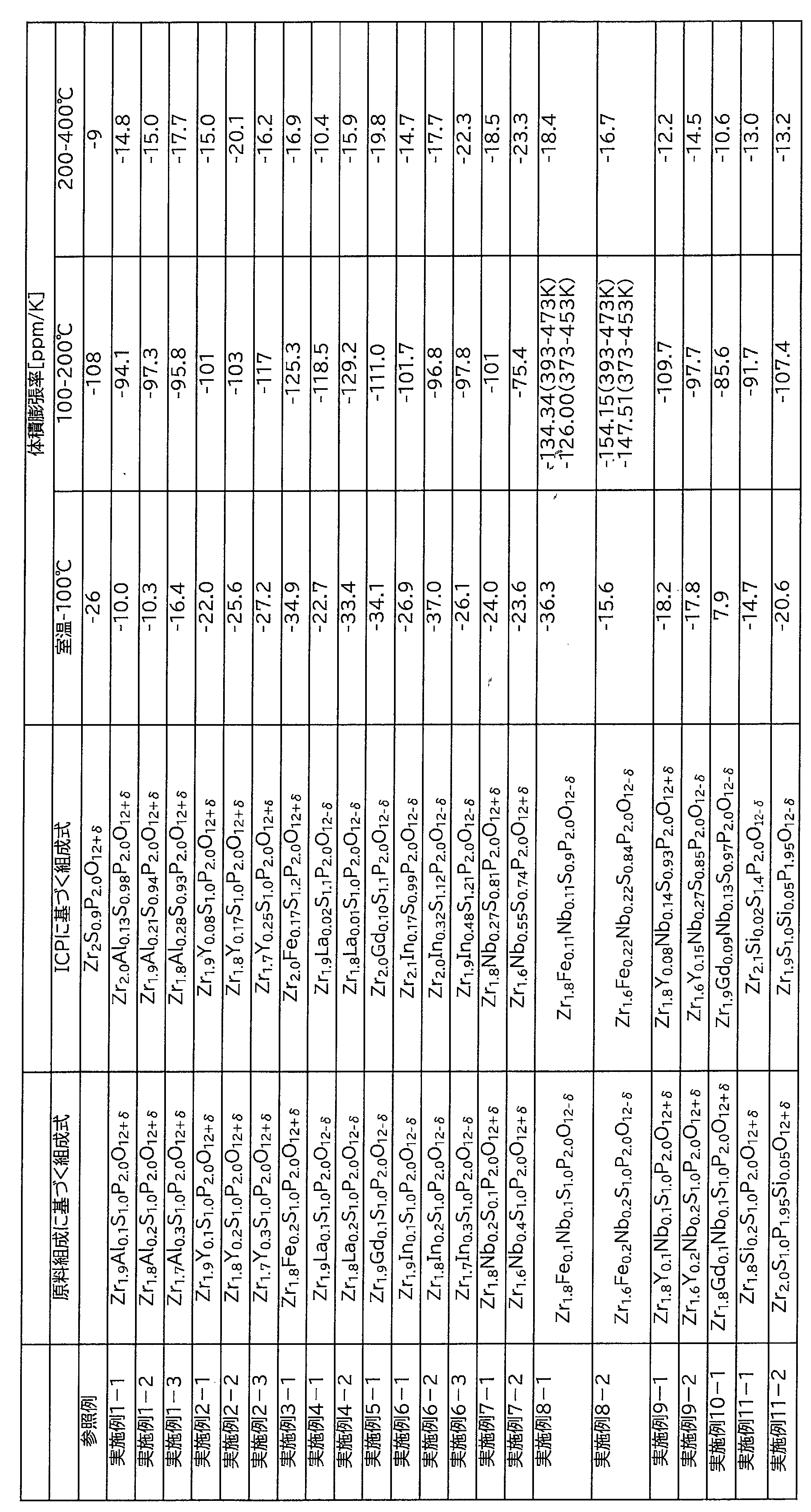
- composition analysis The composition (atomic ratio) of the prepared compound (sample) was analyzed using ICP-OES (Inductivity Coupled Plasma Optical Emission Spectrometry) and is shown in Table 2.
- ICP-OES ⁇ ICP-OES equipment used: 700 series, ICP-OES (Agilent Technologies, Inc.)
- thermo expansion coefficient The coefficient of lattice volume expansion of the prepared compound (sample) was measured using the following method.
- a multi-purpose sample high-temperature device unit was attached to the following powder X-ray diffractometer for high-temperature XRD, and X-ray diffraction patterns were measured at room temperature (30°C), 100°C, 200°C, and 400°C. The measurement was started after standing still for 10 minutes after reaching the target temperature.
- X-ray diffraction pattern and analysis software (PDXL2)
- the crystal structure was refined, and the lattice constant at each temperature was calculated.
- the lattice volume was calculated from the lattice constant.
- Table 2 shows the lattice volume expansion coefficient from room temperature (30 ° C.) to 100 ° C., that is, the lattice volume at 30 ° C. (referred to as “30 ° C. volume”) as a reference, and the lattice volume at 100 ° C.
- the rate of change in volume that is, ((volume at 30°C - volume at 100°C)/volume at 30°C) x 100 was calculated as the volume expansion rate (%) and shown in Table 2 and the figure.
- the coefficient of lattice volume expansion at 100° C. to 200° C. and the coefficient of lattice volume expansion at 400° C. were calculated and shown in Table 2 and FIGS. 1 to 11.
- composition formula (2) Zr 2-xy M x S z P 2 O 12 + ⁇ (wherein M is Al, Fe, Ga, Y, One or more elements selected from In, Nb, Bi, Si, La, Pr, Nd, Sm, Eu, Gd, Tb, Dy, Ho, Er, Tm, Yb and Lu.
- x is the total value of the amount (atomic ratio) of elements constituting M, 0 ⁇ x ⁇ 3, y is a value determined by the amount of Zr defects, ⁇ 2 ⁇ y ⁇ 1, 0 ⁇ z ⁇ 2, 0 ⁇ 2-xy ⁇ 4, ⁇ is a value determined to satisfy the charge neutrality condition)
- Compound 1 represented by Composition formula (3) Zr 2-x-y M x S z P 2-a Q a O 12+ ⁇ (wherein M is Al, Fe, Ga, Y, In, Nb, Bi, Si, La, Pr, Nd , Sm, Eu, Gd, Tb, Dy, Ho, Er, Tm, Yb and Lu, and Q is one selected from Si and Ge Or two or more elements, x is the total value of the amount (atomic ratio) of the elements constituting M, 0 ⁇ x ⁇ 3, y is a value determined by the amount of Zr defects, -2 ⁇ y ⁇ 1, 0 ⁇ z ⁇ 2, 0 ⁇ 2-xy ⁇
- x1 is the total amount (atomic ratio) of the elements constituting M1
- x2 is the total amount (atomic ratio) of the elements constituting M2.
- 0 ⁇ x1+x2 ⁇ 3, 0 ⁇ x1 ⁇ 2, 0 ⁇ x2 ⁇ 2, y is a value determined by the amount of Zr defects, ⁇ 2 ⁇ y ⁇ 1, 0 ⁇ z ⁇ 2, 0 ⁇ 2 ⁇ x1 -x2-y ⁇ 4, a is the total amount (atomic ratio) of the elements that make up Q, 0 ⁇ a ⁇ 2, and ⁇ is a value that satisfies the charge neutrality condition). 4 exhibit a negative coefficient of thermal expansion, particularly in the temperature range of 200° C. to 400° C., which is superior to the compound represented by the composition formula Zr 2 SP 2 O 12.00+ ⁇ . can be considered to indicate
Landscapes
- Chemical & Material Sciences (AREA)
- Organic Chemistry (AREA)
- Inorganic Chemistry (AREA)
- Inorganic Compounds Of Heavy Metals (AREA)
- Catalysts (AREA)
- Silicates, Zeolites, And Molecular Sieves (AREA)
- Compounds Of Iron (AREA)
Abstract
従来とは異なる組成からなる、負の熱膨張率を示す化合物であって、好ましくは、特に200℃~400℃の温度領域において優れた負の熱膨張率を示す新たな化合物を提供する。 組成式(1)ZrwMxSzP2O12+δ(式中、Mは、Al、Fe、Ga、Y、In、Nb、Bi、Si、La、Pr、Nd、Sm、Eu、Gd、Tb、Dy、Ho、Er、Tm、Yb、Ge及びLuのうちから選択される1種又は2種以上の元素である。0<w≦4、xはMを構成する元素の量(原子比)の合計値であり、0<x<3、0<z≦2、δは電荷中性条件を満たすように決まる値)で表される化合物である。
Description
本発明は、温度が上昇すると体積が小さくなる負の熱膨張率を示す新規化合物及びその製造方法、並びに、該新規化合物を用いた複合材料に関する。
電子機器や光学機器、燃料電池やセンサなどの精密さが要求される技術分野では、例えば複数の素材を組み合せてデバイスを構成する際、各素材間の熱膨張率差によって、位置ずれ、界面剥離、断線などが生じると、深刻な問題となる場合がある。そのため、熱膨張の制御技術が要求されている。熱膨張制御技術の一つとして、負の熱膨張率を有する材料(「負熱膨張材料」とも称する)を組み合わせて、全体の熱膨張率を制御する技術が注目されている。
多くの物質は温度が上昇すると、熱膨張によって体積が増大する。これに対して、温めると逆に体積が小さくなる特性を備えた負熱膨張材料が希に存在する。
但し、負熱膨張材料と言っても、一般的には、ある特定の温度域でのみ負熱膨張を示し、それ以外の温度領域では、正の熱膨張を示す材料がほとんどである。
但し、負熱膨張材料と言っても、一般的には、ある特定の温度域でのみ負熱膨張を示し、それ以外の温度領域では、正の熱膨張を示す材料がほとんどである。
負熱膨張材料としては、例えばβ-ユークリプタイト、タングステン酸ジルコニウム(ZrW2O8)、リン酸タングステン酸ジルコニウム(Zr2WO4(PO4)2)、ZnxCd1-x(CN)2、マンガン窒化物、ビスマス・ニッケル・鉄酸化物等が知られている。
また、特許文献1には、新たな負熱膨張材料として、Bi1-xSbxNiO3(ただし、xは0.02≦x≦0.20である)が開示されている。
特許文献2には、新たな負熱膨張材料として、Zr2-aMaSxP2O12+δ(Mは、Ti、Ce、Sn、Mn、Hf、Ir、Pb、Pd、Crから選択される少なくとも1種であり、aは0≦a<2であり、xは0.4≦x≦1であり、δは電荷中性条件を満たすように定まる値である。)で表されることを特徴とする化合物が開示されている。
前記特許文献2に開示された負熱膨張材料は、室温から500℃の範囲で負の熱膨張率を示し、硫黄の含有量(x)が大きいほど、特に100~180℃において負の熱膨張率を示し、低密度化をも実現できる材料であるため、有用な材料として注目されている。
他方、特定の用途では、特に200℃~400℃の温度領域において負の熱膨張率を示す材料が求められている。例えば、電気又は電子部品を接合するのに用いられる半田の融点は170~300℃付近であるため、特に200℃~400℃の温度領域において熱膨張率を制御する必要があり、負の熱膨張率を示す材料が求められている。
他方、特定の用途では、特に200℃~400℃の温度領域において負の熱膨張率を示す材料が求められている。例えば、電気又は電子部品を接合するのに用いられる半田の融点は170~300℃付近であるため、特に200℃~400℃の温度領域において熱膨張率を制御する必要があり、負の熱膨張率を示す材料が求められている。
そこで本発明は、従来とは異なる組成からなる、負の熱膨張率を示す化合物であって、好ましくは、特に200℃~400℃の温度領域において優れた負の熱膨張率を示す新たな化合物を提供せんとするものである。
かかる課題解決のため、本発明は、組成式(1)ZrwMxSzP2O12+δ(式中、Mは、Al、Fe、Ga、Y、In、Nb、Bi、Si、La、Pr、Nd、Sm、Eu、Gd、Tb、Dy、Ho、Er、Tm、Yb、Ge及びLuのうちから選択される1種又は2種以上の元素である。0<w≦4、xはMを構成する元素の量(原子比)の合計値であり、0<x<3、0<z≦2、δは電荷中性条件を満たすように決まる値)で表される化合物を提案する。
本発明はまた、組成式(2)Zr2-x-yMxSzP2O12+δ(式中、MはAl、Fe、Ga、Y、In、Nb、Bi、Si、Ge、La、Pr、Nd、Sm、Eu、Gd、Tb、Dy、Ho、Er、Tm、Yb及びLuのうちから選択される1種又は2種以上の元素である。xはMを構成する元素の量(原子比)の合計値であり、0<x<3、yはZrの欠陥量によって決まる値であり、-2≦y≦1、0<z≦2、0<2-x-y<4、δは電荷中性条件を満たすように決まる値)で表される化合物を提案する。
本発明はまた、組成式(3)Zr2-x-yMxSzP2-aQaO12+δ(式中、MはAl、Fe、Ga、Y、In、Nb、Bi、Si、Ge、La、Pr、Nd、Sm、Eu、Gd、Tb、Dy、Ho、Er、Tm、Yb及びLuのうちから選択される1種又は2種以上の元素であり、QはSi及びGeのうちから選択される1種又は2種以上の元素である。xはMを構成する元素の量(原子比)の合計値であり、0<x<3、yはZrの欠陥量によって決まる値であり、-2≦y≦1、0<z≦2、0<2-x-y<4、aはQを構成する元素の量(原子比)の合計値であり、0<a<2、δは電荷中性条件を満たすように決まる値)で表される化合物を提案する。
本発明はまた、組成式(4)Zr2-x1-x2-yM1x1M2x2SzP2O12+δ(式中、M1はAl、Fe、Ga、Y、In、Nb、Bi、Si、Ge、La、Pr、Nd、Sm、Eu、Gd、Tb、Dy、Ho、Er、Tm、Yb及びLuのうちから選択される1種又は2種以上であり、M2はAl、Cr、Fe、Ga、Y、In、Nb、Bi、Si、Ge、La、Pr、Nd、Sm、Eu、Gd、Tb、Dy、Ho、Er、Tm、Yb、Lu、Ti、Ce、Sn、Mn、Hf、Ir、Pb及びPdのうちから選択される1種又は2種以上であって、前記M1とは異なる元素である。x1はM1を構成する元素の量(原子比)の合計値であり、x2はM2を構成する元素の量(原子比)の合計値であり、0<x1+x2<3、0<x1<2、0<x2<2、yはZrの欠陥量によって決まる値であり、-2≦y≦1、0<z≦2、0<2-x1-x2-y<4、δは電荷中性条件を満たすように決まる値)で表される化合物を提案する。
本発明はまた、組成式(5)Zr2-x1-x2-yM1x1M2x2SzP2-aQaO12+δ(式中、M1はAl、Fe、Ga、Y、In、Nb、Bi、Si、Ge、La、Pr、Nd、Sm、Eu、Gd、Tb、Dy、Ho、Er、Tm、Yb及びLuのうちから選択される1種又は2種以上であり、M2はAl、Cr、Fe、Ga、Y、In、Nb、Bi、Si、Ge、La、Pr、Nd、Sm、Eu、Gd、Tb、Dy、Ho、Er、Tm、Yb、Lu、Ti、Ce、Sn、Mn、Hf、Ir、Pb、Pd、W及びMoのうちから選択される1種又は2種以上であって、前記M1とは異なる元素であり、Qは、Si及びGeのうちから選択される1種又は2種以上の元素である。x1はM1を構成する元素の量(原子比)の合計値であり、x2はM2を構成する元素の量(原子比)の合計値であり、0<x1+x2<3、0<x1<2、0<x2<2、yはZrの欠陥量によって決まる値であり、-2≦y≦1、0<z≦2、0<2-x1-x2-y<4、aはQを構成する元素の量(原子比)の合計値であり、0<a<2、δは電荷中性条件を満たすように決まる値)で表される化合物を提案する。
本発明が提案する化合物、すなわち、上記組成式(1)~(5)で表される化合物はいずれも、負の熱膨張率を示す。よって、正の熱膨張率を示す材料(「正熱膨張材料」と称する)と混合して混合物である複合材料の熱膨張率の制御を行うことができる。
本発明が提案する化合物、すなわち、上記組成式(1)~(5)で表される化合物はいずれも、特に200℃~400℃の温度領域において優れた負の熱膨張率を示すことができる。よって、200℃~400℃の温度領域における熱膨張率の制御に好適に用いることができる。例えば、正熱膨張材料と混合して得られる複合材料の200℃~400℃の温度領域での熱膨張率の制御を実施することができる。
本発明が提案する化合物、すなわち、上記組成式(1)~(5)で表される化合物はいずれも、特に200℃~400℃の温度領域において優れた負の熱膨張率を示すことができる。よって、200℃~400℃の温度領域における熱膨張率の制御に好適に用いることができる。例えば、正熱膨張材料と混合して得られる複合材料の200℃~400℃の温度領域での熱膨張率の制御を実施することができる。
次に、実施の形態例に基づいて本発明を説明する。但し、本発明が次に説明する実施形態に限定されるものではない。
<本化合物1>
本発明の実施形態の一例に係る化合物(「本化合物1」と称する)は、組成式(1)ZrwMxSzP2O12+δ(式中、Mは、Al、Fe、Ga、Y、In、Nb、Bi、Si、La、Pr、Nd、Sm、Eu、Gd、Tb、Dy、Ho、Er、Tm、Yb、Ge及びLuのうちから選択される1種又は2種以上の元素である。0<w≦4、xはMを構成する元素の量(原子比)の合計値であり、0<x<3、0<z≦2、δは電荷中性条件を満たすように決まる値)で表される化合物である。
本発明の実施形態の一例に係る化合物(「本化合物1」と称する)は、組成式(1)ZrwMxSzP2O12+δ(式中、Mは、Al、Fe、Ga、Y、In、Nb、Bi、Si、La、Pr、Nd、Sm、Eu、Gd、Tb、Dy、Ho、Er、Tm、Yb、Ge及びLuのうちから選択される1種又は2種以上の元素である。0<w≦4、xはMを構成する元素の量(原子比)の合計値であり、0<x<3、0<z≦2、δは電荷中性条件を満たすように決まる値)で表される化合物である。
組成式(1)は、本化合物1が、Zr、M元素、S、P及びOからなる化合物であり、P(リン)の原子比を「2」で規格化した場合の各元素の原子比が、Zr:M元素:S:P:O=w:x:z:2:12+δであることを示している。
組成式(1)におけるMを構成し得る元素としては、Al、Fe、Ga、Y、In、Nb、Bi、Si、La、Pr、Nd、Sm、Eu、Gd、Tb、Dy、Ho、Er、Tm、Yb、Ge及びLuを挙げることができ、これらは、1種又は2種以上の組み合わせとして、組成式(1)のMを構成することができる。
本化合物1の組成式(1)において、Zrの量(原子比)を示す「w」は、結晶構造の維持の観点から、0<w≦4であればよく、中でも1以上或いは3以下、その中でも1.5以上或いは2.2以下であることが可能である。
本化合物1の組成式(1)において、M元素の量(原子比)を示す「x」は、Mを構成する元素の量(原子比)の合計値であり、結晶構造の維持の観点から、0<x<3であればよく、中でも0.1以上或いは2以下、その中でも0.2以上或いは0.7以下であることが可能である。
本化合物1の組成式(1)において、S(硫黄)の量(原子比)を示す「z」は、結晶構造の維持の観点から、0<z≦2であればよく、中でも0.2以上或いは1.5以下、その中でも0.3以上或いは1以下であることが可能である。
本化合物1の組成式(1)中において、O(酸素)の量(原子比)を示す「δ」は、電荷中性条件を満たすように定まる値であり、通常は-2.50以上1.00以下である。中でも-2.00以上或いは0.50以下、その中でも-1.50以上或いは0.00以下、その中でも-1.00以上或いは-0.50以下、その中でも-1.33以上或いは-0.80以下である場合がある。
なお、「電荷中性条件」は完全に中性でなくてもよく、化合物として許容される範囲での酸素欠損や酸素過剰の組成は許容するものとする。
なお、「電荷中性条件」は完全に中性でなくてもよく、化合物として許容される範囲での酸素欠損や酸素過剰の組成は許容するものとする。
<本化合物2>
本発明の実施形態の一例に係る化合物(「本化合物2」と称する)は、組成式(2)Zr2-x-yMxSzP2O12+δ(式中、MはAl、Fe、Ga、Y、In、Nb、Bi、Si、Ge、La、Pr、Nd、Sm、Eu、Gd、Tb、Dy、Ho、Er、Tm、Yb及びLuのうちから選択される1種又は2種以上の元素である。xはMを構成する元素の量(原子比)の合計値であり、0<x<3、yはZrの欠陥量によって決まる値であり、-2≦y≦1、0<z≦2、0<2-x-y<4、δは電荷中性条件を満たすように決まる値)で表される化合物である。
本発明の実施形態の一例に係る化合物(「本化合物2」と称する)は、組成式(2)Zr2-x-yMxSzP2O12+δ(式中、MはAl、Fe、Ga、Y、In、Nb、Bi、Si、Ge、La、Pr、Nd、Sm、Eu、Gd、Tb、Dy、Ho、Er、Tm、Yb及びLuのうちから選択される1種又は2種以上の元素である。xはMを構成する元素の量(原子比)の合計値であり、0<x<3、yはZrの欠陥量によって決まる値であり、-2≦y≦1、0<z≦2、0<2-x-y<4、δは電荷中性条件を満たすように決まる値)で表される化合物である。
組成式(2)は、組成式(1)で示される本化合物1に関し、「Zr2SzP2O12+δ」のジルコニウムのサイトの一部をM元素が置換していると推定される組成を示しており、P(リン)の原子比を「2」で規格化した場合の各元素の原子比を示した組成式である。
Mの量が増加するとZrの値が減少する傾向がみられる点から、ジルコニウムのサイトの一部をM元素が置換していると推定することができる。この点は、本化合物2及び3のM元素、並びに、本化合物3及び4のM1元素及びM2元素についても同様である。
Mの量が増加するとZrの値が減少する傾向がみられる点から、ジルコニウムのサイトの一部をM元素が置換していると推定することができる。この点は、本化合物2及び3のM元素、並びに、本化合物3及び4のM1元素及びM2元素についても同様である。
組成式(2)におけるMを構成し得る元素としては、3価のAl、Fe、Ga、Y、In,La、Gd、その他の希土類元素を挙げることができる。その他の希土類元素としては、Pr,Nd、Sm、Eu、Tb,Dy,Ho,Er,Tm,Yb及びLuを挙げることができる。
Mを構成し得る元素としては、そのほかに、4価のSi、Ge、5価のNb、Biを挙げることができる。
これらは、1種又は2種以上の組み合わせとして、組成式(2)のMを構成することができる。
Mを構成し得る元素としては、そのほかに、4価のSi、Ge、5価のNb、Biを挙げることができる。
これらは、1種又は2種以上の組み合わせとして、組成式(2)のMを構成することができる。
なお、M元素として各種元素について試験した結果、例えばCeについては、ジルコニウムのサイトの一部を置換させることができないことを確認している。
本化合物2の組成式(2)において、Zrの量(原子比)を示す「2-x-y」は、結晶構造の維持の観点から、0<2-x-y<4であればよく、中でも1以上或いは3以下、その中でも1.5以上或いは2.2以下であることができる。
本化合物2の化学量論組成は、Zr:S:P=2:1:2であるが、実際にICPなどで組成分析してみると、当該組成比から組成がズレるため、Pのモル比を2で規格化した場合の組成ズレをyで補償した。すなわち、yはZrの欠陥量によって決まる値である。例えば、Zrが過剰又はPが欠損している場合、yはマイナスとなり、Zrが欠損又はPが過剰な場合、yはプラスの値となる。
「y」は、-2≦y≦1であるのが好ましく、中でも-1以上、その中でも-0.5以上或いは0.5以下、その中でも-0.3以上或いは0.3以下、その中でも-0.1以上或いは0.1以下であるのがさらに好ましい。
「y」は、-2≦y≦1であるのが好ましく、中でも-1以上、その中でも-0.5以上或いは0.5以下、その中でも-0.3以上或いは0.3以下、その中でも-0.1以上或いは0.1以下であるのがさらに好ましい。
本化合物2の組成式(2)中、「x」は、Mを構成する元素の量(原子比)の合計値であり、0<x<3であることが好ましく、中でも0.1以上或いは2以下、その中でも0.2以上或いは1以下、その中でも0.3以上或いは0.7以下であるのがさらに好ましい。
本化合物2の組成式(2)中、S(硫黄)の量(原子比)を示す「z」は、0<z≦2であるのが好ましく、中でも0.1以上或いは1.5以下、中でも0.2以上或いは1.2以下、その中でも0.3以上或いは1以下であるのがさらに好ましい。
本化合物2の組成式(2)中の「δ」の意味及び取りうる範囲は、上記組成式(1)と同様である。
<本化合物3>
本発明の実施形態の他の一例に係る化合物(「本化合物3」と称する)は、組成式(3)Zr2-x-yMxSzP2-aQaO12+δ(式中、MはAl、Fe、Ga、Y、In、Nb、Bi、Si、Ge、La、Pr、Nd、Sm、Eu、Gd、Tb、Dy、Ho、Er、Tm、Yb及びLuのうちから選択される1種又は2種以上の元素であり、QはSi及びGeのうちから選択される1種又は2種以上の元素である。xはMを構成する元素の量(原子比)の合計値であり、0<x<3、yはZrの欠陥量によって決まる値であり、-2≦y≦1、0<z≦2、0<2-x-y<4、aはQを構成する元素の量(原子比)の合計値であり、0<a<2、δは電荷中性条件を満たすように決まる値)で表される化合物である。
本発明の実施形態の他の一例に係る化合物(「本化合物3」と称する)は、組成式(3)Zr2-x-yMxSzP2-aQaO12+δ(式中、MはAl、Fe、Ga、Y、In、Nb、Bi、Si、Ge、La、Pr、Nd、Sm、Eu、Gd、Tb、Dy、Ho、Er、Tm、Yb及びLuのうちから選択される1種又は2種以上の元素であり、QはSi及びGeのうちから選択される1種又は2種以上の元素である。xはMを構成する元素の量(原子比)の合計値であり、0<x<3、yはZrの欠陥量によって決まる値であり、-2≦y≦1、0<z≦2、0<2-x-y<4、aはQを構成する元素の量(原子比)の合計値であり、0<a<2、δは電荷中性条件を満たすように決まる値)で表される化合物である。
組成式(3)は、組成式(1)で示される本化合物1に関し、「Zr2SzP2O12+δ」のジルコニウムのサイトの一部をM元素が置換し、リンのサイトの一部をQ元素が置換していると推定される組成を示しており、P(リン)の原子比を「2」で規格化した場合の各元素の原子比を示した組成式である。
組成式(3)におけるMは、上述のように、ジルコニウムのサイトの一部を置換していると推定される元素Mであり、Mを構成し得る元素は、上記組成式(2)のMを構成し得る元素と同様である。
組成式(3)において、Qを構成し得る元素は、Si及びGeのうちから選択される1種又は2種以上の元素である。これら、Si及びGeは、ジルコニウムのサイトの一部を置換するとともに、リンのサイトの一部を置換する場合も想定することができる。
Pを2で規格化した場合、Zrが2より大きくなることから、Pが欠損していると考えられる点から、リンのサイトの一部を、SiやGeが置換していると推定することができる。この点は、本化合物5についても同様である。
Pを2で規格化した場合、Zrが2より大きくなることから、Pが欠損していると考えられる点から、リンのサイトの一部を、SiやGeが置換していると推定することができる。この点は、本化合物5についても同様である。
本化合物3の組成式(3)における、「x」、「y」、「2-x-y」、「z」及び「δ」それぞれの意味及び数値範囲は、上記組成式(2)と同様である。
組成式(3)において、Qの量(原子比)を示す「a」は、Qを構成する元素の量(原子比)の合計値であり、0<a<2であることが好ましく、中でも0.1以上或いは1以下、その中でも0.2以上或いは0.5以下、その中でも0.3以下であるのがさらに好ましい。
<本化合物4>
本発明の実施形態のさらに他の一例に係る化合物(「本化合物4」と称する)は、組成式(4)Zr2-x1-x2-yM1x1M2x2SzP2O12+δ(式中、M1はAl、Fe、Ga、Y、In、Nb、Bi、Si、Ge、La、Pr、Nd、Sm、Eu、Gd、Tb、Dy、Ho、Er、Tm、Yb及びLuのうちから選択される1種又は2種以上であり、M2はAl、Cr、Fe、Ga、Y、In、Nb、Bi、Si、Ge、La、Pr、Nd、Sm、Eu、Gd、Tb、Dy、Ho、Er、Tm、Yb、Lu、Ti、Ce、Sn、Mn、Hf、Ir、Pb及びPdのうちから選択される1種又は2種以上であって、前記M1とは異なる元素である。x1はM1を構成する元素の量(原子比)の合計値であり、x2はM2を構成する元素の量(原子比)の合計値であり、0<x1+x2<3、0<x1<2、0<x2<2、yはZrの欠陥量によって決まる値であり、-2≦y≦1、0<z≦2、0<2-x1-x2-y<4、δは電荷中性条件を満たすように決まる値)で表される化合物である。
本発明の実施形態のさらに他の一例に係る化合物(「本化合物4」と称する)は、組成式(4)Zr2-x1-x2-yM1x1M2x2SzP2O12+δ(式中、M1はAl、Fe、Ga、Y、In、Nb、Bi、Si、Ge、La、Pr、Nd、Sm、Eu、Gd、Tb、Dy、Ho、Er、Tm、Yb及びLuのうちから選択される1種又は2種以上であり、M2はAl、Cr、Fe、Ga、Y、In、Nb、Bi、Si、Ge、La、Pr、Nd、Sm、Eu、Gd、Tb、Dy、Ho、Er、Tm、Yb、Lu、Ti、Ce、Sn、Mn、Hf、Ir、Pb及びPdのうちから選択される1種又は2種以上であって、前記M1とは異なる元素である。x1はM1を構成する元素の量(原子比)の合計値であり、x2はM2を構成する元素の量(原子比)の合計値であり、0<x1+x2<3、0<x1<2、0<x2<2、yはZrの欠陥量によって決まる値であり、-2≦y≦1、0<z≦2、0<2-x1-x2-y<4、δは電荷中性条件を満たすように決まる値)で表される化合物である。
組成式(4)は、組成式(1)で示される本化合物1に関し、「Zr2SzP2O12+δ」のジルコニウムのサイトの一部をM1元素及びM2元素が置換していると推定される組成を示しており、P(リン)の原子比を「2」で規格化した場合の各元素の原子比を示した組成式である。
組成式(4)において、M1を構成し得る元素は、上記組成式(2)のMを構成し得る元素と同様である。
組成式(4)において、M2を構成し得る元素としては、Al、Cr、Fe、Ga、Y、In、Nb、Bi、Si、La、Pr、Nd、Sm、Eu、Gd、Tb、Dy、Ho、Er、Tm、Yb、Lu、Ti、Ce、Sn、Mn、Hf、Ir、Pb及びPdのうちから選択される1種又は2種以上であって、前記M1とは異なる元素を挙げることができる。
組成式(4)において、M2を構成し得る元素としては、Al、Cr、Fe、Ga、Y、In、Nb、Bi、Si、La、Pr、Nd、Sm、Eu、Gd、Tb、Dy、Ho、Er、Tm、Yb、Lu、Ti、Ce、Sn、Mn、Hf、Ir、Pb及びPdのうちから選択される1種又は2種以上であって、前記M1とは異なる元素を挙げることができる。
本化合物4の組成式(4)において、Zrの量(原子比)を示す「2-x1-x2-y」は、結晶構造の維持の観点から、0<2-x1-x2-y<4であればよく、中でも3以下、その中でも0.1以上或いは2以下、その中でも0.2以上或いは1以下、その中でも0.3以上或いは0.7以下であることができる。
本化合物4の組成式(4)中、「x1」は、M1を構成する元素の量(原子比)の合計値であり、「x2」は、M2を構成する元素の量(原子比)の合計値であり、0<x1+x2<3において、0<x1<2であることが好ましく、中でも0.1以上或いは1以下、その中でも0.2以上或いは0.75以下、その中でも0.3以上或いは0.5以下であるのがさらに好ましい。また、0<x2<2であることが好ましく、中でも0.1以上或いは1以下、その中でも0.2以上或いは0.8以下、その中でも0.3以上或いは0.7以下であるのがさらに好ましい。
なお、M1とM2の量は、同量すなわちx1=x2であっても、異なっていてもよい。
但し、電気的中性の維持の観点から、|x1-x2|≦0.3であるのが好ましい。
但し、電気的中性の維持の観点から、|x1-x2|≦0.3であるのが好ましい。
組成式(4)における、「y」、「z」及び「δ」それぞれの意味及び数値範囲は、上記組成式(2)と同様である。
<本化合物5>
本発明の実施形態のさらに他の一例に係る化合物(「本化合物5」と称する)は、組成式(5)Zr2-x1-x2-yM1x1M2x2SzP2-aQaO12+δ(式中、M1はAl、Fe、Ga、Y、In、Nb、Bi、Si、Ge、La、Pr、Nd、Sm、Eu、Gd、Tb、Dy、Ho、Er、Tm、Yb及びLuのうちから選択される1種又は2種以上であり、M2はAl、Cr、Fe、Ga、Y、In、Nb、Bi、Si、Ge、La、Pr、Nd、Sm、Eu、Gd、Tb、Dy、Ho、Er、Tm、Yb、Lu、Ti、Ce、Sn、Mn、Hf、Ir、Pb、Pd、W及びMoのうちから選択される1種又は2種以上であって、前記M1とは異なる元素であり、Qは、Si及びGeのうちから選択される1種又は2種以上の元素である。x1はM1を構成する元素の量(原子比)の合計値であり、x2はM2を構成する元素の量(原子比)の合計値であり、0<x1+x2<3、0<x1<2、0<x2<2、yはZrの欠陥量によって決まる値であり、-2≦y≦1、0<z≦2、0<2-x1-x2-y<4、aはQを構成する元素の量(原子比)の合計値であり、0<a<2、δは電荷中性条件を満たすように決まる値)で表される化合物である。
本発明の実施形態のさらに他の一例に係る化合物(「本化合物5」と称する)は、組成式(5)Zr2-x1-x2-yM1x1M2x2SzP2-aQaO12+δ(式中、M1はAl、Fe、Ga、Y、In、Nb、Bi、Si、Ge、La、Pr、Nd、Sm、Eu、Gd、Tb、Dy、Ho、Er、Tm、Yb及びLuのうちから選択される1種又は2種以上であり、M2はAl、Cr、Fe、Ga、Y、In、Nb、Bi、Si、Ge、La、Pr、Nd、Sm、Eu、Gd、Tb、Dy、Ho、Er、Tm、Yb、Lu、Ti、Ce、Sn、Mn、Hf、Ir、Pb、Pd、W及びMoのうちから選択される1種又は2種以上であって、前記M1とは異なる元素であり、Qは、Si及びGeのうちから選択される1種又は2種以上の元素である。x1はM1を構成する元素の量(原子比)の合計値であり、x2はM2を構成する元素の量(原子比)の合計値であり、0<x1+x2<3、0<x1<2、0<x2<2、yはZrの欠陥量によって決まる値であり、-2≦y≦1、0<z≦2、0<2-x1-x2-y<4、aはQを構成する元素の量(原子比)の合計値であり、0<a<2、δは電荷中性条件を満たすように決まる値)で表される化合物である。
組成式(5)は、組成式(1)で示される本化合物1に関し、「Zr2SzP2O12+δ」のジルコニウムのサイトの一部をM1元素及びM2元素が置換しており、リンのサイトの一部をQ元素が置換していると推定される組成を示しており、P(リン)の原子比を「2」で規格化した場合の各元素の原子比を示した組成式である。
組成式(5)における、M1を構成し得る元素、M2を構成し得る元素は、上記組成式(4)における、M1を構成し得る元素、M2を構成し得る元素と同様である。
組成式(5)における、Qを構成し得る元素は、上記組成式(3)における、Qを構成し得る元素と同様である。
組成式(5)における、Qを構成し得る元素は、上記組成式(3)における、Qを構成し得る元素と同様である。
組成式(5)における、「x1」、「x2」、「x1+x2」及び「2-x1-x2-y」の意味及び数値範囲は、組成式(4)と同様である。
組成式(5)における、「a」の意味及び数値範囲は、組成式(3)と同様である。
組成式(5)における、「y」、「z」及び「δ」それぞれの意味及び数値範囲は、上記組成式(2)と同様である。
なお、本化合物1~5において、酸素を除く各元素量、すなわち、Zr、M、S、P及びQの量は、全量溶解してICP-OESにより測定することができる。
酸素量の厳密な測定は困難であることから、酸素を除く元素の化学比から電気的中性として推定される組成比を用いるものとする。
酸素量の厳密な測定は困難であることから、酸素を除く元素の化学比から電気的中性として推定される組成比を用いるものとする。
<結晶相>
本化合物1、2、3、4及び5に存在する結晶相としては、α-Zr2SP2O12相(ICDDカード番号:04-017-0937又は/及びICDDカード番号:00-038-0489)を挙げることができ、この結晶が主相であること、すなわち、本化合物1、2、3、4及び5をX線回折法(XRD、Cu線源)で分析して得られるX線回折パターンにおいて、この結晶に由来するピーク強度が最も高いことが好ましい。つまり、一部に他の結晶相が含まれていてもよい。例えば、α相(α-Zr2SP2O12)以外に、β相(β-Zr2SP2O12(ICDDカード:04-007-8019))が一部に含まれていてもよい。
本化合物1、2、3、4及び5に存在する結晶相としては、α-Zr2SP2O12相(ICDDカード番号:04-017-0937又は/及びICDDカード番号:00-038-0489)を挙げることができ、この結晶が主相であること、すなわち、本化合物1、2、3、4及び5をX線回折法(XRD、Cu線源)で分析して得られるX線回折パターンにおいて、この結晶に由来するピーク強度が最も高いことが好ましい。つまり、一部に他の結晶相が含まれていてもよい。例えば、α相(α-Zr2SP2O12)以外に、β相(β-Zr2SP2O12(ICDDカード:04-007-8019))が一部に含まれていてもよい。
なお、下記実施例では、格子定数を求めるため、単相のものを作製した。しかし、本化合物1、2、3、4及び5は、工業的に利用するものであるから、その目的に応じて、多相であっても、不純物を含んでいてもよい。
<負の熱膨張率>
本化合物1、2、3、4及び5は、負の熱膨張率を示す。例えば室温(30℃)~100℃の温度領域、室温(30℃)~200℃の温度領域、室温(30℃)~300℃の温度領域、室温(30℃)~400℃の温度領域などにおいて負の熱膨張率を示す。
本化合物1、2、3、4及び5は、負の熱膨張率を示す。例えば室温(30℃)~100℃の温度領域、室温(30℃)~200℃の温度領域、室温(30℃)~300℃の温度領域、室温(30℃)~400℃の温度領域などにおいて負の熱膨張率を示す。
中でも、本化合物1、2、3、4及び5は、200℃~400℃の温度領域において、顕著に優れた負の熱膨張率を示すことが特徴である。具体的には、200℃~400℃に加熱した際、400℃の体積は、200℃の体積に対して0.1%~0.5%収縮することができる。
中でも、本化合物1、2、3、4及び5においてM(M1及びM2を包含する)がYである場合、その中でも好ましくは、本化合物1、2、3においてxが0.05以上1以下である場合には、200℃~400℃に加熱した際、400℃の体積は、200℃の体積に対して0.1%~0.3%収縮することができる。
また、本化合物1、2、3、4及び5においてM(M1及びM2を包含する)がGdである場合、その中でも好ましくは、本化合物1、2、3においてxが0.05以上0.5以下である場合には、200℃~400℃に加熱した際、400℃の体積は、200℃の体積に対して0.3%~0.5%収縮することができる。
また、本化合物1、2、3、4及び5においてM(M1及びM2を包含する)がNbである場合、その中でも好ましくは、本化合物1、2、3においてxが0.1以上0.5以下である場合には、200℃~400℃に加熱した際、400℃の体積は、200℃の体積に対して0.2%~0.5%収縮することができる。
中でも、本化合物1、2、3、4及び5においてM(M1及びM2を包含する)がYである場合、その中でも好ましくは、本化合物1、2、3においてxが0.05以上1以下である場合には、200℃~400℃に加熱した際、400℃の体積は、200℃の体積に対して0.1%~0.3%収縮することができる。
また、本化合物1、2、3、4及び5においてM(M1及びM2を包含する)がGdである場合、その中でも好ましくは、本化合物1、2、3においてxが0.05以上0.5以下である場合には、200℃~400℃に加熱した際、400℃の体積は、200℃の体積に対して0.3%~0.5%収縮することができる。
また、本化合物1、2、3、4及び5においてM(M1及びM2を包含する)がNbである場合、その中でも好ましくは、本化合物1、2、3においてxが0.1以上0.5以下である場合には、200℃~400℃に加熱した際、400℃の体積は、200℃の体積に対して0.2%~0.5%収縮することができる。
また、本化合物1、2、3、4及び5は、100℃~200℃の温度領域においても、顕著に優れた負の熱膨張率を示すことも特徴である。具体的には、100℃~200℃に加熱した際、200℃の体積は、100℃の体積に対して0.5%~1.5%収縮することができる。
中でも、本化合物1、2、3、4及び5においてM(M1及びM2を包含する)がFe及びNbである場合、その中でも好ましくは、本化合物4及び5において、M1及びM2がFe及びNbであって、a1及びa2が0.2以上0.5以下である場合には、100℃~200℃に加熱した際、200℃の体積は、100℃の体積に対して1.1%~1.3%収縮することができる。
また、本化合物1、2、3、4及び5においてM(M1及びM2を包含する)がLaである場合、その中でも好ましくは、本化合物1、2、3においてxが0.05以上0.1以下である場合には、100℃~200℃に加熱した際、200℃の体積は、100℃の体積に対して0.9%~1.1%収縮することができる。
また、本化合物1、2、3、4及び5においてM(M1及びM2を包含する)がFe及びNbである場合、その中でも好ましくは、本化合物4及び5において、M1及びM2がFe及びNbであって、a1及びa2が0.05以上0.2以下である場合には、100℃~200℃に加熱した際、200℃の体積は、100℃の体積に対して1.0%~1.2%収縮することができる。
中でも、本化合物1、2、3、4及び5においてM(M1及びM2を包含する)がFe及びNbである場合、その中でも好ましくは、本化合物4及び5において、M1及びM2がFe及びNbであって、a1及びa2が0.2以上0.5以下である場合には、100℃~200℃に加熱した際、200℃の体積は、100℃の体積に対して1.1%~1.3%収縮することができる。
また、本化合物1、2、3、4及び5においてM(M1及びM2を包含する)がLaである場合、その中でも好ましくは、本化合物1、2、3においてxが0.05以上0.1以下である場合には、100℃~200℃に加熱した際、200℃の体積は、100℃の体積に対して0.9%~1.1%収縮することができる。
また、本化合物1、2、3、4及び5においてM(M1及びM2を包含する)がFe及びNbである場合、その中でも好ましくは、本化合物4及び5において、M1及びM2がFe及びNbであって、a1及びa2が0.05以上0.2以下である場合には、100℃~200℃に加熱した際、200℃の体積は、100℃の体積に対して1.0%~1.2%収縮することができる。
実施例で作成したサンプルの温度と格子定数との関係を示したグラフなどから、本化合物1、2、3、4及び5は、「組成式Zr2SP2O12.00+δで示されるリン酸硫酸ジルコニウム」と同様に、フレームワークメカニズムと相転移メカニズムという異なる収縮メカニズムにより、負の熱膨張率を示すと考えられる。概略的に言えば、室温(30℃)~100℃の温度領域では、主にフレームワークメカニズムにより収縮し、100℃~200℃の温度領域では、主に相転移メカニズムにより収縮し、200℃~400℃の温度領域では、主にフレームワークメカニズムにより収縮するものと考えられる。
なお、フレームワークメカニズムとは、材料が熱収縮するメカニズムの一つであり、原子の結合角が変化することで、結晶構造内の僅かな空間を埋めるように原子団が折りたたまれて結晶が小さくなるメカニズムである。
他方、相転移メカニズムとは、材料が熱収縮するメカニズムの一つであり、元素置換などの方法を用いて、特定の温度域で連続的に相転移することで体積減少を実現するメカニズムである。
他方、相転移メカニズムとは、材料が熱収縮するメカニズムの一つであり、元素置換などの方法を用いて、特定の温度域で連続的に相転移することで体積減少を実現するメカニズムである。
<製造方法>
次に、本化合物1、2、3、4及び5の製造方法について説明する。但し、本化合物1、2、3、4及び5の製造方法が次に説明する製造方法に限定される訳ではない。
次に、本化合物1、2、3、4及び5の製造方法について説明する。但し、本化合物1、2、3、4及び5の製造方法が次に説明する製造方法に限定される訳ではない。
まず、原料として、Zr原料と、リン原料と、硫酸と、上記組成式のMの原料(「M原料」と称する)若しくは、M1の原料(「M1原料」と称する)及びM2の原料(「M2原料」と称する)と、必要に応じて上記組成式のQの原料(「Q原料」と称する)と、水とを混合する(ステップ1)。次に、得られた混合物を水熱処理して水熱処理後混合物を得る(ステップ2)。次に、得られた水熱処理後混合物を乾燥し(ステップS3)、必要に応じて、さらに2回目の乾燥を実施し(ステップS4)、得られた乾燥後混合物を焼成することで本化合物1、2、3、4又は5を得ることができる(ステップS5)。
以下、この製造方法について順次説明する。
以下、この製造方法について順次説明する。
(原料)
Zr原料としては、例えばオキシ塩化ジルコニウム乃至その水和物、塩化ジルコニウム乃至その水和物、オキシ酢酸ジルコニウム乃至その水和物、酢酸ジルコニウム乃至その水和物、硫酸ジルコニウム乃至その水和物、オキシ硝酸ジルコニウム乃至その水和物、硝酸ジルコニウム乃至その水和物、炭酸ジルコニウム乃至その水和物、炭酸ジルコニウムアンモニウム乃至その水和物、炭酸ジルコニウムナトリウム乃至その水和物、炭酸ジルコニウムカリウム乃至その水和物などを用いることができる。但し、これらに限定するものではない。
Zr原料としては、例えばオキシ塩化ジルコニウム乃至その水和物、塩化ジルコニウム乃至その水和物、オキシ酢酸ジルコニウム乃至その水和物、酢酸ジルコニウム乃至その水和物、硫酸ジルコニウム乃至その水和物、オキシ硝酸ジルコニウム乃至その水和物、硝酸ジルコニウム乃至その水和物、炭酸ジルコニウム乃至その水和物、炭酸ジルコニウムアンモニウム乃至その水和物、炭酸ジルコニウムナトリウム乃至その水和物、炭酸ジルコニウムカリウム乃至その水和物などを用いることができる。但し、これらに限定するものではない。
リン原料としては、リン酸(H3PO4)やリン酸水素二アンモニウム((NH4)2HPO4)、リン酸二水素アンモニウム(NH4H2PO4)、リン酸アンモニウム(NH4(PO4)3)、ピロリン酸、ポリリン酸などを用いることができる。但し、これらに限定するものではない。
M原料、M1原料、M2原料、Q原料としては、元素Mを含む化合物、元素M1を含む化合物、元素M2を含む化合物、元素Qを含む化合物、例えば各元素の硫酸塩乃至その溶液、塩化物塩乃至その溶液、硝酸塩、酢酸塩、酸化物、ポリ酸乃至その塩、また、これらの水和物などを挙げることができる。但し、これらに限定するものではない。
必要に応じてS(硫黄)原料として、例えば硫酸アンモニウム、硫黄粉末などを配合することもできる。
(ステップ1)
原料の混合については、Zr原料と、リン原料と、硫酸と、M原料若しくは、M1原料及びM2原料と、必要に応じてQ原料と、水とを一度に混合してもよいし、また、Zr原料と、リン原料と、M原料若しくは、M1原料及びM2原料と、必要に応じてQ原料とを蒸留水に溶解させた後、これらの水溶液に硫酸を混合してもよい。
原料の混合については、Zr原料と、リン原料と、硫酸と、M原料若しくは、M1原料及びM2原料と、必要に応じてQ原料と、水とを一度に混合してもよいし、また、Zr原料と、リン原料と、M原料若しくは、M1原料及びM2原料と、必要に応じてQ原料とを蒸留水に溶解させた後、これらの水溶液に硫酸を混合してもよい。
(ステップ2)
次に、得られた混合物(水溶液)を水熱処理して水熱処理後混合物を得る。
水熱処理の方法としては、混合物(水溶液)を密閉可能な容器に入れて、100~230℃、好ましくは130℃以上、より好ましくは180℃以上の温度に加熱して、圧力が掛かった状態で0.5~4日間、中でも3時間以上静置するようにすればよい。
次に、得られた混合物(水溶液)を水熱処理して水熱処理後混合物を得る。
水熱処理の方法としては、混合物(水溶液)を密閉可能な容器に入れて、100~230℃、好ましくは130℃以上、より好ましくは180℃以上の温度に加熱して、圧力が掛かった状態で0.5~4日間、中でも3時間以上静置するようにすればよい。
水熱処理して得られた水熱処理後混合物は、必要に応じて、固液分離及び洗浄すればよい。例えば、固液分離後、さらに水を加えて固液分離する方法または通水洗浄などの方法により洗浄すればよい。この際、必要に応じて洗浄を繰り返してもよい。
この洗浄によって、余分なS成分を洗浄することができる。但し、洗浄せずに、焼成によって、余分なS成分を焼き飛ばすようにしてもよい。
この洗浄によって、余分なS成分を洗浄することができる。但し、洗浄せずに、焼成によって、余分なS成分を焼き飛ばすようにしてもよい。
(ステップ3)
次に、水熱処理して得られた水熱処理後混合物を乾燥する。
水熱処理後混合物の乾燥は、この際、例えば、水熱処理後混合物を、その品温が60~150℃となるように加熱して乾燥させればよい。
具体的には、水熱処理後の容器には白い沈殿物が生成されているので、この白い沈殿物を含む溶液(混合物)を蒸発皿に流し込み、約100℃のヒータで加熱して余分な水分を蒸発させればよい。但し、乾燥方法は適宜採用すればよい。
次に、水熱処理して得られた水熱処理後混合物を乾燥する。
水熱処理後混合物の乾燥は、この際、例えば、水熱処理後混合物を、その品温が60~150℃となるように加熱して乾燥させればよい。
具体的には、水熱処理後の容器には白い沈殿物が生成されているので、この白い沈殿物を含む溶液(混合物)を蒸発皿に流し込み、約100℃のヒータで加熱して余分な水分を蒸発させればよい。但し、乾燥方法は適宜採用すればよい。
(ステップ4)
次に、必要に応じて、さらに2回目の乾燥を実施する。
1回目の乾燥後の混合物に過剰な硫酸が含まれていると、完全に乾燥することができないため、2回目の乾燥を実施する。具体的には、例えば前記蒸発皿を300℃の電気炉に入れて2回目の乾燥を実施すればよい。但し、乾燥方法は適宜採用すればよい。
次に、必要に応じて、さらに2回目の乾燥を実施する。
1回目の乾燥後の混合物に過剰な硫酸が含まれていると、完全に乾燥することができないため、2回目の乾燥を実施する。具体的には、例えば前記蒸発皿を300℃の電気炉に入れて2回目の乾燥を実施すればよい。但し、乾燥方法は適宜採用すればよい。
(ステップ5)
次に、得られた乾燥後混合物を300~1000℃の温度で焼成することで化合物1、2、3、4又は5を得ることができる。
この際、乾燥後混合物の焼成は、その品温が300~1000℃、中でも400℃以上或いは1000℃以下、その中でも450℃以上或いは900℃以下を1~24時間保持するように焼成すればよい。
なお、例えば光洋サーモシステム製KBF1150℃シリーズの電気炉などのボックス型電気炉を使用した場合、焼成装置の設定温度すなわち炉内温度と品温はほぼ同じ温度になることを確認している。
次に、得られた乾燥後混合物を300~1000℃の温度で焼成することで化合物1、2、3、4又は5を得ることができる。
この際、乾燥後混合物の焼成は、その品温が300~1000℃、中でも400℃以上或いは1000℃以下、その中でも450℃以上或いは900℃以下を1~24時間保持するように焼成すればよい。
なお、例えば光洋サーモシステム製KBF1150℃シリーズの電気炉などのボックス型電気炉を使用した場合、焼成装置の設定温度すなわち炉内温度と品温はほぼ同じ温度になることを確認している。
焼成温度を調整することで、上記一般式中のxの値を調整することができる。具体的には、焼成温度を高くするほど、上記一般式中の硫黄Sが抜けやすくなるため硫黄Sの量が減少する。また、このとき、焼成時間を調整することで、上記一般式中のxの値(つまり、Sの量)を調整してもよい。
<用途>
本化合物1、2、3、4及び5はいずれも、負熱膨張材料として、正の熱膨張率を有する材料(正熱膨張材料)と混合した複合材料とすることができる。さらに、負熱膨張材料および正熱膨張材料のいずれか一方が、他方中に分散状態で存在させることで、熱膨張率が所定範囲に制御された複合材料とすることができる。より好ましくは、正熱膨張材料中に負熱膨張材料を分散させることで、高度に熱膨張率が制御された複合材料を形成することができる。
本化合物1、2、3、4及び5はいずれも、負熱膨張材料として、正の熱膨張率を有する材料(正熱膨張材料)と混合した複合材料とすることができる。さらに、負熱膨張材料および正熱膨張材料のいずれか一方が、他方中に分散状態で存在させることで、熱膨張率が所定範囲に制御された複合材料とすることができる。より好ましくは、正熱膨張材料中に負熱膨張材料を分散させることで、高度に熱膨張率が制御された複合材料を形成することができる。
当該正熱膨張材料としては、例えば樹脂材料、金属材料、セラミックス材料を挙げることができる。
<語句の説明>
本明細書において「α~β」(α,βは任意の数字)と表現する場合、特にことわらない限り「α以上β以下」の意と共に、「好ましくはαより大きい」或いは「好ましくはβより小さい」の意も包含する。
また、「α以上」(αは任意の数字)或いは「β以下」(βは任意の数字)と表現した場合、「αより大きいことが好ましい」或いは「β未満であることが好ましい」旨の意図も包含する。
また、「α≦」(αは任意の数字)或いは「≦β」(βは任意の数字)と表現した場合、「α<」或いは「<β」の意図も包含する。
本明細書において「α~β」(α,βは任意の数字)と表現する場合、特にことわらない限り「α以上β以下」の意と共に、「好ましくはαより大きい」或いは「好ましくはβより小さい」の意も包含する。
また、「α以上」(αは任意の数字)或いは「β以下」(βは任意の数字)と表現した場合、「αより大きいことが好ましい」或いは「β未満であることが好ましい」旨の意図も包含する。
また、「α≦」(αは任意の数字)或いは「≦β」(βは任意の数字)と表現した場合、「α<」或いは「<β」の意図も包含する。
本発明は、以下の実施例により更に説明する。但し、以下の実施例はいかなる方法でも本発明を限定することを意図するものではない。
<実施例・比較例>
原料として、ZrCl2O・8H2O(和光特級、和光純薬工業(株))、(NH4)2HPO4(試薬特級、関東化学(株))、H2SO4(試薬特級、和光純薬(株))、及び、表1に示す置換元素の原料を準備した。
そして、ZrCl2O・8H2Oと(NH4)2HPO4とを、それぞれ0.8Mになるように蒸留水に溶解させた。続いて、これらの水溶液各20mlと、表2に示す原料組成となるように置換元素の原料を混合し、90分間スターラーを用いて攪拌した(ステップ1)。その後、攪拌した後の水溶液(混合物)をテフロン(登録商標)製の容器(HUT-100、三愛科学(株))に注ぎ、耐圧ステンレス製外筒(HUS-100、三愛科学(株))にセットした。そして、この容器を熱風循環オーブン(KLO-45M、光洋サーモシステム(株))に入れて加熱して水熱処理を行った(ステップ2)。水熱処理の温度は180℃、水熱処理の時間は12時間とした。
水熱処理後、取り出したテフロン容器内には白い沈殿物が生成されていた。この沈殿物を含んだ溶液を蒸発皿に流し込み、約100℃のヒータ上で5時間加熱して余分な水分を蒸発させた(ステップ3:1回目の乾燥)。このとき、サンプルは過剰なH2SO4含んでいるため完全には乾燥されずに水分が残っている状態となっていた。このため、蒸発皿ごと300℃の電気炉(KDF-S80、デンケン・ハイデンタル(株))で12時間更に乾燥させた(ステップ4:2回目の乾燥)。
その後、300℃で乾燥したサンプルを電気炉(KDF-S80、デンケン・ハイデンタル(株))を用いて 500℃で4時間焼成して白色粉末状の化合物(サンプル)を得た。
得られた化合物(サンプル)を、X線回折したところ、表2に示す組成の単相であった。
原料として、ZrCl2O・8H2O(和光特級、和光純薬工業(株))、(NH4)2HPO4(試薬特級、関東化学(株))、H2SO4(試薬特級、和光純薬(株))、及び、表1に示す置換元素の原料を準備した。
そして、ZrCl2O・8H2Oと(NH4)2HPO4とを、それぞれ0.8Mになるように蒸留水に溶解させた。続いて、これらの水溶液各20mlと、表2に示す原料組成となるように置換元素の原料を混合し、90分間スターラーを用いて攪拌した(ステップ1)。その後、攪拌した後の水溶液(混合物)をテフロン(登録商標)製の容器(HUT-100、三愛科学(株))に注ぎ、耐圧ステンレス製外筒(HUS-100、三愛科学(株))にセットした。そして、この容器を熱風循環オーブン(KLO-45M、光洋サーモシステム(株))に入れて加熱して水熱処理を行った(ステップ2)。水熱処理の温度は180℃、水熱処理の時間は12時間とした。
水熱処理後、取り出したテフロン容器内には白い沈殿物が生成されていた。この沈殿物を含んだ溶液を蒸発皿に流し込み、約100℃のヒータ上で5時間加熱して余分な水分を蒸発させた(ステップ3:1回目の乾燥)。このとき、サンプルは過剰なH2SO4含んでいるため完全には乾燥されずに水分が残っている状態となっていた。このため、蒸発皿ごと300℃の電気炉(KDF-S80、デンケン・ハイデンタル(株))で12時間更に乾燥させた(ステップ4:2回目の乾燥)。
その後、300℃で乾燥したサンプルを電気炉(KDF-S80、デンケン・ハイデンタル(株))を用いて 500℃で4時間焼成して白色粉末状の化合物(サンプル)を得た。
得られた化合物(サンプル)を、X線回折したところ、表2に示す組成の単相であった。
(組成分析)
作製した化合物(サンプル)の組成(原子比)を、ICP-OES(Inductivity Coupled Plasma Optical Emission Spectrometry)を用いて分析し、表2に示した。
作製した化合物(サンプル)の組成(原子比)を、ICP-OES(Inductivity Coupled Plasma Optical Emission Spectrometry)を用いて分析し、表2に示した。
=ICP-OES=
・使用したICP-OES装置:700シリーズ、ICP-OES(アジレント・テクノロジー株式会社)
・使用したICP-OES装置:700シリーズ、ICP-OES(アジレント・テクノロジー株式会社)
(熱膨張率)
作製した化合物(サンプル)の格子体積の膨張率を次の方法を用いて測定した。
下記の粉末X線回折装置に多目的試料高温装置ユニットを取り付けて高温XRDとし、室温(30℃)、100℃、200℃、400℃においてX線回折パターンを測定した。測定は目標温度に到達後10分間静置後に開始した。
得られたX線回折パターンと解析ソフトウェア(PDXL2)を用いて結晶構造を精密化し、各温度における格子定数を算出した。格子定数から格子体積を算出した。
表2には、室温(30℃)~100℃の格子体積膨張率、すなわち、30℃時の格子体積(「30℃体積」と称する)を基準として、100℃時の格子体積(「100℃体積」と称する)の変化した割合、すなわち((30℃体積-100℃体積)/30℃体積)×100を体積膨張率(%)として算出して、表2及び図に示した。
同様に、100℃~200℃の格子体積膨張率及び400℃の格子体積膨張率を算出して表2及び図1~図11に示した。
作製した化合物(サンプル)の格子体積の膨張率を次の方法を用いて測定した。
下記の粉末X線回折装置に多目的試料高温装置ユニットを取り付けて高温XRDとし、室温(30℃)、100℃、200℃、400℃においてX線回折パターンを測定した。測定は目標温度に到達後10分間静置後に開始した。
得られたX線回折パターンと解析ソフトウェア(PDXL2)を用いて結晶構造を精密化し、各温度における格子定数を算出した。格子定数から格子体積を算出した。
表2には、室温(30℃)~100℃の格子体積膨張率、すなわち、30℃時の格子体積(「30℃体積」と称する)を基準として、100℃時の格子体積(「100℃体積」と称する)の変化した割合、すなわち((30℃体積-100℃体積)/30℃体積)×100を体積膨張率(%)として算出して、表2及び図に示した。
同様に、100℃~200℃の格子体積膨張率及び400℃の格子体積膨張率を算出して表2及び図1~図11に示した。
[高温XRD]
・使用装置:Ultima IV((株)リガク)
・雰囲気:Air
・管電流/管電圧:40kV/40mA
・ターゲット:Cu
・ステップ幅:0.02°
・測定範囲(走査速度):10~80°(4°/min)
・測定温度:室温(30℃)、100℃、200℃、400℃
・使用装置:Ultima IV((株)リガク)
・雰囲気:Air
・管電流/管電圧:40kV/40mA
・ターゲット:Cu
・ステップ幅:0.02°
・測定範囲(走査速度):10~80°(4°/min)
・測定温度:室温(30℃)、100℃、200℃、400℃

上記実施例及びこれまで本発明者が行ってきた試験結果から、組成式(2)Zr2-x-yMxSzP2O12+δ(式中、MはAl、Fe、Ga、Y、In、Nb、Bi、Si、La、Pr、Nd、Sm、Eu、Gd、Tb、Dy、Ho、Er、Tm、Yb及びLuのうちから選択される1種又は2種以上の元素である。xはMを構成する元素の量(原子比)の合計値であり、0<x<3、yはZrの欠陥量によって決まる値であり、-2≦y≦1、0<z≦2、0<2-x-y<4、δは電荷中性条件を満たすように決まる値)で表される化合物1、
組成式(3)Zr2-x-yMxSzP2-aQaO12+δ(式中、MはAl、Fe、Ga、Y、In、Nb、Bi、Si、La、Pr、Nd、Sm、Eu、Gd、Tb、Dy、Ho、Er、Tm、Yb及びLuのうちから選択される1種又は2種以上の元素であり、QはSi及びGeのうちから選択される1種又は2種以上の元素である。xはMを構成する元素の量(原子比)の合計値であり、0<x<3、yはZrの欠陥量によって決まる値であり、-2≦y≦1、0<z≦2、0<2-x-y<4、aはQを構成する元素の量(原子比)の合計値であり、0<a<2、δは電荷中性条件を満たすように決まる値)で表される化合物2、
組成式(4)Zr2-x1-x2-yM1x1M2x2SzP2O12+δ(式中、M1はAl、Fe、Ga、Y、In、Nb、Bi、Si、La、Pr、Nd、Sm、Eu、Gd、Tb、Dy、Ho、Er、Tm、Yb及びLuのうちから選択される1種又は2種以上であり、M2はAl、Cr、Fe、Ga、Y、In、Nb、Bi、Si、La、Pr、Nd、Sm、Eu、Gd、Tb、Dy、Ho、Er、Tm、Yb、Lu、Ti、Ce、Sn、Mn、Hf、Ir、Pb及びPdのうちから選択される1種又は2種以上であって、前記M1とは異なる元素である。x1はM1を構成する元素の量(原子比)の合計値であり、x2はM2を構成する元素の量(原子比)の合計値であり、0<x1+x2<3、0<x1<2、0<x2<2、yはZrの欠陥量によって決まる値であり、-2≦y≦1、0<z≦2、0<2-x1-x2-y<4、δは電荷中性条件を満たすように決まる値)で表される化合物3、
組成式(5)Zr2-x1-x2-yM1x1M2x2SzP2-aQaO12+δ(式中、M1はAl、Fe、Ga、Y、In、Nb、Bi、Si、La、Pr、Nd、Sm、Eu、Gd、Tb、Dy、Ho、Er、Tm、Yb及びLuのうちから選択される1種又は2種以上であり、M2はAl、Cr、Fe、Ga、Y、In、Nb、Bi、Si、La、Pr、Nd、Sm、Eu、Gd、Tb、Dy、Ho、Er、Tm、Yb、Lu、Ti、Ce、Sn、Mn、Hf、Ir、Pb、Pd、W及びMoのうちから選択される1種又は2種以上であって、前記M1とは異なる元素であり、Qは、Si及びGeのうちから選択される1種又は2種以上の元素であって、前記M1及びM2とは異なる元素である。x1はM1を構成する元素の量(原子比)の合計値であり、x2はM2を構成する元素の量(原子比)の合計値であり、0<x1+x2<3、0<x1<2、0<x2<2、yはZrの欠陥量によって決まる値であり、-2≦y≦1、0<z≦2、0<2-x1-x2-y<4、aはQを構成する元素の量(原子比)の合計値であり、0<a<2、δは電荷中性条件を満たすように決まる値)で表される化合物4のいずれも、負の熱膨張率を示し、特に200℃~400℃の温度領域において、組成式Zr2SP2O12.00+δで示された化合物よりも優れた負の熱膨張率を示すと考えることができる。
組成式(3)Zr2-x-yMxSzP2-aQaO12+δ(式中、MはAl、Fe、Ga、Y、In、Nb、Bi、Si、La、Pr、Nd、Sm、Eu、Gd、Tb、Dy、Ho、Er、Tm、Yb及びLuのうちから選択される1種又は2種以上の元素であり、QはSi及びGeのうちから選択される1種又は2種以上の元素である。xはMを構成する元素の量(原子比)の合計値であり、0<x<3、yはZrの欠陥量によって決まる値であり、-2≦y≦1、0<z≦2、0<2-x-y<4、aはQを構成する元素の量(原子比)の合計値であり、0<a<2、δは電荷中性条件を満たすように決まる値)で表される化合物2、
組成式(4)Zr2-x1-x2-yM1x1M2x2SzP2O12+δ(式中、M1はAl、Fe、Ga、Y、In、Nb、Bi、Si、La、Pr、Nd、Sm、Eu、Gd、Tb、Dy、Ho、Er、Tm、Yb及びLuのうちから選択される1種又は2種以上であり、M2はAl、Cr、Fe、Ga、Y、In、Nb、Bi、Si、La、Pr、Nd、Sm、Eu、Gd、Tb、Dy、Ho、Er、Tm、Yb、Lu、Ti、Ce、Sn、Mn、Hf、Ir、Pb及びPdのうちから選択される1種又は2種以上であって、前記M1とは異なる元素である。x1はM1を構成する元素の量(原子比)の合計値であり、x2はM2を構成する元素の量(原子比)の合計値であり、0<x1+x2<3、0<x1<2、0<x2<2、yはZrの欠陥量によって決まる値であり、-2≦y≦1、0<z≦2、0<2-x1-x2-y<4、δは電荷中性条件を満たすように決まる値)で表される化合物3、
組成式(5)Zr2-x1-x2-yM1x1M2x2SzP2-aQaO12+δ(式中、M1はAl、Fe、Ga、Y、In、Nb、Bi、Si、La、Pr、Nd、Sm、Eu、Gd、Tb、Dy、Ho、Er、Tm、Yb及びLuのうちから選択される1種又は2種以上であり、M2はAl、Cr、Fe、Ga、Y、In、Nb、Bi、Si、La、Pr、Nd、Sm、Eu、Gd、Tb、Dy、Ho、Er、Tm、Yb、Lu、Ti、Ce、Sn、Mn、Hf、Ir、Pb、Pd、W及びMoのうちから選択される1種又は2種以上であって、前記M1とは異なる元素であり、Qは、Si及びGeのうちから選択される1種又は2種以上の元素であって、前記M1及びM2とは異なる元素である。x1はM1を構成する元素の量(原子比)の合計値であり、x2はM2を構成する元素の量(原子比)の合計値であり、0<x1+x2<3、0<x1<2、0<x2<2、yはZrの欠陥量によって決まる値であり、-2≦y≦1、0<z≦2、0<2-x1-x2-y<4、aはQを構成する元素の量(原子比)の合計値であり、0<a<2、δは電荷中性条件を満たすように決まる値)で表される化合物4のいずれも、負の熱膨張率を示し、特に200℃~400℃の温度領域において、組成式Zr2SP2O12.00+δで示された化合物よりも優れた負の熱膨張率を示すと考えることができる。
Claims (11)
- 組成式(1)ZrwMxSzP2O12+δ(式中、Mは、Al、Fe、Ga、Y、In、Nb、Bi、Si、La、Pr、Nd、Sm、Eu、Gd、Tb、Dy、Ho、Er、Tm、Yb、Ge及びLuのうちから選択される1種又は2種以上の元素である。0<w≦4、xはMを構成する元素の量(原子比)の合計値であり、0<x<3、0<z≦2、δは電荷中性条件を満たすように決まる値)で表される化合物。
- 組成式(2)Zr2-x-yMxSzP2O12+δ(式中、MはAl、Fe、Ga、Y、In、Nb、Bi、Si、Ge、La、Pr、Nd、Sm、Eu、Gd、Tb、Dy、Ho、Er、Tm、Yb及びLuのうちから選択される1種又は2種以上の元素である。xはMを構成する元素の量(原子比)の合計値であり、0<x<3、yはZrの欠陥量によって決まる値であり、-2≦y≦1、0<z≦2、0<2-x-y<4、δは電荷中性条件を満たすように決まる値)で表される請求項1に記載の化合物。
- 組成式(3)Zr2-x-yMxSzP2-aQaO12+δ(式中、MはAl、Fe、Ga、Y、In、Nb、Bi、Si、Ge、La、Pr、Nd、Sm、Eu、Gd、Tb、Dy、Ho、Er、Tm、Yb及びLuのうちから選択される1種又は2種以上の元素であり、QはSi及びGeのうちから選択される1種又は2種以上の元素である。xはMを構成する元素の量(原子比)の合計値であり、0<x<3、yはZrの欠陥量によって決まる値であり、-2≦y≦1、0<z≦2、0<2-x-y<4、aはQを構成する元素の量(原子比)の合計値であり、0<a<2、δは電荷中性条件を満たすように決まる値)で表される請求項1に記載の化合物。
- 組成式(4)Zr2-x1-x2-yM1x1M2x2SzP2O12+δ(式中、M1はAl、Fe、Ga、Y、In、Nb、Bi、Si、Ge、La、Pr、Nd、Sm、Eu、Gd、Tb、Dy、Ho、Er、Tm、Yb及びLuのうちから選択される1種又は2種以上であり、M2はAl、Cr、Fe、Ga、Y、In、Nb、Bi、Si、Ge、La、Pr、Nd、Sm、Eu、Gd、Tb、Dy、Ho、Er、Tm、Yb、Lu、Ti、Ce、Sn、Mn、Hf、Ir、Pb及びPdのうちから選択される1種又は2種以上であって、前記M1とは異なる元素である。x1はM1を構成する元素の量(原子比)の合計値であり、x2はM2を構成する元素の量(原子比)の合計値であり、0<x1+x2<3、0<x1<2、0<x2<2、yはZrの欠陥量によって決まる値であり、-2≦y≦1、0<z≦2、0<2-x1-x2-y<4、δは電荷中性条件を満たすように決まる値)で表される請求項1に記載の化合物。
- 組成式(5)Zr2-x1-x2-yM1x1M2x2SzP2-aQaO12+δ(式中、M1はAl、Fe、Ga、Y、In、Nb、Bi、Si、Ge、La、Pr、Nd、Sm、Eu、Gd、Tb、Dy、Ho、Er、Tm、Yb及びLuのうちから選択される1種又は2種以上であり、M2はAl、Cr、Fe、Ga、Y、In、Nb、Bi、Si、Ge、La、Pr、Nd、Sm、Eu、Gd、Tb、Dy、Ho、Er、Tm、Yb、Lu、Ti、Ce、Sn、Mn、Hf、Ir、Pb、Pd、W及びMoのうちから選択される1種又は2種以上であって、前記M1とは異なる元素であり、Qは、Si及びGeのうちから選択される1種又は2種以上の元素である。x1はM1を構成する元素の量(原子比)の合計値であり、x2はM2を構成する元素の量(原子比)の合計値であり、0<x1+x2<3、0<x1<2、0<x2<2、yはZrの欠陥量によって決まる値であり、-2≦y≦1、0<z≦2、0<2-x1-x2-y<4、aはQを構成する元素の量(原子比)の合計値であり、0<a<2、δは電荷中性条件を満たすように決まる値)で表される請求項1に記載の化合物。
- 前記組成式(4)及び(5)において、|x1-x2|≦0.3である、請求項4又は5に記載の化合物。
- 負の熱膨張率を示すことを特徴とする請求項1に記載の化合物。
- 200℃以上400℃以下に加熱した際、400℃の体積は、200℃の体積に対して0.1%以上0.5%以下収縮することを特徴とする請求項1に記載の化合物。
- 100℃以上200℃以下に加熱した際、200℃の体積は、100℃の体積に対して0.5%以上1.5%以下収縮することを特徴とする請求項8に記載の化合物。
- 請求項1~5の何れか1項に記載の化合物と、正熱膨張材料との混合物である複合材料。
- 正熱膨張材料、及び、請求項1~5の何れか1項に記載の化合物のいずれか一方が、他方中に分散状態で存在してなる構成を備えた複合材料。
Priority Applications (1)
| Application Number | Priority Date | Filing Date | Title |
|---|---|---|---|
| JP2023573962A JP7626916B2 (ja) | 2022-01-17 | 2022-12-26 | 化合物及びその製造方法、並びに、複合材料 |
Applications Claiming Priority (2)
| Application Number | Priority Date | Filing Date | Title |
|---|---|---|---|
| JP2022-004850 | 2022-01-17 | ||
| JP2022004850 | 2022-01-17 |
Publications (1)
| Publication Number | Publication Date |
|---|---|
| WO2023136116A1 true WO2023136116A1 (ja) | 2023-07-20 |
Family
ID=87279054
Family Applications (1)
| Application Number | Title | Priority Date | Filing Date |
|---|---|---|---|
| PCT/JP2022/047939 Ceased WO2023136116A1 (ja) | 2022-01-17 | 2022-12-26 | 化合物及びその製造方法、並びに、複合材料 |
Country Status (3)
| Country | Link |
|---|---|
| JP (1) | JP7626916B2 (ja) |
| TW (1) | TW202335961A (ja) |
| WO (1) | WO2023136116A1 (ja) |
Cited By (1)
| Publication number | Priority date | Publication date | Assignee | Title |
|---|---|---|---|---|
| JP7828518B1 (ja) * | 2024-11-01 | 2026-03-11 | 三井金属株式会社 | 新規な化合物粉末 |
Citations (2)
| Publication number | Priority date | Publication date | Assignee | Title |
|---|---|---|---|---|
| WO2020004072A1 (ja) * | 2018-06-26 | 2020-01-02 | 日本化学工業株式会社 | 負熱膨張材、その製造方法及び複合材料 |
| WO2021261049A1 (ja) * | 2020-06-22 | 2021-12-30 | 三井金属鉱業株式会社 | 化合物及びその製造方法、並びに、複合材料 |
-
2022
- 2022-12-26 WO PCT/JP2022/047939 patent/WO2023136116A1/ja not_active Ceased
- 2022-12-26 JP JP2023573962A patent/JP7626916B2/ja active Active
-
2023
- 2023-01-07 TW TW112100759A patent/TW202335961A/zh unknown
Patent Citations (2)
| Publication number | Priority date | Publication date | Assignee | Title |
|---|---|---|---|---|
| WO2020004072A1 (ja) * | 2018-06-26 | 2020-01-02 | 日本化学工業株式会社 | 負熱膨張材、その製造方法及び複合材料 |
| WO2021261049A1 (ja) * | 2020-06-22 | 2021-12-30 | 三井金属鉱業株式会社 | 化合物及びその製造方法、並びに、複合材料 |
Non-Patent Citations (2)
| Title |
|---|
| ISOBE TOSHIHIRO, HAYAKAWA YUKO, ADACHI YURI, UEHARA RYOSUKE, MATSUSHITA SACHIKO, NAKAJIMA AKIRA: "Negative thermal expansion in α-Zr2SP2O12 based on phase transition- and framework-type mechanisms", NPG ASIA MATERIALS, NATURE JAPAN KK, JP, vol. 12, no. 1, 1 December 2020 (2020-12-01), JP , pages 80, XP093079278, ISSN: 1884-4049, DOI: 10.1038/s41427-020-00266-9 * |
| S. G. THOMA, JACKSON N. B., NENOFF T. M., MAXWELL R. S.: "MIXED METAL PHOSPHO-SULFATES FOR ACID CATALYSIS", NANOTUBES AND RELATED NANOSTRUCTURES : NOVEMBER 26 - 30, 2007, BOSTON, MASSACHUSETTS, USA; IN: MATERIALS RESEARCH SOCIETY SYMPOSIUM PROCEEDINGS (MRS PROCEEDINGS); ISSN 0272-9172, MATERIALS RESEARCH SOCIETY, US, vol. 497, 1 January 1997 (1997-01-01), US , pages 191 - 200, XP055635472, ISSN: 0272-9172, ISBN: 978-1-60560-826-6, DOI: 10.1557/PROC-497-191 * |
Cited By (1)
| Publication number | Priority date | Publication date | Assignee | Title |
|---|---|---|---|---|
| JP7828518B1 (ja) * | 2024-11-01 | 2026-03-11 | 三井金属株式会社 | 新規な化合物粉末 |
Also Published As
| Publication number | Publication date |
|---|---|
| TW202335961A (zh) | 2023-09-16 |
| JPWO2023136116A1 (ja) | 2023-07-20 |
| JP7626916B2 (ja) | 2025-02-05 |
Similar Documents
| Publication | Publication Date | Title |
|---|---|---|
| JP7017743B2 (ja) | 負熱膨張材料、複合材料、及び負熱膨張材料の製造方法 | |
| Brugge et al. | Germanium as a donor dopant in garnet electrolytes | |
| Rodriguez et al. | Formation of SrBi2Ta2O9: Part II. Evidence of a bismuth-deficient pyrochlore phase | |
| Gover et al. | Structure and phase transitions of SnP2O7 | |
| Valant et al. | Synthesis and dielectric properties of pyrochlore solid solutions in the Bi2O3-ZnO-Nb2O5-TiO2 system | |
| JP7838865B2 (ja) | 負熱膨張材料 | |
| CN101657394A (zh) | 无铅压电陶瓷组合物,其制备方法以及含该材料的压电构件 | |
| CN110734285A (zh) | 一种液相燃烧制备多主元abo3钙钛矿结构陶瓷的方法 | |
| Macias et al. | Synthesis and preliminary study of La4BaCu5O13+ δ and La6. 4Sr1. 6Cu8O20±δ ordered perovskites as SOFC/PCFC electrode materials | |
| JP7626916B2 (ja) | 化合物及びその製造方法、並びに、複合材料 | |
| US5227257A (en) | Compositions derived from bi4v2011 | |
| Joly et al. | Studies on the effect of substitution of tetravalent ions for La3+ in LaMnO3 | |
| Tran et al. | Fabrication of near-zero thermal expansion (FexSc1− x) 2Mo3O12–MoO3 ceramic composite using the reaction sintering process | |
| Ruck et al. | Structural and electrical properties of La2− xCaxNiO4+ δ (0≤ x< 0.4) with regard to the oxygen content δ | |
| Millet et al. | Phase relations between the polytitanates of barium and the barium borates, vanadates, and molybdates | |
| JP7029576B1 (ja) | 化合物及びその製造方法、並びに、複合材料 | |
| Varga et al. | Preparation and thermal expansion of (M0. 5IIIM′ 0.5 V) P2O7 with the cubic ZrP2O7 structure | |
| Tan et al. | Phase equilibria in the Bi2O3-CuO-Nb2O5 ternary system | |
| Salinas-Sanchez et al. | Evidence of antiferromagnetic order in the green phases R2BaCuO5 (R= Dy, Y, and Yb) | |
| Tan et al. | Reaction study and phase formation in Bi2O3-ZnO-Nb2O5 ternary system | |
| Khvostova et al. | Crystal Structure of Solid Solutions in the Sm 2 O 3–CaO–MO and Ln 2 O 3–SrO–MO Systems (Ln= Sm, Gd; M= Fe, Co) | |
| Levitas et al. | Elucidating the influence of molten salt chemistries on the synthesis and stability of perovskites oxides | |
| CN116529199A (zh) | 负热膨胀材料、复合材料、负热膨胀材料的制备方法和部件 | |
| JP2923780B1 (ja) | 五酸化化合物とビスマス酸化物からなる複酸化物間の全域固溶体とその製造法 | |
| Grishchenko et al. | A New View on the Heterovalent Isomorphic Substitution of Zr4+ in Na3Zr2Si2PO12 by Trivalent Elements |
Legal Events
| Date | Code | Title | Description |
|---|---|---|---|
| 121 | Ep: the epo has been informed by wipo that ep was designated in this application |
Ref document number: 22920633 Country of ref document: EP Kind code of ref document: A1 |
|
| WWE | Wipo information: entry into national phase |
Ref document number: 2023573962 Country of ref document: JP |
|
| NENP | Non-entry into the national phase |
Ref country code: DE |
|
| 122 | Ep: pct application non-entry in european phase |
Ref document number: 22920633 Country of ref document: EP Kind code of ref document: A1 |