WO2023112706A1 - 情報処理システム、情報処理方法、プログラム - Google Patents
情報処理システム、情報処理方法、プログラム Download PDFInfo
- Publication number
- WO2023112706A1 WO2023112706A1 PCT/JP2022/044438 JP2022044438W WO2023112706A1 WO 2023112706 A1 WO2023112706 A1 WO 2023112706A1 JP 2022044438 W JP2022044438 W JP 2022044438W WO 2023112706 A1 WO2023112706 A1 WO 2023112706A1
- Authority
- WO
- WIPO (PCT)
- Prior art keywords
- information
- tardive dyskinesia
- user
- symptom
- unit
- Prior art date
- Legal status (The legal status is an assumption and is not a legal conclusion. Google has not performed a legal analysis and makes no representation as to the accuracy of the status listed.)
- Ceased
Links
Images





Classifications
-
- A—HUMAN NECESSITIES
- A61—MEDICAL OR VETERINARY SCIENCE; HYGIENE
- A61B—DIAGNOSIS; SURGERY; IDENTIFICATION
- A61B10/00—Instruments for taking body samples for diagnostic purposes; Other methods or instruments for diagnosis, e.g. for vaccination diagnosis, sex determination or ovulation-period determination; Throat striking implements
-
- G—PHYSICS
- G06—COMPUTING OR CALCULATING; COUNTING
- G06T—IMAGE DATA PROCESSING OR GENERATION, IN GENERAL
- G06T7/00—Image analysis
Definitions
- the present invention relates to an information processing system, information processing method, and program for detecting tardive dyskinesia-like symptom information.
- Tardive dyskinesia may appear as a side effect after using antipsychotic drugs, is a disease characterized by involuntary movements throughout the body, and its incidence is about 2.7 to 6.5% in Japan. It is said that. Most patients with tardive dyskinesia present with involuntary movements of the face (especially the mouth), which can lead to aspiration and choking depending on the severity of the symptoms.
- Patent Document 1 describes an invention relating to a composition for treating tardive dyskinesia.
- An object of the present invention is to provide an information processing system that can easily estimate tardive dyskinesia-like symptoms.
- the main invention of the present invention for solving the above problems is an image acquisition unit that acquires facial image information of a user captured by an imaging unit; a tardive dyskinesia-like symptom information generating unit that generates tardive dyskinesia-like symptom information related to dyskinesia-like symptoms.
- FIG. 2 is a diagram illustrating an example hardware configuration of a server device 10;
- FIG. 3 is a diagram illustrating an example of a software configuration of the server device 10;
- FIG. 3 is a diagram showing a configuration example of a user information storage unit 131;
- FIG. 3 is a diagram showing a configuration example of an image information storage unit 132;
- FIG. 3 is a diagram showing a configuration example of a tardive dyskinesia-like symptom information storage unit 134.
- FIG. 3 is a diagram showing a configuration example of a question answering section 114;
- FIG. It is a figure which shows the flow of the process performed in the information processing system of this embodiment.
- One embodiment of the present invention has the following configuration.
- the tardive dyskinesia-like symptom information according to any one of items 1 and 2, wherein the tardive dyskinesia-like symptom information is specific facial image information specifying only facial image information related to tardive dyskinesia-like symptoms among the acquired facial image information.
- information processing system [Item 4] 4. The information processing system according to Item 3, further comprising a display information generation unit that displays the specific face image information so as to be distinguishable from other face image information.
- a question information transmitting unit that transmits one or more question information including at least question information about the user's tardive dyskinesia-like symptoms; an answer information receiving unit that receives input of answer information corresponding to the question information; further comprising 5.
- the information processing system according to any one of items 1 to 4, wherein the tardive dyskinesia-like symptom information generating unit generates the tardive dyskinesia-like symptom information based on the acquired facial image information and the answer information.
- a question information transmitting unit that presents one or more question information including at least question information about the user's tardive dyskinesia-like symptoms; an answer information receiving unit that receives input of answer information corresponding to the question information; 5.
- the information processing system according to any one of items 1 to 4, further comprising: an answer information transmission unit that transmits the answer information.
- [Item 8] 7 The information processing system according to any one of items 1 to 6, further comprising an imaging instruction unit that instructs the imaging unit to image the face image information during a display period of display information not related to imaging.
- the display information not related to imaging includes game information operable by the user. [Item 11] 11.
- the information processing system according to any one of items 8 to 10, wherein the display information not related to imaging includes display information selectable by the user.
- the computing unit of the computer enables Acquiring face image information of a user imaged by an imaging unit; and generating tardive dyskinesia-like symptom information related to tardive dyskinesia-like symptoms appearing on the user's face based on the acquired facial image information.
- An image acquisition function unit that acquires face image information of a user captured by the imaging unit; a tardive dyskinesia-like symptom information generating function unit that generates tardive dyskinesia-like symptom information related to the tardive dyskinesia-like symptoms appearing on the user's face based on the obtained face image information; Do, program.
- An image acquisition function unit that acquires face image information of a user captured by the imaging unit; a tardive dyskinesia-like symptom information generating function unit that generates tardive dyskinesia-like symptom information related to the tardive dyskinesia-like symptoms appearing on the user's face based on the obtained face image information;
- a computer-readable recording medium on which a program is recorded.
- FIG. 1 is a diagram showing a configuration example of an information processing system (hereinafter also referred to as “this system”) according to an embodiment of the present disclosure.
- this system an information processing system
- At least the face of a user such as an affected person is captured by an imaging unit (for example, a camera), and the user's tardive dyskinesia-like symptoms are estimated from the captured image (either a still image or a moving image). do.
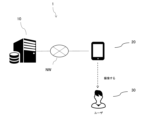
- FIG. 1 is a diagram showing an example of the overall configuration of an information processing system according to this embodiment.
- a server device 10 and a user terminal 20 are communicably connected to each other via a communication network NW.
- the communication network NW is, for example, the Internet or a LAN (Local Area Network), and is constructed by a public telephone line network, a dedicated telephone line network, a mobile phone line network, Ethernet (registered trademark), a wireless communication channel, and the like.
- the server device 10 is a computer that manages the entire information processing system, and is a computer that detects tardive dyskinesia-like symptoms of users.
- the server device 10 is, for example, a workstation, a personal computer, a virtual computer that is logically realized by cloud computing, or the like.
- the server device 10 receives image information of an image captured by an imaging unit provided in the user terminal 20, analyzes the received image information, and estimates a tardive dyskinesia-like symptom.
- the user terminal 20 is a device equipped with an imaging unit, and includes smartphones, personal computers, tablet terminals, and the like. It should be noted that the user terminal 20 can have an application program installed thereon, can execute all or part of the functions executed by the server device 10 by means of the computing device of the user terminal 20, and can also be provided in the server device 10. All or part of the information stored in the storage device 103 can also be stored in a storage unit built into the user terminal 20 .
- FIG. 2 is a diagram showing a hardware configuration example of a computer that implements the server device 10 in this embodiment.
- the server device 10 includes an arithmetic device 101 , a memory 102 , a storage device 103 , a communication interface 104 , an input device 105 and an output device 106 . These are electrically connected to each other through a bus (not shown). Note that, as described above, all or part of the functions executed by the storage device 103 and other devices and the arithmetic device 101 included in the server device 10 are provided in another device such as the user terminal 20, or executed. can be made
- the computing device 101 controls the overall operation of the server device 10, controls transmission and reception of data between elements, executes applications, and performs information processing necessary for authentication processing.
- the arithmetic unit 101 is, for example, a processor such as a CPU (Central Processing Unit) or a GPU (Graphics Processing Unit), and executes each information processing by executing a program stored in the storage device 103 and developed in the memory 102. .
- the memory 102 includes a main memory composed of a volatile memory device such as a DRAM (Dynamic Random Access Memory), and an auxiliary memory composed of a non-volatile memory device such as a flash memory or a HDD (Hard Disc Drive). .
- the memory 102 is used as a work area or the like for the arithmetic device 101 . It also stores the BIOS (Basic Input/Output System) executed when the server device 10 is started, various setting information, and the like.
- BIOS Basic Input/Output System
- the storage device 103 stores various data and various programs such as application programs.
- various data and various programs such as application programs.
- application programs for example, hard disk drives, solid state drives, flash memories, and the like.
- the communication interface 104 is an interface for connecting the server device 10 to the communication network NW.
- wireless communication device USB (Universal Serial Bus) connector and RS132C connector for serial communication. Connect to your network.
- USB Universal Serial Bus
- the input device 105 is, for example, a keyboard, mouse, touch panel, button, microphone, camera (imaging unit), etc. for inputting data.
- the output device 106 is, for example, a display, printer, speaker, etc. that outputs data.
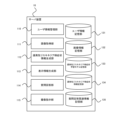
- FIG. 3 is a diagram showing a software configuration example of the server device 10 in this embodiment.
- the server device 10 includes functional units such as a user information management unit 110, an image acquisition unit 111, a tardive dyskinesia-like symptom information generation unit 112, a user information storage unit 131, and an image information storage unit 132. , a tardive dyskinesia-like symptom learning model storage unit 133 and a tardive dyskinesia-like symptom information storage unit 134 .
- each of the functional units described above is realized by reading out a program stored in the storage device 103 into the memory 102 and executing it by the arithmetic unit 101 provided in the server device 10, and each storage unit provided in the server device 10. It is implemented as part of the storage area provided by memory 102 and storage device 103 .
- the user information storage unit 131 stores information about the user 30.
- FIG. 4 is a diagram showing a configuration example of the user information storage unit 131.
- the user information stored in the user information storage unit 131 includes basic information (personal information such as name, address, gender, age, etc.), height, This includes physical information such as body weight, medical history and progression related to tardive dyskinesia-like symptoms.
- the image information storage unit 132 stores face image information of images captured by the imaging unit of the user terminal 20 .
- FIG. 5 is a diagram showing a configuration example of the image information storage unit 132. As shown in FIG. As shown in the figure, the image information storage unit 132 stores face image information, and the face image information is associated with an image ID and a user ID that identifies the user who took the image.
- the image information is data for displaying a face image captured by the imaging unit.
- the facial image information can be data in any format such as JPG, GIF, MP4, MPEG2, AVI, MOV, and the like.
- the facial image information is not limited to the information of the image itself, but is obtained from the facial image and includes each part (for example, mouth, tongue, chin, eyebrows, glabella, nose, ears, etc.) that constitutes the user's facial expression.
- shape information, motion information, and information related to virtual markers attached to the facial image as one or more marks along the shape of each part along with these information.
- shape information and motion information of each part that constitutes the user's facial expression may be obtained by using a known face image analysis technique, but for example, a known facial organ point detection technique may be used, and an Active Shape Model ( ASM) or Active Appearance Model (AAM) may also be used.
- ASM Active Shape Model
- AAM Active Appearance Model
- the shape and movement of each part of the user's face may be calculated (including estimated) based on the organ point information of the facial part.
- the generation of shape information and motion information of each part that constitutes the user's facial expression may be performed by a face image analysis unit (not shown) in this system, or may be performed by a face image analysis unit (unshown) in an external system. ) for execution, and may be returned to the system (eg, the image information storage unit 132).
- the face other than the user's own face (the face of another person other than the user, or the face of an avatar based on an illustration or a three-dimensional model, which is the face of this system or an external system a face automatically set by an external system, or a face selected by the user from a face image presented to the user terminal 20 by this system or an external system; good too.
- a converted face image generation unit may be provided as a functional unit of the arithmetic unit 101 when generating a converted face image inside this system.
- the generated face image by displaying the converted face image when the display image is generated in the display information generation unit, it is possible to reduce the reluctance of the user to check the symptoms by himself/herself. Become. Further, as will be described later, the converted face image may be displayed even when the face image is captured, or the converted face image may be used to determine tardive dyskinesia-like symptoms.
- the tardive dyskinesia-like symptom learning model storage unit 133 stores at least tardive dyskinesia sufferers (tardive dyskinesia It stores a learning model trained with facial images including facial expressions at the time of manifestation of involuntary movements of patients with similar symptoms).
- the learning model is a typical example of involuntary movements of tardive dyskinesia symptoms (including tardive dyskinesia-like symptoms), such as “pursing the mouth (lips) (especially repeatedly pursing)" and “Move your mouth (lips)", “Push out your mouth (lips) or tongue”, “Move your tongue left and right or irregularly”, “Lick your tongue”, “Browse or (especially while closing your eyes) Facial images representing characteristic facial expressions such as wrinkling the nose, clenching teeth, moving the jaw back and forth, and rotating the jaw. Based on this, we learn about facial images of patients with tardive dyskinesia symptoms.
- tardive dyskinesia symptoms including tardive dyskinesia-like symptoms
- Facial images representing characteristic facial expressions such as wrinkling the nose, clenching teeth, moving the jaw back and forth, and rotating the jaw.
- the learning model is not limited to facial images including facial expressions when involuntary movements of patients with tardive dyskinesia occur.
- facial images of patients with dyskinesia especially facial images during speech, normal facial images, facial images when symptoms are mimicked by non-tardive dyskinesia patients, etc.
- tardive dyskinesia-like symptoms (including tardive dyskinesia symptoms diagnosed as tardive dyskinesia) may be estimated, or the accuracy of the estimation may be improved.
- the learning model may be learned using shape information and movement information of each part constituting the user's facial expression, and information on the virtual marker. .
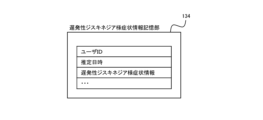
- the tardive dyskinesia-like symptom information storage unit 134 stores information indicating the tardive dyskinesia-like symptoms of the user 30 (including tardive dyskinesia symptoms diagnosed as tardive dyskinesia) (hereinafter referred to as “tardive dyskinesia-like symptoms”). (referred to as “symptom information”).
- FIG. 6 is a diagram showing a configuration example of the tardive dyskinesia-like symptom information storage unit 134. As shown in FIG. As shown in the figure, the tardive dyskinesia-like symptom information includes the estimated date and time when the tardive dyskinesia-like symptom was estimated and tardive dyskinesia-like symptom information corresponding to the user ID of each user.
- each estimation result information corresponding to a plurality of dates and times is stored in correspondence with the user ID, and the transition of the user's tardive dyskinesia-like symptoms is confirmed by referring to the user's past estimation result contents. be able to.
- the user information management unit 110 When estimating the tardive dyskinesia-like symptoms of the user, the user information management unit 110 responds to an input operation by the user or the user's assistant via the input unit (not shown) of the user terminal 20, or by a doctor etc. In response to an observer's input operation via an input unit of an observer terminal (not shown) possessed by the tardive dyskinesia-like symptom observer, input of information about the user is received and stored in the user information storage unit 131 .
- the image acquisition unit 111 acquires image information including the user's face image captured by the imaging unit of the user terminal 20 when estimating the user's tardive dyskinesia-like symptoms.
- the tardive dyskinesia-like symptom information generation unit 112 uses the learning model stored in the tardive dyskinesia-like symptom learning model storage unit 133 to obtain facial image information (or converted facial image information ), the tardive dyskinesia-like symptom is estimated based on the feature information about the parts constituting the facial expression of the user, and the tardive dyskinesia-like symptom information about the user is generated.
- the converted face image is included in the teacher face image used when learning the tardive dyskinesia-like symptom learning model.
- It may be a face image of a person having at least some of the same attributes (age, generation (twenties, thirties, etc.), sex, face shape, place of birth, etc.) as those of the person to whom the image is to be applied.
- the face image information or converted face image information
- the virtual marker face image information displayed with the above-described virtual markers superimposed may be used.
- the tardive dyskinesia-like symptom information is, for example, one or more specific faces related to tardive dyskinesia-like symptoms that are presumed to include facial expressions of tardive dyskinesia-like symptoms in the face image information of the user.
- Image information may be included, for example, it may be specific face image information whose target image ID is stored and specified in the tardive dyskinesia-like symptom information storage unit 134, particularly face images within a predetermined period.
- the information (a plurality of still image information or moving image information) may be specific face image information in which target time information and frame IDs are stored and specified in the tardive dyskinesia-like symptom information storage unit 134.
- the tardive dyskinesia-like symptom information generation unit 112 generates tardive dyskinesia-like symptom information by adding identification information indicating the onset of the tardive dyskinesia-like symptom in association with the image ID or the like of the target face image information.
- the specific facial image information stored and specified in the storage unit 134 may be generated as the tardive dyskinesia-like symptom information.
- the tardive dyskinesia-like symptom information for example, the degree of tardive dyskinesia-like symptoms, such as a five-grade score from 0 to 4 (e.g., evaluated by a score of 0, 1, 2, 3, 4) It may also include rating information to indicate.
- the tardive dyskinesia-like symptom information may include, for example, basis information for estimating tardive dyskinesia-like symptoms. It may include image information that visualizes the grounds for estimation by attaching a heat map or the like, or may include text information that describes which part of the parts that make up the user's facial expression is based on good.
- the tardive dyskinesia-like symptom information storage unit 134 for example, an observer terminal possessed by a tardive dyskinesia-like symptom observer such as a doctor can transmit the information to the server device 10. It is possible for a tardive dyskinesia-like symptom observer to access and refer to it as reference information for grasping the state of the user's tardive dyskinesia-like symptom.
- the tardive symptoms displayed on the display unit of the user terminal 20 by accessing the server device 10 from the user terminal 20 may confirm the dyskinesia-like symptom information, or transmit the information from the user terminal 20 to the observer terminal to confirm the tardive dyskinesia-like symptom information.
- the display information generation unit 113 generates display information (including display images) for performing predetermined display on the display unit of the user terminal 20 .
- display information including display images
- part or all of the functions of the display information generation unit 113 may be replaced by the arithmetic processing unit of the user terminal 20.
- You may prepare for
- the display information generating unit 113 may have a function of displaying the specific facial image information so as to be distinguishable from other facial image information. When specific facial image information is specified based on information, etc., and the specific facial image information and other facial image information are displayed together, for example, the specific image information is emphasized in comparison with other facial image information.
- the specific face image is surrounded by a color frame, given a predetermined mark, or enlarged
- only the specific face image information is displayed.
- An area and a display area where other face image information is displayed may be displayed separately.
- the display information generation unit 113 may have a function of extracting and displaying only the specific face image information.
- the specific face image information and other face image information may be converted face image information that has been converted into another face.
- the question answering unit 114 transmits question information stored in the question/answer related information storage unit 135 to the user terminal 20, receives answer information to the question information from the user terminal 20, and assigns the answer information to the user ID. For example, the information is linked and stored in the question/answer related information storage unit 135 .
- the question answering section 114 includes a question information transmitting section 210 , an answer information receiving section 211 and an answer information transmitting section 212 .
- the question information transmission unit 210 transmits question information stored in the question/answer related information storage unit 135 to the user terminal 20 .
- the question information may be a question of any content, for example, a question related to user information that needs to be input, or question information about the user's tardive dyskinesia-like symptoms (for example, Questions to confirm the situation, questions to confirm the degree of awareness of symptoms, questions about medication status, etc.), and are not limited to these.
- the answer information receiving unit 211 receives answer information from the user terminal 20, associates the answer information with the user ID, and stores it in the question-and-answer related information storage unit 135. Receipt of the answer information may be in any form, but may be performed, for example, through user input to an answer input section (for example, an input form, selection tab, pull-down, etc.) presented together with the question information.
- an answer input section for example, an input form, selection tab, pull-down, etc.
- the answer information transmission unit 212 transmits answer information from the user terminal 20 (for example, answer information read from the question-and-answer related information storage unit 135) to the outside of the information processing apparatus.
- the outside of the information processing apparatus may be, for example, an observer terminal or a user terminal 20 possessed by an observer of tardive dyskinesia-like symptoms such as a doctor. You may make it transmit reply information.
- a tardive dyskinesia-like symptom observer such as a doctor can use the tardive dyskinesia-like symptom information generated by the tardive dyskinesia-like symptom information generation unit 112 (in particular, Since it is possible to refer to the answer information of the user in addition to referencing the face image information), it is possible to make a more appropriate judgment.
- the tardive dyskinesia-like symptom information generation unit 112 uses the learning model stored in the tardive dyskinesia-like symptom learning model storage unit 133 to obtain the user's facial expression.
- the response information received by the response information receiving unit 211 is further referred to. The accuracy of estimating dyskinesia-like symptoms may be improved.
- the question information may be question information about the user's tardive dyskinesia-like symptoms (for example, questions to check the state of symptoms, questions to check the degree of awareness of symptoms, questions about medication status, etc.). , further comprising a learning model learned about the criteria for judging known tardive dyskinesia symptoms, or based on the content of answers to the criteria for judging known tardive dyskinesia symptoms, tardive dyskinesia-like symptoms It is also possible to change the weighting when selecting as the specific face image information related to.
- the imaging instruction unit 115 instructs the timing to start imaging the user's face image when the imaging unit provided in the user terminal 20 is activated.
- the imaging instruction unit 115 preferably has a configuration that instructs the imaging unit to image face image information during a display period of display information not particularly related to imaging. Regarding this, when the user attempts to capture a facial image, the user concentrates on his/her own facial expression, and involuntary movements, which are tardive dyskinesia-like symptoms, are less likely to occur. The applicant has discovered the problem that dyskinesia-like symptoms are difficult to appear in some cases.
- the face image information is imaged during the display period of the display information unrelated to the imaging, thereby making it easier for the involuntary movement to occur without the user being conscious of the imaging.
- the display period of display information that is not related to imaging may include, for example, the above-described question information presentation period or answer information input period.
- ⁇ information on typical symptoms of tardive dyskinesia e.g., information on typical symptoms of tardive dyskinesia, information on treatment methods for tardive dyskinesia, information on therapeutic drugs, etc.
- at least text information It may include a period of time during which information not related to tardive dyskinesia symptoms (e.g., information about current news, information contained in any web page selected by the user, etc.) may be included, or a user-operable game.
- Display information not related to imaging may be configured to be selectable by the user, may be set in advance as user information, or may be stored as setting information in an application on the user terminal 20. .
- FIG. 8 is a diagram showing the flow of processing executed in the information processing system of this embodiment.
- the user information management unit 110 of the server device 10 receives information input regarding the user and stores the user information in the user information storage unit 131 .
- step S101 the image acquisition unit 111 acquires the user's face image information by, for example, reading image information including the user's face image captured by the imaging unit of the user terminal 20 from the image information storage unit 132. do.
- step S102 the tardive dyskinesia-like symptom information generation unit 112 uses the learning model stored in the tardive dyskinesia-like symptom learning model storage unit 133 to generate a facial image containing the acquired facial expression of the user.
- a tardive dyskinesia-like symptom is estimated from the information based on feature information related to facial expressions of the user, and tardive dyskinesia-like symptom information about the user is generated.
Landscapes
- Health & Medical Sciences (AREA)
- Engineering & Computer Science (AREA)
- Life Sciences & Earth Sciences (AREA)
- Medical Informatics (AREA)
- Surgery (AREA)
- General Physics & Mathematics (AREA)
- Pathology (AREA)
- Physics & Mathematics (AREA)
- Biomedical Technology (AREA)
- Heart & Thoracic Surgery (AREA)
- Computer Vision & Pattern Recognition (AREA)
- Molecular Biology (AREA)
- Theoretical Computer Science (AREA)
- Animal Behavior & Ethology (AREA)
- General Health & Medical Sciences (AREA)
- Public Health (AREA)
- Veterinary Medicine (AREA)
- Image Analysis (AREA)
- Medical Treatment And Welfare Office Work (AREA)
- Image Processing (AREA)
- Processing Or Creating Images (AREA)
Priority Applications (2)
| Application Number | Priority Date | Filing Date | Title |
|---|---|---|---|
| JP2023545337A JP7355969B1 (ja) | 2021-12-13 | 2022-12-01 | 情報処理システム、情報処理方法、プログラム |
| JP2023154046A JP2023169331A (ja) | 2021-12-13 | 2023-09-21 | 情報処理システム、情報処理方法、プログラム |
Applications Claiming Priority (2)
| Application Number | Priority Date | Filing Date | Title |
|---|---|---|---|
| JP2021201562 | 2021-12-13 | ||
| JP2021-201562 | 2021-12-13 |
Publications (1)
| Publication Number | Publication Date |
|---|---|
| WO2023112706A1 true WO2023112706A1 (ja) | 2023-06-22 |
Family
ID=86774274
Family Applications (1)
| Application Number | Title | Priority Date | Filing Date |
|---|---|---|---|
| PCT/JP2022/044438 Ceased WO2023112706A1 (ja) | 2021-12-13 | 2022-12-01 | 情報処理システム、情報処理方法、プログラム |
Country Status (3)
| Country | Link |
|---|---|
| JP (2) | JP7355969B1 (https=) |
| TW (1) | TW202339677A (https=) |
| WO (1) | WO2023112706A1 (https=) |
Cited By (1)
| Publication number | Priority date | Publication date | Assignee | Title |
|---|---|---|---|---|
| JP2025067257A (ja) * | 2023-10-12 | 2025-04-24 | 株式会社Ridge-i | 情報処理装置、画像評価方法及び画像評価プログラム、教師データ生成装置、教師データ生成方法、教師データ生成プログラム |
-
2022
- 2022-12-01 WO PCT/JP2022/044438 patent/WO2023112706A1/ja not_active Ceased
- 2022-12-01 JP JP2023545337A patent/JP7355969B1/ja active Active
- 2022-12-12 TW TW111147602A patent/TW202339677A/zh unknown
-
2023
- 2023-09-21 JP JP2023154046A patent/JP2023169331A/ja active Pending
Non-Patent Citations (1)
| Title |
|---|
| 1 January 2015 (2015-01-01), ITO, SHUJI; MIYAGAWA, HIDEKAZU; SUGAHARA, MICHIHIRO; NAKANE, HIDEYUKI; GOTO, SATORU: "Development of Face Expression Measurement System by the Non-invasive Measurement Method Using Video Processing —Application to Tardive Dyskinesia Evaluation—", XP009546833 * |
Cited By (1)
| Publication number | Priority date | Publication date | Assignee | Title |
|---|---|---|---|---|
| JP2025067257A (ja) * | 2023-10-12 | 2025-04-24 | 株式会社Ridge-i | 情報処理装置、画像評価方法及び画像評価プログラム、教師データ生成装置、教師データ生成方法、教師データ生成プログラム |
Also Published As
| Publication number | Publication date |
|---|---|
| JPWO2023112706A1 (https=) | 2023-06-22 |
| JP7355969B1 (ja) | 2023-10-03 |
| TW202339677A (zh) | 2023-10-16 |
| JP2023169331A (ja) | 2023-11-29 |
Similar Documents
| Publication | Publication Date | Title |
|---|---|---|
| KR102423849B1 (ko) | 가상현실을 이용한 진료 및 임상술기 시뮬레이션 제공 시스템 | |
| Tentori et al. | Designing for interaction immediacy to enhance social skills of children with autism | |
| Tulsulkar et al. | Can a humanoid social robot stimulate the interactivity of cognitively impaired elderly? A thorough study based on computer vision methods | |
| US11806162B2 (en) | Methods and systems for the use of 3D human movement data | |
| KR102326694B1 (ko) | 인터렉티브 기술을 적용한 치매 환자 훈련 시스템 | |
| CN110868930B (zh) | 信息处理系统 | |
| Buimer et al. | Conveying facial expressions to blind and visually impaired persons through a wearable vibrotactile device | |
| US20200184843A1 (en) | Information processing apparatus, information processing method, and computer program | |
| CN104737209A (zh) | 信息处理装置、系统、信息处理方法和程序 | |
| WO2021261188A1 (ja) | アバター生成方法、プログラム、アバター生成システム、及びアバター表示方法 | |
| WO2019087502A1 (ja) | 情報処理装置、情報処理方法およびプログラム | |
| JP2019160033A (ja) | 表示制御装置およびプログラム | |
| CN116392123A (zh) | 一种基于游戏交互和眼动追踪的多动症筛查方法及系统 | |
| JP7355969B1 (ja) | 情報処理システム、情報処理方法、プログラム | |
| Castillo et al. | The semantic space for motion‐captured facial expressions | |
| EP4189594A1 (en) | Methods and systems for communication and interaction using 3d human movement data | |
| US20260011079A1 (en) | Information processing device for displaying avatar of user in virtual space, information processing method, and non-transitory computer readable medium | |
| KR102735915B1 (ko) | 메타버스에 기반한 해양 체험 시스템 및 이를 이용한 방법 | |
| TWI900246B (zh) | 多感官人機互動系統及多感官人機互動方法 | |
| US20250359816A1 (en) | Virtual remote tele-physical examination systems | |
| JP2010097240A (ja) | 対話型絵本原稿作成支援機器と、その制御方法、及びそのためのプログラム | |
| JP2025087450A (ja) | 情報処理装置、情報処理方法、及びコンピュータプログラム | |
| JP2026033106A (ja) | システム | |
| JP2025053982A (ja) | サーバ装置、アバター移動方法及びアバター移動プログラム | |
| JP2026016175A (ja) | システム |
Legal Events
| Date | Code | Title | Description |
|---|---|---|---|
| WWE | Wipo information: entry into national phase |
Ref document number: 2023545337 Country of ref document: JP |
|
| 121 | Ep: the epo has been informed by wipo that ep was designated in this application |
Ref document number: 22907234 Country of ref document: EP Kind code of ref document: A1 |
|
| NENP | Non-entry into the national phase |
Ref country code: DE |
|
| 122 | Ep: pct application non-entry in european phase |
Ref document number: 22907234 Country of ref document: EP Kind code of ref document: A1 |