WO2023106325A1 - β-アラニン吸収抑制剤 - Google Patents
β-アラニン吸収抑制剤 Download PDFInfo
- Publication number
- WO2023106325A1 WO2023106325A1 PCT/JP2022/045056 JP2022045056W WO2023106325A1 WO 2023106325 A1 WO2023106325 A1 WO 2023106325A1 JP 2022045056 W JP2022045056 W JP 2022045056W WO 2023106325 A1 WO2023106325 A1 WO 2023106325A1
- Authority
- WO
- WIPO (PCT)
- Prior art keywords
- alanine
- absorption inhibitor
- absorption
- present
- caco
- Prior art date
- Legal status (The legal status is an assumption and is not a legal conclusion. Google has not performed a legal analysis and makes no representation as to the accuracy of the status listed.)
- Ceased
Links
Images


Classifications
-
- A—HUMAN NECESSITIES
- A61—MEDICAL OR VETERINARY SCIENCE; HYGIENE
- A61K—PREPARATIONS FOR MEDICAL, DENTAL OR TOILETRY PURPOSES
- A61K31/00—Medicinal preparations containing organic active ingredients
- A61K31/185—Acids; Anhydrides, halides or salts thereof, e.g. sulfur acids, imidic, hydrazonic or hydroximic acids
-
- A—HUMAN NECESSITIES
- A61—MEDICAL OR VETERINARY SCIENCE; HYGIENE
- A61K—PREPARATIONS FOR MEDICAL, DENTAL OR TOILETRY PURPOSES
- A61K31/00—Medicinal preparations containing organic active ingredients
- A61K31/185—Acids; Anhydrides, halides or salts thereof, e.g. sulfur acids, imidic, hydrazonic or hydroximic acids
- A61K31/19—Carboxylic acids, e.g. valproic acid
- A61K31/195—Carboxylic acids, e.g. valproic acid having an amino group
- A61K31/197—Carboxylic acids, e.g. valproic acid having an amino group the amino and the carboxyl groups being attached to the same acyclic carbon chain, e.g. gamma-aminobutyric acid [GABA], beta-alanine, epsilon-aminocaproic acid or pantothenic acid
-
- A—HUMAN NECESSITIES
- A61—MEDICAL OR VETERINARY SCIENCE; HYGIENE
- A61K—PREPARATIONS FOR MEDICAL, DENTAL OR TOILETRY PURPOSES
- A61K31/00—Medicinal preparations containing organic active ingredients
- A61K31/185—Acids; Anhydrides, halides or salts thereof, e.g. sulfur acids, imidic, hydrazonic or hydroximic acids
- A61K31/19—Carboxylic acids, e.g. valproic acid
- A61K31/195—Carboxylic acids, e.g. valproic acid having an amino group
- A61K31/197—Carboxylic acids, e.g. valproic acid having an amino group the amino and the carboxyl groups being attached to the same acyclic carbon chain, e.g. gamma-aminobutyric acid [GABA], beta-alanine, epsilon-aminocaproic acid or pantothenic acid
- A61K31/198—Alpha-amino acids, e.g. alanine or edetic acid [EDTA]
-
- A—HUMAN NECESSITIES
- A61—MEDICAL OR VETERINARY SCIENCE; HYGIENE
- A61K—PREPARATIONS FOR MEDICAL, DENTAL OR TOILETRY PURPOSES
- A61K31/00—Medicinal preparations containing organic active ingredients
- A61K31/66—Phosphorus compounds
- A61K31/661—Phosphorus acids or esters thereof not having P—C bonds, e.g. fosfosal, dichlorvos, malathion or mevinphos
-
- A—HUMAN NECESSITIES
- A61—MEDICAL OR VETERINARY SCIENCE; HYGIENE
- A61P—SPECIFIC THERAPEUTIC ACTIVITY OF CHEMICAL COMPOUNDS OR MEDICINAL PREPARATIONS
- A61P43/00—Drugs for specific purposes, not provided for in groups A61P1/00-A61P41/00
Definitions
- the present invention relates to a ⁇ -alanine absorption inhibitor. According to the present invention, absorption of ⁇ -alanine from the intestinal tract can be suppressed.
- ⁇ -alanine is one of ⁇ -amino acids, exists as a free amino acid in vivo, and carnosine or anserine is biosynthesized from ⁇ -alanine.
- Carnosine is present in muscles, and it has been reported that intake of ⁇ -alanine increases carnosine, enhances muscle endurance, and suppresses fatigue.
- ⁇ -alanine activates mitochondrial functions (Patent Document 1).
- Patent Document 1 it is known that excessive ingestion of ⁇ -alanine causes a phenomenon called ⁇ -alanine flash, in which the skin becomes tingling.
- ⁇ -alanine is absorbed from the intestinal tract, and it is believed that moderating intestinal absorption suppresses ⁇ -alanine flush. Accordingly, it is an object of the present invention to provide means for inhibiting intestinal absorption of ⁇ -alanine.
- the present invention provides [1] a ⁇ -alanine absorption inhibitor containing, as an active ingredient, a compound selected from the group consisting of ⁇ -aminobutyric acid, taurine, glycine, lysophosphatidylcholine, and ⁇ -glycerophosphocholine, or a salt thereof; and [2] A method for inhibiting ⁇ -alanine absorption, which comprises the step of administering the ⁇ -alanine absorption inhibitor according to [1] to a subject (excluding medical practice on humans); Regarding.
- a ⁇ -amino acid absorption inhibitor containing sesame or its extract as an active ingredient has been reported (Patent Document 2). It is completely different from sesame, which is the active ingredient of the drug.
- the ⁇ -alanine absorption inhibitor of the present invention can suppress absorption of ⁇ -alanine from the intestinal tract.
- FIG. 4 is a diagram schematically showing the Caco-2 cell permeation test.
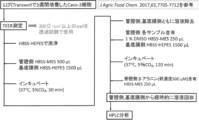
- FIG. 2 shows the protocol for the Caco-2 cell permeation test of ⁇ -alanine.
- Graph showing inhibition of ⁇ -alanine permeation through Caco-2 cell layer when glycine (Example 1), taurine (Example 2), or ⁇ -aminobutyric acid (Example 3) is used as an active ingredient is.
- glycine Example 1
- taurine Example 2
- ⁇ -aminobutyric acid Example 3
- ⁇ -aminobutyric acid Example 3
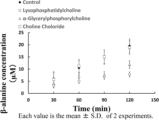
- lysophosphatidylcholine Example 4
- ⁇ -glycerophosphocholine Example 5
- choline chloride Comparative Example 1
- the ⁇ -alanine absorption inhibitor of the present invention contains, as an active ingredient, a compound selected from the group consisting of ⁇ -aminobutyric acid, taurine, glycine, lysophosphatidylcholine, and ⁇ -glycerophosphocholine, or salts thereof.
- the salt of the compound is not limited as long as it is a salt with an inorganic base, an organic base, etc., or a salt with an acid, and is acceptable as a medicine or food.
- Specific salts with inorganic bases or organic bases include salts with inorganic bases, organic bases, or metal alkoxides. It can be produced by mixing the compound with an inorganic base, an organic base, or a metal alkoxide.
- Inorganic bases capable of forming salts include hydroxides, carbonates, hydrogen carbonates, acetates or hydrides of alkali metals (e.g. lithium, sodium or potassium); alkaline earth metals (e.g. magnesium , calcium, or barium) hydroxides or hydrides.
- Organic bases capable of forming salts include dimethylamine, triethylamine, piperazine, pyrrolidine, piperidine, 2-phenylethylamine, benzylamine, ethanolamine, diethanolamine, pyridine, collidine, and the like.
- metal alkoxides include sodium methoxide, potassium tert-butoxide, magnesium methoxide, and the like.
- Preferred salts of ⁇ -alanine are sodium salts, potassium salts, calcium salts, or combinations thereof.
- specific salts with acids include salts with inorganic acids or organic acids.
- Inorganic acids capable of forming salts include hydrochloric acid.
- ⁇ -alanine is a naturally occurring ⁇ -amino acid, also called 3-aminopropanoic acid.
- ⁇ -alanine is contained in chicken and fish, but it can also be synthesized.
- it can be synthesized by the ⁇ -alanine synthesis method from ⁇ -propiolactone (Ford, Org. Sys. Coll. Vol. 3, 34 (1955)).
- it can be synthesized from acrylonitrile and ammonia.
- the ⁇ -alanine absorption inhibitor of the present invention is not limited, but preferably contains ⁇ -alanine.
- the compound contained in the ⁇ -alanine absorption inhibitor moderates absorption of ⁇ -alanine from the intestinal tract and suppresses ⁇ -alanine flash. Therefore, the ⁇ -alanine absorption inhibitor preferably contains the above compound and ⁇ -alanine.
- the content ratio of the compound and ⁇ -alanine is not limited, but is, for example, 1:100 to 100:1, preferably 10:100 to 100:10, more preferably 30:100 to 100. :30, more preferably 50:100 to 100:50.
- the upper and lower limits can be arbitrarily combined to specify the range, for example, 10:100 to 100:30. Within the above range, absorption of ⁇ -alanine from the intestinal tract can be efficiently suppressed.
- the dosage form of the ⁇ -alanine absorption inhibitor of the present invention is not particularly limited, and examples include powders, fine granules, granules, tablets, capsules, suspensions, emulsions, syrups, extracts, Alternatively, oral agents such as pills can be used. Oral agents include gelatin, sodium alginate, starch, cornstarch, sucrose, lactose, glucose, mannitol, carboxymethylcellulose, dextrin, polyvinylpyrrolidone, crystalline cellulose, soybean lecithin, sucrose, fatty acid esters, talc, and magnesium stearate.
- polyethylene glycol polyethylene glycol
- magnesium silicate anhydrous silicic acid
- synthetic aluminum silicate excipients binders, disintegrants, surfactants, lubricants, fluidity enhancers, diluents, preservatives, coloring agents , flavoring agents, flavoring agents, stabilizers, moisturizing agents, preservatives, antioxidants, etc., and can be produced according to a conventional method.
- the dosage when using a ⁇ -alanine absorption inhibitor can be appropriately determined according to, for example, the type of active ingredient used, the subject's age, sex, and body weight, or the administration method.
- the dose for adults is preferably 0.01 to 100 mg/kg of the compound per day.
- the above administration method is an example, and other administration methods may be used.
- the administration method, dosage, administration period, administration interval, etc. of the ⁇ -alanine absorption inhibitor to humans are desirably determined based on the results of controlled experiments.
- the mode of administration is not particularly limited, either, and various forms such as functional foods, health foods (including beverages), or foods and drinks as feeds are possible.
- a ⁇ -alanine absorption inhibitor containing the above compound can be produced using a known production method, except that the above compound is included as an active ingredient.
- the ⁇ -alanine absorption inhibitor of the present invention can contain other ingredients.
- the other components include edible oils and fats, water, glycerin fatty acid ester, sucrose fatty acid ester, sorbitan fatty acid ester, propylene glycol fatty acid ester, glycerin organic acid fatty acid ester, polyglycerin fatty acid ester, calcium stearoyl lactylate, sodium stearoyl lactylate, Emulsifiers such as polyoxyethylene sorbitan fatty acid esters, thickening stabilizers such as locust bean gum, carrageenan, alginic acids, pectin, xanthan gum, crystalline cellulose, carboxymethyl cellulose, methyl cellulose, agar, glucomannan, gelatin, starch, or modified starch, salt or potassium chloride, acidulants such as acetic acid, lactic acid, or gluconic acid; sugars or sugar alcohols; sweeteners such as stevia
- the total content of these other components in the ⁇ -alanine absorption inhibitor of the present invention is preferably 80% by mass or less, more preferably 40% by mass or less, and even more preferably 20% by mass or less.
- the ⁇ -alanine absorption inhibitor of the present invention can be administered to humans, but the subject of administration may be animals other than humans, such as pets such as dogs, cats, rabbits, hamsters, guinea pigs, and squirrels. livestock such as cows, horses and pigs; experimental animals such as mice and rats; and animals raised in zoos and the like.
- the ⁇ -alanine absorption inhibitory method of the present invention comprises the step of administering the ⁇ -alanine absorption inhibitor to a subject.
- the ⁇ -alanine absorption inhibitor those described in the section “ ⁇ -alanine absorption inhibitor>>” can be used without limitation.
- the ⁇ -alanine absorption inhibitor is administered before, at the same time as or after the intake of ⁇ -alanine, preferably at the same time.
- ⁇ -alanine and the compound may be administered as one agent or as separate agents.
- the dosage ratio of the compound and ⁇ -alanine is not limited, but is, for example, 1:100 to 100:1, preferably 10:100 to 100:10, more preferably 30:100 to 100. :30, more preferably 50:100 to 100:50.
- the upper and lower limits can be arbitrarily combined to specify the range, for example, 10:100 to 100:30. Within the above range, absorption of ⁇ -alanine from the intestinal tract can be efficiently suppressed.
- Caco-2 cell permeation test Inhibition of ⁇ -alanine absorption by intestinal cells can be evaluated using the Caco-2 cell permeation assay.
- Caco-2 cells are a cell line derived from human colon cancer, and when cultured, exhibit morphological characteristics of brush borders and tight junctions similar to columnar epithelial cells of the small intestine, and form a monolayered cell layer.
- FIG. 1 Caco-2 cells were cultured on a transmembrane, candidate drugs and ⁇ -alanine were added to the luminal side corresponding to the intestinal tract, and the solution on the basement membrane side corresponding to the blood vessel side was added over time. The amount of ⁇ -alanine permeated per hour is measured by sampling at . If the amount of ⁇ -alanine permeation decreases compared to a control to which no candidate drug is added, it can be determined that the candidate drug has suppressed ⁇ -alanine absorption.
- choline has a similar structure to glycine, as shown in Comparative Examples. It also has a similar structure to lysophosphatidylcholine or ⁇ -glycerophosphocholine. However, choline was unable to inhibit the absorption of ⁇ -alanine. Therefore, in this field, it is considered important to search for compounds that actually suppress absorption of ⁇ -alanine through experiments.
- ⁇ Example 1>> a Caco-2 cell permeation test of ⁇ -alanine was performed using glycine. An outline of the experiment is shown in FIG. Caco-2 cells were cultured in DMEM medium in a 12-well Transwell. Caco-2 cells were washed with HBSS-HEPES, 500 ⁇ L of HBSS-MES was added to the luminal side, and 1500 ⁇ L of HBSS-HEPES was added to the basement membrane side. After 30 min incubation at 37° C., 5% CO 2 , HBSS-MES on the luminal side and HBSS-HEPES on the basement membrane side were aspirated off.
- Example 2>> In this example, a Caco-2 cell permeation test of ⁇ -alanine was performed using taurine. The procedure of Example 1 was repeated except that taurine was used in place of glycine. The results are shown in FIG.
- Example 3>> a Caco-2 cell permeation test of ⁇ -alanine was performed using ⁇ -aminobutyric acid. The procedure of Example 1 was repeated except that ⁇ -aminobutyric acid was used in place of glycine. The results are shown in FIG.
- Example 4 a Caco-2 cell permeation test of ⁇ -alanine was performed using lysophosphatidylcholine. The procedure of Example 1 was repeated except that lysophosphatidylcholine was used at 14 ⁇ g/mL in place of glycine. The results are shown in FIG.
- Example 5>> In this example, ⁇ -glycerophosphocholine was used to conduct a Caco-2 cell permeation test of ⁇ -alanine. The procedure of Example 1 was repeated except that ⁇ -glycerophosphocholine was used in place of glycine. The results are shown in FIG.
- ⁇ Comparative example 1>> In this example, a Caco-2 cell permeation test of ⁇ -alanine was performed using choline chloride. The procedure of Example 1 was repeated except that choline chloride was used in place of glycine. The results are shown in FIG.
- the ⁇ -alanine absorption inhibitor of the present invention can suppress absorption of ⁇ -alanine from the intestinal tract and suppress ⁇ -alanine flush.
Landscapes
- Health & Medical Sciences (AREA)
- Veterinary Medicine (AREA)
- Chemical & Material Sciences (AREA)
- Medicinal Chemistry (AREA)
- Pharmacology & Pharmacy (AREA)
- Life Sciences & Earth Sciences (AREA)
- Animal Behavior & Ethology (AREA)
- General Health & Medical Sciences (AREA)
- Public Health (AREA)
- Epidemiology (AREA)
- Engineering & Computer Science (AREA)
- Bioinformatics & Cheminformatics (AREA)
- Chemical Kinetics & Catalysis (AREA)
- General Chemical & Material Sciences (AREA)
- Nuclear Medicine, Radiotherapy & Molecular Imaging (AREA)
- Organic Chemistry (AREA)
- Acyclic And Carbocyclic Compounds In Medicinal Compositions (AREA)
Abstract
本発明の目的は、β-アラニンの腸管吸収を抑制する手段を提供することである。 前記課題は、本発明のγ-アミノ酪酸、タウリン、グリシン、リゾホスファチジルコリン、及びα-グリセロホスホコリンからなる群から選択される化合物、又はこれらの塩を有効成分として含むβ-アラニン吸収抑制剤によって解決することができる。
Description
本発明は、β-アラニン吸収抑制剤に関する。本発明によれば、β-アラニンの腸管からの吸収を抑制することができる。
β-アラニンは、β-アミノ酸の1種であり、生体内では遊離アミノ酸として存在し、β-アラニンからカルノシン又はアンセリンが生合成される。カルノシンは、筋肉内に存在し、β-アラニンの摂取によってカルノシンが増加し、筋肉の持久力を高めたり、疲労を抑制することが報告されている。
また本発明者らは、β-アラニンがミトコンドリア機能活性することを見出した(特許文献1)。
しかしながら、β-アラニンを過剰に摂取すると、皮膚などがピリピリするβ-アラニンフラッシュと呼ばれる現象が起きることが知られている。β-アラニンは、腸管から吸収されるが、腸管吸収を穏やかにすることで、β-アラニンフラッシュが抑制されると考えられる。
従って、本発明の目的は、β-アラニンの腸管吸収を抑制する手段を提供することである。
しかしながら、β-アラニンを過剰に摂取すると、皮膚などがピリピリするβ-アラニンフラッシュと呼ばれる現象が起きることが知られている。β-アラニンは、腸管から吸収されるが、腸管吸収を穏やかにすることで、β-アラニンフラッシュが抑制されると考えられる。
従って、本発明の目的は、β-アラニンの腸管吸収を抑制する手段を提供することである。
本発明者は、β-アラニンの腸管吸収を抑制する手段について、鋭意研究した結果、驚くべきことに、いくつかの化合物により、β-アラニンの腸管吸収が抑制されることを見出した。
本発明は、こうした知見に基づくものである。
従って、本発明は、
[1]γ-アミノ酪酸、タウリン、グリシン、リゾホスファチジルコリン、及びα-グリセロホスホコリンからなる群から選択される化合物、又はこれらの塩を有効成分として含むβ-アラニン吸収抑制剤、及び
[2][1]に記載のβ-アラニン吸収抑制剤を、対象に投与する工程を含む、β-アラニン吸収抑制方法(但し、人への医療行為を除く)、
に関する。
なお、ゴマ又はその抽出物を有効成分とするβ-アミノ酸吸収抑制剤が報告されているが(特許文献2)、本発明のβ-アラニン吸収抑制剤の有効成分は、前記β-アミノ酸吸収抑制剤の有効成分であるゴマとは全く異なるものである。
本発明は、こうした知見に基づくものである。
従って、本発明は、
[1]γ-アミノ酪酸、タウリン、グリシン、リゾホスファチジルコリン、及びα-グリセロホスホコリンからなる群から選択される化合物、又はこれらの塩を有効成分として含むβ-アラニン吸収抑制剤、及び
[2][1]に記載のβ-アラニン吸収抑制剤を、対象に投与する工程を含む、β-アラニン吸収抑制方法(但し、人への医療行為を除く)、
に関する。
なお、ゴマ又はその抽出物を有効成分とするβ-アミノ酸吸収抑制剤が報告されているが(特許文献2)、本発明のβ-アラニン吸収抑制剤の有効成分は、前記β-アミノ酸吸収抑制剤の有効成分であるゴマとは全く異なるものである。
本発明のβ-アラニン吸収抑制剤によれば、腸管からのβ-アラニンの吸収を抑制することができる。
《β-アラニン吸収抑制剤》
本発明のβ-アラニン吸収抑制剤は、γ-アミノ酪酸、タウリン、グリシン、リゾホスファチジルコリン、及びα-グリセロホスホコリンからなる群から選択される化合物又はこれらの塩を有効成分として含む。
本発明のβ-アラニン吸収抑制剤は、γ-アミノ酪酸、タウリン、グリシン、リゾホスファチジルコリン、及びα-グリセロホスホコリンからなる群から選択される化合物又はこれらの塩を有効成分として含む。
前記化合物の塩としては、無機塩基又は有機塩基等との塩、あるいは酸との塩であって、医薬又は食品として許容される塩であれば限定されない。具体的な無機塩基又は有機塩基等との塩としては、無機塩基、有機塩基、又は金属アルコキシドとの塩が挙げられる。前記化合物と無機塩基、有機塩基、又は金属アルコキシドとの混合により生成しうる。
塩を形成しうる無機塩基としては、アルカリ金属(例えば、リチウム、ナトリウム、又はカリウム等)の水酸化物、炭酸塩、炭酸水素塩、酢酸塩、又は水素化物;アルカリ土類金属(例えば、マグネシウム、カルシウム、又はバリウム)の水酸化物、又は水素化物等が挙げられる。塩を形成しうる有機塩基としては、ジメチルアミン、トリエチルアミン、ピペラジン、ピロリジン、ピペリジン、2-フェニルエチルアミン、ベンジルアミン、エタノールアミン、ジエタノールアミン、ピリジン、又はコリジン等が挙げられる。また、金属アルコキシドとしては、ナトリウムメトキシド、カリウムtert-ブトキシド、又はマグネシウムメトキシド等が挙げられる。β-アラニンの塩としては、ナトリウム塩、カリウム塩、カルシウム塩、又はそれらの組み合わせが好ましい。
また、具体的な酸との塩としては、無機酸、又は有機酸との塩が挙げられる。塩を形成しうる無機酸としては、塩酸が挙げられる。
塩を形成しうる無機塩基としては、アルカリ金属(例えば、リチウム、ナトリウム、又はカリウム等)の水酸化物、炭酸塩、炭酸水素塩、酢酸塩、又は水素化物;アルカリ土類金属(例えば、マグネシウム、カルシウム、又はバリウム)の水酸化物、又は水素化物等が挙げられる。塩を形成しうる有機塩基としては、ジメチルアミン、トリエチルアミン、ピペラジン、ピロリジン、ピペリジン、2-フェニルエチルアミン、ベンジルアミン、エタノールアミン、ジエタノールアミン、ピリジン、又はコリジン等が挙げられる。また、金属アルコキシドとしては、ナトリウムメトキシド、カリウムtert-ブトキシド、又はマグネシウムメトキシド等が挙げられる。β-アラニンの塩としては、ナトリウム塩、カリウム塩、カルシウム塩、又はそれらの組み合わせが好ましい。
また、具体的な酸との塩としては、無機酸、又は有機酸との塩が挙げられる。塩を形成しうる無機酸としては、塩酸が挙げられる。
β-アラニンは、天然に存在するβ-アミノ酸であり、3-アミノプロパン酸(3-aminopropanoic acid)とも称される。β-アラニンは鶏肉や魚などに含まれているが、合成することもできる。例えばβ-プロピオラクトンからのβ-アラニン合成法(Ford, Org. Sys. Coll. Vol. 3, 34(1955))によって合成することができる。別の合成方法として、アクリロニトリル及びアンモニアから合成することもできる。
本発明のβ-アラニン吸収抑制剤は、限定されるものではないが、好ましくはβ-アラニンを含む。β-アラニン吸収抑制剤に含まれる前記化合物は、β-アラニンの腸管からの吸収を穏やかにし、β-アラニンフラッシュを抑制する。従って、β-アラニン吸収抑制剤は、前記化合物及びβ-アラニンを含むものが好ましい。
前記化合物とβ-アラニンの含有比は、限定されるものではないが、例えば1:100~100:1であり、好ましくは10:100~100:10であり、より好ましくは30:100~100:30であり、更に好ましくは50:100~100:50である。前記上限と下限とは、例えば10:100~100:30のように、任意に組み合わせて範囲を特定することができる。前記範囲であることによって、効率的に腸管からのβ-アラニンの吸収を抑制することができる。
前記化合物とβ-アラニンの含有比は、限定されるものではないが、例えば1:100~100:1であり、好ましくは10:100~100:10であり、より好ましくは30:100~100:30であり、更に好ましくは50:100~100:50である。前記上限と下限とは、例えば10:100~100:30のように、任意に組み合わせて範囲を特定することができる。前記範囲であることによって、効率的に腸管からのβ-アラニンの吸収を抑制することができる。
本発明のβ-アラニン吸収抑制剤の投与剤型としては、特に限定がなく、例えば、散剤、細粒剤、顆粒剤、錠剤、カプセル剤、懸濁剤、エマルジョン剤、シロップ剤、エキス剤、若しくは丸剤等の経口剤を挙げることができる。
経口剤は、例えば、ゼラチン、アルギン酸ナトリウム、澱粉、コーンスターチ、白糖、乳糖、ブドウ糖、マンニット、カルボキシメチルセルロース、デキストリン、ポリビニルピロリデン、結晶セルロース、大豆レシチン、ショ糖、脂肪酸エステル、タルク、ステアリン酸マグネシウム、ポリエチレングリコール、ケイ酸マグネシウム、無水ケイ酸、又は合成ケイ酸アルミニウムなどの賦形剤、結合剤、崩壊剤、界面活性剤、滑沢剤、流動性促進剤、希釈剤、保存剤、着色剤、香料、矯味剤、安定化剤、保湿剤、防腐剤、又は酸化防止剤等を用いて、常法に従って製造することができる。
経口剤は、例えば、ゼラチン、アルギン酸ナトリウム、澱粉、コーンスターチ、白糖、乳糖、ブドウ糖、マンニット、カルボキシメチルセルロース、デキストリン、ポリビニルピロリデン、結晶セルロース、大豆レシチン、ショ糖、脂肪酸エステル、タルク、ステアリン酸マグネシウム、ポリエチレングリコール、ケイ酸マグネシウム、無水ケイ酸、又は合成ケイ酸アルミニウムなどの賦形剤、結合剤、崩壊剤、界面活性剤、滑沢剤、流動性促進剤、希釈剤、保存剤、着色剤、香料、矯味剤、安定化剤、保湿剤、防腐剤、又は酸化防止剤等を用いて、常法に従って製造することができる。
β-アラニン吸収抑制剤を用いる場合の投与量は、例えば、使用する有効成分の種類、対象者の年齢、性別、体重、又は投与方法に応じて適宜決定することができる。例えば、本発明のβ-アラニン吸収抑制剤を経口摂取する場合の摂取量は、例えば成人の場合、前記化合物として1日当たり0.01~100mg/kgが好ましい。なお、上記の投与法は一例であり、他の投与法であってもよい。ヒトへのβ-アラニン吸収抑制剤の投与方法、投与量、投与期間、及び投与間隔等は、管理された実験結果によって決定されることが望ましい。
更に、投与形態も特に限定されるものではなく、種々の形態、例えば、機能性食品や健康食品(飲料も含む)、又は飼料として飲食物の形態で与えることも可能である。
前記化合物を含有するβ-アラニン吸収抑制剤の製造方法は、前記化合物を有効成分として含むこと以外は、公知の製造方法を用いて製造することができる。
前記化合物を含有するβ-アラニン吸収抑制剤の製造方法は、前記化合物を有効成分として含むこと以外は、公知の製造方法を用いて製造することができる。
本発明のβ-アラニン吸収抑制剤は、その他の成分を含有することができる。前記その他の成分としては、例えば、食用油脂、水、グリセリン脂肪酸エステル、蔗糖脂肪酸エステル、ソルビタン脂肪酸エステル、プロピレングリコール脂肪酸エステル、グリセリン有機酸脂肪酸エステル、ポリグリセリン脂肪酸エステル、ステアロイル乳酸カルシウム、ステアロイル乳酸ナトリウム、ポリオキシエチレンソルビタン脂肪酸エステル等の乳化剤、ローカストビーンガム、カラギーナン、アルギン酸類、ペクチン、キサンタンガム、結晶セルロース、カルボキシメチルセルロース、メチルセルロース、寒天、グルコマンナン、ゼラチン、澱粉、又は化工澱粉等の増粘安定剤、食塩、又は塩化カリウム等の塩味剤、酢酸、乳酸、又はグルコン酸等の酸味料、糖類又は糖アルコール類、ステビア、又はアスパルテーム等の甘味料、ベータカロチン、カラメル、又は紅麹色素等の着色料、トコフェロール、又は茶抽出物等の酸化防止剤、着香料、pH調整剤、食品保存料、又は日持ち向上剤等の食品素材や食品添加物を挙げることができる。また、各種ビタミンやコエンザイムQ、植物ステロール、又は乳脂肪球皮膜等の機能素材を含有させることも可能である。これらのその他の成分の含有量は、本発明のβ-アラニン吸収抑制剤中、合計で好ましくは80質量%以下、より好ましくは40質量%以下、更に好ましくは20質量%以下とする。
本発明のβ-アラニン吸収抑制剤は、ヒトに対して投与することができるが、投与対象はヒト以外の動物であってもよく、イヌ、ネコ、ウサギ、ハムスター、モルモット、及びリス等のペット;牛、馬及び豚等の家畜;マウス、ラット等の実験動物;並びに、動物園等で飼育されている動物等が挙げられる。
《β-アラニン吸収抑制方法》
本発明のβ-アラニン吸収抑制方法は、前記β-アラニン吸収抑制剤を、対象に投与する工程を含む。β-アラニン吸収抑制剤は、前記「《β-アラニン吸収抑制剤》」の項に記載のものを限定なく使用することができる。
本発明のβ-アラニン吸収抑制方法は、前記β-アラニン吸収抑制剤を、対象に投与する工程を含む。β-アラニン吸収抑制剤は、前記「《β-アラニン吸収抑制剤》」の項に記載のものを限定なく使用することができる。
β-アラニン吸収抑制剤は、β-アラニンの摂取の前、同時又は後に投与されるが、好ましくは同時に投与される。β-アラニンと、前記化合物とは、1つの剤として投与されてもよく、別個の剤として投与されてもよい。
前記化合物とβ-アラニンの投与比は、限定されるものではないが、例えば1:100~100:1であり、好ましくは10:100~100:10であり、より好ましくは30:100~100:30であり、更に好ましくは50:100~100:50である。前記上限と下限とは、例えば10:100~100:30のように、任意に組み合わせて範囲を特定することができる。前記範囲であることによって、効率的に腸管からのβ-アラニンの吸収を抑制することができる。
前記化合物とβ-アラニンの投与比は、限定されるものではないが、例えば1:100~100:1であり、好ましくは10:100~100:10であり、より好ましくは30:100~100:30であり、更に好ましくは50:100~100:50である。前記上限と下限とは、例えば10:100~100:30のように、任意に組み合わせて範囲を特定することができる。前記範囲であることによって、効率的に腸管からのβ-アラニンの吸収を抑制することができる。
(Caco-2細胞透過試験)
腸管細胞のβ-アラニン吸収の抑制に関する評価は、Caco-2細胞透過試験を用いて行うことができる。Caco-2細胞はヒト結腸癌由来の細胞株で、培養すると小腸の円柱上皮細胞に似た刷子縁やタイトジャンクションの形態学的特徴を示し、単層の細胞層を形成する。図1に示すように、Caco-2細胞をトランスメンブレン上で培養し、腸管に相当する管腔側に候補薬物及びβ-アラニンを添加し、血管側に相当する基底膜側の溶液を経時的にサンプリングすることにより、時間当たりに透過したβ-アラニンの量を測定する。候補薬物を添加しないコントロールと比較して、β-アラニンの透過量が減少すれば、候補薬物がβ-アラニン吸収を抑制したと判断できる。
腸管細胞のβ-アラニン吸収の抑制に関する評価は、Caco-2細胞透過試験を用いて行うことができる。Caco-2細胞はヒト結腸癌由来の細胞株で、培養すると小腸の円柱上皮細胞に似た刷子縁やタイトジャンクションの形態学的特徴を示し、単層の細胞層を形成する。図1に示すように、Caco-2細胞をトランスメンブレン上で培養し、腸管に相当する管腔側に候補薬物及びβ-アラニンを添加し、血管側に相当する基底膜側の溶液を経時的にサンプリングすることにより、時間当たりに透過したβ-アラニンの量を測定する。候補薬物を添加しないコントロールと比較して、β-アラニンの透過量が減少すれば、候補薬物がβ-アラニン吸収を抑制したと判断できる。
本発明において、前記化合物が、腸管におけるβ-アラニンの吸収を抑制するメカニズムは、詳細に解析されているわけではない。例えば、比較例に示すように、コリンはグリシンに類似の構造を有している。また、リゾホスファチジルコリン、又はα-グリセロホスホコリンと類似の構造も有している。しかしながら、コリンはβ-アラニンの吸収を抑制することができなかった。従って、本分野においては、実際に実験によりβ-アラニンの吸収を抑制する化合物を探索することが重要だと考えられる。
以下、実施例によって本発明を具体的に説明するが、これらは本発明の範囲を限定するものではない。
《実施例1》
本実施例では、グリシンを用いて、β-アラニンのCaco-2細胞透過試験を行った。実験の概要を図2に示す。
12穴TranswellでCaco-2細胞をDMEM培地で培養した。Caco-2細胞をHBSS-HEPESで洗浄し、管腔側にHBSS-MESを500μL入れ、基底膜側にHBSS-HEPESを1500μL添加した。37℃、5%CO2で30分インキュベートした後に、管腔側のHBSS-MES、及び基底膜側のHBSS-HEPESを吸引除去した。管腔側に、500μMのβ-アラニン及び200μMのグリシンを含む1%DMSO HBSS-MESを250μL添加し、基底膜側にHBSS-HEPESを1500μL添加した。コントロールは、管腔側に500μMのβ-アラニンのみを添加した。37℃、5%CO2でインキュベートし、30分、60分、90分、及び120分後に、基底膜側から100μLのHBSS-HEPESをサンプリングし、HPLCでβ-アラニン濃度を測定した。結果を図3に示す。
本実施例では、グリシンを用いて、β-アラニンのCaco-2細胞透過試験を行った。実験の概要を図2に示す。
12穴TranswellでCaco-2細胞をDMEM培地で培養した。Caco-2細胞をHBSS-HEPESで洗浄し、管腔側にHBSS-MESを500μL入れ、基底膜側にHBSS-HEPESを1500μL添加した。37℃、5%CO2で30分インキュベートした後に、管腔側のHBSS-MES、及び基底膜側のHBSS-HEPESを吸引除去した。管腔側に、500μMのβ-アラニン及び200μMのグリシンを含む1%DMSO HBSS-MESを250μL添加し、基底膜側にHBSS-HEPESを1500μL添加した。コントロールは、管腔側に500μMのβ-アラニンのみを添加した。37℃、5%CO2でインキュベートし、30分、60分、90分、及び120分後に、基底膜側から100μLのHBSS-HEPESをサンプリングし、HPLCでβ-アラニン濃度を測定した。結果を図3に示す。
《実施例2》
本実施例では、タウリンを用いて、β-アラニンのCaco-2細胞透過試験を行った。
グリシンに代えて、タウリンを用いたことを除いては、実施例1の操作を繰り返した。結果を図3に示す。
本実施例では、タウリンを用いて、β-アラニンのCaco-2細胞透過試験を行った。
グリシンに代えて、タウリンを用いたことを除いては、実施例1の操作を繰り返した。結果を図3に示す。
《実施例3》
本実施例では、γ-アミノ酪酸を用いて、β-アラニンのCaco-2細胞透過試験を行った。
グリシンに代えて、γ-アミノ酪酸を用いたことを除いては、実施例1の操作を繰り返した。結果を図3に示す。
本実施例では、γ-アミノ酪酸を用いて、β-アラニンのCaco-2細胞透過試験を行った。
グリシンに代えて、γ-アミノ酪酸を用いたことを除いては、実施例1の操作を繰り返した。結果を図3に示す。
図3に示すように、グリシン、タウリン、又はγ-アミノ酪酸を添加することによって、β-アラニンのCoca-2細胞層の透過が抑制された。
《実施例4》
本実施例では、リゾホスファチジルコリンを用いて、β-アラニンのCaco-2細胞透過試験を行った。
グリシンに代えて、リゾホスファチジルコリンを14μg/mL用いたことを除いては、実施例1の操作を繰り返した。結果を図4に示す。
本実施例では、リゾホスファチジルコリンを用いて、β-アラニンのCaco-2細胞透過試験を行った。
グリシンに代えて、リゾホスファチジルコリンを14μg/mL用いたことを除いては、実施例1の操作を繰り返した。結果を図4に示す。
《実施例5》
本実施例では、α-グリセロホスホコリンを用いて、β-アラニンのCaco-2細胞透過試験を行った。
グリシンに代えて、α-グリセロホスホコリンを用いたことを除いては、実施例1の操作を繰り返した。結果を図4に示す。
本実施例では、α-グリセロホスホコリンを用いて、β-アラニンのCaco-2細胞透過試験を行った。
グリシンに代えて、α-グリセロホスホコリンを用いたことを除いては、実施例1の操作を繰り返した。結果を図4に示す。
《比較例1》
本実施例では、塩化コリンを用いて、β-アラニンのCaco-2細胞透過試験を行った。
グリシンに代えて、塩化コリンを用いたことを除いては、実施例1の操作を繰り返した。結果を図4に示す。
本実施例では、塩化コリンを用いて、β-アラニンのCaco-2細胞透過試験を行った。
グリシンに代えて、塩化コリンを用いたことを除いては、実施例1の操作を繰り返した。結果を図4に示す。
図4に示すように、リゾホスファチジルコリン、又はα-グリセロホスホコリンを添加することによって、β-アラニンのCoca-2細胞層の透過が抑制された。しかしながら、塩化コリンの添加では、β-アラニンのCoca-2細胞層の透過が抑制されなかった。
本発明のβ-アラニン吸収抑制剤は、腸管からのβ-アラニンの吸収を抑制し、β-アラニンフラッシュを抑えることができる。
Claims (2)
- γ-アミノ酪酸、タウリン、グリシン、リゾホスファチジルコリン、及びα-グリセロホスホコリンからなる群から選択される化合物、又はこれらの塩を有効成分として含むβ-アラニン吸収抑制剤。
- 請求項1に記載のβ-アラニン吸収抑制剤を、対象に投与する工程を含む、β-アラニン吸収抑制方法(但し、人への医療行為を除く)。
Priority Applications (1)
| Application Number | Priority Date | Filing Date | Title |
|---|---|---|---|
| JP2023566337A JPWO2023106325A1 (ja) | 2021-12-07 | 2022-12-07 |
Applications Claiming Priority (2)
| Application Number | Priority Date | Filing Date | Title |
|---|---|---|---|
| JP2021-198201 | 2021-12-07 | ||
| JP2021198201 | 2021-12-07 |
Publications (1)
| Publication Number | Publication Date |
|---|---|
| WO2023106325A1 true WO2023106325A1 (ja) | 2023-06-15 |
Family
ID=86730488
Family Applications (1)
| Application Number | Title | Priority Date | Filing Date |
|---|---|---|---|
| PCT/JP2022/045056 Ceased WO2023106325A1 (ja) | 2021-12-07 | 2022-12-07 | β-アラニン吸収抑制剤 |
Country Status (2)
| Country | Link |
|---|---|
| JP (1) | JPWO2023106325A1 (ja) |
| WO (1) | WO2023106325A1 (ja) |
Citations (4)
| Publication number | Priority date | Publication date | Assignee | Title |
|---|---|---|---|---|
| JP2006028174A (ja) * | 2004-06-17 | 2006-02-02 | Morikawa Kenkoudou Kk | プロポリス抽出物の粉末状組成物及びその製造方法 |
| US20190133147A1 (en) * | 2016-05-11 | 2019-05-09 | Tsubo Solutions Pty Ltd | Confectionery product |
| US20190231807A1 (en) * | 2018-01-31 | 2019-08-01 | William H. Cross, III | Folic Compositions and Methods for Treatment of Diabetic Neuropathies |
| WO2020262114A1 (ja) * | 2019-06-28 | 2020-12-30 | 有機合成薬品工業株式会社 | ミトコンドリア機能活性化剤 |
-
2022
- 2022-12-07 JP JP2023566337A patent/JPWO2023106325A1/ja active Pending
- 2022-12-07 WO PCT/JP2022/045056 patent/WO2023106325A1/ja not_active Ceased
Patent Citations (4)
| Publication number | Priority date | Publication date | Assignee | Title |
|---|---|---|---|---|
| JP2006028174A (ja) * | 2004-06-17 | 2006-02-02 | Morikawa Kenkoudou Kk | プロポリス抽出物の粉末状組成物及びその製造方法 |
| US20190133147A1 (en) * | 2016-05-11 | 2019-05-09 | Tsubo Solutions Pty Ltd | Confectionery product |
| US20190231807A1 (en) * | 2018-01-31 | 2019-08-01 | William H. Cross, III | Folic Compositions and Methods for Treatment of Diabetic Neuropathies |
| WO2020262114A1 (ja) * | 2019-06-28 | 2020-12-30 | 有機合成薬品工業株式会社 | ミトコンドリア機能活性化剤 |
Also Published As
| Publication number | Publication date |
|---|---|
| JPWO2023106325A1 (ja) | 2023-06-15 |
Similar Documents
| Publication | Publication Date | Title |
|---|---|---|
| EP0637239B1 (en) | Use of beta-hydroxy-beta-methylbutyric acid for promoting nitrogen retention in humans | |
| EP4212161A1 (en) | Sperm motility improving agent and sperm motility improving method | |
| US9669063B2 (en) | Composition for prevention, amelioration or treatment of metabolic syndrome | |
| CN115867289B (zh) | 含有nr及/或nmn与芝麻素类的组合物 | |
| WO2018079573A1 (ja) | 消化管における吸収低下の改善用組成物、および消化管における吸収の促進用組成物 | |
| EP1230922B9 (en) | Agents for promoting fattening of animals and method of promoting fattening | |
| US20080090749A1 (en) | Prophylactic/therapeutic agent for stress-induced bowel disease | |
| US20040120963A1 (en) | Compositions containing bacterium capable of converting lactic acid into butyric acid and method of preventing/treating hyperlactic acidemia in digestive tract and colon cancer by using the same | |
| WO2023106325A1 (ja) | β-アラニン吸収抑制剤 | |
| JP6677775B2 (ja) | 筋肉増強剤 | |
| JP2004049093A (ja) | 腸内酪酸上昇食品組成物および医薬品 | |
| US8048866B2 (en) | Preventive and/or therapeutic agent for calcipenia | |
| JP7333968B2 (ja) | 過酸化脂質生成抑制剤 | |
| JP7655224B2 (ja) | 筋質向上剤 | |
| US20110070291A1 (en) | Food or beverage composition fortified with thyronamines and/or thyronamine precursors | |
| JP2021028311A (ja) | 肝臓グリコーゲン蓄積促進剤 | |
| JP2015193547A (ja) | 運動様作用を有するレスベラトロール加熱処理組成物 | |
| Kan et al. | Feed additives: do they add to animal welfare? An evaluation | |
| JP2004292349A (ja) | アルドン酸を含有するアンモニア吸収阻害組成物 | |
| JP2007070253A (ja) | 肥満、糖尿病の予防・治療剤 | |
| JP7181695B2 (ja) | 抗認知症剤及び短期記憶障害改善/抑制剤 | |
| JP2009137844A (ja) | 血中尿酸値低下剤 | |
| JP2019077633A (ja) | 抗トキソプラズマ原虫剤 | |
| HK40089668A (zh) | 含有nr及/或nmn与芝麻素类的组合物 | |
| CN119365190A (zh) | 交感神经活化剂和交感神经活化用组合物 |
Legal Events
| Date | Code | Title | Description |
|---|---|---|---|
| 121 | Ep: the epo has been informed by wipo that ep was designated in this application |
Ref document number: 22904253 Country of ref document: EP Kind code of ref document: A1 |
|
| ENP | Entry into the national phase |
Ref document number: 2023566337 Country of ref document: JP Kind code of ref document: A |
|
| NENP | Non-entry into the national phase |
Ref country code: DE |
|
| 122 | Ep: pct application non-entry in european phase |
Ref document number: 22904253 Country of ref document: EP Kind code of ref document: A1 |