WO2023095301A1 - 乾式不織布製造方法 - Google Patents
乾式不織布製造方法 Download PDFInfo
- Publication number
- WO2023095301A1 WO2023095301A1 PCT/JP2021/043444 JP2021043444W WO2023095301A1 WO 2023095301 A1 WO2023095301 A1 WO 2023095301A1 JP 2021043444 W JP2021043444 W JP 2021043444W WO 2023095301 A1 WO2023095301 A1 WO 2023095301A1
- Authority
- WO
- WIPO (PCT)
- Prior art keywords
- fibers
- nonwoven fabric
- resin particles
- fiber
- external force
- Prior art date
- Legal status (The legal status is an assumption and is not a legal conclusion. Google has not performed a legal analysis and makes no representation as to the accuracy of the status listed.)
- Ceased
Links
Images



Classifications
-
- D—TEXTILES; PAPER
- D04—BRAIDING; LACE-MAKING; KNITTING; TRIMMINGS; NON-WOVEN FABRICS
- D04H—MAKING TEXTILE FABRICS, e.g. FROM FIBRES OR FILAMENTARY MATERIAL; FABRICS MADE BY SUCH PROCESSES OR APPARATUS, e.g. FELTS, NON-WOVEN FABRICS; COTTON-WOOL; WADDING ; NON-WOVEN FABRICS FROM STAPLE FIBRES, FILAMENTS OR YARNS, BONDED WITH AT LEAST ONE WEB-LIKE MATERIAL DURING THEIR CONSOLIDATION
- D04H1/00—Non-woven fabrics formed wholly or mainly of staple fibres or like relatively short fibres
- D04H1/40—Non-woven fabrics formed wholly or mainly of staple fibres or like relatively short fibres from fleeces or layers composed of fibres without existing or potential cohesive properties
- D04H1/42—Non-woven fabrics formed wholly or mainly of staple fibres or like relatively short fibres from fleeces or layers composed of fibres without existing or potential cohesive properties characterised by the use of certain kinds of fibres insofar as this use has no preponderant influence on the consolidation of the fleece
- D04H1/425—Cellulose series
-
- D—TEXTILES; PAPER
- D04—BRAIDING; LACE-MAKING; KNITTING; TRIMMINGS; NON-WOVEN FABRICS
- D04H—MAKING TEXTILE FABRICS, e.g. FROM FIBRES OR FILAMENTARY MATERIAL; FABRICS MADE BY SUCH PROCESSES OR APPARATUS, e.g. FELTS, NON-WOVEN FABRICS; COTTON-WOOL; WADDING ; NON-WOVEN FABRICS FROM STAPLE FIBRES, FILAMENTS OR YARNS, BONDED WITH AT LEAST ONE WEB-LIKE MATERIAL DURING THEIR CONSOLIDATION
- D04H1/00—Non-woven fabrics formed wholly or mainly of staple fibres or like relatively short fibres
- D04H1/70—Non-woven fabrics formed wholly or mainly of staple fibres or like relatively short fibres characterised by the method of forming fleeces or layers, e.g. reorientation of fibres
- D04H1/72—Non-woven fabrics formed wholly or mainly of staple fibres or like relatively short fibres characterised by the method of forming fleeces or layers, e.g. reorientation of fibres the fibres being randomly arranged
-
- B—PERFORMING OPERATIONS; TRANSPORTING
- B01—PHYSICAL OR CHEMICAL PROCESSES OR APPARATUS IN GENERAL
- B01D—SEPARATION
- B01D39/00—Filtering material for liquid or gaseous fluids
- B01D39/14—Other self-supporting filtering material ; Other filtering material
- B01D39/16—Other self-supporting filtering material ; Other filtering material of organic material, e.g. synthetic fibres
- B01D39/1607—Other self-supporting filtering material ; Other filtering material of organic material, e.g. synthetic fibres the material being fibrous
- B01D39/1623—Other self-supporting filtering material ; Other filtering material of organic material, e.g. synthetic fibres the material being fibrous of synthetic origin
-
- B—PERFORMING OPERATIONS; TRANSPORTING
- B32—LAYERED PRODUCTS
- B32B—LAYERED PRODUCTS, i.e. PRODUCTS BUILT-UP OF STRATA OF FLAT OR NON-FLAT, e.g. CELLULAR OR HONEYCOMB, FORM
- B32B5/00—Layered products characterised by the non- homogeneity or physical structure, i.e. comprising a fibrous, filamentary, particulate or foam layer; Layered products characterised by having a layer differing constitutionally or physically in different parts
- B32B5/02—Layered products characterised by the non- homogeneity or physical structure, i.e. comprising a fibrous, filamentary, particulate or foam layer; Layered products characterised by having a layer differing constitutionally or physically in different parts characterised by structural features of a fibrous or filamentary layer
- B32B5/022—Non-woven fabric
-
- B—PERFORMING OPERATIONS; TRANSPORTING
- B32—LAYERED PRODUCTS
- B32B—LAYERED PRODUCTS, i.e. PRODUCTS BUILT-UP OF STRATA OF FLAT OR NON-FLAT, e.g. CELLULAR OR HONEYCOMB, FORM
- B32B5/00—Layered products characterised by the non- homogeneity or physical structure, i.e. comprising a fibrous, filamentary, particulate or foam layer; Layered products characterised by having a layer differing constitutionally or physically in different parts
- B32B5/16—Layered products characterised by the non- homogeneity or physical structure, i.e. comprising a fibrous, filamentary, particulate or foam layer; Layered products characterised by having a layer differing constitutionally or physically in different parts characterised by features of a layer formed of particles, e.g. chips, powder or granules
-
- B—PERFORMING OPERATIONS; TRANSPORTING
- B32—LAYERED PRODUCTS
- B32B—LAYERED PRODUCTS, i.e. PRODUCTS BUILT-UP OF STRATA OF FLAT OR NON-FLAT, e.g. CELLULAR OR HONEYCOMB, FORM
- B32B5/00—Layered products characterised by the non- homogeneity or physical structure, i.e. comprising a fibrous, filamentary, particulate or foam layer; Layered products characterised by having a layer differing constitutionally or physically in different parts
- B32B5/22—Layered products characterised by the non- homogeneity or physical structure, i.e. comprising a fibrous, filamentary, particulate or foam layer; Layered products characterised by having a layer differing constitutionally or physically in different parts characterised by the presence of two or more layers which are next to each other and are fibrous, filamentary, formed of particles or foamed
- B32B5/24—Layered products characterised by the non- homogeneity or physical structure, i.e. comprising a fibrous, filamentary, particulate or foam layer; Layered products characterised by having a layer differing constitutionally or physically in different parts characterised by the presence of two or more layers which are next to each other and are fibrous, filamentary, formed of particles or foamed one layer being a fibrous or filamentary layer
-
- B—PERFORMING OPERATIONS; TRANSPORTING
- B32—LAYERED PRODUCTS
- B32B—LAYERED PRODUCTS, i.e. PRODUCTS BUILT-UP OF STRATA OF FLAT OR NON-FLAT, e.g. CELLULAR OR HONEYCOMB, FORM
- B32B5/00—Layered products characterised by the non- homogeneity or physical structure, i.e. comprising a fibrous, filamentary, particulate or foam layer; Layered products characterised by having a layer differing constitutionally or physically in different parts
- B32B5/22—Layered products characterised by the non- homogeneity or physical structure, i.e. comprising a fibrous, filamentary, particulate or foam layer; Layered products characterised by having a layer differing constitutionally or physically in different parts characterised by the presence of two or more layers which are next to each other and are fibrous, filamentary, formed of particles or foamed
- B32B5/30—Layered products characterised by the non- homogeneity or physical structure, i.e. comprising a fibrous, filamentary, particulate or foam layer; Layered products characterised by having a layer differing constitutionally or physically in different parts characterised by the presence of two or more layers which are next to each other and are fibrous, filamentary, formed of particles or foamed one layer being formed of particles, e.g. chips, granules, powder
-
- D—TEXTILES; PAPER
- D04—BRAIDING; LACE-MAKING; KNITTING; TRIMMINGS; NON-WOVEN FABRICS
- D04H—MAKING TEXTILE FABRICS, e.g. FROM FIBRES OR FILAMENTARY MATERIAL; FABRICS MADE BY SUCH PROCESSES OR APPARATUS, e.g. FELTS, NON-WOVEN FABRICS; COTTON-WOOL; WADDING ; NON-WOVEN FABRICS FROM STAPLE FIBRES, FILAMENTS OR YARNS, BONDED WITH AT LEAST ONE WEB-LIKE MATERIAL DURING THEIR CONSOLIDATION
- D04H1/00—Non-woven fabrics formed wholly or mainly of staple fibres or like relatively short fibres
- D04H1/40—Non-woven fabrics formed wholly or mainly of staple fibres or like relatively short fibres from fleeces or layers composed of fibres without existing or potential cohesive properties
- D04H1/42—Non-woven fabrics formed wholly or mainly of staple fibres or like relatively short fibres from fleeces or layers composed of fibres without existing or potential cohesive properties characterised by the use of certain kinds of fibres insofar as this use has no preponderant influence on the consolidation of the fleece
- D04H1/4382—Stretched reticular film fibres; Composite fibres; Mixed fibres; Ultrafine fibres; Fibres for artificial leather
- D04H1/43825—Composite fibres
-
- D—TEXTILES; PAPER
- D04—BRAIDING; LACE-MAKING; KNITTING; TRIMMINGS; NON-WOVEN FABRICS
- D04H—MAKING TEXTILE FABRICS, e.g. FROM FIBRES OR FILAMENTARY MATERIAL; FABRICS MADE BY SUCH PROCESSES OR APPARATUS, e.g. FELTS, NON-WOVEN FABRICS; COTTON-WOOL; WADDING ; NON-WOVEN FABRICS FROM STAPLE FIBRES, FILAMENTS OR YARNS, BONDED WITH AT LEAST ONE WEB-LIKE MATERIAL DURING THEIR CONSOLIDATION
- D04H1/00—Non-woven fabrics formed wholly or mainly of staple fibres or like relatively short fibres
- D04H1/40—Non-woven fabrics formed wholly or mainly of staple fibres or like relatively short fibres from fleeces or layers composed of fibres without existing or potential cohesive properties
- D04H1/42—Non-woven fabrics formed wholly or mainly of staple fibres or like relatively short fibres from fleeces or layers composed of fibres without existing or potential cohesive properties characterised by the use of certain kinds of fibres insofar as this use has no preponderant influence on the consolidation of the fleece
- D04H1/4391—Non-woven fabrics formed wholly or mainly of staple fibres or like relatively short fibres from fleeces or layers composed of fibres without existing or potential cohesive properties characterised by the use of certain kinds of fibres insofar as this use has no preponderant influence on the consolidation of the fleece characterised by the shape of the fibres
- D04H1/43918—Non-woven fabrics formed wholly or mainly of staple fibres or like relatively short fibres from fleeces or layers composed of fibres without existing or potential cohesive properties characterised by the use of certain kinds of fibres insofar as this use has no preponderant influence on the consolidation of the fleece characterised by the shape of the fibres nonlinear fibres, e.g. crimped or coiled fibres
-
- D—TEXTILES; PAPER
- D04—BRAIDING; LACE-MAKING; KNITTING; TRIMMINGS; NON-WOVEN FABRICS
- D04H—MAKING TEXTILE FABRICS, e.g. FROM FIBRES OR FILAMENTARY MATERIAL; FABRICS MADE BY SUCH PROCESSES OR APPARATUS, e.g. FELTS, NON-WOVEN FABRICS; COTTON-WOOL; WADDING ; NON-WOVEN FABRICS FROM STAPLE FIBRES, FILAMENTS OR YARNS, BONDED WITH AT LEAST ONE WEB-LIKE MATERIAL DURING THEIR CONSOLIDATION
- D04H1/00—Non-woven fabrics formed wholly or mainly of staple fibres or like relatively short fibres
- D04H1/40—Non-woven fabrics formed wholly or mainly of staple fibres or like relatively short fibres from fleeces or layers composed of fibres without existing or potential cohesive properties
- D04H1/58—Non-woven fabrics formed wholly or mainly of staple fibres or like relatively short fibres from fleeces or layers composed of fibres without existing or potential cohesive properties by applying, incorporating or activating chemical or thermoplastic bonding agents, e.g. adhesives
- D04H1/593—Non-woven fabrics formed wholly or mainly of staple fibres or like relatively short fibres from fleeces or layers composed of fibres without existing or potential cohesive properties by applying, incorporating or activating chemical or thermoplastic bonding agents, e.g. adhesives to layered webs
-
- D—TEXTILES; PAPER
- D04—BRAIDING; LACE-MAKING; KNITTING; TRIMMINGS; NON-WOVEN FABRICS
- D04H—MAKING TEXTILE FABRICS, e.g. FROM FIBRES OR FILAMENTARY MATERIAL; FABRICS MADE BY SUCH PROCESSES OR APPARATUS, e.g. FELTS, NON-WOVEN FABRICS; COTTON-WOOL; WADDING ; NON-WOVEN FABRICS FROM STAPLE FIBRES, FILAMENTS OR YARNS, BONDED WITH AT LEAST ONE WEB-LIKE MATERIAL DURING THEIR CONSOLIDATION
- D04H1/00—Non-woven fabrics formed wholly or mainly of staple fibres or like relatively short fibres
- D04H1/40—Non-woven fabrics formed wholly or mainly of staple fibres or like relatively short fibres from fleeces or layers composed of fibres without existing or potential cohesive properties
- D04H1/58—Non-woven fabrics formed wholly or mainly of staple fibres or like relatively short fibres from fleeces or layers composed of fibres without existing or potential cohesive properties by applying, incorporating or activating chemical or thermoplastic bonding agents, e.g. adhesives
- D04H1/64—Non-woven fabrics formed wholly or mainly of staple fibres or like relatively short fibres from fleeces or layers composed of fibres without existing or potential cohesive properties by applying, incorporating or activating chemical or thermoplastic bonding agents, e.g. adhesives the bonding agent being applied in wet state, e.g. chemical agents in dispersions or solutions
-
- D—TEXTILES; PAPER
- D04—BRAIDING; LACE-MAKING; KNITTING; TRIMMINGS; NON-WOVEN FABRICS
- D04H—MAKING TEXTILE FABRICS, e.g. FROM FIBRES OR FILAMENTARY MATERIAL; FABRICS MADE BY SUCH PROCESSES OR APPARATUS, e.g. FELTS, NON-WOVEN FABRICS; COTTON-WOOL; WADDING ; NON-WOVEN FABRICS FROM STAPLE FIBRES, FILAMENTS OR YARNS, BONDED WITH AT LEAST ONE WEB-LIKE MATERIAL DURING THEIR CONSOLIDATION
- D04H1/00—Non-woven fabrics formed wholly or mainly of staple fibres or like relatively short fibres
- D04H1/40—Non-woven fabrics formed wholly or mainly of staple fibres or like relatively short fibres from fleeces or layers composed of fibres without existing or potential cohesive properties
- D04H1/58—Non-woven fabrics formed wholly or mainly of staple fibres or like relatively short fibres from fleeces or layers composed of fibres without existing or potential cohesive properties by applying, incorporating or activating chemical or thermoplastic bonding agents, e.g. adhesives
- D04H1/64—Non-woven fabrics formed wholly or mainly of staple fibres or like relatively short fibres from fleeces or layers composed of fibres without existing or potential cohesive properties by applying, incorporating or activating chemical or thermoplastic bonding agents, e.g. adhesives the bonding agent being applied in wet state, e.g. chemical agents in dispersions or solutions
- D04H1/655—Non-woven fabrics formed wholly or mainly of staple fibres or like relatively short fibres from fleeces or layers composed of fibres without existing or potential cohesive properties by applying, incorporating or activating chemical or thermoplastic bonding agents, e.g. adhesives the bonding agent being applied in wet state, e.g. chemical agents in dispersions or solutions characterised by the apparatus for applying bonding agents
-
- D—TEXTILES; PAPER
- D04—BRAIDING; LACE-MAKING; KNITTING; TRIMMINGS; NON-WOVEN FABRICS
- D04H—MAKING TEXTILE FABRICS, e.g. FROM FIBRES OR FILAMENTARY MATERIAL; FABRICS MADE BY SUCH PROCESSES OR APPARATUS, e.g. FELTS, NON-WOVEN FABRICS; COTTON-WOOL; WADDING ; NON-WOVEN FABRICS FROM STAPLE FIBRES, FILAMENTS OR YARNS, BONDED WITH AT LEAST ONE WEB-LIKE MATERIAL DURING THEIR CONSOLIDATION
- D04H1/00—Non-woven fabrics formed wholly or mainly of staple fibres or like relatively short fibres
- D04H1/70—Non-woven fabrics formed wholly or mainly of staple fibres or like relatively short fibres characterised by the method of forming fleeces or layers, e.g. reorientation of fibres
- D04H1/74—Non-woven fabrics formed wholly or mainly of staple fibres or like relatively short fibres characterised by the method of forming fleeces or layers, e.g. reorientation of fibres the fibres being orientated, e.g. in parallel (anisotropic fleeces)
-
- D—TEXTILES; PAPER
- D04—BRAIDING; LACE-MAKING; KNITTING; TRIMMINGS; NON-WOVEN FABRICS
- D04H—MAKING TEXTILE FABRICS, e.g. FROM FIBRES OR FILAMENTARY MATERIAL; FABRICS MADE BY SUCH PROCESSES OR APPARATUS, e.g. FELTS, NON-WOVEN FABRICS; COTTON-WOOL; WADDING ; NON-WOVEN FABRICS FROM STAPLE FIBRES, FILAMENTS OR YARNS, BONDED WITH AT LEAST ONE WEB-LIKE MATERIAL DURING THEIR CONSOLIDATION
- D04H5/00—Non woven fabrics formed of mixtures of relatively short fibres and yarns or like filamentary material of substantial length
- D04H5/04—Non woven fabrics formed of mixtures of relatively short fibres and yarns or like filamentary material of substantial length strengthened or consolidated by applying or incorporating chemical or thermo-activatable bonding agents in solid or liquid form
-
- D—TEXTILES; PAPER
- D04—BRAIDING; LACE-MAKING; KNITTING; TRIMMINGS; NON-WOVEN FABRICS
- D04H—MAKING TEXTILE FABRICS, e.g. FROM FIBRES OR FILAMENTARY MATERIAL; FABRICS MADE BY SUCH PROCESSES OR APPARATUS, e.g. FELTS, NON-WOVEN FABRICS; COTTON-WOOL; WADDING ; NON-WOVEN FABRICS FROM STAPLE FIBRES, FILAMENTS OR YARNS, BONDED WITH AT LEAST ONE WEB-LIKE MATERIAL DURING THEIR CONSOLIDATION
- D04H5/00—Non woven fabrics formed of mixtures of relatively short fibres and yarns or like filamentary material of substantial length
- D04H5/08—Non woven fabrics formed of mixtures of relatively short fibres and yarns or like filamentary material of substantial length characterised by the method of forming fleeces or layers, e.g. reorientation of fibres or yarns
-
- B—PERFORMING OPERATIONS; TRANSPORTING
- B01—PHYSICAL OR CHEMICAL PROCESSES OR APPARATUS IN GENERAL
- B01D—SEPARATION
- B01D2239/00—Aspects relating to filtering material for liquid or gaseous fluids
- B01D2239/02—Types of fibres, filaments or particles, self-supporting or supported materials
- B01D2239/025—Types of fibres, filaments or particles, self-supporting or supported materials comprising nanofibres
-
- B—PERFORMING OPERATIONS; TRANSPORTING
- B01—PHYSICAL OR CHEMICAL PROCESSES OR APPARATUS IN GENERAL
- B01D—SEPARATION
- B01D2239/00—Aspects relating to filtering material for liquid or gaseous fluids
- B01D2239/04—Additives and treatments of the filtering material
- B01D2239/0435—Electret
-
- B—PERFORMING OPERATIONS; TRANSPORTING
- B01—PHYSICAL OR CHEMICAL PROCESSES OR APPARATUS IN GENERAL
- B01D—SEPARATION
- B01D2239/00—Aspects relating to filtering material for liquid or gaseous fluids
- B01D2239/06—Filter cloth, e.g. knitted, woven non-woven; self-supported material
- B01D2239/0604—Arrangement of the fibres in the filtering material
- B01D2239/0636—Two or more types of fibres present in the filter material
-
- B—PERFORMING OPERATIONS; TRANSPORTING
- B01—PHYSICAL OR CHEMICAL PROCESSES OR APPARATUS IN GENERAL
- B01D—SEPARATION
- B01D2239/00—Aspects relating to filtering material for liquid or gaseous fluids
- B01D2239/10—Filtering material manufacturing
-
- B—PERFORMING OPERATIONS; TRANSPORTING
- B01—PHYSICAL OR CHEMICAL PROCESSES OR APPARATUS IN GENERAL
- B01D—SEPARATION
- B01D2239/00—Aspects relating to filtering material for liquid or gaseous fluids
- B01D2239/12—Special parameters characterising the filtering material
- B01D2239/1225—Fibre length
-
- B—PERFORMING OPERATIONS; TRANSPORTING
- B01—PHYSICAL OR CHEMICAL PROCESSES OR APPARATUS IN GENERAL
- B01D—SEPARATION
- B01D2239/00—Aspects relating to filtering material for liquid or gaseous fluids
- B01D2239/12—Special parameters characterising the filtering material
- B01D2239/1233—Fibre diameter
Definitions
- the present disclosure relates to a dry nonwoven fabric manufacturing method for manufacturing a nonwoven fabric containing multiple types of fibers.
- Patent Document 1 a granule is added to a long fiber that is spun and conveyed from a spinning tube, and the granule is used to form another fiber having an outer diameter different from that of the long fiber.
- a manufacturing method for manufacturing a fiber composite containing a plurality of types of fibers with different diameters is disclosed.
- an object of the present disclosure is to enable efficient production of a high-quality nonwoven fabric when producing a nonwoven fabric containing multiple types of fibers with different outer diameters.
- a dry nonwoven fabric manufacturing method provides a plurality of first fibers that are crimped and cut into short fibers, and a plurality of fibers that contain a polymer that can be fiberized. is impregnated with the resin particles, and an external force is applied to the plurality of first fibers impregnated with the plurality of resin particles so that the inter-fiber gaps are reduced, and the applied external force is relaxed, second fibers having an outer diameter smaller than that of the first fibers and set to a value in the range of 30 nm or more and 1.0 ⁇ m or less are formed from the plurality of resin particles in a gas; A nonwoven fabric is formed which is a fiber composite containing two fibers.
- a plurality of first fibers cut into short fibers are used, and ultrafine second fibers having an outer diameter set to a value in the range of 30 nm or more and 1.0 ⁇ m or less, and an outer diameter of A nonwoven fabric that is a fiber composite containing first fibers thicker than second fibers can be produced.
- the above steps can be sequentially performed in a single nonwoven fabric manufacturing apparatus. Therefore, in order to produce a nonwoven fabric containing the first fibers and the second fibers, for example, a production intermediate product containing a plurality of long fibers to which a plurality of resin particles are attached is transferred to a place where nonwoven fabric production equipment is installed. No need to transport.
- the nonwoven fabric containing the first fibers and the second fibers can be manufactured in gas. Therefore, for example, the process of drying the fibers can be simplified as compared with the wet-laid nonwoven fabric manufacturing method. Also, the drying process can reduce excessive damage to the fibers. Therefore, a high-quality nonwoven fabric can be produced efficiently.
- the external force may be applied to the plurality of first fibers to which the plurality of resin particles are attached while heating the plurality of first fibers and the plurality of resin particles.
- the heating temperature when heating the plurality of first fibers and the plurality of resin particles may be set to a value in the range of 70°C or higher and 200°C or lower. This makes it easier to form the second fibers from the plurality of resin particles.
- the plurality of first fibers can be densely arranged, making it easier to form a nonwoven fabric having fine inter-fiber gaps.
- the plurality of first fibers may be carded to form a sheet, and the plurality of resin particles may be adhered to the carded plurality of first fibers.
- a plurality of resin particles can be adhered to a plurality of first fibers that have been processed into a sheet by carding and have their flow directions aligned. Therefore, a plurality of resin particles can be uniformly attached to each first fiber. Also, it is possible to prevent resin particles from adhering to the card processing machine. Therefore, carding can be stably performed on a plurality of first fibers.
- a fiber laminate is formed by stacking the plurality of first fibers formed into the sheet by the carding process, and the plurality of resin particles are applied to the plurality of first fibers of the fiber laminate. It can be attached. Thereby, the resin particles can be affixed to the fiber laminate. Therefore, a bulky nonwoven fabric containing the first fibers and the second fibers can be produced. Further, when forming the fiber laminate, by adjusting the thickness of the fiber laminate according to the degree of overlapping of the plurality of first fibers, the degree of freedom in designing the thickness of the nonwoven fabric can be improved. Therefore, it is possible to efficiently produce a bulky nonwoven fabric having both the properties of the first fiber and the second fiber.
- the length dimension of the short fibers may be in the range of 10 mm or more and 100 mm or less.
- FIG. 1 is a schematic diagram of a nonwoven fabric manufacturing apparatus according to the first embodiment.
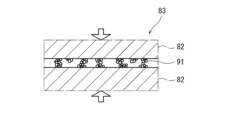
- 2 is a schematic cross-sectional view of the fiber laminate of FIG. 1.
- FIG. 3 is a schematic cross-sectional view of the nonwoven fabric of FIG. 1.
- FIG. 4 is a schematic diagram of a nonwoven fabric manufacturing apparatus according to the second embodiment.
- thermocompression roll pair 7 is used as an example in this embodiment.
- FIG. 1 is an overall view of a nonwoven fabric manufacturing apparatus 1 according to the first embodiment.
- the nonwoven fabric manufacturing apparatus 1 shown in FIG. 1 manufactures the nonwoven fabric 84 based on a dry nonwoven fabric manufacturing method in which a nonwoven fabric is manufactured in gas (for example, air).
- This nonwoven fabric 84 includes first fibers 82 and second fibers 91a.
- the nonwoven fabric referred to in this document refers to a staple fiber nonwoven fabric complying with JIS L 0222:2001 No. 102.
- the veil-like tow band 80 folded and packed in the packing box B is fed out.
- first fibers 82 which are staple fibers and which are the material of the nonwoven fabric 84 .
- the outer diameter of the first fibers 82 can be adjusted as appropriate.
- the outer diameter of the first fiber 82 is, for example, a value in the range of 5 ⁇ m or more and 50 ⁇ m or less, but is not limited to this.
- the toe band 80 includes a plurality of crimped filaments 81 .
- the long fibers 81 contain, for example, at least one of rayon, polypropylene, polyethylene terephthalate, polyethylene, and cellulose acetate.
- the long fibers 81 of this embodiment contain cellulose acetate.
- a material for the long fibers 81 can be selected as appropriate.
- the nonwoven fabric manufacturing apparatus 1 includes a guide member G for guiding the toe band 80, a plurality of guide rolls R1 to R4 and R7 for guiding the toe band 80 in predetermined conveying directions P1 and P2, and a short fiber forming apparatus. a part 2;
- the short fiber forming unit 2 cuts long fibers 81 into a predetermined length dimension to form first fibers 82 that are short fibers, and a cutter 20 that forms first fibers 82 that are short fibers, and the first fibers 82 that are discharged from the cutter 20 in the conveying direction P1. and a carding machine 21 for carding a plurality of first fibers 82 .
- the length dimension of the first fibers 82 formed by the cutter 20 of this embodiment can be set as appropriate.
- the length dimension of the first fiber 82 is, for example, a value in the range of 10 mm or more and 100 mm or less. In another example, the length dimension of the first fiber 82 is a value in the range of 30 mm or more and 100 mm or less.
- the length dimension of the first fibers 82 By setting the length dimension of the first fibers 82 to a value of 100 mm or less, for example, unnecessary entanglement of the first fibers 82 with the carding machine 21 can be prevented.
- By setting the length dimension of the first fibers 82 to 10 mm or more a plurality of crimped first fibers 82 are entangled with each other, and bulky nonwoven fabric 84 with abundant inter-fiber gaps can be easily manufactured.
- the nonwoven fabric manufacturing apparatus 1 includes a dispersion liquid applying device 3 for applying a dispersion liquid 90 containing a plurality of resin particles 91 to a plurality of first fibers 82, and a fiber lamination apparatus 3 for laminating a plurality of first fibers 82 to form a fiber lamination. and a cloth layer (fiber laminate forming device) 4 for forming a body 83 .
- the dispersion impregnating device 3 has one or more nozzles 30 for spraying the dispersion 90 supplied from the outside onto the first fibers 82 , and a housing 31 that accommodates the nozzles 30 .
- the configuration of the dispersion liquid impregnating device 3 is not limited to the above.
- the dispersion liquid impregnating device 3 has, for example, a storage section that stores the dispersion liquid 90 and an impregnation roll that is axially supported so that the dispersion liquid 90 in the storage section adheres to the peripheral surface and adheres to the first fibers 82 .
- the dispersion 90 of this embodiment is an aqueous dispersion.
- the dispersion liquid 90 may contain liquids other than water. By using an aqueous dispersion, the dispersion 90 can be produced relatively inexpensively. Moreover, the dispersion liquid 90 can be easily handled.
- the resin particles 91 include a lamellar structure.
- the lamellar structure refers to a structure in which polymer chains forming the resin of the resin particles 91 are linked and folded.
- the lamellar structure contained in the resin particles 91 is composed of fine fibers formed by linking several million units of polymer chains in a ribbon shape. The fine fibers are folded and stored inside the resin particles 91 .
- the resin particles 91 are primary particles. A plurality of resin particles 91 are combined to form secondary particles. When an external force is applied to the secondary particles (in other words, two or more bonded resin particles 91) so that the resin particles 91 are separated from each other, the fine fibers are pulled out from the resin particles 91 and the resin A second fiber 91 a is formed from the particulate matter 91 .
- the dispersion liquid 90 of the present embodiment contains primary particles including a plurality of resin particles 91 dispersed in a solvent. By attaching the dispersion liquid 90 to the first fibers 82 , the plurality of resin particles 91 are dispersed and attached to the surfaces of the first fibers 82 . As an example, secondary particles of a plurality of resin particles 91 are attached to the surfaces of the first fibers 82 .
- the resin particles 91 are attached to different surfaces of the first fibers 82.
- the plurality of resin particles 91 thus formed are adhered to each other.
- the bonded resin particles 91 are separated from each other by the relaxation of the external force applied to the plurality of first fibers 82 . This forms the second fibers 91a (see FIGS. 2 and 3).
- the resin particulate matter 91 may be, for example, one that is produced by a polymerization reaction and includes a lamellar structure.
- Resin particles 91 contain at least one of PTFE (polytetrafluoroethylene), polypropylene, polyethylene, and polyamide, for example.
- the resin particles 91 of this embodiment contain PTFE.
- the average particle diameter of the resin particles 91 is set to a value in the range of 100 nm or more and 100 ⁇ m or less.
- the average particle diameter is more preferably in the range of 200 nm or more and 700 nm or less, and even more preferably in the range of 250 nm or more and 400 nm or less.
- the average particle diameter refers to the median diameter (cumulative 50% diameter (D50)) calculated from the measurement results by the dynamic light scattering method.
- the resin particles 91 are formed by paste extrusion molding.
- the cloth layer 4 forms a fiber laminate 83 by stacking (here, folding and stacking as an example) a plurality of sheet-like first fibers 82 to which resin particles 91 are affixed.
- the cloth layer 4 has a plurality of rolls R2 to R6 for guiding a plurality of sheet-like first fibers 82, and a housing 40 for housing the rolls R3 to R6.
- the sheet-shaped first fibers 82 are guided upward inside the housing 40 by the rolls R3 and R4, and then guided downward by the pair of rolls R5 and R6. be.
- the plurality of first fibers 82 are reciprocally guided in one direction perpendicular to the vertical direction, folded back and laminated.
- a fiber laminate 83 is thus formed.
- the one direction and the conveying direction P2 of the fiber laminate 83 discharged from the cloth layer 4 cross the conveying direction P1 of the plurality of first fibers 82 when introduced into the cloth layer 4.
- the sheet-like plurality of first fibers 82 are not long fibers but short fibers. Therefore, the plurality of sheet-shaped first fibers 82 have a relatively small restoring force in the overlapped portion compared to, for example, a plurality of sheet-shaped long fibers. Therefore, a plurality of sheet-like first fibers 82 can be easily stacked, and the fiber laminate 83 can be efficiently formed.
- the nonwoven fabric manufacturing apparatus 1 includes a slitter 5 that cuts off unnecessary portions (both ends of the fiber laminate 83 in the width direction as an example) of the fiber laminate 83 discharged from the cloth layer 4, and a fiber laminate 83 that has passed through the slitter 5.
- a pair of pressing rolls 6 for adjusting the thickness of the fiber laminate 83 by pressing in the thickness direction is provided.
- the slitter 5 has a transport roll 51 that transports the fiber laminate 83 and a cutting roll 50 that cuts a portion of the fiber laminate 83 .
- the cut portion 83a of the fiber laminate 83 is introduced into the carding machine 21 and reused.
- the pressure roll pair 6 has a pair of pressure rolls R7 and R8.
- the nonwoven fabric manufacturing apparatus 1 heats the plurality of first fibers 82 and the plurality of resin particles 91 by thermally compressing the fiber laminate 83 that has passed through the pressure bonding roll pair 6 in the thickness direction, and applies the external force.
- a thermocompression roll pair 7, an electret device 8 for electrically polarizing the fiber laminate 83, and a winding roll R12 for winding the nonwoven fabric 84 are provided.
- the thermocompression roll pair 7 has a pair of thermocompression rolls R10 and R11 whose peripheral surfaces are heated.
- the compression roll pair 6 of this embodiment applies the external force to the fiber laminate 83 while heating the fiber laminate 83 .
- the heating temperature of the plurality of first fibers 82 and the plurality of resin particles 91 by the thermocompression roll pair 7 can be appropriately adjusted.
- the heating temperature can be set to a temperature in the range of higher than 25°C and 200°C or lower.
- the heating temperature is, for example, preferably in the range of 50°C or higher and 200°C or lower, more preferably in the range of 70°C or higher and 200°C or lower, and even more preferably in the range of 90°C or higher and 200°C or lower.
- the heating temperature is preferably in the range of 110° C. or higher and 200° C. or lower, and more preferably in the range of 150° C. or higher and 200° C. or lower.
- This heating temperature may be, for example, lower than the melting point of each material of the first fibers 82 and resin particles 91, or lower than the decomposition temperature of each material.
- the electret device 8 improves filtration performance, which is performance when the nonwoven fabric 84 is used as a filtration member, for example. Note that the electret device 8 may be omitted when the nonwoven fabric 84 is used for purposes other than filtration.
- a veil-shaped tow band 80 (a plurality of crimped filaments 81) housed in the packing box B is let out and guided in the conveying direction P1 by the guide member G and the guide roll R1. It is introduced into the short fiber forming part 2 by In the short fiber forming section 2, the tow band 80 is introduced into the cutter 20 and cut. Thereby, a plurality of crimped first fibers 82 are formed. The plurality of first fibers 82 are introduced into the carding machine 21 and carded. As a result, impurities are removed from the plurality of first fibers 82, and the thickness dimension and the flow direction of the fibers are adjusted.
- a plurality of carded first fibers 82 are formed into a sheet so as to have abundant inter-fiber gaps while being entangled with each other.
- the plurality of sheet-like first fibers 82 are impregnated with the dispersion liquid 90 by the dispersion liquid impregnation device 3 .
- a plurality of resin particles 91 containing a fiber-forming polymer are attached to the plurality of first fibers 82 that are crimped and cut into short fibers.
- a plurality of first fibers 82 discharged from the dispersion impregnating device 3 are introduced into the cloth layer 4 .
- a fiber laminate 83 is thus formed.
- the fiber laminate 83 discharged from the cloth layer 4 is introduced into the slitter 5 while being guided in the conveying direction P2. As a result, both sides in the width direction of the fiber laminate 83 are cut.
- the fiber laminate 83 that has passed through the slitter 5 is formed into a sheet having an adjusted thickness by passing through the nip point of the pressure roll pair 6 .
- the fiber laminate 83 that has passed through the nip point of the pair of pressure bonding rolls 6 is guided by the guide roll R9 and passed through the nip point of the pair of thermal pressure bonding rolls 7 to be thermally pressed.
- the external force is applied to the plurality of first fibers 82 and the plurality of resin particles 91 in the fiber laminate 83 while being heated.
- the external force is applied to the plurality of first fibers 82 to which the plurality of resin particles 91 are affixed so as to reduce inter-fiber gaps.
- the first fibers 82 are plasticized to some extent by being heated.
- the external force is relaxed.
- a plurality of second fibers 91 a are formed from a plurality of resin particles 91 .
- the plurality of first fibers 82 and second fibers 91 a are electrically polarized by the electret device 8 .
- the nonwoven fabric 84 is formed.
- the nonwoven fabric 84 is wound by a winding roll R12.
- the nonwoven fabric 84 is cut to a predetermined size, for example, and used.
- FIG. 2 is a schematic cross-sectional view of the fiber laminate 83 of FIG.
- the plurality of first fibers 82 to which the plurality of resin particles 91 are adhered are applied to the plurality of first fibers 82 .
- a nip pressure is applied as the external force so as to shrink the inter-fiber gap while heating the fibers 82 and the plurality of resin particles 91 .
- the plurality of first fibers 82 have reduced inter-fiber gaps.
- the plurality of resin particles 91 attached to the first fibers 82 are adhered to each other to form high-order particles of the resin particles 91 .
- the external force is relieved.
- the external force set to a value of 0.05 MPa or more is applied to the plurality of first fibers 82 to which the plurality of resin particles 91 are affixed.
- the upper limit of the external force may be, for example, several tens of MPa.
- FIG. 3 is a schematic cross-sectional view of the nonwoven fabric 84 of FIG.
- tension is applied to the resin particles 91 so as to separate the resin particles 91 that are adhered to each other between the different first fibers 82 .
- the fine fibers folded in the resin particles 91 are stretched, and the second fibers 91a are formed so as to bridge the different first fibers 82 .
- a nonwoven fabric 84 that is a fiber composite containing the first fibers 82 and the second fibers 91a is formed.
- the second fiber 91a has an outer diameter smaller than that of the first fiber 82 and is set to a value in the range of 30 nm or more and 1.0 ⁇ m or less.
- the second fibers 91 a are supported by the first fibers 82 while being entangled with the first fibers 82 inside the nonwoven fabric 84 . Therefore, even if the second fibers 91a are significantly thinner than the first fibers 82, the second fibers 91a can be supported by the first fibers 82 while preventing the second fibers 91a from being cut. Therefore, the function of the second fibers 91a can be maintained for a long period of time.
- the second fibers 91 a are arranged so as to diffuse throughout the interior of the nonwoven fabric 84 .
- the resin particles 91 in the fiber laminate 83 may shrink or disappear as the second fibers 91a are formed.
- a weight ratio W1/W2 between the total weight W1 of the first fibers 82 of the nonwoven fabric 84 and the total weight W2 of the second fibers 91a and the remaining resin particles 91 can be set appropriately.
- the nonwoven fabric 84 is formed with the weight ratio W1/W2 set to a value in the range of 3.00 or more and 200.00 or less. Accordingly, in the nonwoven fabric 84, the second fibers 91a can be stably supported by the first fibers 82, and the functions of the second fibers 91a can be easily exhibited.
- various components provided in the existing nonwoven fabric manufacturing apparatus for example, metal detectors, iron removal machines, addition devices for adding various additives, fiber lamination
- At least one of a delivery roll for delivering the sheet to be stuck on the body 83 and a paste applying device for applying a paste for sticking the sheet to at least a part of the fiber laminate 83 is arranged. good too.
- a dryer for drying the fiber laminate 83 to which the dispersion liquid 90 has been applied may be arranged between the dispersion liquid applying device 3 and the thermocompression roll pair 7 .
- at least one of a weighing tank for weighing the plurality of first fibers 82, a blending machine, a blower, and a weighing feeder may be arranged.
- a plurality of first fibers 82 cut into short fibers are used, and the outer diameter is set to a value in the range of 30 nm or more and 1.0 ⁇ m or less. and the first fibers 82 having an outer diameter larger than that of the second fibers 91a.
- the above steps can be sequentially performed in a single nonwoven fabric manufacturing apparatus 1 . Therefore, in order to manufacture the nonwoven fabric 84 containing the first fibers 82 and the second fibers 91a, for example, a nonwoven fabric manufacturing facility prepares an intermediate product containing a plurality of long fibers 81 to which a plurality of resin particles 91 are attached.
- the nonwoven fabric 84 containing the first fibers 82 and the second fibers 91a can be manufactured in gas. Therefore, for example, the process of drying the fibers 82 and 91a can be simplified as compared with the wet nonwoven fabric manufacturing method. Also, excessive damage to the fibers 82, 91a due to the drying process can be reduced. Therefore, a high-quality nonwoven fabric 84 can be manufactured efficiently.
- the nonwoven fabric 84 in which the plurality of second fibers 91 a are supported by the plurality of first fibers 82 is manufactured.
- the plurality of first fibers 82 are short fibers and are crimped, and are entangled while extending in a plurality of different directions within the nonwoven fabric 84 . Therefore, for example, the nonwoven fabric 84, which is a fibrous article that is bulky and has abundant inter-fiber gaps, can be manufactured as compared with a fibrous article that contains a plurality of long fibers 81 and a plurality of second fibers 91a.
- the basis weight (g/m 2 ) of the nonwoven fabric 84 is about half that of a fiber article containing a plurality of long fibers 81 and a plurality of second fibers 91a. can be significantly reduced to
- the high-quality nonwoven fabric 84 that allows the function of the second fibers 91a to be exhibited over a long period of time in the inter-fiber gaps. Further, for example, by spraying the dispersion liquid 90 containing the resin particles 91 onto the plurality of first fibers 82, the dispersion liquid 90 can be easily penetrated deep into the gaps between the fibers. Therefore, the second fibers 91a can be uniformly dispersed and arranged in the nonwoven fabric 84 . Thereby, the high-quality nonwoven fabric 84 can be stably manufactured.
- the nonwoven fabric 84 can increase the entanglement of the fibers and suppress uneven density of the fibers, compared to a fibrous article containing a plurality of long fibers 81 and a plurality of second fibers 91a.
- the nonwoven fabric 84 can be efficiently and continuously manufactured by using, for example, the nonwoven fabric manufacturing apparatus 1 concentrated in one place. Therefore, the number of manufacturing processes can be reduced, and the manufacturing cost of the nonwoven fabric 84 can be reduced. Further, according to this embodiment, the nonwoven fabric 84 having both good bulkiness and good porosity can be efficiently manufactured.
- the external force is applied to the plurality of first fibers 82 to which the plurality of resin particles 91 are adhered.
- the heating temperature when heating the plurality of first fibers 82 and the plurality of resin particles 91 is set to a value in the range of 70° C. or more and 200° C. or less.
- heat can be applied to the plurality of resin particles 91 to facilitate the formation of the second fibers 91 a from the resin particles 91 .
- the plurality of first fibers 82 can be densely arranged, making it easier to form the nonwoven fabric 84 having fine inter-fiber gaps.
- a plurality of first fibers 82 are carded to form a sheet, and a plurality of resin particles 91 are adhered to the plurality of carded first fibers 82. do.
- the plurality of resin particles 91 can be adhered to the plurality of first fibers 82 which are processed into a sheet by carding and arranged in the fiber flow direction. Therefore, a plurality of resin particles 91 can be evenly attached to each first fiber 82 .
- the nonwoven fabric 84 is formed with the weight ratio W1/W2 set to a value in the range of 3.00 or more and 200.00 or less.
- the second fibers 91a can be stably supported on the first fibers 82, and the functions of the second fibers 91a can be easily exhibited.
- the first fibers 82 having an outer diameter set to a value within the range of 5 ⁇ m or more and 50 ⁇ m or less are used. Thereby, the difference in outer diameter between the first fibers 82 and the second fibers 91a can be increased, and the degree of freedom in designing the nonwoven fabric 84 can be improved.
- the length dimension of the short fibers is a value in the range of 10 mm or more and 100 mm or less.
- the crimped first fibers 82 are entangled with each other, the bulky nonwoven fabric 84 having abundant interstices between the first fibers 82 and the second fibers 91a can be easily manufactured.
- the plurality of first fibers 82 can be efficiently carded while preventing the plurality of first fibers 82 from getting entangled in the carding machine 21 .
- Other embodiments will be described below, focusing on differences from the first embodiment.
- FIG. 4 is a schematic diagram of a nonwoven fabric manufacturing apparatus 101 according to the second embodiment.
- the nonwoven fabric manufacturing apparatus 101 differs from the nonwoven fabric manufacturing apparatus 1 in that the cloth layer 4 is arranged closer to the carding machine 21 in the transport direction P1 than the dispersion liquid impregnating device 3 is.
- the dispersion liquid 90 is adhered to the plurality of carded first fibers 82 .
- the plurality of first fibers 82 to which the plurality of resin particles 91 are attached are introduced into the cloth layer 4, thereby forming the fiber laminate 183 to which the plurality of resin particles 91 are attached.
- a nonwoven fabric 184 is formed from the fiber laminate 183 .
- a plurality of first fibers 82 formed in a sheet shape by carding are stacked to form a fiber laminate 183, and a plurality of first fibers of the fiber laminate 183 are stacked.
- a plurality of resin particles 91 are adhered to the fibers 82 .
- the resin particles 91 can be adhered to the fiber laminate 183 . Therefore, a bulky nonwoven fabric 184 containing the first fibers 82 and the second fibers 91a can be manufactured. Further, when forming the fiber laminate 183, the degree of freedom in designing the thickness of the nonwoven fabric 184 can be improved by adjusting the thickness of the fiber laminate 183 according to the extent to which the plurality of first fibers 82 are stacked. Therefore, it is possible to efficiently manufacture the bulky nonwoven fabric 184 having both the properties of the first fibers 82 and the second fibers 91a.
- a plurality of first fibers 82 were formed using long fibers 81 that are crimped cellulose acetate (CA) fibers with an outer diameter set to a value in the range of 5 ⁇ m or more and 50 ⁇ m or less. Also, a plurality of resin particles 91 having an average particle diameter set to a value in the range of 100 nm or more and 100 ⁇ m or less and containing PTFE were prepared.
- a nonwoven fabric 84 containing the first fibers 82 and the second fibers 91a was manufactured using the first fibers 82 and the resin particles 91 and the nonwoven fabric manufacturing apparatus 1 of the first embodiment. Using the first fibers 82 and the resin particles 91 and the nonwoven fabric manufacturing apparatus 101 of the second embodiment, a nonwoven fabric 184 including the first fibers 82 and the second fibers 91a was manufactured.
- the heating temperature (compression temperature) for heating the first fibers 82 and the resin particles 91 when the fiber laminates 83 and 183 are compressed by the thermocompression roll pair 7 is normal temperature (25 °C), 70°C, 90°C, 110°C, 150°C, and 200°C.
- the heating temperature for heating the plurality of first fibers 82 and the plurality of resin particles 91 when applying an external force to the plurality of first fibers 82 to which the plurality of resin particles 91 are adhered is set to made it different.
- different nonwoven fabrics 84 and 184 were produced as samples of Examples 1 to 10. Among them, Examples 1 to 5 are samples manufactured by the manufacturing method of the first embodiment based on the dry nonwoven fabric manufacturing method. Examples 6 to 10 are samples manufactured by the manufacturing method of the second embodiment based on the dry nonwoven fabric manufacturing method.
- a plurality of CA fibers which are long fibers 81 with an outer diameter set to a value in the range of 5 ⁇ m or more and 50 ⁇ m or less, were spun.
- resin particles 91 having an average particle diameter set to a value in the range of 100 nm or more and 100 ⁇ m or less and containing PTFE were impregnated.
- a plurality of CA fibers were crimped to produce a veil-like tow band. This toe band was compressed and packed in a packing box B. The tow band was unwound from the packaging box B and opened in the width direction by gas.
- the tow band was further opened by applying tension in the conveying direction using two pairs of opening rollers spaced apart in the predetermined conveying direction.
- the second fibers 91a were formed by the nip pressure from the pair of nip rolls during the crimping process and the external force applied during opening.
- a fibrous article including the long fibers 81 and the second fibers 91a was manufactured as a sample of Comparative Example 1.
- the particle collection efficiency was measured when air containing NaCl particles with a particle diameter of 0.3 ⁇ m was passed through at a flow rate of 5.3 cm/sec. As an example, it can be evaluated that the higher the collection efficiency value, the higher the performance of the sample as a filtering member. Table 1 shows the measurement results of this collection efficiency.
- Examples 1 to 10 had a higher collection efficiency than Comparative Example 1.
- the plurality of first fibers 82 are short fibers, and are crimped to extend in a plurality of different directions within the nonwoven fabrics 84, 184 and intertwine with each other. This is considered to be due to the formation of fine inter-fiber gaps and the improvement in filtration performance.
- the heating temperature of the plurality of first fibers 82 and the plurality of resin particles 91 is preferably in the range of 25° C. or higher and 200° C. or lower, and in the range of 70° C. or higher and 200° C. or lower. It can be said that the value of is more preferable.
- the collection efficiency of the nonwoven fabric is a value in the range of 26% or more and 92% or less, in another example, a value in the range of 38% or more and 92% or less, and in still another example, 65% or more and 92%. The values are in the following range.
- the nonwoven fabric manufactured by the manufacturing method of the present disclosure is not limited to filtering members for filtering impurities from fluids, and may be used for other purposes such as absorbent members used in sanitary products. Further, when applying the external force to the plurality of first fibers 82 and the plurality of resin particles 91, the first fibers 82 and the resin particles 91 do not necessarily have to be heated. Further, instead of using the dispersion liquid attaching device 3, a powder adding device that attaches the powdery resin particles 91 to the first fibers 82 may be used.
Landscapes
- Engineering & Computer Science (AREA)
- Textile Engineering (AREA)
- Chemical & Material Sciences (AREA)
- Chemical Kinetics & Catalysis (AREA)
- General Chemical & Material Sciences (AREA)
- Dispersion Chemistry (AREA)
- Life Sciences & Earth Sciences (AREA)
- Wood Science & Technology (AREA)
- Nonwoven Fabrics (AREA)
Priority Applications (5)
| Application Number | Priority Date | Filing Date | Title |
|---|---|---|---|
| EP21928359.5A EP4438784A4 (en) | 2021-11-26 | 2021-11-26 | PROCESS FOR PRODUCING A DRY NON-WOVEN FABRIC |
| CN202180005936.1A CN116507770A (zh) | 2021-11-26 | 2021-11-26 | 干式无纺布制造方法 |
| PCT/JP2021/043444 WO2023095301A1 (ja) | 2021-11-26 | 2021-11-26 | 乾式不織布製造方法 |
| US17/778,859 US12152325B2 (en) | 2021-11-26 | 2021-11-26 | Dry-laid nonwoven fabric production method |
| JP2022513572A JP7793508B2 (ja) | 2021-11-26 | 2021-11-26 | 乾式不織布製造方法 |
Applications Claiming Priority (1)
| Application Number | Priority Date | Filing Date | Title |
|---|---|---|---|
| PCT/JP2021/043444 WO2023095301A1 (ja) | 2021-11-26 | 2021-11-26 | 乾式不織布製造方法 |
Publications (1)
| Publication Number | Publication Date |
|---|---|
| WO2023095301A1 true WO2023095301A1 (ja) | 2023-06-01 |
Family
ID=86539256
Family Applications (1)
| Application Number | Title | Priority Date | Filing Date |
|---|---|---|---|
| PCT/JP2021/043444 Ceased WO2023095301A1 (ja) | 2021-11-26 | 2021-11-26 | 乾式不織布製造方法 |
Country Status (5)
| Country | Link |
|---|---|
| US (1) | US12152325B2 (https=) |
| EP (1) | EP4438784A4 (https=) |
| JP (1) | JP7793508B2 (https=) |
| CN (1) | CN116507770A (https=) |
| WO (1) | WO2023095301A1 (https=) |
Citations (2)
| Publication number | Priority date | Publication date | Assignee | Title |
|---|---|---|---|---|
| JP2012188774A (ja) * | 2011-03-09 | 2012-10-04 | Mitsubishi Paper Mills Ltd | 不織布及び不織布の製造方法 |
| WO2021039979A1 (ja) | 2019-08-30 | 2021-03-04 | 株式会社ダイセル | 繊維物品の製造方法 |
Family Cites Families (3)
| Publication number | Priority date | Publication date | Assignee | Title |
|---|---|---|---|---|
| EP0669993B1 (en) * | 1992-11-18 | 1997-12-29 | Hoechst Celanese Corporation | Process for making a fibrous structure containing immobilized particulate matter |
| JPWO2013094706A1 (ja) * | 2011-12-22 | 2015-04-27 | 帝人株式会社 | ランダムマット、および強化繊維複合材料 |
| JP6083239B2 (ja) * | 2012-05-23 | 2017-02-22 | 東レ株式会社 | 繊維強化プラスチックおよびその製造方法 |
-
2021
- 2021-11-26 WO PCT/JP2021/043444 patent/WO2023095301A1/ja not_active Ceased
- 2021-11-26 EP EP21928359.5A patent/EP4438784A4/en active Pending
- 2021-11-26 JP JP2022513572A patent/JP7793508B2/ja active Active
- 2021-11-26 CN CN202180005936.1A patent/CN116507770A/zh active Pending
- 2021-11-26 US US17/778,859 patent/US12152325B2/en active Active
Patent Citations (2)
| Publication number | Priority date | Publication date | Assignee | Title |
|---|---|---|---|---|
| JP2012188774A (ja) * | 2011-03-09 | 2012-10-04 | Mitsubishi Paper Mills Ltd | 不織布及び不織布の製造方法 |
| WO2021039979A1 (ja) | 2019-08-30 | 2021-03-04 | 株式会社ダイセル | 繊維物品の製造方法 |
Non-Patent Citations (1)
| Title |
|---|
| See also references of EP4438784A4 |
Also Published As
| Publication number | Publication date |
|---|---|
| US20240328048A1 (en) | 2024-10-03 |
| EP4438784A4 (en) | 2025-09-10 |
| US12152325B2 (en) | 2024-11-26 |
| JP7793508B2 (ja) | 2026-01-05 |
| CN116507770A (zh) | 2023-07-28 |
| EP4438784A1 (en) | 2024-10-02 |
| JPWO2023095301A1 (https=) | 2023-06-01 |
Similar Documents
| Publication | Publication Date | Title |
|---|---|---|
| US20120255662A1 (en) | Integrated nanofiber filter media | |
| US4961974A (en) | Laminated filters | |
| US7816290B2 (en) | Nonwoven mat, method for production thereof and fibre composite | |
| KR102494455B1 (ko) | 적층 부직포 | |
| JP7555344B2 (ja) | 繊維物品の製造方法 | |
| CN103930607A (zh) | 来自连续丝束带的非织造材料及其装置和方法 | |
| CN104093771A (zh) | 碳纤维复合材料 | |
| JP2025512337A (ja) | 二重層ガスフィルター及びそれらを作製するシステム及び方法 | |
| KR20250022003A (ko) | 여과 매체 및 필터 | |
| EP2842732B1 (en) | Nonwoven fabric composite and method for making the same | |
| JP3152748U (ja) | カーボン不織布 | |
| CN112342706B (zh) | 一种能灭活病毒的口罩材料、其生产线及用途 | |
| KR20250019621A (ko) | 섬유성 물질 및 나노입자의 연속 제조를 위한 시스템 및 방법 | |
| KR20250019618A (ko) | 부직 물질 및 부직 물질을 함유하는 제품 | |
| WO2023095301A1 (ja) | 乾式不織布製造方法 | |
| JP7624302B2 (ja) | 繊維物品の製造方法 | |
| CN109943980B (zh) | 无纺布结构与其制作方法 | |
| JP2026037655A (ja) | 積層体 | |
| KR20250019625A (ko) | 섬유성 물질을 제조하기 위한 시스템 및 방법 | |
| KR20250019620A (ko) | 나노입자를 섬유성 물질 내에 보유하기 위한 시스템 및 방법 | |
| JP2026037654A (ja) | 繊維積層体 | |
| CN114340760B (zh) | 空气过滤器滤材以及空气过滤器产品 | |
| CN120981618A (zh) | 纤维物品的制造方法 | |
| WO2024228258A1 (ja) | 繊維物品の製造方法 | |
| KR20250019622A (ko) | 기체 매체 내에서 나노입자를 분리 및/또는 단리하기 위한 시스템 및 방법 |
Legal Events
| Date | Code | Title | Description |
|---|---|---|---|
| WWE | Wipo information: entry into national phase |
Ref document number: 2022513572 Country of ref document: JP |
|
| WWE | Wipo information: entry into national phase |
Ref document number: 202180005936.1 Country of ref document: CN |
|
| WWE | Wipo information: entry into national phase |
Ref document number: 17778859 Country of ref document: US |
|
| WWE | Wipo information: entry into national phase |
Ref document number: 2021928359 Country of ref document: EP |
|
| NENP | Non-entry into the national phase |
Ref country code: DE |
|
| ENP | Entry into the national phase |
Ref document number: 2021928359 Country of ref document: EP Effective date: 20240626 |