WO2023089840A1 - 高強度成形体及びこの製造方法 - Google Patents
高強度成形体及びこの製造方法 Download PDFInfo
- Publication number
- WO2023089840A1 WO2023089840A1 PCT/JP2022/001458 JP2022001458W WO2023089840A1 WO 2023089840 A1 WO2023089840 A1 WO 2023089840A1 JP 2022001458 W JP2022001458 W JP 2022001458W WO 2023089840 A1 WO2023089840 A1 WO 2023089840A1
- Authority
- WO
- WIPO (PCT)
- Prior art keywords
- composite
- molded article
- cellulose
- stress
- group
- Prior art date
- Legal status (The legal status is an assumption and is not a legal conclusion. Google has not performed a legal analysis and makes no representation as to the accuracy of the status listed.)
- Ceased
Links
Images

Classifications
-
- B—PERFORMING OPERATIONS; TRANSPORTING
- B29—WORKING OF PLASTICS; WORKING OF SUBSTANCES IN A PLASTIC STATE IN GENERAL
- B29C—SHAPING OR JOINING OF PLASTICS; SHAPING OF MATERIAL IN A PLASTIC STATE, NOT OTHERWISE PROVIDED FOR; AFTER-TREATMENT OF THE SHAPED PRODUCTS, e.g. REPAIRING
- B29C43/00—Compression moulding, i.e. applying external pressure to flow the moulding material; Apparatus therefor
- B29C43/32—Component parts, details or accessories; Auxiliary operations
- B29C43/34—Feeding the material to the mould or the compression means
-
- B—PERFORMING OPERATIONS; TRANSPORTING
- B29—WORKING OF PLASTICS; WORKING OF SUBSTANCES IN A PLASTIC STATE IN GENERAL
- B29C—SHAPING OR JOINING OF PLASTICS; SHAPING OF MATERIAL IN A PLASTIC STATE, NOT OTHERWISE PROVIDED FOR; AFTER-TREATMENT OF THE SHAPED PRODUCTS, e.g. REPAIRING
- B29C45/00—Injection moulding, i.e. forcing the required volume of moulding material through a nozzle into a closed mould; Apparatus therefor
- B29C45/0001—Injection moulding, i.e. forcing the required volume of moulding material through a nozzle into a closed mould; Apparatus therefor characterised by the choice of material
-
- B—PERFORMING OPERATIONS; TRANSPORTING
- B29—WORKING OF PLASTICS; WORKING OF SUBSTANCES IN A PLASTIC STATE IN GENERAL
- B29C—SHAPING OR JOINING OF PLASTICS; SHAPING OF MATERIAL IN A PLASTIC STATE, NOT OTHERWISE PROVIDED FOR; AFTER-TREATMENT OF THE SHAPED PRODUCTS, e.g. REPAIRING
- B29C45/00—Injection moulding, i.e. forcing the required volume of moulding material through a nozzle into a closed mould; Apparatus therefor
- B29C45/0053—Injection moulding, i.e. forcing the required volume of moulding material through a nozzle into a closed mould; Apparatus therefor combined with a final operation, e.g. shaping
- B29C45/0055—Shaping
-
- C—CHEMISTRY; METALLURGY
- C08—ORGANIC MACROMOLECULAR COMPOUNDS; THEIR PREPARATION OR CHEMICAL WORKING-UP; COMPOSITIONS BASED THEREON
- C08J—WORKING-UP; GENERAL PROCESSES OF COMPOUNDING; AFTER-TREATMENT NOT COVERED BY SUBCLASSES C08B, C08C, C08F, C08G or C08H
- C08J5/00—Manufacture of articles or shaped materials containing macromolecular substances
-
- C—CHEMISTRY; METALLURGY
- C08—ORGANIC MACROMOLECULAR COMPOUNDS; THEIR PREPARATION OR CHEMICAL WORKING-UP; COMPOSITIONS BASED THEREON
- C08L—COMPOSITIONS OF MACROMOLECULAR COMPOUNDS
- C08L1/00—Compositions of cellulose, modified cellulose or cellulose derivatives
- C08L1/02—Cellulose; Modified cellulose
-
- C—CHEMISTRY; METALLURGY
- C08—ORGANIC MACROMOLECULAR COMPOUNDS; THEIR PREPARATION OR CHEMICAL WORKING-UP; COMPOSITIONS BASED THEREON
- C08L—COMPOSITIONS OF MACROMOLECULAR COMPOUNDS
- C08L101/00—Compositions of unspecified macromolecular compounds
-
- B—PERFORMING OPERATIONS; TRANSPORTING
- B29—WORKING OF PLASTICS; WORKING OF SUBSTANCES IN A PLASTIC STATE IN GENERAL
- B29K—INDEXING SCHEME ASSOCIATED WITH SUBCLASSES B29B, B29C OR B29D, RELATING TO MOULDING MATERIALS OR TO MATERIALS FOR MOULDS, REINFORCEMENTS, FILLERS OR PREFORMED PARTS, e.g. INSERTS
- B29K2001/00—Use of cellulose, modified cellulose or cellulose derivatives, e.g. viscose, as moulding material
-
- B—PERFORMING OPERATIONS; TRANSPORTING
- B29—WORKING OF PLASTICS; WORKING OF SUBSTANCES IN A PLASTIC STATE IN GENERAL
- B29K—INDEXING SCHEME ASSOCIATED WITH SUBCLASSES B29B, B29C OR B29D, RELATING TO MOULDING MATERIALS OR TO MATERIALS FOR MOULDS, REINFORCEMENTS, FILLERS OR PREFORMED PARTS, e.g. INSERTS
- B29K2101/00—Use of unspecified macromolecular compounds as moulding material
- B29K2101/12—Thermoplastic materials
-
- B—PERFORMING OPERATIONS; TRANSPORTING
- B29—WORKING OF PLASTICS; WORKING OF SUBSTANCES IN A PLASTIC STATE IN GENERAL
- B29K—INDEXING SCHEME ASSOCIATED WITH SUBCLASSES B29B, B29C OR B29D, RELATING TO MOULDING MATERIALS OR TO MATERIALS FOR MOULDS, REINFORCEMENTS, FILLERS OR PREFORMED PARTS, e.g. INSERTS
- B29K2995/00—Properties of moulding materials, reinforcements, fillers, preformed parts or moulds
- B29K2995/0037—Other properties
- B29K2995/0077—Yield strength; Tensile strength
-
- B—PERFORMING OPERATIONS; TRANSPORTING
- B29—WORKING OF PLASTICS; WORKING OF SUBSTANCES IN A PLASTIC STATE IN GENERAL
- B29K—INDEXING SCHEME ASSOCIATED WITH SUBCLASSES B29B, B29C OR B29D, RELATING TO MOULDING MATERIALS OR TO MATERIALS FOR MOULDS, REINFORCEMENTS, FILLERS OR PREFORMED PARTS, e.g. INSERTS
- B29K2995/00—Properties of moulding materials, reinforcements, fillers, preformed parts or moulds
- B29K2995/0037—Other properties
- B29K2995/0094—Geometrical properties
- B29K2995/0097—Thickness
-
- B—PERFORMING OPERATIONS; TRANSPORTING
- B29—WORKING OF PLASTICS; WORKING OF SUBSTANCES IN A PLASTIC STATE IN GENERAL
- B29L—INDEXING SCHEME ASSOCIATED WITH SUBCLASS B29C, RELATING TO PARTICULAR ARTICLES
- B29L2031/00—Other particular articles
- B29L2031/40—Test specimens ; Models, e.g. model cars ; Probes
-
- B—PERFORMING OPERATIONS; TRANSPORTING
- B32—LAYERED PRODUCTS
- B32B—LAYERED PRODUCTS, i.e. PRODUCTS BUILT-UP OF STRATA OF FLAT OR NON-FLAT, e.g. CELLULAR OR HONEYCOMB, FORM
- B32B2262/00—Composition or structural features of fibres which form a fibrous or filamentary layer or are present as additives
- B32B2262/04—Cellulosic plastic fibres, e.g. rayon
-
- B—PERFORMING OPERATIONS; TRANSPORTING
- B32—LAYERED PRODUCTS
- B32B—LAYERED PRODUCTS, i.e. PRODUCTS BUILT-UP OF STRATA OF FLAT OR NON-FLAT, e.g. CELLULAR OR HONEYCOMB, FORM
- B32B2264/00—Composition or properties of particles which form a particulate layer or are present as additives
- B32B2264/04—Cellulosic particles, e.g. rayon
-
- B—PERFORMING OPERATIONS; TRANSPORTING
- B32—LAYERED PRODUCTS
- B32B—LAYERED PRODUCTS, i.e. PRODUCTS BUILT-UP OF STRATA OF FLAT OR NON-FLAT, e.g. CELLULAR OR HONEYCOMB, FORM
- B32B2264/00—Composition or properties of particles which form a particulate layer or are present as additives
- B32B2264/30—Particles characterised by physical dimension
- B32B2264/301—Average diameter smaller than 100 nm
-
- B—PERFORMING OPERATIONS; TRANSPORTING
- B32—LAYERED PRODUCTS
- B32B—LAYERED PRODUCTS, i.e. PRODUCTS BUILT-UP OF STRATA OF FLAT OR NON-FLAT, e.g. CELLULAR OR HONEYCOMB, FORM
- B32B2264/00—Composition or properties of particles which form a particulate layer or are present as additives
- B32B2264/30—Particles characterised by physical dimension
- B32B2264/302—Average diameter in the range from 100 nm to 1000 nm
-
- B—PERFORMING OPERATIONS; TRANSPORTING
- B32—LAYERED PRODUCTS
- B32B—LAYERED PRODUCTS, i.e. PRODUCTS BUILT-UP OF STRATA OF FLAT OR NON-FLAT, e.g. CELLULAR OR HONEYCOMB, FORM
- B32B2307/00—Properties of the layers or laminate
- B32B2307/50—Properties of the layers or laminate having particular mechanical properties
- B32B2307/54—Yield strength; Tensile strength
-
- B—PERFORMING OPERATIONS; TRANSPORTING
- B32—LAYERED PRODUCTS
- B32B—LAYERED PRODUCTS, i.e. PRODUCTS BUILT-UP OF STRATA OF FLAT OR NON-FLAT, e.g. CELLULAR OR HONEYCOMB, FORM
- B32B27/00—Layered products comprising a layer of synthetic resin
- B32B27/32—Layered products comprising a layer of synthetic resin comprising polyolefins
-
- B—PERFORMING OPERATIONS; TRANSPORTING
- B32—LAYERED PRODUCTS
- B32B—LAYERED PRODUCTS, i.e. PRODUCTS BUILT-UP OF STRATA OF FLAT OR NON-FLAT, e.g. CELLULAR OR HONEYCOMB, FORM
- B32B27/00—Layered products comprising a layer of synthetic resin
- B32B27/34—Layered products comprising a layer of synthetic resin comprising polyamides
-
- B—PERFORMING OPERATIONS; TRANSPORTING
- B32—LAYERED PRODUCTS
- B32B—LAYERED PRODUCTS, i.e. PRODUCTS BUILT-UP OF STRATA OF FLAT OR NON-FLAT, e.g. CELLULAR OR HONEYCOMB, FORM
- B32B27/00—Layered products comprising a layer of synthetic resin
- B32B27/36—Layered products comprising a layer of synthetic resin comprising polyesters
- B32B27/365—Layered products comprising a layer of synthetic resin comprising polyesters comprising polycarbonates
-
- C—CHEMISTRY; METALLURGY
- C08—ORGANIC MACROMOLECULAR COMPOUNDS; THEIR PREPARATION OR CHEMICAL WORKING-UP; COMPOSITIONS BASED THEREON
- C08L—COMPOSITIONS OF MACROMOLECULAR COMPOUNDS
- C08L2203/00—Applications
- C08L2203/30—Applications used for thermoforming
-
- C—CHEMISTRY; METALLURGY
- C08—ORGANIC MACROMOLECULAR COMPOUNDS; THEIR PREPARATION OR CHEMICAL WORKING-UP; COMPOSITIONS BASED THEREON
- C08L—COMPOSITIONS OF MACROMOLECULAR COMPOUNDS
- C08L2205/00—Polymer mixtures characterised by other features
- C08L2205/08—Polymer mixtures characterised by other features containing additives to improve the compatibility between two polymers
-
- C—CHEMISTRY; METALLURGY
- C08—ORGANIC MACROMOLECULAR COMPOUNDS; THEIR PREPARATION OR CHEMICAL WORKING-UP; COMPOSITIONS BASED THEREON
- C08L—COMPOSITIONS OF MACROMOLECULAR COMPOUNDS
- C08L2205/00—Polymer mixtures characterised by other features
- C08L2205/14—Polymer mixtures characterised by other features containing polymeric additives characterised by shape
- C08L2205/18—Spheres
Definitions
- the present invention relates to a composite molded article having excellent strength characteristics containing a cellulose-based nanomaterial (A) and a thermoplastic resin (B), and a method for producing the same.
- Fiber reinforced plastics are lightweight and have excellent mechanical strength. Therefore, in order to reduce greenhouse gas emissions, they are applied to exterior panels and interior materials for automobiles, housings for electrical equipment, building materials, etc., and are decarbonized. It is expected as one of the means of social construction.
- Patent Document 1 discloses a resin composition containing microfibrillated plant fibers chemically modified with alkyl or alkenyl succinic anhydride, a method for producing the same, and a molded product.
- Patent Literature 2 discloses various chemically modified nanocellulose fibers in which highly functional functional groups are introduced to the surface of nanocellulose, and resin compositions containing the same.
- Patent Literature 3 discloses a fiber-reinforced resin composition containing lignocellulose nanofibers with specific physical properties chemically modified with acyl groups or the like and a thermoplastic resin, and a molded article thereof.
- a thermoplastic resin and vegetable fibers such as kenaf are kneaded to produce a resin fiber mixture (containing 50 to 95% by mass of vegetable fibers), and the resin fiber mixture is rolled into a flat plate.
- a method for producing a thermoplastic resin composition characterized by forming a product.
- Patent Document 5 discloses a resin composition with improved tensile elongation, containing cellulose nanofibers, a specific organic component, an acid-modified polyolefin, and a polyolefin-based resin.
- Patent Document 6 discloses a high-strength hard/soft laminate structure material made of a polymer.
- Composite molded articles for example, injection molded articles
- Composite molded articles made of conventional fiber-reinforced resin compositions have improved strength and elastic modulus by combining fibers, but have a low elongation rate and become brittle.
- SUMMARY OF THE INVENTION It is an object of the present invention to provide a molded article having improved mechanical strength properties and thermal properties, which contains a cellulosic nanomaterial and a thermoplastic resin, and a method for producing the same.
- the present inventor conducted various studies, and as a result, a composite molded article (C) containing a cellulose-based nanomaterial (A) and a thermoplastic resin (B) prepared by a specific molding method, The inventors have found that it has excellent mechanical properties such as strength, elastic modulus and elongation, and excellent thermal properties (low coefficient of thermal expansion), and have completed the present invention based on this knowledge.
- the present invention includes, for example, a molded article and a method for producing the same described in each of the items below.
- Section 1 A composite molded article (C) containing a cellulose-based nanomaterial (A) and a thermoplastic resin (B), wherein the area under the stress-strain curve of the composite molded article (C) (AUC1) is the composite molded article
- a composite compact (C) that is at least twice the area under the stress-strain curve (AUC2) of a melt compact (D) of the same composition as body (C).
- the composite molded body (C) is selected from the group consisting of a warm sheared molded body, a warm compression molded body, a warm stretched molded body, and a warm rolled molded body of the melt molded body (D).
- Item 2 The composite molded article (C) according to Item 1, which is at least one molded article that contains a Item 3.
- the item wherein the tensile modulus (EMc) of the composite molded article (C) is at least 1.05 times the tensile modulus (EMd) of the melt molded article (D) having the same composition as the composite molded article (C). 3.
- the composite molded article (C) according to item 1 or 2 which has at least one of the following characteristics (1) to (4) (1)
- the tensile elastic modulus (EMc) of the composite molded article (C) is at least 1.05 times the tensile elastic modulus (EMd) of the melt molded article (D) having the same composition as the composite molded article (C). be.
- the tensile strength of the composite molded article (C) is at least 1.2 times the tensile strength of the molten molded article (D) having the same composition as the composite molded article (C).
- the fracture strain of the composite molded article (C) is at least twice the fracture strain of the molten molded article (D) having the same composition as the composite molded article (C).
- the coefficient of linear thermal expansion (CTE) from 40° C. to 80° C. of the composite molded body (C) is ⁇ 5 to 147 (ppm/K). Item 5.
- the cellulose-based nanomaterial (A) is at least one cellulose-based nanomaterial selected from the group consisting of microfibrillated cellulose-based fibers, cellulose-based fine powder, and cellulose nanocrystals, which may be chemically modified.
- Item 5. The composite compact (C) according to any one of items 1 to 4.
- Item 6. In the cellulose-based nanomaterial (A), part of the hydroxyl groups of sugar chains and/or lignin constituting the material is modified with at least one chemical bond selected from the group consisting of the following (i) to (iii). Item 6.
- R is (a) an alkyl or alkenyl group, (b) an alicyclic hydrocarbon group that may be crosslinked or condensed, and (c) an alicyclic hydrocarbon group that may be crosslinked or condensed or (d) a phenoxyalkyl group, a phenoxyalkyl group substituted with an alkyl group, or a phenoxyalkyl group substituted with an optionally bridged or condensed alicyclic hydrocarbon group.
- thermoplastic resin (B) is polyolefin, polyamide, aliphatic polyester, aromatic polyester, polyacetal, polycarbonate, polystyrene, (meth)acrylic resin, acrylonitrile-butadiene-styrene copolymer (ABS resin), polycarbonate-ABS alloy. (PC-ABS alloy), modified polyphenylene ether (m-PPE), vinyl chloride resin, cellulose resin, polylactic acid (PLA), polyhydroxybutyrate (PHBT), polyhydroxyhexanoate (PHAT), polyhydroxybutyrate Item 8.
- Item 9. Item 9.
- Item 10. Item 10.
- the stress-strain curve is obtained by subjecting the composite compact (C) or the melt compact (D) to a tensile test, with the strain (unit %) on the horizontal axis and the stress (unit MPa) is a curve drawn with the vertical axis of It means the area from the bottom of the curved part to the horizontal axis.
- thermoplastic resin (B) When the thermoplastic resin (B) is a crystalline resin, the temperature of the warm molding process is less than its melting point, and when the thermoplastic resin (B) is an amorphous resin, its glass transition temperature. 12. Manufacture of the composite molded article (C) according to Item 11, wherein the melting point of the crystalline resin is less than the melting point of the crystalline resin when the thermoplastic resin (B) is a mixture of a crystalline resin and a non-crystalline resin. Method. Item 13. In the warm forming process, the ratio (Ct/Dt) of the thickness (Ct) of the composite compact (C) to the thickness (Dt) of the melt compact (D) is 0.1 to 0.9. Item 11 or 12, the method for producing a composite molded article (C).
- AUC1 area under the stress-strain curve
- AUC2 area under the stress-strain curve
- the stress-strain curve is obtained by subjecting the composite compact (C) or the melt compact (D) to a tensile test, with the strain (unit %) on the horizontal axis and the stress (unit MPa) is a curve drawn with the vertical axis of It means the area from the bottom of the curved part to the horizontal axis.
- the molded article of the present invention is excellent in strength and elastic modulus and has improved elongation. That is, the composite molded article of the present invention is hard, strong and tenacious. Moreover, since it contains well-dispersed cellulose-based nanomaterials, it has a small coefficient of thermal expansion and excellent dimensional stability. Therefore, the composite molded article of the present invention can be suitably applied to industrial goods and consumer goods such as outer panels and interior materials for automobiles, housings for electrical equipment, building materials, etc., when used in small amounts. It is possible to reduce the weight and reduce the burden on the environment. In addition, the composite molded article of the present invention is suitable for mass production with low energy.
- the composite molded article of the present invention can be produced with lower energy consumption, that is, at a lower cost than conventional composite molded articles.
- the composite molded article of the present invention is useful for reducing life cycle CO 2 (LCCO 2 ) throughout its production, transportation, use, and recycling stages.
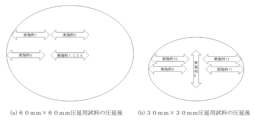
- FIG. 1 is a schematic diagram showing the positions of a rolled sample (generally elliptical) and a dumbbell-shaped specimen cut from it.
- FIG. 2 shows the stress-strain curves of the test pieces obtained in Examples 5, 10 and Comparative Example 2.
- the stress of the test piece of the example - the lower part of the strain curve is hatched ⁇ diagonal line> to indicate the area under the strain curve (AUC1), and the stress of the test piece of the comparative example - the lower part of the strain curve is also hatched ⁇
- the area under the stress-strain curve (AUC2) is indicated by hatching>.
- the cellulosic nanomaterial (A) means that either one of the long axis and the short axis of the cellulosic material is nm size or ⁇ m size (for example, 1 nm to 999 ⁇ m). If the cellulosic nanomaterial (A) has a complex shape that includes protrusions, protrusions, or extensions in addition to its main shape portion, unless otherwise specified, the main shape portion, protrusions, protrusions, and extensions It means that any one of the major axis and the minor axis of any one of the parts is nm size or ⁇ m size.
- a cellulosic material means a material containing cellulose and optionally containing at least one selected from the group consisting of lignin and hemicellulose, unless otherwise specified.
- the composite molded article (C) of the present invention contains a cellulose-based nanomaterial (A) and a thermoplastic resin (B), and the area under the stress-strain curve of the composite molded article (C) ( AUC1) is at least twice the area under the stress-strain curve (AUC2) of a melt compact (D) having the same composition as the composite compact (C).
- the area under the stress-strain curve of the composite molded article (C) (AUC1) is at least 4 of the area under the strain curve (AUC2) of the melt molded article (D) having the same composition as the composite molded article (C). Double is preferred.
- the stress of the composite molded article (C) - the area under the strain curve (AUC1) is the stress of the melt molded article (D) having the same composition as the composite molded article (C) - the area under the strain curve (AUC2) of 2 to It may be 80 times, 4 to 80 times, or the like.
- the stress-strain curve is obtained by subjecting the composite molded body (C) or the melt molded body (D) to a tensile test, with the horizontal axis representing the strain (unit %) and the stress (unit MPa). It is a curve drawn on the vertical axis.
- the area under the stress-strain curve (AUC1 or AUC2) is the stress-strain curve, from the origin (stress 0) of the strain curve to the composite compact (C) or the molten compact (D). It is the area from the bottom of the curve portion to the horizontal axis until it breaks. More specifically, in the stress-strain curve, the curve portion from the origin (stress 0) of the stress-strain curve to the fracture (break point) of the composite compact (C) or the molten compact (D) , is the area of the region surrounded by the horizontal axis and the straight line connecting the breaking point on the curve and the point corresponding to the breaking point on the horizontal axis.
- Fig. 2 shows the stress-strain curves of Examples (Examples 5 and 10) and Comparative Example (Comparative Example 2).
- the stress in the example of this figure - the hatched ⁇ slanted> part (AUC1) at the bottom of the strain curve is the stress of the present invention composite compact (C) -
- the area under the strain curve (AUC1) corresponds to the comparison
- the hatched ⁇ slanting> portion (AUC2) at the bottom of the stress-strain curve in the example corresponds to the area (AUC2) under the stress-strain curve of the melt compact (D).
- the area under the stress-strain curve is usually obtained by dividing the area between the curve and the strain axis into a number of trapezoids using software attached to the tensile tester or Microsoft Excel software. It can be obtained by summing the areas.
- the melt molded article (D) is obtained by melting a composition containing the cellulose-based nanomaterial (A) and the thermoplastic resin (B) to form a melt containing the cellulose-based nanomaterial (A) and the thermoplastic resin (B).
- a molded article is obtained by preparing a composite composition, molding and cooling the melted composite composition in a molten state.
- the melt molded article (D) becomes a material for manufacturing the composite molded article (C), as described later.
- the composite molded article (C) may be produced by shearing, compressing, stretching, rolling, etc. the melt molded article (D), and these processing methods may be used singly or in combination of two or more.
- compression includes compression after injection of the melt molded article (D).
- Preferred processing methods are rolling, shearing and compression.
- the composite molded article (C) is at least selected from the group consisting of a warm sheared molded article, a warm compression molded article, a warm drawn molded article, and a warm rolled molded article of the melt molded article (D). It may be a kind of molding.
- the warm-compression molded body of the melt-molded body (D) includes a molded body obtained by injection-molding the melt-molded body (D) and then compression-molding it. Preferably, it is a warm-rolled compact.
- the molding temperature is below the melting point of the thermoplastic resin (B) when it is a crystalline resin, and below its glass transition temperature when the thermoplastic resin (B) is an amorphous resin.
- the thermoplastic resin (B) is a mixture of a crystalline resin and a non-crystalline resin, it may be below the melting point of the crystalline resin.
- the lower limit of the temperature is room temperature (eg, 10°C, 15°C, 20°C, 25°C, 30°C, 40°C, or 10 to 40°C).
- the composite molded body (C) has excellent tensile elasticity.
- the tensile modulus (EMc) of the composite compact (C) may be at least 1.05 times the tensile modulus (EMd) of the melt compact (D) having the same composition as the composite compact (C), Preferably at least 1.3 times, more preferably at least 1.4 times.
- the tensile elastic modulus (EMc) of the composite molded article (C) is 1.05 to 3 times, 1.1 to 3 times, 1.2 to 1.2 times the tensile elastic modulus (EMd) of the melt molded article (D) having the same composition. It may be three times and so on.
- the composite compact (C) has high tensile strength.
- the tensile strength of the composite molded article (C) is preferably at least 1.2 times, and at least 1.5 times, the tensile strength of the molten molded article (D) having the same composition as the composite molded article (C). more preferably at least 1.6 times.
- the tensile strength of the composite molded article (C) may be 1.2 to 8 times, 1.5 to 8 times, 1.6 to 8 times, etc., the tensile strength of the melt molded article (D) having the same composition.
- the composite compact (C) has a large breaking strain.
- the breaking strain of the composite compact (C) is preferably at least 3 times, more preferably at least 5 times, the breaking strain of the molten compact (D) having the same composition as the composite compact (C). preferable.
- the breaking strain of the composite compact (C) may be 3 to 50 times, or 5 to 50 times the breaking strain of the molten compact (D) having the same composition.
- breaking strain is the magnitude of strain when the test piece breaks in the tensile test.
- the composite compact (C) has low thermal expansion and small dimensional fluctuations even at high temperatures.
- the coefficient of linear thermal expansion (CTE) of the composite molded body (C) can be within a small numerical value. It is preferred that the CTE from 40° C. to 80° C. is within a small number of ⁇ 5 to 147 (ppm/K), more preferably within a small number of 16 to 127 (ppm/K).
- the composite molded article (C) has a feature distinguishable from conventional molded articles that it shrinks when the melting point of the matrix resin approaches.
- the area under the stress-strain curve (AUC1) of the composite molded article (C) of the present invention is the melt molded article ( In addition to the feature of being at least twice the area under the stress-strain curve (AUC2) of D), it preferably has at least one of the following features (1) to (4).
- the tensile elastic modulus (EMc) of the composite molded article (C) is at least 1.05 times the tensile elastic modulus (EMd) of the melt molded article (D) having the same composition as the composite molded article (C). be.
- the tensile strength of the composite molded article (C) is at least 1.2 times the tensile strength of the molten molded article (D) having the same composition as the composite molded article (C).
- the fracture strain of the composite molded article (C) is at least twice the fracture strain of the molten molded article (D) having the same composition as the composite molded article (C).
- the coefficient of linear thermal expansion (CTE) from 40° C. to 80° C. of the composite molded body (C) is ⁇ 5 to 147 (ppm/K).
- the composite molded body (C) has excellent strength and elastic modulus, and has a dramatically improved elongation rate. Furthermore, since the coefficient of linear thermal expansion is small, the dimensional stability is also excellent.
- the cellulose-based nanomaterial (A) preferably has a fiber diameter in the range of 1 nm to 10 ⁇ m, more preferably 1 nm to 1 ⁇ m, still more preferably 1 nm to 500 nm.
- the shape of the cellulose-based nanomaterial (A) may be fibrous, powdery, needle-like, rod-like, or the like.
- Cellulose-based nanomaterials (A) include microfibrillated (MF-ized) cellulose-based fibers (MF-ized cellulose-based fibers), cellulose-based fine powder, and at least one of cellulose nanocrystals is preferably used.
- the cellulosic nanomaterial (A) may contain lignin, or its hydroxyl groups may be chemically modified.
- the MF-modified cellulose fibers preferably have a fiber diameter in the range of 1 nm to 10 ⁇ m, more preferably 1 nm to 1 ⁇ m, still more preferably 1 nm to 500 nm.
- the MF-modified cellulose fibers preferably have a fiber length of 5 ⁇ m or more, more preferably in the range of about 5 ⁇ m to 100 ⁇ m.
- the MF-modified cellulose fiber may contain lignin, or its hydroxyl groups may be chemically modified.
- the MF-modified cellulosic fibers may not all be uniformly MF-modified.
- cellulosic fibers having branch portions are also referred to as MF-modified cellulosic fibers, and can be preferably applied in the present invention.
- MF-modified cellulose fibers include (1) cellulose nanofibers (CNF), (2) lignocellulose nanofibers (lignoCNF), and (3) cellulose nanomaterials (A) such as CNF, lignoCNF, and cellulose. and those that are not cellulose nanocrystals.
- Cellulose nanofibers may have an average fiber width of 4 nm to 100 nm and an average length of 5000 nm or more.
- Lignocellulose nanofibers are cellulose nanofibers containing lignin.
- the cellulose-based fine powder may have both a major axis and a minor axis of 300 nm to 3000 nm.
- Cellulose-based fine powder may be cellulose crystals or amorphous cellulose.
- the cellulose-based fine powder may contain lignin, or its hydroxyl groups may be chemically modified.
- Cellulose nanocrystals are cellulose crystals and do not contain lignin.
- Cellulose nanocrystals may be cellulose crystals with an average width of 10 nm to 50 nm and an average length of 100 nm to 500 nm.
- Cellulose nanocrystals may have their hydroxyl groups chemically modified.
- part of the hydroxyl groups of the sugar chains and/or lignin that constitute the cellulose-based nanomaterial (A) (herein sometimes referred to as the hydroxyl groups of the cellulose-based nanomaterial (A)) is replaced with another It means that it is modified with a group.
- the following chemical modifications (i) to (iii) are preferable in that the cellulose-based nanomaterial (A) can be well dispersed in the molded composite (C).
- Part of the hydroxyl groups of the cellulose-based nanomaterial (A) is esterified with a carboxylic acid represented by the following formula (1). That is, when the hydroxyl group is esterified with a carboxylic acid represented by the following formula (1), the hydroxyl group is converted to —O—CO—R.
- R is (a) an alkyl or alkenyl group, (b) an alicyclic hydrocarbon group that may be crosslinked or condensed, (c) an alicyclic hydrocarbon group that may be crosslinked or condensed or (d) a phenoxyalkyl group, a phenoxyalkyl group substituted with an alkyl group, or a phenoxyalkyl group substituted with an optionally bridged or condensed alicyclic hydrocarbon group.
- Part of the hydroxyl groups of the cellulose-based nanomaterial (A) are half-esterified with alkyl or alkenyl succinic anhydride (in a state of being ester-bonded to one carbonyl of the succinic anhydride group).
- half-esterification means that only one carbonyl group of the two carbonyl groups possessed by the alkyl or alkenyl succinic anhydride reacts with the hydroxyl group of the cellulosic nanomaterial (A) to form an ester bond.
- hydrogen atoms of some hydroxyl groups of the cellulose-based nanomaterial (A) are substituted with carboxymethyl groups, carboxyethyl groups, hydroxyethyl groups, 2-hydroxypropyl groups or cyanoethyl groups to form ether bonds; say.
- carboxymethyl groups carboxyethyl groups, hydroxyethyl groups, 2-hydroxypropyl groups or cyanoethyl groups to form ether bonds; say.
- the hydrogen atom is replaced with a carboxymethyl group, the hydroxyl group is converted to -O-CH 2 -COOH.
- the alkyl and alkenyl groups may be linear or branched.
- the number of carbon atoms in the alkyl group and alkenyl group may be 1 to 17, 1 to 12, 1 to 10, 1 to 6, 1 to 4, 1 to 3, 1 to 2, 1, and the like.
- R is preferably an alkyl or alkenyl group having 1 to 17 carbon atoms, more preferably an alkyl group having 1 to 17 carbon atoms.
- R is preferably a methyl group, ethyl group, iso-butyl group, t-butyl group, n-undecyl group, n-tridecyl group, n-pentadecyl group, n-heptadecyl group, etc., more preferably t-butyl group.
- Carboxylic acids represented by formula (1) in which R is (a) an alkyl or alkenyl group include acetic acid, propionic acid, 2-methylbutanoic acid, pivalic acid, lauric acid, myristic acid, palmitic acid, stearic acid, and the like. Preferred, more preferred is pivalic acid. Moreover, acetic acid is more preferable from the viewpoint of production cost.
- R is (b) an alicyclic hydrocarbon group that may be crosslinked or condensed
- R is an adamantyl group, a cyclohexyl group, 4-(t-butyl)cyclo A hexyl group and the like are preferred, and an adamantyl group is more preferred.
- R is (c) an oxyalkyl group substituted with an alicyclic hydrocarbon group that may be crosslinked or condensed
- R is a bornyloxymethyl group, isobol Niloxymethyl group, menthyl group and the like are preferred.
- the alkyl group is directly It may be chain or branched.
- the number of carbon atoms in the alkyl group may be 1-17, 1-12, 1-10, 1-6, 1-4, 1-3, 1-2, 1, and the like.
- R is a phenoxymethyl group, 4-(t-butyl)phenoxymethyl group, 4-(1,1,3,3-tetramethyl)butylphenoxymethyl group, adamantylphenoxymethyl group, bornylphenoxymethyl group, bornyl A phenoxypentyl group, a menthylphenoxymethyl group and the like are preferable, and a 4-(t-butyl)phenoxymethyl group, 4-(1,1,3,3-tetramethyl)butylphenoxymethyl group, adamantylphenoxymethyl group, bornylphenoxy A methyl group, a menthylphenoxymethyl group, and the like are more preferable.
- alkyl or alkenyl succinic anhydride means alkyl succinic anhydride or alkenyl succinic anhydride.
- alkyl and alkenyl may be linear or branched.
- alkyl succinic anhydrides and alkenyl succinic anhydrides can be used alone or in combination of two or more.
- ASA Alkenyl succinic anhydride
- ASA includes pentenyl succinic anhydride, hexenyl succinic anhydride, octenyl succinic anhydride, decenyl succinic anhydride, undecenyl succinic anhydride, dodecenyl succinic anhydride, tridecenyl succinic anhydride, tetradecenyl succinic anhydride, hexadecenyl succinic anhydride, octadecenyl Succinic anhydride, iso-octadecenyl succinic anhydride is preferred. ASA can be used singly or in combination of two or more.
- an alkenyl succinic anhydride having an olefin chain with a specific number of carbon atoms is sometimes represented by a combination of ASA, which is an abbreviation for alkenyl succinic anhydride, and the number of carbon atoms in the olefin chain.
- ASA alkenyl succinic anhydride (hexadecenyl succinic anhydride) having an olefin chain with 16 carbon atoms is sometimes referred to as "ASA-C16".
- ASA may be described by a product name or a product code number.
- AS1533 manufactured by Seiko PMC Co., Ltd.
- TNS135 manufactured by Seiko PMC Co., Ltd.
- Rikashid DDSA tetrapropenyl succinic anhydride (3-dodecenyl succinic anhydride) Shin Nippon Rika Co., Ltd.
- DSA Disanyo Chemical Industries Co., Ltd.
- PDSA-DA manufactured by Sanyo Chemical Industries, Ltd.
- the alkyl succinic anhydride has a structure in which the unsaturated bond of the alkenyl group of the above various ASAs is reduced by hydrogenation. (that is, succinic anhydride in which the alkenyl group of ASA is converted to an alkyl group).
- succinic anhydride in which the alkenyl group of ASA is converted to an alkyl group can also be suitably used for half-esterification.
- alkyl succinic anhydride octyl succinic anhydride, dodecyl succinic anhydride, tridecenyl succinic anhydride, tetrahexadecyl succinic anhydride, hexadecyl succinic anhydride, octadecyl succinic anhydride and the like are more preferable.
- the degree of chemical modification in the cellulosic nanomaterial (A) is generally expressed as degree of substitution or DS.
- the degree of substitution (DS) is the average number of chemically modified hydroxyl groups in the repeating unit of the cellulosic nanomaterial (A).
- the repeating unit of cellulose that does not contain lignin is a glucopyranose residue (glucose residue), which has three hydroxyl groups. Therefore, the upper limit for the degree of substitution in pure cellulose is 3.
- lignin-containing cellulose contains cellulose as well as hemicellulose and lignin.
- the repeating unit (xylose residue) in xylan contained in hemicellulose and the repeating unit (galactose residue) in arabinogalactan have two hydroxyl groups, and the number of hydroxyl groups in the lignin residue is also two.
- the number of hydroxyl groups per repeating unit is less than 3. Therefore, the number of hydroxyl groups in the average repeating unit of cellulose containing lignin is less than 3. Therefore, the degree of substitution of lignin-containing cellulose is about 2.7 to 2.8, depending on the content of hemicellulose and lignin contained in the cellulose.
- the degree of substitution (DS) can be analyzed by various analytical methods such as elemental analysis, neutralization titration, FT-IR, two-dimensional NMR ( 1 H and 13 C-NMR).
- the degree of substitution is preferably about 0.05 to 2, more preferably about 0.1 to 1.7, and more preferably about 0.15 to About 1.5 is more preferable.
- the degree of substitution is preferably about 0.1 to 1.5, more preferably about 0.2 to 1.2. is more preferred.
- the degree of substitution is preferably about 0.01 to 0.4, more preferably about 0.01 to 0.3.
- the chemically modified cellulose-based nanomaterial (A) having the degree of substitution within the above range has an appropriate degree of crystallinity and solubility parameter (SP), so it is uniformly dispersed in the matrix (thermoplastic resin). Therefore, the molded composite (C) containing the chemically modified cellulose-based nanomaterial (A) having the degree of substitution within the above range has superior strength, elastic modulus, elongation, low thermal expansibility, and the like.
- Thermoplastic resin (B) The matrix of the molded composite (C) is a thermoplastic resin (B).
- the thermoplastic resin (B) includes polyolefin, polyamide, aliphatic polyester, aromatic polyester, polyacetal, polycarbonate, polystyrene, (meth)acrylic resin, acrylonitrile-butadiene-styrene copolymer (ABS resin), polycarbonate-ABS alloy.
- PC-ABS alloy modified polyphenylene ether
- vinyl chloride resin vinyl chloride resin
- cellulose resin polylactic acid (PLA), polyhydroxybutyrate (PHBT), polyhydroxyhexanoate (PHAT), polyhydroxybutyrate copolymers of latex and polyhydroxyhexanoate (PHBH), polybutylene succinate (PBS) and the like, and these can be used singly or in combination of two or more.
- cellulose resins, polylactic acid (PLA), polyhydroxybutyrate (PHBT), polyhydroxyhexanoate (PHAT), copolymers of polyhydroxybutyrate and polyhydroxyhexanoate (PHBH), and polybutylene succinate (PBS) are biodegradable thermoplastics.
- thermoplastic resin (B) polyolefin, polyamide, polyacetal, polycarbonate and the like are preferable, polyolefin, polyamide and the like are more preferable, and polyolefin is particularly preferable.
- Polyolefins include polyethylene and polypropylene of various densities, as well as copolymers of ethylene and olefins other than ethylene, such as copolymers of ethylene and propylene, and copolymers of ethylene and butylene.
- polyolefins polypropylene, polyethylene, etc. are preferable, and for carbon neutrality, polyolefins made from biomass, such as bio-polyethylene and bio-polypropylene, are preferable.
- the thermoplastic resin (B) may be polyolefin, polyamide, aliphatic polyester, aromatic polyester, polyacetal, polycarbonate, polystyrene, (meth) Acrylic resin, acrylonitrile-butadiene-styrene copolymer (ABS resin), polycarbonate-ABS alloy (PC-ABS alloy), modified polyphenylene ether (m-PPE), vinyl chloride resin, cellulose resin, polylactic acid (PLA), selected from the group consisting of polyhydroxybutyrate, (PHBT), polyhydroxyhexanoate (PHAT), copolymer of polyhydroxybutyrate and polyhydroxyhexanoate (PHBH), and polybutylene succinate (PBS); (1) at least one crystalline thermoplastic resin, or (2) a mixture of at least one crystalline thermoplastic resin selected from the above group and at least one amorphous thermoplastic resin selected from the above group , preferably.
- ABS resin acrylonitrile-butadiene-styrene copolymer
- thermoplastic resins examples include polyethylene, polypropylene, polyamide, polyacetal (polyoxymethylene), polyethylene terephthalate, polybutylene terephthalate, polyphenylene sulfide (PPS), polyether ether ketone, and the like, with polyethylene, polypropylene and polyamide being preferred.
- thermoplastic resins include vinyl chloride resin, polystyrene, polymethylmethacrylate, acrylonitrile-butadiene-styrene-copolymer (ABS resin), polycarbonate, modified polyphenylene ether (m-PPE), and polyethersulfone (PESU). , polyetherimide (PEI), polyamideimide (PAI), and the like, and vinyl chloride resin, polystyrene, and polymethyl methacrylate are preferred.
- the content of the cellulose-based nanomaterial (A) in the composite molded body (C) is, for example, 1 to 70% by mass based on the mass of the composite molded body, because it is easy to manufacture and the manufacturing cost is low. , preferably 1 to 50% by mass, more preferably 1 to 30% by mass, still more preferably 1 to 10% by mass.
- this content (% by mass) is calculated from the mass in terms of the chemically modified cellulose-based nanomaterial (A) when the chemically-modified cellulose-based nanomaterial (A) is used. This also applies to the manufacturing method of the present invention.
- the content of the thermoplastic resin (B) in the composite molded body (C) is, for example, 30 to 99% by mass based on the mass of the composite molded body, because of its ease of production and low manufacturing cost. It is preferably 50 to 99% by mass, more preferably 70 to 99% by mass, still more preferably 90 to 99% by mass.
- the composite molded product (C) may contain other components within a range that does not impair the effects of the present invention.
- Other components include compatibilizers, inorganic fillers, antioxidants, light stabilizers and the like, and compatibilizers and inorganic fillers are preferred.
- compatibilizer a resin obtained by adding maleic anhydride, epoxy, or the like to a thermoplastic resin to introduce a polar group, such as maleic anhydride-modified polyethylene resin (PE), maleic anhydride-modified polypropylene resin (PP), and various commercially available A compatibilizing agent is mentioned.
- the compatibilizer may be used alone or in combination of two or more.
- Preferred compatibilizers are maleic anhydride-modified PE, maleic anhydride-modified PP, and the like.
- the content of the compatibilizer is preferably 1 to 40% by mass, more preferably 1 to 20% by mass, based on the mass of the thermoplastic resin (B). preferable.
- inorganic fillers examples include talc, clay, zeolite, aluminum oxide, calcium carbonate, titanium oxide, silica, and magnesium oxide.
- An inorganic filler may be used individually or may be used in combination of 2 or more types.
- Preferred inorganic fillers are talc, calcium carbonate, magnesium oxide and the like.
- the content of the inorganic filler is preferably 0.1 to 10% by mass, more preferably 1 to 5% by mass, based on the mass of the composite molded body.
- the content of the other components is 0.1 to 10% by mass with respect to the weight of the composite molded body.
- 1 to 5% by mass is more preferable.
- Manufacturing method of composite molded article (C) Composite molded article (C) containing cellulosic nanomaterial (A) and thermoplastic resin (B) is manufactured by a manufacturing method including the following steps 1 to 3. can be done. That is, first, a composition containing the cellulose-based nanomaterial (A) and the thermoplastic resin (B) is melted to prepare a molten composite composition containing the cellulose-based nanomaterial (A) and the thermoplastic resin (B). (Step 1). Next, the molten composite composition obtained in step 1 is melted, molded and cooled to prepare a molten compact (D) (step 2). Then, the melt-formed body (D) obtained in step 2 is warm-molded by at least one method selected from the group consisting of shearing, compression, drawing, and rolling (step 3).
- step 1 a composition containing a cellulose-based nanomaterial (A) and a thermoplastic resin (B) is melted.
- the amount of the cellulose-based nanomaterial (A) in the composition is based on the total mass of the cellulose-based nanomaterial (A) and the thermoplastic resin (B), because it is easy to manufacture and the manufacturing cost is low. 1 to 70% by mass, preferably 1 to 50% by mass, more preferably 1 to 30% by mass, still more preferably 1 to 10% by mass.
- the composite molded article contains the above-described components other than the cellulose-based nanomaterial (A) and the thermoplastic resin (B), even if the other components are included in the composition, the subsequent steps in the manufacturing process may be added at , but it is preferable to include it in the composition.
- Melting of the composition in step 1 can be performed by heating the composition. Melting can prepare a molten composite composition.
- the heating temperature should be equal to or higher than the melting point of the thermoplastic resin (B).
- a preferable heating temperature is a temperature higher than the melting point of the thermoplastic resin (B) by 0.5°C or higher. In order to avoid damage to the cellulose-based nanomaterial (A), decomposition of the thermoplastic resin, etc., the temperature is preferably 250° C. or less.
- the heating temperature is the melting point of the thermoplastic resin (B) to a temperature higher than the melting point of the thermoplastic resin (B) by 5°C, and the melting point of the thermoplastic resin (B) to a temperature higher than the melting point of the thermoplastic resin (B) by 10°C.
- composition containing the cellulose-based nanomaterial (A) and the thermoplastic resin (B) is melted while performing a mixing operation such as stirring and kneading the mixture of the cellulose-based nanomaterial (A) and the thermoplastic resin (B). May be melted.
- step 2 When the molten composite composition prepared in step 1 is not in a molten state, in step 2, it is melted and the obtained melt is molded and cooled to prepare a molten compact (D). In the second step, the melted composite composition obtained by melting the composition containing the cellulose-based nanomaterial (A) and the thermoplastic resin (B) in step 1 is molded and cooled. A method of preparing the melt molded article (D) is preferred as an efficient production method.
- the molten compact (D) prepared in step 2 is processed in step 3.
- the processing is preferably warm forming processing by at least one method selected from the group consisting of shearing, compression, drawing and rolling.
- compression includes compression after injection of the melt molded article (D).
- the processing method is preferably rolling, compression, shearing, or the like, and more preferably a method involving a combination of rolling, compression, shearing, or the like.
- the composite molded body (C) may be produced by shearing, compressing, stretching, rolling, etc. the melt molded body (D), and these processing methods may be used singly or in combination of two or more.
- compression includes compression after injection of the melt molded article (D).
- Preferred processing methods are at least one of rolling, shearing, and compression.
- a method is described in which a melt compact (D) is prepared in step 2, and this is warm-molded in step 3 to produce a composite compact (C).
- a method of preparing an injection molded body instead of the body molded body (D) and warm-molding it to produce the composite molded body (C) is preferable in that the composite molded body (C) can be mass-produced quickly. is. That is, first, a composition containing the cellulose-based nanomaterial (A) and the thermoplastic resin (B) is melted to prepare a molten composite composition containing the cellulose-based nanomaterial (A) and the thermoplastic resin (B). (Step 1).
- the molten composite composition obtained in step 1 is injection molded to prepare an injection molded article (E) (step 2).
- the injection molded article (E) obtained in step 2 is warm-molded by at least one method selected from the group consisting of shearing, compression, stretching, and rolling (step 3), thereby efficiently performing composite molding.
- Body (C) can be produced.
- the invention may also include such embodiments.
- thermoplastic resin (B) When the thermoplastic resin (B) is a crystalline resin, the temperature of the warm molding process is less than its melting point, and when the thermoplastic resin (B) is an amorphous resin, it is less than its glass transition temperature. When the resin (B) is a mixture of a crystalline resin and a non-crystalline resin, it is preferably below the melting point of the crystalline resin in order to obtain a composite (C) having good physical properties.
- the ratio (Ct/Dt) of the thickness (Ct) of the composite compact (C) to the thickness (Dt) of the melt compact (D) is 0.1 to 0.9, preferably Pressurization under conditions of 0.1 to 0.8 is preferable for obtaining a composite (C) having good physical properties. Therefore, the conditions in each processing should be adjusted so that (Ct/Dt) is within the above range.
- a flat plate sample 120 mm ⁇ 62 mm ⁇ 2 mm
- injection molded flat plate sample Comparative Example 1
- the obtained flat plate sample was cut to obtain a sample for rolling processing (60 mm ⁇ 60 mm ⁇ 2 mm, 30 mm ⁇ 30 mm ⁇ 2 mm) or a sample for melting (sample for producing a melt molded body, 30 mm ⁇ 30 mm ⁇ 2 mm).
- Rolling process The sample for rolling process is sandwiched between Teflon sheets coated with a mold release agent, and a 37-ton hot press machine (NF-37, Shindo Kinzoku Kogyosho) or a 300-ton hot press machine (TA-300-1W, Yamamoto Iron Works) ) was used to roll.
- the sample after rolling had a generally elliptical shape.
- a 37-ton hot press was used when a low load (Example 1) was applied to the sample, and a 300-ton hot press was used when a high load (Examples 2 to 12) was applied to the sample.
- the rolling temperature was set to 120° C., and the rolling reduction was expressed by the following equation in order to evaluate the degree of rolling.
- test pieces used for measuring tensile properties and thermal properties were cut at different positions and directions in a rolled sample (roughly elliptical) for measurement.
- Example 1 Example 2, and Example 3, different rolling loads (88 kN, 263 kN, and 940 kN, respectively) were applied to three rolling samples (60 mm ⁇ 60 mm ⁇ 2 mm), and from the center of the rolled sample The cut specimens were evaluated.
- Example 4 Example 5, Example 6, and Example 7, the same rolling sample (60 mm ⁇ 60 mm ⁇ 2 mm) was repeatedly applied with a load (2986 kN) six times, and test pieces were obtained from different positions of the rolled sample. got Further, in Examples 8, 9, 10, 11, and 12, the same rolling sample test piece (30 mm ⁇ 30 mm ⁇ 2 mm) was repeatedly applied with a load (926 kN) six times, and rolled. Specimens were obtained from different positions and directions of the sample.
- Tensile test method A dumbbell-shaped test piece (JIS K6251 dumbbell-shaped No. 8) was cut from a rolled sample, an injection-molded flat plate sample before rolling (Comparative Example 1), and a melt-molded body (Comparative Example 2) using a punch cutter. shape) was produced.
- Comparative Example 1 120 mm x 62 mm x 2 mm
- test pieces were obtained from the center in the horizontal (62 mm) direction and the horizontal direction (same direction as in Example 1).
- test pieces can be obtained from arbitrary positions and directions. rice field.
- a dumbbell-shaped test piece JIS K6251 dumbbell-shaped No. 8 was produced.
- the tensile test was performed using a universal testing machine (Instron 3365, Instron Japan) at a tensile speed of 10 mm/min.
- Tensile modulus was determined from the slope of the stress-strain curve by linear regression between 0.05% and 0.25% strain.
- Tensile strength is the maximum stress and breaking strain is the strain at break.
- the area under the stress-strain curve was determined using Microsoft Excel software by dividing the area between the curve and the strain axis into a number of trapezoids and summing these areas. That is, these areas approximately correspond to the integration of the stress-strain curve from strain 0 to strain at break.
- CTE Coefficient of linear thermal expansion
- Table 1 summarizes the measured physical properties.
- an injection molded sample before rolling (Comparative Example 1) and a melt molded product (Comparative Example 2: the composition of this molded product corresponds to the composition of Example 10) were also subjected to a tensile test and CTE measurement.
- Ratios tensile modulus ratio, tensile strength ratio, breaking strain ratio, area ratio under the stress-strain curve, CTE ratio
- the thickness ratio in the table means the ratio of the sample thickness after rolling to the sample thickness before rolling.
- Examples 1 to 4 From the comparison of Examples 1 to 4, an increase in rolling load (or a decrease in sample thickness) increased the area under the stress-strain curve (AUC1) and decreased the CTE. Further, from a comparison of Examples 4 to 7, high elasticity, high strength, and low CTE were expressed in the highly stretched region/direction (region away from the center of the sample/more stretched direction). On the other hand, in the region/direction of low stretching (central region of sample/direction of less stretching), high breaking strain was developed. In Examples 8 to 12, the tensile modulus and tensile strength were further increased by further increasing the rolling stress (rolling load/sample area before rolling) or by decreasing the sample thickness.
- the stress of the composite molded body of the present invention - the area under the strain curve (AUC1) is the stress of the melt molded body (Comparative Example 2) having the same composition as the composite molded body - the area under the strain curve (AUC2) was more than four times as large as
- the tensile elastic modulus (EMc) of the composite molded article of the present invention was 1.3 times or more the tensile elastic modulus (EMd) of the melt-molded article having the same composition as the composite molded article.
- the tensile strength of the composite molded article of the present invention was at least 1.4 times the tensile strength of the molten molded article having the same composition as this composite molded article.
- the fracture strain of the composite molded article of the present invention was at least twice the fracture strain of the molten molded article having the same composition as this composite molded article.
- the coefficient of linear thermal expansion (CTE) of the composite compact of the present invention was smaller than that of the molten compact (CTE) of the same composition as this composite compact. It was also found that the composite molded article of the present invention has the characteristic of shrinking when the temperature of the matrix resin approaches the melting point.
Landscapes
- Chemical & Material Sciences (AREA)
- Engineering & Computer Science (AREA)
- Manufacturing & Machinery (AREA)
- Health & Medical Sciences (AREA)
- Chemical Kinetics & Catalysis (AREA)
- Medicinal Chemistry (AREA)
- Polymers & Plastics (AREA)
- Organic Chemistry (AREA)
- Mechanical Engineering (AREA)
- Materials Engineering (AREA)
- Manufacture Of Macromolecular Shaped Articles (AREA)
- Compositions Of Macromolecular Compounds (AREA)
Abstract
Description
植物由来繊維補強プラスチックに関して、特許文献1には、アルキル若しくはアルケニル無水コハク酸で化学修飾されたミクロフィブリル化植物繊維を含有する樹脂組成物、その製造方法、及び成形体が開示されている。
特許文献2には、ナノセルロースの表面へ高機能性官能基が導入された各種の化学修飾ナノセルロース繊維とそれを含有する樹脂組成物が開示されている。
特許文献3には、アシル基等で化学修飾された特定物性のリグノセルロースナノファイバー及び熱可塑性樹脂を含有する繊維強化樹脂組成物及びその成型体が開示されている。 特許文献4には、熱可塑性樹脂とケナフなどの植物繊維とを混練して樹脂繊維混合物(植物繊維を50~95質量%含有)を製造し、該樹脂繊維混合物を圧延して平板状の圧延物とすることを特徴とする熱可塑性樹脂組成物の製造方法が開示されている。
特許文献5にはセルロースナノファイバー、特定の有機成分、酸変性ポリオレフィン、及びポリオレフィン系樹脂を含む、引張伸び率が改良された樹脂組成物が開示されている。
特許文献6には、高分子よりなる、高強度化された硬質・軟質積層構造材料が開示されている。
項1.
セルロース系ナノ物質(A)及び熱可塑性樹脂(B)を含有する複合成形体(C)であって、前記複合成形体(C)の応力-ひずみ曲線下の面積(AUC1)が、当該複合成形体(C)と同一組成の溶融成形体(D)の応力-ひずみ曲線下の面積(AUC2)の少なくとも2倍である、複合成形体(C)。
[ここで、前記応力-ひずみ曲線は、前記複合成形体(C)又は前記溶融成形体(D)を引張試験に供して得られる、ひずみ(単位%)を横軸に、応力(単位MPa)を縦軸にして描かれた曲線であり、前記面積は、前記曲線のうち、前記応力-ひずみ曲線の原点(応力0)から前記複合成形体(C)又は前記溶融成形体(D)の破断に至るまでの曲線部分の下から横軸までの面積を意味する。]
項2.
前記複合成形体(C)が、前記溶融成形体(D)の温間せん断加工成形体、温間圧縮加工成形体、温間延伸加工成形体、及び温間圧延加工成形体からなる群から選ばれる少なくとも一種の成形体である、項1に記載の複合成形体(C)。
項3.
前記複合成形体(C)の引張弾性率(EMc)が、当該複合成形体(C)と同一組成の溶融成形体(D)の引張弾性率(EMd)の少なくとも1.05倍である、項1又は2に記載の複合成形体(C)。
項4.
下記(1)~(4)の特徴の少なくとも一つを有する、項1又は2に記載の複合成形体(C)
(1)前記複合成形体(C)の引張弾性率(EMc)が、当該複合成形体(C)と同一組成の溶融成形体(D)の引張弾性率(EMd)の少なくとも1.05倍である。
(2)前記複合成形体(C)の引張強度が、この複合成形体(C)と同一組成の溶融成形体(D)の引張強度の少なくとも1.2倍である。
(3)前記複合成形体(C)の破断ひずみが、この複合成形体(C)と同一組成の溶融成形体(D)の破断ひずみの少なくとも2倍である。
(4)前記複合成形体(C)の、40℃から80℃までの線熱膨張係数(CTE)が、-5~147(ppm/K)である。
項5.
前記セルロース系ナノ物質(A)が、化学修飾されていてもよい、ミクロフィブリル化セルロース系繊維、セルロース系微粉末、及びセルロースナノクリスタルからなる群から選ばれる少なくとも一種のセルロース系ナノ物質である、項1~4のいずれかに記載の複合成形体(C)。
項6.
前記セルロース系ナノ物質(A)は、当該物質を構成する糖鎖及び/又はリグニンの水酸基の一部が下記(i)~(iii)からなる群から選ばれる少なくとも一つの化学結合で修飾された、ミクロフィブリル化セルロース系繊維、セルロース系微粉末、及びセルロースナノクリスタルからなる群から選ばれる少なくとも1種のセルロース系ナノ物質である、項5に記載の複合成形体(C)。
(i)下記式(1)で表されるカルボン酸とのエステル
R-COOH (1)
[式中、Rは、(a)アルキル若しくはアルケニル基、(b)架橋若しくは縮合していてもよい脂環式炭化水素基、(c)架橋若しくは縮合していてもよい脂環式炭化水素基で置換されたオキシアルキル基、又は(d)フェノキシアルキル基、アルキル基で置換されたフェノキシアルキル基又は架橋若しくは縮合していてもよい脂環式炭化水素基で置換されたフェノキシアルキル基を示す。]
(ii)アルキル若しくはアルケニル無水コハク酸とのハーフエステル
(iii)カルボキシメチル基、カルボキシエチル基、ヒドロキシエチル基、2-ヒドロキシプロピル基又はシアノエチル基とのエーテル
項7.
前記セルロース系ナノ物質(A)の短径が1nm~10μmの範囲にある、項1~6のいずれかに記載の複合成形体(C)。
項8.
前記熱可塑性樹脂(B)が、ポリオレフィン、ポリアミド、脂肪族ポリエステル、芳香族ポリエステル、ポリアセタール、ポリカーボネート、ポリスチレン、(メタ)アクリル樹脂、アクリロニトリル-ブタジエン-スチレン共重合体(ABS樹脂)、ポリカーボネート-ABSアロイ(PC-ABSアロイ)、変性ポリフェニレンエーテル(m-PPE)、塩化ビニル樹脂、セルロース系樹脂、ポリ乳酸(PLA)、ポリヒドロキシブチレート(PHBT)、ポリヒドロキシヘキサノエート(PHAT)、ポリヒドロキシブチレートとポリヒドロキシヘキサノエートとの共重合体(PHBH)、及びポリブチレンサクシネート(PBS)からなる群から選ばれる少なくとも一種の樹脂である、項1~7のいずれかに記載の複合成形体(C)。
項9.
相溶化剤又は/及び無機フィラーをさらに含有する、項1~8のいずれかに記載の複合成形体(C)。
項10.
前記セルロース系ナノ物質(A)の含有量が複合成形体(C)の質量に対して1~70質量%である、項1~9のいずれかに記載の複合成形体(C)。
項11.
セルロース系ナノ物質(A)及び熱可塑性樹脂(B)を含有する複合成形体(C)の製造方法であって、
(1)セルロース系ナノ物質(A)及び熱可塑性樹脂(B)を含有する組成物を溶融してセルロース系ナノ物質(A)及び熱可塑性樹脂(B)を含有する溶融複合組成物を調製する工程(工程1)
(2)工程1で得られた溶融複合組成物を溶融状態で成形し、冷却し、溶融成形体(D)を調製する工程(工程2)、及び
(3)工程2で得られた溶融成形体(D)をせん断、圧縮、延伸、及び圧延からなる群から選ばれる少なくとも一つの方法により温間成形加工する工程(工程3)を含み、
前記複合成形体(C)の応力-ひずみ曲線下の面積(AUC1)が、前記溶融成形体(D)の応力-ひずみ曲線下の面積(AUC2)の少なくとも2倍である、複合成形体(C)の製造方法。
[ここで、前記応力-ひずみ曲線は、前記複合成形体(C)又は前記溶融成形体(D)を引張試験に供して得られる、ひずみ(単位%)を横軸に、応力(単位MPa)を縦軸にして描かれた曲線であり、前記面積は、前記曲線のうち、前記応力-ひずみ曲線の原点(応力0)から前記複合成形体(C)又は前記溶融成形体(D)の破断に至るまでの曲線部分の下から横軸までの面積を意味する。]
項12.
前記温間成形加工の温度が、前記熱可塑性樹脂(B)が結晶性樹脂である場合はその融点未満であり、前記熱可塑性樹脂(B)が非結晶性樹脂である場合はそのガラス転移温度未満であり、前記熱可塑性樹脂(B)が結晶性樹脂と非結晶性樹脂との混合物である場合は、結晶性樹脂の融点未満である、項11に記載の複合成形体(C)の製造方法。
項13.
前記温間成形加工における、前記溶融成形体(D)の厚さ(Dt)に対する前記複合成形体(C)の厚さ(Ct)の比(Ct/Dt)が、0.1~0.9である、項11又は12に記載の複合成形体(C)の製造方法。
項14.
セルロース系ナノ物質(A)及び熱可塑性樹脂(B)を含有する複合成形体(C)の製造方法であって、
(1)セルロース系ナノ物質(A)及び熱可塑性樹脂(B)を含有する組成物を溶融してセルロース系ナノ物質(A)及び熱可塑性樹脂(B)を含有する溶融複合組成物を調製する工程(工程1)
(2)工程1で得られた溶融複合組成物を、射出成形し射出成形体(E)を調製する工程(工程2)、及び
(3)工程2で得られた射出成形体(E)をせん断、圧縮、延伸、及び圧延からなる群から選ばれる少なくとも一つの方法により温間成形加工する工程(工程3)を含み、
前記複合成形体(C)の応力-ひずみ曲線下の面積(AUC1)が、前記溶融成形体(D)の応力-ひずみ曲線下の面積(AUC2)の少なくとも2倍である、複合成形体(C)の製造方法。
[ここで、前記応力-ひずみ曲線は、前記複合成形体(C)又は前記溶融成形体(D)を引張試験に供して得られる、ひずみ(単位%)を横軸に、応力(単位MPa)を縦軸にして描かれた曲線であり、前記面積は、前記曲線のうち、前記応力-ひずみ曲線の原点(応力0)から前記複合成形体(C)又は前記溶融成形体(D)の破断に至るまでの曲線部分の下から横軸までの面積を意味する。]
ゆえに、本発明の複合成形体は少量の使用で、自動車用の外板及び内装材、電気機器類の筐体、建築資材などの生産財及び消費財に好適に適用することができ、これらの軽量化、環境負荷低減等が可能となる。
また、本発明の複合成形体は、低エネルギーでの大量生産に適している。このため、本発明の複合成形体は従来の複合成形体よりも低いエネルギー消費で、つまり低コストで製造することができる。
以上のことから、本発明の複合成形体は、その生産、運搬、使用、及びリサイクルの段階を通じて、ライフサイクルCO2(LCCO2)の削減に有用である。
セルロース系ナノ物質(A)は、特に断りのない限り、セルロース系物質の長径、短径のいずれか一つがnmサイズ又はμmサイズ(例えば1nm~999μm)であることを意味する。セルロース系ナノ物質(A)が、その主要形状部分に加え、突起部分、突出部分、又は延長部分を含む複雑形状の場合は、特に断りのない限り、主要形状部分、突起部分、突出部分及び延長部分のいずれか一つの部分の長径、短径のいずれか一つが、nmサイズ又はμmサイズであることを意味する。
セルロース系物質は、特に断りのない限り、セルロースを含有し、リグニン及びヘミセルロースからなる群から選ばれる少なくとも一つを任意に含有する物質を意味する。
本発明の複合成形体(C)は、セルロース系ナノ物質(A)及び熱可塑性樹脂(B)を含有し、この複合成形体(C)の応力-ひずみ曲線下の面積(AUC1)が、当該複合成形体(C)と同一組成の溶融成形体(D)の応力-ひずみ曲線下の面積(AUC2)の少なくとも2倍である、特徴を有する。
複合成形体(C)の応力-ひずみ曲線下の面積(AUC1)は、当該複合成形体(C)と同一組成の溶融成形体(D)の応力-ひずみ曲線下の面積(AUC2)の少なくとも4倍であることが好ましい。複合成形体(C)の応力-ひずみ曲線下の面積(AUC1)は、当該複合成形体(C)と同一組成の溶融成形体(D)の応力-ひずみ曲線下の面積(AUC2)の2~80倍、4~80倍等であってよい。
複合成形体(C)は、溶融成形体(D)の温間せん断加工成形体、温間圧縮加工成形体、温間延伸加工成形体、及び温間圧延加工成形体からなる群から選ばれる少なくとも一種の成形体であってよい。ここで、溶融成形体(D)の温間圧縮加工成形体には、溶融成形体(D)を射出成形された後に圧縮成形された成形体が包含される。好ましくは、温間圧延加工成形体である。
(1)前記複合成形体(C)の引張弾性率(EMc)が、当該複合成形体(C)と同一組成の溶融成形体(D)の引張弾性率(EMd)の少なくとも1.05倍である。
(2)前記複合成形体(C)の引張強度が、この複合成形体(C)と同一組成の溶融成形体(D)の引張強度の少なくとも1.2倍である。
(3)前記複合成形体(C)の破断ひずみが、この複合成形体(C)と同一組成の溶融成形体(D)の破断ひずみの少なくとも2倍である。
(4)前記複合成形体(C)の、40℃から80℃までの線熱膨張係数(CTE)が、-5~147(ppm/K)である。
セルロース系ナノ物質(A)はその繊維径が、1nm~10μmの範囲にあるものが好ましく、より好ましくは1nm~1μm、さらに好ましくは、1nm~500nmの範囲にあることが好ましい。セルロース系ナノ物質(A)の形状は、繊維状、粉状、針状、棒状等であってよい。
セルロース系ナノ物質(A)には、複合成形体(C)の優れた物性のために、ミクロフィブリル化(MF化)されているセルロース系繊維(MF化セルロース系繊維)、セルロース系微粉末、及びセルロースナノクリスタルの少なくとも一種が好ましく使用される。セルロース系ナノ物質(A)はリグニンを含有してもよいし、その水酸基が化学修飾されていてもよい。
MF化セルロース系繊維はすべての繊維が均一にMF化されていなくともよく、例えば、繊維の太い部分(幹部分)の直径が5μmで、その表面に1又は複数の直径10nm程度の細い部分(枝部分)が存在するセルロース系繊維も本発明ではMF化セルロース系繊維と称し、本発明において好ましく適用することができる。
セルロースナノファイバーは、平均繊維幅が4nm~100nm、平均長さが5000nm以上であってよい。リグノセルロースナノファイバーは、リグニンを含有するセルロースナノファイバーである。
R-COOH (1)
[式中、Rは、(a)アルキル若しくはアルケニル基、(b)架橋若しくは縮合していてもよい脂環式炭化水素基、(c)架橋若しくは縮合していてもよい脂環式炭化水素基で置換されたオキシアルキル基、又は(d)フェノキシアルキル基、アルキル基で置換されたフェノキシアルキル基又は架橋若しくは縮合していてもよい脂環式炭化水素基で置換されたフェノキシアルキル基を示す。]
(ii)セルロース系ナノ物質(A)の水酸基の一部がアルキル若しくはアルケニル無水コハク酸で、ハーフエステル化(無水コハク酸基の1つのカルボニルとエステル結合した状態)されている。ここで、ハーフエステル化とは、アルキル若しくはアルケニル無水コハク酸が有する2つのカルボニル基のうちの1つのカルボニル基のみがセルロース系ナノ物質(A)の水酸基と反応してエステル結合を形成することをいう。
(iii)セルロース系ナノ物質(A)の一部の水酸基の水素原子がカルボキシメチル基、カルボキシエチル基、ヒドロキシエチル基、2-ヒドロキシプロピル基又はシアノエチル基で置換されてエーテル結合を形成することをいう。例えば、当該水素原子がカルボキシメチル基で置換されると、当該水酸基は-O-CH2-COOHへ変換される。
Rは、炭素数1~17のアルキル若しくはアルケニル基が好ましく、炭素数1~17のアルキル基がより好ましい。Rは、メチル基、エチル基、iso-ブチル基、t-ブチル基、n-ウンデシル基、n-トリデシル基、n-ペンタデシル基、n-ヘプタデシル基等が好ましく、t-ブチル基がより好ましい。
式(1)で表され、Rが(a)アルキル若しくはアルケニル基であるカルボン酸としては、酢酸、プロピオン酸、2-メチルブタン酸、ピバル酸、ラウリン酸、ミリスチン酸、パルミチン酸、ステアリン酸等が好ましく、ピバル酸がより好ましい。また、製造コストの観点から酢酸がより好ましい。
また、本明細書において、ASAを、商品名又は商品コード番号で記載することもある。例えば、AS1533(星光PMC株式会社製)、TNS135(星光PMC株式会社製)、リカシッドDDSA(テトラプロペニル無水コハク酸(3-ドデセニル無水コハク酸)新日本理化株式会社製)、DSA(三洋化成工業株式会社製)及びPDSA-DA(三洋化成工業株式会社製)である。これら列挙したASAも本発明に好適に使用できる。
これに対し、リグニンを含有するセルロースは、セルロースと共にヘミセルロースとリグニンとを含む。へミセルロースに含まれるキシランにおける繰り返し単位(キシロース残基)やアラビノガラクタンにおける繰り返し単位(ガラクトース残基)の水酸基数は2であり、また、リグニン残基の水酸基数も2であり、これらの繰り返し単位当たりの水酸基数は3より小さい。従って、リグニンを含有するセルロースの平均的な繰り返し単位中の水酸基数は3よりも小さい。このため、リグニンを含有するセルロースの置換度は、当該セルロースが含有するヘミセルロース及びリグニンの含量に依存して、2.7~2.8程度である。
置換度(DS)は、元素分析、中和滴定法、FT-IR、二次元NMR(1H及び13C-NMR)等の各種分析方法により分析することができる。
複合成形体(C)のマトリックスは熱可塑性樹脂(B)である。熱可塑性樹脂(B)としては、ポリオレフィン、ポリアミド、脂肪族ポリエステル、芳香族ポリエステル、ポリアセタール、ポリカーボネート、ポリスチレン、(メタ)アクリル樹脂、アクリロニトリル-ブタジエン-スチレン共重合体(ABS樹脂)、ポリカーボネート-ABSアロイ(PC-ABSアロイ)、変性ポリフェニレンエーテル(m-PPE)、塩化ビニル樹脂、セルロース系樹脂、ポリ乳酸(PLA)、ポリヒドロキシブチレート(PHBT)、ポリヒドロキシヘキサノエート(PHAT)、ポリヒドロキシブチレートとポリヒドロキシヘキサノエートとの共重合体(PHBH)、ポリブチレンサクシネート(PBS)等が挙げられ、これらを1種単独又は2種以上組み合わせて使用することができる。
これらのうち、セルロース系樹脂、ポリ乳酸(PLA)、ポリヒドロキシブチレート(PHBT)、ポリヒドロキシヘキサノエート(PHAT)、ポリヒドロキシブチレートとポリヒドロキシヘキサノエートとの共重合体(PHBH)、及びポリブチレンサクシネート(PBS)は生分解性の熱可塑性樹脂である。
熱可塑性樹脂(B)としては、ポリオレフィン、ポリアミド、ポリアセタール、ポリカーボネート等が好ましく、ポリオレフィン、ポリアミド等がより好ましく、ポリオレフィンが特に好ましい。
複合成形体(C)に相溶化剤が含有される場合、相溶化剤の含有量は、熱可塑性樹脂(B)の質量に対して1~40質量%が好ましく、1~20質量%がより好ましい。
複合成形体(C)に無機フィラーが含有される場合、無機フィラーの含有量は、複合成形体の質量に対して0.1~10質量%が好ましく、1~5質量%がより好ましい。
セルロース系ナノ物質(A)及び熱可塑性樹脂(B)を含有する複合成形体(C)は、以下の工程1~工程3を含む製造方法で製造することができる。
すなわち、まず、セルロース系ナノ物質(A)及び熱可塑性樹脂(B)を含有する組成物を溶融してセルロース系ナノ物質(A)及び熱可塑性樹脂(B)を含有する溶融複合組成物を調製する(工程1)。次に、工程1で得られた溶融複合組成物を溶融し、成形し、冷却し、溶融成形体(D)を調製する(工程2)。そして、工程2で得られた溶融成形体(D)をせん断、圧縮、延伸、及び圧延からなる群から選ばれる少なくとも一つの方法により温間成形加工する(工程3)ことにより製造できる。
セルロース系ナノ物質(A)及び熱可塑性樹脂(B)を含有する組成物の溶融は、セルロース系ナノ物質(A)及び熱可塑性樹脂(B)の混合物を撹拌、混練などの混合操作をしながら溶融してもよい。
すなわち、まず、セルロース系ナノ物質(A)及び熱可塑性樹脂(B)を含有する組成物を溶融してセルロース系ナノ物質(A)及び熱可塑性樹脂(B)を含有する溶融複合組成物を調製する(工程1)。次に、工程1で得られた溶融複合組成物を、射出成形し射出成形体(E)を調製する(工程2)。そして、工程2で得られた射出成形体(E)をせん断、圧縮、延伸、及び圧延からなる群から選ばれる少なくとも一つの方法により温間成形加工する(工程3)ことにより、効率よく複合成形体(C)を製造することができる。本発明はこのような実施形態も包含し得る。
なお、請求の範囲及び明細書では、温間成形加工前の溶融成形体(D)の厚さの記号としてDt、それを温間成形加工したのちに得られる複合成形体(C)の厚さの記号としてCtが使用されているが、以下の実施例等においては、圧延に供した材料(すなわち圧延前の成形体)の材料の厚さの記号としてT0、これを圧延したのちの成形体の厚さの記号としてT1を使用することもある。
アルケニル無水コハク酸(ASA)で変性した化学修飾セルロースナノファイバー(CNF)を10質量%含有するポリプロピレン(マスターバッチ;星光PMC株式会社)をポリプロピレン(PP)(ノバテックPP,MA04A,日本ポリプロ(株))と混合し、次いで溶融混練して、セルロースナノファイバー(CNF)を5.9質量%含有するポリプロピレン(PP)複合材料ペレット(溶融複合組成物)を作製した。また、複合材料ペレットから平板試料(120mm×62mm×2mm)を射出成形し(射出成形平板試料(比較例1))、得られた平板試料を切断することによって、圧延加工用試料(60mm×60mm×2mm、30mm×30mm×2mm)あるいは溶融用試料(溶融成形体作成用試料、30mm×30mm×2mm)とした。
前記圧延加工用試料を離型剤で塗布したテフロンシートで挟み、37トンホットプレス機(NF-37,神藤金属工業所)あるいは300トンホットプレス機(TA-300-1W,山本鉄工所)を使って圧延した。圧延後の試料は概ね楕円形状であった。試料に低荷重(実施例1)を与える場合は37トンホットプレス機を使用し、試料に高荷重(実施例2~実施例12)を与える場合は300トンホットプレス機を使用した。圧延温度は120℃に設定し、圧延の程度を評価するため、圧延率を次式のように表した。
圧延率(%)=100×(T0-T1)/T0
ここで、T0=初期の板厚、T1=圧延後の板厚
前記溶融用試料(この試料の組成は実施例10の組成に相当する、30mm×30mm×2mm)をポリエチレンテレフタレートフィルムで挟み、ホットプレスを使って200℃で溶融し、この溶融物が変形しない程度の加圧下で冷却して、溶融成形体(比較例2)を調製した。
圧延加工された試料、圧延加工前の射出成形平板試料(比較例1)、溶融成形体(比較例2)から、打抜きカッターを用いて、ダンベル状試験片(JIS K6251 ダンベル状8号形)を作製した。なお、射出成形平板試料(比較例1)(120mm×62mm×2mm)に対しては、横(62mm)方向中央部、横方向(実施例1と同じ方向)から試験片を得た。溶融成形体(比較例2)は、溶融成形体に含有されているポリプロピレン(PP)分子及び化学修飾セルロースナノファイバー(CNF)に配向性がないことから、任意の位置、方向から試験片を得た。ダンベル状試験片(JIS K6251 ダンベル状8号形)を作製した。引張試験は万能試験機(Instron 3365,インストロン ジャパン)を使い、引張速度は10mm/minで行った。引張弾性率は応力-ひずみ曲線のひずみが0.05%から0.25%間の線形回帰による傾きから求めた。引張強度は最大の応力、破断ひずみは破断時のひずみである。応力-ひずみ曲線下の面積はマイクロソフト・エクセルソフトウエアを用いて、曲線とひずみ軸の間の面積を多数の台形に分割し、これらの面積を合計することにより求めた。すなわち、これらの面積は応力-ひずみ曲線をひずみ0から破断ひずみまで積分したものに近似的に対応する。
圧延加工された試料、圧延加工前の射出成形平板試料(比較例1)、溶融成形体(比較例2)を縦30mm×横2mmに切断し、熱機械分析器(TMA/SS6100,エスアイアイ・ナノテクノロジー株式会社)を使ってCTEを測定した。試料には引張応力4kPaを与え、昇温速度5℃/分、窒素雰囲気下で測定した。40℃から80℃までの範囲のCTEを求めた。

Claims (14)
- セルロース系ナノ物質(A)及び熱可塑性樹脂(B)を含有する複合成形体(C)であって、前記複合成形体(C)の応力-ひずみ曲線下の面積(AUC1)が、当該複合成形体(C)と同一組成の溶融成形体(D)の応力-ひずみ曲線下の面積(AUC2)の少なくとも2倍である、複合成形体(C)。
[ここで、前記応力-ひずみ曲線は、前記複合成形体(C)又は前記溶融成形体(D)を引張試験に供して得られる、ひずみ(単位%)を横軸に、応力(単位MPa)を縦軸にして描かれた曲線であり、前記面積は、前記曲線のうち、前記応力-ひずみ曲線の原点(応力0)から前記複合成形体(C)又は前記溶融成形体(D)の破断に至るまでの曲線部分の下から横軸までの面積を意味する。] - 前記複合成形体(C)が、前記溶融成形体(D)の温間せん断加工成形体、温間圧縮加工成形体、温間延伸加工成形体、及び温間圧延加工成形体からなる群から選ばれる少なくとも一種の成形体である、請求項1に記載の複合成形体(C)。
- 前記複合成形体(C)の引張弾性率(EMc)が、当該複合成形体(C)と同一組成の溶融成形体(D)の引張弾性率(EMd)の少なくとも1.05倍である、請求項1又は2に記載の複合成形体(C)。
- 下記(1)~(4)の特徴の少なくとも一つを有する、請求項1又は2に記載の複合成形体(C)
(1)前記複合成形体(C)の引張弾性率(EMc)が、当該複合成形体(C)と同一組成の溶融成形体(D)の引張弾性率(EMd)の少なくとも1.05倍である。
(2)前記複合成形体(C)の引張強度が、この複合成形体(C)と同一組成の溶融成形体(D)の引張強度の少なくとも1.2倍である。
(3)前記複合成形体(C)の破断ひずみが、この複合成形体(C)と同一組成の溶融成形体(D)の破断ひずみの少なくとも2倍である。
(4)前記複合成形体(C)の、40℃から80℃までの線熱膨張係数(CTE)が、-5~147(ppm/K)である。 - 前記セルロース系ナノ物質(A)が、化学修飾されていてもよい、ミクロフィブリル化セルロース系繊維、セルロース系微粉末、及びセルロースナノクリスタルからなる群から選ばれる少なくとも一種のセルロース系ナノ物質である、請求項1~4のいずれかに記載の複合成形体(C)。
- 前記セルロース系ナノ物質(A)は、当該物質を構成する糖鎖及び/又はリグニンの水酸基の一部が下記(i)~(iii)からなる群から選ばれる少なくとも一つの化学結合で修飾された、ミクロフィブリル化セルロース系繊維、セルロース系微粉末、及びセルロースナノクリスタルからなる群から選ばれる少なくとも1種のセルロース系ナノ物質である、請求項5に記載の複合成形体(C)。
(i)下記式(1)で表されるカルボン酸とのエステル
R-COOH (1)
[式中、Rは、(a)アルキル若しくはアルケニル基、(b)架橋若しくは縮合していてもよい脂環式炭化水素基、(c)架橋若しくは縮合していてもよい脂環式炭化水素基で置換されたオキシアルキル基、又は(d)フェノキシアルキル基、アルキル基で置換されたフェノキシアルキル基又は架橋若しくは縮合していてもよい脂環式炭化水素基で置換されたフェノキシアルキル基を示す。]
(ii)アルキル若しくはアルケニル無水コハク酸とのハーフエステル
(iii)カルボキシメチル基、カルボキシエチル基、ヒドロキシエチル基、2-ヒドロキシプロピル基又はシアノエチル基とのエーテル - 前記セルロース系ナノ物質(A)の短径が1nm~10μmの範囲にある、請求項1~6のいずれかに記載の複合成形体(C)。
- 前記熱可塑性樹脂(B)が、ポリオレフィン、ポリアミド、脂肪族ポリエステル、芳香族ポリエステル、ポリアセタール、ポリカーボネート、ポリスチレン、(メタ)アクリル樹脂、アクリロニトリル-ブタジエン-スチレン共重合体(ABS樹脂)、ポリカーボネート-ABSアロイ(PC-ABSアロイ)、変性ポリフェニレンエーテル(m-PPE)、塩化ビニル樹脂、セルロース系樹脂、ポリ乳酸(PLA)、ポリヒドロキシブチレート(PHBT)、ポリヒドロキシヘキサノエート(PHAT)、ポリヒドロキシブチレートとポリヒドロキシヘキサノエートとの共重合体(PHBH)、及びポリブチレンサクシネート(PBS)からなる群から選ばれる少なくとも一種の樹脂である、請求項1~7のいずれかに記載の複合成形体(C)。
- 相溶化剤又は/及び無機フィラーをさらに含有する、請求項1~8のいずれかに記載の複合成形体(C)。
- 前記セルロース系ナノ物質(A)の含有量が複合成形体(C)の質量に対して1~70質量%である、請求項1~9のいずれかに記載の複合成形体(C)。
- セルロース系ナノ物質(A)及び熱可塑性樹脂(B)を含有する複合成形体(C)の製造方法であって、
(1)セルロース系ナノ物質(A)及び熱可塑性樹脂(B)を含有する組成物を溶融してセルロース系ナノ物質(A)及び熱可塑性樹脂(B)を含有する溶融複合組成物を調製する工程(工程1)
(2)工程1で得られた溶融複合組成物を溶融状態で成形し、冷却し、溶融成形体(D)を調製する工程(工程2)、及び
(3)工程2で得られた溶融成形体(D)をせん断、圧縮、延伸、及び圧延からなる群から選ばれる少なくとも一つの方法により温間成形加工する工程(工程3)を含み、
前記複合成形体(C)の応力-ひずみ曲線下の面積(AUC1)が、前記溶融成形体(D)の応力-ひずみ曲線下の面積(AUC2)の少なくとも2倍である、複合成形体(C)の製造方法。
[ここで、前記応力-ひずみ曲線は、前記複合成形体(C)又は前記溶融成形体(D)を引張試験に供して得られる、ひずみ(単位%)を横軸に、応力(単位MPa)を縦軸にして描かれた曲線であり、前記面積は、前記曲線のうち、前記応力-ひずみ曲線の原点(応力0)から前記複合成形体(C)又は前記溶融成形体(D)の破断に至るまでの曲線部分の下から横軸までの面積を意味する。] - 前記温間成形加工の温度が、前記熱可塑性樹脂(B)が結晶性樹脂である場合はその融点未満であり、前記熱可塑性樹脂(B)が非結晶性樹脂である場合はそのガラス転移温度未満であり、前記熱可塑性樹脂(B)が結晶性樹脂と非結晶性樹脂との混合物である場合は、結晶性樹脂の融点未満である、請求項11に記載の複合成形体(C)の製造方法。
- 前記温間成形加工における、前記溶融成形体(D)の厚さ(Dt)に対する前記複合成形体(C)の厚さ(Ct)の比(Ct/Dt)が、0.1~0.9である、請求項11又は12に記載の複合成形体(C)の製造方法。
- セルロース系ナノ物質(A)及び熱可塑性樹脂(B)を含有する複合成形体(C)の製造方法であって、
(1)セルロース系ナノ物質(A)及び熱可塑性樹脂(B)を含有する組成物を溶融してセルロース系ナノ物質(A)及び熱可塑性樹脂(B)を含有する溶融複合組成物を調製する工程(工程1)
(2)工程1で得られた溶融複合組成物を、射出成形し射出成形体(E)を調製する工程(工程2)、及び
(3)工程2で得られた射出成形体(E)をせん断、圧縮、延伸、及び圧延からなる群から選ばれる少なくとも一つの方法により温間成形加工する工程(工程3)を含み、
前記複合成形体(C)の応力-ひずみ曲線下の面積(AUC1)が、前記溶融成形体(D)の応力-ひずみ曲線下の面積(AUC2)の少なくとも2倍である、複合成形体(C)の製造方法。
[ここで、前記応力-ひずみ曲線は、前記複合成形体(C)又は前記溶融成形体(D)を引張試験に供して得られる、ひずみ(単位%)を横軸に、応力(単位MPa)を縦軸にして描かれた曲線であり、前記面積は、前記曲線のうち、前記応力-ひずみ曲線の原点(応力0)から前記複合成形体(C)又は前記溶融成形体(D)の破断に至るまでの曲線部分の下から横軸までの面積を意味する。]
Priority Applications (2)
| Application Number | Priority Date | Filing Date | Title |
|---|---|---|---|
| JP2023562108A JPWO2023089840A1 (ja) | 2021-11-17 | 2022-01-17 | |
| US18/710,026 US20250010527A1 (en) | 2021-11-17 | 2022-01-17 | High-strength molded body and method for manufacturing same |
Applications Claiming Priority (2)
| Application Number | Priority Date | Filing Date | Title |
|---|---|---|---|
| JP2021-186857 | 2021-11-17 | ||
| JP2021186857 | 2021-11-17 |
Publications (1)
| Publication Number | Publication Date |
|---|---|
| WO2023089840A1 true WO2023089840A1 (ja) | 2023-05-25 |
Family
ID=86396513
Family Applications (1)
| Application Number | Title | Priority Date | Filing Date |
|---|---|---|---|
| PCT/JP2022/001458 Ceased WO2023089840A1 (ja) | 2021-11-17 | 2022-01-17 | 高強度成形体及びこの製造方法 |
Country Status (3)
| Country | Link |
|---|---|
| US (1) | US20250010527A1 (ja) |
| JP (1) | JPWO2023089840A1 (ja) |
| WO (1) | WO2023089840A1 (ja) |
Cited By (1)
| Publication number | Priority date | Publication date | Assignee | Title |
|---|---|---|---|---|
| CN120923834A (zh) * | 2025-10-15 | 2025-11-11 | 圣烽(湖北)新材料科技有限公司 | 一种环保家具保护膜及其制备方法 |
Families Citing this family (1)
| Publication number | Priority date | Publication date | Assignee | Title |
|---|---|---|---|---|
| CN120484433B (zh) * | 2025-06-06 | 2026-02-27 | 江苏台益纳米科技有限公司 | 一种纳米改性聚甲醛塑料颗粒 |
Citations (2)
| Publication number | Priority date | Publication date | Assignee | Title |
|---|---|---|---|---|
| JP2013510920A (ja) * | 2009-11-13 | 2013-03-28 | スヴェトリー・テクノロジーズ・アーベー | 顆粒の製造方法 |
| JP2018527454A (ja) * | 2015-09-21 | 2018-09-20 | ストラ エンソ オーワイジェイ | 複合製品および該製品を製造するプロセス |
Family Cites Families (1)
| Publication number | Priority date | Publication date | Assignee | Title |
|---|---|---|---|---|
| JP6545758B2 (ja) * | 2017-07-26 | 2019-07-17 | 国立大学法人京都大学 | セルロース及び分散剤を含む組成物 |
-
2022
- 2022-01-17 WO PCT/JP2022/001458 patent/WO2023089840A1/ja not_active Ceased
- 2022-01-17 JP JP2023562108A patent/JPWO2023089840A1/ja active Pending
- 2022-01-17 US US18/710,026 patent/US20250010527A1/en not_active Abandoned
Patent Citations (2)
| Publication number | Priority date | Publication date | Assignee | Title |
|---|---|---|---|---|
| JP2013510920A (ja) * | 2009-11-13 | 2013-03-28 | スヴェトリー・テクノロジーズ・アーベー | 顆粒の製造方法 |
| JP2018527454A (ja) * | 2015-09-21 | 2018-09-20 | ストラ エンソ オーワイジェイ | 複合製品および該製品を製造するプロセス |
Cited By (1)
| Publication number | Priority date | Publication date | Assignee | Title |
|---|---|---|---|---|
| CN120923834A (zh) * | 2025-10-15 | 2025-11-11 | 圣烽(湖北)新材料科技有限公司 | 一种环保家具保护膜及其制备方法 |
Also Published As
| Publication number | Publication date |
|---|---|
| JPWO2023089840A1 (ja) | 2023-05-25 |
| US20250010527A1 (en) | 2025-01-09 |
Similar Documents
| Publication | Publication Date | Title |
|---|---|---|
| Wang et al. | Glass fiber reinforced PLA composite with enhanced mechanical properties, thermal behavior, and foaming ability | |
| Kim et al. | Thermal and mechanical properties of cassava and pineapple flours-filled PLA bio-composites | |
| Mohanty et al. | Effect of process engineering on the performance of natural fiber reinforced cellulose acetate biocomposites | |
| Bajwa et al. | Influence of biobased plasticizers on 3D printed polylactic acid composites filled with sustainable biofiller | |
| Gray et al. | Influence of cellulose nanocrystal on strength and properties of low density polyethylene and thermoplastic starch composites | |
| Cui et al. | Cellulose modified by citric acid reinforced Poly (lactic acid) resin as fillers | |
| Huda et al. | Chopped glass and recycled newspaper as reinforcement fibers in injection molded poly (lactic acid)(PLA) composites: A comparative study | |
| Gironès et al. | Natural fiber-reinforced thermoplastic starch composites obtained by melt processing | |
| Lee et al. | Thermal and mechanical properties of wood flour/talc-filled polylactic acid composites: Effect of filler content and coupling treatment | |
| Mohanty et al. | Development of renewable resource–based cellulose acetate bioplastic: effect of process engineering on the performance of cellulosic plastics | |
| Hongdilokkul et al. | A study on properties of PLA/PBAT from blown film process | |
| Liu et al. | Preparation and characterization of reinforced starch-based composites with compatibilizer by simple extrusion | |
| CN112111133A (zh) | 一种聚对苯二甲酸己二酸丁二酯/聚乳酸/淀粉三元共混吹膜树脂的制备方法 | |
| Norrrahim et al. | Performance evaluation of cellulose nanofiber reinforced polypropylene biocomposites for automotive applications | |
| Yang et al. | Superior dispersion led excellent performance of wood-plastic composites via solid-state shear milling process | |
| Teymoorzadeh et al. | Biocomposites of wood flour and polylactic acid: Processing and properties | |
| Sarifuddin et al. | The effect of kenaf core fibre loading on properties of low density polyethylene/thermoplastic sago starch/kenaf core fiber composites | |
| Shi et al. | Enhancing mechanical properties of polylactic acid through the incorporation of cellulose nanocrystals for engineering plastic applications | |
| Essabir et al. | Mechanical and thermal properties of polymer composite based on natural fibers: Moroccan luffa sponge/high density polyethylene. | |
| Oguz et al. | High-performance green composites of poly (lactic acid) and waste cellulose fibers prepared by high-shear thermokinetic mixing | |
| Suzuki et al. | Investigation of the mechanism and effectiveness of cationic polymer as a compatibilizer in microfibrillated cellulose-reinforced polyolefins | |
| Mansor et al. | Recent advances in polyethylene-based biocomposites | |
| US20250010527A1 (en) | High-strength molded body and method for manufacturing same | |
| Srebrenkoska et al. | Biocomposites based on polylactic acid and their thermal behavior after recycling | |
| Dallé et al. | Effect of different nanofillers incorporation on HDPE/LDPE films nanocomposite |
Legal Events
| Date | Code | Title | Description |
|---|---|---|---|
| 121 | Ep: the epo has been informed by wipo that ep was designated in this application |
Ref document number: 22895130 Country of ref document: EP Kind code of ref document: A1 |
|
| ENP | Entry into the national phase |
Ref document number: 2023562108 Country of ref document: JP Kind code of ref document: A |
|
| WWE | Wipo information: entry into national phase |
Ref document number: 18710026 Country of ref document: US |
|
| 122 | Ep: pct application non-entry in european phase |
Ref document number: 22895130 Country of ref document: EP Kind code of ref document: A1 |