WO2023085024A1 - 情報処理装置、情報処理方法、プログラム - Google Patents
情報処理装置、情報処理方法、プログラム Download PDFInfo
- Publication number
- WO2023085024A1 WO2023085024A1 PCT/JP2022/038980 JP2022038980W WO2023085024A1 WO 2023085024 A1 WO2023085024 A1 WO 2023085024A1 JP 2022038980 W JP2022038980 W JP 2022038980W WO 2023085024 A1 WO2023085024 A1 WO 2023085024A1
- Authority
- WO
- WIPO (PCT)
- Prior art keywords
- positioning
- distance measurement
- communication device
- reselection
- reliability
- Prior art date
- Legal status (The legal status is an assumption and is not a legal conclusion. Google has not performed a legal analysis and makes no representation as to the accuracy of the status listed.)
- Ceased
Links
Images











Classifications
-
- G—PHYSICS
- G01—MEASURING; TESTING
- G01S—RADIO DIRECTION-FINDING; RADIO NAVIGATION; DETERMINING DISTANCE OR VELOCITY BY USE OF RADIO WAVES; LOCATING OR PRESENCE-DETECTING BY USE OF THE REFLECTION OR RERADIATION OF RADIO WAVES; ANALOGOUS ARRANGEMENTS USING OTHER WAVES
- G01S5/00—Position-fixing by co-ordinating two or more direction or position line determinations; Position-fixing by co-ordinating two or more distance determinations
- G01S5/02—Position-fixing by co-ordinating two or more direction or position line determinations; Position-fixing by co-ordinating two or more distance determinations using radio waves
- G01S5/14—Determining absolute distances from a plurality of spaced points of known location
-
- G—PHYSICS
- G01—MEASURING; TESTING
- G01S—RADIO DIRECTION-FINDING; RADIO NAVIGATION; DETERMINING DISTANCE OR VELOCITY BY USE OF RADIO WAVES; LOCATING OR PRESENCE-DETECTING BY USE OF THE REFLECTION OR RERADIATION OF RADIO WAVES; ANALOGOUS ARRANGEMENTS USING OTHER WAVES
- G01S11/00—Systems for determining distance or velocity not using reflection or reradiation
- G01S11/02—Systems for determining distance or velocity not using reflection or reradiation using radio waves
- G01S11/06—Systems for determining distance or velocity not using reflection or reradiation using radio waves using intensity measurements
-
- G—PHYSICS
- G01—MEASURING; TESTING
- G01S—RADIO DIRECTION-FINDING; RADIO NAVIGATION; DETERMINING DISTANCE OR VELOCITY BY USE OF RADIO WAVES; LOCATING OR PRESENCE-DETECTING BY USE OF THE REFLECTION OR RERADIATION OF RADIO WAVES; ANALOGOUS ARRANGEMENTS USING OTHER WAVES
- G01S13/00—Systems using the reflection or reradiation of radio waves, e.g. radar systems; Analogous systems using reflection or reradiation of waves whose nature or wavelength is irrelevant or unspecified
- G01S13/74—Systems using reradiation of radio waves, e.g. secondary radar systems; Analogous systems
- G01S13/82—Systems using reradiation of radio waves, e.g. secondary radar systems; Analogous systems wherein continuous-type signals are transmitted
- G01S13/84—Systems using reradiation of radio waves, e.g. secondary radar systems; Analogous systems wherein continuous-type signals are transmitted for distance determination by phase measurement
-
- G—PHYSICS
- G01—MEASURING; TESTING
- G01S—RADIO DIRECTION-FINDING; RADIO NAVIGATION; DETERMINING DISTANCE OR VELOCITY BY USE OF RADIO WAVES; LOCATING OR PRESENCE-DETECTING BY USE OF THE REFLECTION OR RERADIATION OF RADIO WAVES; ANALOGOUS ARRANGEMENTS USING OTHER WAVES
- G01S5/00—Position-fixing by co-ordinating two or more direction or position line determinations; Position-fixing by co-ordinating two or more distance determinations
- G01S5/02—Position-fixing by co-ordinating two or more direction or position line determinations; Position-fixing by co-ordinating two or more distance determinations using radio waves
- G01S5/0205—Details
- G01S5/0244—Accuracy or reliability of position solution or of measurements contributing thereto
-
- G—PHYSICS
- G01—MEASURING; TESTING
- G01S—RADIO DIRECTION-FINDING; RADIO NAVIGATION; DETERMINING DISTANCE OR VELOCITY BY USE OF RADIO WAVES; LOCATING OR PRESENCE-DETECTING BY USE OF THE REFLECTION OR RERADIATION OF RADIO WAVES; ANALOGOUS ARRANGEMENTS USING OTHER WAVES
- G01S2205/00—Position-fixing by co-ordinating two or more direction or position line determinations; Position-fixing by co-ordinating two or more distance determinations
- G01S2205/01—Position-fixing by co-ordinating two or more direction or position line determinations; Position-fixing by co-ordinating two or more distance determinations specially adapted for specific applications
- G01S2205/02—Indoor
Definitions
- the present technology relates to an information processing device, an information processing method, and a program, and particularly to a processing technology related to distance measurement using a phase-based method.
- GNSS Global Navigation Satellite System
- GPS Global Positioning System
- PDR Pedestrian Daed Reckoning
- ToF Time Of Flight
- the PDR method for example, accumulates ranging errors, and the problem is that there is no means to correct them.
- methods that require data collation such as geomagnetic data
- the ToF method is greatly affected by shadowing (degradation of distance measurement performance due to the human body), and there is a problem that the correct distance cannot be measured unless it is in a line-of-sight environment.
- the phase-based method is a method of calculating the distance based on the phase characteristic with respect to the frequency of the signal propagation path used for communication. Specifically, in the phase-based method, wireless signal communication is performed between at least two communication devices while changing the frequency, and the phase characteristic with respect to the frequency of the signal propagation path is obtained. Then, based on this phase characteristic, the distance between the two communication devices can be obtained. In addition, the target device performs distance measurement with at least three communication devices, and obtains the position of the target device based on trigonometry from the distance information, that is, performs positioning. is also possible.
- This technology was created in view of the above circumstances, and aims to improve the accuracy of positioning based on the results of distance measurement by the phase-based method or distance measurement using a communication device.
- An information processing device uses for positioning based on reliability information about ranging or positioning obtained by performing communication processing for ranging by a phase-based method with a selected communication device.
- a determination processing unit is provided for determining whether or not reselection of the communication device is required, or whether or not distance measurement by a method different from the phase-based method is to be performed.
- By performing ranging by the phase-based method it is possible to obtain reliability information indicating the reliability of ranging or the reliability of positioning based on the results of ranging.
- the communication device used for positioning is reselected, and when the reliability of distance measurement by the phase-based method is low, distance measurement by another method is performed. It will be possible to make it possible to make it possible to
- FIG. 1 is a block diagram showing a configuration example of a positioning system including an information processing device as an embodiment according to the present technology
- FIG. 1 is a block diagram showing an internal configuration example of an information processing apparatus as an embodiment
- FIG. 3 is a block diagram showing an internal configuration example of a wireless communication module included in the information processing apparatus as an embodiment
- FIG. 2 is a block diagram showing an internal configuration example of a communication device according to an embodiment
- FIG. 4 is a diagram showing an example of phase measurement in a phase-based method
- FIG. 2 is an explanatory diagram of the phase of a signal propagation path measured in the phase-based method
- FIG. 3 is an explanatory diagram of phase characteristics with respect to frequency of a signal propagation path
- FIG. 4 is an explanatory diagram of an example of a positioning method
- FIG. 10 is a diagram showing the result of transforming the phase frequency characteristic into time-domain waveform data by inverse Fourier transform
- FIG. 2 is a diagram showing an example of arrangement of positioning systems in space
- 3 is a functional block diagram showing functions of the information processing apparatus as the first embodiment
- FIG. FIG. 4 is an explanatory diagram of an example of a combination of communication devices that can surround an information processing device
- FIG. 10 is a diagram showing an example of distance measurement results and distance measurement reliability of a communication device that is primarily selected; It is explanatory drawing about positioning reliability.
- FIG. 4 is a flowchart showing a specific processing procedure example to be executed in order to implement the positioning method as the first embodiment; It is the flowchart which showed the process as a modification of 1st embodiment.
- FIG. 10 is a flowchart of processing as a first example relating to determination of reselection of communication devices and determination of the number of reselected devices;
- FIG. 10 is a flowchart of processing as a second example relating to determination of reselection of communication devices and determination of the number of reselected devices;
- FIG. FIG. 11 is a flowchart of processing as a third example relating to determination of reselection of communication devices and determination of the number of reselected devices;
- FIG. 5 is a functional block diagram showing functions of an information processing apparatus as a second embodiment; It is the flowchart which showed the process as 2nd embodiment.
- FIG. 11 is a functional block diagram showing functions of an information processing apparatus as a third embodiment; FIG. 11 is an explanatory diagram of the flow of distance measurement in the third embodiment; FIG. 11 is a flowchart showing a specific example of processing procedures for realizing a distance measurement method as a third embodiment; FIG.
- First Embodiment> (1-1. Configuration example of positioning system) (1-2. Example of internal configuration of information processing device) (1-3. Example of internal configuration of communication equipment) (1-4. Ranging and positioning by phase-based method) (1-5. Positioning method as the first embodiment) (1-6. Processing procedure) ⁇ 2.
- Second Embodiment> ⁇ 3.
- Third Embodiment> ⁇ 4.
- Variation> ⁇ 5. Summary of Embodiments> ⁇ 6. This technology>
- FIG. 1 is a block diagram showing a configuration example of a positioning system including an information processing device 1 as an embodiment according to the present technology.
- the positioning system includes an information processing device 1 and a plurality of communication devices 2 capable of wireless communication with the information processing device 1 .
- the information processing device 1 is configured as a computer device including a microcomputer having a CPU (Central Processing Unit), a ROM (Read Only Memory), and a RAM (Random Access Memory).
- the information processing device 1 is assumed to be a smart phone, but the information processing device 1 may be another computer device such as a tablet terminal or a personal computer (for example, notebook type).
- wireless communication it is possible to perform wireless communication as short-range wireless communication between the information processing device 1 and the communication device 2 .
- BLE Bluetooth Low Energy: Bluetooth is a registered trademark
- a device that functions as a BLE beacon is used as the communication device 2 .
- the information processing device 1 performs wireless communication with a plurality of communication devices 2 using BLE, and performs distance measurement with the plurality of communication devices 2 using a phase-based method. Then, the information processing device 1 performs positioning of its own position using those distance measurement results. A specific method of distance measurement by the phase-based method and positioning using the distance measurement result will be explained later.
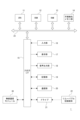
- FIG. 2 is a block diagram showing a hardware configuration example of the information processing apparatus 1.
- the information processing device 1 includes a CPU 11 .
- the CPU 11 executes various processes according to a program stored in a non-volatile memory unit 14 such as a ROM 12 or an EEP-ROM (Electrically Erasable Programmable Read-Only Memory), or a program loaded from a storage unit 19 to a RAM 13. .
- the RAM 13 also stores data necessary for the CPU 11 to execute various processes.
- the programs here may include an application program for implementing positioning based on the results of distance measurement by the phase-based method, and an application program for implementing various functions using the results of positioning, such as a navigation function.
- the CPU 11, ROM 12, RAM 13, and nonvolatile memory section 14 are interconnected via a bus 23.
- An input/output interface (I/F) 15 is also connected to this bus 23 .
- the input/output interface 15 is connected to an input section 16 including operators and operating devices.
- operators and operating devices such as keyboards, mice, keys, dials, touch panels, touch pads, and remote controllers are assumed.
- An operation is detected by the input unit 16 and a signal corresponding to the detected operation is interpreted by the CPU 11 .
- the input/output interface 15 is also connected integrally or separately with a display unit 17 such as an LCD (Liquid Crystal Display) or an organic EL (Electro-Luminescence) panel, and an audio output unit 18 such as a speaker.
- the display unit 17 is used to display various types of information, and is configured by, for example, a display device provided in the housing of the information processing apparatus 1, a separate display device connected to the information processing apparatus 1, or the like.
- the display unit 17 displays images for various types of image processing, moving images to be processed, etc. on the display screen based on instructions from the CPU 11 . Further, the display unit 17 displays various operation menus, icons, messages, etc., that is, as a GUI (Graphical User Interface) based on instructions from the CPU 11 .
- GUI Graphic User Interface
- the input/output interface 15 may be connected to a storage unit 19 composed of a HDD (Hard Disk Drive), a solid-state memory, etc., and a communication unit 20 composed of a modem, etc.
- a storage unit 19 composed of a HDD (Hard Disk Drive), a solid-state memory, etc.
- a communication unit 20 composed of a modem, etc.
- the communication unit 20 communicates with external devices via network lines such as the Internet.
- a drive 21 is also connected to the input/output interface 15 as necessary, and a removable recording medium 22 such as a magnetic disk, an optical disk, a magneto-optical disk, or a semiconductor memory is appropriately mounted.
- a removable recording medium 22 such as a magnetic disk, an optical disk, a magneto-optical disk, or a semiconductor memory is appropriately mounted.
- Data files such as programs used for each process can be read from the removable recording medium 22 by the drive 21 .
- the read data file is stored in the storage unit 19 , and the image and sound contained in the data file are output by the display unit 17 and the sound output unit 18 .
- Computer programs and the like read from the removable recording medium 22 are installed in the storage unit 19 as required.
- a wireless communication module 30 is also connected to the input/output interface 15 .
- the wireless communication module 30 is a communication module for performing short-range wireless communication with an external device.
- the wireless communication module 30 is configured to be able to perform wireless communication with the communication device 2 using BLE.
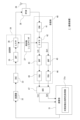
- FIG. 3 is a block diagram showing an internal configuration example of the wireless communication module 30.
- the wireless communication module 30 includes an arithmetic unit 31, a modulator 32, a DAC (Digital to Analog Converter) 33, a transmitter 34, a frequency synthesizer 37, an RF switch (SW) 38, an antenna 39, a receiver 40, and An ADC (Analog to Digital Converter) 47 is provided.
- the wireless communication module 30 in this example is capable of performing wireless communication using BLE. It becomes possible. Therefore, power consumption can be suppressed, and the size of the wireless communication module 30 can be reduced.
- the modulator 32 modulates a signal for wireless communication with the communication device 2 .
- modulation processing for example, IQ modulation is performed.
- I-channel (In-phase: in-phase component) and Q-channel (Quadrature: quadrature component) signals are used as baseband signals.
- the modulator 32 performs modulation processing as IQ modulation on the data to be transmitted supplied from the calculation unit 31 .
- the DAC 33 converts the digital signal from the modulator 32 into an analog signal.
- the analog signal converted by this DAC 33 is supplied to the transmission section 34 .
- the transmission unit 34 is a block that transmits signals by wireless communication. As illustrated, the transmission section 34 has a BPF (Band Pass Filter) 35 and a mixer 36 .
- the BPF 35 passes only signals in a specific frequency band. That is, the BPF 35 supplies the mixer 36 with only signals in a specific frequency band among the analog signals from the DAC 33 .
- the mixer 36 mixes the signal supplied from the BPF 35 with the local oscillation frequency supplied from the frequency synthesizer 37 to convert the signal into a transmission frequency for wireless communication.
- the frequency synthesizer 37 supplies frequencies used for transmission and reception. Specifically, the frequency synthesizer 37 has a local oscillator inside, and is used for conversion between a radio frequency signal and a baseband signal for wireless communication.
- the RF switch 38 is a switch that switches radio frequency (RF) signals.
- the RF switch 38 connects the transmitter 34 to the antenna 39 during transmission, and connects the receiver 40 to the antenna 39 during reception.
- Antenna 39 is an antenna for transmitting and receiving signals by wireless communication.
- the receiving unit 40 is a block that receives signals by wireless communication. As shown, the receiver 40 has an LNA (Low Noise Amplifier) 41, a mixer 42, a BPF 43, a VGA (Variable Gain Amplifier) 44, a BPF 45, and a VGA 46.
- LNA Low Noise Amplifier
- BPF 43 Low Noise Amplifier
- VGA Very Gain Amplifier
- the LNA 41 amplifies the RF signal received by the antenna 39.
- the mixer 42 mixes the signal supplied from the LNA 41 with the local oscillation frequency supplied from the frequency synthesizer 37 to obtain I-channel and Q-channel signals.
- An I-channel signal (denoted as “Ich” in the figure) is supplied to the BPF 43, and a Q-channel signal (denoted as “Qch” in the figure) is supplied to the BPF 45, respectively.
- the I-channel signal obtained by the mixer 42 is input to the BPF 43 to extract only the signal in a specific frequency band and supplied to the VGA 44 .
- the Q-channel signal obtained by the mixer 42 is input to the BPF 45 to extract only the signal in a specific frequency band and supplied to the VGA 46 .
- the VGA 44 and VGA 46 function as analog variable gain amplifiers that adjust the gains of the I-channel signal supplied from the BPF 43 and the Q-channel signal supplied from the BPF 45, respectively.
- the ADC 47 converts the I-channel and Q-channel signals from the receiver 40, that is, the I-channel and Q-channel signals output via the VGA 44 and VGA 46, from analog signals to digital signals.
- the I-channel and Q-channel signals converted into digital signals are supplied to the arithmetic unit 31 .
- the calculation unit 31 is configured with a microcomputer having, for example, a CPU (Central Processing Unit), a ROM (Read Only Memory), and a RAM (Random Access Memory). Various processes are executed according to the program loaded into the RAM from. For example, the calculation unit 31 performs processing for supplying data to be transmitted to the modulator 32 and modulating it. The calculation unit 31 also performs a process of demodulating received data based on the data of the I-channel and Q-channel signals supplied from the ADC 47 .
- a microcomputer having, for example, a CPU (Central Processing Unit), a ROM (Read Only Memory), and a RAM (Random Access Memory).
- Various processes are executed according to the program loaded into the RAM from. For example, the calculation unit 31 performs processing for supplying data to be transmitted to the modulator 32 and modulating it.
- the calculation unit 31 also performs a process of demodulating received data based on the data of the I-channel and Q-channel signals supplied from the ADC 47 .
- the calculation unit 31 has functions of a frequency-phase characteristic acquisition unit 31a and a distance calculation unit 31b shown in the figure as functions for performing distance measurement using wireless communication.
- the frequency phase characteristic acquisition unit 31 a acquires the phase characteristic with respect to frequency of the signal propagation path between the communication device 2 and the communication device 2 .
- processing is performed to acquire the phase characteristic with respect to the frequency of the signal propagation path.
- the distance calculation unit 31b calculates the distance to the communication device 2 based on the phase characteristics with respect to the frequency of the signal propagation path acquired by the frequency phase characteristics acquisition unit 31a.
- FIG. 4 is a block diagram showing an internal configuration example of the communication device 2. As shown in FIG. As can be seen by comparison with FIG. 3, the internal configuration of the communication device 2 is the same as the internal configuration of the wireless communication module 30, so redundant description is avoided. In addition, in the communication device 2, the distance calculation unit 31b is not essential, so the illustration is omitted, but it is also possible to adopt a configuration including the distance calculation unit 31b.
- FIG. 5 is a diagram showing an example of phase measurement in the phase-based method.
- the result of performing wireless communication while changing the frequency between two devices having a wireless communication function that is, between the information processing device 1 (wireless communication module 30) and the communication device 2 in this example, is Measure the phase based on
- a measurement signal is transmitted from the information processing device 1 (initiator) to the communication device 2 (reflector).
- the initiator here means a device that performs distance calculation processing based on the measured phase
- the reflector means a device paired with the initiator that exchanges measurement signals with the initiator.
- FIG. 5 mainly shows the flow of measurement signals relating to phase measurement, and illustration of the modulator 32, DAC 33, frequency synthesizer 37, and ADC 47, for example, is omitted.
- the measurement signal in the information processing device 1 as the initiator, the measurement signal is transmitted from the antenna 39 via the transmitter 34 from the calculator 31 . Also, in the communication device 2 as a reflector, the measurement signal is received by the receiver 40 via the antenna 39 .
- the measurement signal is returned from the communication device 2 to the information processing device 1. That is, in the communication device 2, the measurement signal is transmitted from the calculation unit 31 via the transmission unit 34 from the antenna 39, and in the information processing device 1, the measurement signal is received by the reception unit 40 via the antenna 39, and the calculation unit At 31 the phase characteristic between the two is measured.
- the measurement signal is transmitted from the calculation unit 31 via the transmission unit 34 from the antenna 39
- the measurement signal is received by the reception unit 40 via the antenna 39, and the calculation unit At 31 the phase characteristic between the two is measured.
- FIG. 6 is an explanatory diagram of the phase ⁇ of the signal propagation path measured in the phase-based method.
- the communication device 2 measures the signal phase ⁇ of the measurement signal.
- the signal phase ⁇ measured when the measurement signal is transmitted from the information processing device 1 (initiator) side to the communication device 2 (reflector) side is expressed as " ⁇ IR ". do. 5B, when the measurement signal is transmitted from the communication device 2 side to the information processing device 1 side, the information processing device 1 measures the signal phase ⁇ of the measurement signal. be.
- the signal phase ⁇ measured when the measurement signal is transmitted from the communication device 2 side to the information processing device 1 side in this way is expressed as " ⁇ RI ".
- the signal phase ⁇ is obtained by the following [Equation 1] when the signals of the I channel and the Q channel obtained by receiving the measurement signal are set to "I” and "Q", respectively.
- ⁇ tan ⁇ 1 ⁇ Q/I [Formula 1]
- the phase ⁇ of the signal propagation path is obtained based on the signal phase ⁇ IR and the signal phase ⁇ RI .
- the phase ⁇ is obtained by averaging the signal phase ⁇ IR and the signal phase ⁇ RI .
- the averaging operation here, in addition to the operation of finding the average value of the signal phases ⁇ IR and ⁇ RI , it is also possible to perform the addition operation of the signal phases ⁇ IR and the signal phases ⁇ RI . .
- the phase ⁇ as described above is measured for each frequency while sequentially changing the frequency of the measurement signal within a predetermined frequency band.
- the phase ⁇ is measured for each of a plurality of frequencies.
- the "predetermined frequency band” here may be a frequency band defined as a usage band according to communication standards, such as the 2.4 GHz band (band from 2400 MHz to 2480 MHz) for BLE. .
- the measurement result illustrated in FIG. 7A is obtained.
- the black circles in the figure represent the measurement results of the phase ⁇ at each frequency.
- the result shown in FIG. 7A can be rephrased as the phase characteristic with respect to the frequency of the signal propagation path.
- the phase-based method distance measurement is performed based on the change in phase ⁇ when the frequency changes. Specifically, in the characteristics of the phase ⁇ with respect to frequency change, the magnitude of the gradient of the phase ⁇ as shown in FIG. 7B correlates with the magnitude of the distance. At this time, the steeper the slope of the phase ⁇ , the longer the distance. Therefore, the distance can be calculated based on the gradient of the phase ⁇ .
- the reason for using the group delay ⁇ is to eliminate the influence of the 2 ⁇ ambiguity of the phase.
- the group delay ⁇ is obtained by differentiating the phase ⁇ with respect to the angular frequency ⁇ .
- the method of calculating the distance based on the characteristics of the phase ⁇ with respect to frequency is not limited to the above method, and various methods are conceivable.
- the characteristics of phase ⁇ with respect to frequency are obtained.
- the frequency characteristics of phase ⁇ but also the frequency characteristics of amplitude are obtained.
- a method of transforming the characteristic into a time response waveform by inverse Fourier transform such as IFFT (Inverse Fast Fourier Transform) and obtaining the distance based on the time response waveform can be considered.
- IFFT Inverse Fast Fourier Transform
- the phase-based method Since the phase ⁇ changes according to the frequency, distance measurement by the phase-based method is possible in principle by measuring the phase ⁇ for at least two or more frequencies.
- the distance is calculated by obtaining the phase ⁇ from the measurement result of the signal phase ⁇ in both directions from the information processing device 1 to the communication device 2 and from the communication device 2 to the information processing device 1.
- this is a method for obtaining the distance based on the relative difference information of the signal phase ⁇ . Therefore, the phase-based method has the advantage that it is possible to prevent the accuracy of distance measurement from deteriorating due to the absolute value of the circuit delay of each block involved in signal transmission/reception and the variation due to the temperature characteristics.
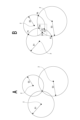
- the position of the information processing device 1 can be determined by triangulation. can be specified. Specifically, since the arrangement position of each communication device 2 as a beacon is known, the position of the information processing device 1 is centered on the position of each communication device 2, as shown in FIG. 8A. It can be obtained as an intersection (x mark in the figure) of three circles each having a radius of a distance D (D1 to D3 in the figure). However, in practice, it is rare for the three circles to intersect at one point. That is, even if the circles intersect, there are usually a plurality of points of intersection P present.
- FIG. 8B shows how the three circles do not intersect at one point and the three circles give rise to a total of six points of intersection P1, P2, P3, P4, P5 and P6.
- the position of the positioning target device that is, the information processing device 1
- the position of the positioning target device can be calculated.
- the three points that connect the points and form a triangle that has the smallest area in other words, form an overlapping portion of three circles.
- the positioning calculation method for specifying the position of the positioning target device using the distance D between the plurality of communication devices 2 is limited to the positioning calculation method using the centroid method (centroid method) as described above. It is not limited to a specific method, but can be considered in various ways.
- FIG. 9 shows the result of transforming the frequency characteristic of the phase ⁇ into time domain waveform data by inverse Fourier transform (for example, IFFT).
- FIG. 9A shows the result at high reliability
- FIG. 9B shows the result at low reliability.
- time domain waveform data obtained by performing inverse Fourier transform on the frequency characteristics of the phase ⁇ measured multiple times are superimposed.
- the horizontal axis is time
- the vertical axis is amplitude
- the thick dotted line indicates an ideal one-wave model (ideal model).
- the ability to obtain such time-domain waveform data information is a unique advantage of the phase-based method, which acquires the frequency characteristics of the phase ⁇ by frequency sweeping. This is an advantage that cannot be obtained in the case of adopting the conventional ranging method using .
- the reliability obtained as the degree of correlation with the time-domain waveform data as the ideal model as described above is the reliability regarding distance measurement when distance measurement is performed by the phase-based method. From this point, this reliability is hereinafter referred to as “distance measurement reliability”. Note that the ranging reliability is also generally referred to as “signal quality", “multipath influence”, or the like.
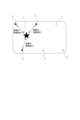
- FIG. 10 schematically shows how the positioning system shown in FIG. 1 is arranged in a certain space such as inside a building.
- at least three communication devices 2 are used at first.
- communication devices 2 with low ranging accuracy should not be selected.
- among the communication devices 2 in the positioning system there is a communication device 2 that is blocked by an obstacle X when viewed from the information processing device 1 as the positioning target device.
- the information processing device 1 performs communication processing to obtain the frequency characteristics of the phase ⁇ with all the communication devices 2 with which communication is possible, and obtains the distance measurement reliability for each communication device 2.
- this embodiment proposes a positioning method as described below.
- FIG. 11 is a functional block diagram showing functions relating to the positioning method as the first embodiment, which the CPU 11 of the information processing device 1 has. As illustrated, the CPU 11 functions as a primary selection processing unit F1, a determination processing unit F2, and a reselection processing unit F3.
- the primary selection processing unit F1 primarily selects a plurality of communication devices 2 to be used for positioning.
- the selection processing by the primary selection processing unit F1 is communication processing for distance measurement by the phase-based method with the communication device 2 (communication processing for measuring phase ⁇ for each frequency). process), it can be defined as a process of selecting the communication device 2 .
- the communication device 2 when outputting one positioning result, after selecting the communication device 2 as the primary selection, the communication device 2 can be selected again based on the reliability (re-selection, which will be described later). reselection processing by the selection processing unit F3). In this respect, the expression "primary" selection is used.
- the above-mentioned "communication processing for distance measurement by the phase-based method” means communication processing for obtaining the characteristic of phase ⁇ with respect to frequency, that is, the phase characteristic with respect to frequency of the signal propagation path. means a process of communicating a plurality of measurement signals with different frequencies with the communication device 2 .
- the primary selection by the primary selection processing unit F1 may be performed as follows. 1) Based on RSSI (received signal strength from communication device 2). 2) Performed based on position coordinate information indicating the arrangement position of the communication device 2 3) Performed based on the RSSI and position coordinate information indicating the arrangement position of the communication device 2 4) Information processing device 1 calculated based on the RSSI Based on the position coordinate information of (positioning target device) and the position coordinate information indicating the arrangement position of the communication device 2
- the RSSI and the position coordinate information indicating the arrangement position of the communication device 2 can be obtained from the BLE advertising signal.
- the advertising signal from the communication device 2 is received by the information processing device 1 before positioning is started.
- the information processing device 1 can communicate with the communication device 2 that has received the advertising signal.
- RSSI information can be obtained when the advertising signal is received.
- the position coordinate information of the communication device 2 included in the advertising signal can be obtained.
- a prescribed number of communication devices 2 are used for positioning.
- the specified number (positioning specified number) referred to here means a value that specifies the number of communication devices 2 used in the positioning process for obtaining the positioning result to be output.
- the plurality of communication devices 2 for positioning are arranged two-dimensionally. is defined as "3".
- the required number of the communication devices 2 for realizing the positioning is "4", and the specified number may be set to "4". .
- RSSI can be, for example, a method of selecting the upper specified number of communication devices 2 having a large RSSI.
- the area of the figure (triangle in this example) formed by connecting the positional coordinates of the communication device 2 is set to a certain value or more.
- a selection method can be mentioned.
- the communication device 2 with the maximum RSSI and the upper residual number (that is, the specified number - 1) with a short distance from the position and the communication device 2 can be selected.
- the position of the information processing device 1 calculated based on the RSSI is selected.
- a method of selecting the closest communication device 2 and the communication device 2 with the highest remaining number of communication devices 2 whose distance from the position of the communication device 2 is short can be mentioned.
- the selection method of 4 there is a method of selecting a set of communication devices 2 that can surround the position of the information processing device 1 calculated based on the RSSI.
- FIG. 12 is a diagram exemplifying a combination of communication devices 2 that can surround the information processing device 1 and a combination of communication devices 2 that cannot surround the information processing device 1 with respect to the latter technique of 4).
- FIG. 12A exemplifies the case where enclosing is possible
- FIGS. 12B and 12C illustrate the case where enclosing is not possible.
- a determination processing unit F2 determines whether reselection of the communication device 2 used for positioning is required based on the reliability information obtained for the communication device 2 primarily selected by the primary selection processing unit F1. I do.
- the wireless communication module 30 executes communication processing for distance measurement by the phase-based method with each of the communication devices 2 that are primarily selected, and the reliability is calculated.
- the reliability the distance measurement reliability described above is calculated for each communication device 2 .
- the determination result indicates that reselection is required. is obtained, and a determination result is obtained that reselection is not required when the condition is satisfied.
- FIG. 13 shows the distance to each communication device 2 obtained by performing ranging by the phase-based method with each communication device 2 that has been primarily selected, and the ranging reliability calculated for each communication device 2.
- a parameter determined in 100 steps for example, based on the impulse response waveform is used as the distance measurement reliability.
- the parameter approaches 100 as the reliability of the distance measurement result increases.
- the reliability is expressed as 80
- the reliability is expressed as 20. is represented by
- the reliability not only the ranging reliability but also the positioning reliability indicating the reliability of positioning can be used.
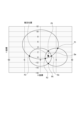
- the positioning reliability will be described with reference to FIG. If the distances D1, D2, and D3 to each of the three communication devices 2 are obtained as described above, positioning can be performed based on the intersection of circles having radii of these distances D1, D2, and D3, respectively. At this time, ideally, as shown in FIG. 9A, each circle intersects at one point. , where three circles overlap as illustrated in FIG. 14, has a certain area. Therefore, the size of the area where the three circles overlap can be used as an indicator of the positioning reliability. In FIG.
- the method of calculating the positioning reliability is not limited to the methods exemplified above.
- the area itself of the portion where three circles overlap can be used as the positioning reliability.
- the determination by the determination processing unit F2 may be performed, for example, by determining whether or not the condition that the positioning reliability is equal to or less than a predetermined threshold THp is satisfied. In this case, if the condition is satisfied, a determination result is obtained that reselection is required, and if the condition is not satisfied, a determination result is obtained that reselection is not required.
- the reselection processing unit F3 reselects the communication device 2 used for positioning in response to the determination by the determination processing unit F2 that reselection is required.
- the processing of the reselection processing unit F3 will be described here when the information on the reliability of distance measurement is used as the reliability information in the determination by the determination processing unit F2. Processing when positioning reliability is used as reliability information will be explained later.
- the reselection processing unit F3 performs reselection based on the information on the reliability of distance measurement obtained for each communication device 2 that is primarily selected. Specifically, in this example, based on the ranging reliability used in the determination by the determination processing unit F2, the selection state is maintained for the communication devices 2 whose ranging reliability is equal to or greater than a predetermined value. (that is, the remaining communication devices 2 among all the communication devices 2 that can communicate) are selected as reselection targets. As a result, it is possible to improve the efficiency of the processing related to reselection.
- reselection is based on the premise that the number of communication devices 2 to be in the selected state after reselection should be the specified number. That is, if there is only one communication device 2 with a distance measurement reliability of a predetermined value or more, two communication devices 2 are reselected, and two communication devices 2 with a distance measurement reliability of a predetermined value or more are selected. , one communication device 2 is reselected.
- target number of devices T the number of communication devices 2 to be reselected, which is obtained based on the ranging reliability of the communication devices 2 that are primarily selected in this way, is referred to as "target number of devices T".
- Reselection of the communication device 2 by the reselection processing unit F3 may be performed as follows. 5) Re-selection is performed based on RSSI 6) Re-selection is performed based on position coordinate information indicating the arrangement position of the communication device 2 7) Distance measurement by the phase-based method performed for each communication device 2 that is primarily selected Reselection is performed based on the position coordinate information of the information processing device 1 obtained by positioning based on the result (corresponding to the coordinate information of the estimated position described above) and the position coordinate information indicating the arrangement position of the communication device 2.
- the communication device 2 with the maximum RSSI and the top T-1 communication devices 2 with the shortest distance between them are reselected.
- the area of the figure formed by connecting the communication device 2 whose distance measurement reliability is equal to or higher than a predetermined value and the newly selected communication device 2 is set to be equal to or larger than a certain value.
- a method of reselection can be mentioned.
- T communication devices 2 to be combined with communication devices 2 whose distance measurement reliability is equal to or higher than a predetermined value are sequentially selected, and T communication devices 2 that can surround the estimated position are detected. Accordingly, the T communication devices 2 are reselected.
- the CPU 11 when the communication device 2 is reselected, the CPU 11 causes the wireless communication module 30 to execute communication processing for distance measurement by the phase-based method for the reselected communication device 2, thereby increasing the distance measurement reliability. Calculate the degrees. If the distance measurement reliability of all of the reselected communication devices 2 is equal to or higher than a predetermined value, the CPU 11 determines the distance measurement result between the primarily selected communication device 2 and the distance between the reselected communication device 2 Positioning calculation is performed based on the distance measurement result, and processing for outputting the positioning result is performed.
- the CPU 11 reselects the communication device 2 again. Thereafter, reselection is repeated until the distance measurement reliability of all the reselected communication devices 2 reaches or exceeds a predetermined value.
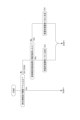
- FIG. 15 An example of a specific processing procedure to be executed in order to implement the positioning method as the first embodiment described above will be described with reference to the flowchart of FIG. 15 .
- the processing shown in FIG. 15 is executed by the CPU 11 shown in FIG.
- the CPU 11 performs primary selection processing for the communication device 2 in step S101. That is, the primary selection process of the communication device 2 is performed by the method exemplified above.
- step S ⁇ b>102 following step S ⁇ b>101 the CPU 11 performs distance measurement execution control by the phase-based method with the selected communication device 2 . That is, the wireless communication module 30 is controlled so as to perform distance measurement by the phase-based method with each communication device 2 that was primarily selected in step S101.
- the wireless communication module 30 is caused to perform up to distance measurement for the communication device 2 that is primarily selected. When used, there is no need to execute up to distance measurement, and at least communication processing for distance measurement by the phase-based method may be executed.
- step S103 following step S102 the CPU 11 performs reliability calculation processing. That is, the distance measurement reliability is calculated based on the information on the frequency characteristics of the phase ⁇ obtained by the distance measurement execution control in step S102. Further, when positioning reliability is used as the reliability information as will be described later, the positioning reliability is calculated. Since the method of calculating the reliability of ranging and positioning has already been explained, redundant explanation is avoided.
- step S104 the CPU 11 determines whether reselection is required. For example, as described above, based on the ranging reliability calculated for each communication device 2 that is primarily selected, whether or not the ranging reliability of all the communication devices 2 is equal to or higher than a predetermined value is determined again. This is performed as a judgment as to whether or not selection is required. Note that another example of the reselection determination in step S104 can be adopted, and this point will be described again with reference to FIGS. 17 to 19. FIG.
- step S104 When it is determined in step S104 that reselection is required, the CPU 11 advances to step S105 to execute processing for determining the number of communication devices to be reselected.
- the number of communication devices to be reselected is the aforementioned target number of devices T, and the number of communication devices 2 to be in the selected state after reselection is determined to be the prescribed number.
- the process of determining the number of communication devices in step S105 can also take another example, and this point will be explained again with reference to FIGS. 17 to 19.
- step S106 the CPU 11 performs reselection processing of the communication device 2. Since the method of this reselection process has already been explained, redundant explanation is avoided.
- step S106 In response to the execution of the reselection process in step S106, the CPU 11 performs distance measurement execution control by the phase-based method with the reselected communication device 2 in step S107. Then, the CPU 11 returns to step S103 in response to performing the distance measurement execution control in step S107. As a result, reliability information as distance measurement reliability and positioning reliability can be calculated for the reselected communication device 2 . Thereafter, in step S104, based on the reliability information of the reselected communication device 2, it is determined whether or not further reselection is required. The process proceeds to S105 and thereafter. In other words, reselection is repeated until it is determined that reselection is unnecessary (that is, until the distance measurement reliability of all reselected communication devices 2 reaches a predetermined value or higher in this example). becomes.
- step S104 When it is determined in step S104 that reselection is not required, the CPU 11 proceeds to step S108 and performs positioning result output processing. That is, the positioning result is output to an application or the like that uses the position information of the information processing device 1, for example.
- the positioning result output process of step S108 if only the distance measurement reliability is used as the reliability information, positioning is not performed for the specified number of selected communication devices 2, so positioning calculation is performed. Above, output the positioning result.
- the wireless communication module 30 when the wireless communication module 30 is not caused to perform ranging with the selected communication devices 2 in calculating the ranging reliability, Based on the information of the frequency characteristic of the phase ⁇ obtained by the communication processing between the terminals, the distance measurement calculation is performed, the positioning calculation is performed based on the distance measurement result, and the positioning result is output.
- FIG. 16 is a flowchart showing processing as a modification of the first embodiment.
- the processing as this modification is processing based on the premise that the position of the information processing device 1 is sequentially acquired when the information processing device 1 moves, for example, when the information processing device 1 is used for navigation.
- the same step numbers are assigned to processes that are the same as the processes that have already been described, and descriptions thereof are omitted.
- the CPU 11 determines in step S109 whether or not the positioning process has ended in response to executing the positioning result output process in step S108. That is, it is determined whether or not a predetermined condition defined as a termination condition of positioning processing is satisfied.
- the CPU 11 advances to step S110, performs distance measurement execution control by the phase-based method with the currently selected communication device 2, and returns to step S103.
- the primary selection processing described in FIG. Processing is performed, and when positioning results are output thereafter, it is determined whether or not reselection is required for the selected communication device 2 based on its reliability information. A selection process is performed. Therefore, it is possible to improve the positioning accuracy in response to the case where the positioning results are sequentially output.
- step S104 Another example of the process of determining whether reselection is necessary (step S104) and the process of determining the number of communication devices to be reselected (step S105) will be described with reference to the flowcharts of FIGS.
- FIG. 17 is a flowchart of processing as a first example.
- the CPU 11 determines whether or not a specified number of high-reliability distance measurement results have been obtained.
- the high-reliability distance measurement result referred to here can be paraphrased as the communication device 2 whose distance measurement reliability is equal to or higher than a predetermined value.
- the determination processing in step S11 corresponds to determining whether or not the condition that the distance measurement reliability of all the primarily selected communication devices 2 is equal to or greater than a predetermined value is satisfied.
- step S11 if the prescribed number of highly reliable ranging results have been obtained, the CPU 11 advances the process to step S108 (positioning result output processing).
- step S12 determines whether the high-reliability distance measurement results are the specified number minus one. That is, it is determined whether or not the number of communication devices 2 whose distance measurement reliability is equal to or greater than a predetermined value is the specified number minus one.
- one of the reselected communication devices 2 has low reliability. Even if there is, there is still a possibility that the reselected another communication device 2 is highly reliable. It is possible to avoid having to make a selection. Therefore, it is possible to shorten the time required for positioning and reduce the processing load related to positioning.
- the number of selected devices is variably set. Specifically, in the above example, the number of reselected devices is increased as the number of communication devices 2 whose distance measurement reliability is equal to or higher than a predetermined value is smaller. If the number of communication devices 2 whose distance measurement reliability is equal to or higher than a predetermined value is small among the primarily selected communication devices 2, it is estimated that the environment is difficult to perform distance measurement. Therefore, by increasing the number of reselection devices, the possibility of reselection can be reduced, the time required for positioning can be shortened, and the processing load related to positioning can be reduced.
- FIG. 18 is a flowchart of processing as a second example.
- the CPU 11 determines in step S11 that the specified number of high-reliability ranging results have not been obtained, and in step S12 determines whether or not the high-reliability ranging result is the specified number minus one.
- the process proceeds to step S21, and it is determined whether or not the positioning reliability is equal to or greater than the threshold THp. If the positioning reliability is equal to or higher than the threshold THp, the CPU 11 advances the process to step S108.
- step S108 the distance measurement result output process of step S108 is executed.
- FIG. 19 is a flowchart of processing as a third example.
- the CPU 11 determines whether or not the positioning reliability is equal to or higher than the threshold THp in step S31, and advances the process to step S108 if the positioning reliability is equal to or higher than the threshold THp. That is, in this case, the determination as to whether or not reselection is required is made based on the positioning reliability rather than the ranging reliability.
- the determination as to whether or not reselection is required is performed based on the ranging reliability and the positioning reliability. Specifically, as described in the process flow of steps S11 ⁇ S12 ⁇ S21 in FIG. Even in such a case, if the positioning reliability of these communication devices 2 is equal to or higher than the threshold value THp, a determination result is obtained that reselection is not required.
- the method of determining whether or not reselection is required based on the ranging reliability and the positioning reliability is not limited to this example.
- the number of reselected devices is determined according to the number of highly reliable ranging results for the primarily selected communication device 2, but the number of reselected devices is determined by the primarily selected communication device 2 may also be considered.
- Second Embodiment> Next, a second embodiment will be described.
- the second embodiment switches between positioning methods based on reliability information.
- the configuration of the positioning system, the configuration of the information processing device 1, and the configuration of the communication device 2 are the same as in the case of the first embodiment, so explanations using drawings will be omitted.
- the information processing device 1 is assumed to be configured as a device having a wireless communication function using a method different from BLE. Specifically, it is assumed to have a wireless communication function based on the UWB (Ultra Wide Band) system.
- UWB Ultra Wide Band
- FIG. 20 is a functional block diagram showing functions of the CPU 11 in the information processing apparatus 1 as the second embodiment.
- the CPU 11 in this case has functions as a selection processing section F1A, a determination processing section F2A, and a distance measurement control section F4.
- the selection processing unit F1A performs the same processing as the primary selection processing unit F1 described in the first embodiment.
- the reason why the name is "selection processing unit” is that the second embodiment does not assume that reselection is performed after selection of the communication device 2 as the primary selection. Instead of using the expression “selection”.
- the determination processing unit F2A determines whether or not to perform range finding by a method other than the phase-based method, based on the reliability information about the range. In this example, the determination processing unit F2A determines whether or not to perform range finding using a method other than the phase-based method, based on the ranging reliability calculated for each of the specified number of communication devices 2 selected by the selection processing unit F1A. judgment is made. Specifically, it is determined whether or not the condition that the distance measurement reliability of all the specified number of communication devices 2 selected by the selection processing unit F1A is equal to or higher than a predetermined value is satisfied.
- the distance measurement control unit F4 Based on the determination result of the determination processing unit F2A, the distance measurement control unit F4 performs control so that the distance measurement is performed by a method other than the phase-based method. Specifically, the determination processing unit F2A of this example performs control so that distance measurement by wireless communication, which uses a wider frequency band than BLE, is performed as distance measurement by another method. More specifically, as distance measurement by another method, control is performed so that distance measurement by the UWB method is performed.
- FIG. 21 is a flow chart showing processing as the second embodiment.
- the CPU 11 in this case calculates the reliability of distance measurement for each of the communication devices 2 that are primarily selected by the reliability calculation process of step S103. is required. That is, it is determined whether or not the distance measurement reliability of all of the selected specified number of communication devices 2 satisfies a predetermined value or more as a determination of whether or not the distance measurement by another method is required. Specifically, in the process of step S202, if the above condition is satisfied, a determination result is obtained that distance measurement by another method is not required, and if the above condition is not satisfied, it is determined that distance measurement by another method is required. Get the judgment result.
- step S201 If it is determined in step S201 that another method of distance measurement is not required, the CPU 11 proceeds to step S202 and performs positioning calculation based on the distance measurement result of the phase-based method. That is, the positioning calculation is performed based on the distance information obtained by the distance measurement performed with each communication device 2 in step S103. After performing the positioning calculation in step S202, the CPU 11 executes the positioning result output process in step S108, and finishes the series of processes shown in FIG.
- step S201 determines that distance measurement by another method is not required
- the CPU 11 proceeds to step S203 and performs distance measurement execution control by the UWB method. That is, the wireless communication module based on the UWB system is caused to perform the distance measurement operation based on the UWB system. Then, in step S204 following step S203, the CPU 11 performs positioning calculation based on the distance measurement result by the UWB method, and executes positioning result output processing in step S108.
- the processing as the second embodiment as described above in response to the case where the reliability of the ranging by the phase-based method is low, the ranging by wireless communication using a wider frequency band, that is, the ranging accuracy is improved. Positioning can be performed by switching to ranging using a method that can be expected to improve the Therefore, it is possible to improve the positioning accuracy.
- the third embodiment relates to a tag search function.
- the tag search function referred to here is, for example, a function of presenting to the user at least the distance to the wireless communication device as a tag in the information processing device 1 such as a smart phone. This tag search function allows the user to search for objects tagged in advance.
- the tag search function acquires distance information by switching between distance measurement based on BLE RSSI (received signal strength) and distance measurement by the UWB method. Specifically, first, by performing distance measurement based on RSSI, it is roughly specified whether the tag is likely to exist in a position close to a certain extent, such as in the same room or building. If the tag is likely to exist nearby, the distance measurement to the tag is obtained by switching to UWB distance measurement in order to specify a more specific distance.
- BLE RSSI received signal strength
- the phase-based ranging is performed to solve the above problem.
- FIG. 22 is a functional block diagram showing functions of the CPU 11 in the information processing apparatus 1 as the third embodiment.
- the hardware configuration of the information processing device 1 is the same as in the case of the second embodiment.
- it is configured to have a wireless communication function based on the UWB system.
- a communication device 2A as a tag is used instead of the communication device 2 .
- the communication device 2A as a tag is configured to be able to execute communication processing for distance measurement by the phase-based method like the communication device 2, and has a wireless communication function by the UWB method. It is configured.
- the CPU 11 in this case has functions as a selection processing unit F5, a determination processing unit F2B, and a distance measurement control unit F6.
- the selection processing unit F5 performs processing for selecting the communication device 2A from a plurality of communication devices 2A.
- FIG. 23 is an explanatory diagram of the flow of ranging in the third embodiment.
- the tag search is performed for a tag selected from a plurality of tags.
- the selection processing unit F5 performs processing for selecting one communication device 2A based on a user's selection operation from among the plurality of communication devices 2A as tags (see FIG. 23A).
- the determination processing unit F2B determines whether or not to perform range finding by a method other than the phase-based method, based on the information on the reliability of range finding.
- the CPU 11 causes the selected communication device 2A to perform distance measurement by the phase-based method, and calculates the distance measurement reliability based on the frequency characteristics of the phase ⁇ obtained by the distance measurement. (See FIG. 23B).
- the determination processing unit F2B determines whether or not to perform range finding by a method other than the phase-based method based on the range measurement reliability thus obtained.
- the determination processing unit F2B obtains a determination result that the distance measurement is performed by a method different from the phase-based method if the distance measurement reliability is not equal to or greater than a predetermined value. On the other hand, if the distance measurement reliability is equal to or higher than the predetermined value, the determination processing unit F2B obtains a determination result that distance measurement by a method other than the phase-based method is not performed.
- the distance measurement control unit F6 performs control so that distance measurement by another method is performed based on the determination result of the determination processing unit F2B. Specifically, when the determination processing unit F2B determines to perform range finding by another method, the range finding control unit F6 performs control to perform range finding by the UWB method (see FIG. 23C). When the reliability of distance measurement is equal to or higher than a predetermined value and the determination processing unit F2B determines that distance measurement by another method is not performed, the CPU 11 performs processing for outputting the distance measurement result of the distance measurement performed by the phase-based method. conduct.
- FIG. 24 is a flowchart showing a specific processing procedure example for realizing the distance measurement method as the third embodiment described above.
- the CPU 11 accepts the selection of the communication device 2A (tag) in step S301, and selects one communication device 2A from the plurality of communication devices 2A based on the user's selection operation.
- step S302 the CPU 11 performs distance measurement execution control by the phase-based method with the selected communication device 2A. Further, in step S303, the CPU 11 executes distance measurement reliability calculation processing, and in step S304, determines whether or not another method of distance measurement is required. Specifically, in this example, it is determined whether or not the reliability of distance measurement is equal to or higher than a predetermined value, and if the reliability of distance measurement is not equal to or higher than the predetermined value, another method of distance measurement is performed (another method of distance measurement is required). If the reliability of distance measurement is equal to or higher than a predetermined value, a judgment result is obtained that distance measurement by another method is not performed (distance measurement by another method is not required).
- step S304 If it is determined in step S304 that distance measurement by another method is not required, the CPU 11 proceeds to step S305 to perform processing for outputting the distance measurement result by the phase-based method, and proceeds to step S308.
- step S304 determines whether distance measurement by another method is not required. If it is determined in step S304 that distance measurement by another method is not required, the CPU 11 advances to step S306 to perform distance measurement execution control by the UWB method, and in subsequent step S307 performs processing to output the distance measurement result. The process proceeds to step S308.
- step S308 the CPU 11 determines whether or not the distance measurement process has ended, and if the distance measurement process has not ended, the process returns to step S302. On the other hand, if the distance measurement process is finished, the CPU 11 finishes the series of processes shown in FIG.
- range finding by another method is not limited to range finding by the UWB method.
- a distance measurement method using wireless communication that uses a wider frequency band than at least BLE may be used.
- the distance measurement by another method may be, for example, the ToF (Time of Flight) method or the LiDAR (Light Detection And Ranging) method.
- the embodiment is not limited to the specific example described above, and various modifications can be made.
- the terminal device such as a smartphone, which performs communication processing for distance measurement by the phase-based method between the communication device 2 and the communication device 2, performs up to positioning.
- the device performs processing up to distance measurement
- the cloud server capable of network communication with the terminal device performs positioning calculation using the distance measurement result obtained from the terminal device and the position coordinate information of the communication device 2.
- the primary selection process, the determination process of the determination processing unit F2, and the reselection process are performed by a cloud server. That is, the cloud server is configured to execute processing as an information processing apparatus according to the present technology.
- the terminal device may transmit the phase ⁇ data (or time-axis waveform data) for each frequency to the cloud server to calculate the ranging reliability. may be calculated, and the calculated distance measurement reliability may be transmitted to the cloud server. It is arbitrary which of the primary selection process, the determination process of the determination processing unit F2, and the reselection process is performed by the terminal device or the cloud server.
- the information processing apparatus (same 1) according to the embodiment performs communication processing for distance measurement by the phase-based method with the selected communication apparatus, and performs distance measurement or positioning. Based on the reliability information of the determination processing unit (F2 , F2A, F2B). By performing ranging using the phase-based method, it is possible to obtain reliability information indicating the reliability of ranging or the reliability of positioning based on ranging results.
- the communication device used for positioning is reselected, and when the reliability of distance measurement by the phase-based method is low, distance measurement by another method is performed. It will be possible to make it possible to Therefore, it is possible to improve the accuracy of positioning based on the results of distance measurement by the phase-based method or distance measurement using a communication device.
- the information processing apparatus includes a primary selection processing unit (F1) that primarily selects a plurality of communication devices used for positioning, and the determination processing unit (F2) performs primary selection by the primary selection processing unit. Based on the reliability information obtained for the obtained communication device, it is determined whether or not reselection of the communication device used for positioning is required. This makes it possible to reselect a communication device to be used for positioning in response to a case where there is a communication device with low reliability among the communication devices that have been primarily selected. Therefore, it is possible to improve the accuracy of positioning based on the results of distance measurement by the phase-based method.
- the primary selection processing unit performs primary selection based on the received signal strength from the communication apparatus.
- the primary selection processing unit performs primary selection based on the received signal strength from the communication apparatus.
- the primary selection processing unit performs primary selection based on positional coordinate information indicating the arrangement position of the communication apparatus.
- positional coordinate information indicating the arrangement position of the communication apparatus.
- the primary selection By performing selection based on the position coordinate information of the communication device as the primary selection, it is possible to eliminate the need to perform communication processing for distance measurement using the phase-based method with all communication devices that can communicate with each other when positioning. becomes. Therefore, it is possible to shorten the time required for positioning and reduce the processing load.
- by making a selection based on the positional coordinate information of the communication device as the primary selection it is possible to select a communication device that satisfies the arrangement condition that can be expected to improve the accuracy of positioning and ranging as the arrangement condition of the communication device used for positioning. As a result, it is possible to prevent reselection from occurring as much as possible. Therefore, in this respect as well, it is possible to shorten the time required for positioning and reduce the processing load.
- the primary selection processing unit performs primary selection based on the received signal strength from the communication device and the position coordinate information indicating the arrangement position of the communication device.
- the primary selection processing unit includes the position coordinate information of the positioning target device calculated based on the received signal strength from the communication device and the position coordinate information indicating the arrangement position of the communication device.
- the primary selection is made on the basis of Even with the above configuration, the primary selection is performed based on the received signal strength and the positional coordinate information of the communication device. Therefore, when performing positioning, it is possible to eliminate the need to perform communication processing for distance measurement using the phase-based method with all communication devices that can communicate, shortening the time required for positioning and reducing the processing load. can be planned.
- the determination processing unit determines whether or not reselection is required based on distance measurement reliability information, which is reliability information about distance measurement. Since positioning in this case is performed based on the results of ranging by the phase-based method, by using ranging reliability information that indicates the reliability of ranging by the phase-based method, reselection determination, that is, positioning It is possible to accurately determine whether or not the required communication device should be reselected.
- distance measurement reliability information which is reliability information about distance measurement. Since positioning in this case is performed based on the results of ranging by the phase-based method, by using ranging reliability information that indicates the reliability of ranging by the phase-based method, reselection determination, that is, positioning It is possible to accurately determine whether or not the required communication device should be reselected.
- the determination processing unit determines whether or not reselection is required based on the positioning reliability information, which is reliability information about positioning.
- the distance measurement reliability information may be calculated as a value different from the true value due to some factor.
- the information processing apparatus includes a reselection processing unit (F3 in the same) that reselects the communication device used for positioning in response to the determination that reselection is required by the determination processing unit.
- a reselection processing unit F3 in the same
- the reselection processing unit performs reselection based on the reliability information about distance measurement obtained for each communication apparatus that is primarily selected.
- the reselection processing unit performs reselection based on the reliability information about distance measurement obtained for each communication apparatus that is primarily selected.
- the reselection processing unit performs reselection based on the received signal strength from the communication device.
- the reselection processing unit performs reselection based on the received signal strength from the communication device.
- the reselection processing unit performs reselection based on position coordinate information indicating the arrangement position of the communication device.
- position coordinate information indicating the arrangement position of the communication device.
- the reselection processing unit includes the position coordinates of the positioning target device obtained by positioning based on the results of distance measurement by the phase-based method performed for each of the primarily selected communication devices. Reselection is performed based on the information and the positional coordinate information indicating the arrangement position of the communication device.
- re-selection by performing selection based on the position coordinate information of the positioning target device obtained from the phase-based ranging result at the time of primary selection and the position coordinate information of the communication device, As a placement condition, it is possible to select a communication device that satisfies the placement condition that can be expected to improve the accuracy of positioning and ranging, and it is possible to prevent the situation where the communication device is reselected after reselection as much as possible. Become. Therefore, in this respect as well, it is possible to shorten the time required for positioning and reduce the processing load.
- the reselection processing unit performs reselection so that the number of communication devices that are in a selected state after reselection matches the prescribed number of positioning.
- the defined number of positioning means a value that defines the number of communication devices used in the positioning process for obtaining the positioning result to be output.
- the reselection processing unit performs reselection so that the number of communication devices that are in the selected state after reselection is greater than the prescribed number of positioning. If reselection is performed so that the number of communication devices that are in the selected state after reselection is the specified positioning number, if the reliability of the reselected communication device is low, another communication device will be immediately selected. You have to choose. On the other hand, if reselection is performed so that the number of communication devices that are in the selected state after reselection as described above is greater than the specified positioning number, one communication device among the reselected communication devices is unreliable.
- the determination processing unit determines whether or not to perform range finding by a method other than the phase-based method, based on the reliability information about the range. making judgments.
- the reliability of the distance measurement by the phase-based method is low, it is possible to determine that the distance measurement should be performed by another method, such as the UWB method, which is expected to have higher accuracy in distance measurement. Therefore, it is possible to improve the distance measurement accuracy.
- the information processing apparatus as an embodiment is provided with a distance measurement control section (F4, F6 in the same) that performs control so that distance measurement by another method is performed based on the determination result of the determination processing section.
- a distance measurement control section F4, F6 in the same
- the distance measurement by the phase-based method is unreliable, it is possible to switch to another method, such as the UWB method, in which higher accuracy in distance measurement can be expected. Therefore, it is possible to improve the distance measurement accuracy.
- distance measurement by the phase-based method is performed by wireless communication of BLE, and the distance measurement control unit uses a frequency band that is higher than that of BLE for distance measurement by another method. Control is performed so that distance measurement is performed using broadband wireless communication.
- the information processing device performs communication processing for ranging by the phase-based method with the selected communication device, and reliability information about ranging or positioning obtained by performing communication processing
- the program of the embodiment is a program readable by a computer device, and is a program for distance measurement or positioning obtained by performing communication processing for distance measurement by a phase-based method with a selected communication device.
- a function to determine whether reselection of the communication device used for positioning is required based on the reliability information, or to determine whether or not to perform distance measurement by a method other than the phase-based method is implemented in the computer device.
- the program as described above can be recorded in advance in an HDD as a recording medium built in a device such as a computer device, or in a ROM or the like in a microcomputer having a CPU.
- a flexible disc a CD-ROM (Compact Disc Read Only Memory), an MO (Magneto Optical) disc, a DVD (Digital Versatile Disc), a Blu-ray disc (Blu-ray Disc (registered trademark)), a magnetic disc, a semiconductor memory
- a removable recording medium such as a memory card.
- Such removable recording media can be provided as so-called package software.
- it can also be downloaded from a download site via a network such as a LAN (Local Area Network) or the Internet.
- LAN Local Area Network
- such a program is suitable for wide provision of the determination processing units F2, F2A, and F2B of the embodiment.
- a program for example, by downloading a program to a personal computer, a portable information processing device, a mobile phone, a game device, a video device, a PDA (Personal Digital Assistant), etc., the personal computer, etc. can be used as the determination processing units F2, F2A, It can function as a device that implements F2B processing.
- the present technology can also adopt the following configuration. (1) Whether it is necessary to reselect the communication device used for positioning based on the reliability information on ranging or positioning obtained by performing communication processing for ranging by the phase-based method with the selected communication device.
- An information processing apparatus comprising a determination processing unit that determines whether or not to perform distance measurement by a method different from the phase-based method.
- a primary selection processing unit that primarily selects a plurality of the communication devices used for positioning, The determination processing unit is Determining whether reselection of the communication device used for positioning is required based on the reliability information obtained for the communication device that is primarily selected by the primary selection processing unit.
- Information processing equipment is Determining whether reselection of the communication device used for positioning is required based on the reliability information obtained for the communication device that is primarily selected by the primary selection processing unit.
- the primary selection processing unit The information processing device according to (2), wherein the primary selection is performed based on the received signal strength from the communication device. (4) The primary selection processing unit The information processing device according to (2), wherein the primary selection is performed based on positional coordinate information indicating an arrangement position of the communication device. (5) The primary selection processing unit The information processing device according to (2), wherein the primary selection is performed based on a received signal strength from the communication device and positional coordinate information indicating an arrangement position of the communication device. (6) The primary selection processing unit The primary selection is performed based on the position coordinate information of the positioning target device calculated based on the received signal strength from the communication device and the position coordinate information indicating the arrangement position of the communication device. Information processing equipment.
- the determination processing unit is The information processing apparatus according to any one of (2) to (6) above, wherein it is determined whether or not the reselection is required based on the distance measurement reliability information that is the reliability information about the distance measurement.
- the determination processing unit is The information processing device according to any one of (2) to (7) above, wherein it is determined whether or not the reselection is required based on the positioning reliability information that is the reliability information about positioning.
- Information processing equipment is the information processing apparatus according to any one of (2) to (6) above, wherein it is determined whether or not the reselection is required based on the distance measurement reliability information that is the reliability information about the distance measurement.
- the reselection processing unit is The information processing device according to (9), wherein the re-selection is performed based on the reliability information about distance measurement obtained for each of the primarily selected communication devices.
- the reselection processing unit is The information processing device according to (9) or (10), wherein the reselection is performed based on the received signal strength from the communication device.
- the reselection processing unit is The information processing device according to (9) or (10), wherein the reselection is performed based on positional coordinate information indicating an arrangement position of the communication device.
- the reselection processing unit is Based on the position coordinate information of the positioning target device obtained by positioning based on the distance measurement result by the phase-based method performed for each of the primarily selected communication devices and the position coordinate information indicating the arrangement position of the communication device The information processing apparatus according to (9) or (10), wherein the reselection is performed.
- the reselection processing unit is The information processing device according to any one of (9) to (13), wherein the reselection is performed such that the number of the communication devices that are in the selected state after the reselection matches the defined number of positioning.
- the reselection processing unit is The information processing device according to any one of (9) to (13), wherein the reselection is performed such that the number of the communication devices that are in the selected state after the reselection is greater than the prescribed number of positioning.
- the determination processing unit is The information processing apparatus according to (1), wherein it is determined whether or not to perform range finding using a method different from the phase-based method based on the reliability information about range finding.
- the information processing apparatus according to (16) further comprising: a distance measurement control unit that performs control so that distance measurement is performed by the different method based on a determination result of the determination processing unit.
- the distance measurement by the phase-based method is performed by BLE wireless communication,
- the ranging control unit The information processing apparatus according to (17), wherein control is performed so that distance measurement by wireless communication using a wider frequency band than BLE is performed as the distance measurement by the different method.
- the information processing device Whether it is necessary to reselect the communication device used for positioning based on the reliability information on ranging or positioning obtained by performing communication processing for ranging by the phase-based method with the selected communication device. information processing method for determining whether or not to perform distance measurement by a method different from the phase-based method.
- a program readable by a computer device Whether it is necessary to reselect the communication device used for positioning based on the reliability information on ranging or positioning obtained by performing communication processing for ranging by the phase-based method with the selected communication device.
Landscapes
- Engineering & Computer Science (AREA)
- Radar, Positioning & Navigation (AREA)
- Remote Sensing (AREA)
- Physics & Mathematics (AREA)
- General Physics & Mathematics (AREA)
- Computer Networks & Wireless Communication (AREA)
- Position Fixing By Use Of Radio Waves (AREA)
Priority Applications (3)
| Application Number | Priority Date | Filing Date | Title |
|---|---|---|---|
| KR1020247011781A KR20240097829A (ko) | 2021-11-10 | 2022-10-19 | 정보 처리 장치, 정보 처리 방법, 프로그램 |
| US18/696,612 US20240393420A1 (en) | 2021-11-10 | 2022-10-19 | Information processing device, information processing method, and program |
| JP2023559517A JPWO2023085024A1 (https=) | 2021-11-10 | 2022-10-19 |
Applications Claiming Priority (2)
| Application Number | Priority Date | Filing Date | Title |
|---|---|---|---|
| JP2021183286 | 2021-11-10 | ||
| JP2021-183286 | 2021-11-10 |
Publications (1)
| Publication Number | Publication Date |
|---|---|
| WO2023085024A1 true WO2023085024A1 (ja) | 2023-05-19 |
Family
ID=86335615
Family Applications (1)
| Application Number | Title | Priority Date | Filing Date |
|---|---|---|---|
| PCT/JP2022/038980 Ceased WO2023085024A1 (ja) | 2021-11-10 | 2022-10-19 | 情報処理装置、情報処理方法、プログラム |
Country Status (4)
| Country | Link |
|---|---|
| US (1) | US20240393420A1 (https=) |
| JP (1) | JPWO2023085024A1 (https=) |
| KR (1) | KR20240097829A (https=) |
| WO (1) | WO2023085024A1 (https=) |
Citations (6)
| Publication number | Priority date | Publication date | Assignee | Title |
|---|---|---|---|---|
| JP2002250765A (ja) * | 2001-02-27 | 2002-09-06 | Pioneer Electronic Corp | 測位装置と測位方法及び測位システム |
| JP2010127850A (ja) * | 2008-11-28 | 2010-06-10 | Ntt Docomo Inc | 測位サーバ、測位システム及び測位方法 |
| WO2013047664A1 (ja) * | 2011-09-30 | 2013-04-04 | 三菱電機株式会社 | 無線通信システム、移動端末装置、基地局装置および管理装置 |
| US20140269391A1 (en) * | 2013-03-14 | 2014-09-18 | Apple Inc. | Location determination |
| WO2021186941A1 (ja) * | 2020-03-18 | 2021-09-23 | 株式会社Jvcケンウッド | 位置推定装置、位置推定方法及び位置推定プログラム |
| WO2021193386A1 (ja) * | 2020-03-25 | 2021-09-30 | ソニーセミコンダクタソリューションズ株式会社 | 通信装置、通信システム及び通信方法 |
Family Cites Families (10)
| Publication number | Priority date | Publication date | Assignee | Title |
|---|---|---|---|---|
| US8044852B2 (en) * | 2009-01-14 | 2011-10-25 | Trimble Navigation Limited | Position determination based on hybrid pseudorange solution data |
| JP5025675B2 (ja) | 2009-03-19 | 2012-09-12 | 三菱電機株式会社 | 移動体検知システム |
| WO2014151164A1 (en) * | 2013-03-15 | 2014-09-25 | Nextnav, Llc | Directional pruning of transmitters to improve position determination |
| US9571985B2 (en) * | 2015-04-09 | 2017-02-14 | Datalogic Ip Tech S.R.L. | High accuracy indoor locating system |
| WO2017103331A1 (en) * | 2015-12-15 | 2017-06-22 | Nokia Solutions And Networks Oy | Positioning of mobile device |
| US9955450B2 (en) * | 2016-04-01 | 2018-04-24 | Guardhat, Inc. | Geo-localization assembly and methodology |
| JP6829833B2 (ja) | 2017-02-01 | 2021-02-17 | 株式会社東海理化電機製作所 | 電波伝搬距離推定装置 |
| WO2020003353A1 (ja) * | 2018-06-25 | 2020-01-02 | 三菱電機株式会社 | 測位装置、測位方法及び測位システム |
| EP4034948B1 (en) * | 2019-09-27 | 2025-11-12 | Nokia Technologies Oy | Method, apparatus and computer program for user equipment localization |
| US11716668B2 (en) * | 2020-11-18 | 2023-08-01 | Dell Products, L.P. | Wireless channel selection management system and method of using the same |
-
2022
- 2022-10-19 JP JP2023559517A patent/JPWO2023085024A1/ja active Pending
- 2022-10-19 WO PCT/JP2022/038980 patent/WO2023085024A1/ja not_active Ceased
- 2022-10-19 KR KR1020247011781A patent/KR20240097829A/ko active Pending
- 2022-10-19 US US18/696,612 patent/US20240393420A1/en active Pending
Patent Citations (6)
| Publication number | Priority date | Publication date | Assignee | Title |
|---|---|---|---|---|
| JP2002250765A (ja) * | 2001-02-27 | 2002-09-06 | Pioneer Electronic Corp | 測位装置と測位方法及び測位システム |
| JP2010127850A (ja) * | 2008-11-28 | 2010-06-10 | Ntt Docomo Inc | 測位サーバ、測位システム及び測位方法 |
| WO2013047664A1 (ja) * | 2011-09-30 | 2013-04-04 | 三菱電機株式会社 | 無線通信システム、移動端末装置、基地局装置および管理装置 |
| US20140269391A1 (en) * | 2013-03-14 | 2014-09-18 | Apple Inc. | Location determination |
| WO2021186941A1 (ja) * | 2020-03-18 | 2021-09-23 | 株式会社Jvcケンウッド | 位置推定装置、位置推定方法及び位置推定プログラム |
| WO2021193386A1 (ja) * | 2020-03-25 | 2021-09-30 | ソニーセミコンダクタソリューションズ株式会社 | 通信装置、通信システム及び通信方法 |
Also Published As
| Publication number | Publication date |
|---|---|
| KR20240097829A (ko) | 2024-06-27 |
| JPWO2023085024A1 (https=) | 2023-05-19 |
| US20240393420A1 (en) | 2024-11-28 |
Similar Documents
| Publication | Publication Date | Title |
|---|---|---|
| US9398412B2 (en) | Indoor position location using docked mobile devices | |
| US9137681B2 (en) | Device for round trip time measurements | |
| US20120062427A1 (en) | Positioning Method and Wireless Communication System Using the Same | |
| US12360225B2 (en) | Communication device and communication method | |
| WO2014168636A1 (en) | Location determination of a mobile device | |
| US20190182795A1 (en) | Narrowband Single Base Location System | |
| US9609487B2 (en) | System for providing location relevant information | |
| US20110270519A1 (en) | Apparatus and Method for Estimating Relative Location | |
| CN110914699A (zh) | 基于信标的位置感知系统 | |
| JP7698630B2 (ja) | 通信装置、通信システム及び通信方法 | |
| US9285457B2 (en) | High-accuracy detection in collaborative tracking systems | |
| US9389300B2 (en) | Mechanism for employing and facilitating geodetic triangulation for determining global positioning of computing devices | |
| WO2023085024A1 (ja) | 情報処理装置、情報処理方法、プログラム | |
| KR20240008839A (ko) | 통신 장치, 거리측정 방법 | |
| US20140162691A1 (en) | Positioning Method and Wireless Communication System Using the Same | |
| JP2017032486A (ja) | 携帯端末の位置測定システム、携帯端末及び位置測定プログラム | |
| KR20240167028A (ko) | 정보 처리 장치, 정보 처리 방법, 프로그램 | |
| EP4617724A1 (en) | Information processing device, information processing method, and program | |
| JP2016145836A (ja) | コンピュータデバイスのグローバルポジショニングを判定するための測地学的三角測量を使用して実現する機構 | |
| WO2025100095A1 (ja) | 通信装置、測位システム、および、通信装置の制御方法 | |
| KR102239506B1 (ko) | 이동단말의 안정적인 고정밀 거리측정 방법 및 이를 수행하기 위한 프로그램을 기록한 기록매체 | |
| US20220044353A1 (en) | System and method for reducing jitter when providing an indication for a relative direction of another device | |
| Schröder et al. | Inphase: an indoor localization system based on phase difference measurements | |
| WO2024241927A1 (ja) | 角度演算装置、角度演算方法 | |
| KR20120041981A (ko) | 무선 랜을 이용하여 agps 성능이 향상된 단말기, 시스템 및 그 방법 |
Legal Events
| Date | Code | Title | Description |
|---|---|---|---|
| 121 | Ep: the epo has been informed by wipo that ep was designated in this application |
Ref document number: 22892524 Country of ref document: EP Kind code of ref document: A1 |
|
| WWE | Wipo information: entry into national phase |
Ref document number: 2023559517 Country of ref document: JP |
|
| WWE | Wipo information: entry into national phase |
Ref document number: 18696612 Country of ref document: US |
|
| NENP | Non-entry into the national phase |
Ref country code: DE |
|
| 122 | Ep: pct application non-entry in european phase |
Ref document number: 22892524 Country of ref document: EP Kind code of ref document: A1 |