WO2023084976A1 - 多方向入力装置 - Google Patents
多方向入力装置 Download PDFInfo
- Publication number
- WO2023084976A1 WO2023084976A1 PCT/JP2022/037833 JP2022037833W WO2023084976A1 WO 2023084976 A1 WO2023084976 A1 WO 2023084976A1 JP 2022037833 W JP2022037833 W JP 2022037833W WO 2023084976 A1 WO2023084976 A1 WO 2023084976A1
- Authority
- WO
- WIPO (PCT)
- Prior art keywords
- housing
- input device
- electrostatic detection
- directional input
- dome
- Prior art date
- Legal status (The legal status is an assumption and is not a legal conclusion. Google has not performed a legal analysis and makes no representation as to the accuracy of the status listed.)
- Ceased
Links
Images






Classifications
-
- H—ELECTRICITY
- H01—ELECTRIC ELEMENTS
- H01H—ELECTRIC SWITCHES; RELAYS; SELECTORS; EMERGENCY PROTECTIVE DEVICES
- H01H21/00—Switches operated by an operating part in the form of a pivotable member acted upon directly by a solid body, e.g. by a hand
- H01H21/02—Details
- H01H21/04—Cases; Covers
-
- H—ELECTRICITY
- H01—ELECTRIC ELEMENTS
- H01H—ELECTRIC SWITCHES; RELAYS; SELECTORS; EMERGENCY PROTECTIVE DEVICES
- H01H21/00—Switches operated by an operating part in the form of a pivotable member acted upon directly by a solid body, e.g. by a hand
- H01H21/02—Details
- H01H21/18—Movable parts; Contacts mounted thereon
- H01H21/22—Operating parts, e.g. handle
-
- H—ELECTRICITY
- H01—ELECTRIC ELEMENTS
- H01H—ELECTRIC SWITCHES; RELAYS; SELECTORS; EMERGENCY PROTECTIVE DEVICES
- H01H25/00—Switches with compound movement of handle or other operating part
-
- H—ELECTRICITY
- H01—ELECTRIC ELEMENTS
- H01H—ELECTRIC SWITCHES; RELAYS; SELECTORS; EMERGENCY PROTECTIVE DEVICES
- H01H25/00—Switches with compound movement of handle or other operating part
- H01H25/04—Operating part movable angularly in more than one plane, e.g. joystick
-
- H—ELECTRICITY
- H01—ELECTRIC ELEMENTS
- H01H—ELECTRIC SWITCHES; RELAYS; SELECTORS; EMERGENCY PROTECTIVE DEVICES
- H01H25/00—Switches with compound movement of handle or other operating part
- H01H25/04—Operating part movable angularly in more than one plane, e.g. joystick
- H01H25/041—Operating part movable angularly in more than one plane, e.g. joystick having a generally flat operating member depressible at different locations to operate different controls
-
- H—ELECTRICITY
- H01—ELECTRIC ELEMENTS
- H01H—ELECTRIC SWITCHES; RELAYS; SELECTORS; EMERGENCY PROTECTIVE DEVICES
- H01H9/00—Details of switching devices, not covered by groups H01H1/00 - H01H7/00
- H01H9/54—Circuit arrangements not adapted to a particular application of the switching device and for which no provision exists elsewhere
Definitions
- the present invention relates to a multi-directional input device.
- a housing having a conductive portion on its surface, and an operation portion supported by the housing so as to be movable based on an operation by an operating body and capacitively coupled to each of the operating body and the conductive portion;
- an operation device comprising a detection unit that detects a proximity state of the operation object to the operation unit based on a change in capacitance in the conductive unit (see, for example, Patent Document 1).
- an object is to provide a multi-directional input device in which the sensitivity of electrostatic detection electrodes is stable.
- a multi-directional input device includes a housing made of an insulator, an operation lever tiltably supported by the housing, a tilt detection sensor for detecting the tilt of the operation lever, and an electrostatic detector.
- an electrostatic detection circuit for detecting capacitance formed between the electrode and a surrounding object, the housing having a dome-shaped dome and an opening provided at the top of the dome; The operating lever is inserted through the opening, and the electrostatic detection electrode has an annular portion arranged to surround the opening.
- FIG. 1 is an external perspective view of a multi-directional input device according to one embodiment
- FIG. Exploded view showing the state where the knob of the multi-directional input device is removed A diagram showing the cross-sectional structure of the knob and the electrostatic detection electrode 1 is an external perspective view of a multi-directional input device according to one embodiment
- FIG. 1 is an external perspective view of a multi-directional input device according to one embodiment (with the housing removed);
- FIG. 1 is an exploded perspective view of a multi-directional input device according to one embodiment;
- FIG. Cross-sectional view of a multi-directional input device according to one embodiment 1 is a plan view of an FPC included in a multidirectional input device according to one embodiment;
- FIG. 4 is a diagram showing output characteristics of a multi-directional input device according to one embodiment;
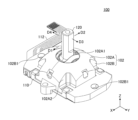
- FIG. 1 is an external perspective view of a multidirectional input device 100 according to one embodiment.
- FIG. 1 shows the knob 50, the housing 102, the frame 110, the FPC 112, the electrostatic detection electrodes 130, the electrostatic detection circuit 140, and the motherboard 150 of the multi-directional input device 100.
- FIG. Of the components shown in FIG. 1, the housing 102, the frame 110, and the FPC 112 are components of the operation device 100A included in the multi-directional input device 100, and are denoted by the reference numeral 100A in parentheses.
- the reference numeral 100A in parentheses.
- the connecting portion 112B of the FPC 112 is not connected to the motherboard 150, but in reality, the connecting portion 112B is connected to the connecting portion of the motherboard 150, and is connected to a control unit or the like mounted on the motherboard 150 for tilt detection. be done.
- FIG. 2 is an exploded view of the multi-directional input device 100 with the knob 50 removed.
- the operating lever 120 is shown, and the electrostatic detection circuit 140 and motherboard 150 shown in FIG. 1 are omitted. Since the operation lever 120 is a component of the operation device 100A, the reference numeral 100A is written in parentheses.
- the Z direction in the drawing is the up-down direction
- the X direction in the drawing is the front-rear direction
- the Y direction in the drawing is the left-right direction.
- the knob 50 is in its neutral position
- the operating lever 120 is in its neutral position.
- the neutral position is a position when the knob 50 or the operation lever 120 is not operated forward, backward, leftward, or rightward.
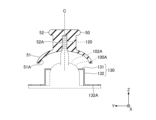
- FIG. 3 is a diagram showing the cross-sectional structure of the knob 50 and the electrostatic detection electrode 130.
- FIG. FIG. 3 shows a cross section parallel to the YZ plane including the central axis C of the knob 50, and shows the outline of the operating device 100A included in the multi-directional input device 100 with a dashed line.
- the knob 50 and the operating lever 120 are in their neutral positions.
- FIG. 4 is a diagram showing the operating device 100A.
- the multi-directional input device 100 is used, for example, as a controller for a game machine or the like.
- the multidirectional input device 100 includes a knob 50, an operating device 100A, electrostatic detection electrodes 130, an electrostatic detection circuit 140, and a motherboard 150.
- FIG. the multi-directional input device 100 is described as including the knob 50, but the multi-directional input device 100 without the knob 50 may also be used.
- the knob 50 is fixed to the upper end side of the operating lever 120.
- the knob 50 is a conductive knob that covers the dome portion 102A of the housing 102 of the operation device 100A. 52.
- the knob 50 has a rotationally symmetric three-dimensional shape with a central axis C shown in FIG. 3 as an axis of symmetry.
- the knob 50 has a hemispherical concave portion 51A corresponding to the shape of the dome portion 102A on the inner surface side facing the dome portion 102A. Further, the knob 50 further has a recess 52A recessed upward from the top of the recess 51A. The upper end of the operating lever 120 is inserted and fixed in the recess 52A.
- Such a knob 50 is a part that an operator touches with his or her hand to operate when the multi-directional input device 100 is used as a controller of a game machine or the like.
- Knob 50 is capacitively coupled with electrostatic detection electrode 130 .
- the electrostatic detection electrode 130 is attached around the dome portion 102A of the housing 102.
- the electrostatic detection electrodes 130 are connected to the electrostatic detection circuit 140 via the mother board 150 .
- the electrostatic detection circuit 140 can detect the proximity or contact of the operator's hand or the like to the knob 50 based on the change in electrostatic capacitance detected by the electrostatic detection electrode 130 .
- Proximity means that the operator's hand or the like is close to the knob 50 in a non-contact state, and contact means that the operator's hand or the like touches the knob 50 .
- the multi-directional input device 100 has a columnar tiltable operation lever 120 that extends upward from the opening 102A1 of the housing 102 .
- the multi-directional input device 100 is tiltably supported with respect to the housing 102, and can be tilted not only in the front-rear direction (directions of arrows D1 and D2 in the figure) and in the left-right direction (directions of arrows D3 and D4 in the figure) by the operation lever 120, Tilting in all directions between these directions is possible.
- the multidirectional input device 100 can output an operation signal corresponding to the tilting operation (tilting direction and tilting angle) of the operating lever 120 to the outside via the FPC (Flexible Printed Circuits) 112 .
- FPC Flexible Printed Circuits
- the operating device 100A will be described using FIGS. 5 to 9 in addition to FIG. Details of the electrostatic detection electrodes 130, the electrostatic detection circuit 140, and the motherboard 150 of the multidirectional input device 100 will be described after the configuration of the operation device 100A is described.
- FIG. 5 is an external perspective view of the operating device 100A (with the housing 102 removed) according to one embodiment.
- FIG. 6 is an exploded perspective view of the operating device 100A according to one embodiment.
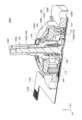
- FIG. 7 is a cross-sectional view of an operating device 100A according to one embodiment.
- the operating device 100A includes a housing 102, an operating lever 120, an actuator 104, a holder 105, an actuator 106, an actuator 103, a spring 108, a holder 107, a pressing member 109, a frame 110, an FPC 112, and a metal sheet 113 .
- the housing 102 has a dome-shaped dome portion 102A that protrudes upward, and a base portion 102B provided below the dome portion 102A.
- the housing 102 may be made of an insulating material, such as resin.
- the lower portion of the housing 102 where the base portion 102B is provided is an example of a portion of the housing 1102 opposite to the side where the dome portion 102A is located.
- the housing 102 incorporates each component (the operation lever 120, the actuators 103, 104, 106, and the holders 105, 107) in the internal space.
- the housing 102 is formed with an opening 102A1 having a circular shape in plan view from above at the top of the dome portion 102A.
- the operating lever 120 is inserted through the opening 102A1.
- the housing 102 has fixing holes 102B1 through which fixing members 60 (see FIG. 2) are inserted, at the ends of the base 102B on the +Y direction side and the ⁇ Y direction side.
- Fixing hole 102B1 is an example of a first fixing hole.
- the fixing member 60 is, for example, a screw or the like.
- the housing 102 has cutout portions 102A2 provided at each of the four outer corners of the dome portion 102A in plan view. Cutout portion 102A2 is provided for fixing electrostatic detection electrode 130 .
- the operation lever 120 is a member that is tilted by the operator.
- the operation lever 120 may be made of an insulating material, such as resin.
- the operating lever 120 has a lever portion 120A and a base portion 120B.
- the lever portion 120A is a substantially cylindrical portion that extends upward from the opening portion 102A1 of the housing 102, and is a portion that is tilted by the operator via the knob 50.
- the base portion 120B is a substantially cylindrical portion that supports the lower end portion of the lever portion 120A inside the housing 102 and rotates as the lever portion 120A is tilted.
- the actuator 104 has a dome shape that is convexly curved upward, and has an elongated hole-shaped opening 104A that extends in the left-right direction (the Y direction in the drawing) along the curved shape.
- the actuator 104 has a rotating shaft 104B projecting outward from each of both ends in the left-right direction. , so as to be rotatable in the front-rear direction (the X direction in the figure).
- the actuator 106 is provided over the actuator 104 .
- the actuator 106 has an upwardly convex curved shape, and has an elongated hole-shaped opening 106A extending in the front-rear direction (the X direction in the drawing) along the curved shape.
- Actuator 106 has rotating shafts 106B projecting outward from both ends thereof in the front-rear direction. When rotating shafts 106B are supported by housing 102, rotating shafts 106B are the center of rotation. , so as to be rotatable in the horizontal direction (the Y direction in the drawing).
- the holder 105 holds the slider 105A on the lower side.
- the holder 105 has a longitudinal shape extending in the sliding direction (X direction) of the slider 105A.
- the holder 105 is slidably provided in the sliding direction (X direction) of the slider 105A.
- a protrusion 105B is provided at the center of the side surface of the holder 105 .
- the holder 107 holds the slider 107A on the lower side.
- the holder 107 has a longitudinal shape extending in the sliding direction (Y direction) of the slider 107A.
- the holder 107 is slidably provided in the sliding direction (Y direction) of the slider 107A.
- a protrusion 107B is provided at the center of the side surface of the holder 107 .
- the actuator 104, the actuator 106, the holder 105, and the holder 107 may be made of an insulator, for example, made of resin.
- the actuators 104 and 106 overlap each other such that the openings 104A and 106A intersect each other.
- the actuator 104 and the actuator 106 overlap each other, the lever portion 120A of the operating lever 120 passes through the openings 104A and 106A, and the actuator 104 and the actuator 106 are combined with the base portion 120B of the operating lever 120 to form a casing together with the base portion 120B.
- Embedded within body 102 .
- the actuator 104 has an engaging portion 104C projecting downward from the rotating shaft 104B on the +Y direction side.
- the engaging portion 104C engages with a protrusion 105B provided at the center of the side surface of a holder 105 which is slidable on the FPC 112 in the front-rear direction (X direction).
- the actuator 104 rotates in the front-rear direction together with the base portion 120B of the operation lever 120 to slide the holder 105 in the front-rear direction when the operation lever 120 is tilted in the front-rear direction (X direction).
- the electrical connection state between the wiper 105A see FIG.
- An operation signal is output with a resistance value corresponding to the tilting operation (tilting direction and tilting angle) of the lever 120 in the front-rear direction.
- the actuator 106 has an engaging portion 106C protruding downward from the rotating shaft 106B on the +X direction side.
- the engaging portion 106C engages with a protrusion 107B provided at the center of the side surface of the holder 107 which is provided slidably on the FPC 112 in the horizontal direction (Y direction).
- the actuator 106 rotates in the left-right direction together with the base portion 120B of the operation lever 120 to slide the holder 107 in the left-right direction.
- the electrical connection state between the slider 107A see FIG.
- the sliders 105A, 107A and the resistors 115, 116, 117 are an example of a tilt detection sensor that outputs a resistance value according to the tilting operation of the operating lever 120 in the front-rear direction and the left-right direction.
- the actuator 103 has a shaft portion 103A and a bottom plate portion 103B.
- the shaft portion 103A is a round bar-shaped portion that is inserted through the through hole 120C of the operation lever 120 and arranged.
- the bottom plate portion 103B is a disc-shaped portion integrally provided at the lower end portion of the shaft portion 103A.
- the spring 108 is incorporated into the opening (see FIG. 7) on the bottom side (-Z direction side) of the operation lever 120 together with the actuator 103 in a state where the shaft portion 103A of the actuator 103 is inserted.
- the spring 108 biases the operating lever 120 upward and biases the bottom plate portion 103B of the actuator 103 downward.
- the spring 108 presses the bottom plate portion 103B of the actuator 103 against the upper surface and center portion of the frame 110 when the operator releases the tilting operation of the operation lever 120, and the bottom plate portion 103B is placed in a horizontal state. By doing so, the operating lever 120 is returned to the neutral position.
- the pressing member 109 is pushed downward by the -Y direction side rotation shaft 104B of the actuator 104, thereby pushing down the metal sheet 113 provided on the FPC 112.
- the switch circuit formed on the FPC 112 is turned on by pressing it to the side and elastically deforming the metal sheet 113 .
- the FPC 112 outputs a switch-on signal indicating that the operating lever 120 has been pushed downward.
- the spring 108 is made of metal.
- the pressing member 109 may be made of an insulating material, such as resin.
- the frame 110 is a metal plate-like member that closes the opening on the bottom side of the housing 102 .
- the frame 110 is formed by subjecting a metal plate to various processing methods (for example, punching, bending, etc.).
- the frame 110 is provided with a pair of claws 110A on each of the front (+X direction) edge and the rear ( ⁇ X direction) edge.
- the frame 110 is fixedly coupled to the housing 102 by engaging each claw portion 110A with the edge of the housing 102 .
- the FPC 112 is an example of a wiring board, and is a flexible film-like wiring member.
- the FPC 112 is arranged below the housing 102 .
- the lower side of the housing 102 is an example of a second side with respect to the housing 102 opposite to the upper side (an example of the first side) where one end protruding from the opening 102A1 of the operation lever 120 is positioned with respect to the housing 102. be.
- the FPC 112 has an extension portion 112A that extends from the upper surface of the frame 110 to the side of the frame 110 (-Y direction). Connected.
- the FPC 112 transmits to the outside an operation signal corresponding to the operation (tilting operation and pressing operation) of the operation lever 120 .
- both surfaces of strip-shaped conductor wiring for example, copper foil
- a flexible and insulating film-like material for example, polyimide resin, polyethylene terephthalate (PET), etc.
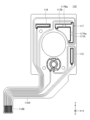
- FIG. 8 is a plan view of the FPC 112 included in the operating device 100A according to one embodiment.
- the surface of the FPC 112 is provided with resistors 115, 116, and 117 which are all planar and strip-shaped.
- each of the resistors 115, 116, and 117 is formed by printing a thin film using a carbon fiber material.
- the resistor 115 is provided near the edge of the FPC 112 on the +X direction side.
- the resistor 115 has a strip shape extending linearly in the Y direction.
- the resistor 116 is provided near the edge of the FPC 112 on the +Y direction side.
- the resistor 116 has a strip shape extending linearly in the X direction.
- the resistors 117 are provided near the corners of the FPC 112 on the +X direction side and the +Y direction side.
- Resistor 117 has an L-shape composed of linear portion 117A and linear portion 117B.
- the linear portion 117A has a strip shape extending linearly in the Y direction.
- the linear portion 117B has a strip shape extending linearly in the X direction.
- FIG. 9 is a diagram showing contact states of the sliders 105A and 107A included in the operating device 100A according to one embodiment.
- the linear portion 117A of the resistor 117 and the resistor 115 are spaced apart from each other and arranged linearly in the Y direction.
- a metal leaf spring-like slider 107A held at the bottom of the holder 107 slides in the Y direction.
- the contact portion 107Aa provided at the end of the slider 107A on the -Y direction side slides.
- a contact portion 107Ab provided at the +Y direction end of the slider 107A slides on the surface of the linear portion 117A.
- the linear portion 117B of the resistor 117 and the resistor 116 are spaced apart from each other and arranged linearly in the X direction.
- a metal leaf spring-like slider 105A held at the bottom of the holder 105 slides in the X direction.
- the contact portion 105Aa provided at the end of the slider 105A on the -X direction side slides.
- the contact portion 105Ab provided at the +X direction end of the slider 105A slides on the surface of the linear portion 117B.
- the slider 107A slides in the Y direction on the surface of the linear portion 117A and the resistor 115 as the operation lever 120 is tilted in the Y direction. do.
- the resistance value between the terminal connected to the resistor 117 and the terminal connected to the resistor 115 changes according to the amount of movement of the slider 107A (that is, the tilting angle of the operating lever 120).
- An external device can detect the tilting operation and the tilting angle of the operating lever 120 in the Y direction based on the change in the resistance value between both terminals.
- the slider 105A slides in the X direction on the surface of the linear portion 117B and the resistor 116 as the operation lever 120 is tilted in the X direction.
- the resistance value between the terminal connected to the resistor 117 and the terminal connected to the resistor 116 changes according to the amount of movement of the slider 105A (that is, the tilting angle of the operating lever 120).
- An external device can detect the tilting operation and the tilting angle of the operating lever 120 in the X direction based on the change in the resistance value between both terminals.
- the straight portion 117A of the resistor 117 has a low resistance portion 117Aa.
- the low resistance portion 117Aa has a lower resistance value than other portions of the straight portion 117A.
- the low resistance portion 117Aa is a portion with which the contact portion 107Ab of the slider 107A abuts when the operating lever 120 is in the neutral position.
- the low-resistance portion 117Aa has a larger number of layers of resistors 117 (that is, has a larger thickness) than the other portions of the straight portion 117A, so that the resistance value of the low resistance portion 117Aa is higher than that of the other portions of the straight portion 117A. is lowered.
- the resistor 117 has two layers in the low resistance portion 117Aa, and the resistor 117 has one layer in the other portion of the linear portion 117A. .
- the resistor whose range is only the low resistance portion 117Aa in the linear portion 117A and the resistor whose range is the entire linear portion 117A are overlapped.
- 117 has two layers.
- the resistance value of the low resistance portion 117Aa is half the resistance value of other portions of the linear portion 117A.
- the straight portion 117B of the resistor 117 has a low resistance portion 117Ba.
- the low resistance portion 117Ba has a lower resistance value than other portions of the straight portion 117B.
- the low resistance portion 117Ba is a portion with which the contact portion 105Ab of the slider 105A abuts when the operating lever 120 is in the neutral position.
- the low-resistance portion 117Ba has a larger number of layers of resistors 117 (that is, has a greater thickness) than the other portions of the straight portion 117B, so that the resistance value of the low resistance portion 117Ba is higher than that of the other portions of the straight portion 117B. is lowered.
- the resistor 117 has two layers in the low resistance portion 117Ba, and the resistor 117 has one layer in the other portion of the linear portion 117B. .
- the resistor covering only the low resistance portion 117Ba in the linear portion 117B and the resistor covering the entire linear portion 117B are overlapped.
- 117 has two layers.
- the resistance value of the low resistance portion 117Ba is half the resistance value of the other portion of the linear portion 117B.
- FIG. 10 is a diagram showing output characteristics of the operating device 100A according to one embodiment.
- the graph shown in FIG. 10 shows the relationship between the length of resistor 117 (the length of linear portions 117A and 117B) and the output voltage value.
- the maximum length of resistor 117 is 5 mm
- the length of resistor 117 when control lever 120 is in the neutral position is 2.5 mm.
- the length of the low resistance portions 117Aa and 117Ba is set to "1.0 mm”.
- the resistance values of the low resistance portions 117Aa and 117Ba are half the resistance values of other portions of the linear portions 117A and 117B.
- the solid line indicates the output voltage when the low resistance portions 117Aa and 117Ba are provided
- the broken line indicates the output voltage when the low resistance portions 117Aa and 117Ba are not provided as a comparative example.
- the output voltage value range width is " 1.0 V”, whereas when the low resistance portions 117Aa and 117Ba are provided, the range width of the output voltage value is “0.5 V” (that is, 2 minutes when the low resistance portions 117Aa and 117Ba are not provided). 1) of
- the operation device 100A reduces the resistance values of the low resistance portions 117Aa and 117Ba, thereby making the slope of the output voltage value in the vicinity of the neutral position of the operation lever 120 gentle. It is possible to narrow the range width of the output voltage value in the vicinity of the neutral position of . As a result, the operating device 100A according to one embodiment maintains the output voltage value at the predetermined output voltage corresponding to the neutral position of the operating lever 120 even when the operating lever 120 has a physical return error. values can be approximated. Therefore, the operating device 100A according to the embodiment can further increase the accuracy of returning the operating lever 120 to the neutral position without signal processing in the output voltage value output by the operating device 100A.
- a resistor whose range covers only the low resistance portions 117Aa and 117Ba in the straight portions 117A and 117B is superimposed on the resistor whose range covers the entire length of the straight portions 117A and 117B. may This can prevent the sliders 107A and 105A from being caught at the boundary between the low resistance portions 117Aa and 117Ba and other portions.
- the electrostatic detection electrode 130 has an annular portion 131 , leg portions 132 and connecting portions 133 . Two legs 132 are provided as an example.
- the electrostatic detection electrode 130 is made of metal, and can be manufactured by, for example, punching or bending a sheet metal made of copper, aluminum, iron, or the like.
- the annular portion 131 is a portion having an annular shape in plan view, and has four claw portions 131A protruding radially inward from the inner peripheral side.
- the four claw portions 131A are arranged at equal intervals in the circumferential direction of the annular portion 131 and aligned with the positions of the notch portions 102A2 of the dome portion 102A of the housing 102 .
- the claw portion 131A has a convex shape that matches the concave shape of the notch portion 102A2.
- the two leg portions 132 extend downward from the +Y direction side and ⁇ Y direction side portions of the outer peripheral portion of the annular portion 131, and the connecting portion 133 extends downward from the outer peripheral portion of the annular portion 131. , extending downward from the -X direction side portion.
- the position where the leg portion 132 on the +Y direction side is connected to the ring portion 131 is between the two claw portions 131A on the +Y direction side, and the leg portion 132 on the -Y direction side is connected to the ring portion 131.
- the position is between the two claws 131A on the -Y direction side.
- the position where the connection portion 133 is connected to the annular portion 131 is between the two claw portions 131A on the -X direction side.
- Annular portion 131 is arranged to surround opening 102A1 on the outer surface of the upper portion of dome portion 102A of housing 102, and claw portion 131A engages notch portion 102A2 of dome portion 102A. It is fixed to the portion 102A.
- the annular portion 131 is located above the housing 102 and is sufficiently spaced apart from the FPC 112 located below the housing 102 so as not to be affected by noise or the like.
- the annular portion 131 is arranged on the outer surface of the upper portion of the dome portion 102A, as shown in FIG. In addition, the width in the radial direction is large. 3, the annular portion 131 is located below the lower end of the knob 50 in the Z direction when the operation lever 120 is in the neutral position. Therefore, when the operating lever 120 is in the neutral position, the annular portion 131 is positioned outside the recess 51A of the knob 50 and not inside the recess 51A.
- the electrostatic capacitance between the electrostatic detection electrode 130 and the knob 50 does not change much and remains substantially constant. be.
- the capacitance between the annular portion 131 and the knob 50 increases in the direction in which the operating lever 120 is tilted, but decreases in the opposite direction. The change in capacitance due to the difference in tilt amount is small.
- the capacitance between the annular portion 131 and the knob 50 when the operating lever 120 is in the neutral position, and the capacitance between the annular portion 131 and the knob 50 when the operating lever 120 is tilted in any direction. is configured so that the difference from the electrostatic capacitance of is also small.
- the capacitance between the annular portion 131 and the knob 50 depends on the direction and amount of tilting of the operating lever 120, and the variation in the capacitance between the annular portion 131 and the knob 50 at the time of tilting and at the neutral position.
- the configuration of the annular portion 131 and the knob 50 that can be reduced in size is adopted because the operator's hand or the like is close to or in contact with the knob 50 regardless of the state of the operation lever 120. This is to enable accurate detection of a state in which the operator's hand or the like is moving away from the knob 50 .
- the leg portion 132 extends downward from the ends of the ring portion 131 in the ⁇ Y direction, and is bent so that the lower end side is L-shaped when viewed from the YZ plane.
- the L-shaped bent portion is configured to sandwich the side surface of the base portion 102B of the housing 102 between the +Y direction side and the ⁇ Y direction side.
- a fixing hole 132A is formed in the portion of the leg 132 that is bent in the L shape (the tip of the leg 132).
- the fixing hole 132A is an example of a second fixing hole.
- the fixing hole 132A is formed to align with the fixing hole 102B1 of the base 102B of the housing 102, and when fixing the multi-directional input device 100 to a housing such as a game controller, the fixing holes 102B1 and 132A are aligned. It can be fixed by inserting and tightening the same screw.
- the connecting part 133 extends downward from the -X-direction end of the ring part 131, and is bent so that the lower end 133A side is L-shaped when viewed from the XZ plane. As shown in FIG. 1, the lower end 133A of the connecting portion 133 is connected to the pad 151 on the surface of the motherboard 150. As shown in FIG. Pads 151 are connected via wiring 152 to electrostatic detection circuit 140 mounted on the surface of motherboard 150 .
- the lower end 133A of the connecting portion 133 is sufficiently separated from the frame 110 and the FPC 112 in the X direction. “Sufficiently separated” means that the connecting portion 133 is separated from the frame 110 and the FPC 112 to such an extent that noise is not picked up.
- the electrostatic detection circuit 140 is connected to the electrostatic detection electrodes 130 via the wiring 152 and pads 151 of the mother board 150 as described above.
- the electrostatic detection circuit 140 is composed of, for example, an IC (Integrated Circuit), applies an AC voltage to the electrostatic detection electrode 130, and detects a current value corresponding to a change in the electrostatic capacitance of the electrostatic detection electrode 130 as an AD (Analog to Digital) conversion. Then, the electrostatic detection circuit 140 detects the proximity state of the operator's hand or the like to the knob 50 based on the change in the current value after AD conversion according to the change in the electrostatic capacitance of the electrostatic detection electrode 130 . Thus, the electrostatic detection circuit 140 detects the electrostatic capacitance between the electrostatic detection electrode 130 and the surrounding object, the knob 50 .
- the electrostatic detection circuit 140 is placed at a sufficient distance from the FPC 112 and the frame 110.
- the FPC 112 is provided with sliders 105A and 107A and resistors 115, 116, 117, etc., which are examples of tilt detection sensors, and generates signals as the operation lever 120 tilts.
- the frame 110 overlaps the FPC 112 and has a portion that is capacitively coupled, the frame 110 has a signal component derived from the signal generated in the FPC 112 . From the perspective of the electrostatic detection circuit 140, the signal generated in the FPC 112 and the signal component generated in the frame 110 are noise.
- the electrostatic detection circuit 140 is arranged at a sufficient distance from the FPC 112 and the frame 110 so that the electrostatic detection circuit 140 does not receive noise from the FPC 112 and the frame 110 . This is to stably detect the proximity or contact of the operator's hand or the like to the knob 50 .
- the motherboard 150 is housed in a housing of a game controller or the like, and is equipped with a microcomputer and other electronic components that control the operation of the game controller and the like.
- the electrostatic detection circuit 140 may be mounted on the motherboard 150 without being affected by noise from these microcomputers and other electronic components.
- the annular portion 131 of the electrostatic detection electrode 130 is provided so as to surround the opening 102A1 of the dome portion 102A of the housing 102, and based on the change in capacitance between the electrostatic detection electrode 130 and the knob 50, to detect the proximity or contact of the operator's hand or the like to the knob 50 . Since the annular portion 131 surrounds the opening portion 102A1 of the dome portion 102A, even if the knob 50 is tilted in the front-rear direction, the left-right direction, and all directions between these directions, the electrostatic detection electrode 130 and the knob do not move. 50 is substantially constant without much change.
- the electrostatic capacitance between the electrostatic detection electrode 130 and the knob 50 does not change much due to the difference in tilting amount. Furthermore, the amount of change in capacitance between the annular portion 131 and the knob 50 is small between the tilted state and the neutral position.
- the multidirectional input device 100 in which the sensitivity of the electrostatic detection electrodes 130 is stable.
- the electrostatic detection electrode 130 is less likely to be affected by tilt detection signals from the FPC 112 and the like.
- the signals and the like related to tilt detection become noise. Therefore, it is possible to provide the multi-directional input device 100 that has high noise resistance and is capable of stably detecting the proximity or contact of the operator's hand or the like. can.
- Electrostatic detection electrode 130 extends from annular portion 131 to the opposite side of housing 102 to the side where dome portion 102A is located. and a connection portion 133 that extends from the housing 102 to the side opposite to the side where the dome portion 102A is located, and has a connection portion 133 that is connected to the electrostatic detection circuit 140.
- the electrostatic detection circuit 140 is separated from the FPC 112. are placed.
- the ring portion 131 is fixed so as not to move, and the electrostatic detection circuit 140 connected to the electrostatic detection electrode 130 via the connection portion 133 is less susceptible to the signal from the FPC 112, so that the electrostatic capacitance can be measured with high accuracy. It is possible to provide the multi-directional input device 100 capable of stably detecting the proximity or contact of the operator's hand or the like.
- the electrostatic detection electrode 130 has a fixing hole 132A which is arranged overlapping with the fixing hole 102B1 of the housing 102 and through which the common fixing member 60 is inserted, the fixing member 60 can be shared. . Moreover, the housing 102 and the electrostatic detection electrode 130 can be stably fixed.
- fixing hole 102B1 is provided at the bottom of housing 102 and fixing hole 132A is provided at the tip of leg 132, housing 102 and electrostatic detection electrode 130 are stabilized at the bottom of housing 102. can be permanently fixed.
- the connecting portion 133 is spaced from the FPC 112, the electrostatic detection electrode 130 is less susceptible to noise from the tilt detection sensor mounted on the FPC 112, and the sensitivity of the electrostatic detection electrode 130 is more stable for multidirectional input.
- An apparatus 100 can be provided.
- the housing 102 has a cutout portion 102A2 provided around the dome portion 102A, and the electrostatic detection electrode 130 has a claw portion 131A that engages with the cutout portion 102A2. can be stabilized by engaging with the dome portion 102A, and the multidirectional input device 100 in which the sensitivity of the electrostatic detection electrode 130 is more stable can be provided.
- the knob 50 is fixed to the operation lever 120 and further includes a conductive knob 50 covering the dome portion 102A. Therefore, a stable capacitance can be obtained between the annular portion 131 of the electrostatic detection electrode 130 and the knob 50, and the sensitivity of the electrostatic detection electrode 130 is more stable. can provide.
- the electrostatic detection electrode 130 Since the electrostatic detection electrode 130 is positioned outside the concave portion 51A of the knob 50 when the operating lever 120 is in the neutral position, the capacitance between the annular portion 131 and the knob 50 varies depending on the tilting direction and tilting amount. It is possible to provide the multidirectional input device 100 in which the amount of variation can be reduced and the sensitivity of the electrostatic detection electrodes 130 is more stable.
Landscapes
- Switches With Compound Operations (AREA)
- Position Input By Displaying (AREA)
- Switches That Are Operated By Magnetic Or Electric Fields (AREA)
- Switch Cases, Indication, And Locking (AREA)
Priority Applications (4)
| Application Number | Priority Date | Filing Date | Title |
|---|---|---|---|
| JP2023559491A JP7604759B2 (ja) | 2021-11-15 | 2022-10-11 | 多方向入力装置 |
| CN202290000675.4U CN222380476U (zh) | 2021-11-15 | 2022-10-11 | 多方向输入装置 |
| US18/642,405 US20240274381A1 (en) | 2021-11-15 | 2024-04-22 | Multidirectional input device |
| JP2024190371A JP7783955B2 (ja) | 2021-11-15 | 2024-10-30 | 多方向入力装置 |
Applications Claiming Priority (2)
| Application Number | Priority Date | Filing Date | Title |
|---|---|---|---|
| JP2021-185853 | 2021-11-15 | ||
| JP2021185853 | 2021-11-15 |
Related Child Applications (1)
| Application Number | Title | Priority Date | Filing Date |
|---|---|---|---|
| US18/642,405 Continuation US20240274381A1 (en) | 2021-11-15 | 2024-04-22 | Multidirectional input device |
Publications (1)
| Publication Number | Publication Date |
|---|---|
| WO2023084976A1 true WO2023084976A1 (ja) | 2023-05-19 |
Family
ID=86335667
Family Applications (1)
| Application Number | Title | Priority Date | Filing Date |
|---|---|---|---|
| PCT/JP2022/037833 Ceased WO2023084976A1 (ja) | 2021-11-15 | 2022-10-11 | 多方向入力装置 |
Country Status (4)
| Country | Link |
|---|---|
| US (1) | US20240274381A1 (https=) |
| JP (2) | JP7604759B2 (https=) |
| CN (1) | CN222380476U (https=) |
| WO (1) | WO2023084976A1 (https=) |
Citations (3)
| Publication number | Priority date | Publication date | Assignee | Title |
|---|---|---|---|---|
| JP2001324397A (ja) * | 2000-05-17 | 2001-11-22 | Wacoh Corp | 力検出装置および操作量検出装置 |
| WO2020031501A1 (ja) * | 2018-08-08 | 2020-02-13 | アルプスアルパイン株式会社 | 操作装置および操作部 |
| JP2020119729A (ja) * | 2019-01-23 | 2020-08-06 | ホシデン株式会社 | 操作レバー及びこれを備えた入力装置並びに操作レバーの製造方法 |
-
2022
- 2022-10-11 WO PCT/JP2022/037833 patent/WO2023084976A1/ja not_active Ceased
- 2022-10-11 JP JP2023559491A patent/JP7604759B2/ja active Active
- 2022-10-11 CN CN202290000675.4U patent/CN222380476U/zh active Active
-
2024
- 2024-04-22 US US18/642,405 patent/US20240274381A1/en active Pending
- 2024-10-30 JP JP2024190371A patent/JP7783955B2/ja active Active
Patent Citations (3)
| Publication number | Priority date | Publication date | Assignee | Title |
|---|---|---|---|---|
| JP2001324397A (ja) * | 2000-05-17 | 2001-11-22 | Wacoh Corp | 力検出装置および操作量検出装置 |
| WO2020031501A1 (ja) * | 2018-08-08 | 2020-02-13 | アルプスアルパイン株式会社 | 操作装置および操作部 |
| JP2020119729A (ja) * | 2019-01-23 | 2020-08-06 | ホシデン株式会社 | 操作レバー及びこれを備えた入力装置並びに操作レバーの製造方法 |
Also Published As
| Publication number | Publication date |
|---|---|
| JP7604759B2 (ja) | 2024-12-24 |
| US20240274381A1 (en) | 2024-08-15 |
| JP7783955B2 (ja) | 2025-12-10 |
| CN222380476U (zh) | 2025-01-21 |
| JP2025003725A (ja) | 2025-01-09 |
| JPWO2023084976A1 (https=) | 2023-05-19 |
Similar Documents
| Publication | Publication Date | Title |
|---|---|---|
| US10483057B2 (en) | Input device | |
| US11650675B2 (en) | Input device with movable handle on a capacitive detection surface and capacitive coupling devices | |
| US11829181B2 (en) | Operation device comprising lever | |
| US11424086B2 (en) | Operation device and operation member | |
| US11861083B2 (en) | Input device having a movable handle on a capacitive detection surface and having capacitive coupling apparatuses | |
| CN117258273B (zh) | 电容摇杆、游戏手柄及游戏控制方法 | |
| US6298566B1 (en) | Angular-displacement detecting device | |
| US9627161B2 (en) | Operating switch | |
| JP7783955B2 (ja) | 多方向入力装置 | |
| US12105895B2 (en) | Operating device using variable resistor | |
| CN112219090A (zh) | 电容式位置传感器和相关的操纵杆装置及控制方法 | |
| JP7442637B2 (ja) | 操作装置 | |
| US12578749B2 (en) | Multidirectional input device | |
| US20260050333A1 (en) | Magnetic and pressure sensing joystick/thumb stick | |
| JP2024161753A (ja) | 入力装置 | |
| JP2024107900A (ja) | 入力装置 | |
| JP2026059100A (ja) | 操作装置 | |
| JP2019109976A (ja) | 入力装置 | |
| JP2020174131A (ja) | 入力装置、及びセンサ装置 | |
| JP2006040688A (ja) | 入力装置 | |
| JP2006338162A (ja) | ポインティングデバイス |
Legal Events
| Date | Code | Title | Description |
|---|---|---|---|
| 121 | Ep: the epo has been informed by wipo that ep was designated in this application |
Ref document number: 22892476 Country of ref document: EP Kind code of ref document: A1 |
|
| WWE | Wipo information: entry into national phase |
Ref document number: 2023559491 Country of ref document: JP |
|
| WWE | Wipo information: entry into national phase |
Ref document number: 202290000675.4 Country of ref document: CN |
|
| 122 | Ep: pct application non-entry in european phase |
Ref document number: 22892476 Country of ref document: EP Kind code of ref document: A1 |
|
| WWP | Wipo information: published in national office |
Ref document number: 202290000675.4 Country of ref document: CN |