WO2023079742A1 - 情報処理装置、分析システム、データ生成方法、及び非一時的なコンピュータ可読媒体 - Google Patents
情報処理装置、分析システム、データ生成方法、及び非一時的なコンピュータ可読媒体 Download PDFInfo
- Publication number
- WO2023079742A1 WO2023079742A1 PCT/JP2021/040990 JP2021040990W WO2023079742A1 WO 2023079742 A1 WO2023079742 A1 WO 2023079742A1 JP 2021040990 W JP2021040990 W JP 2021040990W WO 2023079742 A1 WO2023079742 A1 WO 2023079742A1
- Authority
- WO
- WIPO (PCT)
- Prior art keywords
- attribute
- objects
- certainty
- specified
- search condition
- Prior art date
- Legal status (The legal status is an assumption and is not a legal conclusion. Google has not performed a legal analysis and makes no representation as to the accuracy of the status listed.)
- Ceased
Links
Images




Classifications
-
- G—PHYSICS
- G06—COMPUTING OR CALCULATING; COUNTING
- G06F—ELECTRIC DIGITAL DATA PROCESSING
- G06F16/00—Information retrieval; Database structures therefor; File system structures therefor
- G06F16/20—Information retrieval; Database structures therefor; File system structures therefor of structured data, e.g. relational data
- G06F16/24—Querying
- G06F16/245—Query processing
- G06F16/2457—Query processing with adaptation to user needs
- G06F16/24578—Query processing with adaptation to user needs using ranking
-
- G—PHYSICS
- G06—COMPUTING OR CALCULATING; COUNTING
- G06F—ELECTRIC DIGITAL DATA PROCESSING
- G06F16/00—Information retrieval; Database structures therefor; File system structures therefor
- G06F16/50—Information retrieval; Database structures therefor; File system structures therefor of still image data
- G06F16/53—Querying
- G06F16/538—Presentation of query results
Definitions
- the present disclosure relates to an information processing device, an analysis system, a data generation method, and a program.
- surveillance cameras have been installed in various places due to the spread of surveillance cameras. Images captured by a surveillance camera are used, for example, in investigations of various incidents. Specifically, the police sometimes search for a suspicious person by using eyewitness information of a certain suspicious person from among a huge amount of images.
- Patent Document 1 discloses the configuration of an information processing device that searches for a target person according to search conditions that specify attributes in categories such as gender, hair color, and clothing color.
- the information processing apparatus of Patent Literature 1 designates not only a search condition for which an attribute is specified, but also a degree of certainty representing the likelihood that the search condition will be satisfied, and displays a person who satisfies the search condition and the degree of certainty. For example, when male is specified as an attribute and 90% is specified as a degree of certainty, the information processing device displays, as a search result, persons with a degree of certainty of 90% or more about being classified as “male”. . In other words, the information processing apparatus does not display a person whose certainty of being classified as "male” is less than 90%.
- a search result that facilitates user analysis is obtained by specifying an attribute and certainty disclosed in Patent Document 1, and displaying the persons exceeding the specified certainty by rearranging them in descending order of certainty. be able to. For example, by clarifying the influence of changes in certainty on changes in search results, it is possible to analyze the relationship between certainty and search results. In such a case, it is desired to develop a tool or device for easily recognizing the influence of changes in certainty on changes in search results.
- One of the purposes of the present disclosure is to provide an information processing device, an analysis system, a data generation method, and a program that can easily recognize the influence of changes in certainty on changes in search results.
- An information processing apparatus includes a plurality of objects, at least one attribute by which each of the objects is classified, a certainty factor indicating a probability that the object has the attribute, an attribute specified as a search condition and a certainty factor that can be specified as a search condition for that attribute, and an attribute identical or similar to the attribute specified as the search condition.
- a calculation means for calculating a score indicating the degree of matching of the object with respect to the search condition by using a certainty that the object is present; sorting means for arranging, and specifying means for specifying the degree of certainty to change the order of the objects based on the transition of the score of the plurality of objects which can be specified as the search condition and changes according to the transition of the degree of certainty.
- display control means for generating display data for displaying the attribute specified as the search condition and the certainty factor for changing the order of the objects in association with each other.
- An analysis system includes a plurality of objects, at least one attribute by which each of the objects is classified, and a confidence factor indicating the probability that the object is the attribute.
- Management means for managing in association with each other, an attribute specified as a search condition and a certainty factor that can be specified as a search condition for that attribute, and an attribute identical or similar to the attribute specified as the search condition are managed in association with each other.
- specifying means for specifying the degree of certainty for changing the order of the objects based on the transition of the scores of the plurality of objects that can be specified as the search condition and changing according to the transition of the degree of certainty; an information processing apparatus comprising display control means for generating display data for displaying the attribute specified as the search condition in association with the degree of certainty for changing the order of the objects; and a display for displaying the display data.
- a data generation method includes a plurality of objects, at least one attribute by which each of the objects is classified, a certainty factor indicating a probability that the object has the attribute, are managed in association with each other, attributes specified as search conditions and certainty factors that can be specified as search conditions for those attributes, and certainty factors managed in association with attributes that are identical or similar to the attributes specified as the search conditions.
- a program associates a plurality of objects, at least one attribute by which each of the objects is classified, and a confidence factor indicating the probability that the object is the attribute.
- Attributes specified as search conditions and certainty factors that can be specified as search conditions for those attributes, and certainty factors managed in association with attributes that are identical or similar to the attributes specified as the search conditions, is used to calculate a score indicating the degree of matching of the object with respect to the search condition, sort the score, arrange the plurality of objects in the order of the sorted scores, and specify as the search condition
- the degree of certainty for changing the order of the objects is specified, and the attribute specified as the search condition and the object causes the computer to generate display data to be displayed in association with the degree of certainty that changes the order of .
- FIG. 1 is a configuration diagram of an information processing apparatus according to a first embodiment;
- FIG. 4 is a diagram showing the flow of processing of the data generation method according to the first embodiment;
- FIG. 1 is a configuration diagram of an information processing apparatus according to a second embodiment;
- FIG. 10 is a diagram showing data managed by a management unit according to the second embodiment;
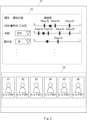
- FIG. 10 is a diagram showing a screen image according to the second embodiment;
- FIG. FIG. 11 is a diagram for explaining order change in the result display area according to the second embodiment;
- FIG. FIG. 10 is a diagram showing the relationship between certainty and scores of respective objects according to the second embodiment;
- FIG. 10 is a diagram showing a change in the order of objects when the certainty factor is 0 and the order of the object when the certainty factor is 1 according to the second embodiment;
- FIG. 10 is a diagram showing the flow of processing for specifying intersections of line segments according to the second embodiment;
- FIG. 10 is a diagram showing a screen image according to the second embodiment;
- FIG. 1 is a configuration diagram of an information processing apparatus according to each embodiment;
- Embodiment 1 BEST MODE FOR CARRYING OUT THE INVENTION
- the information processing device 10 may be a computer device operated by a processor executing a program stored in a memory.
- the information processing device 10 has a management unit 11 , a calculation unit 12 , a sorting unit 13 , a specifying unit 14 and a display control unit 15 .
- the management unit 11, the calculation unit 12, the sorting unit 13, the identification unit 14, and the display control unit 15 may be software or modules whose processes are executed by a processor executing a program stored in memory.
- the management unit 11, the calculation unit 12, the sorting unit 13, the identification unit 14, and the display control unit 15 may be hardware such as circuits or chips.
- the management unit 11 associates and manages a plurality of objects, at least one attribute by which each object is classified, and a certainty factor indicating the probability that the object is an attribute.
- the object may be a person, an animal, a building, a structure, etc.
- the object may be a means of transportation such as a car, bicycle, or train.
- Attributes by which objects are classified may be properties classified within categories such as gender, age, and color of clothes.
- gender category male and female may be used as attributes.
- age category age may be used as an attribute, such as teens, twenties, and thirties, or age may be used.
- clothing color category colors such as red, blue, and yellow may be used.
- further classification of the same color in the clothing color category such as deep red, deep red, etc., may be used.
- the degree of confidence indicates the probability that the object has the attribute, or it may be said that the degree of certainty indicates the likelihood that the object has the specified attribute.
- the degree of certainty may be indicated as a unit of percentage (%), or may be indicated using a decimal number equal to or greater than 0 and equal to or less than 1, for example. If a decimal number greater than or equal to 0 and less than or equal to 1 is used to indicate confidence, the higher the value, the higher the confidence.
- the management unit 11 may hold a database that associates an object, an attribute by which the object is classified, and a certainty factor indicating the probability that the object has that attribute.
- the calculation unit 12 calculates a score that indicates the degree of match of the object with the search condition. Specifically, the calculation unit 12 manages the attribute specified as the search condition, the certainty factor that can be specified as the search condition of the attribute, and the attribute that is the same as or similar to the attribute specified as the search condition. Use the confidence that there is
- the search condition may be input by the user of the information processing device 10, for example.
- the search condition may be input from another computer device to the information processing device 10 via the network.
- the information processing apparatus 10 may determine search conditions by analyzing voice, text, images, or the like.
- the degree of confidence that can be specified as a search condition may be, for example, a value included in the range of values that can be set as the degree of certainty. For example, if the certainty is indicated as a percentage, the certainty that can be specified as a search condition may be a value between 0 and 1. Alternatively, the certainty factor that can be specified as a search condition may be any value between 0 and 1 to any value between 0 and 1.
- Confidence factors associated with attributes that are identical or similar to attributes specified as search conditions are managed by the management unit 11 . That is, the calculation unit 12 uses the attribute specified as the search condition to extract the certainty factor associated with the attribute specified as the search condition, which is the same as or similar to the attribute specified as the search condition, from the database held by the management unit 11.
- the calculation unit 12 may calculate the overall score of the object by summing the score values calculated for each attribute. good. That is, the score for an object is a value obtained by considering or combining multiple attributes.
- the sorting unit 13 sorts the scores and arranges multiple objects in order of the sorted scores. Sorting the scores may be sorting in descending order of score or sorting in ascending order of score. The rearrangement of the plurality of objects by the sorting unit 13 may be rephrased as, for example, the sorting unit 13 creating a ranking of the plurality of objects in the order of the scores.
- the specifying unit 14 specifies the degree of certainty for changing the order of objects based on the transition of the scores of a plurality of objects that can be specified as a search condition and changes according to the transition of the degree of certainty.
- the degree of certainty specified as a search condition changes, the score of each object also changes. Therefore, when the score of the object changes, the order of the objects arranged in order of score also changes.
- the specifying unit 14 specifies the certainty factor specified when the order of the objects is changed.
- the display control unit 15 generates display data that associates and displays the attribute specified as the search condition with the certainty factor for changing the order of the objects.
- a display device used as a device integrated with the information processing device 10 may display the display data, or a display device that receives the display data via the network may display the display data.
- the management unit 11 associates and manages a plurality of objects, at least one attribute by which each object is classified, and a certainty factor indicating the probability that the object has the attribute (S11).
- the calculation unit 12 calculates the attribute specified as the search condition, the certainty that can be specified as the search condition of the attribute, and the certainty that is managed in association with the attribute that is the same as or similar to the attribute specified as the search condition. Calculate the score using the degree and . The score indicates the matching degree of the object with respect to the search conditions (S12).
- the sorting unit 13 sorts the scores and arranges the multiple objects in order of the sorted scores (S13).
- the specifying unit 14 specifies the certainty for changing the order of the objects based on the transition of the scores of the plurality of objects that can be specified as a search condition and changes according to the transition of the certainty (S14).
- the display control unit 15 generates display data for displaying the attribute specified as the search condition in association with the degree of certainty for changing the order of the objects (S15).
- the information processing apparatus 10 specifies a certainty factor that changes the order of objects arranged in the order of scores when the certainty factor of a specified attribute changes. Further, the information processing apparatus 10 generates display data for displaying the confidence factor for changing the order of the objects on the display device. As a result, an analyst or the like who analyzes the data can easily recognize the influence of changes in confidence on the order of objects arranged in the order of scores by visually recognizing the displayed data.
- FIG. 1 describes a configuration in which the management unit 11 is included in the information processing device 10, the management unit 11 may be included in a device different from the information processing device 10, for example. In this case, the calculation unit 12 of the information processing device 10 may acquire information managed by the management unit 11 included in another device via the network.
- the information processing device 20 has a configuration in which a search condition acquisition unit 21 is added to the information processing device 10 .
- the information processing device 20 is connected to the display device 30 .
- the display device 30 may be used integrally with the information processing device 20 , that is, the display device 30 may be included in the information processing device 20 .
- the information processing device 20 may communicate with the display device 30 via a network.
- the display device 30 displays the received display data.
- the display device 30 may be called a display device or the like, for example.
- the management unit 11, the calculation unit 12, the sorting unit 13, the identification unit 14, and the display control unit 15, which configure the information processing device 20, are the same as those of the information processing device 10, and therefore detailed descriptions thereof are omitted.
- the information processing apparatus 20 functions, operations, etc. that are different from those of the information processing apparatus 10, or detailed functions, operations, etc. of the information processing apparatus 20 and the information processing apparatus 10 will be described.
- the search condition acquisition unit 21 acquires search conditions.
- the search condition acquisition unit 21 may acquire search conditions input by the user of the information processing device 20 via an input interface or the like.
- the user may use, for example, a keyboard, a touch panel, a microphone, etc., to input text or voice to input attributes and certainty.
- an eyewitness of the person being searched may determine the confidence factor, which is the attribute with which the person being searched is classified.
- the input search condition is determined according to the subjectivity of the eyewitness.
- the search condition acquisition unit 21 may specify search conditions using the input image. For example, when searching for or searching for a certain person, the user inputs image data showing that person to the information processing device 20 .
- the search condition acquisition unit 21 identifies the attribute of the person displayed in the image by executing image analysis processing or image recognition processing on the input image data, and further calculates the certainty of the attribute. You may
- Image analysis processing or image recognition processing is, for example, learning generated for learning an attribute about a person and a certainty indicating the probability that the person is the attribute, using a plurality of image data in which a person is displayed as training data. It may be performed using a model.
- the search condition acquisition unit 21 acquires the attribute of the person displayed in the image and the certainty factor indicating the probability that the person has that attribute by applying the input image data to the generated learning model.
- FIG. 4 shows that a person is used as an object and the database manages the attributes of the person.
- h_1 to h_6 shown in the column of persons are identification information for identifying persons.
- For the gender category for example, an attribute of male or female is set.
- For the age category for example, ages such as 30's, 40's, and 50's are set. Colors such as bright red, deep red, chestnut, and dark blue are set in the clothing color category.
- Yes is set if the user is wearing glasses, and No is set if the user is not wearing glasses.
- the numerical value shown next to each attribute indicates the probability that each person has that attribute or the certainty that each person has that attribute.
- the clothing color category may be divided into upper body clothing color, lower body clothing color, hat color, shoe color, and the like. Attributes and certainty factors may be set for each of the upper body clothing color, the lower body clothing color, the hat color, and the shoe color.
- a person h_1 has a certainty factor of 0.7 that he is male, a certainty factor of 0.8 that he is in his thirties, and is wearing bright red clothes. Confidence is 0.9 and confidence without glasses is 0.9. Attributes and confidence levels are similarly associated with other persons. Confidence expressed using decimal points less than or equal to 1 indicates higher confidence as the value increases. For example, with respect to person h_1, it may be said that there is a 70% probability that he is male and an 80% probability that he is in his thirties.
- the persons h_1 to h_6 may be persons appearing in images taken by surveillance cameras.
- the management unit 11 may acquire image data captured by a surveillance camera, and identify a plurality of persons, attributes related to the persons, and attribute certainty from the image data. Specifically, in the same way as the search condition acquisition unit 21, the management unit 11 applies the video data to the learning model to obtain the attribute of the person included in the video and the probability that the person has the attribute. may be obtained.
- the management unit 11 may manage the images in which each person is shown in the form of still images or moving images.
- the management unit 11 may manage a video in which each person is shown in association with the attribute and certainty of each person shown in the video.
- the management unit 11 may manage the frame images that form the video in which each person is shown, and the attribute and confidence level of each person shown in the frame image, in association with each other. For example, when the person h_1 is specified, the management unit 11 may extract still image data showing the person h_1.
- the management unit 11 may acquire the attribute of the person included in the video data and the certainty factor indicating the probability that the person has that attribute from the computer that analyzed the video data via the network.
- the user of the information processing device 20 may input to the information processing device 20 the analysis result of the computer device that has analyzed the video data.
- the management unit 11 may acquire video data in which a person is shown from the computer device that has analyzed the video data.
- FIG. 5 shows a display screen 31 displayed on the display device 30.
- the display screen 31 has a search condition specifying area 32 and a result display area 34 .
- the user of the information processing device 20 sets attributes and certainty in the search condition specifying area 32 .
- FIG. 5 shows that the user of the information processing device 20 has set male and 30's as attributes, and has further set red as the color of clothes.
- FIG. 5 shows that the user of the information processing device 20 sets the certainty factor for each attribute using a slide bar in which numerical values from 0 to 1 are set.
- a black circle on the slide bar indicates the confidence factor set by the user. The user can change the certainty factor of each attribute by moving the black circle on the slide bar between 0 and 1.
- the user sets the attribute and confidence level of the person to be searched according to the instructions from the eyewitness who witnessed the person to be searched.
- the input image may be displayed in the search condition specifying area 32 .
- the certainty factor for each attribute is set based on the input image.
- the result display area 34 shows that the persons to be searched are arranged in the order of the scores calculated based on the certainty set for each attribute. For example, the result display area 34 shows that the person on the far left has the highest score, and persons with smaller scores are displayed toward the right.
- #1 to #6 are identification information for identifying a person. For example, #1 to #6 indicate h_1 to h_6.
- the black rectangle on the slide bar of the search condition specification area 32 indicates the confidence factor value for changing the order of the persons displayed in the result display area 34 .
- the rectangles on the slide bar indicate thresholds of certainty for changing the order of the persons displayed in the result display area 34 .
- the confidence level threshold may be displayed on a bar different from the confidence level setting slide bar. For example, a confidence threshold bar is displayed below the confidence setting slide bar.
- FIG. 5 shows the order of persons displayed in the result display area 34 for the three values on the gender slide bar in the search condition designation area 32 when the gender certainty is moved from 0 to 1. indicates that they are replaced.
- O1 to O5 displayed in the search condition specifying area 32 indicate #1 to #5.
- the position of the threshold shown on the gender slide bar is also shown in FIG. Change from where you are.
- the confidence level of the age attribute is at a position different from the position shown in FIG. may change.
- the position of the threshold displayed on the slide bar of all the attributes set in the search condition will change. You may
- the order of #2 and #3 is reversed.
- the display order of #2 and #3 in the result display area 34 is switched.
- the upper diagram of FIG. 6 is the order when the confidence is to the left of the leftmost black rectangle on the gender slide bar.
- the lower diagram in FIG. 6 shows the order in which the confidence is to the right of the leftmost black rectangle on the gender slide bar.
- the order of #2 and #4 is reversed, and in the confidence value indicated by the rightmost black rectangle, # This indicates that the order of 1 and #3 is reversed.
- the black rectangle on the slide bar for age also indicates the value of the degree of certainty for changing the order of the persons displayed in the result display area 34, similarly to the gender. In other words, it shows the values of certainty factors for changing the order of the persons displayed in the result display area 34 on the premise that the certainty factors of the sex and the color of the clothes are the positions of the black circles in FIG.
- the black rectangle on the clothing color slide bar is similar to gender and age.
- the calculation unit 12 calculates the score of each person managed by the management unit 11 using Equation 1 below.
- the j-th attribute of the search condition is, for example, the attribute set for the j-th category displayed in the search condition designation area 32 in FIG. In FIG. 5, the categories are counted from the top displayed category. For example, in FIG. 5, men set in the first category are the first attribute, and men in their thirties set in the second category are the second attribute.
- the j-th attribute to be searched is, for example, the attribute set in the j-th category shown in the database of FIG.
- the categories are counted in order from the categories shown on the left, excluding people.
- the attribute set in the gender category is the first attribute
- the attribute set in the age category is the second attribute
- the attribute set in the clothing color category is the third attribute.
- the fourth attribute is the attribute set in the glasses category.
- the order of the categories displayed in the search condition specifying area 32 of FIG. 5 and the order of the categories shown in the database of FIG. 4 may be predetermined so that the same categories are set in the same order. That is, even if the first category displayed in the search condition specifying area in FIG. 5 and the first category other than the person category shown in the database in FIG. good.
- Sim(f j q , f j h ) calculates the similarity between the j-th attribute of the search condition and the j-th attribute of the search target, and does not calculate the similarity of attributes set in different categories.
- a similarity such as Sim (male, dark blue) is not calculated.
- the similarity of attributes set in different categories may be set to a low value.
- the similarity may not be calculated if the two attributes clearly have no similarity. For example, Sim (10's, 50's) need not be calculated for similarity.
- the similarity between two attributes that can be set in the same category but clearly have no similarity may be set to a low value.
- the search condition specification area 32 in FIG. is entered.
- the left side of the parenthesis indicates the attribute, and the right side indicates the degree of confidence.
- FIG. 5 for example, only thirties are specified in the age category, but a plurality of ages may be set.
- the calculation unit 12 calculates the scores of the persons h_1 to h_4 managed in FIG. 4 as follows. The calculation of scores for h_5 and h_6 is omitted.
- h_5 has a higher score than h_6, and h_5 and h_6 have a lower score than h_4.
- the scores of the persons h_1 to h_6 are h_1, h_3, h_2, h_4, h_5, and h_6 in descending order of score.
- the sorting unit 13 sorts h_1 to h_6 in descending order of score, and the display control unit 15 displays the display data in order of h_1, h_3, h_2, h_4, h_5, and h_6 in the result display area 34.
- S(O 1 ) indicates the score of the person h_1 calculated by the calculator 12 .
- S(O 2 ) to S(O 6 ) also indicate the scores of persons h_2 to h_6.
- FIG. 7 assumes that men, thirties, and red clothes are specified as attributes, and that the confidence levels of men in their thirties and red clothes are at the positions of the black circles in FIG. It shows the transition of each person's score when transitioning from 0 to 1.
- the order of the scores when the attribute is male and the male confidence is 0 is sorted by the sorting unit 13 in descending order of h_1, h_2, h_3, h_4, h_5, and h_6. Also, when the attribute is male and the confidence factor is 1, the sorting unit 13 sorts the scores h_3, h_1, h_4, h_2, h_5, and h_6 in descending order.
- P1, P2, and P3 indicate the degree of certainty of the intersection of line segments that indicate the transition of each person's score.
- the order of persons h_2 and h_3 is reversed in the degree of certainty P1.
- the order of the persons h_2 and h_4 is changed in the degree of certainty P2.
- the order of the persons h_1 and h_3 is changed in the degree of certainty P3.
- Fig. 8 shows the transition of the ranking of objects when the confidence is 0 and the ranking of the objects when the confidence is 1.
- a process of specifying a combination of line segments having intersections by the specifying unit 14 will be described with reference to FIG. 8 .
- the specifying unit 14 selects h_1, which has the highest ranking of objects at the point of time when the degree of certainty is 0. Furthermore, the specifying unit 14 extracts objects that are ranked lower than h_1 when the certainty is 0 and higher than h_1 when the certainty is 1.
- h_3 exists as a corresponding object.
- the specifying unit 14 extracts corresponding objects for h_2 to h_6 as well as for h_1.
- h_3 and h_4 are extracted as objects that are ranked lower than h_2 when the certainty is 0 and higher than h_2 when the certainty is 1.
- the identification unit 14 calculates the intersection points of the line segment h_1 and the line segment h_3, and further calculates the intersection points of the line segment h_2 and the line segments h_3 and h_4, thereby determining the order of the objects. Identify the confidence to replace. As a result, the identifying unit 14 can minimize the number of line segments used to calculate the intersections.
- the specifying unit 14 determines whether the object h_i (i is an integer of 1 to 6) is ranked higher than h_i at the time of confidence 0 or higher than h_i at the time confidence 1. to extract Further, the identifying unit 14 may extract objects from the extracted objects, excluding objects ranked higher than h_i at the points of confidence of 0 and 1. FIG.
- h_3 is extracted as an object having a higher rank than h_1 at the time of confidence 0 or as an object having a higher rank than h_1 at the time of confidence 1.
- h_3 is extracted for h_1.
- h_1, h_3, and h_4 are extracted as objects ranked higher than h_2 at the point of confidence 0 or higher than h_2 at the point of confidence 1.
- h_1 is an object with a higher rank than h_2 at the points of confidence of 0 and 1.
- FIG. Therefore, for h_2, h_3 and h_4 are extracted by removing h_1 from h_1, h_3, and h_4.
- h_1 and h_2 are extracted as an object having a higher rank than h_3 at the time of confidence 0 or as an object having a higher rank than h_3 at the time of confidence 1.
- h_3 there is no object with a higher rank than h_3 at the time points of 0 and 1 confidence. Therefore, h_1 and h_2 are extracted for h_3.
- h_1, h_2, and h_3 are extracted as objects ranked higher than h_4 at the point of confidence 0 or higher than h_4 at the point of confidence 1.
- h_1 and h_3 are objects higher than h_4 at the points of confidence of 0 and 1, respectively. Therefore, h_2 is extracted for h_4.
- Objects are not extracted for h_5 and h_6.
- the identifying unit 14 may calculate the intersection of a certain line segment in this way. For example, when calculating the intersection of h_1, the specifying unit 14 calculates the intersection of a line segment with h_3 extracted in association with h_1. Further, when calculating the intersection of h_3, the specifying unit 14 calculates the intersection of the line segments of h_1 and h_2 extracted in association with h_3. Thereby, the specifying unit 14 can also calculate the intersection of arbitrary line segments.
- the display control unit 15 generates display data so that the reliability of the intersection selected by the specifying unit 14 is displayed on the slide bar of the search condition specifying area 32 in FIG. Further, the display control unit 15 outputs display data to the display device 30, and the display device 30 displays the received display data.
- the sorting unit 13 sorts the y-coordinates of the left end point and the right end point of each line segment set in FIG. 7 (S21). Specifically, in FIG. 7, the sorting unit 13 sorts the y-coordinates of the line segments with a certainty factor of 0 as the left end points, and sorts the y-coordinates of the line segments with a certainty factor of 1 as the right end points.
- the specifying unit 14 selects the target O i of the left end point (S22).
- the specifying unit 14 may select the targets O i in descending order of the y-coordinate value, in other words, in descending order of the score. That is, the specifying unit 14 may first select the target O1 with the highest score.
- the specifying unit 14 extracts an object O j whose right end point y coordinate is larger than O i from the objects O j whose left end point y coordinate is smaller than O i (S23).
- the identifying unit 14 determines whether the target object O i is an object O j ranked higher than O i at the time of certainty 0 or an object higher than O i at the time of certainty 1 You may extract things O k . Furthermore, the identifying unit 14 may extract objects from O j and O k , excluding objects O m that are ranked higher than O i at the time points of confidence 0 and 1.
- the confidence factor threshold in the screen image of FIG. 5 may be shown as in FIG.
- the certainty factor threshold shown in FIG. 10 collectively displays a plurality of certainty factor thresholds shown in FIG.
- the display control unit 15 may display only some thresholds, instead of displaying all the certainty thresholds specified by the specifying unit 14 .
- the information processing apparatus 20 changes the order of the objects displayed in the result display area 34 when changing the certainty of the attribute specified as the search condition. can be specified. Furthermore, the information processing apparatus 20 displays the threshold of the confidence level in the search condition specifying area 32, so that the user can use the threshold of the confidence level when analyzing the relationship between the confidence level and the search result. can.
- the information processing apparatus 20 can display the threshold of the degree of certainty in the search condition specification area 32 for each attribute. This allows the user to analyze in more detail the relevance between the certainty factor and the search results.
- FIG. 11 is a block diagram showing a configuration example of the information processing device 10 and the information processing device 20 (hereinafter referred to as the information processing device 10 and the like).
- the information processing apparatus 10 and the like include a network interface 1201, a processor 1202, and a memory 1203.
- FIG. The network interface 1201 may be used to communicate with network nodes (e.g., eNB, MME, P-GW,).
- Network interface 1201 may include, for example, an IEEE 802.3 series compliant network interface card (NIC).
- eNB stands for evolved Node B
- MME Mobility Management Entity
- P-GW Packet Data Network Gateway.
- IEEE stands for Institute of Electrical and Electronics Engineers.
- the processor 1202 reads and executes software (computer program) from the memory 1203 to perform the processing of the information processing apparatus 10 and the like described using the flowcharts in the above embodiments.
- Processor 1202 may be, for example, a microprocessor, MPU, or CPU.
- Processor 1202 may include multiple processors.
- the memory 1203 is composed of a combination of volatile memory and non-volatile memory.
- Memory 1203 may include storage remotely located from processor 1202 .
- the processor 1202 may access the memory 1203 via an I/O (Input/Output) interface (not shown).
- I/O Input/Output
- memory 1203 is used to store software modules.
- the processor 1202 reads and executes these software modules from the memory 1203, thereby performing the processing of the information processing apparatus 10 and the like described in the above embodiments.
- each of the processors included in the information processing apparatus 10 and the like in the above-described embodiments includes one or more processors containing an instruction group for causing a computer to execute the algorithm described with reference to the drawings. Run the program.
- the program includes instructions (or software code) that, when read into a computer, cause the computer to perform one or more of the functions described in the embodiments.
- the program may be stored in a non-transitory computer-readable medium or tangible storage medium.
- computer readable media or tangible storage media may include random-access memory (RAM), read-only memory (ROM), flash memory, solid-state drives (SSD) or other memory technology, CDs - ROM, digital versatile disc (DVD), Blu-ray disc or other optical disc storage, magnetic cassette, magnetic tape, magnetic disc storage or other magnetic storage device.
- the program may be transmitted on a transitory computer-readable medium or communication medium.
- transitory computer readable media or communication media include electrical, optical, acoustic, or other forms of propagated signals.
- the specifying means is The transition of the score of each object with respect to the transition of the degree of confidence that can be specified as the search condition is indicated using line segments, and the degree of confidence associated with the intersection of the intersecting line segments is changed in the order of the objects.
- the specifying means is When a first certainty factor to a second certainty factor can be specified as the search condition, and when the first certainty factor is specified, the order of the objects and the second certainty factor are specified.
- the information processing apparatus according to appendix 2 wherein the intersecting line segment is specified by comparing the order of the objects in the case where the object is made.
- the specifying means is When the first degree of certainty is designated, among the plurality of objects, an object having a score lower than that of the first object, and when the second degree of certainty is designated, the first 4.
- the clause 3 specifying that a line segment associated with an object that is included in both an object with a higher score than one object intersects a line segment associated with the first object.
- Information processing equipment. Appendix 5)
- the specifying means is An object having a higher score than the first object among the plurality of objects in the first certainty, or an object having a higher score than the first object in the second certainty Objects having higher scores than the first object in the first degree of confidence and the second degree of certainty are excluded, and the line segment related to the remaining objects is the first object. 3.
- the information processing apparatus specifies intersection with a line segment related to one object.
- the specifying means is When a first attribute and a second attribute are specified as the search condition, the value of the second attribute is determined, and the above 6.
- the information processing apparatus according to any one of appendices 1 to 5, wherein the first certainty factor for changing the order of the objects is specified based on transition of scores of a plurality of objects.
- Appendix 7 The information processing apparatus according to appendix 6, wherein the first certainty factor for changing the order of the objects changes according to a change in the certainty factor of the second attribute.
- the display control means is Any one of Appendices 1 to 7, wherein display data for displaying a plurality of objects arranged in order of scores is generated based on attributes specified as search conditions and certainty factors specified as search conditions for the attributes.
- the information processing device according to item 1.
- (Appendix 9) management means for associating and managing a plurality of objects, at least one attribute by which each of the objects is classified, and a confidence level indicating the probability that the object has the attribute; Using the attribute and the confidence that can be specified as a search condition for that attribute, and the confidence that is managed in association with the attribute that is the same as or similar to the attribute specified as the search condition, Calculation means for calculating a score indicating the matching degree of an object; Sorting means for sorting the scores and arranging the plurality of objects in order of the sorted scores; an attribute specified as the search condition; an information processing apparatus having display control means for generating display data to be displayed in association with the degree of certainty that changes the order of and a display device for displaying the display data.
- the display control means is generating display data for displaying a plurality of objects arranged in order of scores based on attributes specified as search conditions and certainty factors specified as search conditions for the attributes;
- the display device 10 The analysis system of Clause 9, wherein the display data is displayed.
Landscapes
- Engineering & Computer Science (AREA)
- Theoretical Computer Science (AREA)
- Data Mining & Analysis (AREA)
- Databases & Information Systems (AREA)
- Physics & Mathematics (AREA)
- General Engineering & Computer Science (AREA)
- General Physics & Mathematics (AREA)
- Computational Linguistics (AREA)
- Information Retrieval, Db Structures And Fs Structures Therefor (AREA)
Priority Applications (3)
| Application Number | Priority Date | Filing Date | Title |
|---|---|---|---|
| US18/700,320 US20250021570A1 (en) | 2021-11-08 | 2021-11-08 | Information processing apparatus, analysis system, data generation method, and non-transitory computer readable medium |
| JP2023557587A JP7761056B2 (ja) | 2021-11-08 | 2021-11-08 | 情報処理装置、データ生成方法、及びプログラム |
| PCT/JP2021/040990 WO2023079742A1 (ja) | 2021-11-08 | 2021-11-08 | 情報処理装置、分析システム、データ生成方法、及び非一時的なコンピュータ可読媒体 |
Applications Claiming Priority (1)
| Application Number | Priority Date | Filing Date | Title |
|---|---|---|---|
| PCT/JP2021/040990 WO2023079742A1 (ja) | 2021-11-08 | 2021-11-08 | 情報処理装置、分析システム、データ生成方法、及び非一時的なコンピュータ可読媒体 |
Publications (1)
| Publication Number | Publication Date |
|---|---|
| WO2023079742A1 true WO2023079742A1 (ja) | 2023-05-11 |
Family
ID=86241038
Family Applications (1)
| Application Number | Title | Priority Date | Filing Date |
|---|---|---|---|
| PCT/JP2021/040990 Ceased WO2023079742A1 (ja) | 2021-11-08 | 2021-11-08 | 情報処理装置、分析システム、データ生成方法、及び非一時的なコンピュータ可読媒体 |
Country Status (3)
| Country | Link |
|---|---|
| US (1) | US20250021570A1 (https=) |
| JP (1) | JP7761056B2 (https=) |
| WO (1) | WO2023079742A1 (https=) |
Citations (1)
| Publication number | Priority date | Publication date | Assignee | Title |
|---|---|---|---|---|
| WO2020255307A1 (ja) * | 2019-06-19 | 2020-12-24 | 日本電気株式会社 | 情報処理装置、情報処理方法、および記録媒体 |
Family Cites Families (1)
| Publication number | Priority date | Publication date | Assignee | Title |
|---|---|---|---|---|
| WO2018090338A1 (en) | 2016-11-18 | 2018-05-24 | Google Inc. | Autonomously providing search results post-facto, including in conversational assistant context |
-
2021
- 2021-11-08 WO PCT/JP2021/040990 patent/WO2023079742A1/ja not_active Ceased
- 2021-11-08 JP JP2023557587A patent/JP7761056B2/ja active Active
- 2021-11-08 US US18/700,320 patent/US20250021570A1/en not_active Abandoned
Patent Citations (1)
| Publication number | Priority date | Publication date | Assignee | Title |
|---|---|---|---|---|
| WO2020255307A1 (ja) * | 2019-06-19 | 2020-12-24 | 日本電気株式会社 | 情報処理装置、情報処理方法、および記録媒体 |
Also Published As
| Publication number | Publication date |
|---|---|
| US20250021570A1 (en) | 2025-01-16 |
| JPWO2023079742A1 (https=) | 2023-05-11 |
| JP7761056B2 (ja) | 2025-10-28 |
Similar Documents
| Publication | Publication Date | Title |
|---|---|---|
| Arietta et al. | City forensics: Using visual elements to predict non-visual city attributes | |
| CN109344285B (zh) | 一种面向监控的视频图谱构建和挖掘方法、设备 | |
| CN108921054B (zh) | 一种基于语义分割的行人多属性识别方法 | |
| JP2022093550A (ja) | 情報処理装置、情報処理方法及びプログラム | |
| KR20200075114A (ko) | 이미지와 텍스트간 유사도 매칭 시스템 및 방법 | |
| CN111368772A (zh) | 身份识别方法、装置、设备及存储介质 | |
| CN107944020A (zh) | 人脸图像查找方法及装置、计算机装置和存储介质 | |
| CN113705293B (zh) | 图像场景的识别方法、装置、设备及可读存储介质 | |
| CN116959099A (zh) | 一种基于时空图卷积神经网络的异常行为识别方法 | |
| JP7512239B2 (ja) | 事例検索装置、方法及びプログラム | |
| Nasir et al. | An enhanced framework for real-time dense crowd abnormal behavior detection using YOLOv8 | |
| CN115374189B (zh) | 基于区块链的食品安全溯源方法、装置及设备 | |
| WO2025086677A1 (zh) | 基于多任务ai大模型的目标检测方法、模型训练方法 | |
| CN110232331A (zh) | 一种在线人脸聚类的方法及系统 | |
| CN111666852A (zh) | 一种基于卷积神经网络的微表情双流网络识别方法 | |
| CN113221667A (zh) | 一种基于深度学习的人脸口罩属性分类方法及系统 | |
| WO2020232697A1 (zh) | 一种在线人脸聚类的方法及系统 | |
| Jeny et al. | Deep learning framework for face mask detection | |
| CN118196835B (zh) | 基于空间一致性的换衣行人重识方法及系统 | |
| JP7622849B2 (ja) | 情報処理装置、表示方法、及びプログラム | |
| WO2023079742A1 (ja) | 情報処理装置、分析システム、データ生成方法、及び非一時的なコンピュータ可読媒体 | |
| KR20190064288A (ko) | 스케치 기반의 영상표절 검사 방법 및 장치 | |
| Gurkan et al. | Evaluation of human and machine face detection using a novel distinctive human appearance dataset | |
| CN112508135B (zh) | 模型训练方法、行人属性预测方法、装置及设备 | |
| CN116311347A (zh) | 人员在岗检测方法、电子设备和计算机可读存储介质 |
Legal Events
| Date | Code | Title | Description |
|---|---|---|---|
| 121 | Ep: the epo has been informed by wipo that ep was designated in this application |
Ref document number: 21963335 Country of ref document: EP Kind code of ref document: A1 |
|
| WWE | Wipo information: entry into national phase |
Ref document number: 18700320 Country of ref document: US |
|
| ENP | Entry into the national phase |
Ref document number: 2023557587 Country of ref document: JP Kind code of ref document: A |
|
| 122 | Ep: pct application non-entry in european phase |
Ref document number: 21963335 Country of ref document: EP Kind code of ref document: A1 |