WO2023053014A1 - A process of preparing an agrochemical oil dispersion and product thereof - Google Patents
A process of preparing an agrochemical oil dispersion and product thereof Download PDFInfo
- Publication number
- WO2023053014A1 WO2023053014A1 PCT/IB2022/059211 IB2022059211W WO2023053014A1 WO 2023053014 A1 WO2023053014 A1 WO 2023053014A1 IB 2022059211 W IB2022059211 W IB 2022059211W WO 2023053014 A1 WO2023053014 A1 WO 2023053014A1
- Authority
- WO
- WIPO (PCT)
- Prior art keywords
- oil dispersion
- dispersion
- colloid mixture
- oil
- active ingredient
- Prior art date
- Legal status (The legal status is an assumption and is not a legal conclusion. Google has not performed a legal analysis and makes no representation as to the accuracy of the status listed.)
- Ceased
Links
Classifications
-
- A—HUMAN NECESSITIES
- A01—AGRICULTURE; FORESTRY; ANIMAL HUSBANDRY; HUNTING; TRAPPING; FISHING
- A01N—PRESERVATION OF BODIES OF HUMANS OR ANIMALS OR PLANTS OR PARTS THEREOF; BIOCIDES, e.g. AS DISINFECTANTS, AS PESTICIDES OR AS HERBICIDES; PEST REPELLANTS OR ATTRACTANTS; PLANT GROWTH REGULATORS
- A01N25/00—Biocides, pest repellants or attractants, or plant growth regulators, characterised by their forms, or by their non-active ingredients or by their methods of application, e.g. seed treatment or sequential application; Substances for reducing the noxious effect of the active ingredients to organisms other than pests
- A01N25/02—Biocides, pest repellants or attractants, or plant growth regulators, characterised by their forms, or by their non-active ingredients or by their methods of application, e.g. seed treatment or sequential application; Substances for reducing the noxious effect of the active ingredients to organisms other than pests containing liquids as carriers, diluents or solvents
-
- A—HUMAN NECESSITIES
- A01—AGRICULTURE; FORESTRY; ANIMAL HUSBANDRY; HUNTING; TRAPPING; FISHING
- A01N—PRESERVATION OF BODIES OF HUMANS OR ANIMALS OR PLANTS OR PARTS THEREOF; BIOCIDES, e.g. AS DISINFECTANTS, AS PESTICIDES OR AS HERBICIDES; PEST REPELLANTS OR ATTRACTANTS; PLANT GROWTH REGULATORS
- A01N47/00—Biocides, pest repellants or attractants, or plant growth regulators containing organic compounds containing a carbon atom not being member of a ring and having no bond to a carbon or hydrogen atom, e.g. derivatives of carbonic acid
- A01N47/08—Biocides, pest repellants or attractants, or plant growth regulators containing organic compounds containing a carbon atom not being member of a ring and having no bond to a carbon or hydrogen atom, e.g. derivatives of carbonic acid the carbon atom having one or more single bonds to nitrogen atoms
- A01N47/28—Ureas or thioureas containing the groups >N—CO—N< or >N—CS—N<
- A01N47/38—Ureas or thioureas containing the groups >N—CO—N< or >N—CS—N< containing the group >N—CO—N< where at least one nitrogen atom is part of a heterocyclic ring; Thio analogues thereof
-
- A—HUMAN NECESSITIES
- A01—AGRICULTURE; FORESTRY; ANIMAL HUSBANDRY; HUNTING; TRAPPING; FISHING
- A01N—PRESERVATION OF BODIES OF HUMANS OR ANIMALS OR PLANTS OR PARTS THEREOF; BIOCIDES, e.g. AS DISINFECTANTS, AS PESTICIDES OR AS HERBICIDES; PEST REPELLANTS OR ATTRACTANTS; PLANT GROWTH REGULATORS
- A01N25/00—Biocides, pest repellants or attractants, or plant growth regulators, characterised by their forms, or by their non-active ingredients or by their methods of application, e.g. seed treatment or sequential application; Substances for reducing the noxious effect of the active ingredients to organisms other than pests
- A01N25/02—Biocides, pest repellants or attractants, or plant growth regulators, characterised by their forms, or by their non-active ingredients or by their methods of application, e.g. seed treatment or sequential application; Substances for reducing the noxious effect of the active ingredients to organisms other than pests containing liquids as carriers, diluents or solvents
- A01N25/04—Dispersions, emulsions, suspoemulsions, suspension concentrates or gels
-
- A—HUMAN NECESSITIES
- A01—AGRICULTURE; FORESTRY; ANIMAL HUSBANDRY; HUNTING; TRAPPING; FISHING
- A01N—PRESERVATION OF BODIES OF HUMANS OR ANIMALS OR PLANTS OR PARTS THEREOF; BIOCIDES, e.g. AS DISINFECTANTS, AS PESTICIDES OR AS HERBICIDES; PEST REPELLANTS OR ATTRACTANTS; PLANT GROWTH REGULATORS
- A01N43/00—Biocides, pest repellants or attractants, or plant growth regulators containing heterocyclic compounds
- A01N43/34—Biocides, pest repellants or attractants, or plant growth regulators containing heterocyclic compounds having rings with one nitrogen atom as the only ring hetero atom
- A01N43/40—Biocides, pest repellants or attractants, or plant growth regulators containing heterocyclic compounds having rings with one nitrogen atom as the only ring hetero atom six-membered rings
- A01N43/42—Biocides, pest repellants or attractants, or plant growth regulators containing heterocyclic compounds having rings with one nitrogen atom as the only ring hetero atom six-membered rings condensed with carbocyclic rings
-
- A—HUMAN NECESSITIES
- A01—AGRICULTURE; FORESTRY; ANIMAL HUSBANDRY; HUNTING; TRAPPING; FISHING
- A01N—PRESERVATION OF BODIES OF HUMANS OR ANIMALS OR PLANTS OR PARTS THEREOF; BIOCIDES, e.g. AS DISINFECTANTS, AS PESTICIDES OR AS HERBICIDES; PEST REPELLANTS OR ATTRACTANTS; PLANT GROWTH REGULATORS
- A01N43/00—Biocides, pest repellants or attractants, or plant growth regulators containing heterocyclic compounds
- A01N43/64—Biocides, pest repellants or attractants, or plant growth regulators containing heterocyclic compounds having rings with three nitrogen atoms as the only ring hetero atoms
- A01N43/647—Triazoles; Hydrogenated triazoles
- A01N43/653—1,2,4-Triazoles; Hydrogenated 1,2,4-triazoles
-
- A—HUMAN NECESSITIES
- A01—AGRICULTURE; FORESTRY; ANIMAL HUSBANDRY; HUNTING; TRAPPING; FISHING
- A01N—PRESERVATION OF BODIES OF HUMANS OR ANIMALS OR PLANTS OR PARTS THEREOF; BIOCIDES, e.g. AS DISINFECTANTS, AS PESTICIDES OR AS HERBICIDES; PEST REPELLANTS OR ATTRACTANTS; PLANT GROWTH REGULATORS
- A01N43/00—Biocides, pest repellants or attractants, or plant growth regulators containing heterocyclic compounds
- A01N43/72—Biocides, pest repellants or attractants, or plant growth regulators containing heterocyclic compounds having rings with nitrogen atoms and oxygen or sulfur atoms as ring hetero atoms
- A01N43/74—Biocides, pest repellants or attractants, or plant growth regulators containing heterocyclic compounds having rings with nitrogen atoms and oxygen or sulfur atoms as ring hetero atoms five-membered rings with one nitrogen atom and either one oxygen atom or one sulfur atom in positions 1,3
- A01N43/76—1,3-Oxazoles; Hydrogenated 1,3-oxazoles
-
- A—HUMAN NECESSITIES
- A01—AGRICULTURE; FORESTRY; ANIMAL HUSBANDRY; HUNTING; TRAPPING; FISHING
- A01N—PRESERVATION OF BODIES OF HUMANS OR ANIMALS OR PLANTS OR PARTS THEREOF; BIOCIDES, e.g. AS DISINFECTANTS, AS PESTICIDES OR AS HERBICIDES; PEST REPELLANTS OR ATTRACTANTS; PLANT GROWTH REGULATORS
- A01N43/00—Biocides, pest repellants or attractants, or plant growth regulators containing heterocyclic compounds
- A01N43/90—Biocides, pest repellants or attractants, or plant growth regulators containing heterocyclic compounds having two or more relevant hetero rings, condensed among themselves or with a common carbocyclic ring system
-
- A—HUMAN NECESSITIES
- A01—AGRICULTURE; FORESTRY; ANIMAL HUSBANDRY; HUNTING; TRAPPING; FISHING
- A01P—BIOCIDAL, PEST REPELLANT, PEST ATTRACTANT OR PLANT GROWTH REGULATORY ACTIVITY OF CHEMICAL COMPOUNDS OR PREPARATIONS
- A01P13/00—Herbicides; Algicides
Definitions
- the present invention relates to a process of preparing an agrochemical oil dispersion.
- the present invention more particularly relates to a process of preparing an agrochemical oil dispersion and a product thereof.
- the process involves preparation of a colloid mixture of specific viscosity range that provides desired rheological support to the agrochemical oil dispersion.
- the presence of colloid mixture imparts long term stability to an agrochemical oil dispersion obtained according to the process of the present invention.
- Agrochemical oil dispersions are stable suspensions of agrochemical active ingredients, such as pesticides and crop protection chemicals, in non-aqueous media, which may contain other dissolved active ingredients and are usually intended for dilution with water before use.
- OD formulations are fast becoming indispensable in the agrochemical industry as a way of formulating hydrolytically unstable actives. They are, however, notoriously difficult to structure effectively due to the high density of the active ingredients. This often leads to an unacceptably high viscosity formulation which still sediments to some degree.
- Typical non-aqueous media used in formulating OD include aromatic and non-aromatic hydrocarbons, halogenated aromatic and non- aromatic hydrocarbons, aromatic and non- aromatic ethers, esters or amides and oils, including, but not limited to, vegetable oils and paraffin oils. Oil dispersions are particularly useful for formulating oil insoluble solid active ingredients.
- a common problem exist with most of the oil dispersion compositions is its stability upon storage.
- the oil dispersion often shows phase separation after it is stored.
- storage even at ambient temperature frequently leads to aggregation effects, syneresis, lump formation or pronounced settling of the suspended phase.
- the effects are irreversible, i.e. even shearing, for example by stirring, cannot re-homogenize the formulation.
- a common method to solve this problem is to add to the dispersions, as anti-settling agent, a rheological additive that increases the viscosity of the system and acts as suspending agent by reducing the settling rate of the particles.
- US 8,298,990 B2 discloses an agrochemical oil dispersion stabilized to particle sedimentation by use of a combination of a clay or silica type rheology modifier and a polymer or oligomer capable of hydrogen bonding i.e. polyethylene glycol or polypropylene glycol.
- US9012515 discloses oil formulations with rheological additives wherein rheological additive enables significant higher weight ratio of solid particles in the composition.
- the rheological additives selected from cellulose-based rheological additives, for example hydroxyethyl cellulose, methylcellulose, hydroxypropyl cellulose and carboxymethyl cellulose; polymeric rheological additives formed from at least one of acrylates, alkylacrylates, and anhydrides; and organoclays.
- the process of preparing such oil formulations suggest mixing of active ingredient, oil medium and rheological additive and further milling it to obtain the final composition.
- W02012080208A1 discloses a method for the preparation of an agrochemical oil dispersion by mixing solid agrochemical active ingredient and oil; and adding an amide rheological additive.
- W02009004281 discloses bentone clays suitable for use with low polarity organic systems that can be activated by certain emulsifiers instead of polar species. It discloses a method of activating an organoclay stabiliser, which organoclay stabiliser is suitable for use with a low polarity liquid, comprising mixing the organoclay stabiliser with an emulsifier selected from the group consisting of alkyl ethoxylates, alkyl ethoxylate phosphate esters, alkyl sulphates, alkyl ammonium salts and castor oil ethoxylates, under high shear conditions in the presence of a low polarity liquid.
- an organoclay stabiliser selected from the group consisting of alkyl ethoxylates, alkyl ethoxylate phosphate esters, alkyl sulphates, alkyl ammonium salts and castor oil ethoxylates
- EP0789999A2 discloses an oil suspension concentrate comprising at least one active ingredient, at least one surfactant selected from the group of alkyl ethoxylates and alkylaryl ethoxylates and one surfactant selected from the group of alkyl sulfonates and alkyl aryl sulfonates and a hydrophobized aluminium layer silicate from the bentonite series as a rheological additive. Therefore, attempts have already been made to incorporate rheological additives in various ways to the oil dispersion, such as activating rheological additives in the presence of a chemical activator in order to function as anti-settling agents with good gel strength; or activating it prior to its incorporation in the dispersion. There is still a need exist to improve the physical stability of oil dispersions and oil suspension concentrates of a variety of agrochemical active ingredients using innovative as well as improved processes that solve the problem of phase separation, settling and unacceptable thickening of the oil dispersion formulation.
- An object of the present invention is to provide a process of preparing stable agrochemical oil dispersion.
- Another object of the present invention is to provide a process of preparing stable agrochemical oil dispersion that involves preparing colloid mixture of controlled viscosity.
- Another object of the present invention is to provide stable agrochemical oil dispersion.
- Another object of the present invention is to provide stable agrochemical oil dispersion with controlled viscosity.
- Another object of the present invention is to provide stable agrochemical oil dispersion of triazolinone herbicide with controlled viscosity.
- Yet another object of the present invention is to provide a method of controlling weeds using stable agrochemical oil dispersion of triazolinone herbicide.
- Another object of the present invention is to provide use of the stable agrochemical oil dispersion of triazolinone herbicide.
- a process for the preparation of stable agrochemical oil dispersion comprising: atleast one active ingredient dispersed in an oil phase; and a colloid mixture of viscosity 3500-5000 cps, wherein said process comprising steps of: (1) preparing a dispersion by mixing atleast one active ingredient in an oil phase;
- step (3) adding colloid mixture of step (2) in the dispersion of step (1) to obtain agrochemical oil dispersion.
- a process for the preparation of stable agrochemical oil dispersion comprising: atleast one active ingredient dispersed in an oil phase; and a colloid mixture of viscosity 3500-5000 cps, wherein said process comprising steps of:
- step (3) adding colloid mixture of step (2) in the dispersion of step (1) to obtain agrochemical oil dispersion.
- a process for the preparation of stable agrochemical oil dispersion comprising: atleast one active ingredient dispersed in an oil phase; and a colloid mixture of viscosity 3500-5000 cps, wherein said process comprising steps of:
- step (1) milling the dispersion of step (1) to achieve desired particle size; (3) separately, preparing colloid mixture of viscosity 3500-5000 cps by mixing rheological additive in an oil phase;
- step (3) adding colloid mixture of step (3) to the dispersion of step (1) to obtain agrochemical oil dispersion.
- the stable agrochemical oil dispersion comprising: atleast one active ingredient dispersed in an oil phase; and a colloid mixture of viscosity 3500-5000 cps.
- the stable agrochemical oil dispersion comprising: atleast one active ingredient dispersed in an oil phase; and
- a method of controlling weeds comprising applying onto weeds or to their locus, an agrochemical oil dispersion comprising: atleast one active ingredient dispersed in oil phase; and a colloid mixture of viscosity 3500-5000 cps.
- an agrochemical oil dispersion is used as herbicide.
- Inventors of the present invention observed that, the incorporation of rheological additives in the oil dispersion shows marked increase in viscosity which subsequently comes down upon standing. Such variability in viscosity creates problem in achieving desired physico-chemical profile of an oil dispersion.
- a stable agrochemical oil dispersion composition can be obtained by a peculiar process that involves separately preparing a colloid mixture of viscosity 3500-5000 cps and incorporating it in the separately prepared mill base of the active ingredient(s) along with other excipients.
- the rheological additive is first mixed in non-aqueous solvent separately and processed to obtain colloid mixture of viscosity ranging from 3500-5000.
- Such colloid mixture is added to the oil phase in which agrochemicals active ingredient(s) and other suitable dispersing agents are dissolved to obtain said agrochemical oil dispersion.
- Inventors found that the incorporation of a colloid mixture of viscosity 3500-5000 cps prepared by separately mixing rheological additive in non-aqueous solvent result into stable oil dispersion with uniform viscosity as well as stable physico-chemical profile.
- Inventors of the present invention observed that stage of addition of colloid mixture while developing an oil dispersion plays a critical role in terms of stability of the invention.
- a colloid mixture is added along with active ingredient and other suitable dispersants in the solvent and homogenized to obtain oil dispersion; it has been observed that over the period of time such oil dispersion thickens due to increase in viscosity and it becomes difficult to pour such oil dispersion from the storage vessel rendering it useless.
- oil dispersion exhibits long term storage stability with little or no alteration in viscosity.
- colloid mixture refers to a refers to a blend capable of providing structuring to the oil dispersion composition.
- rheological additive refers to compounds that provide requisite thickening to the oil dispersion composition.
- an oil phase or a non-aqueous solvent are used interchangeably and corresponds to the continuous phase of an oil dispersion composition.
- a process for the preparation of the stable agrochemical oil dispersion comprising steps of:
- step (3) adding colloid mixture of step (2) in the dispersion of step (1) to obtain agrochemical oil dispersion.
- active ingredient used for preparing agrochemical oil dispersion is selected from herbicides, fungicides and insecticides.
- active ingredient used for preparing agrochemical oil dispersion is selected from herbicides.
- active ingredient used for preparing agrochemical oil dispersion is selected from triazinone, triazole, triazolecarboxamide, triazoIone, triazolinone and N-phenyltriazolinone herbicides, their salts and derivatives thereof.
- active ingredient used for preparing agrochemical oil dispersion is a solid-state herbicide.
- active ingredient used for preparing agrochemical oil dispersion is a triazolinone herbicide.
- active ingredient used for preparing agrochemical oil dispersion is a flucarbazone-sodium.
- a process for the preparation of stable agrochemical oil dispersion comprising: atleast one active ingredient dispersed in an oil phase; and a colloid mixture of viscosity 3500-5000 cps, wherein said process comprising steps of:
- step (3) adding colloid mixture of step (2) in the dispersion of step (1) to obtain agrochemical oil dispersion.
- the process for the preparation of stable agrochemical oil dispersion comprising steps of:
- step (1) milling the dispersion of step (1) to achieve desired particle size
- step (3) adding colloid mixture of step (3) to the dispersion of step (1) to obtain agrochemical oil dispersion.
- the process for the preparation of the stable agrochemical oil dispersion comprising steps of: (1). preparing a dispersion by mixing atleast one active ingredient in oil phase wherein active ingredient is selected from triazolinone herbicide and optionally safener, dispersing agents and other auxiliary agents;
- step (2) milling the dispersion of step (1) to achieve desired particle size of the suspended particles
- step (3) adding colloid mixture of step (3) to dispersion of step (2) under stirring to obtain stable agrochemical oil dispersion.
- dispersing agrochemical active ingredient in an oil phase in the presence of dispersants to obtain dispersed mixture is carried out in homogenizer or medium/high velocity disperser or similar equipment.
- oil phase corresponds to the continuous phase of an oil dispersion composition.
- safener is first melted in hot water bath prior to its mixing with an oil phase.
- the process of preparing stable agrochemical oil dispersion involves milling the dispersed mixture to achieve desired particle size D 5 o from about 3 micron to about 12 micron of the suspended particles.
- the process of preparing stable agrochemical oil dispersion involves milling the dispersed mixture to achieve desired particle size Dgo from about 6 micron to about 25 micron of the suspended particles.
- milling process must be carried out in a mill suitable for solids and liquids, with glass or zirconium balls.
- colloid mixture is obtained by mixing rheological additive in a portion of oil phase under high shear for about 5 minutes to 30 minutes. According to an embodiment of the present invention, colloid mixture is obtained by mixing rheological additive in a portion of oil phase under high shear for about 10 minutes.
- colloid mixture is obtained by mixing rheological additive in a portion of oil phase under high shear for about 20 minutes.
- colloid mixture is obtained by mixing rheological additive in a portion of oil phase under high shear for about 25 minutes.
- colloid mixture is kept aside for 5- 7 hours before its incorporation to the dispersion of active ingredient.
- colloid mixture is kept aside for
- colloid mixture is kept aside for 6 hours before its incorporation to the dispersion of active ingredient.
- colloid mixture is kept aside for
- colloid mixture is obtained by mixing rheological additive selected from clay, fumed silica, precipitated silica, bentonite or a combination thereof; in a portion of oil phase under high shear.
- colloid mixture is obtained by mixing bentonite in a portion of oil phase under high shear.
- colloid mixture is obtained by mixing fumed silica in a portion of oil phase under high shear.
- a process for the preparation of an agrochemical oil dispersion comprises dispersing at least one solid agrochemical active ingredient wherein solid agrochemical active ingredient is selected from triazolinone herbicide in oil phase in the presence of dispersants to obtain dispersed mixture.
- the solid agrochemical active ingredient is selected from triazolinone herbicide.
- the triazolinone herbicide is selected from the group comprising of flucarbazone, sulfentrazone, carfentrazone, thiencarbazone, bencarbazone and amicarbazone, their salts and derivatives thereof.
- triazolinone herbicide is flucarbazone.
- the triazolinone herbicide is flucarbazone-sodium.
- the process for the preparation of the stable agrochemical oil dispersion comprising: flucarbazone sodium and a safener, cloquintocet-mexyl in an oil phase; and a colloid mixture of viscosity 3500-5000 cps, wherein said process comprising steps of:
- step (2) milling the dispersion of step (1) to achieve desired particle size of the suspended particles
- step (3) adding colloid mixture of step (3) to dispersion of step (2) under stirring to obtain stable agrochemical oil dispersion.
- the process for the preparation of the stable agrochemical oil dispersion comprising: flucarbazone sodium and a safener, cloquintocet-mexyl in an oil phase; and a colloid mixture of viscosity 4000-4500 cps, wherein said process comprising steps of:
- step (1) preparing a dispersion by mixing flucarbazone sodium, cloquintocet-mexyl, dispersing agents and other auxiliary agents; (2). milling the dispersion of step (1) to achieve desired particle size of the suspended particles;
- step (3) adding colloid mixture of step (3) to the dispersion of step (2) under stirring to obtain stable agrochemical oil dispersion.
- the stable agrochemical oil dispersion comprising: atleast one active ingredient dispersed in oil phase; and a colloidal mixture of viscosity 3000-5000 cps.
- the stable agrochemical oil dispersion developed according to the invention exhibits controlled viscosity ranging from 100 cps to 2000 cps.
- the stable agrochemical oil dispersion developed according to the invention exhibits controlled viscosity ranging from 300 cps to 2000 cps.
- the stable agrochemical oil dispersion developed according to the invention exhibits controlled viscosity which is lesser than 1500 cps.
- the stable agrochemical oil dispersion developed according to the invention exhibits controlled viscosity which is lesser than 1000 cps.
- the stable agrochemical oil dispersion developed according to the invention exhibits controlled viscosity which is lesser than 700 cps.
- the stable agrochemical oil dispersion developed according to the invention exhibits controlled viscosity which is lesser than 500 cps.
- the stable agrochemical oil dispersion developed according to the invention exhibits controlled viscosity ranging from 100-800 cps.
- the stable agrochemical oil dispersion developed according to the invention remains pourable from the storage vessel.
- the stable agrochemical oil dispersion comprises at least one active ingredient selected from herbicide, fungicide or insecticide classes.
- the active ingredient is an herbicide.
- an herbicide is selected from the group comprising of phenoxy acid derivatives, bipyridyl derivatives, ureas and thioureas (phenyl or substituted ureas), organic phosphorus/ phosphonomethyl amino acids or inhibitors of aromatic acid biosynthesis, protoporphyrinogen oxidase inhibitors (PROTOX) DPE or non-DPE, triazines, triazolinones, triazolinones and triazoles, substituted anilines, amides and acetamides, dinitro compounds, triazolopyrimidines, imidazolinones, benzoic acids, carbamate and thiocarbamate compounds, methyl uracil compounds, polycyclic alkanoic acids, dinitroaniline and nitriles.
- PROTOX protoporphyrinogen oxidase inhibitors
- the active ingredient of triazolinone herbicide class is selected from the group comprising of flucarbazone, flucarbazone sodium and sulfentrazone.
- the active ingredient of triazoIone herbicide is amicarbazone.
- the active ingredient comprises from about 1% w/w to about 70% w/w, preferably 5% w/w to about 50% w/w herbicide of the total weight of the stable agrochemical oil dispersion.
- the stable agrochemical oil dispersion comprises of an oil phase.
- oil phase forms the continuous phase of the oil dispersion.
- oil comprising the oil phase is selected from the group comprising of alkyl esters, soybean oil, rapeseed oil, olive oil, castor oil, sunflower seed oil, coconut oil, corn oil, cottonseed oil, linseed oil, palm oil, peanut oil, safflower oil, sesame oil, tung oil kapok oil, papaya oil, camellia oil, rice bran oil, esters of any of the foregoing, alkoxylated oils of any of the foregoing, methyl and ethyl esters of fatty acids, mineral oils, paraffinic and isoparaffinic oils, esters, aromatic solvents, and combinations of one or more of the foregoing; the stable agrochemical oil dispersion described above where the oil of an oil phase is selected from the group comprising of methylated rapeseed oil, ethoxylated soybean oil, methyl-5-(dimethylamino)-2-methyl-5- oxopentanoate, alkyl dimethylamide
- oil phase comprises of solvents conventionally used to form continuous phase of an oil dispersion.
- oil comprising the oil phase is selected from the group comprising of solvent selected from the group consisting of octane, decane, dodecane, tetradecane, xylene, toluene, naphthalene, hexane, cyclohexane, benzene or its derivatives, petroleum solvents, paraffinic liquids, white mineral oil, silicone oils, and organic epoxides, and mixtures thereof.
- solvent selected from the group consisting of octane, decane, dodecane, tetradecane, xylene, toluene, naphthalene, hexane, cyclohexane, benzene or its derivatives, petroleum solvents, paraffinic liquids, white mineral oil, silicone oils, and organic epoxides, and mixtures thereof.
- oil phase comprises of an ester of aromatic carboxylic acid.
- oil phase comprises of C1-C4 alkyl ester of aromatic carboxylic acid.
- the stable agrochemical oil dispersion comprises of an oil phase selected from C1-4 alkyl ester of benzoic acid, preferably butyl ester (butyl benzoate).
- the stable agrochemical oil dispersion comprises from about 10% w/w to about 90% w/w, preferably 20% w/w to about 80% w/w oil phase of the total weight of the stable agrochemical oil dispersion.
- the stable agrochemical oil dispersion comprises of a colloid mixture.
- the colloid mixture is comprised of a rheological additive and an oil phase.
- the rheological additive is selected from the group comprising of polyacrylics, polyacrylamides, hydrophobically modified cellulose derivatives, modified starches, co-polymers of cellulose derivatives, carboxyvinyl or polyvinyl pyrrolidones, polyethylenes, polyvinyl alcohol and derivatives, clays, attapulgites, magnesium stearate, or aluminium/magnesium hydroxide stearate, silicas such as hydrophobic fumed silica, precipitated silica, and natural gums such as guar gum, gelatin, dextrin, collagen and derivatives or combination thereof.
- the rheological additive is selected from the group comprising silica and silicone derivatives such as precipitated silica and fumed silica.
- the rheological additive is selected from the group comprising natural clays and modified clays.
- the natural clays and modified clays are selected from the group comprising of organically modified bentonite, hectorite and smectite clays, for example tetra alkyl ammonium bentonite (for example BentoneTM 34), tetra alkyl ammonium hectorite (for example BentoneTM 38), tetra(alkyl/aryl) ammonium bentonite (for example Bentone SDTM-1, BentoneTM 52, BentoneTM 120, and BentoneTM 1000), alkylaryl ammonium hectorite (for example Bentone SDTM-3).
- organically modified bentonite for example BentoneTM 34
- tetra alkyl ammonium hectorite for example BentoneTM 38
- tetra(alkyl/aryl) ammonium bentonite for example Bentone SDTM-1, BentoneTM 52, BentoneTM 120, and BentoneTM 1000
- alkylaryl ammonium hectorite for example Bentone SDTM
- the rheological additive is tetra(alkyl/aryl) ammonium bentonite.
- the stable agrochemical oil dispersion comprises from about 0.1 % w/w to about 20% w/w, preferably 0.5 % w/w to about 15% w/w rheological additive of the total weight of the stable agrochemical oil dispersion.
- the stable agrochemical oil dispersion comprises of a colloid mixture of viscosity less than or equal to 5000 cps.
- the stable agrochemical oil dispersion comprises of a colloid mixture of viscosity less than 4500 cps.
- the stable agrochemical oil dispersion comprises of a colloid mixture of viscosity less than 4000 cps.
- the stable agrochemical oil dispersion comprises of a colloid mixture of viscosity ranging from 3500-3800 cps.
- the agrochemical oil dispersion comprising: atleast one active ingredient dispersed in oil phase; and
- the colloid mixture is obtained by mixing rheological additive selected from clay, fumed silica, precipitated silica, bentonite and combinations thereof; in an oil phase.
- the colloid mixture is obtained by mixing rheological additive in oil phase in a ratio from 1:5 to 1:15.
- the colloid mixture is obtained by mixing rheological additive in oil phase in 1:8 ratio.
- the colloid mixture is obtained by mixing rheological additive in oil phase in 1:10 ratio.
- the colloid mixture is obtained by mixing rheological additive in oil phase in 1:12 ratio.
- the stable agrochemical oil dispersion comprises from about 5% w/w to about 15% w/w, preferably 6% w/w to about 12% w/w colloid mixture of the total weight of the stable agrochemical oil dispersion.
- the stable agrochemical oil dispersion comprises of dispersing agents.
- the stable agrochemical oil dispersion comprises of anionic and non-ionic dispersing agents.
- the non-ionic dispersing agents are selected from the group comprising of fatty alcohol ethoxylates, tristyrylphenol ethoxylates, alkylphenolethoxylates, castor oil ethoxylates, fatty acid ethoxylates, alkylpolyglucosides, sorbitan ethoxylates, and ethylene oxide-propylene oxide-ethylene oxide block copolymers.
- the anionic dispersing agents are selected from the group comprising salts of dodecylbenzenesulfonate, sodium dioctylsulfosuccinate, salts of tristyrylphenol ethoxylate phosphates, salts of fatty acids, salts of alkyl sulfates, salts of alkylether sulfates, salts of alkylether phosphates, and sodium N-methyl-N-oleyltaurate.
- the stable agrochemical oil dispersion comprises from about 1% w/w to about 25% w/w, preferably 5% w/w to about 20% w/w dispersing agents of the total weight of the stable agrochemical oil dispersion.
- the stable agrochemical oil dispersion comprises of safeners.
- the safeners are selected from the group comprising of benoxacor, cloquintocet, cloquintocet mexyl, cumyluron, cyometrinil, cyprosulfamide, daimuron, dichlormid, dicyclonon, dimepiperate, fenchlorazole-ethyl, fenclorim, flurazole, fluxofenim, furilazole, isoxadifen-ethyl, mefenpyrdiethyl, mephenate, methoxyphenone, naphthalic anhydride, oxabetrinil, N-(aminocarbonyl)-2- methylbenzenesulfonamide and N-(aminocarbonyl)-2-fluorobenzenesulfonamide, I- bromo-4[(chloromethyl)sulfonyl]benzene, 2-(dichloromethyl)-2-methyl-l,3-di
- the safener is cloquintocet-mexyl.
- the stable agrochemical oil dispersion comprises from about 0.1% w/w to about 20% w/w, preferably 0.5% w/w to about 10% w/w safener of the total weight of the stable agrochemical oil dispersion.
- the stable agrochemical oil dispersion may include one or more adjuvants selected from wetting agent, fertilizers, surfactants, compatibility agents, stabilizers, defoamers, antimicrobial agents, antioxidants, correctives, absorbent, an antifreeze agent, a base, an acid, a buffe and spray colorants (dyes).
- adjuvants selected from wetting agent, fertilizers, surfactants, compatibility agents, stabilizers, defoamers, antimicrobial agents, antioxidants, correctives, absorbent, an antifreeze agent, a base, an acid, a buffe and spray colorants (dyes).
- the stable agrochemical oil dispersion comprises of wetting agent selected the group comprising of soaps; salts of aliphatic monoesters of sulphuric acid including but not limited to, sodium lauryl sulphate; sulfoalkylamides and salts thereof including but not limited to N-methyl-N-oleoyltaurate Na salt; alkylarylsulfonates including but not limited to alkylbenzenesulfonates; alkylnaphthalenesulfonates and salts thereof and salts of ligninsulfonic acid.
- wetting agent selected the group comprising of soaps; salts of aliphatic monoesters of sulphuric acid including but not limited to, sodium lauryl sulphate; sulfoalkylamides and salts thereof including but not limited to N-methyl-N-oleoyltaurate Na salt; alkylarylsulfonates including but not limited to alkylbenzenesulfonates
- the stable agrochemical oil dispersion comprises of defoamer selected from the group comprising of silicone-based compounds, alcohols, glycol ethers, mineral spirits, acetylene diols, polysiloxanes, organosiloxanes, siloxane glycols, reaction products of silicon dioxide and organosiloxane polymer, polydimethylsiloxanes or polyalkylene glycols alone or in combination.
- defoamer selected from the group comprising of silicone-based compounds, alcohols, glycol ethers, mineral spirits, acetylene diols, polysiloxanes, organosiloxanes, siloxane glycols, reaction products of silicon dioxide and organosiloxane polymer, polydimethylsiloxanes or polyalkylene glycols alone or in combination.
- Defoamers that are suitable includes Silcolapse-0 and SAG-1572.
- the stable agrochemical oil dispersion may further comprise of second active ingredient.
- the second active ingredient is an herbicide.
- the second active ingredient is selected from the group comprising of triazinone, triazole, triazolecarboxamide, triazoIone, triazolinone, N-phenyltriazolinone and N-phenyltriazolinone herbicides.
- the second active ingredient is selected from the group comprising of hexazinone, metamitron, metribuzin, amicarbazone, flucarbazone, thiencarbazone, carfentrazone, sulfentrazone and their derivatives.
- second active ingredient in the stable agrochemical oil dispersion is fenoxaprop-P-ethyl.
- second active ingredient in the stable agrochemical oil dispersion is pyroxsulam.
- the stable agrochemical oil dispersion comprises from about 1% w/w to about 70% w/w second active ingredient, from 5% w/w to about 15% w/w colloid mixture of the total weight of the stable agrochemical oil dispersion.
- the stable agrochemical oil dispersion comprises from about 1% w/w to about 70% w/w second active ingredient, from about 10% w/w to about 90% w/w oil phase, from 5% w/w to about 15% w/w colloid mixture of the total weight of the stable agrochemical oil dispersion.
- the stable agrochemical oil dispersion comprises from about 1% w/w to about 70% w/w flucarbazone sodium, from about 10% w/w to about 90% w/w butyl benzoate phase, from 5% w/w to about 15% w/w colloid mixture of the total weight of the stable agrochemical oil dispersion.
- the stable agrochemical oil dispersion comprises from about 1% w/w to about 70% w/w active ingredient and from 5% w/w to about 15% w/w colloid mixture with 3500-5000 cps viscosity of the total weight of the stable agrochemical oil dispersion.
- the stable agrochemical oil dispersion comprises from about 10% w/w to about 70% w/w active ingredient and from 5% w/w to about 15% w/w colloid mixture with 3800-4500 cps viscosity of the total weight of the stable agrochemical oil dispersion.
- the stable agrochemical oil dispersion comprises from about 10% w/w to about 70% w/w active ingredient and from 5% w/w to about 15% w/w colloid mixture with 4200-5000 cps viscosity of the total weight of the stable agrochemical oil dispersion.
- the stable agrochemical oil dispersion comprises from about 1% w/w to about 70% w/w active ingredient, from 5% w/w to about 15% w/w colloid mixture of the total weight of the stable agrochemical oil dispersion, wherein said colloid mixture comprises from about 0.1% w/w to about 10% w/w rheological aid and from about 1% w/w to about 50% w/w oil phase.
- the stable agrochemical oil dispersion comprises from about 1% w/w to about 70% w/w flucarbazone sodium, from 5% w/w to about 15% w/w colloid mixture of the total weight of the stable agrochemical oil dispersion, wherein said colloid mixture comprises from about 0.1% w/w to about 10% w/w bentonite and from about 1% w/w to about 50% w/w butyl benzoate.
- the stable agrochemical oil dispersion comprises from about 1% w/w to about 70% w/w flucarbazone sodium, from about 1% w/w to about 70% w/w fenoxaprop-P-ethyl, from 5% w/w to about 15% w/w colloid mixture of the total weight of the stable agrochemical oil dispersion, wherein said colloid mixture comprises from about 0.1% w/w to about 10% w/w bentonite and from about 1% w/w to about 50% w/w butyl benzoate.
- the stable agrochemical oil dispersion comprises from about 1% w/w to about 70% w/w flucarbazone sodium, from about 1% w/w to about 70% w/w pyroxsulam, from 5% w/w to about 15% w/w colloid mixture of the total weight of the stable agrochemical oil dispersion, wherein said colloid mixture comprises from about 0.1% w/w to about 10% w/w bentonite and from about 1% w/w to about 50% w/w butyl benzoate.
- the stable agrochemical oil dispersion comprises from about 10% w/w to about 70% w/w active ingredient, from 5% w/w to about 15% w/w colloid mixture of the total weight of the stable agrochemical oil dispersion, wherein said colloid mixture comprises from about 0.1% w/w to about 10% w/w rheological aid and from about 1% w/w to about 30% w/w oil phase.
- colloid mixture is obtained by mixing rheological additive in a portion of oil phase under high shear for about 5 min to 30 min.
- colloid mixture is kept aside for 5- 8 hours before its incorporation to the dispersion of active ingredient.
- colloid mixture is kept aside for 5- 7 hours before its incorporation to the dispersion of active ingredient.
- colloid mixture is obtained by mixing rheological additive selected from clay, fumed silica, precipitated silica, bentonite or a combination thereof; in a portion of oil phase under high shear.
- colloid mixture is obtained by mixing bentonite in a portion of oil phase under high shear. According to an embodiment of the present invention, colloid mixture is obtained by mixing fumed silica in a portion of oil phase under high shear.
- a method of controlling weeds comprising applying onto weeds or to their locus, an agrochemical oil dispersion comprising: atleast one active ingredient dispersed in oil phase; and a colloid mixture of viscosity 3500-5000 cps.
- a method of controlling weeds comprising applying onto weeds or to their locus, an agrochemical oil dispersion comprising: atleast one active ingredient and a safener dispersed in an oil phase; and a colloid mixture of viscosity 3500-5000 cps.
- a method of controlling weeds comprising applying onto weeds or to their locus, an agrochemical oil dispersion comprising: triazolinone herbicide; and a colloid mixture of viscosity 3500- 5000 cps.
- a method of controlling weeds comprising applying onto weeds or to their locus, an agrochemical oil dispersion comprising: flucarbazone-sodium; and a colloid mixture of viscosity 3500- 5000 cps.
- a method of controlling weeds comprising applying onto weeds or to their locus, an agrochemical oil dispersion comprising: triazolinone herbicide and safener dispersed in an oil phase; and a colloid mixture of viscosity 3500-5000 cps.
- a method of controlling weeds comprising applying onto weeds or to their locus, an agrochemical oil dispersion comprising: flucarbazone sodium, cloquintocet-mexyl dispersed in an oil phase; and a colloid mixture comprising of viscosity 3500-5000 cps.
- a method of controlling weeds comprising applying onto weeds or to their locus, an agrochemical oil dispersion comprising: flucarbazone sodium, cloquintocet-mexyl dispersed in an oil phase; a second herbicide pyroxsulam; and a colloid mixture comprising of viscosity 3500- 5000 cps.
- a method of controlling weeds comprising applying onto weeds or to their locus, an agrochemical oil dispersion comprising: flucarbazone sodium, cloquintocet-mexyl dispersed in an oil phase; a second herbicide fenoxaprop-p-methyl; and a colloid mixture comprising of viscosity 3500-5000 cps.
- the agrochemical oil dispersion is diluted with water and then applied to plant foliage and/or soil by methods commonly employed in the art, such as conventional high-volume hydraulic sprays, low-volume sprays, air-blast, and aerial sprays.
- the diluted composition may be applied to the plant foliage or to the soil or area adjacent to the plant.
- the dilution and rate of application will depend upon the type of equipment employed, the method and frequency of application desired, the recommended herbicide application rate, as well as the weeds to be controlled.
- an agrochemical oil dispersion is used as herbicide.
- the agrochemical oil dispersion can be mixed with fertilizers or fertilizing materials (e.g. at the dilution step) before its application to weeds/crop plants.
- the agrochemical oil dispersion can be utilized as the sole pesticidal agent or it can be employed in conjunction with other pesticidal agents such as, for example, microbicides, fungicides, other herbicides, insecticides, and acaricides, particularly if these have not already been included in the agrochemical oil dispersion of the invention.
- the agrochemical oil dispersion can be used against various weeds including, but not limited to, the following genera and species: Abutilon theophrasti, Abutilum theophasti, Adonis aestivalis, Adonis spp., Aethusa cynapium, Agrostemma githago, Alopecurus myosuroides, Amaranthus blitoides, Amaranthus retroflexus, Amaranthus spp., Ambrosia, Anagallis arvensis, Anthemis spp., Anthemis arvensis, Aphanes arvensis, Arenaria spp., Artemisia spp., Atriplex patula, Avena sterilis, Bilderdykia convolvulus, Boraginaceae spp., Brassica, Bromus, Bugloss, Buglossoides arvensi, Calystegia sepium, Capsella bur
- the agrochemical oil dispersion can be used to control weeds (such as any of those mentioned above) in crops plants such as cereals crops (e.g. corn, oats (winter and spring), wheat (winter wheat and summer wheat), triticale, durum wheat, rye, barley (winter barley and spring barley), rice, etc.), maize, soya, potatoes, cotton, rapeseed, linseed, beet, sugar cane and also fruit plants.
- cereals crops e.g. corn, oats (winter and spring), wheat (winter wheat and summer wheat), triticale, durum wheat, rye, barley (winter barley and spring barley), rice, etc.
- maize soya, potatoes, cotton, rapeseed, linseed, beet, sugar cane and also fruit plants.
- the agrochemical oil dispersion can also be used to control weeds in permanent grasslands and newly sown grass leys.
- the colloid mixture obtained in above step is kept aside for 5-7 hours to observe change in viscosity.
- the viscosity of colloid mixture was calculated several times after suitable intervals to observe behaviour of rheological additive in the presence of oil phase. It was observed that with each passing time interval, viscosity gradually came down.
- Initial viscosity of the colloid mixture was 9500 which came down to 4370 cps in 7.3 hours and further came down to 3950 in 24 hours. Afterwards, the viscosity remained constant and does not change further. (Table 1) Table 1
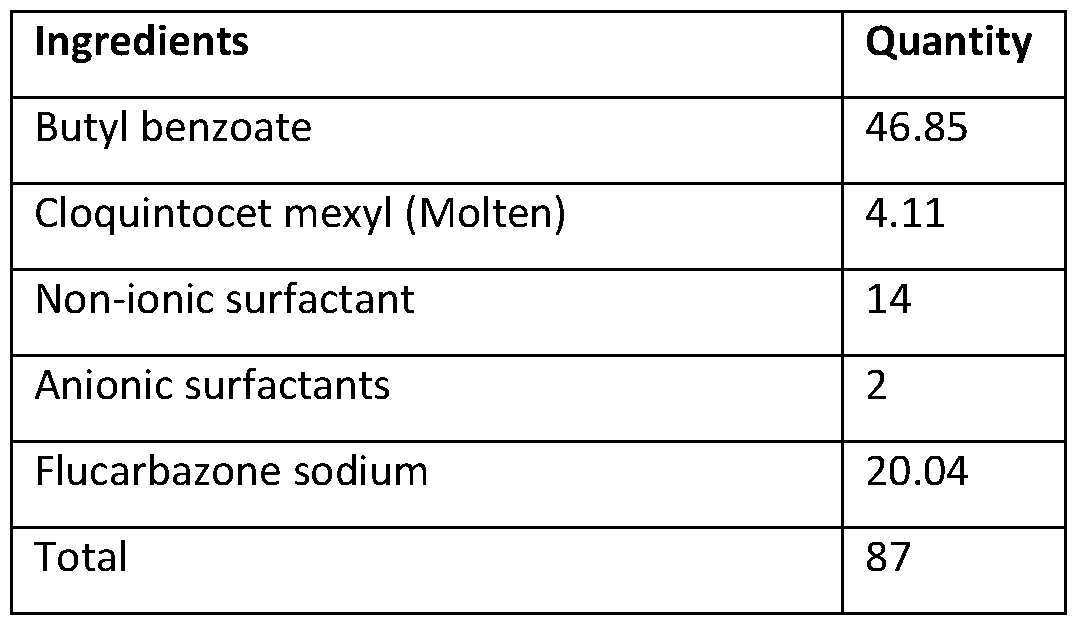
- Example 2 Preparation of 20% w/w Flucarbazone sodium oil dispersion (OD).
- Step 1 Preparation of mill base 4.11 g cloquintocet mexyl was melted separately on a hot water bath (water Batch Temp is 95 deg C) and kept aside. 46.85g butyl benzoate was charged in a mixing vessel and molten cloquintocet mexyl was added under stirring, lg block copolymeric surfactant, 6g fatty alcohol ethoxylate, 2g calcium alkylbenzene sulfonate and 7g fatty acid ethoxylate were added to the same mixing vessel under continuous stirring. 20.04g flucarbazone sodium was then added and homogenized to obtain homogeneous mixture.
- Step 2 Preparation of colloid mixture
- Step 3 Preparation of agrochemical oil dispersion
- colloid mixture was added to the mill base and homogenized for around 45-50 minutes to obtain stable agrochemical oil dispersion.
- An oil dispersion was prepared according to conventional process of preparation that involves mixing all the ingredients together, followed by milling the mixture to obtain desired particle size to obtain oil dispersion. Therefore, flucarbazone sodium herbicide, cloquintocet-mexyl, butyl benzoate, calcium alkylbenzene sulfonate, fatty acid ethoxylate, isotridecyl alcohol polyglycol ether, organoclay and polymeric dispersant were mixed together followed by milling the mixture upto desired particle size to obtain an oil dispersion.
- the formulation characteristics such as pourability and viscosity of the agrochemical oil dispersions developed according to Example-2 and Example-3 were compared.
- Pourability was measured by in house method: The 80ml OD composition was filled in 100ml HDPE bottle. First observation was made by tilting the graduated cylinder at 90 degree and pouring the entire content from graduated cylinder onto 100ml glass beaker. Entire amount of the composition came out from the cylinder. Again, The 80ml OD composition was filled in 100ml HDPE bottle and was given 10 inversions. Second observation was made by tilting the graduated cylinder at 90 degree and pouring the entire content from graduated cylinder onto 100ml glass beaker. Entire amount of the composition came out from the cylinder.
- Example-2 retained good pourability of close to 100% in ambient as well as in 14 days AHS (Accelerated Heat Stability) study, both at 0 inversion and 10 inversions. Therefore, OD composition of Example-2 found to pass pourability test satisfactorily. Viscosity was measured as per CIPAC MT 192. Viscosity of the composition of Example-2 found to be 492 cps which increased within acceptable limit to 602 in 14 days AHS. Composition of Example-2 was kept under observation to check stability of the OD formulation in real time. The sample was kept for 15 months in ambient conditions. The viscosity of the composition of was found to be 296 cPs in real time. The slight change in viscosity observed was within acceptable range. Upon visual inspection, OD found clear without any thickening or phase separation. OD formulation found to be acceptable after 15 months.
- composition of Example-3 found to be 100% pourable at ambient condition but it became too thick that viscosity could not be measured when sample was taken out after 5 14days AHS.
- Composition of Example-3 found to have a viscosity of 578 cps in ambient and further in 14 days AHS, sample became too thick that viscosity could not be measured. (Table 2)
- Example 4-8 Few more compositions of Flucarbazone 20% w/w OD were developed to ascertain effectiveness of colloid mixture in preparing agrochemical oil dispersions.
- compositions of Example-4-8 were prepared to confirm the stability of oil dispersion prepared as per the process disclosed in the present invention.
- Viscosity of colloid mixture 15 prepared as per the process of the present invention by using various rheological additives such as bentonite, modified bentonite, fumed silica and oil phase made of butyl benzoate, mustard oil or soybean oil.
- the colloid mixture of the compositions of Example 4-8 found to be within desired range of 3500-5000 cPs.
- viscosity of final OD compositions also found to be stable with viscosity in an acceptable range from 100-650 cPs. (Table 3)
- compositions of Example 4-8 prepared as per the process disclosed in the present 5 invention were evaluated for pourability characteristic. It was observed that the compositions of Example 4-8 retained good pourability in ambient conditions, both in 0 inversion and 10 inversions. Viscosity of the composition of Examples 4-8 were also found to be within acceptable range. All the compositions found to be satisfactorily pourable in ambient conditions with more than 85% OD composition coming out from the storage 10 container in 0 inversion and more than 95% OD composition coming out from the storage container in 10 inversions. Compositions of Example 4-6 were kept in AHS and rise in viscosity of the final oil dispersion formulations was calculated. All the three formulations exhibited optimum viscosity with slight deviation within ⁇ 6%. Compositions of Example-7 and 8 were evaluated in ambient conditions just after (zero day) and found to exhibit viscosity within acceptable limits. (Table 4)
- Example 9-11 The compositions of Example 9 and Example 10 were assessed for pourability and viscosity of the agrochemical oil dispersions developed according to the process described in the present invention. It was observed that the compositions of Example 9 & 10 retained good pourability in ambient conditions, both in 0 inversion and 10 inversions. Viscosity of the composition of Examples 9 & 10 were also found to be within acceptable range. Overall, it was observed that compositions of Example 9 & 10 remained quite pourable with more than 90% contents coming out of the vessel in 0 inversion as well as in 10 inversions. Viscosity of the final oil dispersion formulations also remained controlled without any significant rise and hence resulting into stable OD formulations. (Table 5 and Table 6)
- Example 9 Amicarbazone 30% Oil Dispersion (OD)
- Example 10 Sulfentrazone 20% w/w Oil Dispersion
- Example 11 Flucarbazone 20% w/w + Pyroxsulam 6% w/w OD
- Flucarbazone-sodium, cloquintocet-mexyl, pyroxsulam, one part of butyl benzoate, anionic surfactant, non-ionic surfactant, ethoxylated phosphate ester and gel part comprising bentonite and remaining part of butyl benzoate were mixed in above quantity and processed as per the Example-1 to obtain oil dispersion composition.
- Example-11 The composition of Example-11 was evaluated for viscosity and visual observations. It appeared as free flowing liquid when tested at 0 day in ambient condition. The composition was kept in storage for cold temperature stability for 1 week at 0°C and - 10°C. It remained free flowing at both 0°C and -10°C. Similarly, its viscosity remained almost constant at 0 day (ambient) as well as after 1 week when kept for cold temperature stability.
- Inventors of the present invention thus successfully prepared an agrochemical oil dispersion by a process described in the present invention that involves preparation of colloid mixture of viscosity range 3500-5000 cps.
- the incorporation of colloid mixture comprising rheological additive and oil phase and its stage of addition during the process of preparing an agrochemical oil dispersion played critical role in obtaining stable composition.
- the compositions developed according to the process described in the present invention based by incorporating colloid mixture of 3500-5000 cps viscosity found to remain stable with desired pourability and viscosity.
Landscapes
- Life Sciences & Earth Sciences (AREA)
- Health & Medical Sciences (AREA)
- General Health & Medical Sciences (AREA)
- Wood Science & Technology (AREA)
- Environmental Sciences (AREA)
- Engineering & Computer Science (AREA)
- Plant Pathology (AREA)
- Pest Control & Pesticides (AREA)
- Zoology (AREA)
- Agronomy & Crop Science (AREA)
- Dentistry (AREA)
- Chemical & Material Sciences (AREA)
- Toxicology (AREA)
- Dispersion Chemistry (AREA)
- Chemical Kinetics & Catalysis (AREA)
- General Chemical & Material Sciences (AREA)
- Agricultural Chemicals And Associated Chemicals (AREA)
Abstract
Description




Claims
Priority Applications (5)
| Application Number | Priority Date | Filing Date | Title |
|---|---|---|---|
| CN202280062201.7A CN117998985A (en) | 2021-09-28 | 2022-09-28 | Method for preparing agrochemical oil dispersion and products thereof |
| MX2024003821A MX2024003821A (en) | 2021-09-28 | 2022-09-28 | A PROCESS FOR PREPARING AN AGROCHEMICAL OIL DISPERSION AND ITS PRODUCT. |
| US18/694,455 US20240389595A1 (en) | 2021-09-28 | 2022-09-28 | A process of preparing an agrochemical oil dispersion and product thereof |
| CA3233076A CA3233076A1 (en) | 2021-09-28 | 2022-09-28 | A process of preparing an agrochemical oil dispersion and product thereof |
| AU2022354673A AU2022354673A1 (en) | 2021-09-28 | 2022-09-28 | A process of preparing an agrochemical oil dispersion and product thereof |
Applications Claiming Priority (2)
| Application Number | Priority Date | Filing Date | Title |
|---|---|---|---|
| IN202121044003 | 2021-09-28 | ||
| IN202121044003 | 2021-09-28 |
Publications (1)
| Publication Number | Publication Date |
|---|---|
| WO2023053014A1 true WO2023053014A1 (en) | 2023-04-06 |
Family
ID=85781440
Family Applications (1)
| Application Number | Title | Priority Date | Filing Date |
|---|---|---|---|
| PCT/IB2022/059211 Ceased WO2023053014A1 (en) | 2021-09-28 | 2022-09-28 | A process of preparing an agrochemical oil dispersion and product thereof |
Country Status (8)
| Country | Link |
|---|---|
| US (1) | US20240389595A1 (en) |
| CN (1) | CN117998985A (en) |
| AR (1) | AR127161A1 (en) |
| AU (1) | AU2022354673A1 (en) |
| CA (1) | CA3233076A1 (en) |
| CL (1) | CL2024000868A1 (en) |
| MX (1) | MX2024003821A (en) |
| WO (1) | WO2023053014A1 (en) |
Citations (5)
| Publication number | Priority date | Publication date | Assignee | Title |
|---|---|---|---|---|
| CN105519559A (en) * | 2015-12-23 | 2016-04-27 | 汤云鹤 | Pesticide composition containing flucarbazone, isoproturon and florasulam, and application thereof in control of wheat field weeds |
| WO2017032644A1 (en) * | 2015-08-21 | 2017-03-02 | Bayer Cropscience Aktiengesellschaft | Oil-based suspension concentrates with low gravitational separation and low viscosity |
| WO2018222726A1 (en) * | 2017-05-30 | 2018-12-06 | Arysta Lifescience Inc. | Safener containing herbicidal oil dispersion |
| US20200077645A1 (en) * | 2018-09-11 | 2020-03-12 | Arysta Lifescience Inc. | Herbicidal oil dispersion and method |
| WO2022224275A1 (en) * | 2021-04-20 | 2022-10-27 | Rajdhani Petrochemicals Private Limited | Synergistic agrochemical oil dispersion formulation |
-
2022
- 2022-09-27 AR ARP220102596A patent/AR127161A1/en unknown
- 2022-09-28 US US18/694,455 patent/US20240389595A1/en active Pending
- 2022-09-28 CN CN202280062201.7A patent/CN117998985A/en active Pending
- 2022-09-28 MX MX2024003821A patent/MX2024003821A/en unknown
- 2022-09-28 WO PCT/IB2022/059211 patent/WO2023053014A1/en not_active Ceased
- 2022-09-28 AU AU2022354673A patent/AU2022354673A1/en active Pending
- 2022-09-28 CA CA3233076A patent/CA3233076A1/en active Pending
-
2024
- 2024-03-25 CL CL2024000868A patent/CL2024000868A1/en unknown
Patent Citations (5)
| Publication number | Priority date | Publication date | Assignee | Title |
|---|---|---|---|---|
| WO2017032644A1 (en) * | 2015-08-21 | 2017-03-02 | Bayer Cropscience Aktiengesellschaft | Oil-based suspension concentrates with low gravitational separation and low viscosity |
| CN105519559A (en) * | 2015-12-23 | 2016-04-27 | 汤云鹤 | Pesticide composition containing flucarbazone, isoproturon and florasulam, and application thereof in control of wheat field weeds |
| WO2018222726A1 (en) * | 2017-05-30 | 2018-12-06 | Arysta Lifescience Inc. | Safener containing herbicidal oil dispersion |
| US20200077645A1 (en) * | 2018-09-11 | 2020-03-12 | Arysta Lifescience Inc. | Herbicidal oil dispersion and method |
| WO2022224275A1 (en) * | 2021-04-20 | 2022-10-27 | Rajdhani Petrochemicals Private Limited | Synergistic agrochemical oil dispersion formulation |
Also Published As
| Publication number | Publication date |
|---|---|
| CA3233076A1 (en) | 2023-04-06 |
| CN117998985A (en) | 2024-05-07 |
| AU2022354673A1 (en) | 2024-05-02 |
| CL2024000868A1 (en) | 2024-08-16 |
| MX2024003821A (en) | 2024-04-25 |
| AR127161A1 (en) | 2023-12-27 |
| US20240389595A1 (en) | 2024-11-28 |
Similar Documents
| Publication | Publication Date | Title |
|---|---|---|
| US11684065B2 (en) | Oil-based suspension concentrates with low gravitational separation and low viscosity | |
| JP5969600B2 (en) | Surfactants and emulsifiers for agricultural oil formulations | |
| CN101808512B (en) | Formulations | |
| EP2563115B1 (en) | Stabilized agricultural oil dispersions | |
| US12414566B2 (en) | Safener containing herbicidal oil dispersion | |
| JP6259506B2 (en) | Compositions and methods for enhancing the physical stability of oil-based suspension formulations for agriculture | |
| KR101956962B1 (en) | Suspoemulsion | |
| CN115209733A (en) | Stable agrochemical compositions | |
| CA2852240A1 (en) | Stable formulations containing fumed aluminum oxide | |
| WO2023053014A1 (en) | A process of preparing an agrochemical oil dispersion and product thereof | |
| EA052937B1 (en) | METHOD FOR PRODUCING AGROCHEMICAL OIL DISPERSION AND A PRODUCT FROM IT | |
| TR2024003741T2 (en) | THE PROCESS OF PREPARING AN AGROCHEMICAL OIL DISPERSION AND ITS PRODUCT | |
| US11877574B2 (en) | Herbicidal oil dispersion and method | |
| CA2995900C (en) | An agrochemical oil-based suspension concentrate comprising low-density particles with low gravitational separation and low viscosity | |
| EA043520B1 (en) | COMPOSITION FOR WEED SUPPRESSION, CONTAINING AN ANTIDOTE, METHOD FOR ITS OBTAINING AND METHOD FOR WEED SUPPRESSION WITH ITS APPLICATION |
Legal Events
| Date | Code | Title | Description |
|---|---|---|---|
| 121 | Ep: the epo has been informed by wipo that ep was designated in this application |
Ref document number: 22875289 Country of ref document: EP Kind code of ref document: A1 |
|
| WWE | Wipo information: entry into national phase |
Ref document number: 202280062201.7 Country of ref document: CN |
|
| WWE | Wipo information: entry into national phase |
Ref document number: 3233076 Country of ref document: CA |
|
| WWE | Wipo information: entry into national phase |
Ref document number: 18694455 Country of ref document: US |
|
| WWE | Wipo information: entry into national phase |
Ref document number: 2024/003741 Country of ref document: TR |
|
| WWE | Wipo information: entry into national phase |
Ref document number: AU2022354673 Country of ref document: AU |
|
| WWE | Wipo information: entry into national phase |
Ref document number: 202490846 Country of ref document: EA |
|
| NENP | Non-entry into the national phase |
Ref country code: DE |
|
| ENP | Entry into the national phase |
Ref document number: 2022354673 Country of ref document: AU Date of ref document: 20220928 Kind code of ref document: A |
|
| 122 | Ep: pct application non-entry in european phase |
Ref document number: 22875289 Country of ref document: EP Kind code of ref document: A1 |