WO2023017654A1 - 予測装置、予測方法、および予測プログラム - Google Patents
予測装置、予測方法、および予測プログラム Download PDFInfo
- Publication number
- WO2023017654A1 WO2023017654A1 PCT/JP2022/015821 JP2022015821W WO2023017654A1 WO 2023017654 A1 WO2023017654 A1 WO 2023017654A1 JP 2022015821 W JP2022015821 W JP 2022015821W WO 2023017654 A1 WO2023017654 A1 WO 2023017654A1
- Authority
- WO
- WIPO (PCT)
- Prior art keywords
- prediction
- smi
- ages
- value
- subject
- Prior art date
- Legal status (The legal status is an assumption and is not a legal conclusion. Google has not performed a legal analysis and makes no representation as to the accuracy of the status listed.)
- Ceased
Links
Images




Classifications
-
- A—HUMAN NECESSITIES
- A61—MEDICAL OR VETERINARY SCIENCE; HYGIENE
- A61B—DIAGNOSIS; SURGERY; IDENTIFICATION
- A61B5/00—Measuring for diagnostic purposes; Identification of persons
- A61B5/22—Ergometry; Measuring muscular strength or the force of a muscular blow
-
- A—HUMAN NECESSITIES
- A61—MEDICAL OR VETERINARY SCIENCE; HYGIENE
- A61B—DIAGNOSIS; SURGERY; IDENTIFICATION
- A61B5/00—Measuring for diagnostic purposes; Identification of persons
- A61B5/72—Signal processing specially adapted for physiological signals or for diagnostic purposes
- A61B5/7271—Specific aspects of physiological measurement analysis
- A61B5/7275—Determining trends in physiological measurement data; Predicting development of a medical condition based on physiological measurements, e.g. determining a risk factor
-
- G—PHYSICS
- G16—INFORMATION AND COMMUNICATION TECHNOLOGY [ICT] SPECIALLY ADAPTED FOR SPECIFIC APPLICATION FIELDS
- G16H—HEALTHCARE INFORMATICS, i.e. INFORMATION AND COMMUNICATION TECHNOLOGY [ICT] SPECIALLY ADAPTED FOR THE HANDLING OR PROCESSING OF MEDICAL OR HEALTHCARE DATA
- G16H50/00—ICT specially adapted for medical diagnosis, medical simulation or medical data mining; ICT specially adapted for detecting, monitoring or modelling epidemics or pandemics
- G16H50/30—ICT specially adapted for medical diagnosis, medical simulation or medical data mining; ICT specially adapted for detecting, monitoring or modelling epidemics or pandemics for calculating health indices; for individual health risk assessment
Definitions
- the present disclosure relates to a prediction device, a prediction method, and a prediction program.
- Patent Literature 1 discloses a device that measures a person's blood pressure, number of steps, or weight, and proposes improvement of the person's diet and exercise based on the measurement results.
- Information related to personal health includes blood pressure, number of steps, and weight, as well as skeletal muscle mass index (SMI: Skeletal Muscle mass Index, hereinafter also referred to as "SMI").
- SMI Skeletal Muscle mass Index
- it is essential to measure decreased skeletal muscle mass along with decreased walking speed and decreased grip strength. Skeletal muscle mass declines with age or disease.
- the SMI is expressed as the sum of the skeletal muscle mass of the limbs divided by the square of the height, and a cutoff value for sarcopenia is established for each of men and women.
- Sarcopenia has recently attracted attention as a factor in physical disability and fall risk in the elderly.
- the SMI of the four legs which is a muscle that develops through exercise, can be improved by improving lifestyle habits such as diet and exercise.
- measuring SMI is important for observing whether lifestyle habits are improving. SMI is difficult to be reflected in the measured values even after several weeks of lifestyle improvement, and it only begins to be reflected in the measured values after several months of lifestyle improvement. For this reason, when a subject attempts to improve his or her lifestyle while observing SMI, the effect of improvement cannot be confirmed unless the subject continues to improve his or her lifestyle over several months. There was a problem that it was difficult to maintain the motivation to continue.
- the present disclosure has been made to solve such problems, and its purpose is to provide a technology that allows subjects to maintain motivation to continue improving their lifestyle habits.
- a prediction device includes an arithmetic device and a communication device communicably connected to the arithmetic device.
- the communication device obtains the first measured value of the subject's advanced glycation end product multiple times in time series, and obtains the second measured value of the subject's skeletal muscle mass.
- the computing device calculates prediction information about a predicted value of the second measured value based on the first measured value and the second measured value obtained a plurality of times in time series.
- a prediction method includes the steps of obtaining a first measured value of advanced glycation end products of a subject a plurality of times in time series, and obtaining a second measured value of skeletal muscle mass of the subject. and calculating prediction information about the predicted value of the second measured value based on the first measured value obtained multiple times in time series and the second measured value.
- a prediction program comprises the step of obtaining, in a computing device, a first measured value of advanced glycation end products of a subject a plurality of times in time series; obtaining a value; and calculating predicted information about a predicted value of the second measured value based on the first measured value obtained a plurality of times in time series and the second measured value.
- the subject in addition to the measured value of SMI, advanced glycation end products (AGEs: Advanced Glycation End Products, hereinafter also referred to as "AGEs”.) Based on the time-series changes in the measured value, Prediction information about the predicted value of SMI can be known. This is expected to make it easier to maintain motivation for continuing to improve lifestyle habits while observing SMI.
- AGEs Advanced Glycation End Products
- FIG. 4 is a diagram for explaining a user identification information table stored by the prediction device according to the embodiment; FIG. It is a figure for demonstrating the browsing information table which the prediction apparatus which concerns on embodiment stores. It is a figure for demonstrating an AGEs evaluation rank. It is a figure which shows an example of an AGEs measured value.
- FIG. 4 is a diagram for explaining SMI evaluation ranks; FIG. 4 is a diagram for explaining the correlation between AGEs and SMI; FIG. 4 is a diagram for explaining the correlation between AGEs and SMI; FIG.
- 4 is a diagram showing an example of SMI prediction; It is a figure which shows an example of the display screen in the user terminal which concerns on embodiment. It is a figure which shows an example of the display screen in the user terminal which concerns on embodiment. It is a figure which shows an example of the display screen in the user terminal which concerns on embodiment. It is a figure which shows an example of the display screen in the user terminal which concerns on embodiment. It is a figure which shows an example of the display screen in the user terminal which concerns on embodiment. It is a figure which shows an example of the display screen in the user terminal which concerns on embodiment. 4 is a flowchart of prediction processing executed by the prediction device according to the embodiment;
- FIG. 1 is a diagram showing a prediction system 1 according to an embodiment. As shown in FIG. 1, the prediction system 1 includes an AGEs measurement device 10, an SMI measurement device 20, a user terminal 30, and a prediction device 50.
- the AGEs measuring device 10 is a device for measuring the AGEs of the subject.
- AGEs is a general term for a plurality of chemical compounds, and is produced when sugars and proteins combine and react through oxidation, dehydration, and condensation.
- AGEs are believed to accumulate in the body due to disordered lifestyles and cause age-related diseases and lifestyle-related diseases (eg, diabetes and dementia).
- AGEs can change with shorter-term lifestyle changes compared to SMIs.
- AGEs can be reflected in measurements after several weeks of lifestyle modification.
- Subjects include elderly people using nursing homes, people with age-related diseases, and people with lifestyle-related diseases.
- AGEs measuring device 10 includes measuring unit 11 , display 12 , and communication unit 13 .
- the display 12 may be omitted.
- the measurement unit 11 noninvasively measures the subject's AGEs.
- the multiple compounds contained in AGEs there are compounds that have the property of emitting fluorescence when irradiated with specific light.
- the measuring unit 11 measures the subject's AGEs by using such properties of the compound.
- the measurement unit 11 When the subject adheres the fingertip to the measurement unit 11, the measurement unit 11 irradiates the skin with light from a light source (not shown).
- the measurement unit 11 may be configured to irradiate the skin (for example, the arm) other than the fingertips of the person to be measured with light.
- the light emitted by the measurement unit 11 is, for example, excitation light having a peak in a wavelength range of 410 nm or less.
- the measurement unit 11 receives fluorescence excited by the light applied to the skin with a light receiving element (not shown), and measures the degree of accumulation of AGEs based on the intensity of the received fluorescence.
- the display 12 displays the measurement results of AGEs obtained by the measurement unit 11 .
- the measurement result includes, for example, a value obtained by converting the intensity of the fluorescence received by the measurement unit 11 and the degree of accumulation of AGEs into a score.
- the measurement result may include a correction value obtained by correcting a value obtained by converting the intensity of the fluorescence received by the measurement unit 11 and the degree of accumulation of AGEs into a score.
- the communication unit 13 transmits and receives data (information) to and from the prediction device 50 by wired communication or wireless communication.
- the communication unit 13 is an information terminal capable of communicating with the prediction device 50 via a network, such as a desktop PC (personal computer), a laptop PC, a smartphone, a smart watch, a wearable device, a tablet PC, and a network adapter. be.
- a network such as a desktop PC (personal computer), a laptop PC, a smartphone, a smart watch, a wearable device, a tablet PC, and a network adapter.
- the communication unit 13 may be configured integrally with the display 12 .
- the communication unit 13 may be separate from each of the measurement unit 11 and the display 12 .
- the SMI measuring device 20 is a device for measuring the subject's SMI.
- Examples of the SMI measuring device 20 include a body composition meter, and in addition to the SMI, body weight, body mass index (BMI: Body Mass Index, hereinafter also referred to as "BMI"), body fat percentage, visceral fat level, basal Metabolic rate, body age, etc. may be measured.
- BMI Body Mass Index
- the AGEs measuring device 10 and the SMI measuring device 20 are installed in various facilities such as pharmacies, medical institutions, nursing homes, and gyms.
- the AGEs measuring device 10 and the SMI measuring device 20 are assumed to be usable by a non-measurer alone, but may be managed by a supporter who supports the subject.
- the supporter measures the AGEs of the subject he or she supports using the AGEs measuring device 10
- the measured value of AGEs (hereinafter also referred to as the "AGEs measured value”) is transferred from the AGEs measuring device 10 to the prediction device 50. sent.
- the supporter measures the SMI of the subject he or she supports using the SMI measuring device 20
- the measured SMI value (hereinafter also referred to as the "measured SMI value") is obtained from the SMI measuring device 20 by the prediction device 50. sent to.
- a supporter like the subject, is a user of the service provided by the prediction system 1 (hereinafter also referred to as "information provision service"), and is a person or organization that supports the subject.
- the supporter may be an outpatient care facility (day service, day care center), care facility staff, a nurse, or a lifestyle counselor.
- the supporter may be a fitness gym instructor or a nutrition advisor.
- the supporter may also be a doctor or nurse in a hospital or clinic.
- the frequency at which the supporter communicates with the subject is not every day (for example, once a week), if the supporter measures the subject's AGEs at that frequency, the change in AGEs can be obtained.
- the SMI measurement value is difficult to change in a few weeks like AGEs, and it starts to be reflected in the measurement value only after several months of lifestyle improvement.
- the user terminal 30 is owned or used by the user.
- the user terminal 30 is an information terminal capable of communicating with the prediction device 50 via a network, such as a desktop PC, laptop PC, smart phone, smart watch, wearable device, and tablet PC.
- a network such as a desktop PC, laptop PC, smart phone, smart watch, wearable device, and tablet PC.
- the user is the user of the information provision service.
- the user may be the person to be measured, or may be a supporter of the person to be measured.
- users are family members, relatives, or related parties (for example, acquaintances) of the person to be measured who have been granted the right to view the measurement results of the person to be measured by the person or supporters. There may be.
- the prediction device 50 is managed by a service provider who provides information provision services.
- the service provider may be a manufacturer of the AGEs measuring device 10 that lends the AGEs measuring device 10 to supporters.
- Prediction device 50 communicates with each of AGEs measurement device 10 , SMI measurement device 20 , and user terminal 30 by functioning as a cloud computer.
- the AGEs measurement device 10 when the subject measures AGEs using the AGEs measurement device 10, the AGEs measurement device 10 outputs the AGEs measurement value to the prediction device 50.
- the prediction device 50 stores the acquired AGEs measurement value together with the subject's AGEs measurement value acquired in the past.
- the SMI measurement device 20 when the subject measures the SMI using the SMI measurement device 20 , the SMI measurement device 20 outputs the SMI measurement value to the prediction device 50 .
- the prediction device 50 stores the acquired SMI measurement value together with the previously acquired SMI measurement value of the subject.
- Measuring AGEs and SMI is important for observing whether the subject's lifestyle is improving.
- AGEs can be reflected in the measured values if lifestyle habits are improved for several weeks, whereas SMI is difficult to be reflected in measured values even if lifestyle habits are improved for several weeks, and even if lifestyle habits are improved for several months.
- SMI is difficult to be reflected in measured values even if lifestyle habits are improved for several weeks, and even if lifestyle habits are improved for several months.
- it begins to be reflected in the measured value. For this reason, when a subject attempts to improve his or her lifestyle while observing SMI, the effect of improvement cannot be confirmed unless the subject continues to improve his or her lifestyle over several months. It is difficult to maintain the motivation to continue.
- the prediction device 50 based on the time-series change in the AGEs measurement value acquired and stored in the past and the SMI measurement value acquired and stored in the past, the SMI measurement value is predicted, and the predicted value of the SMI measurement value (hereinafter also referred to as "SMI predicted value") is stored.
- the prediction device 50 generates browsing information that can be browsed by each user of the subject, the supporter, and the viewer based on the AGEs measurement value obtained in the past, the SMI measurement value obtained in the past, and the SMI prediction value.
- the prediction device 50 may generate browsing information based on other information of the subject.
- Other information includes, for example, blood pressure, body mass index (BMI), vegetable intake, walking speed, and grip strength.
- the prediction device 50 may analyze the health condition of the person to be measured based on the other information described above, generate analysis information including the analysis result, and include the analysis information in the browsing information. That is, the browsing information may include at least one of blood pressure, BMI, vegetable intake, walking speed, grip strength, and analysis information in addition to AGEs measurement value, SMI measurement value, and SMI prediction value.
- the prediction device 50 When the user requests viewing information using the user terminal 30 , the prediction device 50 outputs viewing information to the user terminal 30 in response to the request from the user terminal 30 .
- the user terminal 30 displays the browsing information acquired from the prediction device 50 .
- the user can use the user terminal 30 to view the AGEs measurement values and the SMI measurement values obtained in the past, and also to view changes in the time series of the AGEs measurement values obtained in the past and the SMIs obtained in the past. SMI predictions calculated based on measurements and measurements can be viewed.
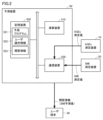
- FIG. 2 is a diagram showing the configuration of the prediction device according to the embodiment.
- the prediction device 50 includes an arithmetic device 510 , a storage device 520 and a communication device 530 .
- the computing device 510 is an example of a computer, and is a computing entity that executes various processes according to various programs.
- Arithmetic device 510 includes, for example, at least one of a CPU (Central Processing Unit), FPGA (Field Programmable Gate Array), GPU (Graphics Processing Unit), and MPU (Multi Processing Unit). Further, the computing device 510 may include volatile memory such as dynamic random access memory (DRAM) and static random access memory (SRAM), non-volatile memory such as read only memory (ROM) and flash memory. Note that the arithmetic device 510 may be configured by an arithmetic circuit (processing circuit).
- the storage device 520 includes non-volatile memories such as HDDs (Hard Disk Drives) and SSDs (Solid State Drives).
- the storage device 520 stores various programs and data such as a prediction program 521 executed by the computing device 510 , user identification information 522 referenced by the computing device 510 , and viewing information 523 .
- the user identification information 522 includes information about the user, such as user ID, password, user name, age, and gender. Prediction device 50 may use user identification information 522 to identify the user.
- the browsing information 523 includes AGEs measured values, SMI measured values, and SMI predicted values. Also, the viewing information 523 may include at least one of blood pressure, BMI, vegetable intake, walking speed, grip strength, and analysis information.
- the storage device 520 may include volatile memory such as DRAM and SRAM, and nonvolatile memory such as ROM and flash memory. Further, computing device 510 may include a media reader (not shown). The computing device 510 may receive a removable disk as a storage medium by means of a media reading device, and acquire various programs and data such as the prediction program 521 and the user identification information 522 from the removable disk.
- the communication device 530 is communicably connected to the computing device 510 .
- the communication device 530 transmits and receives data (information) to and from each of the AGEs measurement device 10, the SMI measurement device 20, and the user terminal 30 by wired communication or wireless communication.
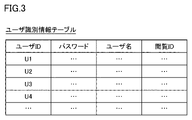
- FIG. 3 is a diagram for explaining the user identification information table stored by the prediction device 50 according to the embodiment.
- Prediction device 50 stores user identification information 522 using the user identification information table of FIG.
- the user identification information table stores information on user IDs, passwords, user names, and browsing IDs as user identification information 522 .
- Each user who uses the information providing service is identified by user identification information 522 .
- the first user is assigned "U1" as the user ID
- the second user is assigned "U2" as the user ID.
- the user ID, password, and user name are input from the user terminal 30 by each user.
- the user terminal 30 outputs the input user identification information 522 to the prediction device 50 .
- the prediction device 50 stores the user identification information 522 acquired from the user terminal 30 in the storage device 520 by storing it in the user identification information table.
- the viewing ID is associated with various types of viewing information such as subject information, AGEs measurement information, SMI measurement information, SMI prediction information, and analysis information in the viewing information table of FIG. 4, which will be described later.
- the prediction device 50 allows the user who is the owner of the user ID associated with the browsing ID to browse the browsing information associated with the browsing ID.
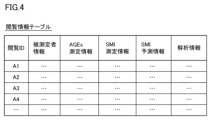
- FIG. 4 is a diagram for explaining the viewing information table stored by the prediction device 50 according to the embodiment.
- the prediction device 50 stores browsing information 523 using the browsing information table of FIG.
- the browsing information table includes browsing ID, subject information, AGEs measurement information, SMI measurement information, SMI prediction information, and analysis information.
- the AGEs measurement information includes the subject's AGEs measurement value obtained in the past.
- the SMI measurement information includes previously obtained SMI measurements of the subject.
- the SMI prediction information includes the SMI prediction value generated based on the AGEs measurement value obtained in the past and the SMI measurement value obtained in the past, the SMI evaluation rank described later corresponding to the SMI measurement value, and the SMI prediction. including lifestyle advice.
- the analysis information includes information about the results of analyzing the health condition of the subject.
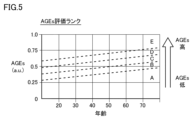
- FIG. 5 is a diagram for explaining the AGEs evaluation rank.
- the prediction device 50 provides a plurality of reference values in stages for the AGEs measurement value, and ranks the AGEs based on the comparison between the AGEs measurement value and the plurality of reference values. For example, five ranks from A to E (hereinafter also referred to as “AGEs evaluation rank”) are provided as ranks attached to AGEs measurement values.
- AGEs evaluation rank is “A”
- the evaluation of the AGEs measurement value is the best
- the AGEs evaluation rank is "E”
- the evaluation of the AGEs measurement value is the worst.
- the reference values of the AGEs evaluation rank shown in FIG. 5 are only examples, and any value may be set as the reference value.
- the reference value of the AGEs evaluation rank may differ depending on the subject's age and gender.
- FIG. 6 is a diagram showing an example of AGEs measurement values.
- the prediction device 50 ranks the acquired AGEs measurement values based on the criteria shown in FIG. 5, and stores the AGEs evaluation rank together with the AGEs measurement values as AGEs measurement information.
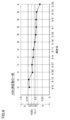
- FIG. 6 shows a graph showing the chronological change in the measured AGEs of the subject, with the date on the horizontal axis and the measured AGEs on the vertical axis.
- the prediction device 50 calculates the AGEs of A to E for each AGE measured value. Assign a rating rank. In the case of this measurer, the AGEs measurement value gradually decreased (improved) during the period from April 6th to June 22nd, and it can be seen that the AGEs evaluation rank also improved from the initial D to A.
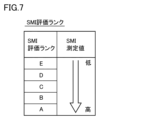
- FIG. 7 is a diagram for explaining the SMI evaluation rank.
- the predictor 50 provides multiple reference values for the SMI measurements in stages, and ranks the SMIs based on comparisons between the SMI measurements and the multiple reference values. For example, five ranks from A to E (hereinafter also referred to as “SMI evaluation ranks”) are provided as ranks assigned to SMI measurement values.
- SMI evaluation ranks are provided as ranks assigned to SMI measurement values.
- any value may be set as the reference value for the SMI evaluation rank.
- the reference value of the SMI evaluation rank may differ according to the age of the person being measured, and may also be different according to the sex of the person being measured.
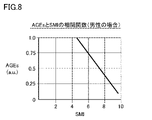
- FIG. 8 shows a graph of the correlation when the subject is male, with the horizontal axis representing the SMI measurement value and the vertical axis representing the AGEs measurement value.
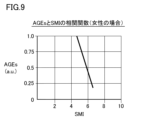
- FIG. 9 shows a graph of the correlation when the subject is a woman, with the horizontal axis representing the SMI measurement value and the vertical axis representing the AGEs measurement value.
- FIG. 10 is a diagram showing an example of SMI prediction.
- FIG. 10 shows an example in which the prediction device 50 calculates the predicted SMI value using the measured AGEs of the subject obtained weekly from April 6 to June 22 shown in FIG. explain.
- the upper part of FIG. 10 shows a graph showing the chronological change in the measured AGEs of the subject, with the date on the horizontal axis and the measured AGEs on the vertical axis.
- the lower part of FIG. 10 shows a graph showing time-series changes in the SMI evaluation rank of the subject, with the date on the horizontal axis and the SMI evaluation rank on the vertical axis.
- the subject uses the AGEs measuring device 10 to measure AGEs regularly every few weeks. For example, the subject uses the AGEs measuring device 10 to measure AGEs every week from April 6th to June 22nd.
- the prediction device 50 acquires the AGEs measurement value from the AGEs measurement device 10 every week from April 6th to June 22nd.
- the subject normally measures the SMI using the SMI measuring device 10 every few months. For example, if the subject uses the SMI measuring device 20 to measure the SMI on April 6th, the next SMI is scheduled to be measured on June 22nd, several months later.
- the prediction device 50 acquires the SMI measurement value at 4/6 from the AGEs measurement device 20 .
- the prediction device 50 After acquiring the SMI measurement value on April 6th, the prediction device 50 calculates the subject's SMI on June 22nd, the next SMI measurement date, as the predicted SMI value at the subsequent prediction timing. do. Furthermore, the prediction device 50 calculates an SMI prediction value based on time-series changes in the AGEs measurement values acquired in a predetermined period going back from the prediction time.
- the prediction device 50 calculates the SMI prediction value for 6/22 at the time of 4/27, 4/6, 4/13, 4/20, and 4/6 obtained in the past one week going back from 4/27. /27 AGEs measurements are read from storage 520 .
- the prediction device 50 predicts the SMI prediction value on June 22 based on the time-series change in the read AGEs measurement value for each week from April 6 to April 27 and the SMI measurement value obtained last April 6. Calculate Then, the prediction device 50 calculates the SMI evaluation rank by comparing the calculated SMI prediction value and the reference value.
- the prediction device 50 calculates the SMI prediction value for June 22 at the time of May 18, 4/27, 5/4, 5/11, and 5/18 acquired in the past one week going back from 5/18.
- AGEs measurements are read from storage device 520 .
- the prediction device 50 predicts the SMI prediction value on June 22, based on the time-series change in the read AGEs measurement value for each week from April 27 to May 18 and the SMI measurement value obtained last April 6. Calculate Then, the prediction device 50 calculates the SMI evaluation rank by comparing the calculated SMI prediction value and the reference value.
- the prediction device 50 calculates the SMI prediction value on 6/22 at the time of 6/8, the prediction device 50 obtains 5/18, 5/25, 6/1, and 6/8 in the past one week going back from 6/8. AGEs measurements are read from storage device 520 . The prediction device 50 predicts the SMI prediction value on June 22 based on the time-series changes in the read AGEs measurement values for each week from May 18 to June 8 and the SMI measurement value obtained last April 6. Calculate Then, the prediction device 50 calculates the SMI evaluation rank by comparing the calculated SMI prediction value and the reference value.
- the AGEs measured values obtained from 4/6 to 6/8 are gradually improving (decreasing), so the prediction device 50
- the SMI evaluation rank is also expected to gradually improve.
- the SMI prediction value and SMI evaluation rank thus obtained are stored in the browsing information table of FIG. 4 as SMI prediction information.
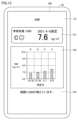
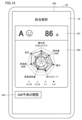
- FIG. 11 to 15 are diagrams showing examples of display screens in the user terminal 30 according to the embodiment.
- the user terminal 30 When the user uses the user terminal 30 to execute an application program for using the information providing service, the user terminal 30 displays a login screen (not shown) on the display 390 . When the user enters a user ID and password on the login screen, the user terminal 30 outputs the user ID and password to the prediction device 50 . When the prediction device 50 authenticates the user based on the user ID and password, the user terminal 30 displays the home screen 31 as shown in FIG. 11 on the display 390. FIG.
- the home screen 31 includes an image 311 for viewing AGEs measurement information, an image 312 for viewing SMI measurement values and SMI prediction information, and an image 313 for viewing analysis information.
- the image 311 shows the most recently measured AGEs measurement value and the AGEs evaluation rank corresponding to the AGEs measurement value.
- the image 311 shows "0.51" as the AGEs measurement value measured on May 18, 2021, and "B" as the AGEs evaluation rank.
- the user terminal 30 displays the AGEs viewing screen 32 as shown in FIG.
- the AGEs viewing screen 32 includes an image 321 showing the most recently measured AGEs measurement value, an image 322 showing chronological changes in the AGEs measurement value in the past (for example, the past one week), and comments on the AGEs measurement value. and an image 323 shown. In this way, the user can browse the AGEs measurement information of the subject by referring to the AGEs browsing screen 32 .
- image 312 shows the most recently measured SMI measurement value and the SMI evaluation rank corresponding to the SMI measurement value.
- image 312 shows "7.6" as the SMI measurement measured on 4/6/2021 and "B" as the SMI evaluation rank.
- the user terminal 30 displays the SMI viewing screen 33 as shown in FIG.
- the SMI viewing screen 33 includes an image 331 showing the most recently measured SMI measurement value, an image 332 showing time-series changes in the SMI measurement value in the past (for example, the past six months), and comments on the SMI measurement value. and an image 333 shown. In this way, the user can view the SMI measurement information of the subject by referring to the SMI viewing screen 33 .
- the image 313 includes analysis results obtained by analyzing the health condition of the subject based on the AGEs measurement value and SMI measurement value, etc., and comments on the analysis results.
- the user terminal 30 displays the comprehensive analysis screen 34 as shown in FIG.
- the comprehensive analysis screen 34 includes an image 341 showing scores and evaluation ranks corresponding to the analysis results, and an image 342 showing the analysis results in a radar chart. In this way, the user can view the analysis information of the subject by referring to the comprehensive analysis screen 34 .
- the comprehensive analysis screen 34 includes an image 343 for viewing the SMI predicted value.
- user terminal 30 displays SMI prediction screen 35 as shown in FIG.
- the SMI prediction screen 35 includes an image 351 showing the predicted SMI value on the next SMI measurement date (June 22 in this example) calculated at the present time (5/18 in this example), and an SMI predicted value based on the SMI predicted value. and an image 352 showing advice on the person's lifestyle habits.
- the image 351 shows that the SMI evaluation rank is improved from "C" to "B” on June 22 as a result of predicting the SMI at the time of May 18th.
- image 352 as advice on lifestyle habits, a comment stating that AGEs and SMI are steadily improving and that the current lifestyle habits are to be continued is shown.
- the user can view SMI prediction information such as an SMI prediction value, an SMI evaluation rank corresponding to the SMI prediction value, and lifestyle advice based on the SMI prediction. can be done.
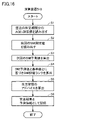
- FIG. 16 is a flowchart of prediction processing executed by the prediction device 50 according to the embodiment.
- the processing steps hereinafter abbreviated as “S”.
- the prediction device 50 reads out the AGEs measurement values for the most recent predetermined period from the current time of prediction from the storage device 520 (S1).
- the prediction device 50 reads the previously obtained SMI measurement value from the storage device 520 (S2).
- the prediction device 50 calculates the SMI prediction value for the next measurement date based on the time-series change in the read AGEs measurement value and the read SMI measurement value (S3).
- the prediction device 50 calculates the SMI evaluation rank corresponding to the SMI predicted value by comparing the calculated SMI predicted value with the reference value (S4). Furthermore, the prediction device 50 calculates lifestyle advice based on the SMI evaluation rank (S5).
- the prediction device 50 stores the SMI prediction value calculated in S4 and the lifestyle advice calculated in S5 as prediction information in the browsing information table of FIG. 4, thereby storing them in the storage device 520 (S6).
- the SMI prediction value and the SMI evaluation value in the future are calculated based on the time-series change in the AGEs measurement value obtained in the past and the SMI measurement value obtained in the past. Calculate rank.
- the subject By viewing the SMI predicted value and the SMI evaluation rank using the user terminal 30, the subject (user) can obtain not only the AGEs measured value repeatedly obtained in a relatively short period of time, but also repeatedly obtained in a relatively long period of time. Even while observing the measured SMI value, it becomes easier to maintain motivation for continuing to improve lifestyle habits.
- the prediction device 50 calculates the SMI prediction value for the next SMI measurement date. However, the prediction device 50 may calculate the SMI prediction value at any timing after the current timing of the prediction.
- the prediction device 50 calculates the SMI prediction value using the AGEs measurement values acquired in the past one week going back from the current time of prediction. However, the prediction device 50 may calculate the SMI prediction value using the AGEs measurement values that have already been obtained at the time of prediction. You may
- the prediction device 50 acquires the AGEs measurement value directly from the AGEs measurement value 10.
- the subject may input the AGEs measurements obtained by the AGEs measurement 10 from his terminal (eg, the user terminal 30), and the prediction device 50 may input the AGEs measurements from his terminal (eg, the user terminal 30).
- AGEs measurements may be obtained from the terminal 30).
- the prediction device 50 obtains the SMI measurement value directly from the SMI measurement value 20.
- the subject may enter the SMI measurements obtained by the SMI measurements 20 from his terminal (eg, user terminal 30), and the prediction device 50 may receive the measurement subject's terminal (eg, user An SMI measurement may be obtained from the terminal 30).
- the prediction device 50 provides viewing information to the user by displaying viewing information such as the SMI predicted value on the display 390 of the user terminal 30. rice field.
- the prediction device 50 may use a printer to output a sheet of paper indicating the viewing information such as the SMI prediction value.
- a prediction device includes an arithmetic device and a communication device communicably connected to the arithmetic device.
- the communication device obtains the first measured value of the subject's advanced glycation end product multiple times in time series, and obtains the second measured value of the subject's skeletal muscle mass.
- the computing device calculates prediction information about a predicted value of the second measured value based on the first measured value and the second measured value obtained a plurality of times in time series.
- the subject can know the prediction information regarding the predicted value of SMI based on the time-series change in the measured value of AGEs in addition to the measured value of SMI. This is expected to make it easier to maintain motivation for continuing to improve lifestyle habits while observing SMI.
- the communication device periodically acquires the first measured value at a first interval, and periodically acquires the second measured value at a second interval longer than the first interval.
- the computing device calculates prediction information based on the time-series change in the first measured value acquired in a predetermined period of the acquisition period of the first measured value.
- the subject can obtain prediction information regarding the predicted value of SMI by measuring AGEs over a predetermined period.
- the computing device calculates the forecast information based on the time-series changes in the first measurement values acquired in the most recent predetermined period retroactively from the time of prediction during the acquisition period.
- the prediction device described in item 4 if the subject measures AGEs over the most recent predetermined period going back from the time of prediction, it is possible to obtain prediction information about the predicted value of SMI. can.
- the computing device calculates, as prediction information, an evaluation result of the prediction value based on comparison with the reference value.
- the subject by observing the evaluation result of the SMI prediction value (SMI evaluation rank), the subject can easily maintain the motivation to continue improving his or her lifestyle habits even with SMI. Become.
- the computing device calculates, as prediction information, advice regarding the subject's lifestyle habits based on the prediction value.
- the subject can easily maintain motivation to continue improving his or her lifestyle while viewing advice on the subject's lifestyle habits based on the predicted SMI value.
- a prediction method includes the step of acquiring a first measured value of advanced glycation end products of a subject a plurality of times in time series, and obtaining a second measured value of skeletal muscle mass of the subject. and calculating prediction information about the predicted value of the second measured value based on the first measured value obtained multiple times in time series and the second measured value.
- the subject can know prediction information regarding the predicted value of SMI based on time-series changes in the measured value of AGEs in addition to the measured value of SMI. This is expected to make it easier to maintain motivation for continuing to improve lifestyle habits while observing SMI.
- a prediction program includes a step of obtaining, in a computing device, a first measured value of advanced glycation end products of a subject a plurality of times in time series, Obtaining two measured values; and calculating prediction information about a predicted value of the second measured value based on the first measured value obtained a plurality of times in time series and the second measured value.
- the subject in addition to the measured SMI, the subject can know the predicted information regarding the predicted value of SMI based on the time-series changes in the measured value of AGEs. This is expected to make it easier to maintain motivation for continuing to improve lifestyle habits while observing SMI.
- 1 prediction system 10 AGEs measurement device, 20 SMI measurement device, 11 measurement unit, 12,390 display, 13 communication unit, 30 user terminal, 31 home screen, 32 AGEs viewing screen, 33 SMI viewing screen, 34 comprehensive analysis screen, 35 prediction screen, 50 prediction device, 311, 312, 313, 321, 322, 323, 331, 332, 333, 341, 342, 343, 351, 352 image, 510 arithmetic device, 520 storage device, 521 prediction program, 522 User identification information, 523 browsing information, 530 communication device
Landscapes
- Health & Medical Sciences (AREA)
- Life Sciences & Earth Sciences (AREA)
- Engineering & Computer Science (AREA)
- Public Health (AREA)
- Medical Informatics (AREA)
- General Health & Medical Sciences (AREA)
- Biomedical Technology (AREA)
- Pathology (AREA)
- Heart & Thoracic Surgery (AREA)
- Surgery (AREA)
- Physics & Mathematics (AREA)
- Veterinary Medicine (AREA)
- Biophysics (AREA)
- Animal Behavior & Ethology (AREA)
- Molecular Biology (AREA)
- Computer Vision & Pattern Recognition (AREA)
- Physiology (AREA)
- Psychiatry (AREA)
- Artificial Intelligence (AREA)
- Signal Processing (AREA)
- Physical Education & Sports Medicine (AREA)
- Data Mining & Analysis (AREA)
- Databases & Information Systems (AREA)
- Epidemiology (AREA)
- Primary Health Care (AREA)
- Medical Treatment And Welfare Office Work (AREA)
- Measuring And Recording Apparatus For Diagnosis (AREA)
Abstract
Description
図1~図4を参照しながら実施の形態に係る予測システム1について説明する。図1は、実施の形態に係る予測システム1を示す図である。図1に示すように、予測システム1は、AGEs測定装置10と、SMI測定装置20と、ユーザ端末30と、予測装置50とを備える。
図2は、実施の形態に係る予測装置の構成を示す図である。図2に示すように、予測装置50は、演算装置510と、記憶装置520と、通信装置530とを備える。
図5および図6を参照しながらAGEsの評価について説明する。図5は、AGEs評価ランクを説明するための図である。
図7を参照しながらSMIの評価について説明する。図7は、SMI評価ランクを説明するための図である。図7に示すように、予測装置50は、SMI測定値に対して段階的に複数の基準値を設け、SMI測定値と複数の基準値との比較に基づき、SMIをランク付けする。たとえば、SMI測定値に付けられるランクとして、A~Eの5段階のランク(以下、「SMI評価ランク」とも称する。)が設けられている。SMI評価ランクが「A」の場合はSMI測定値の評価が最も良く、SMI評価ランクが「E」の場合はSMI測定値の評価が最も悪い。
図8~図10を参照しながら、AGEs測定値を用いたSMI予測値の算出について説明する。
図11~図15を参照しながら、閲覧情報の表示例について説明する。図11~図15は、実施の形態に係るユーザ端末30における表示画面の一例を示す図である。
図16を参照しながら、予測装置50の処理について説明する。図16は、実施の形態に係る予測装置50が実行する予測処理のフローチャートである。図16に示される処理ステップ(以下、これを「S」と略す。)は、演算装置510が予測プログラム521を実行することによって実現される。
以上、実施の形態に係る予測装置50について説明したが、実施の形態に係る予測装置50においては、さらに種々の変形、応用が可能である。以下、実施の形態に係る予測装置50の変形例について、実施の形態に係る予測装置50と異なる部分のみを説明する。
上述した複数の例示的な実施の形態は、以下の態様の具体例であることが当業者により理解される。
Claims (8)
- 被測定者の骨格筋量を予測する予測装置であって、
演算装置と、
前記演算装置と通信可能に接続された通信装置とを備え、
前記通信装置は、
前記被測定者の終末糖化産物の第1測定値を時系列的に複数回取得し、
前記被測定者の前記骨格筋量の第2測定値を取得し、
前記演算装置は、時系列的に複数回取得した前記第1測定値と、前記第2測定値とに基づき、前記第2測定値の予測値に関する予測情報を算出する、予測装置。 - 前記通信装置は、
前記第1測定値を第1間隔で定期的に取得し、
前記第2測定値を前記第1間隔よりも長い第2間隔で定期的に取得する、請求項1に記載の予測装置。 - 前記演算装置は、前記第1測定値の取得期間のうち、予め定められた期間で取得された前記第1測定値の時系列の変化に基づき、前記予測情報を算出する、請求項1に記載の予測装置。
- 前記演算装置は、前記取得期間のうち、予測時点から遡って直近の前記予め定められた期間で取得された前記第1測定値の時系列の変化に基づき、前記予測情報を算出する、請求項3に記載の予測装置。
- 前記演算装置は、前記予測情報として、基準値との比較に基づく前記予測値の評価結果を算出する、請求項1に記載の予測装置。
- 前記演算装置は、前記予測情報として、前記予測値に基づく前記被測定者の生活習慣に関するアドバイスを算出する、請求項1に記載の予測装置。
- 演算装置による被測定者の骨格筋量を予測する予測方法であって、
前記被測定者の終末糖化産物の第1測定値を時系列的に複数回取得するステップと、
前記被測定者の前記骨格筋量の第2測定値を取得するステップと、
時系列的に複数回取得した前記第1測定値と、前記第2測定値とに基づき、前記第2測定値の予測値に関する予測情報を算出するステップとを含む、予測方法。 - 被測定者の骨格筋量を予測する予測プログラムであって、
演算装置に、
前記被測定者の終末糖化産物の第1測定値を時系列的に複数回取得するステップと、
前記被測定者の前記骨格筋量の第2測定値を取得するステップと、
時系列的に複数回取得した前記第1測定値と、前記第2測定値とに基づき、前記第2測定値の予測値に関する予測情報を算出するステップとを実行させる、予測プログラム。
Priority Applications (2)
| Application Number | Priority Date | Filing Date | Title |
|---|---|---|---|
| US18/290,685 US20240389948A1 (en) | 2021-08-11 | 2022-03-30 | Prediction device, prediction method, and prediction program |
| JP2023541223A JP7586331B2 (ja) | 2021-08-11 | 2022-03-30 | 予測装置、予測方法、および予測プログラム |
Applications Claiming Priority (2)
| Application Number | Priority Date | Filing Date | Title |
|---|---|---|---|
| JP2021131058 | 2021-08-11 | ||
| JP2021-131058 | 2021-08-11 |
Publications (1)
| Publication Number | Publication Date |
|---|---|
| WO2023017654A1 true WO2023017654A1 (ja) | 2023-02-16 |
Family
ID=85199699
Family Applications (1)
| Application Number | Title | Priority Date | Filing Date |
|---|---|---|---|
| PCT/JP2022/015821 Ceased WO2023017654A1 (ja) | 2021-08-11 | 2022-03-30 | 予測装置、予測方法、および予測プログラム |
Country Status (3)
| Country | Link |
|---|---|
| US (1) | US20240389948A1 (ja) |
| JP (1) | JP7586331B2 (ja) |
| WO (1) | WO2023017654A1 (ja) |
Citations (4)
| Publication number | Priority date | Publication date | Assignee | Title |
|---|---|---|---|---|
| JP2009050523A (ja) * | 2007-08-28 | 2009-03-12 | Omron Healthcare Co Ltd | 健康管理指針アドバイス装置 |
| JP2013081800A (ja) * | 2013-01-04 | 2013-05-09 | Tanita Corp | 体組成計 |
| JP2013176424A (ja) * | 2012-02-28 | 2013-09-09 | Tanita Corp | 安全ダイエット監視装置および安全ダイエット監視方法 |
| WO2018164221A1 (ja) * | 2017-03-10 | 2018-09-13 | サントリーホールディングス株式会社 | 筋線維化抑制用組成物 |
-
2022
- 2022-03-30 WO PCT/JP2022/015821 patent/WO2023017654A1/ja not_active Ceased
- 2022-03-30 US US18/290,685 patent/US20240389948A1/en active Pending
- 2022-03-30 JP JP2023541223A patent/JP7586331B2/ja active Active
Patent Citations (4)
| Publication number | Priority date | Publication date | Assignee | Title |
|---|---|---|---|---|
| JP2009050523A (ja) * | 2007-08-28 | 2009-03-12 | Omron Healthcare Co Ltd | 健康管理指針アドバイス装置 |
| JP2013176424A (ja) * | 2012-02-28 | 2013-09-09 | Tanita Corp | 安全ダイエット監視装置および安全ダイエット監視方法 |
| JP2013081800A (ja) * | 2013-01-04 | 2013-05-09 | Tanita Corp | 体組成計 |
| WO2018164221A1 (ja) * | 2017-03-10 | 2018-09-13 | サントリーホールディングス株式会社 | 筋線維化抑制用組成物 |
Also Published As
| Publication number | Publication date |
|---|---|
| JPWO2023017654A1 (ja) | 2023-02-16 |
| US20240389948A1 (en) | 2024-11-28 |
| JP7586331B2 (ja) | 2024-11-19 |
Similar Documents
| Publication | Publication Date | Title |
|---|---|---|
| CN113069096B (zh) | 一种用于血压监测的系统和方法 | |
| Ugajin et al. | White-coat hypertension as a risk factor for the development of home hypertension: the Ohasama study | |
| Alharbi et al. | Validation of Fitbit-Flex as a measure of free-living physical activity in a community-based phase III cardiac rehabilitation population | |
| JP7328200B2 (ja) | 生理的反応を改善するための方法およびシステム | |
| JP7032072B2 (ja) | 情報処理装置、情報処理方法、及びプログラム | |
| CN110838367A (zh) | 健康风险综合评估方法 | |
| JP7526634B2 (ja) | 投与計画支援装置および投与計画支援システム | |
| Cosoli et al. | Methods for the metrological characterization of wearable devices for the measurement of physiological signals: state of the art and future challenges | |
| Tophøj et al. | Validity and reliability evaluation of four commercial activity trackers' step counting performance | |
| Kim et al. | Normal pressures and reliability of the Gaitview® system in healthy adults | |
| Gaz et al. | Determining the validity and accuracy of multiple activity-tracking devices in controlled and free-walking conditions | |
| Ganea et al. | Gait assessment in children with duchenne muscular dystrophy during long-distance walking | |
| Le Berre et al. | The psychometric properties of a modified sit-to-stand test with use of the upper extremities in institutionalized older adults | |
| Rowe et al. | Measuring reliability of movement with accelerometry: Fitbit® versus ActiGraph® | |
| KR20100025300A (ko) | 네트워크를 통하여 신체 정보 및 맞춤 처방 정보를 관리하는 헬스케어 서비스 제공 시스템 | |
| US20210193324A1 (en) | Evaluating patient risk using an adjustable weighting parameter | |
| Jamieson et al. | Accuracy of smartwatches for the remote assessment of exercise capacity | |
| Cosoli et al. | Wearable devices and diagnostic apps: beyond the borders of traditional medicine, but what about their accuracy and reliability? | |
| Wenig | The impact of BMI on direct costs in children and adolescents: empirical findings for the German Healthcare System based on the KiGGS-study | |
| JP2017021725A (ja) | 健康管理支援装置、健康管理支援システム及び健康管理支援方法 | |
| Clark et al. | Use of accelerometers in determining risk of falls in individuals post-stroke: A systematic review | |
| KR20210135406A (ko) | 원격 의료 상담 시스템 | |
| Lee et al. | Reliability of using foot-worn devices to measure gait parameters in people with Parkinson’s disease | |
| JP2011138376A (ja) | 診断支援システム | |
| KR102299265B1 (ko) | 건강 관리 장치 및 이의 동작 방법 |
Legal Events
| Date | Code | Title | Description |
|---|---|---|---|
| 121 | Ep: the epo has been informed by wipo that ep was designated in this application |
Ref document number: 22855720 Country of ref document: EP Kind code of ref document: A1 |
|
| WWE | Wipo information: entry into national phase |
Ref document number: 18290685 Country of ref document: US |
|
| WWE | Wipo information: entry into national phase |
Ref document number: 2023541223 Country of ref document: JP |
|
| NENP | Non-entry into the national phase |
Ref country code: DE |
|
| 122 | Ep: pct application non-entry in european phase |
Ref document number: 22855720 Country of ref document: EP Kind code of ref document: A1 |