WO2023007693A1 - 画像分類装置及び方法 - Google Patents
画像分類装置及び方法 Download PDFInfo
- Publication number
- WO2023007693A1 WO2023007693A1 PCT/JP2021/028252 JP2021028252W WO2023007693A1 WO 2023007693 A1 WO2023007693 A1 WO 2023007693A1 JP 2021028252 W JP2021028252 W JP 2021028252W WO 2023007693 A1 WO2023007693 A1 WO 2023007693A1
- Authority
- WO
- WIPO (PCT)
- Prior art keywords
- image
- image classification
- feature
- teacher information
- classification device
- Prior art date
- Legal status (The legal status is an assumption and is not a legal conclusion. Google has not performed a legal analysis and makes no representation as to the accuracy of the status listed.)
- Ceased
Links
Images





Classifications
-
- G—PHYSICS
- G06—COMPUTING OR CALCULATING; COUNTING
- G06T—IMAGE DATA PROCESSING OR GENERATION, IN GENERAL
- G06T3/00—Geometric image transformations in the plane of the image
- G06T3/40—Scaling of whole images or parts thereof, e.g. expanding or contracting
-
- G—PHYSICS
- G06—COMPUTING OR CALCULATING; COUNTING
- G06T—IMAGE DATA PROCESSING OR GENERATION, IN GENERAL
- G06T7/00—Image analysis
-
- G—PHYSICS
- G06—COMPUTING OR CALCULATING; COUNTING
- G06V—IMAGE OR VIDEO RECOGNITION OR UNDERSTANDING
- G06V10/00—Arrangements for image or video recognition or understanding
- G06V10/40—Extraction of image or video features
-
- G—PHYSICS
- G06—COMPUTING OR CALCULATING; COUNTING
- G06V—IMAGE OR VIDEO RECOGNITION OR UNDERSTANDING
- G06V10/00—Arrangements for image or video recognition or understanding
- G06V10/40—Extraction of image or video features
- G06V10/44—Local feature extraction by analysis of parts of the pattern, e.g. by detecting edges, contours, loops, corners, strokes or intersections; Connectivity analysis, e.g. of connected components
-
- G—PHYSICS
- G06—COMPUTING OR CALCULATING; COUNTING
- G06V—IMAGE OR VIDEO RECOGNITION OR UNDERSTANDING
- G06V10/00—Arrangements for image or video recognition or understanding
- G06V10/70—Arrangements for image or video recognition or understanding using pattern recognition or machine learning
- G06V10/762—Arrangements for image or video recognition or understanding using pattern recognition or machine learning using clustering, e.g. of similar faces in social networks
-
- G—PHYSICS
- G06—COMPUTING OR CALCULATING; COUNTING
- G06V—IMAGE OR VIDEO RECOGNITION OR UNDERSTANDING
- G06V10/00—Arrangements for image or video recognition or understanding
- G06V10/70—Arrangements for image or video recognition or understanding using pattern recognition or machine learning
- G06V10/764—Arrangements for image or video recognition or understanding using pattern recognition or machine learning using classification, e.g. of video objects
-
- G—PHYSICS
- G06—COMPUTING OR CALCULATING; COUNTING
- G06V—IMAGE OR VIDEO RECOGNITION OR UNDERSTANDING
- G06V10/00—Arrangements for image or video recognition or understanding
- G06V10/70—Arrangements for image or video recognition or understanding using pattern recognition or machine learning
- G06V10/77—Processing image or video features in feature spaces; using data integration or data reduction, e.g. principal component analysis [PCA] or independent component analysis [ICA] or self-organising maps [SOM]; Blind source separation
- G06V10/771—Feature selection, e.g. selecting representative features from a multi-dimensional feature space
-
- G—PHYSICS
- G06—COMPUTING OR CALCULATING; COUNTING
- G06V—IMAGE OR VIDEO RECOGNITION OR UNDERSTANDING
- G06V10/00—Arrangements for image or video recognition or understanding
- G06V10/70—Arrangements for image or video recognition or understanding using pattern recognition or machine learning
- G06V10/77—Processing image or video features in feature spaces; using data integration or data reduction, e.g. principal component analysis [PCA] or independent component analysis [ICA] or self-organising maps [SOM]; Blind source separation
- G06V10/774—Generating sets of training patterns; Bootstrap methods, e.g. bagging or boosting
-
- G—PHYSICS
- G06—COMPUTING OR CALCULATING; COUNTING
- G06V—IMAGE OR VIDEO RECOGNITION OR UNDERSTANDING
- G06V10/00—Arrangements for image or video recognition or understanding
- G06V10/70—Arrangements for image or video recognition or understanding using pattern recognition or machine learning
- G06V10/77—Processing image or video features in feature spaces; using data integration or data reduction, e.g. principal component analysis [PCA] or independent component analysis [ICA] or self-organising maps [SOM]; Blind source separation
- G06V10/778—Active pattern-learning, e.g. online learning of image or video features
- G06V10/7784—Active pattern-learning, e.g. online learning of image or video features based on feedback from supervisors
- G06V10/7788—Active pattern-learning, e.g. online learning of image or video features based on feedback from supervisors the supervisor being a human, e.g. interactive learning with a human teacher
Definitions
- the present invention relates to an image classification device and method, and more particularly to a technique for reducing training data creation costs in an image classification system equipped with a learning function.
- An image classification system with a learning function may be configured using an image classification model such as deep learning.
- an image classification model such as deep learning
- a large number of input images and teacher information indicating the types of images are required as teacher data, and if the amount of data is large, the cost is enormous.
- Patent Document 1 principal component analysis is performed on an image group to map feature quantities in two or three dimensions. Since the other dimensions are reduced, mapping is performed so that only large features in the image are captured, and small features in the image are ignored. Therefore, it is not suitable when there is important information in a small area in the image. Also, in the case of an image group with large variations in pixel value noise, the noise may be taken as an axis, and important information may be reduced.
- the present invention provides an image classification apparatus and method capable of extracting and mapping important feature amounts even when there is important information in a small area within an image or even in an image group with a lot of noise. intended to provide
- an image classification apparatus for classifying images, wherein a first image generated by adding different noises to the same image among images included in an image group. and a second image group composed of different images, learning is performed so that the feature amount obtained from the first image group is similar, and the feature amount obtained from the second image group is more
- a feature quantity extraction unit that learns differently and extracts feature quantities
- a feature quantity mapping unit that maps the extracted plurality of feature quantities in two or three dimensions using manifold learning, and displays the mapping results.
- a display unit for displaying a teacher information attachment work screen for performing teacher information attachment work.
- the present invention also provides an image classification method for classifying images, wherein a first image classification method generated by adding different noise to the same image included in an image group.
- An image group and a second image group composed of different images are generated, learning is performed so that the feature amount obtained from the first image group approximates, and the feature amount obtained from the second image group is
- An image classification method that learns differently, extracts feature quantities, maps the extracted plurality of feature quantities in two or three dimensions using manifold learning, and displays the mapping results on a work screen for attaching teacher information. I will provide a.
- the present invention it is possible to capture a small area in an important image as an important feature quantity, perform noise-robust feature quantity extraction, and perform two-dimensional or three-dimensional mapping. This supports the creation of appropriate training data and reduces the man-hours required to improve the accuracy of the image classification model.
- FIG. 1 is a diagram showing an example of an image classification device according to a first embodiment
- FIG. 5 is a diagram showing an example of a learning processing procedure of an image classification model for realizing a feature quantity extraction unit;
- 4A and 4B are diagrams showing examples of types of noise addition in processing step S303 of FIG. 3;
- FIG. which showed an example which selects the area
- FIG. 11 is a diagram showing an example of a screen for emphasizing and displaying a feature amount that is isolated compared to other feature amounts on the teacher information addition work screen;
- FIG. 10 is a view showing an example of a screen for designating an area to be re-mapped on the teacher information addition work screen;
- FIG. 11 is a diagram showing an example of a procedure for determining an area for which re-mapping is recommended;
- Example 1 generates a first image group generated by adding different noise to the same image among the images included in the image group, and a second image group composed of different images, a feature quantity extraction unit that learns to approximate feature quantities obtained from the first image group, learns to make the feature quantity obtained from the second image group more different, and extracts the feature quantity;
- a feature amount mapping unit that maps a plurality of feature amounts in two dimensions or three dimensions using manifold learning, a display unit that displays the mapping result, and displays a teacher information addition work screen for performing teacher information addition work, and an embodiment of the image classification device and method thereof.
- Fig. 1 shows a configuration example of the image classification device according to the first embodiment.
- the image classification apparatus of this embodiment includes a feature quantity extraction unit 101 that extracts feature quantities of images included in an image group D2 using an image classification model D1, and a plurality of feature quantities D3 that are mapped two-dimensionally or three-dimensionally.
- a feature amount mapping unit 102 and a display unit 103 for displaying a teacher information addition work screen are provided, and a feature amount distribution map correctly separated for each feature is displayed to realize efficient teacher information addition work.
- the feature amount extraction unit 101 and the feature amount mapping unit 102 can be realized by executing a predetermined function processing program in a normal central processing unit (CPU).
- the feature quantity extraction unit 101 is composed of a feature quantity extractor 101-1 for the image classification model and a dimension reducer 101-2 for stepwise reduction of dimensions.
- the number of dimensions of the feature quantity output by the feature quantity extractor of the image classification model used in deep learning may be 1,000 or more. Since the difference in numbers is large and important features may be reduced, the dimension is reduced step by step using the dimension reducer 101-2.
- the plurality of feature quantities D3 are less than or equal to the number of dimensions output by the feature quantity extractor and are four or more dimensions.
- the dimension reducer can be realized by using a neural network or the like.
- the feature quantity mapping unit 102 can be realized by using, for example, mapping using manifold learning.
- the image classification model D1 may or may not be a model that you want to learn after giving teacher information.
- the input image group D2 is composed of an image group to which teacher information is assigned and an image group to which no teacher information is assigned.
- the teacher information indicates the class of the object mainly appearing in the image.
- the images of the image group to which the teacher information is not assigned may be images that are not classified into any class of the image group to which the teacher information is assigned.
- the size of the image group to which the teacher information is assigned does not matter as to the images of the image group to which the teacher information is not assigned.
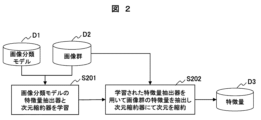
- FIG. 2 shows an example of the processing of the feature quantity extraction unit 101 in FIG.
- the feature quantity extractor 101-1 and dimension reducer 101-2 of the image classification model D1 are learned using the image group D2, and in processing step S202, the learned feature quantity extractor 101-1 and A dimension reducer 101-2 is used to extract the feature quantity of the image group, reduce the dimension, and output.
- FIG. 3 is a diagram explaining an example procedure of a method for learning the feature quantity extractor 101 of the image classification model D1.
- the feature quantity extraction unit 101 simultaneously performs two types of learning for the feature quantity extractor D1-1 of the image classification model D1.
- One is learning using teacher information, and supervised learning of the feature quantity extractor 101-1 and dimension reducer 101-2 is performed using an image group to which teacher information is assigned in processing step S301.
- processing step S302 a plurality of images are obtained from the image group D2 and divided into one image D4 and a second image group D5, which is the other image group. At this time, the number of acquired images is two or more, and the number of images in the second image group D5 is one or more.
- processing step S303 a plurality of patterns of noise are added to one image D4 to such an extent that the class of the object shown in the image does not change, and a plurality of images are generated as a first image group D6.
- processing step S304 the feature amount of the first image group D6 generated from a single image D4 is learned so as to be similar. The amount learns to be more different.
- the degree of similarity between the feature amounts of the first image group is evaluated using cosine similarity or the like, and learning is performed so that the degree of similarity increases.
- the processing step S305 it can be realized by learning such that the degree of similarity is similarly reduced.
- the evaluation of similarity may use the average value of the Euclidean distance, and the method is not limited.
- FIG. 4 shows examples of different noises added in processing step S303.
- Image IM1, image IM2, image IM3, and image IM4 show examples in which noise is added to image IM0 of the moon. Since the image IM0 has more pixels in the non-moon portion than the moon pixels in the image, in the mapping by the principal component analysis, in the image group of the moon included in the image group, the fluctuation of the pixels in the non-moon portion is the main factor. Mapping may be performed as a component.
- the images IM1, IM2, and IM3 are geometric noise.
- Image IM1 is an example in which noise is added by cropping a partial random area of image IM0. At this time, it is desirable that the size of the area to be cropped is such that it contains the pixels of the moon as much as possible.
- Image IM2 is an example in which image IM0 is horizontally reversed.
- Image IM3 is an example in which image IM0 is rotated clockwise by 90 degrees, and the rotation angle is not limited.
- Image IM4 is an example in which a random value is added for each pixel of image IM0.
- processing step S304 it is possible to learn that variations in pixel values due to noise are not important features.
- the noise shown in FIG. 4 may be combined, and a plurality of images can be generated by random combination.
- FIG. 5 shows an example of a screen for assigning teacher information collectively by designating a feature quantity distribution area shown on the teacher information assignment work screen of the display unit 103 .
- the user can confirm the distribution of the feature quantity, and assign training information to multiple well-separated feature quantities as Class 1 at once by specifying the region.
- FIG. 6 shows an example of a screen in which thumbnails of images are displayed at positions where each image is distributed according to the feature amount distribution displayed on the teacher information addition work screen of the display unit 103 .
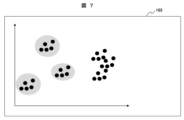
- FIG. 7 shows an example of emphasizing and displaying an area in which a plurality of feature amounts are dense and well separated from other feature amounts in the feature amount distribution displayed on the teacher information addition work screen of the display unit 103 .
- clustering is performed on multiple feature values mapped using X-means, etc., and cluster areas with small cluster variance and large distances from other clusters are emphasized. do.
- the distance here can be realized using the Euclidean distance or the like.
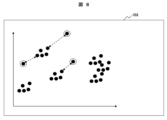
- FIG. 8 shows an example of a screen that emphasizes and displays isolated feature amounts compared to other feature amounts in the feature amount distribution displayed on the teacher information addition work screen of the display unit 103 .
- a point with a large distance from the neighboring feature quantity is emphasized.
- the number of feature values distributed in the range below a certain distance of the target feature value is small, it may be determined as a feature value to be emphasized, or if the average distance to other feature values is large, may be determined as a feature quantity to be emphasized.
- FIG. 9 shows an example of a screen for designating an area to be re-mapped in the feature amount distribution displayed on the teacher information addition work screen of the display unit 103.
- Mapped features may be well-separated features with little variation and features with poor separation and high variability may be displayed. It is possible to display a plurality of well-separated feature values with little variation by performing mapping again in the feature value mapping unit using the .
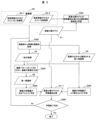
- Fig. 10 illustrates an example of a procedure for determining an area for which mapping is recommended again.
- a clustering result CL1 of a plurality of feature values D3 output by the feature value extraction unit and a clustering result CL2 of a plurality of two-dimensional or three-dimensional feature values D6 output by the feature value mapping unit 102 are compared, and features with different results are identified.
- An area with a large amount is displayed as an area to be remapped in S1002.
- a plurality of feature values before mapping are clustered using X-means or the like, and a plurality of feature values mapped in two or three dimensions are similarly clustered to obtain respective clustering results CL1 and CL2.
- the majority of the clusters to which the plurality of feature quantities before mapping corresponding to the plurality of feature quantities of the post-mapping cluster i belong is defined as the pre-mapping cluster i.
- the number of feature values other than the pre-mapping cluster i among the plurality of feature values corresponding to the post-mapping cluster i is calculated, and when the threshold value is exceeded, the region of the pre-mapping cluster i is displayed as a region for which mapping is recommended again.
- the present invention is not limited to the above-described examples, and includes various modifications.
- the above embodiments have been described in detail for better understanding of the present invention, and are not necessarily limited to those having all the configurations described.
- the above-described configurations, functions, etc. have mainly been described by creating a program that implements part or all of them, but part or all of them can be implemented in hardware by designing them in an integrated circuit, for example. Needless to say, it can be realized. That is, all or part of the functions of the processing unit may be realized by integrated circuits such as ASIC (Application Specific Integrated Circuit) and FPGA (Field Programmable Gate Array) instead of programs.
- ASIC Application Specific Integrated Circuit
- FPGA Field Programmable Gate Array
Landscapes
- Engineering & Computer Science (AREA)
- Theoretical Computer Science (AREA)
- General Physics & Mathematics (AREA)
- Physics & Mathematics (AREA)
- Computer Vision & Pattern Recognition (AREA)
- Multimedia (AREA)
- Databases & Information Systems (AREA)
- Computing Systems (AREA)
- Medical Informatics (AREA)
- Software Systems (AREA)
- General Health & Medical Sciences (AREA)
- Evolutionary Computation (AREA)
- Health & Medical Sciences (AREA)
- Artificial Intelligence (AREA)
- Image Analysis (AREA)
- Information Retrieval, Db Structures And Fs Structures Therefor (AREA)
Abstract
Description
処理ステップS304では図4に示すノイズを複合してもよく、ランダムに複合することで複数の画像が生成できる。
102 特徴量マッピング部
103 教師情報付与作業画面
104 再度マッピング
105 再度マッピング結果
Claims (11)
- 画像分類を行う画像分類装置であって、
画像群に含まれる画像のうち同じ画像に対して異なるノイズを付与して生成された第一の画像群と、異なる画像によって構成される第二の画像群を生成し、前記第一の画像群から得られる特徴量が近似するように学習し、前記第二の画像群から得られる特徴量はより異なるように学習し、特徴量を抽出する特徴量抽出部と、
抽出した複数の特徴量を、多様体学習を用いて二次元又は三次元にマッピングする特徴量マッピング部をと、
マッピング結果を表示し、教師情報付与作業を行う教師情報付与作業画面を表示する表示部と、
を備える、
ことを特徴とする画像分類装置。 - 請求項1に記載の画像分類装置であって、
前記特徴量抽出部は、抽出された特徴量の次元数が大きい場合による多様体学習によるマッピングの精度悪化を回避することを目的に教師情報を用いて学習された次元縮約部を備える、
ことを特徴とする画像分類装置。 - 請求項1に記載の画像分類装置であって、
前記教師情報付与作業画面は、指定された領域内に含まれる複数の特徴量を再度マッピングし表示する、
ことを特徴とする画像分類装置。 - 請求項1に記載の画像分類装置であって、
前記教師情報付与作業画面は、マッピングされた複数の特徴量のうち近傍点との距離が遠い特徴量を強調して表示する、
ことを特徴とする画像分類装置。 - 請求項1に記載の画像分類装置であって、
前記教師情報付与作業画面は、マッピングされた複数の特徴量のうち特徴量分布の密度が高い領域を強調して表示する、
ことを特徴とする画像分類装置。 - 請求項1に記載の画像分類装置であって、
前記教師情報付与作業画面は、複数の特徴量がマッピングされた位置に画像のサムネイルを表示することを特徴とする画像分類装置。 - 請求項1に記載の画像分類装置であって、
前記教師情報付与作業画面は、マッピングされた複数の特徴量をマップ上にて領域選択により一括で教師情報付与できることを特徴とする画像分類装置。 - 請求項1に記載の画像分類装置であって、
前記教師情報付与作業画面は、前記特徴量抽出部により出力された複数の特徴量のクラスタリング結果と前記特徴量マッピング部により出力された二次元または三次元の座標を用いたクラスタリング結果を比較し、結果が異なる場合は再度マッピングすべき領域を表示する、
ことを特徴とする画像分類装置。 - 画像分類を行う画像分類方法であって、
画像群に含まれる画像のうち同じ画像に対して異なるノイズを付与して生成された第一の画像群と、異なる画像によって構成される第二の画像群を生成し、前記第一の画像群から得られる特徴量が近似するように学習し、前記第二の画像群から得られる特徴量はより異なるように学習し、特徴量を抽出し、
抽出した複数の特徴量を、多様体学習を用いて二次元又は三次元にマッピングし、
マッピング結果を教師情報付与作業画面に表示する、
ことを特徴とする画像分類方法。 - 請求項9に記載の画像分類方法であって、
抽出された特徴量の次元数が大きい場合による多様体学習によるマッピングの精度悪化を回避することを目的に次元を縮約し出力する、
ことを特徴とする画像分類方法。 - 請求項9に記載の画像分類方法であって、
前記教師情報付与作業画面は、複数の特徴量のクラスタリング結果と前記二次元または三次元の座標を用いたクラスタリング結果を比較し、結果が異なる場合は再度マッピングすべき領域を表示する、
ことを特徴とする画像分類方法。
Priority Applications (4)
| Application Number | Priority Date | Filing Date | Title |
|---|---|---|---|
| US18/580,712 US20240362892A1 (en) | 2021-07-30 | 2021-07-30 | Image Classification Device and Image Classification Method |
| KR1020237044265A KR20240012520A (ko) | 2021-07-30 | 2021-07-30 | 화상 분류 장치 및 방법 |
| PCT/JP2021/028252 WO2023007693A1 (ja) | 2021-07-30 | 2021-07-30 | 画像分類装置及び方法 |
| CN202180100164.XA CN117597707A (zh) | 2021-07-30 | 2021-07-30 | 图像分类装置及方法 |
Applications Claiming Priority (1)
| Application Number | Priority Date | Filing Date | Title |
|---|---|---|---|
| PCT/JP2021/028252 WO2023007693A1 (ja) | 2021-07-30 | 2021-07-30 | 画像分類装置及び方法 |
Publications (1)
| Publication Number | Publication Date |
|---|---|
| WO2023007693A1 true WO2023007693A1 (ja) | 2023-02-02 |
Family
ID=85086592
Family Applications (1)
| Application Number | Title | Priority Date | Filing Date |
|---|---|---|---|
| PCT/JP2021/028252 Ceased WO2023007693A1 (ja) | 2021-07-30 | 2021-07-30 | 画像分類装置及び方法 |
Country Status (4)
| Country | Link |
|---|---|
| US (1) | US20240362892A1 (ja) |
| KR (1) | KR20240012520A (ja) |
| CN (1) | CN117597707A (ja) |
| WO (1) | WO2023007693A1 (ja) |
Families Citing this family (2)
| Publication number | Priority date | Publication date | Assignee | Title |
|---|---|---|---|---|
| WO2021141051A1 (ja) * | 2020-01-09 | 2021-07-15 | ファナック株式会社 | ワーク画像解析装置、ワーク画像解析方法、及びプログラム |
| JP7328915B2 (ja) * | 2020-02-12 | 2023-08-17 | 株式会社日立ハイテク | 画像分類装置及び方法 |
Citations (2)
| Publication number | Priority date | Publication date | Assignee | Title |
|---|---|---|---|---|
| JP2014229115A (ja) * | 2013-05-23 | 2014-12-08 | キヤノン株式会社 | 情報処理装置および方法、プログラム、記憶媒体 |
| JP2020034998A (ja) * | 2018-08-27 | 2020-03-05 | 日本電信電話株式会社 | 拡張装置、拡張方法及び拡張プログラム |
Family Cites Families (1)
| Publication number | Priority date | Publication date | Assignee | Title |
|---|---|---|---|---|
| JP6971112B2 (ja) | 2017-09-29 | 2021-11-24 | 株式会社Screenホールディングス | 教師データ作成支援装置、分類装置および教師データ作成支援方法 |
-
2021
- 2021-07-30 WO PCT/JP2021/028252 patent/WO2023007693A1/ja not_active Ceased
- 2021-07-30 KR KR1020237044265A patent/KR20240012520A/ko active Pending
- 2021-07-30 US US18/580,712 patent/US20240362892A1/en active Pending
- 2021-07-30 CN CN202180100164.XA patent/CN117597707A/zh active Pending
Patent Citations (2)
| Publication number | Priority date | Publication date | Assignee | Title |
|---|---|---|---|---|
| JP2014229115A (ja) * | 2013-05-23 | 2014-12-08 | キヤノン株式会社 | 情報処理装置および方法、プログラム、記憶媒体 |
| JP2020034998A (ja) * | 2018-08-27 | 2020-03-05 | 日本電信電話株式会社 | 拡張装置、拡張方法及び拡張プログラム |
Non-Patent Citations (1)
| Title |
|---|
| P.Y. SIMARD, D. STEINKRAUS, J.C. PLATT: "Best practices for convolutional neural networks applied to visual document analysis", DOCUMENT ANALYSIS AND RECOGNITION, 2003. PROCEEDINGS. SEVENTH INTERNAT IONAL CONFERENCE ON AUG. 3-6, 2003, PISCATAWAY, NJ, USA,IEEE, vol. 1, 1 January 2003 (2003-01-01), pages 958 - 963, XP055545870, ISBN: 978-0-7695-1960-9, DOI: 10.1109/ICDAR.2003.1227801 * |
Also Published As
| Publication number | Publication date |
|---|---|
| CN117597707A (zh) | 2024-02-23 |
| US20240362892A1 (en) | 2024-10-31 |
| KR20240012520A (ko) | 2024-01-29 |
Similar Documents
| Publication | Publication Date | Title |
|---|---|---|
| Rahtu et al. | Affine invariant pattern recognition using multiscale autoconvolution | |
| TWI716874B (zh) | 影像處理裝置、影像處理方法、及影像處理程式 | |
| US6853374B2 (en) | Image space display method and apparatus | |
| CN110276342A (zh) | 车牌辨识方法以及其系统 | |
| Wang et al. | Transformer for 3D point clouds | |
| CN110163025A (zh) | 二维码定位方法及装置 | |
| CN111292335B (zh) | 一种前景掩模特征图的确定方法、装置及电子设备 | |
| JPH03218581A (ja) | 画像セグメンテーション方法 | |
| CN111179193B (zh) | 基于DCNNs和GANs的皮肤镜图像增强和分类方法 | |
| CN111832476A (zh) | 版面分析方法、阅读辅助设备、电路和介质 | |
| CN113780305A (zh) | 一种基于两种线索交互的显著性目标检测方法 | |
| WO2023007693A1 (ja) | 画像分類装置及び方法 | |
| CN109919128B (zh) | 控制指令的获取方法、装置及电子设备 | |
| CN105225218B (zh) | 用于文档图像的畸变校正方法和设备 | |
| CN108734773A (zh) | 一种用于混合图片的三维重建方法及系统 | |
| US7751621B1 (en) | Method and system for rapid object recall within images | |
| JPH1091782A (ja) | 濃淡画像用特定部位抽出方法 | |
| CN111507252A (zh) | 人体跌倒检测装置、方法、电子终端及存储介质 | |
| CN116584100B (zh) | 适合于覆盖媒体内容的图像空间检测 | |
| CN119516524B (zh) | 一种多余物检测数据集制作方法 | |
| CN111784561A (zh) | 用于从图像中提取对象的方法、装置和存储介质 | |
| CN111435448B (zh) | 图像显著性物体检测方法、装置、设备及介质 | |
| CN119672704A (zh) | 一种可用于虚拟设备的多种类菜品识别方法及系统 | |
| CN113470183A (zh) | 用于等矩形全景图语义解释的多视图一致性正则化 | |
| CN116385941B (zh) | 用于生成中间特征的神经网络的训练方法、装置及介质 |
Legal Events
| Date | Code | Title | Description |
|---|---|---|---|
| 121 | Ep: the epo has been informed by wipo that ep was designated in this application |
Ref document number: 21951893 Country of ref document: EP Kind code of ref document: A1 |
|
| ENP | Entry into the national phase |
Ref document number: 20237044265 Country of ref document: KR Kind code of ref document: A |
|
| WWE | Wipo information: entry into national phase |
Ref document number: 1020237044265 Country of ref document: KR |
|
| WWE | Wipo information: entry into national phase |
Ref document number: 202180100164.X Country of ref document: CN |
|
| NENP | Non-entry into the national phase |
Ref country code: DE |
|
| 122 | Ep: pct application non-entry in european phase |
Ref document number: 21951893 Country of ref document: EP Kind code of ref document: A1 |
|
| NENP | Non-entry into the national phase |
Ref country code: JP |