WO2022255235A1 - 金属有機構造体並びにこれを含むガス貯蔵剤及びこれを使用するガス貯蔵方法 - Google Patents
金属有機構造体並びにこれを含むガス貯蔵剤及びこれを使用するガス貯蔵方法 Download PDFInfo
- Publication number
- WO2022255235A1 WO2022255235A1 PCT/JP2022/021681 JP2022021681W WO2022255235A1 WO 2022255235 A1 WO2022255235 A1 WO 2022255235A1 JP 2022021681 W JP2022021681 W JP 2022021681W WO 2022255235 A1 WO2022255235 A1 WO 2022255235A1
- Authority
- WO
- WIPO (PCT)
- Prior art keywords
- metal
- mmol
- group
- formula
- metal organic
- Prior art date
- Legal status (The legal status is an assumption and is not a legal conclusion. Google has not performed a legal analysis and makes no representation as to the accuracy of the status listed.)
- Ceased
Links
Classifications
-
- B—PERFORMING OPERATIONS; TRANSPORTING
- B01—PHYSICAL OR CHEMICAL PROCESSES OR APPARATUS IN GENERAL
- B01J—CHEMICAL OR PHYSICAL PROCESSES, e.g. CATALYSIS OR COLLOID CHEMISTRY; THEIR RELEVANT APPARATUS
- B01J20/00—Solid sorbent compositions or filter aid compositions; Sorbents for chromatography; Processes for preparing, regenerating or reactivating thereof
- B01J20/22—Solid sorbent compositions or filter aid compositions; Sorbents for chromatography; Processes for preparing, regenerating or reactivating thereof comprising organic material
-
- C—CHEMISTRY; METALLURGY
- C07—ORGANIC CHEMISTRY
- C07D—HETEROCYCLIC COMPOUNDS
- C07D307/00—Heterocyclic compounds containing five-membered rings having one oxygen atom as the only ring hetero atom
- C07D307/77—Heterocyclic compounds containing five-membered rings having one oxygen atom as the only ring hetero atom ortho- or peri-condensed with carbocyclic rings or ring systems
- C07D307/91—Dibenzofurans; Hydrogenated dibenzofurans
-
- C—CHEMISTRY; METALLURGY
- C07—ORGANIC CHEMISTRY
- C07D—HETEROCYCLIC COMPOUNDS
- C07D333/00—Heterocyclic compounds containing five-membered rings having one sulfur atom as the only ring hetero atom
- C07D333/50—Heterocyclic compounds containing five-membered rings having one sulfur atom as the only ring hetero atom condensed with carbocyclic rings or ring systems
- C07D333/76—Dibenzothiophenes
-
- Y—GENERAL TAGGING OF NEW TECHNOLOGICAL DEVELOPMENTS; GENERAL TAGGING OF CROSS-SECTIONAL TECHNOLOGIES SPANNING OVER SEVERAL SECTIONS OF THE IPC; TECHNICAL SUBJECTS COVERED BY FORMER USPC CROSS-REFERENCE ART COLLECTIONS [XRACs] AND DIGESTS
- Y02—TECHNOLOGIES OR APPLICATIONS FOR MITIGATION OR ADAPTATION AGAINST CLIMATE CHANGE
- Y02E—REDUCTION OF GREENHOUSE GAS [GHG] EMISSIONS, RELATED TO ENERGY GENERATION, TRANSMISSION OR DISTRIBUTION
- Y02E60/00—Enabling technologies; Technologies with a potential or indirect contribution to GHG emissions mitigation
- Y02E60/30—Hydrogen technology
- Y02E60/32—Hydrogen storage
Definitions
- the present invention provides a metal-organic framework comprising a combination of carboxylic acid ions and polyvalent metal ions, a gas storage agent comprising the metal-organic framework, and a gas storage agent comprising the step of bringing a gas into contact with the metal-organic framework.
- a metal-organic framework comprising a combination of carboxylic acid ions and polyvalent metal ions
- a gas storage agent comprising the metal-organic framework
- a gas storage agent comprising the step of bringing a gas into contact with the metal-organic framework.
- a metal-organic framework (hereinafter sometimes referred to as "MOF") has a macromolecular structure with internal spaces (that is, pores) by combining metal ions and cross-linking organic ligands that connect them. It is a solid substance and has attracted a great deal of interest for the past ten years as a porous material with functions such as gas storage and separation.
- MOF metal-organic framework
- a MOF with a surface area of 4000 m 2 /g obtained by heating zirconium chloride and terphenyldicarboxylic acid in dimethylformamide can store gases such as hydrogen, methane, and acetylene (Patent Document 1). reference).
- MOF dicarboxylic acid represented by the following formula and Fe 2 CoO(CH 3 COO) 6 or Fe 3 O(CH 3 COO) 6 in the presence of acetic acid in N-methylpyrrolidone at 150° C. for 24 hours, MOF is obtained as dark brown crystals, and it is known that this MOF can store gases such as hydrogen, methane, carbon dioxide, and nitrogen (see Patent Document 2).
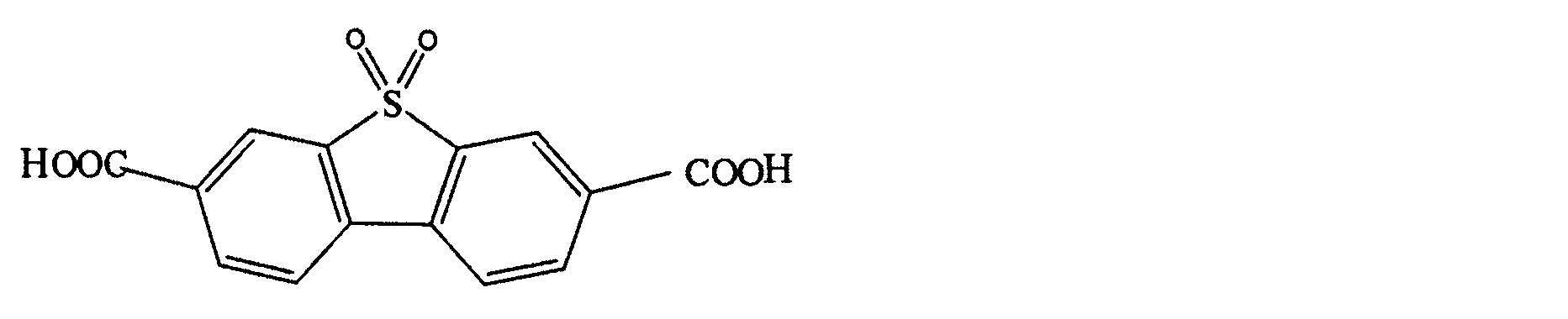
- Patent Document 2 discloses a metal organic structure in which Fe is bonded to a dicarboxylic acid ion obtained from a dicarboxylic acid represented by the following formula.
- An object of the present invention is to provide a novel metal-organic structure having a gas storage function, a gas storage agent using the same, and a gas storage method.
- the present inventors discovered a novel metal organic framework obtained by using a specific dicarboxylic acid having a dibenzothiophene skeleton or a dibenzofuran skeleton as an organic ligand.
- these novel metal-organic structures have a high hydrogen storage capacity, and have completed the present invention.
- a metal organic structure in which a carboxylic acid ion represented by formula (1) and a polyvalent metal ion are combined (provided that the carboxylic acid ion represented by formula (1) and a divalent copper ion are combined wherein X in formula (1) is a sulfur atom, m1, m2, n1 and n2 are all 0, and COO - is both bonded to the 2- and 8-positions (except those with (In formula (1), X is a sulfur atom or an oxygen atom.
- R 1 is a hydroxy group, a C1-6 alkyl group, a C1-6 alkoxy group or a halogeno group.
- n1 and n2 are integers from 0 to 3; When R 1 is 2 or more, each R 1 may be the same or different.
- L is a divalent group represented by the following formula (2). m1 and m2 are 0 or 1; When L is 2 or more, each L may be the same or different.
- R 2 is a hydroxy group, a C1-6 alkyl group, a C1-6 alkoxy group or a halogeno group.
- n3 is an integer of 0-4.
- * and ** represent the bonding position, and ** represents the bonding position with the carboxylate ion.
- the metal-organic framework of the present invention is novel and can store gases such as hydrogen, carbon dioxide, and nitrogen.
- the metal-organic framework of the present invention is a metal-organic framework in which a carboxylate ion represented by the formula (1) and a polyvalent metal ion are combined (provided that the carboxylate ion represented by the formula (1) and divalent copper ions are combined, wherein X in formula (1) is a sulfur atom, m1, m2, n1 and n2 are all 0, and COO - is both 2 excluding those bound to positions and 8).
- X is a sulfur atom or an oxygen atom.
- R 1 is a hydroxy group, a C1-6 alkyl group, a C1-6 alkoxy group or a halogeno group.
- n1 and n2 represent the number of R 1 and are integers from 0 to 3; When R 1 is 2 or more, each R 1 may be the same or different.
- L is a divalent group represented by the following formula (2). m1 and m2 indicate the number of L and are 0 or 1; When L is 2 or more, each L may be the same or different.
- the C1-6 alkyl group for R 1 may be linear or branched, and may be a methyl group, ethyl group, n-propyl group, n-butyl group, n-pentyl group, n-hexyl group, i -propyl group, i-butyl group, s-butyl group, t-butyl group, i-pentyl group, neopentyl group, 2-methyl-n-butyl group, i-hexyl group and the like.
- Examples of C1-6 alkoxy groups for R 1 include methoxy, ethoxy, n-propoxy, i-propoxy, n-butoxy, s-butoxy, i-butoxy, and t-butoxy groups. can be done.
- Examples of the halogeno group for R 1 include a fluoro group, a chloro group, a bromo group and an iodo group.
- R 2 is a hydroxy group, a C1-6 alkyl group, a C1-6 alkoxy group or a halogeno group.
- n3 represents the number of R2 and is an integer of 0-4. When R 2 is 2 or more, each R 2 may be the same or different.
- the C1-6 alkyl group for R 2 may be linear or branched, and may be a methyl group, ethyl group, n-propyl group, n-butyl group, n-pentyl group, n-hexyl group, i -propyl group, i-butyl group, s-butyl group, t-butyl group, i-pentyl group, neopentyl group, 2-methyl-n-butyl group, i-hexyl group and the like.
- Examples of C1-6 alkoxy groups for R 2 include methoxy, ethoxy, n-propoxy, i-propoxy, n-butoxy, s-butoxy, i-butoxy, and t-butoxy groups. can be done.
- Examples of the halogeno group for R 2 include a fluoro group, a chloro group, a bromo group and an iodo group. * and ** represent the bonding position, and ** represents the bonding position with the carboxylate ion.
- a term such as “C1-6” indicates that the number of carbon atoms in the mother nucleus group is from 1 to 6, and the like.
- Specific examples of the carboxylate ion represented by formula (1) include the compounds represented by the following formulas. In the formula below, the case where X is S is exemplified, but the same structure can be exemplified when X is O.
- the polyvalent metal ion in the metal-organic framework of the present invention is not particularly limited as long as it is a metal ion having a valence of 2 or higher, and is selected from the group consisting of metals of groups 2 to 13 of the periodic table. Ions of at least one metal are preferred, and ions of at least one metal selected from Zn, Al, Cu, Zr, Ni, Co, Cr, Fe, Sc, Mo, Mn, Ti and Mg are more preferred.
- one type or two or more types of polyvalent metal ions may be bonded to the carboxylate ion represented by formula (1).
- metal salts include zinc nitrate (Zn(NO 3 ) 2.xH 2 O), titanium nitrate (Ti(NO 3 ) 4.xH 2 O), cobalt nitrate (Co(NO 3 ) 2.xH 2 O), iron (III) nitrate (Fe(NO 3 ) 3 xH 2 O), iron (II) nitrate (Fe(NO 3 ) 2 xH 2 O), nickel (II) nitrate (Ni(NO 3 ) 2.xH 2 O), copper (II) nitrate (Cu(NO 3 ) 2.xH 2 O), aluminum (III) nitrate (Al(CH 3 COO) 3.xH 2 O), magnesium (II) nitrate ( Mg( NO3 ) 2.xH2O ); zinc chloride ( ZnCl2.xH2O ) , titanium chloride (TiCl4.xH2O) , zir
- xH2O iron(II) hydroxide
- Fe(OH) 2.xH 2 O zinc bromide
- ZnBr 2.xH 2 O titanium bromide
- TiBr 4.xH 2 O zirconium bromide
- ZrBr 4.xH 2 O cobalt bromide
- CoBr 2.xH 2 O iron (III) bromide
- FeBr 3.xH 2 O iron (II) bromide (FeBr 2.xH 2 O
- zinc carbonate ZnCO 3.xH 2 O), cobalt carbonate (CoCO 3.xH 2 O), iron(III) carbonate ( Fe2 ( CO3 ) 3.xH2O ); zirconium chloride oxide ( ZrOCl2.xH2O ), molybdenum (II) acetate dimer ( (Mo( CH3COO ) 2 ) 2 ) and the like.
- x is a number from 0 to 12. These can be used individually by 1 type
- the metal-organic framework of the present invention can contain organic ligands other than the carboxylate ions represented by formula (1) as ancillary ligands.
- a high-order structure can be introduced into the metal-organic framework by incorporating an auxiliary ligand into the metal-organic framework.
- Such ancillary ligands include terephthalic acid, phthalic acid, isophthalic acid, 5-cyanoisophthalic acid, 1,3,5-trimesic acid, 1,3,5-tris(4-carboxyphenyl)benzene, 4 ,4′-dicarboxybiphenyl, 3,5-dicarboxypyridine, 2,3-dicarboxypyrazine, 1,3,5-tris(4-carboxyphenyl)benzene, 1,2,4,5-tetrakis(4 -carboxyphenyl)benzene, 9,10-anthracenedicarboxylic acid, 2,6-naphthalenedicarboxylic acid, [1,1′:4′,1′′]terphenyl-3,3′′,5,5′′-tetracarboxylic acid , biphenyl-3,3′′,5,5′′-tetracarboxylic acid, 3,3′,5,5′-tetracarboxydiphenylmethane, 1,
- the method for producing the metal-organic structure of the present invention is not particularly limited, and a solvent diffusion method, a solvent stirring method, a solution method such as a hydrothermal method, or a reaction solution is irradiated with microwaves to homogenize the entire system in a short time.
- a microwave method of heating and irradiating the reaction vessel with ultrasonic waves pressure changes occur repeatedly in the reaction vessel.
- a high energy field of about 5,000 K and 10,000 bar is locally formed as a reaction field for each generation of crystals, an ultrasonic method, a solid phase that mixes a metal ion source and an organic ligand without using a solvent.
- Any method such as a synthesis method or a LAG (liquid assisted grinding) method in which water equivalent to water of crystallization is added to mix the metal ion source and the organic ligand can be used.
- the first to third solutions do not need to be prepared separately. may be mixed together to form a single solution.
- the mixing molar ratio of the metal compound and the carboxylic acid ion represented by the formula (1) or its precursor carboxylic acid is optionally determined depending on the pore size and surface properties of the resulting metal organic structure. can be selected, but it is preferable to use 1 mol or more of the metal compound per 1 mol of the carboxylic acid ion represented by formula (1) or its precursor carboxylic acid, further 1.1 mol or more, and further It is preferable to use 1.2 mol or more, further 1.5 mol or more, further 2 mol or more, furthermore 3 mol or more.
- the concentration of the metal ions in the reaction solution is preferably in the range of 25-200 mmol/L.
- concentration of the carboxylic acid ion represented by formula (1) or its precursor, carboxylic acid, in the reaction solution is preferably in the range of 10 to 100 mmol/L.
- concentration of the ancillary ligand in the reaction solution is preferably 10 to 100 mmol/L.
- the solvent to be used is not particularly limited, but N,N-dimethylformamide (hereinafter sometimes referred to as "DMF"), N,N-diethylformamide (hereinafter sometimes referred to as “DEF”), N,N-dimethylacetamide (hereinafter sometimes referred to as “DMA”), N-methyl-2-pyrrolidone (hereinafter sometimes referred to as “NMP”), dimethyl sulfoxide (hereinafter referred to as "DMSO” ) and water, or a mixture of two or more selected from the group consisting of water.
- DMF N,N-dimethylformamide
- DEF N,N-diethylformamide
- DMA N,N-dimethylacetamide
- NMP N-methyl-2-pyrrolidone
- DMSO dimethyl sulfoxide
- water or a mixture of two or more selected from the group consisting of water.
- the heating temperature of the reaction solution is not particularly limited, it may be room temperature to 140°C, 70 to 140°C, or 80 to 120°C.
- the gas storage agent of the present invention contains the metal organic framework of the present invention.
- the gas storage agent of the present invention may consist solely of the metal-organic framework of the present invention, or may contain other components as long as the use as the gas storage agent is not hindered.
- the shape of the gas storage agent of the present invention is not particularly limited, and examples thereof include powder, granules, pellets, and the like.
- the metal-organic framework of the present invention can store a gas such as hydrogen, methane, acetylene, carbon dioxide, or nitrogen by adsorbing or absorbing the gas.
- the method of storing the gas using the metal-organic structure of the present invention is not particularly limited, but the method of contacting the gas with the metal-organic structure of the present invention is preferred, and the contact method is not particularly limited.
- a tank is filled with the metal-organic structure of the present invention to form a gas storage tank, and gas is introduced into the tank; a method of forming a gas storage tank into a gas storage tank, and a method of forming a tank from the material containing the metal organic structure of the present invention to form a gas storage tank, and a method of introducing gas into the tank. can be done.
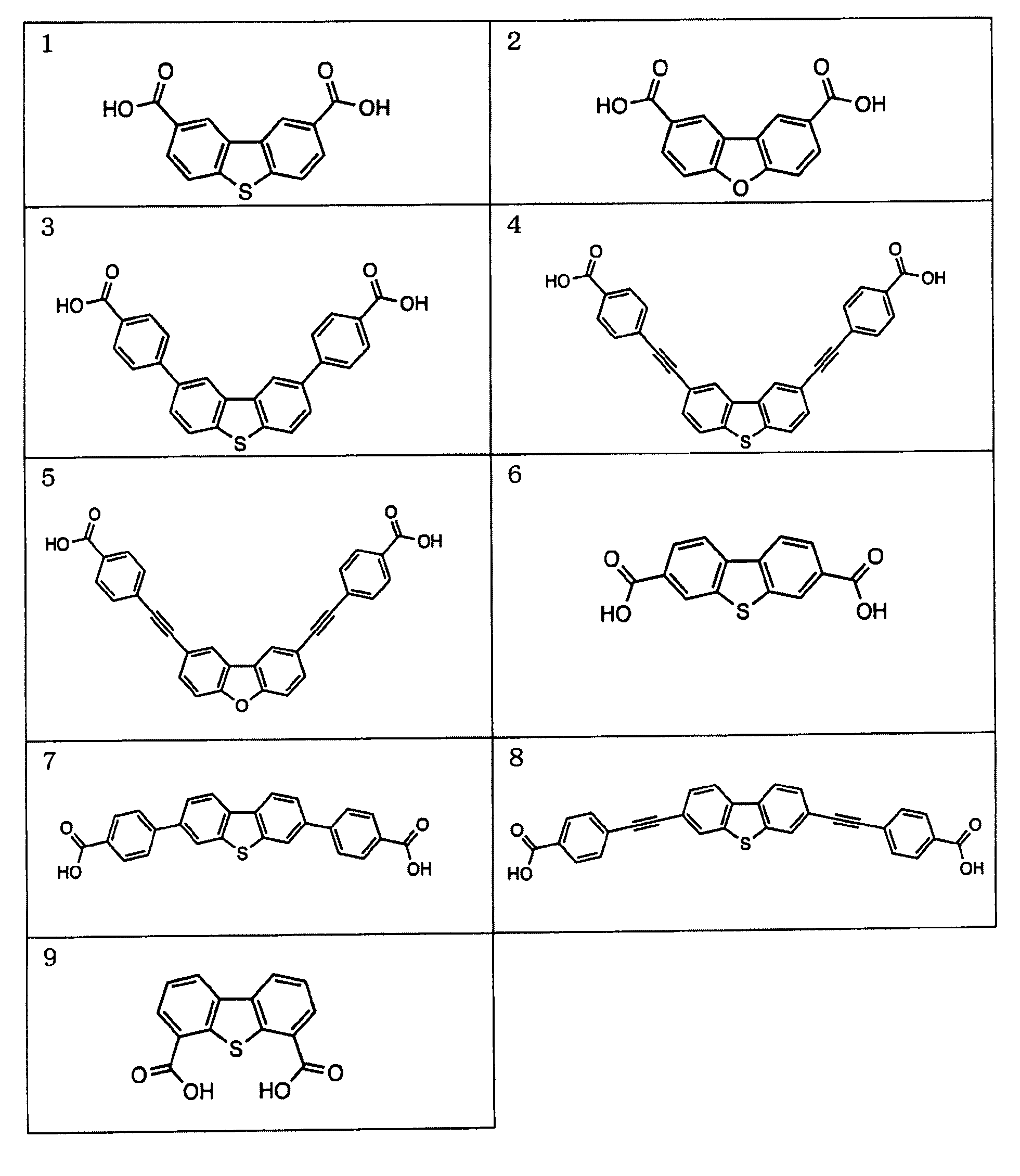
- Organic ligands 1 to 9 shown in Table 1 below were used as the carboxylic acid that serves as the precursor of the carboxylic acid ion represented by formula (1) that constitutes the metal organic structure of the present invention.
- ancillary ligands 1 to 10 shown in Table 2 were used as the ancillary ligand.
- Lithium aluminum hydride (10.4 mmol) was added to a suspension of 2.63 mmol of 3,7-dibromodibenzothiophene dioxide in diethyl ether (40 mL), and the mixture was heated and stirred at 50° C. for 1 hour. The resulting suspension was poured into ice water and acidified with hydrochloric acid. The reaction solution was extracted with chloroform, the organic layer was dried over magnesium sulfate and filtered, and the filtrate was distilled under reduced pressure. The obtained crude product was recrystallized with acetone to obtain 1.11 mmol of 3,7-dibromodibenzothiophene as a white solid.
- organic ligand 4 1 H-NMR (400 MHz, DMSO-d6) ⁇ : 7.70-7.75 (6H, m), 8.00 (4H, d), 8.16(2H, d), 8.78 (2H, s).
- organic ligand 5 1 H-NMR (400 MHz, DMSO-d6) ⁇ : 7.75 (4H, d), 7.78(2H, d), 7.83 (2H, d), 7.99(4H, d), 8.52 (2H, s).
- organic ligand 6 1 H-NMR (400 MHz, DMSO-d6) ⁇ : 8.07 (2H, d), 8.55 (2H, dd), 8.68 (2H, s).
- Example 1-1 10 mL of DMF was added to organic ligand 1 (0.5 mmol) and zinc nitrate hexahydrate (1.0 mmol), and the mixture was heated in an oven (reaction conditions: 90° C., 48 hours). After returning to room temperature, the supernatant was removed. After washing with 10 mL of DMF, the solvent was removed and solvent exchanged into chloroform. 10 mL of chloroform was added and soaked overnight. After removing chloroform, vacuum drying was performed at 150° C. for 5 hours to obtain a metal organic structure 1-1 as a colorless solid.
- Example 1-2 to [Example 1-51] The same operation as in Example 1-1 was performed except that the reaction was performed with the organic ligand, solvent, temperature, heating time, and concentration of the organic ligand shown in Table 3 below. ⁇ 1-51 was obtained. Table 3 shows the results. "Concentration (M)” in Table 3 was calculated as the proportion of the organic ligand in the solvent.
- the solvent “DMF+MeOH” used in Example 1-34 is a mixed solvent of 9 mL of DMF and 1 mL of MeOH.
- Consulation (M) means the concentration of organic ligand, calculated as the percentage of organic ligand in the solvent.
- Example 2-1 Organic ligand 1 (0.5 mmol) was dissolved in DMF 7.5 mL, auxiliary ligand 1 (0.2 mmol) and zinc nitrate hexahydrate (0.5 mmol) were added thereto, and oven (reaction conditions: 90° C. for 48 hours). After returning to room temperature, the supernatant was removed. After washing with 10 mL of DMF, the solvent was removed and solvent exchanged into chloroform. 10 mL of chloroform was added and soaked overnight. After removing chloroform, vacuum drying was performed at 150° C. for 5 hours to obtain a metal organic structure 2-1 as a colorless solid.
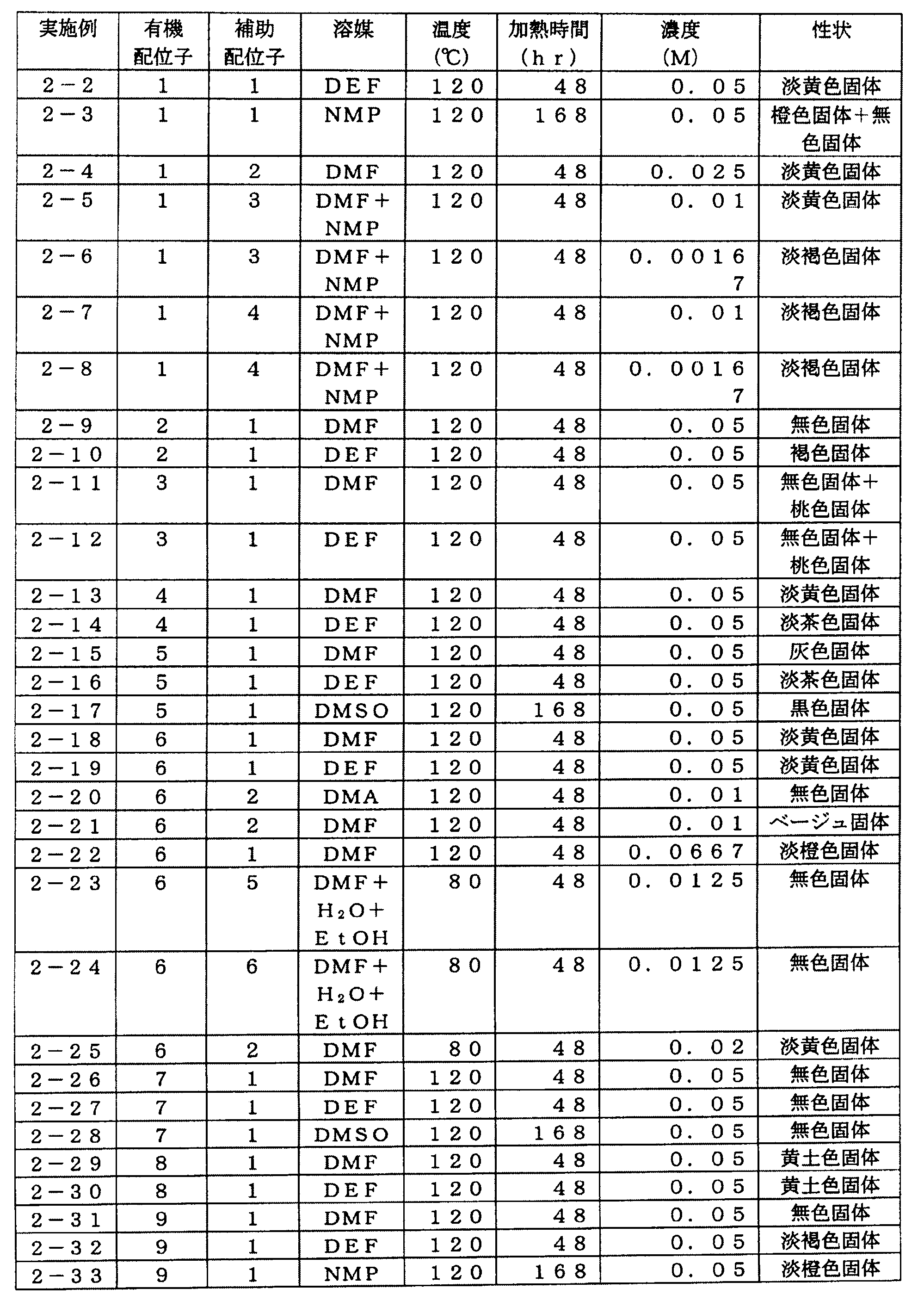
- Example 2-2 to [Example 2-33] The same operation as in Example 2-1 was performed except that the reaction was performed with the organic ligand, ancillary ligand, solvent, temperature, heating time, and concentration of the organic ligand shown in Table 4 below. Structures 2-2 to 2-33 were obtained. Table 4 shows the results.
- a mixed solvent of 5 mL of DMF and 5 mL of NMP was used in Examples 2-5 and 2-7, and a mixed solvent of 30 mL of DMF and 30 mL of NMP was used in Examples 2-6 and 2-8.
- Examples 2-23 and 2-24 a mixed solvent of 5 mL of DMF, 1 mL of water, and 2 mL of EtOH was used.
- Example 3-1 Organic ligand 1 (0.294 mmol) and aluminum nitrate nonahydrate (0.382 mmol) were added with 9.2 mL of DEF and heated in an oven (reaction conditions: 120° C., 168 hours). After returning to room temperature, the supernatant was removed. After washing with 10 mL of DEF, the solvent was removed and solvent exchanged to chloroform. 10 mL of chloroform was added and soaked overnight. After removing chloroform, vacuum drying was performed at 150° C. for 5 hours to obtain a metal organic structure 3-1 as a brown solid.
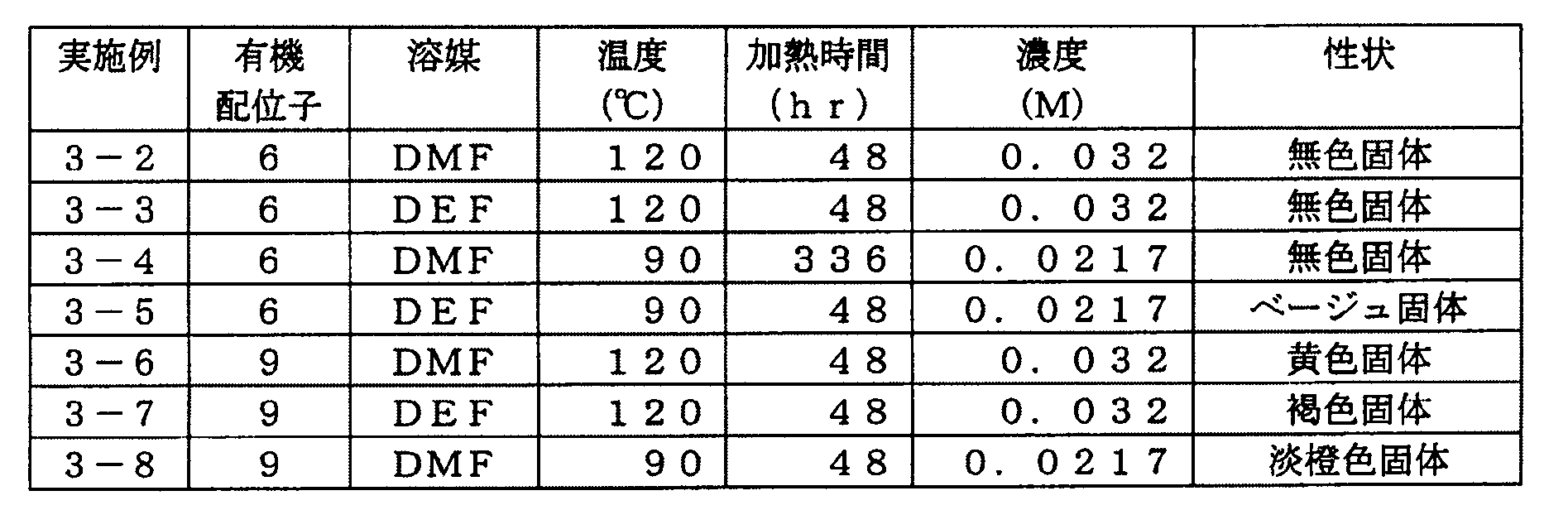
- Example 3-2 to [Example 3-8] The same operation as in Example 3-1 was performed except that the reaction was performed with the organic ligand, solvent, temperature, heating time, and concentration of the organic ligand shown in Table 5 below. ⁇ 3-8 were obtained. Table 5 shows the results.
- Example 4-1 Organic ligand 6 (0.2 mmol) and copper nitrate trihydrate (0.2 mmol) were added with 9.2 mL of DEF and heated in an oven (reaction conditions: 120° C., 168 hours). After returning to room temperature, the supernatant was removed. After washing with 10 mL of DEF, the solvent was removed and solvent exchanged to chloroform. 10 mL of chloroform was added and soaked overnight. After removing chloroform, vacuum drying was carried out at 150° C. for 5 hours to obtain a metal organic structure 4-1 as a pale blue-green solid.
- Example 4-2 to [Example 4-8] Metal organic structures 4-2 to 4-8 were obtained in the same manner as in Example 4-1, except that the reaction was performed using the organic ligand, solvent, temperature, and heating time shown in Table 6 below. . Table 6 shows the results.
- Example 5-1 Organic ligand 1 (0.2 mmol) was dissolved in DEF 9.2 mL, ancillary ligand 2 (0.2 mmol) and copper nitrate trihydrate (0.2 mmol) were added thereto, and oven (reaction conditions: 120° C. for 48 hours). After returning to room temperature, the supernatant was removed. After washing with 10 mL of DMF, the solvent was removed and solvent exchanged into chloroform. 10 mL of chloroform was added and soaked overnight. After removing chloroform, vacuum drying was carried out at 150° C. for 5 hours to obtain a metal organic structure 5-1 as a pale blue-green solid.
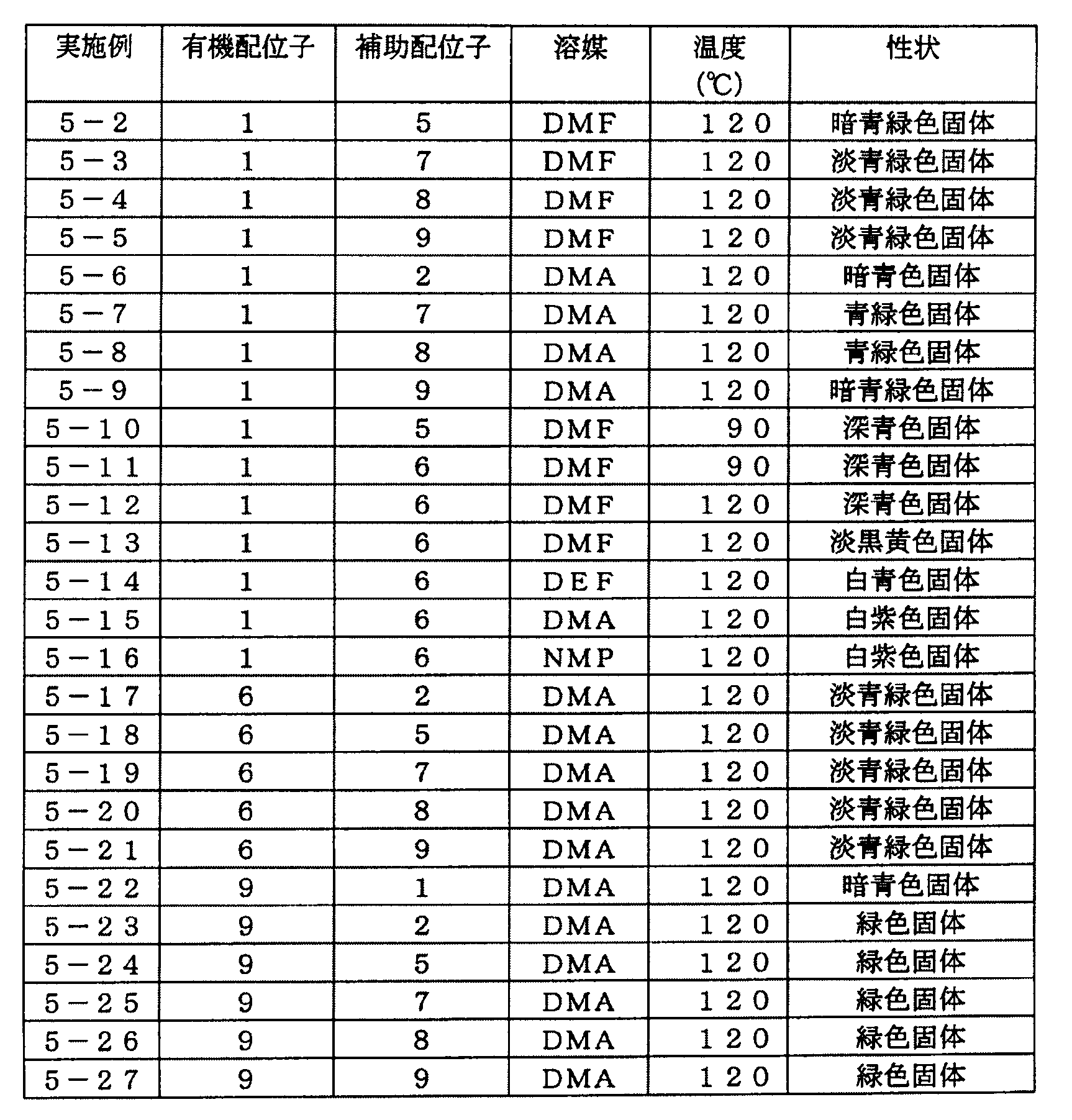
- Example 5-2 to [Example 5-27] Metal organic structures 5-2 to 5-27 were prepared in the same manner as in Example 5-1, except that the reaction was performed using the organic ligand, ancillary ligand, solvent, and temperature shown in Table 7 below. Obtained. Table 7 shows the results.
- Example 6-1 Organic ligand 1 (0.2 mmol) and zirconium chloride (0.2 mmol) were added with 9.2 mL of DMF and heated in an oven (reaction conditions: 120° C., 168 hours). After returning to room temperature, the supernatant was removed. After washing with 10 mL of DMF, the solvent was removed and solvent exchanged into chloroform. 10 mL of chloroform was added and soaked overnight. After removing chloroform, vacuum drying was performed at 150° C. for 5 hours to obtain a metal organic structure 6-1 as a brown solid.
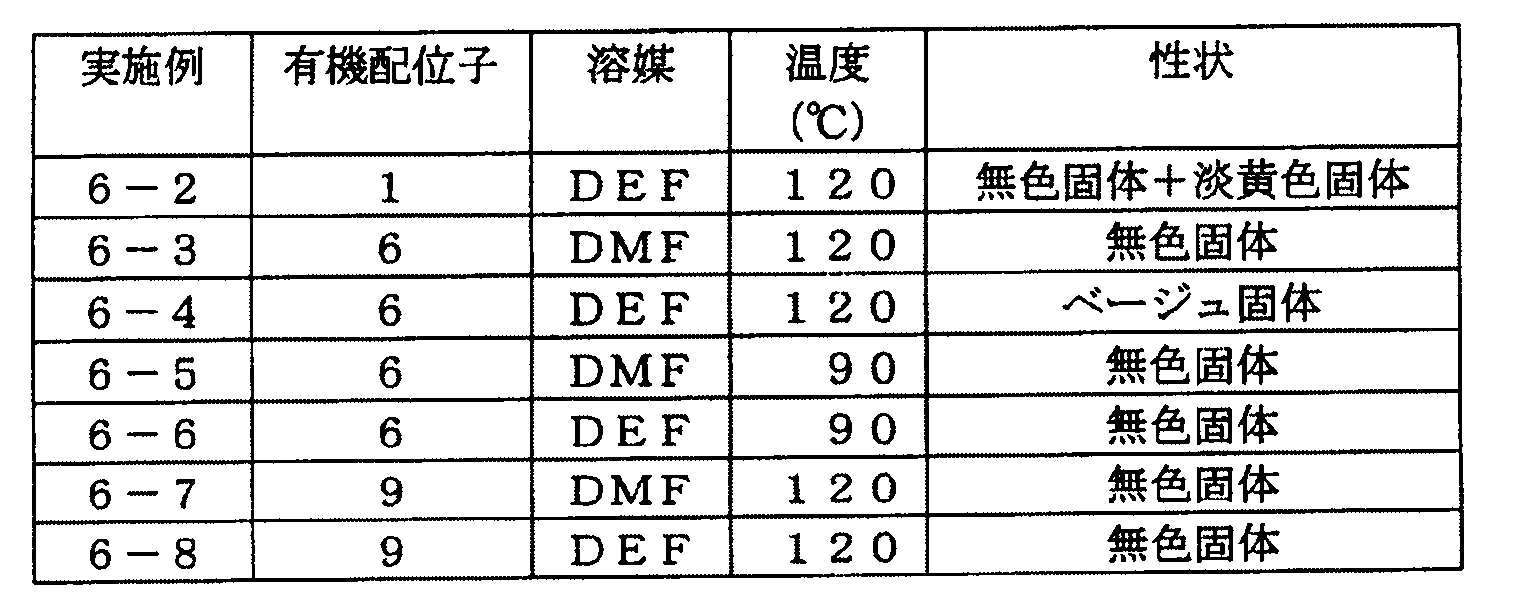
- Example 6-2 to [Example 6-8] Metal organic structures 6-2 to 6-8 were obtained in the same manner as in Example 6-1, except that the reaction was performed using the organic ligand, solvent, and temperature shown in Table 8 below. Table 8 shows the results.
- Example 7-1 The organic ligand 6 (0.2 mmol) was dissolved in 18 mL of DMF, trifluoroacetic acid (1.7 mL) and zirconium chloride (0.2 mmol) were added thereto, and the reaction was carried out in an oven (reaction conditions: 120°C for 48 hours). ) was heated. After returning to room temperature, the supernatant was removed. After washing with 10 mL of DMF, the solvent was removed and solvent exchanged into chloroform. 10 mL of chloroform was added and soaked overnight. After removing chloroform, vacuum drying was performed at 150° C. for 5 hours to obtain a metal organic structure 7-1 as a pale blue-green solid.
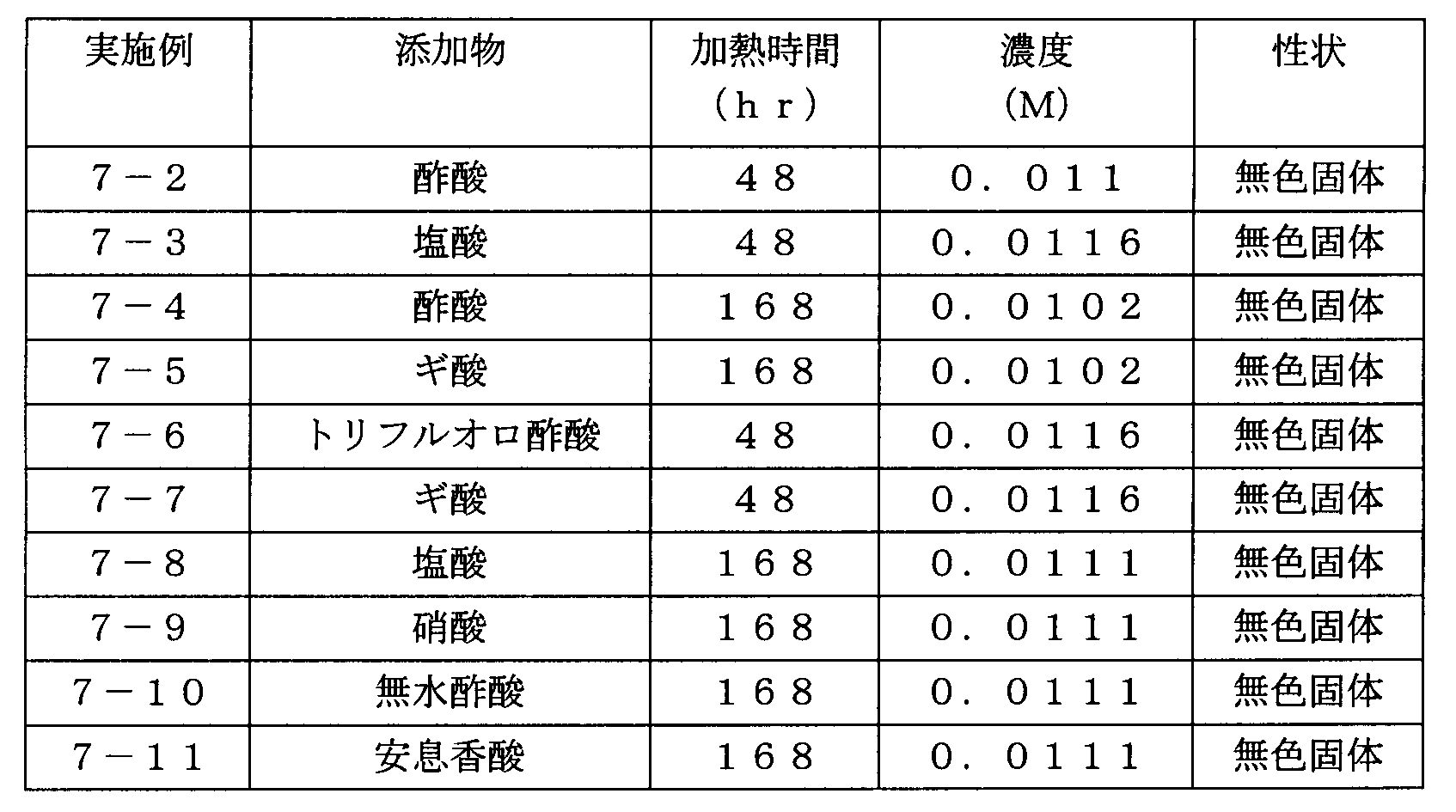
- Example 7-2 to [Example 7-11] Metal organic structures 7-2 to 7-11 were obtained in the same manner as in Example 7-1, except that the reaction was performed with the additive, heating temperature, and organic ligand concentration shown in Table 9 below. rice field. Table 9 shows the results.
- Example 8-1 Organic ligand 1 (0.2 mmol) and nickel nitrate hexahydrate (0.2 mmol) were added with 9.2 mL of DMF and heated in an oven (reaction conditions: 120° C., 48 hours). After returning to room temperature, the supernatant was removed. After washing with 10 mL of DMF, the solvent was removed and solvent exchanged into chloroform. 10 mL of chloroform was added and soaked overnight. After removing chloroform, vacuum drying was performed at 150° C. for 5 hours to obtain a metal organic structure 8-1 as a brown solid.
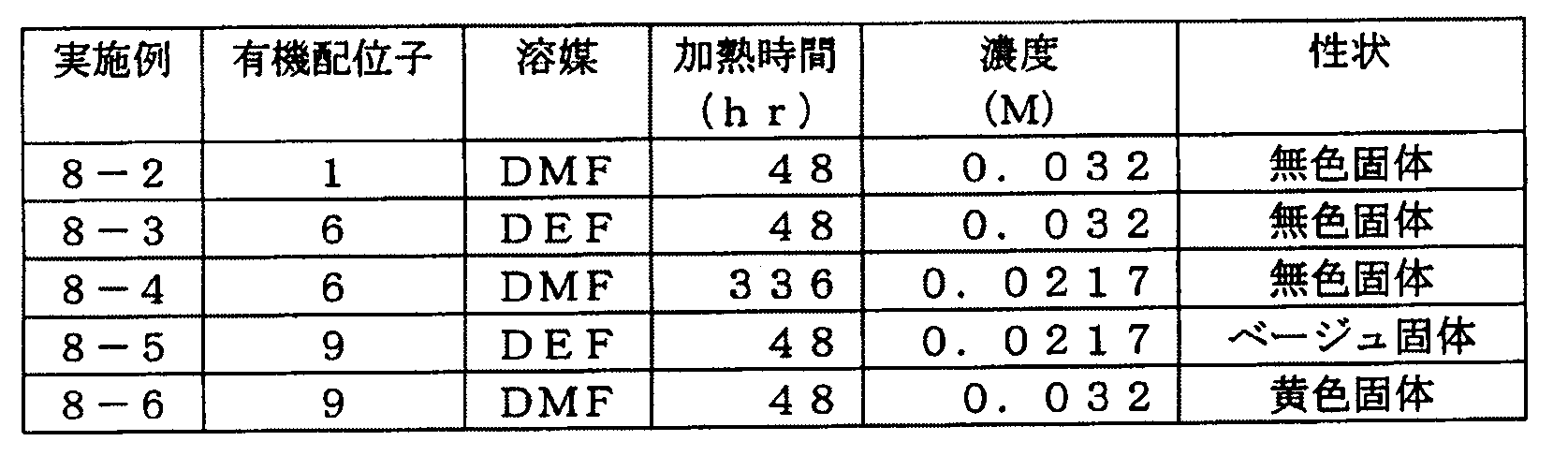
- Example 8-2 to [Example 8-6] The same operation as in Example 8-1 was performed except that the reaction was performed with the organic ligand, solvent, heating temperature, and concentration of the organic ligand shown in Table 10 below, and metal organic structures 8-2 to 8-8 were obtained. -6 was obtained. Table 10 shows the results.
- Example 9-1 Organic ligand 1 (0.2 mmol) and cobalt nitrate hexahydrate (0.2 mmol) were added with 9.2 mL of DMF and heated in an oven (reaction conditions: 120° C., 168 hours). After returning to room temperature, the supernatant was removed. After washing with 10 mL of DMF, the solvent was removed and solvent exchanged into chloroform. 10 mL of chloroform was added and soaked overnight. After removing chloroform, vacuum drying was performed at 150° C. for 5 hours to obtain a metal organic structure 9-1 as a pale purple solid.
- Example 9-2 to [Example 9-6] The same operation as in Example 9-1 was performed except that the reaction was performed with the organic ligand, solvent, heating time, and concentration of the organic ligand shown in Table 11 below, and metal organic structures 9-2 to 9-9 -6 was obtained. The results are shown in Table 11.
- Example 10-1 Organic ligand 1 (0.2 mmol) and chromium chloride hexahydrate (0.2 mmol) were added with 9.2 mL of DMF and heated in an oven (reaction conditions: 120° C., 168 hours). After returning to room temperature, the supernatant was removed. After washing with 10 mL of DMF, the solvent was removed and solvent exchanged into chloroform. 10 mL of chloroform was added and soaked overnight. After removing chloroform, vacuum drying was performed at 150° C. for 5 hours to obtain a metal organic structure 10-1 as a dark green solid.
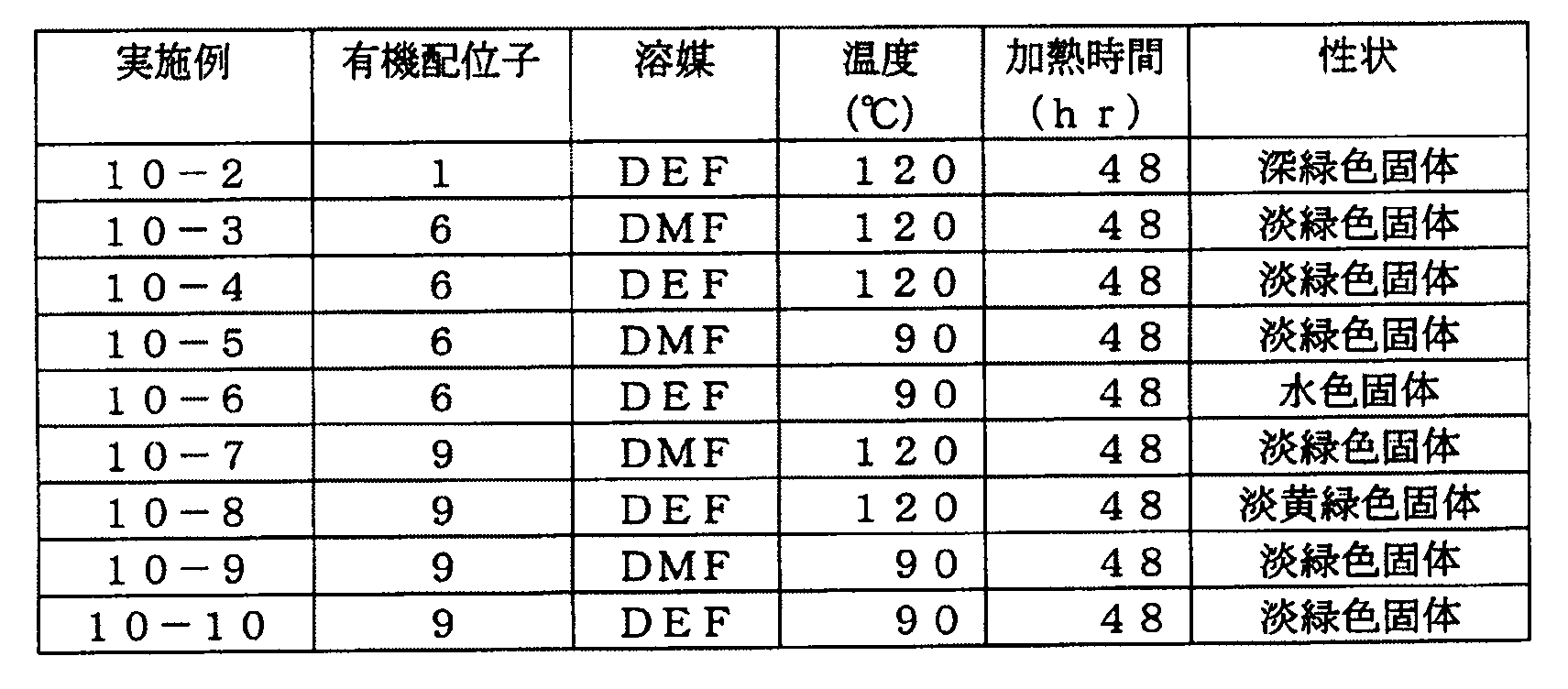
- Example 10-2 to [Example 10-10] Metal organic structures 10-2 to 10-10 were obtained in the same manner as in Example 10-1, except that the reaction was performed using the organic ligand, solvent, temperature, and heating time shown in Table 12 below. . The results are shown in Table 12.
- Example 11-1 Organic ligand 1 (0.2 mmol) and iron chloride hexahydrate (0.2 mmol) were added with 9.2 mL of DMF and heated in an oven (reaction conditions: 120° C., 48 hours). After returning to room temperature, the supernatant was removed. After washing with 10 mL of DMF, the solvent was removed and solvent exchanged into chloroform. 10 mL of chloroform was added and soaked overnight. After removing chloroform, vacuum drying was performed at 150° C. for 5 hours to obtain a metal organic structure 11-1 as an orange solid.
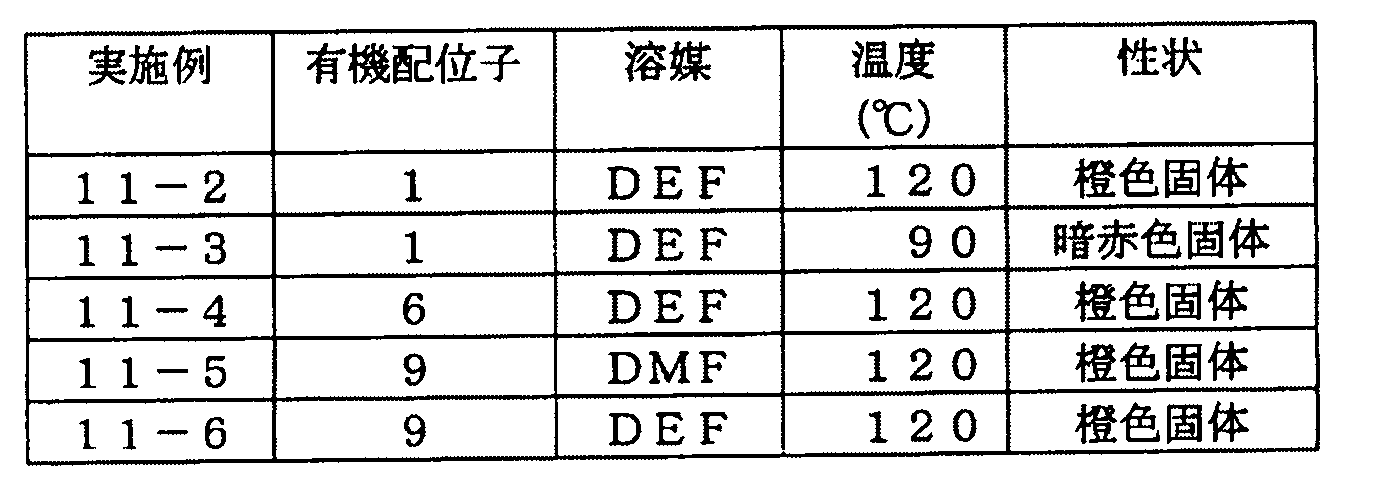
- Example 11-2 to [Example 11-6] Metal organic structures 11-2 to 11-6 were obtained in the same manner as in Example 11-1, except that the reaction was performed using the organic ligand, solvent, and temperature shown in Table 13 below. The results are shown in Table 13.
- Example 12-1 Organic ligand 1 (0.2 mmol) and scandium chloride hexahydrate (0.2 mmol) were added with 9.2 mL of DMF and heated in an oven (reaction conditions: 120° C., 48 hours). After returning to room temperature, the supernatant was removed. After washing with 10 mL of DMF, the solvent was removed and solvent exchanged into chloroform. 10 mL of chloroform was added and soaked overnight. After removing chloroform, vacuum drying was performed at 150° C. for 5 hours to obtain a metal organic structure 12-1 as a colorless solid.
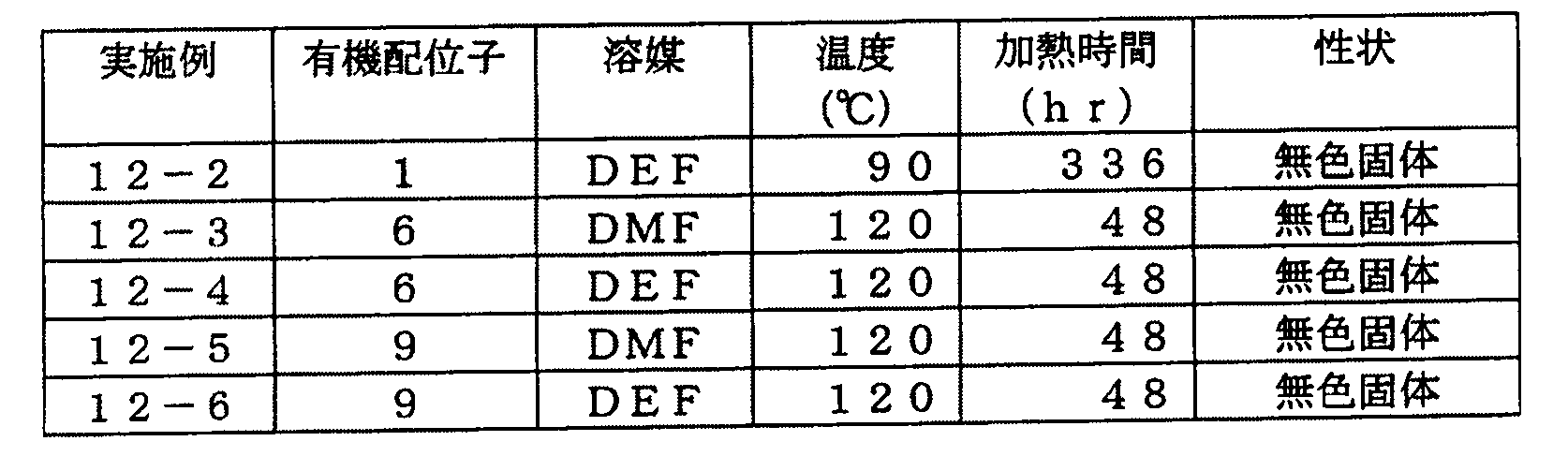
- Example 12-2 to [Example 12-6] Metal organic structures 12-2 to 12-6 were obtained in the same manner as in Example 12-1, except that the reaction was performed using the organic ligand, solvent, temperature, and heating time shown in Table 14 below. . The results are shown in Table 14.
- Example 13-1 Organic ligand 1 (0.2 mmol) and molybdenum acetate dimer (0.1 mmol) were added with 9.2 mL of DEF and heated in an oven (reaction conditions: 120° C., 168 hours). After returning to room temperature, the supernatant was removed. After washing with 10 mL of DEF, the solvent was removed and solvent exchanged to chloroform. 10 mL of chloroform was added and soaked overnight. After removing chloroform, vacuum drying was performed at 150° C. for 5 hours to obtain a metal organic structure 13-1 as a brown solid.
- Example 13-2 to [Example 13-3] Metal organic structures 13-2 to 13-3 were obtained in the same manner as in Example 13-1, except that the reaction was performed using the organic ligand, solvent, temperature, and heating time shown in Table 15 below. . The results are shown in Table 15.
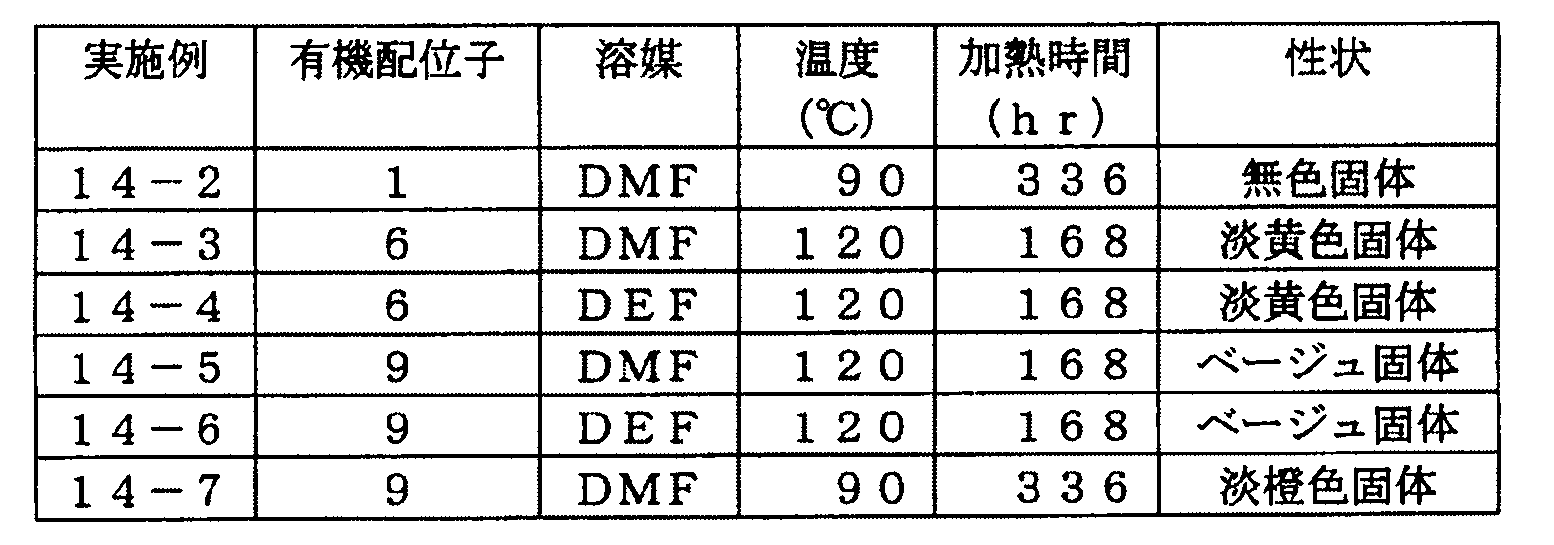
- Example 14-1 Organic ligand 1 (0.2 mmol) and manganese chloride tetrahydrate (0.2 mmol) were added with 9.2 mL of DMF and heated in an oven (reaction conditions: 120° C., 168 hours). After returning to room temperature, the supernatant was removed. After washing with 10 mL of DMF, the solvent was removed and solvent exchanged into chloroform. 10 mL of chloroform was added and soaked overnight. After removing chloroform, vacuum drying was performed at 150° C. for 5 hours to obtain a metal organic structure 14-1 as a colorless solid.
- Example 14-2 to [Example 14-7] Metal organic structures 14-2 to 14-7 were obtained in the same manner as in Example 14-1, except that the reaction was performed using the organic ligand, solvent, temperature, and heating time shown in Table 16 below. . The results are shown in Table 16.
- Example 15-1 Organic ligand 6 (0.01 mmol) was mixed with 10 mL MeOH, 2 mL EtOH, 2 mL water, to which ancillary ligand 5 (0.02 mmol), potassium carbonate (0.02 mmol) and manganese chloride tetrahydrate (0 .02 mmol) was added and heated in an oven (reaction conditions: 80° C., 168 hours). After returning to room temperature, the supernatant was removed. After washing with 10 mL of DMF, the solvent was removed and solvent exchanged into chloroform. 10 mL of chloroform was added and soaked overnight. After removing chloroform, vacuum drying was performed at 150° C. for 5 hours to obtain a metal organic structure 15-1 as a colorless solid.
- Example 16-1 Organic ligand 6 (0.2 mmol) and magnesium nitrate hexahydrate (0.2 mmol) were added with 9.2 mL of DMF and heated in an oven (reaction conditions: 120° C., 168 hours). After returning to room temperature, the supernatant was removed. After washing with 10 mL of DMF, the solvent was removed and solvent exchanged into chloroform. 10 mL of chloroform was added and soaked overnight. After removing chloroform, vacuum drying was performed at 150° C. for 5 hours to obtain a metal organic structure 16-1 as a colorless solid.
- Example 16-2 to [Example 16-5] Metal organic structures 16-2 to 16-5 were obtained in the same manner as in Example 16-1, except that the reaction was performed using the organic ligand, solvent, temperature, and heating time shown in Table 17 below. . The results are shown in Table 17.
- Example 17-1 Organic ligand 6 (0.1 mmol) and zirconium oxychloride (0.1 mmol) were added with 2 mL of DMF and heated in an oven (reaction conditions: 120° C., 48 hours). After returning to room temperature, the supernatant was removed. After washing with 5 mL of DMF, the solvent was removed and solvent exchanged into chloroform. 5 mL of chloroform was added and soaked overnight. After removing chloroform, vacuum drying was performed at 150° C. for 5 hours to obtain a metal organic structure 17-1 as a pale yellow solid.
- Example 18-1 2 mL of DMF was added to organic ligand 6 (0.1 mmol) and titanium chloride (0.1 mmol), and the mixture was heated in an oven (reaction conditions: 120° C., 48 hours). After returning to room temperature, the supernatant was removed. After washing with 5 mL of DMF, the solvent was removed and solvent exchanged into chloroform. 5 mL of chloroform was added and soaked overnight. After removing chloroform, vacuum drying was performed at 150° C. for 5 hours to obtain a metal organic structure 18-1 as a pale yellow solid.
- Example 19-1 Organic ligand 6 (0.1 mmol), Matsumoto Fine Chemical Co. , Ltd. Orgatics TC-400 (Ti(Oi - C3H7 ) 2 ( C6H14O3N ) 2 ) (0.1 mmol) in DMF2mL was added and heated in an oven (reaction conditions: 120° C., 48 hours). After returning to room temperature, the supernatant was removed. After washing with 5 mL of DMF, the solvent was removed and solvent exchanged into chloroform. 5 mL of chloroform was added and soaked overnight. After removing chloroform, vacuum drying was performed at 150° C. for 5 hours to obtain a metal organic structure 19-1 as a colorless solid.
- Example 20-1 The organic ligand 6 (0.1 mmol) was dissolved in 2 mL of DMF, the ancillary ligand 10 (0.1 mmol) and zinc nitrate hexahydrate (0.1 mmol) as a metal reagent were added thereto, and the oven (reaction conditions : 120°C for 48 hours). After returning to room temperature, the supernatant was removed. After washing with 5 mL of DMF, the solvent was removed and solvent exchanged into chloroform. 5 mL of chloroform was added and soaked overnight. After removing chloroform, vacuum drying was performed at 150° C. for 5 hours to obtain a metal organic structure 20-1 as a colorless solid.
- Example 20-2 to [Example 20-13] Metal organic structures 20-2 to 20-13 were obtained in the same manner as in Example 20-1 except that the reaction was performed using the metal salt or metal compound reagent shown in Table 18 below. The results are shown in Table 18.
- BET specific surface area measurement and hydrogen storage amount measurement The BET specific surface area and hydrogen storage capacity at 77 K-atmospheric pressure were measured for some of the obtained metal organic structures.
- the BET specific surface area and the hydrogen storage amount at 77 K-atmospheric pressure were measured using a gas adsorption measuring device Tristar-II (manufactured by Micromeritics).
- the BET specific surface area was calculated by the following method. About 50 mg of the metal organic structure was placed inside a glass cell. The inside of the glass cell was evacuated to vacuum at a temperature of 135° C. and dried for 6 hours. The glass cell was attached to a gas adsorption amount measuring device and immersed in a constant temperature bath containing liquid nitrogen.
- the pressure of the nitrogen contained in the glass cell was gradually increased. The measurement was continued until the pressure of nitrogen introduced into the glass cell reached 1.0 ⁇ 10 5 Pa.
- the hydrogen storage amount at 77K normal pressure was calculated by the following method. After measuring nitrogen, the gas type was changed to hydrogen and the measurement was performed. The pressure of hydrogen contained in the glass cell was gradually increased. The measurement was continued until the pressure of hydrogen introduced into the glass cell reached 1.0 ⁇ 10 5 Pa.
- Table 19 shows the results of the measured BET specific surface areas. Table 19 shows the measured hydrogen storage capacity at 77 K-atmospheric pressure.
- the metal-organic structure of the present invention can store gases such as hydrogen at a practical level. Therefore, it can be suitably used in the energy field using hydrogen such as fuel cells.
Landscapes
- Chemical & Material Sciences (AREA)
- Organic Chemistry (AREA)
- Analytical Chemistry (AREA)
- Chemical Kinetics & Catalysis (AREA)
Abstract
本発明の課題は、ガス貯蔵機能を有する新規な金属有機構造体並びにそれを用いたガス貯蔵剤及びガス貯蔵方法を提供することにある。 式(1)で表されるカルボン酸イオンと多価金属イオンが結合してなる金属有機構造体(但し、式(1)で表されるカルボン酸イオンと2価の銅イオンが結合してなる金属有機構造体であって、式(1)におけるXが硫黄原子であり、m1、m2、n1及びn2がすべて0であり、COO-が双方とも2位及び8位に結合しているものを除く)。 (式(1)中、 Xは硫黄原子又は酸素原子である。 R1は、ヒドロキシ基、C1~6アルキル基、C1~6アルコキシ基又はハロゲノ基である。 n1及びn2は0~3のいずれかの整数である。R1が2以上のとき各R1は互いに同一でも異なっていてもよい。 m1及びm2は0又は1である。Lが2以上のとき各Lは互いに同一でも異なっていてもよい。)
Description
本発明は、カルボン酸イオンと多価金属イオンが結合してなる金属有機構造体、前記金属有機構造体を含むガス貯蔵剤、及び前記金属有機構造体にガスを接触させる工程を含むガスの貯蔵方法に関する。本願は、2021年5月31日に出願された日本国特許出願第2021-091175号に対し優先権を主張し、その内容をここに援用する。
金属有機構造体(以下「MOF」ということがある。)は、金属イオンとそれらを連結する架橋性の有機配位子を組み合わせることで内部に空間(つまり細孔)を持つ高分子構造を有する固体状の物質であり、ガスの貯蔵や分離などの機能をもつ多孔性材料として、この十数年高い興味が持たれてきた。例えば、塩化ジルコニウムとターフェニルジカルボン酸をジメチルホルムアミド中で加熱することにより得られる表面積が4000m2/gのMOFが、水素、メタン、アセチレン等のガスを貯蔵できることが知られている(特許文献1参照)。また、下記式で表されるジカルボン酸とFe2CoO(CH3COO)6又はFe3O(CH3COO)6を酢酸存在下、N-メチルピロリドン中、150℃で24時間加熱することにより、暗褐色の結晶としてMOFが得られ、このMOFは、水素、メタン、二酸化炭素、窒素等のガスを貯蔵できることが知られている(特許文献2参照)。

また、特許文献2には下記式で表されるジカルボン酸から得られるジカルボン酸イオンとFeが結合した金属有機構造体が開示されている。
このような開発が行われるなか、金属有機構造体は、用いる金属種、配位子、反応条件により大きく構造が変化することが知られており、ガス貯蔵機能を有する新規な金属有機構造体の開発が更に求められている。
本発明は、ガス貯蔵機能を有する新規な金属有機構造体並びにそれを用いたガス貯蔵剤及びガス貯蔵方法を提供することを課題とする。
本発明者らは、上記課題を解決すべく鋭意検討を行った結果、ジベンゾチオフェン骨格又はジベンゾフラン骨格を有する特定のジカルボン酸を有機配位子として得られる新規な金属有機構造体を見いだした。また、それらの新規な金属有機構造体には、高い水素貯蔵能力があることを見いだし、本発明を完成するに至った。
すなわち、本発明は以下に示す事項により特定されるものである。
(1)式(1)で表されるカルボン酸イオンと多価金属イオンが結合してなる金属有機構造体(但し、式(1)で表されるカルボン酸イオンと2価の銅イオンが結合してなる金属有機構造体であって、式(1)におけるXが硫黄原子であり、m1、m2、n1及びn2がすべて0であり、COO-が双方とも2位及び8位に結合しているものを除く)。
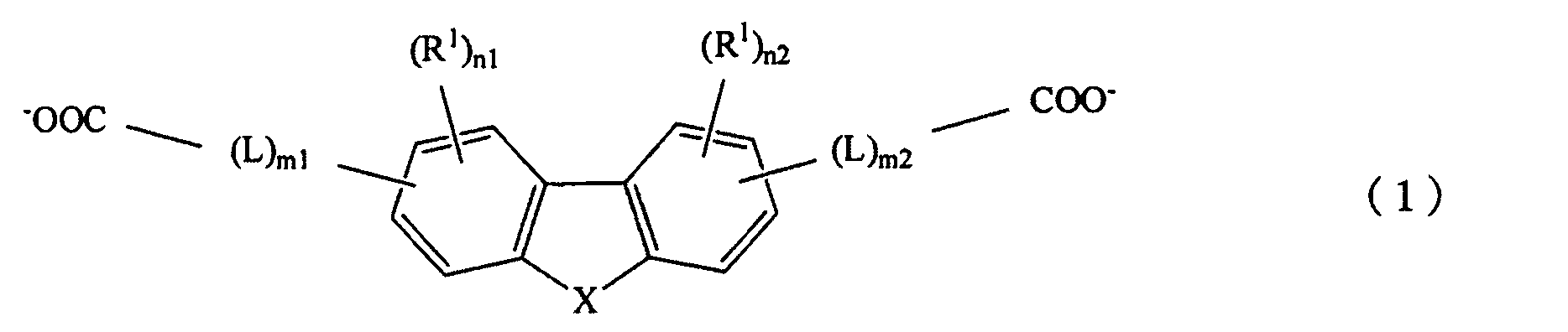
(式(1)中、
Xは硫黄原子又は酸素原子である。
R1は、ヒドロキシ基、C1~6アルキル基、C1~6アルコキシ基又はハロゲノ基である。
n1及びn2は0~3のいずれかの整数である。R1が2以上のとき各R1は互いに同一でも異なっていてもよい。
Lは、以下の式(2)で表される2価の基である。
m1及びm2は0又は1である。Lが2以上のとき各Lは互いに同一でも異なっていてもよい。

式(2)中、
R2は、ヒドロキシ基、C1~6アルキル基、C1~6アルコキシ基又はハロゲノ基である。
n3は0~4のいずれかの整数である。R2が2以上のとき各R2は互いに同一でも異なっていてもよい。
*及び**は結合位置を表し、**はカルボン酸イオンとの結合位置を表す。)
(2)多価金属イオンが、元素の周期表の第2族~第13族の金属からなる群から選ばれる少なくとも1種の金属イオンである上記(1)記載の金属有機構造体。
(3)補助配位子を構成成分として更に含む上記(1)又は(2)記載の金属有機構造体。
(4)上記(1)~(3)のいずれかに記載の金属有機構造体を含むガス貯蔵剤。
(5)上記(1)~(3)のいずれかに記載の金属有機構造体にガスを接触させる工程を含むガスの貯蔵方法。
(1)式(1)で表されるカルボン酸イオンと多価金属イオンが結合してなる金属有機構造体(但し、式(1)で表されるカルボン酸イオンと2価の銅イオンが結合してなる金属有機構造体であって、式(1)におけるXが硫黄原子であり、m1、m2、n1及びn2がすべて0であり、COO-が双方とも2位及び8位に結合しているものを除く)。
Xは硫黄原子又は酸素原子である。
R1は、ヒドロキシ基、C1~6アルキル基、C1~6アルコキシ基又はハロゲノ基である。
n1及びn2は0~3のいずれかの整数である。R1が2以上のとき各R1は互いに同一でも異なっていてもよい。
Lは、以下の式(2)で表される2価の基である。
m1及びm2は0又は1である。Lが2以上のとき各Lは互いに同一でも異なっていてもよい。
R2は、ヒドロキシ基、C1~6アルキル基、C1~6アルコキシ基又はハロゲノ基である。
n3は0~4のいずれかの整数である。R2が2以上のとき各R2は互いに同一でも異なっていてもよい。
*及び**は結合位置を表し、**はカルボン酸イオンとの結合位置を表す。)
(2)多価金属イオンが、元素の周期表の第2族~第13族の金属からなる群から選ばれる少なくとも1種の金属イオンである上記(1)記載の金属有機構造体。
(3)補助配位子を構成成分として更に含む上記(1)又は(2)記載の金属有機構造体。
(4)上記(1)~(3)のいずれかに記載の金属有機構造体を含むガス貯蔵剤。
(5)上記(1)~(3)のいずれかに記載の金属有機構造体にガスを接触させる工程を含むガスの貯蔵方法。
本発明の金属有機構造体は新規であり、水素、二酸化炭素、窒素等のガスを貯蔵することができる。
本発明の金属有機構造体は、式(1)で表されるカルボン酸イオンと多価金属イオンが結合してなる金属有機構造体である(但し、式(1)で表されるカルボン酸イオンと2価の銅イオンが結合してなる金属有機構造体であって、式(1)におけるXが硫黄原子であり、m1、m2、n1及びn2がすべて0であり、COO-が双方とも2位及び8位に結合しているものを除く)。

式(1)中、Xは硫黄原子又は酸素原子である。R1は、ヒドロキシ基、C1~6アルキル基、C1~6アルコキシ基又はハロゲノ基である。n1及びn2は、R1の数を示し、0~3のいずれかの整数である。R1が2以上のとき各R1は互いに同一でも異なっていてもよい。Lは、以下の式(2)で表される2価の基である。m1及びm2は、Lの数を示し、0又は1である。Lが2以上のとき各Lは互いに同一でも異なっていてもよい。

R1のC1~6アルキル基としては、直鎖でも、分岐鎖であってもよく、メチル基、エチル基、n-プロピル基、n-ブチル基、n-ペンチル基、n-ヘキシル基、i-プロピル基、i-ブチル基、s-ブチル基、t-ブチル基、i-ペンチル基、ネオペンチル基、2-メチル-n-ブチル基、i-ヘキシル基等を挙げることができる。R1のC1~6アルコキシ基としては、メトキシ基、エトキシ基、n-プロポキシ基、i-プロポキシ基、n-ブトキシ基、s-ブトキシ基、i-ブトキシ基、t-ブトキシ基等を挙げることができる。R1のハロゲノ基としては、フルオロ基、クロロ基、ブロモ基、イオド基等を挙げることができる。
式(2)中、R2は、ヒドロキシ基、C1~6アルキル基、C1~6アルコキシ基又はハロゲノ基である。n3はR2の数を示し、0~4のいずれかの整数である。R2が2以上のとき各R2は互いに同一でも異なっていてもよい。R2のC1~6アルキル基としては、直鎖でも、分岐鎖であってもよく、メチル基、エチル基、n-プロピル基、n-ブチル基、n-ペンチル基、n-ヘキシル基、i-プロピル基、i-ブチル基、s-ブチル基、t-ブチル基、i-ペンチル基、ネオペンチル基、2-メチル-n-ブチル基、i-ヘキシル基等を挙げることができる。R2のC1~6アルコキシ基としては、メトキシ基、エトキシ基、n-プロポキシ基、i-プロポキシ基、n-ブトキシ基、s-ブトキシ基、i-ブトキシ基、t-ブトキシ基等を挙げることができる。R2のハロゲノ基としては、フルオロ基、クロロ基、ブロモ基、イオド基等を挙げることができる。*及び**は結合位置を表し、**はカルボン酸イオンとの結合位置を表す。「C1~6」などの用語は、母核となる基の炭素原子数が1~6個などであることを表している。
式(1)で表されるカルボン酸イオンとして具体的には、以下の式に表す化合物等を例示することができる。以下の式ではXがSの場合を例示したが、XがOの場合も同様の構造を例示することができる。
式(1)で表されるカルボン酸イオンとして具体的には、以下の式に表す化合物等を例示することができる。以下の式ではXがSの場合を例示したが、XがOの場合も同様の構造を例示することができる。


本発明の金属有機構造体における多価金属イオンとしては、2価以上の金属のイオンであれば、特に制限されないが、元素周期表の第2族~第13族の金属からなる群から選ばれる少なくとも1種の金属のイオンが好ましく、Zn、Al、Cu、Zr、Ni、Co、Cr、Fe、Sc、Mo、Mn、Ti及びMgから選ばれる少なくとも1種の金属のイオンがより好ましい。本発明の金属有機構造体において、式(1)で表されるカルボン酸イオンと結合する多価金属イオンは、1種でもよく2種以上でもよい。
これらの多価金属イオンは、種々の塩の形で供給される。金属塩として具体的には、硝酸亜鉛(Zn(NO3)2・xH2O)、硝酸チタン(Ti(NO3)4・xH2O)、硝酸コバルト(Co(NO3)2・xH2O)、硝酸鉄(III)(Fe(NO3)3・xH2O)、硝酸鉄(II)(Fe(NO3)2・xH2O)、硝酸ニッケル(II)(Ni(NO3)2・xH2O)、硝酸銅(II)(Cu(NO3)2・xH2O)、硝酸アルミニウム(III)(Al(CH3COO)3・xH2O)、硝酸マグネシウム(II)(Mg(NO3)2・xH2O);塩化亜鉛(ZnCl2・xH2O)、塩化チタン(TiCl4・xH2O)、塩化ジルコニウム(ZrCl4・xH2O)、塩化コバルト(CoCl2・xH2O)、塩化鉄(III)(FeCl3・xH2O)、塩化鉄(II)(FeCl2・xH2O)、塩化クロム(III)(CrCl3・xH2O)、塩化スカンジウム(III)(ScCl3・xH2O)、塩化マンガン(II)(MnCl2・xH2O);酢酸亜鉛(Zn(CH3COO)2・xH2O)、酢酸チタン(Ti(CH3COO)4・xH2O)、酢酸ジルコニウム(Zr(CH3COO)4・xH2O)、酢酸コバルト(Co(CH3COO)2・xH2O)、酢酸鉄(III)(Fe(CH3COO)3・xH2O)、酢酸鉄(II)(Fe(CH3COO)2・xH2O);硫酸亜鉛(ZnSO4・xH2O)、硫酸チタン(Ti(SO4)2・xH2O)、硫酸ジルコニウム(Zr(SO4)2・xH2O)、硫酸コバルト(CoSO4・xH2O)、硫酸鉄(III)(Fe2(SO4)3・xH2O)、硫酸鉄(II)(FeSO4・xH2O)、硫酸マグネシウム(II)(MgSO4・xH2O);水酸化亜鉛(Zn(OH)2・xH2O)、水酸化チタン(Ti(OH)4・xH2O)、水酸化ジルコニウム(Zr(OH)4・xH2O)、水酸化コバルト(Co(OH)2・xH2O)、水酸化鉄(III)(Fe(OH)3・xH2O)、水酸化鉄(II)(Fe(OH)2・xH2O);臭化亜鉛(ZnBr2・xH2O)、臭化チタン(TiBr4・xH2O)、臭化ジルコニウム(ZrBr4・xH2O)、臭化コバルト(CoBr2・xH2O)、臭化鉄(III)(FeBr3・xH2O)、臭化鉄(II)(FeBr2・xH2O);炭酸亜鉛(ZnCO3・xH2O)、炭酸コバルト(CoCO3・xH2O)、炭酸鉄(III)(Fe2(CO3)3・xH2O);塩化酸化ジルコニウム(ZrOCl2・xH2O)、酢酸モリブデン(II)二量体((Mo(CH3COO)2)2)等が挙げられる。なお、xは、0~12の数である。これらは1種単独で、又は2種以上を混合して用いることができる。
本発明の金属有機構造体は、式(1)で表わされるカルボン酸イオン以外の有機配位子を補助配位子として含むことができる。金属有機構造体に補助配位子を含有させることで、金属有機構造体に高次構造を導入することができる。そのような補助配位子としては、テレフタル酸、フタル酸、イソフタル酸、5-シアノイソフタル酸、1,3,5-トリメシン酸、1,3,5-トリス(4-カルボキシフェニル)ベンゼン、4,4’-ジカルボキシビフェニル、3,5-ジカルボキシピリジン、2,3-ジカルボキシピラジン、1,3,5-トリス(4-カルボキシフェニル)ベンゼン、1,2,4,5-テトラキス(4-カルボキシフェニル)ベンゼン、9,10-アントラセンジカルボン酸、2,6-ナフタレンジカルボン酸、[1,1’:4’,1”]ターフェニル-3,3”,5,5”-テトラカルボン酸、ビフェニル-3,3”,5,5”-テトラカルボン酸、3,3’,5,5’-テトラカルボキシジフェニルメタン、1,3,5-トリス(4’-カルボキシ[1,1’-ビフェニル]-4-イル)ベンゼン、1,3,5-トリス(4-カルボキシフェニル)トリアジン、1,2-ビス(4-カルボキシ-3-ニトロフェニル)エテン、1,2-ビス(4-カルボキシ-3-アミノフェニル)エテン、trans,trans-ムコン酸、フマール酸、ベンゾイミダゾール、イミダゾール、1,4-ジアザビシクロ[2.2.2]オクタン(DABCO)、ピラジン、4,4’-ジピリジル、1,2-ジ(4-ピリジル)エチレン、1,2-ジ(4-ピリジル)エタン、2,7-ジアザピレン、4,4’-アゾビスピリジン、1,5-ナフチリジン、フェナジン、2ビス(3-(4-ピリジル)-2,4-ペンタンジオナト)銅等が挙げられる。式(1)で表されるカルボン酸イオンと補助配位子を用いる場合の混合モル比は特に制限されない。
本発明の金属有機構造体の製造方法として、特に制限されず、溶媒拡散法、溶媒撹拌法、水熱法等の溶液法、反応溶液にマイクロ波を照射して系全体を短時間に均一に加熱するマイクロ波法、反応容器に超音波を照射することにより、反応容器中で圧力の変化が繰り返し起こり、この圧力の変化により、溶媒が気泡を形成し崩壊するキャビテーションと呼ばれる現象がおき、その際に約5000K、10000barもの高エネルギー場が局所的に形成される結晶の各生成の反応場となる超音波法、溶媒を用いずに、金属イオン発生源と有機配位子を混合する固相合成法、結晶水程度の水を添加して金属イオン発生源と有機配位子を混合するLAG(liquid assisted grinding)法等のいずれの方法も用いることができる。
例えば、金属イオンの発生源となる金属化合物と溶媒とを含有する第一溶液、式(1)で表されるカルボン酸イオン又はその前駆体であるカルボン酸と溶媒とを含有する第二溶液、及び、必要に応じて、補助配位子と溶媒とを含有する第三溶液をそれぞれ調製する工程と、第一溶液と、第二溶液及び第三溶液を混合して反応液を調製し、この反応液を加熱することで、金属有機構造体を得る工程と、を備える。第一~第三溶液は別々に調製する必要はなく、例えば、上記金属化合物、式(1)で表されるカルボン酸イオン又はその前駆体であるカルボン酸、補助配位子となる化合物、溶媒とを1度に混合して1つの溶液を調製してもよい。
上記金属化合物と式(1)で表されるカルボン酸イオン又はその前駆体であるカルボン酸との混合モル比は、得られてくる金属有機構造体の細孔サイズ、表面特性に応じて任意に選択することができるが、式(1)で表されるカルボン酸イオン又はその前駆体であるカルボン酸1モルに対して金属化合物を1モル以上用いるのが好ましく、さらに1.1モル以上、さらに1.2モル以上、さらに1.5モル以上、さらに2モル以上、さらに3モル以上用いるのが好ましい。
反応液中の上記金属イオンの濃度は、25~200ミリモル/Lの範囲が好ましい。
式(1)で表されるカルボン酸イオン又はその前駆体であるカルボン酸の反応液中の濃度は、10~100ミリモル/Lの範囲が好ましい。
補助配位子の反応液中の濃度は、10~100ミリモル/Lであるのが好ましい。
式(1)で表されるカルボン酸イオン又はその前駆体であるカルボン酸の反応液中の濃度は、10~100ミリモル/Lの範囲が好ましい。
補助配位子の反応液中の濃度は、10~100ミリモル/Lであるのが好ましい。
用いる溶媒としては、特に限定されないが、N,N-ジメチルホルムアミド(以下「DMF」と記載することがある。)、N,N-ジエチルホルムアミド(以下「DEF」と記載することがある。)、N,N-ジメチルアセトアミド(以下「DMA」と記載することがある。)、N-メチル-2-ピロリドン(以下「NMP」と記載することがある。)、ジメチルスルホキシド(以下「DMSO」と記載することがある。)及び水からなる群より選ばれる1種又は2種以上を混合して用いることができる。また、これらの溶媒にメチルアルコール、エチルアルコール等のアルコールを混合して用いてもよい。
反応液の加熱温度は、特に制限されないが、例えば、室温~140℃の範囲、70~140℃の範囲、80~120℃等の範囲を挙げることができる。
本発明のガス貯蔵剤は、本発明の金属有機構造体を含む。本発明のガス貯蔵剤は、本発明の金属有機構造体のみからなっていてもよく、ガス貯蔵剤としての使用に支障をきたさない範囲で他の成分を含んでもよい。本発明のガス貯蔵剤の形状は特に制限されず、例えば、粉状、顆粒状、ペレット状等を挙げることができる。本発明の金属有機構造体は、水素、メタン、アセチレン、二酸化炭素、窒素等のガスを吸着または吸蔵することで、前記ガスを貯蔵することができる。本発明の金属有機構造体を用いたガスの貯蔵方法は、特に制限されないが、本発明の金属有機構造体とガスを接触させる方法が好ましく、接触させる方法は、特に制限されない。例えば、タンク中に、本発明の金属有機構造体を充填してガス貯蔵タンクとし、該タンク内にガスを流入する方法、タンクの内壁を構成する表面に本発明の金属有機構造体を担持させてガス貯蔵タンクとし、該タンク内にガスを流入する方法、タンクを本発明の金属有機構造体を含む材料で成形してガス貯蔵タンクとし、該タンク内にガスを流入する方法等を挙げることができる。
以下、本発明の実施例を挙げて、本発明を具体的に説明するが、本発明の技術的範囲はこれらの例示に限定されるものではない。本発明の金属有機構造体を構成する式(1)で表されるカルボン酸イオンの前駆体となるカルボン酸として、以下の表1に示す有機配位子1~9を用いた。
補助配位子を含む場合、その補助配位子しては、表2に示す補助配位子1~10を用いた。

[製造例1]有機配位子1の合成
ジベンゾチオフェン(5.43mmol)を酢酸20mLに溶解させ、臭素(11.0mmol)の酢酸(5mL)溶液を30分以上かけて滴下した。反応溶液を室温で2時間攪拌し、さらに130℃で5時間攪拌した。反応溶液を室温に戻し、析出した固体をろ過した。得られた固体を水で洗浄し、無水酢酸で再結晶を行うことで無色の固体を得た。得られた固体を水で洗浄することで無色の固体として2.00mmolの2,8-ジブロモジベンゾチオフェンを得た。得られた2,8-ジブロモジベンゾチオフェン(10.0mmol)をテトラヒドロフラン100mLに溶解させ、-78℃に冷却した。低温にした反応溶液にノルマルブチルリチウムのヘキサン溶液(1.57M)19.1mmolを30分かけて滴下し、低温のまま2時間攪拌した。攪拌後、細かく砕いたドライアイスを加え1時間攪拌した。さらに室温で1時間攪拌後、テトラヒドロフランを留去したのちに濃塩酸を加えた。析出した固体をろ過し、水及びメタノールで洗浄した後に100℃で乾燥させることで、8.12mmolの2,8-ジカルボキシジベンゾチオフェン(有機配位子1)を無色固体として得た。
ジベンゾチオフェン(5.43mmol)を酢酸20mLに溶解させ、臭素(11.0mmol)の酢酸(5mL)溶液を30分以上かけて滴下した。反応溶液を室温で2時間攪拌し、さらに130℃で5時間攪拌した。反応溶液を室温に戻し、析出した固体をろ過した。得られた固体を水で洗浄し、無水酢酸で再結晶を行うことで無色の固体を得た。得られた固体を水で洗浄することで無色の固体として2.00mmolの2,8-ジブロモジベンゾチオフェンを得た。得られた2,8-ジブロモジベンゾチオフェン(10.0mmol)をテトラヒドロフラン100mLに溶解させ、-78℃に冷却した。低温にした反応溶液にノルマルブチルリチウムのヘキサン溶液(1.57M)19.1mmolを30分かけて滴下し、低温のまま2時間攪拌した。攪拌後、細かく砕いたドライアイスを加え1時間攪拌した。さらに室温で1時間攪拌後、テトラヒドロフランを留去したのちに濃塩酸を加えた。析出した固体をろ過し、水及びメタノールで洗浄した後に100℃で乾燥させることで、8.12mmolの2,8-ジカルボキシジベンゾチオフェン(有機配位子1)を無色固体として得た。
[製造例2]有機配位子2の合成
製造例1におけるジベンゾチオフェンの代わりにジベンゾフランを用いた以外は製造例1と同様の操作を行い、有機配位子2を無色固体として得た。
製造例1におけるジベンゾチオフェンの代わりにジベンゾフランを用いた以外は製造例1と同様の操作を行い、有機配位子2を無色固体として得た。
[製造例3]有機配位子3の合成
2,8-ジブロモジベンゾチオフェン(3.31mmol)、炭酸カリウム(16.5mmol)、4-メトキシカルボニルフェニルボロン酸(8.26mmol)、テトラキス(トリフェニルホスフィン)パラジウム(0.165mmol)、1,2-ジエトキシエタン20mL、水6mLを2日間100℃で撹拌した。室温に戻し水を加え、クロロホルムで抽出した有機層を硫酸マグネシウムで乾燥させろ過し、ろ液を減圧蒸留した。シリカゲルカラムクロマトグラフィーにより分離精製することで、0.877mmolの2,8-ビス(4-メトキシカルボニルフェニル)ジベンゾチオフェンを白色固体として得た。得られた2,8-ビス(4-メトキシカルボニルフェニル)ジベンゾチオフェン(0.877mmol)に水酸化カリウム(4.39mmol)、メタノール20mL、水20mL、テトラヒドロフラン20mLを加え90℃で終夜撹拌した。室温に戻し、希塩酸を加え析出した固体をろ過し、水でよく洗い乾燥させることで、0.877mmolの2,8-ビス(4-カルボキシフェニル)ジベンゾチオフェン(有機配位子3)を無色固体として得た。
2,8-ジブロモジベンゾチオフェン(3.31mmol)、炭酸カリウム(16.5mmol)、4-メトキシカルボニルフェニルボロン酸(8.26mmol)、テトラキス(トリフェニルホスフィン)パラジウム(0.165mmol)、1,2-ジエトキシエタン20mL、水6mLを2日間100℃で撹拌した。室温に戻し水を加え、クロロホルムで抽出した有機層を硫酸マグネシウムで乾燥させろ過し、ろ液を減圧蒸留した。シリカゲルカラムクロマトグラフィーにより分離精製することで、0.877mmolの2,8-ビス(4-メトキシカルボニルフェニル)ジベンゾチオフェンを白色固体として得た。得られた2,8-ビス(4-メトキシカルボニルフェニル)ジベンゾチオフェン(0.877mmol)に水酸化カリウム(4.39mmol)、メタノール20mL、水20mL、テトラヒドロフラン20mLを加え90℃で終夜撹拌した。室温に戻し、希塩酸を加え析出した固体をろ過し、水でよく洗い乾燥させることで、0.877mmolの2,8-ビス(4-カルボキシフェニル)ジベンゾチオフェン(有機配位子3)を無色固体として得た。
[製造例4]有機配位子4の合成
2,8-ジブロモジベンゾチオフェン(3.31mmol)、ヨウ化銅(I)(0.331mmol)、トリフェニルホスフィン(0.661mmol)、ビス(トリフェニルホスフィン)パラジウムジクロリド(0.661mmol)、4-メトキシカルボニルフェニルアセチレン(9.92mmol)、トリエチルアミン30mLを2日間120℃で撹拌した。室温に戻し水を加え、ジクロロメタンで抽出した有機層を硫酸マグネシウムで乾燥させろ過し、ろ液を減圧蒸留した。シリカゲルカラムクロマトグラフィーにより分離精製することで、2.30mmolの2,8-ビス(4-メトキシカルボニルフェニルエチニル)ジベンゾチオフェンを白色固体として得た。得られた2.00mmolの2,8-ビス(4-メトキシカルボニルフェニルエチニル)ジベンゾチオフェンに水酸化カリウム(10.0mmol)、メタノール30mL、水30mL、テトラヒドロフラン30mLを加え90℃で終夜撹拌した。室温に戻し、希塩酸を加え析出した固体をろ過し、水でよく洗い乾燥させることで、1.50mmolの2,8-ビス(4-カルボキシフェニルエチニル)ジベンゾチオフェン(有機配位子4)を無色固体として得た。
2,8-ジブロモジベンゾチオフェン(3.31mmol)、ヨウ化銅(I)(0.331mmol)、トリフェニルホスフィン(0.661mmol)、ビス(トリフェニルホスフィン)パラジウムジクロリド(0.661mmol)、4-メトキシカルボニルフェニルアセチレン(9.92mmol)、トリエチルアミン30mLを2日間120℃で撹拌した。室温に戻し水を加え、ジクロロメタンで抽出した有機層を硫酸マグネシウムで乾燥させろ過し、ろ液を減圧蒸留した。シリカゲルカラムクロマトグラフィーにより分離精製することで、2.30mmolの2,8-ビス(4-メトキシカルボニルフェニルエチニル)ジベンゾチオフェンを白色固体として得た。得られた2.00mmolの2,8-ビス(4-メトキシカルボニルフェニルエチニル)ジベンゾチオフェンに水酸化カリウム(10.0mmol)、メタノール30mL、水30mL、テトラヒドロフラン30mLを加え90℃で終夜撹拌した。室温に戻し、希塩酸を加え析出した固体をろ過し、水でよく洗い乾燥させることで、1.50mmolの2,8-ビス(4-カルボキシフェニルエチニル)ジベンゾチオフェン(有機配位子4)を無色固体として得た。
[製造例5]有機配位子5の合成
製造例4の2,8-ジブロモジベンゾチオフェンの代わりに2,8-ジブロモジベンゾフランを用いた以外は製造例4と同様の操作を行い、有機配位子5を無色固体として得た。
製造例4の2,8-ジブロモジベンゾチオフェンの代わりに2,8-ジブロモジベンゾフランを用いた以外は製造例4と同様の操作を行い、有機配位子5を無色固体として得た。
[製造例6]有機配位子6の合成
ジベンゾチオフェン(5.43mmol)を酢酸(14mL)に溶解させ、過酸化水素水(2.44mL)を滴下した。反応溶液を4時間130℃で撹拌した。室温に戻し水に反応溶液をあけ、無色固体を析出させた。得られた懸濁液をろ過し、無色固体を水、メタノールでよく洗い乾燥させることで、5.09mmolのジベンゾチオフェンジオキシドを無色固体として得た。得られた4.62mmolのジベンゾチオフェンジオキシドとN-ブロモスクシンイミド(9.24mmol)を硫酸(150mL)に溶解させ、室温で24時間攪拌した。得られた懸濁液を氷水にゆっくりとあけ、得られた懸濁液をろ過し、無色固体を水、メタノールでよく洗い乾燥させることで、3.45mmolの3,7-ジブロモジベンゾチオフェンジオキシドを無色固体として得た。得られた2.63mmolの3,7-ジブロモジベンゾチオフェンジオキシドのジエチルエーテル(40mL)懸濁液にリチウムアルミニウムヒドリド(10.4mmol)を加え、50℃で1時間加熱攪拌した。得られた懸濁液を氷水にあけ、塩酸を加えて酸性にした。反応溶液をクロロホルムで抽出し、有機層を硫酸マグネシウムで乾燥させろ過し、ろ液を減圧蒸留した。得られた粗生成物をアセトンで再結晶することで1.11mmolの3,7-ジブロモジベンゾチオフェンを白色固体として得た。得られた5.17mmolの3,7-ジブロモジベンゾチオフェンをテトラヒドロフラン100mLに溶解させ、-78℃に冷却した。低温にした反応溶液にノルマルブチルリチウムのヘキサン溶液(1.57M)15.5mmolを30分かけて滴下し、低温のまま2時間攪拌した。攪拌後、細かく砕いたドライアイスを加え1時間攪拌した。さらに室温で1時間攪拌後、テトラヒドロフランを留去したのちに濃塩酸を加えた。析出した固体をろ過し、水及びメタノールで洗浄した後に100℃で乾燥させることで、4.22mmolの3,7-ジカルボキシジベンゾチオフェン(有機配位子6)を無色固体として得た。
ジベンゾチオフェン(5.43mmol)を酢酸(14mL)に溶解させ、過酸化水素水(2.44mL)を滴下した。反応溶液を4時間130℃で撹拌した。室温に戻し水に反応溶液をあけ、無色固体を析出させた。得られた懸濁液をろ過し、無色固体を水、メタノールでよく洗い乾燥させることで、5.09mmolのジベンゾチオフェンジオキシドを無色固体として得た。得られた4.62mmolのジベンゾチオフェンジオキシドとN-ブロモスクシンイミド(9.24mmol)を硫酸(150mL)に溶解させ、室温で24時間攪拌した。得られた懸濁液を氷水にゆっくりとあけ、得られた懸濁液をろ過し、無色固体を水、メタノールでよく洗い乾燥させることで、3.45mmolの3,7-ジブロモジベンゾチオフェンジオキシドを無色固体として得た。得られた2.63mmolの3,7-ジブロモジベンゾチオフェンジオキシドのジエチルエーテル(40mL)懸濁液にリチウムアルミニウムヒドリド(10.4mmol)を加え、50℃で1時間加熱攪拌した。得られた懸濁液を氷水にあけ、塩酸を加えて酸性にした。反応溶液をクロロホルムで抽出し、有機層を硫酸マグネシウムで乾燥させろ過し、ろ液を減圧蒸留した。得られた粗生成物をアセトンで再結晶することで1.11mmolの3,7-ジブロモジベンゾチオフェンを白色固体として得た。得られた5.17mmolの3,7-ジブロモジベンゾチオフェンをテトラヒドロフラン100mLに溶解させ、-78℃に冷却した。低温にした反応溶液にノルマルブチルリチウムのヘキサン溶液(1.57M)15.5mmolを30分かけて滴下し、低温のまま2時間攪拌した。攪拌後、細かく砕いたドライアイスを加え1時間攪拌した。さらに室温で1時間攪拌後、テトラヒドロフランを留去したのちに濃塩酸を加えた。析出した固体をろ過し、水及びメタノールで洗浄した後に100℃で乾燥させることで、4.22mmolの3,7-ジカルボキシジベンゾチオフェン(有機配位子6)を無色固体として得た。
[製造例7]有機配位子7の合成
製造例3の2,8-ジブロモジベンゾチオフェンの代わりに3,7-ジブロモジベンゾチオフェンを用いた以外は製造例3と同様の操作を行い、有機配位子7を無色固体として得た。
製造例3の2,8-ジブロモジベンゾチオフェンの代わりに3,7-ジブロモジベンゾチオフェンを用いた以外は製造例3と同様の操作を行い、有機配位子7を無色固体として得た。
[製造例8]有機配位子8の合成
製造例4の2,8-ジブロモジベンゾチオフェンの代わりに3,7-ジブロモジベンゾチオフェンを用いた以外は製造例4と同様の操作で行い、有機配位子8を無色固体として得た。
製造例4の2,8-ジブロモジベンゾチオフェンの代わりに3,7-ジブロモジベンゾチオフェンを用いた以外は製造例4と同様の操作で行い、有機配位子8を無色固体として得た。
[製造例9]有機配位子9の合成
ジベンゾチオフェン(10.0mmol)をヘキサン(10mL)に溶解させ、N,N,N’,N’-テトラメチルエチレンジアミン(30.0mmol)を加え、-78℃に冷却した。低温にした反応溶液にノルマルブチルリチウムのヘキサン溶液(1.57M)30.0mmolを30分かけて滴下し、低温のまま2時間攪拌した。攪拌後、細かく砕いたドライアイスを加え1時間攪拌した。さらに室温で1時間攪拌後、ヘキサンを留去したのちに濃塩酸を加えた。析出した固体をろ過し、水及びメタノールで洗浄した後に100℃で乾燥させることで、4.44mmolの4,6-ジカルボキシジベンゾチオフェン(有機配位子9)を無色固体として得た。
ジベンゾチオフェン(10.0mmol)をヘキサン(10mL)に溶解させ、N,N,N’,N’-テトラメチルエチレンジアミン(30.0mmol)を加え、-78℃に冷却した。低温にした反応溶液にノルマルブチルリチウムのヘキサン溶液(1.57M)30.0mmolを30分かけて滴下し、低温のまま2時間攪拌した。攪拌後、細かく砕いたドライアイスを加え1時間攪拌した。さらに室温で1時間攪拌後、ヘキサンを留去したのちに濃塩酸を加えた。析出した固体をろ過し、水及びメタノールで洗浄した後に100℃で乾燥させることで、4.44mmolの4,6-ジカルボキシジベンゾチオフェン(有機配位子9)を無色固体として得た。
得られた有機配位子の1H-NMRデータを以下に示す。
有機配位子1
1H-NMR (400 MHz, DMSO-d6) δ: 8.09 (2H, dd), 8.19 (2H, d), 8.95 (2H, d).
有機配位子2
1H-NMR (400 MHz, DMSO-d6) δ: 7.84 (2H, d), 8.16 (2H, dd), 8.89 (2H, d).
有機配位子3
1H-NMR (400 MHz, DMSO-d6) δ: 7.95 (2H, dd), 8.03-8.09 (8H, m), 8.17(2H, d), 9.02 (2H, d).
有機配位子4
1H-NMR (400 MHz, DMSO-d6) δ: 7.70-7.75 (6H, m), 8.00 (4H, d), 8.16(2H, d), 8.78 (2H, s).
有機配位子5
1H-NMR (400 MHz, DMSO-d6) δ: 7.75 (4H, d), 7.78(2H, d), 7.83 (2H, d), 7.99(4H, d), 8.52 (2H, s).
有機配位子6
1H-NMR (400 MHz, DMSO-d6) δ: 8.07 (2H, d), 8.55 (2H, dd), 8.68 (2H, s).
有機配位子7
1H-NMR (400 MHz, DMSO-d6) δ: 7.91 (2H, d), 7.95 (4H, d), 8.06(4H, d), 8.47(2H, s), 8.51 (2H, d).
有機配位子8
1H-NMR (400 MHz, DMSO-d6) δ: 7.69 (4H, d), 7.72(2H, d), 7.98(4H, d), 8.36(2H, s), 8.47(2H, d).
有機配位子9
1H-NMR (400 MHz, DMSO-d6) δ: 7.67 (2H, t), 8.20 (2H, dd), 8.70 (2H, dd).
有機配位子1
1H-NMR (400 MHz, DMSO-d6) δ: 8.09 (2H, dd), 8.19 (2H, d), 8.95 (2H, d).
有機配位子2
1H-NMR (400 MHz, DMSO-d6) δ: 7.84 (2H, d), 8.16 (2H, dd), 8.89 (2H, d).
有機配位子3
1H-NMR (400 MHz, DMSO-d6) δ: 7.95 (2H, dd), 8.03-8.09 (8H, m), 8.17(2H, d), 9.02 (2H, d).
有機配位子4
1H-NMR (400 MHz, DMSO-d6) δ: 7.70-7.75 (6H, m), 8.00 (4H, d), 8.16(2H, d), 8.78 (2H, s).
有機配位子5
1H-NMR (400 MHz, DMSO-d6) δ: 7.75 (4H, d), 7.78(2H, d), 7.83 (2H, d), 7.99(4H, d), 8.52 (2H, s).
有機配位子6
1H-NMR (400 MHz, DMSO-d6) δ: 8.07 (2H, d), 8.55 (2H, dd), 8.68 (2H, s).
有機配位子7
1H-NMR (400 MHz, DMSO-d6) δ: 7.91 (2H, d), 7.95 (4H, d), 8.06(4H, d), 8.47(2H, s), 8.51 (2H, d).
有機配位子8
1H-NMR (400 MHz, DMSO-d6) δ: 7.69 (4H, d), 7.72(2H, d), 7.98(4H, d), 8.36(2H, s), 8.47(2H, d).
有機配位子9
1H-NMR (400 MHz, DMSO-d6) δ: 7.67 (2H, t), 8.20 (2H, dd), 8.70 (2H, dd).
[実施例1-1]
有機配位子1(0.5mmol)、硝酸亜鉛六水和物(1.0mmol)にDMF10mLを加え、オーブン(反応条件:90℃、48時間)にて加熱した。室温に戻し、上澄みを除去した。DMF10mLを用い洗浄後、溶媒を除去し、クロロホルムへと溶媒を交換した。クロロホルムを10mL加え、終夜浸漬させた。クロロホルムを除去後、150℃で真空乾燥を5時間行い、無色固体として金属有機構造体1-1を得た。
有機配位子1(0.5mmol)、硝酸亜鉛六水和物(1.0mmol)にDMF10mLを加え、オーブン(反応条件:90℃、48時間)にて加熱した。室温に戻し、上澄みを除去した。DMF10mLを用い洗浄後、溶媒を除去し、クロロホルムへと溶媒を交換した。クロロホルムを10mL加え、終夜浸漬させた。クロロホルムを除去後、150℃で真空乾燥を5時間行い、無色固体として金属有機構造体1-1を得た。
[実施例1-2]~[実施例1-51]
下記表3に示す有機配位子、溶媒、温度、加熱時間、及び有機配位子の濃度で反応を行う以外は、実施例1-1と同様の操作を行い、金属有機構造体1-2~1-51を得た。その結果を表3に示す。表3における「濃度(M)」は、溶媒中の有機配位子の割合として算出した。実施例1-34で使用した溶媒の「DMF+MeOH」は、DMF9mLとMeOH1mLの混合溶媒である。
以下の表中においては、「濃度(M)」は、溶媒中の有機配位子の割合として算出した、有機配位子の濃度を意味する。
下記表3に示す有機配位子、溶媒、温度、加熱時間、及び有機配位子の濃度で反応を行う以外は、実施例1-1と同様の操作を行い、金属有機構造体1-2~1-51を得た。その結果を表3に示す。表3における「濃度(M)」は、溶媒中の有機配位子の割合として算出した。実施例1-34で使用した溶媒の「DMF+MeOH」は、DMF9mLとMeOH1mLの混合溶媒である。
以下の表中においては、「濃度(M)」は、溶媒中の有機配位子の割合として算出した、有機配位子の濃度を意味する。


[実施例2-1]
有機配位子1(0.5mmol)をDMF7.5mLに溶解させ、そこに補助配位子1(0.2mmol)及び硝酸亜鉛六水和物(0.5mmol)を加え、オーブン(反応条件:90℃、48時間)にて加熱した。室温に戻し、上澄みを除去した。DMF10mLを用い洗浄後、溶媒を除去し、クロロホルムへと溶媒を交換した。クロロホルムを10mL加え、終夜浸漬させた。クロロホルムを除去後、150℃で真空乾燥を5時間行い、無色固体として金属有機構造体2-1を得た。
有機配位子1(0.5mmol)をDMF7.5mLに溶解させ、そこに補助配位子1(0.2mmol)及び硝酸亜鉛六水和物(0.5mmol)を加え、オーブン(反応条件:90℃、48時間)にて加熱した。室温に戻し、上澄みを除去した。DMF10mLを用い洗浄後、溶媒を除去し、クロロホルムへと溶媒を交換した。クロロホルムを10mL加え、終夜浸漬させた。クロロホルムを除去後、150℃で真空乾燥を5時間行い、無色固体として金属有機構造体2-1を得た。
[実施例2-2]~[実施例2-33]
下記表4に示す有機配位子、補助配位子、溶媒、温度、加熱時間、及び有機配位子の濃度で反応を行う以外は、実施例2-1と同様の操作を行い、金属有機構造体2-2~2-33を得た。その結果を表4に示す。実施例2-5及び2-7では、DMF5mLとNMP5mLの混合溶媒を使用し、実施例2-6及び2-8では、DMF30mLとNMP30mLの混合溶媒を使用した。また、実施例2-23及び2-24では、DMF5mLと水1mLとEtOH2mLの混合溶媒を使用した。
下記表4に示す有機配位子、補助配位子、溶媒、温度、加熱時間、及び有機配位子の濃度で反応を行う以外は、実施例2-1と同様の操作を行い、金属有機構造体2-2~2-33を得た。その結果を表4に示す。実施例2-5及び2-7では、DMF5mLとNMP5mLの混合溶媒を使用し、実施例2-6及び2-8では、DMF30mLとNMP30mLの混合溶媒を使用した。また、実施例2-23及び2-24では、DMF5mLと水1mLとEtOH2mLの混合溶媒を使用した。
[実施例3-1]
有機配位子1(0.294mmol)、硝酸アルミニウム九水和物(0.382mmol)にDEF9.2mLを加え、オーブン(反応条件:120℃、168時間)にて加熱した。室温に戻し、上澄みを除去した。DEF10mLを用い洗浄後、溶媒を除去し、クロロホルムへと溶媒を交換した。クロロホルムを10mL加え、終夜浸漬させた。クロロホルムを除去後、150℃で真空乾燥を5時間行い、茶色固体として金属有機構造体3-1を得た。
有機配位子1(0.294mmol)、硝酸アルミニウム九水和物(0.382mmol)にDEF9.2mLを加え、オーブン(反応条件:120℃、168時間)にて加熱した。室温に戻し、上澄みを除去した。DEF10mLを用い洗浄後、溶媒を除去し、クロロホルムへと溶媒を交換した。クロロホルムを10mL加え、終夜浸漬させた。クロロホルムを除去後、150℃で真空乾燥を5時間行い、茶色固体として金属有機構造体3-1を得た。
[実施例3-2]~[実施例3-8]
下記表5に示す有機配位子、溶媒、温度、加熱時間、及び有機配位子の濃度で反応を行う以外は、実施例3-1と同様の操作を行い、金属有機構造体3-2~3-8を得た。その結果を表5に示す。
下記表5に示す有機配位子、溶媒、温度、加熱時間、及び有機配位子の濃度で反応を行う以外は、実施例3-1と同様の操作を行い、金属有機構造体3-2~3-8を得た。その結果を表5に示す。
[実施例4-1]
有機配位子6(0.2mmol)、硝酸銅三水和物(0.2mmol)にDEF9.2mLを加え、オーブン(反応条件:120℃、168時間)にて加熱した。室温に戻し、上澄みを除去した。DEF10mLを用い洗浄後、溶媒を除去し、クロロホルムへと溶媒を交換した。クロロホルムを10mL加え、終夜浸漬させた。クロロホルムを除去後、150℃で真空乾燥を5時間行い、淡青緑色固体として金属有機構造体4-1を得た。
有機配位子6(0.2mmol)、硝酸銅三水和物(0.2mmol)にDEF9.2mLを加え、オーブン(反応条件:120℃、168時間)にて加熱した。室温に戻し、上澄みを除去した。DEF10mLを用い洗浄後、溶媒を除去し、クロロホルムへと溶媒を交換した。クロロホルムを10mL加え、終夜浸漬させた。クロロホルムを除去後、150℃で真空乾燥を5時間行い、淡青緑色固体として金属有機構造体4-1を得た。
[実施例4-2]~[実施例4-8]
下記表6に示す有機配位子、溶媒、温度、及び加熱時間で反応を行う以外は、実施例4-1と同様の操作を行い、金属有機構造体4-2~4-8を得た。その結果を表6に示す。
下記表6に示す有機配位子、溶媒、温度、及び加熱時間で反応を行う以外は、実施例4-1と同様の操作を行い、金属有機構造体4-2~4-8を得た。その結果を表6に示す。

[実施例5-1]
有機配位子1(0.2mmol)をDEF9.2mLに溶解させ、そこに補助配位子2(0.2mmol)及び硝酸銅三水和物(0.2mmol)を加え、オーブン(反応条件:120℃、48時間)にて加熱した。室温に戻し、上澄みを除去した。DMF10mLを用い洗浄後、溶媒を除去し、クロロホルムへと溶媒を交換した。クロロホルムを10mL加え、終夜浸漬させた。クロロホルムを除去後、150℃で真空乾燥を5時間行い、淡青緑色固体として金属有機構造体5-1を得た。
有機配位子1(0.2mmol)をDEF9.2mLに溶解させ、そこに補助配位子2(0.2mmol)及び硝酸銅三水和物(0.2mmol)を加え、オーブン(反応条件:120℃、48時間)にて加熱した。室温に戻し、上澄みを除去した。DMF10mLを用い洗浄後、溶媒を除去し、クロロホルムへと溶媒を交換した。クロロホルムを10mL加え、終夜浸漬させた。クロロホルムを除去後、150℃で真空乾燥を5時間行い、淡青緑色固体として金属有機構造体5-1を得た。
[実施例5-2]~[実施例5-27]
下記表7に示す有機配位子、補助配位子、溶媒、及び温度で反応を行う以外は、実施例5-1と同様の操作を行い、金属有機構造体5-2~5-27を得た。その結果を表7に示す。
下記表7に示す有機配位子、補助配位子、溶媒、及び温度で反応を行う以外は、実施例5-1と同様の操作を行い、金属有機構造体5-2~5-27を得た。その結果を表7に示す。
[実施例6-1]
有機配位子1(0.2mmol)、塩化ジルコニウム(0.2mmol)にDMF9.2mLを加え、オーブン(反応条件:120℃、168時間)にて加熱した。室温に戻し、上澄みを除去した。DMF10mLを用い洗浄後、溶媒を除去し、クロロホルムへと溶媒を交換した。クロロホルムを10mL加え、終夜浸漬させた。クロロホルムを除去後、150℃で真空乾燥を5時間行い、茶色固体として金属有機構造体6-1を得た。
有機配位子1(0.2mmol)、塩化ジルコニウム(0.2mmol)にDMF9.2mLを加え、オーブン(反応条件:120℃、168時間)にて加熱した。室温に戻し、上澄みを除去した。DMF10mLを用い洗浄後、溶媒を除去し、クロロホルムへと溶媒を交換した。クロロホルムを10mL加え、終夜浸漬させた。クロロホルムを除去後、150℃で真空乾燥を5時間行い、茶色固体として金属有機構造体6-1を得た。
[実施例6-2]~[実施例6-8]
下記表8に示す有機配位子、溶媒、及び温度で反応を行う以外は、実施例6-1と同様の操作を行い、金属有機構造体6-2~6-8を得た。その結果を表8に示す。
下記表8に示す有機配位子、溶媒、及び温度で反応を行う以外は、実施例6-1と同様の操作を行い、金属有機構造体6-2~6-8を得た。その結果を表8に示す。
[実施例7-1]
有機配位子6(0.2mmol)をDMF18mLに溶解させ、そこに添加物としてトリフルオロ酢酸(1.7mL)及び塩化ジルコニウム(0.2mmol)を加え、オーブン(反応条件:120℃、48時間)にて加熱した。室温に戻し、上澄みを除去した。DMF10mLを用い洗浄後、溶媒を除去し、クロロホルムへと溶媒を交換した。クロロホルムを10mL加え、終夜浸漬させた。クロロホルムを除去後、150℃で真空乾燥を5時間行い、淡青緑色固体として金属有機構造体7-1を得た。
有機配位子6(0.2mmol)をDMF18mLに溶解させ、そこに添加物としてトリフルオロ酢酸(1.7mL)及び塩化ジルコニウム(0.2mmol)を加え、オーブン(反応条件:120℃、48時間)にて加熱した。室温に戻し、上澄みを除去した。DMF10mLを用い洗浄後、溶媒を除去し、クロロホルムへと溶媒を交換した。クロロホルムを10mL加え、終夜浸漬させた。クロロホルムを除去後、150℃で真空乾燥を5時間行い、淡青緑色固体として金属有機構造体7-1を得た。
[実施例7-2]~[実施例7-11]
下記表9に示す添加物、加熱温度、及び有機配位子の濃度で反応を行う以外は、実施例7-1と同様の操作を行い、金属有機構造体7-2~7-11を得た。その結果を表9に示す。
下記表9に示す添加物、加熱温度、及び有機配位子の濃度で反応を行う以外は、実施例7-1と同様の操作を行い、金属有機構造体7-2~7-11を得た。その結果を表9に示す。
[実施例8-1]
有機配位子1(0.2mmol)、硝酸ニッケル六水和物(0.2mmol)にDMF9.2mLを加え、オーブン(反応条件:120℃、48時間)にて加熱した。室温に戻し、上澄みを除去した。DMF10mLを用い洗浄後、溶媒を除去し、クロロホルムへと溶媒を交換した。クロロホルムを10mL加え、終夜浸漬させた。クロロホルムを除去後、150℃で真空乾燥を5時間行い、茶色固体として金属有機構造体8-1を得た。
有機配位子1(0.2mmol)、硝酸ニッケル六水和物(0.2mmol)にDMF9.2mLを加え、オーブン(反応条件:120℃、48時間)にて加熱した。室温に戻し、上澄みを除去した。DMF10mLを用い洗浄後、溶媒を除去し、クロロホルムへと溶媒を交換した。クロロホルムを10mL加え、終夜浸漬させた。クロロホルムを除去後、150℃で真空乾燥を5時間行い、茶色固体として金属有機構造体8-1を得た。
[実施例8-2]~[実施例8-6]
下記表10に示す有機配位子、溶媒、加熱温度、及び有機配位子の濃度で反応を行う以外は、実施例8-1と同様の操作を行い、金属有機構造体8-2~8-6を得た。その結果を表10に示す。
下記表10に示す有機配位子、溶媒、加熱温度、及び有機配位子の濃度で反応を行う以外は、実施例8-1と同様の操作を行い、金属有機構造体8-2~8-6を得た。その結果を表10に示す。
[実施例9-1]
有機配位子1(0.2mmol)、硝酸コバルト六水和物(0.2mmol)にDMF9.2mLを加え、オーブン(反応条件:120℃、168時間)にて加熱した。室温に戻し、上澄みを除去した。DMF10mLを用い洗浄後、溶媒を除去し、クロロホルムへと溶媒を交換した。クロロホルムを10mL加え、終夜浸漬させた。クロロホルムを除去後、150℃で真空乾燥を5時間行い、淡紫色固体として金属有機構造体9-1を得た。
有機配位子1(0.2mmol)、硝酸コバルト六水和物(0.2mmol)にDMF9.2mLを加え、オーブン(反応条件:120℃、168時間)にて加熱した。室温に戻し、上澄みを除去した。DMF10mLを用い洗浄後、溶媒を除去し、クロロホルムへと溶媒を交換した。クロロホルムを10mL加え、終夜浸漬させた。クロロホルムを除去後、150℃で真空乾燥を5時間行い、淡紫色固体として金属有機構造体9-1を得た。
[実施例9-2]~[実施例9-6]
下記表11に示す有機配位子、溶媒、加熱時間、及び有機配位子の濃度で反応を行う以外は、実施例9-1と同様の操作を行い、金属有機構造体9-2~9-6を得た。その結果を表11に示す。
下記表11に示す有機配位子、溶媒、加熱時間、及び有機配位子の濃度で反応を行う以外は、実施例9-1と同様の操作を行い、金属有機構造体9-2~9-6を得た。その結果を表11に示す。

[実施例10-1]
有機配位子1(0.2mmol)、塩化クロム六水和物(0.2mmol)にDMF9.2mLを加え、オーブン(反応条件:120℃、168時間)にて加熱した。室温に戻し、上澄みを除去した。DMF10mLを用い洗浄後、溶媒を除去し、クロロホルムへと溶媒を交換した。クロロホルムを10mL加え、終夜浸漬させた。クロロホルムを除去後、150℃で真空乾燥を5時間行い、深緑色固体として金属有機構造体10-1を得た。
有機配位子1(0.2mmol)、塩化クロム六水和物(0.2mmol)にDMF9.2mLを加え、オーブン(反応条件:120℃、168時間)にて加熱した。室温に戻し、上澄みを除去した。DMF10mLを用い洗浄後、溶媒を除去し、クロロホルムへと溶媒を交換した。クロロホルムを10mL加え、終夜浸漬させた。クロロホルムを除去後、150℃で真空乾燥を5時間行い、深緑色固体として金属有機構造体10-1を得た。
[実施例10-2]~[実施例10-10]
下記表12に示す有機配位子、溶媒、温度、及び加熱時間で反応を行う以外は、実施例10-1と同様の操作を行い、金属有機構造体10-2~10-10を得た。その結果を表12に示す。
下記表12に示す有機配位子、溶媒、温度、及び加熱時間で反応を行う以外は、実施例10-1と同様の操作を行い、金属有機構造体10-2~10-10を得た。その結果を表12に示す。
[実施例11-1]
有機配位子1(0.2mmol)、塩化鉄六水和物(0.2mmol)にDMF9.2mLを加え、オーブン(反応条件:120℃、48時間)にて加熱した。室温に戻し、上澄みを除去した。DMF10mLを用い洗浄後、溶媒を除去し、クロロホルムへと溶媒を交換した。クロロホルムを10mL加え、終夜浸漬させた。クロロホルムを除去後、150℃で真空乾燥を5時間行い、橙色固体として金属有機構造体11-1を得た。
有機配位子1(0.2mmol)、塩化鉄六水和物(0.2mmol)にDMF9.2mLを加え、オーブン(反応条件:120℃、48時間)にて加熱した。室温に戻し、上澄みを除去した。DMF10mLを用い洗浄後、溶媒を除去し、クロロホルムへと溶媒を交換した。クロロホルムを10mL加え、終夜浸漬させた。クロロホルムを除去後、150℃で真空乾燥を5時間行い、橙色固体として金属有機構造体11-1を得た。
[実施例11-2]~[実施例11-6]
下記表13に示す有機配位子、溶媒、及び温度で反応を行う以外は、実施例11-1と同様の操作を行い、金属有機構造体11-2~11-6を得た。その結果を表13に示す。
下記表13に示す有機配位子、溶媒、及び温度で反応を行う以外は、実施例11-1と同様の操作を行い、金属有機構造体11-2~11-6を得た。その結果を表13に示す。
[実施例12-1]
有機配位子1(0.2mmol)、塩化スカンジウム六水和物(0.2mmol)にDMF9.2mLを加え、オーブン(反応条件:120℃、48時間)にて加熱した。室温に戻し、上澄みを除去した。DMF10mLを用い洗浄後、溶媒を除去し、クロロホルムへと溶媒を交換した。クロロホルムを10mL加え、終夜浸漬させた。クロロホルムを除去後、150℃で真空乾燥を5時間行い、無色固体として金属有機構造体12-1を得た。
有機配位子1(0.2mmol)、塩化スカンジウム六水和物(0.2mmol)にDMF9.2mLを加え、オーブン(反応条件:120℃、48時間)にて加熱した。室温に戻し、上澄みを除去した。DMF10mLを用い洗浄後、溶媒を除去し、クロロホルムへと溶媒を交換した。クロロホルムを10mL加え、終夜浸漬させた。クロロホルムを除去後、150℃で真空乾燥を5時間行い、無色固体として金属有機構造体12-1を得た。
[実施例12-2]~[実施例12-6]
下記表14に示す有機配位子、溶媒、温度、及び加熱時間で反応を行う以外は、実施例12-1と同様の操作を行い、金属有機構造体12-2~12-6を得た。その結果を表14に示す。
下記表14に示す有機配位子、溶媒、温度、及び加熱時間で反応を行う以外は、実施例12-1と同様の操作を行い、金属有機構造体12-2~12-6を得た。その結果を表14に示す。
[実施例13-1]
有機配位子1(0.2mmol)、酢酸モリブデン二量体(0.1mmol)にDEF9.2mLを加え、オーブン(反応条件:120℃、168時間)にて加熱した。室温に戻し、上澄みを除去した。DEF10mLを用い洗浄後、溶媒を除去し、クロロホルムへと溶媒を交換した。クロロホルムを10mL加え、終夜浸漬させた。クロロホルムを除去後、150℃で真空乾燥を5時間行い、褐色固体として金属有機構造体13-1を得た。
有機配位子1(0.2mmol)、酢酸モリブデン二量体(0.1mmol)にDEF9.2mLを加え、オーブン(反応条件:120℃、168時間)にて加熱した。室温に戻し、上澄みを除去した。DEF10mLを用い洗浄後、溶媒を除去し、クロロホルムへと溶媒を交換した。クロロホルムを10mL加え、終夜浸漬させた。クロロホルムを除去後、150℃で真空乾燥を5時間行い、褐色固体として金属有機構造体13-1を得た。
[実施例13-2]~[実施例13-3]
下記表15に示す有機配位子、溶媒、温度、及び加熱時間で反応を行う以外は、実施例13-1と同様の操作を行い、金属有機構造体13-2~13-3を得た。その結果を表15に示す。
下記表15に示す有機配位子、溶媒、温度、及び加熱時間で反応を行う以外は、実施例13-1と同様の操作を行い、金属有機構造体13-2~13-3を得た。その結果を表15に示す。

[実施例14-1]
有機配位子1(0.2mmol)、塩化マンガン四水和物(0.2mmol)にDMF9.2mLを加え、オーブン(反応条件:120℃、168時間)にて加熱した。室温に戻し、上澄みを除去した。DMF10mLを用い洗浄後、溶媒を除去し、クロロホルムへと溶媒を交換した。クロロホルムを10mL加え、終夜浸漬させた。クロロホルムを除去後、150℃で真空乾燥を5時間行い、無色固体として金属有機構造体14-1を得た。
有機配位子1(0.2mmol)、塩化マンガン四水和物(0.2mmol)にDMF9.2mLを加え、オーブン(反応条件:120℃、168時間)にて加熱した。室温に戻し、上澄みを除去した。DMF10mLを用い洗浄後、溶媒を除去し、クロロホルムへと溶媒を交換した。クロロホルムを10mL加え、終夜浸漬させた。クロロホルムを除去後、150℃で真空乾燥を5時間行い、無色固体として金属有機構造体14-1を得た。
[実施例14-2]~[実施例14-7]
下記表16に示す有機配位子、溶媒、温度、及び加熱時間で反応を行う以外は、実施例14-1と同様の操作を行い、金属有機構造体14-2~14-7を得た。その結果を表16に示す。
下記表16に示す有機配位子、溶媒、温度、及び加熱時間で反応を行う以外は、実施例14-1と同様の操作を行い、金属有機構造体14-2~14-7を得た。その結果を表16に示す。
[実施例15-1]
有機配位子6(0.01mmol)を、MeOH10mL、EtOH2mL、水2mLと混ぜ、そこに補助配位子5(0.02mmol)、炭酸カリウム(0.02mmol)及び塩化マンガン四水和物(0.02mmol)を加え、オーブン(反応条件:80℃、168時間)にて加熱した。室温に戻し、上澄みを除去した。DMF10mLを用い洗浄後、溶媒を除去し、クロロホルムへと溶媒を交換した。クロロホルムを10mL加え、終夜浸漬させた。クロロホルムを除去後、150℃で真空乾燥を5時間行い、無色固体として金属有機構造体15-1を得た。
有機配位子6(0.01mmol)を、MeOH10mL、EtOH2mL、水2mLと混ぜ、そこに補助配位子5(0.02mmol)、炭酸カリウム(0.02mmol)及び塩化マンガン四水和物(0.02mmol)を加え、オーブン(反応条件:80℃、168時間)にて加熱した。室温に戻し、上澄みを除去した。DMF10mLを用い洗浄後、溶媒を除去し、クロロホルムへと溶媒を交換した。クロロホルムを10mL加え、終夜浸漬させた。クロロホルムを除去後、150℃で真空乾燥を5時間行い、無色固体として金属有機構造体15-1を得た。
[実施例16-1]
有機配位子6(0.2mmol)、硝酸マグネシウム六水和物(0.2mmol)にDMF9.2mLを加え、オーブン(反応条件:120℃、168時間)にて加熱した。室温に戻し、上澄みを除去した。DMF10mLを用い洗浄後、溶媒を除去し、クロロホルムへと溶媒を交換した。クロロホルムを10mL加え、終夜浸漬させた。クロロホルムを除去後、150℃で真空乾燥を5時間行い、無色固体として金属有機構造体16-1を得た。
有機配位子6(0.2mmol)、硝酸マグネシウム六水和物(0.2mmol)にDMF9.2mLを加え、オーブン(反応条件:120℃、168時間)にて加熱した。室温に戻し、上澄みを除去した。DMF10mLを用い洗浄後、溶媒を除去し、クロロホルムへと溶媒を交換した。クロロホルムを10mL加え、終夜浸漬させた。クロロホルムを除去後、150℃で真空乾燥を5時間行い、無色固体として金属有機構造体16-1を得た。
[実施例16-2]~[実施例16-5]
下記表17に示す有機配位子、溶媒、温度、及び加熱時間で反応を行う以外は、実施例16-1と同様の操作を行い、金属有機構造体16-2~16-5を得た。その結果を表17に示す。
下記表17に示す有機配位子、溶媒、温度、及び加熱時間で反応を行う以外は、実施例16-1と同様の操作を行い、金属有機構造体16-2~16-5を得た。その結果を表17に示す。

[実施例17-1]
有機配位子6(0.1mmol)、オキシ塩化ジルコニウム(0.1mmol)にDMF2mLを加え、オーブン(反応条件:120℃、48時間)にて加熱した。室温に戻し、上澄みを除去した。DMF5mLを用い洗浄後、溶媒を除去し、クロロホルムへと溶媒を交換した。クロロホルムを5mL加え、終夜浸漬させた。クロロホルムを除去後、150℃で真空乾燥を5時間行い、淡黄色固体として金属有機構造体17-1を得た。
有機配位子6(0.1mmol)、オキシ塩化ジルコニウム(0.1mmol)にDMF2mLを加え、オーブン(反応条件:120℃、48時間)にて加熱した。室温に戻し、上澄みを除去した。DMF5mLを用い洗浄後、溶媒を除去し、クロロホルムへと溶媒を交換した。クロロホルムを5mL加え、終夜浸漬させた。クロロホルムを除去後、150℃で真空乾燥を5時間行い、淡黄色固体として金属有機構造体17-1を得た。
[実施例18-1]
有機配位子6(0.1mmol)、塩化チタン(0.1mmol)にDMF2mLを加え、オーブン(反応条件:120℃、48時間)にて加熱した。室温に戻し、上澄みを除去した。DMF5mLを用い洗浄後、溶媒を除去し、クロロホルムへと溶媒を交換した。クロロホルムを5mL加え、終夜浸漬させた。クロロホルムを除去後、150℃で真空乾燥を5時間行い、淡黄色固体として金属有機構造体18-1を得た。
有機配位子6(0.1mmol)、塩化チタン(0.1mmol)にDMF2mLを加え、オーブン(反応条件:120℃、48時間)にて加熱した。室温に戻し、上澄みを除去した。DMF5mLを用い洗浄後、溶媒を除去し、クロロホルムへと溶媒を交換した。クロロホルムを5mL加え、終夜浸漬させた。クロロホルムを除去後、150℃で真空乾燥を5時間行い、淡黄色固体として金属有機構造体18-1を得た。
[実施例19-1]
有機配位子6(0.1mmol)、マツモトファインケミカル株式会社製オルガチックスTC-400(Ti(O-i- C3H7)2(C6H14O3N)2)(0.1mmol)にDMF2mLを加え、オーブン(反応条件:120℃、48時間)にて加熱した。室温に戻し、上澄みを除去した。DMF5mLを用い洗浄後、溶媒を除去し、クロロホルムへと溶媒を交換した。クロロホルムを5mL加え、終夜浸漬させた。クロロホルムを除去後、150℃で真空乾燥を5時間行い、無色固体として金属有機構造体19-1を得た。
有機配位子6(0.1mmol)、マツモトファインケミカル株式会社製オルガチックスTC-400(Ti(O-i- C3H7)2(C6H14O3N)2)(0.1mmol)にDMF2mLを加え、オーブン(反応条件:120℃、48時間)にて加熱した。室温に戻し、上澄みを除去した。DMF5mLを用い洗浄後、溶媒を除去し、クロロホルムへと溶媒を交換した。クロロホルムを5mL加え、終夜浸漬させた。クロロホルムを除去後、150℃で真空乾燥を5時間行い、無色固体として金属有機構造体19-1を得た。
[実施例20-1]
有機配位子6(0.1mmol)をDMF2mLに溶解させ、そこに補助配位子10(0.1mmol)及び金属試薬として硝酸亜鉛六水和物(0.1mmol)を加え、オーブン(反応条件:120℃、48時間)にて加熱した。室温に戻し、上澄みを除去した。DMF5mLを用い洗浄後、溶媒を除去し、クロロホルムへと溶媒を交換した。クロロホルムを5mL加え、終夜浸漬させた。クロロホルムを除去後、150℃で真空乾燥を5時間行い、無色固体として金属有機構造体20-1を得た。
有機配位子6(0.1mmol)をDMF2mLに溶解させ、そこに補助配位子10(0.1mmol)及び金属試薬として硝酸亜鉛六水和物(0.1mmol)を加え、オーブン(反応条件:120℃、48時間)にて加熱した。室温に戻し、上澄みを除去した。DMF5mLを用い洗浄後、溶媒を除去し、クロロホルムへと溶媒を交換した。クロロホルムを5mL加え、終夜浸漬させた。クロロホルムを除去後、150℃で真空乾燥を5時間行い、無色固体として金属有機構造体20-1を得た。
[実施例20-2]~[実施例20-13]
下記表18に示す金属塩又は金属化合物の試薬を用いて反応を行う以外は、実施例20-1と同様の操作を行い、金属有機構造体20-2~20-13を得た。その結果を表18に示す。
下記表18に示す金属塩又は金属化合物の試薬を用いて反応を行う以外は、実施例20-1と同様の操作を行い、金属有機構造体20-2~20-13を得た。その結果を表18に示す。

(BET比表面積測定及び水素貯蔵量測定)
得られた金属有機構造体の一部について、BET比表面積及び77K-大気圧における水素貯蔵量を測定した。
BET比表面積及び77K-大気圧における水素貯蔵量の測定は、ガス吸着量測定装置Tristar-II(Micromeritics社製)を用いて行った。
BET比表面積は次の方法で算出した。金属有機構造体の50mg程度を、ガラスセルの内部に入れた。ガラスセルの内部は135℃の温度で真空まで減圧し、6時間乾燥させた。ガラスセルをガス吸着量測定装置に装着し、液体窒素入りの恒温槽に浸漬した。ガラスセルに含有される窒素の圧力を徐々に増加させた。ガラスセルの内部に導入された窒素の圧力が1.0×10⁵Paとなるまで測定を行った。
77K常圧での水素貯蔵量は次の方法で算出した。窒素の測定後、水素へとガス種を変更し測定を行った。ガラスセルに含有される水素の圧力を徐々に増加させた。ガラスセルの内部に導入された水素の圧力が1.0×10⁵Paとなるまで測定を行った。
測定したBET比表面積の結果を表19に示した。測定した77K-大気圧における水素貯蔵量を表19に示した。
得られた金属有機構造体の一部について、BET比表面積及び77K-大気圧における水素貯蔵量を測定した。
BET比表面積及び77K-大気圧における水素貯蔵量の測定は、ガス吸着量測定装置Tristar-II(Micromeritics社製)を用いて行った。
BET比表面積は次の方法で算出した。金属有機構造体の50mg程度を、ガラスセルの内部に入れた。ガラスセルの内部は135℃の温度で真空まで減圧し、6時間乾燥させた。ガラスセルをガス吸着量測定装置に装着し、液体窒素入りの恒温槽に浸漬した。ガラスセルに含有される窒素の圧力を徐々に増加させた。ガラスセルの内部に導入された窒素の圧力が1.0×10⁵Paとなるまで測定を行った。
77K常圧での水素貯蔵量は次の方法で算出した。窒素の測定後、水素へとガス種を変更し測定を行った。ガラスセルに含有される水素の圧力を徐々に増加させた。ガラスセルの内部に導入された水素の圧力が1.0×10⁵Paとなるまで測定を行った。
測定したBET比表面積の結果を表19に示した。測定した77K-大気圧における水素貯蔵量を表19に示した。


本発明の金属有機構造体は、水素等のガスを実用的な水準で貯蔵できる。そのため、燃料電池等の水素を利用したエネルギー分野に好適に使用できる。
Claims (5)
- 式(1)で表されるカルボン酸イオンと多価金属イオンが結合してなる金属有機構造体(但し、式(1)で表されるカルボン酸イオンと2価の銅イオンが結合してなる金属有機構造体であって、式(1)におけるXが硫黄原子であり、m1、m2、n1及びn2がすべて0であり、COO-が双方とも2位及び8位に結合しているものを除く)。

Xは硫黄原子又は酸素原子である。
R1は、ヒドロキシ基、C1~6アルキル基、C1~6アルコキシ基又はハロゲノ基である。
n1及びn2は0~3のいずれかの整数である。R1が2以上のとき各R1は互いに同一でも異なっていてもよい。
Lは、以下の式(2)で表される2価の基である。
m1及びm2は0又は1である。Lが2以上のとき各Lは互いに同一でも異なっていてもよい。

R2は、ヒドロキシ基、C1~6アルキル基、C1~6アルコキシ基又はハロゲノ基である。
n3は0~4のいずれかの整数である。R2が2以上のとき各R2は互いに同一でも異なっていてもよい。
*及び**は結合位置を表し、**はカルボン酸イオンとの結合位置を表す。) - 多価金属イオンが、元素の周期表の第2族~第13族の金属からなる群から選ばれる少なくとも1種の金属イオンである請求項1記載の金属有機構造体。
- 補助配位子を構成成分として更に含む請求項1又は2記載の金属有機構造体。
- 請求項1~3のいずれかに記載の金属有機構造体を含むガス貯蔵剤。
- 請求項1~3のいずれかに記載の金属有機構造体にガスを接触させる工程を含むガスの貯蔵方法。
Priority Applications (1)
| Application Number | Priority Date | Filing Date | Title |
|---|---|---|---|
| JP2023525779A JP7839512B2 (ja) | 2021-05-31 | 2022-05-27 | 金属有機構造体並びにこれを含むガス貯蔵剤及びこれを使用するガス貯蔵方法 |
Applications Claiming Priority (2)
| Application Number | Priority Date | Filing Date | Title |
|---|---|---|---|
| JP2021091175 | 2021-05-31 | ||
| JP2021-091175 | 2021-05-31 |
Publications (1)
| Publication Number | Publication Date |
|---|---|
| WO2022255235A1 true WO2022255235A1 (ja) | 2022-12-08 |
Family
ID=84324385
Family Applications (1)
| Application Number | Title | Priority Date | Filing Date |
|---|---|---|---|
| PCT/JP2022/021681 Ceased WO2022255235A1 (ja) | 2021-05-31 | 2022-05-27 | 金属有機構造体並びにこれを含むガス貯蔵剤及びこれを使用するガス貯蔵方法 |
Country Status (3)
| Country | Link |
|---|---|
| JP (1) | JP7839512B2 (ja) |
| TW (1) | TW202306958A (ja) |
| WO (1) | WO2022255235A1 (ja) |
Cited By (2)
| Publication number | Priority date | Publication date | Assignee | Title |
|---|---|---|---|---|
| WO2024184503A1 (en) | 2023-03-09 | 2024-09-12 | Reuter Chemische Apparatebau E.K. | Sulfur-containing heterocyclic compounds and thermoplastic resins |
| WO2024185904A1 (en) * | 2023-03-09 | 2024-09-12 | Mitsubishi Gas Chemical Company, Inc. | Sulfur-containing heterocyclic compounds and thermoplastic resins |
Citations (4)
| Publication number | Priority date | Publication date | Assignee | Title |
|---|---|---|---|---|
| CN105289749A (zh) * | 2015-11-16 | 2016-02-03 | 山东师范大学 | 无定形Fe2O3@Cd-MOF和磁性Fe3O4@Cd-MOF纳米复合材料及其制备方法 |
| WO2020230756A1 (ja) * | 2019-05-13 | 2020-11-19 | 学校法人立教学院 | 金属有機構造体 |
| WO2020262451A1 (ja) * | 2019-06-25 | 2020-12-30 | 学校法人立教学院 | テレフタル酸系配位子を有する金属有機構造体 |
| WO2021172433A1 (ja) * | 2020-02-27 | 2021-09-02 | 学校法人立教学院 | ターフェニル骨格を有するカルボン酸イオンを配位子とする金属有機構造体 |
-
2022
- 2022-05-27 WO PCT/JP2022/021681 patent/WO2022255235A1/ja not_active Ceased
- 2022-05-27 JP JP2023525779A patent/JP7839512B2/ja active Active
- 2022-05-27 TW TW111119846A patent/TW202306958A/zh unknown
Patent Citations (4)
| Publication number | Priority date | Publication date | Assignee | Title |
|---|---|---|---|---|
| CN105289749A (zh) * | 2015-11-16 | 2016-02-03 | 山东师范大学 | 无定形Fe2O3@Cd-MOF和磁性Fe3O4@Cd-MOF纳米复合材料及其制备方法 |
| WO2020230756A1 (ja) * | 2019-05-13 | 2020-11-19 | 学校法人立教学院 | 金属有機構造体 |
| WO2020262451A1 (ja) * | 2019-06-25 | 2020-12-30 | 学校法人立教学院 | テレフタル酸系配位子を有する金属有機構造体 |
| WO2021172433A1 (ja) * | 2020-02-27 | 2021-09-02 | 学校法人立教学院 | ターフェニル骨格を有するカルボン酸イオンを配位子とする金属有機構造体 |
Non-Patent Citations (4)
| Title |
|---|
| ELEFTHERIA NEOFOTISTOU; CHRISTOS D. MALLIAKAS; PANTELIS N. TRIKALITIS: "Unprecedented Sulfone‐Functionalized Metal–Organic Frameworks and Gas‐Sorption Properties", CHEMISTRY - A EUROPEAN JOURNAL, vol. 15, no. 18, 19 March 2009 (2009-03-19), DE, pages 4523 - 4527, XP071828601, ISSN: 0947-6539, DOI: 10.1002/chem.200900341 * |
| LI BING; ZHOU JUN; BAI FENGYING; XING YONGHENG: "Lanthanide-organic framework based on a 4,4-(9,9-dimethyl-9H-fluorene-2,7-diyl) dibenzoic acid: Synthesis, structure and fluorescent sensing for a variety of cations and anions simultaneously", DYES AND PIGMENTS, vol. 172, 5 September 2019 (2019-09-05), GB , pages 1 - 12, XP085831249, ISSN: 0143-7208, DOI: 10.1016/j.dyepig.2019.107862 * |
| LI JIAN-RONG, YAKOVENKO ANDREY A., LU WEIGANG, TIMMONS DAREN J., ZHUANG WENJUAN, YUAN DAQIANG, ZHOU HONG-CAI: "Ligand Bridging-Angle-Driven Assembly of Molecular Architectures Based on Quadruply Bonded Mo−Mo Dimers", JOURNAL OF THE AMERICAN CHEMICAL SOCIETY, vol. 132, no. 49, 15 December 2010 (2010-12-15), pages 17599 - 17610, XP093011836, ISSN: 0002-7863, DOI: 10.1021/ja1080794 * |
| MA SHA; NIU YANFEI; ZHAO XIAOLI; DUAN ZHIMING: "A metal-organic polyhedron based on dibenzothiophene ligand: Gas adsorption and reductive properties", INORGANIC CHEMISTRY COMMUNICATIONS, vol. 70, 16 May 2016 (2016-05-16), NL , pages 10 - 13, XP029632537, ISSN: 1387-7003, DOI: 10.1016/j.inoche.2016.05.009 * |
Cited By (2)
| Publication number | Priority date | Publication date | Assignee | Title |
|---|---|---|---|---|
| WO2024184503A1 (en) | 2023-03-09 | 2024-09-12 | Reuter Chemische Apparatebau E.K. | Sulfur-containing heterocyclic compounds and thermoplastic resins |
| WO2024185904A1 (en) * | 2023-03-09 | 2024-09-12 | Mitsubishi Gas Chemical Company, Inc. | Sulfur-containing heterocyclic compounds and thermoplastic resins |
Also Published As
| Publication number | Publication date |
|---|---|
| JP7839512B2 (ja) | 2026-04-02 |
| TW202306958A (zh) | 2023-02-16 |
| JPWO2022255235A1 (ja) | 2022-12-08 |
Similar Documents
| Publication | Publication Date | Title |
|---|---|---|
| Wang et al. | Asymmetric catalysis with chiral porous metal–organic frameworks: Critical issues | |
| Zhang et al. | Versatile framework solids constructed from divalent transition metals and citric acid: syntheses, crystal structures, and thermal behaviors | |
| Shao et al. | Metal-dependent photocatalytic activity and magnetic behaviour of a series of 3D Co–Ni metal organic frameworks | |
| Yao et al. | Magnetic modulation and cation-exchange in a series of isostructural (4, 8)-connected metal–organic frameworks with butterfly-like [M4 (OH) 2 (RCO2) 8] building units | |
| Jiang et al. | Rational assembly of d10 metal− organic Frameworks with helical nanochannels based on flexible v-shaped ligand | |
| CN104525266B (zh) | 一种金属有机骨架材料光催化剂的制备方法与应用 | |
| Fan et al. | Rational assembly of functional Co-MOFs via a mixed-ligand strategy: synthesis, structure, topological variation, photodegradation properties and dye adsorption | |
| Ma et al. | Polyoxometalate-based metal–organic coordination networks for heterogeneous catalytic desulfurization | |
| Savard et al. | Two-dimensional networks of lanthanide cubane-shaped dumbbells | |
| WO2022255235A1 (ja) | 金属有機構造体並びにこれを含むガス貯蔵剤及びこれを使用するガス貯蔵方法 | |
| Sheikhhosseini et al. | Synthesis and characterization of an Fe-MOF@ Fe3O4 nanocatalyst and its application as an organic nanocatalyst for one-pot synthesis of dihydropyrano [2, 3-c] chromenes | |
| Pang et al. | Synthesis of a purely inorganic three-dimensional porous framework based on polyoxometalates and 4d− 4f heterometals | |
| TWI809360B (zh) | 以具有聯三苯骨架之羧酸離子作為配位子之金屬有機結構體 | |
| Senthil Raja et al. | Solvothermal synthesis, structural diversity, and properties of alkali metal–organic frameworks based on V-shaped ligand | |
| CN116836401B (zh) | 一种钴基金属有机骨架的制备方法及其活化单过氧硫酸氢盐降解有机染料的应用 | |
| Zhang et al. | A novel 2D copper–organic framework for catalyzing CO2 chemical fixation and luminescence sensing | |
| Xu et al. | Solvent-dependent assemblies of trinuclear copper cluster into variable frameworks based on mixed ligands of polyalcohol amines and organic carboxylates | |
| CN115368387B (zh) | 一种5-甲基间苯二甲酸混合配体的金属有机配位化合物及其制备方法与应用 | |
| Niu et al. | Preparation, characterization, and catalytic performances of a pyrazine dicarboxylate-bridging rare-earth-containing polytungstoarsenate aggregate for selective oxidation of thiophenes and deep desulfurization of model fuels | |
| Feng et al. | Hydroformylation over polyoxometalates supported single-atom Rh catalysts | |
| Zhang et al. | Six novel coordination polymers based on the 5-(1 H-tetrazol-5-yl) isophthalic acid ligand: structures, luminescence, and magnetic properties | |
| Lee et al. | Direct Synthesis of Mixed-Metal Paddle-Wheel Metal–Organic Frameworks with Controlled Metal Ratios under Ambient Conditions | |
| Wang et al. | Coordination Chemistry of Cyclohexane-1, 2, 4, 5-tetracarboxylate (H4 L). Synthesis, Structure, and Magnetic Properties of Metal-Organic Frameworks with Conformation-Flexible H4L Ligand | |
| Hao et al. | Two cobalt (II) metal–organic frameworks based on mixed 1, 2, 4, 5-benzenetetracarboxylic acid and bis (benzimidazole) ligands | |
| Yuan et al. | Synthesis, structure and photocatalysis of a new 3D Dy (III)-based metal-organic framework with carboxylate functionalized triazole derivative ligand |
Legal Events
| Date | Code | Title | Description |
|---|---|---|---|
| 121 | Ep: the epo has been informed by wipo that ep was designated in this application |
Ref document number: 22815985 Country of ref document: EP Kind code of ref document: A1 |
|
| WWE | Wipo information: entry into national phase |
Ref document number: 2023525779 Country of ref document: JP |
|
| NENP | Non-entry into the national phase |
Ref country code: DE |
|
| 122 | Ep: pct application non-entry in european phase |
Ref document number: 22815985 Country of ref document: EP Kind code of ref document: A1 |