WO2022244403A1 - 楽譜作成装置、訓練装置、楽譜作成方法および訓練方法 - Google Patents
楽譜作成装置、訓練装置、楽譜作成方法および訓練方法 Download PDFInfo
- Publication number
- WO2022244403A1 WO2022244403A1 PCT/JP2022/010125 JP2022010125W WO2022244403A1 WO 2022244403 A1 WO2022244403 A1 WO 2022244403A1 JP 2022010125 W JP2022010125 W JP 2022010125W WO 2022244403 A1 WO2022244403 A1 WO 2022244403A1
- Authority
- WO
- WIPO (PCT)
- Prior art keywords
- note
- musical score
- attribute information
- string
- token
- Prior art date
- Legal status (The legal status is an assumption and is not a legal conclusion. Google has not performed a legal analysis and makes no representation as to the accuracy of the status listed.)
- Ceased
Links
Images





Classifications
-
- G—PHYSICS
- G10—MUSICAL INSTRUMENTS; ACOUSTICS
- G10H—ELECTROPHONIC MUSICAL INSTRUMENTS; INSTRUMENTS IN WHICH THE TONES ARE GENERATED BY ELECTROMECHANICAL MEANS OR ELECTRONIC GENERATORS, OR IN WHICH THE TONES ARE SYNTHESISED FROM A DATA STORE
- G10H1/00—Details of electrophonic musical instruments
- G10H1/0008—Associated control or indicating means
- G10H1/0025—Automatic or semi-automatic music composition, e.g. producing random music, applying rules from music theory or modifying a musical piece
-
- G—PHYSICS
- G06—COMPUTING OR CALCULATING; COUNTING
- G06N—COMPUTING ARRANGEMENTS BASED ON SPECIFIC COMPUTATIONAL MODELS
- G06N20/00—Machine learning
-
- G—PHYSICS
- G06—COMPUTING OR CALCULATING; COUNTING
- G06N—COMPUTING ARRANGEMENTS BASED ON SPECIFIC COMPUTATIONAL MODELS
- G06N3/00—Computing arrangements based on biological models
- G06N3/02—Neural networks
- G06N3/04—Architecture, e.g. interconnection topology
- G06N3/045—Combinations of networks
-
- G—PHYSICS
- G06—COMPUTING OR CALCULATING; COUNTING
- G06N—COMPUTING ARRANGEMENTS BASED ON SPECIFIC COMPUTATIONAL MODELS
- G06N3/00—Computing arrangements based on biological models
- G06N3/02—Neural networks
- G06N3/08—Learning methods
-
- G—PHYSICS
- G10—MUSICAL INSTRUMENTS; ACOUSTICS
- G10G—REPRESENTATION OF MUSIC; RECORDING MUSIC IN NOTATION FORM; ACCESSORIES FOR MUSIC OR MUSICAL INSTRUMENTS NOT OTHERWISE PROVIDED FOR, e.g. SUPPORTS
- G10G3/00—Recording music in notation form, e.g. recording the mechanical operation of a musical instrument
- G10G3/04—Recording music in notation form, e.g. recording the mechanical operation of a musical instrument using electrical means
-
- G—PHYSICS
- G10—MUSICAL INSTRUMENTS; ACOUSTICS
- G10H—ELECTROPHONIC MUSICAL INSTRUMENTS; INSTRUMENTS IN WHICH THE TONES ARE GENERATED BY ELECTROMECHANICAL MEANS OR ELECTRONIC GENERATORS, OR IN WHICH THE TONES ARE SYNTHESISED FROM A DATA STORE
- G10H1/00—Details of electrophonic musical instruments
- G10H1/0033—Recording/reproducing or transmission of music for electrophonic musical instruments
- G10H1/0041—Recording/reproducing or transmission of music for electrophonic musical instruments in coded form
- G10H1/0058—Transmission between separate instruments or between individual components of a musical system
- G10H1/0066—Transmission between separate instruments or between individual components of a musical system using a MIDI interface
-
- G—PHYSICS
- G10—MUSICAL INSTRUMENTS; ACOUSTICS
- G10H—ELECTROPHONIC MUSICAL INSTRUMENTS; INSTRUMENTS IN WHICH THE TONES ARE GENERATED BY ELECTROMECHANICAL MEANS OR ELECTRONIC GENERATORS, OR IN WHICH THE TONES ARE SYNTHESISED FROM A DATA STORE
- G10H2210/00—Aspects or methods of musical processing having intrinsic musical character, i.e. involving musical theory or musical parameters or relying on musical knowledge, as applied in electrophonic musical tools or instruments
- G10H2210/101—Music Composition or musical creation; Tools or processes therefor
- G10H2210/111—Automatic composing, i.e. using predefined musical rules
-
- G—PHYSICS
- G10—MUSICAL INSTRUMENTS; ACOUSTICS
- G10H—ELECTROPHONIC MUSICAL INSTRUMENTS; INSTRUMENTS IN WHICH THE TONES ARE GENERATED BY ELECTROMECHANICAL MEANS OR ELECTRONIC GENERATORS, OR IN WHICH THE TONES ARE SYNTHESISED FROM A DATA STORE
- G10H2250/00—Aspects of algorithms or signal processing methods without intrinsic musical character, yet specifically adapted for or used in electrophonic musical processing
- G10H2250/311—Neural networks for electrophonic musical instruments or musical processing, e.g. for musical recognition or control, automatic composition or improvisation
Definitions
- the present invention relates to a musical score creation device, a training device, a musical score creation method, and a training method for creating musical scores.
- Patent Literature 1 describes generating score display data by analyzing automatic performance data in the MIDI (Musical Instrument Digital Interface) format.
- Patent Document 2 discloses a method of extracting note characteristics from a music data object such as a standard MIDI file, determining related note syllables based on the note characteristics, and generating a visual musical score according to the note characteristics. is described.
- a practical musical score contains not only notes, but also various attribute information of notes.
- Patent Document 1 or Patent Document 2 cannot estimate attribute information from MIDI data. Therefore, it is difficult to create a practical musical score.
- An object of the present invention is to provide a musical score creation device, a training device, a musical score creation method, and a training method capable of creating practical musical scores.
- a musical score creation apparatus includes a reception unit that accepts a string of notes composed of a plurality of notes, and an estimation unit that estimates each note and attribute information for creating a musical score using a trained model.
- a trained model is a machine learning model that has learned the input/output relationship between a reference note string consisting of a plurality of reference notes, and each reference note and reference attribute information for creating a musical score.
- a musical score creation apparatus comprises: a receiving unit that receives an input note token string that is performance data including information on notes, parts, and beats; Create a musical note token string for training from the musical score element token string, input note token string for training, and input note tokens using a trained model that outputs musical score tokens An estimating unit for estimating a musical score token string from the string and a creating unit for creating an image musical score from the musical score token string.
- a training apparatus comprises a first acquisition unit for acquiring a reference note string composed of a plurality of reference notes, and a second acquisition unit for acquiring each reference note and reference attribute information for creating a musical score. It comprises an acquisition unit, and a construction unit that builds a trained model that has learned the input/output relationship between the reference note sequence, each reference note, and the reference attribute information.
- a musical score creation method accepts a string of notes consisting of a plurality of notes, uses a trained model to estimate each note and attribute information for creating a musical score, and the trained model: It is a computer-executed machine learning model that learns the input/output relationship between a reference note string consisting of a plurality of reference notes and each reference note and reference attribute information for creating a musical score.
- a training method obtains a reference note string consisting of a plurality of reference notes, obtains each reference note and reference attribute information for creating a musical score, obtains a reference note string and each reference note and A trained model that has learned the input-output relationship between the reference attribute information is constructed and executed by the computer.
- FIG. 1 is a block diagram showing the configuration of a processing system including a musical score creating apparatus and a training apparatus according to one embodiment of the present invention.
- FIG. 2 is a diagram showing an example of a musical note token string for learning in each training data.
- FIG. 3 is a piano roll indicated by the learning note token string of FIG.
- FIG. 4 is a diagram showing an example of score element token strings in each training data.
- FIG. 5 is a musical score indicated by the musical score element token string of FIG.
- FIG. 6 is a diagram showing another example of score element token strings in each training data.
- FIG. 7 is a diagram showing another example of the score element token string describing the clef.
- FIG. 8 is a diagram showing another example of the score element token string describing the clef.
- FIG. 1 is a block diagram showing the configuration of a processing system including a musical score creating apparatus and a training apparatus according to one embodiment of the present invention.
- FIG. 2 is a diagram showing an example of a musical note
- FIG. 9 is a diagram showing an example of a musical score element token string describing a voice.
- FIG. 10 is a block diagram showing the configuration of the training device and the musical score creation device.
- FIG. 11 is a diagram showing an example of an image musical score.
- FIG. 12 is a flow chart showing an example of training processing by the training device of FIG.
- FIG. 13 is a flow chart showing an example of musical score creation processing by the musical score creating apparatus of FIG.
- FIG. 14 is a diagram for explaining the operation of the reception unit in another embodiment.
- FIG. 1 is a block diagram showing the configuration of a processing system including a musical score creation device and a training device according to one embodiment of the present invention.
- the processing system 100 includes a RAM (random access memory) 110, a ROM (read only memory) 120, a CPU (central processing unit) 130, a storage section 140, an operation section 150 and a display section 160. .
- RAM random access memory
- ROM read only memory
- CPU central processing unit
- the processing system 100 is implemented by a computer such as a personal computer, tablet terminal, or smart phone.
- the processing system 100 may be realized by cooperative operation of a plurality of computers connected by a communication path such as Ethernet, or may be realized by an electronic musical instrument such as an electronic piano having performance functions.
- the RAM 110 , ROM 120 , CPU 130 , storage section 140 , operation section 150 and display section 160 are connected to the bus 170 .
- the RAM 110, ROM 120 and CPU 130 constitute the training device 10 and the musical score creation device 20.
- FIG. In this embodiment, the training device 10 and the musical score creation device 20 are configured by the common processing system 100, but they may be configured by separate processing systems.
- the RAM 110 consists of, for example, a volatile memory, and is used as a work area for the CPU 130.
- the ROM 120 is composed of, for example, a non-volatile memory, and stores a training program and a musical notation program.
- CPU 130 performs a training process by executing a training program stored in ROM 120 on RAM 110 . Further, the CPU 130 executes a musical score creation program stored in the ROM 120 on the RAM 110 to perform musical score creation processing. Details of the training process and the musical score creation process will be described later.
- the training program or the musical score creation program may be stored in the storage unit 140 instead of the ROM 120.
- the training program or the musical notation program may be provided in a form stored in a computer-readable storage medium and installed in ROM 120 or storage unit 140 .
- a training program or a score creation program distributed from a server (including a cloud server) on the network is installed in the ROM 120 or the storage unit 140.
- the storage unit 140 includes a storage medium such as a hard disk, an optical disk, a magnetic disk, or a memory card, and stores a trained model M and a plurality of training data D.
- the trained model M or each piece of training data D may not be stored in the storage unit 140, but may be stored in a computer-readable storage medium.
- the trained model M or respective training data D may be stored on a server on that network.
- a trained model M is a machine learning model trained to estimate each note and attribute information for creating a musical score, and is constructed using a plurality of training data D.
- Training data D indicates a set of a reference note sequence, each reference note, and reference attribute information.
- the reference note string is shown as a training note token string consisting of a plurality of reference notes that can be generated from MIDI, for example.
- Each reference note and reference attribute information is represented as a score element token string.
- the training data D may be image data representing the image score of FIG. 5, which will be described later.
- a musical note token string for learning and a musical score element token string are created from the image musical score indicated by the training data D.
- the trained model M is constructed by learning the input/output relationship between the learning note token string and the musical score element token string. Details of the learning note token string and the musical score element token string will be described below.
- the note token string for training includes part and metrical structures in addition to the reference note string.
- FIG. 2 is a diagram showing an example of a musical note token string for learning in each training data D.
- FIG. 3 is a piano roll indicated by the learning note token string A in FIG.
- the learning note token sequence A is basically described by a plurality of tokens including tokens A0 to A24 arranged in chronological order. Each token symbolizes a musical element, and some tokens have attributes. Attributes of a token are described in the second half of the token (after the underscore).
- the learning note token string A in FIG. 2 is data obtained by extracting the first two bars of a piece of music.
- Token A0 indicates a part.
- token A0 “R” and “L” indicate the right and left hand parts respectively.
- the right hand token string is placed after “R”.
- “L” is placed, and after "L", the left hand token string is placed.
- the "R” and the right hand token row may be placed after the left hand token row.
- the token A0 is placed at the beginning of the note token string A for training, that is, before the reference note strings (tokens A1 to A24), but it may be placed at any position in the note token string A for training. If there is no distinction between parts, the learning note token string A does not include the token A0.
- Tokens A1 to A24 correspond to reference note strings.
- a reference note in the reference note string is indicated by a pair of a pitch and a note value.
- Pitches are described by attributes of "note” in tokens A1, A3, and so on.
- the note value is described by the "len” attribute in tokens A2, A4, and so on.
- the reference note of pitch "73” and 36 unit time is indicated by the pair of tokens A1 and A2
- the reference note of pitch "69” and 36 unit time is indicated by the pair of tokens A3 and A4. is indicated by Note that in the piano roll of FIG. 3, the key "C5" corresponds to the pitch "72".
- “bar”, “beat” and “pos” are tokens that indicate the metrical structure.
- bars are separated by “bar”
- beats are separated by “beat”.
- the position of the reference note within the beat is described by the attribute "pos”.
- 1 measure is 4 beats.
- the length of one beat is 12 units.
- a part of token A1 to token A12 indicates the reference note string of the first bar. Therefore, tokens A1 to A12 are separated into bars by "bar" before token A1 and “bar” after token A12. Also, the first bar is divided into beats by three "beat”s after token A4. Similarly, the remainder of token A12 to a portion of token A24 (six units of token A24) indicate the reference note string of the second measure.
- the musical score element token string includes note drawing, attribute, and bar information for creating an image musical score.
- FIG. 4 is a diagram showing an example of score element token strings in each training data D.
- FIG. 5 is a musical score indicated by the musical score element token string B in FIG.
- the musical score element token string B is basically described by a plurality of tokens including tokens B1 to B38 arranged in chronological order. Some of the tokens have attributes, like the tokens in the learning note token string A. Attributes of a token are described in the second half of the token. Further, similarly to the musical note token string A for learning, the musical score element token string B may include tokens "R" and "L" indicating parts.
- the reference note in the reference note string is indicated by a set of pitch and note value.
- the pitch is described by the "note” attribute
- the note value is described by the "len” attribute.
- “len_12” corresponds to one beat
- “len_1” corresponds to one beat.
- the stem direction of the reference note is described by the “stem” attribute. When the attribute of "stem” is “down”, the stem is drawn extending downward from the note head. On the other hand, when the attribute of "stem” is “up”, the stem is drawn so as to extend upward from the note head.
- tokens B3-B6 refer to reference note N1 in FIG. 5
- tokens B7-B10 refer to reference note N2
- tokens B11-B14 refer to reference note N3
- tokens B16-B19 refer to reference note N4.
- Tokens B21-B24 denote reference note N5
- tokens B26-B29 denote reference note N6
- tokens B30-B33 denote reference note N7
- tokens B34-B37 denote reference note N8.
- the attribute of "len” is described by a fraction such as 1/2, but may be described by a decimal number such as 0.5.
- a reference rest in a reference note string is described by a "rest” token.
- the note value of a reference rest is described by an attribute of "len” like a reference note.
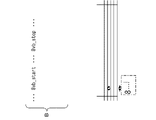
- the beam start and end positions are described by the “beam” attributes “start” and “stop” respectively.
- FIG. 6 is a diagram showing another example of the score element token string B in each training data D.
- FIG. The upper part of FIG. 6 shows a part of the musical score element token string B, and the lower part shows an image musical score corresponding to the musical score element token string B in the upper part.
- Tokens B7 to B14 in the musical score element token string B in FIG. 6 are the same as tokens B7 to B14 in the musical score element token string B in FIG.
- the score element token string B describes key signatures, division and combination of note values, and clef or voice as reference attribute information. contains tokens to A specific example of the reference attribute information in the musical score element token string B will be described below. Reference is made to FIGS. 4 and 5 for a description of the score element token string B that describes key signatures, splitting and joining of note values, and clef.
- Token B2 therefore describes the three sharps enclosed by the dashed line in FIG. Tokens describing the key signature appear at the beginning of the line and at the change position of the key signature in the image musical score.
- token B1 in FIG. 4 the clef is described by the "clef” token.
- the type of clef is described by the "clef” attribute.
- the treble and bass clefs are described by the attributes “treble” and “bass” of "clef", respectively. Therefore, token B1 describes a treble clef as clef C in FIG. Tokens describing clefs appear at the beginning of a line in the image score and at clef change positions.
- FIG. 7 and 8 are diagrams showing other examples of score element token strings B that describe clef.
- the octave line above one octave surrounded by the dashed dotted line in FIG. 7 is described by the token “8va”.
- the octave line one octave below surrounded by the dashed-dotted line in FIG. 8 is described by the token “8vb”.
- the start and end positions of octave lines are described by the attributes "start” and “stop” of "8va” or "8vb” respectively.
- FIG. 9 is a diagram showing an example of a musical score element token sequence B describing a voice part.
- the start and end positions of one of the voices enclosed by the dashed-dotted lines in FIG. 9 are described by a pair of "voice" and “/voice” tokens, respectively.
- FIG. 10 is a block diagram showing the configuration of the training device 10 and the score creation device 20.
- the training device 10 includes a first acquisition unit 11, a second acquisition unit 12, and a construction unit 13 as functional units.
- the functional units of the training device 10 are implemented by the CPU 130 of FIG. 1 executing the training program. At least part of the functional units of the training device 10 may be realized by hardware such as an electronic circuit.
- the first acquisition unit 11 acquires a learning note token sequence A including a reference note sequence, a part, and a metrical structure based on each training data D stored in the storage unit 140 or the like.
- the learning note token string A is obtained by extracting a part of the token string from the musical score element token string B obtained by the second obtaining unit 12, which will be described later.
- the second acquisition unit 12 acquires the musical score element token sequence B including information on drawing notes, attributes, and bars based on each training data D stored in the storage unit 140 and the like.
- the musical note drawings, attributes, and bars included in the musical score image are extracted in chronological order.
- each of the musical note drawings, attributes, and bars extracted in chronological order is converted into tokens according to a predetermined conversion table. As a result, the musical score element token string B is obtained.
- the construction unit 13 For each piece of training data D, the construction unit 13 receives as input the musical note token sequence A for learning acquired by the first acquisition unit 11, and outputs the musical score element token sequence B acquired by the second acquisition unit 12. Let the machine learning model do the learning. By repeating machine learning for a plurality of pieces of training data D, the building section 13 builds a trained model M that indicates the input/output relationship between the learning note token string A and the musical score element token string B.
- the building unit 13 builds the trained model M by training the Transformer, but the embodiment is not limited to this.
- the construction unit 13 may construct the trained model M by training a machine learning model of another method that handles time series.
- the trained model M constructed by the construction unit 13 is stored in the storage unit 140, for example.
- the trained model M constructed by the construction unit 13 may be stored in a server or the like on the network.
- the musical score creation device 20 includes a reception unit 21, an estimation unit 22, a first determination unit 23, a second determination unit 24, and a generation unit 25 as functional units.
- the CPU 130 of FIG. 1 executes the musical score creation program to implement the functional units of the musical score creation apparatus 20 .
- At least part of the functional units of the musical score creation device 20 may be realized by hardware such as an electronic circuit.
- the music notation device 20 may also be incorporated into music engraving software or a digital audio workstation (DAW).
- DAW digital audio workstation
- the accepting unit 21 accepts an input note token string including a note string consisting of a plurality of notes.
- the user can generate an input note token string by operating the operation unit 150 and give it to the reception unit 21 .
- the input note token string has the same configuration as the learning note token string A in FIG. That is, the input note token string has a part and metrical structure in addition to the note string.
- the estimation unit 22 uses the trained model M stored in the storage unit 140 or the like to estimate a musical score token string including notes and attribute information for creating a musical score from the input musical note token string.
- the score token string indicates a token string corresponding to the input note token string accepted by the accepting unit 21, and is estimated based on the note string, part and metrical structure. Since the input note token string has the same structure as the learning note token string A, the musical score token string has the same structure as the musical score element token string B.
- the first determination unit 23 determines accidentals based on the musical score token string estimated by the estimation unit 22 .
- Accidentals are determined, for example, from the key signature and pitch in the musical score token string.
- the accidental of the preceding note may also be used to determine the subsequent accidental.
- the second determination unit 24 determines the time signature based on the musical score token string estimated by the estimation unit 22 .
- the time signature is determined, for example, from the number of beats in each bar in the musical score token string.
- the generating unit 25 generates musical score information representing a musical score in which each note and attribute information are described from the musical score token string estimated by the estimating unit 22 . That is, the generation unit 25 functions as a creation unit, and generates musical score information in a musical score format from the musical score token string.
- the musical score information may be text data such as MusicXML format.
- the image musical score indicated by the musical score information generated by the generating unit 25 is displayed on the display unit 160 .
- FIG. 11 is a diagram showing an example of an image musical score.
- the image score may further include the accidental X determined by the first determination unit 23 .
- the time signature Y determined by the second determination unit 24 may be further described in the image musical score.
- the time signature Y may be written only at the beginning of the musical score.
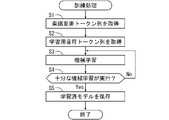
- FIG. 12 is a flowchart showing an example of training processing by the training device 10 of FIG.
- the training process in FIG. 12 is performed by CPU 130 in FIG. 1 executing a training program.
- the second acquisition unit 12 acquires the score element token string B from each training data D (step S1).
- the first acquisition unit 11 acquires a learning note token sequence A corresponding to the score element token sequence B from the score element token sequence B acquired in step S1 (step S2).
- the building unit 13 performs machine learning using the score element token string B acquired in step S1 as an output token and the learning note token string A acquired in step S2 as an input token. (Step S3). Subsequently, the construction unit 13 determines whether or not sufficient machine learning has been performed (step S4). If the machine learning is insufficient, the construction unit 13 returns to step S3. Steps S3 and S4 are repeated while changing the parameters until sufficient machine learning is performed. The number of iterations of machine learning changes according to quality conditions that the trained model M to be constructed should satisfy.
- the construction unit 13 saves the input/output relationship between the learning note token string A and the musical score element token string B acquired by the machine learning in step S3 as a trained model M. (Step S5). This completes the training process.
- FIG. 13 is a flowchart showing an example of musical score creation processing by the musical score creation device 20 of FIG.
- the musical score creation process of FIG. 13 is performed by the CPU 130 of FIG. 1 executing a musical score creation program.
- the receiving unit 21 receives an input note token string (step S11).
- the estimation unit 22 estimates a score token string from the input note token string received in step S11 using the trained model M saved in step S5 of the training process (step S12).
- the first determination unit 23 determines accidentals based on the musical score token string estimated in step S12 (step S13).
- the second determination unit 24 also determines the time signature based on the musical score token string estimated in step S12 (step S14). Either of steps S13 and S14 may be performed first, or may be performed simultaneously.
- the generating unit 25 After that, the generating unit 25 generates musical score information based on the musical score token string estimated in step S12, the accidentals determined in step S13, and the time signature determined in step S14 (step S15). An image musical score may be displayed on the display unit 160 based on the generated musical score information. This completes the musical score creation process.
- the musical score creation apparatus 20 uses the reception unit 21 that accepts a string of notes made up of a plurality of notes and the trained model M to create a musical score. and an estimating unit 22 for estimating each note and attribute information to be created.
- the trained model M is a machine learning model that has learned the input/output relationship between a reference note sequence consisting of a plurality of reference notes and each reference note and reference attribute information for creating a musical score.
- each note and attribute information corresponding to the string of notes are estimated using the trained model M, so it is possible to describe not only the notes but also the attribute information in the musical score. This makes it possible to create a practical musical score.
- the musical score creation device 20 may further include a generating unit 25 that generates musical score information indicating a musical score in which estimated notes and attribute information are described. In this case, the usability is improved because the user does not need to generate score information from each note and attribute information.
- the musical score creation apparatus 20 includes a reception unit 21 that receives an input note token string that is performance data including information on notes, parts, and metric, and an image musical score that is converted into a musical note drawing, attributes, and bars.
- a musical score element token string containing the information of creating a learning note token string from the musical score element token string, inputting the learning note token string, and using a trained model M that outputs a musical score token
- the estimation unit 22 may estimate a key signature as attribute information.
- the estimation unit 22 may estimate division and combination of note values as attribute information.
- the estimation unit 22 may estimate the sound part as the attribute information.
- the estimation unit 22 may estimate the voice part as the attribute information.
- the musical score creation apparatus 20 may further include a first determination unit 23 that determines accidentals based on each estimated note and attribute information.
- the musical score creation device 20 may further include a second determination unit 24 that determines the time signature based on each estimated note and attribute information. In these cases, a more practical musical score can be created.
- the training apparatus 10 includes a first acquisition unit 11 that acquires a reference note string composed of a plurality of reference notes, and a second acquisition unit that acquires each reference note and reference attribute information for creating a musical score. It comprises an acquisition unit 12 and a construction unit 13 that constructs a trained model M that has learned the input/output relationship between the reference note string, each reference note, and the reference attribute information. According to this configuration, it is possible to easily construct a trained model M that has learned the input/output relationship between the reference note string, each reference note, and the reference attribute information.
- the learning note token sequence A includes part and metrical structures, but the embodiment is not limited to this.
- the learning note token string A may include the reference note string and may not include the part and metrical structure.
- the same is true for the input note token string.
- the musical score element token string B includes bar information, but the embodiment is not limited to this.
- the musical score element token string B may contain reference note and reference attribute information, and may not contain bar information. The same applies to the musical score token string.
- the musical score creation device 20 includes the generation unit 25 in the above embodiment, the embodiment is not limited to this.
- the user can compose a musical score based on the musical score token string estimated by the estimating section 22 . Therefore, the musical score creation device 20 does not have to include the generator 25 .
- the musical score creation device 20 includes the first determination section 23 and the second determination section 24, but the embodiment is not limited to this. If accidentals do not need to be written in the score, the score creation device 20 does not need to include the first determination unit 23 . If the time signature does not have to be written in the musical score, the musical score creation device 20 does not need to include the second determination section 24 .
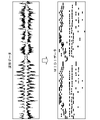
- FIG. 14 is a diagram for explaining the operation of reception unit 21 in another embodiment. As shown in the upper part of FIG. 14 , the user may give waveform data generated by playing the piano or the like to the reception unit 21 .
- the reception unit 21 converts the given waveform data into MIDI data and acquires an input note token string from the converted MIDI data. Therefore, the receiving unit 21 receives the input note token string in the form of waveform data. According to this configuration, it is possible to generate a musical score describing the performance from the waveform data of the performance.
- the receiving unit 21 may receive an input note token string in which right-hand part tokens and left-hand part tokens are mixed. Even in this case, by using a trained model M that has been appropriately trained, it is possible to estimate a musical score token sequence in which right-hand part tokens and left-hand part tokens are separated.
Landscapes
- Engineering & Computer Science (AREA)
- Physics & Mathematics (AREA)
- Theoretical Computer Science (AREA)
- Software Systems (AREA)
- Acoustics & Sound (AREA)
- Multimedia (AREA)
- Artificial Intelligence (AREA)
- General Engineering & Computer Science (AREA)
- Data Mining & Analysis (AREA)
- Evolutionary Computation (AREA)
- Mathematical Physics (AREA)
- General Physics & Mathematics (AREA)
- Computing Systems (AREA)
- Biomedical Technology (AREA)
- Molecular Biology (AREA)
- General Health & Medical Sciences (AREA)
- Computational Linguistics (AREA)
- Biophysics (AREA)
- Life Sciences & Earth Sciences (AREA)
- Health & Medical Sciences (AREA)
- Computer Vision & Pattern Recognition (AREA)
- Medical Informatics (AREA)
- Auxiliary Devices For Music (AREA)
Priority Applications (3)
| Application Number | Priority Date | Filing Date | Title |
|---|---|---|---|
| CN202280036002.9A CN117321675A (zh) | 2021-05-19 | 2022-03-08 | 乐谱制作装置、训练装置、乐谱制作方法以及训练方法 |
| JP2023522256A JP7605302B2 (ja) | 2021-05-19 | 2022-03-08 | 楽譜作成装置、訓練装置、楽譜作成方法および訓練方法 |
| US18/512,133 US20240087549A1 (en) | 2021-05-19 | 2023-11-17 | Musical score creation device, training device, musical score creation method, and training method |
Applications Claiming Priority (2)
| Application Number | Priority Date | Filing Date | Title |
|---|---|---|---|
| JP2021-084905 | 2021-05-19 | ||
| JP2021084905 | 2021-05-19 |
Related Child Applications (1)
| Application Number | Title | Priority Date | Filing Date |
|---|---|---|---|
| US18/512,133 Continuation US20240087549A1 (en) | 2021-05-19 | 2023-11-17 | Musical score creation device, training device, musical score creation method, and training method |
Publications (1)
| Publication Number | Publication Date |
|---|---|
| WO2022244403A1 true WO2022244403A1 (ja) | 2022-11-24 |
Family
ID=84140931
Family Applications (1)
| Application Number | Title | Priority Date | Filing Date |
|---|---|---|---|
| PCT/JP2022/010125 Ceased WO2022244403A1 (ja) | 2021-05-19 | 2022-03-08 | 楽譜作成装置、訓練装置、楽譜作成方法および訓練方法 |
Country Status (4)
| Country | Link |
|---|---|
| US (1) | US20240087549A1 (https=) |
| JP (1) | JP7605302B2 (https=) |
| CN (1) | CN117321675A (https=) |
| WO (1) | WO2022244403A1 (https=) |
Cited By (1)
| Publication number | Priority date | Publication date | Assignee | Title |
|---|---|---|---|---|
| JP2023077128A (ja) * | 2021-11-24 | 2023-06-05 | ヤマハ株式会社 | 楽曲推論装置、楽曲推論方法、楽曲推論プログラム、モデル生成装置、モデル生成方法、及びモデル生成プログラム |
Citations (2)
| Publication number | Priority date | Publication date | Assignee | Title |
|---|---|---|---|---|
| JP2016136251A (ja) * | 2015-01-20 | 2016-07-28 | ハーマン インターナショナル インダストリーズ インコーポレイテッド | 音楽コンテンツ及びリアルタイム音楽伴奏の自動採譜 |
| JP2020003536A (ja) * | 2018-06-25 | 2020-01-09 | カシオ計算機株式会社 | 学習装置、自動採譜装置、学習方法、自動採譜方法及びプログラム |
-
2022
- 2022-03-08 WO PCT/JP2022/010125 patent/WO2022244403A1/ja not_active Ceased
- 2022-03-08 CN CN202280036002.9A patent/CN117321675A/zh active Pending
- 2022-03-08 JP JP2023522256A patent/JP7605302B2/ja active Active
-
2023
- 2023-11-17 US US18/512,133 patent/US20240087549A1/en active Pending
Patent Citations (2)
| Publication number | Priority date | Publication date | Assignee | Title |
|---|---|---|---|---|
| JP2016136251A (ja) * | 2015-01-20 | 2016-07-28 | ハーマン インターナショナル インダストリーズ インコーポレイテッド | 音楽コンテンツ及びリアルタイム音楽伴奏の自動採譜 |
| JP2020003536A (ja) * | 2018-06-25 | 2020-01-09 | カシオ計算機株式会社 | 学習装置、自動採譜装置、学習方法、自動採譜方法及びプログラム |
Cited By (2)
| Publication number | Priority date | Publication date | Assignee | Title |
|---|---|---|---|---|
| JP2023077128A (ja) * | 2021-11-24 | 2023-06-05 | ヤマハ株式会社 | 楽曲推論装置、楽曲推論方法、楽曲推論プログラム、モデル生成装置、モデル生成方法、及びモデル生成プログラム |
| JP7786153B2 (ja) | 2021-11-24 | 2025-12-16 | ヤマハ株式会社 | 楽曲推論装置、楽曲推論方法、楽曲推論プログラム、モデル生成装置、モデル生成方法、及びモデル生成プログラム |
Also Published As
| Publication number | Publication date |
|---|---|
| JP7605302B2 (ja) | 2024-12-24 |
| JPWO2022244403A1 (https=) | 2022-11-24 |
| US20240087549A1 (en) | 2024-03-14 |
| CN117321675A (zh) | 2023-12-29 |
Similar Documents
| Publication | Publication Date | Title |
|---|---|---|
| CN115004294B (zh) | 编曲生成方法、编曲生成装置以及计算机程序产品 | |
| US20090125799A1 (en) | User interface image partitioning | |
| CN114267318B (zh) | Midi音乐文件的生成方法、存储介质和终端 | |
| WO2019022118A1 (ja) | 情報処理方法 | |
| JP6481319B2 (ja) | 楽譜表示装置および楽譜表示方法 | |
| CN108257588B (zh) | 一种谱曲方法及装置 | |
| JP6565528B2 (ja) | 自動アレンジ装置及びプログラム | |
| US20240087549A1 (en) | Musical score creation device, training device, musical score creation method, and training method | |
| JP6645085B2 (ja) | 自動アレンジ装置及びプログラム | |
| JP7593414B2 (ja) | 音楽要素生成支援装置、音楽要素学習装置、音楽要素生成支援方法、音楽要素学習方法、音楽要素生成支援プログラムおよび音楽要素学習プログラム | |
| JP4333700B2 (ja) | 和音推定装置及び方法 | |
| KR102128153B1 (ko) | 기계 학습을 이용한 음악 소스 검색 장치 및 그 방법 | |
| Hayashi et al. | Colorscore: Visualization and condensation of structure of classical music | |
| US10431191B2 (en) | Method and apparatus for analyzing characteristics of music information | |
| WO2022202199A1 (ja) | コード推定装置、訓練装置、コード推定方法および訓練方法 | |
| US12118968B2 (en) | Non-transitory computer-readable storage medium stored with automatic music arrangement program, and automatic music arrangement device | |
| CN112420003A (zh) | 伴奏的生成方法、装置、电子设备及计算机可读存储介质 | |
| JP7679871B2 (ja) | 運指提示装置、訓練装置、運指提示方法および訓練方法 | |
| JP7571804B2 (ja) | 情報処理システム、電子楽器、情報処理方法および機械学習システム | |
| JP2014109603A (ja) | 演奏評価装置、演奏評価方法 | |
| JP4735221B2 (ja) | 演奏データ編集装置及びプログラム | |
| JP2023077140A (ja) | 楽曲生成装置、楽曲生成方法、楽曲生成プログラム、モデル生成装置、モデル生成方法、及びモデル生成プログラム | |
| JP2026074295A (ja) | 楽曲生成装置、楽曲生成方法、楽曲生成プログラム、モデル生成装置、モデル生成方法、及びモデル生成プログラム | |
| JP2007240552A (ja) | 楽器音認識方法、楽器アノテーション方法、及び楽曲検索方法 | |
| JP2016057389A (ja) | コード決定装置及びコード決定プログラム |
Legal Events
| Date | Code | Title | Description |
|---|---|---|---|
| 121 | Ep: the epo has been informed by wipo that ep was designated in this application |
Ref document number: 22804323 Country of ref document: EP Kind code of ref document: A1 |
|
| WWE | Wipo information: entry into national phase |
Ref document number: 2023522256 Country of ref document: JP |
|
| WWE | Wipo information: entry into national phase |
Ref document number: 202280036002.9 Country of ref document: CN |
|
| NENP | Non-entry into the national phase |
Ref country code: DE |
|
| 122 | Ep: pct application non-entry in european phase |
Ref document number: 22804323 Country of ref document: EP Kind code of ref document: A1 |