WO2022239248A1 - 在庫推定装置、在庫推定方法、及び在庫推定プログラム - Google Patents
在庫推定装置、在庫推定方法、及び在庫推定プログラム Download PDFInfo
- Publication number
- WO2022239248A1 WO2022239248A1 PCT/JP2021/018493 JP2021018493W WO2022239248A1 WO 2022239248 A1 WO2022239248 A1 WO 2022239248A1 JP 2021018493 W JP2021018493 W JP 2021018493W WO 2022239248 A1 WO2022239248 A1 WO 2022239248A1
- Authority
- WO
- WIPO (PCT)
- Prior art keywords
- inventory
- yield
- daily
- estimation
- unit
- Prior art date
- Legal status (The legal status is an assumption and is not a legal conclusion. Google has not performed a legal analysis and makes no representation as to the accuracy of the status listed.)
- Ceased
Links
Images





Classifications
-
- G—PHYSICS
- G06—COMPUTING OR CALCULATING; COUNTING
- G06Q—INFORMATION AND COMMUNICATION TECHNOLOGY [ICT] SPECIALLY ADAPTED FOR ADMINISTRATIVE, COMMERCIAL, FINANCIAL, MANAGERIAL OR SUPERVISORY PURPOSES; SYSTEMS OR METHODS SPECIALLY ADAPTED FOR ADMINISTRATIVE, COMMERCIAL, FINANCIAL, MANAGERIAL OR SUPERVISORY PURPOSES, NOT OTHERWISE PROVIDED FOR
- G06Q10/00—Administration; Management
- G06Q10/04—Forecasting or optimisation specially adapted for administrative or management purposes, e.g. linear programming or "cutting stock problem"
-
- G—PHYSICS
- G06—COMPUTING OR CALCULATING; COUNTING
- G06Q—INFORMATION AND COMMUNICATION TECHNOLOGY [ICT] SPECIALLY ADAPTED FOR ADMINISTRATIVE, COMMERCIAL, FINANCIAL, MANAGERIAL OR SUPERVISORY PURPOSES; SYSTEMS OR METHODS SPECIALLY ADAPTED FOR ADMINISTRATIVE, COMMERCIAL, FINANCIAL, MANAGERIAL OR SUPERVISORY PURPOSES, NOT OTHERWISE PROVIDED FOR
- G06Q50/00—Information and communication technology [ICT] specially adapted for implementation of business processes of specific business sectors, e.g. utilities or tourism
- G06Q50/02—Agriculture; Fishing; Forestry; Mining
Definitions
- the technology of the present disclosure relates to an inventory estimation device, an inventory estimation method, and an inventory estimation program.
- the harvesting period is limited in conventional greenhouse horticulture fields such as open-field cultivation and vinyl greenhouses, and harvesting and shipping are often carried out only within a few days or weeks of the year.
- Harvested products are often sent to the wholesale market via collection points, and prices are often determined after the contract is concluded after harvesting.
- harvests can be obtained more stably than in conventional fields, so contract farming is often practiced, in which a contract is made with a promise of quantity and price in advance before harvesting.
- yield prediction may be performed by experienced growers or may use yield prediction techniques such as those described in Non-Patent Document 1.
- Inventory management methods are widely known, such as a method of calculating an appropriate inventory that balances shipments and demand by controlling the timing and amount of ordering and production of raw materials. It is However, in agriculture, it is very difficult to control the yield at the timing of ordering and production as well as the problem of storage period. Inventory management techniques for industrial products cannot be used.
- Non-Patent Document 1 predicts the integrated yield for one week.
- the granularity of weekly yield forecasts is insufficient.
- overs and shorts may occur when viewed in units of one day.
- Weekly yield projections do not allow for this.
- point estimations that estimate one point such as how many kg in what week. The extent of the prediction error varies depending on the environment in the field, the weather forecast, etc., but the point estimation cannot consider the degree of variation.
- the disclosed technique has been made in view of the above points, and provides an inventory estimation device, an inventory estimation method, and an inventory estimation program capable of accurately estimating the excess or deficiency of crop inventory on a daily basis. With the goal.
- a first aspect of the present disclosure is an inventory estimation device for estimating an excess or deficiency in inventory of crops on a daily basis, wherein from the result of predicting the yield of the crop on a weekly basis, a yield estimation unit for estimating the probability distribution of the yield; a shipment amount prediction unit for predicting the shipment amount on a daily basis based on the actual shipment amount of the crop on a daily basis; an initial inventory of the crop; Calculating the probability distribution of the inventory of the crop on a daily basis from the probability distribution of the yield on a daily basis and the forecast result of the shipping amount on a daily basis, and estimating the excess or deficiency of the inventory of the crop on a daily basis. and an inventory estimating unit.
- a second aspect of the present disclosure is an inventory estimation method in an inventory estimation device for estimating an excess or deficiency of crop inventory on a daily basis, wherein a yield estimation unit calculates daily a probability distribution of the yield on a per-unit basis, a shipping amount prediction unit predicting the shipping amount on a daily basis based on actual shipping amounts of the crop on a daily basis, and an inventory estimating unit estimating the amount of the crop on a daily basis calculating a probability distribution of the crop inventory on a daily basis from the initial inventory, the probability distribution of the yield on a daily basis, and the forecast result of the shipment volume on a daily basis; Estimate excess or deficiency.
- a third aspect of the present disclosure is an inventory estimation program for estimating the excess or deficiency of the inventory of crops on a daily basis, wherein the probability distribution of the yield on a daily basis from the result of predicting the yield of the crop on a weekly basis and predicting the daily shipments based on the actual daily shipments of the crop, the initial inventory of the crops, the probability distribution of the daily yields, and calculating the probability distribution of the inventory of the crops on a daily basis, and estimating the excess or deficiency of the inventory of the crops on a daily basis, based on the forecast result of the shipment amount of .
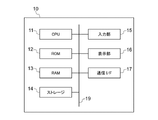
- FIG. 1 is a schematic block diagram of an example of a computer functioning as an inventory estimation device of this embodiment;
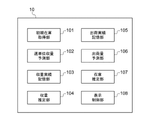
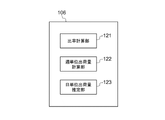
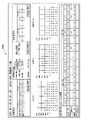
- FIG. It is a block diagram showing the functional configuration of the inventory estimation device of the present embodiment. It is a block diagram showing the functional composition of the yield estimation part of the inventory estimation device of this embodiment. It is a block diagram showing a functional configuration of a shipment amount prediction unit of the inventory estimation device of the present embodiment. It is a block diagram showing functional composition of an inventory estimation part of an inventory estimation device of this embodiment. It is a figure which shows the example of the screen displayed by the display part. It is a flow chart showing a flow of inventory presumption processing of this embodiment. It is a flowchart showing the flow of processing for estimating the daily yield in the inventory estimation processing of the present embodiment.
- FIG. 7 is a flow chart showing the flow of processing for estimating the daily shipment volume in the inventory estimation processing of the present embodiment. It is a flowchart showing the flow of the process of estimating the excess or deficiency of inventory on a daily basis in the inventory estimation process of the present embodiment.
- ⁇ Overview of this embodiment> Input the results of weekly crop yield forecast by the person in charge of cultivation or the yield forecast system, the actual daily yield, the actual daily shipment volume, and the initial stock of the initial crop.
- the yield estimation unit divides the weekly yield prediction result into daily units using the weekly yield prediction result and the actual yield, estimates the probability distribution of the daily yield, and sends it to the inventory estimation unit. hand over.
- the shipping quantity prediction unit predicts the shipping quantity using the weekly yield prediction result, the actual yield, and the actual shipping quantity, and passes it to the inventory estimation unit.
- the inventory estimation unit performs an inventory simulation using the output of the yield estimation unit and the shipment amount prediction unit and the initial inventory, and calculates the shortage rate, the amount of shortage occurrence, the rate of excess occurrence, and the amount of excess occurrence on a daily basis.
- the out-of-stock occurrence rate is the probability that the crop inventory falls below 0 or below the inventory lower limit threshold in one day.
- the shortage occurrence is the amount that needs to be increased in a day to keep the crop inventory from dropping below 0 or the lower inventory threshold.
- the overgrowth rate is the probability that a crop will exceed the high inventory threshold in a single day. Overgrowth is the amount by which the crop inventory in a day needs to be reduced so as not to exceed the high inventory threshold.
- FIG. 1 is a block diagram showing the hardware configuration of an inventory estimation device 10 of this embodiment.
- the inventory estimation device 10 includes a CPU (Central Processing Unit) 11, a ROM (Read Only Memory) 12, a RAM (Random Access Memory) 13, a storage 14, an input section 15, a display section 16, and a communication interface. (I/F) 17.
- CPU Central Processing Unit
- ROM Read Only Memory
- RAM Random Access Memory
- storage 14 an input section 15, a display section 16, and a communication interface. (I/F) 17.
- I/F communication interface.
- the CPU 11 is a central processing unit that executes various programs and controls each section. That is, the CPU 11 reads a program from the ROM 12 or the storage 14 and executes the program using the RAM 13 as a work area. The CPU 11 performs control of each configuration and various arithmetic processing according to programs stored in the ROM 12 or the storage 14 .
- the ROM 12 or storage 14 stores an inventory estimation program for estimating daily inventory.
- the inventory estimation program may be one program, or may be a program group composed of a plurality of programs or modules.
- the ROM 12 stores various programs and various data.
- the RAM 13 temporarily stores programs or data as a work area.
- the storage 14 is composed of a HDD (Hard Disk Drive) or an SSD (Solid State Drive), and stores various programs including an operating system and various data.
- the input unit 15 includes a pointing device such as a mouse and a keyboard, and is used for various inputs.
- the input unit 15 receives the initial stock of crops as an input.
- a crop inventory, an unsorted fruit inventory, and a correct product rate are accepted as inputs, and a value obtained by multiplying the crop inventory, which is a crop, by the unsorted fruit inventory and the correct product rate, is added to the initial Set as inventory.
- the input unit 15 receives an inventory upper limit threshold as an input.
- the crop inventory is the inventory of crops that have been sorted as genuine products in the fruit sorting process
- the unsorted fruit inventory is the inventory of crops that have not yet been sorted in the fruit sorting process.
- the rate of quality products is the percentage of crops that are selected as quality products in the fruit sorting process.
- the display unit 16 is, for example, a liquid crystal display, and displays various information.
- the display unit 16 may employ a touch panel system and function as the input unit 15 .
- the communication interface 17 is an interface for communicating with other devices, and uses standards such as Ethernet (registered trademark), FDDI, and Wi-Fi (registered trademark), for example.
- FIG. 2 is a block diagram showing an example of the functional configuration of the inventory estimation device 10. As shown in FIG.
- the inventory estimation device 10 includes an initial inventory acquisition unit 101, a weekly yield prediction unit 102, a yield performance storage unit 103, a yield estimation unit 104, a shipment performance storage unit 105, and a shipment volume.
- a prediction unit 106 , an inventory estimation unit 107 and a display control unit 108 are provided.
- the initial stock acquisition unit 101 acquires the initial stock of crops received by the input unit 15 .
- the weekly yield prediction unit 102 predicts the yield of crops on a weekly basis, for example, by a method similar to the method described in Non-Patent Document 1 above. It should be noted that the input unit 15 may receive a prediction result of the yield of crops on a weekly basis by a person in charge of cultivation or a yield prediction system. In this case, the weekly yield prediction unit 102 may be omitted.
- the actual yield storage unit 103 stores the actual yield of crops on a weekly basis, including the actual yield of crops on a daily basis.
- the yield estimation unit 104 estimates the probability distribution of the yield on a daily basis from the results of predicting the yield of crops on a weekly basis.
- the yield estimation unit 104 includes a daily yield estimation unit 111, an estimation recording unit 112, an error calculation unit 113, and a probability distribution estimation unit 114, as shown in FIG.
- the daily yield estimation unit 111 divides the weekly yield prediction result into daily yields, and estimates the daily yields.
- the daily yield estimation unit 111 first obtains the yield ratio for each day of the week from the daily yield results for the past two weeks stored in the yield result storage unit 103 . Then, the daily yield estimating unit 111 multiplies the yield predicted on a weekly basis by the yield ratio for each day of the week to obtain a daily yield estimation result. The daily yield estimating unit 111 records the result of estimating the daily yield in the estimation recording unit 112 and passes it to the probability distribution estimating unit 114 .
- the actual weekly yield H r,w-2 of the week before last is the actual yield H r,w-2,Mon of the Monday of the week before last. Including r, w-2, up to Sat.
- the actual weekly yield H r,w ⁇ 1 of the previous week is derived from the actual daily yield H r,w ⁇ 1, Mon of the Monday of the previous week to the actual actual yield H r,w ⁇ 1, of the Saturday of the previous week . Including up to Sat.
- outputs are from the daily yield estimation result He ,w ⁇ 0,Mon for this Monday to the daily yield estimation result He ,w ⁇ 0,Sat for this Saturday and the daily yield estimation result for next Monday. from the yield estimation result He , w+1, Mon to the daily yield estimation result He , w+1, Sat of next Saturday.
- the calculation formula for this example is shown below.
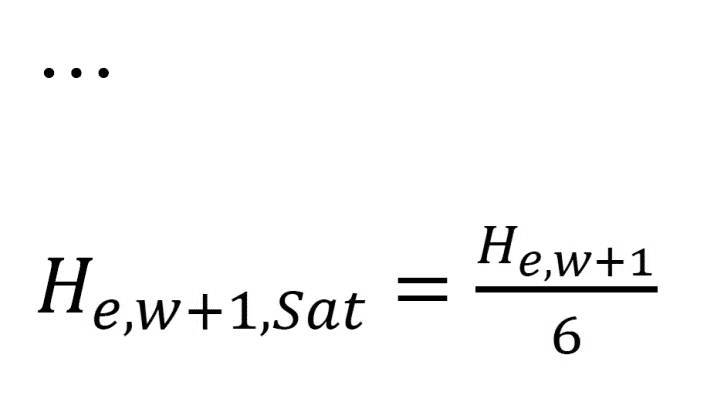
- the daily yield estimation unit 111 estimates the daily yield by evenly dividing the weekly predicted yield by the business days of the week. For example, if Monday through Saturday are business days and there is no harvest or shipment on Sunday, there are 6 business days per week. In that case, the result of dividing the weekly yield prediction result for that week by 6 is used as the daily yield prediction result from Monday to Saturday of that week. In this case, only weekly yield prediction results may be input, and daily actual yields may not be available.
- the calculation formula for this example is as follows.
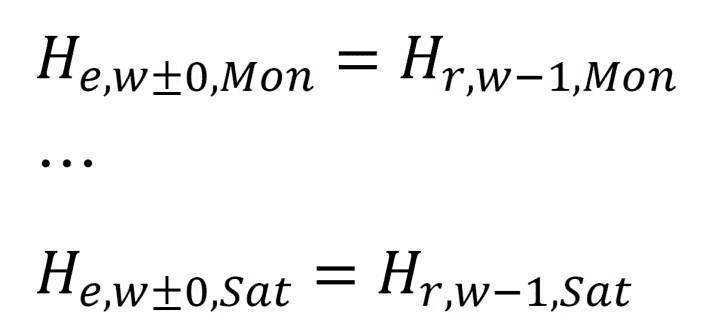
- the daily yield estimating unit 111 simply assumes that the same yield as on the same day of the previous week will be obtained on the same day of the week this week and next week, and estimates the yield on a daily basis.
- the input may be only the actual yield on a daily basis, and the prediction of the yield on a weekly basis may not be required.
- the calculation formula for this example is shown below.
- the estimation recording unit 112 records the estimation result by the daily yield estimation unit 111 each time the inventory estimation process is executed.
- the error calculation unit 113 compares the actual daily yield with the estimation result by the daily yield estimation unit 111 recorded by the estimation recording unit 112, and calculates the error for the daily yield estimation result. do.
- the error calculation unit 113 first compares the past daily yield estimation result of the same date accumulated in the estimation recording unit 112 with the actual daily yield to estimate the past daily yield. Find the error in days for the result. Then, the error calculation unit 113 creates groups according to conditions such as the day of the week of the estimation destination and whether the estimation destination is this week or next week from the execution date of the inventory estimation process, and calculates the standard deviation of the error for each group. .
- the estimation target is the group of "next Tuesday”
- the estimated on January 8 (Monday) Calculate the standard deviation by collecting the daily yield error on January 16 (Tuesday), the daily yield error on January 23 (Tuesday) estimated on January 15 (Monday), and so on.
- environmental conditions such as temperature, humidity, and amount of solar radiation, and the weather forecast issued at the time of inventory estimation processing (weekly weather forecast, 2-week temperature forecast, 1-month forecast, long-term forecast) Forecast, etc.) reliability, prediction range, and the like may be used.
- the value used as the error for the past daily yield estimation results may be either an absolute error or a relative error.
- the absolute error the standard deviation of the absolute error calculated for each group under the same conditions for the future daily yield estimation results from the execution date of the inventory estimation process is used as the error as the probability. It is passed to the distribution estimation unit 114 .
- the relative error the error is obtained by multiplying the estimation result of the future daily yield from the execution date of the inventory estimation process by the standard deviation of the relative error calculated in the same group for each condition. , to the probability distribution estimation unit 114 .
- the error calculation unit 113 sets the error for the daily yield estimation result for each group.
- the error calculator 113 acquires the value of the absolute error or the relative error from the table for each group, and sets the error for the daily yield estimation result.
- the probability distribution estimating unit 114 estimates the probability distribution of the yield on a daily basis based on the estimation result by the daily yield estimating unit 111 and the error of the daily yield estimation result.
- the probability distribution estimating unit 114 uses the normal distribution as the probability distribution of the yield, the estimated result output by the daily yield estimating unit 111 as the average, and the error output by the error calculating unit 113 as the standard deviation. , and passes it to the inventory estimation unit 107 .
- the probability distribution estimating unit 114 uses the normal distribution as the probability distribution of the yield, the estimation result output by the daily yield estimating unit 111 as the average, and the error output by the error calculating unit 113 using a preset numerical value. Using the linearly transformed result as the standard deviation, the probability distribution of the yield is estimated on a daily basis and transferred to the stock estimation unit 107 . Note that a probability distribution other than the normal distribution may be used as the yield probability distribution.
- the shipment record storage unit 105 stores the actual shipment amount of crops on a weekly basis, including the actual shipment amount of crops on a daily basis.
- the shipment amount prediction unit 106 predicts the shipment amount on a daily basis based on the weekly shipment amount of crops stored in the shipment result storage unit 105 .
- the shipment volume prediction unit 106 includes a ratio calculation unit 121, a weekly shipment volume calculation unit 122, and a daily shipment volume estimation unit 123.
- the ratio calculation unit 121 calculates the ratio between the actual weekly yield stored in the actual yield storage unit 103 and the actual weekly shipment amount stored in the actual shipment storage unit 105 .
- the ratio calculator 121 calculates the ratios of the previous week and the week before last.
- the input is the actual weekly yield H r,w ⁇ 2 of the week before last, the actual weekly yield H r,w ⁇ 1 of the previous week, and the actual weekly shipment amount of the week before last.
- S r,w ⁇ 2 be S r,w ⁇ 2
- the actual weekly shipment amount Sr,w-2 of the week before last is obtained from the actual shipment amount Sr,w-2,Mon of the day-by-day shipment on Monday the week before last. including actual shipment volume S r, w-2, Sat.
- the actual weekly shipment volume of the previous week Sr,w-1 is obtained by converting the actual daily shipment volume Sr,w-1,Mon of the previous Monday to the actual daily shipment volume Sr, w of the Saturday of the previous week. -1, including up to Sat. Also, let the output be the ratio r.
- the formula for this example is shown below.
- the weekly shipment amount calculation unit 122 multiplies the weekly yield prediction result by the calculated ratio to predict the weekly shipment amount.
- the weekly shipment amount calculation unit 122 calculates the weekly shipment amounts for this week and next week by multiplying the output of the ratio calculation unit 121 by the prediction result of the weekly yield for this week and next week.
- Inputs are the aforementioned weekly yield prediction result H e,w ⁇ 0 for this week, the weekly yield prediction result for next week H e,w+1 , and the ratio r.
- the output is assumed to be the forecast result Se,w ⁇ 0 of the weekly shipment volume for this week and the forecast result Se,w+1 for the weekly shipment volume for the next week.
- the forecast result Se,w ⁇ 0 of the weekly shipping volume for this week is derived from the forecast result Se,w ⁇ 0,Mon of the daily shipping volume for this Monday.
- Next week's weekly shipping volume prediction result Se,w+1 is derived from next Monday's daily shipping volume prediction result Se,w+1,Mon to next Saturday's daily shipping volume prediction result Se,w+1,Mon . Including up to Sat.
- the daily shipping volume estimation unit 123 divides the forecast result of the weekly shipping volume into daily shipping volume and estimates the daily shipping volume.
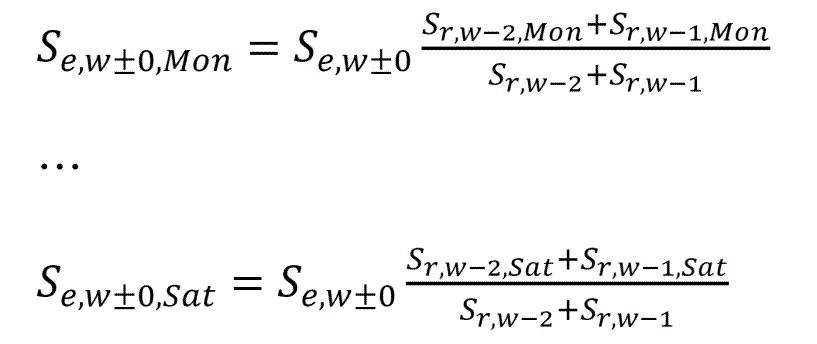
- the daily shipment amount estimation unit 123 multiplies the weekly shipment amounts for this week and next week calculated by the weekly shipment amount calculation unit 122 by the shipment ratio for each day of the week obtained from the daily shipment results for the past two weeks. is the estimation result of the daily shipping volume.
- the input is the forecast result S e,w ⁇ 0 of the weekly shipment volume for this week, the forecast result S e,w+1 of the weekly shipment volume for next week, and the actual weekly shipment volume S r of the week before last.
- w-2 from the actual daily shipment volume Sr,w-2,Mon of the Monday two weeks before to the actual daily shipment volume Sr,w-2,Sat of the Saturday two weeks before, from the previous week From the actual weekly shipment volume S r,w ⁇ 1 and the actual daily shipment volume S r,w ⁇ 1,Mon of the previous Monday, to the actual daily shipment volume S r , w ⁇ 1, of the previous Saturday Up to Sat.
- the prediction result Se,w ⁇ 0,Mon of the daily shipment volume of this Monday to the prediction result Se,w ⁇ 0,Sat of the daily shipment volume of this Saturday is calculated as follows.
- the prediction result Se,w+1,Mon of the daily shipment volume on Monday next week to the prediction result Se,w+1,Sat of the daily shipment volume on Saturday next week are calculated as follows.
- the daily shipment volume estimation unit 123 estimates the daily shipment volume by evenly dividing the output of the weekly shipment volume calculation unit 122 by the business days of the week. For example, if Monday through Saturday are business days and there is no harvest or shipment on Sunday, there are 6 business days per week. In this case, the result of dividing the prediction result of the weekly shipping volume for that week by 6 is used as the estimation result of the daily shipping volume from Monday to Saturday of that week. In this case, even if there is no record of daily shipments, the daily shipment volume can be estimated.
- the daily shipment volume estimation unit 123 simply assumes that the same shipment volume as that of the previous week on the same day of the week will be present on the same days of this week and next week, and estimates the daily shipment volume. In this case, the input is only the actual shipment, and the daily shipment amount can be estimated without the prediction result of the weekly yield or the actual yield.
- the inventory estimating unit 107 calculates the probability distribution of the crop inventory on a daily basis from the initial inventory of the crop, the probability distribution of the yield on a daily basis, and the forecast result of the shipping amount on a daily basis. Estimate excess or shortage of crop stocks. When estimating the excess or deficiency of the crop inventory on a daily basis, the inventory estimation unit 107 calculates the daily crop shortage occurrence rate, the shortage occurrence amount, and the excess crop occurrence rate from the daily crop inventory probability distribution. Estimate incidence and excess incidence.
- the inventory estimation unit 107 includes a harvest execution unit 131, a shipment execution unit 132, and an excess shortage calculation unit 133, as shown in FIG.
- the harvest execution unit 131 performs calculations for harvesting the simulated inventory.
- the harvest execution unit 131 calculates the sum of the initial inventory and the estimation result of the first day output by the yield estimation unit 104 as the inventory after the execution of the harvest on the first day. and For the second and subsequent days of the simulation, the harvesting execution unit 131 adds the final inventory on the n-1 day output by the shipping execution unit 132 and the estimation result on the nth day output by the yield estimation unit 104 to n Stock after the day's harvest execution. At this time, inventory is not treated as a simple weight, but treated as following a probability distribution.
- the normal distribution with mean ⁇ and standard deviation ⁇ is represented as N( ⁇ , ⁇ 2 ).
- X following the normal distribution N( ⁇ , ⁇ 2 ) is expressed as X ⁇ N( ⁇ , ⁇ 2 ).
- the probability distribution of the yield on the i-th day output by the yield estimating unit 104 is N(H i , ⁇ absi 2 ).
- X Hi ⁇ N( ⁇ xHi , ⁇ xi 2 ), where X 0 [kg] is the initial inventory and X Hi is the inventory after the harvesting on the i-th day.
- the shipping execution unit 132 performs calculations to execute shipping for simulated inventory.
- the shipping execution unit 132 subtracts the output of the shipment amount prediction unit 106 from the inventory output by the harvest execution unit 131, and determines the post-shipment inventory. This is the final inventory for the day. At this time, inventory is not treated as a simple weight, but treated as following a probability distribution such as a normal distribution.
- the shipping volume prediction value for the i day output by the shipping volume prediction unit 106 is S i [kg]
- the excess shortage calculation unit 133 calculates the shortage occurrence rate and excess occurrence rate from the final inventory probability distribution for each day output by the shipping execution unit 132 . Also, if the out-of-stock occurrence rate exceeds a certain threshold, the amount of out-of-stock occurrence is calculated. Similarly, if the overproduction rate exceeds a certain threshold, the excess production is calculated.
- the unit 133 can obtain the out-of-stock occurrence rate Punderi on the i-th day using a cumulative distribution function (CDF) of normal distribution as follows.
- CDF cumulative distribution function
- the shortage excess calculation unit 133 can obtain the excess occurrence rate P overi on the i day in the same manner as the shortage occurrence rate P underi as follows. can.
- the out-of-stock excess calculation unit 133 obtains the out-of-stock occurrence amount using a quantile function that is an inverse function of the CDF. Specifically, first, when the shortage occurrence rate P underri exceeds the threshold P th , the shortage excess calculation unit 133 uses the quantile function
- the out-of-stock excess calculation unit 133 obtains th min ⁇ q as the amount of out-of-stock occurrence.
- the excess shortage calculation unit 133 obtains the excess occurrence amount in the same way as the shortage occurrence amount.
- the excess shortage calculation unit 133 uses the quantile function
- the shortage excess calculation unit 133 obtains q-th max as the excess production amount.
- the display control unit 108 causes the display unit 16 to changeably display the initial inventory, the probability distribution of the yield on a daily basis, and the forecast result of the shipping amount on a daily basis, and displays the daily crop inventory. is displayed on the display unit 16.
- the display control unit 108 When the display control unit 108 receives a change in at least one of the initial inventory, the daily yield probability distribution, and the daily shipment amount prediction result, the display control unit 108 displays the changed initial inventory and the daily Yield probability distribution and daily shipment amount prediction results are used to cause the yield estimation unit 104, the shipment amount prediction unit 106, and the inventory estimation unit 107 to perform respective processes.
- FIG. 6 shows an example of a screen 150 displayed by the display control unit 108.
- FIG. 6 shows an example in which the inventory estimation process is executed at the end of business after harvesting and shipping on Monday, February 22, 2021 (Monday of the eighth week, 2021).
- the upper left portion of the screen 150 is for setting the yield
- the upper center portion is for setting the initial inventory
- the right upper portion is for setting the shipping amount.
- the estimation result of the yield estimation unit 104 is input as the initial value for the yield setting
- the prediction result of the shipment amount prediction unit 106 is input as the initial value for the shipment amount setting.
- H i is set in the yield column
- ⁇ absi is set in the error range column.
- shipment amount setting set Si in the shipment amount column.
- a number for calculating the initial stock is set as an initial value.
- the inventory upper limit threshold is a set value used as th max in the inventory estimation unit 107 .
- the inventory lower limit threshold th min is set to 0 if there is no particular set value.
- a yield graph that graphically expresses the probability distribution of the daily yield is displayed, and on the middle right, a shipment graph that graphically expresses the daily shipment is displayed.
- Yield graph bars indicate H i and error bars ⁇ absi .
- the bar graph in the shipment graph shows S i .
- an inventory graph is displayed that graphically expresses the probability distribution of inventory calculated by the inventory estimation unit 107.
- FIG. Inventory graph bars show ⁇ xi and error bars ⁇ xi .
- the lower part of the screen 150 displays the output of the excess shortage calculator 133 of the inventory estimator 107 .
- the output of the shortage excess calculation unit 133 is rounded in units of 5 points and displayed as 0 to 5%, 5 to 10%, 10 to 15%, ..., 95 to 100%. do. If the rate is between 0 and 5%, the shortage and excess amount are not displayed, otherwise the value calculated with Pth being 5% is displayed.
- Initial values are entered when the screen 150 is opened in the yield setting, inventory setting, and shipping amount setting on the upper part of the screen 150, and graphs and simulation results based on the initial values are displayed in the middle part of the screen 150 and the lower part of the screen 150.
- each of the yield estimation unit 104, the shipment amount estimation unit 106, and the inventory estimation unit 107 changes depending on the changed value. Processing is performed to update the displays in the middle of the screen 150 and the bottom of the screen 150 .
- FIG. 7 is a flow chart showing the flow of inventory estimation processing by the inventory estimation device 10.
- the CPU 11 reads out an inventory estimation program from the ROM 12 or the storage 14, develops it in the RAM 13, and executes the inventory estimation process.
- the crop inventory, the unsorted fruit inventory, and the correct product rate are input to the inventory estimation device 10, and the value obtained by adding the crop inventory, the unsorted fruit inventory, and the product of the correct product rate is the initial inventory. is set as Also, the inventory upper limit threshold is input to the inventory estimation device 10 .
- step S100 the CPU 11, as the initial inventory acquisition unit 101, acquires the initial inventory of the set crops.
- step S101 the CPU 11, as the weekly yield prediction unit 102, predicts the yield of crops on a weekly basis by, for example, the method described in Non-Patent Document 1 above.
- step S102 the CPU 11, as the yield estimation unit 104, estimates the probability distribution of the yield on a daily basis from the results of predicting the yield of crops on a weekly basis.
- step S103 the CPU 11, as the shipment amount prediction unit 106, predicts the shipment amount on a daily basis based on the actual daily shipment amount of crops stored in the shipment result storage unit 105.
- step S104 the CPU 11, as the inventory estimating unit 107, calculates the probability distribution of the daily crop inventory based on the initial inventory of the crop, the daily yield probability distribution, and the daily shipment amount prediction result. to estimate the excess or shortage of crop stocks on a daily basis.
- step S105 the CPU 11, as the display control unit 108, causes the display unit 16 to changeably display the initial inventory, the probability distribution of the yield on a daily basis, and the forecast result of the shipment amount on a daily basis.
- the display unit 16 is caused to display the result of estimating the excess or deficiency of the inventory of crops on a daily basis.
- step S106 the CPU 11, as the display control unit 108, determines whether or not a change in at least one of the initial inventory, the daily yield probability distribution, and the daily shipping amount prediction result has been received. . If at least one change of the initial inventory, the probability distribution of the yield on a daily basis, and the forecast result of the shipping volume on a daily basis is received, the process returns to step S102, and the initial inventory and the daily basis after the change are received. Using the probability distribution of the yield and the prediction result of the daily shipment amount, the processes of steps S102 to S105 are performed. On the other hand, if the change is not accepted, the inventory estimation process is terminated.
- step S102 is realized by the processing routine shown in FIG. 8 as an example.
- step S110 the CPU 11, as the daily yield estimation unit 111, divides the prediction result of the weekly yield into daily yields based on the actual daily yield, and calculates the daily yield. presume.
- step S ⁇ b>111 the CPU 11 records the estimation result obtained in step S ⁇ b>110 in the estimation recording unit 112 .
- step S112 the CPU 11, as the error calculation unit 113, compares the actual daily yield with the estimation result by the daily yield estimation unit 111 recorded by the estimation recording unit 112, and determines the daily yield. Calculate the error for the estimated result of .
- step S113 the CPU 11, as the probability distribution estimating unit 114, estimates the probability distribution of the yield on a daily basis based on the estimation result of the daily yield estimating unit 111 and the error of the daily yield estimation result. .
- the above step S103 is realized by the processing routine shown in FIG. 9 as an example.
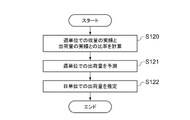
- step S ⁇ b>120 the CPU 11 , as the ratio calculation unit 121 , calculates the actual weekly yield stored in the actual yield storage unit 103 and the actual weekly shipment amount stored in the actual shipment storage unit 105 . Calculate the ratio of
- step S121 the CPU 11, as the weekly shipment amount calculation unit 122, multiplies the weekly yield prediction result by the calculated ratio to predict the weekly shipment amount.
- step S122 the CPU 11, as the daily shipping volume estimating unit 123, divides the prediction result of the weekly shipping volume into daily shipping volume, and estimates the daily shipping volume.
- step S104 is realized by the processing routine shown in FIG. 10 as an example.
- step S130 the CPU 11, as the harvest execution unit 131, performs a calculation for executing the harvest for the simulation target day, and obtains the inventory after the execution of the harvest.
- step S131 the CPU 11, as the shipping executing unit 132, performs calculations for executing shipping for the simulation target date, and obtains inventory after shipping execution.
- step S132 the CPU 11 determines whether or not the simulation target date is the final date. If the simulation target date is the final date, the process proceeds to step S133. On the other hand, if the simulation target date is not the final day, the simulation target date is set to the next day, and the process returns to step S130.
- step S133 the CPU 11, as the excess shortage calculation unit 133, calculates the shortage occurrence rate and the excess occurrence rate from the probability distribution of the final inventory for each day output by the shipping execution unit 132. Also, if the out-of-stock occurrence rate exceeds a certain threshold, the amount of out-of-stock occurrence is calculated. If the excess incidence exceeds a certain threshold, the excess incidence is calculated.
- the inventory estimation device calculates the daily crop inventory based on the initial inventory of the crop, the daily yield probability distribution, and the daily shipment volume prediction result. Calculate the probability distribution of , and estimate the excess or shortage of crop stocks on a daily basis. As a result, it is possible to accurately estimate the excess or deficiency of the inventory of crops on a daily basis.
- the inventory estimation device of this embodiment when making a contract in advance based on the yield prediction result, by using the inventory estimation device of this embodiment, unlike industrial products, the storage period is limited, and the yield can be reduced without harvesting and sorting. Even for crops whose production is not fixed, the possibility of future shortages or excesses and the amount thereof can be known in advance. If there is a possibility of a shortage or excess, we can negotiate with the contractor with plenty of time before the actual yield is determined. As a result, it is possible to prevent loss of credibility due to shortages, loss of orders in the future due to shortages, and price collapse and disposal due to excess.
- the inventory estimation device of the present embodiment it becomes possible to divide the weekly yield prediction result into daily units, so that the yield prediction result can be used even in applications where the weekly granularity is insufficient. will be able to
- the probability distribution of the yield is estimated on the premise that there is variation, not the point estimation, but the degree of error that can occur, and the daily inventory Quantities are also calculated as probability distributions. As a result, it is possible to calculate the occurrence rate and amount of shortages and excesses from the daily inventory amount.
- daily inventory Excess or deficiency can be estimated.
- information such as weather forecast, temperature and humidity in the field, amount of insolation, and the like.
- the various processes executed by the CPU by reading the software (program) in the above embodiment may be executed by various processors other than the CPU.
- the processor is a PLD (Programmable Logic Device) whose circuit configuration can be changed after manufacturing, such as an FPGA (Field-Programmable Gate Array), and an ASIC (Application Specific Integrated Circuit) to execute specific processing.
- a dedicated electric circuit or the like which is a processor having a specially designed circuit configuration, is exemplified.
- the inventory estimation process may be executed by one of these various processors, or by a combination of two or more processors of the same or different type (e.g., multiple FPGAs and a combination of CPU and FPGA). etc.).
- the hardware structure of these various processors is an electric circuit in which circuit elements such as semiconductor elements are combined.
- the inventory estimation program has been pre-stored (installed) in the storage 14, but the present invention is not limited to this.
- Programs are stored in non-transitory storage media such as CD-ROM (Compact Disk Read Only Memory), DVD-ROM (Digital Versatile Disk Read Only Memory), and USB (Universal Serial Bus) memory.
- CD-ROM Compact Disk Read Only Memory
- DVD-ROM Digital Versatile Disk Read Only Memory
- USB Universal Serial Bus
- a non-transitory storage medium storing a program executable by a computer to perform an inventory estimation process,
- the inventory estimation process includes: estimating the probability distribution of the yield on a daily basis from the result of predicting the yield of the crop on a weekly basis; predicting the shipment amount on a daily basis based on the actual shipment amount of the crop on a daily basis; calculating the probability distribution of the inventory of the crop on a daily basis from the initial inventory of the crop, the probability distribution of the yield on a daily basis, and the forecast result of the shipment amount on a daily basis;
- a non-temporary storage medium for estimating the excess or deficiency of inventory.
Landscapes
- Business, Economics & Management (AREA)
- Engineering & Computer Science (AREA)
- Strategic Management (AREA)
- Human Resources & Organizations (AREA)
- Economics (AREA)
- Theoretical Computer Science (AREA)
- Marketing (AREA)
- General Physics & Mathematics (AREA)
- General Business, Economics & Management (AREA)
- Physics & Mathematics (AREA)
- Tourism & Hospitality (AREA)
- Animal Husbandry (AREA)
- Life Sciences & Earth Sciences (AREA)
- Agronomy & Crop Science (AREA)
- Mining & Mineral Resources (AREA)
- General Health & Medical Sciences (AREA)
- Marine Sciences & Fisheries (AREA)
- Health & Medical Sciences (AREA)
- Primary Health Care (AREA)
- Development Economics (AREA)
- Game Theory and Decision Science (AREA)
- Entrepreneurship & Innovation (AREA)
- Operations Research (AREA)
- Quality & Reliability (AREA)
- Management, Administration, Business Operations System, And Electronic Commerce (AREA)
Abstract
在庫推定装置10の収量推定部104が、週単位での前記作物の収量の予測結果から、日単位で前記収量の確率分布を推定する。出荷量予測部106が、日単位での前記作物の出荷量の実績に基づいて、日単位で前記出荷量を予測する。在庫推定部107が、前記作物の初期在庫と、日単位での前記収量の確率分布と、日単位での前記出荷量の予測結果とから、日単位で前記作物の在庫の確率分布を計算し、日単位で前記作物の在庫の過不足を推定する。
Description
本開示の技術は、在庫推定装置、在庫推定方法、及び在庫推定プログラムに関する。
露地栽培やビニールハウスなどによる従来型施設園芸による圃場では収穫期が限られており、年間、数日ないし数週間の間にのみ収穫と出荷が行われることが多い。また、収穫物は集荷所を介して卸売市場に送られるなどにより、収穫後に契約となり価格が決定することが多い。それに対して、高度施設園芸、次世代施設園芸、植物工場などと呼ばれる新しい施設園芸による圃場では年間通じて毎日のように収穫と出荷が可能であることが多い。また、そうした圃場では従来型の圃場よりも安定して収穫が得られるため、収穫前にあらかじめ量や価格を約束して契約をする、契約栽培を行うことが多い。
事前に契約する場合には、将来の収量を予測する収量予測に基づいて契約をすることになる。収量予測が、熟練した栽培担当者によって実施されることもあれば、非特許文献1のような収量予測技術を使うこともある。
大河内理貴、青野雅樹、川嶋和子「ノンパラメトリック回帰を利用した施設園芸作物の生産性の推定」、第3回データ工学と情報マネジメントに関するフォーラム 論文集、DEIM forum 2011、E5-2、2011年2月
収量予測に基づいて事前に契約を行うと、予測が外れたときに問題になる。収量予測よりも収量実績が少なくなった場合は、事前に契約した量が確保できず欠品となり、信用を失うことで今後の契約が得られなくなる可能性がある。逆に収量予測よりも収量が多くなった場合には作物が余ることとなる。余った分については、通常の価格で購入してくれる販売先が確保できなければ、通常より安価にして値崩れを覚悟してでも販売先を確保するか、場合によっては廃棄せざるを得なくなる可能性がある。
作物の在庫を抱えてバッファすることでこれらの問題を回避することができる。しかし、作物は生鮮食品であり保存できる期間が限られるものが多いため、在庫が停滞すると品質の劣化によって廃棄せざるを得なくなる。
保存期間が限られていない工業製品であれば、原材料の発注及び生産のタイミングや量をコントロールすることによって、出荷及び需要のバランスをとった適正在庫を計算する方法などの在庫管理手法が広く知られている。しかし、農業においては、保存期間の問題だけでなく、発注や生産のタイミングで収量をコントロールすることは非常に難しく、実際に収穫及び選果を経て、初めて収量を決定できるという性質を持つため、工業製品向けの在庫管理手法を用いることはできない。
また、収量予測では、週単位の収量を予測することが多く、非特許文献1では、1週間の積算収量を予測している。一方で、実際の収穫や出荷は日々行われるものであるため、週単位の収量予測では粒度が不十分である。また、1週間全体としては過不足がなかったとしても1日単位で見れば過不足が発生してしまうことが起こり得る。週単位の収量予測ではこれを見通すことができない。さらに、従来の収量予測では、非特許文献1のように、第何週は何kgというような1点を推定する点推定が多い。予測誤差がどの程度になるかは、圃場内の環境や天気予報などによって異なるが、点推定ではどの程度のバラつきがあるのか考慮することができない。
開示の技術は、上記の点に鑑みてなされたものであり、精度よく日単位の作物の在庫の過不足を推定することができる在庫推定装置、在庫推定方法、および在庫推定プログラムを提供することを目的とする。
本開示の第1態様は、在庫推定装置であって、日単位で作物の在庫の過不足を推定する在庫推定装置であって、週単位での前記作物の収量の予測結果から、日単位で前記収量の確率分布を推定する収量推定部と、日単位での前記作物の出荷量の実績に基づいて、日単位で前記出荷量を予測する出荷量予測部と、前記作物の初期在庫と、日単位での前記収量の確率分布と、日単位での前記出荷量の予測結果とから、日単位で前記作物の在庫の確率分布を計算し、日単位で前記作物の在庫の過不足を推定する在庫推定部と、を含んで構成される。
本開示の第2態様は、日単位で作物の在庫の過不足を推定する在庫推定装置における在庫推定方法であって、収量推定部が、週単位での前記作物の収量の予測結果から、日単位で前記収量の確率分布を推定し、出荷量予測部が、日単位での前記作物の出荷量の実績に基づいて、日単位で前記出荷量を予測し、在庫推定部が、前記作物の初期在庫と、日単位での前記収量の確率分布と、日単位での前記出荷量の予測結果とから、日単位で前記作物の在庫の確率分布を計算し、日単位で前記作物の在庫の過不足を推定する。
本開示の第3態様は、日単位で作物の在庫の過不足を推定するための在庫推定プログラムであって、週単位での前記作物の収量の予測結果から、日単位で前記収量の確率分布を推定し、日単位での前記作物の出荷量の実績に基づいて、日単位で前記出荷量を予測し、前記作物の初期在庫と、日単位での前記収量の確率分布と、日単位での前記出荷量の予測結果とから、日単位で前記作物の在庫の確率分布を計算し、日単位で前記作物の在庫の過不足を推定することをコンピュータに実行させるためのプログラムである。
開示の技術によれば、精度よく日単位の作物の在庫の過不足を推定することができる。
以下、開示の技術の実施形態の一例を、図面を参照しつつ説明する。なお、各図面において同一又は等価な構成要素及び部分には同一の参照符号を付与している。また、図面の寸法比率は、説明の都合上誇張されており、実際の比率とは異なる場合がある。
<本実施形態の概要>
栽培担当者または収量予測システムによる週単位の作物の収量予測結果と、日単位の収量の実績と、日単位の出荷量の実績と、最初の作物の在庫である初期在庫とを入力とする。収量推定部は、週単位の収量の予測結果と収量の実績を用いて、週単位の収量の予測結果を日単位に分割して、日単位の収量の確率分布を推定して在庫推定部へ渡す。出荷量予測部は、週単位の収量の予測結果と収量の実績と出荷量の実績とを用いて、出荷量を予測して在庫推定部へ渡す。在庫推定部は、収量推定部や出荷量予測部の出力と、初期在庫とを用いて在庫シミュレーションを実施し、日単位で欠品発生率、欠品発生量、過剰発生率、及び過剰発生量を出力する。ここで、欠品発生率は、1日において作物の在庫が、0又は在庫下限閾値を下回る確率である。欠品発生量は、1日において作物の在庫が、0又は在庫下限閾値を下回らないようにするために増やす必要がある量である。過剰発生率は、1日において作物が在庫上限閾値を超える確率である。過剰発生量は、1日において作物の在庫が、在庫上限閾値を上回らないようにするために減らす必要がある量である。
栽培担当者または収量予測システムによる週単位の作物の収量予測結果と、日単位の収量の実績と、日単位の出荷量の実績と、最初の作物の在庫である初期在庫とを入力とする。収量推定部は、週単位の収量の予測結果と収量の実績を用いて、週単位の収量の予測結果を日単位に分割して、日単位の収量の確率分布を推定して在庫推定部へ渡す。出荷量予測部は、週単位の収量の予測結果と収量の実績と出荷量の実績とを用いて、出荷量を予測して在庫推定部へ渡す。在庫推定部は、収量推定部や出荷量予測部の出力と、初期在庫とを用いて在庫シミュレーションを実施し、日単位で欠品発生率、欠品発生量、過剰発生率、及び過剰発生量を出力する。ここで、欠品発生率は、1日において作物の在庫が、0又は在庫下限閾値を下回る確率である。欠品発生量は、1日において作物の在庫が、0又は在庫下限閾値を下回らないようにするために増やす必要がある量である。過剰発生率は、1日において作物が在庫上限閾値を超える確率である。過剰発生量は、1日において作物の在庫が、在庫上限閾値を上回らないようにするために減らす必要がある量である。
<本実施形態に係る在庫推定装置の構成>
図1は、本実施形態の在庫推定装置10のハードウェア構成を示すブロック図である。
図1は、本実施形態の在庫推定装置10のハードウェア構成を示すブロック図である。
図1に示すように、在庫推定装置10は、CPU(Central Processing Unit)11、ROM(Read Only Memory)12、RAM(Random Access Memory)13、ストレージ14、入力部15、表示部16及び通信インタフェース(I/F)17を有する。各構成は、バス19を介して相互に通信可能に接続されている。
CPU11は、中央演算処理ユニットであり、各種プログラムを実行したり、各部を制御したりする。すなわち、CPU11は、ROM12又はストレージ14からプログラムを読み出し、RAM13を作業領域としてプログラムを実行する。CPU11は、ROM12又はストレージ14に記憶されているプログラムに従って、上記各構成の制御及び各種の演算処理を行う。本実施形態では、ROM12又はストレージ14には、日単位の在庫を推定するための在庫推定プログラムが格納されている。在庫推定プログラムは、1つのプログラムであっても良いし、複数のプログラム又はモジュールで構成されるプログラム群であっても良い。
ROM12は、各種プログラム及び各種データを格納する。RAM13は、作業領域として一時的にプログラム又はデータを記憶する。ストレージ14は、HDD(Hard Disk Drive)又はSSD(Solid State Drive)により構成され、オペレーティングシステムを含む各種プログラム、及び各種データを格納する。
入力部15は、マウス等のポインティングデバイス、及びキーボードを含み、各種の入力を行うために使用される。
入力部15は、作物の初期在庫を入力として受け付ける。
本実施形態では、作物在庫と、未選果在庫と、正品率と、を入力として受け付け、作物である作物在庫と、未選果在庫及び正品率を乗算した値とを加算した値を、初期在庫として設定する。また、入力部15は、在庫上限閾値を入力として受け付ける。ここで、作物在庫は、選果工程での正品として選果された作物の在庫であり、未選果在庫は、選果工程での選果が未だ行われていない作物の在庫である。また、正品率は、選果工程で正品として選果される作物の割合である。
表示部16は、例えば、液晶ディスプレイであり、各種の情報を表示する。表示部16は、タッチパネル方式を採用して、入力部15として機能しても良い。
通信インタフェース17は、他の機器と通信するためのインタフェースであり、例えば、イーサネット(登録商標)、FDDI、Wi-Fi(登録商標)等の規格が用いられる。
次に、在庫推定装置10の機能構成について説明する。図2は、在庫推定装置10の機能構成の例を示すブロック図である。
在庫推定装置10は、機能的には、図2に示すように、初期在庫取得部101、週単位収量予測部102、収量実績記憶部103、収量推定部104、出荷実績記憶部105、出荷量予測部106、在庫推定部107、及び表示制御部108を備えている。
初期在庫取得部101は、入力部15により受け付けた作物の初期在庫を取得する。
週単位収量予測部102は、例えば、上記非特許文献1に記載の方法と同様の方法により、週単位で作物の収量を予測する。なお、栽培担当者又は収量予測システムによる週単位での作物の収量の予測結果を、入力部15により受け付けてもよい。この場合には、週単位収量予測部102を省略してもよい。
収量実績記憶部103は、日単位での作物の収量の実績を含む、週単位での作物の収量の実績を記憶している。
収量推定部104は、週単位での作物の収量の予測結果から、日単位で収量の確率分布を推定する。
具体的には、収量推定部104は、図3に示すように、日単位収量推定部111、推定記録部112、誤差計算部113、及び確率分布推定部114を備えている。
日単位収量推定部111は、週単位での収量の予測結果を、日単位での収量に分割し、日単位での収量を推定する。
日単位収量推定部111の処理の一例を、以下に説明する。
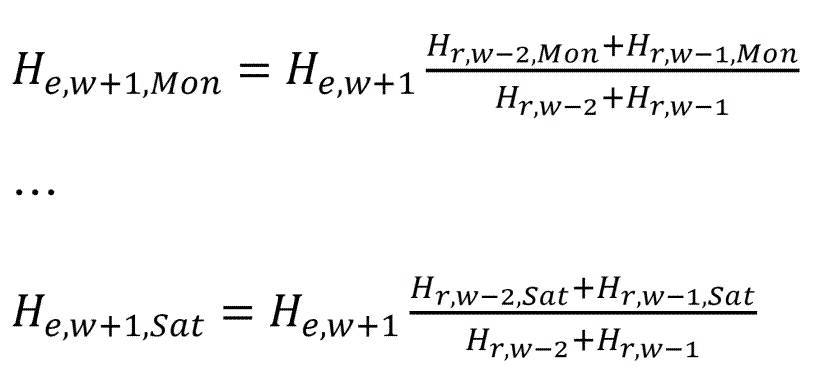
日単位収量推定部111は、まず、収量実績記憶部103に記憶されている、過去2週間分の日単位の収量実績から、曜日別の収量割合を求める。そして、日単位収量推定部111は、週単位で予測された収量に、その曜日別収量割合を乗じることによって、日単位での収量の推定結果とする。日単位収量推定部111は、日単位での収量の推定結果を、推定記録部112に記録するとともに、確率分布推定部114へ渡す。
これを数式で示す。例えば、日曜日は収穫も出荷もなく、在庫推定処理の実行日時が月曜日の業務開始前だとして、入力を、前々週の週単位の収量の実績Hr,w-2、前週の週単位の収量の実績Hr,w-1、今週の週単位の収量の予測結果He,w±0、来週の週単位の収量の予測結果He,w+1とする。
前々週の週単位の収量の実績Hr,w-2は、前々週月曜日の日単位の収量の実績Hr,w-2,Monから前々週土曜日の日単位の収量の実績Hr,w-2,Satまでを含む。
前週の週単位の収量の実績Hr,w-1は、前週月曜日の日単位の収量の実績Hr,w-1,Monから前週土曜日の日単位の収量の実績Hr,w-1,Satまでを含む。
また、出力を、今週月曜日の日単位の収量の推定結果He,w±0,Monから今週土曜日の日単位の収量の推定結果He,w±0,Satまでと、来週月曜日の日単位の収量の推定結果He,w+1,Monから来週土曜日の日単位の収量の推定結果He,w+1,Satまでとする。この例の計算式を以下に示す。

日単位収量推定部111の処理の他の例を、以下に説明する。
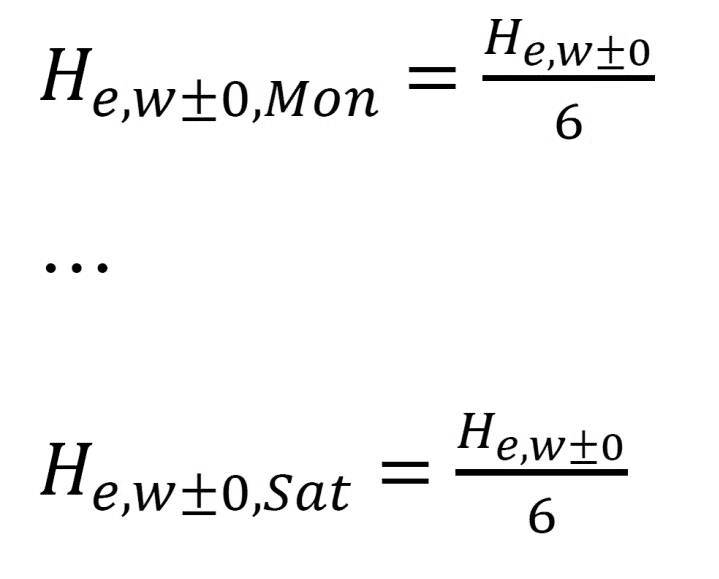
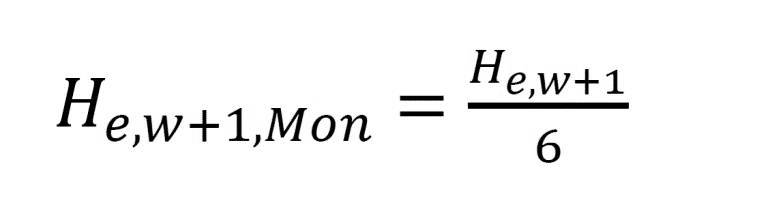
日単位収量推定部111は、週単位で予測された収量を、その週の営業日で均等割りにすることにより、日単位の収量を推定する。例えば、月曜日から土曜日が営業日で、日曜日には収穫も出荷も無いとすると、週当たりの営業日は6日である。その場合、その週の週単位での収量の予測結果を6で割ったものを、その週の月曜日から土曜日までの日単位の収量の推定結果とする。この場合、入力は、週単位での収量の予測結果だけでよく、日単位の収量実績がなくてもよい。この例の計算式は、以下のようになる。
日単位収量推定部111の処理の更に他の例を、以下に説明する。
日単位収量推定部111は、単純に前週の同曜日の収量と同じ収量が今週及び来週の同曜日にも得られるとして、日単位での収量を推定する。この場合、入力は日単位での収量の実績だけでよく、週単位での収量の予測が無くてもよい。この例の計算式を以下に示す。

推定記録部112には、在庫推定処理の実行毎の日単位収量推定部111による推定結果が記録されている。
誤差計算部113は、日単位での収量の実績と、推定記録部112によって記録された日単位収量推定部111による推定結果とを比較して、日単位での収量の推定結果に対する誤差を計算する。
誤差計算部113の処理の一例を以下に説明する。
誤差計算部113は、まず、推定記録部112に蓄積された過去の同じ日付の日単位の収量の推定結果と日単位での収量の実績とを比較して、過去の日単位の収量の推定結果に対する誤差を日単位で求める。そして、誤差計算部113は、推定先の曜日や、在庫推定処理の実行日から見て推定先が今週か来週か、などの条件によって、グループを作り、グループごとに誤差の標準偏差を計算する。
グループ分けについて具体的な例を示す。ある年の1月1日が月曜日として、毎週月曜日に在庫推定処理を実行するとした場合、推定先が「今週火曜日」のグループは、1月1日(月)に推定した1月2日(火)の日単位の収量の誤差、1月8日(月)に推定した1月9日(火)の日単位の収量の誤差、1月15日(月)に推定した1月16日(火)の日単位の収量の誤差、…について集めて標準偏差を計算する。推定先が「今週水曜日」のグループは、1月1日(月)に推定した1月3日(水)の日単位の収量の誤差、1月8日(月)に推定した1月10日(水)の日単位の収量の誤差、1月15日(月)に推定した1月17日(水)の日単位の収量の誤差、…について集めて標準偏差を計算する。さらに、推定先が「来週火曜日」のグループであれば、1月1日(月)に推定した1月9日(火)の日単位の収量の誤差、1月8日(月)に推定した1月16日(火)の日単位の収量の誤差、1月15日(月)に推定した1月23日(火)の日単位の収量の誤差、…について集めて標準偏差を計算する。
グループ分けには曜日や週の他に、温湿度や日射量などの環境条件、在庫推定処理の実行日時点で出されていた天気予報(週間天気予報、2週間気温予報、1カ月予報、長期予報など)の信頼度や予測の幅などを用いてもよい。
過去の日単位の収量の推定結果に対する誤差として使用する値は絶対誤差でも相対誤差でもよい。絶対誤差を使用する場合は、在庫推定処理の実行日から見て未来の日単位の収量の推定結果に対して、それぞれ条件が同じグループで計算された絶対誤差の標準偏差を、そのまま誤差として確率分布推定部114へ渡す。相対誤差を使用する場合は、在庫推定処理の実行日から見て未来の日単位の収量の推定結果に対して、それぞれ条件が同じグループで計算された相対誤差の標準偏差を乗じたものを誤差として確率分布推定部114へ渡す。
誤差計算部113の処理の他の例を以下に説明する。
単純にあらかじめ決めた一定の絶対誤差ないしは相対誤差が発生するものとして、誤差計算部113は、各グループについての、日単位での収量の推定結果に対する誤差を設定する。
誤差計算部113の処理の更に他の例を以下に説明する。
栽培担当者の経験によってグループ分けの条件や各グループにおける絶対誤差ないしは相対誤差の値をあらかじめ決めて、テーブルに入力しておく。誤差計算部113は、グループごとに、そのテーブルから、絶対誤差ないしは相対誤差の値を取得し、日単位での収量の推定結果に対する誤差を設定する。
確率分布推定部114は、日単位収量推定部111による推定結果と、日単位での収量の推定結果に対する誤差とに基づいて、日単位で収量の確率分布を推定する。
確率分布推定部114の処理の一例を以下に説明する。
確率分布推定部114は、正規分布を収量の確率分布とし、日単位収量推定部111の出力した推定結果を、その平均とし、誤差計算部113の出力した誤差を標準偏差として、日単位で収量の確率分布を推定し、在庫推定部107へ渡す。
確率分布推定部114の処理の他の例を以下に説明する。
確率分布推定部114は、正規分布を収量の確率分布とし、日単位収量推定部111の出力した推定結果を、その平均とし、誤差計算部113の出力した誤差について、あらかじめ設定した数値を用いて線形変換したものを標準偏差として、日単位で収量の確率分布を推定し、在庫推定部107へ渡す。なお、収量の確率分布として、正規分布以外の確率分布を用いてもよい。
出荷実績記憶部105は、日単位での作物の出荷量の実績を含む、週単位での作物の出荷量の実績を記憶している。
出荷量予測部106は、出荷実績記憶部105に記憶されている週単位での作物の出荷量の実績に基づいて、日単位で出荷量を予測する。
具体的には、図4に示すように、出荷量予測部106は、比率計算部121、週単位出荷量計算部122、及び日単位出荷量推定部123を備えている。
比率計算部121は、収量実績記憶部103に記憶されている週単位での収量の実績と、出荷実績記憶部105に記憶されている週単位での出荷量の実績との比率を計算する。
比率計算部121の処理の一例を以下に説明する。
比率計算部121は、前週および前々週の比率を計算するものとする。入力を、上述した前々週の週単位の収量の実績Hr,w-2、及び前週の週単位の収量の実績Hr,w-1と、前々週の週単位の出荷量の実績Sr,w-2、及び前週の週単位の出荷量の実績Sr,w-1とする。ここで、前々週の週単位の出荷量の実績Sr,w-2は、前々週月曜日の日単位の出荷量の実績Sr,w-2,Monから前々週土曜日の日単位の出荷量の実績Sr,w-2,Satまでを含む。前週の週単位の出荷量の実績Sr,w-1は、前週月曜日の日単位の出荷量の実績Sr,w-1,Monから前週土曜日の日単位の出荷量の実績Sr,w-1,Satまでを含む。また、出力を比率rとする。この例の数式を以下に示す。

比率計算部121の処理の他の例を以下に説明する。
比率計算部121は、上述した処理の一例を行って比率rを計算する。r>1となった場合は、収量よりも出荷量が過大になってしまう可能性がある。そこで、比率計算部121は、在庫推定処理の実行時の初期在庫X0[kg]を用いて、今週及び来週に出荷可能な総量WH[kg]を
WH=X0+He,w±0+He,w+1
として計算し、今週及び来週の出荷量予測の概算WS[kg]を
WS=(He,w±0+He,w+1)r
として計算する。WH<WSとなった場合には、出荷量が過大であるとみなして、比率計算部121は、WH=WSとなるよう、比率rを
r=(X0+He,w±0+He,w+1)/(He,w±0+He,w+1)
で置き換える。
WH=X0+He,w±0+He,w+1
として計算し、今週及び来週の出荷量予測の概算WS[kg]を
WS=(He,w±0+He,w+1)r
として計算する。WH<WSとなった場合には、出荷量が過大であるとみなして、比率計算部121は、WH=WSとなるよう、比率rを
r=(X0+He,w±0+He,w+1)/(He,w±0+He,w+1)
で置き換える。
比率計算部121の処理の更に他の例を以下に説明する。
比率計算部121は、上述した処理の一例を行って比率rを計算し、計算した比率rを線形変換して、比率rが一定の範囲内に収まるようにする。なお、比率rの求め方は上記に限定されるものではなく、比率rを、先々週及び先週の実際の比率よりも大きく、又は小さくすることにより求めてもよいし、比率計算部121を省略して、常にr=1としてもよい。
週単位出荷量計算部122は、週単位での収量の予測結果に、計算された比率を乗算して、週単位での出荷量を予測する。
週単位出荷量計算部122の処理の一例を以下に説明する。
週単位出荷量計算部122は、今週及び来週の週単位の収量の予測結果に、比率計算部121の出力を乗じることで、今週及び来週の週単位の出荷量を計算する。
入力を、上述した今週の週単位の収量の予測結果He,w±0、来週の週単位の収量の予測結果He,w+1、及び比率rとする。また、出力を、今週の週単位の出荷量の予測結果Se,w±0と、来週の週単位の出荷量の予測結果Se,w+1とする。ここで、今週の週単位の出荷量の予測結果Se,w±0は、今週月曜日の日単位の出荷量の予測結果Se,w±0,Monから今週土曜日の日単位の出荷量の予測結果Se,w±0,Satまでを含む。来週の週単位の出荷量の予測結果Se,w+1は、来週月曜日の日単位の出荷量の予測結果Se,w+1,Monから来週土曜日の日単位の出荷量の予測結果Se,w+1,Satまでを含む。
今週の週単位の出荷量の予測結果Se,w±0は、以下のように計算される。
Se,w±0=He,w±0・r
Se,w±0=He,w±0・r
来週の週単位の出荷量の予測結果Se,w+1は、以下のように計算される。
Se,w+1=He,w+1・r
Se,w+1=He,w+1・r
日単位出荷量推定部123は、週単位での出荷量の予測結果を、日単位での出荷量に分割し、日単位での出荷量を推定する。
日単位出荷量推定部123の処理の一例を以下に説明する。
日単位出荷量推定部123は、週単位出荷量計算部122が計算した今週及び来週の週単位出荷量に、過去2週間分の日々の出荷実績から求めた曜日別の出荷割合を乗じたものを、日単位の出荷量の推定結果とする。
入力を、上述した今週の週単位の出荷量の予測結果Se,w±0、来週の週単位の出荷量の予測結果Se,w+1、前々週の週単位の出荷量の実績Sr,w-2、前々週月曜日の日単位の出荷量の実績Sr,w-2,Monから前々週土曜日の日単位の出荷量の実績Sr,w-2,Satまで、前週の週単位の出荷量の実績Sr,w-1、及び前週月曜日の日単位の出荷量の実績Sr,w-1,Monから前週土曜日の日単位の出荷量実績Sr,w-1,Satまでとする。出力を、上述した、今週月曜日の日単位の出荷量の予測結果Se,w±0,Monから今週土曜日の日単位の出荷量の予測結果Se,w±0,Satまでと、来週月曜日の日単位の出荷量の予測結果Se,w+1,Monから来週土曜日の日単位の出荷量の予測結果Se,w+1,Satまでとする。
今週月曜日の日単位の出荷量の予測結果Se,w±0,Monから今週土曜日の日単位の出荷量の予測結果Se,w±0,Satまでは、以下のように計算される。
来週月曜日の日単位の出荷量の予測結果Se,w+1,Monから来週土曜日の日単位の出荷量の予測結果Se,w+1,Satまでは、以下のように計算される。

日単位出荷量推定部123の処理の他の例を以下に説明する。
日単位出荷量推定部123は、週単位出荷量計算部122の出力をその週の営業日で均等割りにすることにより、日単位の出荷量を推定する。例えば、月曜日から土曜日が営業日で、日曜日には収穫も出荷も無いとすると、週当たりの営業日は6日である。その場合、その週の週単位の出荷量の予測結果を6で割ったものを、その週の月曜日から土曜日までの日単位の出荷量の推定結果とする。この場合、日単位の出荷実績が残っていなくても、日単位の出荷量を推定することができる。
日単位出荷量推定部123の処理の更に他の例を以下に説明する。
日単位出荷量推定部123は、単純に前週の同曜日の出荷量と同じ出荷量が今週及び来週の同曜日にもあるとして、日単位の出荷量を推定する。この場合、入力は、出荷実績だけでよく、週単位の収量の予測結果や収量実績が無くても、日単位の出荷量を推定することができる。
在庫推定部107は、作物の初期在庫と、日単位での収量の確率分布と、日単位での出荷量の予測結果とから、日単位で作物の在庫の確率分布を計算し、日単位で作物の在庫の過不足を推定する。在庫推定部107は、日単位で作物の在庫の過不足を推定する際に、日単位での作物の在庫の確率分布から、日単位での作物の欠品発生率、欠品発生量、過剰発生率、及び過剰発生量を推定する。
具体的には、在庫推定部107は、図5に示すように、収穫実行部131、出荷実行部132、及び欠品過剰計算部133を備えている。
収穫実行部131は、シミュレーション上の在庫に対して収穫を実行する計算を行う。
収穫実行部131の処理の一例を以下に説明する。
収穫実行部131は、まず、シミュレーション初日(1日目)について、初期在庫と、収量推定部104の出力した1日目の推定結果とを加算したものを、1日目の収穫実行後の在庫とする。収穫実行部131は、シミュレーション2日目以降について、出荷実行部132の出力したn-1日目の最終在庫と、収量推定部104の出力したn日目の推定結果とを加算したものをn日目の収穫実行後の在庫とする。このとき、在庫は単純な重量として扱うのではなく、確率分布に従ったものとして扱う。
まず、平均μ、標準偏差σの正規分布をN(μ,σ2)と表すことにする。また、Xが正規分布 N(μ,σ2)に従うことをX~N(μ,σ2)と表現する。
例えば、収量推定部104の出力したi日目の収量の確率分布がN(Hi,σabsi
2)であるとする。そして、初期在庫をX0[kg]、i日目の収穫実行後の在庫をXHiとして、XHi~N(μxHi,σxi
2)とする。すると、1日目の収穫実行後の在庫は、XH1~N(X0+H1,σabs1
2)となり、μxH1=X0+H1,σx1
2=σabs1
2となる。n日目の収穫実行後の在庫の確率分布は、出荷実行部132が出力したn-1日目の最終在庫がXn-1~N(μxn-1,σxn-1
2)ならば、XHn~N(μxn-1+Hn,σxn-1
2+σabsn
2)となり、μxHn=μxn-1+Hn,σxn
2=σxn-1
2+σabsn
2となる。
出荷実行部132は、シミュレーション上の在庫に対して出荷を実行する計算を行う。
出荷実行部132の処理の一例を以下に説明する。
出荷実行部132は、収穫実行部131が出力した在庫から出荷量予測部106の出力を減算したものを、出荷実行後の在庫とする。これが、その日の最終在庫となる。このとき、在庫は単純な重量として扱うのではなく、正規分布などの確率分布に従ったものとして扱う。
例えば、出荷量予測部106の出力したi日目の出荷量予測値をSi[kg]として、i日目の収穫実行後の在庫XHiから減算したものを出荷実行後の在庫(最終在庫)として出力する。この最終在庫をXi~N(μxi,σxi
2)とすれば、i日目の最終在庫はXi~N(μxHi-Si,σxi
2)となり、μxi=μxHi-Siということになる。
欠品過剰計算部133は、出荷実行部132が出力した各日の最終在庫の確率分布から、欠品発生率及び過剰発生率を計算する。また、欠品発生率が一定の閾値を超える場合は欠品発生量を計算する。同様に、過剰発生率が一定の閾値を超える場合は過剰発生量を計算する。
欠品過剰計算部133の処理の一例を以下に説明する。
例えば、i日目の最終在庫が、Xi~N(μi,σi
2)の正規分布に従ったものであり、在庫下限閾値がthmin[kg]であるとすると、欠品過剰計算部133は、i日目の欠品発生率Punderiを、以下のように正規分布の累積布関数(CDF)によって求めることができる。

在庫上限閾値がthmax[kg]であるとすると、欠品過剰計算部133は、欠品発生率Punderiと同様に、i日目の過剰発生率Poveriを、以下のように求めることができる。

また、欠品過剰計算部133は、欠品発生量を、CDFの逆関数である分位関数を用いて求める。具体的には、欠品過剰計算部133は、まず、欠品発生率Punderiが閾値Pthを超えている場合に、分位関数で

を満たすqを求める。そして、欠品過剰計算部133は、欠品発生量としてthmin-qを求める。
欠品過剰計算部133は、欠品発生量と同様に、過剰発生量を求める。
具体的には、まず、欠品過剰計算部133は、Poveriが閾値Pthを超えている場合に、分位関数で

を満たすqを求める。そして、欠品過剰計算部133は、過剰発生量としてq-thmaxを求める。
表示制御部108は、初期在庫と、日単位での収量の確率分布と、日単位での出荷量の予測結果と、を変更可能に表示部16に表示させると共に、日単位での作物の在庫の過不足の推定結果を表示部16に表示させる。
表示制御部108は、初期在庫と、日単位での収量の確率分布と、日単位での出荷量の予測結果との少なくとも一つの変更を受け付けると、変更後の、初期在庫と、日単位での収量の確率分布と、日単位での出荷量の予測結果とを用いて、収量推定部104、出荷量予測部106、及び在庫推定部107の各処理を行わせる。
図6に、表示制御部108により表示される画面150の一例を示す。図6では、2021年2月22日(月)(2021年第8週月曜日)の収穫及び出荷が完了した後の業務終了時に在庫推定処理を実行した場合の例を示している。
画面150の上段左に収量設定を行うための部分があり、上段中央に初期在庫設定を行うための部分があり、上段右に出荷量設定を行うための部分がある。画面150を開いた時点で、収量設定には収量推定部104の推定結果が初期値として入力され、出荷量設定には出荷量予測部106の予測結果が初期値として入力された状態になる。収量設定は、収量欄にHiを、誤差範囲欄にσabsiを設定する。出荷量設定は出荷量欄にSiを設定する。
初期在庫設定では、初期在庫を計算するための数字が初期値として設定される。作物在庫は、業務終了時の選果済の正品在庫であり、未選果在庫は、業務終了時の、収穫したが未選果の在庫であり、正品率は、過去2週間分について選果工程で正品として選果される重量の割合である。ここから初期在庫は、初期在庫=作物在庫+正品率×未選果在庫、で計算される。在庫上限閾値は、在庫推定部107でthmaxとして使う値の設定値である。在庫下限閾値thminは、特に設定値がなければ0とする。
画面150の中段左には、日単位の収量の確率分布をグラフで表現した収量グラフが表示され、中段右には、日単位の出荷をグラフで表現した出荷グラフが表示される。収量グラフの棒グラフはHiを、エラーバーは±σabsiを示す。出荷グラフの棒グラフはSiを示す。画面150の中段中央には、在庫推定部107で計算した在庫の確率分布をグラフで表現した在庫グラフが表示される。在庫グラフの棒グラフはμxiを、エラーバーは±σxiを示す。
画面150の下段には、在庫推定部107の欠品過剰計算部133の出力が表示される。欠品発生率及び過剰発生率について、欠品過剰計算部133の出力を5ポイント単位で丸めて0~5%,5~10%,10~15%,…,95~100%のように表示する。欠品発生量及び過剰発生量について、率が0~5%のときには表示せず、それ以外のときはPthを5%として計算した値を表示する。
画面150上段の収量設定、在庫設定、出荷量設定において、画面150を開いたときに初期値が入力されており、画面150中段や画面150下段に、初期値によるグラフやシミュレーション結果が表示される。ここで、画面150上段の収量設定、在庫設定、出荷量設定に対してユーザによる変更を受け付けると、変更した値に応じて収量推定部104、出荷量予測部106、及び在庫推定部107の各処理を実施して、画面150中段と画面150下段の表示を更新する。
これにより、お客さまから急に出荷量の変更依頼があったとき、その依頼に応じた場合の欠品発生率、過剰発生率、欠品発生量、及び過剰発生量を事前に知ることができる。また、出荷量を変更して何回も在庫推定処理を実行することができるので、どれぐらいの量であれば在庫が耐えられるのかを何回でも試すことができる。出荷量以外にも、収量を変更したらどうなるか、在庫として通常ストックしている量を変更したらどうなるか、保管庫や保冷庫などを増設するなどして在庫上限閾値を増やしたらどうなるかなどのシミュレーションをすることができ、圃場の経営上の意思決定に資することができる。
<本実施形態に係る在庫推定装置の作用>
次に、在庫推定装置10の作用について説明する。図7は、在庫推定装置10による在庫推定処理の流れを示すフローチャートである。CPU11がROM12又はストレージ14から在庫推定プログラムを読み出して、RAM13に展開して実行することにより、在庫推定処理が行なわれる。また、在庫推定装置10に、作物在庫と、未選果在庫と、正品率と、が入力され、作物在庫と、未選果在庫及び正品率を乗算した値とを加算した値が、初期在庫として設定される。また、在庫推定装置10に、在庫上限閾値が入力される。
次に、在庫推定装置10の作用について説明する。図7は、在庫推定装置10による在庫推定処理の流れを示すフローチャートである。CPU11がROM12又はストレージ14から在庫推定プログラムを読み出して、RAM13に展開して実行することにより、在庫推定処理が行なわれる。また、在庫推定装置10に、作物在庫と、未選果在庫と、正品率と、が入力され、作物在庫と、未選果在庫及び正品率を乗算した値とを加算した値が、初期在庫として設定される。また、在庫推定装置10に、在庫上限閾値が入力される。
ステップS100において、CPU11は、初期在庫取得部101として、設定された作物の初期在庫を取得する。
ステップS101において、CPU11は、週単位収量予測部102として、例えば、上記非特許文献1に記載の方法と同様の方法により、週単位で作物の収量を予測する。
ステップS102において、CPU11は、収量推定部104として、週単位での作物の収量の予測結果から、日単位で収量の確率分布を推定する。
ステップS103において、CPU11は、出荷量予測部106として、出荷実績記憶部105に記憶されている日単位での作物の出荷量の実績に基づいて、日単位で出荷量を予測する。
ステップS104において、CPU11は、在庫推定部107として、作物の初期在庫と、日単位での収量の確率分布と、日単位での出荷量の予測結果とから、日単位で作物の在庫の確率分布を計算し、日単位で作物の在庫の過不足を推定する。
ステップS105において、CPU11は、表示制御部108として、初期在庫と、日単位での収量の確率分布と、日単位での出荷量の予測結果と、を変更可能に表示部16に表示させると共に、日単位での作物の在庫の過不足の推定結果を表示部16に表示させる。
ステップS106において、CPU11は、表示制御部108として、初期在庫と、日単位での収量の確率分布と、日単位での出荷量の予測結果との少なくとも一つの変更を受け付けたか否かを判定する。初期在庫と、日単位での収量の確率分布と、日単位での出荷量の予測結果との少なくとも一つの変更を受け付けた場合、上記ステップS102へ戻り、変更後の、初期在庫と、日単位での収量の確率分布と、日単位での出荷量の予測結果とを用いて、上記ステップS102~ステップS105の各処理を行う。一方、上記変更を受け付けなかった場合には、在庫推定処理を終了する。
上記ステップS102は、一例として、図8に示す処理ルーチンにより実現される。
ステップS110において、CPU11は、日単位収量推定部111として、週単位での収量の予測結果を、日単位での収量の実績に基づいて日単位での収量に分割し、日単位での収量を推定する。
ステップS111において、CPU11は、推定記録部112に、上記ステップS110による推定結果を記録する。
ステップS112において、CPU11は、誤差計算部113として、日単位での収量の実績と、推定記録部112によって記録された日単位収量推定部111による推定結果とを比較して、日単位での収量の推定結果に対する誤差を計算する。
ステップS113において、CPU11は、確率分布推定部114として、日単位収量推定部111による推定結果と、日単位での収量の推定結果に対する誤差とに基づいて、日単位で収量の確率分布を推定する。
上記ステップS103は、一例として、図9に示す処理ルーチンにより実現される。
ステップS120において、CPU11は、比率計算部121として、収量実績記憶部103に記憶されている週単位での収量の実績と、出荷実績記憶部105に記憶されている週単位での出荷量の実績との比率を計算する。
ステップS121において、CPU11は、週単位出荷量計算部122として、週単位での前記収量の予測結果に、計算された比率を乗算して、週単位での出荷量を予測する。
ステップS122において、CPU11は、日単位出荷量推定部123として、週単位での出荷量の予測結果を、日単位での出荷量に分割し、日単位での出荷量を推定する。
上記ステップS104は、一例として、図10に示す処理ルーチンにより実現される。
ステップS130において、CPU11は、収穫実行部131として、シミュレーション対象日について、収穫を実行する計算を行い、収穫実行後の在庫を求める。
ステップS131において、CPU11は、出荷実行部132として、シミュレーション対象日について、出荷を実行する計算を行い、出荷実行後の在庫を求める。
ステップS132において、CPU11は、シミュレーション対象日が最終日であるか否かを判定する。シミュレーション対象日が最終日である場合には、ステップS133へ移行する。一方、シミュレーション対象日が最終日でない場合には、シミュレーション対象日を翌日に設定して、上記ステップS130へ戻る。
ステップS133において、CPU11は、欠品過剰計算部133として、出荷実行部132が出力した各日の最終在庫の確率分布から、欠品発生率及び過剰発生率を計算する。また、欠品発生率が一定の閾値を超える場合は欠品発生量を計算する。過剰発生率が一定の閾値を超える場合は過剰発生量を計算する。
以上説明したように、本実施形態に係る在庫推定装置は、作物の初期在庫と、日単位での収量の確率分布と、日単位での出荷量の予測結果とから、日単位で作物の在庫の確率分布を計算し、日単位で作物の在庫の過不足を推定する。これにより、精度よく日単位の作物の在庫の過不足を推定することができる。
また、収量の予測結果に基づいて事前に契約を行う際に、本実施形態の在庫推定装置を用いることで、工業製品とは異なり保存できる期間が限られ、収穫や選果を経なければ収量が確定しない作物であっても、将来の欠品や過剰の可能性やその量を事前に知ることができる。欠品や過剰の可能性が生じたときには、実際の収量が確定する前の段階で、時間的余裕をもって契約先と調整の交渉を行うことができる。これにより、欠品による信用喪失やそれにともなう将来の失注、過剰による値崩れや廃棄を防ぐことができる。
また、本実施形態の在庫推定装置を用いることで、週単位の収量の予測結果を日単位に分割することが可能となり、週単位では粒度が不十分な用途でも収量の予測結果を使用することができるようになる。
また、本実施形態の在庫推定装置による収量の推定では、点推定ではなく、どの程度の誤差があり得るのか、バラつくことを前提として、収量の確率分布を推定しており、日単位の在庫量も確率分布として計算する。これにより、日単位の在庫量から欠品や過剰の発生率や発生量を計算することができる。
また、高度施設園芸、次世代施設園芸、植物工場などであれば通常存在する、日単位の収量の実績、日単位の出荷量の実績、週単位の収量の予測結果から、日単位の在庫の過不足を推定することができる。また、天気予報や圃場内の温湿度、日射量などの情報を追加して用いることも可能である。
また、将来の欠品発生率、欠品発生量、過剰発生率、及び過剰発生量を可視化することができ、時間的余裕をもって取引先と調整の交渉が可能となる。
また、広く行われている週単位の収量予測の結果を日単位に分割する推定を行うことによって、日単位の粒度が必要となる在庫の過不足の推定ができる。
なお、本発明は、上述した実施形態の装置構成及び作用に限定されるものではなく、この発明の要旨を逸脱しない範囲内で様々な変形や応用が可能である。
例えば、上記実施形態でCPUがソフトウェア(プログラム)を読み込んで実行した各種処理を、CPU以外の各種のプロセッサが実行してもよい。この場合のプロセッサとしては、FPGA(Field-Programmable Gate Array)等の製造後に回路構成を変更可能なPLD(Programmable Logic Device)、及びASIC(Application Specific Integrated Circuit)等の特定の処理を実行させるために専用に設計された回路構成を有するプロセッサである専用電気回路等が例示される。また、在庫推定処理を、これらの各種のプロセッサのうちの1つで実行してもよいし、同種又は異種の2つ以上のプロセッサの組み合わせ(例えば、複数のFPGA、及びCPUとFPGAとの組み合わせ等)で実行してもよい。また、これらの各種のプロセッサのハードウェア的な構造は、より具体的には、半導体素子等の回路素子を組み合わせた電気回路である。
また、上記各実施形態では、在庫推定プログラムがストレージ14に予め記憶(インストール)されている態様を説明したが、これに限定されない。プログラムは、CD-ROM(Compact Disk Read Only Memory)、DVD-ROM(Digital Versatile Disk Read Only Memory)、及びUSB(Universal Serial Bus)メモリ等の非一時的(non-transitory)記憶媒体に記憶された形態で提供されてもよい。また、プログラムは、ネットワークを介して外部装置からダウンロードされる形態としてもよい。
以上の実施形態に関し、更に以下の付記を開示する。
(付記項1)
メモリと、
前記メモリに接続された少なくとも1つのプロセッサと、
を含み、
前記プロセッサは、
週単位での作物の収量の予測結果から、日単位で前記収量の確率分布を推定し、
日単位での前記作物の出荷量の実績に基づいて、日単位で前記出荷量を予測し、
前記作物の初期在庫と、日単位での前記収量の確率分布と、日単位での前記出荷量の予測結果とから、日単位で前記作物の在庫の確率分布を計算し、日単位で前記作物の在庫の過不足を推定する
在庫推定装置。
メモリと、
前記メモリに接続された少なくとも1つのプロセッサと、
を含み、
前記プロセッサは、
週単位での作物の収量の予測結果から、日単位で前記収量の確率分布を推定し、
日単位での前記作物の出荷量の実績に基づいて、日単位で前記出荷量を予測し、
前記作物の初期在庫と、日単位での前記収量の確率分布と、日単位での前記出荷量の予測結果とから、日単位で前記作物の在庫の確率分布を計算し、日単位で前記作物の在庫の過不足を推定する
在庫推定装置。
(付記項2)
在庫推定処理を実行するようにコンピュータによって実行可能なプログラムを記憶した非一時的記憶媒体であって、
前記在庫推定処理は、
週単位での作物の収量の予測結果から、日単位で前記収量の確率分布を推定し、
日単位での前記作物の出荷量の実績に基づいて、日単位で前記出荷量を予測し、
前記作物の初期在庫と、日単位での前記収量の確率分布と、日単位での前記出荷量の予測結果とから、日単位で前記作物の在庫の確率分布を計算し、日単位で前記作物の在庫の過不足を推定する
非一時的記憶媒体。
在庫推定処理を実行するようにコンピュータによって実行可能なプログラムを記憶した非一時的記憶媒体であって、
前記在庫推定処理は、
週単位での作物の収量の予測結果から、日単位で前記収量の確率分布を推定し、
日単位での前記作物の出荷量の実績に基づいて、日単位で前記出荷量を予測し、
前記作物の初期在庫と、日単位での前記収量の確率分布と、日単位での前記出荷量の予測結果とから、日単位で前記作物の在庫の確率分布を計算し、日単位で前記作物の在庫の過不足を推定する
非一時的記憶媒体。
10 在庫推定装置
11 CPU
15 入力部
16 表示部
101 初期在庫取得部
102 週単位収量予測部
103 収量実績記憶部
104 収量推定部
105 出荷実績記憶部
106 出荷量予測部
107 在庫推定部
108 表示制御部
111 日単位収量推定部
112 推定記録部
113 誤差計算部
114 確率分布推定部
121 比率計算部
122 週単位出荷量計算部
123 日単位出荷量推定部
131 収穫実行部
132 出荷実行部
133 欠品過剰計算部
150 画面
11 CPU
15 入力部
16 表示部
101 初期在庫取得部
102 週単位収量予測部
103 収量実績記憶部
104 収量推定部
105 出荷実績記憶部
106 出荷量予測部
107 在庫推定部
108 表示制御部
111 日単位収量推定部
112 推定記録部
113 誤差計算部
114 確率分布推定部
121 比率計算部
122 週単位出荷量計算部
123 日単位出荷量推定部
131 収穫実行部
132 出荷実行部
133 欠品過剰計算部
150 画面
Claims (7)
- 日単位で作物の在庫の過不足を推定する在庫推定装置であって、
週単位での前記作物の収量の予測結果から、日単位で前記収量の確率分布を推定する収量推定部と、
日単位での前記作物の出荷量の実績に基づいて、日単位で前記出荷量を予測する出荷量予測部と、
前記作物の初期在庫と、日単位での前記収量の確率分布と、日単位での前記出荷量の予測結果とから、日単位で前記作物の在庫の確率分布を計算し、日単位で前記作物の在庫の過不足を推定する在庫推定部と、
を含む在庫推定装置。 - 前記在庫推定部は、
日単位で前記作物の在庫の過不足を推定する際に、日単位での前記作物の在庫の確率分布から、日単位で前記作物の欠品発生率、欠品発生量、過剰発生率、又は過剰発生量を推定する請求項1記載の在庫推定装置。 - 前記初期在庫と、日単位での前記収量の確率分布と、日単位での前記出荷量の予測結果と、を変更可能に表示部に表示させると共に、日単位での前記作物の在庫の過不足の推定結果を前記表示部に表示させる表示制御部を更に含み、
前記初期在庫と、日単位での前記収量の確率分布と、日単位での前記出荷量の予測結果との少なくとも一つの変更を受け付けると、変更後の、前記初期在庫と、日単位での前記収量の確率分布と、日単位での前記出荷量の予測結果とを用いて、前記収量推定部、前記出荷量予測部、及び前記在庫推定部の各処理を行う請求項1又は2記載の在庫推定装置。 - 前記収量推定部は、
週単位での前記収量の予測結果を、日単位での前記収量の実績に基づいて日単位での前記収量に分割し、日単位での前記収量を推定する日単位収量推定部と、
前記日単位収量推定部による推定結果を記録する推定記録部と、
日単位での前記収量の実績と、前記推定記録部によって記録された前記日単位収量推定部による推定結果とを比較して、日単位での前記収量の推定結果に対する誤差を計算する誤差計算部と、
前記日単位収量推定部による推定結果と、日単位での前記収量の推定結果に対する誤差とに基づいて、日単位で前記収量の確率分布を推定する確率分布推定部と、
を含む請求項1~請求項3の何れか1項記載の在庫推定装置。 - 前記出荷量予測部は、
週単位での前記収量の実績と、週単位での前記出荷量の実績との比率を計算する比率計算部と、
週単位での前記収量の予測結果に、前記計算された比率を乗算して、週単位での前記出荷量を予測する週単位出荷量計算部と、
週単位での前記出荷量の予測結果を、日単位での前記出荷量に分割し、日単位での前記出荷量を推定する日単位出荷量推定部と、
を含む請求項1~請求項4の何れか1項記載の在庫推定装置。 - 日単位で作物の在庫の過不足を推定する在庫推定装置における在庫推定方法であって、
収量推定部が、週単位での前記作物の収量の予測結果から、日単位で前記収量の確率分布を推定し、
出荷量予測部が、日単位での前記作物の出荷量の実績に基づいて、日単位で前記出荷量を予測し、
在庫推定部が、前記作物の初期在庫と、日単位での前記収量の確率分布と、日単位での前記出荷量の予測結果とから、日単位で前記作物の在庫の確率分布を計算し、日単位で前記作物の在庫の過不足を推定する
在庫推定方法。 - 日単位で作物の在庫の過不足を推定するための在庫推定プログラムであって、
週単位での前記作物の収量の予測結果から、日単位で前記収量の確率分布を推定し、
日単位での前記作物の出荷量の実績に基づいて、日単位で前記出荷量を予測し、
前記作物の初期在庫と、日単位での前記収量の確率分布と、日単位での前記出荷量の予測結果とから、日単位で前記作物の在庫の確率分布を計算し、日単位で前記作物の在庫の過不足を推定する
ことをコンピュータに実行させるための在庫推定プログラム。
Priority Applications (2)
| Application Number | Priority Date | Filing Date | Title |
|---|---|---|---|
| JP2023520734A JP7544267B2 (ja) | 2021-05-14 | 2021-05-14 | 在庫推定装置、在庫推定方法、及び在庫推定プログラム |
| PCT/JP2021/018493 WO2022239248A1 (ja) | 2021-05-14 | 2021-05-14 | 在庫推定装置、在庫推定方法、及び在庫推定プログラム |
Applications Claiming Priority (1)
| Application Number | Priority Date | Filing Date | Title |
|---|---|---|---|
| PCT/JP2021/018493 WO2022239248A1 (ja) | 2021-05-14 | 2021-05-14 | 在庫推定装置、在庫推定方法、及び在庫推定プログラム |
Publications (1)
| Publication Number | Publication Date |
|---|---|
| WO2022239248A1 true WO2022239248A1 (ja) | 2022-11-17 |
Family
ID=84028085
Family Applications (1)
| Application Number | Title | Priority Date | Filing Date |
|---|---|---|---|
| PCT/JP2021/018493 Ceased WO2022239248A1 (ja) | 2021-05-14 | 2021-05-14 | 在庫推定装置、在庫推定方法、及び在庫推定プログラム |
Country Status (2)
| Country | Link |
|---|---|
| JP (1) | JP7544267B2 (ja) |
| WO (1) | WO2022239248A1 (ja) |
Citations (4)
| Publication number | Priority date | Publication date | Assignee | Title |
|---|---|---|---|---|
| JP2005151851A (ja) * | 2003-11-21 | 2005-06-16 | Mayekawa Mfg Co Ltd | 農作物需給管理システム、加工食品受発注システム及び農業支援システム |
| JP2005235053A (ja) * | 2004-02-23 | 2005-09-02 | Tadahiro Tsuchiya | 農産物の特定遠隔地直売流通システム |
| WO2014178097A1 (ja) * | 2013-04-30 | 2014-11-06 | 株式会社ファーム・アライアンス・マネジメント | 農業生産情報管理システム、サーバ装置および農業生産情報管理用プログラム |
| JP2020024703A (ja) * | 2018-08-03 | 2020-02-13 | 三菱ケミカル株式会社 | 生産管理システム、管理方法、及びプログラム |
-
2021
- 2021-05-14 JP JP2023520734A patent/JP7544267B2/ja active Active
- 2021-05-14 WO PCT/JP2021/018493 patent/WO2022239248A1/ja not_active Ceased
Patent Citations (4)
| Publication number | Priority date | Publication date | Assignee | Title |
|---|---|---|---|---|
| JP2005151851A (ja) * | 2003-11-21 | 2005-06-16 | Mayekawa Mfg Co Ltd | 農作物需給管理システム、加工食品受発注システム及び農業支援システム |
| JP2005235053A (ja) * | 2004-02-23 | 2005-09-02 | Tadahiro Tsuchiya | 農産物の特定遠隔地直売流通システム |
| WO2014178097A1 (ja) * | 2013-04-30 | 2014-11-06 | 株式会社ファーム・アライアンス・マネジメント | 農業生産情報管理システム、サーバ装置および農業生産情報管理用プログラム |
| JP2020024703A (ja) * | 2018-08-03 | 2020-02-13 | 三菱ケミカル株式会社 | 生産管理システム、管理方法、及びプログラム |
Also Published As
| Publication number | Publication date |
|---|---|
| JP7544267B2 (ja) | 2024-09-03 |
| JPWO2022239248A1 (ja) | 2022-11-17 |
Similar Documents
| Publication | Publication Date | Title |
|---|---|---|
| Khosrowabadi et al. | Evaluating human behaviour in response to AI recommendations for judgemental forecasting | |
| Shee et al. | Endogeneity corrected stochastic production frontier and technical efficiency | |
| Sachs | Safety stock planning under causal demand forecasting | |
| Woodard et al. | Government insurance program design, incentive effects, and technology adoption: the case of skip-row crop insurance | |
| CN108229739B (zh) | 作物产量的预测方法、终端、计算机可读存储介质 | |
| WO2014178097A1 (ja) | 農業生産情報管理システム、サーバ装置および農業生産情報管理用プログラム | |
| Ramadhani et al. | Forecasting of paddy grain and rice’s price: an ARIMA (autoregressive integrated moving average) model application | |
| JP5031715B2 (ja) | 商品需要予測システム、商品の売上数調整システム | |
| Martín‐Rodríguez et al. | Forecasting pseudo‐periodic seasonal patterns in agricultural prices | |
| Darekar et al. | Oilseeds price forecasting: case of mustard in India | |
| JP4296026B2 (ja) | 商品需要予測システム、商品の売上数調整システム | |
| JP2009043292A (ja) | 商品需要予測システムおよび年末年始の商品需要予測システム | |
| Pires-Ribeiro et al. | Agri-food Supply Chain: An Optimisation Approach for Waste Valorisation | |
| Math et al. | Demand driven material requirements planning: An inventory optimization model | |
| JP7544267B2 (ja) | 在庫推定装置、在庫推定方法、及び在庫推定プログラム | |
| JP7416394B2 (ja) | 作付スケジュール算出装置、作付スケジュール算出プログラム、及び、作付スケジュール算出方法 | |
| van der Kruk et al. | Control of Production-Inventory systems of perennial crop seeds | |
| WO2022239249A1 (ja) | 在庫推定装置、在庫推定方法、及び在庫推定プログラム | |
| Cholodowicz et al. | Impact of control system structure and performance of inventory goods flow system with long-variable delay | |
| CN119693095A (zh) | 流量控制方法、设备、介质及产品 | |
| Pavithra | A statistical approach to forecasting potato price in Kolar market of Karnataka | |
| Chołodowicz et al. | A periodic inventory control system with adaptive reference stock level for long supply delay | |
| Khalilzadeh et al. | An MILP model for corn planting and harvest scheduling considering storage capacity and growing degree units | |
| Cholodowicz et al. | Robust control of perishable inventory with uncertain lead time using neural networks and genetic algorithm | |
| Pechrová et al. | Modelling the development of the consumer price of sugar |
Legal Events
| Date | Code | Title | Description |
|---|---|---|---|
| 121 | Ep: the epo has been informed by wipo that ep was designated in this application |
Ref document number: 21941978 Country of ref document: EP Kind code of ref document: A1 |
|
| WWE | Wipo information: entry into national phase |
Ref document number: 2023520734 Country of ref document: JP |
|
| NENP | Non-entry into the national phase |
Ref country code: DE |
|
| 122 | Ep: pct application non-entry in european phase |
Ref document number: 21941978 Country of ref document: EP Kind code of ref document: A1 |