WO2022239177A1 - Ghg排出量推定装置、ghg排出量推定方法及びプログラム - Google Patents
Ghg排出量推定装置、ghg排出量推定方法及びプログラム Download PDFInfo
- Publication number
- WO2022239177A1 WO2022239177A1 PCT/JP2021/018181 JP2021018181W WO2022239177A1 WO 2022239177 A1 WO2022239177 A1 WO 2022239177A1 JP 2021018181 W JP2021018181 W JP 2021018181W WO 2022239177 A1 WO2022239177 A1 WO 2022239177A1
- Authority
- WO
- WIPO (PCT)
- Prior art keywords
- distance
- class
- precipitation
- function
- vehicle usage
- Prior art date
- Legal status (The legal status is an assumption and is not a legal conclusion. Google has not performed a legal analysis and makes no representation as to the accuracy of the status listed.)
- Ceased
Links
Images




Classifications
-
- G—PHYSICS
- G06—COMPUTING OR CALCULATING; COUNTING
- G06Q—INFORMATION AND COMMUNICATION TECHNOLOGY [ICT] SPECIALLY ADAPTED FOR ADMINISTRATIVE, COMMERCIAL, FINANCIAL, MANAGERIAL OR SUPERVISORY PURPOSES; SYSTEMS OR METHODS SPECIALLY ADAPTED FOR ADMINISTRATIVE, COMMERCIAL, FINANCIAL, MANAGERIAL OR SUPERVISORY PURPOSES, NOT OTHERWISE PROVIDED FOR
- G06Q10/00—Administration; Management
- G06Q10/04—Forecasting or optimisation specially adapted for administrative or management purposes, e.g. linear programming or "cutting stock problem"
-
- G—PHYSICS
- G06—COMPUTING OR CALCULATING; COUNTING
- G06Q—INFORMATION AND COMMUNICATION TECHNOLOGY [ICT] SPECIALLY ADAPTED FOR ADMINISTRATIVE, COMMERCIAL, FINANCIAL, MANAGERIAL OR SUPERVISORY PURPOSES; SYSTEMS OR METHODS SPECIALLY ADAPTED FOR ADMINISTRATIVE, COMMERCIAL, FINANCIAL, MANAGERIAL OR SUPERVISORY PURPOSES, NOT OTHERWISE PROVIDED FOR
- G06Q50/00—Information and communication technology [ICT] specially adapted for implementation of business processes of specific business sectors, e.g. utilities or tourism
-
- G—PHYSICS
- G06—COMPUTING OR CALCULATING; COUNTING
- G06Q—INFORMATION AND COMMUNICATION TECHNOLOGY [ICT] SPECIALLY ADAPTED FOR ADMINISTRATIVE, COMMERCIAL, FINANCIAL, MANAGERIAL OR SUPERVISORY PURPOSES; SYSTEMS OR METHODS SPECIALLY ADAPTED FOR ADMINISTRATIVE, COMMERCIAL, FINANCIAL, MANAGERIAL OR SUPERVISORY PURPOSES, NOT OTHERWISE PROVIDED FOR
- G06Q50/00—Information and communication technology [ICT] specially adapted for implementation of business processes of specific business sectors, e.g. utilities or tourism
- G06Q50/40—Business processes related to the transportation industry
- G06Q50/43—Business processes related to the sharing of vehicles, e.g. car sharing
Definitions
- the present invention relates to a GHG emissions estimation device, a GHG emissions estimation method, and a program.
- GHG global warming gas
- vehicle used to calculate the amount of GHG emissions from vehicle use.
- the amount of GHG emissions from vehicle use is often calculated by measuring or estimating the distance traveled by the vehicle, the total amount of fuel used in the vehicle, or the like, and multiplying this by a basic unit.
- the present invention has been made in view of the above points, and an object of the present invention is to enable estimation of GHG emissions reflecting the environment in which vehicles are used.
- a derivation procedure for calculating, for each distance class, a corrected vehicle utilization rate in which the output value of the function for each precipitation class reflects the appearance rate of the precipitation class; a second calculation procedure for calculating an estimated value of estimated GHG emissions based on the distance and number of commuting days of each employee whose distance belongs to the distance class, the corrected vehicle usage rate, and the GHG intensity; is executed by the computer.
- FIG. 4 is a flowchart for explaining an example of a processing procedure executed by the GHG emissions estimation device 10; It is a figure which shows the number of employees contained in each distance class, and the number of vehicle users at the time of no precipitation (0 mm of precipitation). It is a figure which shows an example of the approximation curve of the vehicle usage rate which made the variable the distance in several precipitation classes.
- FIG. 4 is a diagram showing an example of the occurrence rate for each precipitation amount class at a weather station; It is a figure which shows an example of the corrected vehicle usage rate for every distance class.
- GHG greenhouse gas
- a company asks employees (hereinafter simply referred to as "employees") who have applied for commuting by vehicle to: It is assumed that measures are being taken to encourage people to commute by means of transportation other than vehicles as much as possible. In this case, employees who originally had short commuting distances are more likely to switch to walking or bicycling, and the longer the commuting distance, the lower the switching rate. Also, when it rains, it is thought that the number of employees who use vehicles will increase compared to when there is no rain, depending on the amount of rainfall. This embodiment assumes such a situation.
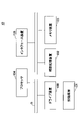
- FIG. 1 is a diagram showing a hardware configuration example of a GHG emissions estimation device 10 according to an embodiment of the present invention.
- the GHG emissions estimation apparatus 10 of FIG. 1 has a drive device 100, an auxiliary storage device 102, a memory device 103, a processor 104, an interface device 105, etc., which are interconnected by a bus B, respectively.
- a program that implements processing in the GHG emissions estimation device 10 is provided by a recording medium 101 such as a CD-ROM.
- a recording medium 101 such as a CD-ROM.
- the program is installed from the recording medium 101 to the auxiliary storage device 102 via the drive device 100 .
- the program does not necessarily need to be installed from the recording medium 101, and may be downloaded from another computer via the network.
- the auxiliary storage device 102 stores installed programs, as well as necessary files and data.
- the memory device 103 reads and stores the program from the auxiliary storage device 102 when a program activation instruction is received.
- the processor 104 is a CPU or a GPU (Graphics Processing Unit), or a CPU and a GPU, and executes functions related to the GHG emissions estimation device 10 according to programs stored in the memory device 103 .
- the interface device 105 is used as an interface for connecting to a network.
- FIG. 2 is a diagram showing a functional configuration example of the GHG emissions estimation device 10 according to the embodiment of the present invention.
- the GHG emissions estimation device 10 has a data access unit 11 , a statistic calculation unit 12 , a function approximation unit 13 and a GHG emissions calculation unit 14 .
- Each of these units is realized by processing that one or more programs installed in the GHG emissions estimation device 10 cause the processor 104 to execute. That is, the GHG emissions estimation apparatus 10 can be implemented by a computer and a program, and the program can be recorded on a recording medium or provided through a network.
- the GHG emission estimation device 10 also uses databases (storage units) such as a commuting DB 121, an environment DB 122, and a basic unit DB 123. Each of these databases can be realized using, for example, the auxiliary storage device 102 or a storage device or the like that can be connected to the GHG emissions estimation device 10 via a network.
- the commuting DB 121 stores data related to employee commuting, such as the location of each employee's home, the commuting route from the home to the work place by vehicle, the distance between points (distance based on the commuting route), the commuting vehicle (private vehicle), and data on past commuting results, etc. are stored.
- Past commuting performance data refers to data that includes the commuting date and time (date and time of departure from home) for each commuting day for each employee, and information indicating whether or not the employee used a vehicle for commuting on each commuting day. .
- the environment DB 122 stores environmental data at each location across the country, such as geographic data such as road networks and past rainfall amounts.
- the basic unit DB 123 stores various basic unit data used when calculating GHG emissions.
- each database is assumed to be equipped with information display/output functions and heterogeneous data integration functions.
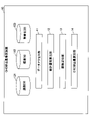
- FIG. 3 is a flowchart for explaining an example of a processing procedure executed by the GHG emissions estimation device 10. As shown in FIG.
- step S101 the data access unit 11 extracts each employee's home location, point-to-point distance, and past performance data from the commuting DB 121.
- the period for which past performance data is to be extracted may be arbitrary, but in the present embodiment, it is set to the past one year.
- the data access unit 11 extracts rainfall data from the rainfall DB at each commuting date and time and starting point (home location) extracted in step S101 for the employee (S102).
- the precipitation data to be extracted may be the data of the nearest weather station to the departure point, or the data of the weather station representative of the area encompassing all target departure points, Data obtained by spatially interpolating weather station data or data obtained by simulation or the like may also be used. In the present embodiment, the data of the weather station representative of the area including all target departure points is extracted. Moreover, although various temporal resolutions can be used for the precipitation data, the hourly precipitation is extracted here.
- the statistical amount calculation unit 12 based on the data extracted in step S102 (precipitation data for each commuting date and time for each employee in the past year, and the distance between points for each employee), a plurality of Precipitation classes and multiple distance classes are set, and for each precipitation class, the total number of employees who actually commute by vehicle to the total number of employees included in each distance class (hereinafter referred to as "the number of vehicle users") ) is calculated (S103).
- the number of employees included in each distance class is common to each precipitation class.
- a precipitation class means each interval when precipitation is divided into regular intervals.
- the distance class means each interval when the distance is divided into regular intervals.
- Fig. 4 is a diagram showing the number of employees included in each distance class and the number of vehicle users during no rainfall (0 mm precipitation). Note that the distance here is the round-trip distance.
- the solid line indicates the number of employees included in each distance class, and the dashed line indicates the number of vehicle users during no rainfall.
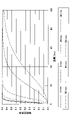
- the vehicle usage rate for each distance class is calculated for each precipitation class.
- the function approximation unit 13 derives an approximation function of the vehicle usage rate with distance as a variable for each precipitation class (S104).
- the function approximating unit 13 uses the same function form for each precipitation class, and approximates the trajectory of the vehicle usage rate for each precipitation class by setting parameters. Therefore, it is desirable that the functional form used here can express various distribution forms by setting parameters. Also, if there are a plurality of parameters defining a function, it is desirable to change only one parameter as much as possible and fix the other parameters for approximation.
- the Gompertz function is used in this embodiment.
- the definition formula (1) of the Gompertz function is shown below.
- the Gompertz function has three parameters, in the present embodiment, only the parameter c is changed, the parameters K and b are fixed, and approximation is performed by numerical calculation. Note that the parameter K is 1, which is the upper limit of the vehicle usage rate.
- Fig. 5 shows a graph of the obtained approximation function. It can be confirmed that the vehicle usage rate tends to increase for all distances as the amount of precipitation increases.
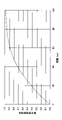
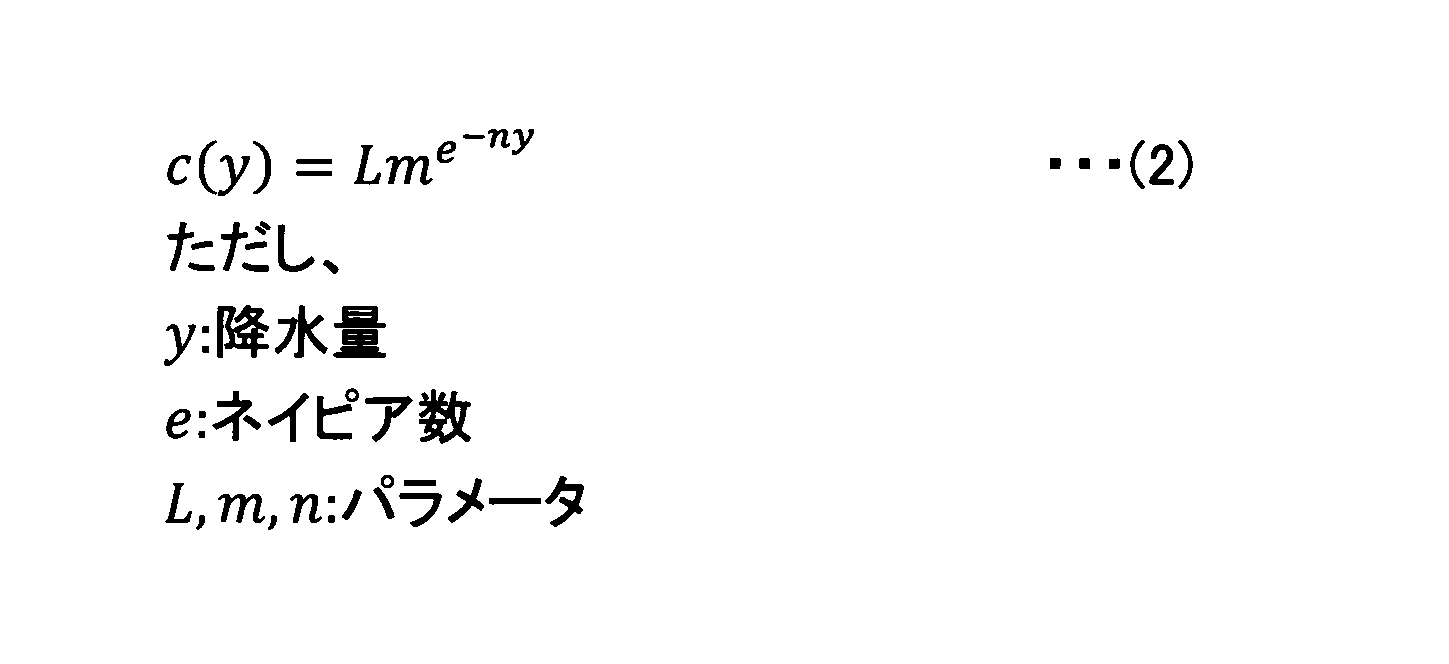
- the function approximation unit 13 derives a function that approximates the value of the parameter c of each precipitation class obtained in step S104, using the precipitation as a variable (S105).
- the Gompertz function is adopted again.
- FIG. 6 shows a graph of the obtained approximation function.
- the function approximation unit 13 integrates the approximate functions obtained in steps S104 and S105 (by substituting the definition formula (2) for the parameter c of the definition formula (1)), and uses the distance and the amount of precipitation as variables. Then, a vehicle usage rate estimation function is derived (S106).
- the vehicle usage rate estimation function (3) is shown below. Note that the parameter K is 1, which is the upper limit of the vehicle usage rate.
- the vehicle usage rate can be calculated for each combination of distance and amount of precipitation using function (3).
- the appearance rate of each precipitation class in the past is calculated from the precipitation data for the past several decades, and the weighted average value of the vehicle usage rate is obtained using this calculation. correspond with .
- step S107 the statistic calculation unit 12 calculates the appearance rate of each precipitation class in the past based on the precipitation data.
- the precipitation data used at this time may be the data of the weather station closest to the departure point, or the data of the weather station representing the area that includes all the target departure points. Data obtained by spatially interpolating weather station data or data obtained by simulation or the like may be used. In this embodiment, the precipitation data of the weather station representing the area is used to calculate the appearance rate of the area.
- Fig. 7 shows an example of the occurrence rate for each precipitation class at a certain weather station.
- the number of days of appearance indicates the annual average number of days for each precipitation class based on the past 30 years of records at a certain weather station. Therefore, the average number of days per year is a real number. Also, the denominator of the occurrence rate is 230 days (annual working days).
- the function approximation unit 13 multiplies the output value for each precipitation class of the vehicle usage rate estimation function (3) obtained in step S106 by the occurrence rate of the corresponding precipitation class for each distance class, to calculate the corrected vehicle usage rate, which is the annual weighted average value of the vehicle usage rate (S108). That is, the corrected vehicle usage rate is calculated for each distance class.
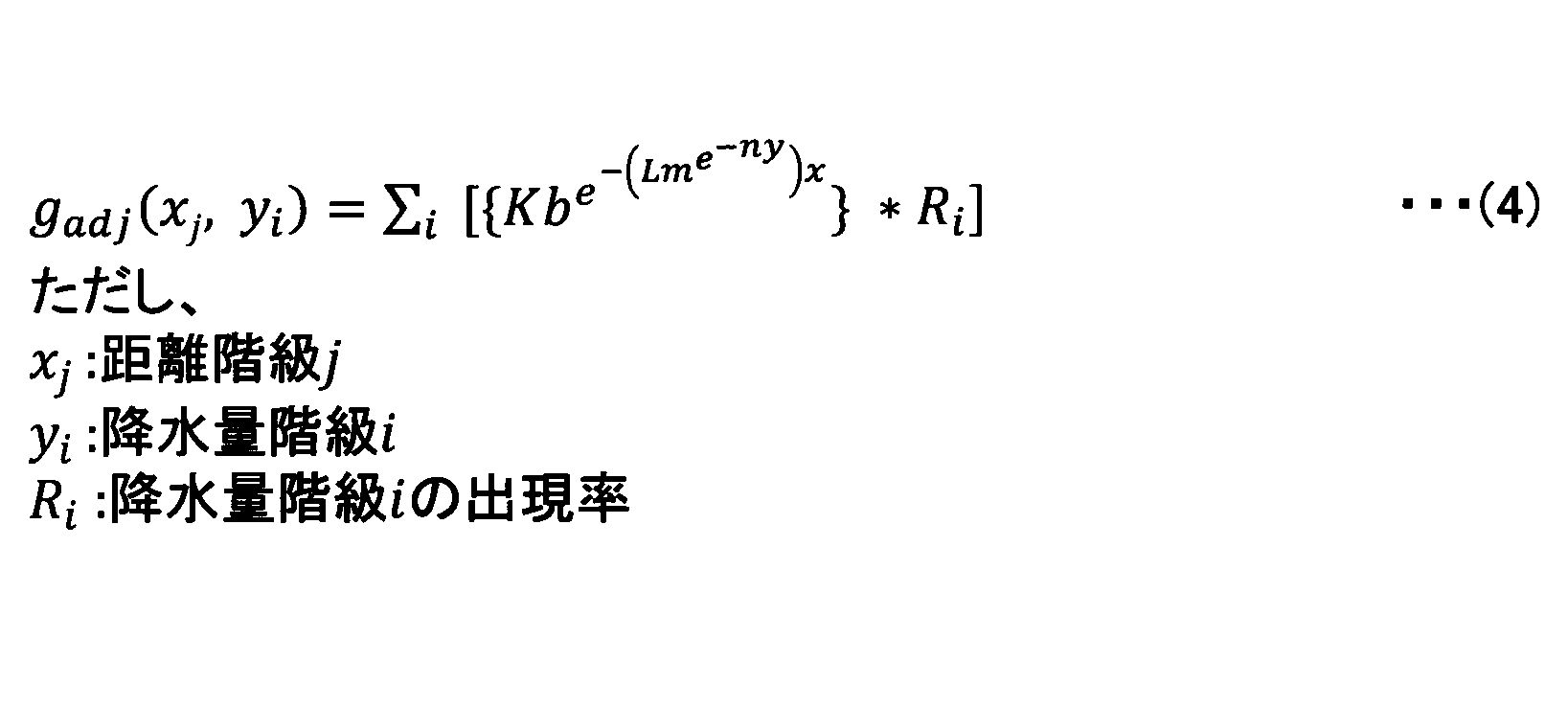
- the function approximation unit 13 multiplies the output values of the distance x and the precipitation amount y in the vehicle usage rate estimation function (3) by the appearance rate Ri of the precipitation amount class yi to which the precipitation amount y belongs. are summed over the distance class x j to obtain the corrected vehicle utilization rate in the distance class x j to which the distance x belongs.
- a modified vehicle utilization estimation function (4) illustrating such an operation is shown below.
- FIG. 8 shows an example of plotting output values (corrected vehicle usage rate) for each distance class xj of the corrected vehicle usage rate estimation function.
- the GHG emission amount calculation unit 14 calculates an estimated value of the GHG emission amount for each distance class xj (S109).
- the GHG emission amount calculation unit 14 first calculates, for each employee k, the distance D k (distance between points) related to the employee k, the number of vehicles N k and , GHG estimation by multiplying employee k's annual commuting days T k , corrected vehicle usage rate g adj (x j , y i ) in distance class x j to which distance D k belongs, and GHG intensity BU Compute an estimate of emissions Qjk .
- N k 1 in this embodiment where each employee is assumed to commute by own vehicle.
- the value of Nk is the reciprocal of the number of people riding in the same vehicle.
- Equation (5) may be calculated for each vehicle used for commuting. In this case, k indicates the vehicle and Tk is always 1. Further, in the present embodiment, it is assumed that the employee's commuting route is the same each time, so the distance Dk is uniquely determined for each employee.
- the GHG emission amount calculation unit 14 calculates the total sum of Q jk calculated for each employee for each distance class x j (each Q jk with common j), thereby calculating the estimated GHG emission amount for each distance class x j Calculate the estimated value Q j of .
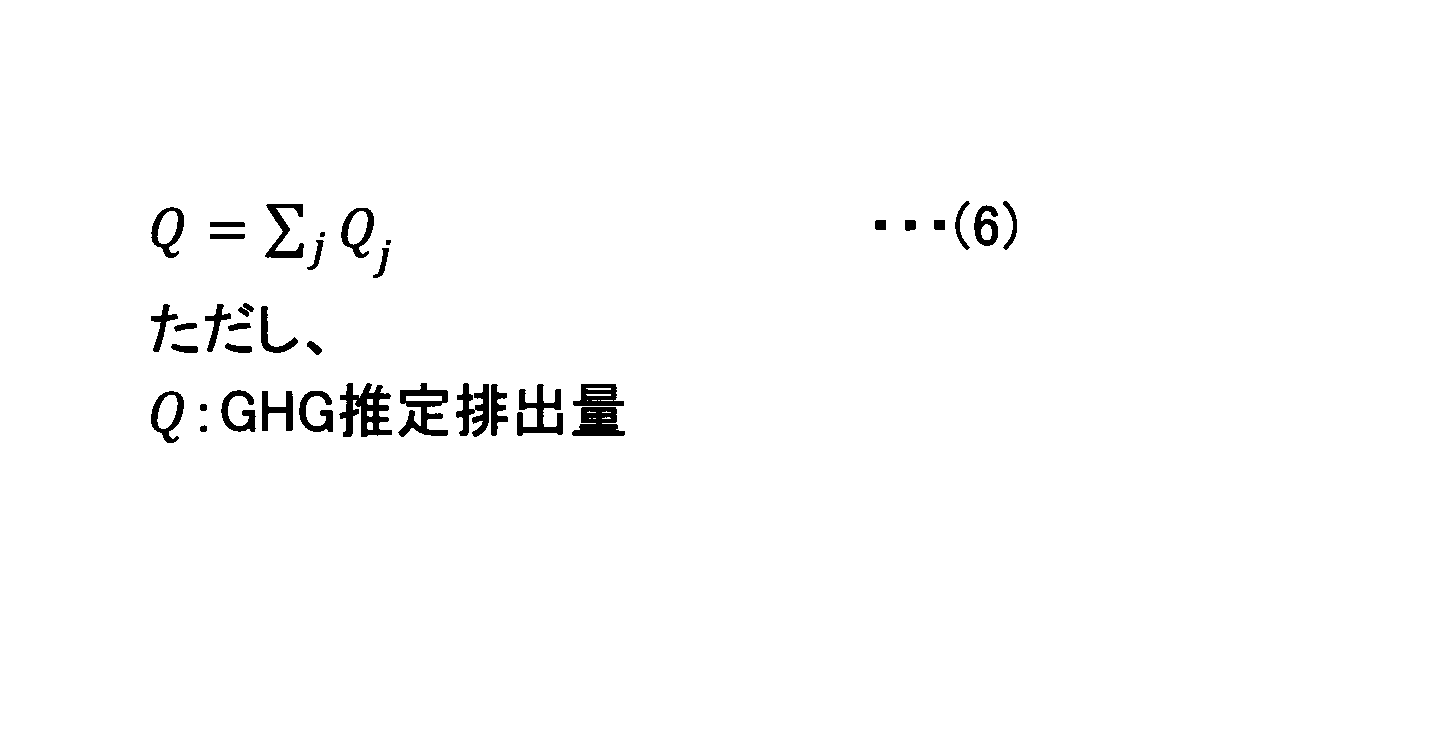
- the GHG emission calculation unit 14 calculates the sum of the estimated location Q j of the estimated GHG emission amount for each distance class x j based on the following calculation formula (6). It is calculated as an estimated value of the estimated GHG emission amount, and the calculation result is output (S110).
- the above is an example of estimating GHG emissions from commuting by employees using their own vehicles at a company, with two environmental factors that determine vehicle use/non-use: the distance to the destination and the amount of rainfall. showed that.
- the distance and amount of precipitation are used as environmental factors, but other environmental factors such as ease of access to public transportation can also be used.
- any calculation system that reflects environmental factors and human thinking/judgment based on them as factors can be handled by the functions and processes described in this embodiment.
- the function approximation unit 13 is an example of the first derivation unit, the second derivation unit, the third derivation unit, and the first calculation unit.
- the GHG emissions calculator 14 is an example of a second calculator.
- GHG emissions estimation device 11 Data access unit 12 Statistics calculation unit 13 Function approximation unit 14 GHG emissions calculation unit 100 Drive device 101 Recording medium 102 Auxiliary storage device 103 Memory device 104 Processor 105 Interface device 121 Commuting DB 122 Environment database 123 Basic unit DB B bus
Landscapes
- Business, Economics & Management (AREA)
- Engineering & Computer Science (AREA)
- Strategic Management (AREA)
- Economics (AREA)
- Human Resources & Organizations (AREA)
- General Business, Economics & Management (AREA)
- General Physics & Mathematics (AREA)
- Marketing (AREA)
- Tourism & Hospitality (AREA)
- Physics & Mathematics (AREA)
- Theoretical Computer Science (AREA)
- Game Theory and Decision Science (AREA)
- Development Economics (AREA)
- Entrepreneurship & Innovation (AREA)
- Operations Research (AREA)
- Quality & Reliability (AREA)
- Health & Medical Sciences (AREA)
- General Health & Medical Sciences (AREA)
- Primary Health Care (AREA)
- Management, Administration, Business Operations System, And Electronic Commerce (AREA)
Abstract
Description



なお、本実施の形態において、関数近似部13は、第1の導出部、第2の導出部、第3の導出部及び第1の算出部の一例である。GHG排出量算出部14は、第2の算出部の一例である。
11 データアクセス部
12 統計量等算出部
13 関数近似部
14 GHG排出量算出部
100 ドライブ装置
101 記録媒体
102 補助記憶装置
103 メモリ装置
104 プロセッサ
105 インタフェース装置
121 通勤DB
122 環境DB
123 原単位DB
B バス
Claims (5)
- 各従業員の車両通勤の距離と過去の各通勤日の降水量データとに基づく、降水量階級ごとの各距離階級の車両使用率に基づいて、距離を変数として車両使用率を推定する第1の近似関数を前記降水量階級ごとに導出する第1の導出手順と、
降水量を変数として前記第1の近似関数のパラメータの値を近似する第2の近似関数を導出する第2の導出手順と、
前記第1の近似関数と前記第2の近似関数とを統合することで、距離及び降水量を変数として車両使用率を推定する関数を導出する第3の導出手順と、
前記距離階級ごとに、前記降水量階級ごとの前記関数の出力値に前記降水量階級の出現率を反映した修正車両使用率を算出する第1の算出手順と、
前記距離階級ごとに、前記距離が当該距離階級に属する各従業員の前記距離及び通勤日数、前記修正車両使用率並びにGHG原単位に基づいて、GHG推定排出量の推定値を算出する第2の算出手順と、
をコンピュータが実行することを特徴とするGHG排出量推定方法。 - 前記第1の算出手順は、前記距離階級ごとに、前記降水量階級ごとの前記関数の出力値の前記降水量階級の出現率での加重平均値である前記修正車両使用率を算出する、
ことを特徴とする請求項1記載のGHG排出量推定方法。 - 各従業員の車両通勤の距離と過去の各通勤日の降水量データとに基づく、降水量階級ごとの各距離階級の車両使用率に基づいて、距離を変数として車両使用率を推定する第1の近似関数を前記降水量階級ごとに導出する第1の導出部と、
降水量を変数として前記第1の近似関数のパラメータの値を近似する第2の近似関数を導出する第2の導出部と、
前記第1の近似関数と前記第2の近似関数とを統合することで、距離及び降水量を変数として車両使用率を推定する関数を導出する第3の導出部と、
前記距離階級ごとに、前記降水量階級ごとの前記関数の出力値に前記降水量階級の出現率を反映した修正車両使用率を算出する第1の算出部と、
前記距離階級ごとに、前記距離が当該距離階級に属する各従業員の前記距離及び通勤日数、前記修正車両使用率並びにGHG原単位に基づいて、GHG推定排出量の推定値を算出する第2の算出部と、
を有することを特徴とするGHG排出量推定装置。 - 前記第1の算出部は、前記距離階級ごとに、前記降水量階級ごとの前記関数の出力値の前記降水量階級の出現率での加重平均値である前記修正車両使用率を算出する、
ことを特徴とする請求項3記載のGHG排出量推定装置。 - 請求項1又は2記載のGHG排出量推定方法をコンピュータに実行させることを特徴とするプログラム。
Priority Applications (3)
| Application Number | Priority Date | Filing Date | Title |
|---|---|---|---|
| JP2023520675A JP7559938B2 (ja) | 2021-05-13 | 2021-05-13 | Ghg排出量推定装置、ghg排出量推定方法及びプログラム |
| US18/559,382 US20240232736A1 (en) | 2021-05-13 | 2021-05-13 | Ghg emission estimation apparatus, ghg emission estimation method and program |
| PCT/JP2021/018181 WO2022239177A1 (ja) | 2021-05-13 | 2021-05-13 | Ghg排出量推定装置、ghg排出量推定方法及びプログラム |
Applications Claiming Priority (1)
| Application Number | Priority Date | Filing Date | Title |
|---|---|---|---|
| PCT/JP2021/018181 WO2022239177A1 (ja) | 2021-05-13 | 2021-05-13 | Ghg排出量推定装置、ghg排出量推定方法及びプログラム |
Publications (1)
| Publication Number | Publication Date |
|---|---|
| WO2022239177A1 true WO2022239177A1 (ja) | 2022-11-17 |
Family
ID=84028542
Family Applications (1)
| Application Number | Title | Priority Date | Filing Date |
|---|---|---|---|
| PCT/JP2021/018181 Ceased WO2022239177A1 (ja) | 2021-05-13 | 2021-05-13 | Ghg排出量推定装置、ghg排出量推定方法及びプログラム |
Country Status (3)
| Country | Link |
|---|---|
| US (1) | US20240232736A1 (ja) |
| JP (1) | JP7559938B2 (ja) |
| WO (1) | WO2022239177A1 (ja) |
Citations (2)
| Publication number | Priority date | Publication date | Assignee | Title |
|---|---|---|---|---|
| JP2013076712A (ja) * | 2008-07-18 | 2013-04-25 | Mizuho Information & Research Institute Inc | 環境負荷評価支援システム、環境負荷評価支援方法及び環境負荷評価支援プログラム |
| JP2019160094A (ja) * | 2018-03-15 | 2019-09-19 | 株式会社日立製作所 | 交通需要予測システムおよび交通需要予測装置 |
-
2021
- 2021-05-13 JP JP2023520675A patent/JP7559938B2/ja active Active
- 2021-05-13 WO PCT/JP2021/018181 patent/WO2022239177A1/ja not_active Ceased
- 2021-05-13 US US18/559,382 patent/US20240232736A1/en active Pending
Patent Citations (2)
| Publication number | Priority date | Publication date | Assignee | Title |
|---|---|---|---|---|
| JP2013076712A (ja) * | 2008-07-18 | 2013-04-25 | Mizuho Information & Research Institute Inc | 環境負荷評価支援システム、環境負荷評価支援方法及び環境負荷評価支援プログラム |
| JP2019160094A (ja) * | 2018-03-15 | 2019-09-19 | 株式会社日立製作所 | 交通需要予測システムおよび交通需要予測装置 |
Also Published As
| Publication number | Publication date |
|---|---|
| JPWO2022239177A1 (ja) | 2022-11-17 |
| US20240232736A1 (en) | 2024-07-11 |
| JP7559938B2 (ja) | 2024-10-02 |
Similar Documents
| Publication | Publication Date | Title |
|---|---|---|
| US20220157094A1 (en) | System and Method for Analyzing Vehicle Data | |
| Andresen et al. | Ambient populations and the calculation of crime rates and risk | |
| US8972192B2 (en) | Estimation of actual conditions of a roadway segment by weighting roadway condition data with the quality of the roadway condition data | |
| EP4300336B1 (en) | Method, apparatus, and computer program product for estimating the privacy risk of anonymized trajectory data | |
| US10732002B2 (en) | Generating accurate speed estimations using aggregated telemetry data | |
| Molloy et al. | Estimating the external costs of travel on GPS tracks | |
| CN104599002A (zh) | 预测订单价值的方法及设备 | |
| Li et al. | Assessing urban drainage pressure and impacts of future climate change based on shared socioeconomic pathways | |
| JP5738140B2 (ja) | 物質の放出量推定装置及びその方法並びにプログラム | |
| EP3721170A1 (en) | Method to measure road roughness characteristics and pavement induced vehicle fuel consumption | |
| WO2022239177A1 (ja) | Ghg排出量推定装置、ghg排出量推定方法及びプログラム | |
| CN112232649A (zh) | 一种任务处理评估方法及其系统、设备 | |
| Ullah et al. | A data-driven approach for customized pay-as-you-drive insurance premiums | |
| Fricke et al. | Reducing Europe’s Aviation Impact on Climate Change using enriched Air traffic Forecasts and improved efficiency benchmarks | |
| Kalila et al. | Big data fusion to estimate urban fuel consumption: a case study of riyadh | |
| JP6668227B2 (ja) | 時空間予測モデル学習装置、時空間予測装置、方法、及びプログラム | |
| CN108256707B (zh) | 保单回访管理方法和装置 | |
| US20140108059A1 (en) | Systems and methods for utilizing an economic model that incorporates economic influences to predict transactions | |
| JP2006242747A (ja) | 気温予測補正装置 | |
| Le Frioux et al. | Speeding Towards Cleaner Air: An Evaluation of Maximum Speed Restrictions in Île-de-France during High Pollution Days | |
| Berkane et al. | Optimal Traffic-Free Departure Forecast | |
| CN117973679B (zh) | 一种道路移动源污染物排放量时空分配方法、装置及介质 | |
| Mattson et al. | Marginal cost pricing and subsidy of small urban transit | |
| Ruugia et al. | Application of GIS spatial interpolation methods inauto insurance risk territory segmentation and rating | |
| EP4647724A1 (en) | Method, apparatus, and computer program product for second level anonymization of trajectories |
Legal Events
| Date | Code | Title | Description |
|---|---|---|---|
| 121 | Ep: the epo has been informed by wipo that ep was designated in this application |
Ref document number: 21941911 Country of ref document: EP Kind code of ref document: A1 |
|
| WWE | Wipo information: entry into national phase |
Ref document number: 2023520675 Country of ref document: JP |
|
| WWE | Wipo information: entry into national phase |
Ref document number: 18559382 Country of ref document: US |
|
| NENP | Non-entry into the national phase |
Ref country code: DE |
|
| 122 | Ep: pct application non-entry in european phase |
Ref document number: 21941911 Country of ref document: EP Kind code of ref document: A1 |