WO2022227639A1 - 基于外插磁化转移信号的cest数据拟合方法、装置及介质 - Google Patents
基于外插磁化转移信号的cest数据拟合方法、装置及介质 Download PDFInfo
- Publication number
- WO2022227639A1 WO2022227639A1 PCT/CN2021/140311 CN2021140311W WO2022227639A1 WO 2022227639 A1 WO2022227639 A1 WO 2022227639A1 CN 2021140311 W CN2021140311 W CN 2021140311W WO 2022227639 A1 WO2022227639 A1 WO 2022227639A1
- Authority
- WO
- WIPO (PCT)
- Prior art keywords
- fitting
- cest
- round
- extrapolated
- group
- Prior art date
- Legal status (The legal status is an assumption and is not a legal conclusion. Google has not performed a legal analysis and makes no representation as to the accuracy of the status listed.)
- Ceased
Links
Images


Classifications
-
- G—PHYSICS
- G01—MEASURING; TESTING
- G01R—MEASURING ELECTRIC VARIABLES; MEASURING MAGNETIC VARIABLES
- G01R33/00—Arrangements or instruments for measuring magnetic variables
- G01R33/20—Arrangements or instruments for measuring magnetic variables involving magnetic resonance
- G01R33/44—Arrangements or instruments for measuring magnetic variables involving magnetic resonance using nuclear magnetic resonance [NMR]
- G01R33/48—NMR imaging systems
- G01R33/54—Signal processing systems, e.g. using pulse sequences ; Generation or control of pulse sequences; Operator console
- G01R33/56—Image enhancement or correction, e.g. subtraction or averaging techniques, e.g. improvement of signal-to-noise ratio and resolution
- G01R33/565—Correction of image distortions, e.g. due to magnetic field inhomogeneities
- G01R33/56563—Correction of image distortions, e.g. due to magnetic field inhomogeneities caused by a distortion of the main magnetic field B0, e.g. temporal variation of the magnitude or spatial inhomogeneity of B0
-
- A—HUMAN NECESSITIES
- A61—MEDICAL OR VETERINARY SCIENCE; HYGIENE
- A61B—DIAGNOSIS; SURGERY; IDENTIFICATION
- A61B5/00—Measuring for diagnostic purposes; Identification of persons
- A61B5/05—Detecting, measuring or recording for diagnosis by means of electric currents or magnetic fields; Measuring using microwaves or radio waves
- A61B5/055—Detecting, measuring or recording for diagnosis by means of electric currents or magnetic fields; Measuring using microwaves or radio waves involving electronic [EMR] or nuclear [NMR] magnetic resonance, e.g. magnetic resonance imaging
-
- A—HUMAN NECESSITIES
- A61—MEDICAL OR VETERINARY SCIENCE; HYGIENE
- A61B—DIAGNOSIS; SURGERY; IDENTIFICATION
- A61B5/00—Measuring for diagnostic purposes; Identification of persons
- A61B5/0033—Features or image-related aspects of imaging apparatus, e.g. for MRI, optical tomography or impedance tomography apparatus; Arrangements of imaging apparatus in a room
-
- G—PHYSICS
- G01—MEASURING; TESTING
- G01R—MEASURING ELECTRIC VARIABLES; MEASURING MAGNETIC VARIABLES
- G01R33/00—Arrangements or instruments for measuring magnetic variables
- G01R33/20—Arrangements or instruments for measuring magnetic variables involving magnetic resonance
- G01R33/44—Arrangements or instruments for measuring magnetic variables involving magnetic resonance using nuclear magnetic resonance [NMR]
- G01R33/48—NMR imaging systems
- G01R33/54—Signal processing systems, e.g. using pulse sequences ; Generation or control of pulse sequences; Operator console
- G01R33/56—Image enhancement or correction, e.g. subtraction or averaging techniques, e.g. improvement of signal-to-noise ratio and resolution
- G01R33/5605—Image enhancement or correction, e.g. subtraction or averaging techniques, e.g. improvement of signal-to-noise ratio and resolution by transferring coherence or polarization from a spin species to another, e.g. creating magnetization transfer contrast [MTC], polarization transfer using nuclear Overhauser enhancement [NOE]
-
- G—PHYSICS
- G01—MEASURING; TESTING
- G01R—MEASURING ELECTRIC VARIABLES; MEASURING MAGNETIC VARIABLES
- G01R33/00—Arrangements or instruments for measuring magnetic variables
- G01R33/20—Arrangements or instruments for measuring magnetic variables involving magnetic resonance
- G01R33/44—Arrangements or instruments for measuring magnetic variables involving magnetic resonance using nuclear magnetic resonance [NMR]
- G01R33/48—NMR imaging systems
- G01R33/54—Signal processing systems, e.g. using pulse sequences ; Generation or control of pulse sequences; Operator console
- G01R33/56—Image enhancement or correction, e.g. subtraction or averaging techniques, e.g. improvement of signal-to-noise ratio and resolution
- G01R33/5608—Data processing and visualization specially adapted for MR, e.g. for feature analysis and pattern recognition on the basis of measured MR data, segmentation of measured MR data, edge contour detection on the basis of measured MR data, for enhancing measured MR data in terms of signal-to-noise ratio by means of noise filtering or apodization, for enhancing measured MR data in terms of resolution by means for deblurring, windowing, zero filling, or generation of gray-scaled images, colour-coded images or images displaying vectors instead of pixels
-
- G—PHYSICS
- G06—COMPUTING OR CALCULATING; COUNTING
- G06F—ELECTRIC DIGITAL DATA PROCESSING
- G06F17/00—Digital computing or data processing equipment or methods, specially adapted for specific functions
- G06F17/10—Complex mathematical operations
- G06F17/11—Complex mathematical operations for solving equations, e.g. nonlinear equations, general mathematical optimization problems
- G06F17/13—Differential equations
-
- G—PHYSICS
- G06—COMPUTING OR CALCULATING; COUNTING
- G06F—ELECTRIC DIGITAL DATA PROCESSING
- G06F17/00—Digital computing or data processing equipment or methods, specially adapted for specific functions
- G06F17/10—Complex mathematical operations
- G06F17/16—Matrix or vector computation, e.g. matrix-matrix or matrix-vector multiplication, matrix factorization
Definitions
- the invention belongs to the technical field of magnetic resonance imaging, and in particular relates to a CEST data fitting method, device and medium based on an extrapolated magnetization transfer signal.
- CEST imaging is a magnetic resonance molecular imaging technique that can detect free proteins and peptides in vivo.
- CEST imaging has been applied in several clinical fields, such as brain tumor grading, monitoring early treatment response to chemoradiotherapy, predicting tumor markers, and detecting ischemic stroke.
- the CEST signal is easily affected by a variety of effects.
- researchers at home and abroad have proposed a variety of methods to calculate the CEST signal to remove these interference effects. These methods can be roughly divided into two categories. One is to use the difference between the reference signal and the marker signal to obtain the final The second is the model fitting to get the final signal.
- Asymmetric magnetization transfer ration asymmetry assumes that (1) the reference signal does not contain the CEST effect; (2) the marker signal contains the CEST effect; (3) other effects are equal in the reference signal and the marker signal.
- the experimental signal is then subtracted from the reference signal, which eliminates other effects and retains only the CEST effect.
- other interference effects are not equal in the reference signal and the marker signal, such as the magnetization transfer (MT) effect of macromolecules, so the signal obtained by the MTR aysm method contains other effects.
- Multi-pool Lorentz fitting assumes that the curve of each effect is a Lorentz curve, and these Lorentz curves are superimposed to form the curve collected by the experiment.
- the value of each effect can be obtained.
- the curves of other effects are not all Lorentzian curves, such as MT, its curve is super-Lorentzian.
- the curve fitted by the Extrapolated Semisolid Magnetization Transfer Reference (EMR) represents other effects except the CEST effect.
- the CEST effect can be obtained by comparing the curve fitted by the EMR with the experimental curve. EMR assumes that the saturation pulse used in the experiment is a square wave and that the system has reached a steady state, but these two conditions are not always satisfied.
- Model fitting methods in the prior art approximate the experimental conditions, but this approximation does not hold under many experimental conditions. Therefore, the purpose of the present invention is to solve the problems existing in the prior art, and in terms of removing the interference effect of CEST imaging, to provide a CEST numerical simulation based on extrapolated magnetization transfer signals that is robust and suitable for various experimental conditions. Combined (Numerical Fit of Extrapolated Semisolid Magnetization Transfer Reference Signal, NEMR for short) method.
- the present invention provides a CEST data fitting method based on an extrapolated magnetization transfer signal.
- the method executes S1 to S3 sequentially for each voxel in the CEST image to obtain the background interference elimination of each voxel.
- CEST effect value of the signal; S1 ⁇ S3 are:
- the two-pool model is expressed as
- the undetermined parameters in the two-pool model are T 1a , T 2a , T 2b , M 0b , k ba ;
- the fitting of the undetermined parameters in the two-pool model has two rounds, and in the first round of fitting, the five undetermined parameters are all within their preset upper and lower limits by using the Fit the sample data for parameter optimization, and obtain the fitting value of the first round; in the second round of fitting, take the fitting value of the first round as the center, and select the upper and lower limits that are narrower than the upper and lower limits of the first round of fitting. Reuse the same fitting sample data as in the first round of fitting to perform a second round of fitting with higher precision on the two-pool model to obtain the final fitting value of the undetermined parameters.
- the parameter combination that needs to change the upper and lower limits is T 1a , T 2b , M 0b or T 1a , T 2b or T 2b , M 0b .
- the data points containing only the MT effect are data points whose frequency is within the range of 80-6 ppm, preferably the data points whose frequency is within the range of 80-20 ppm.
- the preset upper limit of the undetermined parameters T 1a , T 2a , T 2b , M 0b , k ba is [1.5, 0.25, 12e -6 , 0.16, 40]
- the preset lower limit is [0.6, 0.065, 8e -6 , 0.001, 20].
- the upper limit value of the parameter is changed to the first round fitting value of the parameter 120% to 150% of the parameter
- the lower limit is changed to 80% to 50% of the first round fitting value of the parameter; further, the upper limit is preferably changed to 120% of the first round fitting value of the parameter, The lower limit was changed to 80% of the first-round fitted value for this parameter.
- the frequency of interest is 3.5ppm or -3.5ppm
- the CEST effect value corresponding to the frequency of interest at 3.5ppm is the APT # value
- the frequency of interest at -3.5ppm corresponds to the CEST effect The value is NOE # .
- the present invention provides a computer-readable storage medium, where a computer program is stored on the storage medium, and when the computer program is executed by a processor, the computer program according to any one of the first aspect is implemented.
- the present invention provides a CEST data fitting device based on extrapolated magnetization transfer signal numerical fitting, which includes a processor and a storage medium, where a computer program is stored on the storage medium, and when the computer program is When executed by the processor, the method for fitting CEST data based on the extrapolated magnetization transfer signal according to any one of the first aspects is implemented.
- the present invention provides a magnetic resonance imaging device for removing the interference effect of CEST imaging, which is characterized by comprising a magnetic resonance scanner and a control unit, and the magnetic resonance scanner is used for obtaining CEST images through magnetic resonance CEST imaging;
- the control unit can acquire the CEST image and a computer program is stored in the control unit.
- the computer program When the computer program is executed, it is used to realize the CEST based on the extrapolated magnetization transfer signal according to any one of the first aspects.
- the data fitting method outputs the CEST effect value of each voxel to eliminate the background interference signal.
- the present invention has the following beneficial effects:
- the fitting method proposed by the present invention is essentially a step-by-step solution to the BM equation.
- This method has two major advantages. First, since the NEMR iterates in the time dimension, the waveform of the RF pulse actually used can be incorporated into the solution process. instead of assuming that the waveform is a rectangular wave. Secondly, the NEMR method uses the BM equation simulation to describe the CEST effect, rather than a simplified analytical expression, so that it is also applicable when the system is unstable.
- the BM equation is the most basic equation to describe the CEST effect. Iteration can accurately restore physiological parameter values.
- Fig. 1 is the fitting method flow chart of the present invention
- Fig. 2 is a curve of experimental collection in the embodiment and its fitting curve figure
- Figure 3 is a T2-weighted map, a diffusion-weighted map, an APT # map and a NOE # map of an ischemic stroke patient in the Examples.
- the invention provides a method for removing the interference effect of CEST imaging, which is called Numerical Fit of Extrapolated Semisolid Magnetization Transfer Reference Signal (NEMR).
- NEMR Extrapolated Semisolid Magnetization Transfer Reference Signal
- the CEST data fitting method based on the extrapolated magnetization transfer signal integrates the line shape of the MT effect into the Bloch-McConnell (BM) equation.
- BM Bloch-McConnell
- the core of the present invention is to integrate the line shape of MT into the BM equation through a reasonable approximation of the BM equation to form a two-pool model for subsequent fitting.
- the principle of the two-pool model is described in detail below.
- M x , My y and M z are the magnetization components in the x, y and z directions, respectively, ⁇ w and ⁇ are the magnetic resonance frequency of water and the frequency of the externally applied radio frequency pulse, and ⁇ 1 is the applied
- Rate eg k ab represents the rate of exchange from water group a to MT group b
- the absorption rate R rfb of the above-mentioned MT group to the radio frequency pulse can also be represented by a linear function
- the linear function g( ⁇ ) can use various forms such as Lorentzian type, Gaussian type, and super-Lorentzian type. in:
- Gaussian is:
- the super-Lorentzian type is:
- M [M xa , M ya , M za , M zb ] T ,
- the solution of the above-mentioned homogeneous differential equation is the two-pool model of the present invention, and the model has 5 unknowns, namely T 1a , T 2a , T 2b , M 0b , k ba , and other parameters are known quantities.
- T 1a , T 2a , T 2b , M 0b , k ba are known quantities.
- a fitting curve including the MT effect can be obtained, and a cleaner CEST effect can be obtained by making the difference between this fitting curve and the Z spectrum curve corrected by the frequency B0 offset of the main magnetic field.
- the present invention can be used to obtain different CEST effect values, but since different CEST effect values correspond to different frequencies on the curve, for ease of representation, the Z spectrum can reflect a certain CEST effect in the present invention.
- the frequency is called the frequency of interest.
- the CEST effect value to be calculated is the APT # (Amide proton transfer signal from NEMR analysis, the amide proton transfer signal obtained by extrapolating the magnetization transfer signal analysis) value, then the corresponding frequency of interest is 3.5ppm;
- the calculated CEST effect value is NOE # (Numerical Fit of Extrapolated Semisolid Magnetization Transfer Reference Signal, the nuclear Austenite effect signal obtained by analyzing the extrapolated magnetization transfer signal), then its corresponding frequency of interest is -3.5ppm.
- one CEST effect value can be calculated at one time, or multiple CEST effect values can be calculated simultaneously, which is not limited.
- the present invention provides two CEST data fitting methods based on extrapolated magnetization transfer signals. As shown in (a) and (b) in Figure 1, the difference between the two methods is that the parameter fitting methods for the two-pool model are different. The first method is single-round fitting, and the second method is two-round fitting. , the rest of the practice is the same. The following two methods are respectively demonstrated and described through embodiments.
- FIG. 1( a ) the implementation process of the NEMR fitting method using the above-mentioned first fitting method is shown.
- This method needs to acquire the CEST image first, and then execute S1 to S3 sequentially for each voxel in the CEST image to obtain the APT # value and NOE # value of each voxel, thereby forming the APT # map and the NOE # map.
- S1 to S3 The specific implementation processes of S1 to S3 are described below.
- the fitting sample data can be directly used to fit five undetermined parameters T 1a , T 2a , T 2b , M 0b , k ba , within the respective upper and lower limits of the five undetermined parameters, Obtain the fitted values for the 5 undetermined parameters that best fit the entire two-pool model equation.
- the specific fitting method can be implemented by software such as MATLAB, SPSS or other existing technologies, and the fitting degree can be represented by the minimum mean square error.
- the preset upper and lower limits and initial values of the undetermined parameters T 1a , T 2a , T 2b , M 0b , k ba can be adjusted according to the actual situation, as long as they conform to the normal value range of each parameter.
- the preset upper limit of the numbers T 1a , T 2a , T 2b , M 0b , k ba is set to [1.5, 0.25, 12e ⁇ 6 , 0.16, 40]
- the preset lower limit is set to [0.6, 0.065, 8e -6 , 0.001, 20]
- the initial values are set as their respective lower limits.
- the fitting curve including the MT effect can be obtained.
- the frequency ⁇ in the double-pool model is the abscissa of the curve
- the M za in the double-pool model is the curve Y-axis.
- the difference curve is not necessary to obtain, as long as the ordinate value corresponding to 3.5ppm on the fitted curve and the ordinate value corresponding to 3.5ppm on the Z spectrum after the frequency correction of the main magnetic field B0 can be calculated
- the difference between them can be used as the APT # value of the current voxel, and at the same time, the ordinate value corresponding to -3.5ppm on the fitting curve and the ordinate value corresponding to -3.5ppm on the Z spectrum after the B0 frequency correction of the main magnetic field are calculated.
- the difference can be used as the NOE # value of the current voxel.
- an APT # map and a NOE # map can be formed, and the value of each position in the APT # map is this
- the value of each position in the map is the NOE # value corresponding to the position voxel.
- the above NEMR fitting method was tested on a CEST image of the brain of an ischemic stroke patient.
- the CEST imaging sequence used to acquire images includes three modules: (1) CEST saturation module, this module includes 10 Gaussian waveform saturation pulses, each pulse duration is about 100ms, and the amplitude is 1 ⁇ T; ( 2) Spectrum pre-saturation inversion recovery fat pressing module; (3) Fast spin echo acquisition module.
- the main magnetic field frequency B0 offset correction is performed on the collected Z spectrum data (as shown in the experimental curve in Fig. 2, the frequency range is 80--6ppm), and then the above NEMR fitting is performed. .
- the first round of fitting uses data with a frequency of 80-20 ppm as fitting sample data (the points used for fitting are shown in Figure 2), and the unknown parameters T 1a , T 2a , T 2b , M 0b , upper limit of k ba is [1.5, 0.25, 12e -6 , 0.16, 40], the lower limit is [0.6, 0.065, 8e -6 , 0.001, 20], and the initial value is equal to the lower limit.
- the final fitting curve is shown in Figure 2.
- step S1 and S3 of this embodiment are the same as those of embodiment 1, the difference is only that in step S2, the fitting of the undetermined parameters in the two-pool model has two rounds:
- the first round of fitting is the same as in Example 1.
- the fitting sample data is used to optimize the parameters of the five undetermined parameters within their preset upper and lower limits to obtain the first round of fitting values.
- the initial values of the 5 pending parameters are also set to their respective lower bounds.
- multi-parameter fitting is greatly affected by the upper and lower limits of variables, and some parameters may be equal to a given boundary value. Therefore, in this embodiment, it is necessary to set a second step of fitting to alleviate this problem.
- a second round of fitting with higher accuracy is performed on the above two-pool model to obtain the final fitting value of the undetermined parameters. In the specific implementation process, it is not necessary to adjust the upper and lower limits of all the five undetermined parameters of the two-pool model.
- Some parameters can be selected from the five undetermined parameters of the two-pool model to further expand their upper and lower limits.
- the upper and lower limits of the remaining parameters are still the same as The first round of fitting remains the same.
- the parameter combinations that need to change the upper and lower limit values are T 1a , T 2b , and M 0b .
- the changing range of the upper and lower limits should not be too large but not too small.
- the upper limit value of the parameter used in the second round of fitting is preferably changed to 120% of the parameter’s first round fitting value
- the lower limit of the parameters used in the second round of fitting is preferably changed to 80% of the first round of fitting values of the parameters, so that these parameters are further optimized near the first round of fitting values.
- the above NEMR fitting method was tested on a CEST image of the brain of an ischemic stroke patient.
- the CEST imaging sequence used to acquire images is the same as Example 1.
- the main magnetic field frequency B0 offset correction is performed on the collected data, and then NEMR fitting is performed.
- the first round of fitting uses data with a frequency of 80 to 20 ppm as fitting sample data, and the unknown parameters to be fitted T 1a , T 2a , T 2b , M 0b , k ba upper limit is [1.5, 0.25, 12e-6, 0.16, 40], the lower limit is [0.6, 0.065, 8e-6, 0.001, 20], the initial value is equal to the lower limit.
- the second round of fitting use the same fitting sample data as in the first round of fitting, and set the upper limit of T 1a , T 2b , M 0b to 120 of T 1a , T 2b , M 0b obtained in the first round %, the lower limit is set as 80% of T 1a , T 2b , M 0b obtained in the first round, the upper and lower limits of other parameters are consistent with the first round of fitting, and the initial value of all parameters is set as the lower limit of the parameter value.
- FIG. 3 The experimental results of this embodiment are shown in Fig. 3. It can be seen that the APT # map and NOE # map obtained by the NEMR method of the two-step fitting can clearly show other modalities. Lesions (lesions on T2-weighted images, solid white arrows), can also show lesions that are not visible on other modalities (lesions on NOE # map, white dashed arrows), and its display effect is better than Example 1 .
- the above two embodiments are only two examples of the present invention, but not limited thereto.
- other ranges such as 80-20 ppm, 80-6 ppm, etc., may be selected for the selection frequency range of the fitting sample data in the above-mentioned S2 of the present invention.
- the upper and lower limits of the parameters can be adjusted according to the actual situation. The lower limit can be changed to 80% to 50% of the first round fitting value of this parameter.
- the parameter combinations that need to change the upper and lower limit values can be various, for example, in addition to T 1a , T 2b , M 0b , T 1a , T 2b or T 2b , M 0b can also be selected 0b and so on.
- the initial value of the parameter is set to a reasonable value within the upper and lower limits, or by randomly or uniformly setting several different candidate values within the upper and lower limits, the candidate value with the smallest fitting error is obtained. Can be selected as the final initial value.
- the above-mentioned CEST data fitting method based on the extrapolated magnetization transfer signal can be stored in a computer-readable storage medium in the form of a computer program.
- the CEST data fitting method based on the extrapolated magnetization transfer signal can be implemented according to the above method.
- a CEST data fitting device based on the numerical fitting of extrapolated magnetization transfer signals which includes a processor and a storage medium, and a computer program is stored on the storage medium , when the computer program is executed by the processor, the above-mentioned CEST data fitting method based on the extrapolated magnetization transfer signal is realized.
- the computer-readable storage medium is generally provided in the form of memory hardware, and the memory may include random access memory (Random Access Memory, RAM), and may also include non-volatile memory (Non-Volatile Memory, NVM), such as at least one disk storage.
- RAM Random Access Memory
- NVM Non-Volatile Memory
- the processor of the above-mentioned processing program can be a general-purpose processor, including a central processing unit (Central Processing Unit, CPU), a network processor (Network Processor, NP), etc.; it can also be a digital signal processor (Digital Signal Processing, DSP), Application Specific Integrated Circuit (ASIC), Field-Programmable Gate Array (FPGA) or other programmable logic devices, discrete gate or transistor logic devices, discrete hardware components.
- CPU Central Processing Unit
- NP Network Processor
- DSP Digital Signal Processing
- ASIC Application Specific Integrated Circuit
- FPGA Field-Programmable Gate Array
- the above software programs can also be mounted on the cloud platform to provide corresponding services, so the computer-readable storage medium is not limited to the form of local hardware.
- the above-mentioned CEST data fitting method based on the extrapolated magnetization transfer signal can be integrated into the control unit of the magnetic resonance imaging apparatus in the form of a program.
- the magnetic resonance imaging device should include a conventional magnetic resonance scanner and a control unit, and the magnetic resonance scanner can be realized by using the existing technology, which is a mature commercial product, and will not be described again.
- the control unit should also have imaging sequences and other software programs necessary to realize CEST imaging.
- the magnetic resonance scanner is used to obtain the CEST image through the magnetic resonance CEST imaging, and the control unit can obtain the CEST image obtained by the magnetic resonance scanner, and the control unit stores the aforementioned computer program, and when the computer program is executed, it is used to realize the above.
- the CEST data fitting method based on the extrapolated magnetization transfer signal outputs the CEST effect value of each voxel to eliminate the background interference signal.
- each module and function involved in the present invention can be accomplished by circuits, other hardware or executable program codes, as long as the corresponding functions can be realized. If code is employed, the code may be stored in a storage device and executed by corresponding elements in a computing device. Implementations of the present invention are not limited to any particular combination of hardware and software. Each hardware model in the present invention can adopt commercially available products, and can be selected according to actual user needs. Of course, the magnetic resonance CEST imaging sequence and device also need to cooperate with other necessary hardware or software, which will not be repeated here.
Landscapes
- Physics & Mathematics (AREA)
- Health & Medical Sciences (AREA)
- Engineering & Computer Science (AREA)
- General Physics & Mathematics (AREA)
- Nuclear Medicine, Radiotherapy & Molecular Imaging (AREA)
- Life Sciences & Earth Sciences (AREA)
- General Health & Medical Sciences (AREA)
- Radiology & Medical Imaging (AREA)
- Mathematical Physics (AREA)
- High Energy & Nuclear Physics (AREA)
- Pure & Applied Mathematics (AREA)
- Computational Mathematics (AREA)
- Mathematical Optimization (AREA)
- Mathematical Analysis (AREA)
- Signal Processing (AREA)
- Condensed Matter Physics & Semiconductors (AREA)
- Theoretical Computer Science (AREA)
- Data Mining & Analysis (AREA)
- Medical Informatics (AREA)
- Pathology (AREA)
- Animal Behavior & Ethology (AREA)
- Public Health (AREA)
- Veterinary Medicine (AREA)
- Molecular Biology (AREA)
- Heart & Thoracic Surgery (AREA)
- Biomedical Technology (AREA)
- Biophysics (AREA)
- Surgery (AREA)
- Databases & Information Systems (AREA)
- Algebra (AREA)
- Software Systems (AREA)
- General Engineering & Computer Science (AREA)
- Artificial Intelligence (AREA)
- Computer Vision & Pattern Recognition (AREA)
- Operations Research (AREA)
- Computing Systems (AREA)
- Magnetic Resonance Imaging Apparatus (AREA)
Abstract
一种基于外插磁化转移信号的CEST数据拟合方法、装置及介质,属于磁共振成像领域。该基于外插磁化转移信号的CEST数据拟合方法,将MT效应的线型融入到Bloch-McConnell方程中,通过对该方程代表的模型的拟合,可以得出MT效应,将拟合得出的曲线与实验采集到的曲线作差,就可以去除干扰效应。这种基于Bloch-McConnell的拟合方法,可以考虑实验中实际使用的射频脉冲波形,并且在系统非稳态下也可以使用。
Description
本发明属于磁共振成像技术领域,具体涉及一种基于外插磁化转移信号的CEST数据拟合方法、装置及介质。
化学交换饱和转移(Chemical Exchange Saturation Transfer,CEST)成像是一种磁共振分子成像技术,可以检测活体里游离的蛋白质和多肽。CEST成像已经被应用于多个临床领域,比如脑肿瘤分级、监测放化疗的早期治疗反应、预测肿瘤标志物、检测缺血性中风等。但是CEST信号容易受多种效应的影响,国内外研究者提出了多种计算CEST信号的方法以去除这些干扰效应,这些方法可以大致分成两类,一是使用参考信号与标记信号作差得到最终的信号,二是模型拟合得到最终的信号。非对称磁化转移(Magnetization transfer ration asymmetry,MTR
asym)假设(1)参考信号中不包含CEST效应;(2)标记信号包含CEST效应;(3)其他效应在参考信号和标记信号中相等。然后用参考信号减去实验信号,就消除了其他效应只保留CEST效应。但是其他干扰效应在参考信号和标记信号中并不都相等,比如大分子磁化转移(Magnetization transfer,MT)效应,所以MTR
aysm方法得到的信号包含了其他效应。多池洛伦兹拟合假设每个效应的曲线是一条洛伦兹曲线,这些洛伦兹曲线叠加起来形成了实验采集的曲线,通过拟合实验采集到的曲线,可以得出各个效应的值,但是其他效应的曲线并不都是洛伦兹曲线,比如MT,它的曲线是超洛伦兹。外插磁化转移信号(Extrapolated Semisolid Magnetization Transfer Reference,EMR)拟合出的曲线代表除了CEST效应之外的其他效应,将EMR拟合的曲线与实验得到的曲线作差,就可以得到CEST效应。EMR假设实验使用的饱和脉冲是方波而且系统已经到达稳态,但是这两个条件并不总是满足的。
发明内容
现有技术中的模型拟合方法对实验条件作了近似,但是这种近似在许多实验条件下并不成立。因此,本发明的目的在于解决现有技术中存在的问题,并在去除CEST成像的干扰效应方面,提供一种鲁棒的、适合于多种实验条件的基于外插磁化转移信号的CEST数值拟合(Numerical Fit of Extrapolated Semisolid Magnetization Transfer Reference Signal,简称NEMR)方法。
本发明所采用的具体技术方案如下:
第一方面,本发明提供了一种基于外插磁化转移信号的CEST数据拟合方法,该方法针对CEST图像中的每一个体素,依次执行S1~S3,得到每一个体素的消除背景干扰信号的CEST效应值;其中S1~S3为:
S1、对获得的原始Z谱进行主磁场频率B0偏移校正,得到校正后Z谱;
S2、取校正后Z谱中仅含有MT效应的部分数据点作为拟合样本数据,对预先设置有待定参数初值和上下限的两池模型进行拟合,得到待定参数的拟合值;
所述两池模型表示为

式中:exp表示以自然常数e为底的指数函数;Δt表示时刻t的增量;
 分别为t+Δt时刻、t时刻的磁化矢量
 其中
 矩阵M=[M
xa,M
ya,M
za,M
zb]
T,M
xa、M
ya、M
za、M
zb分别为水集团的x方向磁化强度分量、水集团的y方向磁化强度分量、水集团的z方向磁化强度分量、MT集团的z方向磁化强度分量;系数矩阵
 其中矩阵
 向量C=[0,0,R
1aM
0a,R
1bM
0b]
T,Δω
a表示外界施加的射频脉冲的频率和水的频率差,ω
1表示所施加的射频脉冲强度,k
ab表示从水集团交换到MT集团的速率,k
ba表示从MT集团交换到水集团的速率,R
rfb为MT集团对射频脉冲的吸收速率,Δω
b表示外界施加的射频脉冲 的频率和MT的频率差,R
1a=1/T
1a和R
2a=1/T
2a分别为水集团的纵向弛豫速率和横向弛豫速率,R
1b=1/T
1b和R
2b=1/T
2b分别为MT集团的纵向弛豫速率和横向弛豫速率,M
0a和M
0b分别为水集团和MT集团的稳态磁化强度;
所述两池模型中的待定参数为T
1a,T
2a,T
2b,M
0b,k
ba;
S3、基于代入所述拟合值的两池模型得到包含MT效应的拟合曲线,将所述拟合曲线与所述校正后Z谱上感兴趣频率处的差值,作为消去背景干扰信号的CEST效应值。
作为第一方面的优选,所述S2中,两池模型中待定参数的拟合具有两轮,第一轮拟合时对5个待定参数在其预先设定的上下限范围内均利用所述拟合样本数据进行参数优化,获得第一轮拟合值;第二轮拟合时,以第一轮拟合值为中心,选择相对于第一轮拟合上下限范围更窄的上下限,重新使用和第一轮拟合中相同的拟合样本数据对所述两池模型进行第二轮精度更高的拟合,得到待定参数的最终拟合值。
再进一步的优选是,在进行第二轮拟合时,在所述两池模型的5个待定参数中仅选择部分参数调整其上下限,剩余参数的上下限与第一轮拟合保持一致;
更进一步的优选是,在进行第二轮拟合时,需改变上下限的参数组合为T
1a,T
2b,M
0b或T
1a,T
2b或T
2b,M
0b。
作为第一方面中两轮拟合方案的优选,所述S2中,仅含有MT效应的数据点为频率位于80~6ppm范围内的数据点,优选为频率位于80~20ppm范围内的数据点。
作为第一方面中两轮拟合方案的优选,所述S2中,进行第一轮拟合时,待定参数T
1a,T
2a,T
2b,M
0b,k
ba预设的上限是[1.5,0.25,12e
-6,0.16,40],预设的下限是[0.6,0.065,8e
-6,0.001,20]。
作为第一方面中两轮拟合方案的优选,所述S2中,在进行第二轮拟合时,对于需改变上下限的参数,其上限值改为该参数的第一轮拟合值的120%~150%,下限值改为该参数的第一轮拟合值的80%~50%;进一步的,上限值优选改为该参数的第一轮拟合值的120%,下限值改为该参数的第一轮拟合值的80%。
作为第一方面中两轮拟合方案的优选,所述S2中,MT集团对射频脉冲的吸收速率
 其中g(·)是一个线形函数,包括洛伦兹型、高斯型或超洛伦兹型。
进一步的优选是,所述S3中,所述感兴趣频率为3.5ppm或-3.5ppm,3.5ppm的感兴趣频率对应的CEST效应值为APT
#值,-3.5ppm的感兴趣频率对应的CEST效应值为NOE
#。
第二方面,本发明提供了一种计算机可读存储介质,所述存储介质上存储有计算机程序,当所述计算机程序被处理器执行时,实现如第一方面中任一项所述的基于外插磁化转移信号的CEST数据拟合方法。
第三方面,本发明提供了一种基于外插磁化转移信号数值拟合的CEST数据拟合装置,其包括处理器和存储介质,所述存储介质上存储有计算机程序,当所述计算机程序被处理器执行时,实现如第一方面中任一项所述的基于外插磁化转移信号的CEST数据拟合方法。
第四方面,本发明提供了一种去除CEST成像干扰效应的磁共振成像装置,其特征在于,包括磁共振扫描器以及控制单元,所述磁共振扫描器用于通过磁共振CEST成像获取CEST图像;所述控制单元能获取所述CEST图像且控制单元中存储有计算机程序,当所述计算机程序被执行时,用于实现如第一方面中任一项所述的基于外插磁化转移信号的CEST数据拟合方法,输出每一个体素消除背景干扰信号的CEST效应值。
本发明相对于现有技术而言,具有以下有益效果:
本发明提出的拟合方法,本质上是对BM方程的分步求解,该方法有两大优点,首先,由于NEMR在时间维度上进行迭代,可以将实际使用的射频脉冲的波形纳入到求解过程中,而不是假定波形为矩形波。其次,NEMR方法采用BM方程仿真来描述CEST效应,而不是经过简化的解析表达式,使得在系统非稳态时也适用,BM方程是描述CEST效应最基本的方程,在此基础上进行仿真和迭代可以准确地还原生理参数值。
图1为本发明的拟合方法流程图;
图2为实施例中实验采集的一条曲线和它的拟合曲线图;
图3为实施例中一位缺血性中风患者的T2加权图、弥散加权图、APT
#图和NOE
#图。
下面结合附图和具体实施方式对本发明做进一步阐述和说明。
本发明提供了一种去除CEST成像干扰效应的方法,称为外插磁化转移信号的数值拟合(Numerical Fit of Extrapolated Semisolid Magnetization Transfer Reference Signal,NEMR)。该基于外插磁化转移信号的CEST数据拟合方法将MT效应的线型融入到Bloch-McConnell(BM)方程中,通过对该方程代表的模型的拟合,可以得出MT效应,将拟合得出的曲线与实验采集到的曲线作差,就可以去除干扰效应。
本发明的核心是通过对BM方程的合理近似从而将MT的线型融入到BM方程,形成一个用于进行后续拟合的两池模型。下面先对该两池模型的原理进行详细描述。
磁共振的成像过程可由如下的Bloch方程来描述,
dM
x/dt=-M
xR
2-(ω
w-ω)M
y
dM
y/dt=(ω
w-ω)M
x-M
yR
2-ω
1M
z
dM
z/dt=ω
1M
y-M
zR
1+M
0R
1
其中M
x、M
y和M
z分别为x、y和z三个方向的磁化强度分量,ω
w和ω分别为水的磁共振频率和外界施加的射频脉冲的频率,ω
1为所施加的射频脉冲的强度,R
1=1/T
1和R
2=1/T
2分别为纵向和横向弛豫速率,M
0表示稳态磁化强度。该方程只描述了水的磁化强度在射频脉冲影响下随时间改变的情况。对于具有两个交换集团(水集团a;MT集团b)的系统,可由以下方程来描述(需注意的是下列公式中下标a代表水集团的相关参数,而下标b代表MT集团的相关参数):


其中Δω
a=ω-ω
a表示外界施加的射频脉冲的频率和水的频率差;k
ij(i=a或b;j=a或b)则表示了i和j两个集团之间的交换速率(例如k
ab表示从水集团a交换到MT集团b的速率)。
由于MT集团的T
2在微秒量级,M
xb,M
yb会快速达到稳态,也即
0=-Δω
bM
yb-R
2bM
xb
0=Δω
bM
xb-R
2bM
yb-ω
1M
zb

可以解得
 如果定义
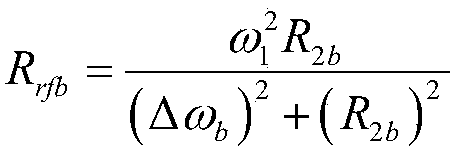 为MT集团对射频脉冲的吸收速率,M
yb可以进一步表示为ω
1M
yb=-R
rfbM
zb,那么关于M
zb的微分方程可以写为

上述MT集团对射频脉冲的吸收速率R
rfb还可以用一个线型函数来表示,
 线形函数g(·)可以使用洛伦兹型、高斯型、超洛伦兹型等多种形式。其中:
洛伦兹型为

高斯型为:

超洛伦兹型为:

经过上述简化之后,原有的六个方程变成四个:


这四个微分方程可以表示为:

其中,M=[M
xa,M
ya,M
za,M
zb]
T,

进一步可以将其转化为齐次微分方程:

其中,

上述齐次微分方程的解可以表示为

其中
 为t+Δt时刻的磁化矢量。
上述齐次微分方程的解即为本发明的两池模型,该模型有5个未知数,分别是T
1a,T
2a,T
2b,M
0b,k
ba,其余参数都是已知量。通过该模型的拟合,可以得出包含 MT效应的拟合曲线,将此拟合曲线和经过主磁场频率B0偏移校正后的Z谱曲线作差,就可以得到更为干净的CEST效应。
需说明的是,本发明可以用于获取不同的CEST效应值,但由于不同的CEST效应值对应于曲线上的不同频率,因此为了便于表示,本发明中将Z谱上能够反映某种CEST效应的频率称为感兴趣频率。例如,假如需要计算的CEST效应值为APT
#(Amide proton transfer signal from NEMR analysis,使用外插磁化转移信号分析得到的酰胺质子转移信号)值,那么其对应的感兴趣频率为3.5ppm;假如需要计算的CEST效应值为NOE
#(Numerical Fit of Extrapolated Semisolid Magnetization Transfer Reference Signal,使用外插磁化转移信号分析得到的核奥氏效应信号),那么其对应的感兴趣频率为-3.5ppm。当然,假如Z谱上具有其他频率也可以反映某种CEST效应,那么也可以作为感兴趣频率,通过计算拟合曲线与校正后Z谱上感兴趣频率处的差值,即可得到该感兴趣频率对应的消去背景干扰信号的CEST效应值。本发明在实现过程中,可以单次计算一种CEST效应值,亦可同时计算多种CEST效应值,对此不作限定。
基于上述原理,本发明提供了两种基于外插磁化转移信号的CEST数据拟合方法。如图1中的(a)和(b)所示,两种做法的区别在于对于两池模型的参数拟合方法不同,第一种方式为单轮拟合,第二种方式为两轮拟合,其余的做法均相同。下面对两种做法分别通过实施例进行展示说明。
实施例1
在本实施例中,如图1中(a)所示展示了采用上述第一种拟合方式的NEMR拟合方法实现流程。该方法需要先获取CEST图像,然后针对CEST图像中的每一个体素,依次执行S1~S3,得到每一个体素的APT
#值和NOE
#值,从而组成APT
#图和NOE
#图。下面对于S1~S3的具体实现过程进行展开描述。
S1、对获得的原始Z谱进行主磁场频率B0偏移校正,得到校正后Z谱。主磁场频率B0偏移校正属于现有技术,对此不再赘述。
S2、取校正后Z谱中仅含有MT效应的部分数据点作为拟合样本数据,对预先设置有待定参数初值和上下限的两池模型进行拟合,得到待定参数的拟合值。
如前所述,本发明中的两池模型表示为

式中:exp表示以自然常数e为底的指数函数;Δt表示时刻t的增量;
 分别为t+Δt时刻、t时刻的磁化矢量
 其中
 矩阵M=[M
xa,M
ya,M
za,M
zb]
T,M
xa、M
ya、M
za、M
zb分别为水集团的x方向磁化强度分量、水集团的y方向磁化强度分量、水集团的z方向磁化强度分量、MT集团的z方向磁化强度分量;系数矩阵
 其中矩阵
 向量C=[0,0,R
1aM
0a,R
1bM
0b]
T,Δω
a表示外界施加的射频脉冲的频率和水的频率差,ω
1表示所施加的射频脉冲强度,k
ab表示从水集团交换到MT集团的速率,k
ba表示从MT集团交换到水集团的速率,参数
 其中g(·)为超洛伦兹型,Δω
b表示外界施加的射频脉冲的频率和MT的频率差,R
1a=1/T
1a和R
2a=1/T
2a分别为水集团的纵向弛豫速率和横向弛豫速率,R
1b=1/T
1b和R
2b=1/T
2b分别为MT集团的纵向弛豫速率和横向弛豫速率,M
0a和M
0b分别为水集团和MT集团的稳态磁化强度。
上述两池模型中,需要对5个待定参数T
1a,T
2a,T
2b,M
0b,k
ba进行后续的参数拟合。仅含有MT效应的部分数据点可以根据实际的原始Z谱进行分析确定,本实施例中优选为频率位于80~20ppm范围内的数据点。
对于第一种方式而言,可以直接利用拟合样本数据对5个待定参数T
1a,T
2a,T
2b,M
0b,k
ba进行拟合,在5个待定参数各自的上下限范围内,获取使整个两池模型方程拟合程度最高的5个待定参数的拟合值。具体的拟合方法可以利用MATLAB、SPSS等软件或者其他现有技术实现,拟合程度可以用最小均方误差来表示。
在进行拟合时,待定参数T
1a,T
2a,T
2b,M
0b,k
ba预设的上下限以及初值可以根据实际情况调整,只要符合各参数的正常取值范围即可。在本实施例中,数 T
1a,T
2a,T
2b,M
0b,k
ba预设的上限设置为[1.5,0.25,12e
-6,0.16,40],预设的下限设置为[0.6,0.065,8e
-6,0.001,20],初值均设为各自的下限。
S3、基于代入5个拟合值的两池模型,即可得到包含MT效应的拟合曲线,双池模型中的频率ω即为曲线的横坐标,双池模型中的M
za即为曲线的纵坐标。用该拟合曲线减去主磁场B0频率校正后的Z谱,即可得到一条差值曲线,在这条差值曲线上取横坐标为3.5ppm和-3.5ppm对应的纵坐标值,分别记为APT
#值和NOE
#值。当然,从简化角度来看,差值曲线不属于必须要获取的,只要能够计算拟合曲线上3.5ppm对应的纵坐标值与主磁场B0频率校正后的Z谱上3.5ppm对应的纵坐标值间的差值,即可作为当前体素的APT
#值,同时计算拟合曲线上-3.5ppm对应的纵坐标值与主磁场B0频率校正后的Z谱上-3.5ppm对应的纵坐标值间的差值,即可作为当前体素的NOE
#值。
整张CEST图像中每一个体素均获得各自对应的APT
#值和NOE
#值后,即可形成一张APT
#图和一张NOE
#图,APT
#图中的每个位置的值为该位置体素对应的APT
#值,NOE
#图中的每个位置的值为该位置体素对应的NOE
#值。
为了进一步展示上述方法的技术效果,将上述NEMR拟合方法在一例缺血性中风病人的大脑CEST图像上进行了测试。在本实施例中,采集图像所使用的CEST成像序列包含三个模块:(1)CEST饱和模块,该模块包含10个高斯波形饱和脉冲,每个脉冲持续时间约为100ms,幅度为1μT;(2)频谱预饱和反转恢复压脂模块;(3)快速自旋回波采集模块。
如图1(a)所示,首先对采集到的Z谱数据(如图2中的实验曲线所示,频率范围80~-6ppm)进行主磁场频率B0偏移校正,然后进行上述NEMR拟合。第一轮拟合使用频率为80~20ppm的数据作为拟合样本数据(拟合用到的点如图2中所示),未知参数T
1a,T
2a,T
2b,M
0b,k
ba上限是[1.5,0.25,12e
-6,0.16,40],下限是[0.6,0.065,8e
-6,0.001,20],初值等于下限。最终拟合曲线如图2所示。
本实施例的实验结果如附图3所示,可以看出,一步拟合的NEMR方法拟合得出的APT
#图和NOE
#图除了能够清楚地显示出其他模态上可以看到的病灶(T2加权图像上的病灶,白色实线箭头),还能够显示出其他模态上不可见的病灶(NOE
#图上的病灶,白色虚线箭头)。
实施例2
在本实施例中,如图1中(b)所示展示了采用上述第二种拟合方式的NEMR方法实现流程。同样的,该方法需要先获取CEST图像,然后针对CEST图像中的每一个体素,依次执行S1~S3,得到每一个体素的APT
#值和NOE
#值,从而组成APT
#图和NOE
#图。
本实施例的S1和S3与实施例1做法相同,区别仅在于步骤S2中,两池模型中待定参数的拟合具有两轮:
第一轮拟合与实施例1相同,先对5个待定参数在其预先设定的上下限范围内均利用前述拟合样本数据进行参数优化,获得第一轮拟合值。5个待定参数的初始值也设置为各自的下限。
但是多参数拟合受变量上下限影响大,有些参数会等于给定的边界值,因此本实施例需要通过设置第二步拟合来减轻这一问题。第二轮拟合时,可以以第一轮拟合值为中心,选择相对于第一轮拟合上下限范围更窄的上下限,重新使用和第一轮拟合中相同的拟合样本数据对上述两池模型进行第二轮精度更高的拟合,得到待定参数的最终拟合值。在具体实现过程中,两池模型的5个待定参数不需要全部进行上下限调整,可以在两池模型的5个待定参数中选择部分参数进一步扩大其上下限值,剩余参数的上下限依然与第一轮拟合保持一致。本实施例在第二轮拟合时,需改变上下限值的参数组合为T
1a,T
2b,M
0b。
本实施例中,通过将部分参数(如T
1a,T
2b,M
0b)限制在第一轮结果的附近,可以使得这些参数在一个较小的范围内变动,从而减轻上下限的不当设置对最终结果的影响。
另外,对于需要改变其上下限值的第一轮拟合值,其上下限值的改变幅度不宜过大但也不宜过小。本实施例中,对于需要改变其上下限值的三个参数T
1a,T
2b,M
0b,第二轮拟合所用的参数上限值优选改为该参数第一轮拟合值的120%,第二轮拟合所用的参数下限值优选改为该参数第一轮拟合值的80%,从而在第一轮拟合值附近对这几个参数进行进一步优化。
为了进一步展示上述方法的技术效果,将上述NEMR拟合方法在一例缺血性中风病人的大脑CEST图像上进行了测试。在本实施例中,采集图像所使用的 CEST成像序列与实施例1相同。
如图1(b)所示,首先对采集到的数据进行主磁场频率B0偏移校正,然后进行NEMR拟合。第一轮拟合使用频率为80~20ppm的数据作为拟合样本数据,未知的待拟合参数T
1a,T
2a,T
2b,M
0b,k
ba上限是[1.5,0.25,12e-6,0.16,40],下限是[0.6,0.065,8e-6,0.001,20],初值等于下限。第二轮拟合时,使用和第一轮拟合中一样的拟合样本数据,将T
1a,T
2b,M
0b的上限设为第一轮得到的T
1a,T
2b,M
0b的120%,下限设为第一轮得到的T
1a,T
2b,M
0b的80%,其余参数的上下限与第一轮拟合保持一致,所有参数的初值设定为该参数值的下限。
本实施例的实验结果如附图3所示,可以看出,两步拟合的NEMR方法拟合得出的APT
#图和NOE
#图除了能够清楚地显示出其他模态上可以看到的病灶(T2加权图像上的病灶,白色实线箭头),还能够显示出其他模态上不可见的病灶(NOE
#图上的病灶,白色虚线箭头),且其显示效果比实施例1更优。
需要注意的是,上述两个实施例仅仅是本发明的两个实例,但并非仅限于此。例如,本发明的上述S2中的拟合样本数据的选择频率范围,可以选用其他范围,如80~20ppm,80~6ppm等。同样的,在进行参数拟合时,对于参数的上下限限制,可以根据实际情况调整,上限值可以改为该参数在第一轮得到的第一轮拟合值的120%~150%,下限值可以改为该参数的第一轮拟合值的80%~50%。再另外,其中第二轮拟合时,需改变上下限值的参数组合可以是多样的,例如除了T
1a,T
2b,M
0b之外,还可以选择T
1a,T
2b或T
2b,M
0b等等。在进行拟合时,参数的初值设为上下限范围内的合理数值,也可以通过在上下限范围内随机或者均匀设置几个不同的待选值,所得拟合误差最小的待选值即可选定为最终的初值。
另外,在本发明的另一优选实施例中,上述基于外插磁化转移信号的CEST数据拟合方法,可以以计算机程序的形式存储与计算机可读存储介质。当计算机程序被处理器调用并执行时,可以按照上述方法实现基于外插磁化转移信号的CEST数据拟合方法。
同样的,在本发明的另一优选实施例中,还提供了一种基于外插磁化转移信号数值拟合的CEST数据拟合装置,其包括处理器和存储介质,存储介质上存储有计算机程序,当计算机程序被处理器执行时,实现上述基于外插磁化转移信号 的CEST数据拟合方法。
计算机可读存储介质一般以存储器硬件形式提供,存储器可以包括随机存取存储器(Random Access Memory,RAM),也可以包括非易失性存储器(Non-Volatile Memory,NVM),例如至少一个磁盘存储器。
上述处理程序的处理器可以是通用处理器,包括中央处理器(Central Processing Unit,CPU)、网络处理器(Network Processor,NP)等;还可以是数字信号处理器(Digital Signal Processing,DSP)、专用集成电路(Application Specific Integrated Circuit,ASIC)、现场可编程门阵列(Field-Programmable Gate Array,FPGA)或者其他可编程逻辑器件、分立门或者晶体管逻辑器件、分立硬件组件。
当然,随着云服务器的广泛应用,上述软件程序也可以搭载于云平台上,提供相应的服务,因此计算机可读存储介质并不限于本地硬件的形式。
在另一优选实施例中,可以将上述基于外插磁化转移信号的CEST数据拟合方法,以程序的形式集成于磁共振成像装置的控制单元中。磁共振成像装置应当包括常规的磁共振扫描器以及控制单元,磁共振扫描器可采用现有技术实现,属于成熟商用产品,不再赘述。控制单元中除了存储有上述计算机程序之外,还应当具有实现CEST成像所必要的成像序列以及其他软件程序。磁共振扫描器用于通过磁共振CEST成像获取CEST图像,而控制单元能获取磁共振扫描器得到的CEST图像,且控制单元中存储有前述的计算机程序,当计算机程序被执行时,用于实现上述基于外插磁化转移信号的CEST数据拟合方法,输出每一个体素消除背景干扰信号的CEST效应值。
本领域的技术人员应当知道,本发明中所涉及的各模块、功能可以通过电路、其他硬件或者可执行的程序代码来完成,只要能够实现相应功能即可。若采用代码,则代码可存储于存储装置中,并有计算装置中的相应元件执行。本发明的实现便不限制于任何特定的硬件和软件结合。本发明中的各硬件型号均可采用市售产品,可根据实际用户需求进行选择。当然,磁共振CEST成像序列及装置中,也需要配合必要的其他硬件或软件,此处不再赘述。
以上所述的实施例只是本发明的一种较佳的方案,然其并非用以限制本发明。有关技术领域的普通技术人员,在不脱离本发明的精神和范围的情况下,还可以做出各种变化和变型。因此凡采取等同替换或等效变换的方式所获得的技术方案, 均落在本发明的保护范围内。
Claims (10)
- 一种基于外插磁化转移信号的CEST数据拟合方法,其特征在于,针对CEST图像中的每一个体素,依次执行S1~S3,得到每一个体素的消除背景干扰信号的CEST效应值;其中S1~S3为:S1、对获得的原始Z谱进行主磁场频率B0偏移校正,得到校正后Z谱;S2、取校正后Z谱中仅含有MT效应的部分数据点作为拟合样本数据,对预先设置有待定参数初值和上下限的两池模型进行拟合,得到待定参数的拟合值;所述两池模型表示为
 式中:exp表示以自然常数e为底的指数函数;Δt表示时刻t的增量;分别为t+Δt时刻、t时刻的磁化矢量
 其中
 矩阵M=[M xa,M ya,M za,M zb] T,M xa、M ya、M za、M zb分别为水集团的x方向磁化强度分量、水集团的y方向磁化强度分量、水集团的z方向磁化强度分量、MT集团的z方向磁化强度分量;系数矩阵
 其中矩阵
 向量C=[0,0,R 1aM 0a,R 1bM 0b] T,Δω a表示外界施加的射频脉冲的频率和水的频率差,ω 1表示所施加的射频脉冲强度,k ab表示从水集团交换到MT集团的速率,k ba表示从MT集团交换到水集团的速率,R rfb为MT集团对射频脉冲的吸收速率,Δω b表示外界施加的射频脉冲的频率和MT的频率差,R 1a=1/T 1a和R 2a=1/T 2a分别为水集团的纵向弛豫速率和横向弛豫速率,R 1b=1/T 1b和R 2b=1/T 2b分别为MT集团的纵向弛豫速率和横向弛豫速率,M 0a和M 0b分别为水集团和MT集团的稳态磁化强度;
 所述两池模型中的待定参数为T 1a,T 2a,T 2b,M 0b,k ba;S3、基于代入所述拟合值的两池模型得到包含MT效应的拟合曲线,将所述 拟合曲线与所述校正后Z谱上感兴趣频率处的差值,作为消去背景干扰信号的CEST效应值。
- 如权利要求1所述的基于外插磁化转移信号的CEST数据拟合方法,其特征在于,所述S2中,两池模型中待定参数的拟合具有两轮,第一轮拟合时对5个待定参数在其预先设定的上下限范围内均利用所述拟合样本数据进行参数优化,获得第一轮拟合值;第二轮拟合时,以第一轮拟合值为中心,选择相对于第一轮拟合上下限范围更窄的上下限,重新使用和第一轮拟合中相同的拟合样本数据对所述两池模型进行第二轮精度更高的拟合,得到待定参数的最终拟合值;优选的,在进行第二轮拟合时,在所述两池模型的5个待定参数中仅选择部分参数调整其上下限,剩余参数的上下限与第一轮拟合保持一致;进一步优选的,在进行第二轮拟合时,需改变上下限的参数组合为T 1a,T 2b,M 0b或T 1a,T 2b或T 2b,M 0b。
- 如权利要求1所述的基于外插磁化转移信号的CEST数据拟合方法,其特征在于,所述S2中,仅含有MT效应的数据点为频率位于80~6ppm范围内的数据点,优选为频率位于80~20ppm范围内的数据点。
- 如权利要求2所述的基于外插磁化转移信号的CEST数据拟合方法,其特征在于,所述S2中,进行第一轮拟合时,待定参数T 1a,T 2a,T 2b,M 0b,k ba预设的上限是[1.5,0.25,12e -6,0.16,40],预设的下限是[0.6,0.065,8e -6,0.001,20]。
- 如权利要求2所述的基于外插磁化转移信号的CEST数据拟合方法,其特征在于,所述S2中,在进行第二轮拟合时,对于需改变上下限的参数,其上限值改为该参数的第一轮拟合值的120%~150%,下限值改为该参数的第一轮拟合值的80%~50%。
- 如权利要求2所述的基于外插磁化转移信号的CEST数据拟合方法,其特征在于,所述S2中,MT集团对射频脉冲的吸收速率其中g(·)是一个线形函数,包括洛伦兹型、高斯型或超洛伦兹型。

- 如权利要求6所述的基于外插磁化转移信号的CEST数据拟合方法,其特征在于,所述S3中,所述感兴趣频率为3.5ppm或-3.5ppm,3.5ppm的感兴趣频率对应的CEST效应值为APT #值,-3.5ppm的感兴趣频率对应的CEST效应值 为NOE #。
- 一种计算机可读存储介质,其特征在于,所述存储介质上存储有计算机程序,当所述计算机程序被处理器执行时,实现如权利要求1~7任一项所述的基于外插磁化转移信号的CEST数据拟合方法。
- 一种基于外插磁化转移信号数值拟合的CEST数据拟合装置,其特征在于,包括处理器和存储介质,所述存储介质上存储有计算机程序,当所述计算机程序被处理器执行时,实现如权利要求1~7任一项所述的基于外插磁化转移信号的CEST数据拟合方法。
- 一种去除CEST成像干扰效应的磁共振成像装置,其特征在于,包括磁共振扫描器以及控制单元,所述磁共振扫描器用于通过磁共振CEST成像获取CEST图像;所述控制单元能获取所述CEST图像且控制单元中存储有计算机程序,当所述计算机程序被执行时,用于实现如权利要求1~7任一项所述的基于外插磁化转移信号的CEST数据拟合方法,输出每一个体素消除背景干扰信号的CEST效应值。
Priority Applications (2)
| Application Number | Priority Date | Filing Date | Title |
|---|---|---|---|
| JP2023566736A JP7595379B2 (ja) | 2021-04-29 | 2021-12-22 | 外挿磁化移動信号に基づくcestデータフィッティング方法、装置及び媒体 |
| US18/495,715 US12467998B2 (en) | 2021-04-29 | 2023-10-26 | CEST data fitting method and apparatus based on extrapolated semisolid magnetization transfer reference signal, and medium |
Applications Claiming Priority (2)
| Application Number | Priority Date | Filing Date | Title |
|---|---|---|---|
| CN202110475243.0 | 2021-04-29 | ||
| CN202110475243.0A CN113171076B (zh) | 2021-04-29 | 2021-04-29 | 基于外插磁化转移信号的cest数据拟合方法、装置及介质 |
Related Child Applications (1)
| Application Number | Title | Priority Date | Filing Date |
|---|---|---|---|
| US18/495,715 Continuation US12467998B2 (en) | 2021-04-29 | 2023-10-26 | CEST data fitting method and apparatus based on extrapolated semisolid magnetization transfer reference signal, and medium |
Publications (1)
| Publication Number | Publication Date |
|---|---|
| WO2022227639A1 true WO2022227639A1 (zh) | 2022-11-03 |
Family
ID=76925346
Family Applications (1)
| Application Number | Title | Priority Date | Filing Date |
|---|---|---|---|
| PCT/CN2021/140311 Ceased WO2022227639A1 (zh) | 2021-04-29 | 2021-12-22 | 基于外插磁化转移信号的cest数据拟合方法、装置及介质 |
Country Status (4)
| Country | Link |
|---|---|
| US (1) | US12467998B2 (zh) |
| JP (1) | JP7595379B2 (zh) |
| CN (1) | CN113171076B (zh) |
| WO (1) | WO2022227639A1 (zh) |
Cited By (1)
| Publication number | Priority date | Publication date | Assignee | Title |
|---|---|---|---|---|
| CN116318050A (zh) * | 2023-02-15 | 2023-06-23 | 西安电子科技大学 | 一种基于频域加权的失配系统静态校正滤波器设计方法 |
Families Citing this family (8)
| Publication number | Priority date | Publication date | Assignee | Title |
|---|---|---|---|---|
| CN113171076B (zh) | 2021-04-29 | 2022-01-04 | 浙江大学 | 基于外插磁化转移信号的cest数据拟合方法、装置及介质 |
| CN115272508A (zh) * | 2022-08-01 | 2022-11-01 | 清华大学 | 基于二池洛伦兹模型的apt磁共振主磁场校正方法 |
| CN115349847B (zh) * | 2022-10-19 | 2023-01-31 | 之江实验室 | 基于分离式定量apt成像的乳腺肿瘤辨别系统 |
| WO2024108545A1 (zh) * | 2022-11-25 | 2024-05-30 | 中国科学院深圳先进技术研究院 | 一种用于cest信号精准定量的b1场校正方法及装置 |
| CN116540159B (zh) * | 2023-05-15 | 2026-04-24 | 浙江大学 | Cest脂肪伪影消除方法、介质、设备及磁共振成像装置 |
| CN116879338B (zh) * | 2023-06-12 | 2024-09-27 | 汕头大学医学院第二附属医院 | 一种vdmp-cest结合非线性拟合检测gaba的方法及系统 |
| CN117233675B (zh) * | 2023-09-12 | 2026-07-14 | 中国科学院深圳先进技术研究院 | 脉冲式稳态cest信号的重建方法、装置、设备及存储介质 |
| CN121385757B (zh) * | 2025-10-31 | 2026-07-17 | 浙江大学 | 基于深度学习的快速磁共振cest定量方法及成像设备 |
Citations (9)
| Publication number | Priority date | Publication date | Assignee | Title |
|---|---|---|---|---|
| US20130166226A1 (en) * | 2011-11-28 | 2013-06-27 | New York University | Apparatus, system, method and computer-readable medium for isolating chemical exchange saturation transfer contrast from magnetization transfer asymmetry under two-frequency rf irradiation |
| CN104997511A (zh) * | 2015-06-01 | 2015-10-28 | 中国科学院深圳先进技术研究院 | 用于磁共振化学交换饱和转移成像的cestr测量方法和系统 |
| US20160334485A1 (en) * | 2015-05-14 | 2016-11-17 | General Electric Company | Magnetic resonance system and method for obtaining a z-spectrum of a cest imaging technique |
| US20180164393A1 (en) * | 2015-05-29 | 2018-06-14 | The Regents Of The University Of California | Ph-weighted mri using fast amine chemical exchange saturation transfer (cest) imaging |
| CN110706199A (zh) * | 2019-08-29 | 2020-01-17 | 西北大学 | 基于伪佛克脱线型的z谱拟合方法及cest mri量化方法 |
| CN111413655A (zh) * | 2020-03-31 | 2020-07-14 | 浙江大学 | 磁共振cest成像频率漂移校正方法、装置、介质及成像设备 |
| CN111566497A (zh) * | 2018-01-11 | 2020-08-21 | 皇家飞利浦有限公司 | 用于化学交换饱和转移mri的基于磁化转移的度量 |
| US20210063512A1 (en) * | 2019-08-30 | 2021-03-04 | Regents Of The University Of Minnesota | Systems and methods for utilizing periodic irradiation to enhance sensitivity of magnetic resonance detection |
| CN113171076A (zh) * | 2021-04-29 | 2021-07-27 | 浙江大学 | 基于外插磁化转移信号的cest数据拟合方法、装置及介质 |
Family Cites Families (4)
| Publication number | Priority date | Publication date | Assignee | Title |
|---|---|---|---|---|
| EP2205986B1 (en) * | 2007-09-26 | 2013-07-03 | The Johns Hopkins University | Frequency referencing for chemical exchange saturation transfer (cest) mri |
| EP2648014A1 (en) * | 2012-04-03 | 2013-10-09 | Koninklijke Philips N.V. | MR imaging using APT contrast enhancement and sampling at multiple echo times |
| JP6599733B2 (ja) * | 2015-11-13 | 2019-10-30 | ジーイー・メディカル・システムズ・グローバル・テクノロジー・カンパニー・エルエルシー | 磁気共鳴装置およびプログラム |
| US10775462B2 (en) * | 2017-07-05 | 2020-09-15 | The General Hospital Corporation | System and method for direct saturation-corrected chemical exchange saturation transfer (DISC-CEST) |
-
2021
- 2021-04-29 CN CN202110475243.0A patent/CN113171076B/zh active Active
- 2021-12-22 JP JP2023566736A patent/JP7595379B2/ja active Active
- 2021-12-22 WO PCT/CN2021/140311 patent/WO2022227639A1/zh not_active Ceased
-
2023
- 2023-10-26 US US18/495,715 patent/US12467998B2/en active Active
Patent Citations (9)
| Publication number | Priority date | Publication date | Assignee | Title |
|---|---|---|---|---|
| US20130166226A1 (en) * | 2011-11-28 | 2013-06-27 | New York University | Apparatus, system, method and computer-readable medium for isolating chemical exchange saturation transfer contrast from magnetization transfer asymmetry under two-frequency rf irradiation |
| US20160334485A1 (en) * | 2015-05-14 | 2016-11-17 | General Electric Company | Magnetic resonance system and method for obtaining a z-spectrum of a cest imaging technique |
| US20180164393A1 (en) * | 2015-05-29 | 2018-06-14 | The Regents Of The University Of California | Ph-weighted mri using fast amine chemical exchange saturation transfer (cest) imaging |
| CN104997511A (zh) * | 2015-06-01 | 2015-10-28 | 中国科学院深圳先进技术研究院 | 用于磁共振化学交换饱和转移成像的cestr测量方法和系统 |
| CN111566497A (zh) * | 2018-01-11 | 2020-08-21 | 皇家飞利浦有限公司 | 用于化学交换饱和转移mri的基于磁化转移的度量 |
| CN110706199A (zh) * | 2019-08-29 | 2020-01-17 | 西北大学 | 基于伪佛克脱线型的z谱拟合方法及cest mri量化方法 |
| US20210063512A1 (en) * | 2019-08-30 | 2021-03-04 | Regents Of The University Of Minnesota | Systems and methods for utilizing periodic irradiation to enhance sensitivity of magnetic resonance detection |
| CN111413655A (zh) * | 2020-03-31 | 2020-07-14 | 浙江大学 | 磁共振cest成像频率漂移校正方法、装置、介质及成像设备 |
| CN113171076A (zh) * | 2021-04-29 | 2021-07-27 | 浙江大学 | 基于外插磁化转移信号的cest数据拟合方法、装置及介质 |
Cited By (1)
| Publication number | Priority date | Publication date | Assignee | Title |
|---|---|---|---|---|
| CN116318050A (zh) * | 2023-02-15 | 2023-06-23 | 西安电子科技大学 | 一种基于频域加权的失配系统静态校正滤波器设计方法 |
Also Published As
| Publication number | Publication date |
|---|---|
| US12467998B2 (en) | 2025-11-11 |
| US20240053423A1 (en) | 2024-02-15 |
| CN113171076A (zh) | 2021-07-27 |
| JP7595379B2 (ja) | 2024-12-06 |
| CN113171076B (zh) | 2022-01-04 |
| JP2024522017A (ja) | 2024-06-07 |
Similar Documents
| Publication | Publication Date | Title |
|---|---|---|
| CN113171076B (zh) | 基于外插磁化转移信号的cest数据拟合方法、装置及介质 | |
| Buonincontri et al. | MR fingerprinting with simultaneous B1 estimation | |
| Irfanoglu et al. | Evaluating corrections for Eddy‐currents and other EPI distortions in diffusion MRI: methodology and a dataset for benchmarking | |
| JP6270668B2 (ja) | 多点ディクソン法 | |
| JP2015024336A (ja) | 磁気共鳴イメージング装置 | |
| US9632155B2 (en) | Apparatus and method for conductivity and susceptibility reconstruction | |
| CN108294753B (zh) | 磁共振定量信息图的获取方法和装置 | |
| Borkowski et al. | Assessment of the systematic errors caused by diffusion gradient inhomogeneity in DTI‐computer simulations | |
| CN112904251A (zh) | 磁共振cest成像频率漂移校正方法、装置、介质及成像设备 | |
| CN101010597B (zh) | 采用已校准幻象确定局部弛豫时间值的mr方法和mr成像设备 | |
| Scholand et al. | Quantitative MRI by nonlinear inversion of the Bloch equations | |
| Ouyang et al. | Single‐shot T2 mapping via multi‐echo‐train multiple overlapping‐echo detachment planar imaging and multitask deep learning | |
| CN116597027A (zh) | 一种非稳态化学交换饱和转移z-谱图像的准稳态重建方法 | |
| CN105997074A (zh) | 一种磁共振定量磁化率成像多回波相位拟合方法 | |
| WO2024235016A1 (zh) | Cest脂肪伪影消除方法、介质、设备及磁共振成像装置 | |
| US11137467B2 (en) | System and method for improved diffusion-weighted imaging | |
| Kuczera et al. | Optimized bias and signal inference in diffusion‐weighted image analysis (OBSIDIAN) | |
| CN120233288A (zh) | 一种磁共振成像的方法、装置及存储介质 | |
| KR102895196B1 (ko) | 병렬-송신 mri 를 위한 펄스 시퀀스를 설계하는 방법, 및 이러한 펄스 시퀀스를 사용하여 병렬-송신 mri 를 수행하는 방법 | |
| Wochner et al. | Diffusion phase-imaging in anisotropic media using non-linear gradients for diffusion encoding | |
| Zhu et al. | Deep learning‐based reconstruction on intensity‐inhomogeneous diffusion magnetic resonance imaging | |
| CN111044957B (zh) | 磁共振成像方法、装置、存储介质和磁共振成像系统 | |
| US20200103480A1 (en) | Magnetic resonance fingerprinting method and system | |
| Pan et al. | Study of power equivalent continuous approximation based on the recent consensus recommendations for brain tumor imaging with pulsed chemical exchange saturation transfer at 3T | |
| JP7377231B2 (ja) | 磁気共鳴イメージング装置、及び、画像処理方法 |
Legal Events
| Date | Code | Title | Description |
|---|---|---|---|
| 121 | Ep: the epo has been informed by wipo that ep was designated in this application |
Ref document number: 21939098 Country of ref document: EP Kind code of ref document: A1 |
|
| WWE | Wipo information: entry into national phase |
Ref document number: 2023566736 Country of ref document: JP |
|
| NENP | Non-entry into the national phase |
Ref country code: DE |
|
| 122 | Ep: pct application non-entry in european phase |
Ref document number: 21939098 Country of ref document: EP Kind code of ref document: A1 |