WO2022224462A1 - 情報処理プログラム、情報処理方法および情報処理装置 - Google Patents
情報処理プログラム、情報処理方法および情報処理装置 Download PDFInfo
- Publication number
- WO2022224462A1 WO2022224462A1 PCT/JP2021/016551 JP2021016551W WO2022224462A1 WO 2022224462 A1 WO2022224462 A1 WO 2022224462A1 JP 2021016551 W JP2021016551 W JP 2021016551W WO 2022224462 A1 WO2022224462 A1 WO 2022224462A1
- Authority
- WO
- WIPO (PCT)
- Prior art keywords
- vector
- subtext
- information processing
- learning
- question
- Prior art date
- Legal status (The legal status is an assumption and is not a legal conclusion. Google has not performed a legal analysis and makes no representation as to the accuracy of the status listed.)
- Ceased
Links
Images







Classifications
-
- G—PHYSICS
- G06—COMPUTING OR CALCULATING; COUNTING
- G06F—ELECTRIC DIGITAL DATA PROCESSING
- G06F16/00—Information retrieval; Database structures therefor; File system structures therefor
- G06F16/30—Information retrieval; Database structures therefor; File system structures therefor of unstructured textual data
- G06F16/33—Querying
- G06F16/332—Query formulation
- G06F16/3329—Natural language query formulation
-
- G—PHYSICS
- G06—COMPUTING OR CALCULATING; COUNTING
- G06F—ELECTRIC DIGITAL DATA PROCESSING
- G06F16/00—Information retrieval; Database structures therefor; File system structures therefor
- G06F16/30—Information retrieval; Database structures therefor; File system structures therefor of unstructured textual data
- G06F16/33—Querying
- G06F16/3331—Query processing
- G06F16/334—Query execution
- G06F16/3344—Query execution using natural language analysis
-
- G—PHYSICS
- G06—COMPUTING OR CALCULATING; COUNTING
- G06F—ELECTRIC DIGITAL DATA PROCESSING
- G06F16/00—Information retrieval; Database structures therefor; File system structures therefor
- G06F16/30—Information retrieval; Database structures therefor; File system structures therefor of unstructured textual data
- G06F16/33—Querying
- G06F16/3331—Query processing
- G06F16/334—Query execution
- G06F16/3347—Query execution using vector based model
-
- G—PHYSICS
- G06—COMPUTING OR CALCULATING; COUNTING
- G06F—ELECTRIC DIGITAL DATA PROCESSING
- G06F18/00—Pattern recognition
- G06F18/20—Analysing
- G06F18/22—Matching criteria, e.g. proximity measures
-
- G—PHYSICS
- G06—COMPUTING OR CALCULATING; COUNTING
- G06F—ELECTRIC DIGITAL DATA PROCESSING
- G06F18/00—Pattern recognition
- G06F18/20—Analysing
- G06F18/24—Classification techniques
- G06F18/241—Classification techniques relating to the classification model, e.g. parametric or non-parametric approaches
- G06F18/2413—Classification techniques relating to the classification model, e.g. parametric or non-parametric approaches based on distances to training or reference patterns
- G06F18/24133—Distances to prototypes
- G06F18/24143—Distances to neighbourhood prototypes, e.g. restricted Coulomb energy networks [RCEN]
-
- G—PHYSICS
- G06—COMPUTING OR CALCULATING; COUNTING
- G06F—ELECTRIC DIGITAL DATA PROCESSING
- G06F40/00—Handling natural language data
- G06F40/30—Semantic analysis
-
- G—PHYSICS
- G06—COMPUTING OR CALCULATING; COUNTING
- G06N—COMPUTING ARRANGEMENTS BASED ON SPECIFIC COMPUTATIONAL MODELS
- G06N3/00—Computing arrangements based on biological models
- G06N3/02—Neural networks
- G06N3/04—Architecture, e.g. interconnection topology
-
- G—PHYSICS
- G06—COMPUTING OR CALCULATING; COUNTING
- G06N—COMPUTING ARRANGEMENTS BASED ON SPECIFIC COMPUTATIONAL MODELS
- G06N3/00—Computing arrangements based on biological models
- G06N3/02—Neural networks
- G06N3/08—Learning methods
- G06N3/084—Backpropagation, e.g. using gradient descent
Definitions
- the present invention relates to an information processing program and the like.
- FAQ frequently Asked Questions
- the company must be responsible for the answers to the FAQ, and AI (Artificial Intelligence) cannot determine the answers. Therefore, a wide variety of question sentences that can be sent from the user and appropriate answers to the question sentences are examined, and the work of editing the FAQ is performed. Is going.
- AI Artificial Intelligence
- an object of the present invention is to provide an information processing program, an information processing method, and an information processing apparatus capable of efficiently editing FAQs.
- the computer executes the following processes.
- the computer calculates vectors for a plurality of subtexts of text information included in a plurality of pieces of history information recording information of a plurality of question sentences and a plurality of response sentences.
- the computer learns a learning model based on learning data that defines the relationship between vectors of some subtexts and vectors of other subtexts among the plurality of subtexts.
- the computer inputs the vector of the new question text to the learning model, thereby calculating the vector of the subtext.
- the computer generates a response corresponding to the new question sentence based on the calculated vector.
- FIG. 1 is a diagram (1) for explaining the processing of the information processing apparatus according to the embodiment.
- FIG. 2 is a diagram (2) for explaining the processing of the information processing apparatus according to the embodiment.
- FIG. 3 is a diagram (3) for explaining the processing of the information processing apparatus according to the embodiment.
- FIG. 4 is a diagram (4) for explaining the processing of the information processing apparatus according to the embodiment.
- FIG. 5 is a diagram showing a system according to this embodiment.
- FIG. 6 is a functional block diagram showing the configuration of the information processing apparatus according to this embodiment.
- FIG. 7 is a diagram showing an example of the data structure of the failure report table.
- FIG. 8 is a diagram showing an example of the data structure of the encoded file table.
- FIG. 9 is a diagram showing an example of the data structure of dictionary information.
- FIG. 10 is a diagram showing an example of the data structure of a vector table.
- FIG. 11 is a diagram illustrating an example of the data structure of an inverted index table.
- FIG. 12 is a flowchart (1) showing the processing procedure of the information processing apparatus according to the embodiment.
- FIG. 13 is a flowchart (2) showing the processing procedure of the information processing apparatus according to the embodiment.
- FIG. 14 is a diagram illustrating an example of a hardware configuration of a computer that implements functions similar to those of the information processing apparatus of the embodiment.
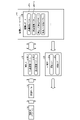
- FIG. 1 to 4 are diagrams for explaining the processing of the information processing apparatus according to this embodiment.
- the information processing device has a troubleshooting history table 30 .
- the trouble handling history table 30 a plurality of past trouble handling histories are registered.
- FIG. 1 shows the troubleshooting history 30a.
- the troubleshooting history 30a includes an area 31a in which data of questions received from customers in the past is recorded, and an area 31b in which data of responses to the questions by the operator are recorded.
- the information processing device generates a failure report table 40 based on the trouble handling history table 30.
- a plurality of failure reports are registered in the failure report table 40 .
- the example shown in FIG. 1 shows a failure report 40a.
- the information processing device generates a failure report 40a based on the troubleshooting history 30a.
- the administrator may refer to the troubleshooting history 30a and input the information of the trouble report 40a to the information processing device via an input device or the like.
- the failure report 40a includes a subtext 41a regarding question content, a subtext 41b regarding common phenomena, a subtext 41c regarding specific phenomena, a subtext 41d regarding causes, and a subtext 41e regarding countermeasures.
- the question content indicates the content of the question text.
- the text included in the area 31a of the troubleshooting history table 30 is the subtext 41a of the question content.
- a common phenomenon indicates a failure phenomenon common to multiple question sentences.
- the text included in the area 32a of the troubleshooting history 30a is the subtext 41b of the common phenomenon.
- the information processing device compares the texts of the question sentences of other failure reports to identify texts that are common phenomena.
- Inherent phenomenon indicates the phenomenon of a specific disability in the target question sentence.
- the text included in the area 32b of the troubleshooting history 30a is the subtext 41c of the inherent phenomenon.
- the information processing device compares the text of the question sentences of other trouble reports to identify the text that is the characteristic phenomenon.
- the cause indicates the cause of the failure.
- the text included in the area 32c of the troubleshooting history 30a is the cause subtext 41d.
- “Handling” indicates how to deal with failures.
- the text included in the area 32d of the trouble handling history 30a is the subtext 41e of the handling.
- the information processing device calculates vectors of the subtexts 41a to 41e included in the failure report 40a.
- the information processing device calculates a question content vector Vq1 from the subtext 41a.
- the information processing device calculates a common phenomenon vector V1-1 from the subtext 41b.
- the information processing device calculates the vector V1-2 of the characteristic phenomenon from the subtext 41c.
- the information processing device calculates a cause vector V1-3 from the subtext 41d.
- the information processing device calculates a countermeasure vector V1-4 from the subtext 41e.
- a specific example in which the information processing apparatus calculates a vector from text information such as subtext will be described later.
- the information processing device also calculates subtext vectors of question content, common phenomena, unique phenomena, causes, and countermeasures for each of the plurality of fault reports included in the fault report table 40 .
- the vector calculated from the subtext of the question content is referred to as "question content vector”.
- a vector calculated from the subtext of a common phenomenon is referred to as a "common phenomenon vector”.
- a vector calculated from the subtext of an eigenphenomenon is referred to as an eigenphenomenon vector.
- a vector calculated from the subtext of the cause is referred to as a “cause vector”.
- a vector calculated from the subtext of the countermeasure is referred to as a “coping vector”.
- the information processing device generates the learning table 65 based on each vector calculated from the plurality of failure reports in the failure report table 40 .
- the information processing device associates a question content vector, a common phenomenon vector, a unique phenomenon vector, a cause vector, and a countermeasure vector calculated from the same failure report, and registers them in the learning table 65 .
- the question content vector is the data on the input side of the learning model 70
- the common phenomenon vector, the unique phenomenon vector, the cause vector, and the countermeasure vector are the data on the output side (correct label) of the learning model 70.
- the information processing device uses the learning table 65 to perform learning of the learning model 70 .
- the learning model 70 corresponds to a CNN (Convolutional Neural Network), RNN (Recurrent Neural Network), or the like.
- a common phenomenon vector, a unique phenomenon vector, a cause vector, and a countermeasure vector are output from different nodes in the output layer.
- the information processing device executes learning by error backpropagation so that the output when the question content vector is input to the learning model 70 approaches the common phenomenon vector, the unique phenomenon vector, the cause vector, and the countermeasure vector.
- the information processing device repeats the above processing based on the relationship between the "question content vector” and the "common phenomenon vector, unique phenomenon vector, cause vector, and countermeasure vector", thereby changing the parameters of the learning model 70. tune (perform machine learning).
- the customer When a failure occurs in the service being used, the customer operates the terminal device to create a question 11 and transmit it to the information processing device.
- the information processing device converts the question 10 into a vector, and inputs the converted vector to the learning model 70 to obtain a common phenomenon vector v10-1 and a unique phenomenon vector v10-2.
- the information processing device compares the common phenomenon vector v10-1 and the unique phenomenon vector v10-2 with the common phenomenon vector and the unique phenomenon vector of each failure report stored in the failure report table 40, respectively. As a result of the comparison, the information processing device identifies a similar common phenomenon vector and failure report 40-1 having the common phenomenon vector.
- failure report 40-1 a failure report having common phenomenon vector v40-11 and unique phenomenon vector v40-12 similar to common phenomenon vector v10-1 and unique phenomenon vector v10-2 is called failure report 40-1.
- the information processing device generates a response sentence 20 in which the cause ⁇ 1 and the countermeasure ⁇ 2 set in the failure report 40-1 are set, and transmits the response sentence 20 to the customer's terminal device.
- the customer When a failure occurs in the service being used, the customer operates the terminal device to create a question 11 and transmit it to the information processing device.
- the information processing device converts the question 11 into a vector and inputs the converted vector to the learning model 70 to calculate the common phenomenon vector v11-1. Note that the information processing apparatus does not identify the natural phenomenon vector when the value of the natural phenomenon vector output from the learning model 70 is not within the predetermined range.
- the information processing device compares the common phenomenon vector v11-1 with the common phenomenon vector of each fault report stored in the fault report table 40, respectively. As a result of the comparison, the information processing device identifies failure reports 40-2 and 40-3 having similar common phenomenon vectors. In this way, when the information processing device identifies a plurality of failure reports, it generates a response sentence 21 and notifies it to the customer's terminal device.
- the response sentence 21 includes the unique phenomenon 21a of the failure report 40-2 and the unique phenomenon 21b of the failure report 40-3.
- the customer operates the terminal device to check the response sentence 21, selects the unique phenomenon similar to the service in progress from among the unique phenomena 21a and 21b, and generates the question sentence 12.
- the customer selects the unique phenomenon 21b, generates the question sentence 12, and transmits it to the information processing device.
- the information processing device Upon receiving the question text 12, the information processing device identifies the failure report 40-3 corresponding to the inherent phenomenon 21b included in the question text 12. The information processing device generates a response sentence 22 in which the cause ⁇ 1 and the countermeasure ⁇ 2 set in the failure report 40-3 are set, and transmits it to the customer's terminal device.
- the information processing device acquires a plurality of subtexts of the text data of the question content and the text data of the response content included in the failure report table 40, and uses the vector of each subtext to create the learning table 65. and perform training of the learning model 70 .
- the information processing device uses a vector calculated by inputting the vector of the question into the learning model 70 to identify the trouble report having the corresponding vector and generate a response. do. This makes it possible to efficiently create FAQs.
- FIG. 5 is a diagram showing a system according to this embodiment. As shown in FIG. 5, this system has terminal devices 5a, 5b, 5c and an information processing device 100. FIG. Terminal devices 5 a to 5 c and information processing device 100 are interconnected via network 6 .
- Terminal devices 5a to 5c are terminal devices used by customers. In the following description, terminal devices 5a to 5c are collectively referred to as terminal device 5.
- FIG. The customer operates the terminal device 5 to generate question text data and transmit it to the information processing device 100 .
- the terminal device 5 receives the response text data from the information processing device, the terminal device 5 displays the received response text information.
- the information processing device 100 generates the learning model 70 by executing the processing described with reference to FIGS. 1 and 2 as preprocessing.
- the information processing apparatus 100 uses the learning model 70 to execute the processing described with reference to FIGS. , to the terminal device 5 .
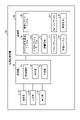
- FIG. 6 is a functional block diagram showing the configuration of the information processing apparatus according to this embodiment. As shown in FIG. 6 , this information processing apparatus 100 has a communication section 110 , an input section 120 , a display section 130 , a storage section 140 and a control section 150 .
- the communication unit 110 is connected to an external device or the like by wire or wirelessly, and transmits and receives information to and from the terminal device 5 and the external device.
- the communication unit 110 is implemented by a NIC (Network Interface Card) or the like.
- the input unit 120 is an input device that inputs various types of information to the information processing device 100 .
- the input unit 120 corresponds to a keyboard, mouse, touch panel, or the like.
- the display unit 130 is a display device that displays information output from the control unit 150 .
- the display unit 130 corresponds to a liquid crystal display, an organic EL (Electro Luminescence) display, a touch panel, or the like.
- the storage unit 140 has a troubleshooting history table 30, a failure report table 40, an encoded file table 50, dictionary information D1, a vector table T1, a transposed index In1, a learning table 65, and a learning model 70.
- the storage unit 140 is implemented by, for example, a semiconductor memory device such as RAM (Random Access Memory) or flash memory, or a storage device such as a hard disk or optical disk.
- the trouble handling history table 30 is a table in which a plurality of past trouble handling histories are registered by an administrator or the like.
- the troubleshooting history table 30 corresponds to the troubleshooting history table 30 described with reference to FIG.
- the trouble report table 40 has a plurality of trouble reports generated based on the trouble handling history table 30.
- the failure report table 40 corresponds to the failure report table 40 described with reference to FIG.
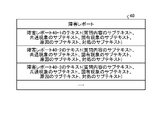
- FIG. 7 is a diagram showing an example of the data structure of the failure report table.
- the failure report table 40 has multiple failure reports.
- the text of the trouble report includes question content subtext, common phenomenon subtext, specific phenomenon subtext, cause subtext, and countermeasure subtext. Although illustration is omitted, each failure report is assigned identification information that uniquely identifies the failure report.
- the encoded file table 50 registers information obtained by encoding each failure report included in the failure report table 40 .
- FIG. 8 is a diagram showing an example of the data structure of the encoded file table. As shown in FIG. 8, this encoded file table 50 associates identification information with compressed code arrays.
- Identification information is information that uniquely identifies the failure report that is the target of encoding.
- the compressed code array represents the fault report encoded word by word.
- the compressed code array has a compressed code array encoded with the subtext of the question content, a compressed code array encoded with the subtext of the common phenomenon, and a compressed code array encoded with the subtext of the specific phenomenon.
- the compression code array has a compression code array that encodes the cause subtext and a compression code array that encodes the countermeasure subtext.
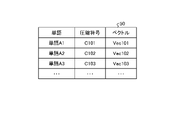
- the dictionary information D1 is dictionary information that defines compression codes corresponding to words.
- FIG. 9 is a diagram showing an example of the data structure of dictionary information. As shown in FIG. 9, the dictionary information D1 associates words, codes, and vectors. It is assumed that vectors corresponding to compression codes are assigned in advance by Poincare embedding or the like. Note that the compression code vector may be specified based on other conventional techniques.
- Poincaré embedding for example, the technique described in the non-patent document "Valentin Khrulkov1 et al. "Hyperbolic Image Embeddings” Georgia University, 2019 April 3" may be used.
- a vector is assigned according to the embedded position in the Poincare space, and the more similar the information, the closer the information is embedded.
- the information processing apparatus 100 embeds a static code in the Poincare space in advance and calculates a vector for the static code.
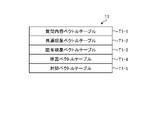
- FIG. 10 is a diagram showing an example of the data structure of a vector table.
- the vector table T1 includes a question content vector table T1-1, a common phenomenon vector table T1-2, a unique phenomenon vector table T1-3, a cause vector table T1-4, a countermeasure vector table T1- 5.
- the question content vector table T1-1 associates the compression code array of the subtext of the question content with the vector.
- the common phenomenon vector table T1-2 associates compression code arrays of common phenomenon subtexts with vectors.
- the peculiar phenomenon vector table T1-3 associates compression code arrays of subtexts of peculiar phenomena with vectors.
- the cause vector table T1-4 associates compression code arrays of cause subtexts with vectors.
- the countermeasure vector table T1-5 associates compression code arrays of countermeasure subtexts with vectors. Illustration of each vector table is omitted.
- the transposed index table In1 defines the offset (distance from the top of the encoded file table 50) of the compression code array of each subtext.
- FIG. 11 is a diagram illustrating an example of the data structure of an inverted index table. As shown in FIG. 11, for example, the transposed index table In1 includes a question content transposed index In1-1, a common phenomenon transposed index In1-2, a unique phenomenon transposed index In1-3, a cause transposed index In1-4, and a countermeasure transposed index. 1-5.
- the question content transposed index In1-1 defines the compression code array of the subtext of the question content and the offset.
- the common phenomenon transposition index In1-2 defines the compressed code array and offset of the subtext of the common phenomenon.
- Eigenphenomenon transposition indices In1-3 define the compressed code array and offset of the subtext of the eigenphenomenon.
- the causal transposition indices In1-4 define the compressed code array and offset of the causal subtext.
- the causal transposition indices In1-5 define compression code arrays and offsets of subtexts to be dealt with.
- the learning table 65 stores data for training the learning model 70.
- the description of the learning table 65 corresponds to the description of the learning table 65 given in FIG.
- the learning model 70 corresponds to CNN, RNN, and the like.
- a common phenomenon vector, a unique phenomenon vector, a cause vector, and a countermeasure vector are output from different nodes in the output layer.
- the control unit 150 has a preprocessing unit 151 , a learning unit 152 and a generation unit 153 .
- the control unit 150 is realized by, for example, a CPU (Central Processing Unit) or an MPU (Micro Processing Unit). Also, the control unit 150 may be executed by an integrated circuit such as an ASIC (Application Specific Integrated Circuit) or an FPGA (Field Programmable Gate Array).
- ASIC Application Specific Integrated Circuit
- FPGA Field Programmable Gate Array
- the preprocessing unit 151 executes processing for generating the failure report table 40, processing for calculating vectors, and processing for generating the learning table 65.
- the process of generating the failure report table 40 by the preprocessing unit 151 will be described. This process corresponds to the process described in FIG.
- the preprocessing unit 151 generates the trouble report table 40 based on the trouble handling history table 30 .
- the preprocessing unit 151 refers to the troubleshooting history to specify an area in which question text data is recorded and an area in which response text data is recorded.
- the area in which the question sentence data is recorded and the area in which the response sentence data is recorded may be set in advance.
- the preprocessing unit 151 extracts the text in the area where the data of the question sentence is recorded as the subtext of the question content.
- the preprocessing unit 151 compares the texts of the question sentences of each troubleshooting history to specify and extract the subtext of the common phenomenon and the subtext of the unique phenomenon.
- the preprocessing unit 151 extracts the subtext of the cause and the subtext of the countermeasure from the text in the area in which the response sentence data is recorded.
- the administrator refers to the troubleshooting history and operates the input unit 120 to specify the subtext of the question, the subtext of the common phenomenon, the subtext of the specific phenomenon, the subtext of the cause, and the subtext of the countermeasure. You may Based on the specified information, the preprocessing unit 151 extracts the subtext of the question, the subtext of the common phenomenon, the subtext of the unique phenomenon, the subtext of the cause, and the subtext of the countermeasure.
- the preprocessing unit 151 extracts the subtext of the question content from the trouble report table 40 .
- the preprocessing unit 151 performs morphological analysis on the subtext of the question content and divides it into a plurality of words.
- the preprocessing unit 151 compares each divided word with the dictionary information D1 and assigns a compression code to the word, thereby generating a compression code array of question content.
- the preprocessing unit 151 registers the compressed code array of the question content in the encoded file table 50 .
- the preprocessing unit 151 compares each divided word with the dictionary information D1, assigns a vector of each word (compression code), and multiplies the vectors of the words included in the subtext of the question content. , to calculate the question content vector.
- the preprocessing unit 151 associates the compressed code array of the question content with the question content vector and registers them in the question content vector table T1-1.
- the preprocessing unit 151 associates the question content vector with the offset and registers them in the question content transposed index In1-1.
- the preprocessing unit 151 similarly generates a common phenomenon compression code and a common phenomenon vector for the subtext of the common phenomenon.
- the preprocessing unit 151 registers the common phenomenon compression code array in the encoded file table 50 .
- the preprocessing unit 151 associates the common phenomenon compression code array with the common phenomenon vector and registers them in the common phenomenon vector table T1-2.
- the preprocessing unit 151 associates the common phenomenon vector with the offset and registers them in the common phenomenon transposition index In1-2.
- the pre-processing unit 151 similarly generates a compression code and an eigenphenomenon vector for the eigenphenomenon subtext.
- the preprocessing unit 151 registers the compression code array of the inherent phenomenon in the encoded file table 50 .
- the preprocessing unit 151 associates the unique phenomenon compression code array with the unique phenomenon vector and registers them in the unique phenomenon vector table T1-3.
- the preprocessing unit 151 associates the characteristic phenomenon vector with the offset and registers them in the characteristic phenomenon transposition index In1-3.
- the preprocessing unit 151 similarly generates a compression code and a cause vector for the cause subtext.
- the preprocessing unit 151 registers the cause compression code array in the encoded file table 50 .
- the preprocessing unit 151 associates the cause compression code array with the cause vector and registers them in the cause vector table T1-4.
- the preprocessing unit 151 associates the cause vector with the offset and registers them in the cause permutation index In1-4.
- the preprocessing unit 151 similarly generates a compression code for the countermeasure and a countermeasure vector for the subtext for the countermeasure.
- the preprocessing unit 151 registers the corresponding compression code array in the encoded file table 50 .
- the pre-processing unit 151 associates the compression code array for coping with the coping vector and registers them in the coping vector table T1-5.
- the preprocessing unit 151 associates the countermeasure vector with the offset and registers them in the countermeasure transposed index In1-5.
- each subtext of the failure report contained in the failure report table 40 and the vector was defined using the encoded file table 50, the vector table T1, and the transposed index In1. It is not limited.
- the information processing apparatus 100 may directly associate each subtext included in the failure report with each vector and set them in the failure report table 40 .
- the preprocessing unit 151 registers, in the learning table 65, the relationship between the "question content vector” and the "common phenomenon vector, unique phenomenon vector, cause vector, countermeasure vector” in the failure report.
- the preprocessing unit 151 generates the learning table 65 by repeatedly executing the above process for each failure report.
- the learning unit 152 uses the learning table 65 to perform learning of the learning model 70 .
- the learning unit 152 executes learning by error backpropagation so that the output when the question content vector is input to the learning model 70 approaches the common phenomenon vector, the unique phenomenon vector, the cause vector, and the countermeasure vector.
- the learning unit 152 repeats the above processing based on the relationship between the “question content vector” and the “common phenomenon vector, unique phenomenon vector, cause vector, and countermeasure vector” to obtain the parameters of the learning model 70. tune (perform machine learning).
- the generation unit 153 is a processing unit that, when receiving question text data from the terminal device 5 , generates response text data corresponding to the question text and transmits the data to the terminal device 5 .
- the processing of the generating unit 153 corresponds to the processing described with reference to FIGS. 3 and 4. FIG.
- the generation unit 153 Upon receiving the question text 10 from the terminal device 5, the generation unit 153 converts the question text 10 into a vector. For example, the generation unit 153 morphologically analyzes the text included in the question sentence 10 and divides it into a plurality of words. The generation unit 153 compares the divided words with the dictionary information D1 to specify the vector of each word, and calculates the vector of the question sentence 10 by integrating the vector of each word.
- the generation unit 153 inputs the vector of the question sentence 10 to the learning model 70 to calculate the common phenomenon vector v10-1 and the unique phenomenon vector v10-2. Note that the generation unit 153 does not use the cause vector and the coping vector that can be output from the learning model 70 .
- the generating unit 153 compares the common phenomenon vector v10-1 and the unique phenomenon vector v10-2 with the common phenomenon vector and the unique phenomenon vector of each failure report stored in the failure report table 40, respectively. As a result of the comparison, generation unit 153 identifies similar common phenomenon vectors and failure reports 40-1 having common phenomenon vectors. For example, the generation unit 153 determines that the compared vectors are similar when the cos similarity between the vectors is equal to or greater than a threshold.
- failure report 40-1 a failure report having common phenomenon vector v40-11 and unique phenomenon vector v40-12 similar to common phenomenon vector v10-1 and unique phenomenon vector v10-2 is called failure report 40-1.
- the generation unit 153 generates the response text 20 in which the cause ⁇ 1 and the countermeasure ⁇ 2 set in the failure report 40-1 are set, and transmits the response text 20 to the terminal device 5 which is the transmission source of the question text 10.
- FIG. 1 a failure report having common phenomenon vector v40-11 and unique phenomenon vector v40-12 similar to common phenomenon vector v10-1 and unique phenomenon vector v10-2.
- the generating unit 153 Upon receiving the question text 11 from the terminal device 5, the generating unit 153 converts the question text 11 into a vector.
- the process of converting the question sentence 11 into a vector is the same as the process of converting the question sentence 10 into a vector.
- the generation unit 153 inputs the vector of the question sentence 11 to the learning model 70 to calculate the common phenomenon vector v11-1. Note that the generation unit 153 does not specify the natural phenomenon vector when the value of the natural phenomenon vector output from the learning model 70 is not within the predetermined range. Moreover, the generation unit 153 does not use the cause vector and the coping vector that can be output from the learning model 70 .
- the generation unit 153 compares the common phenomenon vector v11-1 with the common phenomenon vector of each fault report stored in the fault report table 40. As a result of the comparison, generation unit 153 identifies failure reports 40-2 and 40-3 having similar common phenomenon vectors. In this way, when a plurality of trouble reports are specified, the generation unit 153 generates the response sentence 21 and notifies the terminal device 5 that sent the question sentence 11 of the response sentence 21 .
- the response sentence 21 includes the unique phenomenon 21a of the failure report 40-2 and the unique phenomenon 21b of the failure report 40-3.
- the customer operates the terminal device 5 to check the response sentence 21, selects the unique phenomenon similar to the service in progress from among the unique phenomena 21a and 21b, and generates the question sentence 12.
- the customer selects the characteristic phenomenon 21b, generates the question sentence 12, and transmits it to the generation unit 153 of the information processing apparatus 100.
- the generation unit 153 of the information processing apparatus 100 In the example shown in FIG.
- the generation unit 153 Upon receiving the question text 12, the generation unit 153 identifies the failure report 40-3 corresponding to the inherent phenomenon 21b included in the question text 12. The information processing device generates a response sentence 22 in which the cause ⁇ 1 and the countermeasure ⁇ 2 set in the failure report 40-3 are set, and transmits the response sentence 22 to the terminal device 5 that sent the question sentence 12.
- FIG. 12 is a flowchart (1) showing the processing procedure of the information processing apparatus according to the embodiment.
- the preprocessing unit 151 of the information processing apparatus 100 extracts from the failure report table 40 the subtext of the question contained in the failure report, the subtext of the common phenomenon, the subtext of the unique phenomenon, the subtext of the cause, and so on.
- a text and a subtext of a countermeasure are acquired (step S101).
- the preprocessing unit 151 generates a question sentence vector, a common phenomenon vector, a unique phenomenon vector, a cause vector, and a countermeasure vector based on the dictionary information D1 (step S102).
- the preprocessing unit 151 generates the learning table 65 (step S103).
- the generation unit 153 of the information processing device 100 generates the learning model 70 based on the learning table 65 (step S104).
- FIG. 13 is a flowchart (2) showing the processing procedure of the information processing apparatus according to this embodiment.
- the generation unit 153 of the information processing device 100 receives question text data from the terminal device 5 (step S201).
- the generation unit 153 calculates the vector of the question sentence (step S202).
- the generation unit 153 inputs the vector of the question text to the learning model 70 (step S203).
- the process proceeds to step S205.
- the generation unit 153 proceeds to step S206.
- step S205 Based on the common phenomenon vector and the unique phenomenon vector, the generation unit 153 detects failure reports corresponding to similar common phenomenon vectors and unique phenomenon vectors (step S205), and proceeds to step S210.
- step S206 Based on the common phenomenon vector, the generator 153 detects a plurality of failure reports corresponding to similar common phenomenon vectors (step S206). The generation unit 153 sets each unique phenomenon included in the plurality of detected failure reports as a response plan, and transmits the response plan to the terminal device 5 (step S207).
- the generation unit 153 receives question text data from the terminal device 5 (step S208).
- the generation unit 153 detects a failure report corresponding to the unique phenomenon included in the question (step S209).
- the generating unit 153 generates a proposed response based on the cause and countermeasures of the detected failure report, and transmits it to the terminal device 5 (step S210).
- the information processing apparatus 100 calculates the vector of each subtext of the text data of the question content and the text data of the response content included in the failure report table 40, generates the learning table 65, and executes the learning of the learning model 70. . Further, when receiving a question from a customer, the information processing apparatus 100 uses a vector calculated by inputting the vector of the question into the learning model 70 to identify a failure report having the corresponding vector, and responds to the request. generate sentences. This allows the FQA to be created efficiently.
- the information processing apparatus 100 generates the learning table 65 based on each vector of the subtext of the question content, the subtext of the common phenomenon, the subtext of the unique phenomenon, the subtext of the cause, and the subtext of the countermeasure from the failure report. and the learning of the learning model 70 is executed.
- this learning model 70 it is possible to calculate vectors of common phenomena, unique phenomena, causes, and countermeasures from vectors of question contents.
- the information processing apparatus 100 inputs a question sentence vector into a learning model, calculates a common phenomenon vector and a unique phenomenon vector, detects a failure report corresponding to a similar common phenomenon vector and a similar unique phenomenon vector, and detects the detected failure. Generate a response sentence based on the report. This makes it possible to efficiently generate a response sentence corresponding to the question sentence.
- a trouble report from the trouble handling history for software products was shown, but it is equivalent to a trouble report from the trouble handling history for hardware products such as keyboards, printers, hard disks, and medicines.
- History information may be generated and processed in the same manner as failure reports.
- standard usage methods are indicated in operation manuals and attached documents, there is no description of troubles caused by mistakes in multiple operations (medication) or operating environment (complications).
- From the information extract subtext related to troubles caused by multiple operation errors or operating environments, etc., and calculate vectors in the same way as the subtext of common phenomena, unique phenomena, causes, and countermeasures described above, and use it as a learning model. learning may be performed.
- FIG. 14 is a diagram illustrating an example of a hardware configuration of a computer that implements functions similar to those of the information processing apparatus of the embodiment.
- the computer 200 has a CPU 201 that executes various arithmetic processes, an input device 202 that receives data input from the user, and a display 203 .
- the computer 200 also has a communication device 204 and an interface device 205 for exchanging data with an external device or the like via a wired or wireless network.
- the computer 200 also has a RAM 206 that temporarily stores various information, and a hard disk device 207 . Each device 201 - 207 is then connected to a bus 208 .
- the hard disk device 207 has a preprocessing program 207a, a learning program 207b, a calculation program 207c, and an analysis program 207d. Also, the CPU 201 reads out each of the programs 207 a to 207 d and develops them in the RAM 206 .
- the preprocessing program 207a functions as a preprocessing process 206a.
- Learning program 207b functions as learning process 206b.
- the generation program 207c functions as a generation process 206c.
- the processing of the preprocessing process 206a corresponds to the processing of the preprocessing unit 151.
- the processing of the learning process 206 b corresponds to the processing of the learning unit 152 .
- the processing of the generation process 206 c corresponds to the processing of the generation unit 153 .
- each program 207a to 207c do not necessarily have to be stored in the hard disk device 207 from the beginning.
- each program is stored in a “portable physical medium” such as a flexible disk (FD), CD-ROM, DVD, magneto-optical disk, IC card, etc. inserted into the computer 200 . Then, the computer 200 may read and execute each program 207a to 207c.
- a “portable physical medium” such as a flexible disk (FD), CD-ROM, DVD, magneto-optical disk, IC card, etc.
- information processing device 110 communication unit 120 input unit 130 display unit 140 storage unit 150 control unit 151 preprocessing unit 152 learning unit 153 generation unit
Landscapes
- Engineering & Computer Science (AREA)
- Theoretical Computer Science (AREA)
- Physics & Mathematics (AREA)
- Data Mining & Analysis (AREA)
- General Physics & Mathematics (AREA)
- General Engineering & Computer Science (AREA)
- Computational Linguistics (AREA)
- Artificial Intelligence (AREA)
- Mathematical Physics (AREA)
- Databases & Information Systems (AREA)
- Evolutionary Computation (AREA)
- Life Sciences & Earth Sciences (AREA)
- General Health & Medical Sciences (AREA)
- Health & Medical Sciences (AREA)
- Human Computer Interaction (AREA)
- Bioinformatics & Cheminformatics (AREA)
- Evolutionary Biology (AREA)
- Computer Vision & Pattern Recognition (AREA)
- Bioinformatics & Computational Biology (AREA)
- Biomedical Technology (AREA)
- Biophysics (AREA)
- Molecular Biology (AREA)
- Computing Systems (AREA)
- Software Systems (AREA)
- Audiology, Speech & Language Pathology (AREA)
- Information Retrieval, Db Structures And Fs Structures Therefor (AREA)
Priority Applications (4)
| Application Number | Priority Date | Filing Date | Title |
|---|---|---|---|
| JP2023516021A JPWO2022224462A1 (https=) | 2021-04-23 | 2021-04-23 | |
| EP21937952.6A EP4328762A1 (en) | 2021-04-23 | 2021-04-23 | Information processing program, information processing method, and information processing device |
| PCT/JP2021/016551 WO2022224462A1 (ja) | 2021-04-23 | 2021-04-23 | 情報処理プログラム、情報処理方法および情報処理装置 |
| US18/479,910 US20240028626A1 (en) | 2021-04-23 | 2023-10-03 | Non-transitory computer-readable recording medium storing information processing program, information processing method, and information processing device |
Applications Claiming Priority (1)
| Application Number | Priority Date | Filing Date | Title |
|---|---|---|---|
| PCT/JP2021/016551 WO2022224462A1 (ja) | 2021-04-23 | 2021-04-23 | 情報処理プログラム、情報処理方法および情報処理装置 |
Related Child Applications (1)
| Application Number | Title | Priority Date | Filing Date |
|---|---|---|---|
| US18/479,910 Continuation US20240028626A1 (en) | 2021-04-23 | 2023-10-03 | Non-transitory computer-readable recording medium storing information processing program, information processing method, and information processing device |
Publications (1)
| Publication Number | Publication Date |
|---|---|
| WO2022224462A1 true WO2022224462A1 (ja) | 2022-10-27 |
Family
ID=83722225
Family Applications (1)
| Application Number | Title | Priority Date | Filing Date |
|---|---|---|---|
| PCT/JP2021/016551 Ceased WO2022224462A1 (ja) | 2021-04-23 | 2021-04-23 | 情報処理プログラム、情報処理方法および情報処理装置 |
Country Status (4)
| Country | Link |
|---|---|
| US (1) | US20240028626A1 (https=) |
| EP (1) | EP4328762A1 (https=) |
| JP (1) | JPWO2022224462A1 (https=) |
| WO (1) | WO2022224462A1 (https=) |
Cited By (1)
| Publication number | Priority date | Publication date | Assignee | Title |
|---|---|---|---|---|
| WO2025046681A1 (ja) * | 2023-08-28 | 2025-03-06 | 日本電気株式会社 | 会議情報処理装置、会議情報処理方法、及び、記録媒体 |
Families Citing this family (1)
| Publication number | Priority date | Publication date | Assignee | Title |
|---|---|---|---|---|
| US20250053742A1 (en) * | 2023-08-09 | 2025-02-13 | Sentence Data Refinery Inc. | Textual information refining |
Citations (5)
| Publication number | Priority date | Publication date | Assignee | Title |
|---|---|---|---|---|
| JP2002041573A (ja) | 2000-05-17 | 2002-02-08 | Matsushita Electric Ind Co Ltd | 情報検索システム |
| JP2005196296A (ja) | 2003-12-26 | 2005-07-21 | Sanyo Electric Co Ltd | アフターサービス方法 |
| JP2018206307A (ja) * | 2017-06-09 | 2018-12-27 | エヌ・ティ・ティ レゾナント株式会社 | 情報処理装置、情報処理方法、及びプログラム |
| JP2020135289A (ja) * | 2019-02-18 | 2020-08-31 | 日本電信電話株式会社 | 質問応答装置、学習装置、質問応答方法及びプログラム |
| WO2020240709A1 (ja) * | 2019-05-28 | 2020-12-03 | 日本電信電話株式会社 | 対話処理装置、学習装置、対話処理方法、学習方法及びプログラム |
-
2021
- 2021-04-23 JP JP2023516021A patent/JPWO2022224462A1/ja active Pending
- 2021-04-23 EP EP21937952.6A patent/EP4328762A1/en not_active Withdrawn
- 2021-04-23 WO PCT/JP2021/016551 patent/WO2022224462A1/ja not_active Ceased
-
2023
- 2023-10-03 US US18/479,910 patent/US20240028626A1/en not_active Abandoned
Patent Citations (5)
| Publication number | Priority date | Publication date | Assignee | Title |
|---|---|---|---|---|
| JP2002041573A (ja) | 2000-05-17 | 2002-02-08 | Matsushita Electric Ind Co Ltd | 情報検索システム |
| JP2005196296A (ja) | 2003-12-26 | 2005-07-21 | Sanyo Electric Co Ltd | アフターサービス方法 |
| JP2018206307A (ja) * | 2017-06-09 | 2018-12-27 | エヌ・ティ・ティ レゾナント株式会社 | 情報処理装置、情報処理方法、及びプログラム |
| JP2020135289A (ja) * | 2019-02-18 | 2020-08-31 | 日本電信電話株式会社 | 質問応答装置、学習装置、質問応答方法及びプログラム |
| WO2020240709A1 (ja) * | 2019-05-28 | 2020-12-03 | 日本電信電話株式会社 | 対話処理装置、学習装置、対話処理方法、学習方法及びプログラム |
Non-Patent Citations (3)
| Title |
|---|
| OTSUKA, ATSUSHI ET AL.: "B6-3 Proposal of document retrieval method to predict answer", THE 9TH FORUM ON DATA ENGINEERING AND INFORMATION MANAGEMENT - THE 15TH ANNUAL CONFERENCE OF THE DATABASE SOCIETY OF JAPAN (DEIM FORUM 2017), 6 July 2017 (2017-07-06), pages 1 - 8, XP009549842 * |
| UCHIYAMA, IKUMI: "Utilization for A1 of spreading videos around the world, The reason why commercial broadcasting key stations are serious", NIKKEI ELECTRONICS, NIKKEI BUSINESS PUBLICATIONS, TOKYO, JP, no. 1180, 20 May 2017 (2017-05-20), JP , pages 18 - 20, XP009549781, ISSN: 0385-1680 * |
| VALENTIN KHRULKOV1 ET AL.: "Hyperbolic Image Embeddings", 3 April 2019, CORNELL UNIVERSITY |
Cited By (1)
| Publication number | Priority date | Publication date | Assignee | Title |
|---|---|---|---|---|
| WO2025046681A1 (ja) * | 2023-08-28 | 2025-03-06 | 日本電気株式会社 | 会議情報処理装置、会議情報処理方法、及び、記録媒体 |
Also Published As
| Publication number | Publication date |
|---|---|
| US20240028626A1 (en) | 2024-01-25 |
| JPWO2022224462A1 (https=) | 2022-10-27 |
| EP4328762A1 (en) | 2024-02-28 |
Similar Documents
| Publication | Publication Date | Title |
|---|---|---|
| Olaniyi et al. | Dynamics of the digital workforce: Assessing the interplay and impact of AI, automation, and employment policies | |
| US12001798B2 (en) | Generation of training data for machine learning based models for named entity recognition for natural language processing | |
| Chao et al. | Bert-dst: Scalable end-to-end dialogue state tracking with bidirectional encoder representations from transformer | |
| US10331768B2 (en) | Tagging text snippets | |
| US20230031702A1 (en) | Neural Networks based Multimodal Transformer for Multi-Task User Interface Modeling | |
| US20250111169A1 (en) | Multi-large language model system and method | |
| AU2018375085A1 (en) | Method and apparatus for providing personalized self-help experience | |
| WO2021164301A1 (zh) | 医学文本结构化方法、装置、计算机设备及存储介质 | |
| CN1764944A (zh) | 语音识别系统 | |
| Tao et al. | Biglog: Unsupervised large-scale pre-training for a unified log representation | |
| Gupta et al. | Learning representations on logs for aiops | |
| CN111866004B (zh) | 安全评估方法、装置、计算机系统和介质 | |
| JP2022521174A (ja) | センサ入力信号からのコグニティブ・クエリへの応答 | |
| WO2022224462A1 (ja) | 情報処理プログラム、情報処理方法および情報処理装置 | |
| JP2022119207A (ja) | 機械学習および自然言語処理を利用したワクチン接種データの抽出および確認 | |
| CN113868419A (zh) | 基于人工智能的文本分类方法、装置、设备及介质 | |
| CN112685550A (zh) | 智能问答方法、装置、服务器及计算机可读存储介质 | |
| CN121094099A (zh) | 采用逻辑推理的生成式ai | |
| Sree Lakshmi et al. | Empowering educators: Automated short answer grading with inconsistency check and feedback integration using machine learning | |
| Song et al. | Multi-device universal automation data acquisition and integration system | |
| US20220245350A1 (en) | Framework and interface for machines | |
| WO2023154351A2 (en) | Apparatus and method for automated video record generation | |
| KR102445098B1 (ko) | 인공 지능 기반 의료 텍스트의 노이즈 데이터 필터링 방법, 장치 및 프로그램 | |
| JP2024099337A (ja) | 情報学習装置、方法およびプログラム | |
| CN118119944A (zh) | 用于识别用户的反馈的情绪的系统和方法 |
Legal Events
| Date | Code | Title | Description |
|---|---|---|---|
| 121 | Ep: the epo has been informed by wipo that ep was designated in this application |
Ref document number: 21937952 Country of ref document: EP Kind code of ref document: A1 |
|
| ENP | Entry into the national phase |
Ref document number: 2023516021 Country of ref document: JP Kind code of ref document: A |
|
| WWE | Wipo information: entry into national phase |
Ref document number: 2021937952 Country of ref document: EP |
|
| NENP | Non-entry into the national phase |
Ref country code: DE |
|
| ENP | Entry into the national phase |
Ref document number: 2021937952 Country of ref document: EP Effective date: 20231123 |