WO2022195827A1 - 情報処理装置、情報処理方法及び記憶媒体 - Google Patents
情報処理装置、情報処理方法及び記憶媒体 Download PDFInfo
- Publication number
- WO2022195827A1 WO2022195827A1 PCT/JP2021/011243 JP2021011243W WO2022195827A1 WO 2022195827 A1 WO2022195827 A1 WO 2022195827A1 JP 2021011243 W JP2021011243 W JP 2021011243W WO 2022195827 A1 WO2022195827 A1 WO 2022195827A1
- Authority
- WO
- WIPO (PCT)
- Prior art keywords
- class
- data
- classes
- information processing
- projection matrix
- Prior art date
- Legal status (The legal status is an assumption and is not a legal conclusion. Google has not performed a legal analysis and makes no representation as to the accuracy of the status listed.)
- Ceased
Links
Images





Classifications
-
- G—PHYSICS
- G06—COMPUTING OR CALCULATING; COUNTING
- G06F—ELECTRIC DIGITAL DATA PROCESSING
- G06F17/00—Digital computing or data processing equipment or methods, specially adapted for specific functions
- G06F17/10—Complex mathematical operations
- G06F17/16—Matrix or vector computation, e.g. matrix-matrix or matrix-vector multiplication, matrix factorization
-
- G—PHYSICS
- G06—COMPUTING OR CALCULATING; COUNTING
- G06N—COMPUTING ARRANGEMENTS BASED ON SPECIFIC COMPUTATIONAL MODELS
- G06N20/00—Machine learning
-
- G—PHYSICS
- G06—COMPUTING OR CALCULATING; COUNTING
- G06N—COMPUTING ARRANGEMENTS BASED ON SPECIFIC COMPUTATIONAL MODELS
- G06N99/00—Subject matter not provided for in other groups of this subclass
Definitions
- Patent Literature 1 discloses an example of a technique for generating a projection matrix used for dimensionality reduction.
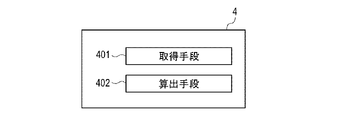
- the plurality of data based on an acquisition means for acquiring a plurality of data each classified into one of a plurality of classes, and an objective function including statistics of the plurality of data, the plurality of data and calculating means for calculating a projection matrix used for dimensionality reduction, wherein the objective function is the inter-class variation of the plurality of data between a first class and a second class among the plurality of classes and a second function including a second term that indicates intra-class variation of the plurality of data in at least one of the first class and the second class,
- the calculation means optimizes the objective function under a constraint condition that selects the first class and the second class in a combination including a specific class that is one of the plurality of classes, thereby
- An information processing device is provided that calculates a projection matrix.
- FIG. 11 is a functional block diagram of an earphone and an information processing device according to a sixth embodiment
- FIG. 14 is a flowchart showing an outline of biometric matching processing performed by an information processing apparatus according to a sixth embodiment
- FIG. 14 is a functional block diagram of an information processing device according to a seventh embodiment
- the information processing apparatus of this embodiment is an apparatus that calculates a projection matrix used for dimension reduction of input data.
- the information processing apparatus of the present embodiment can have a determination function of performing determination such as person identification on data obtained by performing feature selection using a projection matrix on input data.
- This data may be, for example, feature amount data extracted from biometric information.
- the information processing device may be a biometric verification device that performs identification of a person based on biometric information.
- the information processing apparatus of this embodiment is assumed to be a biometric matching apparatus having both a training function for calculating a projection matrix and a determination function based on the projection matrix, but is not limited to this.
- the communication I/F 103 is a communication interface based on standards such as Ethernet (registered trademark), Wi-Fi (registered trademark), and Bluetooth (registered trademark).
- the communication I/F 103 is a module for communicating with other devices such as data servers and sensor devices.
- the input device 104 is a keyboard, pointing device, buttons, etc., and is used by the user to operate the information processing device 1 .
- pointing devices include mice, trackballs, touch panels, and pen tablets.
- the input device 104 may include sensor devices such as cameras, microphones, and the like. These sensor devices can be used to acquire biometric information.
- the output device 105 is, for example, a device that presents information to the user, such as a display device and a speaker.
- the input device 104 and the output device 105 may be integrally formed as a touch panel.
- step S12 the first feature extraction unit 121 extracts feature amount data from the training data.
- step S13 the projection matrix calculator 110 calculates a projection matrix.
- the calculated projection matrix is stored in the projection matrix storage unit 142 .
- feature amount data is multidimensional data, and dimensionality reduction may be required in order to appropriately perform determination based on feature amount data.
- the projection matrix calculation unit 110 performs training for determining a projection matrix for dimensionality reduction based on the training data. Details of the processing in step S13 will be described later.
- feature data extracted from the training data may be stored in the training data storage unit 141 in advance, in which case the process of step S12 may be omitted.
- the determination unit 133 makes a determination based on the feature amount data after feature selection. For example, if the determination by the determination unit 133 is class classification, this determination is processing for determining the class to which the input feature amount data belongs. Further, for example, if the determination by the determination unit 133 is person identification in biometric matching, this determination is processing for determining whether or not the person who acquired the target data is the same person as the registered person.
- Equation (8) is a constraint called an orthonormal constraint.
- the orthonormal constraint has the function of limiting the scale of each column of the projection matrix W and eliminating the redundancy of the feature representation after dimensionality reduction.
- the matrix S ij included in the objective function of WLDA is a matrix indicating inter-class variance
- the matrix S i is a matrix indicating intra-class variance. Therefore, in WLDA, roughly speaking, a projection matrix W is determined that maximizes the ratio of the term indicating the minimum value of inter-class variability of the training data by the term indicating the maximum value of intra-class variability of the training data. be. This approach considers the worst-case combination of multiple training data. Therefore, unlike LDA, which focuses only on the average, even when data is distributed such that only part of the classes overlap, optimization is performed to widen the inter-class distance of such a critical part. A projected projection matrix W can be calculated.
- step S138 the projection matrix updating unit 113 calculates the projection matrix W by performing eigenvalue decomposition on the optimized matrix ⁇ .
- d eigenvalues and their corresponding eigenvectors are calculated from the matrix ⁇ of d rows and d columns.
- D be a diagonal matrix whose diagonal elements are the d calculated eigenvalues
- V be an orthogonal matrix in which the d calculated eigenvectors (vertical vectors) are arranged in each column. (25) can be expressed.
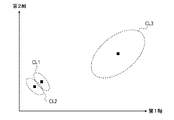
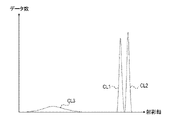
- FIG. 7B is a diagram showing the distribution of training data after projection when class CL1 is set as a specific class.
- the condition of the degree of separation between the class CL1 and other classes is taken into account in the optimization, so the degree of separation between the classes including the class CL1 is is being optimized to improve
- the separability condition between class CL2 and class CL3 is excluded from the optimization constraints. Therefore, as shown in FIG. 7B, particularly class CL1 and class CL2 are well separated.
- the matrix S i,j (overlined is omitted) in Equation (18) is not limited to the average, and at least one of the matrices S i and S j may be used. However, since the two classes can be considered equally, the matrix S i,j (overlined is omitted) is preferably a weighted average of the two classes as in Equation (18).
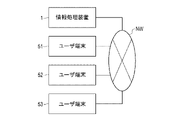
- the information processing apparatus 1 transmits to the user terminal 52 the projection matrix W2 calculated using the class CL2 as the specific class in PWRLDA , and transmits the projection matrix W3 calculated using the class CL3 as the specific class in PWRLDA to the user terminal 52.
- the user terminals 52 and 53 can also perform dimensionality reduction using projection matrices specialized for feature separation between their own class and other classes.
- ear acoustic collation is a technique for judging whether a person is different or not by collating the acoustic characteristics of the person's head including the ear canal. Since the acoustic characteristics of the ear canal differ from person to person, it is suitable for biometric information used for personal verification. Therefore, ear acoustic matching is sometimes used for user discrimination of hearable devices such as earphones. Note that ear acoustic collation may be used not only to determine whether a person is the same, but also to determine the wearing state of a hearable device.
- sound such as sound wave and voice includes non-audible sound whose frequency or sound pressure level is outside the audible range.
- the information processing device 1 is the same device as described in the first to fifth embodiments.
- the information processing device 1 is, for example, a computer communicably connected to the earphone 2, and performs biometric verification based on acoustic information.
- the information processing device 1 further controls the operation of the earphones 2, transmits audio data for generating sound waves emitted from the earphones 2, receives audio data obtained from the sound waves received by the earphones 2, and the like.
- the information processing device 1 transmits compressed music data to the earphone 2 .
- variance is used as an index of intra-class variation or inter-class variation, but any statistic other than variance may be used as long as it can serve as an index of variation.
- Appendix 1 an acquisition means for acquiring a plurality of data each classified into one of a plurality of classes; calculation means for calculating a projection matrix used for dimensionality reduction of the plurality of data based on an objective function including statistics of the plurality of data; has
- the objective function includes a first function including a first term indicating inter-class variation of the plurality of data between a first class and a second class among the plurality of classes; a second function including a second term indicative of intra-class variability of the plurality of data in at least one of two classes;
- the calculation means optimizes the objective function under a constraint condition that selects the first class and the second class in a combination including a specific class that is one of the plurality of classes, calculating the projection matrix; Information processing equipment.
Landscapes
- Engineering & Computer Science (AREA)
- Physics & Mathematics (AREA)
- Mathematical Physics (AREA)
- General Physics & Mathematics (AREA)
- Theoretical Computer Science (AREA)
- Data Mining & Analysis (AREA)
- Software Systems (AREA)
- Mathematical Optimization (AREA)
- Computational Mathematics (AREA)
- Pure & Applied Mathematics (AREA)
- Mathematical Analysis (AREA)
- General Engineering & Computer Science (AREA)
- Computing Systems (AREA)
- Algebra (AREA)
- Databases & Information Systems (AREA)
- Computer Vision & Pattern Recognition (AREA)
- Artificial Intelligence (AREA)
- Evolutionary Computation (AREA)
- Medical Informatics (AREA)
- Image Analysis (AREA)
- Complex Calculations (AREA)
Priority Applications (3)
| Application Number | Priority Date | Filing Date | Title |
|---|---|---|---|
| JP2023506647A JP7519021B2 (ja) | 2021-03-18 | 2021-03-18 | 情報処理装置、情報処理方法及び記憶媒体 |
| US18/281,828 US20240160690A1 (en) | 2021-03-18 | 2021-03-18 | Information processing apparatus, information processing method, and storage medium |
| PCT/JP2021/011243 WO2022195827A1 (ja) | 2021-03-18 | 2021-03-18 | 情報処理装置、情報処理方法及び記憶媒体 |
Applications Claiming Priority (1)
| Application Number | Priority Date | Filing Date | Title |
|---|---|---|---|
| PCT/JP2021/011243 WO2022195827A1 (ja) | 2021-03-18 | 2021-03-18 | 情報処理装置、情報処理方法及び記憶媒体 |
Publications (1)
| Publication Number | Publication Date |
|---|---|
| WO2022195827A1 true WO2022195827A1 (ja) | 2022-09-22 |
Family
ID=83320220
Family Applications (1)
| Application Number | Title | Priority Date | Filing Date |
|---|---|---|---|
| PCT/JP2021/011243 Ceased WO2022195827A1 (ja) | 2021-03-18 | 2021-03-18 | 情報処理装置、情報処理方法及び記憶媒体 |
Country Status (3)
| Country | Link |
|---|---|
| US (1) | US20240160690A1 (https=) |
| JP (1) | JP7519021B2 (https=) |
| WO (1) | WO2022195827A1 (https=) |
Families Citing this family (1)
| Publication number | Priority date | Publication date | Assignee | Title |
|---|---|---|---|---|
| WO2022204702A1 (en) * | 2021-03-24 | 2022-09-29 | Biofire Technologies Inc. | User authentication at an electromechanical gun |
Citations (1)
| Publication number | Priority date | Publication date | Assignee | Title |
|---|---|---|---|---|
| JP2010250670A (ja) * | 2009-04-17 | 2010-11-04 | Denso Corp | 演算装置及びプログラム |
-
2021
- 2021-03-18 WO PCT/JP2021/011243 patent/WO2022195827A1/ja not_active Ceased
- 2021-03-18 US US18/281,828 patent/US20240160690A1/en active Pending
- 2021-03-18 JP JP2023506647A patent/JP7519021B2/ja active Active
Patent Citations (1)
| Publication number | Priority date | Publication date | Assignee | Title |
|---|---|---|---|---|
| JP2010250670A (ja) * | 2009-04-17 | 2010-11-04 | Denso Corp | 演算装置及びプログラム |
Non-Patent Citations (2)
| Title |
|---|
| ITO, YOSHITAKA ET AL.: "Linear Discriminant Analysis Considering Worst-case Variance Ratio and Its Application to Ear Acoustic Authentication", PROCEEDINGS OF THE 2020 AUTUMN MEETING OF THE ACOUSTICAL SOCIETY OF JAPAN; SEPTEMBER 9-11, 2020, 26 August 2020 (2020-08-26) - 11 September 2020 (2020-09-11), JP , pages 631 - 634, XP009540787, ISSN: 1880-7658 * |
| SU BING, DING XIAOQING, LIU CHANGSONG, WU YING: "Heteroscedastic Max–Min Distance Analysis for Dimensionality Reduction", IEEE TRANSACTIONS ON IMAGE PROCESSING, IEEE, USA, vol. 27, no. 8, 1 August 2018 (2018-08-01), USA, pages 4052 - 4065, XP055971586, ISSN: 1057-7149, DOI: 10.1109/TIP.2018.2836312 * |
Also Published As
| Publication number | Publication date |
|---|---|
| JP7519021B2 (ja) | 2024-07-19 |
| US20240160690A1 (en) | 2024-05-16 |
| JPWO2022195827A1 (https=) | 2022-09-22 |
Similar Documents
| Publication | Publication Date | Title |
|---|---|---|
| US12067098B2 (en) | Personal authentication device, personal authentication method, and recording medium | |
| US10642362B2 (en) | Method and system for providing adjunct sensory information to a user | |
| KR102846859B1 (ko) | 인공 지능을 이용하여, 합성 음성의 품질을 평가하는 음성 합성 장치 및 그의 동작 방법 | |
| US10019912B2 (en) | Providing information to a user through somatosensory feedback | |
| Khan et al. | Principal component analysis-linear discriminant analysis feature extractor for pattern recognition | |
| EP2022042B1 (en) | Intersession variability compensation for automatic extraction of information from voice | |
| KR102930046B1 (ko) | 음성 인식 기능을 제공하는 인공 지능 기기, 인공 지능 기기의 동작 방법 | |
| US20110320201A1 (en) | Sound verification system using templates | |
| KR102281504B1 (ko) | 인공 지능을 이용한 음성 합성 장치, 음성 합성 장치의 동작 방법 | |
| US20170084266A1 (en) | Voice synthesis apparatus and method for synthesizing voice | |
| CN113849793A (zh) | 角色分离方法、会议纪要的记录方法、角色展示方法、装置、电子设备及计算机存储介质 | |
| CN116964669A (zh) | 用于产生音频信号的系统和方法 | |
| JP2015175859A (ja) | パターン認識装置、パターン認識方法及びパターン認識プログラム | |
| US20210327407A1 (en) | Speech synthesizer using artificial intelligence, method of operating speech synthesizer and computer-readable recording medium | |
| Chin et al. | Speaker identification using discriminative features and sparse representation | |
| WO2020003413A1 (ja) | 情報処理装置、制御方法、及びプログラム | |
| JP7519021B2 (ja) | 情報処理装置、情報処理方法及び記憶媒体 | |
| JP2005141437A (ja) | パターン認識装置及びその方法 | |
| JP7533584B2 (ja) | 情報処理装置、情報処理方法及び記憶媒体 | |
| KR20210125846A (ko) | 복수의 마이크로폰들을 사용한 음성 처리 장치 및 방법 | |
| KR20250017604A (ko) | 발화 처리 방법 및 상기 방법을 수행하는 전자 장치와, 기록매체 | |
| WO2024157726A1 (ja) | 情報処理装置、情報処理方法及び記憶媒体 | |
| US11017782B2 (en) | Speaker classification | |
| Progonov et al. | Evaluation system for user authentication methods on mobile devices | |
| Liu et al. | Decoding Air Friction Rhythms: Enabling User Identification with Out-Ear Microphones in COTS Earphones |
Legal Events
| Date | Code | Title | Description |
|---|---|---|---|
| 121 | Ep: the epo has been informed by wipo that ep was designated in this application |
Ref document number: 21931574 Country of ref document: EP Kind code of ref document: A1 |
|
| WWE | Wipo information: entry into national phase |
Ref document number: 2023506647 Country of ref document: JP |
|
| WWE | Wipo information: entry into national phase |
Ref document number: 18281828 Country of ref document: US |
|
| NENP | Non-entry into the national phase |
Ref country code: DE |
|
| 122 | Ep: pct application non-entry in european phase |
Ref document number: 21931574 Country of ref document: EP Kind code of ref document: A1 |