WO2022190215A1 - 機械学習プログラム、予測プログラム、装置、及び方法 - Google Patents
機械学習プログラム、予測プログラム、装置、及び方法 Download PDFInfo
- Publication number
- WO2022190215A1 WO2022190215A1 PCT/JP2021/009344 JP2021009344W WO2022190215A1 WO 2022190215 A1 WO2022190215 A1 WO 2022190215A1 JP 2021009344 W JP2021009344 W JP 2021009344W WO 2022190215 A1 WO2022190215 A1 WO 2022190215A1
- Authority
- WO
- WIPO (PCT)
- Prior art keywords
- node
- nodes
- edges
- machine learning
- triple
- Prior art date
- Legal status (The legal status is an assumption and is not a legal conclusion. Google has not performed a legal analysis and makes no representation as to the accuracy of the status listed.)
- Ceased
Links
Images









Classifications
-
- G—PHYSICS
- G06—COMPUTING OR CALCULATING; COUNTING
- G06N—COMPUTING ARRANGEMENTS BASED ON SPECIFIC COMPUTATIONAL MODELS
- G06N5/00—Computing arrangements using knowledge-based models
- G06N5/02—Knowledge representation; Symbolic representation
- G06N5/022—Knowledge engineering; Knowledge acquisition
-
- G—PHYSICS
- G06—COMPUTING OR CALCULATING; COUNTING
- G06N—COMPUTING ARRANGEMENTS BASED ON SPECIFIC COMPUTATIONAL MODELS
- G06N5/00—Computing arrangements using knowledge-based models
- G06N5/02—Knowledge representation; Symbolic representation
-
- G—PHYSICS
- G06—COMPUTING OR CALCULATING; COUNTING
- G06N—COMPUTING ARRANGEMENTS BASED ON SPECIFIC COMPUTATIONAL MODELS
- G06N20/00—Machine learning
-
- G—PHYSICS
- G06—COMPUTING OR CALCULATING; COUNTING
- G06N—COMPUTING ARRANGEMENTS BASED ON SPECIFIC COMPUTATIONAL MODELS
- G06N5/00—Computing arrangements using knowledge-based models
- G06N5/04—Inference or reasoning models
- G06N5/046—Forward inferencing; Production systems
-
- G—PHYSICS
- G16—INFORMATION AND COMMUNICATION TECHNOLOGY [ICT] SPECIALLY ADAPTED FOR SPECIFIC APPLICATION FIELDS
- G16H—HEALTHCARE INFORMATICS, i.e. INFORMATION AND COMMUNICATION TECHNOLOGY [ICT] SPECIALLY ADAPTED FOR THE HANDLING OR PROCESSING OF MEDICAL OR HEALTHCARE DATA
- G16H50/00—ICT specially adapted for medical diagnosis, medical simulation or medical data mining; ICT specially adapted for detecting, monitoring or modelling epidemics or pandemics
- G16H50/20—ICT specially adapted for medical diagnosis, medical simulation or medical data mining; ICT specially adapted for detecting, monitoring or modelling epidemics or pandemics for computer-aided diagnosis, e.g. based on medical expert systems
-
- G—PHYSICS
- G16—INFORMATION AND COMMUNICATION TECHNOLOGY [ICT] SPECIALLY ADAPTED FOR SPECIFIC APPLICATION FIELDS
- G16H—HEALTHCARE INFORMATICS, i.e. INFORMATION AND COMMUNICATION TECHNOLOGY [ICT] SPECIALLY ADAPTED FOR THE HANDLING OR PROCESSING OF MEDICAL OR HEALTHCARE DATA
- G16H50/00—ICT specially adapted for medical diagnosis, medical simulation or medical data mining; ICT specially adapted for detecting, monitoring or modelling epidemics or pandemics
- G16H50/70—ICT specially adapted for medical diagnosis, medical simulation or medical data mining; ICT specially adapted for detecting, monitoring or modelling epidemics or pandemics for mining of medical data, e.g. analysing previous cases of other patients
Definitions
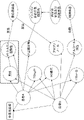
- the information processing device generates a node indicating each value of each item included in the case data as described above, and from each "ID" node, the attributes, drugs, diseases, and side effects of the patient indicated by the ID.
- Graph data is generated by connecting the edges to the nodes that represent each.
- FIG. 2 shows an example of graph data generated from the case data shown in FIG. 2 , nodes indicated by circles with respective values inscribed therein are nodes indicating attributes, drugs, and diseases, respectively, and nodes indicated by rounded squares in which side effects are indicated are nodes indicating side effects. , and the arrows connecting the nodes are edges.
- FIG. 2 shows a case where an ontology (broken line in FIG. 2) indicating background knowledge is connected to graph data indicating case data.
- An ontology that indicates background knowledge is a systematization of background knowledge in the field of interest. etc.
- nodes related to the ontology are represented by ellipses. Converting case data into graph data facilitates such ontology connections. Similar side effects may occur when diseases are similar or when drugs containing the same ingredients are administered. improves.
- the information processing apparatus does not recalculate the embedding vector from 1 and update the graph data, but executes machine learning using additional data to obtain the embedding vector, which is a parameter of the machine-learned graph data. We will update it from time to time.
- the processing load per machine learning is low, there is no need to store all the data used in past execution of machine learning, and changes in data can be immediately dealt with.
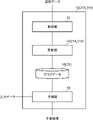
- the machine learning device 10 functionally includes an acquisition unit 12 , an update unit 14 and a prediction unit 18 .
- Graph data 16 is stored in a predetermined storage area of the machine learning device 10 .
- the graph data 16 is machine-learned graph data in a state before additional data is input and update processing is executed.
- Graph data 20 is graph data that has been updated.
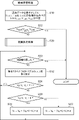
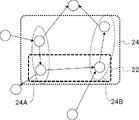
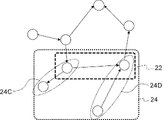
- the updating unit 14 selects a specific embedding vector from among the plurality of embedding vectors based on the additional data and the plurality of embedding vectors representing the plurality of nodes and the plurality of edges of the machine-learned graph data 16.
- a specific embedding vector is an embedding vector representing nodes and edges included in the range determined as the range of online learning.
- the specific embedding vector is the embedding vector of each of one or more nodes and one or more edges that are connected to the triple representing the additional data under a specific condition in the machine-learned graph data 16. is.
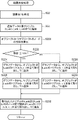
- step S50 the prediction unit 18 acquires the input data input to the machine learning device 10, converts it into graph data, and calculates embedding vectors for each of the nodes and edges included in the graph data representing the input data.
- step S52 the prediction unit 18 uses the similarity between the embedding vector of the graph data 20 and the embedding vector of the input data to determine whether there is a possibility of connecting to an edge to be predicted in the graph data 20. Identify a node.
- step S54 the prediction unit 18 outputs as a prediction result whether or not the edge to be predicted is connected to the identified node, and the prediction process ends.
- the updating unit 214 updates the embedding vector of the graph data 16 based on the additional data to generate the updated graph data 20, like the updating unit 14 in the first embodiment. Since the update unit 214 in the second embodiment has a different method for determining the range of online learning than the update unit 14 in the first embodiment, the method for determining the range by the update unit 214 in the second embodiment will be described below. .
- range determination processing in machine learning processing differs from that in the first embodiment, so the range determination processing in the second embodiment will be described with reference to FIG. 15 .
- processing similar to the range determination processing (FIG. 11) in the first embodiment is denoted by the same step number, and detailed description thereof will be omitted.
- the updating unit 314 updates the embedding vector of the graph data 16 based on the additional data to generate the updated graph data 20, like the updating unit 14 in the first embodiment. Since the update unit 314 in the third embodiment has a different method for determining the range of online learning than the update unit 14 in the first embodiment, the method for determining the range by the update unit 314 in the third embodiment will be described below. .
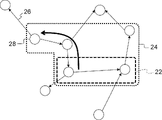
- the range is expanded to include the path from one node of the triple representing the additional data to the prediction node.
- the updating unit adjusts the range to include the nodes and edges included in the triple representing the additional data from the other node to the node having the same distance as the distance from the one node to the prediction node. may decide.
- the range is determined so as to include the path from the subject node to the prediction node, and the length of this path (corresponding to the distance) is two. Therefore, as shown in FIG. 19, the updating unit may extend the range 24 so that the edges and nodes included in the path of length 2 from the node that is the object are also included.
- the imbalance in the scope of the online learning can be eliminated between the node side that is the subject of the triple representing the additional data and the node side that is the object.
- a machine learning device including an acquisition unit and an update unit and a prediction device including a prediction unit may be implemented by different computers.
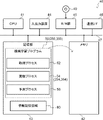
- the storage unit of the machine learning device stores a machine learning program for executing the machine learning process in each of the above embodiments.
- a prediction program for executing the prediction processing in each of the above embodiments is stored in the storage unit of the prediction device.
Landscapes
- Engineering & Computer Science (AREA)
- Theoretical Computer Science (AREA)
- Data Mining & Analysis (AREA)
- General Engineering & Computer Science (AREA)
- Software Systems (AREA)
- Health & Medical Sciences (AREA)
- Medical Informatics (AREA)
- Physics & Mathematics (AREA)
- Artificial Intelligence (AREA)
- Mathematical Physics (AREA)
- Computing Systems (AREA)
- Evolutionary Computation (AREA)
- General Physics & Mathematics (AREA)
- Public Health (AREA)
- Computational Linguistics (AREA)
- Biomedical Technology (AREA)
- Databases & Information Systems (AREA)
- Pathology (AREA)
- Epidemiology (AREA)
- General Health & Medical Sciences (AREA)
- Primary Health Care (AREA)
- Computer Vision & Pattern Recognition (AREA)
- Information Retrieval, Db Structures And Fs Structures Therefor (AREA)
Priority Applications (4)
| Application Number | Priority Date | Filing Date | Title |
|---|---|---|---|
| JP2023504926A JPWO2022190215A1 (https=) | 2021-03-09 | 2021-03-09 | |
| EP21930072.0A EP4307183A4 (en) | 2021-03-09 | 2021-03-09 | MACHINE LEARNING PROGRAM, PREDICTION PROGRAM, DEVICE AND METHOD |
| PCT/JP2021/009344 WO2022190215A1 (ja) | 2021-03-09 | 2021-03-09 | 機械学習プログラム、予測プログラム、装置、及び方法 |
| US18/457,023 US20230401455A1 (en) | 2021-03-09 | 2023-08-28 | Storage medium, prediction device, and prediction method |
Applications Claiming Priority (1)
| Application Number | Priority Date | Filing Date | Title |
|---|---|---|---|
| PCT/JP2021/009344 WO2022190215A1 (ja) | 2021-03-09 | 2021-03-09 | 機械学習プログラム、予測プログラム、装置、及び方法 |
Related Child Applications (1)
| Application Number | Title | Priority Date | Filing Date |
|---|---|---|---|
| US18/457,023 Continuation US20230401455A1 (en) | 2021-03-09 | 2023-08-28 | Storage medium, prediction device, and prediction method |
Publications (1)
| Publication Number | Publication Date |
|---|---|
| WO2022190215A1 true WO2022190215A1 (ja) | 2022-09-15 |
Family
ID=83226432
Family Applications (1)
| Application Number | Title | Priority Date | Filing Date |
|---|---|---|---|
| PCT/JP2021/009344 Ceased WO2022190215A1 (ja) | 2021-03-09 | 2021-03-09 | 機械学習プログラム、予測プログラム、装置、及び方法 |
Country Status (4)
| Country | Link |
|---|---|
| US (1) | US20230401455A1 (https=) |
| EP (1) | EP4307183A4 (https=) |
| JP (1) | JPWO2022190215A1 (https=) |
| WO (1) | WO2022190215A1 (https=) |
Families Citing this family (1)
| Publication number | Priority date | Publication date | Assignee | Title |
|---|---|---|---|---|
| US20240420391A1 (en) * | 2023-06-16 | 2024-12-19 | The Toronto-Dominion Bank | Intelligent dashboard search engine |
Citations (5)
| Publication number | Priority date | Publication date | Assignee | Title |
|---|---|---|---|---|
| JP2016212853A (ja) * | 2015-04-30 | 2016-12-15 | 富士通株式会社 | 類似性計算装置、薬の類似性を計算し及び類似性を用いて副作用を推定する副作用決定装置及びシステム |
| JP2018085116A (ja) | 2016-11-23 | 2018-05-31 | 富士通株式会社 | 知識グラフを完成させるための方法および装置 |
| JP2018206374A (ja) | 2017-05-19 | 2018-12-27 | 富士通株式会社 | 予測される部位特異的なタンパク質リン酸化候補の発見のためのシステムおよび方法 |
| US20190220524A1 (en) * | 2018-01-16 | 2019-07-18 | Accenture Global Solutions Limited | Determining explanations for predicted links in knowledge graphs |
| JP2019125364A (ja) | 2018-01-03 | 2019-07-25 | エヌイーシー ラボラトリーズ ヨーロッパ ゲーエムベーハー | マルチモーダルレコメンデーション方法及びシステム |
-
2021
- 2021-03-09 WO PCT/JP2021/009344 patent/WO2022190215A1/ja not_active Ceased
- 2021-03-09 EP EP21930072.0A patent/EP4307183A4/en not_active Withdrawn
- 2021-03-09 JP JP2023504926A patent/JPWO2022190215A1/ja active Pending
-
2023
- 2023-08-28 US US18/457,023 patent/US20230401455A1/en active Pending
Patent Citations (5)
| Publication number | Priority date | Publication date | Assignee | Title |
|---|---|---|---|---|
| JP2016212853A (ja) * | 2015-04-30 | 2016-12-15 | 富士通株式会社 | 類似性計算装置、薬の類似性を計算し及び類似性を用いて副作用を推定する副作用決定装置及びシステム |
| JP2018085116A (ja) | 2016-11-23 | 2018-05-31 | 富士通株式会社 | 知識グラフを完成させるための方法および装置 |
| JP2018206374A (ja) | 2017-05-19 | 2018-12-27 | 富士通株式会社 | 予測される部位特異的なタンパク質リン酸化候補の発見のためのシステムおよび方法 |
| JP2019125364A (ja) | 2018-01-03 | 2019-07-25 | エヌイーシー ラボラトリーズ ヨーロッパ ゲーエムベーハー | マルチモーダルレコメンデーション方法及びシステム |
| US20190220524A1 (en) * | 2018-01-16 | 2019-07-18 | Accenture Global Solutions Limited | Determining explanations for predicted links in knowledge graphs |
Non-Patent Citations (2)
| Title |
|---|
| MURAKAMI KATSUHIKO: "Knowledge graph embedding using network structure ", THE 34TH ANNUAL CONFERENCE FOR THE JAPANESE SOCIETY OF ARTIFICIAL INTELLIGENCE, 9 June 2020 (2020-06-09), XP055968606 * |
| See also references of EP4307183A4 |
Also Published As
| Publication number | Publication date |
|---|---|
| EP4307183A1 (en) | 2024-01-17 |
| US20230401455A1 (en) | 2023-12-14 |
| JPWO2022190215A1 (https=) | 2022-09-15 |
| EP4307183A4 (en) | 2024-05-01 |
Similar Documents
| Publication | Publication Date | Title |
|---|---|---|
| Ripley et al. | Manual for RSIENA | |
| US12505358B2 (en) | Methods and systems for approximating embeddings of out-of-knowledge-graph entities for link prediction in knowledge graph | |
| JP2022024102A (ja) | 検索モデルのトレーニング方法、目標対象の検索方法及びその装置 | |
| CN108292310A (zh) | 用于数字实体相关的技术 | |
| JP6608972B2 (ja) | ソーシャルネットワークに基づいてグループを探索する方法、デバイス、サーバ及び記憶媒体 | |
| JP2021500692A (ja) | 系図エンティティ解決システムおよび方法 | |
| US10769140B2 (en) | Concept expansion using tables | |
| CN118779340A (zh) | 自然语言查询语句的处理方法和装置 | |
| CN113129053A (zh) | 信息推荐模型训练方法、信息推荐方法及存储介质 | |
| CN113536040A (zh) | 信息查询方法、装置以及存储介质 | |
| CN114118310A (zh) | 基于综合相似度的聚类方法和装置 | |
| US10509800B2 (en) | Visually interactive identification of a cohort of data objects similar to a query based on domain knowledge | |
| JP2019531539A (ja) | 分散コンピューティングタスクを実行するための方法及び装置 | |
| US20210073588A1 (en) | Network architecture search with global optimization | |
| US20230401455A1 (en) | Storage medium, prediction device, and prediction method | |
| JP6321845B1 (ja) | 付与装置、付与方法および付与プログラム | |
| CN111523048A (zh) | 社交网络中好友的推荐方法、装置、存储介质及终端 | |
| US7814186B2 (en) | Methods and systems for intelligent reconfiguration of information handling system networks | |
| US10943353B1 (en) | Handling untrainable conditions in a network architecture search | |
| CN119917674A (zh) | 基于带属性多层图模型的第三方库的表示查询和推荐方法 | |
| JP2018156332A (ja) | 生成装置、生成方法および生成プログラム | |
| CN103477339B (zh) | 模式识别 | |
| CN108805290B (zh) | 一种实体类别的确定方法及装置 | |
| JP6541737B2 (ja) | 選択装置、選択方法、選択プログラム、モデルおよび学習データ | |
| JP7444280B2 (ja) | 機械学習プログラム、推定プログラム、装置、及び方法 |
Legal Events
| Date | Code | Title | Description |
|---|---|---|---|
| 121 | Ep: the epo has been informed by wipo that ep was designated in this application |
Ref document number: 21930072 Country of ref document: EP Kind code of ref document: A1 |
|
| ENP | Entry into the national phase |
Ref document number: 2023504926 Country of ref document: JP Kind code of ref document: A |
|
| WWE | Wipo information: entry into national phase |
Ref document number: 2021930072 Country of ref document: EP |
|
| NENP | Non-entry into the national phase |
Ref country code: DE |
|
| ENP | Entry into the national phase |
Ref document number: 2021930072 Country of ref document: EP Effective date: 20231009 |