WO2022180721A1 - 情報処理装置、要約文出力方法、及び要約文出力プログラム - Google Patents
情報処理装置、要約文出力方法、及び要約文出力プログラム Download PDFInfo
- Publication number
- WO2022180721A1 WO2022180721A1 PCT/JP2021/007002 JP2021007002W WO2022180721A1 WO 2022180721 A1 WO2022180721 A1 WO 2022180721A1 JP 2021007002 W JP2021007002 W JP 2021007002W WO 2022180721 A1 WO2022180721 A1 WO 2022180721A1
- Authority
- WO
- WIPO (PCT)
- Prior art keywords
- sentence
- sentences
- unit
- information
- important
- Prior art date
- Legal status (The legal status is an assumption and is not a legal conclusion. Google has not performed a legal analysis and makes no representation as to the accuracy of the status listed.)
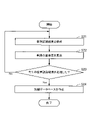
- Ceased
Links
Images







Classifications
-
- G—PHYSICS
- G06—COMPUTING OR CALCULATING; COUNTING
- G06F—ELECTRIC DIGITAL DATA PROCESSING
- G06F16/00—Information retrieval; Database structures therefor; File system structures therefor
- G06F16/30—Information retrieval; Database structures therefor; File system structures therefor of unstructured textual data
- G06F16/33—Querying
- G06F16/332—Query formulation
Definitions
- the present disclosure relates to an information processing device, a summary output method, and a summary output program.
- Patent Literature 1 The summarizing device of Patent Literature 1 creates a summary by combining important sentences extracted from input data. Note that the data is, for example, data indicating a speech recognition result.
- a summary sentence is created using data indicating the speech recognition result. Therefore, for example, if there is an error in speech recognition, the summary contains the error. Also, for example, the content of the abstract is expressed in spoken language. Thus, in the above technique, the summary sentence depends on the writing style of the data. Therefore, the abstract based on the above technology may not be appropriate.
- the purpose of this disclosure is to output an appropriate summary sentence.
- An information processing device analyzes the text data using an acquisition unit that acquires text data indicating the content of dialogue and knowledge information including a plurality of sentences created based on past reports, and morphological analysis.
- an analysis unit an important sentence extracting unit for extracting one sentence as a first important sentence from among a plurality of sentences included in the text data using the result of the morphological analysis;
- a query is created based on one important sentence, sentences obtained by the query are searched from the knowledge information, and scores of each of the retrieved sentences are calculated by a preset method.
- a degree of similarity between the first important sentence and each of the plurality of retrieved sentences, based on the created search calculation unit, the first important sentence, and each of the plurality of retrieved sentences a calculation updating unit that calculates a plurality of similarities and updates the score of each of the retrieved sentences based on the plurality of similarities; and based on the score of each of the retrieved sentences, a selection unit for selecting one of the plurality of sentences as a summary sentence; and an output unit for outputting the summary sentence.
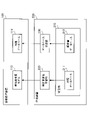
- FIG. 2 is a block diagram showing functions of the information processing apparatus according to Embodiment 1;
- FIG. 2 illustrates hardware included in the information processing apparatus according to the first embodiment;
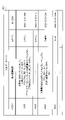
- FIG. 4 is a diagram showing an example of an unnecessary word dictionary according to Embodiment 1;
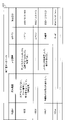
- FIG. 4 is a diagram showing an example of a sentence segmentation dictionary according to Embodiment 1;
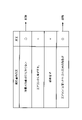
- FIG. 4 is a diagram showing an example of extraction of important sentences according to the first embodiment;
- FIG. 4 is a diagram showing an example of a query according to Embodiment 1;
- FIG. 2 is a diagram showing an example of a knowledge database according to Embodiment 1;
- FIG. 10 is a diagram showing an example of search results according to the first embodiment;
- FIG. 4 is a diagram showing an example of updated scores according to Embodiment 1;
- FIG. 4 is a flow chart showing an example of processing executed by the information processing apparatus according to the first embodiment;
- 2 is a block diagram showing functions of the creation device of Embodiment 1;
- FIG. 4 is a diagram showing an example of a dialogue database according to Embodiment 1;
- FIG. 4 is a diagram showing an example of a report database according to Embodiment 1;
- FIG. FIG. 4 is a diagram showing an example of deletion of non-sentences according to the first embodiment;
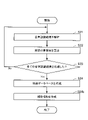
- 4 is a flow chart showing an example of processing executed by the creation device of Embodiment 1.
- FIG. 3 is a block diagram showing functions of an information processing apparatus according to a second embodiment;
- FIG. 12 is a diagram showing an example of a case where a category is not estimated according to the second embodiment;
- FIG. 10 is a flow chart showing an example of processing executed by the information processing apparatus according to the second embodiment;
- FIG. 11 is a block diagram showing functions of a creation device according to Embodiment 2;
- FIG. 10 is a flow chart showing an example of processing executed by the creating device according to the second embodiment;
- FIG. 11 is a block diagram showing functions of an information processing apparatus according to a third embodiment;
- FIG. 13 is a diagram showing an example of auxiliary information according to Embodiment 3;
- FIG. 10 is a flow chart showing an example of processing executed by the information processing apparatus according to the third embodiment;
- FIG. 11 is a block diagram showing functions of a creation device according to Embodiment 3; 14 is a flow chart showing an example of processing executed by the creation device of Embodiment 3; FIG. 11 is a block diagram showing functions of an information processing apparatus according to a fourth embodiment; FIG. FIG. 13 is a flow chart showing an example of processing executed by an information processing apparatus according to a fourth embodiment; FIG.
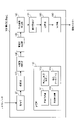
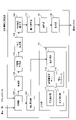
- FIG. 1 is a block diagram showing functions of an information processing apparatus according to a first embodiment.
- the information processing device 100 is a device that executes a summary sentence output method.
- the information processing device 100 may be called a dialogue summary generation device.
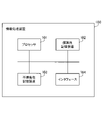
- FIG. 2 illustrates hardware included in the information processing apparatus according to the first embodiment.
- the information processing device 100 has a processor 101 , a volatile memory device 102 , a nonvolatile memory device 103 and an interface 104 .
- the processor 101 controls the information processing apparatus 100 as a whole.
- the processor 101 is a CPU (Central Processing Unit), FPGA (Field Programmable Gate Array), or the like.
- Processor 101 may be a multiprocessor.
- the information processing device 100 may have a processing circuit.
- the processing circuit may be a single circuit or multiple circuits.
- the volatile memory device 102 is the main memory device of the information processing device 100 .
- the volatile memory device 102 is RAM (Random Access Memory).
- the nonvolatile storage device 103 is an auxiliary storage device of the information processing device 100 .
- the nonvolatile storage device 103 is a HDD (Hard Disk Drive) or an SSD (Solid State Drive).
- the interface 104 communicates with other devices. Interface 104 may also receive audio signals indicative of customer and operator speech. In addition, interface 104 may receive textual data entered by an operator.
- the information processing apparatus 100 includes a storage unit 110, an acquisition unit 120, an analysis unit 130, an unnecessary word deletion unit 140, an important sentence extraction unit 150, a creation search calculation unit 160, a calculation update unit 170, a selection unit 180, and an output unit 190. have.
- the storage unit 110 may be implemented as a storage area secured in the volatile storage device 102 or the nonvolatile storage device 103 .
- Part or all of the acquisition unit 120, the analysis unit 130, the unnecessary word deletion unit 140, the important sentence extraction unit 150, the creation search calculation unit 160, the calculation update unit 170, the selection unit 180, and the output unit 190 are realized by processing circuits. You may Some or all of the acquisition unit 120, the analysis unit 130, the unnecessary word deletion unit 140, the important sentence extraction unit 150, the creation search calculation unit 160, the calculation update unit 170, the selection unit 180, and the output unit 190 may be implemented as a module of a program executed by For example, the program executed by the processor 101 is also called a summary sentence output program. For example, a summary sentence output program is recorded on a recording medium.
- the storage unit 110 may store the unnecessary word dictionary 111, the sentence segmentation dictionary 112, the word importance model 113, and the knowledge database 114.
- the unnecessary word dictionary 111, sentence segmentation dictionary 112, word importance model 113, and knowledge database 114 will be described later.
- the acquisition unit 120 acquires text data.
- the acquisition unit 120 acquires text data from an external device (for example, cloud server).
- the acquisition unit 120 acquires text data from the storage unit 110 .
- the text data is data indicating the contents of the dialogue.
- the content of dialogue includes the content of dialogue between a customer and an operator, the content of dialogue between a chatbot and a user, and the like.
- Text data indicating the content of the conversation between the customer and the operator is generated using speech recognition technology.
- the text data includes a plurality of sentences indicating the contents of the dialogue.
- the acquisition unit 120 acquires the knowledge database 114.
- the acquisition unit 120 acquires the knowledge database 114 from the storage unit 110 .
- the acquisition unit 120 acquires the knowledge database 114 from an external device.
- the analysis unit 130 analyzes text data using morphological analysis. As a result, words and parts of speech included in the text data are extracted. The analysis unit 130 may also use syntactic analysis to analyze clauses and relationships between clauses in the text data. The analysis unit 130 may analyze the text data after the unnecessary word deletion process described below has been executed.
- the unnecessary word deletion unit 140 deletes unnecessary words from the text data by a preset method.
- the unnecessary word deletion unit 140 uses the unnecessary word dictionary 111 to delete unnecessary words.
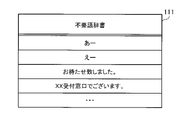
- the unnecessary word dictionary 111 is illustrated.
- FIG. 3 is a diagram showing an example of an unnecessary word dictionary according to the first embodiment.
- the unnecessary word dictionary 111 is stored in the storage unit 110 .
- fillers such as "ah” and “erh” and fixed phrases such as "Thank you for waiting" are registered.
- Information indicating the correspondence between words and parts of speech may be registered in the unnecessary word dictionary 111 .
- the unnecessary word deletion unit 140 may delete unnecessary words from the text data using a learned model obtained by machine learning. If the text data does not contain unnecessary words, the unnecessary word deletion unit 140 does not execute the process.
- the important sentence extraction unit 150 extracts a preset number of sentences from a plurality of sentences included in the text data (for example, text data from which unnecessary words have been deleted) using the result of the morphological analysis. Extract as important sentences.
- the preset number may be one, or two or more.
- the preset number is one, the extracted important sentence is also called the first important sentence. In the following description, the preset number is two or more.
- the important sentence extraction unit 150 divides a plurality of sentences included in the text data.
- a method for dividing a plurality of sentences there are a method of dividing at divisions of speech recognition, a method of dividing by periods or commas included in text data, a method of dividing using a sentence dividing dictionary 112, and a method of dividing using a trained model. A method of dividing is mentioned.
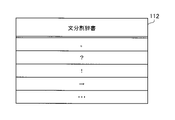
- the sentence segmentation dictionary 112 is illustrated.
- FIG. 4 is a diagram showing an example of a sentence segmentation dictionary according to the first embodiment.
- the sentence segmentation dictionary 112 is stored in the storage unit 110 .
- the important sentence extraction unit 150 may use the sentence division dictionary 112 to divide a plurality of sentences.
- the important sentence extraction unit 150 calculates the importance of each sentence. First, a method of calculating the degree of importance corresponding to one sentence will be described. For example, the important sentence extraction unit 150 uses TF-IDF, Okapi BM25, etc. to calculate the importance of each of the multiple words included in the one sentence obtained from the morphological analysis result. . The important sentence extraction unit 150 adds the importance of each of a plurality of words to calculate the importance of the sentence. In addition, the important sentence extraction unit 150 uses the word importance model 113, which is a trained model, to determine the importance of each of the plurality of words included in the one sentence obtained by the morphological analysis. , may be calculated.
- the word importance model 113 which is a trained model
- the important sentence extracting unit 150 calculates the importance level corresponding to the one sentence by adding the importance levels of each of the plurality of words. Also, the important sentence extraction unit 150 may calculate the average value of the importance of each of a plurality of words as the importance corresponding to the one sentence.
- the important sentence extraction unit 150 calculates the importance of each sentence. As a result, multiple degrees of importance corresponding to multiple sentences are calculated.
- the important sentence extraction unit 150 arranges multiple sentences in descending order of importance.
- the important sentence extraction unit 150 extracts a preset number of high-ranking sentences as important sentences. Specifically, extraction of important sentences will be exemplified.
- FIG. 5 is a diagram showing an example of extraction of important sentences according to the first embodiment.
- FIG. 5 shows multiple sentences (that is, multiple divided sentences) included in the text data.
- the important sentence extraction unit 150 extracts important sentences from a plurality of sentences.
- the important sentence extraction unit 150 extracts a preset number of high ranking sentences as important sentences. This eliminates sentences of low importance. As will be described later, a summary sentence is selected based on the important sentence, so extracting only the important sentence means that an appropriate summary sentence is selected.
- the creation search calculation unit 160 creates a query based on the important sentence. Queries may be formulated on a sentence-by-sentence basis or on a word (ie, morpheme) basis. Queries may be constructed by n-gram chains of sentences or words. Here is an example query.
- FIG. 6 is a diagram showing an example of a query according to the first embodiment.
- FIG. 6 shows a query created based on key sentences.
- FIG. 6 shows a query constructed using 2-gram chaining.
- the creation search calculation unit 160 may create a query by lexicalizing consecutive words in the important sentence.
- the creation search calculation unit 160 creates a query by lexicalizing the negative word in the important sentence and the verb immediately before the negative word.
- FIG. 6 shows "iru_nai" concatenated with the negative word and the immediately preceding verb.
- both the numeral and the unit after the numeral are included in the query.
- the query is “set the air conditioner to 25°C”.
- sentences with different meanings may be retrieved. For example, "Purchase a refrigerator on the 25th” is retrieved. Therefore, the creation search calculation unit 160 may create a query by lexicalizing the numerals in the important sentence and the units following the numerals. For example, a lexicalized query is "25_°C”. As a result, the above query changes to "air conditioner 25_°C setting". In this way, by combining numerals and units into one vocabulary, retrieval of sentences with different meanings is prevented.
- the creation search calculation unit 160 searches the knowledge database 114 for sentences obtained by the query. In other words, the creation search calculation unit 160 uses the query to search the knowledge database 114 for sentences that are close in meaning to the important sentence.
- the knowledge database 114 is illustrated.
- FIG. 7 is a diagram showing an example of the knowledge database according to the first embodiment.
- the knowledge database 114 is also called knowledge information.
- the knowledge database 114 contains a plurality of sentences created based on past reports.
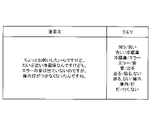
- the knowledge database 114 has items of sentences, indexing queries, steps, and categories.
- sentence item sentences created based on past reports are registered.
- clauses, a plurality of continuous clauses, and a plurality of continuous sentences may be registered in the sentence item.
- a query is registered in the index registration query field.
- the name of the work is registered in the step item.
- a category indicated by the content of a sentence registered in the sentence item is registered in the category item. In this way, a category is associated with each of a plurality of sentences registered in the sentence item.
- the knowledge database 114 may be information in a graph format.
- the creation search calculation unit 160 uses queries to search the knowledge database 114 for sentences that are close in meaning to the important sentences. A plurality of sentences are retrieved as the retrieval result.
- the creation search calculation unit 160 may create a query based on the important sentence and at least one of the preceding sentence and the following sentence of the relevant important sentence in the text data. By including a word included in at least one of the anterior sentence and the posterior sentence in the query, the creation search calculation unit 160 can retrieve sentences related to the important sentence even if the important sentence is short. can.
- the creation search calculation unit 160 may include synonyms of words included in the important sentence in the query. When the word included in the important sentence is "not lit", the creation search calculation unit 160 includes "disappear", which is a synonym of "not lit", in the query. Note that the creation search calculation unit 160 can use word2vec to obtain synonyms of words included in the important sentence. In this way, the creation search calculation unit 160 can search for sentences containing synonyms by including the synonyms in the query.
- the creation search calculation unit 160 may filter search targets by parts of speech such as nouns, verbs, adjectives, and shape words.
- the creation search calculation unit 160 may use the important sentence and the knowledge database 114 to calculate the similarity of sentence vectors.
- the creation search calculation unit 160 calculates scores for each of the plurality of searched sentences by a preset method.
- the preset method is as follows.
- the query is "air conditioner 25_°C setting”.
- the retrieved sentences are "the air conditioner is at 25°C” and "the air conditioner does not work”.
- the creation search calculation unit 160 calculates a score of 2 for “air conditioner is 25°C”.
- the creation search calculation unit 160 calculates a score of 1 for “the air conditioner does not work”. That is, the creation search calculation unit 160 calculates the number of matches between the searched sentence and the words included in the query as a score. Thus, a score is calculated.
- the creation search calculation unit 160 may calculate a score using a calculation method used in a search engine such as Elasticsearch.
- the composition search calculator 160 may include scores for each of the multiple sentences in the search results.
- the search results are illustrated.
- FIG. 8 is a diagram showing an example of search results according to the first embodiment. As shown in FIG. 8, the searched sentence and the score of the searched sentence are output as the search result.
- the calculation update unit 170 calculates a plurality of degrees of similarity based on the important sentence and each of the retrieved sentences. First, a case will be described where similarity is calculated based on an important sentence and one sentence out of a plurality of retrieved sentences.
- the degree of similarity is the degree of similarity between the important sentence and the one sentence. Therefore, the multiple degrees of similarity are degrees of similarity between the important sentence and each of the retrieved multiple sentences.
- the calculation updating unit 170 calculates the degree of similarity using Equation (1).
- I is a set of words included in the important sentence.
- K is a set of words contained in the retrieved sentences.
- the calculation updating unit 170 gives a penalty when the number of elements of the difference set obtained by subtracting the set of words included in the important sentence from the set of words included in the retrieved sentence is large. Calculate the similarity. As a result, it is possible to retrieve sentences that do not contain unnecessary content that is not spoken while absorbing redundant utterances.
- the calculation update unit 170 calculates the degree of similarity based on the important sentence and the one sentence. Similarly, the calculation updating unit 170 calculates similarities corresponding to each of the plurality of sentences. Thereby, a plurality of degrees of similarity are calculated. The calculation update unit 170 may calculate the degree of similarity using each of the top N sentences among the retrieved sentences. The calculation updating unit 170 updates the score of each of the retrieved sentences based on the similarities. Here is an example of the updated score.
- FIG. 9 is a diagram showing an example of updated scores according to the first embodiment.
- the score in FIG. 9 indicates the degree of similarity.
- the selection unit 180 selects one of the plurality of retrieved sentences as a summary sentence based on the updated score of each of the plurality of sentences. For example, the selection unit 180 selects the sentence corresponding to the highest score as the summary sentence. In the following description, the sentence corresponding to the highest score shall be identified as the summary sentence.
- the output unit 190 outputs a summary sentence.
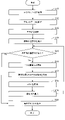
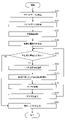
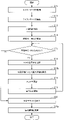
- FIG. 10 is a flowchart illustrating an example of processing executed by the information processing apparatus according to the first embodiment; FIG.
- the acquisition unit 120 acquires text data.
- the analysis unit 130 analyzes the text data using morphological analysis.
- the unnecessary word deletion section 140 deletes unnecessary words from the text data.
- Step S14 The important sentence extraction unit 150 divides multiple sentences included in the text data.
- the important sentence extraction unit 150 calculates the importance of each sentence. As a result, multiple degrees of importance corresponding to multiple sentences are calculated.
- the important sentence extraction unit 150 extracts a preset number of high-ranking sentences as important sentences based on multiple degrees of importance. As a result, multiple important sentences are extracted.
- Step S15 The creation search calculation unit 160 determines whether or not there is an unprocessed important sentence. If there is an unprocessed important sentence, the process proceeds to step S16. If all important sentences have been processed, the process proceeds to step S20. (Step S16) The creation search calculation unit 160 selects one important sentence from the unprocessed important sentences. Note that the selected important sentence may be called a first important sentence.
- Step S17 The creation search calculation unit 160 creates a query based on the key sentence, and searches the knowledge database 114 for a sentence obtained by the query. This retrieves multiple sentences.
- the creation search calculation unit 160 calculates scores for each of the plurality of searched sentences. Thereby, multiple scores corresponding to multiple sentences are calculated.
- Step S18 The calculation update unit 170 calculates a plurality of degrees of similarity based on the important sentence and each of the sentences corresponding to the top N scores.
- the calculation update unit 170 updates the scores of the sentences corresponding to the top N scores based on the similarities.
- Step S19 The selection unit 180 selects the sentence corresponding to the highest score as the summary sentence. Then, the process proceeds to step S15.
- Step S20 The output unit 190 puts together the identified plural abstracts and outputs them as a summary text.
- the output unit 190 may output a summary text created in a report format.
- the summary sentences included in the summary text are not sentences based on speech recognition results.
- the abstract is based on past reports. Therefore, there is a high possibility that the summary does not contain any error. Also, the content of the abstract is not expressed in spoken language. Therefore, the information processing apparatus 100 can output an appropriate summary sentence.
- FIG. 11 is a block diagram showing functions of the creation device according to the first embodiment.
- the creation device 200 has a storage unit 210 , a word importance learning unit 220 and a database creation unit 230 .
- the storage unit 210 may be realized as a storage area secured in a volatile storage device or a non-volatile storage device of the creation device 200 .
- a part or all of the word importance level learning unit 220 and the database creation unit 230 may be implemented by a processing circuit of the creation device 200 .
- part or all of the word importance level learning unit 220 and the database creation unit 230 may be realized as modules of programs executed by the processor of the creation device 200 .
- Storage unit 210 stores dialogue database 211 .
- the dialog database 211 is illustrated.
- 12 is a diagram showing an example of a dialogue database according to Embodiment 1.
- FIG. A dialogue database 211 is stored in the storage unit 210 .
- Past dialogue histories are registered in the dialogue database 211 .
- the dialogue database 211 has items of dialogue ID (identifier), speech recognition result, category, and reception date and time.
- Identifiers are registered in the conversation ID item.
- Conversation content is registered in the speech recognition result item.
- the Category field registers a category indicated by the content of the sentence registered in the Speech Recognition Result field.
- the date and time when the dialogue was conducted is registered in the item of date and time of reception.
- Storage unit 210 stores report database 212 .
- the report database 212 is illustrated. 13 is a diagram illustrating an example of a report database according to Embodiment 1.
- FIG. A report database 212 is stored in the storage unit 210 .
- the report database 212 is information created based on past reports.
- the report database 212 has items of dialogue ID, reception history, response history, category, and date and time of reception.
- Identifiers are registered in the conversation ID item.
- a summary of the information registered in the speech recognition result item of the dialog database 211 is registered in the reception history item.
- Correspondence contents are registered in the correspondence history item.
- a category indicated by the content registered in the reception history is registered in the category item.
- the date and time when the dialogue was conducted is registered in the item of date and time of reception.
- the word importance learning unit 220 creates the word importance model 113 by performing machine learning using the dialogue database 211 .
- the word importance model 113 outputs the importance of the word.
- the database creation unit 230 creates the knowledge database 114 based on the report database 212 .
- the database creation unit 230 creates the knowledge database 114 by extracting meaningful sentences or meaningful clauses from the information registered in the items of reception history and response history of the report database 212. do.
- the database creation unit 230 may delete sentences that are unnatural in terms of language (hereinafter referred to as non-sentences) from the information registered in the report database 212 .
- the database creating unit 230 may calculate the likelihood of a sentence using an n-gram likelihood or the like, and delete non-sentences based on the likelihood of the sentence.
- non-sentences are deleted.
- FIG. 14 is a diagram showing an example of non-sentence deletion according to the first embodiment.
- the database creation unit 230 deletes non-sentences from information registered in the report database 212 .
- the knowledge database 114 is created by deleting non-sentences from past reports. By deleting non-sentences from past reports, it is possible to prevent non-sentences from being selected as summary sentences.
- FIG. 15 is a flowchart illustrating an example of processing executed by the creation device according to Embodiment 1.
- the word importance learning unit 220 refers to the speech recognition results in the dialogue database 211 and analyzes the speech recognition results using morphological analysis.
- the word importance learning unit 220 uses TF-IDF or the like to calculate the importance of the words obtained by the analysis.
- the word importance learning section 220 creates information indicating the correspondence between words and importance.
- Step S23 The word importance learning unit 220 determines whether or not all speech recognition results have been processed. If all speech recognition results have been processed, the process proceeds to step S24. If there is an unprocessed speech recognition result, the process proceeds to step S21.
- the word importance model 113 is information indicating the correspondence between words and importance obtained by repeating steps S21 and S22.
- Step S ⁇ b>24 The database creating section 230 creates the knowledge database 114 based on the report database 212 . As a result, a word importance model 113 and a knowledge database 114 are created.
- FIG. 16 is a block diagram showing functions of the information processing apparatus according to the second embodiment.
- Information processing apparatus 100 further includes category estimating section 191 .
- the storage unit 110 may further store the category estimation model 115.
- the category estimation model 115 When a word is input, the category estimation model 115 outputs a category based on that word. In other words, category inference model 115 infers a category based on the word. Note that, for example, the category is model.
- Acquisition unit 120 acquires category estimation model 115 .
- the acquisition unit 120 acquires the category estimation model 115 from the storage unit 110 .
- the acquisition unit 120 acquires the category estimation model 115 from an external device.
- the category estimation unit 191 estimates the category of dialogue content using the words obtained by the morphological analysis and the category estimation model 115 .
- FIG. 17 is a diagram showing an example in which the category is not estimated according to the second embodiment.
- the category of dialogue content indicated by the text data is a refrigerator. If no category is estimated, many sentences related to microwave ovens are retrieved based on the word "inside light". Therefore, the creation search calculation unit 160 searches for sentences related to "refrigerator" using the estimated category "refrigerator”. As a result, only sentences relating to the dialogue content category are retrieved.
- the information processing apparatus 100 can select an appropriate summary sentence by retrieving only sentences related to the category of dialogue content.
- FIG. 18 is a flow chart showing an example of processing executed by the information processing apparatus according to the second embodiment.
- the process of FIG. 18 differs from the process of FIG. 10 in that step S13a is executed. Further, in the process of FIG. 18, step S17 is changed to step S17a. Therefore, steps S13a and S17a will be described with reference to FIG. Further, description of processes other than steps S13a and S17a is omitted.
- the category estimation unit 191 estimates the category of the dialogue content using the words obtained by the morphological analysis and the category estimation model 115 .
- the creation search calculation unit 160 creates a query based on the important sentence.
- the creation search calculator 160 searches the knowledge database 114 using the estimated category and query. That is, the creation search calculation unit 160 searches the knowledge database 114 using the query while narrowing down the information to the estimated category. This retrieves multiple sentences that are related to the inferred category.
- the creation search calculation unit 160 calculates scores for each of the plurality of searched sentences. Thereby, multiple scores corresponding to multiple sentences are calculated.
- the information processing apparatus 100 can select an appropriate summary sentence by searching only for sentences related to the category of dialogue content.
- FIG. 19 is a block diagram showing functions of the creation device according to the second embodiment.
- Creation device 200 further includes category estimation learning section 240 .
- Category inference learning unit 240 creates category inference model 115 .
- FIG. 20 is a flow chart showing an example of processing executed by the creation device according to the second embodiment.
- the process of FIG. 20 differs from the process of FIG. 15 in that step S24a is executed. Therefore, in FIG. 20, step S24a will be described. The description of the processes other than step S24a is omitted.
- Step S24a The category estimation learning unit 240 performs morphological analysis on the speech recognition results of the dialogue database 211.
- the category estimation learning unit 240 calculates the amount of self-mutual information between the words obtained by the morphological analysis and the categories of the dialogue database 211, and based on the amount of self-mutual information, generates information indicating the correspondence between the words and the categories. , as the category estimation model 115 .
- the category estimation learning unit 240 may perform morphological analysis on the reception history of the report database 212 .
- the category estimation learning unit 240 calculates the self mutual information between the words obtained by the morphological analysis and the categories of the report database 212, and based on the self mutual information, information indicating the correspondence between the words and the categories. is created as the category estimation model 115 .
- FIG. 21 is a block diagram showing functions of the information processing apparatus according to the third embodiment.
- the storage unit 110 may store auxiliary information 116 .
- the auxiliary information 116 is information that aids query generation.
- the auxiliary information 116 is information used when generating queries.
- the auxiliary information 116 is specifically shown.
- FIG. 22 is a diagram showing an example of auxiliary information according to the third embodiment.
- the auxiliary information 116 is information indicating the correspondence between each of a plurality of words, which are a plurality of predicates, and each of a plurality of relational information.
- the relationship information indicates the relationship between multiple words.
- the auxiliary information 116 has items of predicate labels and subword context matrices.
- a word that is a predicate is registered in the item of the predicate label.
- the predicate word "fall" is registered in the item of the sub-word context matrix.
- the relationship information is represented by a two-dimensional table. That is, the relationship information may be considered as two-dimensional information.
- a word that is a predicate is associated with the relationship information.
- the information indicating the correspondence between the predicate word and the relational information may be considered as three-dimensional information. Therefore, the auxiliary information 116 may be considered as three-dimensional information.
- the relationship information indicates the relationship between multiple words.
- the plurality of words are words such as verbs, nouns, and adjectives.
- the relationship information in FIG. 22 exemplifies noun words.
- the relationship information in FIG. 22 may include words of parts of speech other than nouns.
- the relationship information in FIG. 22 indicates that the degree of relationship between "proof” and “illumination” is "159".
- a number such as "159” is called a degree of relationship indicating the degree of relationship between a plurality of words.
- the auxiliary information 116 contains the degree of relationship.
- the degree of relationship may be considered as the amount of self-mutual information. Note that the upper limit of the degree of relationship is not limited to 100.
- the degree of relationship "159" is greater than a preset threshold. Therefore, the relationship information in FIG. 22 indicates that the relationship between "proof” and "illumination” is strong.
- the acquisition unit 120 acquires the auxiliary information 116.
- the acquisition unit 120 acquires the auxiliary information 116 from the storage unit 110 .
- the acquisition unit 120 acquires the auxiliary information 116 from an external device.
- the creation search calculation unit 160 identifies noun words or predicate words that can be predicates from among a plurality of words with parts of speech obtained by performing morphological analysis on important sentences.
- the creation search calculation unit 160 generates a word converted from a noun word into a predicate or a specified predicate word, a word among a plurality of words with parts of speech (for example, also referred to as a first word), and auxiliary information. 116 to identify related words that are words that are related to the word (ie, the first word).
- the creation search calculation unit 160 creates a query based on the important sentence and related words.
- the creation search calculation unit 160 identifies the predicate word “fall”. Based on the predicate word “fall”, the word “proof”, and the auxiliary information 116, the creation search calculation unit 160 identifies the word “illumination” that is related to the word “proof”. The creation search calculation unit 160 creates a query based on the key sentence “proof is dropped” and the word “illumination”. For example, the creation search calculation unit 160 creates the query “proof falling lighting”. Thus, the creation search calculation unit 160 creates a query by query expansion.
- the "proof” in the key sentence "proof fails” is the error of "illumination".
- an important sentence that is, text data
- an error in speech recognition produces the important sentence "Proof falls”.
- the query is formulated based on "proof falls”
- sentences related to "proof” are retrieved.
- the selected summary sentences are less accurate. Therefore, the creation search calculation unit 160 creates a query including “lighting”.
- sentences related to "illumination” are also retrieved. Thereby, the information processing apparatus 100 can select a sentence related to "illumination” as a summary sentence.
- FIG. 23 is a flowchart showing an example of processing executed by the information processing apparatus according to the third embodiment.
- step S17 is changed to step S17b. Therefore, FIG. 23 explains step S17b. A description of the processes other than step S17b is omitted.
- Step S17b The creation search calculation unit 160 creates a query by query expansion.
- the creation search calculation unit 160 searches the knowledge database 114 for sentences obtained by the query. This retrieves multiple sentences.
- the creation search calculation unit 160 calculates scores for each of the plurality of searched sentences. Thereby, multiple scores corresponding to multiple sentences are calculated.
- the information processing apparatus 100 can select a summary with high accuracy.
- the auxiliary information 116 is created by the creation device 200 . Creation of the auxiliary information 116 will be described.
- FIG. 24 is a block diagram showing functions of the creation device according to the third embodiment.
- the creating device 200 further has an auxiliary information creating section 250 .
- Auxiliary information creating unit 250 creates auxiliary information 116 .
- FIG. 25 is a flow chart showing an example of processing executed by the creation device of the third embodiment.
- the process of FIG. 25 differs from the process of FIG. 15 in that step S24b is executed. Therefore, FIG. 25 explains step S24b. A description of the processes other than step S24b is omitted.
- Step S24b the auxiliary information creation unit 250 extracts one predicate and one noun included in the dialogue database 211.
- the auxiliary information creation unit 250 extracts one noun included in the report database 212 .
- the auxiliary information creation unit 250 uses the extracted predicates and nouns of the dialogue database 211 and the nouns of the report database 212 to calculate self-mutual information.
- the auxiliary information creating unit 250 creates the auxiliary information 116 based on the self mutual information. Also, even if the dialogue database 211 (more specifically, the predicates and nouns of the dialogue database 211) contains an error, by searching for the nouns in the knowledge database 114 created based on the report database 212, The error is recovered.
- FIG. 26 is a block diagram showing functions of the information processing apparatus according to the fourth embodiment.
- the information processing apparatus 100 further has an extraction updating unit 192 .
- Acquisition unit 120 acquires correction information.
- the correction information is information of a summary sentence corrected by the user.
- the extraction update unit 192 compares the summary sentence in the summary text output by the output unit 190 and the correction information, and extracts the difference.
- the extraction update unit 192 identifies, from the auxiliary information 116, the degree of relationship between the word in the important sentence and the word corresponding to the difference in the summary sentence based on the difference between the important sentence and the summary sentence. Make it lower than the current relevant degree of relationship (that is, value).
- the extraction update unit 192 identifies, from the auxiliary information 116, the degree of relationship between the word in the important sentence and the word corresponding to the difference in the correction information based on the difference between the important sentence and the correction information, and the identified degree of relationship is It is made higher than the current relevant degree of relationship (that is, value).
- the extracting and updating unit 192 identifies, from the auxiliary information 116, the degree of relationship between the word "proof” in the important sentence and the word "prize name” corresponding to the difference in the abstract sentence, Lower the identified relationship.
- the extraction update unit 192 identifies, from the auxiliary information 116, the degree of relationship between the word “proof” in the important sentence and the word “illumination” corresponding to the difference in the correction information, based on the difference between the important sentence and the correction information. increase the degree of relationship This allows more precise words to be included in the query. Therefore, the information processing apparatus 100 can select a summary sentence with high accuracy.
- FIG. 27 is a flow chart showing an example of processing executed by the information processing apparatus according to the fourth embodiment.
- the process of FIG. 27 differs from the process of FIG. 23 in that step S20a is executed. Therefore, step S20a will be described with reference to FIG. A description of the processes other than step S20a is omitted.
- Step S20a The extraction update unit 192 compares the summary sentence in the summary text output by the output unit 190 and the correction information acquired by the acquisition unit 120, and extracts the difference.
- the extraction update unit 192 updates the auxiliary information 116 based on the difference.
- the information processing apparatus 100 can select a summary sentence with high accuracy.
- 100 information processing device 101 processor, 102 volatile storage device, 103 non-volatile storage device, 104 interface, 110 storage unit, 111 unnecessary word dictionary, 112 sentence segmentation dictionary, 113 word importance model, 114 knowledge database, 115 category estimation model, 116 auxiliary information, 120 acquisition unit, 130 analysis unit, 140 unnecessary word deletion unit, 150 important sentence extraction unit, 160 creation search calculation unit, 170 calculation update unit, 180 selection unit, 190 output unit, 191 category estimation unit, 192 extraction update unit, 200 creation device, 210 storage unit, 211 dialogue database, 212 report database, 220 word importance learning unit, 230 database creation unit, 240 category estimation learning unit, 250 auxiliary information creation unit.
Landscapes
- Engineering & Computer Science (AREA)
- Physics & Mathematics (AREA)
- Theoretical Computer Science (AREA)
- Mathematical Physics (AREA)
- Computational Linguistics (AREA)
- Data Mining & Analysis (AREA)
- Databases & Information Systems (AREA)
- General Engineering & Computer Science (AREA)
- General Physics & Mathematics (AREA)
- Information Retrieval, Db Structures And Fs Structures Therefor (AREA)
- Machine Translation (AREA)
Priority Applications (2)
| Application Number | Priority Date | Filing Date | Title |
|---|---|---|---|
| JP2023501746A JP7305077B2 (ja) | 2021-02-25 | 2021-02-25 | 情報処理装置、要約文出力方法、及び要約文出力プログラム |
| PCT/JP2021/007002 WO2022180721A1 (ja) | 2021-02-25 | 2021-02-25 | 情報処理装置、要約文出力方法、及び要約文出力プログラム |
Applications Claiming Priority (1)
| Application Number | Priority Date | Filing Date | Title |
|---|---|---|---|
| PCT/JP2021/007002 WO2022180721A1 (ja) | 2021-02-25 | 2021-02-25 | 情報処理装置、要約文出力方法、及び要約文出力プログラム |
Publications (1)
| Publication Number | Publication Date |
|---|---|
| WO2022180721A1 true WO2022180721A1 (ja) | 2022-09-01 |
Family
ID=83047888
Family Applications (1)
| Application Number | Title | Priority Date | Filing Date |
|---|---|---|---|
| PCT/JP2021/007002 Ceased WO2022180721A1 (ja) | 2021-02-25 | 2021-02-25 | 情報処理装置、要約文出力方法、及び要約文出力プログラム |
Country Status (2)
| Country | Link |
|---|---|
| JP (1) | JP7305077B2 (cg-RX-API-DMAC7.html) |
| WO (1) | WO2022180721A1 (cg-RX-API-DMAC7.html) |
Citations (3)
| Publication number | Priority date | Publication date | Assignee | Title |
|---|---|---|---|---|
| JP2005084858A (ja) * | 2003-09-08 | 2005-03-31 | Chubu Electric Power Co Inc | ネットワークコミュニケーションシステム、ネットワークコミュニケーション提供サーバ及びこれを動作させるためのプログラム、そのプログラムが記録された記録媒体 |
| JP2020035135A (ja) * | 2018-08-29 | 2020-03-05 | 株式会社日立製作所 | 質問回答システム、質問回答処理方法、及び質問回答統合システム |
| JP2020071676A (ja) * | 2018-10-31 | 2020-05-07 | 株式会社eVOICE | 対話要約生成装置、対話要約生成方法およびプログラム |
-
2021
- 2021-02-25 JP JP2023501746A patent/JP7305077B2/ja active Active
- 2021-02-25 WO PCT/JP2021/007002 patent/WO2022180721A1/ja not_active Ceased
Patent Citations (3)
| Publication number | Priority date | Publication date | Assignee | Title |
|---|---|---|---|---|
| JP2005084858A (ja) * | 2003-09-08 | 2005-03-31 | Chubu Electric Power Co Inc | ネットワークコミュニケーションシステム、ネットワークコミュニケーション提供サーバ及びこれを動作させるためのプログラム、そのプログラムが記録された記録媒体 |
| JP2020035135A (ja) * | 2018-08-29 | 2020-03-05 | 株式会社日立製作所 | 質問回答システム、質問回答処理方法、及び質問回答統合システム |
| JP2020071676A (ja) * | 2018-10-31 | 2020-05-07 | 株式会社eVOICE | 対話要約生成装置、対話要約生成方法およびプログラム |
Also Published As
| Publication number | Publication date |
|---|---|
| JPWO2022180721A1 (cg-RX-API-DMAC7.html) | 2022-09-01 |
| JP7305077B2 (ja) | 2023-07-07 |
Similar Documents
| Publication | Publication Date | Title |
|---|---|---|
| CN112069298B (zh) | 基于语义网和意图识别的人机交互方法、设备及介质 | |
| CN109101479B (zh) | 一种用于中文语句的聚类方法及装置 | |
| JP3720068B2 (ja) | 質問の転記方法及び装置 | |
| US7983915B2 (en) | Audio content search engine | |
| US6345253B1 (en) | Method and apparatus for retrieving audio information using primary and supplemental indexes | |
| US7272558B1 (en) | Speech recognition training method for audio and video file indexing on a search engine | |
| US20040254795A1 (en) | Speech input search system | |
| US20080270344A1 (en) | Rich media content search engine | |
| US20080270110A1 (en) | Automatic speech recognition with textual content input | |
| CN111159381B (zh) | 数据搜索方法及装置 | |
| US10102199B2 (en) | Corpus specific natural language query completion assistant | |
| JP2002510076A (ja) | 言語モデルに基づく情報検索および音声認識 | |
| Mendels et al. | Improving speech recognition and keyword search for low resource languages using web data | |
| WO2018157789A1 (zh) | 一种语音识别的方法、计算机、存储介质以及电子装置 | |
| US20120209590A1 (en) | Translated sentence quality estimation | |
| CA2250694A1 (en) | A system, software and method for locating information in a collection of text-based information sources | |
| CN111125299B (zh) | 一种基于用户行为分析的动态词库更新方法 | |
| JP2011118689A (ja) | 検索方法及びシステム | |
| US11151317B1 (en) | Contextual spelling correction system | |
| CN109783806A (zh) | 一种利用语义解析结构的文本匹配方法 | |
| CN119066155A (zh) | 一种大语言模型的训练方法、装置、设备及存储介质 | |
| CN119808778B (zh) | 一种基于大语言模型的智能文本切分方法和系统 | |
| CN115718791A (zh) | 文本元素的特定性排序及其应用 | |
| JP2015138351A (ja) | 情報検索装置、情報検索方法および情報検索プログラム | |
| CN118797005A (zh) | 智能问答方法、装置、电子设备、存储介质及产品 |
Legal Events
| Date | Code | Title | Description |
|---|---|---|---|
| 121 | Ep: the epo has been informed by wipo that ep was designated in this application |
Ref document number: 21927823 Country of ref document: EP Kind code of ref document: A1 |
|
| ENP | Entry into the national phase |
Ref document number: 2023501746 Country of ref document: JP Kind code of ref document: A |
|
| NENP | Non-entry into the national phase |
Ref country code: DE |
|
| 122 | Ep: pct application non-entry in european phase |
Ref document number: 21927823 Country of ref document: EP Kind code of ref document: A1 |