WO2022158194A1 - Method, device, computer program product, and non-transitory information storage medium for estimating performance of wireless communication network - Google Patents
Method, device, computer program product, and non-transitory information storage medium for estimating performance of wireless communication network Download PDFInfo
- Publication number
- WO2022158194A1 WO2022158194A1 PCT/JP2021/046655 JP2021046655W WO2022158194A1 WO 2022158194 A1 WO2022158194 A1 WO 2022158194A1 JP 2021046655 W JP2021046655 W JP 2021046655W WO 2022158194 A1 WO2022158194 A1 WO 2022158194A1
- Authority
- WO
- WIPO (PCT)
- Prior art keywords
- interference
- activation
- time
- frequency
- value
- Prior art date
- Legal status (The legal status is an assumption and is not a legal conclusion. Google has not performed a legal analysis and makes no representation as to the accuracy of the status listed.)
- Ceased
Links
Classifications
-
- H—ELECTRICITY
- H04—ELECTRIC COMMUNICATION TECHNIQUE
- H04B—TRANSMISSION
- H04B1/00—Details of transmission systems, not covered by a single one of groups H04B3/00 - H04B13/00; Details of transmission systems not characterised by the medium used for transmission
- H04B1/69—Spread spectrum techniques
- H04B1/713—Spread spectrum techniques using frequency hopping
- H04B1/715—Interference-related aspects
-
- H—ELECTRICITY
- H04—ELECTRIC COMMUNICATION TECHNIQUE
- H04B—TRANSMISSION
- H04B17/00—Monitoring; Testing
- H04B17/30—Monitoring; Testing of propagation channels
- H04B17/309—Measuring or estimating channel quality parameters
- H04B17/345—Interference values
-
- H—ELECTRICITY
- H04—ELECTRIC COMMUNICATION TECHNIQUE
- H04B—TRANSMISSION
- H04B17/00—Monitoring; Testing
- H04B17/30—Monitoring; Testing of propagation channels
- H04B17/391—Modelling the propagation channel
Definitions
- At least one of the present embodiments generally relates to a method and a device for estimating a performance of a wireless communication network for a given time-frequency resource allocation, more particularly in the case where said communications in said wireless communication network occurs on a subset of time and frequency resources defined according to a frequency hopping sequence.
- Wireless networks operated on CBTC systems uses public radio frequency bands.
- the 2.4 GHz ISM (Industrial, Scientific and Medical) frequency band has been considered for wireless networks deployed in CBTC systems.
- this band is also widely used by many radio frequency devices (e.g. WiFi hotspots, microwave equipment). Consequently, radio transmissions in CBTC wireless networks may suffer from interferences caused by such external devices. Because of such interferences, many packets sent by one end of a CTBC system may be unreceived by another end.
- At least one packet must be exchanged between both ends within a predetermined time period (typically between 1 s and 1.5s), otherwise the CBTC system starts a train stop procedure. Since a train stop impacts the traffic of several trains, it is desirable that a train stop does not occur more than once a year, once every 10 years, or even once every 20 years.
- Solutions have been developed to reduce the number of train stops in a given time frame. For example, it is known to dynamically allocate timefrequency resources according to a database of interference measurements to reduce the amount of train stops. To this aim, it is known to assess the performance of the CBTC system for a given resource allocation by estimating a metric of the wireless network based on the respective estimated distributions of the probabilities of radio transmission error during a time window. However, this metric assumes a time/frequency independency of the interference signal. Yet, this hypothesis is not valid in the case of wideband sporadic interferers such as Wi-Fi interferers.
- a method for estimating a performance of a wireless communication network for a given time-frequency resource allocation is disclosed.
- the communications in said wireless communication network occur on a subset of time and frequency resources defined according to a frequency hopping sequence.
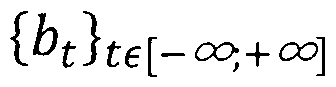
- the communications are subject to interferences whose activation is modeled by a binary random variable b t indicating whether an interferer is active or not at a time instant t, the discrete-time stochastic process being modelled by a Markov chain with memory M on a finite space, M being an integer.
- the method comprises at least on iteration of:
- the above method improves the assessment of the performance of a wireless network especially in the case of inference signals correlated in time and frequency, e.g. in the case of wideband sporadic interferers such as Wi-Fi interferers.
- the learnt Markov chains allow for estimating performance of the transmission on given resources of a frequency hopping system taking into account the time/frequency correlation of interference.
- the method further comprises estimating a value of a metric representing the performance of said wireless communication network for a first given time-frequency resource allocation responsive to said updated set of probabilities.
- estimating a value of a metric representing the performance of said wireless communication network for a first given time- frequency resource allocation from said updated set of probabilities, where Np is the number of packets to be transmitted during a given time window divided into time slots and n t (p) being an index of a time slot during which the p-th packet is transmitted comprises:
- computing a first value as the product of the obtained Np values for each interference activation configuration of a subset of all possible interference activation configurations comprises using a binary tree implementation.
- P e . is a function representative of the probability of error when receiving a packet.
- obtaining, from a receiver, at least one set of consecutive observations of interference activation comprises for at least one time slot:
- updating a set of probabilities of the identified Markov chain according to the obtained at least one set of consecutive observations of interference activation comprises:
- updating a set of probabilities of the identified Markov chain according to the obtained at least one set of consecutive observations of interference activation comprises in the case where at least one observation is in an unknown state:
- the method further comprises estimating a value of a metric representing the performance of said wireless communication network for a second given time-frequency resource allocation responsive to said updated set of probabilities and selecting the given set of time-frequency resource allocations associated with the best metric’s value.
- a device configured to estimate a performance of a wireless communication network for a given time- frequency resource allocation.
- the communications in said wireless communication network occur on a subset of time and frequency resources defined according to a frequency hopping sequence.
- the communications are subject to interferences whose activation is modeled by a binary random variable b t indicating whether an interferer is active or not at a time instant t, the discrete-time stochastic process being modelled by a Markov chain with memory M on a finite space, M being an integer.
- the device comprises at least one processor configured to implement at least on iteration of:
- the processor is further configured to estimate a value of a metric representing the performance of said wireless communication network for a first given time-frequency resource allocation responsive to said updated set of probabilities.
- the present invention also concerns a computer program that can be downloaded from a communication network and/or stored on a non-transitory information storage medium that comprises program code instmctions that can be read and executed by a processing device, such as a microprocessor, for causing implementation of the aforementioned method in any one of its embodiments.
- the present invention also concerns a non-transitory information storage medium, storing such a computer program.
- Fig. 1 schematically represents a wireless communication network in which the present invention may be implemented.
- Fig. 2 illustrates the impact of wideband sporadic interferences on a frequency hopping system.
- Fig. 3 depicts a flowchart of a method for learning Markov chains with memory according to a first embodiment.
- Fig. 4 depicts a flowchart of a method for learning Markov chains with memory according to a second embodiment.
- Fig. 5 depicts a flowchart of a method estimating the performance of a wireless communication network according to an embodiment.
- Fig. 6 depicts a binary tree used for the selection of most relevant conditional probabilities according to one embodiment.
- Fig. 7 depicts a flowchart of a resource allocation method in a wireless communication network according to an embodiment.
- Fig. 8 schematically represents a communication device of the wireless communication network according to an embodiment.
- Fig. 1 schematically represents a wireless communication network, e.g. using CTBC signalling, in which the present invention may be implemented.
- Communications-based train control is a railway signalling system that makes use of communications between the train and track equipment for the traffic management and infrastructure control.
- the wireless communication network comprises APs 110, 111 located along a path, i.e. the track 170 on which the train 130 is running.
- a path i.e. the track 170 on which the train 130 is running.
- the invention disclosed in the context of a train may also apply to other types of vehicle such as for example a bus, the path, in this case, being a predefined route followed by the bus.
- the APs 110, 111 offer services of the wireless communication network to communication devices, such as a communication device 131 located in the train 130.
- the communication device 131 is for instance a mobile terminal or a relay station allowing mobile terminals located in the train to access the services of the wireless communication network via the APs.
- the wireless communication network may further comprise a server 100, for instance implemented in a core network implementing centralized radio resources management and/or mobility management functionalities.
- the APs 110, 111 may be interconnected one with each other, thus implementing decentralized radio resources management and/or mobility management functionalities.
- Static interferers 150, 151, 152, 153 may be located sufficiently close to the track 170 of the train 130 to impact the downlink communications from the APs 110, 111 to the communication device 131 located in the train 130.
- Such interferers 150, 151, 152, 153 are for instance Wi-Fi (registered trademark) access points, conforming to the IEEE 802.11 standards.
- Other static interferers 140, 141 may be located sufficiently close to the AP 1 10 to impact the uplink communications from the communication device 131 located in the train 130 to the AP 110.
- Such interferers 140, 141 are for instance WiFi (registered trademark) access points, conforming to the IEEE 802.11 standards.
- Fig. 2 illustrates the impact of wideband sporadic interferences on a frequency hopping system.
- the frequency band is divided into Nc frequency channels of equal size.
- the frequency band is 80 MHz wide and is divided into 16 channel of 5 MHz each.
- each row of the grid shown in Fig. 2 represents a 5 MHz wide frequency band.
- the frequency carrier is for example around 2.4 GHz. It should be noticed that WiFi interferers are the most probable users of the 2.4 GHz ISM band.
- Time is divided into frame periods. Each frame period is then divided into time slots of equal size, e.g. of 4 ms. Usage of one such frequency channel during one such time slot defines one time and frequency resource.
- the transmission is performed using time and frequency resources of said grid according to a frequency hopping sequence, i.e. the transmission of packets occurs on a subset of time and frequency resource defined by a periodical pattern.
- a frequency hopping sequence i.e. the transmission of packets occurs on a subset of time and frequency resource defined by a periodical pattern.
- the black squares thus show an illustrative example of such a periodic frequency hopping sequence over a represented frame of twenty time slots.
- This pattern is usually a permutation of the sequential usage of all channels defined in a given frequency band.
- the frequency hopping sequence defines a pattern usage of the frequency channels according to the time slots.
- a time and frequency resource is thus identified by a time slot index t and a corresponding frequency channel index nf(t).
- the time slots are indexed from minus infinity to plus infinity.
- the gray rectangles Pl and P2 represent packets of a Wi-Fi interferer using a 20MHz-band which corresponds to 4 adjacent 5MHz- channels of the frequency hopping system.
- the packets Pl and P2 of the Wi-Fi interferers are longer in time than the typical period of time between two usage of any of the four above-mentioned adjacent channels as defined by the frequency hopping system, the same Wi-Fi packet interferes on at least two packets of the frequency hopping system transmitted in a given time window.
- the probability that interference occurs on at least two packets of the frequency hopping system transmitted in a given time window is high.
- the performance at an application layer is representative of a probability that at least one data packet is successfully transferred from one end to the other during a given time window.
- the application layer relates to CTBC and at least one packet must be exchanged from one end to the other during a given time window, otherwise a train stop procedure starts.
- the application layer performs obstacle detection. In this specific case, enough sensor data must be sent from the train to the server to allow the detection of any obstacle in due time.
- the application layer relates to CCTV (Closed-Circuit TeleVision) and requires enough video data to be transmitted between the train and the server.
- the signal to noise ratio experienced by a receiver of a communication occurring during the t th time slot (and consequently on the frequency channel of index nf(t)) is denoted p t .
- One transmission of a data set in the considered system is split into N p packets that are transmitted on a subset of the N w time slots.
- the index of the time slot during which the p-th packet is transmitted is denoted n t (p). thus denotes the set of N p indices identifying the time slots on which the packets are sent during the considered time window.
- the frequency channel on which each of the N p packets is transmitted varies from one packet transmission to another.
- the index of the frequency channel used for transmission of the p-th packet is denoted n f (n t (p)) [0036]
- the activation of interferers is modeled by a binary random variable b t indicating whether an interferer is active or not at a time instant t.
- the discrete-time stochastic process can be approximatively modeled by a Markov chain with memory M defined on a finite space, M being an integer. With a high value of M, typically between 10 and 20, the discrete-time stochastic process is well approximated.
- the performance of the wireless communication network for a given time- frequency resource allocation is assessed by estimating the following metric: where: is a signal to noise ratio experienced during the time slot n t (p) and on the frequency channel that relates to the random variable b t and is defined as follows:
- p active,nf(t) and p inactive, nf (t) further depend on the time t. This may be the case if the receiver or the transmitter is moving.
- a fingerprint database of signal to noise ratio or a prediction algorithm may be used to get p a ctive,n f (t) and p inactive, nf (t) for each time index t.
- Such a fingerprint database stores data related to such signal to noise ratios for each frequency channel index and regions of space associated with region of space indexes.
- the frequency hopping sequence provides the frequency channel index and the train trajectory provides the train position which allows to compute the index of the region of space to which the position belongs.
- the two values of p active, nf(t) and P inactive,nf(t) are read in the database entries associated with the frequency channel index n f (t) and the region of space index.
- the function is for example defined as a function representative of the probability of error when receiving a packet.
- this function represents the probability that no packet is successfully received among the N p packets transmitted during the considered time window.
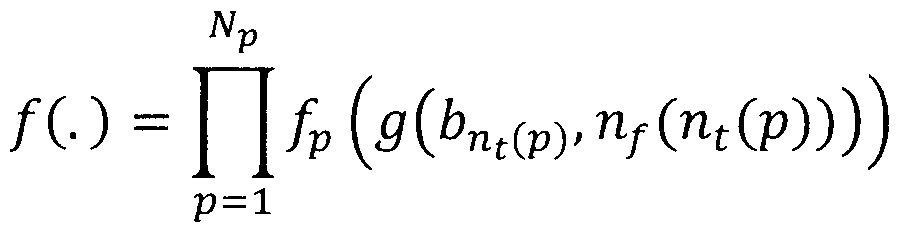
- f() is defined as ) is a function representative of the number of bits that can be transmitted on the time-frequency resource.
- b n ( p )_ 1; ... , b nt ( p j_ M ) inherently carries the structure of the frequency hopping system.
- the time slots n t (p) — M to n t (p) are associated with frequency channels ny(n t (p) — M),...,n f (n t (p)) according to the frequency hopping sequence.
- the function f() relates to the performance of the wireless communication network at an application layer.
- Fig. 3 depicts a flowchart of a method for learning Markov chains with memory according to a first embodiment.
- the communications in said wireless communication network occurs on a subset of time and frequency resources defined according to a periodical frequency hopping sequence.
- the frequency hopping sequence has a periodicity of T FH-
- the receivers are able to make measurements on the interference on all time slots following the frequency channel usage as predetermined by the frequency hopping sequence.
- the method starts at S300.
- At S302 at least one set of consecutive observations of interference activation b t-M , ... , b t is obtained.
- the consecutive observations of interference activation are obtained from a receiver.
- the receiver is able to make measurements on the interference at all time slots following the frequency channel usage as predetermined by the frequency hopping sequence. From the measurements, the receiver is able to determine, for each time slot t, an observation b t of interference activation for example by applying a threshold on the measured interference plus noise level to convert it into a binary observation (presence of interference/no presence of interference). In the case where the interference plus noise level is above the threshold, interference is considered to be present and in the case where the interference plus noise level is below the threshold no interference is considered to be present.
- a frequency channel sequence n f (t — M), associated with the at least one set of consecutive observations of interference activation b t-M is determined from the frequency hopping sequence.
- n MC be the number of distinct M+l-uple of frequency channel sequences n f (t — M), resulting from the frequency hopping sequence.
- Each frequency channel sequence n. f (t — M ⁇ , ... , n f (t) is associated with a Markov chain with memory since each sequence models a specific configuration of time/frequency correlation of interference.
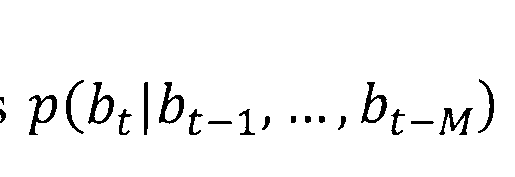
- n MC Markov chains with memory are defined, where 2 ⁇ n MC ⁇ T FH Each Markov chain with memory is associated with a set of probabilities p(b t ⁇ b t -1> ... , b t-M ). n MC is calculated in advance based on the frequency hopping sequence.
- a Markov chain with memory (among the n MC Markov chains) that is associated with the frequency channel sequence determined at S304 is identified.
- each Markov chain with memory is implemented by using a vector with 2 M+1 entries, each entry index corresponding to a given configuration of the interference activation b t-M , ... , b t and storing the estimated probability p(b t ⁇ b t-1 , ... , b t-M )' .
- the row of the vector associated with the identified Markov chain corresponding to the set of consecutive observations of interference activation b t-M , ...
- b t obtained at S302 is identified and updated. Updating comprises adding one unit to a value storing the number of all the occurrences of such event since the beginning of the learning process, adding one unit to the total number of occurrences for the given Markov chain with memory, and computing b t-M by dividing these two values.
- the probabilities are initialized to 0 or 1/2 M+1 and the number of occurrences is initialized to 0.
- a vector (X1 , X2, X3, 0
- an exponential smoothing function is used (if V is a stored value, it is updated with a new value v by replacing V by V x (1 — ⁇ ) + v x ⁇ , where p is a parameter typically small).
- V is a stored value
- v the value stored in the identified row
- the method ends at step S310.
- the method of Fig 4 may be implemented in a transmitter, e.g. in the APs 110, 111, in the server 100, or in a receiver, e.g. in the communication device 131.
- the receiver may obtain and transmit the at least one set of consecutive observations of interference activation to the transmitter that is in charge on updating the Markov chains.
- the receiver obtains the at least one set of consecutive observations of interference activation b t-M , ... , b t , updates the Markov chains and transmits the updated Markov chains to the transmitter.
- Fig. 4 depicts a flowchart of a method for learning Markov chains with memory according to a second embodiment.
- the communications in said wireless communication network occurs on a subset of time and frequency resources defined according to a periodical frequency hopping sequence.
- the frequency hopping sequence has a periodicity of TFH-
- the method may be implemented in a transmitter, e.g. in the APs 110, 111, in the server 100, or in a receiver, e.g. in the communication device 131.
- the probabilities are initialized to 0 or 1/2 M+1 and the number of occurrences is initialized to 0.
- the receivers are not able to make measurements on the interference on all time slots of the N w time slots of the considered time window.
- the receiver may switch off during some time slots, e.g. to save energy or to switch into transmit mode.
- the interference activation b t-M , ... , b t may not be uniquely defined because some information is missing, i.e. some values among b t-M , ... , b t may be in an unknown state.
- the method starts at S400.
- At S402 at least one set of consecutive observations of interference activation b t-M, ... , bj, ... , b t is obtained, wherein at least one observation bj of the set is in an unknown state. Being in an unknown state means that it is unknown whether the value of bj is 0 or 1.
- the consecutive observations of interference activation are obtained from a receiver. Indeed, the receiver is able to make measurements on the interference at least some time slots following the frequency channel usage as predetermined by the frequency hopping sequence. From the measurements, the receiver is able to determine, for at least some time slots, e.g. for each time slot except the j th time slot, an observation of interference activation.
- the receiver determines the observation of interference activation b t by applying a threshold on the measured interference plus noise level to convert it into a binary observation (presence of interference/no presence of interference). In the case where the interference plus noise level is above the threshold, interference is considered to be present and in the case where the interference plus noise level is below the threshold no interference is considered to be present.
- a frequency channel sequence associated with the at least one set of consecutive observations of interference activation b t M , ... , b t is determined from the frequency hopping sequence.
- Each frequency channel sequence n f (t — M), ... , n f (t) is associated with a Markov chain with memory since each sequence characterizes a specific configuration of time/frequency correlation of interference.
- n MC Markov chains with memory are defined, where 2 ⁇ n MC ⁇ T FH .
- Each Markov chain with memory is associated with a set of probabilities p b t-M ).
- a Markov chain with memory (among the n MC Markov chains with 2 ⁇ n MC ⁇ T FH ) that is associated with the frequency channel sequence determined at S404 is identified.
- each Markov chain with memory is implemented by using a vector (also called main vector) with 2 M+1 entries, each entry index corresponding to a given configuration of the interference activation b t-M , ... , b t and storing the estimated probability ... , b t-M )
- the rows of the vector associated with the identified Markov chain compatible with the set of consecutive observations of interference activation b t-M , ... , bj, ...
- Updating comprises, for each of the above events, adding one unit to a value storing the number of all the occurrences of the given above event since the beginning of the learning process, adding one unit to the total number of occurrences for the given Markov chain with memory, and computing the two probabilities by dividing these two values.
- the method ends at step S410.
- a single observation bj is in an unknown state.
- the present principles may be extended to more than one unknown observation.
- an interference activation configuration b t-M associated with an identified Markov chain with memory is not considered relevant in the case where: a) is above a given threshold, for example lOdB. Indeed, in this case the signal to noise ratio is so high that it has a low impact on the error rate. Therefore, the value g or more precisely, are not stored; or b) p(b t
- the interference activation configuration b t-M/ ... , b t has no impact on the final value of the metric in (Eq. 1) even in the worst case where all the other terms take a maximum value. Therefore, the probability p(_b t ⁇ b t- lt ... , b t-M is not stored in this case.
- an interference activation configuration b t M , ... , b t not considered relevant at some point in time may become relevant in the future, for example responsive to new measurements.
- the interference activation configuration is added as an entry in a temporary vector.
- the associated probability p b t ⁇ b t-r , b t-M ) of the identified Markov chain is updated as for the main vector of the identified Markov chain with memory during a predefined amount of time or for a predefined number of observations of the interference activation configuration.
- the probability p b t ⁇ b t-1 , ... , b t-M is inserted in the main vector if it does not verify the above-mentioned condition b).
- Fig. 5 depicts a flowchart of a method estimating the performance of a wireless communication network for a given time-frequency resource allocation according to an embodiment. From the learned Markov chains, it is possible to compute the estimated metric defined by (Eq. 1). [0062]
- the method starts at S500 with a given interference activation configuration
- Np probability values p are obtained from the stored Markov chain with memory associated with the frequency channel sequence n f (n t (p) — M), with p varying from 1 to Np.
- of fl is (M + 1)N p when all index sets [n t (p) — M, ... , n t (p)] are disjoints, and its minimum value is M + N p when the n t (p) time index are successive integers (They cannot be equal since they correspond to different packet transmission time).
- the list of interference activation configurations may be restricted to that is a subset of all possible interference activation configurations.
- the most relevant probabilities are selected using a binary tree implementation as depicted on Fig. 6. This makes it possible to reduce the complexity of the calculation of the metric of (Eq. 1). Indeed, the list of all interference activation configurations can be seen as a binary tree on each leaf (i.e. end of tree branch) being associated with [0075]
- the read value is multiplied by the value carried by the parent node resulting from the depth k — 1 and the value resulting from this multiplication is associated with the corresponding child node. If, for each new child node, this value below a given threshold (e.g. Pl, P2, P4, P5 and P7 on Fig. 6), the branch is not continued and thus cut. On Fig. 6, the branches corresponding to Pl, P2, P4, P5 and P7 are cut while the branches corresponding to P3, P6 and P8 are continued. At the end, only the values of that are associated with the leaves of the tree and that are above a given threshold remain. Therefore, these values are computed in an efficient manner that keeps memory and computational resource reasonable.
- a given threshold e.g. Pl, P2, P4, P5 and P7 on Fig. 6
- the learned Markov chains and consequently the estimated metric defined by (Eq. 1) may be used in several applications, e.g. resource allocation.
- Fig. 7 depicts a flowchart of a resource allocation method in a wireless communication network according to an embodiment.
- the transmitter 100 estimates a metric’s value for each possible resource allocation, i.e., for several configurations of the set ⁇ n t
- the transmitter has a codebook of predetermined resource allocation.
- the transmitter 100 sorts the possible resource allocations according to a predefined criterion, i.e. in increasing (or decreasing depending on whether the metric’s value is to be maximized or minimized) order of the estimated metric values. Sorting the possible resource allocations facilitate the execution of a following step S604.
- the transmitter 100 selects the resource allocation associated with the best estimated metric’s value.
- the best metric value may be the highest or the lowest estimated metric’s value depending on whether the metric’s value is to be maximized or minimized. In the case where f() is defined from Pe(.), then the metric’s value is to be minimized while in the case where f() is defined from D(.), then the metric’s value is to be maximized.
- a set of Markov chains is stored for each geographical area of a given set of geographical areas in a database.
- a feedback from a first receiver e.g. a first train
- the updated Markov chains being used for resource allocation of a second receiver, e.g. a second train, crossing the same geographical area at a later time.
- the measurements on the interference made in the first receiver are transmitted to the database which updates the stored Markov chains based on the transmitted measurements.
- new Markov chains are computed in the first receiver and transmitted to the database. The database receiving the new Markov chain either replaces the former stored Markov chains with the new ones or combines them.
- the feedback may be too long, i.e. the receiver’s condition may have drastically changed between the time the measurements are done and the time the Markov chains are updated.
- Storing, in a database, a set of Markov chains per geographical area makes it possible solves this problem.
- resource allocation is performed according to an online scheduling technique.
- several receivers may be in communication with the transmitter.
- the transmitter has to decide to which receiver to allocate a next time slot according to the past allocations.
- an implementation using a K best tree computation may be used as it is easy to start from the last status of remaining branches and compute the estimated metric corresponding to allocating the new resource to each one of the receivers, deciding to which user the resource must be allocated by maximizing the minimum value among the receivers. More precisely, the N p — 1 previous resource allocations n t (p), ..., n t (N p — 1) associated with the considered receiver are recovered, and it is assumed that the next time resource is allocated for a transmission towards said receiver.
- the estimated metric values computed from Markov Chains is only used in some specific configurations.
- a transmitter estimates a first metric’s value classically, i.e. without using Markov chain with memory.
- This first estimated metric’s value is transmitted to a receiver.
- the receiver learns the Markov chains, e.g. using the method disclosed with respect to Figs 3 or 4, and estimates a second metric’s value from these Markov chains, e.g. using the method disclosed with respect to -Fig. 5.
- the receiver informs the transmitter to use these Markov chains in order to estimate a metric’s value.
- the receiver may transmit the learned Markov chains to the transmitter in order to improve resource allocation. Otherwise, i.e. the difference between the two estimated metric’s values is below the threshold, the metric’s value is estimated classically.
- the learned Markov chains are only used in some specific cases where it is beneficial to use them which makes it possible to decrease the overall complexity.
- the estimated metrics may be used for other applications such as for monitoring radio conditions in a CBTC radio environment. Such monitoring can be used to provide a prediction of train stop events and thus cope in advance with undesirable situations.
- the estimated metric may be used to estimate the performance of a virtual deployment of receivers.
- Fig. 8 schematically represents a communication device 750 of the wireless communication network according to an embodiment.
- the communication device 750 may be a representation of an AP, such as the AP 110, and/or may be a representation of a communication device, such as the communication device 131, and/or may be a representation of the server 100.
- the communication device 750 comprises the following components interconnected by a communications bus 710: a processor, microprocessor, microcontroller or CPU (Central Processing Unit) 700; a RAM (Random- Access Memory) 701; a ROM (Read-Only Memory) 702; an HDD (Hard-Disk Drive) or an SD (Secure Digital) card reader 703, or any other device adapted to read information stored on storage means; and, a set of at least one communication interface 704.
- a processor, microprocessor, microcontroller or CPU Central Processing Unit
- RAM Random- Access Memory
- ROM Read-Only Memory
- HDD Hard-Disk Drive
- SD Secure Digital
- the set of at least one communication interface 704 allows the communication device 750 to communicate with at least one other communication device of the wireless communication network.
- CPU 700 is capable of executing instructions loaded into RAM 701 from ROM 702 or from an external memory, such as an SD card. After the communication device 750 has been powered on, CPU 700 is capable of reading instructions from RAM 701 and executing these instructions.
- the instructions form one computer program that causes CPU 700, and thus the communication device 750, to perform some or all of the steps of the methods described above.
- Any and all steps of the methods described above may be implemented in software by execution of a set of instructions or program by a programmable computing machine, such as a PC (Personal Computer), a DSP (Digital Signal Processor) or a microcontroller; or else implemented in hardware by a machine or a dedicated component, such as an FPGA (Field-Programmable Gate Array) or an ASIC (Application-Specific Integrated Circuit).
- the communication device 750 may comprise electronic circuitry configured to perform some or all of the steps of the methods described above.
Landscapes
- Engineering & Computer Science (AREA)
- Computer Networks & Wireless Communication (AREA)
- Signal Processing (AREA)
- Physics & Mathematics (AREA)
- Electromagnetism (AREA)
- Quality & Reliability (AREA)
- Mobile Radio Communication Systems (AREA)
Abstract
Description




















Claims



Priority Applications (2)
| Application Number | Priority Date | Filing Date | Title |
|---|---|---|---|
| US18/039,666 US12273139B2 (en) | 2021-01-22 | 2021-12-10 | Method, device, computer program product, and non-transitory information storage medium for estimating performance of wireless communication network |
| JP2023546734A JP7546782B2 (en) | 2021-01-22 | 2021-12-10 | Method, device, computer program product, and non-transitory information storage medium for estimating performance of a wireless communication network |
Applications Claiming Priority (2)
| Application Number | Priority Date | Filing Date | Title |
|---|---|---|---|
| EP21305079.2 | 2021-01-22 | ||
| EP21305079.2A EP4033679B1 (en) | 2021-01-22 | 2021-01-22 | Method and device for estimating a performance of a wireless communication network |
Publications (1)
| Publication Number | Publication Date |
|---|---|
| WO2022158194A1 true WO2022158194A1 (en) | 2022-07-28 |
Family
ID=74505163
Family Applications (1)
| Application Number | Title | Priority Date | Filing Date |
|---|---|---|---|
| PCT/JP2021/046655 Ceased WO2022158194A1 (en) | 2021-01-22 | 2021-12-10 | Method, device, computer program product, and non-transitory information storage medium for estimating performance of wireless communication network |
Country Status (4)
| Country | Link |
|---|---|
| US (1) | US12273139B2 (en) |
| EP (1) | EP4033679B1 (en) |
| JP (1) | JP7546782B2 (en) |
| WO (1) | WO2022158194A1 (en) |
Families Citing this family (1)
| Publication number | Priority date | Publication date | Assignee | Title |
|---|---|---|---|---|
| CN120111670B (en) * | 2025-03-15 | 2025-12-23 | 北京科曼达电子技术有限公司 | Method for realizing resource saving optimization of PRACH (physical random Access channel) in 5G communication based on FPGA (field programmable Gate array) |
Citations (1)
| Publication number | Priority date | Publication date | Assignee | Title |
|---|---|---|---|---|
| EP3716506A1 (en) * | 2019-03-27 | 2020-09-30 | Mitsubishi Electric R&D Centre Europe B.V. | Improved wifi interference identification for a use in a public frequency hopping system |
Family Cites Families (5)
| Publication number | Priority date | Publication date | Assignee | Title |
|---|---|---|---|---|
| JP2016136714A (en) | 2015-01-16 | 2016-07-28 | 国立大学法人信州大学 | Wireless communication usage measurement method |
| US9490855B1 (en) * | 2015-09-01 | 2016-11-08 | Qualcomm Incorporated | Method and apparatus for self-directed interference cancellation filter management |
| US10573144B2 (en) * | 2016-10-10 | 2020-02-25 | Netgear, Inc. | Changing topology in a wireless network |
| EP3522404B1 (en) * | 2018-02-02 | 2021-04-21 | Mitsubishi Electric R&D Centre Europe B.V. | Wifi interference identification for a use in a public frequency hopping system |
| US11665777B2 (en) * | 2018-09-28 | 2023-05-30 | Intel Corporation | System and method using collaborative learning of interference environment and network topology for autonomous spectrum sharing |
-
2021
- 2021-01-22 EP EP21305079.2A patent/EP4033679B1/en active Active
- 2021-12-10 JP JP2023546734A patent/JP7546782B2/en active Active
- 2021-12-10 WO PCT/JP2021/046655 patent/WO2022158194A1/en not_active Ceased
- 2021-12-10 US US18/039,666 patent/US12273139B2/en active Active
Patent Citations (1)
| Publication number | Priority date | Publication date | Assignee | Title |
|---|---|---|---|---|
| EP3716506A1 (en) * | 2019-03-27 | 2020-09-30 | Mitsubishi Electric R&D Centre Europe B.V. | Improved wifi interference identification for a use in a public frequency hopping system |
Non-Patent Citations (1)
| Title |
|---|
| MEHTA MAHIMA ET AL: "Analysis of Blocking Probability in a Relay-Based Cellular OFDMA Network", WIRELESS PERSONAL COMMUNICATIONS, SPRINGER, DORDRECHT, NL, vol. 84, no. 4, 23 May 2015 (2015-05-23), pages 2467 - 2492, XP035540112, ISSN: 0929-6212, [retrieved on 20150523], DOI: 10.1007/S11277-015-2715-5 * |
Also Published As
| Publication number | Publication date |
|---|---|
| US12273139B2 (en) | 2025-04-08 |
| EP4033679B1 (en) | 2023-12-27 |
| EP4033679A1 (en) | 2022-07-27 |
| JP7546782B2 (en) | 2024-09-06 |
| JP2023545332A (en) | 2023-10-27 |
| US20240007143A1 (en) | 2024-01-04 |
Similar Documents
| Publication | Publication Date | Title |
|---|---|---|
| US11190944B2 (en) | Spectral sensing and allocation using deep machine learning | |
| US10893416B2 (en) | Method for wireless network monitoring and network node for implementing the same | |
| US20140106801A1 (en) | Transceiver operating in a wireless communications network, a system and method for transmission in the network | |
| Saha et al. | On the relationship between mean absolute error and age of incorrect information in the estimation of a piecewise linear signal over noisy channels | |
| US20160262164A1 (en) | Method and processing device for determining transmission channel resources to be allocated for a communication | |
| US12273139B2 (en) | Method, device, computer program product, and non-transitory information storage medium for estimating performance of wireless communication network | |
| Peserico et al. | Rate adaptation by reinforcement learning for Wi-Fi industrial networks | |
| Plöger et al. | Markov-modulated models to estimate the age of information in cooperative driving | |
| Jayawardhana et al. | Predictive resource allocation for URLLC using empirical mode decomposition | |
| Denizer et al. | Bandseer: Bandwidth prediction for cellular networks | |
| Zhang et al. | Using reinforcement learning in slotted aloha for ad-hoc networks | |
| US11032782B2 (en) | Wireless communication system and method for building signal-to-interference-plus-noise ratio data | |
| CN115997346B (en) | Method, computer program, device and radio frequency system for estimating interference on a radio frequency system using a set of channels | |
| US12362852B2 (en) | Communication method and communication device thereof | |
| EP1639848B1 (en) | Transmission channel selection based on historic quality data | |
| Bkassiny et al. | Optimal and low-complexity algorithms for dynamic spectrum access in centralized cognitive radio networks with fading channels | |
| Manjunath et al. | Mechanisms for the estimation of prediction intervals in vehicular communication scenarios | |
| Amini et al. | Reliability-latency tradeoffs in random access ultra-reliable low-latency energy-harvesting 5G networks with finite blocklength codes | |
| Dobler et al. | LR-FHSS: Analytical Model of Channel Capacity and Header Redundancy Optimization | |
| TRYSNYUK et al. | TECHNOLOGY ENSURING THE RELIABILITY OF INFORMATION ON THE BASIS OF CONCATENATED CODING | |
| Kumar et al. | Cognitive Radios: A Survey of Methods for Channel State Prediction | |
| Nikfar et al. | Spectrum Assignment in Narrowband Power Line Communication | |
| Belogaev et al. | Analysis of the Differential Update Method for Control Information Dissemination in Wireless Networks | |
| Vasfi et al. | Spectrum-Efficient and QoS-Aware Sequence Generation for Channel-Hopping Based Blind Rendezvous in Cognitive Radio-Enabled Internet of Vehicles: A Multi-Agent Twin Delayed Deep Deterministic Policy Gradient Based Method | |
| ADAMOPOULOU et al. | Robust Discovery of Reconfiguration Capabilities for Cognitive Radio |
Legal Events
| Date | Code | Title | Description |
|---|---|---|---|
| 121 | Ep: the epo has been informed by wipo that ep was designated in this application |
Ref document number: 21844416 Country of ref document: EP Kind code of ref document: A1 |
|
| WWE | Wipo information: entry into national phase |
Ref document number: 2023546734 Country of ref document: JP |
|
| WWE | Wipo information: entry into national phase |
Ref document number: 18039666 Country of ref document: US |
|
| NENP | Non-entry into the national phase |
Ref country code: DE |
|
| 122 | Ep: pct application non-entry in european phase |
Ref document number: 21844416 Country of ref document: EP Kind code of ref document: A1 |
|
| WWG | Wipo information: grant in national office |
Ref document number: 18039666 Country of ref document: US |